HAL Id: halshs-02052739
https://halshs.archives-ouvertes.fr/halshs-02052739
Submitted on 28 Feb 2019
HAL is a multi-disciplinary open access
archive for the deposit and dissemination of sci-entific research documents, whether they are pub-lished or not. The documents may come from teaching and research institutions in France or abroad, or from public or private research centers.
L’archive ouverte pluridisciplinaire HAL, est destinée au dépôt et à la diffusion de documents scientifiques de niveau recherche, publiés ou non, émanant des établissements d’enseignement et de recherche français ou étrangers, des laboratoires publics ou privés.
What gains and distributional implications result from
trade liberalization?
Maria Bas, Caroline Paunov
To cite this version:
Maria Bas, Caroline Paunov. What gains and distributional implications result from trade liberaliza-tion?. 2019. �halshs-02052739�
Documents de Travail du
Centre d’Economie de la Sorbonne
What gains and distributional implications result from trade liberalization?
Maria BAS, Caroline PAUNOV
What gains and distributional implications result from trade liberalization?
Maria Bas* Caroline Paunov**
Version: 13th February 2019
Abstract
This paper investigates the distributional impacts of trade liberalization across firms, consumers and workers. Using firm-product-level census data for Ecuador, we exploit exogenous tariff changes at entry to the World Trade Organization. We show that with input tariff cuts firms access higher quality and new input varieties. Consequently, firms increase their product scope and quality, while their production’s skill-intensity increases and costs decrease. “Real” productivity (TFPQ) increases only in the medium run, following adjustments to produce more and higher quality products. Positive immediate revenue productivity (TFPR) gains result because firms’ markups increase. Consumers still gain as quality-adjusted prices decrease and varieties increase. Workers benefit differentially: skilled workers’ wages rise compared to less skilled workers’ wages. Input-tariff liberalization also has distributional impacts across firms. Only more productive firms with high markups increase product scope and quality and gain market shares. With output-trade liberalization the least productive firms decrease their product scope.
Keywords: gains from trade, input and output tariff reductions, product scope, product quality,
market share, quantity and revenue total factor productivity (TFPQ, TFPR), skill premium, markups, price, foreign inputs quality and variety, firm-product-level data, Ecuador.
JEL Codes: F16, O30, D22, O12, O54, L6.
* Maria Bas, University of Paris 1, Centre d'Economie de la Sorbonne (CES). E-mail: [email protected].
Postal address: Maison des Sciences Economiques, 106-112 Bd de l'Hôpital, 75647 Paris, France.
**Caroline Paunov, OECD, Directorate for Science, Technology and Innovation. Email: [email protected]
and [email protected]. Phone: 00 33 (0) 1 45 24 90 40. Postal address: 2, rue André Pascal, 75 775 Paris Cedex 16, France.
We would like to thank the Ecuadorian Statistical Office for their support. Comments from João Amador, Ana M. Fernandes, Lionel Fontagne, Dominique Guellec, Beata Javorcik, Volodymyr Lugovskyy, Gianluca Orefice, Ariell Reshef, Vanessa Strauss-Kahn, Eric Verhoogen, Christian Volpe Martincus and participants at the 2012 Empirical Investigations in Trade and Investment (EITI) conference in Tokyo, the 2017 Meeting of the Royal Economic Society in Bristol, the Novafrica Workshop on Globalization and Development of June 2017, the DEGIT conference 2017 (PSE) and the “International Trade and Labor Markets” seminar of University of Paris 1 are gratefully acknowledged. Earlier versions of this paper were circulated as “Input-quality upgrading from trade liberalization: Evidence on firm product growth and employment”. The findings expressed in this paper are those of the authors and do not necessarily represent the views of the OECD or its member countries..
Introduction
While the productivity gains from trade liberalization for the average firm have been widely documented, more evidence is needed to determine economies’ gains from trade liberalization. The promise of trade liberalization in developing countries is not only that productivity improves, but also that firms upgrade production processes, offering better and more diverse products. Consumers could consequently access more variety and higher quality products at lower price. However, better and more diverse product may allow firms to increase their profit margins instead, providing less benefits to consumers. Moreover, the gains from trade liberalization may be unequally distributed across workers, depending on the skills firms require, and leave those workers with the right skills better off while others without the skills will be worse off. In addition, the distributional effects of trade liberalization across firms matters to understand aggregate gains from trade. Benefits for the economy arise if more productive firms expand as a result of trade liberalization while other less productive firms loose and contract.
This paper provides a comprehensive assessment of the distributional impacts of trade liberalization in Ecuador across firms, consumers and workers. Following an analysis of the effects of input-trade liberalization on firms’ input and output product scope and quality, the paper investigates changes in production processes across firms of different “real” productivity - i.e. firms’ production efficiency as computed using quantity-based total factor productivity (TFPQ) - and profitability. We also analyze the relative returns to different workers, consumers and firms. Our empirical analysis relies on Ecuador’s unilateral trade reform when the country joined the WTO (World Trade Organization) in 1996. In particular, we exploit the exogenous change in effectively applied tariffs across products and over time in highly demanding within-firm estimations that also include within-firm-size trends to remove time-varying trends across firms of different size.
Our paper’s unique contribution to the literature consists in providing a comprehensive causal assessment of the distributional impacts of trade liberalization. Based on a unique firm-product-level dataset for Ecuador over the 1997-2007 period, we measure directly changes of firms’ production processes with regard to production costs and markups. Information on input and output product quantities and sales values allow
estimating input and output quality and obtaining a measure of “real” productivity: quantity total factor productivity (TFPQ). Differently from the widely used revenue total factor productivity (TFPR), TFPQ is not affected by demand shifts or market power variations and allow us to differentiate impacts of input-trade liberalization on production efficiency and markups. We are consequently in position to evaluate the distributional implications on firms by investigating to what extent trade affects efficiency or market power. We can also determine how firms, consumers and workers benefit by investigating trade liberalization’s impacts on quality-adjusted price changes, markups and skill premia. Relative to the existing literature, our analysis goes one step further and investigates the heterogeneous effects of trade liberalization on firms’ production choices on both firms’ efficiency (TFPQ) and their market power. Finally, this paper sheds new light on previous findings that did not have such information and validate estimation techniques used in other studies that lack this information; our findings are in line with those of De Loecker et al. (2016) and validate the methods they employ to estimate firm-product markups and proxy for employment in productivity computations.
The period we analyze is one of transformation for Ecuadorian firms. The share of single-product firms decreases substantially over the period of trade liberalization in Ecuador from 48% in 1997 to only 23% in 2007. Over the 1997-2007 period, 30% of final goods produced in 2007 are new products compared to those produced by the same firms in 1997. The average product quality improves by 55% over the same period for firms present in both periods. The skilled intensity of a firm (the share of skilled workers) increases by 8% on average, increasing the average skill premium by 2.5%. Firms’ average markups also increase by 13% from 1997 to 2007, while at the same time quality-adjusted prices decrease by 7%.
We hypothesize that these transformations are partly driven by Ecuador’s trade liberalization and consequent input tariff cuts in particular. Importing firms pay more for imported inputs than for domestic products and use more varieties in production than firms that do not import inputs. The quality of imported inputs has increased substantially between 1997 and 2007 due to input tariff cuts. Firms relying on imported inputs produce more final goods products and products of better quality. These firms are also more skill-intensive than non-importers of inputs.
The theoretical mechanisms motivating our empirical analysis are as follows: input-trade liberalization reduces the costs of access to imported intermediate inputs, offering firms access to more input varieties and higher quality inputs. Such access to more suitable inputs allows firms to decrease their marginal production costs due to reduced input costs for the same units of products produced of comparable quality. Higher production efficiency arises from the use of more and higher-quality inputs (as in Grossman and Helpman, 1991, Halpern et al., 2015). With fixed costs in product innovation, input-tariff reductions also allow producing additional products, expanding firms’ product scope. Moreover, assuming a quasi linear-demand function and introducing product quality as a demand shifter, input-tariff cuts allow firms to upgrade their output quality.
As to the distributional implications, our model predicts that the initially most productive firms will benefit the most from input-tariff cuts to import more varieties and expand their product scope and upgrade their input- and output-quality. Building on the theoretical framework developed by Melitz and Ottaviano (2008) of heterogeneous firms with endogenous markups, our model predicts that the most productive firms gain larger markups from input-tariff cuts than less productive firms. In other words, these firms do not pass through all benefits from input-trade liberalization to consumers. With improvements in output quality firms will increase markups further. As to the implications of input-trade liberalization across different workers, skilled labor is needed to produce new products of higher-quality, increasing their demand for skilled labor and their returns.
Regarding output tariff cuts, the theoretical literature predicts similar effects to those of input tariff cuts regarding firm output product quality, productivity and investments in improved production processes (Bernard et al., 2011; Eckel et al., 2016; Mayer et al., 2016). The underlying mechanism behind those effects is increased competition in firms’ markets that pushes them to invest in improving performance and differentiating products from their competitors’. As to firms’ product scope, the theoretical literature suggests output tariff cuts have reverse effects than input tariff cuts as firms concentrate on their core products (Bernard et al., 2011). Markups are also expected to decrease as a result of new competition from abroad (Melitz and Ottaviano, 2008; De Loecker et al., 2016).
Our empirical findings that test those theoretical predictions can be summarized as follows: First, we establish a causal link between input-tariff cuts and within firm-product availability of higher quality intermediate goods from abroad and of more variety of foreign inputs. We estimate that a 10 percentage point reduction in input tariffs increases the quality of firms’ intermediate inputs by 34%. The effect of input-tariff cuts by the same amount on the likelihood of importing a new variety of foreign inputs is of only 1%.
Second, we show that firms in industries with larger input tariff cuts expand the number of goods they produce, upgrade the quality of their final products and change their production processes in consequence. A 10 percentage point fall in input tariffs leads to a 2.4 % increase in firm product scope as a result of improved access to new imported varieties. Output tariff reductions decrease product scope by 2.8%. A 10 percentage point fall in input tariffs also leads to a 7 % to 11% increase in product quality due to higher import quality. We find no effect of output tariffs on output quality.
Third, our findings show that production processes change as a result of input-tariff cuts. Firms adopt more skill-intensive production processes and reduce production costs once the improvements in the input quality are taken into account. These findings suggest that access to imported inputs allows firms to optimize their production. However, “real” productivity as measured by TFPQ does not improve in the short run possibly as efficiency gains are offset by the costs associated with adjusting production to produce more products and products of higher quality. Consistently with previous research findings, we identify positive effects of trade liberalization through both input and output tariffs changes on TFPR (the measure used in most studies). These positive effects, however, do not relate to efficiency improvements but markups gains. However, we find positive effects of both input and output tariff reductions on “real” productivity (TFPQ) in the medium run. We also show that firms in industries that benefit more from input-trade liberalization secured higher market shares.
Fourth, regarding the distributional effects of input-trade liberalization we find that only the initially most productive firms with high-markups benefit from input-tariff
cuts to expand their product range and upgrade their product quality. Output tariff cuts reduce the product scope of the least productive firms and push more productive firms with low-markups to improve their product quality. Input-trade liberalization also results in a reallocation of market shares from less productive firms but also productive firms with low-markups to initially more productive firms with high market power.
Trade liberalization also has implications for consumers and workers. Consumers benefit from access to higher quality products at lower price. However, firms do not pass through all gains to consumers: while production costs for similar quality goods decrease by 7.2%, quality-adjusted prices decrease only by 3.3% and markups increase by 11% after a 10 percentage point fall in input tariffs. Workers benefit differentially, in that new production modes require more skills. In consequence, the skill-premium increases by 5% after a 10 percentage point decrease in input tariffs.
Our findings have important policy implications as they point to substantial distributional impacts of input-trade liberalization. Our evidence confirms the positive of input tariff cuts for firms’ production upgrading, supporting improvements in firms’ production techniques to more innovation-intensive production. By contrast, output tariff cuts do not contribute to production process changes. This suggests that the knowledge transfer across borders from trade liberalization is at the heart of improvements to firms’ production processes from trade reforms. Support measures such as training or funding to help firms - particularly those with low markups - to upgrade production processes to benefit from improved inputs could enhance benefits from trade liberalization further. Moreover, while consumers benefit from access to high quality products at lower quality-adjusted prices, firms do not pass through all gains but retain higher markups. The finding that only highly productive firms with already high markups benefit from input-trade liberalization suggests input tariff cuts poses challenges to market competition, which matters to push firms to improve production processes and ensure consumers benefit. Finally, skilled workers, gain more in demand as firms upgrade production processes, also gain relative to the less skilled ones, pushing further the inequalities between top income groups – with more skills and capital. Boosting education to equip workers with the skills to engage in
new production processes can also help support gains from trade liberalization are more widespread.
Our paper adds new findings to the voluminous literature on trade liberalization’s impacts on firms’ performance and decisons. Early studies investigate mainly the effects of trade liberalization on within-firm productivity (e.g. Pavcnik, 2002; Fernandes, 2007; Amiti and Konings, 2007; Topalova and Khandelwal, 2011). Only few, however, focus on trade liberalization’s impacts on “real” productivity or firm efficiency as measured by TFPQ but they do not look at input-trade liberalization (Foster et al., 2008, and De Loecker, 2011). A subsequent set of analyses focuses on wider changes than productivity and identified that firms require high-quality inputs (Bas and Strauss-Kahn, 2015; Fan, Li and Yeaple, 2015, Manova and Yu, 2017), skilled workers (Verhoogen, 2008) or materials (Kugler and Verhoogen, 2012) to produce high-quality goods.1 Our results also confirm findings of Goldberg et al. (2010) for India who show that input-trade liberalization facilitates firms’ access to more varieties of inputs of higher quality to expand product scope. We complement those findings by showing positive effects on product quality and identifying associated production cost reductions, skills upgrading and “real” productivity (TFPQ) effects in addition to identifying distributional implications of those changes across firms, workers and consumers.
Our paper also contributes to a more recent literature on distributional effects of trade liberalization across firms. The theoretical models of Melitz (2003) and Melitz and Ottaviano (2008) predict that output-trade liberalization induces the exit of the least productive firms and a reallocation of resources towards most productive firms. An empirical literature has tested for those heterogeneous effects, including Topalova and Khandelwal (2010), Bas and Berthou (2017) and Bas (2012). Differently from our study, this literature focuses on the impacts of output-trade liberalization and uses revenue-based productivity (TFPR) or other proxies (such as firm size) as dimensions of firm heterogeneities. Our contribution is to test the theoretical mechanisms of an extension of Melitz and Ottaviano (2008) that predicts heterogeneous effects of input-trade liberalization, differentiating distributional effects at initial differences across firms in terms of “real” productivity (measured by TFPQ) and market power.
1 The descriptive analysis in Kugler and Verhoogen (2009) also connects to our work here; their evidence uncovers
Finally, with regards to the distributional question of who benefits from trade liberalization, our work adds to Levinsohn (1993), Harrison (1994) and De Loecker et al. (2016) who investigate the impacts of trade liberalization on markups, prices and costs. We also add to their study by showing how input-trade liberalization has those distributional impacts as a result of improving access to input variety and quality and consequent changes to firm production processes in view of changes in product scope and quality. We also expand on their analysis on distributional gains by documenting implications on workers of different skills. This aspect of our study also links to the literature on the effects of input-trade liberalization and the skill premium (Amiti and Cameron, 2012; Chen et al., 2017).
The remainder of the paper is structured as follows. The next section describes the theoretical motivation. Section 2 gives an overview of the trade reform in Ecuador. Section 3 provides stylized empirical facts that motivate our empirical analysis. Section 4 discusses results of the effect of tariff cuts on firms’ imported input quality and variety, while Section 5 describes effects on product variety and quality and wider production processes. Section 6 investigates distributional effects of trade liberalization across firms, workers and consumers. The last section concludes.
1. Theoretical motivation
This section introduces a simple theoretical framework in partial equilibrium that rationalizes the relationship between input-trade liberalization, access to new and better quality inputs, firm product variety and quality as well as firm production costs and productivity. The framework also identifies distributional implications of input-trade liberalization on firms’ skill premia and markups. The final section discusses expected effects of output-tariff reductions.
Demand
The representative consumer has preferences over a continuum of varieties indexed by
i and a homogeneous good used as numeraire. Preferences are described by a
quasi-linear utility function2 𝑈 = 𝑞
!+ 𝜗 !"!𝑧!𝑞!𝑑𝑖 −!!𝜐 !"! 𝑧!𝑞! !𝑑𝑖 −!!𝛽 !"!𝑧!𝑞!𝑑𝑖 !
,
2 We choose this demand system since it allows for endogenous markups and keep the tractability of the model.
This linear demand system with horizontal product differentiation developed by Ottaviano, Tabuchi and Thisse (2002) and used by Melitz and Ottaviano (2008).
where z is the output quality that acts as a demand shifter. Output quality from the demand side is any attribute of the product that the consumer values and that increases their utility. 𝑞! is the consumption of the numeraire good, with 𝑞! > 0, and 𝑞! is the consumption level of each variety of the differentiated good.3 The substitution between
the differentiated varieties and the numeraire is captured by 𝜗 > 0 and 𝛽 > 0 parameters, while 𝜐 > 0 represents the degree of product differentiation between the varieties. The maximization of the quasi-linear quadratic utility function subject to the consumer’s budget constraint gives the optimal linear demand for the typical variety. This linear market demand system can be expressed as : 𝑞! =!"!
! 𝑃 −
!!
!! ,
where 𝑃 =!"!!"#!"!! and 𝑃 = !! !!!
!𝑑𝑖
!"# . M are the varieties consumed, 𝑃 is the
average quality-adjusted price and 𝑃 is the ceiling price adjusted for output quality that represents the price at which demand for a variety is driven to 0.
Production
Firms can produce new products paying for each product fixed costs of product innovation in terms of skilled non-production labor (S), 𝑤!𝑓!, where 𝑤! is the wage of
skilled workers. The rationale is that new product design requires the use of skilled workers. This assumption implies a complementarity between skilled labor and product innovation, in line with the literature on this topic (e.g. Griliches, 1969, Doms et al. 1997, Bresnahan et al. 2002). The total fixed cost of product innovation for a firm is an increasing function of the set of final good products produced by the firm:
𝐹! 𝑁 = 𝑤!𝑓! 𝑁 ! (1)
with N the set of final products k produced by a firm and 𝑓! > 0 and 𝜌 > 0. The
subscript for firms is omitted. The final goods products k, produce by a firm are aggregated as 𝐾 = !"!(𝑘)!𝑑𝜅
! !
, where k is the quantity of each final good. The price index of final products is 𝑃! = (𝑝!)!!!!
! 𝑑𝜅
!!! !
. The total profits of the firm over all its products is 𝜋 = 𝑃!𝐾 − 𝐶 − 𝐹!, where 𝐶 is the variable cost of production
at the firm level over all the products k produced by the firm. The total number of products N produced by a firm is determined by profit maximisation net of the fixed cost of product innovation:
3 The numeraire good is produced using only production labor hired in a perfectly competitive labor market. This
𝑁 = arg max! 𝜋 − 𝐹! N (2) Firms combine intermediate inputs (X) and production labor (L) to produce each final product (k). The production function for product k of a firm is given by a Cobb-Douglas technology with factor shares η and 1-η and !! is the specific firm-productivity modelled as a heterogeneous component of the marginal costs. As in Melitz and Ottaviano (2008) the marginal costs, c, is heterogeneous across firms:
𝑞(k) =!!𝑋!𝐿!!! (3) As in Halpern et al. (2015), firms produce each final product k using both domestic Xd
and imported Xm input varieties combined those inputs in a CES function with an
elasticity of substitution between the two types of inputs equal to 𝜎 =!!!! :
𝑋 𝑘 = (𝑋!! + (𝑋!)!)
!
! (4)
where the input bundle of imported inputs is a CES aggregate : 𝑋!= (𝛾!𝑥!")!
!"! 𝑑𝑣)
!
! = Ω𝑥!"𝛾! (5)
Ω is the set of foreign input varieties imported by a firm and 𝑥!" is the quantity of imported input variety 𝑣 with quality 𝛾! > 1. Plugging equation (5) into (4) and then
into equation (3) one can see that the quality of imported inputs (𝛾!) as well as the
number of imported input varieties raise the quantity of product k produced.
There are variable costs of importing inputs represented by the input tariffs, 𝜏!, and
fixed costs of importing inputs, 𝐹!. Only the more profitable firms will be able to
source inputs from abroad. The fixed cost of importing is an increasing function of the set of imported input varieties (Ω) as in Gopinath and Neiman (2014).4 The fixed cost
of importing is then given by: 𝐹! Ω = 𝑓 Ω ! with 𝑓 > 0 and 𝜆 > 0.
The corresponding price index of intermediate inputs is: 𝑃! = (𝑝!
! !!!+ (𝑃!) ! !!!) !!! ! .
The price of domestic intermediate inputs is equal to the wage of unskilled labor which is used as a numeraire, 𝑝! = 1. The price index of imported varieties is:
4 The presence of fixed costs of importing that increased with the amount of input varieties is consistent
with the idea that each additional foreign variety requires paying an extra fixed importing costs and it is in line with the empirical evidence found by Halpern et al. (2015).
𝑃! = !!! ! ! !!! !"! 𝑑𝑣 !!! ! = Ω!!!! 𝑝!(𝜏!, 𝛾!") (6) where 𝑝! 𝜏!, 𝛾!" =!!!
! is the average imported input price across all varieties of
foreign inputs of different qualities. We disentangle both mechanisms in the imported input price index: (i) foreign-input quality upgrading and (ii) input variety. Both mechanisms drive imported input price reductions and consequent lower unit production costs. As in Grossman and Helpman (1991) and Halpern et al. (2015), input quality is the relative cost advantage due to the higher efficiency in the production process that arises from the use of high-quality inputs. The higher the quality of imported inputs the lower the input price index. As in Gopinath and Neiman (2014), the imported input price index is a decreasing function of the amount of imported input varieties because the elasticity of substitution between imported input varieties ranges from 0 < 𝜃 < 1.
The unit cost indexes for firms relying only on domestic inputs (index by d) and importing firms (index by m) are as follows. For firms relying only of domestic inputs, the unit cost is equal to 𝑐! = 1 since the price of domestic inputs is equal to the wage
of non-production workers (L) which is used as a numeraire, 𝑐! = 1. For importing
firms, the unit cost index is a function of imported input price index determined by input tariffs, foreign input quality and varieties: 𝑐! = 1 + 𝑃!
! !!!
(!!!)! !
. Importing firms pay a fixed cost, while importing reduces their marginal cost as access to high-quality imported inputs increases their efficiency.
Output quality
The quality of each product k is determined by the quality of inputs and input variety. For simplicity we assume that domestic inputs are of quality equal to 1, while each foreign input variety 𝑣 with quality 𝛾! > 1. Therefore, output quality, z depends on the
average input quality of all varieties 𝛾! and the set of imported input varieties Ω:
𝑧 = Ω𝛾! ! (7)
with 𝜉 > 1 .The output quality increases with input quality upgrading and with access to new imported inputs varieties5.
5
Input-trade liberalization, input variety, input and output quality, prices, markups
Firms maximize profits for each product k separately and choose their optimal price and output level subject to the linear demand they face for each product k derived from the quasi-linear utility function: 𝜋! = 𝑝!𝑞 k − 𝑤!𝐿 − 𝑝!𝑋!− 𝑃!𝑋!− 𝑤!𝑓! . Importing firms’ optimal price 𝑝!, markup 𝜇!, revenues and profits for product k are given by: 𝑝! 𝑐 =!! ! 𝑃𝑧 + 𝑐 𝜇!(𝑐) = !! ! 𝑃𝑧 − 𝑐 (8) 𝑟! 𝑐 =𝑐!𝐿 4𝜐 𝑃!− 𝑐 𝑧 ! 𝜋!(𝑐) = 𝑐!𝐿 4𝜐 𝑃 − 𝑐 𝑧 !
The optimal output price and markup depend on the initial productivity (1/c), input quality and input variety. As in the baseline model of Melitz and Ottaviano (2008), initially more productive firms (with lower initial marginal cost) charge higher markups. In our setting with input quality and variety, there are two opposite effects at play. On the one hand, access to high quality foreign inputs and more varieties decreases the imported input price index and thereby the input-cost index of importing firms (𝑐!) putting down output prices and markups (cost-efficiency effect). On the
other hand, product quality (z) increases prices and markups. Product quality, z, determined by equation (7), is an increasing function of input quality and input variety. Under the assumption that there are increasing returns to upgrading input quality and input variety on output quality, 𝜉 > 1 , the latter effect dominates and input quality upgrading and access to more varieties of inputs increases prices, markups, revenues and profits. Plugging equation (7), output quality, into equation (8) gives the optimal prices, markups, revenues and profits as a function of imported input quality and input variety. 𝑝! 𝑐 =!! ! 𝑃 Ω𝛾! !+ 𝑐 𝜇!(𝑐) = !! ! 𝑃 Ω𝛾! !− 𝑐 (9) 𝑟! 𝑐 =𝑐!𝐿 4𝜐 𝑃!− 𝑐 Ω𝛾! ! ! 𝜋!(𝑐) =𝑐!𝐿 4𝜐 𝑃 − 𝑐 Ω𝛾! ! !
After profit maximization, firms also choose optimally their demand for production workers (L), domestic (Xd) and foreign inputs (𝑥!"). The set of foreign input varieties
is also determined endogenously by profit maximisation net of the fixed cost of importing varieties, where 𝜋! is total profits of the firm:
Ω = arg max! 𝜋 − 𝐹! Ω (10)
Theoretical implications
Our simple framework generates the following three testable hypotheses:
(i) Input-tariff cuts lead to firms’ increasing their product scope and quality.
Since there are fixed costs of producing new final goods products, the increase in firms’ variable profits after input-tariff cuts allows firms to introduce new varieties of final goods, expanding their product scope N as shown in equation (2). As output quality is an increasing function of imported input quality and inputs varieties (equation 7), input-trade liberalization - which improves access to input quality and variety - allows firms to upgrade the product quality.
(ii) Input-tariff cuts reduce firms’ production costs, increase their productivity and raise the skill-intensity of production.
Input tariffs reductions lower the relative unit cost of importing firms.6 As shown in
equation (6), the greater the imported input quality (𝛾!) the higher the efficiency of foreign varieties in the production process and the lower the imported input price index and consequently the unit production cost.7 This increase in profits for importers
of higher quality inputs in turn allows firms to import more varieties as shown in equation (10). The growth in the set of foreign input varieties induces a further reduction of the imported input price index - as shown in equation (6) - decreasing even more the unit cost of importers.
Productivity gains from foreign input quality upgrading arise as importing firms can produce more output with the same amount of inputs of better quality. This can be seen by plugging equation (5) into (4) and then into equation (3).
Producing new products also requires additional non-production workers to cover the fixed cost of product innovation that is skill intensive as shown in equation (1) as skilled labor accounts for the fixed costs of innovation.
(iii) Input-tariff cuts benefit more productive firms with higher markups and affect quality-adjusted consumer prices, firms’ markups and skill premia positively.
The model implies a positive reallocation of market shares across firms within an
6 Plugging the imported input price index (equation (6)) into c
m and partially differentiating c cm with respect to the
input tariffs, we obtain !!!
!!!> 0.
7 This outcome is already present in Grossman and Helpman (1991) and Halpern et al. (2015), where the quality of
foreign inputs is interpreted as a relative cost advantage due to the higher efficiency in the production process that arises from the use of high-quality inputs.
industry as more productive firms are more prone to change production processes and introduce more and higher quality products. This is because initially more productive firms (lower marginal costs, c) will set lower prices and have larger revenues and profits. Input-trade liberalization will allow firms to improve the quality and varieties of foreign inputs raising output quality that increases firms’ revenues and profits. This effect will be stronger for more productive firms (lower c) as shown in equations (8) and (9) by the interaction between the initial productivity (1/c) and output quality (z). In this setting more productive firms with lower initial marginal cost charge higher markups as shown in equation (8). More productive firms do not pass through the entire initial cost differential to consumers in their prices. Consumers may still benefit depending on the extent to which firms increase their markups and/or pass through gains in the form of lower quality-adjusted prices. Equation (9) also show that output quality upgrading as a result of access to more input varieties and higher quality allow most productive firms (lower c) to increase output quality and markups.
As to workers, with the skill-intensity of production required for new products to be produced from high-quality inputs, input-trade liberalization, enhances skilled labor demand of firms producing new final goods and so it will raise the relative wage of skilled labor.
Theoretical implications of output trade liberalization
In the theoretical framework presented above, we abstract from the effects of output tariff reductions for tractability reasons. In this section we discuss the similarities and differences in expected impacts of output-trade liberalization compared to input-liberalization as identified in the relevant theoretical literature.
Regarding product scope, the multi-product firms’ model developed by Bernard et al. (2011) predicts that firms will reduce their product scope and concentrate their production in the core products to face tougher foreign competition resulting from output-tariff cuts. They also provide empirical evidence. This suggests a reverse effect of output-trade liberalization compared to input-trade liberalization on product scope. By contrast, models on output-trade liberalization’s effects project positive impacts on firm product quality as expected for input-trade liberalization. Antoniades (2015) extends the heterogeneous firms model developed by Melitz and Ottaviano (2008) to include output quality and shows that competition raises the scope for quality differentiation. Most productive firms upgrade output quality to face competition.
Investments to improve product quality also relates to the literature on firms’ innovating to escape competition (Aghion and Howitt, 2005; Aghion et al., 2005, 2009). Amiti and Khandelwal (2013) and Fernandes and Paunov (2013) show firms upgrade the quality of their products after output tariffs cuts.
As to firm production processes, output-trade liberalization is expected to push firms to improve their productivity, adding to expected gains from input-tariff cuts (Bernard et al., 2011; Mayer et al., 2016). Several empirical works using micro-data have found positive effects of foreign competition on within-firms’ TFPR (e.g. Pavcnik, 2002, Fernandes, 2007; Amiti and Konings, 2007; Topalova and Khandelwal, 2011; among others). In addition, Eckel et al. (2015) provide a model and show empirically that foreign competition leads firms to change their production, including their investments to improve product quality.
As to the distributional implications, finally, several models predicts the pro-competitive effects of trade on markups as in the model of Melitz and Ottavianno (2008). In a framework with variable markups and heterogeneous firms, they show that trade liberalization through the competition channel will reduce markups. Levinsohn (1993), Harrison (1994) and De Loecker et al. (2016) show that output tariff cuts have pro-competitive effect of reducing firms’ markups.
2. Ecuador’s trade liberalization
Ecuador’s accession to the WTO
In this section, we describe Ecuador’s trade integration process, and in particular the major change brought by the country’s accession to the WTO in the mid-1990s, and the trade-policy instruments that were applied.
Ecuador’s trade policy during the 1970s and 1980s was characterized by trade protection policies focusing on import substitution as in other Latin American and Caribbean countries during this period. Trade was consequently very restricted in order to shield industries from foreign competition, with high nominal tariffs and import licenses in most sectors.
A unilateral trade-reform plan was launched in the mid-1990s due to the accession to the World Trade Organization (WTO) in 1996. The main implication of acceding to WTO was a unilateral trade liberalization process in Ecuador that consisted in substantial tariff reductions that was accompanied by other measures that facilitated firms’ access to foreign markets and to intermediate inputs from abroad: reductions to import restrictions, the modernization of trade institutions (customs procedures and simplification of steps for trade procedures), and a reinforcement of trade preferences that Ecuador received from the U.S. within the ATPA (Andean Trade Promotion Act). Several laws promoting free trade were also signed, including the “Law of Export Facilitation and Maritime Transport” and the “Customs Law”. The latter reduced customs procedures from 18 steps to only 3 and simplified them.
After Ecuador entered WTO, the government signed the “Foreign Trade Law” (1997). This law resulted in the creation of the Ministry of Foreign Trade. The aim of this new Ministry was to promote export diversification and foreign technology transfer through imports of inputs and capital goods. During the period 1997-2000, multilateral negotiations within WTO took place focusing on specific accession commitments of Ecuador. These negotiations led to further tariff reductions and the elimination of import licenses in specific sectors.8
With tariff reductions, the highest initial input tariffs experienced the biggest reduction over the period. Figure 1 shows the variation in industry level input tariffs between 1996 and 2007. Input tariffs at the industry level are computed as the input tariffs at the product level faced by each firm using constant weights averaged over the period. Average output tariffs declined by 6 percentage points and average input tariffs declined by 7 percentage points during the period. The maximum level of reduction of input tariffs is 28 percentage points for the 3-digit industry 315 (manufacture of electric lamps and lighting equipment) from an input tariff of 33% in 1996 to 5% in 2007. The minimum input tariffs of almost zero in 2007 correspond to the 3-digit industry 369 (manufacture n.e.c of musical instruments, toys jewelry). Our empirical framework makes use of the sectoral differences in input tariff reductions.
8 See for more details the description of these negotiations can be found at
Figure 1: Changes in input tariffs from 1996-2007
Source: Authors’ calculation based on input tariff at the product level faced by firms constructed by matching the Ecuador’s effectively applied import tariffs with respect to the rest of the world at HS 6-digit product level from WITS (World Bank) with our data by establishing a product correspondence to the 11-digit ISIC-Rev. 3 categories of Ecuadorian firms’ input products and the HS 6-digit level.
Exogeneity of tariff changes
Our analysis exploits the changes in input-tariffs across industries over the 1996-2007 period. For this approach to be valid, potential reverse causality between tariff changes and firm performance needs to be excluded. In particular, it should not be the case that firms producing in industries with greater input-tariff cuts lobbied for these lower tariffs.
We test whether tariff changes are exogenous to initial industry and firm characteristics. As done in previous studies such as Topalova and Khandelwal (2010) and Goldberg et al. (2010), we regress first changes in input and output tariffs on a number of industry characteristics and firm performance in the initial year. Annex Tables A.1 and A.2 show that input and output tariff changes between 1996 and 2007 were uncorrelated with industry-level characteristics and with initial firm performance measures. If the government had targeted specific firms and industries during trade liberalization, then tariff changes would have been correlated with initial firm performance. -.25 -.2 -.15 -.1 -.05 0
Change in input tarif
f 1996-2007
.05 .1 .15 .2 .25 .3
3. A first glance at the data
Firm-product level data
We use a Census panel dataset collected by the Ecuadorian Institute of Statistics (INEC) of formal manufacturing plants (corresponding to ISIC Rev. 3 category D) with 10 or more employees for the period 1997-2007.9 The manufacturing dataset contains 16,678 manufacturing plant-year observations and has information on plants overall sales and value-added, employment, capital investments as well as expenditures on production as provided in most firm census data.
The distinctive feature of our data is that we can link this information to two other datasets, which contain information on plants’ intermediate inputs and on plants’ output products, respectively. The first dataset gives annual plant-level information on primary materials, auxiliary materials, replacements and accessories, and packing materials used for production. For each intermediate input, plants provide information on the purchasing price and quantity separately for national and foreign supplies. The second dataset provides information for each plant’s final products. We have information at the firm-11 digit product level on quantities and values are sold in the market as well as quantities produced and the cost of production for each product. We implement several data cleaning procedures and check the quality of our dataset following Bernard et al. (2010), Kugler and Verhoogen (2011) and Goldberg et al. (2010). We test the quality of our products data by identifying firms with irregular output product drops (i.e. products that disappear from production and then reappear again) and firms with product jumps (i.e. products that are produced only once in the intermediate years of firm presence in the sample). These tests, which follow Bernard et al. (2010), are satisfactory in that product drops and jumps are relatively infrequent. Moreover, the consistency of our findings to those Kugler and Verhoogen (2012) obtain for Colombia on importer characteristics provide additional confidence in using this novel dataset for empirical analysis. The data appendix describes the dataset and cleaning procedures in detail (see Tables A.6 to A.9). We find similarities between statistics based on our product level data and those obtained based on comparable data for other countries. Ecuadorian firms’ core products represent 77%, 50% and 43% for
9 The dataset collects information at the plant level. For convenience we refer to the terms plant and firm
plants that produce 2, 6 and 8 products respectively.10 This compares to the evidence by Bernard et al. (2010) for the United States and Goldberg et al. (2010) for India. The average firm produces 2.5 goods (s.d. 2), while the maximum products sold by a firm is 14. Single-product firms represent, on average across 1997-2007, about 32% of overall output sales, a lower share compared to the numbers for India and the United States. The share of single-product firms decreased substantially over the period: In 1997, 48% of Ecuadorian firms are single-product firms in 1997, while in 2007 only 23% of firms are single-product firms. Among those firms that are present over the entire period, 30% of their 2007 products were new relative to 1997. The number of inputs used in production is less skewed than for outputs reflecting the multiple set of inputs needed for output production.11
Our data allow obtaining measures of quality-adjusted prices, firm markups – using information on product sales value and production costs - and quantity total factor productivity (TFPQ) and the more conventional revenue-based total factor productivity (TFPR). We obtain productivity indexes as used in Aw et al. (2001) and Arnold and Javorcik (2009) based on Caves et al. (1982) which allow for flexible and heterogeneous production technologies and consistent comparisons of TFP in plant-level panel data (Van Biesebroeck, 2007). We use firm-plant-level output prices to obtain TFPQ and industry-level output prices to obtain TFPR. The advantage of TFPQ relative to TFPR is that we can disentangle efficiency gains from pure price (markup) effects (Foster et al., 2008; De Loecker, 2011). The data appendix describes how these productivity indexes are obtained.
To identify the impact of tariff reductions, we use Ecuador’s effectively applied import tariffs at HS 6-digit product level as provided by the WITS database of the World Bank. The effectively applied tariffs correspond to the most favorite nation (MFN) tariff or the tariff applied by the country as decided under a preferential trade agreement, if applicable. Input tariffs are computed as a weighted average of the input tariffs at the product level faced by each firm using constant weights averaged over the
10 These and other unreported findings are available from the authors upon request.
11 We also compare the standard deviations of purged unit values for 2-digit ISIC Rev. 3 industries with the same
standard deviations obtained for a Colombian products dataset by Kugler and Verhoogen (2009, 2012). Purged unit values are the residuals from regressions of log unit values on product fixed effects or from regressions of log unit values on product-year fixed effects. Our standard deviations are somewhat larger than theirs but are sufficiently within bounds to be explained by the fact that we consider more aggregate industry categories and a country with a distinct profile of manufacturing production.
period. We link the tariff data to our data on Ecuadorian firms by establishing a product correspondence between the 11-digit ISIC-Rev. 3 categories of Ecuadorian firms’ output and input products and the HS 6-digit product level categories. In the firm-product estimations input tariffs are at the HS 6-digit product level, while in the firm level estimations both output and input tariff measures are aggregated at the 3-digit ISIC-Rev.3 industry level using constant weights.
Stylized facts
With trade liberalization, Ecuador’s imports increased by 14% on average and doubled between 1994 and 2004. In this section we document several empirical facts on the characteristics of imported intermediate inputs and firms’ sourcing intermediate inputs from abroad relative to non-importance.
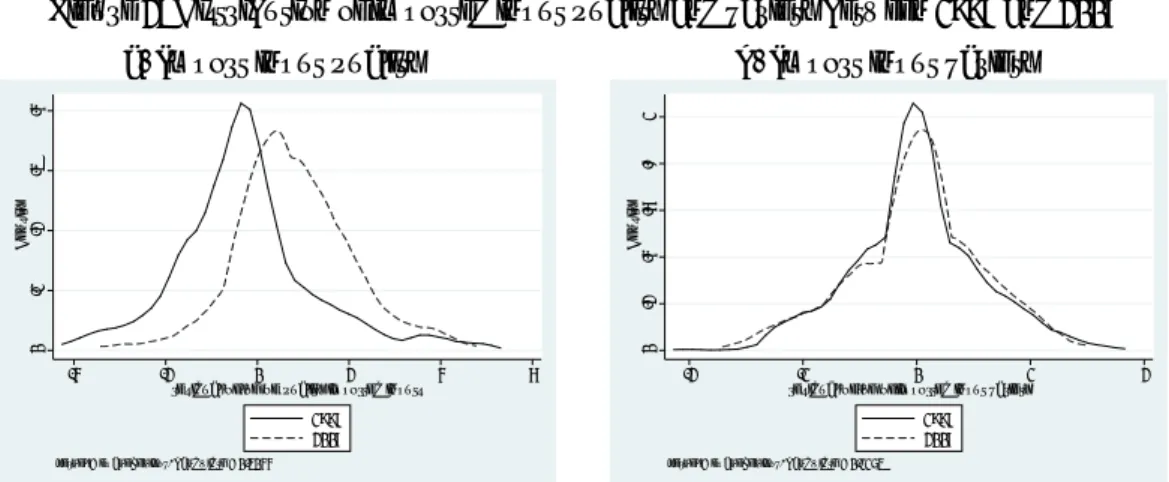
First, the quality of imported inputs of Ecuadorian firms increased but less so their access to new input varieties from 1997 to 2008 (Figure 2).
Figure 2: Distribution of imported input quality and variety between 1997 and 2007 a) Import input quality b) Import input variety
Notes: We compare the evolution of input-quality, measured as a residual of a demand function estimation as
described in section 5.1, by regressing this variable on firm fixed effects, industry-year and province-year fixed effects and plotting the residuals. In this way we compare input-quality of the same firm since only firm-product pairs that are present in both years are included.
Second, Ecuador’s importers rely on more varieties of inputs and pay more for inputs from abroad than non-importers. These findings (shown in Table A.3 in the Annex), which replicate an analysis conducted by Kugler and Verhoogen (2009) for Colombian firms, suggest that importing inputs allows Ecuadorian firms access higher quality inputs from abroad (inputs of higher price) and more input variety.
0 .1 .2 .3 .4 Density -4 -2 0 2 4 6 residual of log of quality imported inputs
1997 2007
kernel = epanechnikov, bandwidth = 0.3044
0 .2 .4 .6 .8 1 Density -2 -1 0 1 2 residual of log of imported input variety
1997 2007
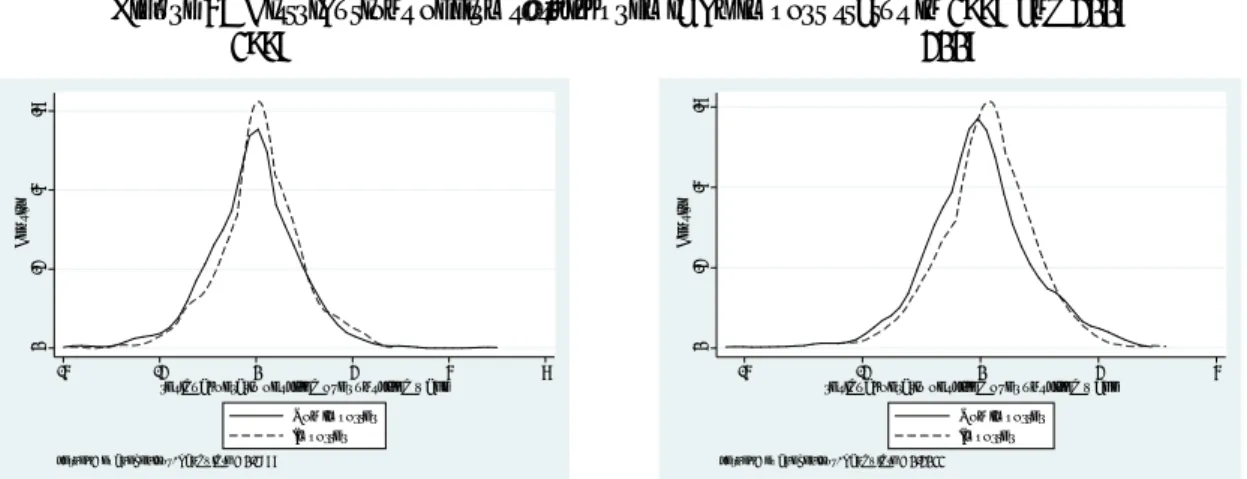
Third, between 1997-2007 following Ecuador’s trade liberalization, importers increased the number and quality of final goods products (Figures 3a and b). The skill intensity of importers’ production also increased relative to non-importers (Figure 3c). Figure 3: Distributions of firm product scope, quality and production skill-intensities, by import
status in 1997 and 2007 a) Product scope 1997 2007 b) Product quality 1997 2007 c) Skill intensity 1997 2007
Notes: We compare the number of products, output quality and relative demand for skilled labor at the firm level
in 1997 and 2007 by regressing those variables on industry-year and province-year fixed effects and plotting the residuals for importers and non-importers. Only firms that are present in both years are included.
0 .2 .4 .6 .8 Density -2 -1 0 1 2 residual of log of number of final goods products
Non importer Importer
kernel = epanechnikov, bandwidth = 0.1502
0 .2 .4 .6 .8 Density -2 -1 0 1 2 residual of log of number of final goods products
Non importer Importer
Fourth, we observe changes with regards to the returns to firms and their investors, consumers and differently skilled workers. Firms’ average markups increase by 13% from 1997 to 2007. At the same time the quality-adjusted prices decrease by 7%. We also see a shift towards a higher skills wage premium in 2007 for importers relative to non-importers (Figure 4).
4. Trade liberalization’s impact on input quality and variety
This section explores the causal impact of input tariff cuts on firms’ access to imported input quality and on the ability of firms to source new input varieties from abroad.
Figure 4: Distributions of firms’ skill premia by import status in 1997 and 2007 1997 2007
Notes: We compare the wage skill premium at the firm level by regressing those variables on industry-year and
province-year fixed effects and plotting the residuals. Only firms that are present in both years are included.
Measuring input-quality upgrading
In order to test for the impact of imported input-quality upgrading, we first estimate imported inputs quality following the methodology proposed by Khandelwal et al. (2013) (KSW hereafter). This measure of quality developed by KSW is widely used to capture product quality (Bas and Strauss-Kahn, 2015; Fan, Li and Yeaple, 2015, 2018, Manova and Yu, 2017, among others).
KSW demonstrate that assuming a CES utility function where product quality acts as a demand shifter, the quality of each product can be estimated using information on quantities, unit values and the elasticity of substitution across products.Quality is then represented as any product attribute that shifts the demand curve as first proposed by Sutton (1991). Inferring product quality from demand functions means that conditional on prices a product with higher demand (quantity) is assigned higher quality.
0 .2 .4 .6 Density -4 -2 0 2 4 6 residual of ratio of skilled over unskilled wage
Non importer Importer
kernel = epanechnikov, bandwidth = 0.1877
0 .2 .4 .6 Density -4 -2 0 2 4 residual of ratio of skilled over unskilled wage
Non importer Importer
KSW estimate quality as a demand shifter that corresponds to the residual of an OLS estimation of the quantity and price (unit value) on country-time fixed effects - that control for price index and income at destination - and product fixed effects that control for variation across products since prices and quantities are not necessarily comparable across products.The estimated quality is a function of the residual of such estimation and the elasticity of substitution between products. In their case, the objective is to estimate product quality of exported products at the firm level for Chinese firm-product disaggregated at the HS 6-digit level and country of destination level from customs data for the textile sector.
For our purposes we adapt KSW’s estimation to estimate the quality of imported inputs by firms in Ecuador. The quality of imported inputs corresponds to the residual of an OLS estimation of the following regression:
xikt + σpikt =αk +αt +ηikt (I)
where xikt and pikt denote the natural logs of the quantity and price of product k at 11-digit code imported by firm i in year t. The product fixed effect αk controls for unobservable characteristics across products since prices and quantities are not necessarily comparable across products. The estimated log quality, λikt, depends on the residual of that estimation ηikt and the elasticity of substitution σ: λikt = ηikt/(σ − 1). We estimate quality of imported and domestic inputs separately following this method for each HS 2-digit level sector to take into account sector-specific differences. We rely on the elasticities of substitution estimated by Broda et al. (2006) for Ecuador. We also present a robustness test relying on the average elasticity of substitution equal to 5 for the United States estimated by Broda and Weinstein (2006).
The indicator of input quality derived from this estimation implies that conditional on input price, foreign varieties with higher import quantities (demand by domestic firms) are assigned a higher quality relative to other imported varieties with lower quantities within the same industry (HS 2-digit sector level).
Input-trade liberalization and imported inputs quality upgrading
In this section, we look at the relationship between import tariff cuts and changes in the quality of imported inputs. We use the estimated quality, λijkt, of firm i importing product k in industry j in year t as the dependent variable and regress it on input tariffs applied by Ecuador at the HS 6-digit product level, including firm-product, industry-year fixed effects as well as firm initial size trend (where the initial size of firm i is defined by the logarithm of total production of the firm):
𝜆!"#! = 𝛼 + 𝛾!" Input τ !,!!! +𝛾! Size !,!!∗ 𝜂!+ 𝜇!"+ 𝜃!"+ 𝜀!"#$ (II) where Input τk,t-1 represents the input tariffs that Ecuador effectively applies to product
k. In this specification, where we estimate within firm-product effects of trade
liberalization on the quality of imports at the firm-product level, the import tariffs that Ecuador applies to a specific input product k are the tariffs on intermediate inputs. Output tariffs at the industry level that capture foreign competition effects on the domestic market have no direct impact on imported inputs and consequently are not included in this specification. 𝑆𝑖𝑧𝑒!,!!∗ 𝜂!corresponds to initial firm size trends, where the initial size of firm i is defined by the logarithm of total firm sales. These variables control not only for pre-existing firm trends but also for unobservable shocks to firms of similar sizes over time. All specifications include firm-product fixed effects µik, that
take into account unobservable and time-invariant firm-product characteristics and industry-year fixed effects, 𝜃!", that control for macroeconomic shocks varying across sectors and time affecting all firms in the same sector in the same way.
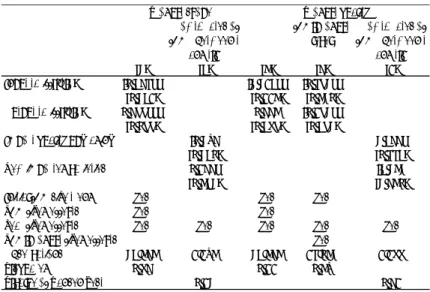
Columns (1) and (2) of Table 1 present the results. The coefficient of interest on import tariffs at the product level is negative and significant, indicating that input-trade liberalization allows firms to upgrade the quality of their imported inputs. The estimated coefficient suggests that for a 10 percentage point reduction of input tariffs, importing firms increase the quality of their intermediate inputs by 34%. Column 2 shows that these results are robust to using the median sigma for the US (5) to estimate imported inputs quality. As expected the magnitude of the effect is much smaller in this latter case as we assume the elasticity of substitution is the same across all sectors and equal to 5.
Next we subject these results to a series of validation tests. First, we verify that the effects we identify are not simply the result of technological progress that may have improved input quality and be correlated with import tariffs. If this was the case, we should have the same effect on both domestic and foreign inputs. We run a falsification test and estimate the effect of import tariffs on the quality of domestic intermediate inputs. We find that import tariffs have no significant effect on the quality of domestic inputs (columns 3 and 4 of Table 1).
Second, it may be that our input quality measure is capturing higher prices but not quality. If this was the case, we would expect firms not to increase the quantity of intermediate inputs purchased from abroad. We test for this possibility and look at the effects of input-trade liberalization on the quantity of imported inputs. Column (5) shows that firms increase the quantity of imported inputs with input tariff cuts. The estimated coefficient suggests that for a 10 percentage point reduction of input tariffs, importing firms increase the quantity of their foreign intermediate inputs by 20%.
Table 1: Input tariff cuts, inputs quality and quantity
Notes: In columns (1) to (4) the dependent variable is the estimated quality of imported (domestic) inputs of firm i
and product k in year t. In columns (5) and (6) the dependent variable is the logarithm of the quantity of imported (domestic) products. Heteroskedasticity-robust standards errors are reported in parentheses. Standard errors are clustered at the product level. ∗∗∗, ∗∗, and ∗indicate significance at the 1, 5 and 10 percent levels respectively.
Third, we look at the effect of input tariff on the domestic quantity of intermediate goods. Results presented in column (6) suggest that firms have substituted domestic inputs by foreign ones during trade liberalization. The estimated coefficient indicates that actually Ecuadorian firms have reduced the demand for domestic inputs by the same amount that they have increased the demand for foreign intermediate inputs.
Imported Domestic
sectoral sigma sigma 5 sectoral sigma sigma 5
(1) (2) (3) (4) (5) (6)
Input tariffs(k,t−1) -3.409** -0.882** 1.074 0.682 -2.065* 1.725*
(1.608) (0.419) (0.800) (0.435) (1.234) (0.888)
Initial firm size trend yes yes yes yes yes yes
Firm-product fixed effects yes yes yes yes yes yes
Industry-year fixed effects yes yes yes yes yes yes
Observations 15,273 15,273 41,580 46,167 16,142 46,171 R-squared 0.33 0.43 0.42 0.48 0.79 0.80 Imported Input quality Domestic Quantity of inputs
Input-trade liberalization and new varieties of imported inputs
Next we turn to investigate the possible impact of input-trade liberalization on new varieties. We identify from our data new varieties of foreign inputs (at the 11-digit level) that have not been sourced in the previous year from national producers or abroad. The approach allows testing for the within-firm effect of input tariffs cuts on access to new varieties of foreign inputs. The approach differs from Goldberg et al. (2010) who rely on aggregate input product data to identify the effect of tariff cuts on imported inputs varieties.
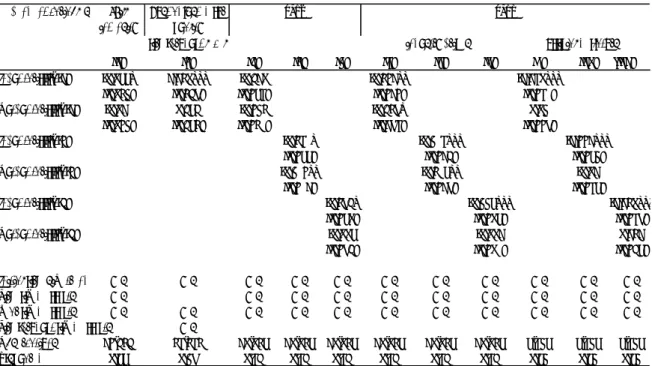
In order to test the input variety mechanism, we carry out two types of tests at different level of aggregation: at the firm-product-year and at the firm-year levels. First, we look at the probability domestic firms have of sourcing a new variety from abroad by regressing a new variety of foreign inputs indicator variable at the firm-product level on import tariffs applied by Ecuador at the HS 6-digit level, including firm-product fixed effects and, as in our previous model (II), industry-year fixed effects and a firm initial size trend. The dependent variable that captures imports of a new variety at the firm-product level is a dummy variable equal to one if the firm imports a new 11-code product that has not been sourced in the domestic or foreign market in the previous year. Results, presented in column (1) of Table 2, suggest that for a 10 percentage point reduction of input tariffs, the probability of importing a new variety of inputs increased by 1%.
Conducting the same falsification test as before on input quality, we investigate the effect of input tariff on the probability of sourcing a new variety of domestic intermediate goods. Results presented in column (2) suggest the likelihood that firms buy new varieties of domestic inputs is lower, possibly because they substituted domestic varieties for imported varieties. This evidence is consistent with the previous finding that tariff cuts reduce firms’ demand for domestic inputs (column 6, Table 1). Second, we investigate the effects of input tariff cuts on the number of new varieties of foreign inputs that a firm purchases in a year and the share of new imported varieties over all varieties that the firm purchases. In this case, we test whether firms in industries facing greater input tariff cuts have increased the amount of imported input
varieties they did not source before, relative to firms facing lower input tariff cuts.12 The coefficient in column (3) and (4) of Table 2 suggest that after a 10 percentage point reduction of input tariffs, firms increase the number of new imported varieties by 5 % and the share of new imported input varieties relative to total inputs by 1.2 %.
Table 2: Input tariff cuts and new varieties of imported inputs
Notes: Standard errors are clustered at the product level. ∗∗∗, ∗∗, and ∗ indicate significance at the 1, 5 and 10
percent levels respectively.
5. Impacts on trade liberalization on firms’ production
This section explores the impacts of trade liberalization on firms’ product scope and quality and implications on firms production processes with regard to production costs, skill intensity and productivity.
Product scope and quality
We investigate the relationship between the availability of imported intermediate goods due to input-tariff reductions and firms’ product scope and output quality. We estimate the following model, using as before a within-firm estimator, to test this relationship:
lnY!"# = 𝛼 + 𝛾!"! Input τ!,!!!+𝛾! Output τ !,!!! + γ!" Size !,!!∗ η!+ µ!+ η!+ ε!"# (III) where lnYijt is one of the outcome variables measuring firms’ production choices: the
logarithm of the number of products firm i produces (the products are available in the dataset at 13-digit levels) and output quality across all the products a firm i produces, in a 3-digit industry j and year t.
12 Input tariff at the industry level were constructed as explained in Section 3.2.
New imported New domestic Number of new Share of new variety dummy variety dummy imported varieties imported varieties
(1) (2) (3) (4)
Input tariffs (k,t−1) -0.106** 0.242*** -0.542*** -0.125*
(0.054) (0.079) (0.198) (0.068)
Initial firm size trend yes yes yes yes
Firm-product fixed effects yes yes Industry-year fixed effects yes yes
Firm fixed effects yes yes
Year fixed effects yes yes
Observations 61,709 61,709 12,352 12,352
R-squared 0.32 0.41 0.42 0.87
Output quality is measured at the firm-11-digit product-year level following the methodology developed by KSW we also use to compute input quality in the previous section. The quality of an 11-digit product produced by a firm in a year is the residual of a demand function estimation as in equation (I) including product and year fixed effects. In the firm level estimations, we aggregate output quality across all the products a firm produces at firm-year level. In the case of output quality we look at the effects of industry level input tariff cuts on both the firm-level measure of output quality as well as the disaggregated measure of product quality at the firm 11-digit product level applying in the latter case firm-product fixed effects.
The input τj,t-1 is the corresponding input tariffs of the 3-digit industry computed as a
weighted average of the input tariffs at the product level faced by each firm producing in that industry using constant weights averaged over the period. Output τj,t-1 is the
corresponding output tariffs of the 3-digit industry. As in the previous specification we control for pre-trends at the firm level, 𝑆𝑖𝑧𝑒!,!!∗ 𝜂! that corresponds to initial firm size trends. The estimation includes firm fixed effects in addition to time fixed effects, 𝜂!, in order to take into account unobservable shocks varying across time affecting all firms in the same way. Since tariffs vary at the 3-digit industry level over time, the standard errors are clustered at the 3-digit industry level.
Table 3 presents the estimation results for equation (III). Our findings show that lower input tariffs affect firms’ product growth. In column (1) the coefficient of input tariffs is negative and significant at the 5% confidence level, indicating that a 10 percentage point drop in input tariffs increased firms’ product scope by 2.4%. Results also show that output-trade liberalization, which enhances foreign competition for Ecuadorian firms, has a negative effect on their product scope. For the average output tariff reduction over the period (6 percentage points), firms reduced their product scope by 2.8%. This result on output tariff reductions is in line with the work of Bernard et al. (2011), they find that the US-Canada trade agreement by reducing output tariff induce firms to drop products.
Next, we explore the effects of input quality upgrading and new imported varieties on changes in firms’ product scope. Since firms’ import quality upgrading and access to new varieties of inputs are endogenous to firms’ improvement of their production process, we rely on instrumental variable estimator in a 5-year difference equation to