HAL Id: cea-02509150
https://hal-cea.archives-ouvertes.fr/cea-02509150
Submitted on 16 Mar 2020HAL is a multi-disciplinary open access archive for the deposit and dissemination of sci-entific research documents, whether they are pub-lished or not. The documents may come from teaching and research institutions in France or abroad, or from public or private research centers.
L’archive ouverte pluridisciplinaire HAL, est destinée au dépôt et à la diffusion de documents scientifiques de niveau recherche, publiés ou non, émanant des établissements d’enseignement et de recherche français ou étrangers, des laboratoires publics ou privés.
Critically safety and organizational principles at the
CEA
G. Kyriazidis, E. Gagnier
To cite this version:
G. Kyriazidis, E. Gagnier. Critically safety and organizational principles at the CEA. ICNC 2015 - International Conference on Nuclear Criticality safety, Sep 2015, Charlotte, United States. �cea-02509150�
CRITICALITY SAFETY AND ORGANIZATIONAL PRINCIPLES AT THE CEA
Georgios Kyriazidis1 – Emmanuel Gagnier2
Commissariat à l'Energie Atomique et aux Energies Alternatives
1
CEA, DEN, DPIE, SA2S, F-13108 Saint-Paul-lez-Durance, France
2
CEA, DEN, DM2S, SERMA, F-91191 Gif-sur-Yvette, France [email protected]; [email protected]
1. INTRODUCTION
The Commissariat à l'Énergie Atomique et aux Énergies Alternatives – usually referred to as the CEA has ten research centers in various regions of France, each one specializing in specific areas of research. These research centers / laboratories are located throughout France in the regions of Paris/Île de France, Rhône-Alpes, Languedoc Roussillon (Rhône Valley), Provence-Alpes-Côte d'Azur, Aquitaine, Central France and Burgundy.
Among them all, research on nuclear energy is conducted mainly in 3 civil research centers1: at Saclay in the region Paris/Île de France, Marcoule in the Rhône Valley and Cadarache in Provence.
In mid-1999, just a few months before the Tokai – Mura criticality accident, the CEA decided to review the organization regarding criticality safety in all of its nuclear facilities in order to improve it.
It's important to point out that until that time, the CEA's criticality safety organization had a very simplemodel. One high level criticality safety specialist appointed as the “ICC” (Ingénieur Criticien de Centre / Center's Criticality Engineer) was in charge of an entire nuclear center regardless of the number of nuclear facilities within. This criticality "officer" function was formally established in France in 1984 by the nuclear regulator (today's Autorité de Sûreté Nucléaire – more commonly known as the ASN).
2. CEA ORGANIZATION
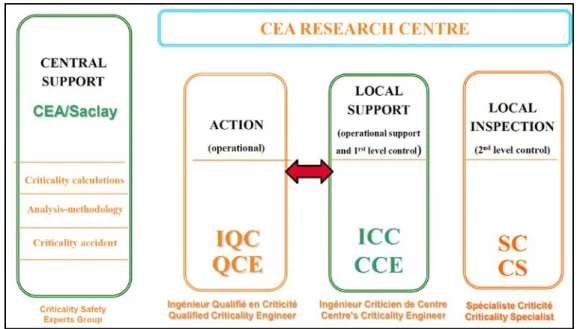
As presented at the ICNC in 2003, the CEA's organization 2 is based on an operational line, backed up by support resources, and a control line. The organization is specified in a CEA internal instruction from the Nuclear Safety and Protection Division (DPSN) with specific instructions for each CEA center.
1
Nuclear research at the Grenoble research center ended in early 2000. Today, all of the nuclear facilities there have been decommissioned and their dismantling is still underway.
2 ICNC 2003 - "The Organization of Criticality Hazard Prevention at the CEA" JAERI-Conference 2003-019
Regarding criticality safety and in particular the operational line and support resources, a three "level" organization was established as follows: (from "top" to "bottom"):
1. A central (CEA) Criticality Safety Expertise Group (CSEG) in which criticality specialists perform among their other activities, criticality calculations for each of the nuclear facilities. The members of the CSEG are also in charge of criticality accident issues (until 2014, a Criticality Skill Team dedicated to criticality accidents was located in Valduc near experimental facilities. However, today it is closed.)
2. At each CEA center, there is a high level expert – ICC (He has a renewable term of 4 years)
3. At every nuclear facility (Installation Nucléaire de Base - INB3 / Basic Nuclear Facility ) where fissile materials are present, there is a local organization which is managed by a local criticality specialist named IQC (Ingénieur Qualifié en Criticité / Qualified Criticality Engineer with a renewable term of 4 years as well).
Regarding the control line and in particular the control function the aim of which is to enforce the observance, the adequacy and efficiency of the measures taken by the operational line managers in order to meet the nuclear safety goals set down by the director of each CEA Center, a team usually called the Safety Cell (“Cellule Sûreté”) exists as well. The Safety Cell is totally independent of the aforementioned operational line, reports directly to the director of each CEA Center, and it performs a thorough check of the safety documents and all operational practices. This safety team includes one person with sufficient criticality expertise to be appointed the Criticality Specialist (CS).
These lines are implemented at every CEA center with licensed nuclear facilities (Installation Nucléaire de Base - INB) where fissile materials are present and where criticality safety issues can be met.
Figure 1: Organization chart
3 the list is available at www.asn.fr
3. TRAINING FOR THE IQCs', ICCs', SCs'
3.1. Training of the IQCs
In order to reinforce this structure, an appropriate training in accordance with the responsibilities of the position is given to the appointees in charge of the operations or the control. Some of these positions require a “qualification agreement”.
Training for the IQCs is a two times one week process. These "initial training" sessions are organized by the INSTN (National Institute of Nuclear Sciences and Techniques4) at Cadarache. The first one week session includes general theoretical aspects on criticality safety (an overview of fission phenomenology, cross sections, Monte Carlo codes, accidents, etc…..). During the second 3½ day session, the IQC's receive "practical training" in which they are trained using criticality reports/calculations, procedures, operating practices, etc. They are also given a quick overview of the regulatory framework regarding criticality, dealing with matters such as nuclear laws, nuclear regulatory authority decisions and internal CEA recommendations as examples. For each training session, the trainees receive a certificate of attendance awarded by the INSTN. The nuclear facility manager in which an IQC is working must put in an application to the ICC for his/her "qualification". This initial qualification at the beginning of a criticality safety "career" is almost always accompanied by obligations and sometimes restrictions. The usual obligation is to stay in close touch with the ICC during the first months after his/her nomination as the IQC of the facility.
3.2. Training of the ICCs
On the whole, the ICCs have an overall good professional background in general nuclear safety and in criticality safety if possible. Recruitment is done among the ranks of reactor/neutron physicists, nuclear safety engineers or nuclear chemistry engineers and former IQCs.
Prior to their appointment, they receive an approximate nine-week overall training session which involves theoretical and practical aspects. An ICC applicant must pass a qualifying examination and spend one week as a trainee in a French nuclear facility during which he is required to write an internship report followed by a presentation / oral examination of the report to a committee made up of ICCs and senior French criticality experts.
Furthermore, a diploma is issued by the INSTN (training sessions take place every two years in France). It is the duty of the director of a CEA research center to request the "qualification" of the ICC for his own specific center, and a "qualification agreement" is issued by the Head of the Criticality Skills Team, following the appointment of the candidate by the director of the CEA center as an official ICC.
4 more information at http://www-instn.cea.fr/Criticality-Safety.html
3.3. Training of the SCs
Criticality Specialists must have as a minimum requisite for training the same as that of the IQCs, but they often have had previous ICC training and experience in addition to this. It is the responsibility of the head of the “safety cell” to request the "qualification" of the SC for the specific center, and a "qualification agreement" is issued by the head of the Criticality Skills Team, after the appointment of the candidate as a SC.
4. RESPONSIBILITIES OF THE IQCs, ICCs, SCs
4.1. Responsibility of the IQCs
The IQC carries out his responsibilities only in the area of one specific nuclear facility (INB) under the control of the INB's manager. He has the delegated authority to conduct every day controls within the perimeter of his nuclear facility. Either alone or in collaboration, he must write all the procedures, operational documents, verifies them (if he has not written them himself), and then submits all the regulatory procedures referenced in the general operating rules to the ICC for validation/control.
He must solicit the ICC for detailed technical advice, especially when he's unexperienced in the field or a beginner at the nuclear facility. In both cases it's mandatory.
As soon as he's experienced enough, he conducts training sessions for his own facility workers (either alone or possibly with the ICC) and holds periodical updated re-training sessions).
He carries out the criticality safety assessments and defines the necessary criticality calculations when new facilities are opened or when existing facilities are modified or whenever periodic regulatory assessments are led, under the guidance and support of the ICC.
4.2. Responsibilities of the ICCs
The ICC is the technical authority regarding criticality safety in a nuclear center. He is the upmost technical advisor for the IQC's, nuclear facility managers and the Center manager and as such, he controls and validates all relevant criticality safety documents, particularly criticality safety assessments.
He keeps in touch with the Criticality Skills Team on a routine basis and he attends internal CEA meetings dealing with general criticality issues and actively participates in the definition of internal regulations.
He makes sure that nuclear facilities are operated according to the specific rules and procedures of each, ensuring permanent sub-criticality. He meets all the demands of the center's facilities in the area of criticality safety.
He leads experience exchanges between the IQC's of "his" CEA center and takes into account the feedback on criticality safety coming from other CEA centers.
4.3. Responsibilities of the SCs
The SC is the final formal authority regarding criticality safety in a nuclear center. As member of the safety cell he has, among his other responsibilities, the task of checking that the facilities are being operated in conformance with the regulatory authorizations. This is accomplished through facility visits, documents and recordings inspections and by carrying out technical and quality assessments.
He implements lessons learned from significant criticality safety events that have occurred in nuclear facilities (located inside or outside his Center) and advises the Director of the center in case of any irregular or unusual situations arising in a facility and concerning the prevention of criticality hazards.
He controls all the relevant criticality safety documents on a formal basis before these are sent to the nuclear safety authority (the ASN).
5. DOCUMENTARY ORGANIZATION 5.1. General Documentary Organization
Criticality safety analysis is included in the baseline report of a nuclear facility. The outcome of a criticality safety analysis involves requirements (limits, rules, poisons, etc …). These are to be found in the Règles Générales d'Exploitation / General Operating Rules (RGE/GOR). The RGE/GOR are in general structured into several parts but regarding criticality safety one must two special chapters:
1. the definition domain 2. the general criticality rules.
All the operational requirements (limits, etc ...) can be found in the "Definition Domain" chapter. In the chapter entitled, "General Criticality Rules", we find all the general operating procedures and/or instructions. Sometimes, especially in old baseline reports, the "Definition domain" is actually the first part of the "General Criticality Rules" chapter.
All the documents (procedures, control parameters, operating instructions,…) referenced into the "General Criticality Rules" chapter MUST BE / ARE approved by the ICC who is the guarantor of their technical "quality".
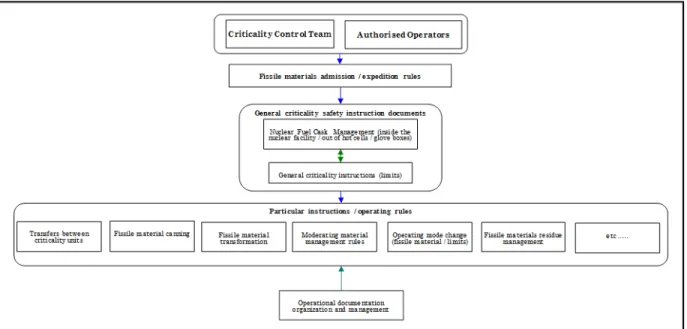
In some nuclear facilities, an organizational note called "criticality safety organization" summarizes in detail the hierarchy of the various documents pertaining to criticality safety such as procedures, operating rules, etc. Here's the chart of this tree structure:
Figure 2: Documentary Organizations Chart Example
Criticality control team = a team whose members trained by the IQC and ICC, have been appointed by the nuclear facility manager and who are distinctly identified; they never control an operation in which they participate.
Authorized operators = workers appointed by the nuclear facility manager in order to perform operations on nuclear fuel / fissile material; they can "touch", transform/modify, transfer, containerize, etc … the fissile material.
These first two documents are important regarding the double contingency principle.
Fissile materials admission / expedition rules = a document describing all the steps to be taken before a cask enters or leaves the nuclear facility's area (perimeter). Example: control of the fissile material nature expected to be received versus the regulatory authorizations of the facility.
Nuclear Fuel Cask Management = a document describing all the procedures necessary for cask management (especially if the facility uses the nuclear transport Criticality Safety Index / CSI).
General criticality instructions (limits) = document in which the regulatory general operation rules (GOR) are transposed into more simple operational and understandable, everyday rules.
Particular instructions / operating rules = specific rules for specific operations such as :
o Transfers between criticality units: how to respect the addressee criticality unit's limits (example: mass limits).
o Fissile material canning: how to make sure fissile material can be recognized after canning
o Fissile material transformation: how to recognize the fissile material after transformation (example: what mass to assign to the various length parts of an initial fuel pin after cutting it)
o Moderating material management rules: what the rules are and how to comply with the criticality unit's moderating material limits (quantity/amount, quality/grade)
o Operating mode change (fissile material / limits): what kind of operations must be undertaken in order to make sure that another kind of fissile material can be processed into the same criticality unit (new limits)
o Fissile material residue management: how can we cope with fissile material residues in a hot cell / glove box (accumulation, rinsing, ..).
On an operational basis, daily monitoring regarding criticality issues is conducted through this documentary "structure". This "structure" is in accordance with the variety / complexity of the operations conducted in each facility, and of course nuclear workers are given the adequate training on how to use / fill in these documents that are necessary in conducting the various processes.
6. FINAL APPROVAL OF DOCUMENTS
Documents containing the word criticality must have to be approved by the ICC before continuing to the next level of internal control / validation / approval. This is not an optional way of proceeding, it's totally compulsory.
Documents such as safety reports, general operating rules, etc. must go through the SC's examination and obtain approval before the director of the CEA center or his delegated authority signs them in order to be sent to the Nuclear Safety Authority (ASN).
7. TRAINING PRACTICES – CRITICALITY EXERCISES
Among the training practices, classroom training is the most usual one especially when the safety report of a facility changes. A new process implies new RGE/GOR, new procedures, operational instructions, etc.
Nuclear facilities perform periodic alarm tests of the CAAS (Criticality Accident Alarm System), in accordance with the constructor’s recommendations and also training, exercises and evacuation drills in order to check personnel awareness.
8. GENERAL GUIDES AND DOCUMENTS FOR CRITICALITY ENGINEERS
Criticality engineers (at all levels) have guides which are available everywhere (paper, local servers, intranets). One can especially find:
CEA N – 2051 (French criticality standard also known as "the Maubert guide ") Guide Cards5
(fiches guides): a collection of files (card format) each dealing with one issue such as the minimal critical mass, etc. …
A Guide for Criticality Accident Studies6
among others.
There are also national groups dedicated to information sharing such as the French Criticality Experts Group made up by a panel of experts from French operating companies and engineering entities such as: the CEA, AREVA companies (NP, NC, E&P…), EURODIF, ANDRA, and also workgroups on the French criticality safety codes package, CRISTAL (users, validation, calculation schemes, …).
9. CONCLUSIONS
The CEA has a strong criticality safety organization in general and in each center in particular (local organization).
Regarding the general organization, a homogeneous process of Qualification and Appointment for the different criticality safety functions provides that criticality engineers have the required level of knowledge and skills. The central CEA criticality safety expertise group who is in charge of methodological guides, criticality networks, lessons learned, provide high level information especially on the evolution of the criticality "état de l'art / state of the art".
In each CEA center, the local organization, with IQCs in each nuclear facility (laboratory, storage area, reactor, etc …) and the SC for the entire center ensure that the operational resources and control functions are distinctly separated. The ICC is the "man in the middle" between the support resources and the control functions.
The CEA has an overall criticality safety organization supported by a complete set of documents.
5
file collection (ICNC’07 : A guide to summarizing the main notions and principles of criticality safety : the criticality guide files collection
6 NCSD’05 : Guide in Progress for Criticality Accident Studies