ENVIRONMENTAL BIOTECHNOLOGY
An unexpected gene cluster for downstream degradation
of alkylphenols in Sphingomonas sp. strain TTNP3
Boris A. Kolvenbach&Hyazinth Dobrowinski&Jan Fousek&Cestmir Vlcek&
Andreas Schäffer&Frederic L. P. Gabriel&Hans-Peter E. Kohler&
Philippe F. X. Corvini
Received: 1 April 2011 / Revised: 14 June 2011 / Accepted: 15 June 2011 / Published online: 14 July 2011 # Springer-Verlag 2011
Abstract In silico analysis of nucleotide sequences flank-ing the recently found hydroquinone dioxygenase in Sphingomonas sp. strain TTNP3 revealed a gene cluster that encodes a hydroquinone catabolic pathway. In addition to the two open-reading frames encoding the recently characterized hydroquinone dioxygenase, the cluster con-sisted of six open-reading frames. We were able to express the three open-reading frames, hqdC, hqdD, and hqdE, and demonstrated that the three gene products, HqdC, HqdD, and HqdE had 4-hydroxymuconic semialdehyde dehydrogenase, maleylacetate reductase, and intradiol dioxygenase activity, respectively. Surprisingly, the gene cluster showed similarities
to functionally related clusters found in members of theβ- and
γ-proteobacteria rather than to those found in other members of the genus Sphingomonas sensu latu.
Keywords Hydroquinone . Degradation . Sphingomonas . Nonylphenol . Bisphenol A
Introduction
Bisphenol A (BPA) and nonylphenol (NP) are well-known environmental contaminants that exert adverse effects on the reproductive system and the development of organisms (vom
Saal and Hughes2005; Soares et al.2008). Both compounds
have been widely detected in surface waters in concen-trations up to several microgram per liter, i.e. levels that
already may cause biological effects (Soares et al. 2008;
Klecka et al.2010; vom Saal and Hughes2005; Raecker et
al.2011). Fortunately, under aerobic conditions, BPA and NP
may both be degraded by various microorganisms
(Kolven-bach et al. 2007; Gabriel et al. 2007a, 2008; Kang et al.
2006; Corvini et al. 2006b). Besides further restricting the
use of BPA and nonylphenol polyethoxylates, optimization of biological wastewater treatment techniques, based on a better understanding of biodegradation mechanisms, may hence contribute to reduce current pollutant levels. We
B. A. Kolvenbach (*)
:
H. Dobrowinski:
P. F. X. Corvini Institute for Ecopreneurship, School of Life Sciences, University of Applied Sciences Northwestern Switzerland,Muttenz, Switzerland
e-mail: [email protected] B. A. Kolvenbach
:
A. SchäfferInstitute for Environmental Research, Rheinisch-Westfälische Technische Hochschule,
Aachen, Germany J. Fousek
:
C. VlcekInstitute of Molecular Genetics, Academy of Sciences of the Czech Republic,
Prague, Czech Republic
J. Fousek
:
C. Vlcek Centre for Applied Genomics, Prague, Czech Republic F. L. P. GabrielInstitute of Clinical Chemistry and Laboratory Medicine, University of Rostock,
Rostock, Germany H.-P. E. Kohler
Swiss Federal Institute of Aquatic Science and Technology, Dübendorf, Switzerland
P. F. X. Corvini
School of the Environment, Nanjing University, Nanjing, China
recently have characterized an ipso-substitution pathway that is used by several sphingomonads, i.e., members of the genus Sphingomonas sensu latu, to degrade nonylphenols and bisphenol A and that yields hydroquinone as an
intermediate (Gabriel et al.2005b,2007a,b); Corvini et al.
2006a; Kolvenbach et al.2007.
Sphingomonads are frequently isolated from the envi-ronment as potent degraders of a wide range of xenobiotics,
such as PAH (Zhao et al.2008; Schuler et al.2009),γ-HCH
isoproturone (Hussain et al. 2011), and alkylphenolic
disruptors (Gabriel et al. 2005a; Sakai et al. 2007; Sasaki
et al.2005). Among bacteria isolated from the environment,
sphingomonads have a special status as their genes show a relatively low degree of sequence homology with homol-ogous genes from other Proteobacteria. This indicates that flow of genetic information between sphingomonads and
other genera is restricted (Stolz2009).
In sphingomonads, hydroquinone is formed as a metab-olite during degradation of 4-nitrophenol and, as a minor
metabolite, during that ofγ-hexachlorohexane (Leung et al.
1997, 1999; Endo et al. 2005). The hydroquinone
dioxy-genases found in these strains are of the LinE or PcpA type and are encoded by a single open-reading frame (Miyauchi
et al.1999; Ohtsubo et al.1999). In the corresponding gene
clusters, the open-reading frame encoding for the hydro-quinone dioxygenase is located near that of maleylacetate reductase, which is transcribed in the reverse direction. The two genes are separated by a sequence assigned to a putative LysR-type transcriptional regulator (Endo et al.
2005). Other hydroquinone dioxyenases have also been
found clustered with sequences coding for glutathione S-transferases associated with upstream steps of the lindane
degradation pathway (Nagata et al.2006).
Inβ- and γ-proteobacteria, hydroquinone was found as a
metabolite in the degradation of 4-hydroxyacetophenone
(Moonen et al. 2008) and 4-nitrophenol (Wei et al. 2010;
Shen et al. 2010). The identified clusters contained open
reading frames (putatively) coding for the two subunits of a heterotetrameric hydroquinone dioxygenase, a 4-hydroxymuconic semialdehyde dehydrogenase, a maleyla-cetate reductase, an intradiol dioxygenase and a ferredoxin
(Shen et al. 2010; Wei et al. 2010; Moonen et al. 2008;
Zhang et al.2009).
Recently, the hydroquinone dioxygenase from Sphingo-monas sp. strain TTNP3 has been purified. Unlike all other hydroquinone dioxygenases identified in sphingomonads so
far, the enzyme is anα2β2heterotetramer and is encoded by
two open-reading frames (hqdA and hqdB; Kolvenbach et
al.2011).
Here, we present the partial characterization of a Sphingomonas sp. strain TTNP3 gene cluster involved in
hydroquinone degradation. Besides containing the genes coding for the hydroquinone dioxygenase, i.e. hqdA, hqdB, and additional open-reading frames encoding functional enzymes of the hydroquinone degradation pathway. Remark-ably, in terms of arrangement and sequence of genes, the TTNP3 hydroquinone dioxygenase cluster resembles
func-tionally related clusters contained inβ- and γ-proteobacteria
and is dissimilar to those in α-proteobacteria, such as
sphingomonads.
Materials and methods
Genomic data and sequence accession numbers
Partial genomic data of Sphingomonas sp. strain TTNP3
has been as described elsewhere (Kolvenbach et al.2011).
The nucleotide and amino acid sequences reported here have been deposited at GenBank under accession number JF440299.
Chemicals
Tris, nicotinamide adenine dinucleotide (NAD) and the reduced salt of NAD (NADH) were obtained from Applichem (Axonlab, Switzerland). A technical nonylphenol mixture, hydroquinone, catechol, and hydroxyhydroquinone were obtained from Sigma (Switzerland).
In silico analysis of genomic sequences of Sphingomonas sp. strain TTNP3
Open-reading frames were identified using the GeneMark. hmm for Prokaryotes algorithm, version 2.4 (Lukashin and
Borodovsky 1998). Comparisons of amino acid or
nucle-otide sequences were performed with the respective Basic Local Alignment Search Tool (BLAST) programs on the National Center for Biotechnology Information (NCBI)
website (http://www.ncbi.nlm.nih.gov/; Altschul et al.
1997).
Bacterial strains and culture conditions for Sphingomonas sp. strain TTNP3
Sphingomonas sp. strain TTNP3 (Table 1) (deposited at
BCCM under accession number LMG 21268) was grown on Standard I Medium as described previously (Corvini et
al.2004). Cells were harvested at an OD550of about 3.0. If
not stated otherwise, enzymatic activity was induced by addition of 0.5 mM technical grade nonylphenol 16 h prior to harvesting. Cultures were then centrifuged at 4,500×g for 15 min and resuspended in 50 mM Tris buffer (pH 7.0) at 4°C. The washing procedure was repeated twice before the (Manickam et al. 2008), pentachlorophenol (Yang et al.
cells were resuspended to attain a dry weight concentration
of 33 mg/mL and stored at−20°C.
Cloning and expression of hqdC, hqdD, and hqdE from Sphingomonas sp. strain TTNP3
hqdC, hqdD, and hqdE were amplified from Sphingomonas sp. strain TTNP3 by colony polymerase chain reaction (PCR) using high-fidelity polymerase Elongase (Invitrogen,
Switzerland) and the primers listed in Tables2and3. Products
were purified by electrophoresis and subsequent extraction from agarose gels with the Nucleospin Extract II extraction kit (Macherey-Nagel, Switzerland), before adenylation and ligation into the pGEM-T easy vector (Promega, USA) by means of T4 DNA ligase (New England Bioscientific via Bioconcept, Switzerland) to yield plasmids designated pGEM-hqdC, pGEM-hqdD, and pGEM-hqdE, respectively. As a control, the control insert enclosed in the pGEM-T easy kit
was ligated into the vector, designated pGEM-con (Table1).
Plasmids were individually transformed into 5-alpha high efficiency competent Escherichia coli (NEB, USA) for
plasmid amplification. The correct orientation of the respec-tive insert in the vector was confirmed by PCR using the M13 reverse primer as forward primer (as it is oriented opposite to the desired insert) and the respective reverse primer used for amplification of the insert. Clones were grown on SOC medium containing 100 mg/L ampicillin, and plasmids were recovered by the Qiaprep Spin Miniprep Kit (Qiagen, Switerland) and transformed into BL21-DE3 pLysS competent E. coli (Invitrogen via Lubioscience, Switzerland). For protein expression, cells were grown on LB medium containing 100 mg/L ampicillin and 34 mg/L
chloramphen-icol to an OD600 of 0.6 and induced for 4 h at 37°C by
addition of 1 mM IPTG, before harvesting the cells by centrifugation for 15 min at 4,500×g. Overexpression was verified by sodium dodecyl sulfate-polyacrylamide gel electrophoresis (SDS-PAGE) analysis.
Preparation of cell extracts and enzyme assays
Thawed cells of Sphingomonas sp. strain TTNP3 were disrupted by means of sonication on ice (8 min at 60% intensity, 0.6 s/s duty cycle using a Labsonic M sonicator by B. Braun Biotech, equipped with a 3 mm probe).
E. coli cells were harvested after induction, washed twice with Tris buffer (50 mM, pH 7.5 at 4°C) and disrupted by sonication on ice (30 s at 60% intensity, 0.6 s/s duty cycle using a Labsonic M sonicator by B. Braun Biotech, equipped with a 3-mm probe). The obtained crude extracts were separated from cells and debris by centrifugation (21,500×g for 15 min).
Both formation and degradation of 4-hydroxymuconic semialdehyde in the wild-type strain were monitored
photometrically at 320 nm (Spain and Gibson 1991). Of
the sample, 35μL (either crude cell extract or 50 mM Tris
buffer at pH 7.0 for abiotic controls) was added to 280μL
of Tris buffer and reactions were started by adding 35μL of
a freshly prepared solution of hydroquinone in Tris buffer
(final hydroquinone concentration of 100μM).
4-Hydroxymuconic semialdehyde dehydrogenase activity of 4-hydroxymuconic semialdehyde dehydrogenase (HqdC) Table 1 Bacterial strains and plasmids used in this study
Strains and plasmids Characteristics Source or reference Strains Sphingomonas sp. strain TTNP3 Wild-type, nonylphenol degrader Tanghe et al. (1999) E. coli
DH5α Amplification of plasmids NEB BL21 Expression strain Invitrogen Plasmids
pGEM-T easy T-A clone vector Promega pGEM-hqdC pGEM derivative bearing hqdC This work pGEM-hqdD pGEM derivative bearing hqdD This work pGEM-hqdE pGEM derivative bearing hqdE This work pGEM-con pGEM derivative bearing
the Promega control insert
This work
Table 2 Primers used in this study
Primer Oligo sequence Purpose Position in the sequence
hqdCF ATGGCCCTCGACGACC Amplification of hqdC 4153–4168
hqdCR TCAGCGCTTGTAGAACGG Amplification of hqdC 5632–5649
hqdDF ATGCAGGATTTCATTTACTGCGG Amplification of hqdD 5655–5677
hqdDR TCATGATGCCGGACGCTC Amplification of hqdD 6696–6713
hqdEF ATGAAAGGTGCGATCTTCCC Amplification of hqdE 6710–6729
hqdER TTATGCTCCAGCCAAGCG Amplification of hqdE 7520–7537
T able 3 Comparison of open-reading frames of the hqd gene cluster in Sphingomonas sp. strain TTNP3 with homologous sequences by BLAST analysis Gene product Closest uncharacterized/characterized homologs ORF Frame Position in sequence (nt) No. of amino acids Mass (kDa) Function Description GenBank accession no.
Overall sequence identity
(%) a Or ganism hqdR +2 1– 846 282 31.9 T ranscription regulator AraC-type transcriptional regulator EFN09601 39 Sphingobium chlor ophenolicum L-1 hqdA +2 1 105 –1617 171 18.6 Hydroquinone dioxygenase small subunit Hypothetical protein NP_927509 51 Photor habdus luminescens subsp. laumondii TT O1 Hydroquinone dioxygenase small subunit ADB81386 47 P . fluor escens hqdB +2 1663 –2688 342 38.2 Hydroquinone dioxygenase lar ge subunit Hypothetical protein NP_927510 65 Photor habdus luminescens subsp. laumondii TT O1 Hydroquinone dioxygenase large subunit ACA50458 62 P . fluor escens orf1 +3 2753 –3886 378 39.7 Hypothetical protein Hypothetical protein YP_003760983 13 Nitr osococcus watsoni C-1 13 Assimilatory nitrate reductase YP_981639 4 P . naphthalenivorans CJ2 hqdC +2 4153 –5649 499 53.5
Hydroxymuconic semi-aldehyde dehydrogenase
Putative aldehyde dehydrogenase AAS87583 68 Burkholderia (Ralstonia ) sp. SJ98 Hydroxy-muconic semialdehyde dehydrogenase ACA50459.1 68 P . fluor escens ACB hqdD +1 5655 –6713 353 37.1 Maleylacetate reductase Maleylacetate reductase YP_003450967 63 Azospirillum sp. B510 hqdE +3 6710 –7537 276 29.7 Intradiol ring-cleavage dioxygenase Intradiol ring-cleavage dioxygenase ZP_02891065 56 Burkholderia ambifaria IOP40-10 Intradiol ring-cleavage dioxygenase ACN43573.2 52 Pseudomonas putida DLL-E4 hqdF +3 7544 –7939 132 15.0 Putative ferredoxin Hypothetical protein NP_927517 31 Photor habdus luminescens subsp. laumondii TT O1 Ferredoxin subunit of nitrite reductase and ring-hydroxylating dioxygenase ZP_00055242.2 28 Magnetospirillum magnetotacticum MS-1 a Overall sequence identity was calculated by multiplication of the percentage of sequence coverage with the amino acid identity within aligned seque nces, both of which were calculated by the BLAST algorithm
was assayed photometrically by monitoring the decrease of substrate concentration at 320 nm, in addition to
subsequent gas chromatography–mass spectrometry
(GC-MS) analysis as described below. Reaction mixtures
contained 0.5 mM NAD, 200 μM 4-hydroxymuconic
semialdehyde, and 175μL cell extract brought to a final
volume of 350 μL with 50 mM Tris buffer (pH 7.0).
Reactions were started by addition of 4-hydroxymuconic semialdehyde, which was freshly produced by incubation of purified hydroquinone dioxygenase from
Sphingomo-nas sp. strain TTNP3 with 400 μM hydroquinone for
10 min. The purification of hydroquinone dioxygenase of Sphingomonas sp. strain TTNP3 has been recently
described (Kolvenbach et al.2011).
For maleylacetate reductase activity of HqdE, reaction mixtures contained 2 mM NADH, 0.5 mM maleylacetate,
and 175 μL cell extract, brought to a total volume of
350μL with 50 mM Tris buffer (pH 7.0). Maleylacetate
was freshly produced by hydrolysis of 5 mM cis-butenolide in water containing 15 mM NaOH (Kaschabek
and Reineke1995). For HqdE, 175μL of cell extract and
140 μL of 50 mM Tris buffer (pH 7.0) were incubated
with 0.5 mM hydroxyhydroquinone or catechol (both substrate solutions were prepared as 5 mM stock solutions in water instantly before the experiment), respectively, before incubating for 30 min at room temperature. The samples incubated with catechol also contained 1 mM of EDTA.
Cell extract of the strain bearing pGEMcon was used as a negative control for all enzyme assays.
After 30 min of incubation at room temperature, all reaction solutions for the respective enzyme assays were worked up for GC-MS analysis.
Analytical methods
Samples were acidified with a drop of 6 M HCl and extracted twice with two volumes of ethyl acetate; the
organic phase was dried over Na2SO4 before evaporation
under a gentle nitrogen stream. Extracts were redissolved in acetonitrile/N,O-bis(trimethylsilyl)trifluoroacetamide (90:10 v/v) for derivatization at 75°C for 15 min. Samples were analyzed in an Agilent 7890A series gas chromato-graph (Agilent Technologies, Basel, Switzerland) equipped
with a Zebron ZB-5MS column, (30 m×0.25 mm, 0.25μm
film thickness, Phenomenex) coupled to an Agilent 5975 C series mass spectrometer. The mass selective detector was operated in the scan mode (mass range m/z 50–600) with an electron energy of 70 eV. The oven temperature program was 70°C for 3 min, 8°C per minute to 250°C; the injector temperature was 200°C; the interface temperature 280°C.
The injection volume was 1μL (split 1:30). The carrier gas
was helium (1 mL/min).
SDS-PAGE was carried out with 10% Tris-glycine
minigels according to a standard protocol (Laemmli 1970)
in a Mini-PROTEAN Tetra Cell (BioRad), using Precision plus unstained protein standards (Biorad).
Results
Hydroquinone metabolism in the wild-type strain
In degradation experiments with hydroquinone and crude extracts of Sphingomonas sp. strain TTNP3, we observed an initially rapid increase in absorption of the reaction mixture at 320 nm. The increase came to a halt after about 2 min and was followed by a decrease, indicating that the putative 4-hydroxymuconic semialdehyde intermediate had been degraded to further metabolites. Crude cell extracts from uninduced cells had an initial apparent hydroquinone dioxygenase specific activity of 5 mU/mg protein, whereas activities of extracts from cells induced with 0.5 mM hydroquinone and 0.5 mM technical nonylphenol were 96 and 297 mU/mg, respectively. The apparent degradation rates of 4-hydroxymuconic semialdehyde in the later course of the reaction were 0.6, 2.5, and 3.1 mU/mg protein for the uninduced, hydroquinone-induced, and nonylphenol-induced cells, respectively. GC-MS analysis of trimethyl silylated samples of the reaction mixture taken after 15 min of incubation led us to identify 4-hydroxymuconic semi-aldehyde and 3-oxoadipate as products. 4-Hydroxymuconic semialdehyde produced several chromatographic peaks that corresponded to different conformational isomers with mass spectra similar to one another and consistent with literature
data (Miyauchi et al.1999). 3-Oxoadipate was identified by
the mass spectrum of its N,O-bis(trimethylsilyl)
trifluoroa-cetamide (BSTFA)-derivatized form (Rieble et al.1994).
Catechol and hydroxyhydroquinone metabolism in the wild-type strain
Crude extract of strain TTNP3 contained enzyme activities for turnover of catechol as well as hydroxyhy-droquinone. GC-MS analysis of trimethyl silylated samples of incubation mixtures with catechol led to the detection of two meatbolites. One of the metabolites showed a retention time and a mass spectrum identical to those of the trimethyl silylated derivative of authentic
cis,cis-muconic acid (Table 4) and the other metabolite
showed a retention time and a mass spectrum identical to those of the trimethyl silylated derivative of authentic
3-oxoadipate (Table4; Rieble et al.1994). GC-MS analysis
of trimethyl silylated samples of incubation mixtures with hydroxyhydroquinone also showed the formation of two metabolites. Here, one showed the retention time and
respective mass spectrum identical to that of the trimethyl
silylated derivative of maleylacetate (Table 4) and the
other one had a mass spectrum identical to that reported for trimethylsilylated 3-oxoadipate.
hqd Gene cluster of Sphingomonas sp. strain TTNP3 In silico analysis of the sequences flanking hqdA and hqdB, which encode the small and large subunit of hydroquinone dioxygenase in Sphingomonas sp. strain TTNP3, revealed the presence of a gene cluster that contained, besides hqdA and hqdB, six additional
open-reading frame (ORF; see Fig.1). BLAST searches for four
of these ORF (hqdC, hqdD, hqdE, and hqdF) revealed 68%, 63%, 56%, and 31% sequence similarities, respec-tively, to nucleic acid sequences coding for enzymes
functionally related to hydroquinone degradation (Table3).
The ORF termed hqdR bore sequence similarities to a putative AraC-type transcriptional regulator from Sphin-gobium chlorophenolicum L-1 (39% sequence identity), and the one termed orf1 showed 4% sequence identity to an assimilatory nitrate reductase from Polaromonas
naphthalenivorans strain CJ2 (Table3).
Qualitative determination of enzyme activities in cell extract of E. coli BL21-DE3 overexpressing hqdC, hqdD, and hqdE
Incubation of cell extract of E. coli BL21-DE3 expressing
HqdC with 4-hydroxymuconic semialdehyde and NAD+
led to a decrease of absorption at 320 nm in the incubation mixture. GC-MS analysis of trimethylsilylated samples of
I II III IV V VI VII
hqdR hqdA hqdB orf1 hqdC hqdD hqdE hqdF
II III IV V VI VII
hapC hapD hapE hapF hapG hapH hapI hapA hapB
Sphingomonas
sp. strain TTNP3
Pseudomonas fluorescens ACB
II III V VI VII
pnpC pnpD pnpE pnpF pnpG orf5 orf4 pnpB pnpA
Pseudomonas putida DLL-E4 I pnpR IV II III IV V VI VII 6200 Burkholderia sp. strain CCGE1002 6199 6198 I 6197 6196 6195 6194 6193 II III IV V VI VII 3373 Burkholderia ambifaria MC40-6 3374 3375 I 3376 3377 3378 3379 3380 IX V X XI XII orf7 Sphingobium japonicum UT26S orf1 linF VIII
orf2 linEb orf4 orf5
Sphingobium chlorophenolicum
ATCC 39723
IX V XII
orf7 orf8 orf9
VIII A p c p E p c p pcpM orf15 orf16 X XI XIII XIII orf11 orf12 Fig. 1 Organization of the hqd gene cluster on a 8.0-kb fragment of
the genome of Sphingomonas sp. strain TTNP3 (for detailed explanation, see Table 3), aligned with the hap gene cluster of P. fluorescens strain ACB (GenBank accession number AF355751), the pnp gene cluster of Pseudomonas putida DLL-E4 (GenBank accession number FJ376608) and putative hydroquinone degradation gene clusters of Burkholderia sp. strain CCGE1002 (NCBI reference sequence NC_014119.1; chromosome 3; e.g., 6200 corresponds to BC1002_6200) and Burkholderia ambifaria MC40-6 (NCBI reference
sequence NC_010552.1; chromosome 2; 3373 corresponds to BamMC406_3373, e.g.). Organization of clusters attributed to HQ degradation in two sphingomonad strains are shown for comparison, i.e., Sphingobium japonicum UT26 (NCBI reference sequence AB177985) and Sphingobium chlorophenolicum ATCC 39723 (NCBI reference sequence AF512952). Roman numbers gene homologies, dark gray arrows genes attributed to hydroquinone degradatino, and light gray arrows other genes. The genes indicated with I and X code for (putative) transcriptional regulators
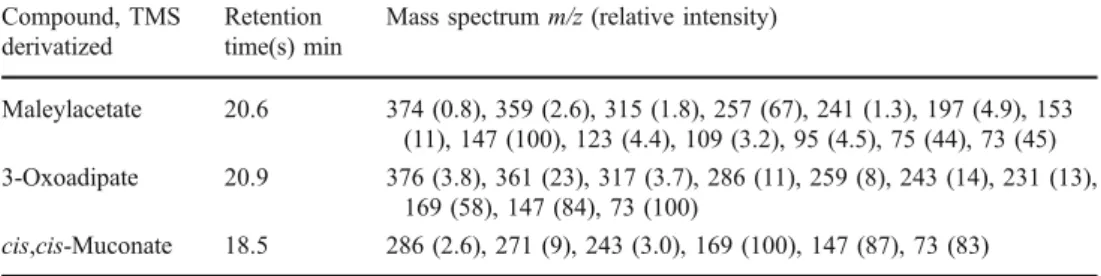
Compound, TMS derivatized
Retention time(s) min
Mass spectrum m/z (relative intensity)
Maleylacetate 20.6 374 (0.8), 359 (2.6), 315 (1.8), 257 (67), 241 (1.3), 197 (4.9), 153 (11), 147 (100), 123 (4.4), 109 (3.2), 95 (4.5), 75 (44), 73 (45) 3-Oxoadipate 20.9 376 (3.8), 361 (23), 317 (3.7), 286 (11), 259 (8), 243 (14), 231 (13),
169 (58), 147 (84), 73 (100)
cis,cis-Muconate 18.5 286 (2.6), 271 (9), 243 (3.0), 169 (100), 147 (87), 73 (83) Table 4 Mass spectra of
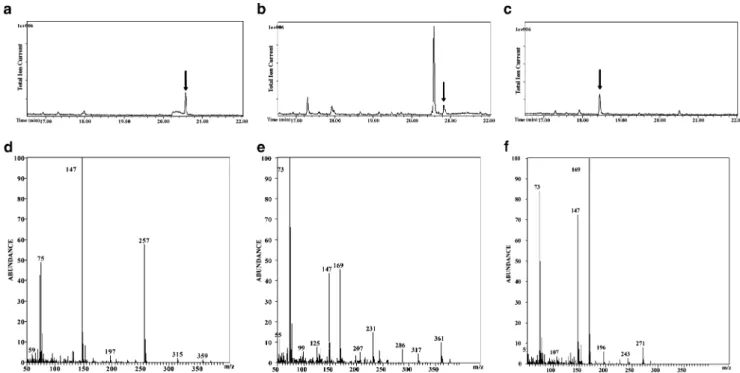
such incubation mixtures revealed the formation of a peak with respective retention time and mass spectrum corresponding to that of trimethylsilylated maleylacetate. Addition of NADH and maleylacetate to cell extract of the
E. coli strain expressing maleylacetate reductase (HqdD) yielded a product whose mass spectrum was identical to that of the 3-oxoadipate product detected in crude cell extracts of Sphingomonas sp. strain TTNP3. GC-MS analyses showed that cell extract of the E. coli strain expressing HqdE was capable of degrading both catechol and hydroxyhydroquinone to metabolites with retention times and mass spectra identical to those of cis,cis-muconic acid and maleylacetate, respectively. Expression of hqdC, hqdD, and
hqdE, respectively, has been verified by SDS-PAGE (Fig.2).
Discussion
Previous incubations of crude cell extracts of Sphingomonas sp. strain TTNP3 with the substrates NP and BPA, respectively, showed formation of hydroquinone as an intermediate. Hydroquinone was further degraded to 4-hydroxymuconic acid semialdehyde by a hydroquinone
dioxygenase (Kolvenbach et al. 2011). In this work, we
could show that 4-hydroxymuconic semialdehyde is trans-formed to maleylacetate and then to 3-oxoadipate in
subsequent steps (Fig. 3). We could also show that the
DNA sequences surrounding those sequences coding for the subunits of the already characterized hydroquinone dioxyge-nase form a gene cluster containing several open reading
Fig. 3 Chromatograms of incubations with cell extracts of E. coli strains and mass spectra of metabolites formed by enzymes encoded in the hqd gene cluster. a GC-MS chromatogram of BSTFA-derivatized extract of the incubation of HqdC with 4-hydroxymuconic semi-aldehyde and NAD, derivatized maleylacetate is indicated by the arrow; b GC-MS chromatogram of BSTFA-derivatized extract of the
incubation of HqdD with maleylacetate and NADH, derivatized 3-oxoadipate is indicated by the arrow; c GC-MS chromatogram of BSTFA-derivatized extract of the incubation of HqdE with catechol, derivatized cis,cis-muconate is indicated by the arrow; d mass spectrum of maleylacetate from a; e mass spectrum of 3-oxoadipate from b; f mass spectrum of cis,cis-muconate from c
Fig. 2 SDS-PAGE analysis of cell extracts of E. coli strains after induction with 1 mM IPTG. A, B, C, and D show cell extract of the strains bearing, hqdC, hqdD, hqdE, and pGEM-con, respectively; E marker proteins. Arrows indicate the bands attributed to the respective heterologously expressed enzymes
frames possibly associated to hydroquinone degradation in Sphingomonas sp. strain TTNP3. For two open reading frames, i.e. hqdC and hqdD, this association could be shown. Furthermore, we demonstrated hydroquinone dioxyge-nase activity to be inducible by hydroquinone and technical NP, although it is possible that induction by NP was actually mediated by the hydroquinone intermediate formed
during degradation of NP (Corvini et al. 2006a). We
observed lower hydroquinone dioxygenase activities in extracts of cells grown in the presence of hydroquinone than in extracts of cells grown with technical NP. However, further research is needed to establish whether induction after incubation with NP may also be caused by the hydroquinone intermediate formed during degradation of NP, as NP is transformed by a constitutively expressed
ipso-hydroxylase (Corvini et al.2006a).
This contrast between the inducibility of hydroquinone dioxygenase and constitutive expression of nonylphenol ipso-hydroxylase, the enzyme catalyzing the initial step in NP degradation, is a further example of the complex regulation mechanisms operating in sphingomonads (Stolz
2009). Whether or not the genes hqdC, hqdD, hqdE, and
hqdF are co-transcribed with hqdA and hqdB will need to be examined in further experiments.
Three of the ORFs in the hqd gene cluster of Sphingomonas sp. strain TTNP3 were cloned and heterologously expressed in E. coli. We confirmed that the putative HqdC and HqdD
held the annotated function (see Fig.4). The E. coli clone
expressing HqdE was able to cleave both catechol and hydroxyhydroquinone to the respective intradiol ring-cleavage products, whereas the control strain only containing the vector with a control insert was not. In the wild-type strain, incubations with catechol also led to the formation of small amounts of 3-oxoadipate, indicative of the strain’s ability to further metabolize the ring cleavage product. As hydroxyhydroquinone was not found as a metabolite in incubations of hydroquinone with cell extract of Sphingomo-nas sp. strain TTNP3, the role of HqdE in the degradation of hydroquinone still remains unclear in this strain.
As 40–60% sequence identity have been shown to be sufficient for protein function transfer (for enzymes, third-level to full enzyme commission numbers could be inherited within this threshold, as shown by Addou et al.
(2009)), it is tempting to speculate that the ORF termed
hqdR may be involved in the expression regulation of the cluster. However, its exact role remains elusive. The sequence-derived gene product showed 39% and 38% amino acid identity to putative AraC-type transcription regulators found in the shotgun genome sequence S. chlorophenolicum strain L-1 (GenBank accession number EFN09601.1) and in the genome sequence of Sphingobium japonicum strain UT26S (GenBank accession number BAI95789.1), respectively. Both putative regulators are located upstream of putative intradiol ring-cleavage dioxy-genases and are transcribed in the same direction as the dioxygenases. Nevertheless, their exact role has not been elucidated yet.
The possible gene product of hqdF was identified by sequence identity as a putative [2Fe-2S] ferredoxin, with 28% overall sequence identity to a known ferredoxin
(Table 3). It was recently shown that a group of 16
ferredoxins belonging to ring-hydroxylating enzymes had quite homogenous amino acid sequences, with sequence
identities of as little as 29% (Kweon et al. 2008).
Previously, it was shown that this type of ferredoxins might participate in the reactivation of catechol 2,3-dioxygenases
(Hugo et al.1998,2000; Polissi and Harayama1993) after
suicide deactivation by halogenated or methylated catechol
derivatives (Bartels et al. 1984; Cerdan et al. 1994). An
analog reactivation mechanism has been recently proposed for heterotetrameric hydroquinone dioxygenases such as the ones identified in Sphingomonas sp. strain TTNP3 and Pseudomonas fluorescens strain ACB (Kolvenbach et al.
2011; Moonen et al. 2008). Future studies will show if
hqdF codes for a ferredoxin involved in reactivation of hydroquinone dioxygenase.
As the amino acid sequence of the translated gene product of orf1 showed only weak similarities to known Fig. 4 Proposed pathway for the
degradation of hydroquinone in Sphingomonas sp. strain TTNP3. Enzyme activities that were successfully annotated to open-reading frames in the hqd cluster are labeled with the respective names. Open-reading frames that were functionally verified in this work are framed
proteins (i.e., 4%, compare Table 3), its function in Sphingomonas sp. strain TTNP3 remains unknown.
In terms of arrangement of open-reading frames, the hqd gene cluster of Sphingomonas sp. strain TTNP3 resembles gene clusters associated with hydroquinone degradation of
Pseudomonas (Moonen et al.2008; Shen et al.2010; Wei et
al.2010) and putative gene clusters of Burkholderia strains
(Fig.1) and does not resemble gene clusters associated with
chlorohydroquinone degradation in downstream pathways of pentachlorophenol and lindane degrading
sphingomo-nads (Cai and Xun2002; Nagata et al. 2007). Moreover,
BLAST searches for the gene products of the hqd cluster in all but one case (HdqR) showed that the sequences had higher similarities to sequences from nonsphingomonads
than to those form other sphingomonads (Table 3). We
conclude that strain TTNP3 may have acquired the hqd
cluster at least partially from β-or γ-proteobacteria by
horizontal gene transfer (Table4).
Acknowledgments BAK and FLPG were funded by the Swiss National Science Foundation grant SNF-200021-120547. JF and CV were funded by the EC Grant Agreement 265946. We thank Dr. Stefan Kaschabek (University Freiberg) for generously providing a sample of cis-butenolide.
References
Addou S, Rentzsch R, Lee D, Orengo CA (2009) Domain-based and family-specific sequence identity thresholds increase the levels of reliable protein function transfer. J Mol Biol 387(2):416–430 Altschul SF, Madden TL, Schäffer AA, Zhang J, Zhang Z, Miller W,
Lipman DJ (1997) Gapped BLAST and PSI-BLAST: a new generation of protein database search programs. Nucleic Acids Res 25(17):3389–3402. doi:10.1093/nar/25.17.3389
Bartels I, Knackmuss H-J, Reineke W (1984) Suicide inactivation of catechol 2,dioxygenase from Pseudomonas putida mt-2 by 3-halocatechols. Appl Environ Microbiol 47(3):500–505
Cai M, Xun L (2002) Organiz ation and regulati on of pentachlorophenol-degrading genes in Sphingobium chlorophe-nolicum ATCC 39723. J Bacteriol 184(17):4672–4680. doi:10.1128/jb.184.17.4672-4680.2002
Cerdan P, Wasserfallen A, Rekik M, Timmis KN, Harayama S (1994) Substrate specificity of catechol 2, 3-dioxygenase encoded by TOL plasmid pWW0 of Pseudomonas putida and its relationship to cell growth. J Bacteriol 176(19):6074–6081
Corvini PFX, Vinken R, Hommes G, Schmidt B, Dohmann M (2004) Degradation of the radioactive and non-labelled branched 4(3 ′,5′-dimethyl 3′-heptyl)-phenol nonylphenol isomer by Sphingomo-nas TTNP3. Biodegradation 15(1):9–18
Corvini PFX, Hollender J, Ji R, Schumacher S, Prell J, Hommes G, Priefer U, Vinken R, Schaffer A (2006a) The degradation of alpha-quaternary nonylphenol isomers by Sphingomonas sp. strain TTNP3 involves a type II ipso-substitution mechanism. Appl Microbiol Biotechnol 70(1):114–122. doi:10.1007/s00253-005-0080-0
Corvini PFX, Schaffer A, Schlosser D (2006b) Microbial degradation of nonylphenol and other alkylphenols—our evolving view. Appl Microbiol Biotechnol 72(2):223–243. doi: 10.1007/s00253-006-0476-5
Endo R, Kamakura M, Miyauchi K, Fukuda M, Ohtsubo Y, Tsuda M, Nagata Y (2005) Identification and characterization of genes involved in the downstream degradation pathway of gamma-hexachlorocyclohexane in Sphingomonas paucimobilis UT26. J Bacteriol 187(3):847–853. doi:10.1128/jb.187.3.847-853.2005
Gabriel FLP, Giger W, Guenther K, Kohler H-PE (2005a) Differential degradation of nonylphenol isomers by Sphingomonas xeno-phaga Bayram. Appl Environ Microbiol 71(3):1123–1129. doi:10.1128/aem.71.3.1123-1129.2005
Gabriel FLP, Heidlberger A, Rentsch D, Giger W, Guenther K, Kohler HPE (2005b) A novel metabolic pathway for degradation of 4-nonylphenol environmental contaminants by Sphingomonas xenophaga Bayram: ipso-hydroxylation and intramolecular rearrangement. J Biol Chem 280(16):15526–15533. doi:10.1074/jbc.M413446200
Gabriel FLP, Cyris M, Giger W, Kohler HPE (2007a) ipso-Substitution: a general biochemical and biodegradation mecha-nism to cleave alpha-quaternary alkylphenols and bisphenol A. Chem Biodivers 4(9):2123–2137
Gabriel FLP, Cyris M, Jonkers N, Giger W, Guenther K, Kohler HPE (2007b) Elucidation of the ipso-substitution mechanism for side-chain cleavage of alpha-quaternary 4-nonylphenols and 4-t-butoxyphenol in Sphingobium xenophagum Bayram. Appl Environ Microbiol 73(10):3320–3326. doi:10.1128/aem.02994-06
Gabriel FLP, Routledge EJ, Heidlberger A, Rentsch D, Guenther K, Giger W, Sumpter JP, Kohler HPE (2008) Isomer-specific degradation and endocrine disrupting activity of nonylphenols. Environ Sci Technol 42(17):6399–6408. doi:10.1021/es800577a
Hugo N, Armengaud J, Gaillard J, Timmis KN, Jouanneau Y (1998) A novel [2Fe-2S] ferredoxin from Pseudomonas putida mt2 promotes the reductive reactivation of catechol 2,3-dioxygenase. J Biol Chem 273(16):9622–9629
Hugo N, Meyer C, Armengaud J, Gaillard J, Timmis KN, Jouanneau Y (2000) Characterization of three XylT-like [2Fe-2S] ferredoxins associated with catabolism of cresols or naphthalene: evidence for their involvement in catechol dioxygenase reactivation. J Bacteriol 182(19):5580–5585. doi:10.1128/jb.182.19.5580-5585.2000
Hussain S, Devers-Lamrani M, El Azhari N, Martin-Laurent F (2011) Isolation and characterization of an isoproturon mineralizing Sphingomonas sp. strain SH from a French agricultural soil. Biodegradation 22(3):637–650
Kang J-H, Katayama Y, Kondo F (2006) Biodegradation or metabo-lism of bisphenol A: from microorganisms to mammals. Toxicology 217(2–3):81–90
Kaschabek SR, Reineke W (1995) Maleylacetate reductase of Pseudomonas sp. strain B13: specificity of substrate conversion and halide elimination. J Bacteriol 177(2):320–325
Klecka GM, Naylor CG, Staples CA, Losey B (2010) Occurrence of nonylphenol ethoxylates and their metabolites in municipal wastewater treatment plants and receiving waters. Water Environ Res 82:447–454
Kolvenbach B, Schlaich N, Raoui Z, Prell J, Zuhlke S, Schaffer A, Guengerich FP, Corvini PFX (2007) Degradation pathway of bisphenol A: does ipso substitution apply to phenols containing a quaternary alpha-carbon structure in the para position? Appl Environ Microbiol 73(15):4776–4784
Kolvenbach BA, Lenz M, Benndorf D, Rapp E, Vlcek C, Fouzek J, Gabriel FLP, Kohler H-PE, Schäffer A (2011) Purification and characterization of hydroquinone dioxygenase from Sphingono-mas sp. strain TTNP3. AMB Express 1:8
Kweon O, Kim S-J, Baek S, Chae J-C, Adjei MA, Baek D-H, Kim Y-C, Cerniglia CE (2008) A new classification system for bacterial Rieske non-heme iron aromatic ring-hydroxylating oxygenases. BMC Biochem 9:11. doi:10.1186/1471-2091-9-11
Laemmli UK (1970) Cleavage of structural proteins during the assembly of the head of bacteriophage T4. Nature 227(5259):680–685
Leung KT, Tresse O, Errampalli D, Lee H, Trevors JT (1997) Mineralization of p-nitrophenol by pentachlorophenol-degrading Sphingomonas spp. FEMS Microbiol Lett 155(1):107–114 Leung KT, Campbell S, Gan Y, White DC, Lee HT, Trevors J (1999)
The role of the Sphingomonas species UG30 pentachlorophenol-4-monooxygenase in p-nitrophenol degradation. FEMS Micro-biol Lett 173(1):247–253
Lukashin AV, Borodovsky M (1998) GeneMark.hmm: new solutions for gene finding. Nucleic Acids Res 26(4):1107–1115
Manickam N, Reddy MK, Saini HS, Shanker R (2008) Isolation of hexachlorocyclohexane-degrading Sphingomonas sp. by dehalo-genase assay and characterization of genes involved inγ-HCH degradation. J Appl Microbiol 104(4):952–960
Miyauchi K, Adachi Y, Nagata Y, Takagi M (1999) Cloning and sequencing of a novel meta-cleavage dioxygenase gene whose product is involved in degradation of gamma-hexachlorocyclohexane in Sphin-gomonas paucimobilis. J Bacteriol 181(21):6712–6719
Moonen MJH, Kamerbeek NM, Westphal AH, Boeren SA, Janssen DB, Fraaije MW, van Berkel WJH (2008) Elucidation of the 4-hydroxyacetophenone catabolic pathway in Pseudomonas fluores-cens ACB. J Bacteriol 190(15):5190–5198. doi:10.1128/jb.01944-07
Nagata Y, Kamakura M, Endo R, Miyazaki R, Ohtsubo Y, Tsuda M (2006) Distribution ofγ-hexachlorocyclohexane-degrading genes on three replicons in Sphingobium japonicum UT26. FEMS Microbiol Lett 256(1):112–118. doi:10.1111/j.1574-6968.2005.00096.x
Nagata Y, Endo R, Ito M, Ohtsubo Y, Tsuda M (2007) Aerobic degradation of lindane (γ-hexachlorocyclohexane) in bacteria and its biochemical and molecular basis. Appl Microbiol Biotechnol 76(4):741–752
Ohtsubo Y, Miyauchi K, Kanda K, Hatta T, Kiyohara H, Senda T, Nagata Y, Mitsui Y, Takagi M (1999) PcpA, which is involved in the degradation of pentachlorophenol in Sphingomonas chlor-ophenolica ATCC39723, is a novel type of ring-cleavage dioxygenase. FEBS Lett 459(3):395–398
Polissi A, Harayama S (1993) In vivo reactivation of catechol 2,3-dioxygenase mediated by a chloroplast-type ferredoxin: a bacterial strategy to expand the substrate specificity of aromatic degradative pathways. EMBO J 12(8):3339–3347
Raecker T, Thiele B, Boehme RM, Guenther K (2011) Endocrine disrupting nonyl- and octylphenol in infant food in Germany: considerable daily intake of nonylphenol for babies. Chemo-sphere 82(11):1533–1540
Rieble S, Joshi DK, Gold MH (1994) Purification and characterization of a 1, 2, 4-trihydroxybenzene 1, 2-dioxygenase from the basidiomycete Phanerochaete chrysosporium. J Bacteriol 176(16):4838–4844 Sakai K, Yamanaka H, Moriyoshi K, Ohmoto T, Ohe T (2007)
Biodegradation of bisphenol A and related compounds by Sphingomonas sp. strain BP-7 isolated from seawater. Biosci Biotechnol Biochem 71(1):51–57. doi:10.1271/bbb.60351
Sasaki M, Maki J, Oshiman K, Matsumura Y, Tsuchido T (2005) Biodegradation of bisphenol A by cells and cell lysate from
Sphingomonas sp. strain AO1. Biodegradation 16(5):449–459. doi:10.1007/s10532-004-5023-4
Schuler L, Jouanneau Y, Ní Chadhain S, Meyer C, Pouli M, Zylstra G, Hols P, Agathos S (2009) Characterization of a ring-hydroxylating dioxygenase from phenanthrene-degrading Sphin-gomonas sp. strain LH128 able to oxidize benz[a]anthracene. Appl Microbiol Biotechnol 83(3):465–475. doi: 10.1007/s00253-009-1858-2
Shen W, Liu W, Zhang J, Tao J, Deng H, Cao H, Cui Z (2010) Cloning and characterization of a gene cluster involved in the catabolism of p-nitrophenol from Pseudomonas putida DLL-E4. Bioresource Tech 101(19):7516–1522
Shimojo M, Kawakami M, Amada K (2009) Analysis of genes encoding the 2,4-dichlorophenoxyacetic acid-degrading enzyme from Sphingomonas agrestis 58–1. J Biosci Bioeng 108(1):56–59
Soares A, Guieysse B, Jefferson B, Cartmell E, Lester JN (2008) Nonylphenol in the environment: a critical review on occurrence, fate, toxicity and treatment in wastewaters. Environ Int 34 (7):1033–1049
Spain JC, Gibson DT (1991) Pathway for biodegradation of p-nitrophenol in a Moraxella sp. Appl Environ Microbiol 57 (3):812–819
Stolz A (2009) Molecular characteristics of xenobiotic-degrading sphingomonads. Appl Microbiol Biotechnol 81(5):793–811. doi:10.1007/s00253-008-1752-3
Tanghe T, Dhooge V, Verstraete W (1999) Isolation of a bacterial strain able to degrade branched nonylphenol. Appl Environ Microbiol 65(2):746–751
vom Saal FS, Hughes C (2005) An extensive new literature concerning low-dose effects of bisphenol A shows the need for a new risk assessment. Environ Health Perspect 113(8):926–933. doi:10.1289/ehp.7713
Wei Q, Liu H, Zhang J-J, Wang S-H, Xiao Y, Zhou N-Y (2010) Characterization of a para-nitrophenol catabolic cluster in Pseudomonas sp. strain NyZ402 and construction of an engi-neered strain capable of simultaneously mineralizing both para-and ortho-nitrophenols. Biodegradation 21(4):575–584
Yang C-F, Lee C-M, Wang C-C (2006) Isolation and physiolog-ical characterization of the pentachlorophenol degrading bacterium Sphingomonas chlorophenolica. Chemosphere 62 (5):709–714
Zhang J-J, Liu H, Xiao Y, Zhang X-E, Zhou N-Y (2009) Identification and characterization of catabolic para-nitrophenol 4-monooxygenase and para-benzoquinone reductase from Pseudo-monas sp. strain WBC-3. J Bacteriol 191(8):2703–2710. doi:10.1128/jb.01566-08
Zhao H-P, Wang L, Ren J-R, Li Z, Li M, Gao H-W (2008) Isolation and characterization of phenanthrene-degrading strains Sphingo-monas sp. ZP1 and Tistrella sp. ZP5. J Hazard Mater 152 (3):1293–1300