POPULATIONECOLOGY
Effects of Landscape Structure on Movement Patterns of the Flightless
Bush Cricket Pholidoptera griseoaptera
TIM DIEKO¨TTER,1,2MARJAN SPEELMANS,3FRANC¸OIS DUSOULIER,4 WALTER K. R. E. VAN WINGERDEN,5JEAN-PIERRE MALFAIT,3
THOMAS O. CRIST,6PETER J. EDWARDS,1ANDHANSJO¨RG DIETZ1
Environ. Entomol. 36(1): 90Ð98 (2007)
ABSTRACT Because the viability of a population may depend on whether individuals can disperse, it is important for conservation planning to understand how landscape structure affects movement behavior. Some species occur in a wide range of landscapes differing greatly in structure, and the question arises of whether these species are particularly versatile in their dispersal or whether they are composed of genetically distinct populations adapted to contrasting landscapes. We performed a capture-mark-resight experiment to study movement patterns of the ßightless bush cricket Pholidoptera griseoaptera (De Geer 1773) in two contrasting agricultural landscapes in France and Switzerland. The mean daily movement of P. griseoaptera was signif-icantly higher in the landscape with patchily distributed habitat (Switzerland) than in the landscape with greater habitat connectivity (France). Net displacement rate did not differ between the two landscapes, which we attributed to the presence of more linear elements in the connected landscape, resulting in a more directed pattern of movement by P. griseoaptera. SigniÞcant differences in the movement patterns between landscapes with contrasting structure suggest important effects of landscape structure on movement and dispersal success. The pos-sibility of varying dispersal ability within the same species needs to be studied in more detail because this may provide important information for sustainable landscape planning aimed at maintaining viable metapopulations, especially in formerly well-connected landscapes.
KEY WORDS dispersal strategy, habitat fragmentation, metapopulation, movement behavior, sus-tainable landscape planning
Dispersal is regarded as one of the key factors inßu-encing population dynamics and the persistence of species (Hanski 1999). Movement between spatially separated patches serves many ecological purposes including increasing access to resources (Dieko¨tter et al. 2006), genetic exchange between subpopulations (Leisnham and Jamieson 2002), colonization of empty habitat patches (Kindvall and Ahlen 1992, Berggren et al. 2001), and escape from adverse environmental con-ditions (Hill et al. 2001). Therefore, an understanding of how animal species can respond to structural changes in the landscape is important for successful species management and sustainable landscape
plan-ning aimed at enhancing biodiversity (Vos et al. 2001, Bailey et al. 2002, Opdam et al. 2002).
A variety of habitat- and landscape-speciÞc features are known to affect the movement behavior and dis-persal of insects; these include the internal structure (With 1994, Kindvall 1999, Hein et al. 2003, Berggren 2004) and size of habitat fragments (Kindvall and Ahlen 1992, Hjermann and Ims 1996, Appelt and Po-ethke 1997), the characteristics of the surrounding matrix (Bieringer and Zulka 2003, Haynes and Cronin 2003), the geometrical shape of habitat fragments (Tischendorf and Wissel 1997), and the connectivity of habitat elements (Hjermann and Ims 1996, Bonte et al. 2004). In addition, theoretical and empirical studies have shown that landscape characteristics act as se-lective forces in the evolution of dispersal (Levin et al. 1984, Gandon and Michalakis 1999, Hill et al. 1999, Hanski et al. 2004).
However, knowledge of whether the movement behavior and dispersal of species differ among land-scapes of contrasting structure is scarce, especially for less mobile animals. Many studies comparing insect movements among differently structured landscapes have focused on highly mobile species (Thomas and 1Institute of Integrative Biology ETH, CH-8092 Zurich,
Switzer-land.
2Corresponding author: Justus Liebig University, IFZ-Department
of Animal Ecology, Heinrich-Buff-Ring 26 Ð32, D-35392 Giessen, Ger-many (e-mail: [email protected]).
3Institute of Nature Conservation, 1040 Brussels, Belgium. 4Laboratoire ECOBIO CNRS 655, Universite´ de Rennes 1, 35042
Rennes Cedex, France.
5Alterra Landscape Centre, Wageningen UR, Wageningen, The
Netherlands.
6Department of Zoology, Miami University, Oxford, OH 45056.
Harrison 1992, Hanski 1999, Hill et al. 1999, Hanski et al. 2004); much less is known about ßightless insects, which are more likely to be affected by differences in landscape structure.
In Europe, many different types of agriculture land-scape have developed over past centuries (Meeus 1993), and despite intensiÞcation, there remains a great diversity of landscape structure. The fact that some species occur across a wide range of landscapes raises the question of whether these species are par-ticularly ßexible in their dispersal ability or whether they consist of populations adapted to varying local conditions. If the latter is the case, different popula-tions are likely to respond differently to continuing changes in the agricultural landscape, depending on the kind of conditions to which they are historically adapted.
The ßightless bush cricket Pholidoptera griseoaptera (De Geer 1773) (Orthoptera: Tettigoniidae) is a hab-itat generalist that occurs in forest edges and hedger-owsÑ habitats that are represented in most European agricultural landscapes. Because of its restricted mo-bility and its distribution across landscapes of varying composition, P. griseoaptera is a particularly interest-ing species for studyinterest-ing the effects of landscape struc-ture on movement and dispersal. In this paper, we describe a capture-mark-resight (CMR) experiment in which animals were released into two differently structured agricultural landscapes: one in Switzerland and one in France. We tested for differences in basic mobility, net displacement, and straightness of ment of P. griseoaptera by comparing means of move-ment parameters among countries with two replicate sites nested within country.
Fig. 1. Spatial distribution of the two main habitats of P. griseoaptera, woodlots and hedgerows, in the two agricultural landscapes in Switzerland (CH) and France (F). Release points were located within the marked areas.
Materials and Methods
Study Species. The dark bush cricket Pholidoptera griseopateraoccurs throughout much of Europe (Maas et al. 2002). It is typically found along woodland edges and hedgerows (Samietz 1995), and these landscape elements are the main sites for both feeding and re-production. Other vegetation types such as meso- and xerothermic grasslands and reed beds (Samietz 1995) may serve as additional feeding habitats.
Pholidoptera griseopaterais polyphagous, feeding on both plants (e.g., Rubus fruticosus L. agg., Taraxacum officinale Wiggers, Urtica dioica L.) and arthropods (e.g., caterpillars, ßies, and spiders) (Ingrisch 1976). Because of its biennial life cycle, the species requires uncultivated habitats (Hartley and Warne 1973). Eggs are laid during the summer and autumn months in the axils of leaves, in pithy stems, or in decaying wood, and hatch in spring of the year after next. The nymphs go through seven instars before they reach the adult stage. The imagos, 13Ð18 mm long (Bellmann 1993), are ßightless, and macropterous individuals have never been observed. They can be found from mid-July until November and are active during both day and night.
Study Areas. The study was conducted in two
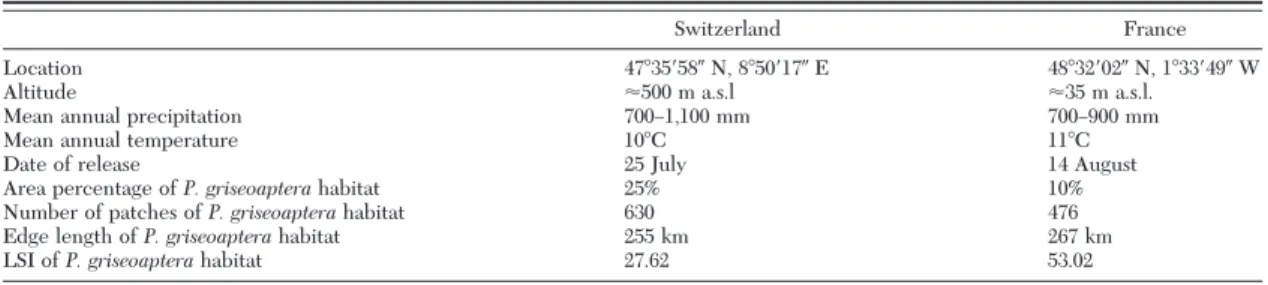
Eu-ropean agricultural landscapes that differed in the relative proportions and the spatial conÞguration of woodlands and hedgerows (Fig. 1; Table 1). While the landscape in Switzerland has a high proportion of patchily distributed woodlands within a matrix of agricultural land, the area in France has a dense network of hedgerows. Within each landscape type, mark-recapture studies were conducted at two dif-ferent sites with a typical mix of woody, seminatural elements representing the main habitat of P. griseo-aptera(Fig. 1).
The Swiss study area was in the Canton of Thurgau, close to the Nussbaumer Seen and the town of Buch (Table 1). Two forest patches where P. griseoaptera was known to occur were chosen for the capture-mark-resight experiment (CMR). One site (CH1) was situated on the margin of a rather open, deciduous forest with a well-developed shrub layer bordering grassland (Fig. 2). The second site (CH2), on a forest margin bordered by a gravel path, had a dense, hedge-like structure. The forest showed a sparse ground cover of bramble and dry grasses (Fig. 2).
The French study area was in the northeastern part of Brittany, close to the Bay of Mont-Saint-Michel and near the town of Pleine-Fouge`res (Table 1). In this area, P. griseoaptera occurred commonly in shrub hab-itats, hedgerows, and woodlands (Dusoulier 1999). Two hedgerows were chosen for the release of marked animals. One hedgerow (F1) was bordered on one side by a ditch that was overgrown by bramble and bracken and a paved road, and on the other by bracken (Pteridium aquilinum L. Kuhn) (Fig. 2). The second hedgerow (F2) was bordered on both sides by grass-land (Fig. 2).
CMR Experiment. CMR experiments were
con-ducted over a period of 10 d in both landscapes in July and August 2002 (Table 1). Individuals captured in the study areas were kept individually in portable cool boxes (⬇10⬚C) before and after marking. During cap-tivity, animals were provided with leaves of T. offici-nale.The maximum period in captivity was 36 h. Adults were marked using a single tag of reßective tape (4 by 9 mm; 3M Scotchlite 7610 high gain Þxed with Tesa second glue gel) covering both the lateral and distal side of the pronotum (see also Heller and von Helv-ersen 1990, Kindvall 1999). An identiÞcation number was written on the distal part of the reßective tag using a permanent marker. This marking technique seemed to cause less distress to the animals than tags Þxed around the femur.
Release procedures were the same at each site, with approximately equal numbers of males and females being released within an area of 2 m2around each release point. In Switzerland, 100 (50/m2) marked individuals were released at the edge of each of the two forest patches. In France, however, where the habitat elements were narrow hedgerows, the number of animals released per site was 50 (25/m2).
An area of 300 m radius around each point of release (including both habitat elements and cultivated land) was carefully searched for marked animals on 10 con-secutive nights after release. Observers wore head-lamps and could readily locate marked individuals by their reßective tags without handling them or disturb-ing their immediate vicinity. The positions of individ-uals were recorded using measuring tapes and suitable landmarks.
Analysis. Landscape characteristics were quantiÞed
by calculating the area percentage, the number of
Table 1. Characterization of the release sites
Switzerland France
Location 47⬚35⬘58⬙ N, 8⬚50⬘17⬙ E 48⬚32⬘02⬙ N, 1⬚33⬘49⬙ W
Altitude ⬇500 m a.s.l ⬇35 m a.s.l.
Mean annual precipitation 700Ð1,100 mm 700Ð900 mm
Mean annual temperature 10⬚C 11⬚C
Date of release 25 July 14 August
Area percentage of P. griseoaptera habitat 25% 10% Number of patches of P. griseoaptera habitat 630 476 Edge length of P. griseoaptera habitat 255 km 267 km LSI of P. griseoaptera habitat 27.62 53.02
The main habitat of P. griseoaptera within the two studied agricultural landscapes in Switzerland and France is represented by woodlots and hedgerows.
patches, the edge length, and the Landscape Shape Index (LSI) of woody seminatural elements, repre-sented by hedgerows and woodlots in an area of 16 km2 in France and 22 km2in Switzerland (Fig. 1), using FRAGSTATS (McGarigal et al. 2002). The LSI equals the total edge length of woody seminatural landscape elements eidivided by the minimum edge length min ei, which is achieved when the habitat type of interest (woodlots and hedgerows) is maximally clumped into a single, compact patch: LSI⫽ ei/min ei. LSI⫽ 1 when the landscape consists of a single, max-imally compact patch and increases without limit as the patch type becomes more disaggregated or more linear in its spatial extent. Smaller habitat area and smaller number of patches but similar edge length of P. griseoapterahabitat in France compared with
Swit-zerland indicate that a higher LSI in France is related to a higher linearity of habitat elements in France than in Switzerland (Table 1).
To evaluate the effects of landscape structure on movement behavior and dispersal, we calculated the mean daily movement (MDM), deÞned as the mean of all straight line distances between consecutive days observed for an individual, and the net displacement rate (NDR), deÞned as the maximum distance be-tween the point of release and the last observed po-sition of one individual divided by the number of days between release and the last observation. The ratio of NDR to MDMÑreferred to as the straightness index (SI)Ñwas also calculated. To improve comparability between countries, we restricted the analysis to indi-viduals that were resighted two to six times. The only
Fig. 2. Landscape characteristics and observed movement and dispersal patterns of marked individuals of P. griseoaptera in Switzerland (CH1,2) and France (F1,2).
long distance disperser (224 m) found in the experi-ment was regarded as an outlier and excluded from the analysis. Point-to-point distances were calculated us-ing ArcMap 8.2 (ESRI 2002). We did not discriminate males and females in this study because both sexes showed similar movement patterns in a previous study (Dieko¨tter et al. 2005).
All movement parameters were ln-transformed be-fore analysis to meet the assumptions of analysis of variance (ANOVA). A nested ANOVA model was used with sites nested within country. Because of unequal numbers of individuals recaptured at differ-ent sites (unbalanced design), the differdiffer-ent hypoth-eses were tested using type III SS (Quinn and Keough 2002). Analyses were conducted using SAS 8.02 (SAS Institute 2001).
Results
Resight Rates. In all study sites, the frequency of
resightings tended to decrease with time since release (Fig. 3). In France, resight rates decreased rather steadily, whereas in Switzerland, they ßuctuated and showed sudden drops on rainy days. Resight rates after 24 h ranged from 62% at CH1to 84% at F1and de-creased after 10 d to 47% at CH1and 0% at F2. The proportion of animals that was never resighted ranged
from 2% at F1to 36% at F2. The proportion of animals that were resighted two to six times was 24% at F2, 45% at CH1, 63% at CH2, and 70% at F1.
Movement Patterns. In the Swiss landscape, several
individuals were observed to cross the border be-tween a forest edge and the adjacent matrix (Fig. 2). At CH1, 61% of the animals resighted moved from the forest margin into the meadow on at least one occa-sion. Boundary crossings were observed throughout the study period, although with decreasing frequency. At CH2, 30% of the animals resighted were observed to cross the boundary between the forest margin and the gravel road. Successful interpatch dispersal was observed at both sites with a maximum distance of 224 m covered by an individual within a period of 8 d. In the French landscapes, no marked animals were observed to leave the habitat elements in which they had been released (Fig. 2).
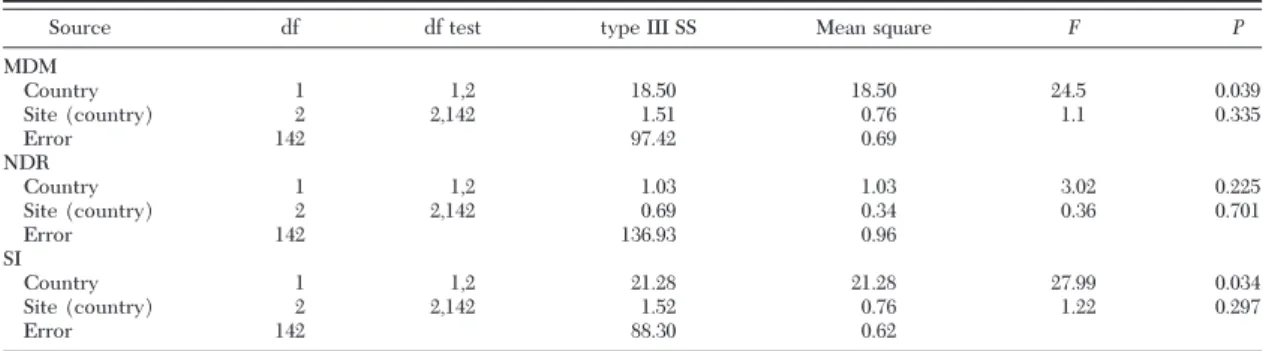
The untransformed mean daily movement of indi-vidual P. griseoaptera (MDM) ranged from a minimum of 0.2 m to a maximum of 31.0 m. The MDM in Swit-zerland was signiÞcantly higher than in France (Table 2; Figs. 4 and 5). No signiÞcant effect of site within country was detected (Table 2). In contrast to the MDM, the NDR did not differ signiÞcantly between countries (Table 2; Fig. 5) or between sites within countries (Table 2). However, the SI did vary, being signiÞcantly higher in France than in Switzerland (Ta-ble 2; Fig. 5). Sites within countries did not differ signiÞcantly in SI (Table 2).
Fig. 3. Resight rates (black), missing individuals found on following days (gray), and permanently lost individuals (white) of P. griseoaptera on each observation day for study sites in Switzerland (CH1,2) and France (F1,2). The number
of released animals was n⫽ 100 in Switzerland and n ⫽ 50 in France.
Table 2. Nested ANOVA of MDM, NDR, and SI observed in P. griseoaptera released in three countries and among sites within countries
Source df df test type III SS Mean square F P
MDM Country 1 1,2 18.50 18.50 24.5 0.039 Site (country) 2 2,142 1.51 0.76 1.1 0.335 Error 142 97.42 0.69 NDR Country 1 1,2 1.03 1.03 3.02 0.225 Site (country) 2 2,142 0.69 0.34 0.36 0.701 Error 142 136.93 0.96 SI Country 1 1,2 21.28 21.28 27.99 0.034 Site (country) 2 2,142 1.52 0.76 1.22 0.297 Error 142 88.30 0.62
Fig. 4. Relative frequency distributions of MDM of P. griseoapterain Switzerland (CH) and France (F).
Discussion
Resight Rates. We observed a general decrease of
resight rates over time, which is characteristic for CMR studies (Narisu et al. 1999, Hein et al. 2003) and may be caused by an area-dilution effect, mortality, or the loss of markers (cf. Turchin 1998).
Although no marked individuals were found to leave the habitat elements where they were released in either of the French sites, resight rates in one of the hedgerows decreased much more rapidly than in the other. This difference cannot by explained by ob-server error because both sites were sampled on the same days by the same person. More likely, it was caused by a higher density of predators (e.g., birds, rodents, amphibians, reptiles, or spiders) and/or less structural protection against predators at one of the sites (Heller and von Helversen 1990, Ingrisch and Ko¨hler 1998, Hein et al. 2003).
Movement Patterns. A comparison of the results
from the two landscapes strongly suggests that land-scape structure inßuences patterns of movement and dispersal. Thus, there were signiÞcant differences in MDM and SI between the two landscapes and also in the readiness of animals to leave suitable habitat.
For a ßightless species, P. griseoaptera in Switzer-land moved surprisingly long distances and was more successful than had been expected in dispersing be-tween patches. The mean and maximum values of the MDMs for P. griseoaptera in Switzerland easily ex-ceeded the means of daily movement distances ob-served for males (2.25 m) and females (2.16 m) of the similar-sized bush cricket M. bicolor (Kindvall 1999), a sedentary species that usually moves very little and is unwilling to leave its native habitat patches (Kind-vall and Ahlen 1992). The observed MDM in Switzer-land was well within the range of distances measured for the larger and fully winged bush cricket Platycleis albopunctata in suitable habitat (mesoxerophytic grassland; see Hein et al. 2003). In the well-connected landscape in France, in contrast, the mean daily move-ment of P. griseoaptera was signiÞcantly lower than in Switzerland and far below the basic mobility of M. bicolor(Kindvall 1999).
Because we wished to study strongly contrasting landscapes, it was inevitable that the two study areas were widely separated. It is therefore possible that differences in movement behavior were also caused by factors such as climatic conditions. In fact, because the climate in both regions is rather similar and there was little different climatic conditions during the study period, we do not think that this factor was important. Another difference between the two re-gions was release density, which was deliberately var-ied to take account of the differing size of habitat patches. IntraspeciÞc interactions have been shown to affect movement behavior in other bush cricket spe-cies (Weidemann et al. 1990, Brunzel 2002). However, because the values of MDM of P. griseoaptera released in artiÞcially high densities (50/m2) were similar to those recorded in an earlier study for animals released in natural densities (4/m2
; Dieko¨tter et al. 2005), we believe that release density was not an important fac-tor either. Rather, we believe that the observed dif-ferences in the MDM between the Swiss and the French study areas reßect differences in dispersal strategy in contrasting landscapes. Such a conclusion is also consistent with previous studies (Berggren 2004).
Although there were no obvious barriers that might impede movement away from the hedgerows in either F1 (northern side only) or F2, no individuals were recorded outside the hedges at the French study sites. In addition to apparent physical barriers, such as roads (cf. Samways 1989), movement of P. griseoaptera might also have been affected by edge-mediated be-havior (cf. Berggren et al. 2002). For example, al-though highly permeable, the adjacent heathland at F1 may have been avoided because of the abrupt change in structure, low food availability, or unsuitable mi-croclimatic conditions. Stamps et al. (1987) and
Kind-Fig. 5. Means and SEs of the untransformed parameters MDM, NDR, and SI of P. griseoaptera for the different study sites within countries. Different letters indicate signiÞcant differences between countries.
vall (1999) interpreted such habitats as psychological rather than physical barriers to dispersal and sug-gested that the fraction of individuals choosing to move into less proÞtable habitat depends on the con-ditions experienced by individuals in the local patch. In the Swiss landscape with patchily distributed habitat, P. griseoaptera frequently left the woody el-ements, along which it was released. This was the case irrespective of whether forest patches were bordered by grassland (CH1) or a gravel road (CH2), although crossings between forest edge and grassland were more frequent than between forest edge and gravel road. The observed differences in the frequencies of animals that left wood structures into the adjacent matrix suggest the possibility of complementary re-sources (food or thermal) in adjacent grasslands, whereas the gravel road acted more as a potential barrier on the movement behavior of P. griseoaptera (cf. Samways 1989). In contrast to the quantitative difference in the edge-mediated behavior of P. griseo-apterabetween sites in Switzerland, the movement behaviors of P. griseoaptera between Switzerland and France were qualitatively different and would have more pronounced effects on spatial spread than the more subtle differences in movement patterns ob-served within sites.
Differences in the edge-mediated behavior of P. griseoapteraled to a signiÞcant difference in the SI of movement between the two regions studied. A signif-icantly higher SI was observed for animals released in well-connected hedgerows in France than for animals released in patchy elements in the Swiss study area; as a result, there was a similar spatial spread (NDR) of individuals in both countries, despite the signiÞcantly lower basic mobility (MDM) of P. griseoaptera in France. This Þnding leads to the general conclusion that the spatial spread of individuals depends not solely on basic mobility but also on the structure of the landscape in which the animals are moving.
The observed differences in edge transitions of P. griseoapterabetween Switzerland and France may be partly related to factors such as food availability or population densities. However, the consistent pattern of matrix avoidance in the absence of apparent phys-ical barriers in France and the numerous transitions of P. griseoaptera into the matrix in Switzerland couldÑin combination with the observed differences in MDMÑalso be the result of an effect of landscape structure on the evolution of dispersal strategies.
Indeed, the general heritability of mobility traits (Roff and Fairbairn 2001), the direct effects of land-scape structure on movement behavior and dispersal (Keyghobadi et al. 1999, Berggren et al. 2001, Hein et al. 2003), and the recent Þndings on very mobile in-sects (Hill et al. 1999, Hanski et al. 2004) are good reasons to believe that the movement differences ob-served in this study are the result of selection for different patterns of dispersal behavior in landscapes of contrasting structure. In landscapes with a well-connected network of suitable habitats such as the one in France, there may be an advantage in remaining within suitable habitat and thus avoiding the risks
associated with moving through less favorable patches. In contrast, in a landscape where suitable habitats occur as scattered fragments, interpatch dis-persal may be essential to counteract the effects of inbreeding and local extinctions of subpopulations (Bengtsson 1978). Results from a genetic survey on P. griseoapterain agricultural landscapes in Switzerland and Belgium (T.D., unpublished data) support the idea that different dispersal strategies may be favored in landscapes of contrasting structure. However, to test this idea, reciprocal CMR experiments need to be performed at several sites within landscapes that differ in the spatial arrangement of habitat patches.
In conclusion, our study showed that movement patterns and behavior of P. griseoaptera differ between structurally distinct landscapes. Linear habitat ele-ments such as hedgerows promote linear movement and therefore contribute to the net displacement of individuals. It seems likely that differences in the readiness of P. griseoaptera to leave suitable habitat elements between landscapes showing a well-con-nected structure or patchy distribution of habitats reßect, at least in part, the different evolved strategies of dispersal in contrasting landscapes. The surprisingly long distances covered by this ßightless species in patchy landscapes suggest that high dispersal ability may be both a prerequisite for, and a consequence of, species persistence in highly fragmented and dis-turbed agricultural landscapes.
Knowledge of how the dispersal ability of a species varies in relation to landscape structure may be es-sential in developing effective conservation strategies. In addition to providing adequate amounts of suitable habitat, it seems crucial that the spatial conÞguration of habitat elements and its projected alterations match the potentially landscape-speciÞc dispersal strategies of target species.
Acknowledgments
This study is part of the EU-Project Greenveins and is supported Þnancially by the European Union (EVK2Ð2000-00082) and the Swiss Federal OfÞce for Education and Sci-ence (00.0080 Ð2). The authors thank numerous helpers in the Þeld. T.D. thanks R. DeFilippi for GIS support, S. Gu¨sewell for statistical advice, and R. Billeter, J. Alexander and anonymous referees for valuable comments on previous versions of this manuscript.
References Cited
Appelt, M., and H. J. Poethke. 1997. Metapopulation dy-namics in a regional population of the blue winged grass-hopper (Oedipoda caerulescens; Linnaeus, 1758). J. Insect Conserv. 1: 205Ð214.
Bailey, S. A., R. H. Haines-Yound, and C. Watkins. 2002. Species presence in fragmented landscapes: modelling of species requirements at the national level. Biol. Conserv. 108: 307Ð316.
Bellmann, H. 1993. Heuschrecken: beobachten-bestimmen. Naturbuch Verlag, Augsburg, Germany.
Bengtsson, B. O. 1978. Avoiding inbreeding: at what cost? J. Theor. Ecol. 73: 439 Ð 444.
Berggren, A. 2004. Impact of grazing on individual male movement in RoeselÕs bush-cricket Metrioptera roeseli: one possible clue to species range expansion. J. Insect Behav. 17: 419 Ð 429.
Berggren, A., B. Birath, and O. Kindvall. 2002. Effect of corridors and habitat edges on dispersal behavior, move-ment rates, and movemove-ment angles in RoeselÕs bush-cricket (Metrioptera roeseli). Conserv. Biol. 16: 1562Ð1569. Berggren, A., A. Carlson, and O. Kindvall. 2001. The effect
of landscape composition on colonization success, growth rate, and dispersal in introduced bush-crickets Metri-optera roeseli.J. Anim. Ecol. 70: 663Ð 670.
Bieringer, G., and K. P. Zulka. 2003. Shading out species richness: edge effect of a pine plantation on the Or-thoptera (Tettigoniidae and Acrididae) assemblage of an adjacent dry grassland. Biodivers. Conserv. 12: 1481Ð1495. Bonte, D., L. Baert, L. Lens, and J. P. Maelfait. 2004. Effects of aerial dispersal, habitat specialisation, and landscape structure on spider distribution across fragmented grey dunes. Ecography 27: 343Ð349.
Brunzel, S. T. 2002. Increased dispersal rates and distances in density-stressed bush crickets (Metriophera brachy-ptera). Beitra¨ge Entomol. 52: 241Ð253.
Dieko¨tter, T., K. Walther-Hellwig, M. Conradi, M. Suter, and R. Frankl. 2006. Effects of landscape elements on the distribution of the rare bumblebee species Bombus mus-corumin an agricultural landscape. Biodivers. Conserv. 15: 57Ð 68.
Dieko¨tter, T., D. Csencsics, C. Rothenbu¨hler, R. Billeter, and P. J. Edwards. 2005. Movement and dispersal patterns in the bush cricket Pholidoptera griseoaptera: the role of developmental stage and sex. Ecol. Entomol. 30: 419 Ð 427. Dusoulier, F. 1999. Ge´ographie des Orthopte`res de Bret-agne. Les Orthopte`res en Bretagne : bio-indicateurs cli-matologiques ou re´sultat de lÕartiÞcialisation de la bio-sphe`re? Me´moire de maõˆtrise de Ge´ographie, Universite´ Haute-Bretagne, Rennes II: 181.
Environmental Systems Research Institute [ESRI]. 2002. ArcMap 8.2. Environmental Systems Research Institute, Redlands, CA.
Gandon, S., and Y. Michalakis. 1999. Evolutionarily stable dispersal rate in a metapopulation with extinctions and kin competition. J. Theor. Biol. 199: 275Ð290.
Hanski, I. 1999. Metapopulation ecology. Oxford University Press, Oxford, UK.
Hanski, I., C. Era¨lahti, M. Kankare, O. Ovaskainen, and H. Sire´n. 2004. Variation in migration propensity among in-dividuals maintained by landscape structure. Ecol. Lett. 7: 958 Ð966.
Hartley, J. C., and A. C. Warne. 1973. The distribution of Pholidoptera griseoaptera(Deg.) (Orth., Tett.) in En-gland and Wales related to accumulated temperatures. J. Anim. Ecol. 42: 531Ð537.
Haynes, K. J., and J. T. Cronin. 2003. Matrix composition affects the spatial ecology of a prairie planthopper. Ecol-ogy 84: 2856 Ð2866.
Hein, S., J. Gombert, T. Hovestadt, and H. J. Poethke. 2003. Movement patterns of the bush cricket Platycleis al-bopunctata in different types of habitat: matrix is not always matrix. Ecol. Entomol. 28: 432Ð 438.
Heller, K. G., and O. von Helversen. 1990. Survival of a phaneropterid bush-cricket studied by a new marking technique (Orthoptera, Phaneropteridae). Entomol. Gen. 15: 203Ð208.
Hill, J. K., C. D. Thomas, and O. T. Lewis. 1999. Flight morphology in fragmented populations of a rare British butterßy, Hesperia comma. Biol. Conserv. 87: 277Ð283.
Hill, J. K., Y. C. Collingham, C. D. Thomas, D. S. Blakeley, R. Fox, D. Moss, and B. Huntley. 2001. Impacts of land-scape structure on butterßy range expansion. Ecol. Lett. 4: 313Ð321.
Hjermann, D. O., and R. A. Ims. 1996. Landscape ecology of the wart-biter Decticus verrucivorus in a patchy land-scape. J. Anim. Ecol. 65: 768 Ð780.
Ingrisch, S. 1976. Vergleichende untersuchungen zum nahrungsspektrum mitteleuropa¨ischer laubheuschrecken (Saltatoria: Tettigoniidae). Entomol. Zeitschr. 86: 217Ð224. Ingrisch, S., and G. Ko¨hler. 1998. Die heuschrecken
mitteleu-ropas. Westarp Wissenschaften, Magdeburg, Germany. Keyghobadi, N., J. Roland, and C. Strobeck. 1999. Inßuence
of landscape on the population genetic structure of the alpine butterßy Parnassius smintheus (Papilionidae). Mol. Ecol. 8: 1481Ð1495.
Kindvall, O. 1999. Dispersal in a metapopulation of the bush cricket, Metrioptera bicolor (Orthoptera : Tettigoniidae). J. Anim. Ecol. 68: 172Ð185.
Kindvall, O., and I. Ahlen. 1992. Geometrical factors and metapopulation dynamics of the bush cricket, Metrioptera bicolor Philippi (Orthoptera, Tettigoniidae). Conserv. Biol. 6: 520 Ð529.
Leisnham, P. T., and I. G. Jamieson. 2002. Metapopulation dynamics of a ßightless alpine insect Hemideina maori in naturally fragmented habitats. Ecol. Entomol. 27: 574 Ð 580.
Levin, S. A., D. Cohen, and A. Hastings. 1984. Dispersal strategies in patchy environments. Theor. Popul. Biol. 26: 165Ð191.
Maas, S., P. Detzel, and A. Staudt. 2002. Gefa¨hrdungsanalyse der heuschrecken Deutschlands. Bundesamt fu¨r Naturs-chutz, Bonn-Bad Godesberg, Germany.
McGarigal, K., S. A. Cushman, M. C. Neel, and E. Ene. 2002. FRAGSTATS: Spatial pattern analysis program for cate-gorical maps. Computer software program produced by the authors at University of Massachusetts, Amherst (www. umass.edu/landeco/research/fragstats/fragstats.html). Meeus, J. H. A. 1993. The transformation of agricultural
landscapes in Western-Europe. Sci. Total Environ. 129: 171Ð190.
Narisu, J. A. Lookwood, and S. P. Schell. 1999. A novel mark-recapture technique and its application to monitoring the direction and distance of local movements of rangeland grasshoppers (Orthoptera : Acrididae) in the context of pest management. J. Appl. Ecol. 36: 604 Ð 617.
Opdam, P., R. Foppen, and C. Vos. 2002. Bridging the gap between ecology and spatial planning in landscape ecol-ogy. Landscape Ecol. 16: 767Ð779.
Quinn, G. P., and J. K. Keough. 2002. Experimental design and data analysis for biologists. Cambridge University Press, Cambridge, UK.
Roff, D. A., and D. J. Fairbairn. 2001. The genetic basis of dispersal and migration, and its consequences for the evolution of correlated traits, pp. 191Ð2002. In J. Clobert, E. Danchin, A. A. Dhondt, and J. D. Nichols (eds.), Dis-persal. Oxford University Press, Oxford, UK.
Samietz, J. 1995. Die heuschreckenfauna (Orthopteroidea: Ensifera, Caelifera) des truppenu¨bungsplatzes Ohrdruf (Thu¨ringen). Thu¨r. Faun. Abh. 2: 73Ð84.
Samways, M. J. 1989. Insect conservation and landscape ecology: a case-history of bush crickets (Tettigoniidae) in southern France. Environ. Conserv. 16: 217Ð226. SAS Institute. 2001. SAS for Windows: release 8.02. SAS
Stamps, J. A., M. Buechner, and V. V. Krishnan. 1987. The effects of edge permeability and habitat geometry on emigration from patches of habitat. Am. Nat. 129: 533Ð 552.
Thomas, C. D., and S. Harrison. 1992. Spatial dynamics of a patchily distributed butterßy species. J. Anim. Ecol. 61: 437Ð 446.
Tischendorf, L., and C. Wissel. 1997. Corridors as conduits for small animals: Attainable distances depending on movement pattern, boundary reaction and corridor width. Oikos 7: 603Ð 611.
Turchin, P. 1998. Quantitative analysis of movement : mea-suring and modeling population redistribution in animals and plants. Sinauer, Sunderland, MA.
Vos, C. C., J. Verboom, P.F.M. Opdam, and C.J.F. Ter Braak. 2001. Toward ecologically scaled landscape indices. Am. Nat. 157: 24 Ð 41.
Weidemann, S., O. Stiedl, and K. Kalmring. 1990. Distribu-tion and populaDistribu-tion density of the bushcricket Decticus
verrucivorus in a damp-meadow biotope. Oecologia
(Berl.) 82: 369 Ð373.
With, K. A. 1994. Ontogenic shifts in how grasshoppers in-teract with landscape structure - an analysis of movement patterns. Funct. Ecol. 8: 477Ð 485.
Received for publication 12 July 2006; accepted 30 October 2006.