Artisanal Gold Miners Encountering Large-Scale Mining in Guinea:
Expulsion, Tolerance and Interference
Matthieu Bolay
11. Small- and Large-Scale Gold Mining: Who Competes for What?
Most gold mining companies in western Africa have settled in areas where artisanal gold min-ing (ASM2) was already practiced before the companies came to the place. The relations betweenartisanal gold diggers and the mining companies are often conflictive, which is usually explained by a supposed competition for access to the same resources. However, it was proven that the inde-pendent artisanal gold miners and the large-scale multinational mining companies do not compete for the same gold (Hilson 2011). The first ones are technically constrained to limit their digging to surface reefs or alluvial placers, while mining companies extract large quantities of ore from deep reefs (Hilson and Yakovleva 2007: 102; USAID 2005: 3). Recent and recurrent incidents on gold mining fields in Guinea and elsewhere have shown that, despite their interest in different kinds of deposits, artisanal gold miners were continuously labelled “illegal robbers” when they were caught on the lease of an active gold mining company. The criminalization of artisanal min-ing is part of the everyday life of gold diggers in a non-formalized context of work, mainly due to administrative constraints and the high costs involved in making their activity enter the licensing system (Fisher 2007: 739). The informality of their practices is usually not much objected to by the state authorities as long as they do not interfere with the same spaces of the large-scale gold mining companies.
However, the topic has recently evinced some interest also from the media, mainly after several accidents taking place on the territory of gold mining companies that caused the death of many artisanal gold diggers.3 In Upper Guinea (Siguiri), the company AngloGold Ashanti was forced
to react and reaffirm its position as legal owner of the land vis-à-vis the “illegal robbers mainly coming from outside”. These accidents have accelerated the deployment of new forms of control by the concerned company, mainly through its Corporate Social Responsibility (CSR) programs. After having spent a total of one year with artisanal gold diggers in the region of Siguiri, where AngloGold Ashanti operates since 2004, in this chapter, I present how artisanal miners interact with the neighbouring spaces occupied by AngloGold Ashanti. I will describe three forms of typi-cal encounters that appeared successively and analyse them with regard to the application of CSR
1 A Review of this chapter was undertaken by Prof. Katja Werthmann.
2 According to the global report on artisanal and small-scale mining (Hentschel et al. 2002), Artisanal and Small-Scale Mining (ASM) refers to informal mining activities carried out using low technology or minimum machinery. 3 In November 2008 and February 2009, 13 and 23 artisanal gold miners died in two shaft collapses that occurred on
the lease area of the mining company AngloGold Ashanti in the region of Siguiri, in Guinea. The accidents were disseminated by media in and beyond the region (A.F.P. 13.11.2008).
1
Published in Thomas Niederberger et al. (Eds), The Open Cut: Mining, Transnational Corporations and Local Populations, pp. 187-204, 2016, which should be used for any reference to this work
programs. I rely on a political ecology approach, which seeks to understand how the control over specific resources is organized. This becomes particularly visible in situations where different stakeholders meet and/or negotiate their access to resources—in this case, gold ore. Therefore, I examine different forms of encounters that take place between a gold mining company and the surrounding gold diggers, who are either local residents or itinerant artisanal gold miners. The analysis of this interaction shall help in better understanding of how measures undertaken by a gold mining company, in order to control spaces of extraction, are perceived by artisanal gold diggers, and what consequences these measures have for the gold diggers.
First, the context of the case study will be described with regard to the history of gold mining and the related movements of people in the region. A special focus is placed on the social organi-zation of artisanal mining at the local level. Second, I will briefly present the research methods and the theoretical framework. Third, I will describe three forms of typical interactions that I respectively call expulsion, tolerance and interference. Finally, the implications of CSR programs towards the social organization of ASM will be discussed, especially concerning the fragmenta-tion of the social organizafragmenta-tion of artisanal gold mining.
2. Gold Mining in Bouré: Long-Standing Practices and the
Standardization of Encounters
Gold mining has always been powerful in attracting people from faraway places to the re-gions of extraction. The most known and widely documented examples are the gold rushes in the frontier-era in the United States. Similar dynamics can be found in contemporary Africa (Jacques et al. 2006 ; Werthmann and Grätz 2012: 11), where the concept of frontier has been adapted to grasp the interactions of fortune-seekers with local communities, with reference to migratory dynamics and the related social boundaries (Grätz 2004). According to historians, the region of Bouré in northern Guinea, where this study was conducted, was already a common venue for populations of northern arid areas during the dry season at the time of the Malian Empire. Between the 12th and the 16th century, the Malian Empire, which had exclusive ownership on the gold nuggets, already relied on a seasonal workforce (Ki-Zerbo and Niane 1991: 195). The activity was exclusively conducted during the dry season and strictly depended on the agricultural calendar. Whole villages or families left their places of origin for temporary settlements, some of which became permanent villages (Herbert 2012: 26-28). Contrary to other areas of Guinea where gold deposits have been discovered only recently, the region of Bouré has historically developed mainly upon gold mining and numerous waves of “transitory” migrants. Temporary workers were traditionally hosted through the institution of tutorat, which is a customary convention that gives its beneficiaries a grant of land tenure rights in exchange for continuing gratitude and allegiance towards the owner. Sometimes, the benefit includes the provision that the tuteur receives part of the production from his “guest” (Chauveau 2007: 66). The institution of tutorat became standard-ized through hosting practices embedded in migration narratives. These narratives still play an important role. First, they shape identities of the local populations through land claims and by reference to the first settlers. Second, they serve as a regulation for the immigrant or temporary settled populations (e.g. Werthmann 2006). Later, during colonial times, temporary workers kept on maintaining regular contacts with artisanal mining settlements where they had established prerogatives, in particular through tutorat relations. These dynamics have visible impacts on the current social organization, such as the commonality of multilocal households, but have also met major changes that I will address later.
Since more than ten years, artisanal gold mining has literally exploded in western Africa— both in terms of the number of people engaged in the activity and the extent of the exploited min-ing fields (Hentschel et al. 2002). On the one hand, the rapidly increasmin-ing gold price contributed to the attractiveness of the activity among populations that were traditionally not involved in mining (for example, urban dwellers and educated people). On the other hand, unemployment in urban centres is also a major cause of engagement in the ASM sector (Hilson and Potter 2005). Unemployed people often participate in the increasing urban-rural migrations (Beauchemin and Bocquier 2004: 2253) or contribute to “return” migrations even if they had never lived in their “place of origin” before (Potts 1995). Thus, in the tradition of long-standing circular movements, an increasing number of people engage in full-time artisanal gold mining by adopting a mobile way of life that allows them to move quickly from one mining field to another without any inten-tion to settle (Jonsson and Bryceson 2009).
This chapter is concerned with encounters between multinational companies and the surround-ing populations, comprissurround-ing both local residents and the above-mentioned itinerant artisanal miners. Since the 1980s, these relations started getting increasingly standardized through CSR programs. According to Carroll (1999), the shift from mutual avoidance to a sustained and organ-ized involvement in the social life of the local population was partly due to strong incentives from international institutions and NGOs. This position contributed to a rising critique of companies’ environmental and social damages. Regular critiques were developed by the NGOs and
ics about the meagre impacts of measures for the benefit of the local population compared to the benefits of legitimizing the presence of extractive multinational companies in developing coun-tries (for a synthesis: Banerjee 2008). In the mineral extraction sector, Hönke (2010) showed how companies used their CSR programs to better control the territories where they were operating. Other studies deal with the consequences of these programs for the social life of the concerned communities such as conflicts between villages (Frynas 2005: 592) or among villagers (Luning 2012) when it comes to accessing benefits. Despite an obvious unequal distribution of power, arti-sanal miners and the concerned communities cannot be considered passive victims. Several case studies in the Melanesian context have shown how communities adopted CSR and the develop-mental discourses on land tenure, to benefit from compensations and CSR investments. Commu-nities strategically organize in “customary land groups” or create a “landowner” status in order to get access to compensation funds of the mining companies or the state, as well as to benefit from quota-share through the Ministry of Mines (Filer and Macintyre 2006; Jorgensen 2004). In-teractions between communities and the mining companies are hence increasingly standardized through CSR programs and the related discourses, agents and programs.
Therefore, I propose to analyse encounters between artisanal miners and a gold mining com-pany, from the miners’ perspective (both locals and itinerants), by taking into consideration the existing social boundaries among the gold diggers. The next section describes some specificities of the present case study, especially regarding how work is organized in the artisanal mining fields in proximity to the concession area of the company.
3. The Case Study
The present study was conducted in the region of Bouré, 40 kilometers from Siguiri town in Upper Guinea. Largely known for its important gold deposits, it is the first allocated concession in Guinea that was given to a large-scale mining company. First called Société Aurifère de Guinée (Ashanti Goldfields Corporation), it then merged with AngloGold in 2004 and became part of AngloGold Ashanti Ltd. In the region, the company is known as “SAG”.
SAG started exploiting gold in 1989. The arrival of the company first evoked great expectations concerning employment perspectives in the region. Disappointment was equally great, as most hired workers were expats and the few available jobs for the local population were physically demanding and low-paid. A former employee in the artisanal mines reported: “Salary is so low, that with the rush, I finally went back to artisanal mining. Work is very hard too but there [with artisanal mining] you can be lucky and you are free.”4 As a consequence of the unsatisfying
work-ing conditions, relations between the company and the population in Siguiri and the villages of Bouré rapidly turned conflictive and resulted in frequent strikes by local employees and protests by the neighbouring population of Siguiri, among whom many are part-time or seasonal artisanal mine workers.
Around the active pits of the company, the soil is drilled by thousands of small shafts made by the artisanal gold miners. Those are usually young men who leave their home place to generate an income before settling down back home. However, the forms of engagement in the artisanal gold mining sector differ, and can be ideally presented by three specific types: First, some miners engage in long-term itineraries that sometimes last several years. This implies cutting off most family ties and a return is only possible when they acquire recognition in the sector and adequate savings to start living on their own. Such miners often refer to mining as a form of “adventure”,
which is a common reference in the migration narratives in western Africa (Bredeloup 2008). Second, there are miners who engage seasonally or temporarily, usually as part of the household strategies of securing livelihood. Such miners often consider mining as a complement to their main activity, which is farming. Third, local residents of mining areas usually depend exclusively and most often indirectly on gold mining activities. They mainly combine several income gen-erating activities related to gold mining, except participating directly in the extraction process. They invest in mining activities either by owning a shaft, by providing mechanical support, by doing business with gold ore, or by offering services in the mining camps; for example, in small restaurants and coffee shops, or in stores selling clothes and extraction material. Their autochtho-nous status, besides owning a shaft, also allows them to be considered as part of the local militia. Seasonal workers are often hosted by local residents, either through the institution of tutorat or through family ties. They usually maintain strong personal networks extending over several years. On the contrary, itinerant gold miners settle in temporary mining camps close to the min-ing fields. The camps can host up to several thousands of people durmin-ing the dry season and thus become major hubs for trade and business for the whole region (Mbodj 2009). Different kinds of workers characterize working conditions on ASM extraction sites: First, a team of shaft diggers who associate with a local shaft owner, whose responsibility is the maintenance of the team until gold is reached. The shaft owner is hence considered a member of the team in the distribution of the latter extracted ore, which is divided among the initial stakeholders and washed individually. Second, when the ore is finally reached, experienced gold diggers, specialized in underground ex-traction, called kalayantigilu start joining the initial team and are asked to “take a turn” inside the galleries. The work in the tunnels is considered much harder and is usually done by kalayantigilu, who sell their workforce and experience from shaft to shaft. They can earn much more than the Map 2: Mining area and settlements near Siguiri.
shaft owners and initial teams as these gold diggers multiply their operations in the best shafts. In any operation, success can hardly be ensured. This pushes some gold diggers, be they itiner-ant or not, to try their luck in the neighbouring territories of the mining company, in particular when they face difficulties to meet their daily expenses. Because of the mechanized operations undertaken by the SAG, rich deposits are accessible easier there. In some places, abandoned ore can be conveniently rewashed through ASM and these small quantities can cover daily needs. Yet, these operations imply greater risks because of the soil fragility. From the miners’ accounts, collapses can be anticipated by listening to and reading the warning signs given by the subsoil. However, such skills require time and experience and are associated with the so-called “masters” or “officers”.
Fig. 1: Searching for gold in Kintinian tunnel. Photo: Matthieu Bolay.
Between 2009 and 2010, several accidents took place on the territory of the SAG. Shaft col-lapses caused the deaths of more than 30 artisanal gold diggers and were largely covered in the regional media and much farther. In response to these fatalities, the SAG accelerated the “stra-tegic action plan” of its “community development” plan. The plan officially aimed at providing infrastructural support to the neighbouring communities and improving the relations with them.
After briefly describing data collection methods in the next section, I will then present how artisanal gold miners active in the area re-interpreted relations with the mining company by pay-ing special attention to the successive forms of distribution of control over gold minpay-ing spaces induced by CSR.
4. Methodology
The field research was conducted during a total of ten months in gold mining areas in Upper Guinea between 2009 and 2012. More specifically, I collected data in the mentioned region of Bouré, where the SAG is settled. Diverse anthropological methods were combined and several stakeholders’ perspectives were taken into consideration. The first objective aimed at capturing and comparing access strategies to mining resources of itinerant and resident mine workers in different locations. Village-managed artisanal mining fields, abandoned artisanal mining fields and mining spaces upon the lease of the mining company constituted my main field. I first stayed in two miners’ households for two three-month periods where I followed day-to-day activities on the neighbouring mining fields. These insights were complemented by 24 interviews with male resident and temporary miners. I also interviewed two women but did not include this data because of the exceptionality of their experience in the view of the other male interviewees.5
Interviews mostly focused on miners’ strategies of access to mining resources both formally and
5 Women make up half of the population living on the artisanal gold mining fields. The division of labor prevents them from doing any kind of subterranean work. This makes them less prone to operate in the concession area of the mining company.
Fig. 2: Artisanal miners at work in Kofilani Boure. Photo: Matthieu Bolay.
informally, on their general perception of the mining company, as well as on their interpretation of the programs undertaken by the SAG. Complementary interviews were conducted with tom
bolomas6 and local state officials in order to obtain their perspective on relations among the
min-ers, and between the miners and the mining company. Because of the “tripartite” context that this chapter addresses, informal discussions were also held with other local stakeholders such as village chiefs, soldiers, employees of the SAG, among whom some had executive positions, and two police officers. Those insights were useful to better understand how they interpret the social heterogeneity of the mining community, especially in their diverse relations with the SAG. I also collected copies of police statements for casualties in the area of Bouré through local informants, and reviewed public relations and official statements of the SAG to capture its official position toward the “mining community”.
In my data, the perspective of the artisanal miners has obviously more weight than the one of the company, which was almost inaccessible through formal interviews. Some noteworthy studies approach the question from this perspective and recall that private firms should not be considered as monolithic entities. Strategies rely on personalities and political ties with local state institu-tions, and are thus often far from the officially stated position of the mining company (e.g., Davis and Franks 2011 ; Frynas 2005 ; Kapelus 2002). However, as the main concern of this paper is to understand how artisanal miners experience neighbourly relations with the mining company, its activities directed toward the “community” and the situations that arise from their encounters, the perspective of the mining company is less addressed.
The analysis of the material has been guided by a political ecology approach, which aims at identifying inequalities in terms of access to natural resources; in this case, to soils of high grade gold ore. Gold is not a renewable resource at human scale and the potential conflict should hence not only be considered “environmental”7 but also include its economic and political dimensions
(Escobar 2006). Natural agency is considered, however, as it obviously affects actions and/or reactions both of artisanal miners and of the mining company. For instance, shaft collapses pro-voke fatalities and attract media coverage and its potential occurrence influences choices of the gold diggers. In our case, socio-environmental conflict theory provides a framework focusing on conflictive situations in the access to and over resources (for example, high grade ore soils). With this framework, we can examine who controls what, who is allowed to decide what and who is expected to do what tasks (Little 2007; Robbins 2012). By asking these basic questions, we can better understand how the increasing scarcity in gold access due to appropriation by private companies and an increasing number of gold diggers leads to conflicts between social entities (local and itinerant artisanal miners, artisanal miners and non-miners, artisanal miners and the mining company). The three presented cases show that the more cooperative the approach of the company toward the “community”, the more conflictive it turns within the targeted community. The argument here is that the conflict moves from the tensions between company and the miners to tensions between local populations and the miners. The main reason is that the local autoch-thony conventions are challenged by CSR programs and turned into effective social boundaries in the context of work of the artisanal gold miners, by following an approach based on autochthony through the interference of CSR programs.
6 Tom bolomas literally means “the ones that hold coercive power” in Maninkakan; they act as a local militia and control the artisanal mining fields under the mandate of the village authorities.
5. From Mutual Avoidance to Interference
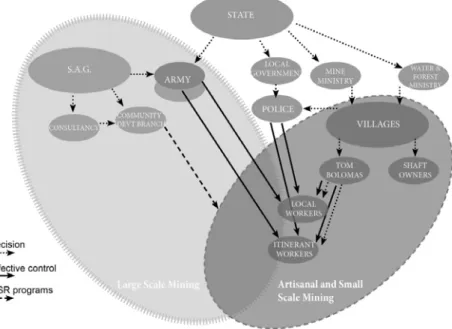
Different stakeholders are involved in framing the encounters between the SAG and the arti-sanal gold miners. This is visible at two different levels. First, the level of decision-making, and second, the level of decision-implementation. These decisions mostly concern control over terri-tory and the application of programs towards the “communities”. The following image refers to the main stakeholders and their relations concerning power in decision-making and control over working spaces.
The presence of the state is less dealt with in this chapter, because it is usually limited to episodic incursions of agents of the Ministry of Mines in the villages managing artisanal mining fields in order to collect taxes. In the everyday relations between the SAG and the gold diggers, the state is usually not directly involved, though its representatives at the local level (for example, the president of the local government) or the army (in cases of strikes and protests) occasionally can play an important role. I examine here three types of encounters between the SAG and the ar-tisanal gold miners that appeared successively, and reflect the evolution of the company’s strategy towards “unwelcome” gold diggers. The three examined cases appeared successively but should not be considered isolated steps as they add up and integrate with the previous ones.
Fig. 3: Map of stakeholders.
5.1 Expulsion: Reactions to the Incursions of the Clandos
Concerning decision-making power, the common understanding in the past years was a simple territorial division. On the one hand, the SAG manages its mining lease area. On the other hand, the villages, through their authorities and local militia, control the artisanal mining fields. This clear divide illustrates well the position of mutual avoidance of the different actors and the “for-tress strategy” of the SAG that they were applying worldwide before the broadening of the CSR (Caroll 1999). Despite this clear territorial divide, artisanal gold miners often cross these lines to access the pits of the company where the ore is more easily accessible. Digging the soil in the lease of the company is risky on two grounds. First, gold diggers expose themselves to important risks of shaft collapses because of soil instability largely caused by drilling and dynamite explosions. Second, they also expose themselves to military patrols in charge of controlling the territory; be-ing caught results in heavy fines and often imprisonment by the local police. Intervention of the family and bribes are usually needed for release.
Incursions can be of two kinds. Initiators are often individuals or small groups of gold diggers and sometimes also massive movements of artisanal mine workers benefitting from the temporary lack of company control over their licensed areas. Experts in these practices are called clandos (“clandestines”) because they operate outside the law and because they have been the main target of the patrols. An old man in Balato reports on the common view on clandos: “Ever since the SAG is here you have had people digging in their pits. For us (the tom bolomas), it is not a problem if they want to try their luck there. If they get caught it is their own responsibility; that is why they often go at night. Most of them are in the shafts in the faro8 during daytime and at night they hide
to get to the [company] pits.” This statement illustrates well how responsibilities in controlling the neighbouring spaces of the lease and the faro are distributed. From the perspective of the local
8 The faro is the artisanal gold mining field. Fig. 4: Miners’ camp in Bouré. Photo: Matthieu Bolay.
population, entering the lease of the SAG to get gold ore is certainly a risky operation but is not morally condemned.
While clandos usually operate with maximum discretion, the territory of the SAG is, on certain occasions, massively occupied by all kinds of artisanal gold miners, especially when strikes and protest emanating from Siguiri town lead to the temporary closure of the mine. This was the case in 2009 when hundreds of unemployed youths blocked the road connecting the processing factory to the town for several days in order to demand more company investment in the provision of jobs and in access to services such as health care or electricity supply. A small summary of that day spent with local gold diggers in the pit will illustrate the classic expulsion strategy of the company towards the gold diggers.
“We knew for two days that strike would start on Saturday. In Siguiri town, most youths at the coffee shop intend to join the march to Koron. In the neighbouring villages, plans are more concerned with occupying the pit than blocking the road. I hence decide to remain in Fatoya for the night in order not to be blocked by the protest. On Saturday morning, I join Seydoujan to go to the pit, which is already totally occupied when we arrive. Most people collect left-over ore on the edges of the pit, while others attempt to dig small trenches at the bottom of the pit. Women do instantaneous washing and fill bags with the ore that looks most promising. In a few hours, the whole population of the neighbouring mining fields of Fatoya, Boukaria, Kofilani and Kintinian seems to have rushed and replicated the organization of the faro in the unoccupied pits. No later than one hour after our arrival, Seydou spots three military vehicles approaching fast towards one of the edges of the pit. At this same moment, almost all trenches have already emptied and everyone is running in the opposite direction. Seydoujan advises not to run and to walk quietly out of the pit. It is just expulsion, he says, they cannot arrest everyone so they usually arrest no one. When we come back to Balato, Seydoujan explains that this same scenario, called ratissage by people, has been repeated several times during the year and is increasingly being coordi-nated with the protests from Siguiri town.”9
Clandos incursions and ratissage do not rely on the same purposes and circumstances. Clandos
incursions are part of the everyday life occurring on the fuzzy borders of the SAG territory, while massive movements of people in the pits depend on protests organized in the town. However, they both provoke the almost instantaneous expulsion of the gold diggers out of the concession areas of the company. “Expulsion” clearly affirms the property of the SAG upon a certain territory by controlling it with the support of contracted soldiers. Decisions are unilaterally taken by the SAG and intended to prevent any confrontation with the gold diggers by symbolically reaffirming the figure of the fortress.
5.2 Tolerance: the Illusion of Uncontrolled Zones
As a reaction to the numerous accidents that occurred on the lands managed by the SAG and which resulted in the exercise of its responsibility towards the clandos operating on the mining lease, the company developed a more cooperative approach towards the artisanal gold miners. Agents of the SAG started roundtables with the neighbouring village authorities and related tom
bolomas committees in order to redefine the controlled territory of the company. According to
members of the tom bolomas, the company used the following arguments: an increasing number
9 Adapted from personal fieldnotes.
of people were caught on the mining lease and their imprisonment was being criticized by the local elites. Further, fatalities of artisanal miners on the company’s territory would damage its image. The proposed solution was a withdrawal of the patrols from areas that had been fully exploited by the company so that artisanal miners would be free to access these zones. While the message was well received by the gold diggers, it posed several problems for village authorities. First, artisanal mining fields represent important incomes for village authorities and families owning the land. They could lose parts of their incomes if gold diggers started operating mas-sively on spaces where tom bolomas would not be allowed to collect taxes. Consequently, the local militia could not control these new spaces dedicated to artisanal mining. Second, members of the local militia mentioned that the risk of shaft collapses was higher in places that had already largely been exploited by industrial means such as drilling and use of explosives.
This new approach of the company towards the artisanal gold miners hence suggests a shift in the control of the area and a redistribution of responsibilities. From controlling all the concession territories, the company decided to limit control to the active zones of exploitation. Villages, ruled by tom bolomas, remained in charge of controlling the artisanal mining fields. Yet, no responsibil-ity was defined for the remaining zones located within the company’s lease where artisanal min-ing was now tolerated. There are two consequences of this policy of tolerance in the day-to-day practices of artisanal gold miners. First, people in the most vulnerable positions started digging these areas, where ore was now easily accessible but in lower quantities. In particular, this activ-ity became an option to find day-to-day basic incomes for young itinerant mine workers without either a stable network of peers or mining experience. Second, accidents in those remaining zones increased. Personal reports based on the local Red Cross and police reports show that out of 200 fatalities the majority occurred outside of the artisanal mining fields controlled by the local mili-tia. Third, SAG did not report these casualties occurring on their licensed lands. This contributed to enhancing the company’s image in its yearly report. Further, SAG could escape from accusa-tions concerning human rights violaaccusa-tions, as such incidents are unwelcome for a company that has subscribed to the Voluntary Principles on Security and Human Rights (AngloGoldAshanti 2010). Fig. 5: Abandoned mining site occupied by artisanal miners in Bougaria Bouré. Photo: Matthieu Bolay.
The question of responsibility for what could appear as a hecatomb is well summarized by one of the heads of the local militia: “Of course, it is too dangerous [to dig shafts in the remaining areas of the company]. We often come here and tell them to get out of the shafts, but the following day they are back. We already have to manage the village plots and decide where people can dig and not dig, but there it is the SAG which decides. We don’t take taxes there; it is not for the vil-lage, so we cannot prevent their coming”.
This unambiguous statement shows that the decision of the company to tolerate the venture of the gold diggers in abandoned pits involves the inability (and somehow unwillingness) of local authorities to extend their management upon these areas. Controlling space is a way to control access to resources, but it is also a way to regulate work in a hardly formalized environment. In consequence, the withdrawal of the SAG from the control of some segments of its territory fos-ters the appearance of unregulated spaces of work where the most vulnerable workers operate at greater risk in order to secure their livelihoods. Though not explicitly mentioned, practice shows that space is regulated by boundaries based on experience and locality in this case. Newcomers, who can neither count on their experience, nor on strong ties with local residents to access the good spots on the artisanal mining fields, are more vulnerable and more prone to turn towards remaining zones.
5.3 Interference: Intervention in the Social Life of Artisanal Mining
A third type of encounter between the mining company and the artisanal gold miners can be identified through the implementation of CSR programs in the “community”. CSR programs (public awareness on environmental issues, investment in community relation improvement, in-vestment in health care) extend the scope of influence of the SAG from the spaces of gold extrac-tion to the neighbouring villages and mining camps. Following the “collaborative” trend initiated in 2009, the company, for example, invested in electricity infrastructure for the “communities”. At the beginning, the question of who constituted the targeted “community” had to be solved. On the one hand, understanding the community as an equivalent for the “village” meant put-ting aside the miners’ principal problem that most of the villagers were not local residents. On the other hand, focusing on the “community of artisanal miners” signified formal recognition of their presence and work also on the remaining areas that were legally still under the responsibil-ity of the company. The 2009 consultancy study brought the following definitions of artisanal miners “groups” such as “two separate artisanal mining groups operating at Siguiri—the local, traditional orpailleurs10 and the artisanal miners who come from outside the Siguiri area and, inmost cases, are not Guinean. Specifically, [the report] highlighted the existing tension and conflict between these two groups who compete for the same mining sites”.
Further, in the report, the so-called “traditional orpailleurs” are associated with regular artisa-nal mining in the villages’ places, while in contrast, “strangers” are said to work “outside the tra-ditional system (…) within the mine’s lease area” (AngloGoldAshanti 2009). As discussed earlier, artisanal mining is historically embedded in practices of mobility, which standardized, through the institution of tutorat, the “multi-locality” category, and the networks of peers going beyond the single mining field. The provided definition contributes to the identification of a legitimate community to interact with, and consequently to the exclusion of non-native mine workers from the targeted group despite the close relations that were traditionally maintained between them.
10 Orpailleur is a French term for the gold prospectors.
Based on this definition of “mining community”, the company, through its consultancy office, addressed the administrative and customary “natives” as representatives to manage the distribu-tion. Unsurprisingly, electrification quickly turned into a divisive issue between recognized na-tives, whose access was guaranteed through CSR programs, and the considered allochthonous, who had to pay significant taxes to get access to electricity on the informal market. Thus, people who were established for long and gained their autochthonous status within the social space of the artisanal mining fields — for example, through the right to own a shaft, to participate in the plots sharing, or to integrate the tom bolomas team — were excluded from access to new infra-structure services. In other words, they were considered strangers again, which impacted upon their artisanal mining activities and meant their exclusion from decision-making processes in the management of corporate investment benefits, which only focused on the villages.
Hence, from the control of workspaces, the SAG, through its CSR policy, controlled specific infrastructures and interfered in the social life of both itinerant and local resident artisanal min-ers. Decisions were mainly taken by consulting local authorities and implementation occurred by transferring allocation tasks to local elites. In consequence, itinerant gold diggers were pro-gressively deprived of some of their established prerogatives, which caused conflicts among the artisanal miners. For instance, ordinary energy providers were suddenly accused of cheating on the prices and of imposing an unequal competition. These artisanal miners often bring their own gas infrastructure from other regions and thus competed with the locals who were developing an informal energy market through their access to company-installed electricity lines. As these com-panies were from Burkina Faso, Mossi-speaking artisanal mine workers were quickly and vio-lently expelled. The same occurred with the management of ore mills and automatic sluices that often came from Malian markets. Also other machine owners who were not residents of the place had to justify their linkage to “native” families in order not to be expelled. For instance, a tom
boloma established for long in the region argued in reaction to the autochthony politics of village
authorities: “They took me in the militia because I had been a student and I can write. First they were saying no because I was a stranger. For me, it is twenty years that I am living here; I know the mines, how to read, to write…of course, I can be a tom boloma. But now, again, some say I should not remain in the team. Although I do not even have a machine, some tell me to leave...”
Thus, the unequal allocation of access to energy resources based on autochthony has weakened the usual conventions regulating the presence of itinerant gold diggers. The application of an ex-ternal categorizing discourse hence made social boundaries effective through the interference of revised property rules on the technical elements needed for the production of gold in the artisanal sector.
In this third type of encounters, the conflict of gold diggers opposing the mining company is externalized to the field of artisanal gold mining, where the company indirectly rules by control-ling access to energy. By creating facilities in the extraction and treatment of gold through energy supply and by letting remaining zones be uncontrolled, the SAG provides a new framework for the surrounding artisanal mining fields where the issue of access to land is partly replaced by the one of access to energy. The transfer of allocation tasks to the natives’ authorities also contributes to the autochtonization of work relations between resident and itinerant workers. Without control-ling space stricto sensu, the company through CSR programs thus interferes in the social organi-zation of artisanal mining and partially prevents the appearance of gold diggers in its active pits.
6. Discussion and Outlook
In this chapter, I have shown three successive typical forms of interaction between a gold min-ing company and the surroundmin-ing artisanal miners from their perspective. Each of these encoun-ters highlights different ways of controlling spaces for gold extraction and the subsequent division of power in the control of working spaces. The three types of interactions appeared successively between 2009 and 2012 but should not be considered as isolated steps. Each new type integrates with the previous one(s) in such a way that the control over working spaces is progressively re-shaped during those three years. The first type of encounter (expulsion) relies on a clear division of control between the area of the mining concession, on the one hand, and the artisanal mining fields, on the other. Coercive power is transferred to the army on the territory of the SAG and to the local militia on the artisanal mining fields. Artisanal miners caught on the licensed land are expelled in the best case or transferred to the police for imprisonment. The second case (tolerance) appeared after several controversies about the responsibility of the company concerning fatalities that occurred upon its lease. Control is here withdrawn from leftover zones, which remain free of access to the artisanal miners. Fatalities drastically increase in those places and often affect young, inexperienced and poor itinerant mine workers. In the third type (interference), the former division of control of working spaces remains the same. However, the energy supply to the “com-munity” (the natives in the given definition) by the company through CSR programs allows the SAG to interfere in the social organization of artisanal mining. The consequence is a return to conflicts and autochthony-based claims and the expulsion of numerous itinerant workers from the artisanal mining fields.
From those three interrelated types, it appears that the company diversified the types of control over the territory, and even extended it to the surrounding gold diggers. Direct control is main-tained and strengthened in the active pits. Besides, soft control is deployed beyond the licence area through energy supply, extending also to the spaces of artisanal extraction. Through this, village authorities gain power in the zones of artisanal extraction, upon which they reactivate au-tochthony boundaries that usually only concerned the living spaces (camps and villages through
tutorat). Finally, the transfer of allocation tasks to the village authorities implies that the
responsi-bility of the company in sensitive zones is removed and potential conflict is partially externalized to the artisanal miners. Thus, it appears that the more the company and the gold diggers interact, the more conflictive the relations among the gold diggers become. Also, the case study shows that the control over territories is gradually reshaped in order to maintain a strict coercive control in the active industrial mining areas without regard to the original lease of the company, while facilitating access to abandoned areas. Finally, the control of energy resources contributes to the autochtonization of work relations among artisanal gold miners despite a long history of estab-lished conventions of work and hosting between local and itinerant miners.
Finally, the study suggests that the common understanding of environmental conflict to grasp conflictive situations between large-scale mining and small-scale mining is not fully applicable to the case presented here. As mentioned by Escobar (2006), political and economic dimensions must be taken into consideration to understand better the motives for control in specific territo-ries. While the issue is understood from both miners’ and company’s points of view, as a concern of access to and control over spaces of work, the motives to control them differ. From the miners’ perspective, the question is essentially an economic concern of accessing gold ore, depending on the resources they have (for example autochthon status, stable network of peers and experience). On the other side, the mining company does not face effective loss of gold ore but acts at the local level out of political concern to maintain its image, freed from responsibility for the accidents oc-curring upon its land. Moreover, the CSR initiatives contribute in externalizing potential conflicts away from the responsibility of the company.
In contrast to other studies that focus on the relations between companies and the state, I have centred the analysis on the relations between a mining company and the surrounding collectives to understand how the evolving categorization of spaces dedicated to artisanal gold mining and control over spaces contributed to increased conflicts among the gold diggers. The extension of social boundaries based on autochthony conventions to the working sphere of the mining fields has in particular one main consequence. From the gold miners’ point of view, be they locals or itinerants, the application of CSR programs de facto opens a new register for justification for the procurement of the needed resources such as energy for the extraction of gold (Boltanski and Thévenot 2008).
In a context of rising worker mobility—facilitated by networks in a process of professionali-zation despite the informality of the practices in legal terms—the current state of the art raises questions regarding the echoes of these modes of governance at the level of the state. For instance, while autochthon discourses are not new in western Africa, their political uses by state actors has often contributed to generate tensions (Bayart 2001; Ceuppens 2005; Chauveau 2000). Neverthe-less, it is interesting to recall that, since the new Guinean presidency of Alpha Condé in November 2010, the official discourse on mining resources has changed: while companies are pressed to renegotiate their concessions and to give higher revenues to the state, the artisanal mining sector also becomes involved in terms of potential incomes. The first speech given by the Presidency to the national association of small-scale gold and diamond diggers highlights this new trend. After regretting the “lack of organization” of the gold diggers, the Presidency warned them against neighbouring countries taking advantage of the situation. This statement well illustrates how non-nationals are designated as responsible for all kinds of problems in the ASM sector at different institutional levels despite their historical involvement in artisanal gold mining and the massive presence of Guinean mine workers in the neighbouring countries. Thus, in most governmental of-fices concerned with artisanal mining, “foreigners” are also referred to as appropriating national wealth.
Far from considering the transnationality of the artisanal mining sector, the official position regarding ASM participates in the growing discourse based on autochthony at the level of the state to the point of extending this divide to the category of nationality. Thus, as long as the mobile component of gold extraction and the proper modes of organization of this exploitation system are not taken into consideration by decision-makers and local administrators, the results are growing tensions among the workers. Moreover, it is known that artisanal mining activities and the related movements of people constantly arose in the last decade (IOM 2012 ; UNECA 2003). The traditional seasonal displacements of workers from their home places to the mining areas are complemented by long-term displacements to more and farther mining fields spread beyond national borders. For most mine workers, adopting an extreme mobile way of life has become an inherent condition for work in the artisanal mining sector, and as such forms a neces-sary component of this socio-technical system. Therefore, the categorizations emanating from the CSR programs based on a generic understanding of belonging through the national-ethnic lens when assessing transnational work practices only partly reflect the issues of the workers on the ground. Rather, they generate supplementary conflict potential among them by externalizing the competition for resources.
References
AngloGoldAshanti 2009: Country Report: Guinea; and 2010 Country Report: Guinea.
Banerjee, Subhabrata Bobby 2008: Corporate Social Responsibility: The Good, the Bad and the Ugly. Critical Sociology 34(1): 51–79.
Bayart, Jean-François; Geschiere, Peter; Nyamnjoh, Francis 2001: Autochtonie, démocratie et citoyenneté en Afrique.
Critique internationale 10(1): 177–194.
Beauchemin, Cris and Philippe Bocquier 2004: Migration and Urbanisation in Francophone West Africa: An Overview of the Recent Empirical Evidence. Urban Studies 41(11): 2245–2272.
Boltanski, Luc and Laurent Thévenot 2008: De la justification. Les économies de la grandeur. Paris: Gallimard. Bredeloup, Sylvie 2008: L’aventurier, une figure de la migration africaine. Cahiers internationaux de sociologie 125(2):
188.
Carroll, Archie B. 1999: Corporate Social Responsibility: Evolution of a Definitional Construct. Business & Society 38(3): 268–295.
Ceuppens, Bambi and Peter Geschiere 2005: Autochtony: Local or Global? New Modes in the Struggle over Citizenship and Belonging in Africa and Europe. Annual Review of Anthropology 34: 385–407.
Chauveau, Jean-Pierre 2000: Question foncière et construction nationale en Côte d’Ivoire. Les enjeux silencieux d’un coup d’État. Politique Africaine 78: 94–125.
Chauveau, Jean-Pierre 2007: Transferts fonciers et relation de “tutorat” en Afrique de l’Ouest : évolutions et enjeux actuels d’une institution agraire coutumière. Journal des Sciences Sociales 4: 7–32.
Davis, Rachel and Daniel M. Franks 2011: The Costs of Conflict With Local Communities in the Extractive Industry. First International Seminar on Social Responsibility in Mining, Santiago.
Escobar, Arturo 2006: Difference and Conflict in the Struggle over Natural Resources: A Political Ecology Framework.
Development and Change 49(3): 6–13.
Filer, Colin and Martha Macintyre 2006: Grass Roots and Deep Holes: Community Responses to Mining in Melanesia.
The Contemporary Pacific 18(2): 215–231.
Fisher, Eleanor 2007: Occupying the Margins: Labour Integration and Social Exclusion in Artisanal Mining in Tanzania.
Development and Change 38(4): 735–760.
Frynas, Jedrzej George 2005: The False Developmental Promise of Corporate Social Responsibility: Evidence From Multinational Oil Companies. International Affairs 81(3): 581–598.
Grätz, Tilo 2004: Les frontières de l’orpaillage en Afrique occidentale. Autrepart 30(2): 135–150.
Hentschel, Thomas, Felix Hruschka and Michael Priester 2002: Global Report on Artisanal & Small-Scale Mining. Mining, Minerals and Sustainable Development. IIED. 70.
Herbert, Eugenia W. 2012: Elusive Frontiers: Precolonial Mining in Sub-Saharan Africa. In: Werthmann, Katja and Tilo Grätz (eds.): Mining Frontiers in Africa. Anthropological and Historical Perspectives. Köln: Rüdiger Köppe Verlag, 23–32.
Hilson, Gavin 2011: “A Conflict of Interest”? : A Critical Examination of Artisanal/Large-Scale Miner Relations in Sub-Saharan Africa. In: Botchway, Francis N. (ed.): Natural Resource Investment and Africa’s Development. Edward Elgar Publishing.
Hilson, Gavin and Clive Potter 2005: Structural Adjustment and Subsistence Industry: Artisanal Gold Mining in Ghana.
Development and Change 36(1): 103–131.
Hilson, Gavin and Natalia Yakovleva 2007: Strained Relations: A Critical Analysis of the Mining Conflict in Prestea, Ghana. Political Geography 26(1): 98–119.
Hönke, Jana 2010: New Political Topographies. Mining Companies and Indirect Discharge in Southern Katanga (DRC).
Politique Africaine 120(4): 105–127.
IOM, International Organization for Migration 2012: Global Eye on Human Trafficking. Geneva. 11.
Jacques, Eric et al. 2006: Artisanal and Small-Scale Gold Mines in Burkina Faso: Today and Tomorrow. In: Hilson, Gavin (ed.): Small-Scale Mining, Rural Subsistence and Poverty in West Africa. London: Practical Action135–147.
Jonsson, J. B. and D. F. Bryceson 2009: Rushing for Gold: Mobility and Small-Scale Mining in East Africa. Development
and Change 40(2): 249–279.
Jorgensen, Dan 2004: Who and What is a Landowner? Mythology and Marking the Ground in a Papua New Guinea Mining Project. In: Rumsey, A and J Weiner (eds.): Mining and Indigenous Lifeworlds in Australia and Papua New
Guinea. Wantage (UK): Sean Kingston Publishing, 68–100.
Kapelus, Paul 2002: Mining, Corporate Social Responsibility and the “Community”: The Case of Rio Tinto, Richards Bay Minerals and the Mbonambi. Journal of Business Ethics 39(3): 275–296.
Ki-Zerbo, Joseph and Djibril Tamsir Niane 1991: Histoire générale de l’Afrique—Volume 4, L’Afrique du XIIe au XVIe siècle. Paris: Présence africaine/Edicef/Unesco.
Little, Paul Elliott 2007: Political Ecology as Ethnography: a Theoretical and Methodological Guide. Translated from
Horizontes Antropológicos, Porto Alegre. 12(25): 85-103.
<socialsciences.scielo.org/pdf/s_ha/v3nse/scs_a12.pdf> accessed on 20.6.2014.
Luning, Sabine 2012: Processing Promises of Gold: A Minefield of Company–Community Relations in Burkina Faso.
Africa Today 58(3): 23–39.
Mbodj, Faty B. 2009: Boom aurifère et dynamiques économiques entre Sénégal, Mali et Guinée. Echogéo 8. Potts, Deborah 1995. Shall We Go Home? Increasing Urban Poverty in African Cities and Migration Processes. The
Geographical Journal 161(3): 245–264.
Robbins, Paul 2012: Political Ecology. Oxford: Wiley-Blackwell.
UNECA, United Nations Economic Commission for Africa 2003: Report on Selected Themes in Natural Resources Development in Africa: Artisanal and Small-Scale Mining and Technology Challenges in Africa. Addis Ababa: Third Meeting of the Committee on Sustainable Development, United Nations Economic Commission for Africa. USAID 2005: Minerals and conflict: A toolkit for intervention. Office of Conflict Management and Mitigation.
Washington DC: USAID.
Werthmann, Katja 2006: Gold Diggers, Earth Priests, and District Heads: Land Rights and Gold Mining in Southwestern Burkina Faso. In: Kuba, Richard and Carola Lentz (eds.): African Social Studies Series. Leiden: BRILL, 119–136. Werthmann, Katja and Tilo Grätz 2012: “Introduction”. In: Werthmann, Katja and Tilo Grätz (eds.): Mining Frontiers in