Bitcoin: a new way to understand Payment Systems
by
Javier Iglesias de Ussel
MSc, Person, Society, and Law by University Complutense, Madrid (2009) Double BA, Business Administration and Law by ICADE, Madrid (2008)
Submitted to the MIT Sloan School of Management in Partial Fulfillment of the Requirements for the Degree of
Master of Business Administration
at the
Massachusetts Institute of Technology June 2015
D 2015 Javier Iglesias de Ussel. All rights reserved
MASSACHUSETTS INSTITUTE OF' tECH NOLOLGY
JUN 2 4 2015
LIBRARIES
The author hereby grants to MIT permission to reproduce and to distribute publicly paper and electronic copies of this thesis document in whole or in part in any medium now known or
hereafter created.
SignatureofAutho
Signature redacte
%t- Ja MIT Sloan Sc Certified by
V
d1-iier Iglesias de Ussel hool of Management
Roberto Rigob6n Professor of Applied Economics
Accepted by
- I .1I M
Signature redacted
IT Sloan School of ManagementThesis Supervisor Maura Herson Director MBA Program MIT Sloan School of ManagementBitcoin: a new way to understand Payment Systems
by
Javier Iglesias de Ussel
Submitted to the MIT Sloan School of Management on May 8, 2015 in Partial Fulfillment of the Requirements for the Degree of Master of Business Administration
Abstract
Bitcoin has recently raised substantial attention from a variety of players: media, academia, and regulators. While the price of Bitcoin has continuously and substantially gone down since its peak in December 2013, other metrics indicate a more optimistic prospect. The adoption of Bitcoin is increasing rapidly, even in off-line channels, with companies such as Microsoft, Paypal, EBay, Dell, and Expedia now accepting Bitcoin payments. Venture capitalists are avid for investment opportunities in Bitcoin related opportunities, such as online wallets and remittance payment systems among others. Bitcoin has a prominent present as a payment technology and the potential to grow as a relevant alternative to credit cards and bank transfer. However, some features of its configuration will hinder its future growth. In this paper, I explore what Bitcoin is today and how could it be improved.
Thesis Supervisor: Roberto Rigob6n Title: Professor of Applied Economics MIT Sloan School of Management
Acknowledgements
I would like to express my sincere gratitude to MIT Sloan School of Management. Its
academia, students, and excellence ecosystem have empowered me to write this document. In particular, I would like to assert my deep gratitude to Roberto Rigob6n, my professor and thesis supervisor. His energy, passion, and continued support have been instrumental for the genesis of this document.
I am very thankful to professor Christian Catalini for sharing with me his experience on the
MIT Bitcoin project and his research on crowd-funding and to Dan Elitzer, president of the MIT Bitcoin club, for organizing several events and building a solid community around Bitcoin in Boston. These events provided me with a privileged access to the ecosystem of users and investors in Bitcoin.
Diego Perez Baudin is the manager at Do Eat, the first restaurant to accept Bitcoin in Madrid. To him I owe my first off-line interaction with Bitcoin. Emilio Ontiveros is the Chairman of Analistas Financieros Internacionales and an expert in the Spanish and Latin American financial sector. In my conversations with him I learnt how traditional financial institutions, particularly those in Latin America, are reacting to Bitcoin.
Finally, I will take this opportunity to thank my parents Julio and Carmen, both university professors, and my brothers Enrique and Ignacio for their permanent encouragement, support and attention.
Without all these people, and many others who have helped me directly and indirectly, the present document would not have been completed.
TABLE OF CONTENTS
A B ST R A CT ... 3
A CK N O W LED G E M EN T S ... 5
A CR O N Y M S A N D D EFIN IT IO N S ... 9
IN T R O D U CT IO N ... 11
CHAPTER 1 - W HAT IS BITCOIN AND HOW DOES IT W ORK? ... 15
1. T HE B ITCOIN CYCLE ... 15
2. BUYING AND SELLING BITCOIN ... 15
3. PAYING FOR GOODS OR SERVICES W ITH BITCOIN ... 18
4. M INING OR VERIFICATION OF TRANSACTIONS ... 19
5. A DDITIONAL CONSIDERATIONS ... 21
CH A P T ER 2 - IS B IT C O IN M O N EY ? ... 2 5 1. H ISTORICAL PRECEDENTS OF M ONEY ... 25
2. B ITCOIN AND THE TRADITIONAL FUNCTIONS OF M ONEY ... 26
2.1. Unit of account ... 2 7 2.2. M ean of exchang e ... 29
2.3. D eposit of value ... 31
2.4. Key takeaw ays ... 33
3. PERSPECTIVES ON THE FAIR VALUE OF BITCOIN ... 34
3.1. W edbush ... 34
3.2. Bank of A m erica ... 3 7 3.3. B itcoin Investm ent Trust ... 40
3.4. K ey takeaw ays ... 41
CHAPTER 3 - BITCOIN AS AN ALTERNATIVE TO PAYERS AND MERCHANTS ... 43
1. K EY FEATURES ... 43
1.1. Ten m inutes delay ... 43
1.2. Irreversibility ... 44
1.3. Pseudony m identification ... 45
1.4. Internet access required ... 46
2. A DVANTAGES ... 46
2.1. Low cost ... 46
2.2. Q uicker ... 47
2.3. Security of the transactions ... 48
2.4. Potential to attract niche custom ers ... 49
2.5. B itcoin m om entum ... 49
2.6. Flexibility ... 52
2. Z M IT B itcoin Project ... I ... 53
3. CHALLENGES ... 54
3.1. R ig id supply of B itcoin ... 54
3.2. Lack of a credit system ... 56
3.3. R ole of B itcoin in illegal transactions ... 56
3.5. Com pensation to m iners through ses ... 63
4. FUTURE ... 63
BIBLIO G RA PH Y A N D SO U R CES...67
List of Figures
Figure 1: Spot price of bitncoin ... 16Figure 2: Bitcoin price evolution, in dollars1...16
Figure 3: A cquisition of bitcoin... 17
Figure 4: A cquisition of good or service using bitcoin ... 18
Figure 5: Overview of the m ining process ... 19
Figure 6: Average confirm ation tim e of BTC transactions (m inutes)... 20
Figure 7: Key variables on Bitcoin supply2...22
Figure 8: Bitcoin supply over tim e (m illion units issued) ... 22
Figure 9: A verage daily paym ent volum e (m illion dollar)... 28
Figure 10: Daily num ber of BTC transactions ... 31
Figure 11: Transacting vs. Investing ratio ... 33
Figure 12: Illustrative reports on Bitcoin3...34
Figure 13: Bitcoin price drivers as per W edbush analysis (December 2013)...36
Figure 14: Bitcoin price drivers as per W edbush analysis (A ugust 2014)... 37
Figure 15: Bitcoin Investm ent Trust key facts...41
Figure 16: Google searches on Bitcoin over tim e ... 50
Figure 17: Regional breakdow n of Google searches on Bitcoin... 50
Figure 18: Bitcoin Venture Capital funding by year ... 51
Figure 19: Silk Road paym ent system ... 57
Figure 20: Market share of Bitcoin exchanges (March 2012-March 2014)... 59
Acronyms and Definitions
Bitcoin or bitcoin? Bitcoin refers to the platform, technology, and community around
Bitcoin; bitcoin (lowercase "b") refers to the unit of that currency. The following quote clarifies the difference: "Bitcoin with a capital 'B' is a peer-to-peer network that allowsfor the proof and transfer of ownership without the needfor a trusted third party. The unit of that network is bitcoin with a little 'b'. Goldman Sachs, March 2014
Blockchain: Unlike cash transactions, where a note or coin does not carry info on the
previous transactions that it has been used for, Bitcoin transactions carry a public record with the history of all the previous transactions in chronological order. A new block is incorporated to the chain on average every ten minutes
BTC: Refers to bitcoin
Satoshi Nakamoto: Pseudonym of the creator of Bitcoin and author of its founding paper: "Bitcoin: A Peer-to-Peer Electronic Cash System" (published in 2008). The real identity behind Satoshi Nakamoto remains unclear. It is even unclear whether it refers to one or more persons.
Satoshi: Satoshi is the smallest unit of Bitcoin that the network supports today. It is a
hundredth millionth of a bitcoin (1/100,000,000 or 0.00000001 bitcoin). In the future this configuration may be changed to allow for further subdivisions.
"Give me control of a nation's money supply,
and I care not who writes its laws"
Mayer Amschel Bauer Rothschild
Introduction
The long story of money until the XX century was characterized by the state's efforts to control the supply money. The ultimate expression of this trend was the quest by the state of the monopoly in the supply of money. Kevin Dowd and Richard Timberlake published in
1998: "Money and Nation State"', a book that describes the efforts made by states to
accomplish this objective.
One of the central characteristics of the history of money has been the proliferation of centers for the issuance of money. In the past, economic transactions frequently took place in reduced geographic areas. This fueled the use of local money within nearby populations. However, the development of the state in different countries progressively eroded this diversity of money and imposed the money coined by the State.
In the XIX century, the importance of money as a symbol of national unity and sovereignty grew significantly. For the first time in history, money was perceived as a symbol as relevant as the flag or the national hymn. This was precisely one of the reasons that Mrs. Thatcher, Prime Minister of the United Kingdom from 1979 to 1990, used to oppose the integration of the UK in the Euro Area. She refused to give away to the European institutions one of the core values of the sovereignty: the right to issue money.
The relevance of money as a symbol of sovereignty becomes evident at times of high political instability such as wars (particularly civil wars). In this context, one of the typical targets for confrontation is money. Manipulation of money is used as a weapon against the enemy; following the conquest of an area to the enemy, the coin is changed as an evidence of the change in sovereignty over that territory. Several examples exist on this direction. One recent example took place during the Spanish Civil War (1936-1939), immediately
after the conquest of a new territory new coins were issued locally and old money was confiscated.
On the other hand, XX century has seen the emergence of different realities of varied nature that have eroded the monopoly of the State in the control, issuance, and usage of coin. The Euro is one example in this direction. The Euro has its origin in an agreement between States. However, these States do not give away political sovereignty to the European Union. Credit cards are another instrument that avoids the direct use of physical money by citizens. Cards have started to become wide spread for small payments (i.e.: in parking, cafeterias, etc.), substituting pocket money; mobile payments (i.e.: M-Pesa in Kenya and Venmo in the US) are also utilized to avoid paying with loose change. E-commerce is an
additional tool that avoids the direct usage of money.
Furthermore, the economic crisis has increased the footprint of the barter, the most ancient economic exchange. Exchange of holiday homes for short periods of time, such as summer holidays, is one of its most frequent forms. "Sharing economy" is on the rise, with activities such as direct rental of vehicles through internet or shared rental of parking slots for use on different time frames (i.e.: weekdays vs. weekends, or different times within the day), without intermediation.
The reality of money has become so inherent to manhood, that even in the most hostile contexts money-like instrument arise. As illustrated in the brilliant movie: Stalag 17 (1953, directed by Billy Wilder), allied World War II prisoners of war used cigarettes as a substitute of money. That allowed prisoners to trade the goods they received from the Red Cross, such as biscuits, milk, soap, or chocolate, into a common currency. The relatively small value of a single cigarette made it a "unit of account", durability acted as "store of value", and widespread acceptance was instrumental for cigarettes to achieve the status of "method of payment".
These are some of the evidences of the emergence of new modalities of exchange not based in the utilization of coins and notes. The diversion from physical money is testimony of the heterogeneity and pluralism of the developed societies in the XXI century. Money is not only linked with the economic life, but also has social and cultural ramifications.
It is evident that the society of communication, globalization, and internet will also impact money. For this reason, the surge of digital money: the creation by Satoshi Nakamoto of Bitcoin, is a symbol and manifestation of the internet era.
Chapter 1 - What is Bitcoin and how does it work?
1. The Bitcoin Cycle
Bitcoin is a crypto currency. It allows users to measure value (unit of account), pay for goods or services (mean of exchange), and hold it on a virtual or physical wallet therefore allowing to postpone the decision to spend it (deposit of value). These functionalities have many elements in common with those of traditional currency.
On the other hand, Bitcoin does not emulate the traditional system. Transactions take place in the blockchain and away from the traditional financial system (i.e.: credit cards and bank accounts do not act as intermediaries). Furthermore, it has been created without underlying assets or Government backing. In fact, its creators have been vocal about the benefits of being independent from political interferences.
There are two ways for someone to get hold of bitcoin. First and most frequent, a person may directly buy bitcoin at any of the Bitcoin wallets available (i.e.: Coinbase, etc.). Second, a person may mine Bitcoin. In a nutshell, mining consists in verifying a block of
transactions through the solution of a complex mathematical problem. The first miner to successfully verify each block gets compensated with a number of newly issued Bitcoin. The outline of the process is as follows:
2. Buying and selling bitcoin
A person buys bitcoin or sells in exchange of dollars or other currency. For example, as of
22nd April 2015 (14.17pm Eastern Standard Time), the cost of one bitcoin was 237.19 dollars, 220.88 euros, 157.66 GB pounds, or 1,472.76 Chinese Yuan. The table below from Coindesk, one of the most relevant research houses on Bitcoin, shows the actual prices.
Figure 1: Spot price of bitcoin
'237.19
$235.81 $238.16 S230.97 $3348 14:081,00Source: Coindesk, 22nd April 2015 at 14.17pm Eastern Standard Time
Figure 2: Bitcoin price evolution, in dollars
1,400 1,200 1,000 -800 600 400 200 0 NV i C
)
I -. I ...... ..I...Source: Blockchain.info, as per 22nd April 2015
Bitcoin transactions are executed at the spot trading value at the time of the transaction. The price of bitcoin fluctuates permanently: 24 hours per day, 7 days per week, every day of the year. This is different from the stock market (i.e.: NYSE, etc.) that only accepts trades
certain hours of the day and the week, typically 9.30-4pm Monday to Friday.
Bitcoin transactions take place through intermediaries or "wallets". There is no official place to buy bitcoin. Numerous wallets have been established as private companies. They
.. . ... .
work autonomously and provide the intermediation service. Frequently, they earn a fee from each transaction. For example, Coinbase charges 1% fee per transaction (i.e.: you acquire 100$ worth of bitcoin, Coinbase will charge 1$ upon acquisition). Another intermediary, Circle, does not charge any fee.
Figure 3: Acquisition of bitcoin
_
IIinfo
8lookchain ~ Bitso AddressGreenHive Xapo Coinbase
Source: self-elaborated
A number of platforms exist where bitcoin can be acquired. Given the decentralization
spirit of the network, it is the user responsibility to use a wallet that is reputed and secure. In the past, intermediaries have been hacked or engaged in fraudulent activities. The bankruptcy of Mountain Gox in early 2014 is perhaps the most relevant example.
In this context, users should pay attention to the reputation of the intermediary they choose. If you hold cash, it does not make a difference to hold one specific 100$ note or another. Similarly, if you have a bank account, it does not really matter if you have it with one bank or with another, as they are all FDIC insured. However, if you hold bitcoin, more attention should be placed as to what intermediary you are using. Different intermediaries will have different reputation, fees, escale, etc. It is also important to note that Bitcoin do not pay interest. In this sphere, they work like cash or real assets: real estate, art, etc.
I personally own one bitcoin through Coinbase and a fraction of a bitcoin through Circle,
another platform. Coinbase, headquartered in San Francisco, is one of the most active bitcoin companies. In January 2015, it raised 75 million dollar from New York Stock
Exchange (NYSE), the Spanish Financial Institution BBVA, and the former CEOs of Citigroup and Reuters. On the other hand, Circle is a Boston based initiative that recently received a capital injection by Goldman Sachs, it provides insurance for its deposits, and does not
charge fees for acquisition or disposal of bitcoin. I choose Circle and Coinbase after exploring some of the alternatives. Circle and Coinbase are two of the many valid Bitcoin intermediaries.
3. Paying for goods or services with bitcoin
Once you own a bitcoin, you can either hold or spend it. If you decide to hold it, it will fluctuate in value relative to currencies such as euro, dollar, etc. Alternatively, you may use it to buy assets. A person may buy certain goods or services paying with bitcoins.
The acceptance of bitcoin among merchants (and volume of transactions) is quickly increasing. Companies such as Paypal, EBay, Dell, Expedia, EBay, and Wikipedia already accept transactions denominated in bitcoin. However, in absolute terms the acceptance of bitcoin is far lower than that of credit cards. If Bitcoin is successful, over time, its
acceptance will be widespread.
Figure 4: Acquisition of good or service using bitcoin
_
3
SExpedia
COilMicrosoft
Good/service
M
PayPal ebay
Source: self-elaboratedTransaction is executed (and Bitcoin transferred to merchant) within as little as ten minutes and frequently takes place at the market BTC to USD exchange rate. The acquirer can choose whether to pay a transaction fee. If a transaction fee is paid, the transaction will be executed more quickly. On the other hand, the merchant chooses the exchange rate
applied to the transaction. In theory they could apply a markup or a discount. In "Bitcoin as Money?" S. Lo and J. C. Wang, of the Federal Reserve Bank of Boston, show that on average these two online retailers applied an average 0.2-0.9% discount over the spot foreign exchange rate during May-June 2014. It remains unclear the underlying rationale for this
behavior and whether other merchants do the same. However, one possible explanation is that merchants partially share with customers the savings they achieve from accepting
Bitcoin. The case of Avalancha, a retailer in Argentina points to this direction (see epigraph
3.1 in chapter 3 for more detail).
It is important to note that the execution of the transaction takes place in the Bitcoin
network through the mining process. Unlike other methods of payment (Paypal, Apple Pay, Google Wallet), Bitcoin transactions are not linked to the traditional financial system (i.e.: to bank account, credit or debit card). The only link with the traditional financial system is the acquisition (and disposal) of Bitcoin as they are paid with traditional money. Bitcoin transactions are cleared through mining, a new and innovative process.
4.
Mining or verification of transactions
Verification of Bitcoin transactions takes place through mining, a competitive method. A block of transactions is executed on average every ten minutes. Each block of transactions
is executed through the competitive solution of a complex mathematical problem by the mining community.
Figure 5: Overview of the mining process
Block of Bitcoin transactions
4
Transaction verifiedwithin 10 minutes
Miner 1 Miner 2 etc
Source: self-elaborated
Miners are individuals or groups of individuals that join forces and computing power to solve each problem. The first miner to correctly solve each block of transactions and get his solution verified by the broader mining community gets compensated with 25 newly issued
bitcoin plus whatever fees users have voluntarily decided to pay to expedite the execution of their transactions (on average around 0.5 bitcoin more per block).
The difficulty of each mathematical problem is adjusted so that on average, a block of transactions is verified every 10 minutes. The graph below shows the average confirmation time of transactions which trends towards 10 minutes. This timing is a convention and
could be amended (increased or reduced) in the future.
Figure 6: Average confirmation time of BTC transactions (minutes)
25 20 15 10 5 0 ...
Jan-09 Jan-10 Jan-11 Jan-12 Jan-13 Jan-14 Jan-15
Source: Blockchain.info, as per April 2015
The mining process has two relevant features. On the one hand it is collaborative by nature. On the other, it records each new block of transactions in the context of all the previous blocks in what is usually refered to as blockchain.
The mining process is collaborative by nature. Unlike transactions in the traditional financial system, Bitcoin transactions involve no verification by a central authority. Verification is executed by the community of miners in a competitive process. They compete to successfully verify each block of transactions. The first miner or group of miners to successfully verify a transaction gets compensated (currently receives 25 bitcoins). And the solution is consequently verified by the rest of the community. The mining process is therefore strongly decentralized.
Initially, mining could be executed from a desktop computer. Today, the competition among miners has increased. As a result, expensive computing power (software and hardware) is required to successfully mine.
The record of Bitcoin transactions is held through Blockchain. Each new block of
transactions is recorded in the context of all the previous blocks in chronological order. This adds complexity to the Bitcoin mining process. And it facilitates the reconciliation of transactions through the public ledger.
The public ledger is the skeleton of the Bitcoin network. All past transactions are
incorporated to the public ledger as long as they are verified by the mining community. On the other hand, all new transactions will be assessed against the public ledger. For example, if someone makes a Bitcoin payment, miners will check whether he has a balance of bitcoin sufficient to support the payment.
The key feature of the blockchain process is that it takes place through mining, a public verification. This is distinct from the traditional payments systems that take place through central verification by banks, whether directly (bank transfers) or indirectly (credit card payments).
The mining process is understood by many experts as one of the greatest innovations that Bitcoin has introduced, with multiple potential applications in areas beyond the
transactions payments services. Bill Gates is not an Bitcoin enthusiast. However, he referred to it as "an exciting new technology".
5.
Additional considerations
In this epigraph I will cover the issuance of bitcoin through mining and the limitation in the total number of available bitcoins.
Bitcoins are issued as compensation for the first miner or group of miner that verifies a block of transactions. The compensation scheme has been designed in such a way that it is halved approximately every four years. From 2009 to 2013, the compensation was 50
bitcoin/block (remember that a block is verified every ten minutes). The current compensation is 25 bitcoin/block, it will be halved again in 2017, and so on so forth.
The maximum number of bitcoins to be issued is 21 million. At the above described path of issuance, it is expected that this will happen by year 2140. The table and the chart below describes the key mechanism.
Figure 7: Key variables on Bitcoin supply
Key variables
Frequency of blocks mining (verification) 1 block mined (verified) every 10 minutes 144 blocks mined (verified) per day
1,440 minutes per day (24*60) Compensation to miners
25 bitcoins per block mined (verified) Compensation is halved every 210,000 blocks Hence, compensation is halved every four years Future of Bitcoin
21 million: maximum number of bitcoins to be issued 2140 year when issuance of bitcoin will deplete
Source: self-elaborated
Figure 8: Bitcoin supply over time (million units issued)
20
-
.. .10
5-0
2009 2019 2029 2039 2049
-- Bitcoin Supply (mil)
- - Projected BTC (mil)
The limited supply of bitcoin to 21 million has several consequences. On the one hand, Bitcoin supporters argue that it will result in a price increase over the long run. This would be further fueled by another phenomenon: the potential loss of bitcoins due to loss of passwords or other circumstances (i.e.: holders may die without having passed the details to successors, etc.). These elements would theoretically result in an appreciation of the
remaining bitcoin.
On the other hand, the expected downward trend of the compensation for miners has a clear consequence: bitcoin transaction fees will inevitably increase in the medium run to offset the diminished and ultimately eliminated compensation in Bitcoin.
The traditional monopoly by the State in the issuance of money has been substituted for the algorithm complexity of mining Bitcoins.
Chapter 2
-
Is Bitcoin money?
1. Historical precedents of money
Before money existed, people had to agree one to one exchanges. This limitation made transaction difficult to execute. For example, if someone owned a cow and wanted to exchange it for five sheep, he had to find someone that had opposite intentions. Obviously, it is not easy to find someone that had five sheep and wanted to exchange them for a cow. Bartering had several limitations. It required double coincidence of needs. A transaction would not take place unless the two parties had something of similar value that the other party wanted. It was difficult of exchange things of different value (i.e.: very high vs very small value). It required simultaneous need for exchange (i.e.: timing can impede an exchange if I want something now but someone can only offer it later). Furthermore, it limited the complexity of the goods that could be transacted. The manufacture of popular goods was incentivized; other goods had difficult access to the market.
In this context, money emerged and Governments, due to its collective dominance, slowly and steadily started gaining terrain in the regulation of money. Initially, money had an underlying value due to its material composition. Coins were made of gold, silver, and copper and that drove their value. Governments minted the coins. But the value of those coins derived from the material composition of those coins.
Over time, this changed. Governments decided to increase their control of money. They took the coins and exchanged them for newly issued notes that had a claim right on the gold. Citizens no longer had the gold on their hands. They had pieces of papers that they could trade with. If they wanted, citizens could also exchange those pieces of paper for gold. Consequently, Governments held large reserves of gold on their coffers.
Finally the gold standard fell. Governments decided not to allow citizens to change the notes for the gold. In this context, the balance changed. Money was still an asset: it was generally accepted for trade. However, it was no longer backed by an asset. This was the birth of the fiat money, where trust and confidence were the key drivers of money.
All over the world, Governments fight companies that engage in monopoly practices. Companies such as Microsoft, Google, and Gazprom have been subject to antitrust cases. The underlying rationale for these actions is that monopolies hinder economic prosperity. In this context, it is surprising that Government have enforced the monopoly in the
issuance of money since the end of the 19th century.
In his article: "Milton Friedman and the Case Against Currency Monopoly", George Selgin, a professor of Macroeconomics in the University of Georgia, opens a debate on whether Governments should hold a monopoly in the issuance of money.
George Selgin analyzes the evolution of Milton Friedman view on this subject: "Despite having been an unflinching champion of classical liberalism andfree markets, Milton
Friedman atfirst (Friedman 1960: 4-9) shared the common view concerning the necessity of official currency monopolies"'.
Over time, the author notes, Friedman opened his mind to eliminating the monopoly of Governments in the issuance of money: "Friedman ultimately concluded (Friedman and Schwartz 1986: 52) that there is, after all, 'no reason currently to prohibit banks or other groupsfrom issuing hand-to-hand currency' ".
Bitcoin has emerged as a potential alternative to fiat money. It is still questionable whether
it will achieve the mass scale it seeks. Bitcoin' configuration is grounded on free market
ideology and aversion towards central regulation. In this context, it is interesting to analyze how regulators over the world address this new reality. Epigraph 3.4 of Chapter 3 covers the regulation in the US and other countries as well as its underlying rationale.
2. Bitcoin and the traditional functions of money
Economic theory has traditionally defined (1) unit of account, (2) mean of exchange, and
(3) deposit of value as the three functions for money. In the following epigraph I will define
each of these functions and analyze how Bitcoin falls into each of these functions. The function of unit of account is not exclusive to formal money. Under some
Greg Mankiw has documented that allied World War II prisoners of war used cigarettes as a substitute of money. The Red Cross distributed goods such as biscuits, milk, soap,
cigarettes, and chocolate among prisoners. These packs were distributed to without taking into account their preferences. In this context, many, including non-smokers, choose to trade those goods into cigarettes that acted as a single currency. For example, Mankiw notes that a shirt was worth 80 cigarettes and some prisoners would wash the clothes of others in exchange of 2 cigarettes.
The relatively small value of a single cigarette made it a unit of account, durability acted as store of value, and widespread acceptance was instrumental for cigarettes to achieve the status of method of payment.
In the following epigraph, I will briefly describe the three functions of money and evaluate how Bitcoin fits under each of them.
2.1.
Unit of account
Unit of account measures to what extent the value of things is measured in a common unit of measure. In the US the value of virtually all goods and services is referenced to the dollar. The price of a bag of chips, a new BMW, and the average salary per hour is around 1$,
35,000$, and 25$ respectively. In the US the dollar is a universal benchmark of value. It is
very easy to observe the relative value of different goods and services. Therefore, the dollar complies with the unit of account function of money.
Does Bitcoin comply with this function of money? Only partially.
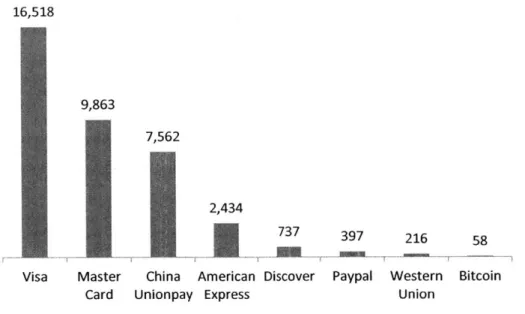
On the one hand Bitcoin is not yet generally accepted. You can't buy a bag of chips, a new BMW, or get paid in bitcoin. Today, Bitcoin allows you to buy only a limited set of goods and services (some examples are outlined in epigraph 3 of Chapter 2). As a result of this, the magnitude of the transactions is still very small relative to other payment systems. Bitcoin has not yet achieved (and may never achieve) mass adoption.
Figure 9: Average daily payment volume (million dollar) 16,518 9,863 7,562 2,434 737 397 216 58
Visa Master China American Discover Paypal Western Bitcoin Card Unionpay Express Union
Source: The Nielsen Report, company websites, Sterne Agee, as per September 2014
On the other hand, even merchants that accept bitcoin most frequently set up prices in their local currency (i.e.: dollar) and then convert to the spot Bitcoin/local currency
exchange rate at the time of a transaction. For example, on the 22nd April 2015, the price of
a standard laptop in Dell website was 741$. The option to pay Bitcoin was available. You could pay 3.13 bitcoin (at the prevailing exchange rate of 237$/bitcoin). In this context, Bitcoin is only a secondary benchmark of value. Price of goods is set up in dollars and then converted to Bitcoin.
Microsoft is another example of a retailer that accepts Bitcoin payments. However,
Microsoft is not yet accepting direct payments for its goods. Today, you can add money to your Microsoft account using your Bitcoin. And then, buy goods at Microsoft online store. The option to pay directly for goods does not yet exist.
This risk averse attitude by merchants is natural. Bitcoin track record has been extremely volatile. The cost base of merchants is in their local currencies (not in Bitcoin). Therefore, they prefer to limit their exposure to this extreme price volatility.
2.2. Mean of exchange
Confidence is the most important asset for fiat money. One will only accept money if he is confident that others will also accept it. General acceptance is a key feature for an
instrument to gain the right to be defined as money.
Money is only useful if it allows its holder to buy multiple goods and services. Otherwise, it would not be money but a token or voucher that is only accepted in exchange for a very narrow set of goods or services.
For example, a Starbucks voucher may not be defined as money. It provides you the right to acquire a single good (coffee) in a relatively small set of places (Starbucks shops). With these limitations, clearly a Starbucks voucher is not enough to qualify as a proper mean of exchange.
Different citizen may have different objectives when adopting bitcoin. They may want to buy bitcoin and hold it, putting an emphasis on the store of value that we will visit on the next epigraph. Or they may want to buy and sell bitcoin, putting an emphasis on the mean of exchange.
Does Bitcoin qualify as a mean of exchange? Bitcoin is not backed by an asset (gold) or a sovereign institution (traditional currency). Hence, confidence is the greatest asset. In order for Bitcoin to qualify as mean of exchange, Again, the general acceptance in a broad spectrum of transactions and merchants would be required.
A number of reasons encourage merchants to accept Bitcoin payments. Transactions carry
substantially lower fees than credit card transactions. A merchant has two options when accepting bitcoin payment. The merchant can either keep the bitcoin and avoid the volatility risk or automatically convert them to local currency (i.e.: dollar). The former carries a fee of around 0%; the latter would cost the merchant around 1%. In both cases, transactions carry lower fees than debit and credit cards (around 3%).
There are other benefits for merchants of accepting Bitcoin. Some are tangible: merchants receive Bitcoin payments in as little as ten minutes vs. several days or weeks for debit and
credit card transactions. Others are intangible. For example, it helps them to attract a specific segment of customers,
Accepting Bitcoin payments is generally attractive for merchants. However, the appeal for end customers to adopt Bitcoin is unclear.
Ideology (absence of central banking authority), privacy (anonymity or pseudonymity of transactions), potential appreciation (albeit with a risk), and ease of use (with potential to bring on board unbanked or underbanked people into the system) are advantages of the adoption of Bitcoin.
On the other hand, Bitcoin presents a number of disadvantages. Bitcoin has been extremely volatile in the past. This makes it risky to hold Bitcoin relative to traditional money. There are no economic incentives (of a similar nature than those of merchant) for individuals to adopt bitcoin, and the payment process may take up to 10 minutes per transaction making it inconvenient to use.
Bitcoin has experimented a strong growth of its adoption to date, measured by the
increasing number of daily transactions (97,000 as per 22nd April 2015) and the number of merchants that accept it (over 100,000, as per February 2015). However, the mixed
balance of the appetite for individuals to adopt Bitcoin poses a serious threat to the potential for Bitcoin to emerge as a generally accepted currency.
Bitcoin still represents a very limited number of transactions relative to other payment systems (debit and credit cards). However, there is a clear upward trend in the daily
number of BTC transactions. Average number of daily transactions has grown from 5,200 (in 2011) to 67,000 (in 2014) and to 97,000 (in 2015 till 22nd April). Should this strong upward trend in the number of Bitcoin transactions continue, there is potential for Bitcoin to emerge as a generally accepted form of transaction.
Figure 10: Daily number of BTC transactions 140,000 120,000 100,000 80,000 60,000 40,000 20,000
0
-Source: www.blockchain.info as of April 2015
2.3.
Deposit of value
The third traditional function of money is deposit of value. The value of money stays relatively stable in the future. If you hold one dollar today, the purchasing power of that dollar in one day, one month, or one year will be relatively similar. In practice, it may decline (if inflation exists) or increase (if deflation exists). However, these deviations will generally not be significant.
Money allows people to postpone their decision to consume. If a family earns 75,000 and spends 60,000 dollars in a given timeframe, they will save 15,000 dollars. In order for them to save any money, they will need to be confident that they will be able to spend that saved
money in the future. In environments with extremely high inflation, families tend not to save any money and to acquire as many durable goods as possible. This has been the case in Venezuela or Zimbabwe in recent periods of high inflation.
In the previous paragraph we discussed money as a mean of exchange. In that context, "buy and sell" function, the ability to execute transactions (acquire goods and services paying with money), was paramount. Now we are covering the deposit of value function of money.
protection. Speculators will also expect capital appreciation and consequently bear a risk for holding that asset.
Does Bitcoin qualify as an appropriate store of value? In my opinion, today the answer to this question is negative.
Since its creation in 2009, the price of Bitcoin has been extremely volatile. Figure 2 in page
13 shows the evolution of the price of Bitcoin since its creation in 2009. To name just three
three data points, Bitcoin was largely trading under 1 dollar until April 2011, it went up to over 1,000 dollars in December 2013, and is trading at around 237 dollars as of the 22nd of
April 2015. These references show the extreme volatility of Bitcoin. The extreme volatility results in
Bitcoin seeks to achieve mass adoption. However, this extreme price volatility is a serious obstacle for Bitcoin to achieve that ambitious objective. All players will take measures to reduce or avoid volatility risk. End users will not feel comfortable holding Bitcoin balances, merchants that accept Bitcoin payments will automatically convert them to their local currencies, and miners will diminish their investment in mining equipment.
In "Bitcoin as Money?", Stephanie Lo and
J.
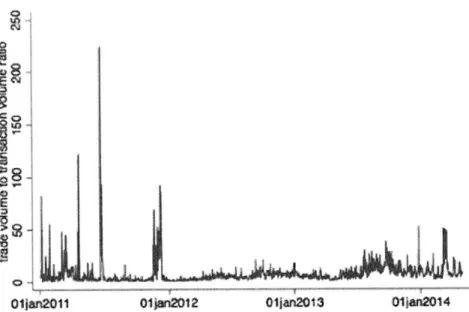
Christina Wang, of the Federal Reserve Bank of Boston identify and separate two main uses of Bitcoin. On the one hand, Bitcoin is used for transacting (acquiring goods and services). On the other hand, it is used for investing (acquiring Bitcoin on the hope that its price will go up in the future).Their analysis defines two metrics to differentiate the use for transacting and investing. The former is defined as "the estimated number of bitcoin sent over the Bitcoin network". The latter is defined as "number of bitcoin trades on exchanges againstfiat currencies".
Figure 11: Transacting vs. Investing ratio
011an2011 01jwn2O12 Oljan2013 01jan2014
Source: "'Bitcoin as Money?", Stephanie Lo and Christina Wang, Federal Reserve Bank of Boston
The chart describes the ratio between Bitcoin use for Transacting vs. Investing. The higher the ratio, the more it is used for Transacting (i.e.: mean of exchange) vs. Investing (i.e.: deposit of value). The chart shows a growing (albeit moderately) use of Bitcoin as a mean of exchange.
2.4. Key takeaways
Comments Overall rating
V Prices in Bitcoin available for several goods
Unit of account Bitcoin is divisible to accommodate transactions of smaller value
X Prices are generally set on local currencies, then converted to Bitcoin
Low transaction costs
Quicker execution of transactions
Mean of exchange Useful instrument for the unbanked
No central authority, independent verification
X Bitcoin accepted by a very limited number of merchants Limited supply (21 million); long term value increase?
May be attractive in turmoil periods (EU bailout of Cyprus) or in
Store of value countries with high inflation (Argentine, Venezuela, etc.)
3. Perspectives on the Fair Value of Bitcoin
Bitcoin is a powerful platform for payments and has some elements in common with money. In this context: How much should Bitcoin be worth?
Research departments of Investment banks, such as Goldman Sachs and UBS, issue
valuation recommendations of stocks, bonds, and commodities on a daily basis. Typically, they perform an analysis that results into an assessment of the fair value of an asset. Depending on the market trading of the asset relative to the fair value, the resulting recommendation is to Buy/Hold/Sell that asset.
A number of banks have issued research reports on Bitcoins. However, only two have
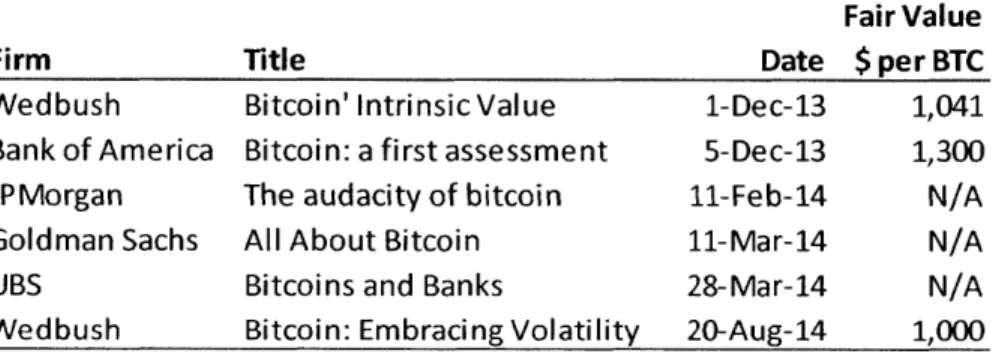
provided a fair value recommendation for Bitcoin. The table below shows some illustrative examples.
Figure 12: Illustrative reports on Bitcoin
Fair Value
Firm Title Date $ per BTC
Wedbush Bitcoin' Intrinsic Value 1-De c-13 1,041
Bank of America Bitcoin: a first assessment 5-Dec-13 1,300
JPMorgan The audacity of bitcoin 11-Feb-14 N/A
Goldman Sachs All About Bitcoin 11-Mar-14 N/A
UBS Bitcoins and Banks 28-Mar-14 N/A
Wedbush Bitcoin: Embracing Volatility 20-Aug-14 1,000
Source: Self-elaborated on the basis of selected Broker Research reports on Bitcoin
Wedbush and Bank of America have been determined enough to establish a target valuation for Bitcoin, despite its track record of excessive volatility.
3.1. Wedbush
Wedbush: "Bitcoin Intrinsic Value" (published on the 1st of December 2013) valued Bitcoin at 1,041 USD. The analysis identifies three key areas where adoption and usage of Bitcoin may grow exponentially: "disruptive payment network technology, alternative uncorrelated
According to the analysis, the success of Bitcoin in the above areas will determine the value drivers for Bitcoin: Penetration of potential demand, and Years to achieve such penetration. Wedbush established a fair valuation for Bitcoin of 1,041 USD, contingent on Bitcoin
transactions achieving a 1% penetration (i.e.: one in one hundred transactions takes place via Bitcoin) over a ten year period time frame. The chart below shows the sensitivity of the valuations of Bitcoin expected by Wedbush depending on the future adoption of Bitcoin as
a percentage of the total transactions and on how quickly that adoption happens. Wedbush identifies three areas where Bitcoin can potentially win market share: global
foreign currency reserves, money supply in high inflation countries (such as Venezuela, Iran, Argentina, or Syria), and Gold as a Financial Asset.
Bitcoin thrives in the context of market inefficiencies. Argentina is a clear example: it has extremely high inflation (officially 24% in 2014, unofficial estimates 40%) and currency controls that set artificial obstacles to the free movement of capitals. In order to encourage the use of the local currency (el peso argentino), the government has established rigid currency controls that make it expensive to make payments in international currencies (euro or dollar).
Overall, payments in dollars carry 30% transaction costs in Argentina. This figure incorporates the duties, divergence between the official exchange rate and the black market one, and the credit card fees. Furthermore, it takes an average of 20 days for the international payment to arrive to Argentina. Obviously, these make it burdensome to accept international payments.
An insightful article by the New York Times (Can Bitcoin conquer Argentina, 3rd May 2015)
explores the rise in the usage of Bitcoin. Platforms like BitPagos have been very successful in facilitating credit card payments from foreign clients. This enabled merchants (hotels, retailers, etc.) to receive credit card payments from foreign customers moving their money in and out of Argentina via Bitcoin transactions. And hence, avoiding the 30% transaction fees.
Some merchants are starting to pass on part of the savings to customers that pay using Bitcoin. This is the case of Avalancha (www.avalancha.com), an Argentinian online retailer that offers 10% discount to clients that pay using Bitcoin. It is a win-win situation for the company and its customers. The former saves money (30% average transaction fee) and receives the payment sooner (immediately rather than in 20 days). The latter receive a
10% discount.
This example shows the case for companies and customers adopting Bitcoin, particularly in geographic locations where inefficiencies, such as high inflation or foreign currency
controls take place.
Figure 13: Bitcoin price drivers as per Wedbush analysis (December 2013)
Years to Achieving Peak Penetration
20 10 5 1 1% $520 $1,041 $2,081 $10,407 o ra 0 5% 2,602 5,204 10,407 52,035 C 10% 5,204 10,407 20,814 104,070 - 20% 10,407 20,814 41,628 208,141 )(Mi millions,
Global. Foreign Currency Resenes $7,453,736
Money Supply in High Infation Countries $4,305,488
Gold as Financial Asset $1,900,000
Total Potential Aggregate Demand $13,659,224
Estimated supply in 2014 13 million BTC
Source: Wedbush: "Bitcoin Intrinsic Value", issued on the 1st of December 2013
In August 2014, Wedbush issued another report with another valuation methodology. The report identified three potential scenarios for the valuation of Bitcoin.
In the bearish scenario, Bitcoin is valued at 0 based on: other virtual currency overtakes Bitcoin, fatal error happens, or Bitcoin is made illegal. The document attributes a 50%
probability to this scenario. Hence, the probability weighted value of Bitcoin in this scenario is 0.
In the base scenario, Bitcoin is valued at 1,000$ based on the crypto currency being successful in niche sectors (remittances, etc.). The document attributes a 49.95% probability to this scenario. Hence, the probability weighted value of Bitcoin in this scenario is 499.50$.
In the bullish scenario, Bitcoin is valued at 1,000,000$ based on the crypto currency becoming the global working capital for trade. The document attributes a 0.05% probability to this scenario. Hence, the probability weighted value of Bitcoin in this
scenario is 500$.
According to this theory, the volatility of the price of Bitcoin (see Figure 2 in page 14) is explained by the changing expectations of investors on the likelihood of every scenario. For example, if investors attribute a 0.01% more chances to the bullish scenario, this would result in approximately 100$ more of valuation for Bitcoin. This extreme sensitivity is therefore driving the volatility of the price of Bitcoin.
Figure 14: Bitcoin price drivers as per Wedbush analysis (August 2014)
SOvertaken by anotter coin
* Fatal ffaw uncowred
-Bmoadly made illegial with strict enforcement
$0 50.00% $0.00
-Specific use cases take hold (e.g. remittance, micro transactions, $1,000 49.95% $499.50
machine--o-machne, etc.)
- -Bitcoan becomes global working capital of trade (S20 trillion monetary $1,000,000 0.05% $5W.00
Probability-welgIhted outcome $999.50
Source: Wedbush: "Embracing Volatility: Trading as Bitcoin's First Killer App", issued on the 20th August 2014
3.2. Bank of America
Bank of America: "Bitcoin: afirst assessment" (published on the 5th of December 2013) valued Bitcoin at 1,300 USD. According to Bank of America, Bitcoin has the potential to
"become a major mean of paymentfor e-commerce and may emerge as a serious competitor to traditional money transfer providers". Furthermore, Bank of America believes that Bitcoins has "clear potentialfor growth as a medium of exchange".
In December 2013, Bitcoin was trading at over 1,000 USD. At that time, Bank of America report established a fair valuation for Bitcoin of 1,300 USD (or market capitalization of 15 billion USD). However, this valuation was contingent on two aggressive statements:
1. Bitcoin becoming a "major player in both ecommerce and money transfer" 2. Bitcoin achieving a "significant store of value with a reputation close to silver"
3. Ultimately, a valuation of 1,300 USD assumes that Bitcoin captures "10% of e-commerce or money transfers"
Despite the high valuation attributed to Bitcoin, the report is cautious. It mentions that the "1 00fold increase in Bitcoin prices thisyear is at risk of running ahead ofitsfundamentals". In order to explain the value drivers for Bitcoin, Bank of America separately analyzes the value of Bitcoin as a mean of exchange and as a store of value.
Bitcoin attributes two value drivers as a mean of exchange: Bitcoin is used as a mean of payment of e-commerce transactions and for money transfers (i.e.: remittances). These two functions are valued separately.
As a mean of payment for e-commerce transactions, Bank of America observes that on average US families hold 4 cents for every 1$ they spend over the year. Bank of America also notes that B2C e-commerce sales in the US totaled 224$ billion in 2012. In this context, "households would set aside 10$ billion [around 4% of the B2C e-commerce sales]for their on-line shopping".
If we assume that Bitcoin "willgrow to accountfor the payment of 10% of all on-line shopping, this would suggest that US households would want to have a balance of 1$ billion worth of Bitcoins". Bank of America assumes that the US represents a fifth of the world's GDP. And hence the total balance of Bitcoin required in the world would be 5$ billion.
As a mean for sending money (i.e.: remittances), Bank of America makes the assumption that Bitcoin will become one of the top three players in the money transfer industry. "Given Bitcoin's supply isfixed, when one buys a Bitcoin, one is acquiring not only a medium of exchange but also an investment in the enterprise value of Bitcoin. Bitcoin's market
capitalization could be viewed as its enterprise value. With the average market capitalization of Western Union, MoneyGram and Euronet at about 4.5$ billion, we will add this number to
the maximum market capitalization of Bitcoin's role as a medium of exchange."
In this context, Bank of America notes that the maximum market capitalization for Bitcoin's as a medium of exchange =
5$ bn (for B2C e-commerce) + 4.5$ bn (mean for payments) = 9.5$ bn
Today there are 14 million bitcoin issued. Hence, the maximum value for Bitcoin as mean of exchange should be around 650$/bitcoin (9.5$ bn/14m). This is far above the current trading value of 237$/bitcoin as per 22nd April 2015.
On the other hand, Bank of America assesses Bitcoin as store of value. The report notes that Bitcoin does not pay any interest (unlike typical financial instruments). In this context, Bitcoin has some similarities to precious metals or cash, the report notes.
The first potential benchmark for Bitcoin as a store of value is gold. According to Bank of America, "the current outstanding value ofgold bar/coins/ETFs is about 1.3$ trn". However, the volatility of Bitcoin is five times larger than that of gold. Hence, Bitcoin as a store of value is worth in the most optimistic scenario five times less than gold: 300$ million.
Furthermore, "the reputation of gold as a unique and safe store of value has been growing for the past ten thousand years. It will take some timefor Bitcoins to acquire that reputation. We don't know how to quantify the value ofgold's reputation, but this reputation is probably the main reason that its value is 60 times that ofsilver". In this context, the report states that "if we were to assume that Bitcoin were to eventually acquire the reputation of silver (which is an extremely ambitious assumption), this suggests that Bitcoin market capitalization for its role as a store of value could reach 5$ billion".
As a result of the above, the maximum market capitalization for Bitcoin's as a store of value is 5$ billion.
Bank of America therefore concludes that the maximum overall market capitalization for Bitcoin is 14.5$ billion (9.5$ billion as mean of exchange and 5$ billion as deposit of value). Today, this would suggest a total valuation for Bitcoin of around 1,000$/bitcoin (14.5$
billion/14 million). Again, this is far above the current trading value of 237$/bitcoin as per
22nd April 2015.
3.3.
Bitcoin Investment Trust
Bitcoin Investment Trust ("BIT") is a fund that allows investors to gain exposure to Bitcoin in an officially regulated investment vehicle. BIT is listed in the Over the Counter Markets Group with the ticker: GBTC. SecondMarket, a US based broker dealer (registered by US regulator FINRA) acts as marketer, distributor, and custodian for this fund. Ernst & Young is the auditor.
Every share in BIT represents a tenth of a Bitcoin. Therefore, if you own ten shares of BIT, you indirectly own one Bitcoin. This official vehicle opens Bitcoin as an investment option
for several people willing to invest in Bitcoin without going through the normal hurdles (opening an account in an intermediary or wallet, keeping the password in a safe place, etc.).
BIT facilitates Bitcoin enthusiasts to invest in Bitcoin their Individual Retirement Accounts, 401ks, and other brokerage and investor accounts. It is an aggressive proposition to invest your pension in Bitcoin given the extreme past volatility. However, it is positive that the option is available for those willing to take the risk.
On the negative side, it has a 2% annual administrative and safekeeping fee. This fee is large, in line with the fees that other funds charge for similar services.
A very interesting feature of BIT is that it provides an indirect measure of the value of
Bitcoin. Only accredited investors (those with annual income >200,000$ or total assets >
1,000,000$) can invest in BIT. Therefore, the trading value of BIT may be interpreted as the
On May 5th, 2015 BIT went public. Over the first two days, BIT had been trading at between 37 and 55$. Remember that every share in BIT represents a tenth of a Bitcoin. This implies
a value for one Bitcoin of 370 and 550$ respectively, far above the trading value of 230$ at the time.
It is far too early (and too limited of a data set) to draw conclusions. However, the success of Bitcoin Investment Trust sends a positive signal to the market: accredited investors do not only see Bitcoin as an attractive investment option, but are also keen to pay a premium for it.
Figure 15: Bitcoin Investment Trust key facts
SUMMARY INFORMATION
Septemer
an3Sponsor
Each -8fT share repr-esented
n ip of o, bitcoi
.Vy O i C rpO AP P
LL IiFrmriy ACAM41
sideyApstin LLP
ET .< &Young
C orti r ",a I Stix k
PrNS C Tnwst Millennium Tust hf Secnd&amon
B
C N Source: www.bitcointrust.co3.4. Key takeaways
* Almost all the relevant Investment Banks (Goldman Sachs, JPMorgan, UBS, Deutsche Bank, etc.) have issued various research notes on Bitcoin. However, only two
(Wedbush and Bank of America) have been determined enough to provide valuation analysis on Bitcoins. This is understandable, given the recent origin of Bitcoin, its innovative nature (and consequently lack of comparable realities), extreme price volatility, and complex underlying drivers. Even Wedbush and Bank of America have not continued providing updates on the valuation of Bitcoin.
* The two reports (Wedbush and Bank of America) that contain explicit valuation analysis were issued in early December 2013, at the time where the valuation of Bitcoin reached over 1,000$/bitcoin, its maximum level since its creation in 2009. Today, Bitcoin trades at a substantially lower level: 237$/bitcoin as of 22nd April
2015. Critics say that equity research analysts are better at explaining what
happened in the past than forecasting what will happen in the future. In this case, both Wedbush and Bank of America expressed their concerns about the
unsustainably high valuation level that Bitcoin was trading at.
* It is extremely difficult to forecast the price of Bitcoin, even for industry experts. The valuation presented by Wedbush and Bank of America relies on some indirect
valuation mechanism. For example, Wedbush estimates the areas where Bitcoin may have a competitive advantage (foreign currency and gold reserves, store of value in high inflation countries), and presents the value of Bitcoin as a function of what share of those areas will Bitcoin achieve (1-20%) and how quickly will Bitcoin achieve that status (1-20 years). On another note, Wedbush presents three potential scenarios for the adoption of Bitcoin (base, bullish, and bearish) and presents the probabilities of each scenario as the key value driver. On the other hand, Bank of America presents a bottom up analysis of the value of Bitcoin on the basis of its attractive as a mean of exchange and deposit of value.
Chapter 3
-
Bitcoin as an alternative to payers and
merchants
Bitcoin has transformed the process of executing a payment in the same way that email transformed the traditional post services. However, it still lacks sufficient scale among customers (people willing to use Bitcoin in their everyday lives) or merchants (merchants willing to accept Bitcoin payments). In order to become a relevant payment service, Bitcoin should achieve mass adoption.
Overall, Bitcoin transactions cost is extremely low and its execution is substantially quicker relative to traditional payment systems. However, irreversibility, lack of identification, and need for internet access may be inconvenient for certain merchants and end-customers. Bitcoin is a framework that allows developers to continuously improve its configuration. Individuals, start-ups, and venture capitals have developed applications to improve the functionalities of Bitcoin and overcome its obstacles. For example, apps have been
developed to expedite the payment process or allow merchants to immediately convert the bitcoins they receive into other currencies (dollar, euro, etc.).
1. Key features
The following features are crucial when assessing the merits of Bitcoin versus other payment systems.
1.1. Ten minutes delay
On average, it only takes as little as ten minutes to confirm and execute a Bitcoin transaction.
This means that bitcoin payments may go from the sender to the recipient in only ten minutes. This is a remarkably short time lapse relative to other payment systems. For example, it takes two to three weeks for merchants to receive payments from credit cards, and one day (local) to one week (international) for bank transfers to be executed.
On the other hand, ten minutes is too big of a time lapse for the confirmation of an offline transaction. Imagine a restaurant having to wait ten minutes every time a client wants to pay using Bitcoin. That would introduce a big inefficiency in the restaurant: lines of people waiting, lower turnover of tables and customers, etc.
In this context, a number of applications have been designed by independent developers (i.e.: Bitpay, Liberty Teller, and Shopify among others) to tackle this problem. These applications eliminate the time lapse when accepting payments on store. This objective is sometimes achieved through transferring Bitcoin as gift vouchers like e-wallets.
For example, MIT Coop, the store at MIT University that sells textbooks, supplies and school stuff, accepts payments in Bitcoin both on store and online. The solution has been provided by Bitpay, a Bitcoin payment service provider and is getting increasingly popular in an ecosystem that is inclined to technological innovations: MIT itself has a clear technical focus and the city of Cambridge hosts several tech (Google, Microsoft) and
healthcare/biotech (Takeda, Pfizer, Sanofi) companies.
1.2. Irreversibility
Unlike debit and credit card payments, Bitcoin transactions may not be reversed. Once a Bitcoin transaction has been verified it is final. This presents unbalanced implications for merchant and customer. More specifically, merchants receive too much power relative to end customers.
Recently, I was checking my credit card statement when I noticed that I had been charged twice for a hotel stay. I called my credit card provider, explained the situation, and got an immediate refund of my overpayment. This quick fix would not have been possible if the payment had been done through Bitcoin.
Irreversibility of Bitcoin transactions introduces hassles for both merchant (it adds process complexity, refunds have to be implemented as new transactions of opposite signs) and customer (uncertainty, customer protection).
What if a transaction is sent to a wrong destination? What if the transaction is sent for the incorrect amount (i.e.: 10 bitcoin instead of 1.0 bitcoin)? The solution to these potential