Biophysical coupling between turbulence, veliger behavior,
and larval supply
by
Heidi L. Fuchs
B.S., University of Wisconsin – Madison (1990) B.S., University of Wyoming (1999)
Submitted in partial fulfillment of the requirements for the degree of Doctor of Philosophy in Biological Oceanography
at the
MASSACHUSETTS INSTITUTE OF TECHNOLOGY and
WOODS HOLE OCEANOGRAPHIC INSTITUTION September 2005
© Heidi L. Fuchs 2005. All rights reserved.
The author hereby grants to MIT and WHOI permission to reproduce and distribute publicly paper and electronic copies of this thesis document in whole or in part.
Author . . . . MIT/WHOI Joint Program in Applied Ocean Science and Engineering
02 September 2005 Certified by . . . . Lauren S. Mullineaux Senior Scientist Woods Hole Oceanographic Institution Thesis Supervisor
Accepted by . . . . John Waterbury Chairman, Joint Committee for Biological Oceanography Woods Hole Oceanographic Institution
Biophysical coupling between turbulence, veliger behavior,
and larval supply
by
Heidi L. Fuchs
Submitted to the MIT/WHOI Joint Program in Applied Ocean Science and Engineering on 02 September 2005, in partial fulfillment of the
requirements for the degrees of
Doctor of Philosophy in Biological Oceanography Abstract
The goals of this thesis were to quantify the behavior of gastropod larvae (mud snails Ilyanassa obsoleta) in turbulence, and to investigate how that behavior affects larval supply in a turbulent coastal inlet. Gastropod larvae retract their velums and sink rapidly in strong turbulence. Turbulence-induced sinking would be an adaptive behavior if it resulted in increased larval supply and enhanced settlement in suitable coastal habitats.
In laboratory experiments, mud snail larvae were found to have three behavioral modes: swimming, hovering, and sinking. The proportion of sinking larvae increased exponentially with the turbulence dissipation rate over a range comparable to turbulence in a tidal in-let, and the mean larval vertical velocity shifted from upward to downward in turbulence resembling energetic nearshore areas.
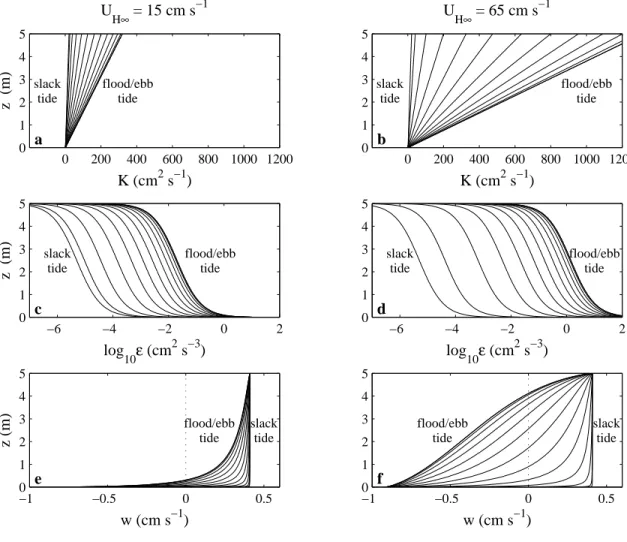
The larval response to turbulence was incorporated in a vertical advection-diffusion model to characterize the effects of this behavior on larval supply and settlement in a tidal channel. Compared to passive larvae, larvae that sink in turbulence have higher near-bed concentrations throughout flood and ebb tides. This high larval supply enables behaving larvae to settle more successfully than passive larvae in strong currents characteristic of turbulent tidal inlets.
A study was conducted at Barnstable Harbor, MA to estimate the responses of lar-vae to turbulence in the field. Gastropod larlar-vae from different coastal environments had genus-specific responses to turbulence, suggesting that larvae use turbulence for large-scale habitat selection. On ebb tides, mud snail larvae had a similar response to turbulence as in the laboratory, with greater sinking velocities in strong turbulence. Behavior estimates differed for flood and ebb tides, indicating that additional physical cues influence behavior. Turbulence-induced sinking behavior would enhance retention and promote settlement of mud snail larvae in habitats like Barnstable Harbor.
Thesis Supervisor: Lauren S. Mullineaux Title: Senior Scientist
Biophysical coupling between turbulence, veliger behavior,
and larval supply
by
Heidi L. Fuchs
Submitted to the MIT/WHOI Joint Program in Applied Ocean Science and Engineering on 02 September 2005, in partial fulfillment of the
requirements for the degrees of
Doctor of Philosophy in Biological Oceanography Abstract
The goals of this thesis were to quantify the behavior of mud snail larvae (Ilyanassa obso-leta) in turbulence, and to investigate how that behavior affects larval supply in a turbulent coastal inlet. Gastropod larvae retract their velums and sink rapidly in strong turbu-lence. In laboratory experiments, mud snail larvae had three behavioral modes: swimming, hovering, and sinking. The proportion of sinking larvae increased exponentially with the turbulence dissipation rate and the mean larval vertical velocity shifted from upward to downward in turbulence comparable energetic tidal inlets. Modeling results showed that compared to passive larvae, larvae that sink in turbulence have higher near-bed concen-trations throughout flood and ebb tides. This high larval supply enables behaving larvae to settle more successfully than passive larvae in strong currents characteristic of turbu-lent tidal inlets. In a field study, gastropod larvae from different coastal environments had genus-specific responses to turbulence, suggesting that larvae use turbulence for large-scale habitat selection. Mud snail larvae on ebb tides had a similar response to turbulence as in the laboratory, but behavior was influenced by additional cues on flood tides. Turbulence-induced sinking behavior would increase larval supply and promote settlement of mud snail larvae in favorable coastal habitats.
Thesis Supervisor: Lauren S. Mullineaux Title: Senior Scientist
Acknowledgments
I am grateful to my advisor Lauren Mullineaux for adopting me into her lab in my second year, for giving me the freedom to pursue this research, and for being such an excellent role model. Thanks also to my committee, Mike Neubert, Rudy Scheltema, Glenn Flierl, Danny Gr¨unbaum, and Scott Gallager for all of their helpful suggestions. I’m grateful to Mike for his encouragement and for showing me how math should be taught. I’m grateful to Rudy for introducing me to the beautiful world of larvae, and for taking me to Antarctica. Thanks to Glenn for filling the post of MIT committee member, and for his many insightful comments. Thanks to Danny for his willingness to be on my committee and for several enlightening discussions about modeling. I’m grateful to Andy Solow for his kindness and patience; his input made my thesis better and gave me a real appreciation for statistics.
Thanks to Hal Caswell, Mike Neubert, and everyone in their labs for letting me attend lab meetings and Nantucket retreats; I learned a lot and was inspired by their great collab-oration. Thanks also to John Trowbridge, Steve Elgar, Jim Lerczak, Sandy Williams, Gene Terray, and Britt Raubenheimer for their patience and willingness to explain to a biologist about turbulence and how to measure it.
My lab and field studies would have been impossible without help from many people. Jay Sisson provided technical assistance on many aspects of lab and field work, and saved the day more than once. Peter Schultz and Jim Thompson gave technical advice and did several dives to deploy/recover current meters. Stace Beaulieu and Nan Trowbridge also provided dive support. Three guest students Lynne Davies, Michael Workman, and Yuri Yamashita spent their summers laboring over my larvae. Ken Houtler, Matt Gould, Marga McElroy, Mark Dennett, Jonathan Murray, Carly Strasser, Tin Klanscek, Linda Kalnejais, and Rob Jennings drove boats and assisted with sampling on my many harbor cruises. Jim Lerczak, Rocky Geyer, Steve Elgar, Sandy Williams, Gene Terray, Lisa Levin, Wade McGillis, and Scott Gallager loaned me their instruments and equipment. Sean McKenna introduced me to the turbulence tank. Dave Kulis provided algae. Erik Anderson and Erich Horgan, and Jim Leichter gave helpful advice. Fabian Tapia, Rob Jennings, and Margaret Boettcher helped collect snaill egg capsules in the field. The Barnstable Harbormasters were helpful in selecting the field study sites, and Millway Marina provided a mooring.
Thanks to Lara, Rob, Carly, Diane, Susan, Stace, Fabian and Jim for being wonderful labmates. Thanks to Claudio DiBacco for being a great mentor. Thanks also to Ami Schel-tema, Vicke Starczak, Nan Trowbridge, Gareth Lawson, and Kristin Gribble for making Redfield a friendlier place. Thanks to the WHOI Academic Program office - Julia, Marcia,
John, and Judy – for taking such great care of us Joint Program students.
My deepest gratitude to the friends that made my time on the East Coast so enjoyable: Linda, Mea, Margaret, Joe, Sarah, Kristy, John, Jonathan, Jeff and Cara, Rose, Charlie, Rhea, Fabian, Heather and Michael, Jeff and Tetjana, Bea, Carlos and Jessica. Without them I might have run away long ago. Thanks also to my family.
Unpublished sections of this thesis hopefully will result in publications co-authored by Mike Neubert (Chapter 3) and by Andy Solow and Lauren Mullineaux (Chapter 4).
Financial support was provided by a National Science Foundation Graduate Research Fellowship, the WHOI Academic Programs Office, a WHOI Coastal Ocean Institute grant, a WHOI Mellon independent study grant to L. S. Mullineaux and M. G. Neubert, a Sea Grant New Initiative grant (Grant No. NA16RG2273, project no. R/O-38-PD), the WHOI Biology department, and the Rinehart Coastal Research Center.
Contents
1 Introduction 9
1.0.1 Mud Snails . . . 9
1.0.2 Turbulence . . . 10
1.0.3 Thesis Overview . . . 11
2 Sinking behavior of gastropod larvae (Ilyanassa obsoleta) in turbulence 15 3 Sinking in turbulence: Effects of larval behavior on larval supply and settlement in tidal currents 29 3.1 Introduction . . . 29
3.2 Model Descriptions . . . 31
3.2.1 Advection-Diffusion Model . . . 31
3.2.2 Physical Parameters . . . 32
3.2.3 Behavioral Parameters . . . 35
3.2.4 Estimating Larval Supply and Settlement . . . 35
3.2.5 Particle-Tracking Model . . . 38
3.3 Results . . . 41
3.3.1 Larval Supply . . . 41
3.3.2 Settlement Success . . . 43
3.3.3 Advection-Diffusion vs. Particle Tracking model . . . 48
3.4 Discussion . . . 48
3.4.1 Larval Supply . . . 48
3.4.2 Settlement Success . . . 49
4 Larval behavior in turbulence: Maximum-likelihood estimates from field plankton distributions 55 4.1 Introduction . . . 55
4.2 Methods . . . 57 4.2.1 Plankton Samples . . . 57 4.2.2 Current Measurements . . . 58 4.3 Analysis . . . 59 4.3.1 Current Measurements . . . 59 4.3.2 Advection-Diffusion Model . . . 60
4.3.3 Maximum Likelihood Estimation of Behavior . . . 61
4.3.4 Model assumptions . . . 64
4.4 Results . . . 65
4.4.1 Current Measurements . . . 65
4.4.2 Plankton Profiles . . . 66
4.4.3 Maximum-Likelihood Behavior Estimates . . . 66
4.5 Discussion . . . 68
4.5.1 Hydrodynamics . . . 68
4.5.2 Plankton Variability . . . 69
4.5.3 Larval Behavior . . . 70
4.5.4 Summary . . . 72
5 Summary and Conclusions 93 5.1 Summary of Results . . . 93
5.2 Evolutionary Context . . . 94
5.3 Unanswered Questions and Future Work . . . 95
5.3.1 Laboratory vs. field estimates of behavior . . . 95
5.3.2 Omissions of the model . . . 96
5.3.3 Future work . . . 96
5.4 Significance . . . 97
A Web appendix (Chapter 2) 101
B Diffusivity and Dissipation Estimates for Maximum Likelihood Analysis
Chapter 1
Introduction
Many benthic invertebrates disperse via planktonic larvae whose behavior potentially in-fluences large-scale settlement patterns. Larval dispersal and settlement are the result of coupled physical and biological processes. Larval behavior (swimming or sinking) allows larvae to transport themselves vertically, and vertical movement can affect the horizontal transport of larvae by positioning them in particular currents. Vertical swimming or sinking also affects the supply of competent larvae to bottom substrates prior to settlement. Larvae that respond opportunistically to environmental cues are more likely to settle in suitable coastal habitats.
Gastropod larvae sink in turbulence, and this behavior is expected to affect the supply of larvae to benthic habitats. I define larval supply as the concentration of larvae near the bottom, because near-bottom larvae are available for settlement. Larval supply is influenced not only by behavioral responses to small-scale turbulence, but also by larger scale vertical mixing. These complex biophysical interactions control the delivery of larvae to benthic habitats. My goal was to investigate the interactions between turbulence, larval behavior, and larval supply of intertidal gastropods.
1.0.1 Mud Snails
Mud snails (Ilyanassa obsoleta) were used as a model organism because they are significant and conspicuously abundant (Fig. 1-1) members of the intertidal community. Mud snails are benthic engineers – they rework sediments, ingest recently-settled larvae [4], and alter the distributions of other organisms through disturbance [2, 3] and competition. Mud snails are also infamous as the intermediate hosts of many duck and fish parasites [1], and as unwanted invaders of west coast habitats [5].
Mud Snails
a
b
Figure 1-1: (a) Mud snail aggregations on intertidal flats of Barnstable Harbor, MA and (b) mud snail larvae that are ready to settle.
Mud snail larvae spend 1.5 to 4 weeks in the plankton before settling. When mud snail larvae are competent to metamorphose, they can select substrates for settlement over small scales [6]. Behaviors of mud snail larvae in the water column were unknown. This thesis describes the behavior of mud snail larvae in turbulence, and the potential effects of this behavior on larval supply and settlement.
1.0.2 Turbulence
Two aspects of turbulence are important in this thesis. The first is turbulence at the larval scale (mm’s). Larvae interact with the smallest eddies, described by the Kolmogorov microscales η (length scale), τ (time scale), and υ (velocity scale). These scales are related to the kinematic viscosity ν and the energy dissipation rate ε [7] by
η = µ ν3 ε ¶1 4 (1.1) τ =³ ν ε ´1 2 (1.2) υ = (νε)14 . (1.3)
The dissipation rate quantifies the transfer of turbulent kinetic energy to heat energy. Although energy is generated at large scales, it is passed to smaller scales when large eddies shed smaller eddies and so on (the energy cascade [e.g., 7]). The smallest eddies contain too little energy to overcome viscous forces, and the remaining energy is dissipated as heat. The
dissipation rate is related to the total energy produced as well as the scales of the smallest eddies. I use ε throughout this thesis to quantify the turbulence experienced by larvae.
The second important aspect of turbulence is the vertical mixing of larvae through the water column. Most larvae are able to swim or sink, but all larvae are diffused by turbulent eddies. Turbulent mixing of particles by eddies is described by the eddy diffusivity K. The relative strength of diffusivity vs. behavioral advection (swimming or sinking) determines the extent that behavior influences larval distributions.
1.0.3 Thesis Overview
The goals of this thesis were to quantify the sinking response of mud snail larvae as a function of turbulence, and to estimate the effects of this behavior on larval supply. In Chapter 2, I use a mixture model to quantify the behavior of competent larvae in laboratory-generated turbulence. In Chapter 3, I use an advection-diffusion model to characterize the effects of turbulence-induced sinking behavior on larval supply and settlement in tidal channels. In Chapter 4, I fit an advection-diffusion model to larval distributions in a tidal channel to estimate larval responses to turbulence in the field.
Bibliography
[1] L.A. Curtis and L. E. Hurd. Age, sex, and parasites: spatial heterogeneity in a sandflat population of Ilyanassa obsoleta. Ecology, 64:819–828, 1983.
[2] T.H. DeWitt and J. S. Levinton. Disturbance, emigration, and refugia: how the mud snail, Ilyanassa obsoleta (Say), affects the habitat distribution of an epifaunal amphi-pod, Microdeutopus gryllotalpa (Costa). Journal of Experimental Marine Biology and Ecology, 92:97–113, 1985.
[3] R. Dunn, L. S. Mullineaux, and S. W. Mills. Resuspension of postlarval soft-shell clams Mya arenaria through disturbance by the mud snail Ilyanassa obsoleta. Marine Ecology Progress Series, 180:223–232, 1999.
[4] J. H. Hunt, W. G. Jr. Ambrose, and C. H. Peterson. Effects of the gastropod, Ilyanassa obsoleta (Say), and the bivalve, Mercenaria mercenaria (L.), on larval settlement and juvenile recruitment of infauna. Journal of Experimental Marine Biology and Ecology, 108:229–240, 1987.
[5] M.S. Race. Competitive displacement and predation between introduced and native mud snails. Oecologia, 1982:337–347, 1982.
[6] R. S. Scheltema. Metamorphosis of the veliger larvae of Nassarius obsoletus (Gas-tropoda) in response to bottom sediment. Biological Bulletin, 120:92–109, 1961. [7] H. Tennekes and J. L. Lumley. A First Course in Turbulence. MIT Press, 1972.
Chapter 2
Sinking behavior of gastropod
larvae (Ilyanassa obsoleta) in
turbulence
by Heidi L. Fuchs, Lauren S. Mullineaux, and Andrew R. Solow Reprinted from Limnology and Oceanography 49(6):1937-1948
Limnol. Oceanogr., 49(6), 2004, 1937–1948
q2004, by the American Society of Limnology and Oceanography, Inc.
Sinking behavior of gastropod larvae (Ilyanassa obsoleta) in turbulence
Heidi L. Fuchs,1Lauren S. Mullineaux, and Andrew R. Solow Woods Hole Oceanographic Institution, Woods Hole, Massachusetts 02543
Abstract
Larvae of coastal gastropods sink in turbulence and may use nearshore turbulence as an initial settlement cue. Our objective was to quantify the relationship between turbulence and the proportion of sinking larvae for competent mud snail veligers (Ilyanassa obsoleta). We exposed larvae to a range of field-relevant turbulence conditions (« 5 8.1 3 1023to 2.7 3 100cm2s23) in a grid-stirred tank, holding other factors constant. We used a video plankton
recorder to record larval movements in still water and in turbulence. Larval trajectories and velocity measurements were extracted using video-image analysis. We also measured turbulent flow velocities independently, using laser Doppler velocimetry. To interpret empirical measurements in terms of larval behavior, we developed a three-component, normal mixture model for vertical velocity distributions of larvae in turbulence. The model was fitted to observed larval velocities by maximum likelihood, to estimate the proportions of sinking, hovering, and swim-ming larvae. Over the range of turbulence intensities found in typical coastal habitats, the proportion of sinking larvae increased exponentially (r250.89) with the log of the turbulence dissipation rate. The net mean behavioral velocity of the larvae shifted from positive to negative when the dissipation rate reached ;1021cm2s23. By sinking
when they enter turbulent, shallow water, competent larvae could improve their chances of settling in favorable coastal habitats.
Very little is known about how larval behavior in the plankton affects patterns of larval supply and settlement of benthic invertebrates. Much work has been done to describe larval behavior during the exploration of substrates, when larvae can sometimes select settlement sites over small scales (millimeters to centimeters). Less progress has been made on understanding the behavioral contribution while lar-vae are transported through the water column to benthic hab-itats. Under some hydrodynamic conditions, larvae could settle more successfully if they responded to waterborne cues by sinking toward the benthos. If the swimming velocity and gravitational sinking velocity differ by a factor of two or more, behavioral changes can significantly affect larval
sink-1Corresponding author ([email protected]).
Acknowledgments
Y. Yamashita helped collect and culture the larvae. We are grate-ful to J. Sisson for assistance with LDV measurements and to J. H. Trowbridge for guidance on spectral analysis. B. Raubenheimer and E. A. Terray also gave advice on flow data analysis. We thank C. DiBacco for generously sharing his culturing expertise and supplies, V. R. Starczak for advising us on the experimental design, and S. P. McKenna for introducing us to the turbulence tank. S. M. Gal-lager provided video equipment, software, and advice on particle tracking. M. G. Neubert, R. S. Scheltema, S. M. Gallager, G. R. Flierl, and D. Gru¨nbaum contributed to intellectual discussions. The tank was used by permission of W. R. McGillis. P. Alatalo, R. S. Scheltema, and M. R. Sengco loaned culturing equipment, and M. G. Neubert loaned a computer. D. M. Kulis supplied the algal stocks. S. E. Beaulieu, F. J. Tapia, D. Gru¨nbaum, R. Jennings, and two anonymous reviewers provided helpful comments on an earlier version of the manuscript.
The research was funded by a National Science Foundation grad-uate fellowship and a Woods Hole Oceanographic Institution Edu-cation fellowship to H.L.F. and a Woods Hole Oceanographic In-stitution Mellon Independent Study Award to L.S.M. and M. G. Neubert.
This is Woods Hole Oceanographic Institution contribution 11142.
ing fluxes (Gross et al. 1992; Eckman et al. 1994) and the time it takes for larvae to reach the bottom (McNair et al. 1997). Yet, with a few exceptions (e.g., Pawlik and Butman 1993; Tamburri et al. 1996; Welch and Forward 2001), it is unknown whether larvae change their behavior in response to conditions in the water column.
Ciliated larvae are generally assumed to reach the bottom boundary layer as passive particles (Butman 1987; Abelson and Denny 1997), but passive deposition alone cannot ex-plain some population distributions. In Barnstable Harbor, Massachusetts, mud snails (Ilyanassa obsoleta) are the most conspicuously abundant megafauna on the intertidal mud flats, yet their settlement in the harbor seems improbable, because swimming larvae have mean upward velocities (H. L. Fuchs unpubl. data). Although swimming larvae are un-likely to be deposited on the bottom, sinking larvae have a good chance of settling along with fine sand in the harbor, and a behavioral switch may explain the apparently suc-cessful settlement of mud snail larvae.
With heavy shells for ballast, gastropod larvae can alter their vertical flux by changing their mode of behavior from swimming to sinking. Veligers are weak, ciliary swimmers with dense shells, and their gravitational sinking velocities are greater in magnitude than their maximum swimming ve-locities in any direction (e.g., Hidu and Haskin 1978). When larvae switch from swimming to sinking mode, the advective component of vertical flux changes accordingly. Most settle-ment models assume a constant larval velocity, ignoring pos-sible effects of behavioral changes on larval fluxes (but see Eckman et al. 1994). Yet laboratory observations (Crisp 1984; Young 1995) and field evidence (Barile et al. 1994) suggest that gastropod larvae pull in their velums and sink when disturbed, and this behavioral change may affect set-tlement dynamics.
Turbulence could provide an initial cue for larvae to sink and explore for settlement sites (Chia et al. 1981). Many larvae settle preferentially on particular sediments
(Snel-1938 Fuchs et al.
Table 1. Representative dissipation rates for ocean regions.
Location «(cm2s23) Source
Open ocean (mixed layer) Continental shelf (mixed layer) Tidal channels and estuaries Surf zone
1027–1022
1025–1022
1022–100
1021–102
Dillon and Caldwell (1980) Oakey and Elliott (1982) Gross and Nowell (1985) George et al. (1994)
Fig. 1. Schematic of the turbulence tank as viewed from the side. The small rectangle indicates the location of video measurements, centered 19.1 cm from the bottom and 11 cm from the outer walls. Asterisks indicate the locations of LDV measurements.
grove et al. 1998) or in the presence of conspecifics (Schel-tema et al. 1981) or chemical cues (Pawlik 1992; Tamburri et al. 1996). However, preferred settlement sites can only be detected near the bottom and over small spatial scales (tens of centimeters). In shallow nearshore areas, sinking larvae would have more contact with the bottom and more settle-ment opportunities than swimming larvae. There would be no settlement-related benefits for larvae that sink in deeper, offshore areas, away from suitable habitats. Turbulence dis-sipation rates generally increase from offshore to inshore regions (Table 1) and might indicate to larvae when they are entering potential habitat areas. We hypothesize that turbu-lence above some threshold level provides a primary settle-ment cue for mud snail larvae and that larvae respond to this cue by sinking more frequently. This is a behaviorally mediated deposition hypothesis: larvae are deposited in near-shore environments because the behavioral response to a hy-drodynamic cue increases their sinking fluxes in coastal ar-eas.
We conducted larval behavioral experiments in a grid-stirred turbulence tank of the type used extensively in re-search on fluid turbulence (e.g., Hopfinger and Toly 1976; De Silva and Fernando 1994) and plankton feeding rates in turbulence (e.g., Saiz 1994; MacKenzie and Kiørboe 1995). Grid tanks are ideal for understanding larval behavior in
water-column turbulence, because they lack a developed boundary layer and substrate-related settlement cues. Larvae are not induced to explore or attach to substrates in such tanks, and their observed activities are representative of be-havior in the water column.
Materials and methods
Larval cultures—Mud snail (I. obsoleta) egg capsules
were collected at Barnstable Harbor on 30 June 2002 and divided into 12-liter buckets of filtered seawater in a 208C culture room. Larvae hatched out over 10 d and were sieved daily into fresh culture buckets. Cultures were continually aerated, and seawater was changed every other day. The lar-vae were fed ;105 cells ml21of Isochrysis galbana and
Thalassiosira pseudonana. Experiments were done in the
culture room, so that larvae experienced consistent environ-mental conditions. Experiments began when larvae reached 24 d of age and were competent to metamorphose.
Turbulence tank—Our experiments were done in a
103-liter, grid-stirred turbulence tank (Fig. 1). The grid was cen-tered at 40 cm from the bottom of the tank and 10 cm from the free surface, and was stirred from below with an oscil-lation amplitude of 11.34 cm. McKenna (2000) provides a detailed description of the tank. All measurements were made at a point far enough from the grid to be in an area of homogeneous, nearly isotropic turbulence (De Silva and Fernando 1994), and as far as possible from any boundaries. Turbulence intensity was proportional to grid oscillation fre-quency, which was controlled by setting the voltage. The turbulent Reynolds number ReHT(see Table 2 for a
descrip-tion of symbols) was calculated as in Hopfinger and Toly
(1976), with empirical constants given in McKenna (2000). Treatment levels were ReHT 5 (100, 200, 300, 400, 500, 600), corresponding to the turbulence dissipation range ex-pected in tidal inlets. In our measurement volume, there was a slight (,10 mm s21) downward mean flow due to the weak
circulation generated by grid motion (McDougall 1979; Mc-Kenna 2000). Mean flow was accounted for in our analysis of larval behavior (see ‘‘Analysis’’ section).
Experimental design—Behavioral experiments were
rep-licated six times with 24-d-old, competent larvae, and no larvae were reused. For the last replicate, only 27-d-old lar-vae were available. In each replicate, the turbulence tank was filled with 0.2 mm filtered seawater, at a temperature within 618C of room temperature. Several thousand larvae were gently added to the tank, along with ;2.5 3 104cells ml21
of food. Because of human error, no food was added in rep-licate 3.
1939
Behavior of gastropod larvae in turbulence
Table 2. List of symbols. All velocities are vertical, with positive upwards. Symbol Description , pi P pTi PT
Eddy length scale
Probability density of wLin mode i in still water
Total probability density of wLin still water
Probability density of wLin mode i in turbulence
Total probability density of wLin turbulence
ReHT
Wo
Wi
WTi
w
Theoretical turbulent Reynolds number Flow velocity [(;N(mo,s2)]
o
Larval behavioral velocity in mode i [;N(mi,s2)]
i
Larval relative velocity in mode i [(;N(m ,s2)]
i i
T T
Observed flow velocity ^w&
wL
^wL&
DwL
w9
Mean flow velocity (5mo)
Observed larval velocity Net mean behavioral velocity Behavioral velocity range
RMS flow velocity from direct estimate 9 wˆ w9HT w9ML ai aTi
RMS flow velocity from spectral estimate (øsˆo)
RMS flow velocity from empirical relationships RMS flow velocity from maximum likelihood (5so)
Proportion of larvae in mode i in still water Proportion of larvae in mode i in turbulence
« h n s2
n
Turbulence dissipation rate Kolmogorov length scale
Kinematic viscosity of seawater (50.01 cm2s21)
Measurement noise variance
Fig. 2. Schematic of turbulent Reynolds number ReHTvs. time in
behavioral experiments. Turbulence became stationary in this tank after ;5 min of grid oscillation. Solid lines show the duration of each turbulence treatment, and rectangles indicate when the video record was taken. Rest periods are shown between turbulence treat-ments. This example is from replicate 1.
In each replicate, the larvae were exposed to alternating periods of calm water and turbulence (Fig. 2). After an initial acclimation period, video measurements were collected with no flow in the tank. Then six turbulence treatments were administered in a randomized sequence determined by a Lat-in square. Rest periods between treatments allowed larvae to regain their calm-water behavior. Video measurements were collected using an analog video plankton recorder. The video frame was 3 3 4 cm with an estimated 2-cm depth of field and was illuminated by an infrared spotlight (l 5 800 nm). Larvae were already acclimated to the ambient room lighting, so no light-related behavioral changes were ex-pected during the experiments.
Before each replicate, a subsample of larvae was removed from the culture. Larval competency was verified by putting larvae in a petri dish with Barnstable Harbor sediment (Scheltema 1961); most stopped swimming and burrowed into the sediment within 3.5 h and metamorphosed within 24 h (n 5 25). Other larvae were killed with a few drops of ethanol for fall-velocity measurements. Dead larvae with re-tracted velums were pipetted gently into the top of a 2-liter glass cylinder (45 cm tall, 7.7 cm diameter) filled with room-temperature seawater. Larvae were timed (n 5 20) as they fell through a 12.5-cm distance near the bottom of the cyl-inder. We also anaesthetized larvae using MgCl2 and at-tempted to measure their fall velocities with velums extend-ed, but these larvae often recovered their mobility in the seawater column. Larval shell lengths were measured (n 5 10) using a compound microscope with an optical micro-meter.
Flow velocity measurements—Flow velocities were
mea-sured with a Dantec two-axis laser Doppler velocimeter (LDV) after all larval experiments were completed, to avoid any interference of the laser or seeding particles with larval behavior. LDV is not ideal for turbulence measurements in near-zero mean flow (see ‘‘Results’’) but was the best in-strument for measuring velocity remotely. The tank was filled with filtered seawater and heavily seeded with 10-mm hollow glass spheres (density 5 1.05 g cm23). After 10 min of initial grid oscillation, vertical and horizontal velocities were measured (n 5 2,000–10,000 records) by LDV at five points in the focal plane of the larval video frame (Fig. 1). Flow measurements were made at each turbulence treatment level in a randomized order and then were replicated for the center point only.
Larval velocity measurements—Larval video records were
digitized using an EPIX PICXI SV5 image capture board with XCAP-Std software. Each 20-min still-water video seg-ment was digitized into 40 50-frame sequences at 2 frames s21(fps). The turbulent video segments were digitized into 30 sequences per treatment replicate at 5 and 10 fps for ReHT # 200 and ReHT.200, respectively. The sequence length was limited by image buffer size, and capture intervals were selected so that movements of individual larvae could be followed easily from frame to frame.
Image sequences were processed digitally, to measure the larval vertical velocities. Larval centroid positions were found using Matlab software (provided by S. M. Gallager) and linked into larval trajectories using a Matlab algorithm based on distance and distance/direction correlations. Travel distances were determined from a grid visible in the video frame. The grid-spacing distance was calibrated with a ruler placed in the focal plane, to account for perspective.
Im-1940 Fuchs et al.
probable trajectory segments were removed manually. For each no-flow replicate, we obtained between 100 and 300 larval trajectories. For each turbulence treatment replicate, we obtained several hundred to 2,000 trajectories. To use only independent velocity measurements, we took the ve-locity for a single frame-to-frame step from each trajectory, using the step beginning closest to the center of the video frame. A few outliers (,2% of the samples) were removed for the statistical analysis.
The software did introduce a potential bias by splitting crossed trajectories. Hovering and swimming larvae move more slowly than sinking larvae, and slow-moving larval tracks had more steps and a greater likelihood of being split. The result was an artificial increase in the number of mea-surements, particularly for hoverers and swimmers. Because this bias was unlikely to add support to our hypothesis, we considered it an acceptable observation error.
Analysis
Turbulence—To avoid disturbance of larvae during the
experiments, we estimated turbulence characteristics from separate LDV measurements, from relationships of grid-tank dynamics, and from larval velocity measurements. LDV measurements were used to calculate the mean vertical flow velocity ^w& and root-mean-square (rms) vertical velocity w9, using unbiased approximations for a burst-sampled process (Buchave et al. 1979). The spectrum of the velocity time series was estimated with a block-averaged, discrete perio-dogram for randomly sampled data (Chan et al. 1998). We
estimated the noise variance s2and velocity variance sˆ2
n o
contributions from the spectrum (Voulgaris and Trowbridge
1998). The spectral rms velocity wˆ 9 is ;sˆ2. Relationships
o
of grid-tank dynamics were used to calculate the theoretical
rms vertical velocity w9HTusing the formulation in Hopfinger
and Toly (1976) with empirical constants given in McKenna
(2000). This estimate of w9HTis a function of grid geometry
and forcing conditions and is linearly related to ReHT. Larval
velocity measurements were used to estimate statistically the
fluid velocity variance (s2) during each replicate of the
lar-o
val experiments. Maximum-likelihood estimates (MLEs) of
rms velocity w9ML(5so) were obtained by fitting a normal
mixture model to the larval velocities, as described in the following sections.
For each estimate of rms velocity, the turbulence
dissi-pation rate « was calculated as « 5(w9)3,21, where the eddy
length scale , was taken to be , 5 0.2z, and z is the distance from the grid (Tennekes and Lumley 1972; McKenna 2000).
The Kolmogorov length scale was estimated by h 5
(n3«21)0.25, wherenis the kinematic viscosity (Tennekes and
Lumley 1972).
Larval behavior—Our goal was to determine how many
larvae were sinking with retracted velums, because sinking was the only behavior that we expected to be associated with settlement. The proportion of sinkers could not be estimated simply by integrating over the proportion of observed neg-ative (downward) velocities, however, because the observed larval velocities have both a behavioral component and a fluid transport component. A sinking larva can be carried
upward by an eddy, resulting in an observed velocity in an upward (positive) direction. Even in still water, swimming and hovering larvae (swimmers that maintain a relatively constant position) move both upward and downward, mak-ing it impossible to classify larvae as sinkers on the basis of downward movement alone. Ideally, larvae with their vel-ums retracted could be classified visually as sinkers, regard-less of their velocities. At higher turbulence levels, though, motion blur in our video images prevented us from classi-fying larvae by visual inspection. Larvae could not be cat-egorized individually into behavioral modes; instead, we an-alyzed larval behavior statistically, by fitting a normal mixture model to our larval velocity data to estimate the proportions of swimming, hovering, and sinking larvae.
In our analysis of larval behavior, several assumptions were made.
(1) Instantaneous flow velocities Wo are normal, with
meanmoand varianceso2.
Wo; N(mo,so2)
(2) In still water, the vertical velocities Wiof larvae in a
given behavioral mode are approximately normal, with
meansmiand variancessi2.
2 W ; N(i mi,si), 2 1 swimmers (m1. 0,s1$ 1) 2 i 5 2 hoverers (m2# 0,s2# 1) 2 3 sinkers (m , 0,s $ 1, zmz .m,zmz) 3 3 3 1 2
(3) Flow velocity and larval velocity are independent and
additive—that is, relative larval velocity in flow W equalsTi
flow velocity Woplus larval behavioral velocity Wi.
W 5 WTi o1 Wi (1)
(4) Larval sinking and swimming abilities do not change significantly with flow conditions. Within a behavioral mode,
Wiis not a function of Wo.
Assumption 1 has been validated in laboratory studies of grid-generated turbulence (Mouri et al. 2002), and our LDV velocity data were normally distributed. Assumption 2 was justified by analysis of larval velocities in still water (details follow). Assumption 3 is frequently used in studies of par-ticle transport in turbulence (e.g., Reeks 1977), because in-ertial forces are negligible for particles with Reynolds num-ber #1. Assumption 4 could not be directly verified but was considered to be reasonable given the experimental contions. For ciliary swimmers, the speed of movement is di-rectly proportional to the ciliary beat frequency, which is limited by viscosity and by salinity- and temperature-depen-dent biochemical rates (Chia et al. 1984; Podolsky and Emlet 1993; Young 1995). These seawater properties remained constant during our experiment, and there would have been no viscosity- or biochemical rate–related effects on larval swimming or hovering abilities. Larval swimming orienta-tions can potentially be affected by velocity shear (Jonsson et al. 1991), but such an effect was not apparent in our ex-periments (see ‘‘Discussion’’ section).
Our assumptions place no constraints on behavioral changes from one mode to another. Within a given behav-ioral mode, the larval velocities are drawn from a fixed,
1941
Behavior of gastropod larvae in turbulence
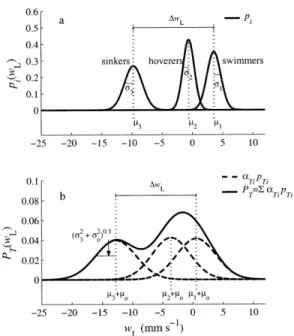
Fig. 3. Graphical representation of the three-component mixture model, showing the contribution of swimming, hovering, and sink-ing behaviors to the observed vertical velocity distribution of larvae in turbulence. (a) Behavioral velocity distributions of sinking, hov-ering, and swimming larvae were estimated for larvae in still water (dead larvae were used to determine sinking velocities) and were assumed to be independent of flow. Velocity means miand SDs si
are indicated for each behavioral mode. (b) The three-component mixture model for observed larval velocity distributions in turbu-lence has contributions from each behavioral mode, where pTiare the probability densities of individual modes and a are the mixingTi
proportions. Velocity means (m 5 mTi o1mi) are indicated for each
behavioral component, the SD [s 5Ï(s 1 s )] is indicated2 2
i
T o i
only for the sinking mode, and moand s are the fluid velocity2o
mean and variance. When the three-component mixture model was fitted to observed velocity data, a and sTi owere estimated by
max-imum likelihood. In this example, they were chosen arbitrarily for illustrative purposes (a 5 0.33, mTi o5 23.0 mm s21, so5 3.0 mm
s21, and Re
HT5 100). Note that because the mean flow velocity is
negative, the model predicts that 77% of observed velocities would be ,0 here, although the proportion of sinking larvae was only 33%.
known distribution, but individual larvae can switch behav-ioral modes without restriction.
Mixture model for larval behavior in still water—We first
estimated the velocity means mi, variances s , and mixing2i
proportions aiof swimmers, hoverers, and sinkers in no-flow
conditions by fitting a three-component normal mixture model to the still-water larval velocity distributions. The
probability density of observed larval vertical velocity wL
was modeled as 3 2 2 P(wLz a , m , s ) 5i i i
O
a p (wi i Lz m , s )i i (2) i51 where, for i 5 (1, 2, 3), 2 1 2(w 2 m )L i 2 p (wi Lz m , s ) 5i i exp 2 (3) 2[
2s]
Ï2p si iMaximum-likelihood parameter estimates of ai, mi, and
s were calculated using the expectation-maximization (EM)2
i
algorithm (McLachlan and Peel 2000).
In still water, the proportion of sinkers a3 was too low
(,0.03 in all replicates) to use MLEs of m3and s to de-23
scribe the sinking velocities. The fall velocities of dead lar-vae were approximately normal and were used as a proxy for the velocity distribution of live, actively sinking larvae with retracted velums. Although larvae can sink with ex-tended velums by stopping ciliary motion, we observed that most larvae fully retracted their velums when sinking in tur-bulence. Given the predominance of velum retraction and the relatively small difference in velocities of the two types of sinkers (,10%; H. L. Fuchs unpubl. data), we included only sinkers with retracted velums in the model.
The variables miand s characterize the behavioral ve-i2
locities of swimming, hovering, and sinking larvae from each culture (Fig. 3a) and were used as known values (by assumption 4) in the analysis of larval behavior in turbu-lence. Normality of the modes was assessed using probabil-ity plots. We also estimated the behavioral velocprobabil-ity range as the difference between mean swimming and sinking
veloc-ities, calculated as DwL5m12m3(Fig. 3a). Larger values
of DwL indicate that larvae have more control over their
vertical position in the water.
Mixture model for larval behavior in turbulence—We
es-timated the proportions a of swimmers, hoverers, and sink-Ti
ers in each turbulence treatment by fitting a three-compo-nent, normal mixture model to the observed velocity distributions of larvae in turbulence. By assumption 3, the
relative velocity of a larva in turbulence WTiis the sum of
its behavioral velocity Wi and the fluid velocity Wo. The
random variables W are distributed with normal probabilityTi
densities p , with means and variances given byTi
m 5 m 1 mTi i o
(4)
2 2 2
sTi5s 1 si o
For each observed larval relative velocity wL, the
behav-ioral mode i of the observed larva was unknown, and the
probability density of wLin turbulence was modeled as
3
2 2
P (wT Lz a , m , s ) 5Ti Ti Ti
O
a p (wTi Ti Lz m , s )Ti Ti (5)i51
(Fig. 3b). The mean flow velocity mo(5^w&) from LDV
mea-surements was used as a known value. By assumption 4, mi
and s from still-water segments were also used as known2
i
values in eqs. 4 and 5. The unknown parameters (aTiand
s ) were estimated for each treatment replicate using a mod-2
o
ified EM algorithm (Web Appendix 1 athttp://www.aslo.org/
lo/toc/volp49/issuep6/1937a1.pdf) to maximize the
log-like-lihood of eq. 5 over all observed velocities. Within the
1942 Fuchs et al.
Fig. 4. Fluid velocity characteristics calculated from LDV measurements, from theory and from observed larval velocities. (a) Mean vertical velocity ^w&. (b) rms vertical velocity w9. (c) Turbulence dissipation rate «. (d) Kolmogorov length scaleh. Theoretical estimates were obtained using an empirical relationship between grid-forcing conditions and rms velocities (Hopfinger and Toly 1976). Direct, unbiased estimates were calculated from raw LDV data (Buchave et al. 1979). Spec-tral estimates were calculated by removing the estimated noise contribution from LDV velocity spectra (Voulgaris and Trowbridge 1998). MLEs were obtained by fitting a three-component mixture model to observed velocities of larvae in turbulence and averaging estimates from six replicates. Error bars are 1 SE. Mean flow velocity (a) cannot be estimated theoretically or by spectral methods.
dependence on s , and these parameters can be estimated2
o
simultaneously from the observed larval velocities.
Relating behavior to turbulence—We wished to determine
the general relationships between turbulence characteristics and the proportion of sinking larvae. Maximum-likelihood values of w9ML(5sofrom the mixture model) were our best
estimates of turbulence intensity in individual replicates (see ‘‘Results’’ section), and these were used to calculate the dis-sipation rate « and the Kolmogorov length scale h for each turbulence treatment. The parameters were averaged by treatment level, and the relationships between « or h and the proportion of sinkers sT3were estimated by exponential re-gression.
Any group of larvae has a net mean behavioral velocity ^wL&, and the relationship between ^wL& and « is of interest for addressing population-level questions about larval fluxes. We calculated the net mean velocity of larvae in each treat-ment replicate as ^wL& 5 S a mTi i. The relationship between
^wL& and log10«,
(a log1 10«)
^w & 5 m 2 a eL 1 0 (6) was estimated by exponential regression. The net velocity ^wL& is bounded above by the mean swimming velocity m1 and falls off exponentially with log10«. Linear and logistic
functions of « were also fitted to ^wL& but had poorer fits and are omitted. Because larval swimming abilities varied among cultures, the model was fitted for individual replicates and for pooled data, excluding replicates with maximum and minimum values of DwL.
Results
Turbulence characteristics—A comparison of LDV
mea-surements from five points in the video frame indicated that turbulence was generally homogeneous within our measure-ment area, although some inhomogeneities appeared at the highest turbulence level. At ReHT5 600, w9 values at the outer points differed from w9 at the center point by 5–20%. In spite of this spatial inhomogeneity, we considered it worthwhile to present results from all turbulence treatment levels. All reported LDV results refer to the average of rep-licate measurements taken at the center point of the video frame.
The mean vertical flow velocity ^w& was generally nega-tive but always had a magnitude ,7 mm s21(Fig. 4a). The
relationship between ReHTand mean flow velocity appeared to be nonlinear, presumably because the pattern of circula-tion in the tank has a nonlinear dependence on forcing con-ditions (McDougall 1979; McKenna 2000).
1943
Behavior of gastropod larvae in turbulence
Table 3. Shell size and still-water velocities for competent larvae, given as mean 6 1 SD. Fall velocities were measured for a subsample of dead larvae (n 5 20) from each replicate. Velocities were measured for live larvae (100 , n , 300) during each replicate, and the velocities of swimmers and hoverers and the mixing proportions were estimated by maximum likelihood. Also given is the mean difference between swimming velocity and fall velocity (DwL) for each culture.
Replicate Age (days) Shell length (mm) Fall velocity (mm s21) Hovering velocity (mm s21) Swimming velocity (mm s21) Proportion of sinkers Proportion of swimmers DwL (mm s21) 1 2 3 4 5 6 24 24 24 24 24 27 648693 690643 587640 662669 767658 605646 29.261.1 29.261.0 26.461.2 28.861.5 29.861.5 27.061.2 20.460.7 21.360.2 20.161.0 20.560.8 20.561.0 20.960.3 4.061.2 1.762.9 3.061.6 3.061.6 3.661.0 0.861.8 0.03 0.01 0.00 0.00 0.00 0.00 0.15 0.47 0.20 0.25 0.27 0.61 13.2 10.9 9.3 11.8 13.4 7.9
Direct estimates of w9 increased linearly with ReHT(r25 0.97), from 10.1 mm s21at the lowest turbulence level to
18.9 mm s21at the highest level (Fig. 4b). Spectral estimates
of wˆ 9 were consistently ;7 mm s21less than direct estimates
of w9, indicating a substantial noise contribution in the mea-sured velocity variance (Fig. 4b). The noise was assumed to have zero mean and no effect on ^w&. The spectral method sometimes overestimates the noise variance (Voulgaris and Trowbridge 1998), but LDV measurements are generally noisy because of Doppler noise and velocity shear in the measurement volume (Buchave et al. 1979; Voulgaris and Trowbridge 1998). Because of the high percentage of noise in the LDV measurements, the direct and spectral calcula-tions were probably over- and underestimates of the rms ve-locity, but they are presented here as independent reference estimates.
When it was estimated from the three-component mixture model, the fluid velocity variance w9MLwas always close to the theoretical values w9HTderived from empirical relation-ships of grid tank dynamics (Fig. 4b). This was also true for the turbulence dissipation rate « (Fig. 4c) and Kolmogorov length scale h (Fig. 4d), which were calculated directly from rms velocity estimates. The close correspondence between our average estimates of w9MLand w9HTillustrates the validity of using a mixture model to estimate turbulence intensity by maximum likelihood from the measured larval velocities.
Because of uncertainty in w9 and wˆ 9 from the LDV
mea-surements (due to the noise contribution) and because MLEs of w9MLdirectly represent the turbulence intensity during each replicate of the larval experiments, we discuss our larval behavior results in terms of turbulence characteristics cal-culated from w . MLEs w9ML 9MLclosely resembled theoretical values w , and the relationships between larval behavior9HT and w9MLare qualitatively the same as those between behavior and w . As calculated from w9 9 , « was 8.1 3 1023–2.7 3
HT ML
100cm2s23, and h was 0.2–1.2 mm.
Larval velocities in still water—Although all larvae were
raised under identical conditions, larval size and swimming abilities varied between cultures. Mean fall velocities were 6.4–9.8 mm s21(Table 3), and replicates 3 and 6 had
sig-nificantly slower fall velocities than other replicates (one-way analysis of variance, F5,1145 24.268, p 5 0.001 with post-hoc Tukey’s test). The slowest-sinking larvae were also
the smallest, and larvae in replicate 6 had the slowest mean swimming velocity.
In no-flow conditions, hovering and swimming larvae formed two distinct groups in all replicates (Fig. 5a). Swim-mers always had positive mean velocities and velocity var-iances .1 mm s21, whereas hoverers had negative mean
ve-locities and velocity variances ,1.1 mm s21(Table 3). The
proportion of sinking larvae was always ,0.03 and was K0.01 in four of six cultures. The proportions of swimming and hovering larvae varied between cultures. The behavioral velocity range DwLwas 7.9–13.4 mm s21.
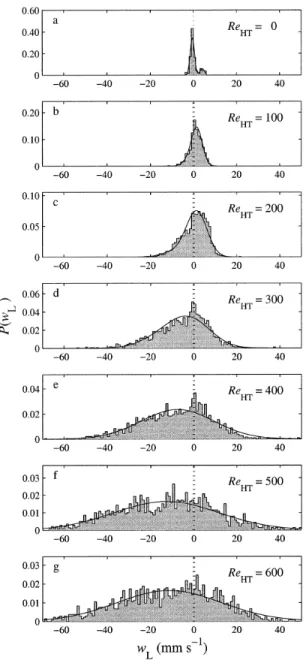
Larval behavior in turbulence—The distributions of
ob-served larval velocities became wider at higher turbulence intensities (Fig. 5) because of the increased flow variance. The distributions also shifted toward more negative veloci-ties at higher turbulence levels, in part because of the mean downward flow and in part because of the increasing pro-portion of sinking larvae. For larvae in still water, the ve-locity distributions were always positively skewed and bi-modal, whereas in turbulence, the velocity distributions were negatively skewed.
We found a clear relationship between turbulence intensity and the proportion of larvae in each behavioral mode, as estimated from the three-component normal mixture model (Fig. 6). The proportion of sinking larvae was effectively zero at ReHT5 100 and generally increased with turbulence intensity. The proportion of hovering larvae was lower in turbulence than in no-flow conditions. The proportion of swimming larvae was higher than other groups in turbulence up to ReHT5 400 (e.g., Fig. 7) and then decreased at higher turbulence levels as the mean proportion of sinkers in-creased.
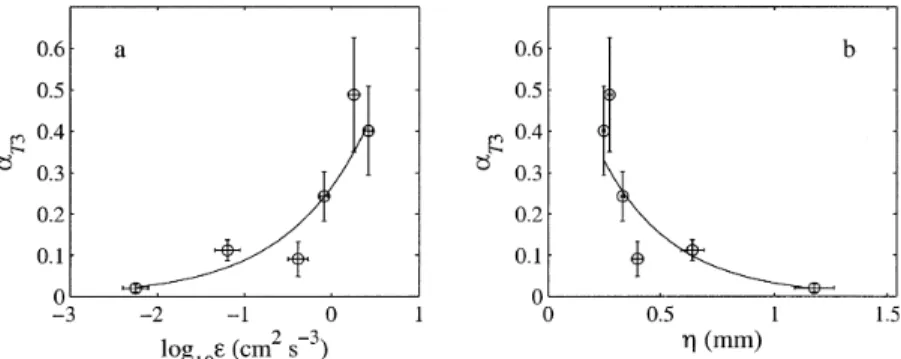
Relating behavior and turbulence—When data were
av-eraged by turbulence treatment, the mean proportion of sink-ing larvae aT3increased approximately exponentially with the log of the dissipation rate [aT35 0.26 exp(1.1 log10«), r2 5 0.89; Fig. 8a] and decreased approximately exponentially with the Kolmogorov length scale [aT35 0.71 exp(23.1h),
r25 0.86; Fig. 8b].
An exponential model provided a good fit (r25 0.73 for pooled data) to the relationship between the net behavioral velocity ^wL& and the dissipation rate « (Fig. 9). The net
1944 Fuchs et al.
Fig. 5. Normalized histograms of observed larval vertical veloc-ities for all turbulence levels, from replicate 1. Solid curves show the best fits from the three-component mixture model.
behavioral velocity was negative at dissipation rates greater than « 5 7.4 3 1022–3.2 3 1021cm2s23. When the data
were pooled, this threshold was at 1.9 3 1021cm2s23.
Discussion
Mud snail veligers in our study altered their behavior in response to turbulent flow conditions and sank more fre-quently in more intense turbulence. Although we cannot show conclusively that veliger sinking behavior is a precur-sor to settlement, the response was demonstrated in late-stage, competent larvae. Moreover, the turbulence-induced response was most pronounced under turbulence conditions comparable to energetic nearshore areas where intertidal spe-cies must settle.
Our experimental turbulence treatments were specifically appropriate for questions about settlement in tidal flows at Barnstable Harbor, the natal habitat of our larvae. There are no published measurements of dissipation rates from the har-bor, but Hunt and Mullineaux (2002) reported shear veloci-ties of up to u* 5 3.5 cm s21over the inner-harbor tidal
flats during flood tide. Using the relationship « 5 u3 */kz, where k is von Karman’s constant and z is height above bottom (Gross and Nowell 1985), the dissipation rate can be estimated as « ø 100cm2s23over the flats. We measured
turbulence in Barnstable Harbor during one complete tidal cycle in August 2002 and estimated dissipation rates to be « ø 1022–101cm2s23(H. L. Fuchs unpubl. data). The lowest
turbulence level used in our experiments (« 5 8.1 3 1023
cm2s23) is probably representative of slack tide, whereas the
higher turbulence levels (up to « 5 2.7 3 100cm2s23) would
be found during flood or ebb tides. Although laboratory-generated turbulence is often more intense than that in rel-evant field conditions (Peters and Redondo 1997), our ex-perimental turbulence levels were comparable to those in an adult mud snail habitat.
Our behavioral results (Fig. 8) suggest that veligers will exhibit sinking behavior in turbulent (« . 1022 cm2s23),
shallow areas but not in calmer (« , 1022cm2s23) offshore
water. Our experiments were conducted at turbulence levels representative of tidal channels and partially mixed estuaries (« 5 1023–100cm2s23; Table 1), where behavioral changes
could potentially affect larval supply to intertidal habitats. Dissipation rates are generally lower in offshore areas and are unlikely to induce a larval sinking response, even during moderate storms. In winds ø15 m s21, dissipation rates at
the surface and thermocline reach « 5 1023–1022cm2s23
(Dillon and Caldwell 1980), but our larvae rarely sank at « # 1022 cm2 s23. Although stormy conditions at sea could
cause some veligers to sink (Barile et al. 1994), we expect that larvae will encounter and respond to strong turbulence primarily in nearshore areas.
Larval sinking in turbulent, coastal zones could potentially affect horizontal transport of larvae over spatial scales of tens of kilometers. Pringle and Franks (2001) described an asymmetric mixing mechanism that causes sinking particles to be transported shoreward in tidal currents. It is possible that physical mechanisms such as asymmetric mixing trans-port could enhance the retention of sinking larvae in coastal inlets, providing additional opportunities for settlement.
Larval behavior—We expected mud snail larvae to sink
or swim, but we found that they also hover, especially in still water. Many species of mollusk larvae hover by pro-ducing mucous strings that act as natural tethers (Fenchel and Ockelmann 2002), but our larvae had no apparent mu-cous strings and were probably large and dense enough to
1945
Behavior of gastropod larvae in turbulence
Fig. 6. Maximum-likelihood values of mean proportionsaTiof
sinking, hovering, and swimming larvae vs. ReHT. Symbols show
averaged estimates from all replicates for each turbulence treatment level. Error bars are 1 SE.
Fig. 7. Normalized histogram of observed larval velocities from replicate 1, ReHT5 200, showing fitted velocity distribution for the
three-component mixture model (solid curve) with contributions from each behavioral mode (dashed lines).
Fig. 8. Mean proportion of sinking larvae aT3vs. (a) log10of the dissipation rate « and (b)
Kolmogorov length scaleh. All values are from MLEs. Symbols show average estimates from six replicates per treatment level (excluding ReHT5 0), and error bars are 1 SE. Solid lines show
exponential regressions.
hover without added drag. Bivalve larvae create wider feed-ing currents and feed more efficiently by hoverfeed-ing than by swimming (Gallager 1993; Fenchel and Ockelmann 2002). In calm water, where contact rates between larvae and food particles are low, mud snail larvae also may hover more to increase feeding efficiency.
Larvae in our experiments sank more frequently at higher turbulence intensities, and this tendency could have impor-tant implications for settlement. Given consimpor-tant turbulence conditions, sinking particles reach the bottom more quickly and accumulate to higher near-bottom concentrations than neutrally buoyant particles (e.g., McNair et al. 1997). Com-petent mud snail larvae would reach the benthos more quick-ly by sinking than by swimming, but there is no apparent benefit for larvae that sink in calm, deep water (e.g., off-shore) over unsuitable habitats. The exponential relationship between the proportion of sinkers and log10« suggests that larvae should sink primarily in near-shore areas during
en-1946 Fuchs et al.
Fig. 9. Net mean behavioral velocity of larvae ^wL& vs. log10of
the dissipation rate «. Symbols show velocity estimates for each treatment from replicates 1–4 (replicates with maximum and min-imum values of DwLwere excluded). Dashed lines show the
ex-ponential regressions for individual replicates, and the solid line shows the regression fit to pooled data, usingm15 4.1 mm s21and
DwL5 13.3 mm s21.
ergetic tides, as might be expected if the response were re-lated to settlement.
Veliger larvae clearly respond to turbulence, but the phys-iological mechanism of turbulence detection is unknown. Mud snail larvae retract their velums when the cilia are touched (Dickinson 2002), indicating the presence of mech-anosensory cilia that could detect velocity shear. It has also been hypothesized that gastropod larvae sense acceleration with their statocysts (Chia et al. 1981; Crisp 1984; Young 1995). Chia et al. (1981) found a neural connection between the statocysts and cilia in nudibranch veligers (Rostanga
pul-chra), which suggests that these organs might have related
functions. Both the velar cilia and the statocysts could po-tentially be used for detection of shear and acceleration in small eddies.
It is interesting to note that the sharpest increase in the proportion of sinking larvae occurred when the Kolmogorov length scale was less than the larval body length (Fig. 8b). Although Kolmogorov-scale eddies contain a very small per-centage of the total turbulent kinetic energy, velocity gra-dients exist even at scales smaller than millimeters (Lazier and Mann 1989). Larvae may detect and respond to shear in the smallest-scale eddies, and sinking behavior could de-pend on interactions of larvae with eddies at the Kolmogo-rov scale. Alternatively, larvae may retract their velums in response to being accelerated or rotated by the flow vorticity, which increases with the dissipation rate. Regardless of the detection mechanism, descriptors of small-scale turbulence (h and «) are probably the most relevant flow characteristics for understanding larval responses to turbulence.
Because vorticity increases with dissipation rate, velocity shear could potentially affect the orientation and
directed-swimming abilities of larvae in strong turbulence. Larvae that normally swim in a velum-up orientation will begin to tumble if the viscous torque caused by velocity shear across the body greatly exceeds the gravitational torque, caused by an asymmetric density distribution. Tumbling is defined as rotation past 908 from the normal, velum-up orientation (Jonsson et al. 1991). We calculated the critical shear (as in Kessler 1986; Jonsson et al. 1991) required to tumble our larvae as shearcrø 102s21. This is about an order of mag-nitude greater than the highest shear rate in our experiments, which we estimated as shear ø «0.5n20.5 5 1.6 3 101s21.
For shear , 2 3 101s21, the gravitational torque on the
larvae will always compensate the viscous torque, allowing larvae to remain within about 108 of the normal upward orientation (Jonsson et al. 1991). Visual inspection of our video record confirmed that, even at the highest turbulence level, in-focus larvae were always oriented with the velums up. We conclude that velocity shear had little or no effect on larval swimming abilities in our experiment and that competent mud snail larvae probably tumble only in ex-tremely turbulent conditions (e.g., the surf zone).
Implications of turbulence-induced sinking behavior—
There are possible ecological and evolutionary benefits for veligers that sink in turbulence. Gastropod larvae may sink in turbulence as a way of avoiding predators (Young 1995). Mud snail veligers responded to turbulence even in the ab-sence of predators, and we infer that larval fluxes are af-fected by turbulence-induced sinking behavior, regardless of whether turbulence is generated by predators or by physical sources. Abelson and Denny (1997) suggested that hydro-dynamic forces might alter larval behavior and even provide a settlement cue. We hypothesize that a turbulence-induced sinking response enables larvae to move toward the bottom when they reach shallower coastal waters. Near-bottom lar-vae contact the bottom more frequently than those in the upper water column (McNair et al. 1997) and could have more opportunities to test substrates and settle in suitable areas.
To understand biophysical coupling between turbulence and settlement, it is necessary to determine the hydrodynam-ic conditions where larval behavior can affect sinking fluxes (Crimaldi et al. 2002). The net behavioral velocity of our larvae shifted from positive (upward) to negative (down-ward) when the dissipation rate reached ; « 5 1021cm2s23.
This shift could result in significant changes in the advective component of larval vertical fluxes. On the other hand, the observed velocity distributions of our larvae grew wider as
w9 increased, indicating that larval movement is dominated
more by flow as turbulence intensifies. Larvae probably de-tect eddies at or near the Kolmogorov scale, which is a func-tion of «, and we expect the proporfunc-tion of sinking larvae aT3to increase exponentially with log10« in the field as in the lab. Behavioral changes may affect sinking fluxes less, however, when the vertical turbulence intensity w9 greatly exceeds the behavioral velocity range DwL.
Although we focused on water-column processes, it is worth noting that settlement fluxes depend on both the prob-ability of reaching the bottom and the probprob-ability of attach-ment to substrates (Gross et al. 1992; Crimaldi et al. 2002).