Positioning
and differentiation by
using
brand personality attributes
Do
mission and vision statements contribute
to
building a unique corporate identity?
Diana
Ingenhoff and Tanja Fuhrer
Department for Media and Communication Science,
University of Fribourg, Fribourg, Switzerland
1. Introduction
The problem confronting many companies today is that they sell products and services similar to those of their competitors. Gaining a competitive advantage has become increasingly complex and difficult, because every successful innovation in terms of sales tends to be quickly copied by competitors (Ehrenberget al., 1997). Rivalry is not a question of price or advantages within the range of physical, financial, and human resources any more. Several authors have come to the conclusion that a company should try to differentiate itself by other competitive resources and thus establish a position of non-price differentiation (Davies et al., 2003; Deephouse, 1999; Karaosmanoglu and Melewar, 2006; Leitch and Motion, 2007; Melewar et al., 2005; Rubinson, 2005; Trout, 2000). The aim is to be desirable, unique, and highly valued
Published in "Corporate Communications: An International
Journal" 15(1), 2010, 83–101 which should be cited to refer
to this work
(Sharp and Dawes, 2001). Therefore, corporate reputation and the stakeholders’ perception of the organization (Balmer, 2001) plays an important role regarding competitiveness.
By communicating its identity, “the underlying ‘core’ or basic character of the firm” (Barnettet al., 2006, p. 33), a company can try to positively influence its reputation and thus position itself within its marketplace (Chun and Davies, 2001; van Riel and Balmer, 1997). One of the main concepts of the corporate identity management process is corporate personality, which consists of corporate philosophy and values (Stuart, 1999). Mission and vision statements are discussed as an important medium for conveying these values and emphasizing uniqueness and difference (Leuthesser and Kohli, 1997; Yamauchi, 2001). These statements are often included in the corporate web site – and are thus accessible to all stakeholders at any time (Chun, 2004) – and form their online brand personality.
As online brand personality is imperative for any firm regarding long-term brand equity (Okazaki, 2006), it is important to analyze companies’ self-presentation and particularly the ways in which they achieve a competitive position. The main objective of our study, therefore, is to analyze the use of brand personality attributes in mission and vision statements across several sectors and industries in Switzerland. As all present studies focus on US firms, for the first time our study will gain insights into whether the results of the previous studies could be applied to Western European countries. Referring to Peyrefitte and David (2006), who revealed industry institutionalization regarding the inclusion of David’s (1989) nine components, this study investigates whether statements from different sectors or industries contain different brand personality elements:
RQ1. Do companies belonging to a cross-section of industries and/or sectors use brand personality elements in different ways in their mission and vision statements?
Furthermore, the study is based on Chun and Davies (2001), who investigated mission and vision statements published on the web sites of large US firms. Findings show that companies position themselves within their marketplace using brand personality elements in their mission and vision statements. Our purpose is to analyze how companies in Switzerland position themselves in their mission and vision statements: RQ2. Do companies use their mission and vision statements on their corporate
web sites to position themselves within their marketplace? 2. Literature review
2.1 The management of corporate identity
For an organization, management of its identity is of strategic importance in terms of positioning and differentiation within the marketplace (Chun and Davies, 2001; Okazaki, 2006). Corporate identity can imbue the company with a clear competitive advantage (Balmer and Gray, 2000).
Several academics have paid attention to the subject of corporate identity (Balmer, 2001; Karaosmanoglu and Melewar, 2006; Melewar and Jenkins, 2002; Melewaret al., 2005; Olutayo Otubanjo and Melewar, 2007; van Riel and Balmer, 1997). We adopt the definition of corporate identity as the “mix of elements which gives organizations their distinctiveness” (Balmer, 2001, p. 254) or as the “underlying ‘core’ or basic character
of the firm” (Barnettet al., 2006, p. 33). Furthermore, corporate identity refers to the way in which the organization presents itself to its stakeholders and answers questions like “who are you?” (Dowling, 2004, p. 21) and “what [is] the organization” (Melewar et al., 2005, p. 61).
Corporate identity can generally be defined “in terms of an organization’s ethos, aims and values that create a sense of individuality, differentiating the brand” (de Chernatony and Harris, 2000, p. 268). A company’s top management must be aware of the importance of both the formulation and communication of the company’s identity and must manage it with the objective of realizing a distinctive, unique appearance.
Therefore, the development of a positive brand is essential (Balmer, 2001). This study focuses on branding at the corporate level, where the whole company is concerned. According to Balmer (2001, p. 281), a corporate brand “involves the conscious decision by senior management to distill and make known the attributes of the organization’s identity in the form of a clearly defined branding proposition.” Through its corporate brand, a company might be identified and chosen by the stakeholder. This is also a way to obtain their loyalty (Sherrington, 1999).
Besides, the communication of a favorable corporate brand it is likewise imperative to achieve a positive reputation, which is of particular importance for the competitiveness of a company. To understand the concept of corporate reputation, it is first necessary to define corporate image. We refer to the idea of corporate image as the stakeholder’s perception, defining image as “their immediate mental perception of the organization” (Balmer, 2001, p. 257).
Generally speaking, reputation is the combination of images held of a company. According to Chun and Davies (2001, p. 316), reputation is a “collective construct, a term referring to all stakeholders’ views of the company.” It is also important to recognize that it is not about a short-term dimension, but an enduring perception held of the organization (Balmer, 2001).
Although it is not possible to control reputation directly in this regard, the management of identity plays an important role. A company can try to influence the transition from identity to image (Barnett et al., 2006) and thus positively influence corporate reputation. Therefore, to achieve a strong brand the company must consider what is most important for its stakeholders and consequently accentuate this particular aspect. In doing so, the firm can differentiate itself from potential competitors. In addition, the sensitivity for other traits can be lowered, which makes a comparison with other companies even more complex (Sharp and Dawes, 2001).
2.2 Corporate personality and the human metaphor
According to Balmer (1998), corporate identity is based on corporate personality and thus on the values present within a firm. One possible way to describe a company is by the use of personality and character attributes. The brand is looked at as having “personality” (Aaker and Fournier, 1995) and described using human characteristics. The brand is thus viewed as a “character, a partner and a person” (Aaker and Fournier, 1995, p. 393), whereas brand personality is “the set of human characteristics associated with a brand” (Aaker, 1997, p. 347). Several researchers have adhered to the personification of a brand and to the use of the human metaphor, as they believed it to be the best way to conceptualize the complexity of an organization reflected in brand personality aspects (Chun and Davies, 2001; Davieset al., 2001; Keller and Richey, 2006;
Okazaki, 2006). The current research aims to find out whether industry differences exist regarding the use of brand personality elements. Therefore, we agree to use Aaker’s scale to investigate whether companies belonging to different industries use the brand personality elements in their mission and vision statements differently.
Aaker developed a theoretical framework by enhancing the “Big Five” composition from human psychology and by isolating the dimensions of sincerity, excitement, competence, sophistication and ruggedness with several sub-categories (Aaker, 1997). Finally, Aaker specified a total of 42 terms in a scale. Mainly, positive attributes are listed, because the scale was supposed to be used to determine “the extent to which brand personality affects the probability that consumers will approach (versus avoid) products” (Aaker, 1997, p. 350).
A few years later, another scale was developed by Davieset al. (2004) in order to assess a company’s reputation from both internal and external points of view. This scale also includes negative items to measure the company’s personality.
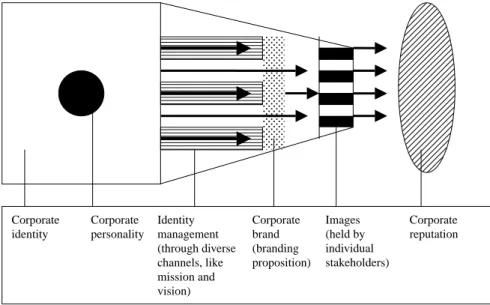
Figure 1 shows the concepts introduced above. It illustrates how corporate reputation is composed of the images held by the individual stakeholders. These images are in turn a reflection of corporate identity, with corporate personality as its core, in the social field. As the figure shows, these images can be influenced, at least in part, by identity management.
The ways in which firms manage their identity in order to finally gain positive reputation and thus to stand out from each other have been researched from various angles. Several channels provide an opportunity to communicate difference and uniqueness to stakeholders. One of them is the communication of a firm’s essential values through its vision and mission statements (Leuthesser and Kohli, 1997). 2.3 Companymission and vision
In the literature, many authors have adopted the so-called vision-driven approach, which refers to corporate mission and vision as the basis and core of corporate identity
Figure 1. Identity management process Corporate identity Corporate personality Identity management (through diverse channels, like mission and vision) Corporate brand (branding proposition) Images (held by individual stakeholders) Corporate reputation
management (Balmer and Soenen, 1999; Melewaret al., 2005). Melewar et al. (2005) specified the two steps required in this regard: first, the communication of mission, vision, and philosophy inwardly and outwardly. It is important to recognize that identity management must focus on both internal and external stakeholders (de Chernatony and Harris, 2000). Second, “the planning, implementation and maintenance of corporate visual identity systems, marketing communication activities and behavioral forms in order to externalize company values” (Melewaret al., 2005, p. 61) is crucial.
Corporate mission specifies management issues in the present. It serves as a reflection of the company and its people (Want, 1986), and pertains to the reason for the existence of the company (Melewaret al., 2005). According to Abratt (1989), mission is a succinct expression of corporate purpose. The perspective of a corporate vision, on the other hand, is more forward looking. Vision specifies the desired status of the company in the future (Campbell and Tawaday, 1990; Yamauchi, 2001).
A company’s identity, and thus its core philosophy and values, can be communicated through mission and vision statements (Yamauchi, 2001). It mirrors the company’s reason for being (David, 1989) and ought to answer the question “where is our company going?” (Campbell and Tawaday, 1990, p. 11). David (1989, p. 109) described the statement as an “enduring statement of purpose” and further specified it as “the fundamental, unique purpose that sets a business apart from other firms of its type and identifies the scope of the business’ operations in product and market terms.” On the whole, mission and vision statements provide a significant channel for communicating essential values and norms (Leuthesser and Kohli, 1997) to target groups such as consumers, shareholders, and employees. The statement forms part of the corporate policy that is shown to the stakeholders, and is therefore of utmost importance.
2.4 Mission and vision statement components in research
Before now, several researchers have focused on examining mission and vision statements. One especially relevant research stream investigated the statements’ components (Campbell and Tawaday, 1990; David, 1989; David and David, 2003; Pearce and David, 1987; Peyrefitte and David, 2006), while another analyzed their use, impact and purpose (Campbellet al., 2001; Chun and Davies, 2001; Hooley et al., 1992). To begin with, the Ashridge model by Campbell and Tawaday (1990) lists the four main elements of any statement as: purpose, strategy, behavior standards, and values. David (1989) used another approach to examine the statements of large manufacturing and service firms, and worked out nine key components that should be included in every statement.
Peyrefitte and David (2006) adopted David’s (1989) nine components in order to ascertain the institutional forces that influence firms regarding the formulation of their statement. As firms have to be responsive to their multiple constituents in order to meet the dual demands of task and institutional environments, they anticipated and found similar use of mission components across and within industries, i.e. firms respond to their shared constituents in similar ways. That leads us to our hypotheses: H1. The use of mission and vision statement components on corporate web sites is
Building on that topic, another issue to be explored is whether industries from the same sector bear any resemblance or not. Accordingly, the question to be asked is whether there are any differences between sectors, particularly between the manufacturing and services sector:
H2. The use of mission and vision statement components on corporate web sites is similar among different sectors.
2.5 Aaker’s personality framework in research
In the last few years, many research papers drew upon the Aaker (1997) scale to analyze brand personality. Some researchers focused on the perception of a certain brand (Rojas-Me´ndezet al., 2006; Venable et al., 2003; Smith et al., 2006), while others examined the management aspect of brand personality (Chun and Davies, 2001; Opokuet al., 2006).
Most important for this paper is the research by Chun and Davies (2001), who made use of the framework in order to verify the idea of an organization’s positioning within their marketplace through mission and vision statements. They analyzed statements of large American firms published on their corporate web sites. Finally, the researchers could support the claims that companies position themselves within their marketplace using elements of reputation in mission and vision statements. This study ties in with the findings of Chun and Davies (2001) and intends to investigate positioning within the marketplace in Switzerland:
H3. The content of mission and vision statements on corporate web sites is compatible with the concept of positioning the organization within its marketplace (Chun and Davies, 2001).
Nevertheless, positioning is not enough to outperform competitors. Being desirable, unique, and highly valued in the eyes of stakeholders is the effect of differentiation (Sharp and Dawes, 2001, p. 740).
Furthermore, Chun and Davies (2001) found that firms position rather than differentiate themselves by using mission and vision statements. The lack of differentiation raises the final question of whether companies also differentiate themselves using their mission and vision statements on their corporate web site, leading to the fourth proposition:
H4. Firms do not differentiate themselves using their mission and vision statements on their corporate web site (Chun and Davies, 2001).
Drawing on Sharp and Dawes’ definition of differentiation, the aim will be to test whether firms stand out from the crowd by stressing particular aspects of brand personality which are different from their rivals, or if they just emphasize the same aspects their competitors do (Davieset al., 2003).
3. Research methodology 3.1 Sample
To compare our results with previous studies predominantly carried out in the USA, it is necessary to draw a sample within the same competitive environment and economic institutions. For our research sample, we choose industries in Switzerland
that are representative of Western European countries. Switzerland has three main culturally different language regions (German, French, and Italian) closely connected with each of the respective neighbouring countries, and is therefore quite representative of and unique in Europe. Many large European and international companies have their headquarters in Switzerland, giving an excellent opportunity for research in the field of mission statement components.
First, in order to elaborate differences in mission and vision statement content due to industry differences, the sample used for this study comprises a total of six Swiss industries from both the production sector (secondary sector) and the services sector (tertiary sector). From the secondary sector, the electronics industry, the pharmaceutical and chemicals industry, and the food industry were chosen. The sample further comprises the banking industry, the insurance industry and consulting companies, which belong to the tertiary sector.
In order to investigate positioning within the marketplace and be comparable to prior studies of mission components (David, 1989; Peyrefitte and David, 2006), the biggest representatives per industry were chosen. Large international companies are known as possessing a rich wealth of intangible assets like brands and patents. Therefore, one would expect these firms to be in a strong, competitive position and to aim at differentiating from their rivals.
The list consulted is a yearly publication by the Schweizer Handelszeitung (2006). On the “Top List” from the Schweizer Handelszeitung, Swiss firms with strong financial performance are registered in analogous manner to theFortune 500 list used by Chun and Davies (2001) or the BusinessWeek Corporate Scoreboard used by Peyrefitte and David (2006) as well as several other researchers.
The 25 biggest firms competing in each industry were chosen. Except for the insurance companies, which were listed by the size of their capital investments, the selection criterion was turnover. It should be noted that in the case of the insurance and consulting industries, less than 25 companies were listed. For the latter the market survey of the Association of Management Consultants Switzerland (2005) provided another 14 major companies. In all, we analyzed 134 web sites.
For this study, special attention is paid to the work by Chun and Davies (2001), who limited their subject of investigation to statements published online. This study ties in with their research and investigates information that is publicly available on the companies’ web sites. When searching the web sites, the first criterion was whether or not they comprise an English version, as this study aims to exclusively investigate mission and vision statements written in English. This allows for the investigation of firms from any part of Switzerland. Although it is not one of the official languages in Switzerland, more and more companies declare English to be their corporate language. 3.2 Data collection
Corporate web sites were analyzed for explicit offerings of mission and vision statements, which the company uses to present itself to its stakeholders. First of all, sections describing the company were consulted. Every page that is accessible via the homepage and has at least partially the same URL was considered as a section.
In the study, only explicit offerings of statements were analyzed (Leuthesser and Kohli, 1997). Besides, “mission” and “vision,” potential denotations are “purpose,” “strategy,” “values,” and “standards and behavior” (Campbell and Tawaday, 1990).
Also, statements can be made available under expressions including the words “philosophy,” “principles,” “beliefs” (Pearce and David, 1987), or “goal” (Leuthesser and Kohli, 1997).
Moreover, only statements based on long-term considerations were incorporated. Therefore, any short-term information such as news was ignored. All information used refers to the company as a whole or to the company brand, but not to any individual businesses, products or services. Furthermore, only sections that serve to inform all stakeholders equally about the company were considered. For instance, career sections, where the company promotes itself to potential future employees, were ignored. Other parts of the web site, such as structure, company history, or team or stakeholder descriptions, which refer in a way to the mission and vision of a company, were omitted, too (Chun and Davies, 2001). Sections limited to corporate social responsibility were not included either.
3.3 Accessibility
The internet as a pull medium involves new challenges for corporate communication and corporate self-presentation (Pollach, 2005). The quality of a company’s web site depends on the reliability of its content and its “up-to-dateness” (Chun, 2004). Also, the web site ought to be dynamic (Ind and Riondino, 2001), while the material should be readily identifiable, quickly discoverable, and easily accessible (Chun and Davies, 2001). It is important that a company web site includes a statement that is easy to find and access (Chun and Davies, 2001). Nevertheless, Chun and Davies assert that this is not being done as well as it might.
Therefore, the analysis of the accessibility of mission and vision statements should also be considered. The time taken to locate the statement will therefore be noted as well as the clicks taken to find all information required. In addition, importance will be attached to the length of the statements.
3.4 Content analysis
The texts extracted were analyzed by using Aaker’s (1997) personality framework. However, in addition to the 42 Aaker terms and their derivates, the scale was extended to include synonyms.
An initial pre-test with mission and vision statements of German firms from the same industries was done in order to test the scale. It was necessary to impose several restrictions: first, slogans including words listed counted only once, even though they might appear several times throughout the text. Terms that are used in the title and appear in exactly the same context in a section right below were handled the same way. Second, words that are part of company or product names were not considered. Third, the coder had to avoid counting adjectives relating to something other than the company, its product and services or its members. To exemplify, attributes describing the market or other companies were left out.
After the extraction of the text, the actual content analysis started with a binary coding procedure. Following this, the inclusion or exclusion of Aaker’s (1997) five dimensions of brand personality was analyzed.
Next, another quantitative approach was made, as the frequency of occurrence of every term specified in the framework was analyzed. Finally, intracoder reliability of over 0.9 indicated high agreement.
We used correspondence analysis to present the relative positioning of the companies. This makes it possible to plot profile similarity on a graph. For the subject of this study, the output of correspondence analysis can be described as “a pictorial representation of both the companies whose M&V statements are being assessed and the constructs they are assessed against” (Chun and Davies, 2001, p. 324). The technique allows simplified analysis of cross-tabular data collected in the form of numerical frequencies (Greenacre, 1993) and is useful for representing categorical research data with a low-dimensional map (Whitlark and Smith, 2001). The most interesting output is the symmetric map of the categories including both rows and columns. The horizontal axis shows dimension of greatest variation in the data, while the vertical one represents the second greatest. The remaining dimensions are left out so as to simplify matters.
It must be pointed out that the map cannot be read in the traditional sense. x2-distances rather than Euclidean are displayed. As a rule, short distances mean strong similarity while big distances imply dissimilarity. The average profile is the centroid of the row profiles. According to Greenacre (1993), approximation to the zero point depends on a profile’s mass. Greenacre suggested that symmetric maps are preferable for investigating either row-to-row distances or column-to-column distances. Hence, the interpretation should concentrate on the positions of the points along the two principal axes. Yet, while being aware of all the above limitations, it is possible to draw some conclusions concerning the relative occurrence of one row profile to a column profile, particularly of an industry to a brand personality. Also, the interpretation is not about absolute values, but about profiles and their relative position to each other. The advantage of the interpretation of relative values is that differences in level are being eliminated. Hence, for this research differences in terms of statement length no longer play a role.
4. Research findings 4.1 Accessibility
None of the 134 visited web sites raised noteworthy difficulties regarding URL, since it was composed mostly of the company name or else the forwarding was carried out automatically. A total of 95 firms, representing 70.9 percent, had an English version of their web site. The proportion in the secondary sector (78.7 percent) was higher than in the tertiary sector (61 percent).
We scanned the web sites for mission and vision or equivalent statements. In the end, we found 63 mission and vision statements of companies, with more companies from the tertiary sector than from the secondary sector.
The time taken to find mission and vision or equivalent statements was in all cases very short, accurately defined as less than one minute. That result stands in contrast to the findings of Chun and Davies (2001), who mostly required more than ten minutes for the location of their statements. The reason for that might be the span of six years between the two surveys, in respect of the quantum leap regarding internet technology in general and web presence of companies in particular.
In the majority of cases, at least one subsection had to be accessed first in order to reach the desired information. Both sectors used the section heading “about us,” whereas companies of the secondary sector also used “company” as a heading. All in all, most sections refer to the companies’ description of themselves and are named
accordingly. Furthermore, most statements are published on the company web site as “mission,” followed first by “vision” and “values,” and second by “strategy” and “principles.” Many firms also labeled their statement something different to those listed in the code plan. Possible denotations are “success factors,” “corporate cultural values and norms,” “our aim” and “ambition,” amongst others.
More than half of the firms provided their statement in one single piece, whereas less than 8 percent (five firms) split the text into three or more parts. However, big differences were detected when checking the length of the texts. Although most companies publish statements at a length of 200 to 500 words, statements from less 200 (eight statements) to more than 500 words (11 statements) were found.
4.2 Usage of brand personality attributes
OurH1, which predicted that mission and vision statements on corporate web sites are similar across industries (Peyrefitte and David, 2006) was strongly supported. We used Pearson’sx2-test in order to find out whether Aaker’s brand personality attributes were used consistently by companies within the same industry. In case of “sincerity,” the results show onlyp-values higher than 0.05, hence no significance. This means that no industry shows significant tendency regarding the use of that brand personality characteristic. In contrast, the “excitement” characteristic is mainly incorporated by pharmaceutical and chemical industry companies, consulting firms and insurance firms, who consequently show statistically significant results (p , 0.05). Furthermore, in every industry over 85.7 percent (p , 0.01) of the firms used “competence” in their mission and vision statement. More precisely, only two firms from the food industry do not include that characteristic. Regarding “sophistication,” only the pharmaceutical and chemical industry showed statistically significant similarities concerning the exclusion of the term. In other words, hardly any of the companies tested included that personality element. Lastly, “ruggedness” was not incorporated by many firms either, with exceptions being the four firms from the insurance industry.
OurH2, which predicted that the use of mission and vision is also similar between the secondary and the tertiary sector, was strongly supported too. Here, an independent-samplet-test revealed no significant differences between sectors.
Since the method used above is only applicable to two groups, the investigation of similarities and differences between individual industries requires another test. The Kruskal-WallisH-test concerns a nonparametric test for ordinal data that can be used to compare more than two populations (Table I).
The results did not show any significant differences regarding the dependent variables “sincerity,” “excitement,” “competence,” and “sophistication.” Only “ruggedness” showed a significant difference. That dissimilarity was due to the fact that all insurance companies include “ruggedness,” which is only used sparingly by companies of the other industries. Again, it has to be emphasized that the four firms of the insurance industry cannot be considered as fully representative. All in all, theH1 andH2 suggesting similarities between sectors and industries could be supported at this stage.
4.3 Positioning and differentiation
Frequency analysis revealed how often the brand personality categories were being used by the companies.
El ectronics (n¼ 10) Pharma/chem. (n ¼ 13) Foo d (n ¼ 14) Banks (n ¼ 8) Consu lting (n ¼ 14) Ins urances (n¼ 4) Kruskal-Wallis analyses of varianc e Miss ion statement component n (% n ) x 2 n (% n ) x 2 n (% n ) x 2 n (% n ) x 2 n (% n ) x 2 n (% n ) x 2 H -rat io Sincerity 6 60 0.40 9 69.2 1.92 9 63. 2 1.14 6 75 2.00 9 64.3 1.14 3 75 1.00 0.67 Excite ment 6 60 0.40 12 92.3 9.31 ** 9 64. 3 1.14 6 75 2.00 12 85.7 7.14 ** 4 100 * – 6.48 Competence 10 100 * – 13 100 * – 12 85. 7 7.14 ** 8 100 * – 14 100 * – 4 100 * – 7.115 Sophistication 3 30 1.60 1 7.7 9.31 ** 5 35. 7 1.14 1 12.5 4.50 * 4 28.6 2.52 2 50 – 5.02 Ruggedness 1 10 6.40 ** 2 15.4 6.23 ** 5 35. 7 1.14 1 12.5 4.50 * 4 28.6 2.57 4 100 – 14.36 ** Notes: *p # 0.05; **p # 0.01 Table I. Usage of brand personality characteristics in industries
To begin with, the outcome of the electronics industry should be looked at in detail. There, the firms used “competence” more than twice as often as “sincerity” or “excitement.” “Sophistication” and “ruggedness,” however, were rarely included in the mission and vision statements.
In order to find out more about the proportion by which the brand personality categories are being used by the individual companies, the row profiles can be consulted. In the case of the electronics industry, all firms – except Inficon and Schurter – put most weight on competence. Furthermore, the average of the row profiles – in other words their mass – is an indicator of the importance of the respective row category. “Competence” therefore has the largest mass. Also, because companies spent similar percentages on this category, its profile is quite flat. Consequently, “competence” is located relatively close to the zero point of the symmetric map (Figure 2, Table II).
With reference to the restrictions concerning interpretation of row-to-column distances, it can be said that these companies group around “competence.”
Figure 2.
Symmetric map of profile similarity communicated by electronics industry companies
Symmetric map (axis D1 and D2: 85.26 %)
RUG SOPH COM EXC SIN SI SEZ SCH PH MI MM KA IN ER AL –1 0 1 2 3 –4 –3 –2 –1 0 1 2 3 4 D1 (60.12 %) D2 (25.14 %) Column Row Sincerity (SIN) Excitement (EXC) Competence (COM) Sophistication (SOPH) Ruggedness (RUG) Sum Alcatel (AL) 0.11 0.33 0.56 0.00 0.00 1 Ericsson (ER) 0.00 0.00 1.00 0.00 0.00 1 Inficon (IN) 0.60 0.00 0.30 0.10 0.00 1 Kaba (KA) 0.00 0.00 1.00 0.00 0.00 1 Maxon Motor (MM) 0.19 0.19 0.63 0.00 0.00 1 Micronas (MI) 0.23 0.15 0.62 0.00 0.00 1 Philips (PH) 0.08 0.25 0.50 0.08 0.08 1 Schurter (SCH) 0.50 0.00 0.50 0.00 0.00 1 SEZ 0.00 0.15 0.85 0.00 0.00 1 Siemens (SI) 0.00 0.29 0.64 0.07 0.00 1 Average 0.17 0.18 0.62 0.03 0.01 1 Table II.
Row profiles of the electronics industry companies
Furthermore, from the fact that they are located at close range to the zero point, similarity to the average profile can be inferred. Other firms, which are also close to the center, still show profile differences. Maxon Motor and Micronas, for instance, differ in dimension one due to the slightly higher proportion of both “sincerity” and “excitement.” Yet, regarding dimension one first and foremost, Inficon and also Schurter show different profiles and group around “sincerity.” Philips and Siemens on the other hand included “excitement” relatively often. The contingency table reveals that only Philips incorporates the rarely used brand personality categories “sophistication” and “ruggedness” at all, which further explains its profile difference in dimension two and its location furthest to the top end of they-axis (Figure 3).
The analysis of the other industries tied in with the results of the electronics industry.
However, some differences between the individual industries were found. To begin with, in the pharmaceutical and chemicals industry “excitement” outweighed “sincerity” as second most used attribute. Furthermore, the comparatively high value of total inertia for the food industry means that the range of dispersion is broader than with the other samples. Consequently, the company profiles are more different to each other. Also, a few food industry firms managed to position themselves away from the others. Above all, Lindt and Spru¨ngli exclusively presented itself as sophisticated. Unilever did not position itself near “competence” either, but towards “excitement.”
In particular, we found a clustering on the symmetric map, mainly around the brand personality attribute “competence.” Owing to that poor differentiation of profiles the decision was taken to focus on “competence” only. Therefore, correspondence analysis was reapplied within this particular category with the aim of investigating potential positioning and differentiation regarding the sub-categories “reliable,” “intelligent,” and “successful.” That subdivision revealed that one category, namely “successful,” clearly dominated, whereas either “reliable” or “intelligent” came second. It was only the majority of consulting companies whose profiles grouped around “intelligent” rather than “successful.”
Figure 3. Symmetric map of profile differences for “competence” between companies of the electronics industry
Symmetric map (axis D1 and D2: 100.00 %)
SUC INT REL SI SEZ SCH PH MI MM KA IN ER AL –1 –0.5 0 0.5 1 1.5 –2 –1.5 –1 -0.5 0 0.5 1 1.5 2 2.5 D1 (53.40 %) D2 (46.60 %) Column Row
In summing up, ourH3, proposing that the content of mission and vision statements is compatible with the concept of positioning the organization within its marketplace, could be confirmed. Also, in line with Chun and Davies (2001), we found confirmation for H4 that firms do not differentiate themselves using their mission and vision statement on their corporate web sites.
5. Discussion
The purpose of this study was to examine the current state of mission and vision statements and to analyze differentiation strategies through the use of online brand personality attributes in Switzerland as an example of a European approach. The results provide persuasive support for several conclusions.
First of all, the investigation of the accessibility revealed that the time taken to find the mission and vision statements on corporate web sites was much shorter than it was for Chun and Davies (2001). Moreover, the lengths of the statements have increased. Nevertheless, web presence has not improved in every aspect, as a considerable number of the firms still do not include any mission and vision statement at all. Our results show that Aaker’s (1997) framework could successfully be extended to a final scale of 130 terms.
The investigation of the inclusion or exclusion of the five brand personality categories in mission and vision statements clearly showed similarities between industries and sectors and consequentlyH1 and H2 could be supported. That outcome stands in line with the results of Peyrefitte and David (2006), who investigated the inclusion of the statement components, defined by David (1989), and corroborated their hypothesis proposing that norms of statement content vary little by industry. The reason for the detected similarity might be that brand personality is more concerned with the actual or desired perception of the company or corporate brand held by stakeholders. Hence, the company approaches them on an emotional level and not by means of its actual business.
The results of the frequency analysis and the ensuing correspondence analysis revealed that every company shows its own individual profile. Even though the personality profiles are often positioned close to each other on the diagram, they do not lie exactly at the same place. With a few exceptions, most companies emphasized the same brand personality attributes, namely “competence” and “successful.” Nevertheless, they differ to some extent regarding their use of the other attributes.
Chun and Davies (2001, p. 329) called such dominant elements “table-stakes,” by definition attributes, which the majority of companies position themselves against. They are “the cost of competing in the market rather than something which can usefully differentiate the players.” Consequently, in the first instance, these attributes are used to attain competitive position and to approach the stakeholders.
All in all, in the American (Chun and Davies, 2001) and in the current Swiss study the results regarding the usage of brand personality attributes in mission and vision statements were about the same. The scatter-plots of correspondence analysis showed that in their “frame of reference” (Chun and Davies, 2001) companies do position themselves by communicating personality profiles in their mission and vision statements. In spite of the restrictions regarding the interpretation of row-to-column distances, certain conclusions about the proximity to brand personality categories could be drawn.H3, about the content of mission and vision
statements on the corporate web site and its compatibility with the concept of positioning the organization within its marketplace, is thus supported.
The findings are interpreted with reference to the statement by Whitlark and Smith (2001, p. 26), who found that managers “may want to increase the distinctiveness of their brand by emphasizing what the brand does best”. It might be difficult for a company to do so by communicating its character traits. The human metaphor is more appropriate for a company wanting to achieve closeness to its stakeholders by presenting itself as a person or even as their partner (Aaker and Fournier, 1995). The company can provide confidence by doing this effectively, but it is difficult to attain uniqueness by presenting a personality that is totally different to others. Consequently, H4 – stating that companies do not differentiate themselves by using brand personality attributes – could be supported.
On the whole, the company management must be aware of the difficulties concerning formulation of mission and vision statements (Bart, 1997). First, the aims might not be clearly put into words or they might simply not be achievable. Second, the mission statement can either fail to express the company’s goals exactly or it can even be wrong. The existence of mission and vision statements thus requires a company’s culture to be in accordance with its strategy (Campbell and Tawaday, 1990). Third, mission statements can be used improperly and might not involve or address the right stakeholders. Lastly, another problem might be the similarity to other companies’ statements regarding corporate brand personality. In view of the findings of this study, managers could consider a position other than “competent.”
6. Limitations and future research
It must be considered that in this study only written material published on web sites in English was investigated, as that language is of major importance in business nowadays. Any visual aspects, which certainly play an important role regarding self-presentation on the web site, were not taken into account.
Another important limitation concerns correspondence analysis. It is imperative to acknowledge the restrictions of that statistical technique. When working with the two-dimensional solution, it is important to consider the loss of quality due to the exclusion of the remaining dimensions. It is also important to note that the results show only the relative, not the absolute positioning of the firms.
Since this study focused on positioning amongst the biggest firms competing in the marketplace, future research could look at the positioning of small and medium-sized businesses. The selection of other industries could also provide an opportunity for further studies, as could the research of the same industries in another country. 7. Conclusion
On the whole, claims that companies do present corporate brand personality by communicating respective attributes through mission and vision statements published on their web site could be supported. However, the brand personality categories are largely used in similar ways by all industries; no noteworthy sector or industry differences could be revealed, reflecting that elements of mission and vision statements might have become institutionalized (Peyrefitte and David, 2006). The reason for that might lie in institutional forces, through coercive, normative, and mimetic pressure
on the one hand (DiMaggio and Powell, 1983) and in mutual adoptions because firms watched one another and had interlocking board relations (Scott, 2001) on the other.
The findings of this study show that through the medium of brand personality a competitive position can be achieved. However, most examined firms emphasize the same characteristic, namely competence, which brings out relatively similar positions. In doing so, the companies approach the mass of stakeholders rather than any minority group.
To sum up, the conclusion can be drawn that companies neither gain competitive advantage by selling unrivalled products and services, nor by conveying a unique brand personality. Strictly speaking, they position themselves rather than differentiate themselves by communicating personality attributes via mission and vision statements. It can be said that conveying a brand personality is not sufficient to stand out from one’s competitors. Brand personality might be important in terms of stakeholders’ confidence in the respective company, but the achievement of uniqueness must be based upon other aspects. Stallworth Williams (2008) found out that the emphasized values and the targeted goodwill-recipients of high-performing firms differ from those of low-performing firms, while the corporate identity is quite similar. Another link between corporate web sites, reputation and brand equity was proposed by Argyriou et al. (2006); this is worth addressing in future research. Moreover, company activities, which impact differentiation, might be found in the field of corporate social responsibility amongst others (David et al., 2005). However, our study shows that managers should not predominantly orient the formulation of their mission statement to the norms of their industry (Peyrefitte and David, 2006), nor to their stakeholders in order to demonstrate responsiveness. The challenge will be to develop a mission statement comprising both.
In all, we found good reasons to advise managers to closely consider these developments and take up the challenge to communicate uniqueness. Certainly, further exploration of these possibilities to improve corporate reputation in future will be worthwhile.
References
Aaker, J.L. (1997), “Dimensions of brand personality”, Journal of Marketing Research, Vol. 34, pp. 347-56.
Aaker, J.L. and Fournier, S. (1995), “A brand as a character, a partner, a person: three perspectives on the question of brand personality”, Advances in Consumer Research, Vol. 22, pp. 391-5.
Abratt, R. (1989), “A new approach to the corporate image management process”,Journal of Marketing Management, Vol. 5 No. 1, pp. 63-76.
Argyriou, E., Kitchen, P.J. and Melewar, T.C. (2006), “The relationship between corporate websites and brand equity: a conceptual framework and research agenda”,International Journal of Market Research, Vol. 48 No. 5, pp. 575-99.
Association of Management Consultants Switzerland (2005), ASCO-Marktstudie. Fakten und Trends zum Management Consulting Schweiz, Association of Management Consultants Switzerland, Zu¨rich, available at: www.asco.ch/pdf/ASCO_Marktstudie_2006.pdf (accessed June 15, 2007).
Balmer, J.M.T. (1998), “Corporate identity and the advent of corporate marketing”,Journal of Marketing Management, Vol. 14, pp. 963-96.
Balmer, J.M.T. (2001), “Corporate identity, corporate branding and corporate marketing: seeing through the fog”,European Journal of Marketing, Vol. 35, pp. 248-91.
Balmer, J.M.T. and Gray, E.R. (2000), “Corporate identity and corporate communications: creating a competitive advantage”,Corporate Communications:An International Journal, Vol. 4 No. 4, pp. 171-6.
Balmer, J.M.T. and Soenen, G.B. (1999), “The acid test of corporate identity management”, Journal of Marketing Management, Vol. 15, pp. 69-92.
Barnett, M.L., Jermier, J.M. and Lafferty, B.A. (2006), “Corporate reputation: the definitional landscape”,Corporate Reputation Review, Vol. 9, pp. 26-38.
Bart, C.K. (1997), “Sex, lies and mission statements”,Business Horizons, November/December pp. 9-18,.
Campbell, A. and Tawaday, K. (1990),Mission and Business Philosophy, Heinemann, Oxford. Campbell, D., Shrives, P. and Bohmbach-Saager, H. (2001), Voluntary Disclosure of Mission
Statements in Corporate Annual Reports: Signalling What to Whom?, Blackwell, Malden, MA.
Chun, R. (2004), “The e-reputation mix: building and protecting retailer brands online”,European Retail Digest, Vol. 41, pp. 16-19.
Chun, R. and Davies, G. (2001), “E-reputation: the role of mission and vision statements in positioning strategy”,Brand Management, Vol. 8, pp. 315-33.
David, F.R. (1989), “How companies define their mission”,Long Range Planning, Vol. 22, pp. 90-2. David, F.R. and David, F.R. (2003), “It’s time to redraft your mission statement”,Journal of
Business Strategy, Vol. 24 No. 1, pp. 11-14.
David, P., Kline, S. and Dai, Y. (2005), “Corporate social responsibility practices, corporate identity and purchase intention: a dual-process model”, Journal of Public Relations Research, Vol. 17 No. 3, pp. 291-313.
Davies, G., Chun, R. and DaSilva, R.V. (2001), “The personification metaphor as a measurement approach for corporate reputation”,Corporate Reputation Review, Vol. 4, pp. 113-27. Davies, G., Chun, R., DaSilva, R.V. and Roper, S. (2003), Corporate Reputation and
Competitiveness, Routledge, London.
Davies, G., Chun, R., DaSilva, R.V. and Roper, S. (2004), “A corporate character scale to assess employee and customer views of organization reputation”,Corporate Reputation Review, Vol. 7, pp. 125-46.
de Chernatony, L. and Harris, F. (2000), “Developing corporate brands through considering internal and external stakeholders”,Corporate Reputation Review, Vol. 3, pp. 268-74. Deephouse, D.L. (1999), “To be different, or to be the same? It’s a question (and theory) of
strategic balance”,Strategic Management Journal, Vol. 20, pp. 147-66.
DiMaggio, P.J. and Powell, W.W. (1983), “The iron cage revisited: institutional isomorphism and collective rationality in organizational fields”, American Sociological Review, Vol. 48, pp. 147-60.
Dowling, G.R. (2004), “Corporate reputations: should you compete on yours?”, California Management Review, Vol. 46, pp. 19-36.
Ehrenberg, A., Barnard, N. and Scriven, J. (1997), “Differentiation or salience”, Journal of Advertising Research, Vol. 37 No. 3, pp. 7-14.
Handelszeitung (2006), Top 2006. Die gro¨ssten Industrie-, Handels-, und Dienstleistungsunternehmen, Banken und Versicherungen in der Schweiz, Handelszeitung, Zu¨rich.
Hooley, G.J., Cox, A.J. and Adams, A. (1992), “Our five year mission – to boldly go where no man has been before”,Journal of Marketing Management, Vol. 8, pp. 35-48.
Ind, N. and Riondino, M.C. (2001), “Branding on the web: a real revolution?”,Brand Management, Vol. 9 No. 1, pp. 8-19.
Karaosmanoglu, E. and Melewar, T.C. (2006), “Corporate communications, identity and image: a research agenda”,Brand Management, Vol. 14 Nos 1/2, pp. 196-206.
Keller, K.L. and Richey, K. (2006), “The importance of corporate brand personality traits to a successful 21st century business”,Brand Management, Vol. 14, pp. 74-81.
Leitch, S. and Motion, J. (2007), “Retooling the corporate brand: a Foucauldian perspective on normalisation and differentiation”,Journal of Brand Management, Vol. 15, pp. 71-80. Leuthesser, L. and Kohli, C. (1997), “Corporate identity: the role of mission statements”,Business
Horizons, Vol. 40, pp. 59-66.
Melewar, T.C. and Jenkins, E. (2002), “Defining the corporate identity construct”, Corporate Reputation Review, Vol. 5, pp. 76-90.
Melewar, T.C., Karaosmanoglu, E. and Peterson, D. (2005), “Corporate identity: concept, components and contribution”,Journal of General Management, Vol. 31, pp. 59-81. Okazaki, S. (2006), “Excitement or sophistication? A preliminary exploration of online brand
personality”,International Marketing Review, Vol. 23 No. 3, pp. 279-303.
Olutayo Otubanjo, B. and Melewar, T.C. (2007), “Understanding the meaning of corporate identity: a conceptual and semiological approach”, Corporate Communications: An International Journal, Vol. 12 No. 4, pp. 414-32.
Opoku, R., Abratt, R. and Pitt, L. (2006), “Communicating brand personality: are the websites doing the talking for the top South African business schools?”, Brand Management, Vol. 14, pp. 20-39.
Pearce, J.A. II and David, F. (1987), “Corporate mission statements: the bottom line”,Academy of Management Executive, Vol. 1, pp. 109-16.
Peyrefitte, J. and David, F.R. (2006), “A content analysis of the mission statements of United States firms in four industries”,International Journal of Management, Vol. 23, pp. 296-301. Pollach, I. (2005), “Corporate self-presentation on the WWW: strategies for enhancing usability, credibility and utility”,CorporateCommunications:An InternationalJournal, Vol. 10 No. 4, pp. 285-301.
Rojas-Me´ndez, J.I., Erenchun-Podlech, I. and Silva-Olave, E. (2006), “The Ford brand personality in Chile”,Corporate Reputation Review, Vol. 7, pp. 232-51.
Rubinson, J. (2005), “Simply better is simply wrong”,Marketing Research, Vol. 17 No. 3, pp. 43-5. Scott, W.R. (2001),Institutions and Organizations, Sage, Thousand Oaks, CA.
Sharp, B. and Dawes, J. (2001), “What is differentiation and how does it work?”,Journal of Marketing Management, Vol. 17, pp. 739-59.
Sherrington, M. (1999), “Branding and brand management”, in Baker, M.J. (Ed.),Encyclopediaof Marketing, Thomson Business Press, London, pp. 376-89.
Smith, A.C.T., Graetz, B.R. and Westerbeek, H.M. (2006), “Brand personality in a membership-based organization”, International Journal of Nonprofi and Voluntary Sector Marketing, Vol. 11 No. 3, pp. 251-66.
Stallworth Williams, L. (2008), “The mission statement: a corporate reporting tool with a past, present, and future”,Journal of Business Communication, Vol. 45 No. 2, pp. 94-119. Stuart, H. (1999), “Towards a definite model of the corporate identity management process”,
Corporate Communications:An International Journal, Vol. 4 No. 4, pp. 200-7.
Trout, J. (2000), Differentiate or Die: Survival in Our Era of Killer Competition, Wiley, New York, NY.
van Riel, C.B.M. and Balmer, J.M.T. (1997), “Corporate identity: the concept, its measurement and management”,European Journal of Marketing, Vol. 31, pp. 340-55.
Venable, B.T., Rose, G.M. and Gilbert, F.W. (2003), “Measuring the brand personality of non-profit organizations”,Advances in Consumer Research, Vol. 30.
Want, J.H. (1986), “Corporate mission. The intangible contributor to performance”,Management Review, Vol. 75 No. 8, pp. 46-50.
Whitlark, D.B. and Smith, S.M. (2001), “Using correspondence analysis to map relationships”, Marketing Research, Fall, pp. 22-7.
Yamauchi, K. (2001), “Corporate communication: a powerful tool for stating corporate missions”, Corporate Communications:An International Journal, Vol. 6 No. 3, pp. 131-6.
Further reading
David, F.R. (2007), Strategic Management: Concepts and Cases, 11th ed., Prentice-Hall, Englewood Cliffs, NJ.
Statsoft (1984-2003), “Correspondence analysis”, Statsoft, available at: www.statsoft.com/ textbook/stcoran.html (accessed July 26, 2007).
About the authors
Diana Ingenhoff is an Associate Professor for Media and Communication Science at the University of Fribourg (Switzerland), Department for Media and Communication Science. She is responsible for organizational communication, corporate communication management, public relations and media economics. Before, she was Head of the Center for Corporate Communication and Senior Lecturer at the Institute for Media and Communications Management (MCM Institute), University of St Gallen (Switzerland). Her current key aspects of research and teaching activities are international organizational communication, reputation management, and corporate social responsibility. Diana Ingenhoff is the corresponding author and can be contacted at: [email protected]
Tanja Fuhrer is a Research Associate at the University of Fribourg, Switzerland, Department for Media and Communication Science. She studied Communication Science and graduated in 2008.