Netherlands Journal of Geosciences / Geologie en Mijnbouw 83 (3): 227-239 (2004)
Late Oligocene Warming Event in the southern North Sea Basin:
benthic foraminifera as paleotemperature proxies
E. De Man1& S. Van Simaeys2
1 Royal Belgian Institute of Natural Sciences, Vautierstraat 29, B-1000 Brussels,
Belgium. E-mail: [email protected] (corresponding author)
2 Historical Geology, University of Leuven, Redingenstraat 16, B-3000 Leuven, Belgium
Manuscript received: February 2004; accepted: August 2004
Abstract
The investigation of foraminiferal assemblages from a series of Oligocene borehole sections allowed paleoenvironment and paleoclimate reconstructions for the Rupelian and Chattian (Lower and Upper Oligocene) Stages in their type region, the southern North Sea Basin. A striking feature coinciding with the Rupelian-Chattian (R-C) unconformity is the major change in paleotemperature and paleobathymetry. The shallow marine to restricted marine subtropical fauna at the base of the Chattian is in strong contrast with the deeper marine and cooler upper Rupelian assemblages. This study suggests that the early Chattian transgression is genetically related to a widespread major warming pulse, known as the Late Oligocene Warming Event.
Keywords: benthic foraminifera, global warming, Oligocene, paleotemperature, Rupelian-Chattian boundary
Introduction
As most of the Paleogene climatic and oceanographic studies focused on intervals of presumed rapid global change and biotic extinctions, such as those at the Cretaceous-Tertiary (K-T), Paleocene-Eocene or Eocene-Oligocene boundary, most researches did not further explore the remainder of the Paleogene geo-logical archive. This has led to the generally accepted assumption that, since the Early Eocene Climatic Optimum (or ‘EECO’, e.g., Zachos et al., 2001), a long-termed, gradual and pervasive global deteriora-tion of the earth’s climate resulted in a unidirecdeteriora-tional cooling and the development of a significant Arctic and Antarctic cryosphere, as known from the present earth conditions (Ivany et al., 2003). However, detailed deep-sea benthic δ18O studies from continuous ODP holes show that the presumed gradual climatic trend is characterised by strong short-term fluctuations. A
series of warmer (e.g., the ‘Middle Eocene Climatic Optimum’, Bohaty & Zachos, 2003; the ‘Late Oligocene Warming Event’ and ‘Mid Miocene Climatic Optimum’, Zachos et al., 2001), and colder intervals (e.g., the Oi- and Mi-‘events’ or ‘glaciations’, Miller et al., 1987, 1991, 1998; Zachos et al., 1993, 1994, 1996, 1999, 2001) were recognised, and correlated around both hemispheres. While the impact and significance of these events now begins to be realised by the scien-tific community, clearly influencing our understanding of the nature of long- and short-term climate changes, only few speculations on possible underlying mecha-nisms have been put forward (Bohaty & Zachos, 2003). We here report on a drastic climate change associated with the base of the Chattian unit-stratotype in the southern North Sea Basin, recognised by means of benthic foraminiferal assemblages, and further suggest possible correlation with the Late Oligocene Warming Event of Zachos et al. (2001).
Geological setting
Both the classic Lower- and Upper Oligocene unit-stratotypes (respectively the Rupelian and Chattian Stages) were defined on the basis of southern North Sea Basin successions, and have been the topic of many (micro)paleontological, sedimentological and geochemical studies (for an overview see Van Simaeys et al., 2004). The R-C unconformity in the southern North Sea Basin is associated with major changes in benthic foraminiferal assemblages (De Man et al., 2004). The base of the Chattian sequence is characterised by the bloom of benthic foraminifer
Asterigerinoides guerichi guerichi (>70%). This distinct
and widespread ‘Asterigerina Horizon’ can be recognised throughout the North Sea Basin (e.g., Ellermann, 1958; Indans, 1958, 1965; Doppert & Neele, 1983; Ulleberg, 1987; King, 1983, 1989; De Man et al., 2004) and allows clear recognition of the R-C boundary in its type region (Van Simaeys et al.,
2004). Other significant bio-events, coeval with the ‘Asterigerina Horizon’, are the first occurrences of
Elphidium subnodosum and Protelphidium roemeri (De
Man et al., 2004). Despite the fact that regional bio-stratigraphy achieves high resolution, chronostrati-graphic calibration of these successions to the international time scale remains problematic, mainly due to the marginal to restricted marine nature of most deposits and the near absence of traditional, age-indi-cative calcareous microfossils. Recent dinoflagellate correlations, however, revealed that the R-C uncon-formity in the stratotype area is genetically related to the Oligocene Glacial Maximum (OGM, see Van Simaeys et al., submitted) and further suggest that the oldest of the time-transgressive glauconitic fine Chattian sands in the southern North Sea Basin were deposited around 26.7 Ma (Van Simaeys, 2004).
Material & Methods
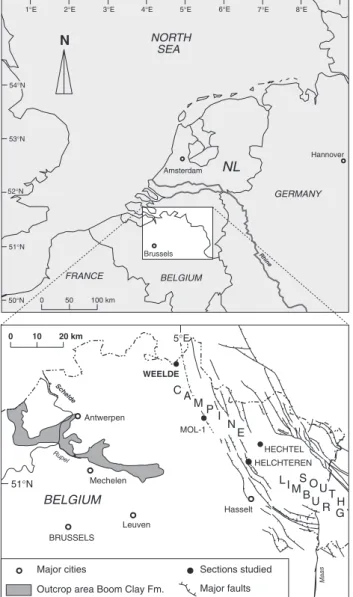
The benthic foraminiferal investigation is based on approximately 80 samples from 4 cored boreholes in NE Belgium, covering the Rupelian Boom Clay and the Chattian Voort Sand Formation (Fig. 1, see also De Man et al., 2004). These data are furthermore completed with published results from the lower part of the Boom Clay Formation (Hooyberghs et al., 1992; Grimm & Steurbaut, 2001). A composite section (CS) for the R-C transition in the southern North Sea Basin is compiled on the basis of geophysical well log data and biostratigraphy. The ‘Asterigerina Horizon’ – defining the base of the Chattian Stage – is designated as reference level zero (see De Man et al., 2004).
Equally sized samples (~200g) were dried in an oven and then soaked in a dilute solution of a phosphate-containing detergent (‘Sun’). All samples were washed on a 63 µm sieve, dried, and then split on a 120 µm sieve. Only the fraction >120 µm was examined quan-titatively. Relative abundances were calculated from at least 200 benthic individuals, except when the faunas were very sparse (Table 1; for details and range charts see De Man et al., 2004). For the lower part of the section (up to level S50), counts are limited to 100 benthic foraminifera per sample (data by Hooyberghs et al., 1992 and Grimm & Steurbaut, 2001) and hence are statistically not representative. To recognise and evaluate post-mortem changes, i.e. dissolution and transport, the quality of preservation for the fora-miniferal assemblages was evaluated (see e.g., Murray, 1984, p. 467). Only assemblages revealing minor post-mortem modifications are applied in the present paleo-environmental reconstructions. Rhine N 0 50 100 km NORTH SEA Brussels BELGIUM GERMANY NL Amsterdam FRANCE Hannover 50°N 51°N 52°N 53°N 54°N 5°E 4°E 3°E
1°E 2°E 6°E 7°E 8°E
BELGIUM 0 10 20 km WEELDE MOL-1 BRUSSELS Antwerpen Mechelen Rupel Leuven Schelde Maas Hasselt
Outcrop area Boom Clay Fm.
Sections studied Major faults Major cities HECHTEL HELCHTEREN 5°E 51°N CA M PI E N S O U T H L IM B UR G
Fig. 1. Location of the sections studied (modified after Van Simaeys et al., 2004).
The planktonic foraminifera were not identified to species level, but only calculated as percentages (P% = [number planktonic / (number benthic + planktonic foraminifera)] × 100). In a semi-enclosed basin, this value is not primarily related to depth but rather to the influx of oceanic water into the basin (Murray, 1976). The Fisher diversity index (α), allowing comparison with modern equivalent environ-ments, is determined following standard procedures as described by Murray (1973). The three suborders (hyaline, porcellaneous and agglutinated forms) are taken into account for the triangular plot (Murray, 1973, p. 26), and additional differentiation is made for calcareous and non-calcareous agglutinants (according to King, 1989), allowing recognition of low oxygen levels.
Temperature delineation for each genus is based on the assumption that the environmental conditions for modern genera are essentially the same as for the fossil record. This assumption is fairly reliable for
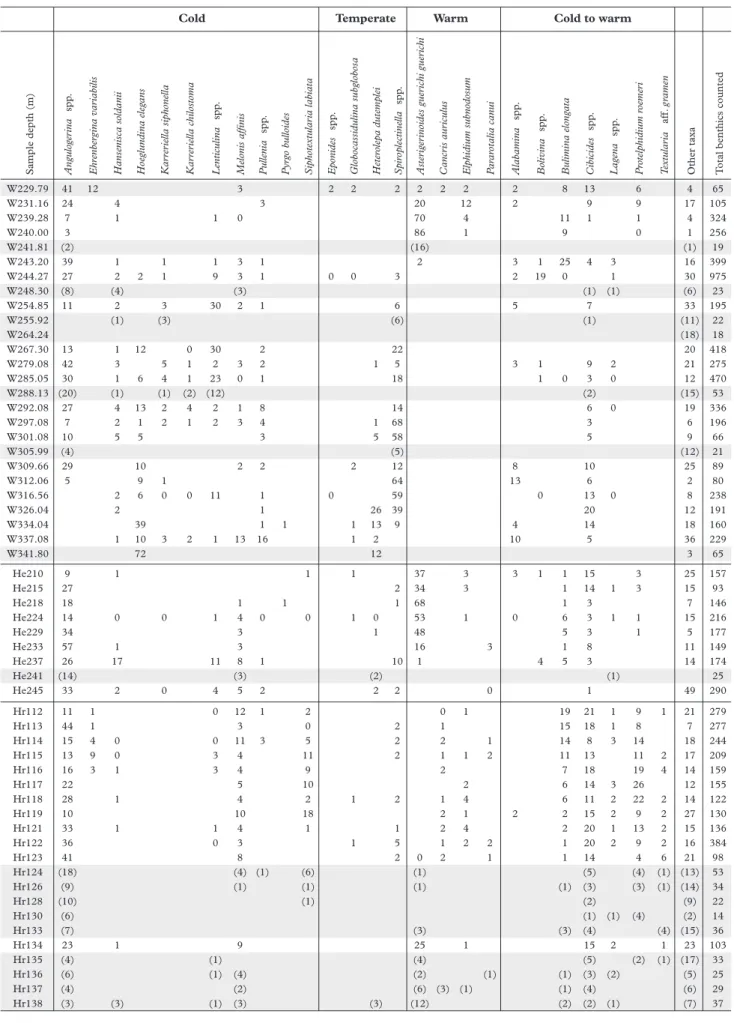
Cenozoic times (Murray, 1984, p. 469). Additionally, this assumption is evaluated through comparison with Oligocene shallow marine faunas from different paleogeographic provinces (e.g., Beckmann, 1953; Corliss, 1981; Wong, 1976; Wood et al., 1985). These approaches led to the establishment of 4 different categories, each category grouping species with a clear affinity towards respectively ‘cold’, ‘temperate’, ‘warm’ or ‘cold to warm’ conditions (Table 1). Quantification of these temperature-restricted eco-groups is based on comprehensive lists of temper-ature preferences for modern benthic foraminifera (e.g., Jarke, 1961; Haake, 1962; Hofker, 1977; Murray, 1973, 1991; see Table 1 and Fig. 2).
These data allow the reconstruction of a paleo-temperature curve according to the equation of Lommerzheim (1991); a method successfully applied for late Oligocene samples (Kohnen, 1995):
n
Ttrend= (1/n) Σ ni∗ [(Tmin,i + Tmax,i)/2] i=1
With i representing a certain taxon, n the total amount of specimens counted within the assemblage, ni the appropriate number of specimens of taxon i and Tmin,i, Tmax,i its minimum and maximum temperature (see Fig. 2). It is here stressed that this method only provides a trend value for comparing the different assemblages, and should not be regarded as an absolute method for determining paleotemperatures.
Paleoenvironment: results and interpretation
Evaluation of the assemblage-quality
The majority of the assemblages yield specimens with shiny to dull hyaline tests, with juveniles and adults of the same species present, and broken tests being very rare. There is no significant loss of agglutinated tests, as indicated by the presence of both adult and juvenile
Karreriella siphonella. Hence, these assemblages are
regarded as reliable for paleoecological interpretations (field I of Murray, 1984, p. 467). Some upper Rupelian samples (around –74 m and –55 m in the CS) are anomalously enriched in pyritised agglutinants (medium to large agglutinated tests), suggesting dis-solution of hyaline calcareous tests. The latter assem-blages are assigned to field IIICC (Murray, 1984, p. 467), and hence cannot be used in further paleo-environmental reconstructions.
Results
The Fisher diversity index (α index), representing the assemblage diversity, is high for the lower part of the
0 10 20 30 (°C) Murray (1991) Murray (1973) Jarke (1961) GENERA TEMPERATURE Cold Tropical
Fig. 2. Temperature ranges of selected, encountered taxa, as recorded in literature.
Cold Temperate Warm Cold to warm
Sample depth (m) Angulo
ge rina spp . Ehrenberg ina v a riabilis
Hansenisca soldanii Hoeglundina eleg
ans Kar rer iella siphonella Kar rer iella chilostoma Lenticulina spp .
Melonis affinis Pullenia
spp . Pyrg o b ulloides Siphotextular ia labia ta Eponides spp .
Globocassidulina subglobosa Heterolepa dutemplei Spiroplectinella
spp . Aster ig er inoides guer ichi guer ichi Cancr is aur iculus Elphidium subnodosum Pa rarotalia canui Alabamina spp . Bolivina spp . Bulimina elong a ta Cibicides spp . Lag ena spp . Protelphidium roemer i T extular ia aff . g ramen
Other taxa Total benthics counted
W229.79 41 12 3 2 2 2 2 2 2 2 8 13 6 4 65 W231.16 24 4 3 20 12 2 9 9 17 105 W239.28 7 1 1 0 70 4 11 1 1 4 324 W240.00 3 86 1 9 0 1 256 W241.81 (2) (16) (1) 19 W243.20 39 1 1 1 3 1 2 3 1 25 4 3 16 399 W244.27 27 2 2 1 9 3 1 0 0 3 2 19 0 1 30 975 W248.30 (8) (4) (3) (1) (1) (6) 23 W254.85 11 2 3 30 2 1 6 5 7 33 195 W255.92 (1) (3) (6) (1) (11) 22 W264.24 (18) 18 W267.30 13 1 12 0 30 2 22 20 418 W279.08 42 3 5 1 2 3 2 1 5 3 1 9 2 21 275 W285.05 30 1 6 4 1 23 0 1 18 1 0 3 0 12 470 W288.13 (20) (1) (1) (2) (12) (2) (15) 53 W292.08 27 4 13 2 4 2 1 8 14 6 0 19 336 W297.08 7 2 1 2 1 2 3 4 1 68 3 6 196 W301.08 10 5 5 3 5 58 5 9 66 W305.99 (4) (5) (12) 21 W309.66 29 10 2 2 2 12 8 10 25 89 W312.06 5 9 1 64 13 6 2 80 W316.56 2 6 0 0 11 1 0 59 0 13 0 8 238 W326.04 2 1 26 39 20 12 191 W334.04 39 1 1 1 13 9 4 14 18 160 W337.08 1 10 3 2 1 13 16 1 2 10 5 36 229 W341.80 72 12 3 65 He210 9 1 1 1 37 3 3 1 1 15 3 25 157 He215 27 2 34 3 1 14 1 3 15 93 He218 18 1 1 1 68 1 3 7 146 He224 14 0 0 1 4 0 0 1 0 53 1 0 6 3 1 1 15 216 He229 34 3 1 48 5 3 1 5 177 He233 57 1 3 16 3 1 8 11 149 He237 26 17 11 8 1 10 1 4 5 3 14 174 He241 (14) (3) (2) (1) 25 He245 33 2 0 4 5 2 2 2 0 1 49 290 Hr112 11 1 0 12 1 2 0 1 19 21 1 9 1 21 279 Hr113 44 1 3 0 2 1 15 18 1 8 7 277 Hr114 15 4 0 0 11 3 5 2 2 1 14 8 3 14 18 244 Hr115 13 9 0 3 4 11 2 1 1 2 11 13 11 2 17 209 Hr116 16 3 1 3 4 9 2 7 18 19 4 14 159 Hr117 22 5 10 2 6 14 3 26 12 155 Hr118 28 1 4 2 1 2 1 4 6 11 2 22 2 14 122 Hr119 10 10 18 2 1 2 2 15 2 9 2 27 130 Hr121 33 1 1 4 1 1 2 4 2 20 1 13 2 15 136 Hr122 36 0 3 1 5 1 2 2 1 20 2 9 2 16 384 Hr123 41 8 2 0 2 1 1 14 4 6 21 98 Hr124 (18) (4) (1) (6) (1) (5) (4) (1) (13) 53 Hr126 (9) (1) (1) (1) (1) (3) (3) (1) (14) 34 Hr128 (10) (1) (2) (9) 22 Hr130 (6) (1) (1) (4) (2) 14 Hr133 (7) (3) (3) (4) (4) (15) 36 Hr134 23 1 9 25 1 15 2 1 23 103 Hr135 (4) (1) (4) (5) (2) (1) (17) 33 Hr136 (6) (1) (4) (2) (1) (1) (3) (2) (5) 25 Hr137 (4) (2) (6) (3) (1) (1) (4) (6) 29 Hr138 (3) (3) (1) (3) (3) (12) (2) (2) (1) (7) 37
Table 1. Quantitative distribution of environmental important benthic foraminiferal taxa from the Weelde (W), Hechtel (He) and Helchteren (Hr) borehole. Grey zones indicate statistically not representative samples.
Rupelian section (for the interval –130 to –90 m:α values vary between 7 and 16) and gradually declines for the upper Rupelian samples (for the interval –90 to 0 m:α values vary between 3 and 7; see Table 2 and Fig. 3). One upper Rupelian sample, i.e. –37 m in the CS, shows an unexpected high α index (see Table 2 and Fig. 3). The Fisher diversity index for the base of the Chattian succession is distinctly lower compared to the Rupelian assemblages (for the interval 0 to 10 m: α values vary between 1 and 4, Fig. 3). Higher up the Chattian, the Fisher diversity index increases again, reaching maximum values around 43 and 48 m in the CS (Fig. 3).
In general, planktonic foraminifera are rare through-out the Oligocene sthrough-outhern North Sea Basin succes-sions. Only in the lower part of the Rupelian section, planktonic foraminifera are more common, and reach maximum values around –118 m in the CS (P~50%, Fig. 3, Table 2). In the upper part of the section, planktonic foraminifera are very rare (<5%), except for 3 levels (–95, –74 and 43 m), showing values around ~17%. The Oligocene southern North Sea Basin foraminiferal assemblages are furthermore dominated by hyaline taxa. The porcellaneous com-ponent shows slightly higher values in the Chattian as compared to the Rupelian assemblages, whereas non-calcareous agglutinants are more represented within the Rupelian (Fig. 3).
Interpretation
The foraminiferal assemblages from the lower part of the Rupelian successions suggest normal marine shelf conditions (~100 m water depth), based on a high Fisher diversity index (α >7) and the proportion of hyaline taxa on the triangular plot (Murray, 1991) (see Fig. 3). The common occurrence of planktonic foraminifera further suggests open marine connec-tions to the oceanic realm (Grimm & Steurbaut, 2001); the maximum abundance of planktonic foraminifera in -118 m coincides with a maximum flooding surface (Vandenberghe et al., 2001). The upper Rupelian foraminiferal assemblages (–90 m to 0 m), showing a lower diversity index and rare plank-tonic foraminifera, suggest a gradual shallowing of a poorly ventilated and more isolated marine environ-ment (Van Simaeys et al., 2004).The increased assem-blage diversity around –37 m (α index = 10), coinciding with the recurrence of several dinocyst taxa and the first occurrence of some calcareous nannoplankton species (Van Simaeys et al., 2004), suggests a renewed opening of a marine pathway and the inflow of well-oxygenated water masses, re-installing normal marine conditions. The basal Chattian foraminiferal
assemblage suggests marginal marine to brackish-marine conditions, with water depths not exceeding 20 m. The glauconiferous sandy substrate points towards increased hydrodynamic energy compared to the upper Rupelian successions. Higher up the Chattian, conditions return to a normal marine environment.
Paleotemperature: results and interpretation
Evaluation of the encountered taxa
Temperature delineation for the different ecogroups and – if specified – for different taxa is based on values listed in literature (see Fig. 2). In case different temperature-ranges were listed for the same taxon, the maximum range was taken into account and used in the equation of Lommerzheim (1991) (see above). Extinct taxa (e.g. Rotaliatina) and taxa with no clear or unknown affinity towards specific climatic condi-tions (e.g. nodosariids) are grouped as ‘other taxa’ (see Table 1) and are not used in the present paleo-environmental analysis.
Asterigerinoides guerichi guerichi, originally described
as Asterigerina guerichi Franke, 1912, is here considered to have the same paleoecological preferences as the genus Asterigerina. The latter genus is reported as an inner shelf species occurring in subtropical to tropical conditions (Murray, 1991, p. 288 & p. 323).
Asterigerinoides is reported from late Eocene sections
in northern Italy, with presumed water temperatures exceeding 22°C (Murray, 1991, p. 308). In the late Oligocene North Sea Basin successions, Asterigerinoides
guerichi guerichi co-occurs with Miogypsina (Anderson
et al., 1971), a larger foraminifera, clearly favouring warm subtropical conditions. The affinity of
Pararotalia towards warm conditions is confirmed by
Lauriat-Rage et al. (1993); this taxon is believed to have a temperature preference between 15 and 25°C. Also the keeled Elphidium subnodosum is regarded as a typical shelf species, favouring warm conditions (Murray, 1991, p. 129 & p. 324).
Globocassidulina subglobosa is listed as a cold
tem-perate to temtem-perate species in modern faunas, occur-ring in water masses between 4 and 20°C (Murray, 1991, p. 80 & p. 159). In Oligocene times, however, this species tends to prefer much warmer conditions (see e.g. Wood et al., 1985 and Corliss, 1981). The same holds true for both Eponides spp. and Heterolepa
dutemplei. In modern faunas these species have affinity
towards cold temperate to temperate conditions, while during the Oligocene, these species frequently occur in subtropical regions.
Hr112 50 279 26 7 92 5 2 1 0 Hr113 49 277 20 5 97 1 2 0 0 Hr114 48 244 31 10 91 2 7 0 0 Hr115 47 209 29 9 82 3 13 2 1 Hr116 47 159 20 6 84 3 9 4 3 W 229 46 65 19 7 98 0 2 0 12 Hr117 45 155 17 5 86 3 10 0 0 Hr118 44 122 22 8 92 3 3 2 2 Hr119 43 130 27 11 74 5 19 2 16 Hr121 41 136 23 9 90 4 3 2 4 Hr122 40 384 32 9 89 5 4 2 2 Hr123 39 98 20 7 87 5 2 6 6 Hr124 38 53 Hr126 36 34 W 231 30 105 18 6 100 0 0 0 4 Hr134 28 103 1 He210 26 157 23 7 95 4 1 0 6 Hr138 25 37 He215 20 93 14 4 97 1 2 0 1 He218 18 146 13 3 98 1 1 0 0 He224 12 216 26 7 97 2 1 0 1 He229 7 177 11 3 100 0 0 0 1 W 239 3 324 15 3 100 0 0 0 0 He233 3 149 15 4 99 1 0 0 4 W 240 2 256 6 1 100 0 0 0 0 W 241 1 19 W 242 0 0 W 243 –1 399 26 6 97 1 1 1 1 He237 –1 174 20 6 90 0 10 0 1 W 244 –2 975 36 7 95 0 4 1 2 He241 –5 25 100 4 W 248 –6 23 100 He245 –9 290 19 5 98 0 2 0 1 W 252 –10 0 100 0 W 254 –12 195 24 7 92 0 5 3 3 W 260 –18 0 100 W 267 –25 418 14 3 77 0 22 0 0 W 272 –30 0 100 W 276 –34 0 100 W 279 –37 275 34 10 87 1 6 6 1 W 285 –43 470 23 5 77 0 17 6 0 W 288 –46 53 100 W 292 –50 336 22 5 79 1 14 6 1 W 297 –55 196 20 5 27 1 69 3 2 W 301 –59 66 100 W 305 –64 21 100 W 309 –67 89 11 3 88 0 12 0 0 W 312 –70 80 8 3 34 1 65 0 0 W 316 –74 238 26 8 39 1 59 1 19 W 322 –80 3 100 W 326 –84 191 13 3 61 0 39 0 0 W 334 –92 160 12 3 83 8 9 0 4 W 337 –95 229 22 6 92 2 0 6 21 TW 51 –103.5 100 24 11 100 0 0 0 21 W 341 –105 65 100 TW 46 –108 100 14 4,5 100 0 0 0 1 TW 43 –110.5 100 21 8 98 0 1 1 13 TW 41 –112.5 100 16 5 99 0 0 1 9 TW 18 –118 100 25 11 92 0 8 0 87 TW 16 –118.2 100 26 11 86 1 12 1 43 TW 15 –118.4 100 23 10 95 0 5 0 26 TW 14 –118.7 100 26 11 93 0 7 0 7 TW 13 –119 100 22 8 95 0 5 0 60 TW 12 –120 100 28 13 66 0 31 3 23 TW 11 –120.5 100 20 7 93 0 6 1 34 TW 10 –121 100 24 10 90 0 7 3 44 TW 9 –121.5 100 28 13 88 1 11 0 21 TW 8 –122 100 29 14 93 0 5 2 29 TW 8b –123 100 21 8 95 0 5 0 34 TW 7 –124 100 25 11 97 1 1 1 34 TW 6 –124.5 100 29 13 96 0 4 0 3 TW 5 –125.5 100 28 12 92 0 8 0 5 TW 4 –126 100 26 11 93 0 6 1 3 TW 3 –126.4 100 26 11 92 0 6 2 3 TW 2 –126.7 100 26 11 93 0 6 1 2 TW 1 –127 100 22 8 84 0 15 1 11 TW 35 –127.3 100 20 7 97 0 3 0 46 TW 34 –127.5 100 24 10 94 0 1 5 24 SN 11 –128 100 22 9 88 0 10 2 63 TW 33 –128.5 100 26 12 90 0 8 2 2 SN 10 –129 100 27 12 80 0 17 3 1 SN 9 –129.5 100 29 13 97 0 3 0 12 TW 31 –130 100 17 6 96 0 4 0 0 SN 8 –131 100 23 7 95 0 4 1 7 SN 7 –132 100 20 7 93 0 6 1 6 SN 5 –134 100 32 16 86 0 10 4 26 SN 3 –138 100 26 13 86 0 10 4 17
Sample depth (m) CS (m) Total benthics counted Number of species α- index % h
y
aline
% porcellaneous % calcareous agglutinants % non calcareous agglutinants P % Sample depth (m) CS (m) Total benthics counted Number of species α- index % h
y
aline
% porcellaneous % calcareous agglutinants % non calcareous agglutinants P % Table 2. Foraminiferal paleoenvironment parameters for the Oligocene southern North Sea Basin successions. Sample depth refers to the exact depth in the appropriate borehole or outcrop section (Hr: Helchteren borehole; He: Hechtel borehole; W: Weelde borehole; TW: Terhagen West; SN: Sint Niklaas). Counts not exceeding 100 specimens per sample are indicated in grey.
Angulogerina spp., often used in synonymy with Trifarina spp., nowadays occurs in water masses with
temperatures between 4 and 11°C (Murray, 1991,
p. 251). From the Southern Ocean, this genus is even recorded in shelf deposits with water temperatures between –2 and 1°C (Murray, 1991, p. 274). Other
V 10 21 I II IV III 1 2 5 67 8 9 11 VI 12 13 VII 14 15 18 19 20 VIII IX X XI In pro-gress
BENTHIC FORAM ZONA
TION 17 16 S60 S50 S80 S90 S70 S110 S150 S180 S190 S200 S40 S10 S20 S30 R DB COMPOSITE SECTION 0 -50 -100 -150 50 V
oort Sand Formation
T ransitional layers Te rhagen Mb. Putte Member Belsele Waas Mb. Ruisbroek Member LITHOSTR A T.
Boom Clay Formation
ST AGE S SERIES CHA TTIAN RUPELIAN OLIGOCENE MIOCENE S10 Unconformity Clay Sand Silt Gravel Septaria Horizon FAUNAL COMPOSITION 0 20 40 60 80 100% 0 20 40 60 80 100 P% (P%) REL A TIVE ABUNDANCE PLANKT ONIC FORAMINIFERA DIVERSITY (α-INDEX) 0 4 8 12 16 Hyaline Porcellaneous Agglutinated (calcareous) Agglutinated (non calcareous)
Fig. 3. Foraminiferal paleoenvironment parameters for the Oligocene southern North Sea Basin successions. Composite section and benthic foram zonations after De Man et al., 2004. Data from the outcrop section (up to S50) by Hooyberghs et al. (1992). Counts not exceeding 100 specimens per sample are indicated by dashed lines.
recent cold water taxa (e.g. Karreriella, Lenticulina,
Pullenia and Pyrgo) generally occur in water masses
with temperatures not exceeding 10°C.
The distribution of the genus Protelphidium, of which the modern representative is thought to be Haynesina (Murray, 1991, p. 136 & p. 309), is primarily related to salinity. However, optimum temperature conditions for this genus are between 15 and 20°C.
Results
A paleotemperature curve, based on the benthic foraminiferal assemblage for each sample and using the equation as explained above, has been constructed for the Oligocene southern North Sea Basin succes-sions (Fig. 4). In general, the Rupelian assemblages are dominated by cold to cold-temperate taxa (i.e.
V 10 21 I II IV III 1 2 5 67 8 9 11 VI 12 13 VII 14 15 18 19 20 VIII IX X XI In pro-gress
BENTHIC FORAM ZONA
TION 17 16 S60 S50 S80 S90 S70 S110 S150 S180 S190 S200 S40 S10 S20 S30 R DB COMPOSITE SECTION 0 -50 -100 -150 V
oort Sand Formation
T ransitional layers Terhagen Mb. Putte Member Belsele Waas Mb. Ruisbroek Member LITHOSTRA T.
Boom Clay Formation
ST AGES SERIES CHA TTIAN RUPELIAN OLIGOCENE MIOCENE DINOCYST ZONA TION NP- ZONA TION NP 25* NP 24* NP 23 NP 22 NSO2 NSO3 NSO4a NSO4b NSO5a NSO6 5b NSO7 NSO8 0 10 20 30 (°C) 0 10 20 30 (°C) PALEOTEMPERATURE Ttrend = 1 ni* (Tmin,i + Tmax,i) n
ni= number of specimens of taxon i
Tmin, Tmax = min/max temperature 2
i =1 n
n
= total amount of specimens counted
C12r C12n
MAGNET
OSTRA
T.
Fig. 4. Benthic foraminiferal paleotemperature curve for the Oligocene southern North Sea Basin succes-sions. Grey zone indicates the reliability interval, as calculated from minimum and maximum values for the temperature range of taxa. Composite section and benthic foraminifer zonation after De Man et al., 2004; NP*-zonation after Van Simaeys et al., 2004; dino-cyst zonation after Van Simaeys et al., in press; magnetostratigraphy after Vandenberghe et al., 2001. Counts not exceeding 100 specimens per sample are indicated by a dashed line. Legend as in Fig. 3.
Lenticulina, Pullenia, Hoeglundina, Spiroplectinella, Hansenisca, Angulogerina, etc.), and the calculated
bottom water paleotemperatures never exceed 10°C (Fig. 4). Some rare Rupelian samples (i.e., –110 m, –74 m and –37 m in the CS), however, are charac-terised by both cold- and warm temperate taxa (e.g.,
Quinqueloculina and Bolivina) and hence show slightly
higher bottom water paleotemperatures. The base of the Chattian, on the contrary, is characterised by abundant warm temperate, tropical to subtropical taxa (i.e. Asterigerinoides, Elphidium, Cancris) and the calculated bottom water paleotemperatures exceed 20°C (Fig. 4). Higher up the Chattian, the warm temperate to subtropical species are less abundant, and cold-temperate taxa (i.e. Angulogerina, Lenticulina,
Melonis, Ehrenbergina) become more frequent. Interpretation
The most obvious climate change recognised in the Oligocene southern North Sea Basin successions is the major warming-event associated with the basal Chattian sediments. Although the attributed equation should not be used for determining absolute paleo-temperatures, it is clear that the cold to cold-temperate Rupelian benthic foraminiferal assemblages are in strong contrast with the tropical to subtropical fauna as recorded from the basal Chattian sediments.
A Late Oligocene Warm Episode?
As the marked tropical to subtropical conditions for the basal Chattian sediments in the southern North Sea Basin clearly conflict with the general perception of a long-termed, pervasive global deterioration of the Paleogene climate, our findings need to be considered with caution. Do the tropical to subtropical Chattian deposits at Northern Hemisphere mid latitudes indi-cate temporal climate amelioration, or are these results biased by the simultaneous shallowing of the environ-ment?
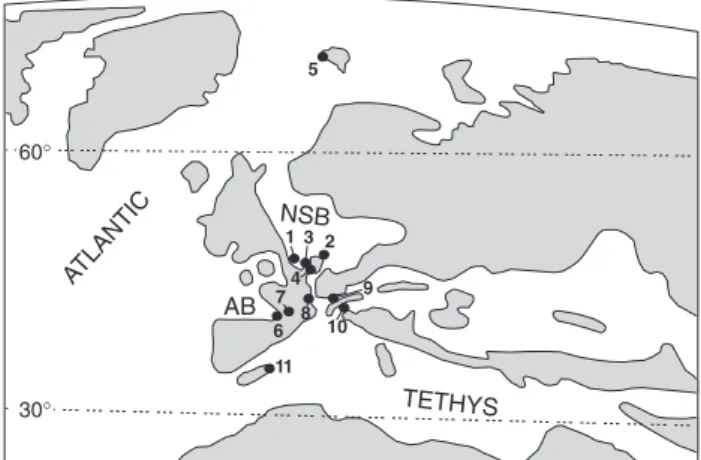
Other records of Late Oligocene warm temperate to subtropical conditions in the southern North Sea Basin have been documented in both the marine and continental realm. Estimated paleotemperatures, based on benthic foraminiferal assemblages from the Chattian unit-stratotype, i.e. the Doberg section in NW-Germany (Fig. 5), reveal annual average temper-atures between 14°C and 19°C (Kohnen, 1995). Moreover, from the middle part of the Doberg section, Anderson et al. (1971) reports on the presence of
Miogypsina septentrionalis, a larger foraminifer,
indi-cating tropical to subtropical conditions (Murray, 1973; Murray, 2002). Chattian Hiatella arctica molluscs from the well calibrated Kapellen and Rossenray profiles (Fig. 5; see also Ellermann, 1958; Indans, 1958) yield summer temperatures1between 26.5 and 27°C, while winter temperatures range between 20.5°C and 24.5°C (Strauch, 1968). The unexpected high paleo-temperatures for the lower Chattian deposits, as calculated in our study, are within the range the previous paleotemperature reconstructions for the southern North Sea Basin.
Two localities from the southernmost margin of the Lower Rhine Embayment (Fig. 5) further yield sub-stantial data on the Late Oligocene climatic condi-tions. The lake Rott sequence – consisting of lagoonal to lacustrine clay and brown coal deposits – belongs to the upper part of MP30 (Mörs, 2002) and hence has an approximate age of ~24 Ma (Utescher et al., 2000). The Enspel locality yields a rich and diversi-fied flora containing fruits, seeds and leaves; a radio-metric date of 25.8 Ma (or MP 28, Storch et al., 1996) indicates a Late Oligocene age. From these localities, Utescher et al. (2000) reconstruct the terrestrial paleo-climate, by using the coexistence approach on different paleobotanical records. The authors calculate Mean
1 By investigating the numerical distribution, shell form and growth of recent Hiatella arctica, Strauch (1968) deduced quantitative temperature
data from size measurements of adult fossil populations.
30° 60° 9 11 6 2 7 8 10 5 4 1 3 NSB AB ATLANTIC TETHYS
Fig. 5. Location of other Late Oligocene warm to subtropical records. 1. Rupelian unit stratotype (this study); 2. Chattian unit stratotype (Anderson et al., 1971; Kohnen, 1995); 3. Lower Rhine Embayment, i.e. Kapellen and Rossenray sections (Strauch, 1968); 4. Southernmost part of Lower Rhine Embayment, i.e. Lake Rott and Enspel (Schwarzbach, 1952; Utescher et al., 2000; Mörs, 2002); 5. Spitsbergen (Feyling-Hanssen & Ulleberg, 1984); 6. Aquitaine Basin (Lauriat-Rage et al., 1993; Antunes & Cahuzac, 1999); 7. Aquitaine molasse basin (Astruc et al., 2003); 8. Swiss Molasse (Berger, 1998); 9. Bavarian folded molasse (Uhlig et al., 2000); 10. Slovenian Sava Basin (Bruch & Mosbrugger, 2002); 11. Mallorca (Ramos et al., 2001). Paleogeographic map modified from Ziegler (1990), Scotese & Golanka (1992) and Sissingh (2003).
Annual Temperatures (MAT) of 15.7-16.8°C for Enspel and 16.5-20.8°C for lake Rott; while the Warm Month Mean (WMM) for both localities respectively lies around 25°C and between 26-28°C. The authors (Utescher et al., ibid.) interpret both the Enspel and lake Rott flora as to be deposited during very warm conditions. The warm nature of the lake Rott flora is furthermore supported by the remains of tropical palms (Schwarzbach, 1952) and the rich vertebrate fauna, containing crocodiles, snakes, Rhinocerotidae and Marsupialia (von Koeningswald & Mosbrugger, 1989; Mörs, 1995, 1996, 2002). Feyling-Hanssen & Ulleberg (1984) report on a peculiar benthic foraminiferal assemblage from Sarsbukta, Spitsbergen (Fig. 5): up to ~10-20% of the benthic foraminifera consist of Asterigerinoides cf. guerichi; hence this asso-ciation can tentatively be attributed to the early Chattian ‘Asterigerina-Horizon’. Recent representatives of this genus, however, show clear affinity to shallow, warm temperate to subtropical conditions (Fig. 2). This observation suggests much warmer conditions on Spitsbergen during the Late Oligocene as compared to the present Arctic climate.
Several other studies report on Late Oligocene warm temperate to subtropical conditions in NW Europe: in the Aquitaine Basin (SW France, see Fig. 5), the Escornebeou sections have been ascribed to the Chattian based on the reported P22 (planktonic foraminifera), the NP25 (nannoplankton) calcareous microfossil assemblages (Antunes & Cahuzac, 1999) and based on Sr-dating (foraminiferal tests are dated as 25.8 Ma ± 0.31 Ma, Cahuzac et al., 1997). The warm, at least subtropical climate during the deposition of these Chattian successions is inferred from the presence of Tomistomine crocodilians, which cannot live at temperatures lower than 10°C as a minimum during the coldest season (Antunes & Cahuzac, 1999). Other climate indicators, pointing towards warm, tropical conditions, are the presence of numerous larger foraminifera (i.e. Nummulites bouillei2 and Miogypsinoides), the abundance of hermatypic corals (>120 species), echinoids, molluscs and sharks3; for an overview see Lauriat-Rage et al. (1993). Also the vertebrate fauna from the Aquitaine molasse basin (Fig. 5) reveals several taxa with affinities to warm conditions: Astruc et al. (2003) reports on vertebrate bearing localities with Rhinocerotidae in MP25/26 (early Chattian) and crocodile-, lizard-, snake- and Marsupialia remains assigned to MP26 (Chattian).
From the Swiss Molasse (Fig. 5), Berger (1998) reports on the ‘Rochette’ fossil assemblage, of which the ‘warm character’ is clearly indicated by the abun-dance of Lygodium4and by the large size of the turtles and crocodiles. These Lower Freshwater Molasse localities are dated by mammals (MP29, ~25.5 Ma according to Berger, 1992) and charophytes (notata zone, Late Oligocene). Uhlig et al. (2000) report on tropical, estuarine environments with mangrove vege-tation from the Lower Cyrena Beds in the Bavarian folded molasse (Fig. 5). These beds correspond to the upper part of mammal zone MP24 and hence can be attributed to the lower Chattian. Bruch & Mosbrugger (2002) reconstruct the Late Oligocene paleoclimate in the Slovenian Sava Basin (Fig. 5) and document warm temperate, humid climate conditions with low annual variation. Ramos et al. (2001) report on the presence of crocodile and turtle remains (mean monthly temperature ~20°C) and elements of rain forest vegetation5from the Late Oligocene lacustrine Cala Blanca Formation, Mallorca (Fig. 5). Strati-graphic age control is based on charophytes, paly-nomorphs and rodent fossil remains (Ramos et al., 2001).
From this, and previous studies – using independent tools of paleoclimate reconstruction – it becomes clear that warm to tropical conditions emerged during the Late Oligocene in NW-Europe. This widespread major warming pulse suggests correlation with the global Late Oligocene Warming Event (LOWE, Zachos et al., 2001); this assumption is supported by dino-flagellate cyst correlations (Van Simaeys, 2004). The LOWE – calibrated against magnetochron C8 – induced a major sea level rise, which seems to be genetically related to the early Chattian transgression in the southern North Sea Basin (Van Simaeys, 2004).
Quantitative data from Northern Hemisphere mid latitude Oligocene deposits is limited, poorly calibrated (Buchardt, 1978), or altered by diagenesis (Attendorn, 1995). Detailed oxygen isotope analysis on benthic foraminifera and incrementally sampled otoliths and bivalves from Belgian Oligocene deposits should enable recognition of the Late Oligocene Warming Event in the stratotype regions (De Man et al., in prep.).
2 Recent Nummulitidae occur in tropical conditions with sea surface temperatures between 24-34°C (Langer & Hottinger, 2000). 3 i.e. Carcharhiniforms, suggesting at least moderately warm waters (Antunes & Cahuzac, 1999).
4 Leaves of a lower vascular plant of which the recent Lygodium palmatum is found in Florida (Berger, 1998). 5 i.e. Sabal, Sapindus, Ficus.
Conclusions
Quantitative analysis of benthic foraminifera from several boreholes throughout the Oligocene southern North Sea Basin successions enables the reconstruc-tion of both paleoenvironment and paleoclimate changes associated with the Rupelian-Chattian transition in their type region.
By determining the Fisher α diversity index, the proportion of hyaline, porcellaneous and agglutinated taxa, and the relative abundance of planktonic foraminifera (P%), it is shown that the lower part of the Rupelian is characterised by normal marine shelf conditions with temporal open connections towards the ocean realm and water depths around 100 m. The upper Rupelian successions show a gradual shallowing and the realisation of a poorly ventilated and more isolated marine environment.The base of the Chattian sequence, on the contrary, is characterised by marginal marine to brackish-marine conditions, with water depths not exceeding 20 m. Higher up the Chattian successions, conditions return to a normal marine environment.
A major climate change coincides with the Rupelian-Chattian unconformity in the southern North Sea Basin: the unexpected tropical to subtropical benthic foraminiferal assemblages from the basal Chattian sediments in the southern North Sea Basin are in strong contrast with the cold to cold-temperate Rupelian fauna. Previous studies – using independent tools of paleoclimate reconstruction – confirm that warm to tropical conditions emerged during the Late Oligocene in NW-Europe. This widespread major warming pulse suggests correlation with the global Late Oligocene Warming Event (LOWE, Zachos et al., 2001); an assumption supported by dinoflagellate cyst correlations (Van Simaeys, 2004).
Acknowledgements
The authors would like to express their gratitude to Henk Brinkhuis, Stefaan Revets, Robert Speijer and Etienne Steurbaut for stimulating discussions. Careful reviews were provided by Gitte V. Laursen and Bruno Cahuzac. Thanks are due to both of them. EDM gratefully acknowledges the support of the DWTC-Brussels (Grant WI/36/C03) and SVS acknowledges support from the University of Leuven (Special Faculty Section nr. 12692 Grant).
References
Anderson, A.J., Hinch,W., Martini, E., Müller, C. & Ritzkowski, S., 1971. Chattian. Giornale di Geologia 37(2): 69-79.
Antunes, M. & Cahuzac, B., 1999. Crocodilian faunal renewal in the Upper Oligocene of Western Europe. Comptes rendus de l’académie des sciences serie II Fascicule A-Sciences de la terre et des planètes 328(1): 67-72.
Astruc, J.G.Hugueney, M., Escarguel, G., Legendre, S., Rage, J.-C., Simon-Coinçon, R., Sudre, J. & Sigé, B., 2003. Puycelci, a new vertebrate-bearing locality in the Aquitaine molassic basin. Density and continuity of the Paleogene biochronologic record in the Quercy and peripheral basins area. Geobios 36(6): 629-648. Attendorn, 1995. δ13C und δ18O-Isotopenverhaltnisse von
Pectiniden des Chatt der Niederrheinischen Bucht, NW-Deutschland. Neues Jahrbuch fur Geologie und Palaontologie Abhandlungen 198(1/2): 223-232.
Beckmann, J.P., 1953. Die Foraminiferen der Oceanic Formation (Eocaen-Oligocaen) von Barbados, Kl. Antillen. Eclogae Geologicae Helvetiae 46(2): 301-412.
Berger, J.-P., 1992. Correlative chart of the European Oligocene and Miocene: Application to the Swiss Molasse Basin. Eclogae Geologicae Helvetiae 85(3): 573-609.
Berger, J.-P., 1998. ‘Rochette’ (Upper Oligocene, Swiss Molasse): a strange example of a fossil assemblage. Review of Palaeobotany and Palynology 101: 95-110.
Bohaty, S. & Zachos, J.C., 2003. Significant Southern Ocean warming event in the late middle Eocene. Geology, 31(11): 1017-1020.
Bruch, A.A. & Mosbrugger, V., 2002. Palaeoclimate versus vegetation reconstruction – palynological investigations on the Oligocene sequence of the Sava Basin, Slovenia. Review of Palaeobotany and Palynology 122: 117-141.
Buchardt, B., 1978. Oxygen isotope palaeotemperatures from the Tertiary period in the North Sea area. Nature 275: 121-123. Cahuzac, B., Turpin, L. & Bonhomme, P., 1997. Sr isotope record
in the area of the Lower Miocene historical stratotypes of the Aquitaine Basin (France). In: Montanari, A., Odin, G.S., Coccioni, R. (eds), Miocene stratigraphy: an integrated approach. Developments in Paleontology and Stratigraphy. Elsevier (Amsterdam): 33-56.
Corliss, B.H., 1981. Deep-sea benthonic foraminiferal faunal turnover near the Eocene/Oligocene boundary. Marine Micro-paleontology 6: 367-384.
De Man, E.,Van Simaeys, S., De Meuter, F., King, C. & Steurbaut, E., 2004. Oligocene benthic foraminiferal zonation for the southern North Sea Basin. Bulletin van het Koninklijk Belgisch Instituut voor Natuurwetenschappen – Aardwetenschappen 74 supplement: 177-195.
De Man, E., Vandenberghe, N., Van Simaeys, S. & Ivany, L., in preperation.δ18O record of the Rupelian-Chattian boundary in
NE Belgium.
Doppert, J.W.C. & Neele, N.G., 1983. Biostratigraphy of marine Paleogene deposits in the Netherlands and adjacent areas. Mededelingen Rijks Geologische Dienst 37(2): 4-79.
Ellermann, C., 1958. Die mikrofaunistische Gliederung des Oligozäns im Schacht Kapellen bei Moers (Niederrhein). Fortschritte Geologie von Rheinland und Westfalen 1: 205-214. Feyling-Hanssen, R.W. & Ulleberg, K., 1984. A Tertiary-Quaternary section at Sarsbukta, Spitsbergen, Svalbard, and its foraminifera. Polar Research 2 n.s.: 77-106.
Grimm, K.I. & Steurbaut, E., 2001. Foraminiferal biofacies analysis of the Boom Clay in the Rupel area (Oligocene, Belgium) and correlation with the Mainz Basin (Germany). In: N.Vandenberghe (ed), Contributions to the Paleogene and Neogene Stratigraphy of the North Sea Basin. Aardkundige Mededelingen 11. Leuven University Press, Leuven: 9-20.
Haake, F.-W., 1962. Untersuchungen an der Foraminiferen-Fauna im Wattengebiet zwischen Langeoog und dem Festland. Meyniana 12: 25-64.
Hofker, J., 1977. The foraminifera of dutch tidal flat and salt marches. Netherlands Journal of Sea Research 11(3/4): 223-296. Hooyberghs, H., Vercauteren, T., De Meuter, F. & Symons, F., 1992. Foraminiferal studies in the Boom Formation. Ministerie van Economische Zaken, Belgische Geologische Dienst, Professional paper 8(258): 1-46.
Indans, J., 1958. Mikrofaunistische Korrelationen im marinen Tertiär der Niederrheinischen Bucht. Fortschritte Geologie von Rheinland und Westfalen 1: 223-238.
Indans, J., 1965. Nachweis des Asterigerinen-Horizontes im Oberoligozän des Dobergs bei Bünde/Westfalen. Neues Jahrbuch Geologie und Paläontologie, Abhandlungen 123(1): 20-24. Ivany, L.C., Nesbitt, E.A. & Prothero, D.R., 2003. The marine
Eocene-Oligocene transition: a synthesis. In: Prothero, D.R., Ivany, L.C. & Nesbitt, E.A. (eds), From Greenhouse to Icehouse. The marine Eocene-Oligocene transition. Columbia University Press, New York: 522-534.
Jarke, J., 1961. Die Beziehungen zwischen hydrographischen Verhältnissen, Faziesentwicklung und Foraminiferenverbreitung in der heutigen Nordsee als Vorbild für die Verhältnisse während der Miocän-Zeit. Meyniana 10: 21-36.
King, C., 1983. Cainozoic micropalaeontological biostratigraphy of the North Sea. Report Institute of Geological Sciences 82(7): 1-40. King, C., 1989. Cenozoic of the Norh Sea. In: D.G. Jenkins & J.W. Murray (eds), Stratigraphical atlas of fossil foraminifera. British micropalaeontological society series. Ellis Horwood Limited (Chichester): 418-489.
Kohnen, O., 1995. Paläotemperaturen aus dem Oberoligozän des Norddeutschen Beckens. Neues Jahrbuch für geologie und palaontologie – Abhandelungen 198(1/2): 233-241.
Langer, M. & Hottinger, L., 2000. Biogeography of selected larger foraminifera. Micropaleontology 46(1): 105-126.
Lauriat-Rage, A., Brébion, Ph., Cahuzac, B., Chaix, Ch., Ducasse, O., Ginsburg, L., Janin, M.-C., Lozouet, P., Margerel, J.-P., Nascimento, A., Pais, J., Poignant, A., Pouyet, S. & Roman, J., 1993. Palaeontological data about the climatic trends from Chattian to present along the Northeastern Atlantic frontage. Ciencias da Terra, Universidade Nova Lisboa (1st Congress R.C.A.N.S., Lisboa, 1992) 12: 167-179.
Lommerzheim, A., 1991. Mikropaläontologische Indikatoren für Paläoklima und Paläobathymetrie in der borealen Oberkreide: Bohrung Metelen 1001. Facies 24: 183-254.
Miller, K.G., Fairbanks, R.G. & Mountain, G.S., 1987. Tertiary oxygen isotope synthesis, sea level history, and continental margin erosion. Paleoceanography 2(1): 1-19.
Miller, K.G., Feigenson, M.D., Wright, J.D. & Clement, B.M., 1991. Miocene isotope reference section, Deep Sea Drilling Project site 608: an evaluation of isotope and biostratigraphic resolution. Paleoceanography 6(1): 33-52.
Miller, K.G. Mountain, G.S., Browning, J.V., Kominz, M., Sugerman, P.J., Christie-Blick, N., Katz, M.E. & Wright, J.D., 1998. Cenozoic global sea level, sequences, and the New Jersey transect: results from coastal plain and continental slope drilling. Reviews of Geophysics 36(4): 569-601.
Mörs, T., 1995. Die Sedimentationsgeschichte der Fossillagerstätte Rott und ihre Alterseinstufung anhand neuer Säugetierfunde (Oberoligozän, Rheinland). Courier des Forschungs-Instituts Senckenberg 187: 101-115.
Mörs,T., 1996. Die Säugetiere der oberoligozänen Fossillagerstätte Rott bei Bonn (Rheinland). Decheniana 149: 205-232. Mörs, T., 2002. Biostratigraphy and paleoecology of continental
Tertiary vertebrate faunas in the Lower Rhine Embayment (NW-Germany). Netherlands Journal of Geosciences 81(2): 177-183. Murray, J.W., 1973. Distribution and ecology of living benthic
foraminifera. Heinemann, London, 274 pp.
Murray, J.W., 1976. A method of determining proximity of marginal seas to an ocean. Marine Micropaleontology, 22: 103-119. Murray, J.W., 1984. Benthic Foraminifera: some relationships
between ecological observations and palaeoecological inter-pretations, Benthos ’83; 2nd Int. Symp. Benthic Foraminifera, Pau, April 1983: 465-469.
Murray, J.W., 1991. Ecology and Palaeoecology of benthic foraminifera. Longman Scientific and Technical, New York, 341 pp. Murray, J.W., 2002. Introduction to benthic foraminifera. In: Haslett, S.K. (ed) Quaternary environmental micropalaeon-tology. Arnold, London: 5-13.
Ramos, E., Cabrera, L., Hagemann, H.W., Pickel,W. & Zamarreño, I., 2001. Palaeogene lacustrine record in Mallorca (NW Mediter-ranean, Spain): depositional, palaeogeographic and palaeoclimatic implications for the ancient southeastern Iberian margin. Palaeogeography, Palaeoclimatology, Palaeoecology 172: 1-37. Schwarzbach, M., 1952. Aus der Klimageschichte des Rheinlandes.
Geologische Rundschau 40: 128-136.
Scotese, C.P. & Golanka, J., 1992. Paleogeographic atlas, PALEOMAP progress report 20-0692. Arlington, University of Texas: 34 pp.
Sissingh, W., 2003. Tertiary paleogeographic and tectonostrati-graphic evolution of the Rhenish Triple Junction. Palaeo-geography, Palaeoclimatology, Palaeoecology 196: 229-263. Storch, G., Engesser, B. & Wuttke, M., 1996. Oldest fossil record
of gliding in rodents. Nature 379: 439-441.
Strauch, F., 1968. Determination of Cenozoic sea-temperatures using Hiatella arctica (Linné). Palaeogeography, Palaeoclima-tology, Palaeoecology 5: 213-233.
Uhlig, U., Reichenbacher, B. & Bassler, B., 2000. Mammals, fish otoliths and charophytes from the Lower Cyrena Beds (Oligocene) of the folded molasse of Bavaria (Murnau syncline). Eclogae Geologicae Helvetiae 93(3): 503-516.
Ulleberg, K., 1987. Foraminiferal zonation of the Danish Oligocene sediments. Bulletin geological Society Denmark 36: 191-202. Utescher, T., Mosbrugger, V. & Ashraf, A.R., 2000. Terrestrial
Climate Evolution in Northwest Germany Over the Last 25 Million years. Palaios 15: 430-449.
Vandenberghe, N., Hager, H., Van Den Bosch, M., Verstraelen, A., Leroi, S., Steurbaut, E., Prüfert, J. & Laga, P., 2001. Strati-graphic Correlation by calibrated well logs in the Rupel Group between North Belgium, the Lower-Rhine area in Germany and Southern Limburg and the Achterhoek in The Netherlands with list of figures and in annex correlation plates. In: N.Vandenberghe (ed), Contributions to the Paleogene and Neogene Stratigraphy of the North Sea Basin. Aardkundige Mededelingen 11. Leuven University Press, Leuven: 69-84.
Van Simaeys, S., 2004. The Rupelian-Chattian boundary in the North Sea Basin and its calibration to the international time-scale. Netherlands Journal of Geosciences / Geologie en Mijnbouw 83(3): 241-248.
Van Simaeys, S., De Man, E., Vandenberghe, N., Brinkhuis, H. & Steurbaut, E., 2004. Stratigraphic and palaeoenvironmental analysis of the Rupelian-Chattian transition in the type region: evidence from dinoflagellate cysts, foraminifera and calcareous nannofossils. Palaeogeography, Palaeoclimatology, Palaeoecology 208: 31-58.
Van Simaeys, S., Brinkhuis, H., Pross, J., Williams, G. & Zachos, J., submitted. Arctic dinoflagellate migration marks the Mid Oligocene Climatic Minimum. Geology.
Van Simaeys, S., Munsterman, D. & Brinkhuis, H., in press. Oligocene dinoflagellate cyst biostratigraphy of the southern North Sea Basin. Review Palaeobotany and Palynology. Von Koeningswald, W. & Mosbrugger, V., 1989. Rott im Überblick.
In: W. Von Koeningswald (ed), Die Fossillagerstätte Rott bei
Hennef im Siebengebirge. Rheinlandia, Siegburg: 81-82. Wong, T.E., 1976. Tertiary stratigraphy and micropaleontology of
the Guiana Basin. Geologie en Mijnbouw Dienst Suriname, Mededeling 25: 13-107.
Wood, K.C., Miller, K.G. & Lohmann, G.P., 1985. Middle Eocene to Oligocene benthic foraminifera from the Oceanic Formation, Barbados. Micropaleontology 31(2): 181-197.
Zachos, J.C., Lohmann, K.C., Walker, J.D.G. & Wise, S.W., 1993. Abrupt climate change and transient climates during the Paleogene: a marine perspective. Journal of Geology 101: 191-213. Zachos, J.C., Opdyke, B.N., Quinn, T.M., Jones, C.E. & Halliday, A.N., 1999. Early Cenozoic glaciation, Antarctic weathering, and seawater 87Sr/86Sr: is there a link? Chemical Geology 161: 165-180.
Zachos, J.C., Pagani, M., Sloan, L., Thomas, E. & Billups, K., 2001. Trends, rhythms, and aberrations in global climate 65 Ma to present. Science 292: 686-693.
Zachos, J.C., Quinn, T.M. & Salamy, S., 1996. High-resolution (104years) deep-sea foraminiferal stable isotope records of the Eocene-Oligocene climate transition. Paleoceanography 11(3): 251-266.
Zachos, J.C., Stott, L.D. & Lohmann, K.C, 1994. Evolution of early Cenozoic marine temperatures. Paleoceanography 9: 353-387. Ziegler, P.A., 1990. Geological atlas of western and central Europe.
Shell Internationale Petroleum Maatschappij B.V. (Den Haag), 239 pp.