Swiss Directorate for Development Cooperation and humanitarian aid (SDC)
Evaluation Section and Industry, Vocational Education & Urban development Service
CROSS-SECTIONAL ANALYSIS CRAFTS '90 - SYNTHESIS Cross-Sectional Analysis of Project Evaluations in the Field of Micro and Small Enterprise Promotion in the crafts sector
udrun Kochendörfer-Lucius, Stuttgart
ian-Pierre Wolf, KEK/CDC, Biel-Bienne March 1992 DEH/DDA
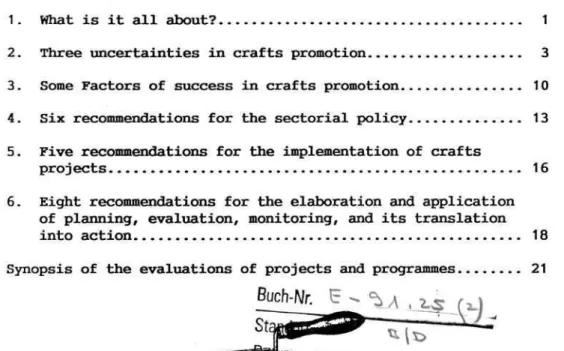
TABLE O F CONTENTS
1. What is it all about? 1 2. Three uncertainties in crafts promotion 3
3. Some Factors of success in crafts promotion 10 4. Six recommendations for the sectorial policy 13 5. Five recommendations for the implementation of crafts
projects 16 6. Eight recommendations for the elaboration and application
of planning, evaluation, monitoring, and its translation
into action 18 Synopsis of the evaluations of projects and programmes 21
^ ^ ¿SAS} „ -^
This SYNTHESIS is an extract from a more comprehensive report on behalf of SDC . For a copy of this report (in German only) write to the following address:
SWISS DIRECTORATE FOR DEVELOPMENT COOPERATION AND HUMANITARIAN AID (SDC) Evaluation Section
Eigerstrasse 73
CH-3003 BERNE
The findings and recommendations made in this CROSS-SECTIONAL ANALYSIS CRAFTS "90 (CSA CRAFTS '90) reflect the opinion of the
1. WHAT IS IT ALL ABOUT?
This cross-sectional analysis Crafts^ 1990 (CSA CRAFTS '90) for-mulates findings and recommendations concerning the promotion of crafts in the context of development cooperation. It is based on 22 evaluation reports on ten crafts promotion projects pro-duced in the period between 1983 and 1990.
Nine of these projects are or have been supported by SDC. Seven projects are concerned with rural crafts and another three with the urban informal sector. Four of the projects evaluated are located in Latin America, five in Africa and one in Asia .
These very different projects have one thing in common: they pro-mote small-scale and micro enterprises, usually with less than five employees.
The findings and recommendations contained in the CSA CRAFTS '90 are the result of filtering the contents of the 22
eval-uation reports on the basis of a number of specific criteria. This data was then commented, evaluated and synthesized. An analysis carried out far from the field!
This approach entails a number of problems: step by step the au-thors of this CSA leave the comparatively concrete level of the evaluation reports searching to extract synthetic and pointed statements. Their task: isolating from the multi-faceted and of-ten contradictory material of the project evaluations those fin-dings that can be generalized.
The findings and recommendations of the CSA do not address themselves to any particular project. The questions are: What are the recommendations for (a) the sectorial policy of SDC, (b) the implementation of crafts projects, (c) the adjustment of planning, evaluation, monitoring and its translation into action?
In this document CRAFTS is being used in the sense of village trade, artisan business, micro and small scale enterprise. Synopsis of the evaluations of projects and programmes: 3rd cover page.
This booklet contains the gist of the CSA CRAFTS '90, i.e. the points the authors wished to raise at the end of their analysis and considerations.
The comparison with other studies on crafts and small-scale and micro enterprise promotion confirms many of the findings of this CSA: SDC supports an important target group (though women have hardly been included); the heterogeneity in the micro enterprise sector makes promotion efforts quite difficult; the efforts un-dertaken are not very effective. The comparison also reveals a widespread lack of practical experience in the field of promoting small and micro-enterprises.
- UNDP/Gov. of the Netherlands/ILO/UNIDO, Development of rural
small industrial enterprise, Vienna, 1988
- FGU/FUNDES, Sektorstudie Handwerk und Industrie, Königstein/ Niederurnen, 1987 (im Auftrag der DEH)
- US-AID, A.I.D. Microenterprise Stocktaking: Synthesis Report, Washington D.C., 1989
2. THREE UNCERTAINTIES IN CRAFTS PROMOTION
Crafts promotion is concerned with creating an economic environ-ment in which small-scale and micro enterprises are capable of holding their own alongside the large economic units, thus making a useful contribution to their national economies. This ability is the result of different adjustment processes at the level of enterprises and inter-enterprise organisations, as well as adap-ting certain framework conditions. These objectives are clear and self-evident. Unlike the objectives, however, the practical si-tuation of crafts promotion is characterized by many uncertain-ties.
First uncertainty: The economic impact
LACK OF INFORMATION ON HOW TO CREATE INCOME, PURCHASING POWER AND EMPLOYMENT
Can crafts promotion projects improve income, purchasing power and create employment in the small-scale and micro enterprise sector for the constantly growing and more and more marginalized social strata?
The reports point out that the projects do not give any satis-factory answers to this question, i.e.:
Generating income:
- the effects on income of the project activities are not known; - the majority of the craftsmen supported believe that their
in-come has increased (in most cases to a minor extent); - the increases are unstable.
Generating purchasing power:
- the effects of the project activities on purchasing power are not known;
- projects assume that selling goods and services allows to in-crease the purchasing power of craftsmen (and try therefore to increase the supply of the craftsmen):
- projects consider that they are not alone responsible for gene-rating purchasing power (as this depends also on the demand, e.g. in the agricultural sector).
Creating employment:
- in the best of cases, projects stabilize the existing employ-ment situation;
- it is presumed that some projects have led to the creation of new jobs; in relation to the demand, however, their number is not significant;
- projects have created new but unstable jobs which, in addition, are bad in terms of pay and working conditions.
Second uncertainty: The approach
THE DIVERSITY AND FLUCTUATION IN THE MICRO AND SMALL-SCALE ENTERPRISE SECTOR POSES PROBLEMS OF DELIMITATION
An almost infinite number of criteria used for describing micro and small-scale enterprises indicates a "biotope" with a variety of "species": number of staff, labour and capital intensity, in-ternal division of labour, productivity, bank loans, operating years, business management, possessory rights, accounting, in-come, market position, production volume, turnover, forward and backward linkages, growth, etc. Each enterprise has its specific features.
But for promoting concrete action, categories have to be establi-shed; these categories are, however, only homogenous in terms of the criteria they are based upon. The diversity does not exactly make things easy for those involved in crafts promotion. Very often, they deplore the heterogeneity of the target group.
The delimitation problem becomes nearly insoluble as soon as one leaves the more or less clear level of the enterprises in order to support craft organizations or to try to influence those framework conditions which are unfavourable to the crafts busi-nesses. It then becomes rather difficult to adjust the measures of promotion to the specific needs of a target-group. On both le-vels, the proposed measures will automatically have their reper-cussions on the entreprises not belonging to the target-group. In other words, the difficulty to delimit the target- group en-tails the difficulty to limit the effects of the measures of pro-motion: they will always have direct or indirect effects on the
whole area of enterprises and economic mechanisms. Which is then the place of craft businesses within the general evolution of the economy?
Quite often, the promoting agencies' vision of the future of the craft businesses and of the way they can be integrated into the macroeconomic structures remains rather obscure. Much attention is, however, attributed to technical innovations, e.g. new machi-nes in the workshop.
ACADEMIC STUDIES ARE OF LITTLE PRACTICAL USE TO THE PEOPLE INVOLVED IN CRAFTS PROMOTION
So far, economic and development theories have only come up with very general answers to practical questions arising in the con-text of micro and small-scale enterprise promotion: How to assess the development potential of the businesses?
What are the most effective means of promotion? How important is the crafts sector for the development process? How is it influenced by modern industry?
ECONOMIC PERSPECTIVE - NON-ECONOMIC PERSPECTIVE: THE WRONG QUESTION
Who has to answer the questions arising in connection with crafts promotion? The business economist, the sociologist, the ethnolo-gist, the economist, the technician or all of them?
It can be taken for granted that a non-subsidized business will only survive if there is a balance between expenditure and income. This leads to the logical conclusion that attention should focus primarily on the aspect of profitability. At the same time, focus-ing only on profitability is not enough. Economic action cannot be explained simply by the model of the "homo oeconomicus". Economic action is frequently influenced by non-economic factors. Some observations illustrate this:
- In certain cases products are sold below cost price.
- Inspite of dire need some people refuse to sell their labour. - Sometimes crafts businesses are closed on weekdays.
- The customers do not always buy in the cheapest and most convenient places.
Usually, the first look is directed at the economic aspect. There are, however, other aspects to be considered in connection with the promotion of crafts businesses. Social, cultural, religious and psychological factors determine the economic performance in a decisive manner.
TAKING A CLOSER LOOK IS INDISPENSABLE IN ORDER TO VERIFY ASSUMPTIONS
An unbiased look at the enterprises and the social conditions of the craftsmen and craftswomen helps the project to gain important insights: what kind of organization models do they represent? How much autonomy do they have and to what kind of economic in-terdependence are they subjected to? Do they have promising plans for the future? What is the scope of the non-economic factors? Will they accept the measures proposed by the promotion scheme? Can the envisaged measures be financed? How can they be imple-mented at enterprise level?
This "sensory" contact (looking, listening, touching) between the actors of a project and the craft business has scarcely ever been a subject of the evaluations. Does that mean that there is hardly any such contact?
What does the profile of the adviser look like? A professional handling of the extension instruments is just as indispensable as being open to the apparently lateral aspects that often determine the state and development of the businesses in a way that cannot be detected at first glance.
During the realisation of a project, there must be a framework enabling the people involved to take this "closer look". Other-wise the project routine and everyday affairs make people forget to take a closer look. It is important to take time to visit the enterprises regularly and to talk to the craftsmen and craftswo-men.
THE TIME FACTOR: THE SCOPE OF ACTIVITIES MUST BE DEFI-NED AND EXAMIDEFI-NED
The weakness of micro and small-scale enterprises is of a struc-tural nature. In the short run, broad success cannot be expected. This makes it hard for development agencies to decide whether promotion measures should be continued or stopped when they have had no or a relatively low impact: Have the measures taken been inadequate? Or have they not been implemented long enough? Craftsmen and craftswomen, too, are confronted with the dilem-ma of evaluating the success of a project from a short-term and a longterm perspective. Rural crafts rooted in a traditional con-text tend to function on the basis of long-term considerations. The everyday worries in the urban "informal sector", however, require actions that bring about short-term results.
In this context, the question is justified: is an intervention by means of a project the appropriate instrument for crafts promo-tion? Project activities are always designed for a limited dura-tion, appropriate for a clearly defined task. Crafts promodura-tion, in contrast, knows no time limit or is in any case a long-term task. Moreover, it cannot be separated from the dynamics of the national economy.
Third uncertainty: the factors in favour or against crafts promo-tion
THE UNFAVOURABLE ENVIRONMENT
It is a common complaint that policy and economic environment is "unfavourable". It seems to be quite obvious: a change of this environment would lead to instant improvements. A reliable administration, predictability of legal decisions, political sta-bility, a liberal economic system, good infrastructures, a market economy, all of this would be helpful... But reality is quite different! Unless, of course, there were a magician with the pow-er to make disappear the complicated and vpow-ery long history of development that has brought about the "unfavourable national conditions"!
Furthermore: the "unfavourable international environment" the countries of the South always point to (debt remission,
disman-tling of agricultural protectionism, stable raw material prices ...) are far from being improved rapidly.
Besides the general economic conditions that can hardly be chan-ged by any one project alone, there are also those conditions which affect only certain areas, such as local structures. These, to a certain extent, can be improved by means of an appropriate project input. A good project management should pay increased attention to these conditions.
THE AMBIVALENT RELATIONSHIP BETWEEN THE STATE AND THE CRAFTSMEN
The projects are negatively affected by the ambivalent relation-ship existing between the State, its administration and the small-scale and micro enterprises. On the one hand, the work of the craftsmen is interfered with, they are driven away by the police, they are disadvantaged in comparison with the modern sector, as evidenced by the industrialization policy pursued by governments. Yet, there is at the highest political level some understanding of the need of promoting the crafts sector.
The attitude of the craftsmen towards the government is just as contradictory: they want government assistance while at the same time being suspicious of its projects. Due to previous experience they are afraid of being on the losing side when relying upon them. This holds particularly true for businesses of the "infor-mal sector". In this difficult context crafts promotion depends upon the cooperation with partners who enjoy the confidence of the craftsmen and are authorized representatives of their inter-ests.
AUTONOMOUS DEVELOPMENT VERSUS DEVELOPMENT FROM OUTSIDE
The sustainability of crafts promotion seems to be guaranteed only if the craftsmen take their development into their own hands: if they (1) organise themselves in order to produce more efficiently and to better represent their interests vis-à-vis the government and (2) finance themselves, make efficient use of their resources, and thus increase their independence.
Looking closely at the different elements of the common goal of independent development, diverging approaches emerge among the partners involved: whereas the projects emphasize the craftsmen's own efforts and initiative, the craftsmen's associations are pri-marily interested in autonomy and short-term results. Whilst the projects demand the financial involvement of the craftsmen and cost coverage, the associations demand subsidies.
Ideologizing and idealizing self-organisation, self-financing and self-management is of little practical help. Promotion takes pla-ce in a tense context full of contradictions: projects demand self-help while at the same time endangering it again and again through their own activities. Also, the projects' demand for in-volvement of the craftsmen can hardly be fulfilled without also fulfilling the demand of the craftsmen for an improvement of their material situation.
3. SOME FACTORS OF SUCCESS IN CRAFTS PROMOTION The projects examined by CSA CRAFTS '90 achieved partial successes when they took the following points into account:
COOPERATION WITH NON-GOVERNMENTAL PARTNERS
Wherever a local, non-governmental or private organization exists which enjoys the confidence of the craftsmen and, in addition, is willing to cooperate with the government, projects can take this bond of trust as a basis and start off with their activities quick-ly and effectivequick-ly. In cases where there is no cooperation with craft associations or NGOs, the interventions of the projects are put on a par with "the government". If at all, those projects can gain the confidence of the craftsmen only by means of an enor-mous methodological input and long-term efforts.
INVOLVEMENT OF THE GOVERNMENT
The cooperation of governmental and non-governmental organiza-tions has turned out to be quite promising. Both partners can com-bine their specific advantages to the benefit of the craftsmen. While governmental organizations aim at an improvement of the framework conditions at the local, regional and national level, non-governmental organizations have direct access to the crafts-men. Protection from the government is of decisive importance whenever businesses of the informal sector are promoted under unfavourable political or economic conditions.
PARTICIPATION OF THE CRAFTSMEN
In promoting crafts businesses, serious mistakes can be made, such as:
- concentrating the activities on an increasing output and offer without taking into account the absorption capacity of market; - banking entirely on foreign and vertical aid and
- neglect the direct and effective participation of the craftsmen and women.
This kind of promotion, whether it comes from a project, a gov-ernment agency, an NGO or a crafts association, will always be
resources and capabilities of the craftsmen are assessed just as realistically as the demand for their products and services, the promotion will bring about economic benefits.
A realistic assessment of these factors from the outside is vir-tually impossible; it requires an intensive exchange with the craftsmen, their active involvement in planning promotion meas-ures and their recognition as entrepreneurs with short and long-term economic interests. So far, the projects have had difficul-ties in this respect.
PROMOTION OF ORGANISATIONS, ORGANISATIONAL DEVELOP-MENT
Functioning crafts organizations are indispensable. Independence and autonomous development manifest themselves in the creation of selfmanaged bodies (associations, banks) and in the ability of their members to control their associations and leaders. Without tangible economic benefits, however, the craftsmen soon lose in-terest in establishing political organizations and lobbies. On the other hand, if these associations are not controlled by the crafts-men they will soon cease to represent the interests of the lat-ter. To be competent in self-organization and self-management is not always evident, but it can be learned.
THE ADVISORY APPROACH
The evaluations pay little attention to the kind of advice the projects provide to the entrepreneurs, this despite the fact that the cooperation between extension service and craftsmen is the crucial issue of the projects. Two aspects prove to be particu-larly significant: (1) the professional and human qualification of the extension workers which will determine whether or not their services are accepted; (2) the extension strategy of the project (organization of the service, selection and training of its staff, job description).
Tailor-made solutions produce better results than any general approach. In this regard, the advantages of cooperating with craftsmen's organizations and NGOs must be emphasized, i.e. in the field of professional training on a rather informal level.
USING AND ADAPTING PROMOTION INSTRUMENTS
Promotion instruments adapted to their context will allow crafts workshops to maintain a certain flexibility in response to the continuous fluctuations of the market. This is the condition sine qua non for generating income and creating jobs. Inspite of structural differences and very dissimilar needs acccording to the specific sector, it seems that the promotion instruments are being used in a relatively uniform manner. It often happens that once such an instrument has been introduced, its promoters find it difficult to question it and prefer to change the target-group. For example, if small-scale rural enterprises do not participate adequately in the proposed credit schemes, very quickly the pro-motion efforts of these programmes will instead be channelled into larger businesses or urban centres.
The tasks and perspectives of crafts promotion vary according to the specific problems of the target-groups, e.g. growth-oriented sectors or affected by structural problems. While the growth- ori-ented sectors are searching for profitability and at the same time maintaining their competitiveness, the sectors affected by struc-tural problems are looking for rapid income and securing their survival. It is, therefore, indispensable to elaborate differ-entiated promotion instruments and to undertake a systematic evaluation of the experience made by SDC and other organiza-tions in this field.
4. SIX RECOMMENDATIONS FOR THE SECTORIAL POLICY (1) Strategies for crafts promotion should be based on concrete
experience and formulated at the country level.
The heterogeneity of the crafts sector does not allow the elabo-ration of uniform promotion concepts. On the contrary, the promo-tion strategies must take into account the concrete economic and socio-cultural conditions. They must, therefore, be adapted to the specific regional situation, defined at a country level and elabo-rated in close cooperation with experienced craftsmen's and self-help organizations or NGOs.
(2) Short-term and long-term objectives should be equally impor-tant.
The short term increase in income and employment should be pro-moted as much as the creation of sustainable and self-managed promotion structures. Without tangible short-term benefits, the craftsmen will lose interest in the long-term goal of self-organization.
(3) Craftsmen's organizations, other self-help organizations or NGOs participate in the promotion efforts undertaken by SPC. Supporting these organizations is a focal point of SDC's promotion programme.
Negotiations among the different partners involved might change the socio-economic framework. Therefore, if they want to become an accepted interlocutor, it is important that the craftsmen or-ganise themselves.
At the level of individual businesses, neither government nor donor agencies, multinational organizations or the receiving sta-te should insta-tervene directly to carry out development activities. SDC cannot build up crafts organizations. This is a far too del-icate task for a government agency. It can, however, support ex-isting organizational efforts in this field. This makes all the more sense when other organizations have already become active: NGOs, private institutions, associations, etc.
SDC should also stop pressuring the craftsmen to form associa-tions (cooperatives, etc.) as a prerequisite for obtaining its sup-port. It should rather give firm support to self-organization:
the crafts sector develops its own structures and SDC provides complementary assistance to existing structures only when needed.
(4) Institution building should be a focal point of promotion. Supporting partner organizations primarily means strengthening their self-management and self-financing abilities; this includes above all:
- organizational development (counselling and training);
- project management (communication of partner organizations and associations with craftswomen and craftsmen, realisation of promotion projects for the crafts sector).
In the management of a project, promoting and adapting credit schemes should be a priority. Recommendations for target group oriented granting of credits should be elaborated from case to case.
(5) Business counselling requires a competent extension staff and continuity.
Expertise, communicative abilities as well as a profound know-ledge of the particular setting are the prerequisites for a com-petent business extension service. Experienced and successful small-scale entrepreneurs usually have a good business acumen, but often they do not have enough time to strengthen the project in this field. Within the scope of their availability and in a fa-vorable social environment they can render valuable services pro-vided that they receive an appropriate compensation. Possible gaps they might have in the field of socio-pedagogical competence can be closed through the acquisition of such skills.
More attention must be paid to the opportunities offered by hori-zontal extensions: exchange of experience, mutual visits and ex-change programmes among the crafts workshops.
(6) Projects for the promotion of rural mechanization should also be considered as crafts promotion projects.
The focus of projects on the mechanization needs in the agricul-tural sector prevails (and is justified). However, this prioritiy means that the capacities of many of the workshops are comple-tely absorbed by the needs of these projects. This instrumentali-zation of the crafts sector impairs its autonomous development. Crafts promotion must also become part of the objectives of ag-ricultural mechanization projects: the workshops produce and re-pair appropriate tools and implements.
The production of tools and machines in workshops run by a pro-ject has disastrous consequences: it obstructs the view on the potentials and obstacles of private crafts businesses. Instead of spending a lot of money on setting up workshops, the existing ones should be used and further developed.
5. FIVE RECOMMENDATIONS FOR THE IMPLEMENTATION OF CRAFTS PROJECTS
(1) Crafts promotion projects should base their activities on a previous market analysis.
In order to avoid a supply-oriented activism, this recommendation is of basic importance.
A market analysis shows:
- the goods and services offered by small-scale and micro-enterprises;
- the prices on the different markets; - the demand of the customers; - the products of competitors.
Ideally, craftsmen and craftswomen should take part in the market analysis. Their experience and perception must be considered. In a second step, the potential for market fluctuations should be assessed. This potential constitutes a limiting factor and the project managers should take it into account in the formulation of the objectives. In a third step, the question can then be rai-sed whether the promotion goals and the potentials for market fluctuations are compatible. Before taking up their activities, the project managers have to be sure that a positive answer to these questions is likely.
(2) Looking for craftsmen's or self-help organizations as part-ners is essential.
SDC seeks to get in touch with local or regional self-help orga-nizations or NGOs via the SDC coordination offices or South/ South-networks.
A first step would be to set up an inventory of intermediary or-ganizations that are eligible as partners in a given country. A list of criteria for assessing the possibilities for cooperation would be quite helpful. Furthermore, information on the context in which the micro and small-scale enterprises are functioning must be included in this analysis.
(3) The projects should create a framework for the participation of the craftsmen.
This framework may take the form of workshops, a newspaper, discussions during mutual visits among crafts workshops, state-ments regarding project plans. This kind of contact between the project and the target-groups must take place regularly and have a formal basis, in other words, it should be accepted by the partners involved and have a somewhat binding character.
(4) Demand surveys among the craftsmen should take an inductive approach.
Emphasis should be placed on the experiences of the crafts busi-nesses and not on theoretical calculations or performance targets of the national development plan.
(5) Learning through the project experience is vital for the de-velopment of crafts promotion.
Crafts promotion efforts are still patchy and with little impact. Most evaluations do not make any comments on the sustainability of project efforts, because little experience has been gained so far. Thus, it is of paramount importance that promotion projects include the following question in their questionnaire: What are the most important lessons we have learned so far?
The objective at project level should not consist in a great (most probably unrealistic) impact on the national economy through external promotion, but rather in finding, testing and conveying solutions in cooperation with craftsmen's organizations that can become blueprints for other situations.
6. EIGHT RECOMMENDATIONS FOR THE ELABORATION AND APPLICATION OF PLANNING, EVALUATION, MONITORING AND ITS TRANSLATION INTO ACTION
(1) The objectives of the project should be clearly defined and discussed.
For the sake of transparency for everybody involved, the medium and longer-term intentions of the promotion project must be de-fined. It is by no means the objective of that definition to force the project into a straight jacket but rather to open it for dis-cussion. Consistent planning, the application of monitoring and evaluation instruments and the clarification of criteria for coop-eration should (with the necessary adjustments) be part of a project since its pilot stage.
Promotion projects are not to be confused with crafts businesses. Unpredictability on the part of the businesses does not relieve the projects of their responsibility. The more precise a vision of the crafts of the future is elaborated, the easier it will be to concentrate the energies on this future. The workshops discus-sing the future can, however, only be successful, if the crafts-men, and increasingly also the craftswomen have their say in de-cision-making.
Agreements on the project's objectives must be discussed regu-larly; otherwise they will soon be forgotten.
(2) The framework conditions must be taken into account by the project.
Up until now, crafts promotion projects have had little effect on the political, economic, administrative and legal context and, if at all, at the local level only. This context, however, has a decisive influence on the project's scope for action: locations of the businesses are subject to regulations; local branches of cooperative or agricultural banks are non-existent; the owners of micro and small-scale businesses are harassed by the police. Getting a general idea of the impact of this context constitutes an important management instrument: it helps to avoid an unnec-essary waste of energies.
If this has not been done already during the planning of the pro-ject, the evaluators should ask the project to draw up a list of political, economic, administrative and legal conditions favou-rable or unfavoufavou-rable to the project's activities. The list must show the influence the project can exert on the respective le-vels. It will be updated at least once in each project stage. (3) Efficiency, effectiveness and impact should be evaluated by
means of some standardized indicators.
The efforts regarding the elaboration of monitoring and evalua-tion criteria must show in the evaluaevalua-tion: analysis criteria are set up for each of the three standard evaluation categories, then one to three decisive indicators are defined; their application is compulsory in any evaluation.
(4) The evaluation team should cooperate in an exemplary way with a number of crafts businesses.
The projects must have a concrete impact. This must be tangible at business level, in the workshops of the assisted enterprises. Thus, it is no waste of time for the evaluation team to take a closer look at some of the selected businesses in the project area. In order to communicate with these businesses, only "preci-sion instruments" should be used: observe closely, listen care-fully and ask questions! It is evident that enough time must be dedicated to this.
(5) Experts from the private sector of the economy (banks, cham-bers of commerce, training institutes) should carry out evalua-tions in cooperation with development experts.
The experts from the private sector are called to look at the projects from the angle of economic feasibility and viability. This first look will necessarily have to be completed by an ana-lysis of the socio-cultural aspects and the development policy formulated by the "experts in development cooperation" (who are often generalists trained and experienced in this field).
(6) The implementation of the recommendations of previous evalu-ations should be examined.
This is an important task for the evaluation teams who often en-counter unjustified breaks in the history of a project. Each pro-ject is marked by its collaborators and is altered without
hesi-tation at each change of personnel. But the evaluators, too, have their individual preferences and rely on their personal working tools.
The purpose of this recommendation is to engage both the project and the evaluating team to put the continuity of the project at the top of their priorities.
(7) Adjusting the promotion instruments to the needs of the tar-get groups.
The target groups in crafts promotion are extremely heterogenous. Thus very differentiated instruments must be applied. There is no panacea for all project ills. What proves successful with one spe-cific target group can still be a failure with another. The rea-sons for that may often seem quite plausible. Nevertheless, one should be careful with drawing rash conclusions.
Experiences must be systematized. Concentrating on the question "Which instrument and/or which combination of instruments is par-ticularly successful for which target group?" often provides im-portant hints for the sectorial policy.
Emphasis is placed on credit and financing instruments. How should extension work and loans be combined? What has proved to be effective, what has not? For whom? Under what conditions? (8) Concretization of "non-project related crafts promotion". Many observations seem to indicate that a distinction must be drawn between the crafts and the informal sector on the one hand and the more "traditional" development sectors on the other in terms of their promotion needs. Project support designed for cle-arly defined tasks of a limited duration (good example: the engi-neering sector!) is probably not the only and most appropriate means of promotion.
A workshop should develop ideas for the promotion of micro and small-scale enterprises outside the general framework of a p r o - , ject.
o en CT> en;,:,