
The facial weak order on hyperplane arrangements
Texte intégral
Figure

Documents relatifs
We define a partition of the set of integers k in the range [1, m−1] prime to m into two or three subsets, where one subset consists of those integers k which are < m/2,
In this article, we study the convergence of the distributions of numerical approximations of the solutions of the solutions of a large class of linear parabolic stochastic
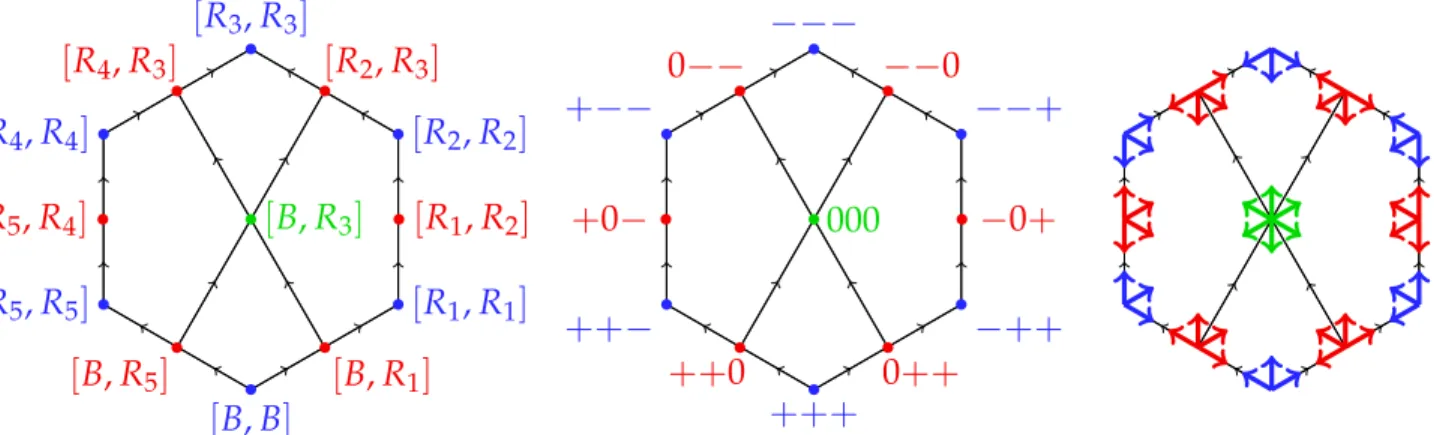
The aims of this article are: 1 To give two alternative characterizations of the facial weak order see Theorem 3.14: one in terms of root inversion sets of parabolic cosets which
Given a learning task defined by a space of potential examples together with their attached output values (in case of supervised learning) and a cost function over the
To give two alternative characterizations of the facial weak order (see Theorem 10): one in terms of root inversion sets of parabolic cosets which extend the notion of inversion sets
The paper is organised as follows: in Section 2 we define the family of posets from valued digraphs, which are couples of a simple acyclic digraph together with a val- uation on
1365–8050 c 2015 Discrete Mathematics and Theoretical Computer Science (DMTCS), Nancy, France.. The main purpose of this paper is to introduce a new family of posets, defined from
Restricting the weak order to the set of 231-avoiding permutations gives rise to the Tamari lattice, a well-studied lattice whose Hasse diagram can be realized as the edge graph
