Code Generation for the IOA Language
by
Michael J. Tsai
Submitted to the Department of Electrical Engineering and Computer
Science
in partial fulfillment of the requirements for the degrees of
Bachelor of Science in Computer Science and Engineering
and
Master of Engineering in Electrical Engineering and Computer Science
at the
MASSACHUSETTS INSTITUTE OF TECHNOLOGY
May 2002
@
2002 Massachusetts Institute of Technology. All rights reserved.
The author hereby grants to MIT permission to reproduce and
distribute publicly paper and electronic copies of this thesis document
in whole
or
in part.
MASSACHUSETTS INSTITUTE OF TECHNLGjBARKER
JUL 3 1 2002
LIBRARIES
A u th or ...
...
. . .. . .
Department of electrical Engineering and Computer Science
May 24, 2002
Certified by...
...
Nancy A. Lynch
NE9Professor of s/are Science and Engineering
Thesis Supervisor
C ertified by ....
...
Joshua A. Tauber
PhD Candidate
Lh4is
Supervisor
Accepted by
...
'-Arthur C. Smith
Chairman, Department Committee on Graduate Students
Code Generation for the IOA Language
by
Michael J. Tsai
Submitted to the Department of Electrical Engineering and Computer Science on May 24, 2002, in partial fulfillment of the
requirements for the degrees of
Bachelor of Science in Computer Science and Engineering and
Master of Engineering in Electrical Engineering and Computer Science
Abstract
This thesis presents a framework of tools for compiling distributed algorithms writ-ten in the IOA language. The target of the compilation is Java code that runs on a network of workstations. The framework includes machinery for matching IOA data types with their implementations and a library of commonly used data type implementations. The interface generator tool produces an auxiliary automaton that connects the algorithm to local sources of I/O. The invocation generator tool assists the user in creating sources of local input. The framework provides two means of resolving nondeterminism: a source-to-source transformer accompanied by user input and a language extension for annotating IOA source files.
Thesis Supervisor: Nancy A. Lynch
Title: NEC Professor of Software Science and Engineering
Thesis Supervisor: Joshua A. Tauber Title: PhD Candidate
Acknowledgments
I could not have asked for better advisors. Professor Nancy Lynch introduced me
to the IOA project three years ago. She has been extremely helpful throughout this
project, and her confidence in me has been most encouraging. Josh Tauber, who
followed my work most closely, always provided just the right level of guidance and
supervision. From discussions of intricate coding details, to high-level design, to how
to present my work in writing, he has been an endless source of ideas and constructive
criticism. His design of the code generator forms the immediate basis for my work.
Toh Ne Win and Laura Dean participated in many important discussions about
IOA and Java and gave valuable feedback as users of my code. Additionally, Toh
im-plemented many crucial classes and answered my random questions. Antonio Ramirez
created much of the infrastructure that my code depends upon and helped me learn
the IOA codebase. Professor Stephen Garland helped me with the IOA front-end,
taught me LSL, and asked thoughtful questions. Atish Dev Nigam and Holly Reimers
contributed valuable code, and Atish was a great sounding board for my attempts at
explaining the workings of the toolset. Daniel Chvatik commented on drafts of this
document.
Other members of LCS have provided suggestions and feedback, including Stanislav
Funiak, Professor Michael Ernst, Andrej Bogdanov, and Shien Jin Ong. Professor
David Gifford's class helped give me a formal understanding of much of the work I
had been doing.
Ultimately, none of this would have been possible without the love and support
of my family. It is to them that I dedicate this work.
Contents
1 Introduction
12
1.1 The IOA Language and Toolset . . . . 12
1.2 IOA Code Generation . . . . 13
1.3 Thesis Overview. . . . . 17
1.4 Writing Conventions . . . . 21
2 Abstract Data Types 23 2.1 O verview . . . . 23
2.1.1 Code Generation . . . . 23
2.1.2 D ata Types . . . . 24
2.1.3 Chapter Roadmap . . . . 26
2.2 Implementation Classes . . . . 26
2.2.1 ADTs Extend ioa.runtime.adt.ADT . . . . 27
2.2.2 ADTs are Immutable . . . . 27
2.2.3 Static Methods Implement Operators . . . . 28
2.2.4 Return Value Casting . . . . 29
2.2.5 Arbitrary Initialization and Parameterizations . . . . 29
2.2.6 Inheritance . . . . 32
2.2.7 Comparing ADTs . . . . 33
2.2.8 Exceptions . . . . 34
2.3 Registry Classes . . . . 34
2.3.1 Looking up Simple Sorts and Operators . . . . 35
2.3.3
Curried Parameters . . . .
37
2.3.4 Looking up Dynamic Sorts and Operators . . . . 39
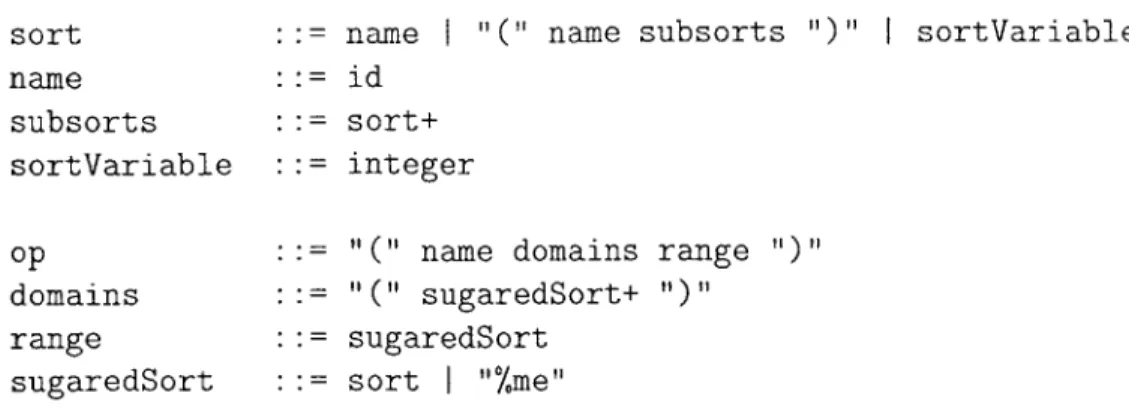
2.3.5 Matching Compound Sorts and Operators . . . . 40
2.3.6 Installer . . . . 42
2.3.7 Looking up Return Types . . . . 44
2.3.8 Shortcutting . . . . 46
2.3.9 Locating ADTs at Compile-Time . . . . 46
2.4 Registration Classes . . . . 47
2.4.1 Standard Registration Classes . . . . 48
2.4.2 Dynamic Registration Classes . . . . 48
2.4.3 Non-Standard Registration Classes . . . . 49
2.4.4 Flexibility Without Registration Classes . . . . 49
2.5 Test C lasses . . . . 51
2.5.1 Testing Implementation Classes . . . . 51
2.5.2 Testing Registration Classes . . . . 52
2.5.3 Catching Bugs in the Implementation/Registration Interface . 53 2.6 Recipe for Writing ADTs . . . . 53
2.7 Sharing ADTs with the Simulator . . . . 55
2.8 A D T Library . . . . 56
2.8.1 Standard IOA ADTs . . . . 56
2.8.2 O ther A DTs . . . . 60
3 The Interface Generator 62 3.1 Type Definitions . . . . 63
3.2 States of the Interface Automaton . . . . 64
3.3 Input Actions of the Interface Automaton . . . . 65
3.4 Output Actions of the Interface Automaton . . . . 66
3.5 getlnvocation and putinvocation . . . . 67
3.6 Exam ple . . . . 67
3.6.2
Interface Automaton Bankinginterface . . . .
4 The Next Action Determinator
4.1
Kinds of Nondeterminism
. . . .
4.2
The NAD Transformation . . . .
4.2.1
States of A' . . . ..
4.2.2
The Scheduler
Transition . . . .
4.2.3
Transitions ofA . . . ..
4.3
Sum m ary . . . .
4.4
E xam ple . . . .
4.4.1
Nondeterministic Automaton
Adder
. . . .
4.4.2
Next-Action Deterministic Automaton
AdderNAD
. . . .
4.5
Evaluation of the NAD . . . .
5 Compiling the Nondeterminism Resolution Language
5.1
NDR Language Extensions . . . .
5.2
Adding NDR to the Code Generator . . . .
5.2.1
Parsing NDR Constructs . . . .
5.2.2
Compiling NDR Constructs . . . .
5.2.3
Handling Transitions with Parameters . . . .
5.3
Java Translation Overview . . . .
5.4 Java Translations of NDR Blocks . . . .
5.4.1 Schedules . . . .
5.4.2 Determinators . . . .
5.5 Java Translations of NDR Statements . . . .
5.5.1 Programs . . . . 5.5.2 Assignments . . . . 5.5.3 Conditionals . . . . 5.5.4 Loops . . . . 5.5.5 fire Statements . . . . 5.5.6 yield Statements . . . .
69
72
73
73
73
74
75
75
76
76
77
78
80
81
83
83
84
86
. . .
86
. . .
87
. . .
87
. . .
88
89
89
. . .
89
. . .
90
. . .
91
. . .
91
92
5.6
Example . . . .. . . . .
5.7
Comparisons W ith the Simulator . . . .
6 MPI
6.1
Serializing ADTs . . . .
6.2
Setting up MPI . . . .
6.3
Running Automata . . . . .
6.4
MPI Experiment . . . .
6.5 Future Work . . . .
92
93
95
95
96
97
97
98
7 Invocations and Runtime
I/O
99
7.1
ADT S-Expressions . . . .
. .
.
.
99
7.1.1
Converting ADTs to S-Expressions . . . .
100
7.1.2
Converting S-Expressions to ADTs . . . .
100
7.1.3
Encoding Examples . . . .
101
7.2
T hreading . . . .
103
7.3
Lockable Sequences and LSeqSort . . . .
103
7.3.1
Java Code to Update Stdin . . . .
105
7.3.2
IOA Code to Update Stdin . . . .
107
7.3.3
Implementing the Locking Operators . . . .
108
7.4 The Invocation Generator . . . .
110
7.4.1
Reusing the Simulator . . . .
110
7.4.2
Implementation . . . .
111
7.4.3
Exam ple . . . .
112
7.4.4
Future Work.
8 Miscellany 8.1 Preconditions and where Clauses . 8.2 API Documentation . . . . 8.3 Regression Tests . . . . 8.4 Graphical User Interface . . . . .. . . .
112
115
115
115
116
117
9 Discussion and Future Work
119
A ADT Implementation Examples
121
A.1
String: A
Simple Sort ...
...
121
A .1.1
LSL Trait . . . 121
A.1.2 Implementation Class: ioa. runtime. adt. StringSort . ... 122
A.1.3 Registration Class: ioa.registry. java.StringSort . . . . .
125
A .1.4 Test Class . . . .
126
A .1.5 IO A File . . . .
131
A.1.6 Generated Java Code . . . .
131
A.2 Set: A Compound Sort . . . .
132
A .2.1
LSL Trait . . . .
132
A.2.2
Implementation Class: ioa.runtime.adt.SetSort
. . . .
132
A.2.3
Registration Class: ioa.registry. java.SetSort . . . .
137
A .2.4 Test C lass . . . .
138
A .2.5 IO A File . . . .
142
A.2.6
Generated Java Code . . . .
143
B NDR Compilation Example
144
B.1 Automaton with NDR Annotations . . . .
144
B.2 Generated Java Code . . . .
145
C Banking Example
150
C.1
Automaton with NDR Annotations . . . .
150
C.2 Generated Java Code . . . .
154
List of Figures
1-1
Code Generation Process Overview . . . .
16
1-2 Creating Interface Automata . . . .
16
1-3
Composing the Algorithm and Auxiliary Automata . . . .
17
1-4 Removing Nondeterminism With the NAD . . . .
17
2-1 Code Generation Package Structure . . . .
24
2-2 The Three Types of ADT Classes and Their Dependencies . . . .
26
2-3 Abstract Contents of the Registry . . . .
35
2-4 Information Flow and the Registry . . . .
35
2-5 Translating and Emitting an Operator on a Compound Sort . . . . .
38
2-6 Sort Template Grammar . . . .
41
3-1
Sort Identifier Grammar . . . .
4-1
The
Scheduler
Transition's Main Control Loop
5-1
5-2
5-3
5-4
5-5
64
76
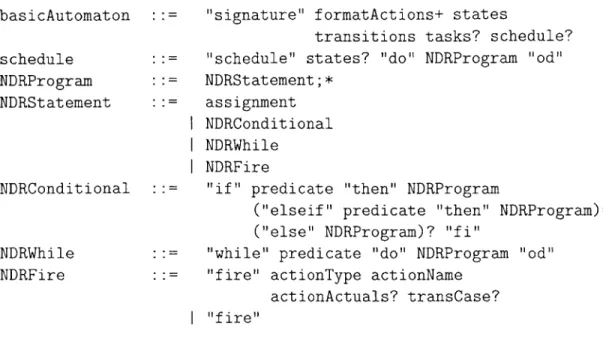
IOA Grammar for an Automaton ...
Annotated IOA Grammar for an Automaton .
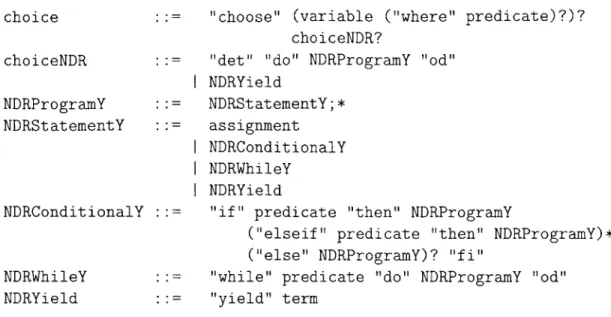
IOA Grammar for a Choice . . . .
Annotated IOA Grammar for a Choice . . . .Flattening Nested Statements . . . .
. . . .
8 1
. . . .
82
. . . .
82
. . . .
83
. . . .
87
6-1 Implementation of readResolve() for Booleans
96
7-1
Updating Stdin from the Main Thread
. . . .
106
7-2 Java Code for Updating Stdin From the Main Thread
106
7-3 Registering the Locking Operators . . . .
109
7-4 Input to the Invocation Generator . . . .
113
List of Tables
Chapter 1
Introduction
1.1
The IOA Language and Toolset
Distributed algorithms are becoming increasingly important in modern computer sys-tems, but they are notoriously difficult to design and implement correctly. The In-put/Output Automaton model [16] provides a formal way to describe distributed algorithms at a high level of abstraction. Researchers can then reason about them using this concise representation to express properties and theorems. Such analytic work can increase confidence in the correctness of an algorithm.
IOA [9, 10] is a formal language for specifying I/O automata. The IOA toolkit, in
development by the Theory of Distributed Systems (TDS) and Networks and Mobile Systems (NMS) groups, is a suite of tools for working with the IOA language. The toolkit is intended as an environment for algorithm and system design using
I/O
automata. The toolkit has a number of components.The IOA front-end tool, ioaCheck, can check the syntax and static semantics of
IOA programs, as well as prettyprint them. Soon it will be able to compose multiple
automata into a single primitive automaton; this facilitates hierarchical development of systems. After checking IOA programs the front-end translates them into the
intermediate langauge (IL), an s-expression printout of the abstract syntax tree and symbol table.
tool converts a restricted class of IOA programs into the Larch Shared Language [11]. The Larch Prover (LP) may then be used to verify theorems about the underlying I/O automata. A prototype translator [7] to TLA+ allows model checking via Lamport's
TLC.
The IOA simulator [4], the most developed member of the toolkit, facilitates interactive development of IOA programs by interpreting closed
I/O
automata on thefly. The user can observe the state of the automaton after each transition and verify
that it is operating as expected, while the simulator verifies that the automaton's invariants hold at each step. The simulator supports paired simulation [20], in which two automata are simulated in lock-step. After each transition the simulator verifies that the simulation relation between them holds. Additionally, the simulator can produce execution traces that may be used as input to the Daikon invariant detector
[5].
The IOA code generator, currently under development, will compile a restricted class of IOA programs into a standard imperative language. The target of our first implementation is Java. Unlike the simulator, the code generator is not restricted to supporting closed automata. Rather, it can accept an entire system of automata, each of which communicates with the others and exchanges information with the environment. The goal is for the code generator to produce the Java code for each node (automaton) so that the system may be run on a network of workstations. This thesis presents several contributions to the IOA code generator, which are further described below.
1.2
IOA Code Generation
The IOA toolkit may be used to write IA programs that describe I/O automata and to gain confidence that they are correct. However, putting the algorithm into practice requires coding it up to run on a system of physical machines. This process is time-consuming and error-prone. It is easy to introduce subtle programming errors and quite difficult to detect them. Further, if the IOA specification changes, the code
must be rewritten and the time spent debugging the old code is lost.
The obvious solution is to reduce the chance of errors by minimizing human in-volvement in the process. This is the primary motivation for the development of the
IOA code generator, which is an automated tool that translates IOA programs into
Java. The generated code is provably correct, subject to stated assumptions about the correctness of system services and hand-coded data type implementations, and the faithfulness of the code generator's implementation to its design
[231.
The output of the code generator is a Java program that represents one node of the distributed computation. Each workstation runs its own copy of the program in a Java virtual machine. The nodes communicate with each other by exchanging messages using the Java bindings
[1]
for the Message Passing Interface (MPI) [18].IOA has been designed to be suitable for both verification and code generation.
However, these two goals are often at odds; features such as concurrency, nonde-terminism, and declarative transition effects simplify verification at the expense of complicating the implementation. The general strategy is for the programmer to design a simple, high-level program that is optimized for verification. He can then successively refine the program into lower-level versions that are more straightforward to implement. Each step of this refinement can be verified, e.g., by proving simulation relations.
The input to the code generator is a program in node-channel form. It is arranged as a collection of automata (one for each node) that communicate via reliable, one-way FIFO channels. Channels connect nodes to each other and to external input and output (modeled as environment automata). The code generator produces Java code that implements the node automata. The implementation of the FIFO channels is the same for each program, and so it is included in a runtime library.
The code generation process consists of a sequence of program transformations. Each transformer reads an IOA program and produces another IOA program in a simpler, more stylized form that is more amenable to code generation. Some of these transformations require input from the programmer. The last transformation produces not another IOA program, but a Java one.
The following is a general outline of the code generation steps. For more details, see Section 1.3 and
[23].
" The interface generator creates an auxiliary interface automaton for each node
automaton. The interface automaton connects the node to external sources of input and output, such as files or the user's console (Figure 1-2).
" The composer takes as input the node automaton, the interface automaton,
and auxiliary network automata (which are not program-specific). It produces a single primitive automaton for the system comprised of these parts (Figure
1-3).
" The output of the composer is a nondeterministic automaton. The next action
determinator (NAD) transforms this into an automaton that is next-action de-terministic. That is, at any given time only one action of the automaton is enabled. In effect, it collects implicit nondeterminism throughout the automa-ton into a single scheduler action where the nondeterminism is made explicit
(Figure 1-4).
" The user specifies a scheduler for the next-action deterministic automaton,
which determines when each action should be enabled and what the values of its parameters should be. This has the effect of removing the nondeterminism so that the automaton becomes next-state deterministic.
" Or, instead of the preceding two steps, the user can resolve nondeterminism
using annotations in the IOA source file. The code generator can then compile the annotations to Java.
* The final step is for the code emitter to generate a Java program from the much-simplified IOA program. The output of the emitter is a subclass of the ioa. runt ime .Automaton class in the code generator's runtime library.
Algorithm
Checker
interface
Generator
Library Composer Auterfatcn
Node NAD ProgrammerGU Input apm Scheduled Automaton
Datatype Library EmitterCode
Java
Source
Figure 1-1: Overview of the code generation process when using the NAD to resolve nondeterminism.
Algorithm Checker No Inerfatr Aterfac n
Figure 1-2: Interface automata are created by parsing IOA programs into IL and running the interface generator tool on the IL.
_I nterface Au t om ato n __
Algorithm Checker Composer Node
Library
Figure 1-3: Unscheduled node automata are created by composing the original algo-rithm automata with the interface automata from.
Node NAD -10 GUI Nhedued
tJ
User
Figure 1-4: Unscheduled node automata are scheduled by running them through the NAD, which makes them next-action deterministic. The user then provides a schedule, making them next-state deterministic.
1.3
Thesis Overview
This section describes the contributions of this thesis to the IQA code generator.
Abstract Data Types
The code emitter's job is to translate a simplified IA program into Java. In most cases, this translation proceeds in the same way for all IQA programs: an automaton always translates to a class, a transition always translates to a method, and a state variable always translates to a member variable. Data types cannot be translated in this manner because they are extensible. At any time, the user can introduce new data types that are specific to her problem domain.
IA data types are specified axiomatically using the Larch Shared Language (LSL)
[11]. They are implemented in Java, as part of the runtime library. We assume that the data type implementations are correct and that they correspond to the
it must find the corresponding method in the runtime library that implements the
operation. This task is handled by the implementation registry. Creating a new data
type involves not only implementing it in Java (for inclusion in the runtime library),
but also telling the registry which IA data type and operators the implementation
corresponds to. At compile-time, the code emitter consults the registry to look up
the implementations of the program nodes it is translating.
With respect to abstract data types, I have:
" Created a new implementation registry and lookup mechanism, based on a
prototype by Joshua A. Tauber, which was in turn based on work by Antonio
Ramirez-Robredo.
" Added several layers of abstraction to make adding new data type
implemen-tations as easy as possible for toolkit users. Registering an operator on a data
type now takes one line of code instead of approximately eighteen. This system
has been used by Nigam
[19
to implement some ADTs that are not built into
IA, and by Win
[30]
to implement IQA's shorthand data types.
" Completed the implementations of IQA's built-in data types.
" Modified the IOA simulator to use the code generator's registry and data type
implementations. Toolkit users can now create a single implementation for each
new data type and use it with both the simulator and the code generator.
" Created a mechanism by which the generated code can assign values of the
correct type to uninitialized state variables.
" Documented the code generator's ADT architecture and provided a recipe for
adding new data types.
Interface Generator
The interface generator takes as input a primitive node automaton and produces for
it a customized interface automaton. The interface automaton connects the node
automaton to the environment. It parses input from the console and translates it into input actions on the node automaton. Similarly, it translates output actions on the node automaton into textual output on the console.
Our implementation of the node automaton is single-threaded, and IOA requires that the execution of each transition be atomic. However, just as IOA input actions are non-blocking, console input may arrive at any time. Therefore, an important function of the interface automaton is buffering. The interface automaton runs in two threads of its own, one for input and one for output. It receives input as it arrives and buffers it until the node automaton is ready for the corresponding transition to be invoked.
The interface generator module was envisioned by Tauber [23]. I have provided an implementation, which relies heavily on Ramirez-Robredo's work on the IOA in-termediate language [20] and on Reimers's inin-termediate language unparser [21].
Next Action Determinator
The NAD takes as input a primitive automaton that is the composition of the node automaton and the interface and network automata. It produces an automaton that is next-action deterministic, that is, where only one action is enabled at a given time.
IOA programs contain explicit nondeterminism in the form of choose statements and implicit nondeterminism in that transitions may happen in any order and with any parameters that satisfy their preconditions. The NAD makes the implicit non-determinism explicit and collects it into a single scheduler transition. It assigns each transition a unique index and adds a program counter state variable to the automa-ton. The precondition of each transition is modified so that it is only enabled when the program counter is equal to the transition's index. The scheduler transition is responsible for setting the value of the program counter and determining parameter values that satisfy the precondition of the enabled transition.
The NAD transformation is due to Vaziri, Tauber, and Lynch [28]. I have pro-vided an implementation, in the form of a source-to-source transformer. Vaziri [29] has shown that the semantic transformation of the I/O automata and the syntactic
transformation produced by the code generator's NAD module are equivalent.
Compiling the Nondeterminism Resolution Language
An alternative method of resolving nondeterminism is to annotate the IOA program using the nondeterminism resolution language that Ramirez-Robredo developed for the simulator. The annotations allow the user to specify a schedule and also to determine the values of choose statements. I have extended the code emitter to
compile the annotations to Java. This approach to resolving nondeterminism has many practical advantages, and I expect that users will prefer it to using the NAD tool.
Invocations and Runtime
I/O
The interface automaton's job is to translate input from the local environment into input actions and to translate output actions into output to the local environment.
I have defined an s-expression representation for invocations of IOA actions. The
interface automaton reads a file consisting of a list of these invocations and causes the corresponding input actions to be executed. When an output invocation is ex-ecuted, the interface automaton creates an invocation s-expression and appends it to an output file. Because invocations are tedious to create by hand, I have cre-ated a convenience tool called the invocation generator that creates them from fire
statements written in the nondeterminism resolution language.
Other
Other contributions in this thesis include:
" Work on the IA front-end-in particular, implementation of the intermediate
language translator and parts of the prettyprinter.
" Enhancements to the intermediate language classes, including improved parsing,
" Enhancements to the prototype code emitter to handle transition parameters, preconditions, where clauses, and other features related to data types.
" Implementations of the auxiliary interface automata that link the node
automa-ton to the console.
" Enhancements to the data type implementations so that they can be transferred
across the network, and a simple experiment that demonstrates how to use mpiJava with the IOA toolkit.
" A prototype graphical user interface from which the user can edit IOA programs
and run some of the tools that are needed for the code generation process.
" A regression testing framework for the IOA toolkit, along with a suite of unit
tests and regression tests for the modules described in this document.
1.4
Writing Conventions
This thesis includes code fragments and program examples written in several different programming languages. The following typesetting conventions are used to help the reader:
" Sans-serif type is used for IOA and LSL, with language keywords in bold.
" Constant width type is used for Java, with language keywords slanted. " Constant width type is also used for grammars, filenames, command names,
URLs, program output, and strings.
" Grammars are expressed in BNF, and terminals are enclosed in quotation marks.
In addition, several potentially vague terms are used as follows:
User a person using the IOA toolset to develop and verify algorithms. Users program
in IOA and LSL.
Programmer a person developing the IOA toolset itself. Programmers program in
Java and PolyJ. Users become programmers when they extend the IOA toolset to support additional abstract datatypes.
Algorithm automaton the original automaton that the user begins with and that
he may also use with the simulator or LP. During the code generation process, the algorithm automaton will be composed with other auxiliary automata.
Compile-time when the code emitter translates the final automaton (a composition
of the algorithm automaton and auxiliary automata) from IOA into Java.
Runtime when the generated Java code runs on a network of workstations.
Node a networked workstation that carries out one part of the distributed compu-tation by running the generated Java code.
Chapter 2
Abstract Data Types
2.1
Overview
2.1.1
Code Generation
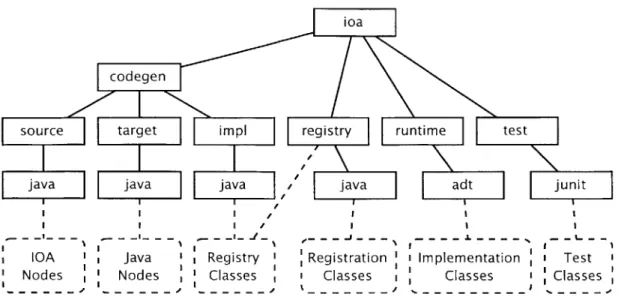
When the IOA code generator converts an IA program into runnable Java code, it first parses the program, which has already been translated from IOA into the intermediate language (IL) by the front-end. The result of this parse is an ab-stract syntax tree with nodes for each element of the IA program (e.g. transitions, state variables, and operators). The source syntax tree consists of objects from the ioa. codegen. source. java package.
The next step is to translate the source syntax tree, node by node, into the target syntax tree. The target tree consists of objects from the ioa. codegen. target. j ava package and has nodes that correspond to Java language elements (e.g. classes, vari-ables, and methods). In the final step, the code generator walks the target syntax tree, asking each node to emit itself as a string. The result of emitting the whole target tree is a Java program that can be compiled and run, with the help of classes in the ioa.runtime.adt and ioa.runtime.io packages. These runtime packages are self-contained; no other part of the code generator is needed to run the generated code.
ioa
codegen
source target impl registry runtime test
java java java java adt unit
OA Java Registry Registration Implementation Test I
Nodes Nodes Classes Classes Classes Classes
Figure 2-1: Code Generation Package Structure
the package diagram in Figure 2-1.
The brunt of the code generator's work is in translating the nodes of the source tree into nodes of the target tree. In most cases, this translation proceeds in the same way for all IOA programs: an automaton always translates to a class, a transition always translates to a method, and a state variable always translates to a member variable. These translations can be hard-coded into the nodes of the source syntax tree. However, data types must be handled differently, and we will talk about them now.
2.1.2
Data Types
IOA data types are divided into two categories: sorts and sort constructors. Sorts
are simple data types such as integers (Int), real numbers (Real), and booleans (Bool). Sort constructors are compound data types that are parameterized by other sorts or sort constructors. Examples include sequences of integers (Seq[Int]) and mappings from strings to sequences of integers (Map[String, Seq[lnt ]]). Most of the discussion in this thesis applies to both sorts and sort constructors; therefore, for brevity, I will use "sort" to mean "sort or sort constructor" and clearly indicate sections that apply
only to one category of data types.
Data types cannot be translated in the fixed manner of Section 2.1.1 because they are extensible. At any time, the programmer can add new data types by specifying them in the Larch Shared Language (LSL) [11] and implementing them in Java. Doing so should not require modifying the core of the code generator.
Each IOA sort is implemented by a Java class, and each operator is implemented
by a method on that class. At compile time, one of the code generator's jobs is to
map IOA sorts and operators to their Java implementations, so that it can create the proper nodes in the target syntax tree. Much of the work in adding support for new data types involves telling the code generator about this correspondence.
The classes involved in generating code for abstract data types (ADTs) may be divided into three categories:
" Implementation Classes, which implement sorts and their operators. These are
written by the user, one per data type, and live in ioa.runtime.adt. Of the three kinds of classes, this is the only one that is needed at runtime (i.e. when compiling or running the generated code).
" Registry Classes, which maintain a mapping between IOA sorts (and opera-tors) and the Java implementation classes (and methods) that implement them. These are built into the code generator.
* Registration Classes, which interface between the implementation classes and
the registry classes so that each group is isolated from the other. These are writ-ten by the user, one per implementation class. They implement the Registrable interface. Registration classes that are part of the standard IOA toolkit distri-bution belong to the ioa.registry. java package. If a user extends the code generator to support additional data types, their registration classes may belong to one of the user's packages.
The relation between these categories and the package structure is shown in Fig-ure 2-1. The dependencies between them are shown in FigFig-ure 2-2; in particular, note that registration classes decouple the implementation classes from the registry.
Part of the Code
User-Defined Generator Core
Implementation Classes Registration Classes 1 Registry Classes
Figure 2-2: The three types of ADT classes and their dependencies. Registration classes call methods of the registry classes and depend on the names of the methods in their corresponding implementation class. The registry classes and implementation classes are independent of one another.
2.1.3
Chapter Roadmap
The remainder of this chapter describes how the code generator's ADT classes are designed and how they may be extended to support additional sorts. Section 2.2 tells how IOA sorts are implemented in Java, Section 2.3 explains how the code generator uses the registry to map sorts and operators to their implementations, and Section 2.4 describes how to install new implementation classes into the registry. Section
2.5 explains the testing architecture for verifying implementation classes, registration
classes, and the correspondence between them. Section 2.6 gives a recipe for writing new ADTs. Section 2.7 explains how the work described here has been reused in the IOA simulator. Sections 2.8.1 and 2.8.2 explain the data types that have already been implemented, and Appendix A contains complete examples of the files needed to add support for new data types and examples of the generated Java code.
2.2
Implementation Classes
The code generator supports the standard sorts defined in the IQA manual [9]: Array,
Bool, Char, Int, Map, Mset, Nat, Real, Seq, Set, and String; as well as the shorthand sorts
enumeration, tuple, and union. Each sort is implemented by a Java class called an
implementation
class that belongs to the ioa.runtime.adt package. By convention,the name of the implementation class is the name of the IA sort followed by "Sort". Thus, the IOA boolean sort, Bool, is implemented by BoolSort; and the IGA multiset
sort, Mset, is implemented by MsetSort. For brevity, in this section I will sometimes refer to the implementation class as "the ADT."
Each IOA operator is associated with a single sort that introduces it and is im-plemented by a static method in the implementation class of the introducing sort. For instance, the -+--: Int, Int - Int addition operator on integers is introduced by
Int and implemented by IntSort .addO. When the code generator generates code for
a program, it translates each operator application into a static method invocation. Thus, the static methods form the interface between the implementation class and the rest of the generated code.
2.2.1
ADTs Extend
ioa.runtime.adt.ADT
Implementation classes extend the ioa. runt ime. adt. ADT abstract class. They must override the non-static equals(O method inherited from
java.
lang. Object, so that it checks for value equality instead of reference equality.The ADT abstract class provides implementations for two operators that are com-mon to all IOA data types: equality
(
and inequality ( _. These operators are implemented by static methods in ADT. equals 0 and notEquals 0 take two ADTs (classes that extend ADT) as parameters and return BoolSorts that indicate whether the ADTs are equal or unequal. The implementations for these operators are automat-ically installed into the registry; there is no need to mention them in the registration class (see Section 2.4).2.2.2
ADTs are Immutable
ADTs are immutable. Each ADT overrides equals 0 so that it returns true for objects that represent the same value, even though they may not be the same
ob-ject.
Because they override equals0, ADTs must also override hashCode 0 so that it satisfies the Java language's hashCode 0 contract [22]:'Thus, all of the container ADTs are slow because insertion and deletion require an amount of copying that is linear in the number of contained elements. Future work could optimize away the unnecessary copying.
... If two objects are equal according to the equals(0 method, then
calling the hashCode() method on each of the two objects must produce the same integer result.
If this clause of the contract is violated, collection data types that use hash tables
will fail. They will not be able to find objects that they contain, making it impossible to test for membership or remove objects.
Since immutable ADTs properly override hashCode 0, container ADTs may be implemented using hash tables. For instance, MapSort uses a hash table to maintain a mapping, and setSort uses one to map elements to their multiplicities.
In addition, all ADTs should override toString() to "unparse" themselves; this is important for readable output from the simulator [4, 20, 5] and also when debugging the code generator.
2.2.3
Static Methods Implement Operators
The implementation class contains a public static method, also called a code gener-ation method, for each of the sort's operators. Making the methods static simplifies code generation by making the syntax of the generated code more regular. However, because static method calls are verbose and unnatural for writing Java data types, all but the simplest implementation classes define two sets of methods: instance meth-ods implement the operators on the sort, and public static methmeth-ods are called by the generated code.
The public static methods are just wrappers for the instance methods, so it is simple to implement them. Maintaining these two sets of methods is a little extra work compared to implementing everything using the public static methods; however, the instance methods are useful to have when hand-coding programs elsewhere in the toolkit.
The parameters and return values (if any) of the static methods are instances of
signature; otherwise, it is labelled ADT2 to indicate that it is known to be an imple-mentation class. The order of the method's parameters is the same as the order of the operands in the domain of the IOA operator. This means that in most cases the first parameter happens to be an instance of the ADT that defines the method. For example, the prototype of the method for the indexing operator on mappings
__[__ ]: Map[D, R], D - R is public static ADT get(MapSort map, ADT key). Its im-plementation simply calls the MapSort instance method public ADT get (ADT key).
2.2.4
Return Value Casting
Java is a statically typed language, and a Java program will only compile if the compiler can verify that methods are called with parameters of the correct types.
Container data types are usually written to contain Objects, so after taking an Object out of a container, one must downcast it (cast it to a more specific type) before using it. This is a general problem with Java containers such as Vector and Hashtable, and it affects implementation classes in the same way.
To deal with this, whenever the code generator emits a method call, it also emits a downcast for the return value. For instance, the generated code for an IGA term such as head(aSeqOflnt) might be ((IntSort)SeqSort.head(aSeqf Int-vO)). The code generator handles this automatically (see Section 2.3.7). The implementation class writer can assume both that parameters to his classes' methods will be downcast so that they satisfy the method signatures and that non-specific return types, such as
ADT, will not pose problems for code using his methods.
2.2.5
Arbitrary Initialization and Parameterizations
The IA language allows state variables to be initialized explicitly or arbitrarily. Explicitly initialized variables are assigned values by the programmer. For instance, an automaton's states section might include the line
a: Array
[
nt , Bool ] := constant (true)which initializes a to an array where the value at each integer index is the boolean constant true. Alternatively, the programmer may write a: Array[Int, Bool]. This indicates that the variable is arbitrarily initialized, and IOA allows the elements of a to take on any values so long as they are of the correct sort. In this case, the code generator must initialize a before firing any of the automaton's transitions.
When the code generator needs to create an initial value for a variable, it first finds the implementation class for the variable's sort and calls its method
public static ADT construct(Parameterization p)
which is charged with creating and returning "some" instance of the implementa-tion class. The Parameterizaimplementa-tion parameter provides the implementaimplementa-tion class with information about the subsorts of the sort constructor that it is implementing.
In the base case, construct o is being called on the implementation class of a simple sort. In this case, the Parameterization carries no useful information and is ignored. construct o returns a suitable default value.
In the recursive case, construct o is being called on the implementation class of a compound sort. Typically, constructing the compound sort will require recursively constructing instances of the subsorts. For instance, because each index of an array must have a value, an array must construct at least one instance of its element type subsort. It can then use this to initialize itself. The Parameterization contains all the information about the subsorts, so the array can call its ADT constructSubsort (int) method to create an instance of one of the subsorts.
In the case of arrays, construct o looks like:
public static ADT construct(Parameterization p)
{
ADT elementValue = p.constructSubsort(p.nSubsorts() - 1);
return constant(elementValue);
It simply creates an instance of the element subsort' and creates an array where all the slots have the same value.
Since the generated code contains Parameterization objects, Parameterization must be part of the code generator's self-contained runtime package. (See Figure 2-1.) The registry classes are not part of the runtime, so Parameterization may not use them when it recursively constructs subsorts. Therefore, the code generator looks up all the needed implementation classes at compile-time and stores the results in the Parameterization. Each Parameterization stores the implementation class and Parameterization for each of its subsorts.
Ultimately, the purpose of a Parameterization is to provide the information nec-essary for the ADT implementation to construct a value of the proper type. When the code generator translates a state variable, it creates a member variable in the target syntax tree. If the IOA program initialized the state variable, it translates the IOA initializing term into a Java one. Otherwise, it creates an InitialValue node in the target syntax tree. An InitialValue is a term that stores the class that will generate the value, as well as a Parameterization containing the needed subsort information. Emitting an InitialValue creates a call to the construct(Parameterization) method of the implementation class for the value's type, e.g. ArraySort. construct O for the above example. The parameter of the method is generated by emitting the InitialValue's stored Parameterization object. The return value of construct(O is cast (from ADT) to the appropriate type.
The result of emitting a Parameterization is a Java fragment that reconsti-tutes the Parameterization. Again using the above example, the generated code
for a: Array[ Int , Bool] is:
ArraySort av0 = (ArraySort)ArraySort.construct( new Parameterization( new Class [] {ioa.runtime.adt.IntSort.class, ioa.runtime.adt.BoolSort.class}, new Parameterization[] 3
The nSubsorts 0 - 1 is necessary because arrays can have two or three subsorts, depending
{new Parameterizationo,
new ParameterizationO}));
The parameters to the outermost Parameterization constructor are an array of implementation classes for the subsorts and an array of Parameterizations for them. The innermost Parameterization constructors take no arguments because Int and
Bool have no subsorts.
The astute reader will have noticed that Parameterization is seemingly a runtime class that knows how to emit itself. This is impossible because knowledge about emit-ting is confined to the code generator's internals and is not part of the runtime. There are, in fact, two Parameterization classes: ioa.runtime.adt.Parameterization and
ioa. codegen.target .java.Parameterization. The former contains the functionality
needed at runtime, and the latter (which is a subclass) handles the emitting. Creation of Parameterizat ions is handled by the registry classes' factory (ImplFactory), which in the case of the code generator always creates emittable Parameterizations.
2.2.6
Inheritance
ADTs can inherit method implementations from their superclass. For instance, equals(0 and notEquals 0 are implemented in ADT, and the other ADTs inherit these implementations. When BoolSort. equals () is called, ADT. equals 0 is invoked. In-heriting observer methods in this manner will also work for user-defined methods.
In contrast to observer methods, producer methods return new instances of the data type. For instance, SeqSort.append() returns a new SeqSort based on the original and the parameter. If a subclass of SeqSort does not override append(), then append() will continue to return SeqSorts; it will not return instances of the subclass. This is clearly not acceptable because then calling append() demotes the subclass to a SeqSort, and it cannot be promoted by casting because it actually was created as a SeqSort and nothing more.
On the other hand, if the subclass is written to override append(0, then it has gained little from inheritance: just to add a method or modify an existing one, every
one of the ADT's producers must be rewritten to return instances of the subclass. And if a producer is added to the base class, then all the derived classes will break. In summary, inheritance does not work as well as we would like, but the limitations lie with immutability rather than with our design of the ADT classes.
2.2.7
Comparing ADTs
Container ADTs such as priority queues require that the elements they contain be totally ordered. To support this, element ADTs that support comparison (such as
Int, Real, and String) extend ioa.runtime.adt.omparabeADT instead of ADT. To do
this, they must provide implementations of the following method: public int compareTo(Object object)
The parameter is assumed to be a ComparableADT, but it is declared as an Object
so that ComparableADT can implement java.lang.Comparable. This lets the ADT
implementation use Java containers such as trees and utility functions such as sort 0. The return value of compareTo 0 should be zero if the two ADTs are equal, negative if this is less than object, and positive if the reverse is true. In ADTs such as IntSort that define comparison operators, the comparison operators are implemented in terms of compareTo0.
Operators on ordered data types are implemented in the normal way, except that generic data type parameters are declared as ComparableADTs instead of ADTs. For example, the priority queue implementation contains this method:
public static PQSort add(ComparableADT a, PQSort p)
Although the priority queue trait assumes that the element sort is totally
or-dered, the IOA checker does not prevent the user from creating priority queues of
uncomparable types. In the case of the code generator, such errors will be caught at compile-time when the Java compiler complains that an ADT has been passed to a method that requires a ComparableADT. The same code when run through the simulator results in a SimException that reports an illegal method argument.
2.2.8
Exceptions
The static code generation methods should signal errors and representation violations
by throwing RepExceptions or subclasses of RepException. These unchecked
excep-tions will be caught by the runtime system. Examples of situaexcep-tions in which it is appropriate to throw a RepException are when the code tries to:
" divide by zero
" find the predecessor of the natural number zero
" take the head or tail of an empty sequence
" pop an empty stack
" access a non-current value of a union
2.3
Registry Classes
When the code generator translates an IOA term into Java, it must match IOA sorts and operators to Java classes and methods. To do this, it uses the registry classes, which maintain a mapping between IOA objects and their Java implementations. The principal class that maintains this mapping is ConstrImplRegistry, whose name stands for "Constructor Implementation Registry." I will refer to it simply as "the registry."
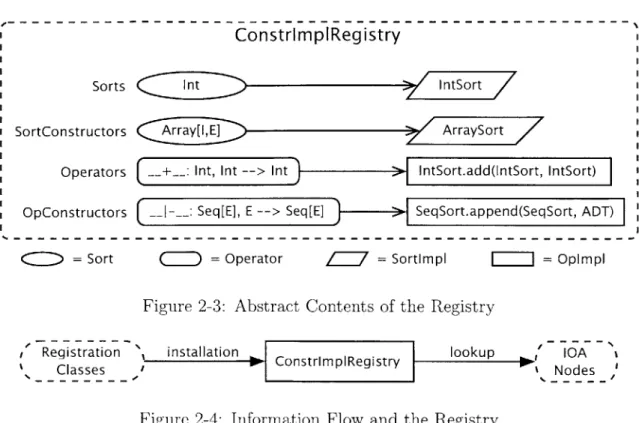
The contents of the registry are diagrammed in Figure 2-3.
The registry is used in two phases. In the first phase, the registration classes install their implementation classes into the registry. This process is described in Section 2.4. In the second phase, the code generator uses the registry to look up the implementations of the IOA objects that it needs to emit. These two phases are diagrammed in Figure 2-4 and are described below.
To look up a sort or operator, the code generator calls getImpi() on the reg-istry. This method takes a single parameter, an intermediate language ioa. ii. Sort
ConstrImplRegistry
SortCo
Sorts nor
nstructors Array[Irt
Operators +_
Int, Int
-- >Int
IntSort.add(IntSort,
IntSort)nstructors Seq[E], E -- > Seq[E] SeqSort.append(SeqSort, ADT)
= Sort
C
)
= Operator/
/ = Sortimpi = Opimpi Figure 2-3: Abstract Contents of the RegistryRegistration installation onstrmpRegistry IOA
Figure 2-4: Information Flow and the Registry
or ioa.il.Operator, and returns an instance of ioa.registry.SortImpl or
ioa. registry. OpImpi, respectively. How the lookup process works and what kinds of SortImpis and OpImpis (which are both subtypes of Impi, a marker interface for implementations) are returned depend on whether the sorts are simple or compound.
2.3.1
Looking up Simple Sorts and Operators
For simple sorts and operators, the registry maintains two tables. The sort table maps Sort keys to SortImpis, and the operator table maps operator keys to OpImpis. Keys are simply structured String representations that include the name of the sort or operator and (recursively) all of its subsorts. The syntax of keys is an implemen-tation detail that is subject to change; they are created using the makeOpKey() and makeSortKey() methods of ConstrImpiRegistry.
The registry's installSortImpl() and installOpImpi 0 methods let one add map-pings to the tables, and the getImpi(Sort) and getImpl(operator) methods use them to look up SortImpi and OpImpi objects for simple sorts and operators.
When looking up a simple sort, the registry returns a SortImpi that is an instance OpCo
of ioa.codegen.target.java.Class. The Class object knows the name of the class
that implements the sort (e.g., ioa.runtime.adt.seqsort). The code generator calls upon it to emit these pieces of information when the time is right.
Looking up simple operators works in the same way. The registry returns an OpImpi that is an instance of ioa.codegen.target.java.operator. The Operator is a node in the target syntax tree, and it knows which method (e.g., SeqSort.headO) implements the IA operator that it represents. It also remembers which
ioa. ii. Operator object it is supposed to be implementing. When the code generator asks the Operator to emit itself, it passes the operator a list of actual parameters. The operator emits the name of the method (e.g., SeqSort.head) followed by the list of parameters (delimited by commas and enclosed by parentheses). It emits a cast of the return value of the method to the implementation class of the sort that the
IOA operator returns. This lets one, for instance, take a StringSort out of a SeqSort
and assign it to a variable of type StringSort, even though SeqSort.heado returns a vanilla ADT.
2.3.2
Looking up Compound Sorts and Operators
For compound sorts and operators, the registry maintains two more tables. The sort constructor table maps Strings to chains of SortConstructors, and the opera-tor construcopera-tor table maps Strings to chains of OpConstrucopera-tors. Unlike their Impi counterparts, SortConstructor and OpConstructor are not nodes of the target syntax tree. Instead, they are intermediary objects that know how to construct Classes and operators. They represent IQA sort and operator constructors and extend
ioa.registry.Constructor.
The keys of the sort constructor table and operator constructor tables are shallow
IOA names (omitting subsorts) for sorts and operators (e.g., Map and _I-_). The
values are chains of constructor objects that share the same shallow name. When looking up a compound Sort or Operator, the registry uses the corresponding table to find the appropriate chain of constructors. If the code generator has an imple-mentation for the Sort or Operator, then one of the Constructors in the chain must
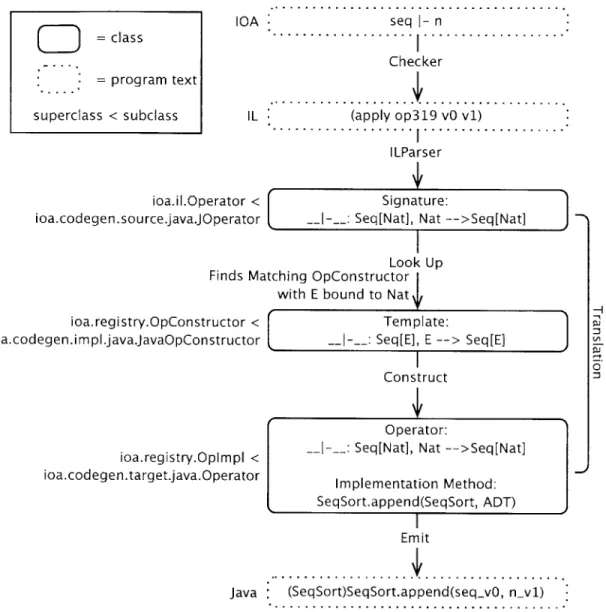
claim to be able to implement it. The registry searches down the chain, asking each Constructor whether it matchoes (can implement) the given sort or Operator; see Section 2.3.5. When it finds the right Constructor, the registry asks the constructor to construct the appropriate SortImpi or OpImpi. The registry returns the Impi, and from then on everything proceeds as in Section 2.3.1. Figure 2-5 shows the process of generating code for an operator on a compound sort.
2.3.3
Curried Parameters
In most cases, there is a one-to-one mapping between IOA operators and the Java methods that implement them. Sometimes, however, it is impractical to write a method for each operator. In this case, it is useful to implement a family of IOA operators with the same Java method. For instance, Char has nullary operators for each character: 'a', 'b', etc. There are many such operators, and they differ only in the character value that they return. It is therefore convenient to implement all such operators with a single method, CharSort, lit (char). The parameter to this method is a char that differs depending on which IOA operator is being applied at a given time. For instance, when the IOA program references the nullary operator 'a', the code generator outputs harSort.lit('a').
Here, the character literal 'a' is a curried parameter; it is not present in the IOA operator application, but it is added to the Java method invocation. The operator is nullary, but the implementation method is unary. The 'a' is built into the subclass of operator object that implements 'a'. This class is called ExtOperator4; and it
supports an arbitrary number of curried parameters, which it prepends to the argu-ment list during emission. Operators with curried parameters may be registered using Installer. addCurriedOp 0 instead of addOp (). Curried operators on compound sorts are not supported at this time.
4
ioa.il.Operator < ioa.codegen.source.java.JOperator IOA seq I- n Checker IL (apply op319 vO v1) ILParser Signature:
Seq[Nat], Nat -- >Seq[Nat]
Look Up Finds Matching OpConstructor
with E bound to Nat
ioa.registry.OpConstructor <
ioa.codegen. impi .java.JavaOpConstructor
ioa.registry.Oplmpl < ioa.codegen.target.java.Operator Template: Seq[E], E -- > Seq[E] Construct Operator:
Seq[Nat], Nat -- >Seq[Nat] Implementation Method: SeqSort.append(SeqSort, ADT)
Em it
Java (SeqSort)SeqSort.append(seq-vO, n-vl)
Figure 2-5: Translating and emitting an operator on a compound sort. First, the IOA program is parsed by the checker. The checker outputs an intermediate language version of the program. The ILParser parses this into nodes of the source syntax tree. The code generator begins the translation. When it encounters an operator on
Seq[Nat], it looks it up in the registry and finds an OpConstructor for Seq[E], which
can handle Seq[Nat]. The
OpConstructor
constructs an Operator node in the target syntax tree. The code generator translates the IOA operator invocation into a Java method call, and emits the text of that call with the actual parameters.ED = class = program text superclass < subclass
--I pa Li, pa 0