HAL Id: hal-03148470
https://hal.archives-ouvertes.fr/hal-03148470
Submitted on 28 Feb 2021
HAL is a multi-disciplinary open access
archive for the deposit and dissemination of
sci-entific research documents, whether they are
pub-lished or not. The documents may come from
teaching and research institutions in France or
abroad, or from public or private research centers.
L’archive ouverte pluridisciplinaire HAL, est
destinée au dépôt et à la diffusion de documents
scientifiques de niveau recherche, publiés ou non,
émanant des établissements d’enseignement et de
recherche français ou étrangers, des laboratoires
publics ou privés.
Nine new open clusters within 500 pc from the Sun
Siegfried Röser, Elena Schilbach, Bertrand Goldman
To cite this version:
Siegfried Röser, Elena Schilbach, Bertrand Goldman. Nine new open clusters within 500 pc from
the Sun. Astronomy and Astrophysics - A&A, EDP Sciences, 2016, 595, pp.A22.
�10.1051/0004-6361/201629158�. �hal-03148470�
DOI:10.1051/0004-6361/201629158 c ESO 2016
Astronomy
&
Astrophysics
Nine new open clusters within 500 pc from the Sun
Siegfried Röser
1, Elena Schilbach
1, and Bertrand Goldman
2, 31 Zentrum für Astronomie der Universität Heidelberg, Mönchhofstraße 12−14, 69120 Heidelberg, Germany
e-mail: [roeser;elena]@ari.uni-heidelberg.de
2 Max-Planck-Institut für Astronomie, Königstuhl 17, 69117 Heidelberg, Germany
3 Observatoire astronomique de Strasbourg, Université de Strasbourg − CNRS UMR 7550, 11 rue de l’Université, 67000 Strasbourg,
France
Received 21 June 2016/ Accepted 6 August 2016
ABSTRACT
Aims.One of the results of the Milky Way Star Clusters (MWSC) survey was the detection of a slight under-density of old (ca. 1 Gyr) clusters within the nearest kilo-parsec from the Sun. This under-density may be due to an ineffectiveness in the detection of larger structures with lower surface brightness. We report on our attempts to reveal such clusters.
Methods.We derived proper motions from a combination of Tycho-2 with URAT1, and obtained a mean precision of about 1.4 mas/yr per co-ordinate for 1.3 million stars north of −20◦
declination. We cut the sky into narrow proper motion slices and searched for spatial over-densities of stars in each slice. We then examined stars from over-densities in optical and near-infrared colour-magnitude diagrams to determine if they are compatible with isochrones of a cluster. We estimated the field star contamination using our data and the Besançon Galactic model.
Results.We detected nine hitherto unknown open clusters in the vicinity of the Sun with ages between 70 Myr and 1 Gyr, and distances between 200 and 500 pc.
Key words. open clusters and associations: general – catalogs – surveys – proper motions
1. Introduction
Star clusters are considered building blocks of the Galaxy. Their study is important for our understanding of star formation and of the history of the Milky Way. The Milky Way Star Clus-ters (MWSC) project (Kharchenko et al. 2012) aims to deliver a sample of open clusters within the larger solar neighbourhood, which covers a representative data set of clusters of all ages. Al-thoughKharchenko et al.(2013) found that their sample of some 2800 open clusters is essentially complete to 1.8 kpc from the Sun, for a small subset of the oldest open clusters (log t ≥ 9), these authors noted evidence of incompleteness within about 1 kpc from the Sun (see Fig 4. inKharchenko et al. 2013).
In the following years, several efforts were undertaken to fill the gap of old clusters within 1 kpc. A classical method to re-veal new open clusters is searching for stellar over-densities on the sky. This method has been applied bySchmeja et al.(2014) on the basis of the 2MASS catalogue (Skrutskie et al. 2006). Al-though they found 139 new open clusters, the situation within 1 kpc did not change. The depth of 2MASS is responsible for a high average background noise, so this method turned out to be more effective for the detection of compact clusters which, in general, are the more distant clusters.
For a better detection of over-densities, the background noise can be reduced by using proper motions to construct subsets of co-moving stars. Open clusters are gravitationally bound enti-ties of co-eval stars, so common motion is a necessary condition for stars forming an open cluster. The internal velocity disper-sion depends on cluster mass and usually reaches a few hundred meters per second for the vast majority of open clusters in the Galaxy. For example, the internal one-dimensional velocity dis-persion found to be 0.44 km s−1for an old open cluster such as
the Hyades with a tidal mass of 275 M (seeRöser et al. 2011). Even for loose ensembles, such as nearby young moving groups, the one-dimensional velocity dispersions are about 1 km s−1(see Mamajek 2016). At 200 pc, 1 mas/y in proper motion roughly corresponds to 1 km s−1in space motion, so the internal velocity dispersion of an open cluster, and even of a moving group should still be smaller than the typical present-day accuracy of proper motions of stars at distances larger than about 200 pc.
In their search for undetected clusters, Scholz et al. (2015) used proper motions from a subset of 399 million stars of the PPMXL (Röser et al. 2010) catalogue. The accuracy of the proper motions in PPMXL depends essentially on declination. For stars with 2MASS observations, Röser et al. (2010) give a typical accuracy of proper motions of 4 mas/yr north of −30◦ declination, and 9 mas/yr south of it. Taking this into ac-count, Scholz et al. (2015) divided the catalogue into 441 cir-cular proper motion bins (radius 15 mas/yr) within ±50 mas/yr in µαcos δ and in µδ. In each proper motion bin, they looked for over-densities in small sky areas (“sky pixels”) of 0.25 × 0.25 deg2, which corresponds to the typical size of clusters in the MWSC survey. As a result, 63 new open clusters were found by this approach, however, all were farther away from the Sun than 1 kpc.
Why did Scholz et al. (2015) not find new clusters within 1 kpc? Possibly, the missing clusters (within 1 kpc) should have a larger angular extent on the sky than is reflected in the small sky pixels chosen byScholz et al.(2015). Also, the large bins (a radius of 15 mas/yr) in proper motion space do not efficiently re-duce the sky background, which makes over-densities more dif-ficult to be detected. For the detection of nearby clusters small (less than about 1 mas/yr) proper motion bins and large spacial bins of about 1 deg2could be a reasonable choice.
A&A 595, A22 (2016)
The forthcoming Gaia data releases will be ideal for this pur-pose. However, in this paper we try to show that even a moderate progress in the precision of proper motions allows us to reveal so far unknown open clusters within 1 kpc from the Sun. The results presented here should be looked at as a current snapshot of what we can expect from Gaia data. We note that it was not our inten-tion to determine the most accurate astrophysical parameters of these clusters on the basis of the presently available astrometric and photometric data as these parameters will be revised within a short time using the Gaia results.
In Sect. 2 we describe how we improved the Tycho-2 (Høg et al. 2000) proper motions and then explain the adopted method of cluster detection in Sect. 3. In Sect. 4 we present the newly found clusters, and the discussion in Sect. 5 concludes the paper.
2. Improving Tycho-2 proper motions
We used URAT1 (Zacharias et al. 2015) to improve the Tycho-2 proper motions and to test what proper motions, which are more precise than those of Tycho-2, can do for open cluster stud-ies. URAT1 contains 228 million objects down to about R = 18.5 mag, north of about −20◦ declination. For the bulk of the Tycho-2 stars, URAT1 gives positions at a mean epoch around 2013.5 and an accuracy level of about 20 mas per co-ordinate. We cross-matched URAT1 with Tycho-2 (the original data set tyc2.dat from CDS), and obtained new proper motions via a least-squares adjustment as described, for example in PPMXL (Röser et al. 2010). To avoid formally ultra-precise astrometry for a small number of stars, we chose a 10 mas floor for the pre-cision of a URAT1 position.
We constructed a catalogue, hereafter called TYCURAT, containing 1 300 000 stars north of −20◦declination with an av-erage formal precision of 1.35 mas/yr in proper motion, both in right ascension and in declination. The corresponding accu-racy in Tycho-2 is 2.37 mas/yr, which gives a formal improve-ment of proper motion accuracy of 40%. URAT1 was astromet-rically calibrated by its authors using UCAC4 (Zacharias et al. 2013), which is nominally on the ICRS system. No attempt has been made to investigate potential regional systematic distor-tions in the proper motion system of the new catalogue TYCU-RAT. These possible zonal deviations are not crucial for a poten-tial detection of open clusters and moving groups on areas of a few square degrees. We then cross-matched the TYCURAT cat-alogue with ASCC-2.5 (Kharchenko 2001) to obtain the John-son B, V and 2MASS J, H, KSphotometry, which is included in the latter1.
3. Detecting nearby stellar groups
The stellar content of TYCURAT is a subset of the ASCC-2.5 catalogue, which was already used for a systematic search of open clusters by Kharchenko et al. (2005). These authors re-vealed 109 new Galactic open clusters by looking around each star (seed) brighter than V = 9.5 in an area less than 0.3 deg to see if they could find companions with proper motions within 1σ of the proper motion of the seed. In a next step, they checked whether the selected stars fit to an isochrone in an (B − V, V) colour−magnitude diagram (CMD). Using TYCURAT, which has the same stellar content on 67 per cent of the sky, we could not expect to find a large number of new clusters. However, with 1 TYCURAT is available on request from
improved proper motions and changing the detection criteria we get a chance to reveal those clusters that escaped the detection byKharchenko et al.(2005).
3.1. Astrometric steps
In our approach, we first start with a narrow range of 1.5 mas/yr in proper motion space to down-select stars with the same proper motion and look for their concentrations in circular bins with a radius of 0.5 deg on the sky to reveal cores of possible co-moving objects. The details of the procedure are described below. (a) Depending on their proper motions, we divided TYCURAT
stars into subsets (which we call proper motions slices) by the following rule. In the proper motion plane (µαcos δ, µδ) we selected a quadratic area around the origin given by the condition |µαcos δ|+ |µδ| ≤ 43 mas/y and chose grid points (centres) at each integer value (i, k). This gives 3785 proper motion slices. A slice (i, k) then contains all stars for which (µαcos δ−i)2+(µδ−k)2≤ 1.52holds. The number of stars per slice strongly varies and depends on the total proper motion. The maximum number of 44 000 stars is at (µαcos δ, µδ)= (−1, −3), whereas the number of stars is less than 150 at the borders of our square. About 90% of all slices contain less than 6000 stars. These slices represent a seven-fold overlap of the proper motion plane, with the effect that the same over-density on the sky may appear in neighbouring slices, but not necessarily with the same signal-to-noise ratio.
(b) In the second step we searched for over-densities in the proper motion slices. For each star in a proper motion slice, we counted all its neighbours within a radius of 0.5 deg (called sky circle) and determined the surface density S (stars/square degree). Surrounding each star’s sky circle we chose an area of 9 sq. deg, where we determined the back-ground surface density B. We only retain stars if S/B of their sky circle is larger than 3.0 and their S − B is larger than 5 per square degree. If the angle between two stars is less than 0.5 deg, each of them is in the other’s sky circle. We discard the one with the lower S /B. This cleaning goes on until only “isolated” sky circles are left, which we call Level-0 centres. As our system of proper motion slices represents a seven-fold overlap of the sky, a Level-0 centre in slice n could have the same or a neighbouring Level-0 centre in slice m. If they are within the radius of a sky circle and the difference of their actual proper mo-tions is less than 1.5 mas/yr, only the Level-0 centre with higher S/B is retained. These survivors are called Level-1 centres; they are disjunct and are possible candidates of new open clusters.
Of course, many of the Level-1 centres could be related to known open clusters. Therefore, we cross-matched them with the MWSC clusters (Kharchenko et al. 2013) and with the most recent cluster list DAML02 VERSION 3.5 of 2016 Jan. 28 (Dias et al. 2002). We discarded all the Level-1 centres within 0.7 deg of a known cluster, if the radius of the known cluster was larger than 0.2 deg. If the radius of a cluster in MWSC or in DAML is smaller than 0.2 deg, it cannot be identical to one of the objects found here. About 200 Level-1 centres surviving this process (called Level-2 centres) were then subject to a pho-tometric check of their existence as clusters.
3.2. Photometric steps.
(a) We first made a quick and coarse check in the (J − KS, KS) CMD of the stars in a sky circle around a Level-2 centre
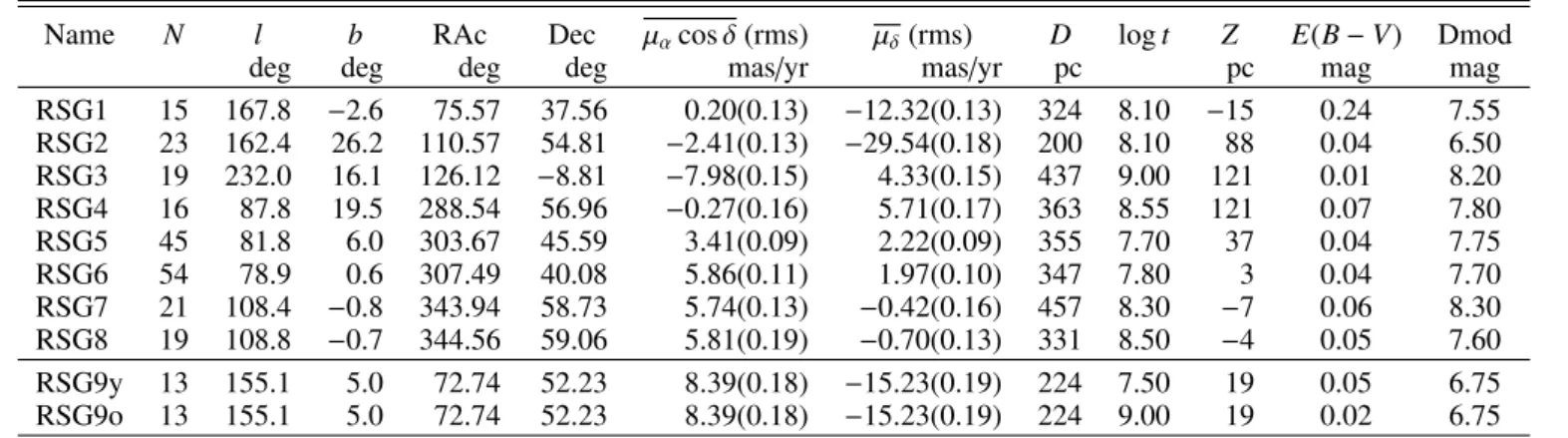
Table 1. New open clusters.
Name N l b RAc Dec µαcos δ (rms) µδ(rms) D log t Z E(B − V) Dmod
deg deg deg deg mas/yr mas/yr pc pc mag mag
RSG1 15 167.8 −2.6 75.57 37.56 0.20(0.13) −12.32(0.13) 324 8.10 −15 0.24 7.55 RSG2 23 162.4 26.2 110.57 54.81 −2.41(0.13) −29.54(0.18) 200 8.10 88 0.04 6.50 RSG3 19 232.0 16.1 126.12 −8.81 −7.98(0.15) 4.33(0.15) 437 9.00 121 0.01 8.20 RSG4 16 87.8 19.5 288.54 56.96 −0.27(0.16) 5.71(0.17) 363 8.55 121 0.07 7.80 RSG5 45 81.8 6.0 303.67 45.59 3.41(0.09) 2.22(0.09) 355 7.70 37 0.04 7.75 RSG6 54 78.9 0.6 307.49 40.08 5.86(0.11) 1.97(0.10) 347 7.80 3 0.04 7.70 RSG7 21 108.4 −0.8 343.94 58.73 5.74(0.13) −0.42(0.16) 457 8.30 −7 0.06 8.30 RSG8 19 108.8 −0.7 344.56 59.06 5.81(0.19) −0.70(0.13) 331 8.50 −4 0.05 7.60 RSG9y 13 155.1 5.0 72.74 52.23 8.39(0.18) −15.23(0.19) 224 7.50 19 0.05 6.75 RSG9o 13 155.1 5.0 72.74 52.23 8.39(0.18) −15.23(0.19) 224 9.00 19 0.02 6.75
using TOPCAT2 (Taylor 2005). A Level-2 centre was se-lected for a more careful treatment if stars with (J − Ks) < 0.4 showed a tendency towards building a part of a main sequence or a turn-off region. The Level-2 centres were im-mediately rejected if, on the CMDs, their stars showed a random distribution, mostly at the limiting magnitude of Tycho-2. So, we could quickly check the Level-2 centres found in the previous step.
(b) Only 11 Level-2 centres made it into the final process. From the stars in each Level-2 centre’s sky circles, we determined a mean position α, δ and mean proper motions (µαcos δ, µδ). Then we selected an area of 2 deg radius around α, δ con-taining the stars from a proper motion slice around the mean proper motion.
The photometric B, V data from ASCC-2.5 are pretty accurate for stars brighter than V= 10, but the accuracy decreases rapidly for fainter stars. Therefore, we cross-matched the stars around each Level-2 centre with APASS9 (Henden et al. 2016) to ob-tain more precise optical photometry for fainter stars, knowing that there may be small systematic differences between the pho-tometric systems of ASCC-2.5 and APASS9.
In order to determine membership, distance modulus, age, and reddening, we used Padova CMD 2.83 solar metallicity
isochrones both within the optical (B−V, V) and the near-infrared (J − KS, KS) CMDs. Allowing for possible binarity, we consider a star as a probable member if its offset from the isochrone is less than 2.5 sigma of its photometric error in magnitude and colour in both CMDs.
4. Newly found open clusters
For 8 out of 11 Level-2 centres, representing nine clusters (see below), we obtained reasonable fits to Padova isochrones. The newly detected clusterings are located in the solar neighbour-hood at distances below 500 pc from the Sun. The candidates RSG1 to RSG8 are very probably genuine physical groups. Membership and astrophysical parameters could be determined sufficiently well. Nevertheless, accurate parallaxes of at least several reliable cluster stars could improve the quality of param-eter dparam-etermination. A definite age cannot be derived for RSG9; this critically depends on the secure membership status of the two brightest stars.
Table 1 summarises the astrophysical parameters of the newly found objects. Columns 1 and 2 contain the names of the 2 Tool for OPerations on Catalogues And Tables
3 http://stev.oapd.inaf.it/cgi-bin/cmd
clusters and the number of probable members (N), contained in TYCURAT, as determined in Sect. 3.2. All the following cluster parameters are determined from these probable members.
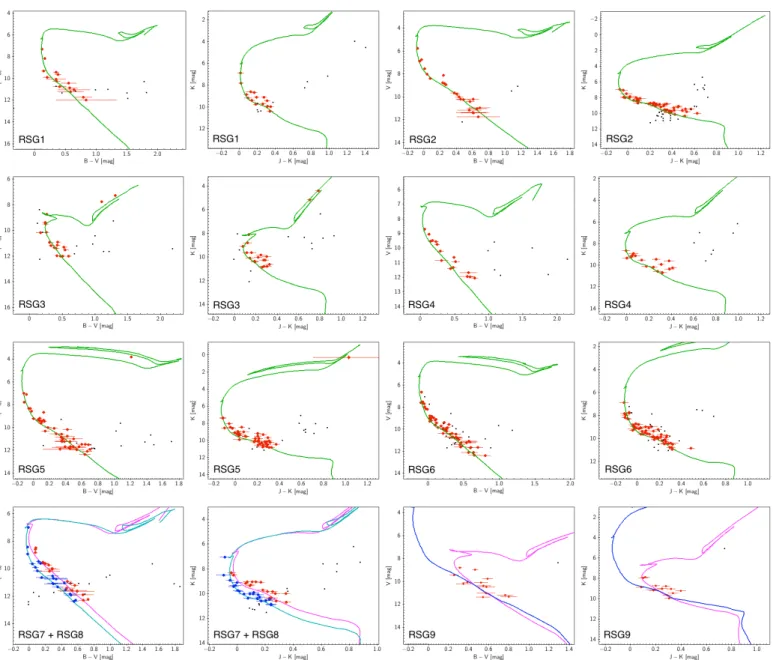
The coordinates of the centres in Galactic longitude (l), Galactic latitude (b), right ascension (RAc), and declination (Dec) are given in Cols. 3 to 6. In Cols. 7 and 8 lists the mean proper motion and the precision of the mean motions. The dis-tances D, ages (log t), the distance Z from the Galactic plane, reddening E(B − V) and distance modulus (Dmod) are given in Cols. 9−13. The CMDs of the new clusters are shown in Fig.1. To evaluate a possible contamination by the stellar pop-ulation from the general Galactic field we used the Besançon galactic model (Robin et al. 2003) with realistic extinction in-cluded in the simulation, based upon the 3D extinction maps of Schlafly et al.(2014). As our underlying survey, the Tycho-2 catalogue is about 90% complete down to V= 11.5 (Høg et al. 2000) and rapidly gets incomplete beyond this value; we cut our simulations at this magnitude. For each cluster we simulated the contribution of field stars in the same proper motion range and on an area of ≈12.5 sq. deg around the centre and show the re-sults in the CMDs of Fig.2. The number of the predicted stars was always fairly less than the number of the actual stars in the cluster areas, a hint at the reality of the over-densities found.
Each of the nine clusters is briefly discussed below: RSG1
The combined use of optical and NIR photometric data permitted a reliable selection of the most probable members. A parallax of 3.8 ± 0.7 mas (van Leeuwen 2007) and a spectral type B9 (Skiff 2014) of the brightest member (HD 32270) are consistent with the distance and age determined for RSG1. The members form a relatively compact group of 1 × 1 sq. deg (5.6 pc × 5.6 pc) of young stars moving with a significant tangential velocity of 19 km s−1relative to the Sun. As seen from Fig.2the predicted field-star contamination is negligible for this cluster.
RSG2
RSG2 is the nearest cluster with the largest proper motion. This cluster groups around the two B8/B9 stars 19 Lyn A and 19 Lyn B, and includes three probable members with a relative parallax accuracy from 11% to 15% in van Leeuwen (2007). They indicate a mean distance of 197 pc, coinciding well with our determination based on isochrone fitting. Since RSG2 is so close to us, we allowed a search for possible members on a larger area of the sky (R < 3 deg). RSG2 is about as old as the Pleiades but is considerably less populated. Remarkably, it is located at about the same galactic longitude (l= 166◦for RSG2 and l = 163◦ for the Pleiades), but north of the Galactic plane
A&A 595, A22 (2016)
Fig. 1.Colour−magnitude diagrams (B − V, V) and (J − KS, KS) of the clusters RSG1 to RSG9 from Table1. Thick red (blue in the case of RSG7)
dots with error bars are confirmed photometric members; small black dots are field stars within the same proper motion slice within a 2 deg radius (a 3 deg radius in the case of RSG2) around the cluster centre. Fitted Padova isochrones corresponding to the ages given in Table 1 are shown as coloured lines.
(b= 26◦for RSG2 and b= −23◦for the Pleiades). Because of its large proper motion, this cluster is practically free from field-star contamination (two stars obtained from the model). We could only show where posible contaminants would lie in the CMD in Fig.2when we used a large area of 200 sq. deg (factor seven in area).
RSG3
This cluster is rather far away to have accurate trigonometric parallaxes. According tovan Leeuwen(2007), the two brightest members, HD 70358 (K1 III) and HD 70407 (K2 III), are located at distances between 270 and 480 pc from the Sun, which does not contradict our estimate from isochrone fitting. RSG3 is the oldest cluster in our sample and it represents a rather loose group of co-moving stars distributed within an area of 20 pc × 20 pc. In the case of RSG3, the stellar population from the Besançon model illuminates the problem of revealing old clusters in a shallow sky survey. The model gives a contamination of about 30% near the isochrone of the cluster. More accurate astrometric
data from the first Gaia data release will decide upon the fate of this cluster.
RSG4
With an age of about 350 Myr, this cluster is a typical represen-tative of the cluster population in the solar neighbourhood (see Piskunov et al. 2006). A parallax of 3.5±0.7 mas of the brightest member HD 180007 (A0/A0III) is consistent with our estimate of the cluster distance. According to the model, the contamina-tion is rather small, so we have no doubt about its existence.
RSG5
This cluster is the youngest one in our sample. There are four probable members with parallaxes measured by H
ipparcos
with a relative accuracy of 10−20%. The resulting aver-age distance of about 325 pc (275−435 pc) is consistent with our estimate. The brightest star (31 Cyg) is a spectro-scopic binary K4Ib+B4V (Pourbaix et al. 2004) with an age of 39.8 ± 10.3 Myr (Tetzlaff et al. 2011), which also sup-ports our age estimate for the cluster. In accordance with theFig. 2.Observed and predicted (by the Besançon model) (J − KS, KS) CMDs in the areas of the clusters from Table1. Red symbols refer to
observations, where thick dots indicate probable members and circles indicate field stars. The black dots are predicted field stars from the Besançon model of the Galaxy.
prediction from the model, the contamination by field stars is only about 15%.
RSG6
As a relatively young, nearby, and well-populated cluster, RSG6 is concentrated within an area of about 2.5 × 2.5 sq. deg, (15 pc × 15 pc) partly covering the cluster Roslund 6 (Roslund 1960). Roslund 6 is more distant, 544 pc; older, log t = 8.67; and smaller, radius 0.3 deg (data fromKharchenko et al. 2013). There are H
ipparcos
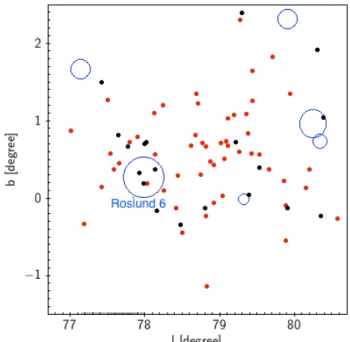
parallaxes of a relative accuracy better than 18% for five B stars that were selected as probable RSG6 members. They place the cluster at a distance of about 330 pc (230−450 pc), which coincides well with our distance estimate. The spectral type of the brightest star HD 194789, B6 IV/V (Skiff 2014) indicates a young age for RSG6. As RSG6 and Roslund 6 have nearly the same proper motions (given the preci-sion in TYCURAT) the question of whether Roslund 6 is either a separate cluster behind RSG6 or a part of a large, complex RSG6 can only be solved definitely with Gaia parallaxes and proper motions. In Fig.3we show the area surrounding Roslund 6 and RSG6 on the sky. According to the model the contamination is less than 10%, so we have no doubt about its existence.RSG7 and RSG8
The CMDs of the co-moving stars in this sky area reveal a well-defined sequence, although it is too wide to be caused by binarity of several members. A possible explanation is that there is a mix-ture of several clusterings with about the same proper motions, but at different distances (one behind the other) projected on the sky in the same direction. We fit the observed distribution by two different isochrones; the results are given in Table1and Fig.1. Unfortunately, the parallax was measured by H
ipparcos
only for the brightest star with a relative accuracy better than 20% resulting in a distance between 355 and 500 pc. The Besançon model for the area of RSG7 and RSG8 in Fig.2shows moderate contamination near the sequences of the two clusters. With Gaia data a clear decision can be made about the number of groups and whether the stars are members of RSG7 or RSG8.RSG9
This group is represented by only 13 co-moving stars distributed over an area of 5 pc × 10 pc (with 8 stars concentrated to an
Fig. 3.Area around the new cluster RSG6 (galactic coordinates). Red dots indicate the probable members in RSG6; black dots indicate the TYCURAT stars within the same proper motion slice. Open clusters from MWSC are shown as large blue circles, the radius corresponding to the cluster radius r2 in MWSC.
inner core of 2 pc × 4 pc) and with a relatively large proper mo-tion. The major axis of the cluster core is parallel to the galactic plane and the direction of the proper motion vector coincides with the major axis. For one star a parallax of 3.63 ± 0.94 mas (van Leeuwen 2007) was measured by H
ipparcos
. Although the relative accuracy is rather moderate, this agrees with our distance estimate for RSG9. The age, however, cannot be de-termined definitely, i.e., all ages between log t = 7.5 and 9.0 are still acceptable. Here, Gaia is needed for a conclusive mem-bership determination. On the other hand, the contamination by field stars is not an issue for this cluster.A&A 595, A22 (2016)
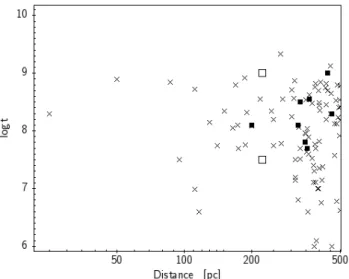
Fig. 4.Distances and ages of the newly found clusters within 500 pc. The new clusters are shown as black squares, whereas the MWSC clus-ters (Kharchenko et al. 2013) are shown as crosses. The open squares indicate the age spread of the cluster RSG9.
5. Discussion
Our results show that with highly precise proper motions and carefully selected search parameters it is still possible to reveal hitherto unknown open clusters even in the closer neighbour-hood of the Sun up to 500 pc. On the other hand, we detected no new open cluster beyond that distance. A possible reason is the low limiting magnitude of Tycho-2. So, the larger the dis-tance modulus and extinction, the less probable it becomes to obtain enough unevolved stars to find a cluster main sequence in the CMDs. It looks as if this happens at distance modulus 8.5 (roughly 500 pc).
Owing to the shallow depth of Tycho-2, we were only able to find the brightest and most massive stars in our clusters. Typ-ical stellar mass functions in open clusters (see e.g. Fig. 3 in Bastian et al. 2010) imply that the total mass of a cluster is gov-erned by stars around 0.5 M which, at distances prevailing here, are below the limiting magnitude of Tycho-2. Not knowing the mass we cannot make a statement about whether the new clusters are still gravitationally bound or if they are dissolving.
Our findings contribute substantially to the open cluster pop-ulation within 500 pc from the Sun. In Fig.4we show the dis-tribution of the distances and ages of our nine newly found clus-ters. The clusters are shown as black squares, and only cluster RSG9 is presented as two open squares indicating the range of possible ages. Also shown are the 92 clusters (crosses) from Kharchenko et al.(2013). Although we could only search 67% of the sky, our results increase the total number of clusters within
500 pc by 10%. Only two of the MWSC clusters, Ruprecht 147 and NGC 752, have log t ≥ 9. RSG3 adds one more cluster to this old cluster generation; RSG9 may add another one if its old age is confirmed.
The first Gaia data release will contain TGAS
(Michalik et al. 2015) supplying proper motions similar to or better than TYCURAT on the whole sky. But the biggest progress will be achieved by the about 2 million absolute parallaxes. These will surpass the H
ipparcos
parallaxes in quality and by a factor of 20 in quantity. It will open the path to a substantial leap in open cluster research.Acknowledgements. This study was supported by Sonderforschungsbereich SFB 881 “The Milky Way System” (subprojects B5 and B7) of the German Research Foundation (DFG). It is a great pleasure to acknowledge Mark Tay-lor from the Astrophysics Group of the School of Physics at the University of Bristol for his wonderful work on TOPCAT, Tool for OPerations on Catalogues And Tables. We made extensive use of the major functions of this beautiful tool. This research has made use of the SIMBAD database and of the VizieR catalogue access tool, operated at CDS, Strasbourg, France.
References
Bastian, N., Covey, K. R., & Meyer, M. R. 2010,ARA&A, 48, 339
Dias, W. S., Alessi, B. S., Moitinho, A., & Lépine, J. R. D. 2002,A&A, 389, 871
Henden, A. A., Templeton, M., Terrell, D., et al. 2016, VizieR Online Data Catalog: II/336
Høg, E., Fabricius, C., Makarov, V. V., et al. 2000,A&A, 355, L27
Kharchenko, N. V. 2001,Kinematika i Fizika Nebesnykh Tel, 17, 409
Kharchenko, N. V., Piskunov, A. E., Röser, S., Schilbach, E., & Scholz, R.-D. 2005,A&A, 440, 403
Kharchenko, N. V., Piskunov, A. E., Schilbach, E., Röser, S., & Scholz, R.-D. 2012,A&A, 543, A156
Kharchenko, N. V., Piskunov, A. E., Schilbach, E., Röser, S., & Scholz, R.-D. 2013,A&A, 558, A53
Mamajek, E. E. 2016, in IAU Symp. 314, eds. J. H. Kastner, B. Stelzer, & S. A. Metchev, 21
Michalik, D., Lindegren, L., & Hobbs, D. 2015,A&A, 574, A115
Piskunov, A. E., Kharchenko, N. V., Röser, S., Schilbach, E., & Scholz, R.-D. 2006,A&A, 445, 545
Pourbaix, D., Tokovinin, A. A., Batten, A. H., et al. 2004,A&A, 424, 727
Robin, A. C., Reylé, C., Derrière, S., & Picaud, S. 2003,A&A, 409, 523
Röser, S., Demleitner, M., & Schilbach, E. 2010,AJ, 139, 2440
Röser, S., Schilbach, E., Piskunov, A. E., Kharchenko, N. V., & Scholz, R.-D. 2011,A&A, 531, A92
Roslund, C. 1960,PASP, 72, 205
Schlafly, E. F., Green, G., Finkbeiner, D. P., et al. 2014,ApJ, 789, 15
Schmeja, S., Kharchenko, N. V., Piskunov, A. E., et al. 2014,A&A, 568, A51
Scholz, R.-D., Kharchenko, N. V., Piskunov, A. E., Röser, S., & Schilbach, E. 2015,A&A, 581, A39
Skiff, B. A. 2014, VizieR Online Data Catalog, 1
Skrutskie, M. F., Cutri, R. M., Stiening, R., et al. 2006,AJ, 131, 1163
Taylor, M. B. 2005, in Astronomical Data Analysis Software and Systems XIV, eds. P. Shopbell, M. Britton, & R. Ebert,ASP Conf. Ser., 347, 29
Tetzlaff, N., Neuhäuser, R., & Hohle, M. M. 2011,MNRAS, 410, 190
van Leeuwen, F. 2007,A&A, 474, 653
Zacharias, N., Finch, C. T., Girard, T. M., et al. 2013,AJ, 145, 44
Zacharias, N., Finch, C., Subasavage, J., et al. 2015,AJ, 150, 101