LAURENT ISABELLE, University of Ottawa.
SHOULD PUPIL PERSONNEL WORKERS IN SCHOOLS
HAVE BOTH TEACHER TRAINING
AND EXPERIENCE?*
When John Paterson and I attended the Executive meeting of the Canadian Guidance and Counselling Association in Toronto last fall, we had a dis cussion on counsellor selection and education which eventually led us to agree to this public debate. We had argued whether counsellors ought first be teachers, he upholding the position that counsellors ought first be teachers, I holding the view that some counsellors could be drawn from teachers ranks, but that it ought not be exclusively so.
I would like to discuss whether counsellors, one of the recognized groups of workers in the pupil personnel field, should not necessarily have both teacher training and experience prior to their entry into the counselling field. The writer's position rests on the following assumptions:
( I) although school counselling is a profession in development, probably still at a very early stage in development in comparison to medicine, law, and teaching, it is a legitimate profession in its own right; although school counsellors appear to still be seeking an identity, a uniqueness, and a clearly defined role, this search is not too different from any other professional's search for an identity and a role;
(2) according to self and vocational self-concept development theory it is not necessary for counsellors-or pupil personnel workers generally-to first become teachers. On the contrary this is an impediment to self and voca tional self-concept development as a counsellor; and
(3) education of counsellors, like education of teachers, lawyers, etc. can and must exist in its own right.
SCHOOL COUNSELLING-A LEGITIMATE PROFESSION
School counselling, and other pupil personnel services, have become professions in their own right (Isabelle, 1967). Some of the reasons for this are: (I) Education is not longer the private reserve of the select few: every single citizen has a fundamental right to education. Education today is not only accessible to every shade of racial, social, economic, political and re ligious variation, but also to most levels of age, talent, specific aptitudes and interests-and moreover compulsory for both sexes to age 16, and as some rumors would have it soon to be 18 in many areas, without forgetting of course, the explosion in adult education;
(2) Our philosophy of education has also evolved. In the earlier ages, the rationale was simple and quite dramatic, it was a sink or swim idea paral leling (or governed by) the Darwinian theory of the "survival of the fittest." 'Debate as part of CGCA/SCOC conference, Edmonton, 1969.
Today, however, we are not only concerned with the survivors, but we are concerned with every single individual in the school;
(3) The new sciences of psychology and sociology have brought new light on learning theory, motivation, levels of achievement and vocational atttain ment, mass mobility and human needs;
(4) We are also in the age of interplanetary space, of ever more complex machinery and technology from color television to jet transportation. It is not surprising therefore that these and other changes affecting our society and our schools have gradually exhausted the time, the energy, the re sources and the competence of the teacher. Specialization was inevitable: the generalist had to give way to the specialist---of course including the school counsellor.
No longer can a teacher cope with all the subject matter in a given educational level-we don't talk about "grades" any more-and no longer can the teacher attend to the "whole child"-if ever he did! We soon dis covered that education in the wide acceptance of the term had to be the shared responsibility of several individuals, professions and institutions, from teachers, principals, superintendents; parents, ministers of the Church, to counsellors, psychologists, social workers, "attendance counsellors", etc. . . .
Naturally enough, counsellors and other pupil personnel workers first emerged from the ranks of teachers, as physicians emerged from the ranks of barbers. It probably could not have been otherwise. But must it continue to be so? If the role of teachers has evolved, so has the role of counsellors, and teachers as the exclusive source of counsellors is no longer adequate but detrimental to the further evolvement of counselling as a distinctive professional role. There are several recent publications on the nature and functions of the school counsellor. Although they are mildly at variance with one another on some peripheral areas of activity they are in sufficient agreement with one another on the principal functions to attempt a range definition of the school counsellor function:
(1) assistant to students with "normal" educational, vocational, personal and! or social problems, in both individual and group counselling;
(2) consultant to teachers and others referring students;
(3) interpreter of guidance practices to teachers, administrators, parents, employers and other professions;
(4) advisor to the School Board on matters within his sphere of compe tence;
(5) consultant to employers in government, business and industry in mat ters relevant to the employ of students;
(6) researcher on matters pertinent to student development: educational, vocational, personal and social; and
(7) assistant to the Director of Student Personnel Services.
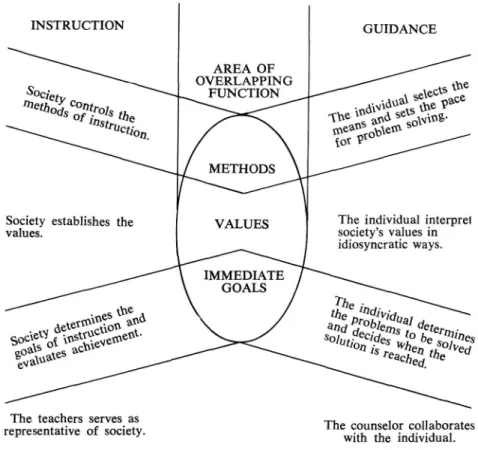
This sphere of activity and competence is different from that of the teacher. Agreed that the counsellor is an educator, but, he is different from the teacher. The writer would like to draw parallels between the two func tions of education, instruction and guidance, to illustrate this argument and to further establish that school counselling is a distinctive profession. For this parallel, Weitz (1964) stresses that despite their common central pur
pose of redirecting human behavior into new and more productive chan nels, "these two functions differ from each other in significant ways." He goes on to say: "The differences are primarily matters of emphasis, but the emphasis has important consequences in practice."
Differences in emphasis between
Guidance and Instruction
( I) Emphasis placed upon the student's idiosyncratic inter pretation of society's values; The counsellor is secondarily a representative of the society -because he is primarily an agent of the individual, used by him to clarify, through interpretation, his own value system;
(2) The immediate objectives of learning-the behavior prod ucts, the skills, the attitudes, the content, etc. are deter mined by the individual seek ing guidance;
The major control over the immediate end product is exercised by the learner; (3) The control over the methods
of learning is exercised by the learner, using the coun sel10r as a facilitative agent;
(4) Individual methods, permIssI veness and problem centered learning are techniques appro priate to the guidance process; (5) The guidance process requires a highly flexible organization in order to provide a structure in which an individual seeking assistance can find his own means of control.
Emphasis is placed upon the broad values held in esteem by the society;
The teacher becomes a repre sentative of society, he is in vested by the society with the authority to interprete and transmit these values to the students;
The teacher determines what these immediate objectives
will be;
The major control over that products is exercised by the teacher;
The control over the process of instruction is exercised primarily by the teacher who manipulates the environment in such a way as to evoke the responses required by society; Group methods, authoritarian control and rote learning of fundamentals are techniques appropriate to instruction; Instruction requires a fairly rigid, authoritarian organiza tion to insure a broad inter pretation of society's values and an efficient management of the instructional process.
Weitz (1964) goes on to affirm that these differences in emphasis, organization and techniques require different kinds of personnel to carry them out.
The differences in personnel are necessary not only in terms of their differ ences in training, which is an obvious and essential difference. but also in terms of their outlook and role perceptions. Good teachers who see them
selves primarily as representatives of society may become poor counsellors, and good counsellors who view themselves as agents of individuals may become indifferent teachers (Weitz, 1964, pp. 59-67).
Arbuckle (1966) also clearly shows that teachers and counsellors do not require the same skills to perform their respective functions, and further that they differ from each other in terms of personality characteristics.
Weitz (1958) also maintains that failure to recognize differences between the two professional roles is detrimental to both instruction and counselling. Weitz (1958) reported the results of a survey of counsellor employment policies and practices in 48 states of the U.S.A. by asking persons in charge of state guidance services if: (I) there was a shortage of guidance personnel in the area; (2) would people with strong graduate and undergraduate experience in the behavioral sciences, but not certifiable as teachers, be eligible to serve as counsellors in any of the schools in the area; (3) under what type of certification could they be employed; and (4) if ineligible for employment as certified guidance workers, would they know of any situation in the area under which such people could be employed on an
INSTRUCTION GUIDANCE AREA OF OVERLAPPING SOCiety FUNCTION methOd COntrol s of' s the InstrUct· IOn.
Society establishes the The individual interpret
values. society's values in
idiosyncratic ways.
The teachers serves as The counselor collaborates representative of society. with the individual.
Figure I. The Relationship between the Instructional and Guidance Functions of Education.
experimental basis so that it might be possible to determine whether such people could perform adequately without the usual teaching experience. Among the many very illuminating responses to these questions Weitz (1958) came to several conclusions, one of them being that what many of these administrators are saying is:
that education is primarily the transmittal of society's values, skills, and ideas and that any other practice is alien to its central function. Such a view (that the guidance practitioner who is not also a teacher is "incapable of understanding the problems of the classroom") eliminates the guidance function and at the same time dilutes the effectiveness of the instructional function of education (Weitz, 1958).
In summary, therefore, this writer maintains that counselling is a pro fession in its own right, and that the differences between objectives, between means to achieve these objectives, and between persons exercising these roles of counselling and teaching are such that the insistance on becoming a teacher first, prior to becoming a counsellor, is not only a restrictive practice but it is an impediment to the development of counselling as a distinctive profession and an impediment to the candidate becoming a true counsellor.
SELF AND VOCATIONAL SELF-CONCEPT DEVELOPMENT THEORY AND THE SCHOOL COUNSELLOR
According to self and vocational self-concept theory there appears to be little need for teacher education and teaching experience as prerequisites to counsellor selection and education. In order to substantiate this line of argu ment it is necessary to emphasize the hypothesis that the self-concept coun sellor and the vocational self-concept counsellor exist. This hypothetical formulation obviously applies to pupil personnel workers as well. The writer also finds it necessary at this time to summarily review the meanings of self-concept, vocational self-concept, and the process of their development. Super's (1963) work offered definitions that can appropriately be presented here.
Self is what a person is, a being having personality, having its own identity, and it changes as it interacts with the environment.
Self-percepts are self-impressions that emanate from the person's own senses, i.e., the perception of skin color, the perception of body size, etc. . . . These are known as self-percepts, primary self-percepts.
Secondary self-impressions or self-percepts are primary self-percepts that have acquired special significance because of their relationship with other percepts, or ideas about the self, i.e., skin color in a racial group. These secondary self-concepts are known as self-concepts, that is, self images which have acquired meaning and which have been related to other self percepts. A self-concept is a self-picture, a picture of self in some role, some situation, performing some set of functions.
The Self-Concept System is the organization of several self-images or self-concepts into a picture that the individual has of himself in different roles and in different types of situations. A person has several concepts of himself but only one self-concept system.
The Vocational Self-Concept is the constellation of self-images, self attributes-self-concepts-considered by the individual to be vocationally
relevant, whether or not they have been translated into a vocational prefer ence.
At the very beginning of that monograph on Career Development, Super (1963) wrote:
In expressing a vocational preference, a person puts into occupational term inology his idea of the kind of person he is, that in entering an occupation, he seeks to implement a concept of himself; that in getting established in an occupation he achieves self-actualization. The occupation thus makes possible the playing of a role appropirate to the self-concept (pp. 18-19). To be consistent with an earlier hypothesis, therefore, this writer must affirm that a person who expresses the vocational preference counsellor puts into occupational terminology his or her idea of the kind of person he or she is, that a person who enters the profession counsellor seeks to implement a concept of himself or herself, that a person getting established in the occupa tion counsellor achieves self-actualization, and finally, that the profession counsellor makes possible the playing of a role appropriate to the self concept.
Having reviewed the meanings of self, self-concept, and vocational self-concept, it might now be useful to quickly summarize the theory of self-concept development (Isabelle, 1967). Against the background of Buehler's "life stages": growth, exploration, establishment, maintenance and decline and Miller and Form's Career Patterns (Super, 1964), we find that adolescence is the stage of emergence of a self-concept although the total process begins at birth. It is the period of exploration, beginning with the exploration of self and work in the home. This period of exploration ex tends to the school, where the curriculum itself, in much of its content and purpose, is exploratory. Orientation courses, group work sessions, ideally including self-analysis and studies of educational and occupational oppor tunities, are key steps. Many students, even as late as in the graduate or professional school, still need a great deal of orientation to themselves and to their prospective field of study.
Exploration may continue in a variety of situations including part-time or summer work. After school, the period of transition from the school to the world of work is known as the period of reality testing, a second key point in vocational self-concept development. In a counselling education program, the supervised practicum and internship constitute a vital link between the theory and its application. It is often described as the flounder ing or trial process, where there is an attempt to implement the self-concept.
It can also be called the internalization process, beginning with assessment: assessment of self and assessment of the acquired knowledge, assessment of technical or professional competence, of the work load, of work attitudes, of work values. It is a period of adjustment: adjustment to the new or developing self, adjustment to others including co-workers and superiors. This assessment and adjustment are a bringing into consciousness, a de veloping of awareness of self and others, leading to acceptance of self and others, ending in a responsiveness to others. Further, reality testing begins to assess the importance of security, of advancement, of status, of role, in the profession and in the community.
These stages of exploration and reality testing are followed by the period of establishment, where the self-concept is further modified and
implemented. This phase is characterized by further stock-taking, increased stability, under the multiple influence of increasing age, seniority, income, family responsibilities, professional relationships, community participation, etc. It is therefore extremely important that self-concept development of the counsellor be somewhat crystallized before this stage. The establishment phase is followed by the maintenance phase, the period of preservation of the self-concept, or as Super called it "being nagged by the self-concept!" Maintenance leads to the years of decline and the adjustment to the new self in retirement.
In this writer's view, the critical points in the becoming of a counsellor are the exploratory, the reality testing and the establishment stages of voca tional self-concept development. Undergraduate education in the human ities, the sciences and the social sciences including psychology, falls in the exploratory stage of development, a period of widening of the student's vision of himself and his environment (and perhaps a stage of awakening to new dimensions). This is a phase of self-percept formation and crystal lization, a phase of development of several self-concepts and perhaps several vocational self-concepts.
In the light of current trends in teacher education, the concurrent program is rapidly gaining recognition and acceptance. Teacher educators apparently wish to capitalize on this exploratory stage in order to foster self-images or percepts and self-concepts related to the occupational teacher. Teacher educators want teachers to become teachers by expecting them to concentrate, during the undergraduate years, on subjects related to the career of teaching. This trend will likely foster, hasten and crystallize the vocational self-concept teacher, understood to be related to, but different from, the career of counselling. It therefore appears that upon the voca tional self-concept teacher, my colleague wishes to superimpose the voca tional self-concept counsellor. It is necessary to develop first a vocational self-concept teacher? Is this required by other professions?
The other important teacher education program is known as the con sequent program, that is usually a one year program post B.A., post B.Sc., etc. for secondary school teachers and one or two years post grade 12 or 13 for primary school teachers. This is a highly concentrated program, empha sizing primarily teaching methods and techniques, hopefully developing in the candidate those attributes and skills considered to be essential to the role of teacher in the classroom. Unlike the concurrent program which spreads teacher formation including theory and practice over a three or four years during the undergraduate years, the consequent program endeavors to achieve the same ends, in a one or two year period after a first degree or high school diploma respectively. Regardless of the type of program how ever, why insist upon the development of self-concepts and vocational self concepts teacher for counsellors when it is theoretically possible and de sirable to develop self-concepts and vocational self-concepts counsellor at both the undergraduate and the graduate levels?
The second critical period in career development, as we have seen, is the reality testing phase. In teacher education, this phase is largely teaching practice under close supervision. In counselling these are largely the practice and the interneship phases in counsellor education usually at the level of a master's degree. Since reality testing is admittedly a trial phase, often
described as the floundering phase, where attempts to implement the self concept are made, is it wise and economical to expect a potential counsellor to try himself or herself out at teaching, to flounder as it were, in a teaching role, when we all know that the trial and floundering stage in counselling alone is difficult enough! Implementing self-concepts counsellor over and above self-concepts teacher are not only unrealistic, but detrimental. Are not some of the self and vocational self-concepts teacher at variance with, if not contrary to, self and vocational self-concepts counsellor? Should not some of the vocational self-concepts teachers, if one is to become counsel lor, be changed or even eliminated before others related to the counselling role be implemented? Is this not only destructive, but time consuming, frustrating and futile?
Finally, the establishment period of development that follows the reality testing phase is the third critical point. It seems that most counsellors do not have the opportunity to explore nor to do the reality testing of counsel ling that precedes the establishment phase. In fact they have largely spent their time, energies and resources exploring and testing teaching. Further more, most counsellors are thrown into counsellor functions without the requisite knowledge of themselves nor of the youth they are expected to assist. It should be recalled, at this point, that Weitz (1958) survey found that undergraduate and graduate education in pertinent disciplines of soci ology and psychology, but without teacher certification, are found to be non-certifiable as counsellors nor employable as counsellors. It seems at present that the stage of establishment, as counsellor, contains most of the developmental steps of exploration, reality testing and establishment all in one-not only an impractical and questionable practice, but very likely an impossibility from the point of view of developmental psychology. This writer suspects that to insist on teacher education (not training) and ex perience in order to become a counsellor is to not only disregard self and vocational self-concept development theory, but also to misunderstand the dynamics of self percept to self-concept formation leading to vocational choice. It is also to confuse the roles teachers and counsellors play.
EDUCATION OF COUNSELLORS
Education of counsellors, like education of teachers, lawyers, techni cians, etc. . . . can and must exist on its own merits.
Education of counsellors obviously follows the first step which is the selection of candidates for counselling roles. We have seen that insisting on teacher education and experience as a prerequisite is not only question nable-for a number of reasons already given-but the writer's last point is that it is a very restrictive practice indeed. Restrictive because it is ob vious that good counsellors can and are found outside the teacher ranks. To limit the source of counsellors to teacher ranks is to restrict selection to a relatively narrow segment of the theoretical distribution of potential counsellors. Secondly it has often been stated that selection of counsellors ought to be from the ranks of the best teachers. Is this not still further limiting the possible sources? Is this not also detrimental to the teaching profession itself? Do we not already deplore the depletion of numbers of good teachers to administration? Who says, and what evidence is there, to
establish that good teachers are good counsellors? According to vocational development theory it might even be the contrary that is valid. The writer admits that some teachers can become good counsellors, however, he does not subscribe to the philosophy of "all teachers counsellors," nor to the one which says "the best teachers counsellors." Rather let's consider that teachers can be one of the many sources of potential counsellors.
A number of publications (e.g., Mathewson, 1956) claim that the counsellor education program should be at the graduate level, the con census being at least of two years' duration, on a full-time basis, beyond a first baccalaureate, for the mass of opportunities available, in other words the M.A. level, and the doctorate degree for the positions of leadership.
It is not suggested that the source of counsellors be limited to teacher ranks nor teacher education programs-whether concurrent or consequent. It has obviously not eliminated them as a potential source either. The important point in these recommendations is graduate education, of at least two years' duration, after a first baccalaureate, for the mass of counsellor positions in schools. This is a recognition of the fact that the vocational self-concept development counsellor is partly an internalization process of knowledge of self and others, of subject matter and of values, requiring intensive study and adequate internship. Broad undergraduate education including relevant concentrations as a basis for the graduate level work appears to be the most promising path to follow. In the case of counsellor education, this writer would suggest that some courses in the education area should constitute part of the "relevant concentrations," particularly courses in administration and organization of education and general methodology of teaching insofar as some group guidance activities are concerned. Without exaggerating the value of such courses, and assuring you that recommending them as part of a program of study can not be construed as a concession that counsellors should first become teachers, I will recognize that knowledge about educa tion and the school is very important. So is commercial law for the ac countant-yet we do not expect that he also be a lawyer.
In summary, I do not subscribe to the idea that pupil personnel workers especially counsellors must first have teacher education and ex perience, nor does the writer subscribe to the idea that teachers-gradu ates or in training-be the sole source of workers in the pupil personnel service field, and particularly counselling, for reasons philosophical, psy chological, economical, social and practical.
REFERENCES
Arbuckle, D. S. PupiL personneL services in the modern schooL. Allyn & Bacon, Inc., Boston 1966.
Isabelle, L. Self-concept of the school counselor, SchooL Guidance Worker, 1967,23,2-13.
Mathewson, R. A. Guidance policy and practice (revised), Harper & Row, New York, 1956.
Super, D. E. Career deveLopment: SeLf-concept theory, College Entrance Examination Board, New York, 1963.
Weitz, H. The role of the guidance worker in the schools. The Personnl'l and Guidance JournaL, 1958, 37, 266-272.
Weitz, H. Behaviour change through guidance. John Wiley & Sons, Jnc., New York, 1964.
RESUM~
LAURENT ISABELLE
Est-ce que la personne qui veut se donner