HAL Id: hal-02370719
https://hal.archives-ouvertes.fr/hal-02370719
Submitted on 19 Nov 2019HAL is a multi-disciplinary open access archive for the deposit and dissemination of sci-entific research documents, whether they are pub-lished or not. The documents may come from teaching and research institutions in France or abroad, or from public or private research centers.
L’archive ouverte pluridisciplinaire HAL, est destinée au dépôt et à la diffusion de documents scientifiques de niveau recherche, publiés ou non, émanant des établissements d’enseignement et de recherche français ou étrangers, des laboratoires publics ou privés.
Neural network system identification in noise-amplifier
flows: an experimental study using optical-flow PIV data
Antonios Giannopoulos, Jean-Luc Aider
To cite this version:
Antonios Giannopoulos, Jean-Luc Aider. Neural network system identification in noise-amplifier flows: an experimental study using optical-flow PIV data. 15th International Conference on Fluid Control, Measurements and Visualization, May 2019, Naples, Italy. �hal-02370719�
15th International Conference on Fluid Control, Measurements and Visualization
27-30 May 2019, Naples, Italy
Extended Abstract ID:106 1
Neural network system identification in noise-amplifier flows: an
experimental study using optical-flow PIV data
Antonios Giannopoulos
1,*, Jean-Luc Aider
11 Laboratoire de Physique et Mécanique des Milieux Hétérogènes (PMMH), CNRS UMR7636, ESPCI Paris,
PSL Université, Sorbonne Université, Université Paris Diderot, Sorbonne Paris Cité, 75005 Paris, France
*corresponding author: [email protected]
Abstract
A neural-network system identification method along with a standard proper orthogonal decomposition was implemented to identify dynamical systems of typical noise-amplifier flows: the transitional flat plate boundary layer in the presence of the Tollmien-Schlichting instability and the backward-facing step flow. The influence of the sensor nature and the number of snapshots on the success of the network training and validation is discussed.
Keywords: neural networks, flow control, Particle Image Velocimetry
1 Introduction
It is now possible to make Real-Time
2D2C Particle Image Velocimetry (RT-PIV) using an optical flow algorithm running on a GPU (Graphics Processor Unit) [1]. It gives the opportunity to use data extracted from the instantaneous velocity fields, like vorticity or instantaneous recirculation bubble area, as inputs for closed-loop flow control experiments [2]. Both Backward-Facing Step (BFS) and Flat-Plate Boundary Layer (BL) flows have been studied in the same low-Reynolds number hydrodynamic channel driven by gravity, designed to minimize upstream perturbations.2 Noise-amplifier flows
Noise-amplifier flows even globally stable, amplify the upstream unknown random environment perturbations that penetrate the shear layer via a receptivity process. These disturbances are convected downstream and amplified until they break into turbulent fluid motion. Typical cases are the transitional Flat-Plate BL and the BFS flows. Guzman et al. computationally [3] and Varon et al. [4] experimentally, identified a state-space model of the full field dynamics in the form of Proper Orthogonal Decomposition coefficients, using local sensor information in a statistical learning N4SID identification method. The method is promising but not well-adapted to noisy experimental flows and has a strong computational cost. Artificial Neural Networks (ANNs) can also be used for the identification of the full field dynamics from local sensors but in a more flexible and intrinsically non-linear way.
Fig. 1 PIV window and local visual sensors in the BFS flow (left) and transitional flat plate flow (right).
2 Neural network identification
ANNs can provide a multiple-input multiple-output non-linear mapping of a M-dimensional dynamical input variable and an N-dimensional output. The simplest ANN architecture consists of one non-linear hidden layer and one linear layer. Each hidden layer neuron is a non-linear function of linear combinations of its inputs, using a weight and a bias for each input. The network is given an amount of data for the so-called training or
15th International Conference on Fluid Control, Measurements and Visualization
27-30 May 2019, Naples, Italy
Extended Abstract ID:106 2
learning process and a new data-set for the validation process, to avoid overfitting. ANNs are of increasing interest in fluid mechanics for modelling and model order reduction [5]. Focused Time-Delay Neural Networks (FTDNN) are standard feed-forward architectures along with a tapped time-delay in the sensor (input). A simple scheme of the architecture is shown in Fig. 2. The time-delay and the number of neurons in the hidden layer are two free parameters to be chosen accordingly to improve training and validation fit. The choice of sensor is critical for the success of the identification. The combination of the sum of the swirling strength (λci)
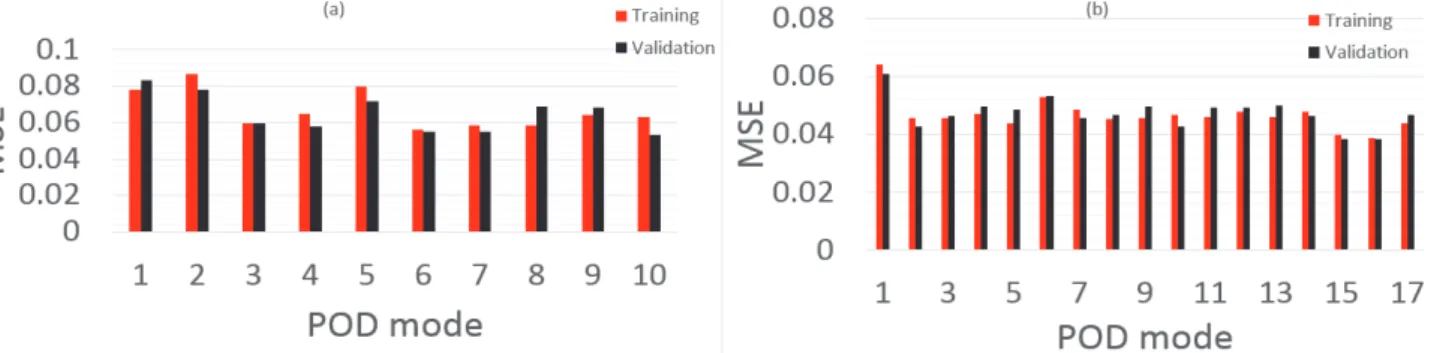
criterion in a window together with the local vertical fluctuation velocity as seen in Fig. 1 were found to be the best inputs. As seen in Fig. 3, the presented ANN approach is proved successful for the identification of the POD coefficients time-series and the reconstruction of the velocity fields. The combination of swirling strength criterion together with the local upstream vertical velocity proved to be the best sensor. The identification method is ideal to be used in a model-free control scheme, for example with the use of a genetic programming-created control law [6] in order to minimize the fluctuation energy of the system.
Fig. 2 A shallow time delay neural-network mapping local PIV sensor-variables (velocity and swirling strength criterion) to N global POD coefficients of the full field dynamics.
Fig. 3 Training and validation time series mean squared identification fit error of the global POD coefficients containing 80% of the total energy for BFS flow for ReH =1385(a) and for transitional flat plate flow (b).
References
[1] Gautier, Nicolas & Aider (2015), J.-L, Real-time planar flow velocity field measurements using an optical flow algorithm implemented on GPU, Journal of Visualization, 18 (2), 277-286 .
[2] Gautier, Nicolas & Aider (2015), J.-L, Frequency lock closed-loop control of a separated flow using visual feedback, Exp. in Fluids 56 (1), 1-10.
[3] Guzman I, J., Sipp, D. & Schmid, P. J. (2014) A dynamic observer to capture and control perturbation energy in noise amplifiers. Journal of Fluid Mechanics 758, pp 728–753
[4] Varon E, Guzman I, J., Sipp, D. & Schmid, P. J., Aider J.-L. (2017) Experimental application of a dynamic observer to capture and predict the dynamics of a flat-plate boundary layer. Advances in Turbulence XIV, Proceedings of the 15th EUROMECH European Turbulence Conference (ETC15), Delft, Pays-Bas, 2015. [5] Nathan Kutz, J. (2017). Deep learning in fluid dynamics. Journal of Fluid Mechanics, 814,
1-4,10.1017/jfm.2016.803
[6] Gautier, Nicolas et. al. (2015). Closed-loop separation control using machine learning, Journal of Fluid Mechanics, 770. pp 442- 457. 10.1017/jfm.2015.95