HAL Id: tel-01124339
https://tel.archives-ouvertes.fr/tel-01124339
Submitted on 6 Mar 2015
HAL is a multi-disciplinary open access
archive for the deposit and dissemination of sci-entific research documents, whether they are pub-lished or not. The documents may come from teaching and research institutions in France or abroad, or from public or private research centers.
L’archive ouverte pluridisciplinaire HAL, est destinée au dépôt et à la diffusion de documents scientifiques de niveau recherche, publiés ou non, émanant des établissements d’enseignement et de recherche français ou étrangers, des laboratoires publics ou privés.
Unified matheuristic for solving rich vehicle routing
problems
Rahma Lahyani
To cite this version:
Rahma Lahyani. Unified matheuristic for solving rich vehicle routing problems. Signal and Image processing. Ecole Centrale de Lille; Université de Sfax. Faculté des sciences économiques et de gestion, 2014. English. �NNT : 2014ECLI0011�. �tel-01124339�
No d’ordre: 2 4 5
ÉCOLE CENTRALE DE LILLE
THÈSE
présentée en vue d’obtenir le grade de
Docteur
en
Automatique, Génie Informatique, Traitement du Signal et Image
par
Rahma Lahyani
Doctorat délivré simultanément par l’École Centrale de Lille et la Facultée Des Sciences Économiques et de Gestion de Sfax dans le cadre d’une cotutelle internationale de thèse
Une matheuristique unifiée pour résoudre des
problèmes de tournées de véhicules riches
Unified matheuristic for solving rich vehicle routing
problems
Soutenue le 13 juin 2014 devant le jury d’examen:
Rapporteur Bernard Gendron Université de Montréal
Rapporteur Saoussen Krichen Université de Jendouba
Président Saïd Hanafi Université de Valenciennes
Examinateur Jorge E. Mendoza Université Catholique de l’Ouest
Examinateur Nenad Mladenovic Brunel University
Directeurs Habib Chabchoub Université de Sfax Mahdi Khemakhem Université de Sfax Frédéric Semet Ecole Centrale de Lille
Thèse préparée au sein des laboratoires LAGIS et LOGIQ École Doctorale SPI 072 (EC Lille)
for me, for my parents, and for my brother and sisters.
Acknowledgments
This research project would not have been possible without the help and support of many people, in particular my three very complimentary advisers. I would like to express my gratitude to Pr. Frédéric Semet. He taught me to define clear research objectives, to mark the boundaries of what can be achieved in limited time, and to keep trying until things are perfect. I am also thankful to him for opening the doors of the Ecole Centrale de Lille, and giving me the opportunity to join the LAGIS team. I would like also to thank Dr. Mahdi Khemakhem for giving me the taste of operations research in his excellent master degree course on linear programming and metaheuristics. With him I learned that research was not exclusively about brilliant ideas, but also about methodology, attention to details, and perseverance. A special thank goes to him for his training lessons in the programming language C, for his patience and for introducing me to the world of researchers and showing me that fun and science can go well together, but most importantly for the simple fact of being a friend and believing in me. I would also like to thank Pr. Habib Chabchoub for believing in me from the first months, for his valuable advice before taking the decision to start this dissertation, and for his support during the moments of doubts. I would like to thank Pr. Saoussen Krichen for being part of my committee, for reviewing the present dissertation and for her valuable advice on research and life. I also would like to thank Pr. Bernard Gendron for accepting the invitation to be part of my committee and reviewing the present dissertation, and also for offer-ing me the opportunity to pursue my investigation with his team. I would thank him for receiving me in CIRRELT and for the fruitful (and fun) discussions we have made. In addition, I would like to thank Pr. Saïd Hanafi for his participation in the jury, his advices along the way and our always interesting discussions in congresses and conferences. I also thank Dr. Jorge Mendoza for being part of the jury and for his inspiring determination. Finally, I would like to thank Pr. Nenad Mladenovic not only for being part of my jury but also for sharing his experience in different research areas, which gave me a broader vision for my research career choices. I would like to thank Pr. Lenadro C. Coelho and Pr. Gilbert Laporte whom I visited in Montreal, and had the opportunity to continue working with after I returned to France. I thank Leandro for sharing his expertise on routing and metaheuristics, for always being here to discuss ideas even when he was busy and also for offering me the opportunity to pursue my investigation with his team.
Acknowledgments
Going through this three years journey would not have been possible without the help and support of friends and colleagues on both sides of the Mediterranean. A special thank goes to Yang, Julie, Baisi, Henri, Fanny who kindly accepted me in their office and with whom I share a good meal and a good laugh. All my grat-itude goes to Ramla, Manel, Manel, Maissa, Ryma, Abir, Fattoum who made me feel at home when missing Tunisia and for their good friendship inside and outside the University. Life would not have been possible without the support of my fam-ily, my sisters Fatma, Amina, Hanen, my brother Mohamed, my nephews Abdou, Doudi and Maymou who bring me much joy and happiness in my life. Finally, I would like to dedicate this thesis to my parents Wassila and Abdelkarim for their love, confidence, parayers and support throughout my studies and life.
Contents
Acknowledgments iii
Introduction 1
1 Rich vehicle routing problems: from a taxonomy to a definition 11
1.1 Introduction . . . 12
1.2 RVRP Taxonomy . . . 13
1.2.1 Taxonomy . . . 14
1.2.1.1 Scenario characteristics (SCs) . . . 16
1.2.1.2 Problem physical characteristics (PPCs) . . . 20
1.3 Taxonomy analysis . . . 26
1.4 Conclusions . . . 35
2 Models for a rich vehicle routing problem with compartments 37 2.1 Introduction . . . 38
2.2 Mixed integer linear program for the MDMC MCm-VRPTW . . . 39
2.2.1 Problem description . . . 39
2.2.2 Mathematical model . . . 44
2.3 Reformulation based on Dantzig-Wolfe decomposition . . . 49
2.3.1 Decomposition principle . . . 49
2.3.2 DW reformulation for the MDMCMCm-VRPTW . . . 52
2.4 Pricing subproblem formulation . . . 55
2.5 Conclusions . . . 57
3 Matheuristic design for a multi-constrained TSP with profits 59 3.1 Introduction . . . 60
3.2 Describing available unified methods for VRPs . . . 61
3.3 Matheuristic approach . . . 62
3.3.1 Perturbation phase . . . 64
3.3.2 Improvement phase . . . 66
3.4 Main features of the matheuristic approach . . . 68
3.4.1 Multi-start constructive heuristic . . . 68
3.4.2 Neighborhoods . . . 69
3.4.2.1 Routing neighborhoods. . . 70
CONTENTS
3.4.3 Route feasibility check . . . 79
3.4.3.1 Loading feasibility check . . . 79
3.4.3.2 Temporal feasibility check and optimization . . . 80
3.5 Conclusions . . . 81
4 From methods to implementation and results 83 4.1 Design of data structure classes . . . 84
4.1.1 Challenges . . . 84
4.1.2 Data structures classes . . . 85
4.2 Computational experiments . . . 89
4.2.1 OP instances . . . 90
4.2.2 OPTW instances . . . 91
4.2.3 Experimental results for the RPTP . . . 96
4.2.3.1 New testbed. . . 96
4.2.3.2 Sensitivity analysis . . . 101
4.3 Conclusions . . . 103
5 Column generation heuristic 105 5.1 Introduction . . . 105
5.2 Column generation heuristic components . . . 106
5.2.1 Initial solution heuristic . . . 106
5.2.2 Accelerating strategies for solving the pricing problem . . . 109
5.2.3 Post-processing procedure . . . 110
5.3 Computational experiments . . . 111
5.3.1 CVRP instances. . . 111
5.3.2 MCMCm-VRPTW instances . . . 113
5.4 Conclusions . . . 115
6 Real case study: The collection of olive oil in Tunisia 117 6.1 Introduction . . . 118
6.2 Mathematical description of the problem . . . 120
6.2.1 Notation . . . 120 6.2.2 Mathematical model . . . 121 6.2.3 Valid inequalities . . . 122 6.3 Branch-and-cut algorithm . . . 124 6.4 Computational experiments . . . 125 6.4.1 Instance generation . . . 125 6.4.2 Computational results . . . 128 6.5 Conclusions . . . 131 Conclusions 133 References 137 Résumé 167 vi
Abstract 171
List of Figures
1 Operations research cycle (Rardin, 1998) . . . 2
2 Contributions summary . . . 7
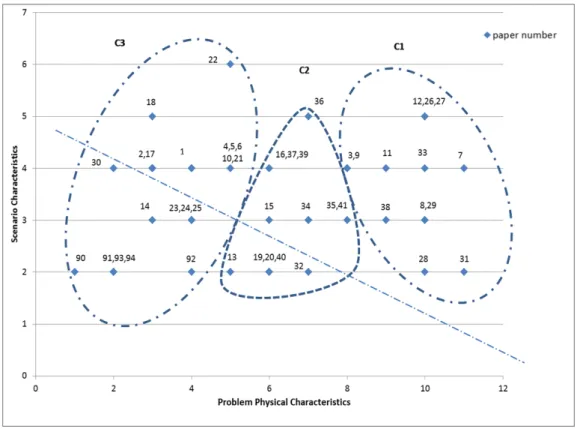
1.1 Cluster analysis . . . 31
2.1 The MDMCMCm-VRPTW assumptions . . . 41
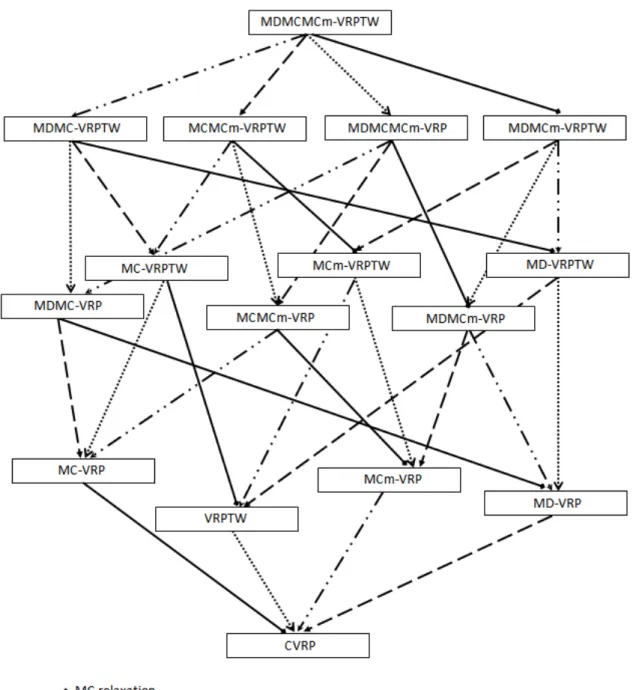
2.2 The related problems to the MDMCMCm-VRPTW and their inter-connections . . . 42
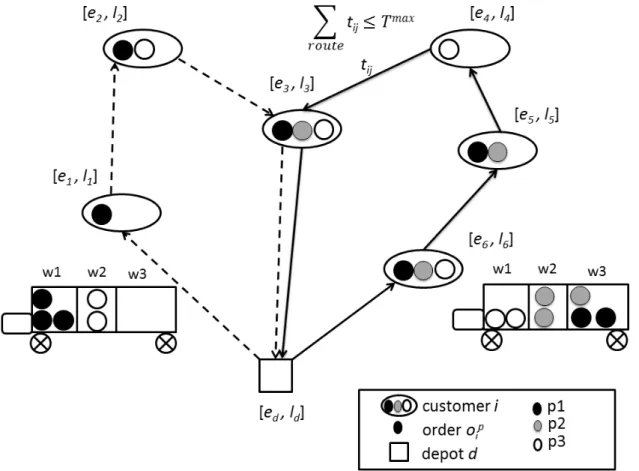
2.3 Example of solution for the MDMCMCm-VRPTW . . . 44
2.4 Block-angular matrices for K blocks. . . 50
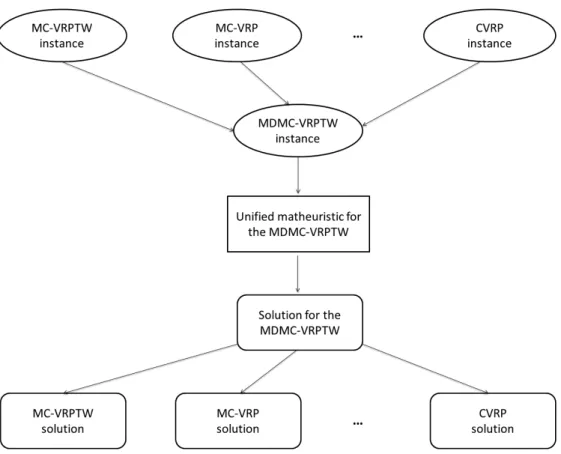
3.1 Transformation process for solving rich and basic VRPs with a unified matheurisric, adapted from Røpke and Pisinger (2006a) . . . 63
3.2 Representing the VNS* general behavior . . . 66
3.3 Similarity removal heuristic . . . 72
3.4 Spatio-temporal insertion heuristic . . . 76
3.5 Example of a solution based on the Quadratic Multiple Knapsack Problem with Conflicts . . . 78
4.1 Solution representation using the order class and the compartment class . . . 88
5.1 Column generation based heuristic . . . 107
6.1 Map of Tunisia pinpointing producers and regional offices locations (Source: Google Maps, accessed March 2014). . . 119
6.2 Geographical locations of the producers around the region of Sfax (Source: Google Maps, accessed March 2014). . . 127
6.3 Geographical locations of the producers around the region of Kairouan (Source: Google Maps, accessed March 2014) . . . 127
List of Algorithms
1 Variable Neighborhood Search* (VNS*) . . . 65
2 Generic structure of removal heuristics . . . 71
3 Generic structure of insertion heuristics . . . 74
4 Get_Compartment heuristic . . . 80
5 Heuristic to construct an initial set of columns . . . 108
List of Tables
1.1 A Taxonomy of RVRPs. . . 15
1.2 Selected papers devoted to pure routing problems . . . 28
1.3 Selected papers devoted to combined routing problems . . . 29
2.1 Notations used in the description of the MDMCMCm-VRPTW . . . 45
4.1 Details of the order class . . . 86
4.2 Details of the compartment class . . . 87
4.3 Details of the solution class . . . 87
4.4 Comparison of VNS* to the state-of-the-art methods on Tsiligirides (1984) data sets . . . 91
4.5 Comparison of VNS* to the state-of-the-art methods on Chao et al. (1996) data sets . . . 91
4.6 Average results of the slow methods on Solomon’s data sets . . . 95
4.7 Average results of the fast methods on Solomon’s data sets . . . 95
4.8 Average results of the state-of-the-art methods on Cordeau’s data sets 95 4.9 Incompatibility configurations in generated data sets . . . 97
4.10 Average results of VNS* on RPTP data sets . . . 99
4.11 Average results of VNS* variants on RPTP data sets . . . 100
4.12 Effectiveness of the insertion and removal heuristics . . . 103
5.1 Performance of the column generation heuristic on the CVRP instances112 5.2 Classes description . . . 113
5.3 Results of the column generation heuristic on the MCMCm-VRPTW instances . . . 114
6.1 Producers locations in Figures 6.2 and 6.3 . . . 128
6.2 Configurations of the real-world instances. . . 129
6.3 Summary of computational results of the test instances with respect to several configurations . . . 130
Introduction
Once upon a time . . .
or back in 2009 to be more precise, Idiscov-ered thoroughly the transportation management system in the courses "Modeling
and Optimization" and "Logistics" held respectively by Frédéric Semet and Habib
Chabchoub as part of my master program "Operations Research and Production
Management" at the University of Sfax. I was immediately interested in supply
chain management, a subject that influences considerably the performance of the whole system. I was particularly fascinated by the possibility of translating the complexity of real-life transport systems into mathematical models, often easy to state and difficult to solve. Through these courses, I discovered the traveling
sales-man problem and the vehicle routing problem, which have attracted the interest of
many researchers over more than 50 years and are still among the most prominent combinatorial optimization problems studied until today. This hands-on, I followed later on, over the period winter 2009 - autumn 2010, an intensive training entitled "Algorithms and Data Structures applied to Operational Research" held by Mahdi Khemakhem. This training was part of the Ph.D. preparation courses organized by the LOGIQ laboratory. The training offered insight into metaheuristics solution approaches applied to several combinatorial optimization problems. We considered and applied efficient algorithms combining neighborhoods and strategy guidelines to obtain high quality solutions with a little computational effort. These courses enabled me to obtain a more mature perception of transportation problems and to express my interest for these problems for the first time through my master research project in 2010. In this project, I proposed a generic mathematical model covering different scenarios for a multi-constrained vehicle routing problem with compart-ments. Then, I mostly applied an exact branch-and-bound algorithm to solve it. I succeeded to apply this approach only for instances of limited sizes because of the combinatorial aspect of the problem. Therefore, with some knowledge about ex-act and approximate solution approaches and with a lot of motivation, I decided to explore more thoroughly this research area in my Ph.D. thesis, since January 2011.
Introduction
Rich vehicle routing problems as research field
Satisfying efficiently requirements for transportation systems is a central aspect in logistics. It typically affects strategic and long term horizon decisions involving large capital investments. But it conditions also the success of medium and short term horizon operations. Modeling real-life transportation problems as mathemat-ical programs has a deep impact on the optimization process. Over simplifications may omit relevant features of the problem or may even generate solutions and rec-ommendations which cannot be converted into feasible real-life decisions. Similarly, when all details with respect to the transportation problem are included, the result-ing model may turn to be intractable. The proposed mathematical models should then maintain a balance between generality and exhaustiveness. Figure 1illustrates the operations research cycle gathering the problem modeling, the model solution and the solution interpretation so as to change the original problem through deci-sions. Finally, one has to ensure that a final solution addresses the core problem properly.
Figure 1: Operations research cycle (Rardin, 1998)
The problems considered in this thesis arise in the field of freight road trans-portation in many real-life industrial contexts. They correspond often to complex combinations of assignment, loading, scheduling and routing decisions. All the decisions are inter-correlated with the objective of optimizing the transportation resources while satisfying the customers requirements. Because many features have 2
to be considered as well as different types of decision, such transportation problems are usually considered as "rich". A rich transportation problem may be considered as a multi-attribute problem reflecting the complexities of the real-life transporta-tion systems by combining various challenges revealed daily. The most general case of transportation problems can be modeled as a capacitated vehicle routing problem (CVRP). Introduced more that fifty years ago (Laporte, 2009), the Vehicle Rout-ing Problem (VRP) is one of the most prominent and widely studied combinatorial optimization problem. We conduct a simple query on Scopus using "vehicle
rout-ing" as search words over a period of 39 months, from January 2010 to March 2014.
This exact phrase was searched in "Article Title, Abstract, Keywords" field options to remove irrelevant studies. The search resulted in 3570 publications with a peak in 2013 with up to 1000 publications. These publications include 1858 conferences papers, 1692 journal articles, 13 book chapters and 7 books. The growth rate of the VRP literature requires necessarily a systematic way to classify the emergent and new variants of VRPs. Many surveys exist, describing specific VRP variants and displaying the similarities and the differences among the contributions. We re-fer, for example, to (Ritzinger and Puchinger, 2013) for the stochastic VRP, (Pillac et al.,2013) for the dynamic VRP, (Archetti and Speranza,2012) for the split VRP, (Campbell and Wilson, 2014) for the periodic VRP. Nonetheless, this observation enables us to identify existing gaps in the literature dealing with VRPs. There is a lack of studies dealing with the emergent research area, often known as Rich VRPs (RVRPs), inspite of the several surveys for single-variant VRPs. The class of RVRPs requires a taxonomy providing a framework to identify those which can be consid-ered as rich among the numerous variants of the VRPs. The purpose of the first part of the thesis is to provide a generic taxonomy for the RVRPs literature with respect to relevant real-life issues.
Unified framework methodology as a research
in-centive
Many solution methods have been designed for the VRPs: exact methods, which provide the optimal solution of a model, and approximate approaches, which pro-duce high quality solutions within a reasonable amount of time at the expense of optimality. Since most of the problems tackled are NP-hard, exact methods are sel-dom applicable in real-life contexts. Such cases require often a solution of a large and multifaceted VRPs within a short computation time. An alternative to exact
Introduction
methods would be to combine exact and metaheuristic algorithms. This emergent approach, referred to as matheuristics or model-based metaheuristics, seems to be a very promising path towards the solution of rich combinatorial optimization prob-lems. Matheuristics take advantage from synergy between approximate and exact solution approaches and often lead to considerably higher performance with respect to solution quality and running time. Puchinger and Raidl (2005) classify these methods into two main categories: collaborative combinations and integrative
com-binations. The collaboration consists in executing exact and heuristic algorithms
sequentially or in parallel while exchanging information between both. However, no algorithm is contained in another. At the opposite, the integration requires the def-inition of a subproblem embedded into a master problem. The column generation algorithm based on metaheuristics is a good example for this category. It consists in using the value of the dual bounds for assessing the quality of admissible solutions obtained by approximate approaches. We follow this approach in this thesis.
Previously proposed solution methods for VRPs may often be adapted to other problem to a certain degree while the real-life problems bring new methodological challenges because of their variety. Such variety may affect both the problem model and the proposed solution method. In addition, RVRPs always combine conflicting decisions and objectives. Solving these problems iteratively by considering subset of features and/or decisions may lead to unfeasible decisions. Therefore, proposing new solution approaches for each specific real-life problem independently is no longer a reasonable choice neither for researchers nor for practitioners. Indeed, commer-cial softwares for transportation systems must be able to face a variety of real-life problems and respond to the multiple combinatorial issues that may arise. These statements motivate the development of a unified method to provide good quality solution approaches for a wide class of rich and basic VRPs. The number of pub-lished studies that propose unified solution approaches addressing several variants of routing problems has increased significantly, see e.g. (Røpke and Pisinger,2006b,
Subramanian et al., 2011, Derigs and Vogel, 2014, Vidal et al., 2013b, 2014). As stated, the methodological purpose of this thesis is to propose a flexible column gen-eration based matheuristic to solve RVRPs.The proposed method may be used to solve a set of basic and rich VRPs. The matheuristic proposed relies on the variable neighborhood search (VNS), (Mladenovic and Hansen, 1997), since it includes the desirable features of a metaheuristic (Cordeau et al.,2002b). The simple version of the VNS is based on exploiting neighborhood structures iteratively. This feature of-fers a considerable flexibility when it comes to extension as well as specialization of the matheuristic.
In this thesis several problems were selected as testbed for reasons explained at the beginning of each corresponding chapter. All these variants can be viewed as ex-tensions of the Capacitated VRP (CVRP) or/and of the traveling salesman problem. The general problem we tackle is the depot compartment multi-commodity vehicle routing problem with time windows (MDMCMCm-VRPTW). The main variants addressed are: the multi-compartment profitable tour prob-lem with time windows and incompatibility constraints denoted by (RPTP), the orienteering problem (OP), the orienteering problem with time window (OPTW), the multi-product, multi-period and multi-compartment vehicle routing problem (MPPC-VRP) and the multi-compartment vehicle routing problem (MC-VRP).
Contributions details
Motivated by a case study dealing with heterogeneous goods, we examine a vari-ant of the CVRP arising when multi-compartment vehicles are required to ensure the transport of multiple products under physical and temporal restrictions. In this problem, a customer may have different orders, each corresponding to one single product. Since orders may be delivered by different vehicles, this introduces some restricted splitting policies and leads to increase the problem difficulty. We propose to design and implement a unified matheuristic framework to solve this challeng-ing VRP, and show how it can be used to solve related rich VRPs. The main contributions of this thesis are sketched by Figure 2.
Taxonomy : Our first contribution consists in defining the hierarchical attributes considered when building the taxonomy and identifying the related recent and rel-evant surveys and studies. We survey and classify 41 papers describing practical cases and addressing different issues related to RVRPs according to the taxonomy built. Finally, we conduct a cluster analysis on the selected papers that leads us to provide a discriminating definition for this class of problems.
Flexible and unified method : This thesis contributes to the solution of a rich
VRP and some of its variants through a column generation based matheuristic. The column generation resolution requires the definition of a master problem and sub-problems, one for each vehicle. The overall performance relies on the algorithm used for them. A first methodological contribution of the thesis is the design of generic data structures which facilitates the flexibility of the code. We design four main data structures describing respectively the problem, the customer order, the
Introduction
compartment and the solution. Next, we propose a VNS matheuristic, based on approximate routing neighborhoods and exact loading neighborhoods to solve the MDMCMCm-VRPTW with a single vehicle. Routing neighborhoods are based on the Ruin and Recreate paradigm, (Schrimph et al., 2000). The current solution is partially destroyed, and then repaired using adapted insertion and removal heuris-tics. The performance of the VNS matheuristic is assessed on instances including up to 288 customers for the OP and the OPTW literature and on more complex gen-erated instances. It produces high quality solutions (less than 3% from the optimal solution values) within very short computational time (few seconds). The column generation based method (detailed in chapter 5) solves the master problem heuris-tically thanks to the embedded VNS matheuristic. At each iteration, single vehicle routes generated by the VNS are included in the pool of routes. Then a new solu-tion combining some of these routes is identified, which leads to another call to the VNS procedure.
A post-processing step solving to optimality an NP-hard assignment problem is executed to eliminate dominated routes. The efficiency of the algorithm is assessed on instances for the CVRP and the MCVRP. The obtained results are competitive. By validating the proposed framework, we contribute to the research in the RVRP area where such solution algorithms have not been considered before.
Compartment assignment problem : Considering multi-compartment
vehi-cles in a routing problem further increases the difficulty of the problem addressed. In such cases, the routing and the loading problems have to be optimized jointly. However, we examine separately the loading problem associated with MC-VRP and referred to the compartment assignment problem (CAP). We propose and solve to optimality two mathematical models for the CAP: a Quadratic Multiple Knapsack
Problem with Conflicts and a Linear Multiple Knapsack Problem with Conflicts.
These models are coupled as exact loading neighborhood to the VNS matheuristic to optimize the loading problem of the current solution.
Modeling and solving a real-life case study : This thesis was initiated
through a cooperation with industrial partners facing the problem of collecting olive oil in Tunisia. The harvest must be picked up from different producers, geographi-cally scattered over the center of Tunisia, during a set of periods and with respect to incompatibility restrictions. The relatively small size of the real-life instances encouraged us to solve the problem to optimality. We propose a mathematical
Introduction
formulation for the problem along with a set of new and known valid inequali-ties and routing and assignment cuts. Based on the work of (Coelho and Laporte,
2013a), we propose an exact branch-and-cut algorithm. We obtain considerable im-provements when compared to the current plans designed manually by the industrial partners and we provide an automated way of making routing and allocation de-cisions more efficiently. Additionally, we generate realistic data sets and conduct further experiments to evaluate different transportation scenarios and to highlight the advantages of buying multi-compartments vehicles.
Outline
Being divided into six parts, the structure of this document matches with the re-search work described above. Chapter1presents an overview for many relevant VRP classes, then provides a definition for RVRPs. The remaining chapters describe the methodological contributions of this thesis. Chapter 2 is about the MDMCMCm-VRPTW. We formally introduce the problem. Then, we propose a mixed integer linear programming formulation and an integer model based on the Dantzig-Wolfe decomposition. Chapter3is devoted to the description of hybrid solution approaches to solve the MDMCMCm-VRPTW with a single vehicle. We give a general presen-tation of the VNS method forming the core of our solution approach. Sequential and collaborative combinations of a set of routing and loading neighborhoods are presented next. We focus on the description of efficient removal heuristics for shak-ing. For customers re-insertion and route improvement we propose several insertion heuristics as well as exact loading neighborhoods. In Chapter 4 we move from the method description to the method implementation. We analyze the challenges en-countered while developing the VNS method and provide a simple and effective data structure which may be easily generalized for other VRP classes. Later, we assess the efficiency of the proposed matheuristic on a set of single-vehicle routing instances with profits from the literature and on a set of new generated instances. We provide a sensitivity analysis distinguishing the main components for increasing the perfor-mance of the VNS. The column generation based algorithm is described in Chapter
5. We present its different components and further provide computational results on a selection of RVRPs including the instances from the real-life application. The latter is described in Chapter 6. The formulation is provided and strengthened by the introduction of a set of known and new valid inequalities. We examine their im-pact on the algorithm efficiency. To better support the managerial process of the industrial partner which is currently on the verge of buying new vehicles, we
ate a set of instances with different fleet composition describing the possible future scenarios. Finally, overall conclusions and perspectives are drawn in the last chapter of the thesis. In Appendix A, we report detailed computational experiments carried out in this thesis.
Chapter 1
Rich vehicle routing problems:
from a taxonomy to a definition
The purpose of this chapter is twofold: i) to provide a comprehensive and relevant taxonomy for the RVRP literature; ii) to propose an elaborate definition of RVRPs. To this end, selected papers addressing various cases are classified using the pro-posed taxonomy. Once the articles have been classified, a cluster analysis based on two discriminating criteria is performed and leads to the definition of RVRPs.
Part of this work was presented at the First IEEE International Conference on
Logistics Operations Management (GOL’2012), (Lahyani et al., 2012). An article based on this chapter was submitted for publication: R. Lahyani, M. Khemakehm, F. Semet. Rich vehicle routing problems: From a taxonomy to a definition. European
Rich vehicle routing problems: from a taxonomy to a definition
1.1
Introduction
The Vehicle Routing Problem (VRP), introduced by Dantzig and Ramser (1959), is a central problem in operations research applied to transportation sciences. Over the last three decades, the number of academic publications on the numerous vari-ants of the VRP has increased extensively (see (Eksioglu et al.,2009)). These studies can be roughly divided into theoretical papers providing mathematical formulations and exact or approximate solution methods for academic problems and case-oriented papers. Several taxonomies and surveys devoted to the VRP have appeared, e.g., (Bodin,1975,Bodin and Golden,1981,Desrochers et al.,1990,Laporte and Osman,
1995) who provided a bibliography of 500 studies. More recently, Laporte (2009) reported on the last fifty years of academic vehicle routing from a historical per-spective and Eksioglu et al. (2009) presented a taxonomy for the VRP literature. Many books or book chapters have been devoted to the VRP, its variants, and to exact and heuristic algorithms, see, e.g., (Toth and Vigo,2002,Cordeau et al.,2007,
Golden et al., 2008).
The most elementary VRP considered in the literature is the CVRP. Geograph-ically scattered customers have demands for a homogeneous product. They have to be served by identical vehicles with a limited capacity based at one depot. The CVRP aims to determine a set of vehicles routes of minimum total cost over a sin-gle period such that: i) each route starts and ends at the depot; ii) each customer is served by only one vehicle; iii) the total demand on each route does not exceed the vehicle capacity. Most papers devoted to classical problems focus on idealized models and are motivated by unsolved theoretical problems. Nevertheless, in re-cent years methodological progress and the development of computer technologies has led to an increasing academic attention to new variants including more complex constraints and objectives. This trend is stimulated by the complex characteristics of real-life VRPs. The families of these extended problems are often called Rich Vehicle Routing Problems (RVRPs). Several works focusing on RVRPs have been published. In particular, two special issues were dedicated to works on rich com-binatorial optimization problems (Hartl et al., 2006, Hasle et al., 2006). Papers by (Sörensen et al., 2008, Drexl, 2012a) compare the VRPs in academic research versus the VRPs in the real-life and delineate the complexity of real-life VRPs. Based on identified gaps, they emphasize on the necessity of adapting commercial software systems to the evolution of customer needs, and of incorporating more in-tricate constraints. Doerner and Schmid (2010) present a survey devoted to hybrid matheuristics for RVRPs and identify promising future avenues.
In most papers devoted to RVRPs, the authors claim that the problem addressed is rich, and then focus on the mathematical modeling and on the solution methods. Thus, the definitions of the RVRP are rather vague and not significantly different. For instance, (Pellegrini, 2005, Reyes et al., 2008, Rieck and Zimmermann, 2010,
Drexl,2012a) suggest that the term rich vehicle routing is associated with problems that represent some or all aspects of a real-world application including optimization criteria, constraints, and preferences. Recently, some attempts have been made to propose unified models and algorithms tackling different classes of routing problems, see e.g. (Røpke and Pisinger, 2006b, Subramanian et al., 2011, Derigs and Vogel,
2014, Vidal et al., 2013b,2014).
There is no precise definition nor criterion that leads to determine whether or not a VRP is rich. Such definition has to rely on a relevant taxonomy which can help to distinguish among the numerous variants of the VRP. Therefore, the objective of this chapter is twofold: i) to provide a generic taxonomy for the RVRP literature with respect to relevant real-life issues; ii) to propose a discriminating definition of the RVRP.
The remainder of this chapter is organized as follows. Section 1.2 describes the taxonomy and introduces the key characteristics considered when it was built. Def-initions of the hierarchical taxonomy attributes are provided. In Section 1.3, we survey several papers describing practical cases and addressing different issues re-lated to RVRPs. They are classified on the basis of the taxonomy attributes. A cluster analysis of the selected papers is provided and discussed. Last, a RVRP def-inition is proposed. Section 1.4 concludes this chapter by discussing some future research avenues.
1.2
RVRP Taxonomy
Creating a taxonomy is an efficient and effective way of consolidating knowledge (Reisman,1992). It enables not only efficient and effective storage, sorting, and sta-tistical analysis but also knowledge expansion and building (Eksioglu et al., 2009). Several surveys and classifications of the VRP have been used as guidelines for the RVRP taxonomy developed in this chapter. This taxonomy aims to build a relevant framework to classify any RVRP study without going into unnecessary details. It at-tempts also to highlight the different facets of richness encountered in the literature, and to distinguish RVRPs from standard VRPs.
To "validate" this taxonomy, we have selected papers devoted to RVRPs pub-lished since 2006. Real-life and academic works using as benchmarks randomly
Rich vehicle routing problems: from a taxonomy to a definition
generated instances or real data have been considered. Surveys or theoretical ar-ticles without testbed have been omitted. Only papers devoted to node routing problems for road transportation have been retained. More than a half of them are based on real-life applications. We also have paid attention to take papers emanat-ing from different countries. Indeed, each country has its geographical and political specificities and its own industrial practices. This may lead to introduce specific con-straints on the routing plan. As a result, 41 papers published in different journals and conferences are examined attempting to be as exhaustive as possible. However, we apologize for any unintended omission of some relevant articles.
1.2.1
Taxonomy
In this section, we focus on the description of the taxonomy (see Table 1.1) and on the presentation of its main attributes. The taxonomy was iteratively built, due to the complexity of the distribution planning process. The taxonomy does not in-tend to highlight all differences between variants of the VRP in order to maintain its comprehensibility and its size. It is instead designed according to central con-cepts in routing that are often present in industrial applications. More precisely, the attributes mentioned are not necessarily the basic VRP features but are related to characteristics which alter the nature of the problem significantly. The purpose of the taxonomy is not to classify the papers according to all the details but rather to focus on relevant features. Indeed, we face the following dilemma. The omission of relevant variants of problems studied in the literature introduces some bias in the classification. Similarly, deepening the level of details may lead to an unmanage-able taxonomy. Hence, we try to maintain a moderate level of granularity for the proposed RVRP taxonomy.
The taxonomy is constructed hierarchically with at most four subclasses. Prob-lems are considered according to the Scenario Characteristics (SCs) and to the Problem Physical Characteristics (PPCs). Under each of these two classes, the most discriminating attributes are listed. They determine whether or not the problem un-der study can be classified as rich. The taxonomy is organized in an arborescent way with three levels associated with the strategic level, the tactical level and the operational level. Each of them is divided into sublevels. The difference between the three levels depends on the types of decision involved. The strategic and tacti-cal levels are associated with the first branch of the taxonomy, i.e. the SCs. They correspond to the transportation strategy which describes the distribution system and designs its main components. At the strategic level, the company has to de-cide if the operational plan deals simultaneously with decisions related to different 14
functions of the supply chain or if transportation planning issues are addressed. For instance, the strategic planning could include decisions related to the locations and the number of depots used. At the tactical level, the order type and the visit fre-quencies at customers over a given time horizon could be considered. The multi-use of vehicles or the data type leads to other extensions. Although these decisions are not related to daily transport activities, they affect the routing plan significantly.
The operational level is associated with the PPCs. It describes the distribution planning including the vehicle and the driver schedules. At this level, short-term and daily decisions are handled considering each vehicle route. These decisions re-late to the routing of goods using the distribution system designed at the strategic and tactical levels. These decisions are based on the characteristics of vehicles, and on specific constraints faced daily. These constraints are specified for a customer, a vehicle, a driver or a road.
Rich vehicle routing problems: from a taxonomy to a definition
1.2.1.1 Scenario characteristics (SCs)
In this section, we describe the sublevels of the strategic and tactical levels presented in Table 1.1. We briefly define the characteristics of each sublevel and provide some relevant references.
1.2.1.1.a Input data
The uncertainty and the variability of the data over the planning period are key factors for a classification of VRPs. Data can be subdivided into four classes: deterministic, stochastic, static and dynamic.
The deterministic routing problem assumes that the problem parameters are known with certainty while the stochastic data assumes that probability distribu-tions are associated with them. In the Stochastic Vehicle Routing Problem (SVRP), the routes may not be followed as planned. The three most common stochastic parameters studied in the literature are: customers demands, service times and travel times (Hasle and Kloster,2007). We refer to (Gendreau et al.,1996,Flatberg et al.,2005,Cordeau and Laporte,2007,Louveaux and Laporte,2009,Ritzinger and Puchinger, 2013) for focused surveys.
A seminal work on the Dynamic Vehicle Routing problem (DVRP) is due to
Psaraftis (1988). In the DVRP, the scheduling plan established at the beginning of the planning period may be adjusted. It allows the possibility of receiving addi-tional information and changing some problems parameters. Then, the problem is resolved. For example, new customer requests may occur during the planning period and must be considered while the vehicles routes are being executed. For recent lit-erature reviews, we refer to (Psaraftis,1995,Powell et al.,2001, 2003,Larsen et al.,
2008, Berbeglia et al., 2010, Pillac et al., 2013).
1.2.1.1.b Decision management components
Supply chain management is a set of approaches utilized to integrate efficiently cus-tomers, manufacturers, warehouses and stores. It ensures producing the products and distributing them at the right quantities, to the right location and at the right time in order to minimize system wide costs while satisfying service level require-ments (Kaminsky and Simchi-Levi, 2003). Hence, integrating decisions of different functions such as purchasing, inventory control, outsourcing, locating depots, pro-duction planning, and distribution management are a practice increasingly followed by many companies (Armentano et al.,2011). Nevertheless, the complexity of these functions may inhibit defining and solving a complete model including all decision
variables. The related extensions of the VRP in the literature are inventory-routing, location-routing, production-routing and vehicle and driver scheduling. Schmid et al. (2013) propose an elaborated survey on relevant extensions of routing prob-lems arising in the context of supply chain management. The authors describe a new family of integrated models considering the interdependencies between different types of decisions.
The service type decision is a strategic level of decision. Going back to the paper byDantzig et al. (1954), each customer has to be served once and only once. How-ever, profits may be associated with the customer service. In such cases, a subset of served customers must be determined to maximize an objective function which includes the total profit collected. This VRP variant is known as the VRP with profits, see (Feillet et al.,2005).
Boudia et al. (2007) states that, ideally, any cost reduction effort should encom-pass a production planning. First introduced by Glover et al. (1979), production and distribution planning aims to determine the quantity produced for each item, the distribution plans and the quantities of each item delivered to each customer. This variant was reviewed by (Vidal and Goetschalckx, 1997, Sarmiento and Nagi,
1999,Chen, 2004,Adulyasak et al., 2013) while recent works are those of (Chandra and Fisher,1994, Armentano et al., 2011,Adulyasak et al., 2012).
In Inventory Routing Problems (IRP), the supplier defines, in addition to the routing plans, the quantities to deliver using inventory levels at consumers to avoid stock shortages. Fisher et al. (1982) and Bell et al. (1983) pioneered this approach when they studied the IRP at Air Products, a producer of industrial gases. Elabo-rate surveys are provided by (Campbell et al., 1998, Cordeau et al., 2007,Bertazzi et al., 2008). Andersson et al. (2010) also describe industrial aspects of combined inventory management and routing in maritime and road transportation. They pro-pose a classification and a comprehensive literature review of the current state of the research. Coelho et al. (2013) describe this research area over the last thirty years. They categorize the IRP literature with respect to the structure of the problem and to the availability of information on customer demand. When production manage-ment, inventory management and transportation management are combined, the objective is to determine the quantities produced, the quantities delivered to cus-tomers and the vehicle schedules while minimizing the total costs. These costs include setup costs, holding costs and distribution costs. Some relevant references are (Fumero and Vercellis, 1999,Boudia et al., 2007, Boudia and Prins, 2009, Bard and Nananukul, 2009, Coelho et al., 2012a,b, Coelho, 2013, Coelho and Laporte,
Rich vehicle routing problems: from a taxonomy to a definition
The Location Routing Problem (LRP) aims to determine the location of depots serving customers and the routes rooted at those depots simultaneously. Surveys on the LRP have been proposed by (Balakrishnan et al., 1987,Laporte, 1988,1989,
Berman et al., 1995, Min et al.,1998) and recently by (Nagy and Salhi, 2007). The simultaneous determination of the vehicle and driver schedules represents a significant trend in transportation management. It implies to elaborate a crew assignment and the associated routes concurrently. The literature devoted to this challenging variant is scarce (Wen et al., 2011). Nevertheless, recent papers have been published e.g., (Haase et al., 2001, Freling et al., 2003, Xu et al., 2003, Goel,
2009, Zäpfel and Bögl,2008,Wen et al.,2011). Note that the regulation of working hours can be modeled as additional constraints (see the section dedicated to driver regulations).
1.2.1.1.c Depots
In the classic VRP, a single depot is in use which may be quite restrictive in practice. Thus, in real-life applications, there are often multiple depots and vehicles may have different starting and final locations. It may be required to allocate the customers to the appropriate depot. The depots may have different characteristics, regarding of their number, locations and capacities, which may affect the overall costs. Over the last four decades, many papers studied the multi-depots vehicle routing problem, for instance, (Tillman,1969, Laporte et al.,1984, 1988,Salhi et al., 1998,Surekha and Sumathi, 2011, Vidal et al., 2012, Hemmelmayr et al., 2013, Rahimi-Vahed et al.,
2013, Muter et al., 2014).
1.2.1.1.d Operation type
Four classes of routing problems can be distinguished: problems where goods are either delivered or picked-up, problems where goods are loaded and unloaded, prob-lems where goods are loaded on board when the delivery part of the route is completed, and last dial-a-ride problems. The first class corresponds to the classical VRP. The goods are loaded at the depot and then unloaded at customer locations, or pickup tasks are performed at the customer sites and the unloading at the depot. The second class, where goods are transported between pickup and delivery loca-tions, is named Vehicle Routing Problems with Pickups and Deliveries (VRPPD). In the VRPPD, goods can be loaded or unloaded at each customer. In the standard case, the pickup point and the delivery point must be served on the same route. There are many possible extensions to the VRPPD. The VRPPD was divided into
other subclasses in Parragh et al. (2008b). A survey on this research area is due to
Desaulniers et al.(2002).
The Vehicle Routing Problems with Backhauls (VRPB) was introduced by
Goetschalckx and Jacobs-Blecha (1989). It consists in transporting goods from the depot to linehaul customers and from backhaul customers to the depot. The VRPB arises in various applications like in the grocery industry where supermar-kets and shops are considered as the linehaul customers, and grocery suppliers are the backhaul customers (Toth and Vigo, 2002). Four subtypes of the VRPB were considered and detailed in Parragh et al. (2008a).
The Dial-A-Ride Problem (DARP) refers to the situation where a shipment has to be transported between pre-specified pickup and delivery locations under ser-vice restrictions. The DARP arises frequently in health related transportation like patient transportation or blood transportation. Recent solution methods and sur-veys on the DARP can be found in (Berbeglia et al., 2007, Cordeau and Laporte,
2007,Parragh et al.,2008b,Paquette et al., 2009,Kirchler and Wolfler Calvo, 2013,
Paquette et al., 2013).
The difference between the above described problems is usually expressed through additional constraints. For the last three classes, there are always precedence constraints between the different types of nodes.
1.2.1.1.e Load splitting
In the classical VRP, each customer is served by only one vehicle. The possibility of multiple visits to the same customer characterizes the VRP with Split Deliver-ies (SDVRP) introduced by Dror and Trudeaut (1989). An intermediate level of splitting should also be identified when several products have to be delivered to a customer. In this case, several visits to the same customer may occur, each product being delivered during a unique visit. Archetti and Speranza(2007,2012) proposed a state of the art for the SDVRP.
1.2.1.1.f Planning period
The distribution plan may be computed over a single period or over several periods. In the Periodic Vehicle Routing problem (PVRP), all the input data is available at the beginning of the planning period. The customer requests are known in ad-vance as well as the possible combinations for the visiting days. At each period, one has to decide which customers are served in this period and which orders are post-poned to the next periods. The PVRP was first introduced in the paper ofBeltrami
Rich vehicle routing problems: from a taxonomy to a definition
and Bodin (1974). Since then it was extensively studied and enriched with sev-eral variants. A vast literature is dedicated to the PVRP, see e.g., (Cordeau et al.,
1997, Francis and Smilowitz,2006,Hemmelmayr et al., 2009,Wen et al., 2010, Bal-dacci et al.,2011,Gulczynski et al.,2011, Vidal et al., 2012,Michallet et al.,2014). (Francis et al., 2008, Campbell and Wilson, 2014) have proposed a focused survey on modeling and solution methods.
1.2.1.1.g Multiple use of vehicles
In the VRP with multiple use of vehicles, the same vehicle may perform several trips during the planning period while respecting additional temporal precedence constraints. Introduced by Fleischmann(1990), the multiple use of vehicles was ad-dressed recently. Most papers appear in the last decade, see, e.g., (Petch and Salhi,
2003, Olivera and Viera, 2007,Salhi and Petch,2007,Alonso et al.,2008,Azi et al.,
2010, 2012, Macedo et al., 2011,Cattaruzza et al.,2014). In this variant, it is com-mon to add additional restrictions related to the vehicle use and to decompose the operating costs in loading/unloading costs and variable costs. The variable costs may be related to the vehicle cleaning service between tours as in (Oppen et al.,
2010, Oppen and Løkketangen,2008).
1.2.1.2 Problem physical characteristics (PPCs)
1.2.1.2.a Vehicles
Vehicles with different characteristics better match customer needs related to phys-ical restrictions, to environmental concerns, to specific logistic equipments or to demand variations, see, for example, (Semet and Taillard, 1993, Tarantilis et al.,
2003, 2004, Bräysy et al.,2008). The first characteristics of the vehicles considered here are related to the types of vehicle available at the planning period. There are also physical characteristics related to the loading/unloading process. Last, social driver regulations may significantly affect the vehicle routes and are considered then as vehicle characteristics.
Dealing with the fleet composition goes back to the seminal paper by Kirby
(1959). Since then, several variants of the Heterogeneous Fleet Vehicle Routing Problem (HFVRP) have been addressed in the literature. Recent surveys have been proposed by Baldacci et al. (2008),Hoff et al.(2010). The primary decision related to the fleet consists to determine the size of the fleet, which is always limited in real life applications.
The most common capacity constraints in freight transportation are expressed in terms of weight, volume, or number of pallets. Several capacity restrictions may be taken into account simultaneously. The vehicles may differ according to their capacities and the same vehicle may have several compartments with different capacities. Derigs et al.(2011a) have proposed a survey on VRP with multiple com-partments. The use of multiple compartments is relevant when several products, which must remain separated during transportation, have to be loaded on the vehi-cles. For instance, multi-compartment vehicles are used, to perform selective waste collection (Muyldermans and Pang,2010b,Reed et al.,2014), to distribute food re-quiring different levels of refrigeration (Chajakis and Guignard,2003), to distribute various types of fuel to petroleum companies (Brown and Graves, 1981, Cornillier et al.,2008b,a) and to transport animals from farms to slaughterhouses (Oppen and Løkketangen,2008). The optimization of routes to transport animals from farms to slaughterhouse is known as the livestock collection problem. It is a complex IRP combining animal welfare regulations and production and inventory constraints, and requiring vehicles with compartments.
Recently, loading and routing problems have been addressed jointly. Their com-bined optimization leads to the Loading Vehicle Routing Problem (LoVRP) dealing with more complex loading constraints than a simple weight or volume restriction. Routes are obtained thanks to the chronological order induced by the loading policy. The most common loading/unloading methods are based on the LIFO (Last-In-First-Out) and FIFO (First-In-First-(Last-In-First-Out) rules. If the vehicle picks up request i before request j, then it must deliver request j (i) before delivering request i (j) respec-tively (Carrabs et al., 2007). Some references devoted to different variants of the LoVRP are (Doerner et al., 2007, Fuellerer et al., 2009,2010,Tricoire et al., 2011). In other studies, the loading problem and the routing problem are solved separately. The loading problem is viewed as a Bin Packing Problem (Cruz Reyes et al., 2007) or as a Tank Truck Loading Problem (Cornillier et al., 2008b,a, 2009, 2012). Iori and Martello (2010) propose a recent survey on the VRP with loading constraints.
Although a vast literature is devoted to the VRP, constraints related to the legis-lation on driving and working hours were included infrequently. Such rules are either imposed by the company or legal regulations. Some examples are: daily working periods, number and duration of daily and weekly rest periods, maximum period of driving hours, overtime working hours and wages, etc. Driver regulations aim to provide safe driving, to reduce the number of accidents and to reduce the total costs. In recent years, there has been an increasing number of papers describing VRPs where a limited set of the European Union or United States regulations is
Rich vehicle routing problems: from a taxonomy to a definition
taken into account (e.g., (Zäpfel and Bögl, 2008, Wen et al., 2011, Beaudry et al.,
2010, Derigs et al.,2011b, Parragh et al., 2012)). Other studies include all parts of the mandatory legislation and the legal requirements, e.g., (Rancourt et al., 2013,
Vidit, 2008) who studied the US regulation in his thesis. (Goel, 2009, Kok et al.,
2010, Prescott-Gagnon et al., 2010) consider a VRP with time window respecting all driver rules imposed by the European Union. Recently, Goel and Vidal (2013) consider several sets of driver regulations in the United States, Canada, the Euro-pean Union and Australia to provide an international evaluation of the impact of different rules on the road safety and on the minimization of transportation costs.
1.2.1.2.b Time related constraints
The VRP with time window (VRPTW) was studied first in case studies by (Pullen and Webb,1967,Knight and Hofer,1968,Madsen, 1976). Time window constraints impose that the service at every customer must start and end within a given time window. In the case of hard time window, the vehicle is allowed to arrive before the defined time window and waits until the customer becomes available, but it is not allowed to arrive late. In the case of soft time window, penalties are given for services starting after the allowed time windows. It leads to take into account the travel times between customer locations, the service times at customers and the loading/unloading times at the depot. Defining time window at the depot implies that the earliest departure time and the latest arrival time for each vehicle must lie within the interval time associated with the depot. A variant is the multiple time windows in which one of the time intervals associated with each customer has to be selected. In the last decades, time constrained routing problems have been exten-sively studied. Bräysy and Gendreau(2005a,b),Kallehauge et al.(2005),Kallehauge
(2008) andGendreau and Tarantilis (2010) propose recent surveys on this problem. Often, the route duration is limited to a predefined parameter which may be equal to the total driver working hours or to the route access time. Indeed, a road segment may have a limited access given by an interval of time specifying when it can be entered. The time restriction can also be set by the number of customers visited on a route.
1.2.1.2.c Incompatibility constraints
In real-life applications, many (in)compatibility constraints may occur between the problem entities specifically customer, depot, vehicle compartment, prod-ucts and driver, as it was discussed in Hasle and Kloster (2007). These 22
(in)compatibilities can be classified in two types depending on the causing fac-tor: physical (in)compatibilities and temporal (in)compatibilities. Some of these constraints are described in what follows.
An extension of the VRPTW is the VRP with temporal dependencies, which includes synchronization and sequencing constraints between customers, vehicles, visits or depots. As Dohn et al. (2011) point out, many practical applications including such constraints were studied. Some examples are: (i) sequencing con-straints related to technicians in the Port of Singapore, (e.g., (Lim et al., 2004, Li et al., 2005)); (ii) synchronization between visits in ground handling at airports, (e.g.,Dohn et al. (2009)); (iii) coupled time windows for vehicles and schools in the design of school bus transportation services, (e.g., Fügenschuh (2006)).
The temporal incompatibilities are also present as precedence constraints requir-ing synchronization between tours. The vehicle must visit some pick-up customers before visiting some delivery customers. This chronological order is a key point in the DARP, in the VRPPD, in the VRP with backhauls and sometimes in VRP. For example, in the transportation of livestock from farms to slaughterhouses, (Oppen and Løkketangen, 2008, Oppen et al., 2010), the health status associated with the farms may enforce an order for the visits. An elaborate and recent survey on vehicle routing problems with multiple synchronization constraints is due toDrexl(2012b). There are also physical inclusion and exclusion restrictions as discussed in (Desrochers et al., 1990). It may occur that a customer must (not) be served from a given depot, by a given vehicle (e.g., Pellegrini et al. (2007)) or a specific driver (e.g., Rieck and Zimmermann (2010)). Indeed, the vehicle requirements and the driver qualifications, such as licensing, training for transporting specific materials and knowledge about a geographical area, may limit the compatibility between driver and vehicle. The VRP including incompatibilities between customers and vehicles types is known as the site dependent VRP (see e.g., Baldacci et al.(2008)).
Similarly, the vehicle characteristics or the product specificity may cause vehicle-request incompatibility, see e.g., (Goel and Gruhn, 2008, Goel, 2010, Ceselli et al.,
2009). In the distribution of multi-commodity loads, each vehicle can be used to handle specific types of cargos. Distribution to groceries is a relevant example where different types of food to deliver require vehicles with different temperature levels. In animal transportation, different animal types cannot be transported together in the same compartment (e.g., (Oppen and Løkketangen,2008,Oppen et al., 2010)). Similarly in a health application, the patient condition may prohibit sharing the ambulance with other patients to avoid the spread of diseases or to allow a medical staff assistance, see e.g., (Beaudry et al., 2010, Parragh et al., 2012).
Rich vehicle routing problems: from a taxonomy to a definition
1.2.1.2.d Specific constraints
In industrial real-life applications, managers face continuously various and non-standard challenging constraints coming from the problem specificities. For instance, decisions may be constrained by outsourcing resources, by environmental issues, by the prioritization of customers or by cross docking related restrictions. Other constraints are logistic restrictions encountered daily when the vehicle routes are designed. They are described in what follows.
• Outsourcing decisions
In some cases, decision has to be made whether a route is performed using the company resources or outsourcing services. The constraint set is then ex-panded, and the cost function includes cost terms for outsourced resources. Recent papers taking into account such decisions are due to (Ileri et al.,2006,
Zäpfel and Bögl, 2008, Moon et al., 2012, Kovacs et al., 2012, Stenger et al.,
2013).
• Environmental protection
During the last years, environmental concerns have been addressed in VRP studies. This research avenue is known as green routing problems in the lit-erature. More precisely, the use of vehicles may be constrained by the release of gas and toxic effluents into the atmosphere. Reducing noise may also be a restriction on the types of vehicles used. Erdoğan and Miller-Hooks (2012) formulated and proposed solution methods for a green VRP arising in the re-fueling industry. Xiao et al.(2012) extend classical works on CVRP with the objective of minimizing fuel consumption and identified factors causing the variation in fuel consumption. The reader may refer to the book of McKinnon et al. (2012) and to the survey papers by (Sbihi and Eglese, 2007a,b, Demir et al., 2014, Lin et al., 2014) who examined the environmental issues related to vehicle routing and scheduling problem.
• Prioritization of customers
Additional transportation requests may have to be planned to face some un-expected events such as out of stock situations at some customers or vehicle breakdowns. In such a case, priority tags are put on orders to determine which goods must be delivered first (see e.g., Cornillier et al. (2008b,2009)).
• Cross docking strategy
A cross dock terminal can be considered as a consolidation center having a short term inventory holding capacity. During a short time period incoming 24
cargos are unloaded and sorted at a distribution center, and then goods are loaded on outgoing vehicles serving given areas, see e.g. , (Lee et al., 2006,
Liao et al.,2010,Wen et al.,2009,Santos et al.,2011a,b,Vahdani et al.,2012,
Van Belle et al., 2012). Such delivery systems are of interest for industries facing large distribution costs like pharmaceutical and food companies, see e.g., Boysen (2010). Decisions related to the management of cross docking terminals are constrained by the design of the pickup and delivery routes. • Open routes
A few papers have been devoted to the Open Vehicle Routing Problem (OVRP) introduced bySchrage(1981). In the OVRP, the driver must not return to the depot once the last customer on the route has been served. The route may ter-minate at a car park or at the driver home. Some relevant applications of the OVRP can be found in the home delivery of packages and newspapers (e.g.,
Russell et al.(2008)), when deliveries are outsourced to independent contrac-tors or when drivers use their own vehicles. Some recent studies on the OVRP are due to (Tarantilis and Kiranoudis, 2002, Brandão, 2004, Fu et al., 2005,
Letchford et al., 2007, Ceselli et al., 2009, Rieck and Zimmermann, 2010). • Accessibility constraints
Accessibility constraints differ from incompatibility constraints between vehi-cles and customer locations by imposing the use of different transportation means to serve customers. This corresponds to different real-life cases based on multimodal transportation systems. For example, in Semet and Taillard
(1993) some routes are covered by trucks and trailers which have to be un-coupled to serve a subset of customers. Some references describing different truck and trailer routing applications are Gerdessen (1996), Hoff and Løkke-tangen (2007), Caramia and Guerriero (2010), Derigs et al. (2013), Villegas et al. (2011,2013).
• Simultaneous vehicles on site
In some industry sectors, many orders per day may have to be delivered at the same customer separately. Since queues may occur, a limit is set on the number of vehicles that are present simultaneously at the same location, e.g.,
Cruz Reyes et al. (2007). This restriction occurs in the production and the delivery of newspapers where a fixed number of trucks may start their routes at the same time for the state edition, e.g., Russell et al. (2008).
Rich vehicle routing problems: from a taxonomy to a definition
• Cleaning
To satisfy sanitary rules and to prevent contamination while transporting oil, chemicals products, lubricants, cattle food and animals, vehicle cleaning is an essential daily operation. Cleaning may be not necessary for some sequencing of products. Hence, in the VRP model we have to decide when cleaning oper-ations are necessary for the proposed scheduling plan and how much it costs. For example, in (Oppen and Løkketangen, 2008, Oppen et al., 2010), the au-thors impose the visits of the disinfected farms at the end of the route to avoid unnecessary cleaning.
1.2.1.2.e Objective function
The objectives can be multiple and diverse. The most common objectives include minimizing some or all of these criteria: the total traveled distance, the total time, the total tour cost, the fleet size, and/or maximizing the service quality, the col-lected profit. When multiple objectives are identified, the different objectives are often in conflict. Hence, adequate algorithms have to ensure some trade-off between them. For a survey on the multi-objective VRPs, we refer toJozefowiez et al.(2008).
1.3
Taxonomy analysis
Considering the selected papers, we have to mention that some authors first con-sider a simplified version of a VRP and then tackle a more complicated variant by considering additional constraints. For instance, Parragh (2011) first solves a restricted and simplified version of the heterogeneous DARP. Then Parragh et al.
(2012) take into consideration the medical requirements of patients and modeled them as incompatibilities constraints. Similarly, Pellegrini(2005) focuses on a VRP with heterogeneous vehicles and multiple time windows for customers. Later on, in
Pellegrini et al. (2007) the authors consider multiple visits to some customers over a periodic horizon, hierarchical objectives, and additional customer requirements.
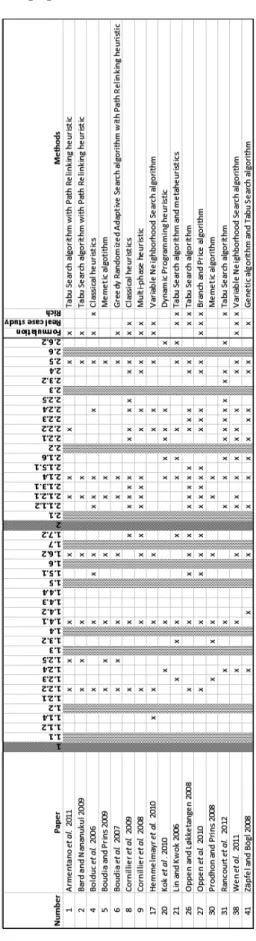
In Tables1.2 and 1.3, papers addressing different variants of the VRP are listed. Table 1.2 is devoted to papers addressing pure routing problems. Therefore, the sublevels of the level decision management component (1.2) are omitted. In Table
1.3, we consider papers that combine routing vehicles with other strategic or tac-tic facets. Each artac-ticle is classified according to the attributes defined in the above taxonomy (see Table 1.1). The subclasses and branching classes are shaded. When the attribute is present in the corresponding paper, ’X’ is reported in the associated cell. The column headed Number provides the numbers, we assigned, to each se-26
lected paper. In what follows, we give the number of the selected paper into square brackets. The columns headed Formulation, Real case study indicate whether or not the article includes a mathematical formulation and/or a set of instances based on a real-life application. In the column headed Rich, we report whether or not the authors consider the problem under study as a RVRP. The last column headed Method refers to the types of designed method(s).
In Tables 1.2 and 1.3, all described attributes are present in one paper at least. This shows that no unnecessary node has been introduced in the taxonomy. In se-lected papers, the routing based problems with pickups or deliveries were studied more deeply than the other variants. Indeed, 61% of the papers selected addressed routing issue only (1.2.1), and 70.7% of them are devoted to pickup or delivery (1.4.1) problems. At the opposite, little attention has been paid to routing prob-lems dealing with other decisions, such as location (1.2.3), driver scheduling (1.2.4) and production (1.2.5). This suggests some promising future research avenues. Even if stochastic and dynamic problems are quite challenging, they constitute almost 15% of the selected papers which illustrate the key role played by these problem char-acteristics. Different types of temporal and physical incompatibilities between the basic entities (2.4) are present in the considered papers (63.4%) as well as specific restrictions (2.5) related to real-life applications (53.7%). Moreover, the time con-strained routing problems have been studied intensively. In more than half of the selected papers, the VRPs tackled take into account time window restrictions for customers and/or road accesses (2.2.2). Opening hours for depots (2.2.3) are de-fined in almost 40% of the papers. Last, it is noteworthy to mention that the social constraints such as legislation rules on driving and working hours are considered in 22% of the papers (2.1.6). This illustrates that social driver regulations increasingly are taken into account in the VRP literature since 2006.
In 56% of the papers, mathematical formulations are provided even if approx-imate methods are then designed to solve the problem under study. The models typically aim to provide a complete description of the problem. With respect to the solution methods, exact algorithms are proposed in two papers while heuristics and metaheuristics are described in the remaining 39 papers. This is due to the ability of approximate methods to find near-optimal solutions for large instances of complex problems.
Rich vehicle routing problems: from a taxonomy to a definition
Table 1.2: Selected papers devoted to pure routing problems