UNIVERSITÉ DU QUÉBEC
MÉMOIRE PRÉSENTÉ À
L'UNIVERSITÉ DU QUÉBEC À TROIS-RIVIÈRES
COMME EXIGENCE PARTIELLE
DE LA MAÎTRISE EN ADMINISTRATION DES AFFAIRES
PAR
YAN ZHU
THE EFFECT OF HUMAN RESOURCE PARCTICES ON FIRM
PERFORMACE IN CHINE SE SMES: AN EMPIRICAL STUDY IN
MANFACTURING SECTOR
Université du Québec à Trois-Rivières
Service de la bibliothèque
Avertissement
L’auteur de ce mémoire ou de cette thèse a autorisé l’Université du Québec
à Trois-Rivières à diffuser, à des fins non lucratives, une copie de son
mémoire ou de sa thèse.
Cette diffusion n’entraîne pas une renonciation de la part de l’auteur à ses
droits de propriété intellectuelle, incluant le droit d’auteur, sur ce mémoire
ou cette thèse. Notamment, la reproduction ou la publication de la totalité
ou d’une partie importante de ce mémoire ou de cette thèse requiert son
autorisation.
Le Résumé
La gestion
des ressources humaines représente un déterminant important dans le niveau
de
performance
des
organisations. En
effet,
depuis
les 20
dern
ières
années,
plusieurs
études,
ont été en
mesure de montrer un lien
significatif
entre la mise
en œuvre
de
certaines
activités de gestion
des ressources humaines
(GRH)
et l'accroissement de l'
efficacité
organisationnelle
de la firme.
Une analyse
détaillée de la
littérature semble
d'ailleurs
montrer que les
effets
de la GRH
sur les différents paramètres organisationnels s'obtiennent
et ce,
nonobstant le
cadre
théorique ou méthodologique utilisé. Plus particulièrement, autant
les propositions universal istes, de contingence ou
configurationnelle
ont pu montrer les
effets
positifs des
activités
de
GRHsur
l'
accroissement
du niveau de performance de
l
'
entrepri se.
En
dépit du
caractère encourageant
des différentes
études académiques
réalisées
à ce
jour,
certaines zones
d'
indétermination demeurent
encore
particulièrement nébuleuses.
En effet,
une simple revue
de la littérature montre que les principales recherches
ont été
réalisées
en
contexte nord
-américain.
À
l'exception de quelques
études européennes
,
les différentes
recherches ont été
menées dans un cadre culturel
occ
idental,
occultant
du même
coup
un
grand
nombre d'
organisat
ions,
notamment celles provenant du plus
grand
pays
émergent au
monde, la
Chine. Également, les recherches,
à l'exception de quelques raresrecherches, les
études
menées
en gestion stratégique des ressources humaines (GSRH)
l'
ont été en
prenant
la
grande entreprise comme toile
de fond
, laissant en
plan les
organisations de type PME.
C
'
est en tenant compte
de
ces
deux précédents
éléments que
nous
avons
développé
cette
recherche. Plus
particulièrement, nous
allons
util
iser
le modèle universaliste des ressources
humaines afin
de
voir
les
effets
de
certaines activités ou
pratiques de
GRH sur
différents
indicateurs de
performance de
38
PME
chinoises
du
secteur
manufacturier.
Utilisant
une
démarche
hypothético déductive, nous
avons été en
mesure de montrer
et ce, nonobstant
le
caractère culturel particulier de la Chine, que certaines activités de GRH avaient des effets positifs sur le niveau de performance des PME étudiées. Plus particulièrement, l'étude que les propositions universalistes semblent même transcender les cultures, donnant ainsi un poids considérable aux présupposés théoriques évoqués il y a plus de 20 ans par l'École de gestion de Stanford et souvent remises en question par bon nombre de recherches et d'orientations paradigmatiques adverses.
Bien que cette recherche représente une des rares recherches de GSRH en contexte chinois, elle permet certes de mieux connaître le comportement des activités de GRH dans un contexte culturel comme celui de la Chine, mais ne permet certainement pas de clore définitivement un débat qui ne fait que débuter. En effet, nous devons convenir que cette recherche, bien que porteuse, se veut encore perfectible. D'une part, les moyens disponibles ne nous ont pas permis d'analyser un échantillon plus important. D'autre part, outre la limitation sectorielle dans laquelle nous avons enfermé notre recherche, soulignons également le préjugé théorique que nous avons utilisé, laissant en plan des modèles théoriques très pertinents comme celui de l'approche de contingence et de l'approche de la configuration.
Abstract
Previous studies suggest that strategic human resource management (SHRM) is beneficial to finn performance. The SHRM literature draws on three dominant modes of theorizing: universalistic, contingency and configurational perspectives. At present, most of empirical researches on these three perspectives are based on the North American environment, and many scholars focused on large enterprises as sample of empirical studies. We know it is possible that some SHRM practices which are effective for western enterprises are not effective for enterprises in Asia because of the different environment and culture, and the studies on the relationship between SHRM and firm performance in small and medium enterprises are rarely while they have significant values in social practices as weil as in theory. The purpose of this study is to testify the universalistic perspective of view by examining the positive relationship between certain SHRM practices and firm performances in Small and medium manufacturing enterprises located in different parts of the People's Republic of China.
In this study, human resource management practices data and firm performance data of 38 Small and medium manufacturing enterprise were collected from a questionnaire survey by using the list of china top 1000 high growing SMEs in manufacturing industry as sample and the snowball strategy that utilized contacts of contacts. We identified several SHRM practices and the organizational performances and setup the primary hypothesis that: The practices of lncentive compensation, Training, selective hiring, performance evaluation, organization, sharing information, job security and Social activates and sports will lead to higher level of organizational performance. Through the statistical software SPSS 15, we used the relationship analysis to build a matrix of correlations between the SHRM practices and the organization performances, as weil as regression analysis to validate the conclusions already left reflected the correlation matrix.
Based on the universal approach, the relationship between SHRM practices and organizational performance have been examined. The finding indicated that certain SHRM practices are better th an other Human resource practices, the former have positive relationship with the organization performance no matter what the firms' strategy are. More specifically, The empirical result through relationship analysis revealed that with innovation level controlled, some strategic human resource practices in incentive compensation, training, selective hiring, performance evaluation and information sharing have significant positively effect on at least on organization performance factor. Furthermore, the regression analysis validated that incentive compensation, training, job security and social and sport activates has significant effect on organization performance. This finding supports the proposed hypothesis of our study.
To the best of our knowledge, this is the first large-scale study (200 questionnaires survey) on the relationship between HRM and Small and Medium enterprise performance in the context of the People's Republic of China. The result developed in this study adds valuable insight to the existing strategic Human resource literature by identifying the means through which the SHRM practices leads to a firm's success in Chinese SMEs in manufacturing
sector. The current study makes a theoretical contribution to support the universalistic perspective and resource based view in the Asia society, which has different environ ment from North American's. Practically, this study provides guidance about how to build an effective human resource management system to improve the organization performance by identifying the specific SHRM practices for SMEs in Chinese manufacturing industry.
Different from most previous studies conducted in a Western context, this study examined data of China, and thus examined a very different cultural and institutional environment. Although this study obtained valuable results, the limitations of the subjective data, limited
future study
,
more
work on
revealing the influence
of other
unexplored
factors
to better
understand the
determinants
of
firm performance
should
be done
, and
future
studies could
also analyze configurational and contingency
perspective
of HRM and
their
effect on firm
performance.
Acknowledgements
We would like to take this opportunity to genuinely thank ail individuals who have helped us in this effOlt. Primarily, we would like to thank the supervisor, Professor Michel Arcand, who not only gave his valuable inputs during my dissertation but have also guided us ail along the MBA education, His guidance and support throughout the education has been invaluable in helping us complete this study and grow as a professional. Our sincere gratitude also goes out to Professor André Cyr and François Labelle in the course of « General strategy of SME», thanks you for helping us understand in-depth about the theory in Strategie Human resource management and resource based view. We should also acknowledge Professor Normand Pettersen in the course of <Methodology of research>. He helps us to know the business research method and how to conduct a graduate study in practices.
In
addition, we would like to thank to ail other professors who teach us during my MBA program, we have gained from each of them much in perspective about knowledge: ail ofwhich has culminated in helping us successfully complete this work.At this point, we would like to recognize the endless support of the parents, who provided continued and dedicated support in many ways. They have given ail they possibly cou Id, we so crucially needed throughout the professional and personal life to this day. We could hardly be who we are today without them.
TABLE OF CONTENTS
ACKNOWLEDGEMENTS ... 1
TABLE OF CONTENTS ••••••••••••••••••••••••••••••••••••••••••••••••••••••••••••••••••••••••••••••••••••••••••••••••••••• II LIST OF FIGURES ...
V
LIST OF TABLES ... VI CHAPTER 1 FRAMEWORK OF PROBLEM ... 21.1
INTRODUCTION ...2
1.1.1 A QUESTION FOR DISCUSSION ... 2
1.1.2 RESEARCH METHODOLOGY ... 2
1.1 .3 RESEARCH STRUCTURE ... 3
1.2 HUMAN RESOURCE MANAGEMENT: A NEW COMPETITIVE ADVANTAGE •••••••••••••••••••••• 4 1.2.1 COMPETITIVE ADVA TAGE THEORY ... 5
1.2.2 RESOURCE BASED THEORJES OF SUSTAINABLE COMPETITIVE ADVANTAGE ... 6
1.2.3 THE SUSTAINABLE COMPETITIVE ADVANTAGE THEORY BASED ON HUMAN RESOURCES ... 9
1.3 STRATEGIC HUMAN RESOURCE MANAGEMENT AND ORGANIZATION EFFECTIVENESS: AN OVERVIE\\' ... 12
1.4 CONCLUSION AND PROPOSITION ••••••••••••••••••••••••••••••••••••••••••••••••••••••••••••••••••••••••••••••• 13 CHAPTER 2 THEORETICAL FRAMEWORK ... 15
2.1 INTRODUCTION ... 15
2.1.1 EMERGENCE OF SHRM ... 15
2.2 DEFINITIONS OF THE SHRM ...••••••••••••••.•...••••..••••.••••.••.••••••••••••.••.•..•.•...•••...••...•. 17
2.3 THE MODELS OF SHRM •••••••••••••••••••••••••••••••••••••••••••••••••••••••••••••••••••••••.•••••••••••••••••••• 18 2.4 SHRMAND ORGANIZATION EFFICIENCY: THREE PERSPECTIVE THEORIES •••••••••••• 20 2.4.1 UNIVERSALISTIC PERSPECTIVE ... 20
2.4.2 Co TINGENCY PERSPECTIVE ... 21
2.4.3 CONFIGURATIONAL PERSPECTiVE ... 22
2.5 THE VIEW OF UNIVERSALISTIC PERSPECTIVE ... 23
2.5.1 THE MAJOR THEORETICAL FOUNDATION ... 23
2.5.2 THE EMPIRICAL STUDY OF UNIVERSALISTIC PERSPECTIVE ... 25
2.5.3 CRITICAL SYNTI-ŒSIS OF EMPIRICAL STUDIES ... 32 2.5.4 CONCLUSION OF UNrVERSALlSTIC PERSPECTIVE ... ", ...
J4
2.6 VARIABLES AND HYPOTHESIS ... 34
2.6.1 PRESENTATION OF RH VARIABLES ... 34
2.6.2 PRESENT OF DEPENDENT VARIABLES RELATED TO ORGAN1ZATION PERFORMANCE ... 38
2.6.3 PRESENT OF CONTROL VARIABLES ... 41
2.6.4 PRIMARY HYPOTHESIS ... 41
2.7 RESUME ... 42
CHAPTER
3
METHODOLOGY ...44
3.1 INTRODUCTION ... 44
3.2 STRATEGY AND RESEARCH TYPE ... 44
3.3 THE POPULATION STUDY ... 47
3.4 THE OPERATION PHASE OFRESEARCH ... 48
3.4.1 SAMPLING ... 48
3.4.2 BUILDING THE COLLECTION TOOL ... 49
3.4.3 MEASUREMENT OF VARIABLE ... 50
3.4.4 THE QUESTIONNAIRE ADMINISTRATION ... 54
3.4.5 ANALYSIS OF SURVEY DATA ... 55
CHAPTER 4 RESUL TS AND ANAL YSIS ... 57
4.1 INTRODUCTION ... 57
4.2 DISPLA Y THE RESUL TS ...
58
4.2.1 DESCRIPTIVE STATISTICS ... 58
4.2.2 CORRELATION ANAL YSIS ... 59
4.2.3 REGRESSION ANALYSIS ... 62
4.3
CONCLUSION AND DISCUSSION ...67
4.4 LIMITATION OF THE STUDY AND SUGGESTIONS FOR FUTURE RESEARCH ... 69
BIBLIOGRAPHY ... 72
APPENDIX 1: FIRST LETTER TO THE QUESTIONNAIRE PARTICIPANTS ... 79
APPENDIX 2: FIRST LETTER TO THE QUESTIONNAIRE PARTICIPANTS (IN CHINESE) ...
81
APPENDIX 3: SECOND LETTER TO THE QUESTIONNAIRE PARTICIPANTS .. 83
APPENDIX 4: SECOND LETTER TO THE QUESTIONNAIRE PARTICIPANTS (IN CHINE SE) .........••........
84
APPENDIX
5:
QUESTIONNAIRE
... 86
LIST OF FIGURES
FIGURE 1 THE BEST PRACTICE PERSPECTIVE THEORY ... 21
FIGURE 2 CONTINGENCY PERSPECTIVE THEORY ... 22
FIGURE
3
THE HUMAN CAPITAL VIEW SUPPORTING THESHRM ...
..
....
...
.
...
..
24
LIST OF TABLES
TABLE
1.
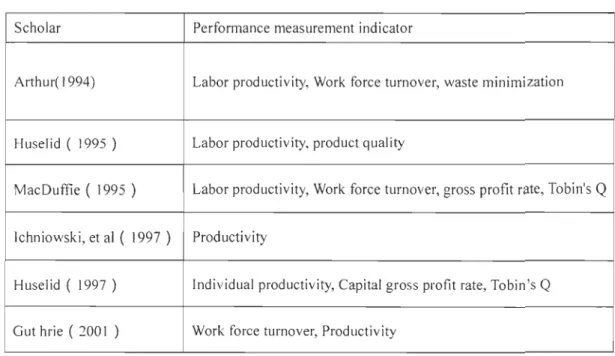
THE BEST PRACTICES STATED BY DIFFERENT SCHOLARS ... 29TABLE 2. OVERVIEW OFTHE PERFORMANCE MEASUREMENT PROVIDED BY SCHOLARS .. 30
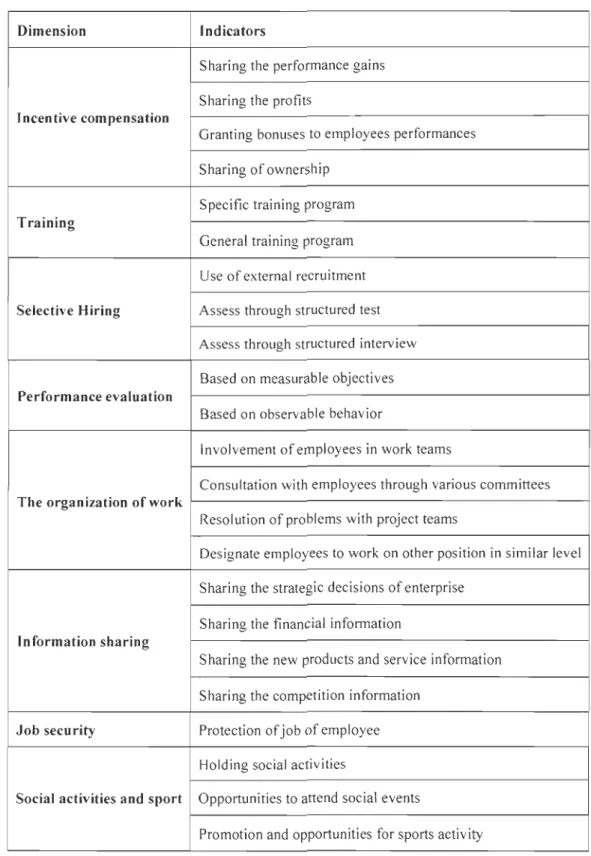
TABLE 3. DIMENSION AND INDICA TORS OF SHRM PRACTICES ... 51
TABLE 4. DIMENSION AND INDICATORS OF ORGANIZATION PERFORMANCE ... 52
TABLE 5. DIMENSION AND INDICATOR OF THE INNOVATION DEGREE ... 53
TABLE 6. DESCRIPTIVE STATISTICS ... 59
TABLE 7. CORRELATION COEFFICIENT BETWEEN SHRM PRACTICESAND ORGANIZATION PERFORMANCES ... 61
CHAPTERI
Chapter 1 Framework of Problem
1.1
Introduction
1.1.1 A question for discussion
Pursuing high performance is an important issue concerned by the governors of each firm. Only by clearing understanding the causation of the high performance, the governors can possibly improve the internai environment of enterprise actively and effectively and create
high-performance organization. Compared with organization performance management, strategie human resource management (SHRM) is a relative new field, which commits itself
to examining the effectiveness of human resources practices on the holistic performance of firms in a macro perspective. In the past 20 years, many research findings in SHRM have
come forth not only in theory but also in practice. A great numbers of Empirical Researches
show that the practice of SHRM has positive relationship with the organization performance. Nowadays SHRM has developed as an independent field in management, the discussion of the question that how the practice of SHRM improves the organization performance has significance not only in theory of management but also in practice of management. The purpose of this paper is to illustrate the positive effects and the mechanism function of SHRM on the organization performance, to research the circumstance of the small and medium enterprises (SMEs) in manufacturing industry in China and then provide countermeasure solution for SHRM based on organization performance.
1.1.2 Research methodology
This paper adopted literature summary to illustrate the theories of SHRM and organization performance, referred to the empirical research findings on the effect of the SHRM to the organization performance from many scholars and analysis the relationship between them.
We launched a survey by sending questionnaires to about 200 managers in SMEs in manufacturing industry in China, letting them fill out the questionnaire and collect the first hand quantitative data. We also interviewed some managers by telephone to collect qualitative information. We made taxonomy of organization performances by the different types. We code the feedback questionnaire and marked the best practice and the performance with the score from 1 to 5. Using statistical software, we analyzed the coefficient of the best practices of SHRM and organization performance. Through this method, we tried to validate the positive relative relationship between the SHRM and the organization performance in universality perspective. Finally we discussed the new situation of the best practices of SHRM of SMEs in manufacturing industry in China and explore the corresponding effect of the organizations' performance.
1.1.3 Research structure
This research conducts both theoretical and empirical research approach, and accordingly, there are two parts:
The tirst part is the theoretical part, including chapter 1 and chapter 2. Chapter 1 briefly describes the research method and the structure of the document, analysis the resource based view theories, then explores the relationship between human resource and competitive advantages and finally proposes that there exists the positive relationship between the SHRM and organization performance. Chapter 2 gives the definition for the SHRM, reviews the original sources of the theories in SHRM and organization performance and illustrates three perspective theories for analyzing the relationship between them. Through reviewing scholars' empirical researches on SHRM in universality perspective theory, we got the conclusion and set up de pend variables and independent variables and make assumption for the analysis used in this paper.
The second part is the empirical research part, including the chapter 3 to chapter 5. Chapter 3 analyses the sample of the questionnaires collected from more than thirty SMEs in
manufacturing industry in China, builds the linear model of for the SHRM and organization
performance and does the correlation analysis through statistical Software. Chapter 4
illustrates and explains the result of Data analysis. Chapter 5 gets the conclusion through
analyzing the result of the model and then proposes the limitation of this study and suggestion for improving the future empirical study on the SHRM theory in SMEs.
1.2
Human resource management: a new competitive advantage
During the last decade there has been a dramatic shift in the field of human resource
management. This shift has broadened the focus of HR research from the micro analytic
research that dominated the field in the past to a more macro or strategic perspective. The
strategic perspective of HR, which has been labeled strategic human resource management (SHRM), has grown out of research's desire to demonstrate the important of human resource practices for organization performance.
Professor Michael Porter's (1980) famous competitive advantage theory established three
strategies for the firm to win the competitors: cost leader ship, differentiation and focus. Traditional sources of competitive advantage, such as natural resources, technology and
economlcs of scale have become increasingly easy to imitate. According to the resource-based vlew (Barney, 1986); the finn could develop sustained competitive through creating value in a manner that is rare and difficult for competitors to imitate. The concept of HR as a strategic asset has implications for This issue. HR is an invisible asset creates value wh en it is embedded in the operational system in a manner that enhances firm ability to deal with a turbulent environment. ln the theory perspective studies, more and scholars though human resource management has become a new competitive advantage for the organizations.
1.2.1 Competitive advantage theory
Some scholars in strategy management believe that the reason why an enterprise can get
higher performance than other enterprises do is that the former owns the competitive
advantages which do not owned by others. In recent years, scholars who research strategy management refocus the internaI of the organization and seek the relationship among the internaI resource, strategy and performance of the enterprise, the competitive advantage is the fruit of such efforts. Harvard business school management professor Michael Porter
(1980) pointed out that the fundamental basis of above- average performance in the long run
is five force of competitive advantages. According to Porter's view, an enterprise can get the sustainable competitive advantage through the following three strategies:
1. Cost leadership
In it, a firm sets out to become the low-cost producer in its industry. The firm has a broad
scope and servers many industry segments. They decrease the average cost, the way to expand the economies of scale because of the competitive advantages on low priee, they can carry out expansion at low cost, get the advantage of economies of scale and built up higher
entrance barriers. In TV set industry, for example, cost leadership require efficient size picture tube facilities, a low cost design, automated assembly, and global scale over which to amOt1ize R&D. The essential of low cost strategy is the high-performance in enterprise,
which can be accomplished by innovations in technology, structure and management, etc. Furthermore, the most effective and crucial way to improve the performance of organization
is to improve the human resource management.
2. Differentiation strategy
ln a differentiation strategy, a finn seeks to be unique in its industry along some dimensions that a widely valued by buyer. It selects one or more attributes that many buyers in an
perce ive as important, and it is rewarded for it uniqueness with a premium price. A firm that
can achieve and sustain differentiation will be an aboye-average performer in its industry if price premium exceeds the extra cost incurred in being unique. The core of differentiation is how to satisfy the need of interest related individual or group. This can also be achieved
through improvement in technology of production, after selling service and marketing, etc.
Ali ofthese are related to the human resource management.
3.
Focus
strategy
This strategy is quite different from the others because it rests on the choice of a narrow
competitive scope within an industry .The focus strategy has two variants. In co st focus a firm seeks a cost advantage in its target segment, while in differentiation focus a firm seeks
differentiation in its target segment. A good example of a focuser who has exploited
difference in the production process that best serves different segments is Hammermill Paper. Hammennill has increasingly been moving toward relatively low volume,
high-quality specialty papers, where the larger paper companies with higher volume
machines face a stiff cost penalty for short production run. Hammer mill's equipment is more suited to shorter runs with frequent setups.
1.2.2 Resource based theories of sustainable competitive advantage
Barry (1991) defined the resources as :
«
aIl assets, capabilities, organizationaI processes, finn attributes, information, knowledge, etc which controlled by a finn that enable the firmconceive of and implement strategies that improve its efficiency and effectiveness» . There are tangible resource and intangible resource. Tangible resources are the physical asset of an
organization such as plant, people and finance. lntangible resources are non-physical as sets su ch as information, reputation and knowledge (Richard, 1992). Resource can be also classified into three categories: physical capital resources, human capital resources and
advantages offirm.
The different ways of positioning the resource-based view generate what could almost be described as three different resource-based theories of competitive advantages (Schulz 1991) .These resource based theories share a common set of assumption, such as the assumption that resource and capabilities may be heterogeneously distributed across firms and the assumption that this different may be long lasting( Barney, 1991), but they emphasize different implications of those assumption and focus on explaining different sustained performance across firms. In Barney's view (2001), the resource based view can be positioned relative to at lease three theoretical traditions: SCP-Based theories of competitive advantage, neo-classical microeconomic, evolutionary economic.
1. The resource based theory of neo-c1assicaI microeconomics
New classical microeconomics focus on how market forces determine the quantity, quality and priee of good and service sold in a market. While this theory adopts many of same assumption as the resource based view, there exist only impo11ant differences between them. The former assume that resource and capabilities are elastic in supply, however the latter argue that at least sorne factor of production may be inelastic in supply because of they can only be developed over long periods and are difficult to be developed in short term or because of they cannot be bought or sold. Supply inelasticity thus can become a source of sustained competitive advantage. The advantage of positioning the resource-based view relative to neo cJassical microeconomic are significant, even though « it did not effectively address issues that were critical to many strategie management scholars.
»
(Barney 2001)2. The resource based theory of evolutionary economics
Unlike neo-classical microeconomics, this evolutionary theory does not apply equilibrium analysis but use of simulation and other method. In Nelson and Winter's view (1982), In the
face of competition, Firm vary in routines, sorne of which are revealed to be more efficient and effective than others, the most efficient and effective routines generate competitive advantages for firms. There are close link between resource based view and evolutionary economic. For example, the concept routines used in evolutionary theory are an example of firm resources and capabilities, which are used in resource based view; firm heterogeneity is also an important part of both theories; while the sustainability of competitive advantage in evolutionary theory is much close to the concepts of sustained competitive advantages used resource-base view. However positioning resource-based view on evolutionary economics would not address many of the central issue in the field of strategic management which we analysis in this paper.
3. The resource based theory of SCP-based model of competitive advantage
In Barry's view, it is the best way to posit the resource based view to
sep
based model, which is the five force model by Michael Porter (Barry 2001). This resource-based view of the firm focuses on the internai resources of the firm as the major determinant of competitive success. A sustained competitive advantage exists only when other firms are incapable of duplicating the benefits of a competitive advantage (Lippman & Rumelt, 1982). Not ail finn resources and capabilities of enterprise have the potential to become the fundament of the sustainable competitive advantages, only four empirical indicators of the potential of finn resources to generate sustained competitive advantage are proposed, which are: (1). Valuable, in the sense that it exploits opportunities and/or neutralizes threats in a firm's environment;(2).Rare among a firm's current and potential competition; (3).lmperfectly imitable (either through unique historical conditions, causal ambiguity, or social complexity); (4).without strategically equivalent substitutes( Barney,1991).1.2.3 The sustainable competitive advantage theory based on human resources
Although some tradition resources of competitive advantage, such as nature resource, technology and economic of scale, are still valuable to the firm, they become more and more easily to be imitated by the competitor in recent years. Sorne intangible resource of firm, such as human resource and reputations are much hard to be imitated. Furthermore, we see in a national survey of chief executives, Sorne of the more significant findings of the survey
were that: employee knowhow and reputation are perceived as the resources which make the most important contribution to business success; they are also identified as the resources which would take the longest to replace from firm, suggesting that they have considerable
significance with respect to the sustainability of competitive advantage; and that for most companies operations is the most important area of employee know how (RICHARD HALL 1992). In resource-base view, human resource has the same characteristics with the know-how employees and reputation, which are hard to copy by the competitor. In fact,
human resources quai if Y as resources of sustained competitive advantage because they meet
such criteria established by Barney (1991).
1.
Human
resource capital as
valuable
First, as a source of sustained competitive advantage, human resources must provide value
the firm. In real business world, we know human resource are the important asset owned by the enterprise, containing work skills, abilities, knowledge and other factors. Ali su ch can add create value to the firm, while the work attitude and performance of employees can also add value to the enterprise. In theory, recent work in the area of utility analysis for resource has also provided both a theoretical rationale for the ways in which human capital resources increase firm value and techniques for estimating this increase in value (Wright,
McMahan and McWilliams, 1994). For example, Schmidt et al. (1979) provided a means of
estimating the financial value that human resources contribute to the finn, and consent that higher quality human resources result in higher financial value for firms.
2. Human capital resources as rare
ln human resource
research,
one
measures of the quality
of
human resources is
cognitive
ability due to
its
consistent empirical support as one of the
best predictors
of
performance
in
work organizations (Hunter and
Hunter
,
1984). It has
two characteristics. First
is
that
cognitive ability
has
been consistently
demonstrated
to
have
a strong
positive
relationship
with
individual job
performance. Second
is
that cognitive ability is a relatively stable
attribute which
is normally distributed in the population.
So
because
cognitive ability is
normally distributed in
the population
,
human resources
with
high
ability
levels
are
,
by
definition
,
rare.
Furthermore
,
the extent that jobs require
skills which allow for variance
in
individual contributions (i.e., when
job-relevant
skills are
no longer
a commodity)
,
these
skills should
be normally distributed in the
population. Thus
,
under these
conditions
,
high
quality
human
resources are
rare.
3.
Human
resource as inimitable
The way
,
in
which the human
resources
act as a competitive advantage
may
be determined
by unique
historical
conditions,
be
subject to causal ambiguity or stem from social
complexity
.
Firstl
y,
firms have
unique histories,
over
the
courses of which
particular
culture and
norms
develop (Sathe, 1985).
Human capital
resource
may be melded
together to create a
sy
nergistic work culture where
individuals
work co-operatively
in line
with organization
goals.
Second
,
human resource may also
be
the source of causal ambiguity
,
this will occur with
production
,
Because output
is not the
sum of the separable outputs of each co-operating
resource
,
it
may be impossible
to
identify
the source of the competitive advantage that arises
from team
production.
For example
,
Japan
'
s
manufacturing industry have high
competitive
advantage, is it
because
of
the high productivity
ofblue-collar worker
,
or
because
of flexible
production method
,
or more efficient management
by
manager
,
it
is
hard to identify the true
reasons.
Third, social complexity may arise from transaction specifie relationships, and competitive advantage they comprise may be due to transaction specifie human capital. So human resources and social complexity are intrinsically linked because social complexity must result from human interactions. Thus, in theory, competitive advantages stemming from culture or norms, team production or transaction-specifie human capital might be imitable.
4. Human capital resources as non-substitutable
It is important to note that human resources are one of the few firm resources which have the potential to not become obsolete and be transferable across a variety of technologies, products and markets. Although the rapid pace of technological change has resulted in new technologies which make former technical skills obsolete. Many human capital resources are quite generalizable that make the new knowledge and technical skill quickly transfer to the new technologies. Human capital resources such as cognitive ability are transferable across a wide variety of technologies, products and markets. Resources that can substitute for human resources are those resources that are themselves valuable, rare, inimitable and non substitutable.
Human resource can provide a competitive advantage that leads to higher firm performance in both static environment and more dynamic environments.
First, in statie environment, higher level of human capital should enable a firm to have relative productivity advantage compared to its competitors. For example, a firm with human capital resources in terms of cognitive ability should possess a productivity relative to other firms. Second, under more dynamic environment, the human capital can affect firm effectiveness through increasing it capacity to adapt to particular environment
requirement (Wright, McMahan and McWilliams, 1994).
1.3
Strategie Human Resouree Management and Organization
Effeetiveness: An Overview
In today's increasing intensive market competition, the issue of organization effectiveness is an important indicator measuring whether the finn operates weil or bad, which directly detennine the survival and development of enterprise. A general view of firm effectiveness is that it is the operational performance generated in a regular operating period, containing firm efficiency and economy effectiveness.
Strategic Human resource management (SHRM) can be regarded as a general approach to the strategic management of human resources in accordance with the intentions of the organization on the future direction it wants to take. The basic percepts of SHRM have nature affinity with the resource-based view (RBY) of competitive advantage in the strategy field (Barney, 1991). The strong and obvious connection to the RBY serves the SHRM field in two ways: First, it foregrounds the role of human resources in questions of strategy, raising the importance of research and practice in SHRM. Second, it encourages a more relevant focus for HRM, away from the HR practices themselves and toward their effect on firm resources (Delery, 1998).
SHRM predicated on two fundamental assertions. First is the idea that organization's human resource are of critical strategic importance- that the skill, behavior, and interactions of employees have the potential to provide both the foundation for formulation and the means for strategy implementation. Second is that a firm's HRM practice are instrumental in developing the strategic capability of its pool of human resource.
Research on the contribution of human resources and SHRM to organizational effectiveness has addressed a wide array of questions. For instance, what is the effect of HR practices on the development of a firm's human resources? Which HR practices lead to greater organizational performance? To what degree does that depend on firm strategy? How does a finn ensure that its HR practices "fit" with its strategy? How does it ensure that its individual HR practices fit with one another, or fit even matter in HR practice? Must the
attributes of a firm's base of human resources always align with an a priori strategy, or can its stock of ski Ils, knowledge, and interactions drive strategic direction? The key constructs and central debates in SHRM have grown out of the above questions from many scholars'
work. What is common to ail of scholars' work is that they focus on the links among HR practices, the human resource pool, and organizational outcomes, and with the consentience that SHRM are related to the organization effectiveness. We will discuss these works in details in the following chapter.
1.4
Conclusion and
proposition
The first chapter analyses the competitive advantages and the resource based Vlew,
positioning the latter on three tradition theory and result in three different resource based theory of competitive advantages. According to Barney's view (1991), in strategy management field, the best way to posit the resource base view is positioning it on porter's five force mode!. Not ail finn resources can generate sustainable competitive advantages,
only the resources with four indicators can generate it. Human resource Human resource can provide a competitive advantage that leads to higher finn performance because human resource capital are valuable, rareness, inimitable, and non-substitute. SHRM have nature affinity with the resource-based view (RBV) of competitive advantage in the strategy field, HRM and HRM practices have relationship with organization performance, proved by a lot of empirical researches which will be discuss in the next chapter.
CHAPTER2
Chapter 2 Theoretical framework
2.1
Introduction
2.1.1 Emergence of SHRM
Strategie human resource management (SHRM) is a new crossed field which appears in
recent decades in management study field and bridge across both the field of human
resource management and the field of strategy management. We know in the 1970s,
enterprises were familiar with the concept of human resource management (HRM).
However, the traditional HRM function, or technical HRM activities, which covers a wide range of employment practices (recruitment, selection, performance appraisal, training and development and the administration of compensation and benefits, etc ), emphasis the people but ignores the connection with the strategy of the organization and also ignore the treatment of the human resource in perspective of strategy, leading the lack of fitness and the elasticity between the human resource management and the organization strategy. Since
Tradition HRM is hard to adapt the requirement needed for rapid development and
innovation of enterprises, enterprise, many scholars tried to put forward a general management theory to explain, forecast, and to coach the employee and the researcher's
human resource management and also want to explain sorne questions ignored in the aspect of employee relationship. They developed a new theOl"y to combine the HRM function with
business strategy and reflected a more flexible arrangement and utilization of human resources to achieve the organizational goals, and accordingly help organizations gain a competitive advantage, which was called Strategie human resource management.
The subfield of SHRM which devoted to exploring HR's role in supporting business
for a link between strategic planning and human resource planning signified the conception
the field of SHRM, but its birth came in the early 1980s with Devanna, Fombrum and
(1984) article devoted to extensively exploring the link between business strategy and HR.
SHRM's evolution has consistently followed developments within the field of strategic
management. For example, Baird, Meshoulam, Degive and Burack brought forward
integrated SHRM theory and proposed people to adopt this theory in their articles one after
the other. They thought the difference between the strategic HRM and the traditional HRM
whether the determination of human resource management plan is connected with the
organization's strategic plan. Organizations needed a process ofSHRM to help deal with the
rate of 'strategic surprises' that generated the need for flexibility and innovation, developing
culture to harness creativity and enterprise (Kanter, 1983; Baird & Meshoulam, 1988).In the developing process of SHRM theories, the most influencing one is generated by Beer et
al.(1984) that suggest SHRM is about developing and implementing HR strategies that
and support the delivery of four key goals: competence, commitment, congruence and cost,
they write article that Provides framework consisted of six basic components (i.e.,
factors, stakeholder interests, HRM policy choices, HR outcomes, long-term consequences,
and feed-back loop). It developed variations of SHRM into a broader approach.
With these issues in mind, we can see that SHRM are different from the traditional HRM.
SHRM emphasize the congruence or 'fit' between HR practice and business strategy. Many
scholars assert that the employment of effective HR practices and the design of a HR system
compatible with the firm strategy are imperative for the successful implementation of
business strategies (Miles & Snow 1984, Baird & Meshoulam 1988, Wright & McMahan 1992). There are also increasing numbers of empirical studies, conducted in various
on the relationship between strategic HRM and organizational performance or competitive
advantage. Essentially, SHRM emphasizes developing the firm's capacity to respond to the
firm is a reflection of its response to the competitive external changes, a human capital pool with a broad array of skills that are compatible with the corporate strategy, is a catalyst for fulfilling the strategie goals through promoting behavioral utility among employees.
2.2
Definitions of the SHRM
In spite of the increasing attention paid to SHRM, the term remains unclear. Sorne scholars have described SHRM as a process, others have described it as outcome, and others have considered it a combination of process and outcome.
In the perspective of considering SHRM as process, Ulrich and Lake (1991) defined SHRM as a process of linking HR practices to business strategy. Later, Bamberger and Meshoulam (2000) argued that SHRM is a competency-based approach to personnel management that focuses on the development of durable, imperfectly imitable, and other non-tradable resources.
In the perspective of define SHRM as an outcome, for Wright & McMahan (J 992), SHRM refers to « the pattern of planned HR deployments and activities intended to enable a firm to achieve its goals» . Similarly, Wright and Snell (1991) considered SHRM to be
« organizational systems designed to achieve sustainable competitive advantages through people» .
Considering both process and outcome together, Truss and Gratton (1994) defined SHRM as « the linkage of HR functions with strategie goals and organizational objectives to improve business performance and cultivate an organizational culture that fosters innovation and flexibility» .
developments and aetivities intended to enable an organization to aehieve its goals» . This
definition integrates the two main points:
1. linkage of human resouree aetivities with the organizational strategy; and 2. harmonization ofvarious human resouree aetivities
Armstrong and Long (1994) think that SHRM refers to an organization's deeision-making
about its human resourees; it is an organization's overall plan to pursue to aehieve its goals
through people; where human resouree management and strategie management are eorrelated with people being an integral eomponent ofany organization's eorporate strategy. Armstrong and Baron (2002) developed the definition of SHRM as « a general approaeh to
the strategie management of human resourees in aeeordanee with the intentions of the organization on the future direction it wants to take. It is concerned with longer term people
issues as part of the strategie management proeesses of the business» .
SHRM ean be also eonsidered as an overall proeess to deal with long-term human resourees
issues as part of the strategie management of the organ ization, rather than being supportive, foellsing on reerlliting, training and taking eare of benefits, SHRM's role has beeome
strategic building and using human capital to ensure competitive advantage (Batilett &
Ghoshal , 2002).
2.3
The models of SHRM
One method of defining HR strategie poliey and praetiee areas is to eonsider vartous strategie human resource models. Many seholars have created different models of SHRM. Sorne major ones are as below.
strategic human resource management activities. The model established five components including human resources management philosophy, policy, program, practices and processes. These five SHRM activities are significant in achieving the organization's strategic needs and business objectives, which reflect management's overall plan for growth, adaptability and profitability. The model f10ws from top downwards in one At the top is organizational strategy in which strategic business needs are identified and specific qualities are assigned to these. Two components, internai characteristics (culture nature of the business) and external characteristics (the state of the economy and critical success factors in the industry), flow into the process and enable business needs to be and expressed as mission statements. The melding of business needs with HR activities is very challenging, mainly because linkages between human resource activities and business
needs tend to be the exception, even during non-turbulent times (Schuler, 1992).
8ased on field studies in four industries, Miles and Snow (1978) c1assify firms within a industry into four groups, i.e. defenders, prospectors, analyzers and reactors, depending on how a finn responds to the three major problems facing the firm (entrepreneurial,
and administrative problems).The Defender has a narrow and relatively stable produce-market domain. The Prospector continually searches for product and market
opportunities and experiments with potential responses to emerging environmental trends. The Analyzer operates in two domains, one relatively stable, in which they operate routinely and efficiently, and the other changing, in which they operate in an innovative way. Each generic type develops structure and management processes to support the chosen strategy. Reactors have no consistent strategy and they merely respond passively to environment pressure. Miles and snow (1978) have also proposed that Strategy differentiation is based on distinction approaches to: (1). entrepreneurial problems: definition of market-product
(2). engineering problems: choice oftechnical systems; (3). administrative problems: related to organizational structure and processes. Central to this model is the specific relationship
between the four strategic types and environment. Coherent with the environment enactment
process, defenders will carve a niche in the market where stability can be found even in
dynamic industries, whereas prospectors will be the source of instability in an industry by
constantly producing innovation.
In contrast to Miles and Snow, Dyer and Holder (1988) classified the diverse array of HR
policies into three major HR strategy types, they proposed a comprehensive Human
Resource Strategic Typology consisting of three strategic types--inducement, investment
and involvement.
2.4
SHRM and organization efficiency: Three perspective theories
Research papers on SHRM are classified into three perspectives, according to Delery and
Dot Y (1996) categorization as « universalistic, contingency and configurational»
perspectives, which built upon the relations between HRM and firm's performance. The
main differentiating characteristic across these categories is the level of system complexity
assumed by the researcher and the capacity of various research approaches for model ing system complexity. Universalistic approaches pay little attention to interaction effects
among organizational variables, a contingency perspective begins to allow for su ch effects,
and the configurational school sees system interaction effects as critically important (Barry,
2004).
2.4.1 Universalistic perspective
Universalistic or « best-practice» approaches assert that certain independent-dependent
variable relationships hold across whole populations of organizations, that is, sorne HRM
practices are al ways better than others, and most organizations should adopt them (Miles &
Snow, 1984; Pfeffer, 1994). Because of globalization and increasing competitive press,
practices» are those found to consistently lead to higher organizational performance,
irrespective of an organization's strategy, which can be called high performance work
practices or best practices. Examples of such practices as formaI training systems, profit
sharing, voice mechanisms, and job detinition.
Osterman (1994), Pfeffer (1994) and Huselid (1995) supported and used the universal
perspective in their research. Several other empirical studies also support this approach. For example, Delery and Dot Y (1996) suggest two step to develop universalistic predictions:
tirst, important strategie HR practices are identified; second, arguments that relate the individual practices to organizational performance are presented. The universal perspective
theory can be illustrated as the follow.
Figure 1 the best practice perspective theory
The positive relationship between two variables
Best practice human Firm performances resource managements
2.4.2 Contingency perspective
Going beyond the universalistic perspective, research in strategie human resource management has investigated the relationship between HR systems and firm performance
from the contingency perspective. The task of the researchers is to select a theory of firm strategy and organizational performance (Fombrun, Tichy, & DeVanna, 1984, and Schuler
& Jackson, 1987). They found that the relationship between HRM and the organization performance will be different for different levels of the critical contingency variable. The contingency perspective draws a causal line from the HR policies and practices to the organizational performance metrics, and it allows for the moderating effects of strategy.
Effectiveness of HR practices is contingent on how weil they mesh with other aspects of the organization. The primary concern is with vertical fit (alignment with strategy) rather than horizontal fit (HR practices hanging together as a coherent, self reinforcing system). While this mode directs attention toward effects among variables, internai system interaction are not a central concern. In contingency predictions, the relationship between the use of
specifie employment practices and organizational performance is posited to be contingent
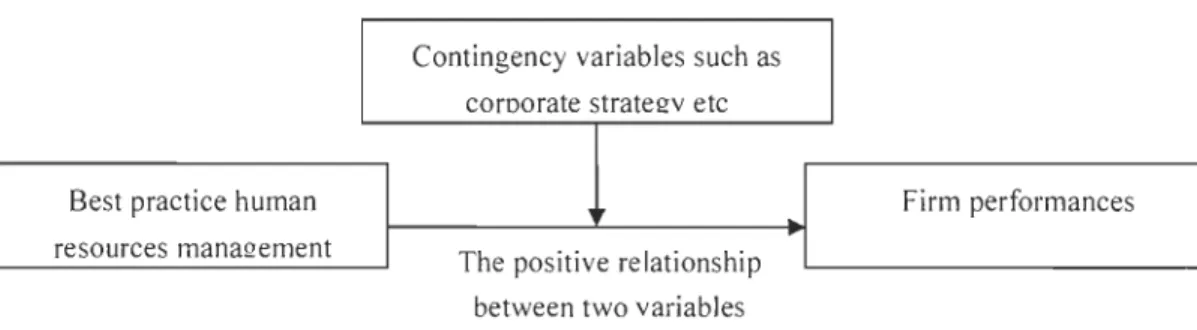
an organization's strategy. The contingency perspective model can be illustrated by the
following picture 2.2.
Figure 2 Contingency perspective theory
Contingency variables such as coroorate strateQ:Y etc
Best practice human Firm performances
resources manaQ:ement The positive relationship between two variables
2.4.3 Configuration al Perspective
The configurational school in organization studies follows a holistic principle of inquiry and
is concerned with how patterns of multiple interdependent variables relate to a given dependent variable (Meyer, Tsui, & Hinings, 1993; Miller & Friesen, 1984). Researchers gather multiple dimensions of organizations, such as strategies, structures, cultures, and processes, into typologies of ideal types and treat the types as independent variables. This goes beyond the contingency approach, in which "researchers have been preoccupied with
abstracting a limited set of structural concepts-centralization and formalization, for
example-and measuring their relationships with a limited set of abstracted situational
A
conRgurational view focuses on patterns ofHR
practices that together form an internallyconsistent whole (i.e., their effects are mutually reinforcing) and draws a correlation between those patterns and organizational performance (Dot y & Glick, 1 994).The purported
advantage of the configurational perspective is that it acknowledges system interaction
effects-that the whole may be more or less than the sum of its parts. One significant shortcoming is that it is typically unmanageable to construct and test more than a few configurations, which understates the real-world complexity of organizational systems.
2.5
The view of universalistic perspective
2.5.1 The major theoretical foundation
Scholars from different disciplines have presented vanous conceptual frameworks to explain the nexus between a firm's HRM systems/practices and performance. The most
prominent ones among these are human capital theory, agency theory and resource-based
theory.
Among the theories that have been used to develop Universalistic propositions, we can highlight the agency and transaction costs framework. According to the arguments of the universalistic writers, the influence on performance of certain policies, such as appraisal or benefit sharing, has been demonstrated because those practices contribute to overcoming the problems of opportunism and also to reducing internaI management costs (Delery and Dot y,
1996).
Furthermore, the basic proposition of human capital theory, which argues that organizations with valuable knowledge, skills and abilities will present better performance levels, has also fostered many universalistic conclusions. For example, Huselid (1995) stated that as part of high performance work system, the human capital activities can improve the organization performance through the skill of employee, incent and the work structure of organization.
different of human resource management level can also reflect the different level of human capital investment (Lepak & Snell, 1999). The human capital theory can iIIustrate SHRM in universalistic perspective as in the foIIowing route.
Figure 3 The human capital view supporting the SHRM
Human resources
...
The values of the...
Firmpractices ~
human resources performances
Remark: " + "means the positive relationship between two variables
Recently, the resource based view is the newest and the most important theoretical foundation of the SHRM. While sorne scholars distinguish the terms of 'resource', 'competence', 'capacity', 'capability' and so forth, following Barney (1995) ,The se resources and capabilities can be categorized into four groups-financial, physical, human, and organizational . The resource-based approach stresses the need for a specific HRM
strategy, which seeks to achieve competitive advantage by increasing the efficiency and
competency of the work force. It should also be noted that according to the resource-based
view, a firm' resources and capabilities must meet four conditions- valuable, rare, inimitable
and non substitutable-to be the sources of the firm's « sustained competitive advantage» ,
wh ich in turn leads to its competitive business strategies (Barney, 1991). MacDuffte (1995) contended that human resources can be a primary source of sustainable competitive advantage for a finTI. ]n Human Resource perspective, we find that Human resource (HR) is rare and human resource management (HRM) is inimitable, so we think Human resource represent the possibility of competitive advantage of firm, while Human resource translate this possibility to realization. Both HR and HRM form the competitive advantages of firm, which has impact on the firm performance.
Human resources + The competitive Firm performances Human resources advantages of firms
practices
0 .... ..-... ... 1 ... fI.J.. , , _ ... 1... .... _ ...... :.: .... 1_.: ... ,..1...: ................ __ : .... 1...1 ... ...
2.5.2 The empirical study of universalistic perspective
Scholars in universalistic perspective think that in human resource management, there exist
sorne best HRM practices, which has direct effect on the organization performance, these
effects are universal or strong so they can improve the enterprises' performance whatever
the industry the enterprise belonged and whatever the strategy the enterprise adopted. Many
empirical researches have tested and verified the relationship between the SHRM and the
organization performance. For example, Leonard (1990) examined the effects of executive
compensation policy and organizational structure on the performance of 439 large U.S.
corporations between 1981 and 1985. He found that: « Companies with long-term incentive
plans enjoyed significantly greater increases in ROE (return on equity) th an did companies
without such plans, and by 1985 long-tenn incentive plans had been nearly universally
adopted by large corporations» . Milkvich (1990) also found that the merit pay plan has
relationship with the organization performance and the enterprise with merit pay system can
achieve higher performance. These issues showed that the organization with compensation system based on the performance of employee can get higher long term financial
performance than the organization without it.
Terpstra and Rozell( 1993) collected survey data from the heads of the HRM departments of
201 organizations regarding the extent of use of five staffing practices supported by the
academic literature., and a significant positive relationship between organizations' use of the
five staffing practices and both annual profit and profit growth across ail industries.
rotation and total quality management can lead to improvement of productivity for the American enterprises.
Huselid (1995) comprehensively evaluated the links between systems of high Performance Work Practices and firm performance. Result based on a national sample of nearly one thousand firms indicated that these practices have an economically and statistically significant impact on both intermediate employee outcome (turnover and productivity) and short- and long-term measures of corporate financial performance.
Delaney and Huselid (1996) studied 590 profit and nonprofit organizations to research the impact of selection, training, compensation, grievance procedures, decision making and internai promotional practices and the interaction of these practices on two perceptual measures of organizational performance. Perceptions of market performance were related to ail of the HR practices except for the measure of decentralized decision making, but perceptions of organizational performance were related only to incentive compensation. In another article, De1ery and Dot Y (1996) found that organizations that had strategically al igned HR practices repolied return on as sets and return on equity figures that were nearly 50% higher than competing institutions that had not aligned their HR systems.
Simon K.M.Mak and Syed Akhtar (2003) collected Data from 63 publicly listed companies Hong Kong through a questionnaire that contained objective measures of human resource management practices and subjective measures of strategie orientations. The human management practices included job description, internai career opportunity, job security,
profit sharing, training, performance appraisal and voice mechanisms. Company
was measured in tenns of return on equity. Correlation analysis indicated that only job description and profit sharing correlated positively and significantly with the company performance across both managerial and non-managerial employees.
1. Iitcraturc rcview of Empirical Rcscarches on the basis of differcnt best practices
The notion of 'best practices' HRM should be reasonably familiar to most specialists in HRM and industrial relations, However, in the aspect of what HRM practices make up the
best practice, scholars did not hold consensus .it might be worth reiterating the main
elements in the list produced by Pfeffer (1998) before moving on to assess wh ether or not
these do actually constitute 'best practice' or are less 'best' than the name might imply.
Essentially, Pfeffer identified seven practices of successful organizations, reduced from his
earlier (1994) list of sixteen by combining several ofthese together, as weil as drawing upon
the results of other studies. They are: (1) Employment security, (2) Selective hiring, (3)
Self-managed teams/team-working, (4) High compensation contingent on organizational
performance, (5) Extensive training, (6) Reduction of status differences, (7) Sharing
information. If we categorize the scholars' empirical researches of the relationship of best
practices and the organization performance based on these seven different practices, we get
the following findings.
ln the aspect of hiring and selecting, Terrpstra and Rozell (1993) investigated the
relationship between the use of five staffing practices and organizational level measures of
performance, Which are: (1). the use of follow-up studies of recruiting sources to determine
which sources yield greater proportions of high performing employees, (2). the use of
validation studies for the predictors used in selection, (3). the use of structured, standardized
interviews for selection, (4). the use of cognitive aptitude and ability tests for selection, and
(5). the use of biographical information blanks or weighted application blanks for
selection. They found a significant positive relationship between organizations' use of the
five staffing practices and both annual profit and profit growth across ail industries.
ln the aspect of Extensive training, Russell, Terbory and Powers (1985) presented an
performance, as opposed to more traditional individual level measures. They indicated that
training and organizational support were significantly correlated with both measures of store
performance, although the relationship between training and organizational performance
stronger. Appelbaum et al. (2000) asserted that formai and informai training are positively
related to employee trust and intrinsic motivation. Boselie et al. (2001) asserted that training
and development are positive related to trust in decision-making and perceived employee
security.
ln the performance evaluation and compensation field, Abowd (1990) investigates whether
the sensitivity of managerial compensation to corporate performance in one year is
positively related to corporate performance in the next year. He find that Accounting-based
measures of performance yield only weak evidence of such an association, but economic
and market measures yield stronger evidence. Delery and dot Y (1996) find that
result-orientated performance evaluation and profit sharing plan has significant positive
relationship with organization performance. Fey, Bjorkman and Pavlovskay indicated that
high salaries will have a positive impact on
HR
and these study provided support for theimportance of including both managers and non-managers in the same study, but treating
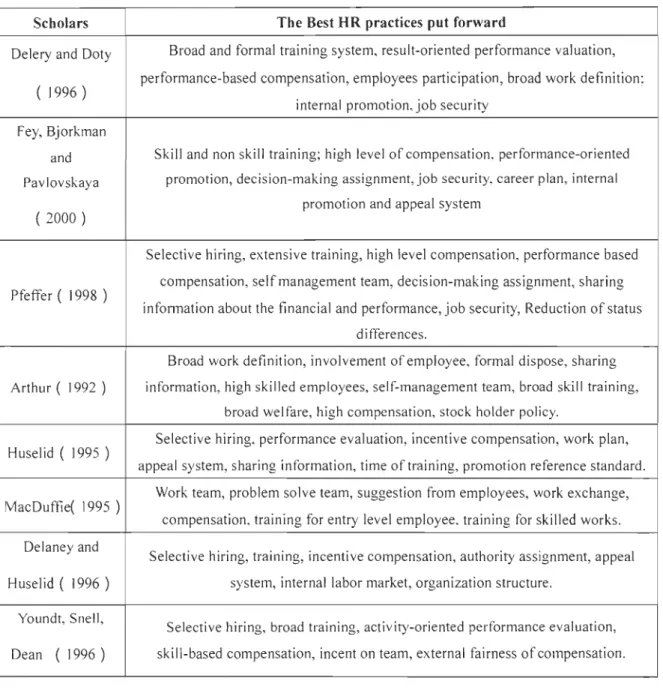
them separately. The following table presents some of the best practices provide by different