HAL Id: tel-03214800
https://tel.archives-ouvertes.fr/tel-03214800
Submitted on 2 May 2021HAL is a multi-disciplinary open access archive for the deposit and dissemination of sci-entific research documents, whether they are pub-lished or not. The documents may come from teaching and research institutions in France or abroad, or from public or private research centers.
L’archive ouverte pluridisciplinaire HAL, est destinée au dépôt et à la diffusion de documents scientifiques de niveau recherche, publiés ou non, émanant des établissements d’enseignement et de recherche français ou étrangers, des laboratoires publics ou privés.
heterogeneous IoT
Mohamed Ali Kandi
To cite this version:
Mohamed Ali Kandi. Lightweight key management solutions for heterogeneous IoT. Cryptography and Security [cs.CR]. Université de Technologie de Compiègne, 2020. English. �NNT : 2020COMP2575�. �tel-03214800�
Par Mohamed Ali KANDI
Thèse présentée
pour l’obtention du grade
de Docteur de l’UTC
Lightweight key management solutions for
heterogeneous IoT
Soutenue le 14 décembre 2020
Spécialité : Informatique et Sciences et Technologies de
l’Information et des Systèmes : Unité de recherche Heudyasic
UNIVERSIT´
E DE TECHNOLOGIE DE COMPI`
EGNE
Sp´ecialit´e : Informatique et Sciences et Technologies de l’Information et des Syst`emes
Lightweight Key Management Solutions for
Heterogeneous IoT
14/12/2020
Par Mohamed Ali KANDI
Composition du jury:
Abdelamadjid BOUABDALLAH Professeur des universit´es, Universit´e de Technologie de Compi`egne
Directeur de Th`ese
Karima BOUDAOUD Maˆıtre de conf´erences, Uni-versit´e de Nice
Examinatrice
Bernard COUSIN Professeur des universit´es, Universit´e de Rennes
Rapporteur
Romain LABORDE Maˆıtre de conf´erences HDR, Universit´e de Toulouse
Rapporteur
Hicham LAKHLEF Maˆıtre de conf´erences, Uni-versit´e de Technologie de Compi`egne
Co-Directeur de Th`ese
Dritan NACE Professeur des universit´es, Universit´e de Technologie de Compi`egne
Journal article
• Mohamed Ali Kandi, Hicham Lakhlef, Abdelmadjid Bouabdallah, and Yacine Challal. “A Versatile Key Management Protocol for Secure Group and Device-to-Device Communication in the Internet of Things”. In: Journal of Network and Computer Applications 150 (2020).
International conferences
• Mohamed Ali Kandi, Hicham Lakhlef, Abdelmadjid Bouabdallah, and Yacine Challal. “An Efficient Multi-Group Key Management Protocol for Internet of Things”. In: 26th IEEE International Conference on Software, Telecommunications and Computer Networks (SoftCOM). Split, Croatia, Sep. 2018.
• Mohamed Ali Kandi, Hicham Lakhlef, Abdelmadjid Bouabdallah, and Yacine Challal. “An Efficient Multi-Group Key Management Protocol for Het-erogeneous IoT Devices”. In: IEEE Wireless Communications and Networking Conference (WCNC). Marrakech, Moroco, Avr. 2019.
• Mohamed Ali Kandi, Hicham Lakhlef, Abdelmadjid Bouabdallah, and Yacine Challal. “A Key Management Protocol for Secure Device-to-Device Communication in the Internet of Things”. In: IEEE Global Communications Conference (Globecom). Waikoloa, USA, Dec. 2019.
International workshop
• Mohamed Ali Kandi, Djamel Eddine Kouicem, Hicham Lakhlef, Abdelmad-jid Bouabdallah, and Yacine Challal. “A Blockchain-based Key Management Protocol for Secure Device-to-Device Communication in the IoT”. In: proceed-ings of the 19th IEEE International Conference on Trust, Security and Privacy in Computing and Communications (TrustCom)/ International Workshop on Cyberspace Security (IWCSS). Guangzhou, China, Dec. 2020.
Submitted article
• Mohamed Ali Kandi, Djamel Eddine Kouicem, Messaoud Doudou, Hicham Lakhlef, Abdelmadjid Bouabdallah, and Yacine Challal. “A Decentralized Blockchain-based Key Management Protocol for Heterogeneous and Dynamic IoT Devices”. In: IEEE Transactions on Dependable and Secure Computing. Submitted.
The Internet of Things (IoT) is an emerging technology that has the potential to improve our daily lives in a number of ways. It consists of extending connectivity beyond standard devices (such as computers, tablets and smartphones) to all everyday objects. The IoT devices, also called smart objects, can collect data from their surroundings, collaborate to process them and then act on their environment. This increases their functionalities and allow them to offer various services for the benefit of society. However, many challenges are slowing down the development of the IoT. Securing communication between its devices is one of the hardest issue that prevents this technology from revealing its full potential. Cryptography provides a set of mechanisms to secure data. For their proper function-ing, these mechanisms require secret parameters called keys. The Key Management is a branch of cryptography that encompasses all operations involving the handling of these keys: generation, storage, distribution and replacement. Lightweight cryptography con-sists of extending the conventional mechanisms (including the Key Management) to the resource-limited devices. To be efficient in the IoT, the new mechanisms must offer a good compromise between security, performance and resource requirements. Lightweight Key Management is the essence of secure communication in the IoT and the core of our work. In this thesis, we propose a novel lightweight Key Management protocol to secure commu-nication between the heterogeneous and dynamic IoT devices. To design our solution, we consider three modes of communication: device-to-device, group and multi-group commu-nication. While most of the related works focus only on one of these modes of communi-cation, our solution efficiently secures all three of them. It also automatically balances the loads between the heterogeneous devices according to their capabilities. We then prove that this makes our protocol more suitable for the IoT as it is efficient and highly scal-able. Furthermore, we propose a decentralization of our protocol based on the blockchain technology and smart contracts. We show that, by empowering multiple participants to manage the cryptographic keys, decentralization solves trust issues, lowers risk of system failure and improves security. We finally implement our solution on resource-constrained IoT motes that are based on the Contiki operating system. The objective is to experimen-tally evaluate the performance of our solution and to complete our theoretical analyses.
Keywords: Internet of things, Security, Lightweight cryptography, Key Management, Blockchain.
L’Internet des objets (IdO) est une technologie ´emergente ayant le potentiel d’am´eliorer notre quotidien de diff´erentes fa¸cons. Elle consiste `a ´etendre la connectivit´e au-del`a des appareils standards (tels que les ordinateurs, les tablettes et les smartphones) `a tous les objets du quotidien. Ces appareils, ´egalement appel´es objets intelligents, peuvent alors collecter des donn´ees de leur entourage, collaborer pour les traiter puis agir sur leur environnement. Cela augmente leurs fonctionnalit´es et leur permet d’offrir divers services au profit de la soci´et´e. Cela dit, de nombreux d´efis ralentissent le d´eveloppement de l’IdO. La s´ecurisation des communications entre ces appareils est l’un des probl`emes les plus difficiles qui empˆeche cette technologie de r´ev´eler tout son potentiel.
La cryptographie fournit un ensemble de m´ecanismes permettant de s´ecuriser les donn´ees. Pour leur bon fonctionnement, ces derniers ont besoin de param`etres secrets appel´es cl´es. La gestion des cl´es est une branche de la cryptographie qui englobe toutes les op´erations impliquant la manipulation de ces cl´es: g´en´eration, stockage, distribution et remplacement. Par ailleurs, la cryptographie l´eg`ere consiste `a ´etendre les m´ecanismes conventionnels (la gestion des cl´es comprise) aux appareils `a ressources limit´ees. Afin d’ˆetre efficaces dans l’IdO, les nouveaux m´ecanismes doivent offrir un bon compromis entre s´ecurit´e, performance et consommation de ressources. La gestion l´eg`ere des cl´es est donc l’essence de la communication s´ecuris´ee dans l’IdO et le cœur de notre travail.
Dans cette th`ese, nous proposons un nouveau protocole l´eger de gestion des cl´es pour s´ecuriser la communication entre les appareils h´et´erog`enes et dynamiques de l’IdO. Pour concevoir notre solution, nous consid´erons trois modes de communication: d’appareil `a appareil, de groupe et de multi-groupes. Alors que la plupart des travaux connexes se concentrent uniquement sur l’un de ces modes de communication, notre solution s´ecurise efficacement les trois. Aussi, elle ´equilibre automatiquement les charges entre les appareils h´et´erog`enes en fonction de leurs capacit´es. Nous prouvons alors que cela rend notre proto-cole plus adapt´e `a l’IdO ´etant donn´e qu’il est efficace et hautement ´evolutif. De plus, nous proposons une d´ecentralisation de notre protocole bas´ee sur la technologie blockchain et les contrats intelligents. Ainsi, nous montrons qu’en permettant `a plusieurs participants
de g´erer les cl´es cryptographiques, la d´ecentralisation r´esout les probl`emes de confiance, r´eduit le risque de d´efaillance du syst`eme et am´eliore la s´ecurit´e. Nous impl´ementons enfin notre solution sur des platformes IoT `a ressources limit´ees qui sont bas´ees sur le syst`eme d’exploitation Contiki. L’objectif est d’´evaluer exp´erimentalement les performances de notre solution et de compl´eter nos analyses th´eoriques.
Mots Cl´es : Internet des Objets, S´ecurit´e, Cryptographie l´eg`ere, Gestion des cl´es, Blockchain.
List of Publications iii
Abstract v
R´esum´e vii
Contents ix
List of figures xvii
List of tables xxi
List of algorithms xxiii
1 Introduction 1
1.1 Motivations . . . 1
1.2 Research topic . . . 2
1.3 Our contributions . . . 3
1.4 Organization of the manuscript . . . 4
2 General context 5 2.1 Introduction . . . 6
2.2 Fundamentals of the Internet of Things . . . 7
2.2.1 IoT architecture . . . 7 ix
2.2.2 IoT features . . . 8
2.2.3 IoT applications . . . 10
2.2.4 Top IoT challenges . . . 11
2.3 Fundamentals of Network Security . . . 12
2.3.1 Network security objectives . . . 12
2.3.2 Network security attacks . . . 13
2.3.3 Network security and cryptography . . . 14
2.3.3.1 Ciphers . . . 14
2.3.3.2 Hash functions . . . 15
2.3.3.3 Key derivation functions . . . 16
2.4 Blockchain . . . 17 2.4.1 Blockchain structure . . . 17 2.4.2 Blockchain architecture . . . 18 2.4.3 Blockchain features . . . 19 2.4.4 Blockchain consensus . . . 20 2.4.5 Smart contracts . . . 21 2.5 Conclusion . . . 22
3 Key Management in the IoT: Classification and Challenges 23 3.1 Introduction . . . 24
3.2 Fundamentals of Key Management . . . 25
3.2.1 Generation . . . 25
3.2.2 Storage . . . 26
3.2.3 Distribution . . . 26
3.3 Key Management and IoT . . . 27
3.3.1 Lightweight cryptography . . . 27
3.3.2 IoT requirements for the Key Management . . . 28
3.4 Key Management classification . . . 30
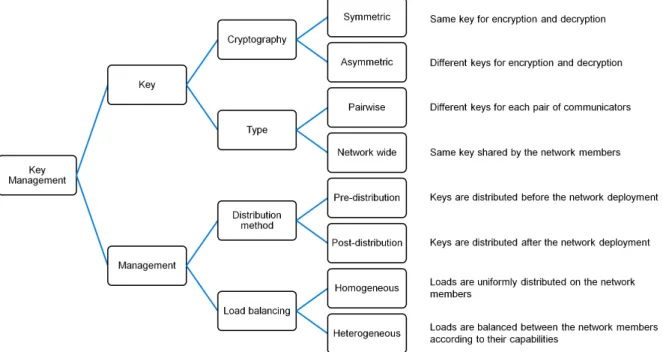
3.4.1 Classification criteria . . . 30 3.4.1.1 Key cryptography . . . 30 3.4.1.2 Key type . . . 31 3.4.1.3 Distribution method . . . 32 3.4.1.4 Load balancing . . . 33 3.4.2 Proposed classification . . . 34
3.5 Key Management challenges in the IoT . . . 37
3.6 Our contributions . . . 38
3.6.1 Notations . . . 39
3.6.2 Application and threat model . . . 40
3.7 Conclusion . . . 41
4 Dynamic Key Management for Secure Device-to-Device Communica-tion 43 4.1 Introduction . . . 44
4.2 Related Works . . . 45
4.2.1 Deterministic schemes . . . 45
4.2.2 Pure probabilistic schemes . . . 45
4.2.3 Deployment knowledge based schemes . . . 46
4.3 Our solution . . . 47
4.3.2 Hash functions . . . 49 4.3.2.1 Zero-level approach . . . 49 4.3.2.2 One-level approach . . . 49 4.3.2.3 Two-level approach . . . 50 4.3.3 Set management . . . 52 4.3.3.1 Assignment Algorithm . . . 52 4.3.3.2 Reorder Algorithm . . . 53 4.3.4 Node management . . . 54 4.3.4.1 Node joining . . . 54 4.3.4.2 Node leaving . . . 55 4.4 Security analysis . . . 57 4.4.1 Theoretical analysis . . . 57 4.4.1.1 Zero-level approach . . . 57 4.4.1.2 One-level approach . . . 58 4.4.1.3 Two-level approach . . . 59 4.4.2 Comparison . . . 60 4.5 Performance evaluation . . . 61 4.5.1 Theoretical analysis . . . 61
4.5.1.1 Overheads on the Key Manager . . . 61
4.5.1.2 Overheads on the nodes . . . 62
4.5.2 Comparison . . . 62
4.5.2.1 Scalability . . . 63
4.5.2.2 Connectivity . . . 63
4.5.2.4 Efficiency . . . 64
4.5.2.5 Flexibility . . . 65
4.6 Conclusion . . . 65
5 Heterogeneous Key Management for Secure Group Communication 67 5.1 Introduction . . . 68
5.2 Related Works . . . 69
5.2.1 Tree based schemes . . . 69
5.2.2 Combinatorial optimization based schemes . . . 70
5.2.3 Batch rekeying based schemes . . . 70
5.3 Our solution . . . 71
5.3.1 Classification of cryptographic keys . . . 72
5.3.2 Subgroup Management . . . 73
5.3.2.1 Capability Evaluation Function . . . 74
5.3.2.2 Heterogeneous subgrouping . . . 74 5.3.2.3 Assignment Algorithm . . . 76 5.3.2.4 Reorder Algorithm . . . 79 5.3.3 Node management . . . 80 5.4 Security analysis . . . 81 5.4.1 Backward secrecy . . . 81 5.4.2 Forward secrecy . . . 81 5.4.3 Collusion resistance . . . 82 5.5 Performance evaluation . . . 82 5.5.1 Theoretical analysis . . . 82
5.5.1.2 Overheads on nodes . . . 83
5.5.2 Simulation . . . 84
5.5.3 Comparison . . . 86
5.5.3.1 Efficiency and scalability . . . 87
5.5.3.2 Heterogeneity . . . 88
5.6 Conclusion . . . 89
6 Blockchain-Based Decentralized Key Management for secure Multi-group Communication 91 6.1 Introduction . . . 92
6.2 Related Works . . . 93
6.2.1 Multi-Group Key Management schemes . . . 93
6.2.2 Blockchain solutions . . . 93
6.3 Our solution . . . 94
6.3.1 Layer 1: Key Management . . . 95
6.3.1.1 Group and service management . . . 95
6.3.1.2 Classification of cryptographic keys . . . 96
6.3.1.3 Node Management . . . 97
6.3.1.4 Subgroup management . . . 97
6.3.2 Layer 2: Blockchain Management . . . 98
6.3.2.1 Transaction management upon network change . . . 99
6.3.2.2 Consensus Algorithm . . . 100
6.3.2.3 Blockchain interest . . . 101
6.4 Security analysis . . . 103
6.4.2 Resilience against node capture . . . 104
6.4.2.1 Theoretical analysis . . . 104
6.4.2.2 Comparison . . . 105
6.4.3 Resilience against BP capture . . . 105
6.4.3.1 Theoretical analysis . . . 105
6.4.3.2 Comparison . . . 106
6.5 Performance evaluation . . . 107
6.5.1 Overheads on the Key Manager . . . 107
6.5.2 Overheads on nodes . . . 108
6.6 Conclusion . . . 109
7 Experimentation 111 7.1 Introduction . . . 112
7.2 Software environment . . . 113
7.3 Operating system: Contiki . . . 114
7.3.1 Processes . . . 114 7.3.2 Events . . . 114 7.3.3 Network Stack . . . 115 7.3.4 PowerTrace . . . 115 7.3.5 Cooja . . . 116 7.4 Material resource . . . 116 7.5 Experimental platform . . . 119 7.5.1 Key Manager . . . 119 7.5.2 Nodes . . . 119 7.5.3 Intermediate motes . . . 120
7.6 Experimental results . . . 121
7.6.1 Response time of BPs . . . 121
7.6.2 Storage overhead on nodes . . . 123
7.6.3 Execution time on nodes . . . 124
7.6.4 Energy consumption by nodes . . . 125
7.7 Conclusion . . . 127
8 Conclusion and future works 129
2.1 IoT architecture. . . 7
2.2 IoT features. . . 8
2.3 IoT communication technologies. . . 9
2.4 Top IoT challenges. . . 11
2.5 Network security objectives. . . 12
2.6 Network security attacks. . . 13
2.7 Cryptographic hash functions. . . 16
2.8 Blockchain. . . 17
2.9 Client-server vs peer-to-peer networks. . . 18
2.10 Normal contract vs smart contract. . . 21
3.1 Key generation. . . 25
3.2 Lightweight Key Management. . . 27
3.3 IoT communication modes. . . 28
3.4 Classification criteria. . . 30
3.5 Key cryptography. . . 31
3.6 Key Type. . . 32
3.7 Distribution method. . . 33
3.8 Load balancing. . . 33
3.9 IoT network (Key Manager and nodes). . . 39 xvii
4.1 Key Management approaches for secure device-to-device communication. . . 46
4.2 Our device-to-device Key Management. . . 47
4.3 Example of node distribution in a network N . . . 48
4.4 One-level approach. . . 50
4.5 Two-level approach. . . 51
4.6 Node joining and leaving. . . 56
4.7 An example of communications a node can decrypt. . . 57
4.8 An example of communications the node 3 cannot decrypt. . . 59
4.9 Variation of the percentage of compromised links. . . 60
4.10 Variation of nodes’ storage overhead according to n. . . 63
4.11 Variation of the average path length according to the size of the key ring. . . 64
5.1 Tree based schemes. . . 69
5.2 Key Management approaches for secure group communication. . . 70
5.3 Example of a group partitioning. . . 71
5.4 Our group Key Management. . . 72
5.5 Example of a group partitioned into three subgroups. . . 76
5.6 Example of a subgroup splitting. . . 78
5.7 Effect of the number of nodes on the value of p. . . 85
5.8 Effect of the maximum capability of nodes on the value of p. . . 85
5.9 Effect of the percentage of merging on the value of p. . . 86
5.10 Effect of the subgrouping type on the value of p. . . 86
5.11 Efficiency and scalability. . . 87
6.2 Network partitioning. . . 96
6.3 Example of a blockchain transaction. . . 98
6.4 Decentralized rekeying upon a network change using a blockchain. . . 100
6.5 Rejoin exchange. . . 102
6.6 Resilience against node capture. . . 105
6.7 Resilience against BP capture. . . 106
7.1 Structure of a Contiki process. . . 114
7.2 Rime stack overview. . . 115
7.3 Network components. . . 119
7.4 Key Manager. . . 119
7.5 Network partitioning. . . 120
7.6 Experimental platform. . . 120
7.7 Effect of r on response time. . . 121
7.8 Effect of nst on response time. . . 122
7.9 Effect of cp on response time. . . 122
2.1 Types of blockchain architecture. . . 19 3.1 IoT requirements for the Key Management. . . 29 3.2 Classification notations . . . 34 3.3 Classification of existing solutions . . . 36 3.4 Summary of notations. . . 39 4.1 Classification of cryptographic keys. . . 48 5.1 Example of keys held by nodes. . . 72 7.1 IoT mote specifications. . . 118 7.2 Storage overhead on nodes (Keys stored in the RAM). . . 123 7.3 Storage overhead on nodes (Keys stored in the flash). . . 124 7.4 Execution time on nodes (Keys stored in the RAM). . . 125 7.5 Execution time on nodes (Keys stored in the flash). . . 125 7.6 Energy consumption by nodes (Keys stored in the RAM). . . 125 7.7 Energy consumption by nodes (Keys stored in the flash). . . 126 7.8 Battery life. . . 126
1 Homogeneous Assignment Algorithm . . . 53 2 Homogeneous Reorder Algorithm . . . 54
3 Heterogeneous Assignment Algorithm . . . 77 4 Heterogeneous Reorder Algorithm . . . 80
5 Consensus Algorithm . . . 100
Introduction
We are about to wake up to a new world. A world where, not only computers, but everything will be contacted to the Internet. From our clothing and appliances to our vehicles and buildings. A world where everyday objects will be so smart that they will be able to automatically interact with their environment and communicate with each other. They will be able to collect data from their surrounding, collaborate to process them and then act on their environment. This increases their functionalities and allow them to offer various services for the benefit of society, which until then were not able to provide. Known as the Internet of Things (or the IoT), this emerging technology promises to improve our daily lives in a number of ways. Smart homes, for example, involve using smart devices to ensure comfort, convenience and energy efficiency to the homeowners. Autonomous vehicles are able to automatically exchange data to maintain traffic flow and avoid crashes. However, many challenges are slowing down the development of the Internet of Things. Securing communication between its devices is one of the hardest issue that prevents this technology from revealing its full potential.
1.1
Motivations
Network security consists of designing mechanisms to protect the data in motion from malicious attacks. In fact, securing communication is an old issue that existed long before the Internet of Things. It is as old as the computer networks themselves. Since then, there have always been people who target computer information systems, with or without malicious intent. Security becomes more and more complex as the motivations and capabilities of threat actors continue to evolve. The Internet of Things, despite its many benefits, has only made this task even more challenging. Today, securing communication is the primary concern of the Internet of Things developers and one of the main challenges that are slowing down the expansion of the technology [51]. This is mostly due to the three following reasons:
Increasing number of devices: The number of devices connected to the Internet is constantly increasing since its appearance. If all everyday objects will also be connected, this number will explode in the years to come. According to the Cisco Annual Internet Report [35], around 30 billion devices will be connected to the Internet by 2023 (up from 18 .4 billion in 2018). This growing number of connected objects will necessarily generate a huge amount of data, which makes their protection much more challenging.
Wireless and mobile devices: Nowadays, mobile devices are evolving at lightning speed. This is largely due to the Internet of Things, since its very nature favors mobile to desktop devices. According to the Cisco Annual Internet Report [35], nearly 45 % of the devices that will be connected to the Internet by 2023 will be mobile (up from 30 % in 2018). On the one hand, these mobile devices necessarily require wireless communication. On the other, they must be physically small and thereby have limited energy supply. The problem is that securing communication becomes more difficult when it is wireless, especially if the energy resources are limited.
Heterogeneous devices: In addition to energy resources, the storage and computing capabilities are very varied in the Internet of things. They can also be very limited for some of its objects. Indeed, the Internet of Things devices include sophisticated servers, computers, smartphones as well as resource-constrained sensors. Balancing the level of security and performance between this variety of devices is very challenging.
1.2
Research topic
Cryptography is one of the strongest tool used to ensure security services. It includes a set of algorithms and mechanisms that are used to secure sensitive and classified data. Encryption, for example, can be applied to a block of data (plaintext) to convert it into a secret code (ciphertext) that hides the true meaning of the information. Cryptographic keys are the secret parameters that make the algorithms secure data. Like a physical key, a cryptographic one guarantees that only the entities owning it can open the door that protect the data. In encryption, for example, only people who know the right key should be able to retrieve the plaintext from a ciphertex. Therefore, for cryptography to be effective, it is important that the system that manages these keys is well designed. The Key Management is a branch of cryptography that encompasses all operations involving the handling of cryptographic keys: generation, storage, distribution and replacement [16].
The problem with cryptography, in general, is that it requires a significant amount of resources to be effective. Its algorithms can hardly be implemented in the constrained devices of the Internet of Things. Recently, a new concept, called lightweight cryptography, has appeared. It consists of expanding cryptographic mechanisms to the resource-limited devices, by designing new lightweight algorithms. These new mechanisms should be able to provide a good compromise between security, performance and resource requirements (hardware cost) [18]. The international standardization of lightweight cryptography is currently underway [96]. For lightweight cryptography to be efficient, it is essential that the Key Management can also operate over resource-limited devices. Lightweight Key Management is therefore the essence of secure communication in the Internet of Things and the core of our work.
1.3
Our contributions
In this thesis, we propose a novel lightweight Key Management protocol to secure communication between the heterogeneous and dynamic devices of the Internet of Things. To achieve this, we start by identifying the expectations of the Internet of Things from the Key Management. On this basis, we classify the related works according to different criteria. The objective is to clearly present the remaining challenges and to propose new solutions to overcome them. We then show that our protocol is more suitable for the Internet of Things than the existing ones. We also implement it on resource constrained IoT motes that are based on the Contiki operating system. The aim is to experimentally evaluate the performance of our protocol and to complete the theoretical analyses. To design our solution, we consider three modes of communication: device-to-device, group and multi-group communication. In device-to-device communication, a device communi-cates with a specific other device. In group communication, a device communicommuni-cates with a set of other devices. It can be its direct neighbors or all the network members participating in the same service. As a device can participate in several services at the same time, it may need to communicate only with those participating in a particular service. This is referred to as multi-group communication. While most of the related works only focus on one of these communication modes, our solution secures all three of them. It then considers the needs of each of them and best meets its requirements. To achieve this, we proceed in stages and propose several major contributions. These contributions are summarized in the following points:
Dynamic Key Management for secure device-to-device communication: We introduce a Key Management protocol for secure device-to-device communication in dynamic networks. Compared to the existing schemes, our solution provides a good compromise between the Internet of Things requirements: resilience, connectivity, mobility, flexibility, efficiency and scalability. To achieve this balance, the network members are uniformly distributed into logical sets. A device shares then a distinct pairwise key with each member of its set and a unique pairwise set key with the members of each of the other sets.
Heterogeneous Key Management for secure group communication: We enhance our protocol so that it also secures group communication in heterogeneous networks. Our new solution ensures the forward and backward secrecy and resists to collusion attacks. Also, by balancing the loads between the heterogeneous devices according to their capabilities, our solution becomes more efficient and highly scalable.
Blockchain-based decentralized Key Management for multi-group communica-tion: We complete our solution so that it deals with the multi-group communication. We make sure that it guarantees the secure coexistence of several services in a single network. We also propose a decentralization of our protocol based on the blockchain technology and smart contracts. Thus, the system continues to operate when an entity fails and the compromise of a participant does not jeopardize the whole network.
1.4
Organization of the manuscript
The remainder of the manuscript is organized as follows. In chapter 2, we present the general context of our work: the Internet of Things, network security and the blockchain technology. In chapter 3, we detail the Key Management and emphasis its importance in network security. We also propose a classification of the existing solutions and identify the challenges they face in the Internet of Things. In chapter 4, we introduce a dynamic Key Management protocol for secure device-to-device communication in the Internet of things. In chapter 5, we present a heterogeneous Key Management protocol for secure group communication in the Internet of Things. In chapter 6, we introduce a blockchain-based decentralized Key Management protocol for multi-group communication in the Internet of Things. In chapter 7, we propose an implementation of our solution considering the Contiki operating system and resource constrained IoT platforms. Finally, we conclude our work, in chapter 8, and present the main future work directions and open issues.
General context
In this chapter, we present the general context of our work and define the main concepts necessary to understand the rest of the manuscript. The first notion we introduce is the Internet of Things (IoT). This is a network made up of a large number of everyday objects, which are able to automatically communicate to computer systems, people and each other. The aim is to provide various services for the benefit of society. One of the main challenges that are slowing down the development of the IoT is how to secure communication between its devices. This leads us to the second concept related to our work, which is network security. Network security consists of designing a set of mechanisms to protect the network against existing and emerging threats. Some security protocols require a third party to function properly. This causes several problems, namely the dependence of a single point of failure and the need to trust a central entity. The blockchain, which is the last concept we introduce in this chapter, is a solution to these issues. It is a decentralized and secure storage technology. Based on smart contracts, the blockchain can be used to securely replicate an application on several entities.
2.1
Introduction
The number of devices connected to Internet is constantly increasing since its appearance. Now that this number far exceeds that of people in the world, we are no longer talking about Internet but about Internet of Things (IoT). The IoT devices, commonly called smart objects, are everyday objects that are able to automatically communicate to computer systems, people and each other. To achieve this, many software and hardware technologies are emerging. The IoT gives rise to revolutionary applications such as health care, environment monitoring, smart homes and smart cities. The aim is to provide various services for the benefit of society. One of the main challenges facing the development of the IoT is how to secure communication between this huge number of smart objects [51]. Network security consists of designing a set of policies and mechanisms to protect the network against existing and emerging threats. Although it is a fairly old discipline, it remains an open issue and the subject of numerous research. It gets even more complex over time since the motivations and capacities of threat actors continue to evolve. Despite its benefits, the IoT has exacerbated this problem even more. This is due to the wireless nature of communications, the limited resources of its devices and many other reasons [141]. Some security protocols require a third party for proper functioning. This creates several problems, namely the dependence of a single point of failure and the need to trust a central entity. The blockchain, which is a decentralized and secure storage technology, is a solution to these issues.
The term blockchain first appeared in Nakamoto’s Bitcoin paper describing a new decentralized cryptocurrency [93]. The technology started then to be used in various applications. The blockchain is composed of a chain of blocks, each storing a cryptographic hash of the previous one. To guarantee that each network member records the same transactions in the same order, consensus algorithms are used. They define a set of rules to achieve overall system reliability in the presence of a number of faulty participants. The blockchain technology also allows the implementation of smart contracts. These are computer programs that are defined beforehand and stored in the blockchain. They can be run, automatically and in a decentralized way, by the blockchain participants to execute the settlement of a contract between organizations, people or objects.
The remainder of this chapter is organized as follows. Section 2.2 presents the fundamen-tals of the Internet of Things. Section 2.3 introduces the fundamenfundamen-tals of network security. Section 2.4 presents the blockchain technology and smart contracts. Section 2.5 concludes the chapter.
2.2
Fundamentals of the Internet of Things
The Internet of Things (IoT) is an emerging technology that promises to make our daily lives more comfortable in many ways. It aims to extend connectivity beyond standard devices (such as computers, tablets and smartphones) to all everyday objects. These devices, commonly known as smart objects, can then automatically collect data from their environment, store it, process it and even exchange it with each other. This enhances their functionalities and makes them able to offer new services to society, which until then were not able to provide.
2.2.1
IoT architecture
The common IoT architecture is composed of three layers: devices, gateways and cloud (Figure 2.1).
Figure 2.1– IoT architecture.
Devices: The IoT devices, or smart objects, are everyday devices improved to increase their functionality (See section 2.2). A smart object involves an exchange between the physical and the digital words [72]. Let us take as example an alarm clock. If it is not smart, we can only set it to a specific time and it will alert us when the time comes. If the alarm clock is smart then it will be able to interact with its environment and communicate to other smart objects. It can, for example, communicate to the lighting so it gradually brightens our room in the morning. It can also communicate to the coffee maker and the heating, so that our place is warm and our coffee is ready and hot for us when we wake up. The IoT devices have the particularity of being heterogeneous (They are based on different technologies) and usually suffer from a lack of resources. For these reasons, IoT gateways are required [149].
Gateways: The IoT gateways are more powerful equipment than the IoT devices. They are mainly used as intermediate between other components. They can be used to translate communication between the heterogeneous devices if they need to exchange their data. They can also be used to store and process the data that the IoT devices can not handle for lack of capacity (whether in terms of storage or calculation). Finally, the IoT gateways can act as a middle layer between devices and cloud to protect the system from malicious attacks and unauthorized access [149].
Cloud: The IoT cloud is a sophisticated high performance network of servers optimized to perform high speed data processing and deliver accurate analyses. They are mainly used instead of gateways for two reasons: efficiency and remote access. The number of IoT devices being constantly increasing, the gateways may not be enough to efficiently manage the huge amount of data collected by all these devices. The IoT cloud offers then tools to collect, process, manage and store massive data in real time. Furthermore, the final user may need data collected by devices located far away. The IoT cloud can solve this problem by allowing remote access to the data collected by the devices [106].
2.2.2
IoT features
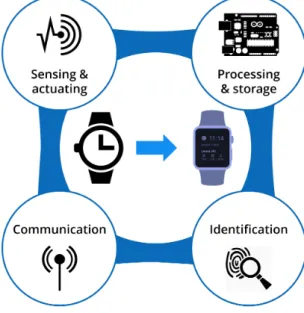
There are mainly four features that distinguish a smart object (IoT device) from a normal object: interaction with the environment (sensing and actuation), data management (processing and storage), communication and identification [72] (Figure 2.2).
Interaction with the environment: To be able to interact with its environment, i.e. collect data from it and act on it, a smart object must be equipped with sensors and actuators [52]. A sensor is an electronic device whose purpose is to detect events or changes in its environment. It is able to convert a physical, biological or chemical parameter (e.g. velocity, GPS coordinates, temperature, humidity, etc...) into an electrical signal that can be stored and processed by the device. On the opposite, an actuator transforms an electric signal into a physical parameter. Sensors and actuators act then as a bridge between the physical and the digital words.
Data management: Although most of calculation and storage are done on gateways and the cloud, smart objects are usually equipped with microcontrollers and non-volatile memories for local computing and storage [54]. The aim is to allow them to locally process the data they can handle and to autonomously make some decisions. This on-device intelligence will reduce network traffic and thereby energy consumption. Communication: Smart objects must be able to communicate with each other and
with the rest of IoT components. For this purpose, a number of different wireless communication technologies have been developed. They can be classified according to two axes: signal range and energy consumption [116] (Figure 2.3). Although a high-range communication provides a better connectivity, it is less secure. Indeed, it is easier to capture the traffic between two communicators. Low energy consumption technologies are usually more suitable for communications involving the IoT resource-constrained devices. However, they cannot achieve a high data rate.
Figure 2.3 – IoT communication technologies.
Identification: To communicate, smart objects need to be able to identify one another. An identifier is like an electronic fingerprint that can take the form of a name, an address or a code. Several technologies are used to uniquely identify smart objects. Barcodes, for example, are optical representation of data, while RFID use Radio Frequency [66]. Therefore, unlike a barcode, an RFID tag does not need to be within the line of sight of the reader and my operate hundreds of meters from it.
2.2.3
IoT applications
The IoT makes possible the development of a huge number of applications, which have the potential to improve our lives. We can cite as examples: smart homes and cities, smart vehicles, smart health and smart environment.
Smart homes and cities: Smart objects distributed in houses and cities can make our lives more comfortable [55]. The room lighting can automatically change according to time of day. The heating may be adapted to our preferences and to the weather. Energy can be saved by automatically switching off the electrical equipments when not needed. Domestic incidents may be avoided with appropriate monitoring and alarm systems. Smart objects have also the ability to improve our cities. The standby lightning can switch on only when someone walks by. The air pollution and the CO2 emissions may also be controlled to improve the environment [119].
Smart vehicles: Smart objects can be used by vehicles to sense their environment and autonomously navigate without human intervention. This will relieve travelers from driving and reduce accidents due to human errors [6]. Smart vehicles can also communicate with each other to control traffic, minimize congestion, find parking spots and avoid crashes.
Smart health: The global population is aging and the number of chronic diseases is increasing [100]. Basic healthcare will become out of reach to most people in the future. To resolve this problem, the IoT can be used to move the medical checks from hospitals to the patients’ home. This will save a lot of time on both sides. Patients can then be provided with smart objects, which automatically collect health data (e.g. blood pressure, weight and blood sugar level) and share it with authorized people. These devices can also automatically alert hospitals in the case of a medical emergency like heart failure, diabetes, asthma attacks. Old people will be able to live without fear of not being able to call for help when they are alone.
Smart environment: Smart objects can be used to control and monitor the environment. They may detect a forest fire as soon as it starts. They then automatically deliver warning alarms so that firefighters can act before the fire spread. Smart objects can also be used to track endangered animals. Thus, they may live in their natural habitat, while being monitored all the time [95]. The IoT devices can also be deployed in ponds and tanks to monitor different parameters in real-time. The quality of the water can then be controlled to prevent some diseases that could affect people and animals.
2.2.4
Top IoT challenges
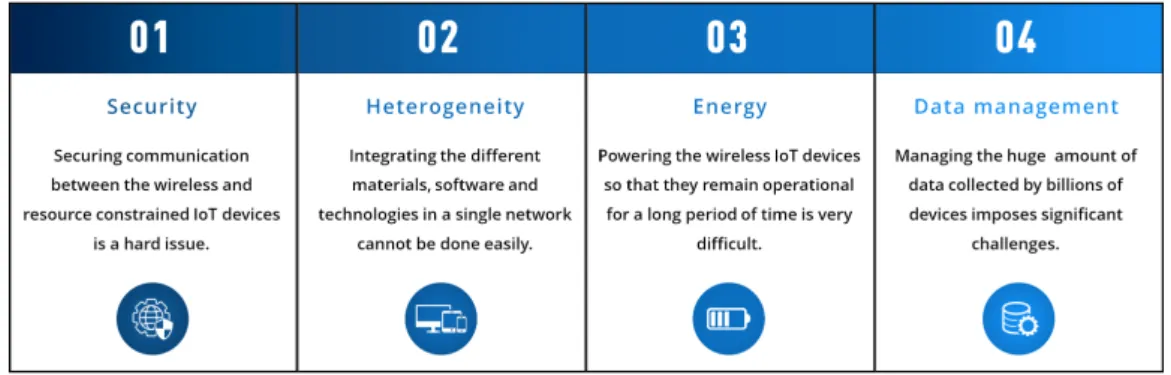
Although some of the IoT applications are currently available in our society, many challenges are slowing down their development. The main concerns of the IoT developers are [51]: data management, energy consumption, heterogeneity and especially security (Figure 2.4).
Figure 2.4– Top IoT challenges.
Data Management: In the future, billions of devices will be connected to the Internet. Managing the huge amount of heterogeneous data they can collect imposes significant challenges, especially when time, resource, and processing capabilities are limited. Energy consumption: In most of the IoT applications, devices need to run in complete
autonomy for several months or possibly years. However, these devices are usually wireless and limited by their small physical size. Consequently, they have restricted battery energy supply. It is therefore really difficult to power these devices to keep them operational for a long period of time.
Heterogeneity: Companies develop IoT protocols and materials independently of each other. This results in many different technologies that usually cannot integrate with one another. This lack of compatibility becomes a real issue. For example, as presented in the previous section, the IoT devices can use various communication technologies. These technologies being spread over different frequency, it is not possible to make all the IoT devices communicate directly.
Security: The IoT devices are vulnerable to cyber-attacks. Another task for engineers is then to secure them, especially when they collect sensitive data. However, having constrained computational resources, it is not possible to install any antivirus software on the IoT devices and the sophisticated security mechanisms are not efficient on them. Therefore, there is a need to design alternative security methods that are at least just as effective as the existing ones, while requiring fewer resources.
2.3
Fundamentals of Network Security
Security is the primary concern of the IoT developers and one of the main challenges that are slowing down the expansion of this technology [51]. Even before the appearance of the IoT, securing sensitive and classified data was considered as a major issue. It is becoming more and more complex since the motivations and capabilities of threat actors continue to evolve. The data to be protected can be either in rest (sitting on storage media) or in motion (moving across the network). Network security consists of designing mechanisms to protect the data in motion from attacks and to fulfil a certain number of objectives.
2.3.1
Network security objectives
Network security objectives usually involve three basic concepts, commonly referred to as the CIA triad [88]: confidentiality, integrity and availability (Figure 2.5).
Confidentiality: Confidentiality means that only the authorized entities must be able to view sensitive and classified data. Any other party must not be able to understand these data even if it can access them.
Integrity: Integrity means that only the authorized entities must be able to modify sensitive and classified data. An unauthorized modification on them must be detected. Availability: Availability means that the data and system must be accessible to the authorized entities all the time. It must be available even in case of attempted attack or equipment failure.
2.3.2
Network security attacks
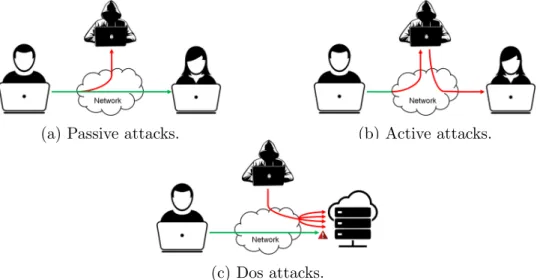
There are a number of threats that jeopardize the network security. Depending on the above-mentioned objectives, the network attacks can be classified into three categories [131]: passive, active and denial of service attacks.
Passive attacks: Passive attacks compromise confidentiality. They are usually based on eavesdropping as the attacker aims to access the data illegally without altering it (Figure 2.6a). Packet capturing and port scanning are examples of such attacks. In a packet capturing attack, the attacker captures the data packets crossing the network. He will then be able to read sensitive data like passwords or card numbers. In a port scanning attack, the attacker starts by searching for the TCP or UDP ports that are open on the target system. After that, he tries to discover the services running on these ports and the vulnerabilities in the software used.
Active attacks: Active attacks compromise integrity. They are usually considered as more dangerous attacks since the attacker does not just access the data but also modifies it (Figure 2.6b). He can then delete its content or inject new one. Man-in-the-middle attack is an example of such attacks. The attacker puts himself between two communicators to manipulate the packets exchanged between them.
Denial of service attacks: Denial of service (Dos) attacks aim to prevent a system from functioning properly and therefore compromise availability (Figure 2.6c). These attacks try to overwhelm the system by monopolizing or exhausting its resources. DoS attacks can be more severe if they are executed in a distributed manner.
(a) Passive attacks. (b) Active attacks.
(c) Dos attacks.
2.3.3
Network security and cryptography
Cryptography is one of the strongest tool used to provide security services. It is considered both as an art of secret writing and a science used to protect sensitive and classified data. In addition to fulfilling two main security objectives (data confidentiality and integrity), cryptography ensures message authentication and non-repudiation [102]. In other words, it guarantees the authenticity of the author of a message and provides the proof that the announced author is the real one. Cryptography relies on two basic components: a key and an algorithm (or methodology). Keys are secret parameters that are usually known only by authorised entities. Algorithms are generally known to everyone. They are procedures that take as input data and keys and produce an output. There are mainly three kinds of such algorithms: ciphers, hash functions and key derivation functions.
2.3.3.1 Ciphers
Ciphers are mathematical algorithms that can be applied to a block of data (plaintext) to convert it into a secret code (ciphertext) that hides the true meaning of the information. Ciphers must be reversible as it must be possible to retrieve the plaintext from the ciphertext. Encryption is the name given to the operation of using a cipher to generate the ciphertext, while decryption is used to refer to the reverse operation that consists of retrieving the plaintext. Ciphers being generally known to everyone, they are based on secret cryptographic keys to ensure confidentiality. An attacker, who does not have the appropriate keys, should not be able to retrieve the plaintext from a ciphertext. Ciphers can be classified into two categories: symmetric and asymmetric.
Symmetric algorithms: Also known as secret key algorithms, they involve the use of the same key for encryption and decryption. Their effectiveness depends on the secrecy of the shared keys. As long as the sender and receiver are the only ones to know it, they can securely exchange messages. Common examples of symmetric algorithms include the following: DES [85], 3DES [59], AES [33], and Blowfish [117].
Asymmetric algorithms: Also known as public key algorithms, they use different keys for encryption and decryption. Each network member is associated with a pair of related keys: a public key which is disseminated widely and a private key known only by it. The effectiveness of these algorithms depends then on the difficulty of guessing the private key from the public one. Common examples of asymmetric algorithms include the following: RSA [107], ElGamal [44] and ECC [20].
2.3.3.2 Hash functions
Cryptographic hash functions are mathematical operations that convert a block of data of arbitrary length to a fixed-size numerical value. This value should appear random and is called message digest or simply hash value. A cryptographic hash function must satisfy the following requirements [9]:
• It must be efficiently computable, meaning that the calculation of the hash must be easy and quick;
• It must be collusion resistant, i.e. it must not give the same hash for different input data;
• It must be a one-way function, in other words it is impossible (at least difficult) to find the input data from the hash;
• It must be deterministic so that the same input always results in the same hash; • It must ensure that a small change to the input modifies the hash so that it appears
uncorrelated with the first one.
Cryptographic hash functions can be used to verify data integrity. The sender may apply such a function on a message and attach to it the resulting hash. The receiver can then run the same function on the received message and compare the obtained hash with the one he received with the message. The three most popular cryptographic hash functions are MD5 [108], SHA-1 [43] and SHA-2 [122]. Just like ciphers, these functions are usually known to everyone. Therefore, they need to be combined with secret cryptographic keys to be effective. An attacker, who does not know the key used for generating the hash, should not be able to generate the same hash. There are mainly two methods of using a cryptographic hash function along with cryptographic keys.
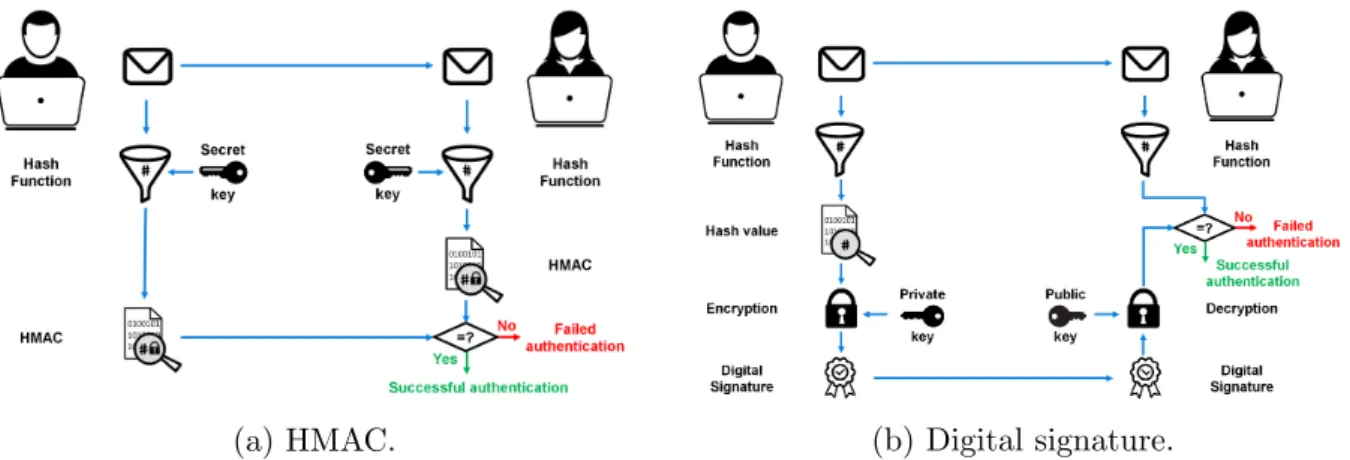
HMAC: Hashed Message Authentication Code (HMAC) protocol consists of combining a cryptographic hash function along with a shared key to calculate a code that is attached to the massage sent [74]. The receiver can then use the same key and hash function on the message and compare the result to the received code (Figure 2.7a). Thus, in addition to verifying the data integrity, the HMAC makes it possible to authenticate the sender of the message. Indeed, an attacker, who does not know the secret key, can not alter the message without being noticed since he cannot recalculate the correct hash.
Digital signature: While HMAC protocol uses symmetric keys along with a cryp-tographic hash function to generate an authentic code, digital signature uses asymmetric encryption [73]. The author of a message signs his message by hashing it and then using his private key to encrypt the obtained result. The receiver can decrypt the signature using the public key of the sender, calculate the hash of the received message and compare the two results (Figure 2.7b). If there is a match, the receiver will be able to ensure the data integrity, authenticate the sender of the message and be sure of its identity (non-repudiation). Indeed, being the only one to know his private key, no one else can generate the same digital signature.
(a) HMAC. (b) Digital signature.
Figure 2.7 – Cryptographic hash functions.
2.3.3.3 Key derivation functions
Key derivation is a process by which a cryptographic key is derived from a password, a shared secret or an other key [16]. Key derivation functions must be deterministic so that the same input data always results in the same key. They are mainly used in the following three cases:
• They can be used when key expires to update them.
• They can be used when two or more participants collaborate to generate a shared key from several shared secrets.
• Passwords being usually weak, key derivation functions can be applied to them to generate longer and more random keys.
2.4
Blockchain
Given their complementary features, more and more applications that combines the IoT and the blockchain are emerging. The blockchain is a decentralized and secure storage technology. It is often confused with Bitcoin and cryptocurrencies in general. The term blockchain indeed first appeared in Nakamoto’s Bitcoin paper describing a new decentralized cryptocurrency [93]. However, due to its many interesting characteristics, this technology is used today in various applications. We can cite as examples: food traceability, identity management and delivery of diplomas and certificates.
2.4.1
Blockchain structure
The term blockchain derives from the fact that it is composed of a chain of blocks, each storing a set of transactions and the cryptographic hash of the previous block [17] (Figure 2.8).
Transaction: It is the storage unit of the blockchain. The data stored in it depends on the application for which the blockchain is used. In Bitcoin, for example, a transaction contains data about the sender, the receiver and the amount of coins transferred. Block: It is a data structure containing a set of transactions, their cryptographic hash
and the hash of the previous block. Note that the first block does not store the hash of the previous one since there is none. In Bitcoin, for example, this is called the Genesis Block and is the first block ever created by Nakamoto himself.
Chain: It is a sequence of blocks in a specific order. The key behind blockchain’s security is the fact that its blocks are linked by their hashes. Any change in a block requires modifying the hash of all the following ones in the chain, in other words, overwriting all its content.
2.4.2
Blockchain architecture
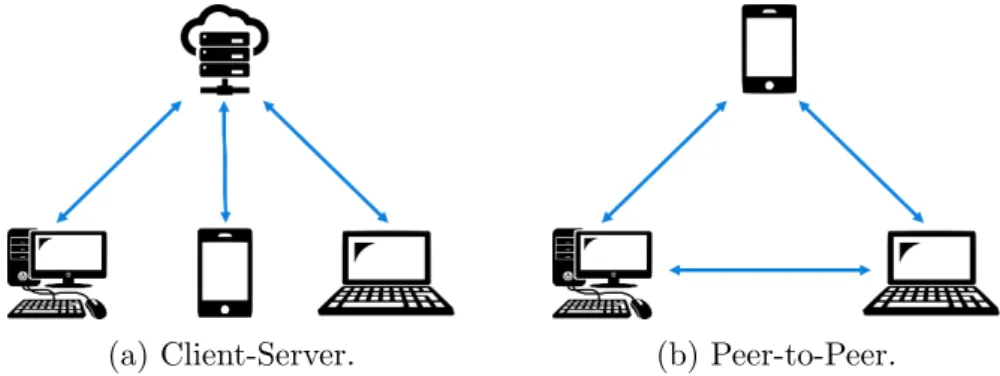
Today, many applications use a client-server network (Figure 2.9a). This architecture is centralized since all data is stored in a single machine (the server) to facilitate its management. In a blockchain decentralized architecture, on the other hand, everyone stores and participates in the data management. The system is therefore controlled by every member of a peer-to-peer network [77] (Figure 2.9b). A blockchain perfectly illustrates the notion of democratized system. Since these collaborative parties do not necessarily trust each other, the blockchain technology offers mechanisms allowing them to reach common consensus. Thanks to that, the data cannot be altered without the agreement of the whole network, or at least most of them. The blockchain architectures can be classified into three categories [115]: public, consortium and private (Table 2.1).
(a) Client-Server. (b) Peer-to-Peer. Figure 2.9 – Client-server vs peer-to-peer networks.
Public blockchain: In a public architecture, the blockchain is accessible and its data can be managed by anyone who wants to join. A large number of participants offers better immutability as it is not possible to modify the data after they have been stored in the blockchain. However, the data management requires a lot of resources. We can cite as examples of public blockchain: Bitcoin [93], Ethereum [139] and Litecoin [50]. Consortium blockchain: In a consortium architecture, the blockchain is accessible and its data can be managed only by authorized users from several organizations. With less participants, it becomes less difficult to alter the data. However, the blockchain management is more efficient. We can cite as examples of consortium blockchain: Quorum [10], Hyperledger [24] and Corda [22].
Private blockchain: In a private architecture, the blockchain is accessible and its data can be managed only by authorized users from a specific organization. With a limited number of participants, this architecture is the least secure, but the most efficient. We can cite as examples of private blockchain: Ripple [7], Tendermint [76] and Hyperledger [24].
Property Public blockchain Consortium blockchain Private blockchain Read permission Public Public or restricted Public or restricted Write permission Public Restricted Restricted Efficiency Low Medium High Immutability High Medium Low Example Bitcoin Hyperledger Tendermint
Table 2.1 – Types of blockchain architecture.
2.4.3
Blockchain features
Regardless of the architecture adopted, the number of blockchain applications is constantly increasing. The prime reason behind this is that the blockchain is coming with myriads of features making it useful in various fields. We can cite as examples [84, 134]: decentralization, immutability, traceability, anonymity, transparency and security.
Decentralization: It consists of distributing computation and storage over multiple entities. This solves the single point of failure problem and makes it difficult for anyone to compromise the system.
Immutability: It means that the data stored in the blockchain are permanent and unalterable. They cannot be neither modified nor deleted. This brings more trust between parties and more data integrity.
Traceability: It is possible to track the origin of each transaction in the blockchain. This helps to prevent from tampering with the records and to quickly identify the source of a problem when it occurs.
Anonymity: If some users wish to hide their identity, the blockchain technology allows the use of generated addresses to keep their anonymity. They can then participate in the blockchain management without giving any personally identifying information. Transparency: The blockchain content is viewable to everyone and its transactions are
identically recorded in multiple locations. This is why the blockchain is considered hacking-resistant.
Security: The blockchain uses cryptography to ensure the confidentiality of the exchanged messages. It is more precisely based on digital signatures so that its participants can verify the integrity and authenticity of the transactions.
2.4.4
Blockchain consensus
The blockchain is a distributed database managed by several participants. A copy of its content is therefore stored in the memory of each of them. Before actually adding a new block to the blockchain, all (or at least the majority) of these participants must agree on it. They accomplish this agreement through consensus algorithms. These are mechanisms based on a set of rules to guarantee that each participant record the same blocks in the same order. The existing consensus algorithms can be classified into two categories [17]: leader-based mechanisms and byzantine fault tolerance-based algorithms.
Leader-based mechanisms: In this class of algorithms, the participants compete to elect the leader that will validate the next block. Proof of work (PoW) [93], as an example of such mechanisms, is mainly used in cryptocurrencies such as Bitcoin. Before adding a new block to the blockchain, each of its participants tries to solve a complex cryptographic puzzle. This process is referred to as mining and the individuals that participate in it as miners. The miners compete with each other to solve the puzzle and the first one to do it is reworded with cryptocurrency. Once the puzzle is solved by a miner, it becomes the leader and forges the next block. All the other participants check then if the solution is correct and add the block to their copy of the blockchain. The verification must be an easy operation compared to the resolution. Solving the puzzle requires a lot of calculation and thereby wastes a huge amount of energy. Proof of Stake (PoS) [132] is an other leader-based mechanism, which is more energy-efficient. Indeed, the leader (also called validator) is chosen according to different criteria, without having to solve difficult problems. In cryptocurrencies, for example, the leader can be chosen according to its economic stake. Thus, a participant has a probability of being elected proportional to the amount of coins it possesses.
Byzantine fault tolerance-based algorithms: These algorithms are mainly based on communication. Using the Practical Byzantine Fault Tolerance Algorithm (PBFT) [25], for example, a participant (called proposer) is first elected in a round-robin fashion. The proposer broadcasts its block to all other participants, which becomes then validators. Each validator checks the received block, broadcasts a response (which can be positive or negative) and waits for the responses of the others. When a validator receives a number of positive responses above a certain threshold (two thirds of the number of participants in general), it broadcasts a commit and waits for the responses of the others. When a validator receives a number of commits above the threshold, it adds the block to the blockchain.
2.4.5
Smart contracts
Smart contracts are one of the most promising types of blockchain use. Concretely, they are autonomous and irrevocable computer programs usually stored in a blockchain. They can be automatically run by its participants to execute the settlement of a contract between organizations, people or objects [34]. Smart contracts are self-verifiable, self-executable and tamper proof. Although the idea of smart contracts was introduced in 1994, by Nick Szabo, it has not been put into practice until the appearance of the blockchain. It is precisely this technology that has eliminated the need for a trusted third-party. The advantages of smarts contracts can be summarized in the following:
• Being stored in a blockchain, smart contracts take advantage of all its features to secure an agreement between two parties. We have indeed the guarantee that the terms of the contract cannot be modified.
• Unlike traditional contracts, automating the execution of smart contracts eliminates the risk of violation of its terms.
• Smart contracts reduce the intermediate costs: the preparation, the monitoring and the signing of a contract by notaries and lawyers.
Smart contracts are used, for example, in cryptocurrency to automatically exchange coins between users based on predefined conditions and without third-party involvement. They can also be used for travel insurance to automatically compensate passengers when their flights are late or cancelled. This operation is carried out without the need to fill out any form by clients or to process requests by companies. The sale of personal items is an other example of smart contracts use. The ownership of the item is automatically transferred to the buyer when the monetary is received by the seller. This can be done without the need of a third-party and without risk of fraud (Figure2.10).
(a) Normal contract. (b) Smart contract.
2.5
Conclusion
The purpose of this chapter was to present the general context of our work. We started by introducing the concept of the IoT, its architecture, features and applications. We also stated that the main challenge that is slowing down the development of this emerging technology is security. We then recalled the fundamentals of network security and the cryptographic mechanisms that are used to achieve its goals. We finally presented the blockchain and smart contracts, which are other emerging technologies that are closely linked to the two other concepts.
An important point to consider is that most of the cryptographic mechanisms, that we covered in this chapter, require keys for their proper functioning. The key to security is therefore the cryptographic keys. For this reason, the next chapter is entirely devoted to the concept of Key Management for secure communication between the IoT devices.
Key Management in the IoT:
Classification and Challenges
In this chapter, we present the objective of our research and the related works. We start by defining the notion of Key Management and its importance in network security. The role of such a system can be summarized in the generation, storage, distribution and revocation of cryptographic keys. Next, we present different criteria that can be used to classify the existing solutions. These criteria are related to the encryption technique used, the type of key, the distribution method and the load balancing. We then present some of the existing Key Management protocols and classify them according to the previously mentioned criteria. We also discuss each of this categories by citing its advantages and disadvantages. The aim is to identify the challenges that the related works encounter. Finally, we summarize our contributions to overcome these challenges.
3.1
Introduction
Cryptographic keys are secret parameters that are combined with cryptographic algo-rithms to secure communication. They are used to encrypt data, generate HMAC codes, sign messages and even derive other keys. Thus, only the entities that know the key must be able to reproduce or reverse the operation for which it was used, i.e. retrieve the plaintext from a ciphertext, verify the HMAC code, check the digital signature or generate the same key. Since the effectiveness of cryptographic algorithms depends on keys, it is important that the system that manages these keys is well designed. The main role of a Key Management system is therefore to establish secure links between the members of a network by providing them with cryptographic keys [146].
The Key Management system is first responsible of generating keys. It also stores them, and sometimes archives them, when necessary. It is in charge of distributing keys on the appropriate network members as well. Finally, it updates the keys when new members join the network and replace them when they get compromised. Although different Key Management protocols were proposed, each of them presents its own limitations and weaknesses. More importantly, our literature revue shows that none of the existing solutions meets all the IoT requirements in terms of security and performance. This leads us to present lightweight cryptography, which aims to use less resources than conventional cryptography in terms of storage, computing, communication and energy. The goal is to provide security solutions that can operate over resource-limited devices [23].
To properly categorize the existing solutions and to determine the problems they encounter, we classify them according to several criteria: the encryption technique used, the type of key, the distribution method and the load balancing. The combination of these different parameters gives rise to a number of protocol classes. We discuss the advantages and disadvantages of each of them. This classification helped us to achieve a comprehensive view of the exiting Key Management protocols. We were then able to clearly identify the challenges that these solutions face in the IoT. The Key Management being the purpose of our work, we propose novel contributions to overcome these challenges. Unlike most of the existing protocols, our solution is more IoT oriented and better meet its needs. The remainder of this chapter is organized as follows. Section 3.2 presents the funda-mentals of the Key Management. Section 3.3 introduces the IoT requirements for the Key Management. Section 3.4 presents a classification of the existing Key management solutions. Section 3.5 introduces the Key Management challenges in the IoT. Section 3.6 presents our contributions. Section 3.7 concludes the chapter.
3.2
Fundamentals of Key Management
The proper management of keys is essential to guarantee the effectiveness of cryptography. Indeed, if an adversary manages to discover the keys, he will be able to thwart all the cryptographic mechanisms. The Key Management is therefore the essence of secure communication and the core of our work. It includes all the operations involving the handling of cryptographic keys: generation, storage, distribution and replacement [16].
3.2.1
Generation
Keys can be generated by their owner(s) or by a trusted third authority. This is mainly done in three different ways: random generation, key derivation and key agreement [12]. Note that some Key Management protocols have specific methods for generating keys.
Random generation: Keys can be generated using a pseudo-random bit generator (RNG). This is a device or an algorithm that outputs numbers with properties close to that of sequences of random numbers (Figure 3.1a) [12].
Key derivation: Keys can be derived from a password or another key using a key derivation function (KDF). Passwords being usually weak, key derivation functions can be applied to them to generate longer and more random keys. Moreover, an expired or compromised key can be combined with an available one to drive a new key (Figure 3.1b) [14].
Key agreement: Keys can be generated with agreement between participants using a key agreement protocol (KAP) such as Diffie-helman[38]. The aim is to obtain the key by merging secret information from several entities (Figure 3.1c) [13]. The combination of these information can be done by concatenating or exclusive-oring them for example.
(a) Random generation. (b) Key derivation. (c) Key agreement. Figure 3.1 – Key generation.
3.2.2
Storage
The time span during which a key is authorized for use is called cryptoperiod [14]. During this phase, the key must be available to the appropriate devices. Keys can be stored within devices if they are being actively used. They may also be stored in more secure external storage mediums and be recalled when needed. In some cases, keys can even be archived at the end of their cryptoperiod, so that they can be recovered later [16]. Archived keys are usually encrypted to ensure their confidentiality.
3.2.3
Distribution
Distribution consists of moving a key from an entity that either owns or generates it to another that is intended to use it [12]. When secret key distribution is required, the keys must be transported manually or using secure channels. Manual transporting means physically moving a device or document containing the key. A secure channel is a path that uses cryptography to ensure confidentiality and integrity [14]. The distribution of public keys does not have to be secured, but should ensure to the receiver that the claimed owner is the actual owner. A trusted entity is usually required to vouch for the identity of users.
3.2.4
Replacement
Keys need to be replaced in two cases: expiration and revocation [14]. A key expires when its cryptoperiod is over. If a key gets compromised before the end of its cryptoperiod, it will be revoked and will no longer be operational. Key replacement can be done in two different ways: rekeying and key update.
Rekeying: The new key is independent of the old one [13]. As long as an adversary does not have access to the new key, he will not be able to calculate it even if he knows the old one. This method is more secure and well suited in case the old key is compromised. It requires nevertheless the distribution of the new key.
Key update: The new key is derived from the old one in a non-reversible way [16]. This method is more efficient as all entities that share the key can update it independently of each other. However, an adversary who knows the old key can calculate the new one. Thus, key update is usually used when a key expired. This method can still be applied on compromised keys, if it combines them with some secret parameters.