RESEARCH OUTPUTS / RÉSULTATS DE RECHERCHE
Author(s) - Auteur(s) :
Publication date - Date de publication :
Permanent link - Permalien :
Rights / License - Licence de droit d’auteur :
Institutional Repository - Research Portal
Dépôt Institutionnel - Portail de la Recherche
researchportal.unamur.be
University of Namur
Genetic algorithms used for the optimization of light-emitting diodes and solar thermal
collectors
Mayer, Alexandre; Bay, Annick; Gaouyat, Lucie; Nicolay, Delphine; Carletti, Timoteo; Deparis,
Olivier
Published in:
Proceedings of SPIE - The International Society for Optical Engineering
DOI:
10.1117/12.2060811 Publication date:
2014
Document Version
Publisher's PDF, also known as Version of record
Link to publication
Citation for pulished version (HARVARD):
Mayer, A, Bay, A, Gaouyat, L, Nicolay, D, Carletti, T & Deparis, O 2014, Genetic algorithms used for the optimization of light-emitting diodes and solar thermal collectors. in Proceedings of SPIE - The International
Society for Optical Engineering. vol. 9187, 918705, SPIE, The Nature of Light: Light in Nature V, San Diego,
United States, 18/08/14. https://doi.org/10.1117/12.2060811
General rights
Copyright and moral rights for the publications made accessible in the public portal are retained by the authors and/or other copyright owners and it is a condition of accessing publications that users recognise and abide by the legal requirements associated with these rights. • Users may download and print one copy of any publication from the public portal for the purpose of private study or research. • You may not further distribute the material or use it for any profit-making activity or commercial gain
• You may freely distribute the URL identifying the publication in the public portal ?
Take down policy
Genetic algorithms used for the optimization of light-emitting
diodes and solar thermal collectors
Alexandre Mayer
*a, Annick Bay
a,b, Lucie Gaouyat
a, Delphine Nicolay
c,
Timoteo Carletti
c, Olivier Deparis
aa
Research Center in Physics of Matter and Radiation, University of Namur, Rue de Bruxelles 61,
5000 Namur, Belgium;
bScripps Institution of Oceanography, University of California,
San Diego, 9500 Gilman Drive, La Jolla, CA USA 92093;
cDepartment of Mathematics and naXys,
Namur Center for Complex Systems, University of Namur, Rempart de la Vierge 8, 5000 Namur,
Belgium
ABSTRACT
We present a genetic algorithm (GA) we developed for the optimization of light-emitting diodes (LED) and solar thermal collectors. The surface of a LED can be covered by periodic structures whose geometrical and material parameters must be adjusted in order to maximize the extraction of light. The optimization of these parameters by the GA enabled us to get a light-extraction efficiency η of 11.0% from a GaN LED (for comparison, the flat material has a light-extraction efficiency η of only 3.7%). The solar thermal collector we considered consists of a waffle-shaped Al substrate with NiCrOx and SnO2 conformal coatings. We must in this case maximize the solar absorption α while minimizing the
thermal emissivity ϵ in the infrared. A multi-objective genetic algorithm has to be implemented in this case in order to determine optimal geometrical parameters. The parameters we obtained using the multi-objective GA enable α~97.8% and ϵ~4.8%, which improves results achieved previously when considering a flat substrate. These two applications demonstrate the interest of genetic algorithms for addressing complex problems in physics.
Keywords: genetic algorithm, optimization, light-emitting diode, solar thermal collector, GaN, Al, cermet
1.
INTRODUCTION
Nature has developed its own algorithms for determining optimal solutions. With genetic algorithms (GA), we actually mimic natural selection in order to determine the optimal solutions of complex problems in physics. The idea to implement natural selection to problems that are not related to biology is due to Holland.1 Other pioneering works on this subject were presented by De Jong,2 Baker,3 Goldberg,4 Harik,5 etc. While fundamental aspects of these evolutionary algorithms continue to be investigated,6 their usefulness is proven by a growing number of applications.7-9
The idea of genetic algorithms consists in working with a population of individuals, each of them representing a given set of physical parameters and therefore a given value of the objective function we seek at optimizing. The initial population usually consists of individuals with random parameters. The best individuals are selected for the next generation. They are also allowed to breed in order to generate new individuals. Mutations are finally introduced as additional mean of exploration. When applied from generation to generation, this evolutionary strategy makes it possible to get closer and closer to the global optimum of a problem.
These general principles actually leave room for a variety of interpretations regarding the way a genetic algorithm should be implemented. The differences appear in the details when implementing the different steps of the algorithm. The coding of parameters, the definition of an effective fitness to work with when the objective function has several components and the strategy to use for the selection are a few examples. Every developer of a genetic algorithm will finally implement his own tricks to help the genetic algorithm converge more efficiently to the global optimum. For a given implementation of a genetic algorithm, one must take decisions regarding the size of the population, the rate of crossover and the rate of mutation. This is essentially done from experience.
*
[email protected]; http://perso.fundp.ac.be/~amayer
The Nature of Light: Light in Nature V, edited by Rongguang Liang, Joseph A. Shaw, Proc. of SPIE Vol. 9187, 918705 · © 2014 SPIE · CCC code: 0277-786X/14/$18 · doi: 10.1117/12.2060811
We present in this article a genetic algorithm we developed for the optimization of light-emitting diodes and solar thermal collectors. The genetic algorithm is presented with details in Sec. II. Sec. III presents the application of the GA to the optimization of a GaN light-emitting diode. Sec. IV presents the optimization of a solar thermal collector using a multi-objective version of the GA. We finally conclude this work in Sec. V.
2.
DESCRIPTION OF THE GENETIC ALGORITHM
Let f = f(xr)be an objective function of n physical parameters xi, where xi ϵ [xi min
, xi max
] with a specified granularity of
∆xi in the representation of each parameter. A solution in the mathematical sense will consist of a given set of physical
parameters. We want to find, amongst this whole set of possibilities for the parameters xi,the values that maximize
globally the objective function f.
Each parameter xi is represented by a string of ni bits (0 or 1), also called a “gene”. The corresponding value of xi is given
in most applications by
1
2
min max min−
−
+
=
i n i i i i ix
x
gene
x
x
(1) where ∈[0,2ni −1] igene stands for the value coded by the gene i in Gray binary coding.10 The length ni of each gene is
chosen so that n i i
i x x
x − )/(2i−1)≤∆
( max min .
If a strict enforcement of the granularity ∆xi is required, one can use instead of Eq. (1) the expression i i i i
x
gene
x
x
=
min+
∆
(2) where ∈[0,2ni −1] igene as previously. The genetic algorithm must reject in this case gene values that lead to xi >ximax.
The advantage of working with a strict representation of the parameters xi is that the number of possibilities to explore is
smaller. The genetic algorithm is therefore likely to converge more rapidly to the solution.
A given set of parameters
{ }
x
i ni=1is finally represented by the juxtaposition of the n genes used for the representation of each parameter. These strings of n genes are also called “DNA”. The genetic algorithm actually works on the DNA representation of these parameters when searching for the optimal solution.We work with a population of npop=100 individuals. Each individual has its own DNA. It is therefore representative of a
given set of parameters. The initial population usually consists of random individuals. These individuals must be evaluated in order to determine their fitness. When the objective function f is a scalar function, the fitness is simply taken as the value of this function. When the objective function f has several components, we work with an effective fitness that depends on the different components fj of this objective function and on the Pareto-classification of the individuals
regarding these different components (see the Appendix). The evaluation of these individuals can be done in parallel on most recent computers since multi-core architectures are today the standard. This makes genetic algorithms especially suited to parallel-programming techniques.
The individuals are then sorted according to their fitness. We select npop/2 individuals (“the parents”) by a rank-based
“Roulette Wheel Selection”. This is a random selection procedure in which the probability for an individual to be selected is proportional to its weight on a “wheel”.10 The individual with the highest fitness receives a weight of npop, the
second-best individual receives a weight of npop-1, etc. The individual with the smallest fitness receives a weight of 1. A
given individual can be selected several times. This enables the best individuals to progressively dominate the population.
The parents are transferred to the next generation. In addition, they determine new individuals (“the children”). For any pair of parents, two children are obtained either (i) by a one-point crossover of the parents’ DNA (probability of 90%), or (ii) by a simple replication of the parents’ DNA (probability of 10%). The point at which the two parts of the parents’ DNA is exchanged is chosen randomly.10 The transmission of unchanged individuals to the next generation enables the conservation of good solutions. The exploration of new solutions is achieved by the individuals obtained when crossing the parents’ DNA. These individuals combine the features of individuals that passed the selection process. These
individuals will from time to time have a higher fitness than their parents, which makes the genetic algorithm progress in its search for optimal solutions.
We finally introduce random mutations on the children’s DNA. Each bit of the children’s DNA has a probability of 1% to be reversed. This is an essential ingredient for the exploration of parameters. When the rate of mutation is too small, the genetic algorithm may converge too quickly, without finding the global optimum. When the rate of mutation is too high, the exploration of parameters tends to be essentially random and therefore inefficient considering the number of possibilities to explore. The mutation rates to use are typically between 0.1% (mild value for easy convergence) and 5% (aggressive value). We use a value of 1% based on experience with previous problems.
These steps of selection, crossover and mutation must be repeated from generation to generation until convergence is achieved (maximum of 100 generations). By this game of natural selection, the genetic algorithm will progressively converge to the global optimum of the function f. We implemented elitism in order to make sure that the best individual is not lost when going from one generation to the next. We also replaced the bottom 10% of the population by random individuals. This incorporation of random individuals at each generation enables the introduction of seeds to the global optimum that may have been missing in the initial population. It also enables the genetic algorithm to consider useful directions in the exploration of parameters. Although this requires additional evaluations of the fitness, experience shows that convergence is actually improved when doing so. Since the evaluation of the fitness was especially time-consuming for the applications presented in this paper, we established a record with all individuals that were evaluated. This record was checked systematically by the genetic algorithm before each evaluation of the fitness in order to avoid unnecessary repetitions of these calculations.
3.
OPTIMIZATION OF A LIGHT-EMITTING DIODE
The first application we consider aims at optimizing the light-extraction efficiency η of GaN light-emitting diodes (LED). This application is essentially an extension of the work presented by Bay et al. in Refs 11 and 12. It was demonstrated in this previous work that the light-extraction efficiency of existing GaN light-emitting diodes can be improved by considering a periodic texturation of the surface. This texturation consisted of the periodic repetition of structures made of photoresist with a “factory-roof” geometry.
The main wavelength λ of the GaN LED is 425 nm. The light-extraction efficiency is defined by
∫ ∫
=
ππθ
φ
λ
θ
θ
φ
η
2 0 2 / 0sin
)
,
,
(
d
d
T
(3)where T(θ,φ,λ) is the transmittance of the system for a radiation of wavelength λ coming from the GaN substrate with (θ,φ) directional angles. The transmittance was calculated by using a Rigorous Coupled-Waves Analysis within the transfer-matrix methodology.13-14 The dielectric constant of GaN at the wavelength considered is 6.4.15 The dielectric constant of the current-spreading layer (nickel and gold alloy) was calculated considering εNi=-3.7+i 8.1 and εAu=-1.6+i
6.3.16 The dielectric constant ε of the photoresist is 2.763 (manufacturer’s value for photoresist AZ 9245®).17
The parameters that were considered in the work of Bay et al. are the period P and the height H of factory-roof structures made of photoresist. By scanning on P and H for values between 1 and 15 µ m with a step of 1 µm, a maximum for the light-extraction efficiency η was found for P=5 µ m and H=6 µ m. The value of η reported in Ref. 12 is 5.7%, which corresponds to a relative increase of 55% compared to the value achieved without the photoresist (η= 3.7% for the flat GaN).
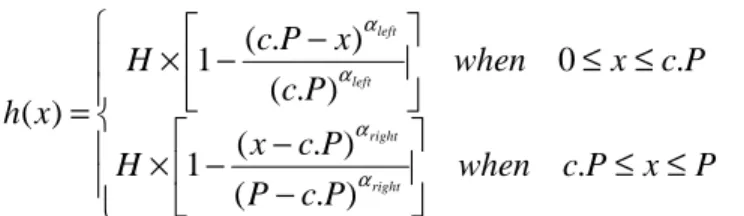
We extend this previous work by considering periodic structures with a more general shape. We also refine the exploration of parameters. The objective is to achieve higher light-extraction efficiencies by an optimal choice of parameters. The height h(x) of the structures considered for the surface texturation of GaN is given the general expression
≤
≤
−
−
−
×
≤
≤
−
−
×
=
P
x
P
c
when
P
c
P
P
c
x
H
P
c
x
when
P
c
x
P
c
H
x
h
right right left left.
)
.
(
)
.
(
1
.
0
)
.
(
)
.
(
1
)
(
α α α α (4)where P and H refer as previously to the period and the height of these structures. The parameter
c
∈
[
0
,
1
]
determines the position of the apex of these structures. For c=0, 0.5 and 1, the apex is respectively on the left, in the middle and on the right of the base period P. The coefficients αleft and αright determine the concavity of the left and right edges. Straightedges are achieved when αleft=αright=1. Values of αleft or αright higher than 1 will result in concave edges that extend
beyond the reference triangular shape achieved when αleft=αright=1. Values of αleft or αright smaller than 1 will result in
convex edges that keep within the reference triangular shape achieved when αleft=αright=1.
The “factory-roof” structures considered in the work of Bay et al.12 correspond to c=1, αleft=1 and αright =1. We extend
this study by considering periodic structures with a period P between 1 and 15 µm (step ≤ 0.1 µm), a height H between 1 and 15 µ m (step ≤ 0.1 µ m), a relative center position c between 0.5 and 1 (step ≤ 0.01), and αleft and αright coefficients
between 0.2 and 5 (step ≤ 0.01). The results achieved by the genetic algorithm are summarized in Table 1.
Table 1. Parameters relevant to our model of surface texturation for a GaN LED and resulting light-extraction efficiencies. The four lines correspond to different optimizations of these parameters (the parameters optimized in each study are underlined).
P (µm) H (µm) c αleft αright ε η Source
5 6 1 1 1 2.763 5.7% Ref. 12
6.98 4.97 0.508 1.074 1.055 2.763 7.1% GA
3.20 2.13 1 1 1 6.325 7.3% GA
3.42 2.63 0.603 1.205 0.933 6.340 11.0% GA
The results presented in Table 1 show that it is possible using the genetic algorithm to obtain parameters that increase substantially the light-extraction efficiency η of GaN light-emitting diodes. The solution found by the GA when considering P, H, c, αleft and αright as adjustable parameters enables a light-extraction efficiency η of 7.1%. This
represents a relative increase of 92% compared to the η value of 3.7% achieved for a flat GaN. These results were achieved by giving the photoresist a dielectric constant ε of 2.763 (manufacturer’s value for photoresist AZ 9245®).17 We can extend this study and consider the dielectric constant ε as an additional adjustable parameter. This should guide future experimental work by suggesting materials to use for the surface texturation. We considered for this study ε values between 1.2 and 6.35 (step ≤ 0.01). The results achieved when considering P, H and ε as adjustable parameters are presented in the third line of Table 1. We achieve in this case a light-extraction efficiency of 7.3% (relative increase of 97% compared to the flat GaN). By considering finally P, H, c, αleft, αright and ε as adjustable parameters, we achieved a
light-extraction efficiency of 11.0% (fourth line of Table 1). This corresponds to a relative increase of 197% compared to the flat GaN. The structure associated with this last result is represented in Fig. 1. The solutions found by the GA, when ε is considered as an adjustable parameter, suggest that the material used for the surface texturation should have essentially the same dielectric constant as the GaN. It seems also that the optimal shapes are essentially symmetric with respect to the center of the period.
When searching for optimal values of P, H, c, αleft, αright and ε, the number of bits required for the representation of these
six parameters was 49 (we used the parameter representation given in Eq. 1 as a strict enforcement of the parameter granularity was not necessary). This corresponds to the length of a DNA. The number of possibilities to explore for the six parameters considered in this optimization was therefore 249= 562,949,953,421,312. The genetic algorithm managed to find the optimum given in the fourth line of Table 1 after only 1687 evaluations of the fitness.
N O fbest (solid), mean (dashed) 0.06 0.08 0.1 N \
\\
---1,,,.. \\
E X _c No
0 1 2 x (gm) 3Figure 1. Representation of the structure achieved when searching for optimal values of P, H, c, αleft, αright and ε with the
objective of maximizing the light-extraction efficiency of GaN light-emitting diodes. The parameters associated with this representation are given in the fourth line of Table 1. The light-extraction efficiency achieved with this structure is 11.0%.
Figure 2. Best fitness (solid) and mean fitness (dashed) in the population when searching for optimal values of P, H, c, αleft,
αright and ε with the objective of maximizing the light-extraction efficiency of GaN light-emitting diodes.
4.
OPTIMIZATION OF A SOLAR THERMAL COLLECTOR
The second application we consider deals with the optimization of a solar thermal collector. This application is essentially an extension of the work presented by Gaouyat et al. in Refs 18 and 19. In this previous work, an aluminium substrate with NiCrOx and anti-reflection (AR) coatings was studied with the objective of developing high-performance
solar thermal collectors. The NiCrOx ceramic-metal composite (cermet) was chosen because of its high durability and
attractive absorption/emission selectivity.20 The applicability of this material to the development of solar thermal collectors was presented with details in Ref. 19.
In order for a solar thermal collector to be efficient, one must maximize the solar absorption α, while minimizing the thermal emissivity ε in the infrared.18-19 α represents the fraction of the solar spectrum that is effectively absorbed by the system. ε represents the fraction of the spectrum of a blackbody heated at 373 K that will escape the system (equivalent of thermal losses). These quantities are defined by
∫
∫
∞ ∞ − = 0 0 ) ( / ) ( )] ( 1 [λ
λ
λ
λ
λ
α
R BS d BS d (5) and∫
∫
∞ ∞ − = 0 0 ) ( / ) ( )] ( 1 [λ
λ
λ
λ
λ
ε
R Ba d Ba d (6)where BS(λ) is the solar irradiance spectrum (Air Mass 1.5), Ba(λ) is the irradiance spectrum of a blackbody heated at 373
K and R(λ) is the reflectance of the system for a radiation of wavelength λ having a normal incidence.
Values of α=91.2% and ε=1.5% were achieved in previous work by considering a bi-layer stack of NiCrOx/AR deposited
on a flat Al substrate.19 We seek at improving these results by keeping the same Al/NiCrOx/AR configuration. The Al
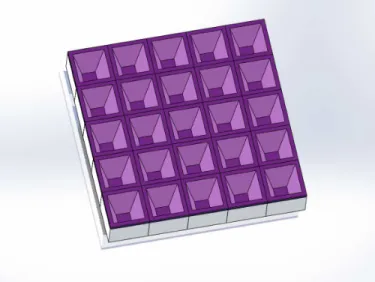
substrate will be shaped like a “waffle” (see Fig. 3). This idea was inspired by the work of Shimizu on structured W substrates for high-temperature solar absorbers.21 We use finally SnO2 as material for the anti-reflection coating. The
geometrical parameters that characterize the Al substrate are hence the period P, the height H of the Al, the ratio f between the width of the holes on the front side of the Al and the period, and finally the ratio r between the width of the holes on the back side of the Al and that on the front side. Conformal coatings of NiCrOx (thickness t1) and SnO2
(thickness t2) are then added to this waffle-shaped Al structure.
Figure 3. Waffle-shaped Al substrate with conformal coatings of NiCrOx and SnO2. This structure is considered for the
development of high-performance solar thermal collectors.
The optical properties of this waffle-shaped Al/NiCrOx/SnO2 system can be simulated by using again a Rigorous
Coupled-Waves Analysis within the transfer-matrix methodology for the calculation of R(λ).13-14 The optical properties of the different materials were taken from the literature and UV-visible and IR ellipsometric measurements.18,22-23 The parameters considered for this optimization problem are P, H, f, r, t1 and t2. There are two objective functions to
maximize: f1=α and f2=1-ε. We must therefore use a multi-objective genetic algorithm.
The general idea of multi-objective genetic algorithms follows the description of Sec. II. We work in this case with an effective fitness that depends on the two components f1 and f2 of the objective function and on the Pareto-classification
of the population with respect to these two components. The definition of this effective fitness is given with details in the Appendix. The multi-objective genetic algorithm seeks in this case at establishing a set of Pareto-optimal solutions. These solutions provide (f1, f2) values with a distinct advantage compared to the rest of the population. Amongst this set
of Pareto-optimal solutions, individuals that are better for f1 will be weaker for f2 (but no individual in the whole
population is better for both f1 and f2). Making finally a choice amongst this set of solutions depends on how we value
the two components f1 and f2 of the objective function and on their practicability for an experimental device. We
implemented elitism and kept records for solutions that were better for either f1, f2 or f1+f2 (solutions that maximize f1+f2
^ o o co E ó o .1) 0 o CL .4-o N 10 20 30 Generation 40 50
For the optimization of the solar collector, we considered P values between 500 and 1500 nm (step of 5 nm) and H values between 500 and 2500 nm (step of 5 nm). These boundaries enable P and H to keep in the same range as the absorbed wavelengths. We take f values between 0.5 and 0.99 (step of 0.01) and r values between 0 and 0.99 (step of 0.01) in order to explore the full range of pyramidal shapes. Finally t1 and t2 are chosen between 50 nm and 100 nm (step
of 5 nm) to be representative of layer thicknesses obtained by physical vapor deposition (PVD). The representation of these parameters relied on Eq. 2 in order for H, t1 and t2 to be always multiples of the same unit (5 nm). It was indeed
easier in this case to achieve good spatial discretization of the system. The number of bits required for the DNA representation of these parameters was 38 and the number of possibilities to explore was 48,763,605,000. The number of evaluations of the fitness was however as small as 2377 for the results presented here.
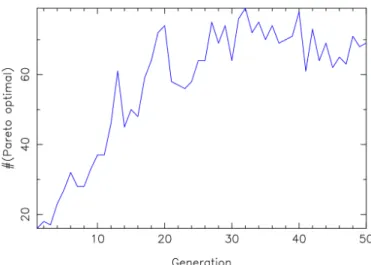
Solutions providing good values for f1, f2 or f1+f2 were quickly established by the GA so that a representation of the
number of Pareto-optimal solutions is actually more illustrative for the progress achieved by the algorithm. Fig. 4 shows that the genetic algorithm progressively builds up an ensemble of Pareto-optimal solutions for the realization of a solar thermal collector. The solution that provides the maximal value of f1+f2 is given in the first line of Table 2. The next
three lines provide selected Pareto-optimal solutions established by the GA.
Figure 4. Number of Pareto-optimal solutions when searching for P, H, f, r, t1 and t2 with the objective of optimizing the
parameters α and ε of a solar thermal collector.
Table 2. Parameters relevant to the optimization of the parameters α and ε of a solar thermal collector. The first line corresponds to the solution that maximizes f1+f2, where f1= α and f2=1- ε. The next three lines correspond to selected
Pareto-optimal solutions established by the GA.
P (nm) H (nm) f r t1 (nm) t2 (nm) α ε
1345 1960 0.96 0.45 50 50 97.8% 4.8% f1+f2 max
1435 1975 0.99 0.31 55 50 98.4% 5.8% P-optimal 795 1590 0.90 0.28 50 50 96.1% 4.1% P-optimal 560 545 0.95 0.28 50 50 95.2% 3.7% P-optimal The results presented in Table 2 compare very well with the values of α=91.2% and ε=1.5% achieved in previous work with a flat Al/NiCrOx/AR configuration19 and with the record values of α=97% and ε=5% obtained on a 3-layers stack.23
The three Pareto-optimal solutions given in Table 2 illustrate the fact that solutions with better α values have less attractive ε values. These solutions have t1 and t2 values around 50 nm. The choice of a particular solution for the
realization of a solar thermal collector will depend at this point on how we want to compromise between α and ε and on other practical considerations.
5.
CONCLUSION
These applications prove that genetic algorithms constitute a smart approach to global optimization problems. Genetic algorithms involve indeed a collective exploration of the parameter space. This gives the algorithm the capacity to escape local optima. The algorithm is also more robust against the possible failure of an individual to evaluate the fitness and it can easily account for constrains in the parameter space. The population contributes in this exploration of parameters to a reservoir of information on the fitness. This database may be used to guide the exploration through additional heuristics. Genetic algorithms are finally especially suited to parallel programming techniques. High efficiency on super-calculators was indeed achieved by using a multi-agent programming model in order to parallelize the evaluation of the fitness. The applications presented in this work aimed at optimizing parameters that influence the efficiency of GaN light-emitting diodes and solar thermal collectors. The solutions found by the GA turned out to improve the efficiencies achieved in previous work and to be competitive with record values found in the literature. The multi-objective version of the genetic algorithm actually provides a whole set of solutions with distinct advantages. Making a choice amongst this set of solutions depends on how we value the different components of objective function and on practical considerations. Addressing these optimization problems by scanning on the different parameters considered would have been intractable because the number of possibilities to consider grows exponentially with the number of parameters (each evaluation of the fitness required up to 50 hours of CPU time for the optimization of the LED and up to 30 hours for the optimization of the solar collector). The genetic algorithm could however address these optimization problems by evaluating in parallel only a reduced number of possibilities. These results prove that genetic algorithms are a great value for addressing complex problems in physics.
ACKNOWLEDGMENTS
A.M. is funded as Research Associate by the Fund for Scientific Research (F.R.S.-FNRS) of Belgium. L.G. is supported by FNRS-FRIA. D.N. and T.C. acknowledge the Belgian Network DYSCO (Dynamical Systems, Control, and Optimization), funded by the Interuniversity Attraction Poles Programme and initiated by the Belgian Science Policy Office. This research used resources of the "Plateforme Technologique de Calcul Intensif (PTCI)" (http://www.ptci.unamur.be) located at the University of Namur, Belgium, which is supported by the F.R.S.-FNRS under the convention No. 2.4520.11. The PTCI is member of the "Consortium des Equipements de Calcul Intensif (CECI)" (http://www.ceci-hpc.be). Erwin Volon is acknowledged for his Solid Works representations of the Al/NiCrOx/SnO2
structure. Frédéric Wauthelet is finally acknowledged for the script that enabled the development of multi-agent versions of the genetic algorithm.
APPENDIX: EFFECTIVE FITNESS FOR A MULTI-OBJECTIVE GENETIC ALGORITHM
We define here the effective fitness that was used by the multi-objective genetic algorithm in Sec. IV. This effective fitness is used to establish a classification of the population. This is indeed required in the selection step of the algorithm. The effective fitness presented here is that used by Nicolay in previous work.24 The idea is due originally to Deb.25 Let us consider a population of npop individuals. We refer by n to the number of parameters xi and by fj to the different
components of the objective function.
A solution
x
r
1 is dominated by the solutionx
r
2 iff
j(
x
r
2)
≥
f
j(
x
r
1)
∀
j
andj
:
f
j(
x
2)
f
j(
x
1)
r
r
>
∃
.Pareto-optimal solutions are solutions that are not dominated. These solutions will receive a rank of 1. Solutions will receive a rank of 2 if they are not dominated when discarding solutions of rank 1. Solutions of rank 3 are solutions that are not dominated if we discard solutions of rank 1 and 2. We can proceed in this way and attribute a rank to every individual in the population.
The effective fitness will be higher for individuals that have lower ranks. The genetic algorithm will tend in this way to develop solutions that are Pareto-optimal instead of solutions that improve a specific combination of the components fj of
the objective function. We seek also at establishing a set of Pareto-optimal solutions that presents a good dispersion. This prevents indeed early convergence of the GA to a given individual. We proceed therefore in the following way to define the effective fitness.
All individuals of rank 1 receive an effective fitness of npop. We then define a sharing function in order to reduce,
amongst individuals of the same rank, the effective fitness of individuals that are too close. For individuals of the same rank, we define a distance matrix whose components dk,l are defined by
∑
=
−
−
=
n i i i i i l kx
x
l
x
k
x
d
1 2 min max ,]
[
]
[
(7)where xi[k] refers to the parameter xi of an individual k,
max
[
]
] , 1 [ max
k
x
x
i n k i pop ∈=
andmin
[
]
] , 1 [ mink
x
x
i n k i pop ∈=
.The sharing function between two individuals is then defined by
S
k,l=
1
−
(
d
k,l/
σ
share)
2 if dk,l ≤ σshare and 0 otherwise.Following Ref. 24-25, we take n share
=
0
.
5
/
10
σ
. We then define the niche count of a given individual by∑
=
l l k kS
m
, where the sum is restricted to individuals of the same rank. The effective fitness of each individual is thendivided by its niche count. We penalize in this way individuals that are too close to other individuals within the same rank.
The effective fitness of all individuals of rank 2 is then initialized with a value of 0.99×feffect,min[rank 1], where feffect,min[rank 1] refers to the minimal value of the effective fitness for the individuals of rank 1. We proceed then by
computing the distance matrix dk,l, the sharing function Sk,l and finally the niche count mk for all individuals of rank 2.
The effective fitness of these individuals is then divided by their niche count.
We continue in this way until all individuals in the population have been attributed an effective fitness. Other definitions are possible for this effective fitness. They may be considered in future work.
REFERENCES
[1] Holland, J. H., [Adaptation in Natural and Artificial Systems], University of Michigan Press, Ann Arbor, 1-183 (1975).
[2] De Jong, K. A., [An analysis of the behaviors of genetic adaptative systems], PhD thesis, University of Michigan, Ann Arbor, 1-256 (1975).
[3] Baker J. E., "Adaptative selection methods for genetic algorithms," Proceedings of the 1st International Conference on Genetic Algorithms and their Applications, 101-111 (1985).
[4] Goldberg, D. E., "Sizing populations for serial and parallel genetic algorithms," Proceedings of the Third International Conference on Genetic Algorithms, 70-79 (1989).
[5] Harik, G., Cantu-Paz, E., Goldberg, D. E. and Miller, B. L., "The gambler's ruin problem, genetic algorithms, and the sizing of populations," Evol. Comput. 7(3), 231-253 (1999).
[6] Ma, Z. H., "Chaotic populations in genetic algorithms," Appl. Soft Comput. 12, 2409-2424 (2012).
[7] Goldberg, D. E., [Genetic Algorithms in Search, Optimization and Machine Learning], Addison-Weley, Reading, 1-432 (1989).
[8] Preblea, S., Lipson, M. and Lipson, H., "Two-dimensional photonic crystals designed by evolutionary algorithms," Appl. Phys. Lett. 86(6), 061111 (2005).
[9] Lin, A. and Philips, J., "Optimization of random diffraction gratings in thin-film solar cells using genetic algorithms," Sol. Energ. Mat. Sol. C. 92, 1689-1696 (2008).
[10] Judson, R., "Genetic Algorithms and their use in Chemistry," Reviews in Computational Chemistry 10, 1-73 (1997).
[11] Bay, A., Sarrazin, M., and Vigneron, J.-P., "Search for an optimal light-extracting surface derived from the morphology of a firefly lantern," Opt. Eng. 52(2), 028001-1-028001-7 (2013).
[12] Bay, A., André, N., Sarrazin, M., Belarouci, A., Aimez, V., Francis, L. A. and Vigneron, J.-P., "Optimal overlayer inspired by Photuris firefly improves light-extraction efficiency of existing light-emitting diodes," Optics Express 21 (S1), A179-A189 (2013).
[13] Vigneron, J.-P., Forati, F., André, D., Castiaux, A., Derycke, I. and Dereux, A., "Theory of electromagnetic energy transfer in three-dimensional structures," Ultramicroscopy 61, 21-27 (1995).
[14] Vigneron, J.-P. and Lousse, V., "Variation of a photonic crystal color with the miller indices of the exposed surface," Proc. SPIE 6128, 61281G (2006).
[15] Eliseev, P., Smolyakov, G. and Osinski, M., "Ghost modes and resonant effects in AlGaN-InGaN-GaN lasers," IEEE J. Sel. Top. Quantum Electron. 5, 771-779 (1999).
[16] Lynch, D., Hunter, W. and Palik, E., [Handbook of Optical Constants of Solids II], Academic Press, Inc., 1991. [17] "Microchemicals, optical parameters of photoresists," (2010). www.microchemicals.eu/technical_information. [18] Gaouyat, L., Mirabella, F. and Deparis, O., "Critical tuning of magnetron sputtering process parameters for
optimized solar selective absorption of NiCrOx cermet coatings on aluminium substrate," Appl. Surf. Sci. 271,
113-117 (2013).
[19] Gaouyat, L., He, Z., Colomer, J.-F., Lambin, Ph., Mirabella, F., Schryvers, D. and Deparis, O., "Revealing the innermost nanostructure of sputtered NiCrOx solar absorber cermets," Sol. Energ. Mat. Sol. C. 122, 303-308
(2014).
[20] Kennedy, C. E., "Review of Mid- to High-Temperature Solar Selective Absorber Materials," NREL/TP-520-31267, National Renewable Energy Laboratory, Colorado, July 2002.
[21]Shimizu, M., Takeuchi, K., Sai, H., Iguchi, F., Sata, N. and Yugami, H., "High-temperature solar selective absorber material using surface microcavity structures," Proc. ASME 5, 783-787 (2011).
[22] Stenzel, O., [The Physics of Thin Film Optical Spectra: An Introduction], Springer, Heidelberg (2005).
[23] Zhao, S. and Wäckelgảrd, E., "Optimization of solar absorbing three-layer coatings," Sol. Energ. Mat. Sol. C. 90(3), 243-261 (2006).
[24] Nicolay, D., [Modélisation et apprentissage des réseaux de neurones artificiels], Master thesis, University of Namur, Namur, 48-57 (2012).
[25] Deb, K., "Multi-objective evolutionary algorithms: Introducing bias among Pareto-optimal solutions," [Advances in Evolutionary Computing], Springer-Verlag, Berlin, 263-292 (2003).