HAL Id: tel-02901184
https://tel.archives-ouvertes.fr/tel-02901184
Submitted on 16 Jul 2020
HAL is a multi-disciplinary open access
archive for the deposit and dissemination of sci-entific research documents, whether they are pub-lished or not. The documents may come from teaching and research institutions in France or abroad, or from public or private research centers.
L’archive ouverte pluridisciplinaire HAL, est destinée au dépôt et à la diffusion de documents scientifiques de niveau recherche, publiés ou non, émanant des établissements d’enseignement et de recherche français ou étrangers, des laboratoires publics ou privés.
Synthesis of silver nanoparticles using a plasma-liquid
process
Mine Er
To cite this version:
Mine Er. Synthesis of silver nanoparticles using a plasma-liquid process. Chemical Physics [physics.chem-ph]. Université Sorbonne Paris Cité, 2019. English. �NNT : 2019USPCD001�. �tel-02901184�
UNIVERSITÉ PARIS 13
ÉCOLE DOCTORALE GALILÉE
THÈSE
présentée par
Mine ER
pour obtenir le grade de
DOCTEUR D’UNIVERSITÉ
Spécialité : Génie des Procédés
Synthèse de nanoparticules d'argent à l'aide
d'un procédé plasma-liquide
soutenue publiquement le 16 mai 2019 devant le jury composé de
Stéphanie OGNIER
Rapporteur
Christophe COLBEAU-JUSTIN
Rapporteur
Franck CLEMENT
Examinateur
Dominique VREL
Examinateur
Arlette VEGA GONZÁLEZ
Co-encadrante
Xavier DUTEN
Directeur de thèse
Thèse préparée au sein du Laboratoire des Sciences des Procédés et des Matériaux LSPM-CNRS, UPR 3407, Villetaneuse
3
Acknowledgements
First of all, I want to thank my director of thesis Prof. Xavier DUTEN and co-supervisor Arlette VEGA-GONZALEZ for giving me the opportunity to work with them on this PhD project. It has been an educative experience in which I have gained much scientific knowledge in multidisciplinary research fields. Furthermore, it has been an experience, which allowed me to develop myself on a personal level.
I also want to thank Cathy ROND for her valuable advices and discussions on the project.
It would not be possible to perform experiments without technical assistance of Nicolas FAGNON, Pascal BOUTIN, and Noël GIRONDON-BOULANDET. Therefore, I want to thank them for their effort in helping me with designing and developing the experimental set-up as a part of this PhD work.
I want to thank Samir FARHAT for his advice and also for allowing me to perform particle characterization using the DLS.
I want to thank Ovidiu BRINZA for his advice and help during the particle characterization process.
I also want to thank the members of the PhD committee, Christophe COLBEAU-JUSTIN, Stephanie OGNIER, Franck CLEMENT, and Dominique VREL, for their time and valuable comments on my PhD work.
Lastly, I would like to thank the administration, permanents, students, and technicians at LSPM for their kindness and personal support.
5
Abstract
The main objectives of this thesis are to develop a plasma liquid immersion (PLI) method for the synthesis of silver nanoparticles.
Synthesis of silver nanoparticles is first investigated with respect to chemical parameters (concentration of precursor and of stabilizing agent, and initial pH of the precursor solution) in the aim of optimizing PLI process and silver nanoparticles in order to synthesize spherical, small-sized, and uniformly-distributed silver nanoparticles. This investigation is performed using a MARX pulse generator. Secondly, synthesis of silver nanoparticles is investigated with respect to physical parameters (pulse duration, applied voltage, and applied voltage over the inter-electrode distance for a constant ratio). For this investigation, a solid-state BEHLKE switch is used in the generation of plasma pulses.
The study showed that the synthesis and morphology of silver nanoparticles are process dependent. Differences in the generation of plasma discharges are observed, when using two types of pulse generators, and are further explained. Optimized silver nanoparticles, synthesized using the MARX pulse generator, are spherical and uniformly distributed with an average hydrodynamic diameter of 10nm. These silver nanoparticles were produced by injecting only 40mJ energy into pulsed plasma discharges of the PLI process with 2W in power consumption. Synthesis of silver nanoparticles at similar synthesis conditions using the BEHLKE pulse generator resulted in the production of larger-sized polyhedral-shaped silver nanoparticles.
7
Résumé
Le principal objectif de cette thèse sont de développer un procédé plasma / liquide (PLI) pour la synthèse de nanoparticules d‟argent.
La synthèse de nanoparticules d‟argent est d‟abord étudiée en fonction de paramètres chimiques (concentration du précurseur et d‟agent stabilisant, pH initial de la solution) dans le but d‟optimiser le procédé de PLI et de synthétiser des particules sphériques de petite taille et uniformément réparties. Cette étude est réalisée à l‟aide d‟un générateur d‟impulsions MARX. Dans la suite, la synthèse de nanoparticules d'argent est étudiée en fonction de paramètres physiques (durée d'impulsion, tension appliquée et tension appliquée sur la distance inter-électrodes pour un rapport constant). Pour cette étude, un commutateur BEHLKE à semi-conducteurs est utilisé pour la génération d‟impulsions haute tension.
L‟étude a montré que la synthèse et la morphologie des nanoparticules d'argent sont dépendantes de paramètres de processus chimiques et physiques. Des différences dans la génération de décharges de plasma sont observées lors de l'utilisation de deux types de générateurs d'impulsions et sont expliquées plus en détail. Les nanoparticules d'argent synthétisées à l'aide du générateur d'impulsions MARX sont sphériques et uniformément réparties avec un diamètre hydrodynamique moyen de 10 nm. Ces nanoparticules d'argent ont été préparées par des décharges pulsées ayant une énergie de 40 mJ/impulsion et une puissance de 2 W. La synthèse de nanoparticules d'argent dans des conditions de synthèse similaires à l'aide du générateur BEHLKE a abouti à la production de nanoparticules d'argent de taille plus grande et polyhédriques.
9
Chapter I - Introduction
For more than a century, catalysis has played a key role in many industrial applications. From the Berger lamp in 18981 to enzymes, catalysis is currently used in more than 80% of industrial applications. In general, catalysis refers to the acceleration or reorientation of reaction kinetics by means of a catalyst, and in some cases selectivity to direct a reaction in a preferred direction.
The catalysts do not appear generally in the reaction balance and are often used in smaller amounts than the reactive products, especially when they are used in the form of nano-catalysts. Indeed, the smaller a particle, the greater the ratio between the number of atoms of its surface and those present in its volume. At the scale of the nanoparticles, the physical properties of the materials that constitute them vary according to the inverse of their radius, and are often very different from those of the massive materials. For example, in the case of gold, particle size has a remarkable effect on their reactivity. Indeed, if it is inert in the massive state, the gold can become extremely reactive in the form of nanometric particles. Particle size also has an effect on the physical properties of the metal. For example, while solid gold melts at 1063 °C, a gold nanoparticle measuring 2.5 nm in diameter melts at 300 C.
During the thesis of Zixian Jia2, the 3PE team (Polyphasic plasma processes & Environment) developed, in collaboration with the NINO team (Nanomatériaux INOrganiques) of the LSPM, a two-phase process coupling an electric discharge at atmospheric pressure and a nano-catalyst based on mixed oxide (from type TiO2 / Ag or TiO2 / Au) for the degradation of pollutant present
in low concentration in a gas flow. In this context, the work of Z. Jia had shown that it was possible to degrade more than 90% of a model molecule (CH3CHO - 10/500 ppm) at
atmospheric pressure and ambient temperature, with very low energy consumption. The initial idea of the first studies of two phase plasma/catalysis process was to combine the advantages of the operation of non-thermal plasmas at room temperature, their low energy consumption (0.1-5 W) coupled with their high chemical reactivity in the gas phase3 (via the energy electron
1
https://www.maison-berger.fr/
2 Jia Z., Elaboration des matériaux composites nanostructures à base de TiO2 pour la dépollution des effluents
gazeux avec une activation par plasma, (2013), Université Paris 13
10
production, reactive species such as O, O3, OH, N2 *, ...) and an additional catalytic effect
(mainly via the reduction of by-products), by immersing a catalyst in a plasma1, 3, 4
As part of the work of this thesis, the objectives of the 3PE team were to develop a process
coupling an electric discharge produced in a liquid containing a metal precursor, in order to synthesize particles of controlled size and morphology.
Synthesis of nanoparticles in liquid phase has many advantages in nanoparticle synthesis. The main advantage is to control nanoparticle surface properties and to prepare nanoparticles for use in specific applications. One of the noble metallic nanoparticles that are highly demanded in nanoparticle synthesis and application is silver nanoparticles5. This relies on the low-cost and broad application field of silver nanoparticles5.
Conventional methods in nanoparticle synthesis do not always meet the requirements of a green nanoparticle synthesis, which are at the same time economic and time-saving. In this regard, alternative synthesis processes are taken into use in this work, which respects thus following process criteria:
One-step process – A simple process, which requires few synthesis steps as possible Time-saving – A process of short reaction time in which particles are produced
“Green” – A process, which avoids the use of harmful and hazardous reactants, generation of reduced by-products and waste
Cost-effective – A process operating with low energy consumption. This being at ambient reaction temperatures under atmospheric pressure.
In addition, following requirements will be met in this work for synthesis of silver nanoparticles:
High purity – A process, which does not result in nanoparticle contamination from the electrode material, or nanoparticles being exposed towards oxidation
Reproducible – A process, which yields in a reproducible nanoparticle synthesis
Fine-tuning of particle morphology – A process, which gives the freedom to control particle size, shape, and particle dispersion
4 Holzer.F, Roland.U, Kopinke.F-D, Applied Catalysis B: Environmental, (2002), 38:163.
11
Since it is a start-up project for plasma-synthesized nanoparticles, the initial aim of this work is to develop a PLI (Plasma Liquid Immersion) experimental set-up, which provides synthesis of pure and metallic nanoparticles. Generation of stable plasma discharges reaching up to 16kV in a liquid phase is a quite challenging task in comparison to plasma generation in the gaseous phase. The realization of nanoparticle synthesis through plasma liquid immersion technique is generation of plasma discharges in an aqueous metal salt solution containing dissolved silver ions. Usually, in solution chemistry, metal ions are exposed to an energy source in the form of heat or UV-light exposure in the presence of a reducing agent in order to reduce metal ions into metal nanoparticles. In plasma synthesis of nanoparticles, highly energetic electrons are generated from plasma discharges to dissociate water molecules into radicals (O, H, OH) and ions (H2O+, O2–). These plasma-created reactive species participate thus in the reduction of metal
ions into metal nanoparticles.
The goal of this study is to investigate synthesis of silver nanoparticle through a parametrical study in the use of a PLI synthesis technique.
The first part focuses on optimization of the PLI process for synthesis of small-sized and uniformly distributed silver nanoparticles. A parametric study has been performed to investigate the influence of chemical parameters on silver nanoparticle synthesis.
In the second part of this thesis synthesis of silver nanoparticles has been realized in order to study the influence of physical process parameters on silver nanoparticle synthesis.
This thesis is structured in the following procedure:
In the first chapter, a short introduction to the thesis is given in terms of objectives and the
structure of thesis.
The second chapter is devoted to a literature review on the state of the art, pointing out the
technological and scientific challenges as well as fundamental aspects on metal nanoparticle synthesis, non-thermal plasma generation, and plasma-liquid interaction and reaction pathways.
In the third chapter, description of commonly applied nanoparticle characterization methods
has been included. Particle characterization techniques that provided further information about nanoparticles produced in this work are: Determination of particle nature and state of oxidation,
12
as well as particle purity performed by X-ray Diffraction (XRD), Electron Dispersive X-ray Spectroscopy (EDS), and X-ray Photon Spectroscopy (XPS). Characterization of as-synthesized nanoparticles was performed by UV-visible absorption spectroscopy and Dynamic Light Scattering (DLS). Later, particles were characterized by Scanning Electron Microscopy (SEM) and particles below 20nm were characterized by Transmission Electron Microscopy (TEM). In the continuation of chapter 3, a description of the laboratory-developed PLI system has been performed in the application of plasma pulses generated by MARX and BEHLKE pulse generator. In the following, a parametrical study on silver nanoparticle synthesis applying MARX and BEHLKE was performed.
The fourth chapter concerns the first parametrical study on silver nanoparticles synthesized in
the use of the PLI process with plasma pulses generated by the MARX generator. This parametrical study is performed with focus on chemical parameters related to silver nanoparticle synthesis. Parameters of main interest are: Concentration of silver precursor (i.e. AgNO3),
concentration of stabilizing agent (i.e. PVP), and initial pH of precursor solution. The PLI process has been optimized to produce spherical, small-sized and uniformly distributed silver nanoparticles.
The fifth chapter concerns the second parametrical study performed by the PLI process with
plasma pulses generated by BEHLKE generator. This parametrical study is performed with focus on physical parameters related to the PLI process. Parameters of main interest are: Pulse duration, applied voltage, and applied voltage over the inter-electrode distance for a constant ratio. By investigating these parameters, particle growth mechanism and nanoparticle morphology has been studied.
In the sixth chapter, a final conclusion of this work on the parametrical study on silver
13
Table of Contents
Chapter I - Introduction ... 9
Chapter II - Bibliographic study and state of the art ... 17
2.1 Introduction to metallic nanomaterials ... 17
2.1.1 Classification of nanomaterials ... 17
2.1.2 Optical properties in nanomaterials ... 19
2.1.3 Application of silver nanoparticles ... 21
2.2 Synthesis methods ... 23
2.2.1 Chemical methods ... 25
2.2.2 Physical methods ... 27
2.2.3 Silver nanoparticle synthesis... 28
2.3 Nanoparticle nucleation and growth mechanisms ... 30
2.3.1 Nucleation ... 30
2.3.2 Growth ... 32
2.3.3 Stabilization of metallic nanoparticles ... 34
2.3.4 Size- and shape controlled synthesis of metal nanoparticles ... 36
2.4 Plasma-liquid interaction in nanoparticle synthesis ... 39
2.4.1 Classification of plasma ... 40
2.4.2 Plasma-liquid interactions ... 41
2.4.3 Physical and chemical processes in PLI ... 43
2.4.4 Metal nanoparticle synthesis by PLI ... 48
2.5 Plasma-liquid interactions for silver nanoparticle synthesis ... 51
2.5.1 Influence of process parameters on nanoparticle synthesis ... 51
2.5.2 Chemical parameters ... 51
2.5.3 Physical parameters ... 54
2.6 Conclusion ... 57
Chapter III – Materials, silver nanoparticle synthesis, and characterization techniques ... 59
14
3.1.1 Reactor and electrodes ... 59
3.1.2 Preparation of the metallic precursor solution ... 62
3.1.3 Experimental procedure ... 63
3.1.4 Data acquisition ... 63
3.1.5 Cleaning of the electrodes ... 64
3.2 DC-pulse generation techniques in plasma-in-liquid processes ... 65
3.2.1 Method 1: Marx high voltage DC-pulse generator ... 65
3.2.2 Method 2: Behlke high voltage DC-pulse generator ... 70
3.3 Nanoparticle characterization techniques ... 73
3.3.1 UV-vis spectroscopy ... 73
3.3.2 Dynamic light scattering ... 76
3.3.3 Scanning electron microscopy ... 79
3.3.4 Energy dispersive X-ray spectroscopy... 81
3.3.5 Transmission electron microscopy ... 82
3.3.6 X-ray diffraction ... 83
3.3.7 X-ray photoelectron spectroscopy ... 85
3.4 Conclusion ... 86
Chapter IV – Synthesis of silver nanoparticles by a pulsed plasma discharge in liquid (PLI): In the use of a MARX pulse generator ... 87
4.1 Particle characterization and elemental analysis of silver-based nanomaterials ... 88
4.1.1 Summary ... 94
4.2 The influence of the metal precursor concentration on the silver nanoparticle synthesis ... 94
4.2.1 Plasma-liquid interaction and nanoparticle growth mechanism ... 106
4.2.2 Summary ... 110
4.3 Influence of surfactant concentration on silver nanoparticle synthesis ... 110
4.3.1 Silver nanoparticle growth mechanism in the presence of stabilizing agent ... 123
4.3.2 Summary ... 125
4.4 The influence of initial pH of the metal precursor solution on silver nanoparticle synthesis ... 126
15
4.4.2 Summary ... 141
4.5 Conclusion ... 142
Chapter V – Synthesis of silver nanoparticles by pulsed plasma discharges in liquid phase: using a solid state pulse generator ... 143
5.1 The influence of discharge pulse duration on silver nanoparticle synthesis ... 144
5.1.1 Summary ... 160
5.2 The influence of applied voltage on nanoparticle synthesis ... 161
5.2.1 Summary ... 175
5.3 The influence of inter-electrode distance on silver nanoparticle synthesis ... 176
5.3.1 Summary ... 187
5.4 Growth mechanism of silver nanoparticles ... 188
5.5 Conclusion ... 188
Chapter VI - Conclusion & perspectives ... 191
17
Chapter II - Bibliographic study and state of the art
2.1 Introduction to metallic nanomaterials
The definition of nanomaterial according to International Organization for Standardization (ISO) is clusters of atoms or molecules measured in the nanoscale size range, approximately between 1nm and 100nm (ISO 2015a). In the lower limit (<1nm) of the nanoscale, atoms and individual molecules exist, and are not considered as nano-objects. In the upper limits, objects exceeding the nanoscale measured between 100nm and 1µm are classified as sub-micro-particles
(ISO 2015a). Nano-objects are in possession of at least one external dimension (this is to say, height, length, and depth), which are all measured within the nanoscale (<100nm). Under these conditions nano-objects are enabled to exist in different sizes and shapes.
2.1.1 Classification of nanomaterials
Fundamental shapes of nano-objects constitute of nanoplate (one external dimension),
nanofibre (two external dimensions), and nanoparticle (three external dimensions) (ISO 2015b). Classification of nanomaterials based on dimensioning was first developed by (Gleiter 2000). Since the dimensioning of nanomaterials did not account for structures such as fullerenes, nanotubes, and nano-flowers, the dimensioning of nanomaterials was later extended to 0D, 1D, 2D, and 3D nanostructures by (Pokropivny and Skorokhod 2007). Nanomaterials are classified based on their dimensionality, which contains following nanoparticle structures:
0D nanostructures are quantum dots (uniformly arrayed particles), heterogeneous nanoparticles, core-shell (Trinh et al. 2015), hollow spheres (J.-M. Lee et al. 2007), and
fullerenes.
1D nanostructures are nano-wires, -rods, -tubes (Eatemadi et al. 2014), -belts, and -ribbons.
2D nanostructures are nano-plates, -sheets, -walls, and -disks. These nanostructures have only one dimension in the nanoscale.
3D nanostructures are nano-balls, -coils, -cones, -pillar, and -flowers. Increased surface area in comparison to 0D, 1D, and 2D nanomaterials, due to highly porous particles
(Tiwari, Tiwari, and Kim 2012).
18
0D nanomaterials (three external dimensions in the nanoscale)
Quantum dots Nanoparticles Core-shell
1D nanomaterials (two external dimensions in the nanoscale)
Nanorods Nanofibre Nanotubes
2D nanomaterials (one external dimension in the nanoscale)
Nanoplates Nanowalls Nanosheets
3D nanomaterials
Nanoballs Nanocones Nanoflowers
Figure 1: Nanomaterial classification based on dimensions. 0D: Quantum dots (J.-Y. Wu et al. 2014),
nanoparticles (Hieda, Saito, and Takai 2008), core-shell (Park, Im, and Park 2011). 1D : Nanorods (L. Zhu et al.
2008), nanofibre (Langley et al. 2013), nanotubes (Fang et al. 2014). 2D : Nanoplates (Jia Liu et al. 2011),
nanowalls (Prasad et al. 2017), nanosheets (Feng et al. 2015). 3D: Nanoballs (Teng, Wang, and Zhu 2008),
19
Properties of nanomaterials are size-dependent. An increment in surface-to-volume ratio, exposes atoms on the surface, leading to higher reactivity, and thus improvement in material properties (Roduner 2006). This is also what makes nanomaterials unique as compared to their bulk counterparts. Improvements are mainly observed in properties regarding magnetic (Mørup, Frandsen, and Hansen 2017), optical (K. L. Kelly et al. 2003), catalytic (Cuenya 2010), and
electrical properties (Radoń et al. 2018).
In the following, optical properties of metallic nanoparticles will be discussed.
2.1.2 Optical properties in nanomaterials
In quantum mechanics, size-dependent properties of nanomaterials are explained by the
quantum confinement effect. This effect is observed in what corresponds to quantum dots,
quantum wires, and quantum wells, which is the intermediate of bulk semiconductor materials and single molecules or atoms. Electrons of quantum wells, quantum wires, and quantum dots are confined in one-, two, or three-dimensions, respectively (Brazis 2017). An increase in electron energy increases the strength of electron confinement, and agrees to 1D > 2D > 3D, for electron confinement of quantum wells being the weakest (Ashrafi 2011). Electron energy levels in quantum dots are discrete and not continuous as in bulk semiconductor materials. As it is shown on figure 2, a transition from continuous to discrete electron confinement increases the electron band gap, and restricts thus the movement of electrons. Therefore, as nano-crystal size decreases, the band gap energy increases, and emits thus a greater energy resulting from electron-hole recombination (Ashrafi 2011).
Figure 2: Quantum confinement effect. The transition from continuous energy levels in bulk semiconductor
20
Optical effect is also observed in metallic nanoparticles, and is known as the Surface Plasmon
Resonance (SPR). This phenomenon occurs, when an external electric field (e.g. photons) is
applied, thus giving rise to collective oscillations of free valence electrons. As electrons are charged elementary particles, vibrations from valence electrons generate an electric field. Hence, the resonance of electric field (e.g. electro-magnetic field) from the light source and valence electrons causes the so-called SPR on metallic nanoparticle surface (Satoshi Horikoshi and Serpone 2013). Irradiation of nanoparticles, which are smaller in size than the wavelength of the incident light beam deviates the electric field causing surface polarization of metallic nanoparticles. This is the so-called Localized Surface Plasmon Resonance (LSPR) effect, which is illustrated on figure 3.
Figure 3: LSPR of metallic nanoparticles. Reproduced from (Peiris, McMurtrie, and Zhu 2016).
SPR depends on dielectric properties of the metal, the dispersing media, extent of particle agglomeration, and on particle size and shape (Rivera, Ferri, and Marega 2012). SPR in metallic nanoparticles occur mainly in the ultraviolet (UV) region of the electromagnetic spectrum, while in few metals (i.e. gold (Au), silver (Ag), and copper (Cu)), the SPR shifts towards the visible region (Singh 2016). In case of spherical gold nanoparticles SPR appears around 520-550nm, which corresponds to a red color at visible light. For spherical silver nanoparticles SPR appears at around 400nm, corresponding thus to a yellow color at visible light (Satoshi Horikoshi and Serpone 2013). Absorption spectra of gold- and silver colloidal solutions are presented in figure 4, which shows the SPR peak of small-sized and spherical nanoparticles.
21
Figure 4: Absorption spectra of small-sized and spherical metallic nanoparticles of a) AuNP and b) AgNP
with SPR around 520nm and 400nm, respectively. Modified and reproduced from (Brown et al. 2012). Insets
images show representative colloidal solution of AuNP and AgNP at the given SPR wavelengths. Modified
and reproduced from (nanoComposix 2018).
2.1.3 Application of silver nanoparticles
An advantage of nanoscience and -technology is the possibility to engineer nanoparticles by fine-tuning of their surface parameters (e.g. size, shape, composition, and structure) through application of various synthesis routes. Since nanoparticle properties are determined by surface parameters of nanoparticles, it is through fine-tuning of these parameters possible to modify nanoparticle properties (Xia et al. 2009). Due to the unique and improved properties of nanoparticles, it is therefore of great interest to incorporate nanoparticles in different application fields. Silver nanoparticles are in particular promising for application in diagnostics (Cordeiro et al. 2016), sensing (Doria et al. 2012), energy storage (C. Liu et al. 2010), catalysis (Haruta 2004), medicine (Odularu 2018), daily life products (Pulit-Prociak and Banach 2016), and in many other fields.
Some examples of silver nanoparticle application in research and industrial applications are mentioned in the following:
Application of silver nanoparticles as an antibacterial agent is common in many fields. The agent is most efficient, when the specific surface area of silver nanoparticles is increased
(Helmlinger et al. 2016). Improved antimicrobial properties of silver nanoparticles was also
reported by (Agnihotri, Mukherji, and Mukherji 2014), when the size of nanoparticle was reduced to 5nm. (Kujda et al. 2015) demonstrated the antimicrobial properties of silver
22
nanoparticles by its interaction with bacteria. They demonstrated that silver nanoparticles attached to bacteria culture and caused disintegration of the cell membrane. The antimicrobial properties of silver nanoparticles have also been proved to be effective by combining silver nanoparticles with other materials. As an example, (Yamada et al. 2017) demonstrated that application of zirconia coated with silver nanoparticles is possible in dentistry as antimicrobial agent.
Silver nanoparticles are further applied in water disinfection, due to its toxicity towards microorganisms (e.g. viruses, bacteria, and fungi) that may exist in water and wastewater (Lu et al. 2016). Several techniques in water disinfection were proposed. One of them includes the technique reported by Kujda et al., in which microorganism disintegrates through direct contact with silver nanoparticles. There is a tendency for silver nanoparticles to aggregate in aqueous media due to limited stability, and this is a problem in application, since aggregation of silver nanoparticles will reduce its reactivity and hence efficiency as an antimicrobial agent
(Shrivastava et al. 2007), (Kvítek et al. 2008). Therefore, other techniques have been proposed. Instead of direct application of silver nanoparticles in the aqueous medium, nanoparticles are attached to filter materials (e.g. cellulose fibers) via in-situ reduction of silver ions (Dankovich and Gray 2011).
Quantum dots are applied in electronics as in photovoltaic devices, sensors, and light-emitting diodes (LED) (Kang et al. 2017). Due to blinking of their luminescence and their toxicity, their application has been restricted in health science (H. Zhang, Yee, and Wang 2008). Silver nanoparticles has been presented as a better alternative in overcoming these issues, since silver nanoparticles has lower toxicity, good reproducibility, and are stable in solutions. (Maretti et al. 2009) prepared highly-stable fluorescent silver nano-clusters, which are smaller than 3nm. Silver nano-clusters are applicable in bio-imaging (Kundu et al. 2017), chemical sensing (Xiong et al. 2016), and fluorescence labeling (Jian Zhang et al. 2008).
Another common application field of silver nanoparticles is its use as supported catalyst in various chemical processes, due to increased efficiency and selectivity. In catalysis, application of silver nanoparticles is also preferred over other noble elements such as gold, platinum, and palladium nanoparticles, due to being a low-cost element (Dong et al. 2015).
23
Chemical processes include among others the catalytic decomposition of H2O2 in the presence of
colloidal silver (Weiss 1935). In another study performed by (Chimentao et al. 2007) silver nanoparticles were prepared by different techniques and deposited onto α-Al2O3 in order to
study the epoxidation of styrene to styrene oxide in the presence of silver nanoparticles. Silver nanowires were obtained via polyol reduction technique, and silver polyhedral nanoparticles obtained via the wetness impregnation reduction technique. With this study, Chimentao et al. showed that catalysis preparation and reaction conditions would have an influence on catalytic activity and selectivity on resulting products. Furthermore, it was in this study determined that morphology of silver nanoparticles does have an influence on selective oxidation of oleofins. In this case silver nanowires showed improved catalytic activity over polyhedral nanoparticles.
(Jiang, Liu, and Sun 2005) did also introduce the catalytic application of silver nanoparticle in reduction of dyes such as methylene blue. In this study, the silver nano-catalyst was immobilized onto SiO2 support in order to avoid agglomeration of silver nanoparticles during the catalytic
reduction process of dyes. They determined that the catalytic activity of silver nanoparticles is influenced by the presence of stabilizing agents and addition of electrolytes.
Silver nanoparticles have a large variation of applications with the above-mentioned being some of them. In the following section, different nanoparticle synthesis methods, based on conventional chemical and physical methods, will be presented.
2.2 Synthesis methods
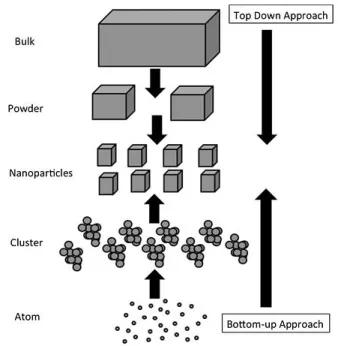
Metallic nanoparticles are either prepared by bottom-up or top-down approaches, as illustrated on figure 5. In top-down approaches, bulk materials are reduced down to nano-scale particles by destructive methods, such as mechanical milling (Koch 2003), nano-lithography (Venugopal and Kim 2013), laser ablation (M. Kim et al. 2017), sputtering (Terashima et al. 2013), and thermal decomposition (Odularu 2018). The bulk material is mechanically transformed into metal powder, before achieving the final product. Most of these techniques (e.g. laser ablation) are expensive, and energy-intensive in nanoparticle production, but result in small-sized nanoparticles. Mechanical techniques (e.g. milling) are not an option if small-sized, pure and uniform nanoparticles containing no defects are of importance.
24
In bottom-up approaches, atoms or molecules condenses in gas or liquid phase, and coalesces into nanoparticles by chemical or physical forces. Examples of synthesis techniques in the bottom-up approach are chemical vapor deposition (CVD) (Manawi et al. 2018) and chemical
reduction technique (Jun Liu et al. 2013). This approach is initiated by atomic-scaled components, which nucleates into nano-clusters, followed by the growth and production of nanoparticles.
Figure 5: Top-down and bottom-up approaches in nanoparticle production. Reproduced from (Su and Chang
2018).
Advantages in bottom-up approaches for nanoparticle production are plenty. In bottom-up approach it is possible to control particle properties and fine-tune surface parameters of nanoparticles (e.g. size, shape, structure, and composition). This is possible since, metallic component exists in the dispersing media initially in the atomic scale range. Nanoparticle synthesis in liquids is energy efficient, when the synthesis is carried out under atmospheric pressure (Patm), and when the reaction temperature is close to ambient temperature (Tamb). In
comparison to vapor phase, working in liquid phase enables size and shape selective recovery of nanoparticles by taking into use advanced techniques such as ultra-centrifugation or filtration
(Meireles et al. 2010), (Robertson et al. 2016). Challenges in liquid phase of nanoparticle synthesis include up-scaling of the process for commercialization, since changes of process
25
parameters and an increase of batch volume results in lack of nanoparticle reproducibility
(Tsuzuki 2009), (Paliwal, Babu, and Palakurthi 2014). Disadvantages in chemical reduction techniques performed in liquid phase, is the use of chemical reactants that are in most cases toxic and hazardous to human health and environment (Dahl, Maddux, and Hutchison 2007). And the resulting product may not be as pure as nanoparticles produced from the gas phase, due to contamination from chemical reactants and by-products.
Nanoparticle synthesis techniques applying bottom-up approaches are in possession of advantages and qualities over synthesis techniques applying the top-down approach. These techniques are especially promising in optimization of nanoparticle synthesis towards a time-saving, cost-effective, and environmental-friendly process. Based on these point-of-views, it is
decided to continue this work in the direction towards nanoparticles synthesis techniques applying the bottom-up approach in liquid phases.
In the following, examples of chemical and physical conventional nanoparticle synthesis techniques applying the bottom-up approach will be presented.
2.2.1 Chemical methods
Chemical reduction of metal salts
In chemical nanoparticles synthesis processes three main components are generally employed, these include metal precursors (usually metal salts as source of metal ions), reducing agents (e.g. NaBH4), and stabilizing or capping agents. In order to control nanoparticle surface parameters,
presence of stabilizing or capping agents may be required in some cases. Chemical reduction techniques involve two stages, nucleation and subsequent growth, which are important in controlling the size and shape of nanoparticles. Nucleation and subsequent growth stages are usually controlled by adjusting several process parameters such as reaction temperature, pH, concentration of precursors, reducing agents, and stabilizing agents (Saleh and Gupta 2016). The most well-known chemical reduction synthesis technique is the Turkevich method developed by
(Turkevich, Stevenson, and Hillier 1951). In this method, synthesis of gold nanoparticles
proceeds in the reduction of by sodium citrate in aqueous solution under heating for an accelerated reaction rate. This technique has later been employed on the synthesis of silver nanoparticles by (P. C. Lee and Meisel 1982). Citrate served both as reducing and stabilizing
26
agent in the process and had also a significant role in the growth of nanoparticles. In another chemical reduction method gold nanoparticles are synthesized in an organic solution, and
is reduced by NaBH4. This method is known as the Brust-Schiffrin method and was developed
by (Brust et al. 1994).
Electrochemical nanoparticle synthesis
Electrochemistry is applied in processes such as treatment of water and electroplating of metal surfaces. Another very common process in which electrochemistry is applied is the production of nanoparticles. In this technique, the synthesis of nanoparticles occurs mainly due to electrochemical reactions. Transport of charges in such processes is provided by applying low voltage electrical discharges to a pair of electrodes (via electrons), which are immersed in an electrolyte solution (via ions). The electrolyte solution serves to enhance conduction of the electric current during nanoparticle synthesis. Electrochemical reactions that occur on the interface between the electrode surface and the electrolyte include red-ox reactions. Due to oxidation of the counter electrode (known as the anode), dissolution of the anode yields in the generation of metal ions (Bagotsky 2005). In this case metal ions that exist in the electrolyte solution are source to nanoparticle synthesis. Metal ions become reduced on the surface of the working electrode (known as the cathode) into metal atoms, and grow into clusters. This corresponds to the electrochemical process performed by (Yu et al. 1997). In this study gold nano-rods were prepared in the application of 3mA current to the electrodes during 30min. The nanoparticle synthesis was prepared under ultra-sonication at elevated temperatures at around 40°C. In another study (Yang et al. 2003) prepared copper nano-rods in the application of current densities between 0.14-0.3mA·cm-2 to the electrolytic cell during 30min. It occurs also that the electrochemical synthesis of nanoparticles is prepared, in which metal ions already exist in the electrolyte as dissolved metal salts, and are reduced into metal atoms using two inert electrodes
(J.-J. Zhu et al. 2001). In this case silver nano-rods were prepared in the application of 10mA to the electrodes during 25min. The nanoparticle synthesis was like-wise prepared under ultra-sonication at 20°C. The frequently occurring disadvantages in electrochemical synthesis of nanoparticles are that the process is time consuming, and that the resulting product is oxidized, and can result in agglomerated particles. Furthermore, the use of hazardous chemicals is involved in the electrochemical synthesis of nanoparticles.
27
2.2.2 Physical methods
Chemical vapor deposition (CVD)
CVD is the most applied thin-film deposition technique for nanomaterial synthesis. It is also a preferred technique for mass production of CNT (Andrews et al. 1999). It is possible to produce CNT by different variations of the CVD technique. Some of these CVD variations are hot-wire CVD (Lehman et al. 2006), hot-filament CVD (Dikonimos Makris et al. 2004), and microwave plasma-enhanced CVD (Y. C. Choi et al. 2000). CNT are produced in a closed reaction chamber in the presence of a precursor and a catalyst (preferred catalyst for CNT is iron) with a process time between minutes up to hours. Furthermore, the technique operates at process temperatures between 500-1000°C under vacuum. Advantages of CNT production with CVD technique is that it is possible to obtain the desired structure by controlling deposition parameters as in alignment, length, wall number and diameter (Manawi et al. 2018).
Pulsed laser ablation
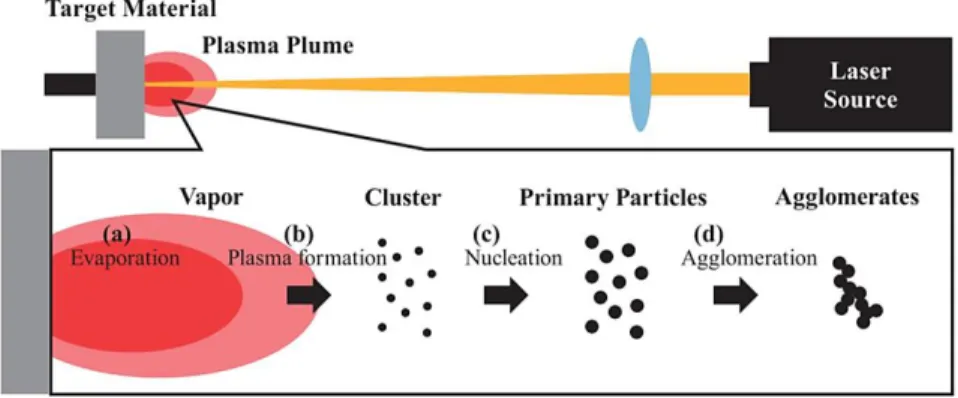
In laser ablation techniques a high energy laser source is applied for etching of surface atoms by breaking of chemical bonds, when focusing on a solid surface target. As a result, atoms vaporize into the surrounding media (gas or liquid phase). The pulsed laser ablation technique is schematically illustrated on figure 6, which shows the nanoparticle formation mechanism. Due to collision between reactive species and surrounding molecules, a laser-induced plasma plume is generated on the target surface (M. Kim et al. 2017). Production of nanoparticles is controlled by process parameters such as laser properties (e.g. laser power and laser source), target material, pressure, and the surrounding media. These process parameters have an impact on nanoparticle surface parameters. As an example, laser-ablation in low-pressure gas phase is preferred for generation of small-sized nanoparticles, since a larger plume is obtained under these conditions. Laser ablation in gas phase does results in production of nanoparticles of high-purity, since particle purity depends in this case only on purity of metal source and surrounding media. Drawbacks in laser ablation techniques are difficulties in controlling particle size distribution and particle agglomeration (M. Kim et al. 2017).
28
Figure 6: Nanoparticle production in laser ablation technique, and a schematic presentation of nucleation and
growth of nanoparticle formation. Reproduced from (M. Kim et al. 2017).
Laser ablation permits generation of different types of nanoparticles including quantum dots
(Horoz et al. 2012), oxide nanoparticles (P. Liu et al. 2011), and CNT (Chrzanowska et al. 2015). Gold nanostructures was also produced on a substrate under Patm (Nikov et al. 2017). In
their study, it was reported that morphology of nanostructures strongly depended on the deposition geometry (i.e. deposition angle between substrate and plasma plume).
Conventional nanoparticle synthesis techniques applying the bottom-up approach was presented in the production of metallic nanoparticles in a liquid phase. In the following, common synthesis techniques and methods applied for the production of silver nanoparticles will be covered.
2.2.3 Silver nanoparticle synthesis
The demand of silver nanoparticles has increased, due to its applicability in multiple fields. Over the years, various synthesis techniques have been developed and techniques have been optimized in order to prepare small-sized and uniform silver nanoparticles.
Silver nanoparticles were prepared by (P. C. Lee and Meisel 1982) using the chemical reduction technique. In this synthesis silver ions are reduced by sodium citrate. Further investigation on the role of citrate revealed that besides acting as a reducing agent, citrate anions also has a stabilizing effect on silver nanoparticles. At this point the LaMer nucleation and growth mechanism was used to describe the nucleation and growth of nanoparticles. However, studies of (Van Hyning and Zukoski 1998) revealed that the LaMer nucleation and growth
29
mechanism does not relate to their observations. Therefore, Van Hyning et al. studied the nucleation and growth mechanism, which is applicable to their results. They prepared silver nanoparticles via the chemical reduction technique in which silver perchlorate ions are reduced by sodium borohydride. In their study it was determined that an increase of the sodium borohydride concentration would result in the instability of silver nanoparticles.
In the study performed by (Zielińska et al. 2009) the stability of silver nanoparticles were of main focus. Silver nanoparticles were prepared using the chemical reduction method.Zielińska et
al. showed that the type of precursor has an effect on particle stability. According to their
research, stable and spherical silver nanoparticles were synthesized using silver citrate as the precursor in the presence of NaBH4, as both reducing agent and stabilizing agent. These results
were compared to silver nanoparticles prepared in the use of silver nitrate or silver acetate as the precursor. In this case silver nanoparticles were unstable and precipitated shortly after the synthesis. Alternatively, (Malina et al. 2012) presented in their study that it is also possible to synthesize stable and uniform spherical silver nanoparticles via the chemical reduction technique using AgNO3 as precursor and NaBH4 as reducing agent and polymer as the stabilizing agent.
In a study performed by (Hsu and Wu 2011) crystalline silver nanoparticles between 3-15nm were prepared in the reduction of silver ions (AgNO3) by formaldehyde using three stabilizing
agents. Reduction by formaldehyde is rather slow and requires thus catalysts or a reaction promoter in order to speed up the reaction process. Furthermore, synthesis at high pH favors the reducing efficiency in the presence of poly-(N-vinyl-2-pyrrolidone) (PVP) yielding average particle size of 15nm spherical silver nanoparticles. Thiosalicylic acid as the stabilizing agent in this case would yield 8nm spherical silver nanoparticles. Finally, triethylamine (TEA) would yield the smallest particles of 3nm spherical silver nanoparticles. It has been observed that without addition of stabilizing agent, particles would agglomerate, which were prevented through Ag-N bonding by TEA. Concentration of the stabilizing agent has a determining role, as an increased TEA concentration would lead to an increase in particle agglomeration.
(Rodríguez-Sánchez, Blanco, and López-Quintela 2000) produced silver nanoparticles in the application of 20V to silver electrodes. Another observation is that the complete coverage of the cathode limits nanoparticle formation and favors thus the particle deposition process. To avoid
30
cathode deposition and limiting nanoparticle production (Khaydarov et al. 2009) used two metallic silver plates as an electrode pair for the synthesis of colloidal silver nanoparticles.
In another study performed by (Dikovska et al. 2013) the effect of laser wavelength on particle morphology was investigated. They showed that deposition of metallic silver nanoparticles on silica substrate by laser ablation under vacuum resulted in the decrease of particle size as the laser wavelength was decreased.
Conventional synthesis techniques in metal nanoparticle synthesis have been covered. Furthermore, the disadvantages in these techniques have been discussed, which include the following: Use of chemicals, which are hazardous towards the environment. Some of them are time-consuming, and are energy-intensive. Difficulties in synthesis of size- and shape controlled nanoparticle have been observed as well. For this reason an increased interest in ”green” nanoparticle synthesis techniques are developed.
Metal nanoparticle synthesis techniques that is promising and that may be a solution to the above-mentioned problematics is the combination of physical and chemical techniques, namely plasma-liquid synthesis of metal nanoparticles
2.3 Nanoparticle nucleation and growth mechanisms
Formation of nanoparticles is explained in terms of nucleation and growth mechanisms under different nanoparticle synthesis processes. The first theory in nucleation and growth mechanism was formulated by (LaMer and Dinegar 1950), and other theories were proposed eventually.
2.3.1 Nucleation
The classical nanoparticle growth theory was transposed to nanoparticle synthesis by (LaMer and Dinegar 1950), which is based on the classical nucleation theory. They introduce the burst-nucleation concept, where nuclei are formed simultaneously, and will grow afterwards without further nucleation, due to homogeneous nucleation. Nanoparticle synthesis processes (e.g. seed mediated growth) are usually resulting in synthesis of monodisperse nanoparticles. This is valid, when nucleation and growth mechanism are in agreement with homogeneous nucleation, and thus the classical LaMer theorem.
31
LaMer mechanism of nanoparticle nucleation and growth is divided in three main steps, as shown in figure 7, where monomer concentration is presented as a function of time. In the first step of the LaMer diagram “generation of atoms” a rapid increase in concentration of free monomers occurs (reduction: ). In the second step “self-nucleation”, the monomers undergo burst-nucleation, and reduction in concentration of free monomers in the solution occurs (dimerization: ). Towards the end of stage two, concentration of monomers are below the minimum nucleation concentration (Cmin), and almost no nucleation
occurs. In the last step “growth”, nanoparticle clusters grows upon collision with neighboring clusters, which results in aggregation and coalescence.
Figure 7: The classical LaMer model on nucleation and growth mechanism of nanoparticle synthesis.
Reproduced from (Xia et al. 2009).
It was up to debate, whether the LaMer model (based on the classical nucleation theory) is able to describe particle growth and predict size of nanoparticles. This was determined based on studies performed by (Van Hyning and Zukoski 1998), which showed the inconsistency in results, when compared to the LaMer model. For this reason, alternative nucleation and growth models for describing nanoparticle nucleation and growth mechanism was proposed by (J. Polte et al. 2012). This model was adapted to the work of Van Hyning and Zukosi, which is based on the reduction of silver perchlorate (AgClO4) with NaBH4. Nanoparticle nucleation and growth
mechanisms are usually confirmed by time-resolved in-situ experimental techniques such as small-angle X-ray scattering (SAXS) (J. Polte et al. 2012), (Wuithschick et al. 2013) and in-situ
32
UV-vis spectroscopy measurements combined with ex-situ transmission electron microscopy (TEM) characterization of nanoparticles.
The nucleation and growth mechanism that describes silver nanoparticle synthesis by reduction with NaBH4 consists of four steps, as illustrated on figure 8.
Figure 8: A four-step nucleation and growth model on nanoparticle synthesis proposed by (J. Polte et al.
2012). Reproduced from (Pacioni et al. 2015).
In the first step of the nucleation and growth model, rapid reduction of silver ions into silver atoms occurs during the first 200ms of the synthesis. In the second step, reduced metal atoms form dimers, trimers etc. These clusters coalesce until the particles have certain stability. These two steps occurs within the first 5s into nanoparticle synthesis, which results in a particle size of around 2-3nm. This step is followed by a metastable state (third step), which is also described as an intermediate phase of stability, in which particles larger than 1nm remain at a constant size for about 5-10min. In the final step, the stability of nanoparticles decreases, which induces a further growth due to coalescence within 30-60s. This produces stable nanoparticles of around 5-8nm (J. Polte et al. 2012).
2.3.2 Growth
Several theories for describing growth processes of nanoparticles from their nuclei state were later developed. (Reiss 1951) developed a growth model known as “growth by diffusion”, which was developed with focus on the LaMer nucleation and growth model. In this case, the growth rate of spherical particles depends on the monomer flux supplied to the particles. Reiss deduced that if diffusional growth is only depending on monomer flux, small nanoparticles will grow faster in the presence of large particles to result a narrow size distribution. Since this growth
33
mechanism does not consider other growth effects such as aggregation, coalescence, or dissolution (Ostwald ripening), Reiss‟s model was later extended by (Sugimoto 1987).
The Ostwald ripening mechanism of growth is caused by the change in solubility of nanoparticles dependent on their size which is described by the Gibbs-Thomson relation. Due to the high solubility and the surface energy of smaller particles within solution, these re-dissolve and in turn allow larger particles to grow even more, as shown in figure 9a (Thanh, Maclean, and Mahiddine 2014). However, the Ostwald ripening is, according to (Jörg Polte 2015) unlikely to occur, due to metallic nanoparticles being thermodynamically stable at the common reaction temperature ranges (<200°C).
Figure 9: Nanoparticle growth mechanisms. a) Ostwald ripening, and b) Oriented attachment. Reproduced
from (Jing Zhang, Huang, and Lin 2010).
Therefore, the coalescence growth mechanism of nanoparticles is more likely to occur instead as a result of insufficient nanoparticle surface stabilization. These growth mechanisms are similar, and both result in decreased particle concentration with increasing particle size.
Coalescence and oriented attachment are two other very similar examples of growth
mechanisms that nanoparticles are able to undergo during the nanoparticle growth phase. The main difference lies on the attachment between particles at the grain boundaries. In coalescence there is no particular preference for the attachment, thus the lattice planes are randomly oriented. On the other hand, in oriented attachment there is a common crystallographic alignment, which allows for continuous crystallographic planes (Thanh, Maclean, and Mahiddine 2014). The two former growth mechanisms are illustrated without showing details in figure 9b.
34
2.3.3 Stabilization of metallic nanoparticles
Stabilization of metallic nanoparticles is necessary in controlling their size and shape during the growth phase. Without colloidal stabilization of clusters, unstable colloidal particles would grow continuously, thus forming aggregates, and precipitation of metallic particles would occur in the dispersing media (Cosgrove 2010). To some extent, it is possible to reverse the interaction of weakly bonded particles (agglomerations) in the application of external forces such as stirring or mixing. Agglomerates are a group of particles, which are influenced by weak forces (e.g. Van der Waals forces). However, this is not the case, if attractive forces holding particles together are stronger than applied external forces (e.g. covalent bonds). In this case, particles are irreversibly aggregated, which is also known as particle coagulation. To obtain a system of well dispersed particles sufficiently strong repulsive forces, that are at least stronger than attractive forces, are required. Stabilization mechanisms that provide colloidal stability include electrostatic and steric stabilization. Example of a stable and unstable colloidal solution is illustrated on figure 10.
Figure 10: Difference between stable and unstable colloidal solution. Reproduced from (Medix 2016).
A theory in electrostatic stabilization of colloidal solutions was developed by (Verwey 1947),
which is also known as the DLVO theory. Nanoparticles are electrostatically stabilized, when Van der Waals attraction forces between two negatively charged particles are counterbalanced by Coulomb repulsive forces, as shown in figure 11. It states that the total interaction energy of particles (Wtotal) is the sum of interaction energy of attractive Van der Waals forces (WA) and
interaction energy of repulsive Coulomb forces (WR), as expressed in equation 1:
Equation 1
In terms of spherical particle stabilization, the interaction energy of particles exposed to Van der Waals attractive forces are expressed as in equation 2:
35
Equation 2
Where, A: Hamaker constant; r: Particle radius; and D: Distance between two particle surfaces
The interaction energy of particles exposed to Coulomb repulsive forces is expressed as in equation 3:
Equation 3
Where, ε: dielectric constant of the solvent; ε0 : vacuum permittivity; ζ : zeta potential;
κ : thickness of electrical double layer (EDL).
The electrostatic stability of nanoparticles is affected by parameters such as the ionic strength, nanoparticle surface potential, and particle size. The ion concentration is directly proportional to
κ, and thus to the exponential decrease in the surface potential. This means that the higher the
ion concentration, the smaller is the EDL (Jörg Polte 2015).
Electrostatically stabilized nanoparticles are described to have at least one electrical double layer due to surface charges. The resulting Coulomb repulsion forces between particles decay exponentially with the particle-particle interaction distance. Hence, if the electrostatic repulsion is sufficiently high, it prevents the particles from coagulation. When particles are farther than approx. 10nm (corresponding to thickness of EDL) no overlap of EDL occurs, and electrostatic repulsion between particles is zero. However, an overlap in EDL leads towards development in repulsive forces between particles (G. Cao 2004).
As a simple and economic stabilizing method, the disadvantage of stabilizing colloidal solution electrostatically is the stabilization mechanism being sensitive towards ionic strength of the liquid media (Shi 2002).
Figure 11: Electrostatic- and steric stabilization mechanisms of metallic nanoparticles. Reproduced from
(Gual et al. 2010).
Steric stabilization of nanoparticles is provided by adsorption of long-chained
36
11. This protective layer of long-chained molecules creates a repulsive force, which counterbalances Van der Waals forces preventing thus nanoparticle aggregation. Steric stability does not depend on the size of nanoparticles, since particle stabilization depends on parameters such as concentration of stabilizing agent, process temperature, chain length and solubility of the stabilizing agent (Shi 2002). The steric stabilization of nanoparticles is explained by adding a term to the DLVO theory, which describes the repulsive forces, due to the repulsive interactive energy (Wsteric), as expressed in equation 4:
Equation 4
In steric stabilization of metallic nanoparticles, the surface of particles is modified, when interacting with compounds, such as polymers (Surudzic et al. 2013), complex ligands (H. Liu et al. 2012), or surfactants (Kora, Manjusha, and Arunachalam 2009). Stabilizing agents interacts with metal nanoparticles by surrounding the particle surface, which limits the surface accessibility of particles. This reduces thus the reactivity of metal nanoparticles and modifies their properties (Jiang, Liu, and Sun 2005).
In a study performed by (Surudzic et al. 2013), it was shown that the concentration of
surfactants has an impact on the concentration of nanoparticles. Thus, increasing capping agent (i.e. PVA) concentration would accordingly increase nanoparticle concentration, due to the stabilizing effect of PVA.
2.3.4 Size- and shape controlled synthesis of metal nanoparticles
Surface characteristics or morphology (i.e. size, shape, composition, and structure) of metal nanoparticles are controlled during nanoparticle synthesis in the liquid phase. Nanoparticle morphology is usually controlled, since nanoparticle properties are determined by surface characteristics of metal nanoparticles. In order to tailor the morphology of metal nanoparticles, several nanoparticle synthesis techniques have been developed.
Nanoparticle synthesis control initiates once clusters have grown past a critical size, and exist as seeds. Seeds may exist as single crystals (c.f. figure 12a) or single- or multiple-twinned crystal structure (c.f. figure 12b). It is even possible that these co-exist in a synthesis.
37
Figure 12: Nanocrystals as a) Single crystal or b) multiple-twinned crystal. Recreated and reproduced from
(Q. Zhang et al. 2010).
Seeds of single-crystal structure can develop into octahedron, cuboctahedron, cube, or octagonal rod, while seeds of multiple-twinned crystal structure can develop into decahedron, icosahedron, or five-fold twinned rod (K. W. Choi et al. 2014). Shape control of nanoparticles occurs by controlling the distribution of these seeds via kinetic- and thermodynamic depending factors. Under thermodynamic synthesis control, formation of single-crystal seeds is developed in the attempt to minimize the total surface free energy of the system. In terms of a FCC structured crystal, the surface energies of the crystallographic facets are estimated as
. In shape-controlled growth the nanocrystals grows in the presence of both {111}
and {100} facets, or in the presence of {111} or {100} in order to minimize the total surface energy, and other facets of higher energy disappears (K. W. Choi et al. 2014). Under kinetic
synthesis control, formation of multiple twinned seeds is developed when keeping the reduction
rate of metal ions slow. Thus, the population of seeds may be controlled, and seeds take form into kinetically controlled shapes. This is achieved by slowing the reduction rate of the metal precursor in order to prevent nuclei growing auto-catalytically into polyhedral structures (K. W. Choi et al. 2014). Crystal structures, which are in thermodynamic equilibrium and shape of structures in the decrease in thermodynamic equilibrium, are shown in figure 13.
Figure 13: The distance of nanocrystals away from thermodynamic equilibrium. Reproduced from (Tang et
38
Oxidative etching is another method to control crystal growth, in which zero-valent metal
atoms are oxidized back into metal ions. Presence of a ligand in combination with O2 in the
solution results in a strong etchant to seeds. The oxidative etching is susceptible to occur in multiple-twinned crystal seeds rather than single-crystal seeds, due to the fact the defect zones having a higher energy. Therefore, single-crystal seeds are more resistant towards oxidative etching. (K. W. Choi et al. 2014). As a result of shape- and size control of metal nanoparticles, properties of metal nanoparticles are modified. In terms of optical properties, modification in shape and size affects the SPR of metal nanoparticles. The influence of shape control of metal nanoparticles is observed on extinction, absorbance, and scattering spectra of silver nanoparticles as presented on figure 14.
Figure 14: Calculated UV-vis extinction (black), absorption (red), and scattering (blue) spectra of silver
39
2.4 Plasma-liquid interaction in nanoparticle synthesis
Plasma is the fourth state of matter, which is defined by an ionized gas that is made up of a collection of freely moving charged particles, electrons, ions, and neutral particles, which in average becomes electrically neutral. Also, the density of electrons and ions are nearly equal, thus making plasma quasi-neutral. Naturally occurring plasmas can only exist in the atmosphere if the conditions are adequate and is observed in most cases as lightning and northern lights in the atmosphere, but makes up 99% of matter in the universe. On the other hand, engineered plasmas are found as glow (Xuechen Li et al. 2017), arcs (Hrabovský 2002), or corona discharges
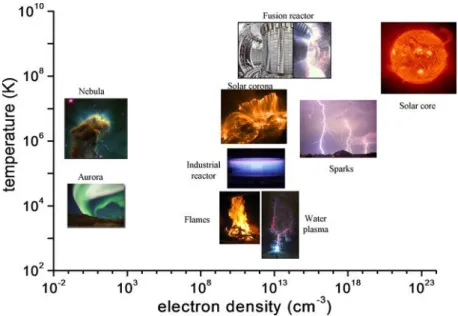
(Veldhuizen and Rutgers 2001). Engineered plasmas has a broad field of application such as in water treatment (Foster 2017), plasma medicine (Haertel et al. 2014), (von Woedtke et al. 2013), nanoparticle synthesis (Kondeti et al. 2017), and many other fields (Nijdam et al. 2012). They exist in various forms and shapes, and are thus characterized based on electron temperature (Te)
and electron density (ne). Other examples of engineered and naturally occurring plasmas are
shown in figure 15 in correlation to Te and ne.
Figure 15: Classification of engineered and natural plasmas based on their T and ne. Reproduced from (LPP