Publisher’s version / Version de l'éditeur:
Vous avez des questions? Nous pouvons vous aider. Pour communiquer directement avec un auteur, consultez la
première page de la revue dans laquelle son article a été publié afin de trouver ses coordonnées. Si vous n’arrivez pas à les repérer, communiquez avec nous à [email protected].
Questions? Contact the NRC Publications Archive team at
[email protected]. If you wish to email the authors directly, please see the first page of the publication for their contact information.
https://publications-cnrc.canada.ca/fra/droits
L’accès à ce site Web et l’utilisation de son contenu sont assujettis aux conditions présentées dans le site LISEZ CES CONDITIONS ATTENTIVEMENT AVANT D’UTILISER CE SITE WEB.
Housing Note (National Research Council of Canada. Division of Building
Research); Volume 3
READ THESE TERMS AND CONDITIONS CAREFULLY BEFORE USING THIS WEBSITE.
https://nrc-publications.canada.ca/eng/copyright
NRC Publications Archive Record / Notice des Archives des publications du CNRC :
https://nrc-publications.canada.ca/eng/view/object/?id=f88435f0-bc9e-4f2e-a39c-c559a54c5d17
https://publications-cnrc.canada.ca/fra/voir/objet/?id=f88435f0-bc9e-4f2e-a39c-c559a54c5d17
NRC Publications Archive
Archives des publications du CNRC
This publication could be one of several versions: author’s original, accepted manuscript or the publisher’s version. / La version de cette publication peut être l’une des suivantes : la version prépublication de l’auteur, la version acceptée du manuscrit ou la version de l’éditeur.
Access and use of this website and the material on it are subject to the Terms and Conditions set forth at
Do You Make These Wasteful Mistakes in Frame Construction?
Hansen, A. T.
Ser
NA7110
~ 2 1 h 8
no.
3
c. 2N A T I O N A L R E S E A R C H C O U l C I L
C A N A D A
D I V I S I O N OF BUILDING R E S E A R C A
H O U S I N G N O T E N O . 3
DO YOU M A K E
THESE
W A S T E F U L M I S T A K E S
IN
F R A M E CONSTRUCTION
?
by
A. T.
Hansen
Reprinted from National Builder, Vol.
X,
No. 10, Oct. 1961, p.22-23FIGURE 1
-
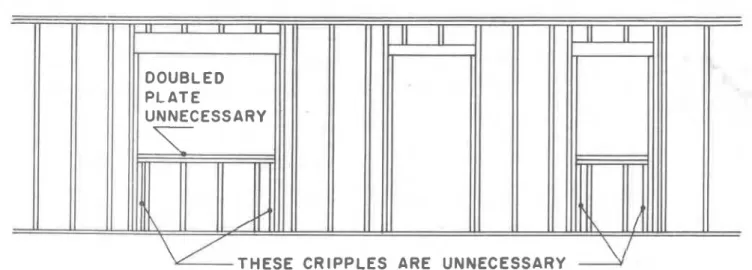
WALL OPENINGS framed without regard to standard stud spacing and with unnecessary additional framing.Do
-
you
make fikese wasfiefull misfiakes
iin frame consfirrucRiiorn?
A DBR
survey showed that
34%
of exterior wall in the average house
had studs in the wrong places,
used
more materials than needed. The
picture probably hasn't changed moch since.
Wood stud walls are widely used in Canadian house construction because such walls, as well as being economical to build, are well suited to Canadian climate. They are easy to insulate at fairly low cost - the typical wood stud
wall with 3 inches of mineral wool insu- lation providing as much thermal resis- tance as 14% feet of solid concrete or
11% inches of solid wood. In addition, wood stud walls are of particular ad- vantage in Canada in that they can be built in winter without requiring heated enclosures.
Call reduce cost
d woad dud wdta
Economical as wood stud walls may
be, however, there is still canriderable scope for further cost savings. This .can be achieved by careful planning and good judgment in the use of framing ma- terial. For instance the number of studs required to frame exterior walls can be reduced by locating the window and
door openings s o that the openiag is adjacmt t o a stud I sCmdar&sped~~g. Sometimes moving a window opening
a
few inches to the right or left will elim- inate the necessity of an additional stud. If windows can be obtained that will fit into the rough opening formed by studs at standard spacing these shmW be used.
Maintaining a uniform stud spacing leads to easier application of insulation since need for cutting of insulation is .
reduced. Less cutting of standard width building materials such as plywood or gypsum board is also achieved when the framing is arranged t o coincide with the standard dimensions of the material. A
nation-wide survey conducted by the Di- vision of Buildmg Research in 1950 and
1951 revealed that in the average house approximately 34 per c m t of the exterior
wall area is framed with stuck that are spaced so as t o be unsuited for the instal- lation of building materials manufactured t o the usual standard dimensions without additional cutting and fitting. It is doubt- ful if this picture has changed signifi- cantly since this survey was made.
Window o h
d ~ p r c s
Observations of .a -bet of builders' operaLiarq show that often more fram-
FIGURE 2
-
WALL OPENINGS located to take advantage of standard stud spacing and employing full-depth lintels.ing material is used around openings than is necessary. It is common practice in many areas, for example, to provide cripples to support the ends of the hori- zontal plate beneath window openings. These members are not necessary struc- turally since there is no load on this plate and they are not required in the "Housing Standards". Some builders also double this plate, again an unnecessary
use of material as this does not con-
tribute to the structural strength of the wi~ll in any way.
These may be small items in them- selves but when one considers the total material and labor required to install these pieces in a house, the cost soon runs into many dollars. An indication of the savings in framing material pos- sible with some planning in the framing layout is illustrated in Figs. 1 and 2.
Full depth lintel
eliminates need for insulation
Many builders find that framing over exterior wall openings is accomplished economicany by installing lintels of suf- ficient size t o completely fill the space above window and door openings rather than installing the minimum permitted lintel size with additional vertical filler pieces between the top wall plate and the lintel. The full depth lintel not only eliminates the extra cutting and fitting of additional pieces, but also eliminates the need for insulation between the lintel and the top wall plates.
Plywood box bepm Hotels
less likely to shrink
The Small Homes Council of the Uni- versity of Illinois has developed a num- ber of plywood box beam lintels to span various size openings. These lintels are essentially made up of 2-inch by Cinch members that form the top and bottom flanges, to which are glued, t o one or both sides, plywood webs of from % t o
% inch depending on the span. These
lintels have an advantage in that there
is less possibility of shrinkage than with solid wood members. On the other hand, gluing is an additional complication and should be attempted only by those fam- iliar with the proper gluing techniques. The use of what are termed "contin- uous lintels" around the top of the ex- terior walls has been proposed as an alternative method to installing individual lintels over each opening. These lintels are usually formed by two 2- by 6- inch members on edge (although larger lintels are necessary for clear spans wider than 6 feet), separated by %-inch pieces of plywood, and attached to the top of the wall by lag screws or other fastening method. This system eliminates individ- ual lintels, but uses more material since the lintel is continuous over the solid wall portions as well as the openings. Additional framing is still needed over the window openings if the tops of the openings are to be of usual height. Wider stud spacing
saves h e , materials
One device for the elimination of framing members that offers a consider- able opportunity for saving is the use of 24-inch stud spacings for both partitions and exterior walls rather than the usual 16-inch spacing. The "Housing Stand- ards" permit this 24-inch spacing pro- vided the walls support only roof and ceiling loads.
Apart from the considerable saving in framing materials (about 35 to 40 studs for the average house). there is also a saving in labor time for the in- stallation of these additional studs. This is still only part of the saving, however. Because there are fewer studs, there are naturally fewer members to which the cladding materials and insulation must be attached.
A very rough calculation of possible savings indicate 13 per cent less nailing is required t o fasten 4- by 8-foot ver- tically applied sheathing or siding and
about 25 per cent less nailing to install 2-foot wide gypsum sheating. In the case of horizontal wood siding, about 30 per cent less nailing is necessary. The picture is much the same for the installation of interior finishing. About 25 per cent fewer nails are required for gypsum lath and about 20 to 25 per cent less nailing to apply wall board. After the wall board joints are taped, there are from 37 to 50 per cent fewer nail heads to conceal depending upon whether the board is applied horizontally or vertically. There is also a reduction of about 33 per cent in the number of pieces of blocking where blocking is used to support the edges of horizontally applied dry wall. Less time is required for the installation of insulation and fewer members have to be drilled to install electrical wiring.
Minimum thickness should be increased
All these advantages. of course, must be weighed in the light of the limita- tions of 24-inch stud spacings. As a rule, thicker gypsum lath should be used
('h inch as against j/s inch) and dry wall
should be at least 'A inch thick. Since many builders are at present using M-
inch dry wall on 16-inch stud centres. this would mean no additional expense. If a single thickness of plywood is used as combined siding and sheathing, with 24-inch stud spacings, the minimum thickness should be increased from 3/k in to lh inch. The requirements for sheath- ing thickness, however, are the same for both 16-and 24-inch spacings.
With the cost of houses increasing each year, it is becoming more and more important to continue to strive for ways to reduce construction costs. Care- ful planning contributes to this end since it not only reduces the building materi- als required in the construction of ;I
frame house but also the labor costs required to install these materials.