Designing an Algorithm for Role Analysis
by
Viktor Kuncak
B.S., University of Novi Sad (2000)
Submitted to the Department of Electrical Engineering and Computer
Science
in partial fulfillment of the requirements for the degree of
Master of Science
at the
MASSACHUSETTS INSTITUTE OF TECHNOLOGY
September 2001
@
Massachusetts Institute of Technology 2001. All rights reserved.
Author...
...
Department of Electrical Engineering and Computer Science
August 20, 2001
C ertified by ...
..
....
...
Martin C. Rinard
Associate Professor
Thesis Supervisor
Accepted by ...
... . . .. .... .. .. .. . . .. ...Arthur C. Smith
Chairman, Department
Committee onGrad
A04 c N TJTUQA ACH ETTS IN TITUTE OFTECHNOL.OGY
Designing an Algorithm for Role Analysis
by
Viktor Kuncak
Submitted to the Department of Electrical Engineering and Computer Science on August 20, 2001, in partial fulfillment of the
requirements for the degree of Master of Science
Abstract
This thesis presents a system for specifying constraints on dynamically changing ref-erencing relationships of heap objects, and an analysis for static verification of these constraints. The constraint specification system is based on the concept of role. The role of an object depends, in large part, on its aliasing relationships with other ob-jects, with the role of each object changing as its aliasing relationships change. In
this way roles capture object and data structure properties such as unique references, membership of objects in data structures, disjointness of data structures, absence of representation exposure, bidirectional associations, treeness, and absence or presence of cycles in the heap.
Roles generalize linear types by allowing multiple aliases of heap objects that participate in recursive data structures. Unlike graph grammars and graph types, roles contain sufficiently general constraints to conservatively approximate any data structure.
We give a semantics for mutually recursive role definitions and derive properties of roles as an invariant specification language. We introduce a programming model that allows temporary violations of role constraints. We describe a static role analysis for verifying that a program conforms to the programming model. The analysis uses fixpoint computation to synthesize loop invariants in each procedure.
We introduce a procedure interface specification language and its semantics. We present an interprocedural, compositional, and context-sensitive role analysis that verifies that a program respects the role constraints across procedure calls.
Thesis Supervisor: Martin C. Rinard Title: Associate Professor
Acknowledgments
I would like to thank my advisor Martin Rinard for initiating this exciting research direction. He proposed the concept of roles and has been providing the essential guidance in exploring the large design space of lightweight program specifications.
I am grateful to all members of Martin's group for creating a stimulating atmo-sphere for research. I thank Patrick Lam who dared to join me in the exploration of roles while the concept was still in its early stage. He helped crystallize ideas of the role analysis and provided a valuable help in its presentation. I thank Brian Demsky for interesting discussions related to dynamic role discovery. I thank Darko Marinov for valuable critical comments regarding the concept of roles and role analysis. I thank Alexandru Salcianu for discussions about the interprocedural aspects of the pointer and escape analysis. I thank Radu Rugina for answering my questions about the context sensitive pointer analyses, C. Scott Ananian for thoughts on introducing sets and relations into Java, Chandrasekhar Boyapati for his comments on relationships of roles with type systems, and William Beebee for discussions about region-based memory allocation in Java.
Many thanks to Darko, Alexandru, and Maria-Cristina Marinescu for helping me survive in the new environment. I also thank my office mates Karen Zee, Patrick Lam and Jonathan Babb for tolerating my continuous presence in the office. I thank Jon for many intriguing chats on a range of topics.
I thank my parents and family for all the support they gave me over the previous years and this year in particular.
Contents
1 Introduction 11
1.1 Overview of Roles . . . . 12
1.1.1 Role Definitions . . . . 13
1.1.2 Roles and Procedure Interfaces . . . . 13
1.2 Contributions . . . . 13
1.3 Outline of the Thesis . . . . 15
2 Roles as a Constraint Specification Language 19 2.1 Abstract Syntax and Semantics of Roles . . . . 19
2.1.1 Heap Representation . . . . 19
2.1.2 Role Representation . . . . 19
2.1.3 Role Semantics . . . . 20
2.2 Using Roles . . . . 21
2.3 Some Simple Properties of Roles . . . . 24
3 A Programming Model 27 3.1 A Simple Imperative Language . . . . 27
3.2 Operational Semantics . . . . 28
3.3 Onstage and Offstage Objects . . . . 30
3.4 Role Consistency . . . . 32
3.4.1 Offstage Consistency . . . . 32
3.4.2 Reference Removal Consistency . . . . 32
3.4.3 Procedure Call Consistency . . . . 32
3.4.4 Explicit Role Check . . . . 33
3.5 Instrumented Semantics . . . . 33
4 Intraprocedural Role Analysis 37 4.1 Abstraction Relation . . . . 37 4.2 Transfer Functions . . . . 40 4.2.1 Expansion . . . . 42 4.2.2 Contraction . . . . 47 4.2.3 Symbolic Execution . . . . 48 4.2.4 Node Check . . . . 49
5 Interprocedural Role Analysis 51
5.1 Procedure Transfer Relations . . . . 51
5.1.1 Initial Context . . . . 51
5.1.2 Procedure Effects . . . . 54
5.1.3 Semantics of Procedure Effects . . . . 55
5.2 Verifying Procedure Transfer Relations . . . . 57
5.2.1 Role Graphs at Procedure Entry . . . . 57
5.2.2 Verifying Basic Statements . . . . 58
5.2.3 Verifying Procedure Postconditions . . . . 59
5.3 Analyzing Call Sites . . . . 59
5.3.1 Context Matching. . . . . 60 5.3.2 Effect Instantiation . . . . 62 5.3.3 Role Reconstruction . . . . 62 6 Extensions 65 6.1 M ultislots . . . . 65 6.2 Root Variables . . . . 65 6.3 Singleton Roles . . . . 66
6.4 Cascading Role Changes . . . . 68
6.5 Partial Roles . . . . 69
6.5.1 Partial Roles and Role Sets . . . . 70
6.5.2 Semantics of Partial Roles . . . . 71
6.5.3 Fixpoint Definition of the Greatest Role Assignment ... 72
6.5.4 Expressibility of Partial Roles . . . . 73
6.5.5 Role Subtyping . . . . 74 7 Related Work
7.1 Typestate Systems . . . . 7.2 Roles in Object-Oriented Programming 7.3 Shape Analysis . . . . 7.4 Interprocedural Analyses . . . . 7.5 Program Verification . . . . 79 . . . . 7 9 . . . . 8 0 . . . . 8 2 . . . . 8 4 . . . . 8 5 8 Conclusion
A Decidability Properties of Roles
A.1 Roles with Field and Slot Constraints . . . . A.1.1 Forms of Slot Constraints . . . . A.1.2 Equivalence of Original and Generalized Slots . . . . A.1.3 Eliminating Field Constraints . . . . A.1.4 Decidability of the Satisfiability Problem . . . . A.2 Undecidability of Model Inclusion . . . .
87 89 89 89 90 90 91 92
List of Figures
1-1 Role Reference Diagram for a Scheduler . . . . 1-2 Role Definitions for a Scheduler . . . . 1-3 Suspend Procedure ...
2-1 Roles of Nodes of a Sparse Matrix . . . . 2-2 Sketch of a Two-Level Skip List . . . . 3-1 Syntactic Sugar for if and while . . . . 3-2 Semantics of Basic Statements . . . . 3-3 Semantics of Procedure Call . . . . 3-4 Operational Semantics of Explicit Role Check 3-5 Instrumented Semantics . . . . 4-1 4-2 4-3 4-4 4-5 4-6 4-7 4-8 4-9 4-10 5-1 5-2 5-3 5-4 5-5 5-6 5-7 5-8 5-9 6-1 6-2 6-3 Abstraction Relation . . . . Simulation Relation Between Abstract and Abstract Execution ..+ . . . . Expansion Relation . . . . Instantiation Relation . . . . A Role Graph for an Acyclic List . . . . . Split Relation . . . . Contraction Relation . . . . Normalization . . . . Symbolic Execution of Basic Statements .
Concrete
Initial Context for kill Procedure . . . . . Insert Procedure for Acyclic List . . . . Insert Procedure with Object Allocation . . The Set of Role Graphs at Procedure Entry Verifying Load, Store, and New Statements . Procedure Call . . . . The Context Matching Algorithm . . . . Effect Instantiation . . . . Call Site Role Reconstruction . . . . Roles for Circular List . . . . An Instance of Role Declarations . . . .
Example of a Cascading Role Change . . . .
Execution 12 14 15 22 23 27 29 30 33 34 39 41 41 42 43 44 45 47 47 48 53 55 56 58 58 60 61 63 64 67 67 68
6-4 Abstract Execution for setRoleCascade . . . . 69
6-5 Definition of a Tree . . . . 70
6-6 Definition of a List . . . . 71
A-1 A Grid after Role Preserving Modification . . . . 94
Chapter 1
Introduction
Types capture important properties of the objects that programs manipulate, increas-ing both the safety and readability of the program. Traditional type systems capture properties (such as the format of data items stored in the fields of the object) that are invariant over the lifetime of the object. But in many cases, properties that do change are as important as properties that do not. Recognizing the benefit of captur-ing these changes, researchers have developed systems in which the type of the object changes as the values stored in its fields change or as the program invokes operations on the object [84, 83, 20, 91, 92, 11, 40, 26]. These systems integrate the concept of changing object states into the type system.
The fundamental idea in this work is that the state of each object also depends on the data structures in which it participates. Our type system therefore captures the referencing relationships that determine this data structure participation. As objects move between data structures, their types change to reflect their changing relationships with other objects. Our system uses roles to formalize the concept of a type that depends on the referencing relationships. Each role declaration provides complete aliasing information for each object that plays that role-in addition to specifying roles for the fields of the object, the role declaration also identifies the complete set of references in the heap that refer to the object. In this way roles generalize linear type systems [87, 6, 56] by allowing multiple aliases to be statically tracked, and extend alias types [82, 88] with the ability to specify roles of objects that are the source of aliases.
This approach attacks a key difficulty associated with state-based type systems: the need to ensure that any state change performed using one alias is correctly re-flected in the declared types of the other aliases. Because each object's role identifies all of its heap aliases, the analysis can verify the correctness of the role informa-tion at all remaining or new heap aliases after an operainforma-tion changes the referencing relationships.
Roles capture important object and data structure properties, improving both the safety and transparency of the program. For example, roles allow the programmer to express data structure consistency properties (with the properties verified by the role analysis), to improve the precision of procedure interface specifications (by allowing the programmer to specify the role of each parameter), to express precise
referenc-LiveHeader next
next next
DeadProcI
LiveList next null
next proc proc left right
pev
RunnProc Sleinro
next pr left right
R e v ne xt
root RunningHeader
SleepingTree]
next prev
Figure 1-1: Role Reference Diagram for a Scheduler
ing and interaction behaviors between objects (by specifying verified roles for object fields and aliases), and to express constraints on the coordinated movements of ob-jects between data structures (by using the aliasing information in role definitions to identify legal data structure membership combinations). Roles may also aid program optimization by providing precise aliasing information.
1.1
Overview of Roles
Figure 1-1 presents a role reference diagram for a process scheduler. Each box in the diagram denotes a disjoint set of objects of a given role. The labelled arrows between boxes indicate possible references between the objects in each set. As the diagram indicates, the scheduler maintains a list of live processes. A live process can be either running or sleeping. The running processes form a doubly-linked list, while sleeping processes form a binary tree. Both kinds of processes have proc references from the live list nodes LiveList. Header objects RunningHeader and SleepingTree simplify operations on the data structures that store the process objects.
As Figure 1-1 shows, data structure participation determines the conceptual state of each object. In our example, processes that participate in the sleeping process tree data structure are classified as sleeping processes, while processes that participate in the running process list data structure are classified as running processes. Moreover, movements between data structures correspond to conceptual state changes-when a process stops sleeping and starts running, it moves from the sleeping process tree to the running process list.
1.1.1
Role Definitions
Figure 1-2 presents the role definitions for the objects in our example.1 Each role definition specifies the constraints that an object must satisfy to play the role. Field constraints specify the roles of the objects to which the fields refer, while slot con-straints identify the number and kind of aliases of the object.
Role definitions may also contain two additional kinds of constraints: identity constraints, which specify paths that lead back to the object, and acyclicity con-straints, which specify paths with no cycles. In our example, the identity constraint next .prev in the RunningProc role specifies the cyclic doubly-linked list constraint
that following the next, then prev fields always leads back to the initial object. The acyclic constraint left, right in the SleepingProc role specifies that there are no cycles in the heap involving only left and right edges. On the other hand, the list of running processes must be cyclic because its nodes can never point to null.
The slot constraints specify the complete set of heap aliases for the object. In our example, this implies that no process can be simultaneously running and sleeping.
In general, roles can capture data structure consistency properties such as dis-jointness and can prevent representation exposure [14, 22]. As a data structure de-scription language, roles can naturally specify trees with additional pointers. Roles can also approximate non-tree data structures like sparse matrices. Because most role constraints are local, it is possible to inductively infer them from data structure instances.
1.1.2
Roles and Procedure Interfaces
Procedures specify the initial and final roles of their parameters. The suspend procedure in Figure 1-3, for example, takes two parameters: an object with role RunningProc p, and the SleepingTree s. The procedure changes the role of the ob-ject referenced by p to SleepingProc whereas the obob-ject referenced by s retains its original role. To perform the role change, the procedure removes p from its RunningList data structure and inserts it into the SleepingTree data structure
s. If the procedure fails to perform the insertions or deletions correctly, for instance
by leaving an object in both structures, the role analysis will report an error.
1.2
Contributions
This thesis makes the following contributions:
e Role Concept: The concept that the state of an object depends on its refer-encing relationships; specifically, that objects with different heap aliases should be regarded as having different states.
'In general, each role definition would specify the static class of objects that can play that role. To simplify the presentation, we assume that all objects are instances of a single class with a set of fields F.
role LiveHeader {
fields next LiveList I null;
}
role LiveList {
fields next LiveList I null,
proc RunningProc I SleepingProc; slots LiveList.next I LiveHeader.next; acyclic next;
}
role RunningHeader {
fields next : RunningProc I RunningHeader, prev : RunningProc I RunningHeader; slots RunningHeader.next I RunningProc.next,
RunningHeader.prev I RunningProc.prev; identities next.prev, prev.next;
}
role RunningProc {
fields next : RunningProc I RunningHeader, prev : RunningProc I RunningHeader; slots RunningHeader.next | RunningProc.next,
RunningHeader.prev I RunningProc.prev, LiveList.proc;
identities next.prev, prev.next;
}
role SleepingTree {
fields root : SleepingProc I null, acyclic left, right;
}
role SleepingProc {
fields left : SleepingProc I null, right : SleepingProc I null;
slots SleepingProc.left I SleepingProc.right SleepingTree.root;
LiveList.proc;
acyclic left, right;
}
role DeadProc { }
procedure suspend(p : RunningProc ->> SleepingProc,
s : SleepingTree)
local pp, pn, r;
pp = p.prev; pn = p.next; r = s.root;
p.prev = null; p.next = null; pp.next = pn; pn.prev = pp;
s.root = p; p.left = r; setRole(p : SleepingProc);
}
Figure 1-3: Suspend Procedure
" Role Semantics and its Consequences: It presents a semantics of a lan-guage for defining roles. The programmer can use this lanlan-guage to express data structure invariants and properties such as participation of objects in data structures. We show how roles can be used to control the aliasing of objects, and
express reachability properties. We show certain decidability and undecidability
results for roles.
* Programming Model: It presents a set of role consistency rules. These rules give a programming model for changing the role of an object and the circumstances under which roles can be temporarily violated.
* Procedure Interface Specification Language: It presents a language for
specifying the initial context and effects of each procedure. The effects summa-rize the actions of the procedure in terms of the references it changes and the
regions of the heap that it affects.
" Role Analysis Algorithm: It presents an algorithm for verifying that the
program respects the constraints given by a set of role definitions and procedure specifications. The algorithm uses a data-flow analysis to infer intermediate
referencing relationships between objects, allowing the programmer to focus
on role changes and procedure interfaces. The analysis can verify acyclicity constraints even if they are temporarily violated. The interprocedural analysis
verifies read effects as well as "may" and "must" write effects by maintaining
a fine grained mapping between the current heap and the initial context of the procedure.
1.3
Outline of the Thesis
The rest of the thesis is organized as follows.
In Chapter 2 we introduce the representation of program heap (2.1.1) and the
for-mally define the semantics of roles by giving a criterion for a heap to satisfy the role constraints (2.1.3). We then highlight some application level properties that can be specified using roles (2.2) and give examples of using roles to describe data structures. We give a list of properties (2.3) that show how roles help control aliasing while giv-ing more flexibility than linear type systems. We show how to deduce reachability properties from role constraints and give a criterion for a set of roles to define a tree. A more detailed study of the constraints expressible using roles is delegated to Appendix A, where we prove decidability of the satisfiability problem for a class of role constraints (A.1.4), and undecidability of the model inclusion for role definitions
(A.2).
In Chapter 3 we introduce a programming model that enables role definitions to be integrated with the program. We introduce a core programming language with procedures (3.1) and give its operational semantics (3.2). Next we introduce the notion of onstage and offstage nodes (3.3) which defines the criterion for temporary violations of role constraints by generalizing heap consistency from (2.1.3). As part of the programming model we introduce restrictions on programs that simplify later analysis and ensure role consistency across procedure calls (3.4). We give the pre-conditions for transitions of the operational semantics that formalize role consistency. We then introduce an instrumented semantics that gives the programmer complete control over the assignment of roles to objects (3.5). This completes the description of the programming model, which is verified by the role analysis.
We present the intraprocedural role analysis in Chapter 4. We define the abstract representation of concrete heaps called role graphs and specify the abstraction relation (4.1). We then define transfer functions for the role analysis (4.2). This includes the expansion relation (4.2.1) used to instantiate nodes from offstage to onstage using instantiation (4.2.1) and split (4.2.1). We model the movement of nodes offstage using the contraction relation (4.2.2). We also describe the checks that the role analysis performs on role graphs to ensure that the program respects the programming model (4.2.3, 4.2.4).
In Chapter 5 we generalize the role analysis to the interprocedural case. We first introduce procedure interface specification language (5.1) that describes initial context (5.1.1) and effects (5.1.2) of each procedure. We give examples of proce-dure interfaces and define the semantics of initial contexts (5.1.1) and effects (5.1.3). The interprocedural analysis extends the intraprocedural analysis from Chapter 4 by verifying that each procedure respects its specification (5.2) and by instantiating pro-cedure specifications to analyze call sites (5.3). The verification of transfer relations uses a fine grained mapping between nodes of the role graph at each program point and nodes of the initial context. The analysis of call sites needs to establish the map-ping between the current role graphs and callee's initial context (5.3.1), instantiate callee's effects (5.3.2) and then reconstruct the roles of modified non-parameter nodes (5.3.3).
In Chapter 6 we present the extensions of the basic role framework described in previous chapters. These extensions allow a statically unbounded number of heap references to objects (6.1), roles defined by references from local variables, non-incremental changes to the role assignment (6.4), and roles for specifying partial
information about object's fields and aliases (6.5). The last section also outlines a subtyping criterion for partial roles.
In Chapter 7 we compare our work to the previous typestate systems, the propos-als to control the aliasing in object oriented programming and the term roles as used in object modeling and database community. We compare our role analysis with pro-gram verification and analysis techniques for dynamically allocated data structures. Chapter 8 concludes the thesis.
Chapter 2
Roles as a Constraint Specification
Language
In this chapter we introduce the formal semantics of roles. We then show how to use roles to specify properties of objects and data structures.
2.1
Abstract Syntax and Semantics of Roles
In this section, we precisely define what it means for a given heap to satisfy a set of role definitions. In subsequent sections we will use this definition as a starting point for a programming model and role analysis.
2.1.1
Heap Representation
We represent a concrete program heap as a finite directed graph H, with nodes(Hc) representing objects of the heap and labelled edges representing heap references. A graph edge (01,
f,
02) E H, denotes a reference with field namef
from object oi to object 02. To simplify the presentation, we fix a global set of fields F and assume that all objects have the set of fields F.2.1.2
Role Representation
Let R denote the set of roles used in role definitions, nUIlR be a special symbol always denoting a null object null, and let RO = R U {nUlIR}. We represent each role as the conjunction of the following four kinds of constraints:
e Fields: For every field name
f
E F we introduce a function fieldf : R a 2Ro denoting the set of roles that objects of role r E R can reference through fieldf.
A fieldf
of role r can be null if and only if nUlRC
fieldf(r). The explicit use of nullR and the possibility to specify a set of alternative roles for every field allows roles to express both may and must referencing relationships." Slots: Every role r has slotno(r) slots. A slot SlOtk(r) of role r E R is a subset
of R x F. Let o be an object of role r and o' an object of role r'. A reference
(o',
f,
o) E H, can fill a slot k of object o if and only if (r',f)
E SlOtk(r). Anobject with role r must have each of its slots filled by exactly one reference. " Identities: Every role r E R has a set of identities(r) C F x F. Identities
are pairs of fields (f, g) such that following reference
f
on object o and then returning on reference g leads back to o." Acyclicities: Every role r E R has a set acyclic(r) C F of fields along which
cycles are forbidden.
2.1.3
Role Semantics
We define the semantics of roles as a conjunction of invariants associated with role definitions. A concrete role assignment is a map pc : nodes(Hc) -+ Ro such that pe(nullc) = nUll
R-Definition 1 Given a set of role definitions, we say that heap H, is role consistent iff
there exists a role assignment pc : nodes(He) -+f RO such that for every o E nodes(He) the predicate \ocallyConsistent(o, He, pc) is satisfied. We call any such role assignment pc a valid role assignment.
The predicate locallyConsistent(o, Hc, pc) formalizes the constraints associated with role definitions.
Definition 2 locallyConsistent(o, He, pc) iff all of the following conditions are met.
Let r = pe(o).
1) For every field f C F and (o, f, o') C He, pc(o') E fieldf(r).
2) Let {(01, fl), . . ., (ok, fA)} = {(o', f) 1 (o',
f,
o)C
Hc} be the set of all aliasesof node o. Then k = slotno(r) and there exists some permutation p of the set
{1,... , k} such that (pc(oi), fi)
c
slot, (r) for all i.3) If (o,
f,
o') E He, (o', g, o") E He, and(f,
g) E identities(r), then o = o".4)
It is not the case that graph He contains a cycle01,
f,...,
oS,f,o
1 where o = o andfi,.
..,f
C acyclic(r)Note that a role consistent heap may have multiple valid role assignments pc. However,
in each of these role assignments, every object o is assigned exactly one role pc(o). The existence of a role assignment pc with the property pc(Oi) # poc(o2) thus implies
2.2
Using Roles
Roles capture important properties of the objects and provide useful information about how the actions of the program affect those properties.
" Consistency Properties: Roles can ensure that the program respects appli-cation - level data structure consistency properties. The roles in our process scheduler, for example, ensure that a process cannot be simultaneously sleeping and running.
" Interface Changes: In many cases, the interface of an object changes as its referencing relationships change. In our process scheduler, for example, only running processes can be suspended. Because procedures declare the roles of their parameters, the role system can ensure that the program uses objects correctly even as the object's interface changes.
" Multiple Uses: Code factoring minimizes code duplication by producing general-purpose classes (such as the Java Vector and Hashtable classes) that can be used in a variety of contexts. But this practice obscures the different purposes that different instances of these classes serve in the computation. Be-cause each instance's purpose is usually reflected in its relationships with other objects, roles can often recapture these distinctions.
" Correlated Relationships: In many cases, groups of objects cooperate to implement a piece of functionality. Standard type declarations provide some information about these collaborations by identifying the points-to relationships between related objects at the granularity of classes. But roles can capture a much more precise notion of cooperation, because they track correlated state changes of related objects.
Programmers can use roles for specifying the membership of objects in data struc-tures and the structural invariants of data strucstruc-tures. In both cases, the slot con-straints are essential.
When used to describe membership of an object in a data structure, slots specify the source of the alias from a data structure node that stores the object. By assigning different sets of roles to data structures used at different program points, it is possible to distinguish nodes stored in different data structure instances. As an object moves between data structures, the role of the object changes appropriately to reflect the new source of the alias.
When describing nodes of data structures, slot constraints specify the aliasing constraints of nodes; this is enough to precisely describe a variety of data structures and approximate many others. Property 16 below shows how to identify trees in role definitions even if tree nodes have additional aliases from other sets of nodes. It is also possible to define nodes which make up a compound data structure linked via disjoint sets of fields, such as threaded trees, sparse matrices and skip lists.
x X x x
Figure 2-1: Roles of Nodes of a Sparse Matrix
Example 3 The following role definitions specify a sparse matrix of width and height at least 3. These definitions can be easily constructed from a sketch of a sparse matrix in Figure 2-1.
role Al {
fields x :A2, y :A4; acyclic x, y;
}
role A2 {
fields x :A2 I A3, y :A5;
slots A1.x I A2.x;
acyclic x, y; } role A3 { fields y :A6; slots A2.x; acyclic x, y; } role A4 {
fields x :A5, y :A4
I
A7; slots A1.y I A4.y;acyclic x, y;
}
role A5 {
fields x : A5 y A6, y ;A5 A8;
slots A4.x I A5.x, A2.y I A5.y;
two two
SL 2 2 null
CL1 15 2
I
one one one one one one
Figure 2-2: Sketch of a Two-Level Skip List }
role A6 {
fields y : A6 I A9; slots A5.x, A3.y I A6.y; acyclic x, y; } role A7 { fields x : A8; slots A4.y; acyclic x, y; } role A8 { fields x : A8 I A9; slots A7.x I A8.x, A5.y; acyclic x, y;
}
role A9 {
slots A8.x, A6.y; acyclic x, y;
}
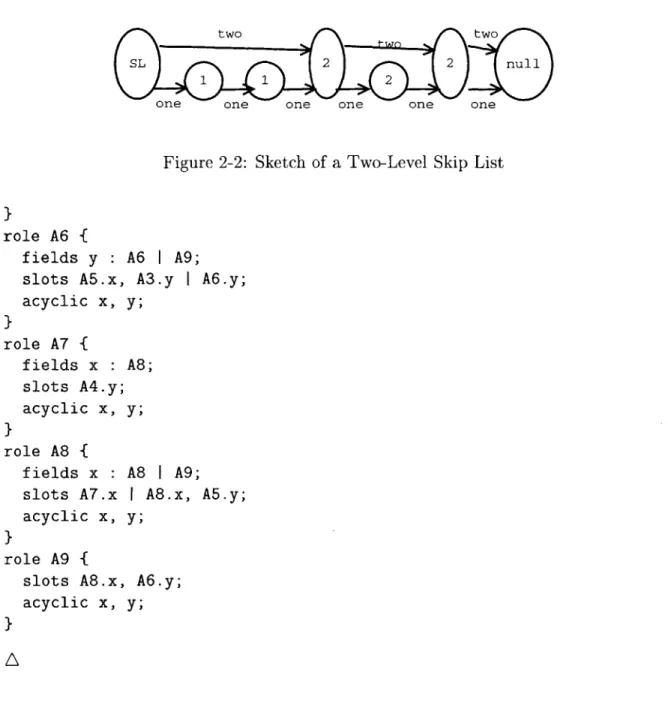
Example 4 We next give role definitions for a two-level skip list [69] sketched in
Figure 2-2.
role SkipList {
fields one : OneNode
I
TwoNodeI
null; two : TwoNodeI
null;}
role OneNode {
fields one : OneNode
I
TwoNodeI
null; two : null;slots OneNode.one I TwoNode.one
I
SkipList.one; acyclic one, two;role TwoNode {
fields one : OneNode I TwoNode I null; two : TwoNode I null;
slots OneNode.one I TwoNode.one I SkipList.one,
TwoNode.two I SkipList.two;
acyclic one, two;
} A
2.3
Some Simple Properties of Roles
In this section we identify some of the invariants expressible using sets of mutually recursive role definitions. Some further properties of roles are given in Appendix A.
The following properties show some of the ways role specifications make object aliasing more predictable. They are an immediate consequence of the semantics of roles.
Property 5 (Role Disjointness)
If there exists a valid role assignment pc for H, such that p(o1) # p(o2), then o1 # 02. The previous property gives a simple criterion for showing that objects Oi and 02 are unaliased: find a valid role assignment which assigns different roles to o1 and 02. This use of roles generalizes the use of static types for pointer analysis [24]. Since roles create a finer partition of objects than a typical static type system, their potential for proving absence of aliasing is even larger.
Property 6 (Disjointness Propagation)
If (01,
f,
02), (03, g, 04) E He, 01 # 03, and there exists a valid role assignment pc for He such that pc(02) = Pc(04) = r but fieldf (r) n fieldg (r) = 0, then 02$
04-Property 7 (Generalized Uniqueness)
If (01,
f,
02), (03, g, 04) E He, 01 5 03, and there exists a role assignment pc such that PC(02) = Pc(04) = r, but there are no indices i # j such that (pc(o1), f) C sloti(r) and(pc(o2), g) E slotj (r) then 02 0 04.
A special case of Property 7 occurs when slotno(r) = 1; this constrains all references
to objects of role r to be unique.
Role definitions induce a role reference diagram RRD which captures some, but not all, role constraints.
Definition 8 (Role Reference Diagram)
Given a set of definitions of roles R, a role reference diagram RRD is is a directed graph with nodes RO and labelled edges defined by
RRD = {(r,
f,
r') I r' E fieldf (r) and Ei (r, f) E sloti(r')}Each role reference diagram is a refinement of the corresponding class diagram in a statically typed language, because it partitions classes into multiple roles according to their referencing relationships. The sets p-j(r) of objects with role r change during program execution, reflecting the changing referencing relationships of objects.
Role definitions give more information than a role reference diagram. Slot con-straints specify not only that objects of role r1 can reference objects of role r2 along field
f,
but also give cardinalities on the number of references from other objects. In addition, role definitions include identity and acyclicity constraints, which are not present in role reference diagrams.Property 9 Let pc be any valid role assignment. Define G = {(pc(o), f, pc(o2))
I
(01, f, 02) E H,}Then G is a subgraph of RRD.
It follows from Property 9 that roles give an approximation of may-reachability among heap objects.
Property 10 (May Reachability)
If there is a valid role assignment pc : nodes(He) -+ Ro such that pc(o1)
#
p,(o2) where 01,02 G nodes(He) and there is no path from pc(oi) to pN(02) in the role referencediagram RRD, then there is no path from o1 to 02 in He.
The next property shows the advantage of explicitly specifying null references in role definitions. While the ability to specify acyclicity is provided by the acyclic constraint, it is also possible to indirectly specify must-cyclicity.
Property 11 (Must Cyclicity)
Let F0 C F and R, C R be a set of nodes in the role reference diagram RRD such
that for every node r E Rey, if (r, f, r') E RRD then r' E Rcyc. If pc is a valid role assignment for He, then every object 01 E H, with pe(o1) E Reyc is a member of a
cycle in H, with edges from F0.
The following property shows that roles can specify a form of must-reachability among the sets of objects with the same role.
Property 12 (Downstream Path Termination)
Assume that for some set of fields F0 C F there are sets of nodes RNTER C R,
RFNAL C RO of the role reference diagram RRD such that for every node r
C
RINTER-1. F0 C acyclic(r)
2. if (r,
f,
r') E RRD forf
C FO, then r' E RINTERU RFNALLet pc be a valid role assignment for He. Then every path in H, starting from an object o1 with role pc(o1) e RNTER and containing only edges labelled with F is a
RFNAL-Property 13 (Upstream Path Termination)
Assume that for some set of fields F C F there are sets of nodes RNTER C R,
RNIT C RO of the role reference diagram RRD such that for every node r C RNTER:
1. F0 C acyclic(r)
2. if (r',
f,
r) E RRD forf
C FO, then r' E RNTERU RNITLet pc be a valid role assignment for He. Then every path in He terminating at an
object 02 with PC(02) E RNTER and containing only edges labelled with F is a suffix of
a path which started at some object o1, where pc(o1) C RINIT
-We next describe the conditions that guarantee the existence at least one path in the heap, rather than stating the properties of all paths as in Properties 12 and 13. Property 14 (Downstream Must Reachability)
Assume that for some set of fields F0 C F there are sets of roles RNTER C R,
RFIN AL C RO of the role reference diagram RRD such that for every node r E RNTER:
1. F0 C acyclic(r)
2. there exists f E F such that fieldf(r) C RNTER U RFNAL
Let pc be a valid role assignment for He. Then for every object o1 with pc(o1) E RNTER
there is a path in H, with edges from F from 01 to some object 02 where Pc(02) E RFNAL.
Property 15 (Upstream Must Reachability)
Assume that for some set of fields F0 C F there are sets of nodes RINTER C R,
RIN\T C R of the role reference diagram RRD such that for every node r E R\NTER:
1. F0 C acyclic(r)
2. there exists k such that slotk(r) C (RINTER U RINIT) x F
Let pc be a valid role assignment for He. Then for every object 02 with pe(02) E RINTER
there is a path in He from some object o1 with pc(o1) E RINIT to the object 02.
Trees are a class of data structures especially suited for static analysis. Roles can express graphs that are not trees, but it is useful to identify trees as certain sets of mutually recursive role definitions.
Property 16 (Treeness)
Let RTREE R f be a set of roles and F0 C F set of fields such that for every r C RTREE
1. F C acyclic(r)
2. {i sloti(r) n (RTREE X F0) #}I < 1 Let pc be a valid role assignment for H, and
S C {(ni, f, n2) I (ni, f, n2) E H, p(ni), p(n2) E RTREE,f E FO}
Chapter 3
A Programming Model
In this chapter we define what it means for an execution of a program to respect the role constraints. This definition is complicated by the need to allow the program to temporarily violate the role constraints during data structure manipulations. Our approach is to let the program violate the constraints for objects referenced by local variables or parameters, but require all other objects to satisfy the constraints.
We first present a simple imperative language with dynamic object allocation and give its operational semantics. We then specify additional statement preconditions that enforce the role consistency requirements.
3.1
A Simple Imperative Language
Our core language contains, as basic statements, Load (x=y. f), Store (x. f=y), Copy (x=y), and New (x=new). All variables are references to objects in the global heap and all assignments are reference assignments. We use an elementary test statement combined with nondeterministic choice and iteration to express if and while state-ment, using the usual translation [44, 5] given in Figure 3-1. We represent the control flow of programs using control-flow graphs.
A program is a collection of procedures proc c Proc. Procedures change the global heap but do not return values. Every procedure proc has a list of parame-ters param(proc) = {parami(proc)} and a list of local variables local(proc). We use var(proc) to denote param(proc) U local(proc). A procedure definition specifies the ini-tial role preRk(proc) and the final role postRk(proc) for every parameter paramk(proc). We use procj for indices
j
E .J to denote activation records of procedure proc. We fur-ther assume that fur-there are no modifications of parameter variables so every parameter references the same object throughout the lifetime of procedure activation.if t stat1 stat2 (test (t); stati) I (test ( ! 0; stat2) while tstat (test (t); stat)*; test(! t)
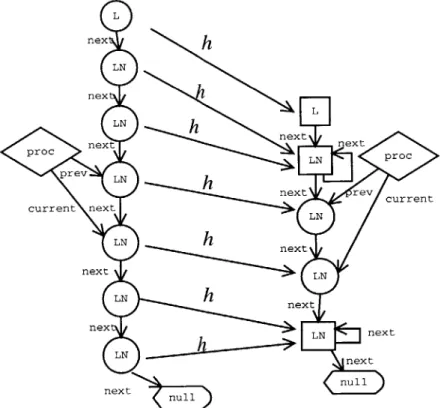
Example 17 The following kill procedure removes a process from both the doubly linked list of running processes and the list of all active processes. This is indicated by the transition from RunningProc to DeadProc.
procedure kill(p : RunningProc ->> DeadProc, 1 : LiveHeader)
local prev, current, cp, nxt, lp, ln;
{
// find 'p' in ''
prev = 1; current = l.next;
cp = current.proc; while (cp != p) { prev = current; current = current.next; cp = current.proc; }
// remove 'current' and 'p' from active list nxt = current.next;
prev.next = nxt; current. current.proc = null;
setRole(current : IsolatedCell);
// remove 'p' from running list lp = p.prev; ln = p.next; p.prev = null; p.next = null; lp.next = in; ln.prev = lp; setRole(p : DeadProc);
}
3.2
Operational Semantics
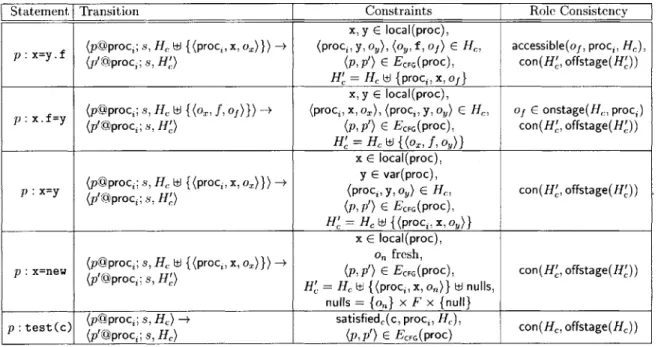
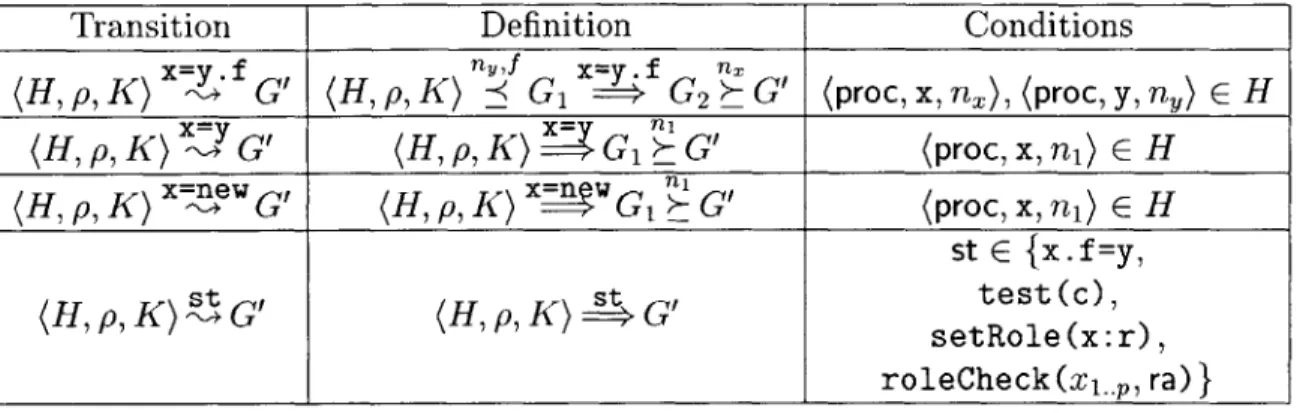
In this section we give the operational semantics for our language. We focus on the first three columns in Figures 3-2 and 3-3; the safety conditions in the fourth column are detailed in Section 3.4.
Figure 3-2 gives the small-step operational semantics for the basic statements. We use A U B to denote the union A U B where the sets A and B are disjoint. The program state consists of the stack s and the concrete heap Hc. The stack s is a sequence of pairs pOproci
C
x(Proc xK),
where pC
NCFG(proc) is a program point, and proci E Proc xK
is an activation record of procedure proc. Program points pE
NCFG(proc) are nodes of the control-flow graphs. There is one control-flow graph for every procedure proc. An edge of the control-flow graph (p, p')E
ECFG(proc)indicates that control may transfer from point p to point p'. We write p : stat to state that program point p contains a statement stat. The control flow graph of each procedure contains special program points entry and exit indicating procedure entry
Statement Transition Constraints Role Consistency x, y E local(proc),
(pdproc ; s, H, U {(proci, x, o,)}) - (proci, y, o), (o,, f, of) E He, accessible(of, proci, He),
(p'@proc ; s, H') (p, p') E ECFG(prOc), con(H', offstage(H'))
H' = He {procj, x, of }
x, y C local(proc),
P y (pproc ; s, Hc U {(or, f, of)}) -+ (proci, x, o.), (proci, y, o,) c He, of E onstage(Hc, proci)
(p'@proc ; s, H') (p,p') E ECFG(proc), con(H', offstage(H')) H' = H, _ _ fH{(or, f, o_)}
x E local(proc),
(p~aroc: sH, t f proi, x o,)})y C var(proc),
P: X (proc s, H U {(procs, x,) (proc, y, o ) H., con(H', offstage(H')) (p,p') E ECFG(proc),
H =H {(proci. x, o,) x c local(proc),
o, fresh,
p: x=new (p'proc ; s,Hc U {(proc, x, o)}) > (p,p') C ECFG(proc), con(H', offstage(H')) (p'Hproc ; s, H)= H, U {(proci, x, o,)} U nulls,
nulls = {o,} x F x {null}
p test (c) (pproc ; (p' proc ; s, Hc) - satisfied,(c, proci, H,), con(He, offstage(Hc))
s, Hc) (p, p') E ECFG (proc)
satisfiedc(x==y, proci, Hc) iff {o I (proci, x, o) C Hc} = {o I (proci, y, o) E He} satisfied,(! (x==y), proci, Hc) iff not satisfiedc(x==y, proci, Hc) accessible(o, proci, Hc) := (3p E param(proc) : (proci, p, o) E Hc)
or not (]proc 3v E var(proc') : (proc', v, o) C Hc)
Statement Transition Constraints Role Consistency
(pQproc; s, Hr) -4 nulls = {(proci, v, nulI I
entry :- ('proci; s, H, L nulls) v E local(proc), con(Hc, offstage(Hc)) np, p') E ECFG(proc)
j fresh in p~proci; s,
(pOproci; s, Hc) -+ (p, p') E ECFG(proc), conW(ra, He, S),
p : proc'(Xk)k (entry proc; p'@proc.; s, H') ,O : (proci, Xk, O) E He, ra = {(ok, preRk(proc'))}k,
H,' = H, {( proc',P, Ok)1k, S = offstage(He) U {Ok}k
Vk Pk = paramk(proc')
conW(ra, Hc, S),
exit - (p2proc,;s, Hc) -+ AF ={(proci, v, n) ra ={(parndk (proci), postRk(proc)) k,
- (s, H, \ AF) (proci, v, n) E Hc} S = offstage(Hc) U { o I (proci, v, o) E- H, }
parndk (proci) = o where (proci, paramk (proc), o) E H, Figure 3-3: Semantics of Procedure Call
and exit, with no statements associated with them. We assume that each condition of a test statement is of the form x==y or ! (x==y) where x and y are either variables or a special constant null which always points to the nulle object.
The concrete heap is either an error heap error, or a non-error heap. A non-error heap H, C N x F x N U ((Proc x N) x V x N) is a directed graph with labelled edges, where nodes represent objects and procedure activation records, whereas edges represent heap references and local variables. An edge (oi,
f,
02) E N x F x N denotes a reference from object 01 to object 02 via field f E F. An edge (proci, x, o)c
H,means that local variable x in activation record proci points to object o.
A load statement x=y. f makes the variable x point to node of, which is referenced by the f field of object o,, which is in turn referenced by variable y. A store statement x. f=y replaces the reference along field f in object o. by a reference to object oy that is referenced by y. The copy statement x=y copies a reference to object oy into variable x. The statement x=new creates a new object o, with all fields initially referencing
null,, and makes x point to o,. The statement test (c) allows execution to proceed only if condition c is satisfied.
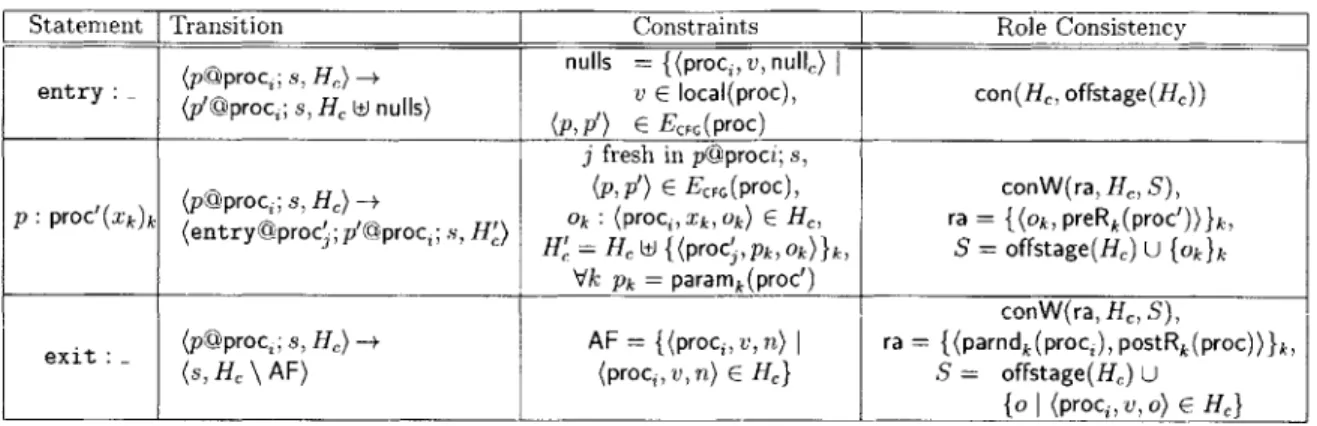
Figure 3-3 shows the semantics of procedure calls. Procedure call pushes new activation record onto stack, inserts it into the heap, and initializes the parameters. Procedure entry initializes local variables. Procedure exit removes the activation record from the heap and the stack.
3.3
Onstage and Offstage Objects
At every program point the set nodes(Hc) of all objects of heap H, can be partitioned into:
1. onstage objects (onstage(Hc)) referenced by a local variable or parameter of some activation frame
onstage(He, proc;):={o
I
3x E var(proc)(proc;, x, o)
c
Hc} onstage(He):= U onstage(He, proci)proci
2. offstage objects (offstage(Hc)) unreferenced by local or parameter variables
offstage(Hc) := nodes(Hc) \ onstage(He)
Onstage objects need not have correct roles. Offstage objects must have correct roles assuming some role assignment for onstage objects.
Definition 18 Given a set of role definitions and a set of objects S, C nodes(Sc), we
say that heap H, is role consistent for Se, and we write con(He, Sc), iff there exists a role assignment pc : nodes(He) -+ Ro such that the locallyConsistent(o, He, pc, Sc) predicate is satisfied for every object o E Sc.
We define locallyConsistent(o, He, pc, Sc) to generalize the locallyConsistent(o, He, pc) predicate, weakening the acyclicity condition.
Definition 19 locallyConsistent(o, He, pc, Sc) holds iff conditions 1), 2), and 3) of
Definition 2 are satisfied and the following condition holds:
4')
It is not the case that graph He contains a cycle o1, f1,... ,o, f, o1 such that01 = o, fi, ... ,
f,
c
acyclic(r), and additionally o1,.. ., o, C S,.Here Sc is the set of onstage objects that are not allowed to create a cycle whereas objects in nodes(Hc) \ Sc are exempt from the acyclicity condition. The predicates locallyConsistent(o, Hc, Pc, Sc) and con(He, S,) are monotonic in Sc, so a larger Sc implies a stronger invariant. For Sc = nodes(Hc), consistency for Sc is equivalent
with heap consistency from Definition 1. Note that the role assignment pc specifies roles even for objects o C nodes(Hc) \ Sc. This is because the role of o may influence
the role consistency of objects in Sc which are adjacent to o.
At procedure calls, the role declarations for parameters restrict the set of poten-tial role assignments. We therefore generalize con(Hc, Sc) to conW(ra, He, Sc), which restricts the set of role assignments pc considered for heap consistency.
Definition 20 Given a set of role definitions, a heap He, a set Sc C nodes(He),
and a partial role assignment ra C Se -4 R, we say that the heap H, is consistent
with ra for Se, and write conW(ra, He, S), iff there exists a (total) role assignment pc : nodes(He) -+ Ro such that ra C pc and for every object o C S, the predicate
3.4
Role Consistency
We are now able to precisely state the role consistency requirements that must be satisfied for program execution. The role consistency requirements are in the fourth row of Figures 3-2 and 3-3. We assume the operational semantics is extended with transitions leading to a program state with heap error, whenever role consistency is violated.
3.4.1
Offstage Consistency
At every program point, we require con(Hc, offstage(He)) to be satisfied. This means that offstage objects have correct roles, but onstage objects may have their role tem-porarily violated.
3.4.2
Reference Removal Consistency
The Store statement x. f=y has the following safety precondition. When a reference (ox, f, of) E H, for (proc, x, ox) E Hc, and (ox, f, of) E H, is removed from the heap,
both ox and of must be referenced from the current procedure activation record. It is sufficient to verify this condition for of, as ox is already onstage by definition. The reference removal consistency condition enables the completion of the role change for of after the reference (or,
f,
of) is removed and ensures that heap references areintroduced and removed only between onstage objects.
3.4.3
Procedure Call Consistency
Our programming model ensures role consistency across procedure calls using the following protocol.
A procedure call proc'(xi, ..., xp) in Figure 3-3 requires the role consistency pre-condition conW(ra, Hc, S,), where the partial role assignment ra requires objects Ok, corresponding to parameters Xk, to have roles preRk(proc') expected by the callee, and
S, = offstage(Hc) U {Ok}Ik for (procx, ,k) c Hc.
To ensure that the callee proc' never observes incorrect roles, we impose an
accessi-bility condition for the callee's Load statements (see the fourth column of Figure 3-2).
The accessibility condition prohibits access to any object o referenced by some local variable of a stack frame other than proc', unless o is referenced by some parameter of proc'. Provided that this condition is not violated, the callee proc only accesses objects with correct roles, even though objects that it does not access may have in-correct roles. In Chapter 5 we show how the role analysis statically ensures that the accessibility condition is never violated.
At the procedure exit point (Figure 3-3), we require correct roles for all objects referenced by the current activation frame proc. This implies that heap operations performed by proc' preserve heap consistency for all objects accessed by proc.
Statement Transition Constraints Role Consistency r
(p(Oproci; s, H,) --+conW(ra, Hc, S),
p : roleCh ck(, .... , x,, ra) (p'@proci; s, Hc) (A P') E ECFG S = offstage(He) U
{o I (proci, Xk, o) E H,} Figure 3-4: Operational Semantics of Explicit Role Check
3.4.4
Explicit Role Check
The programmer can specify a stronger invariant at any program point using
state-ment roleCheck(xi,..., x,ra). As Figure 3-4 indicates, roleCheck requires the
conW(ra, He, Sc) predicate to be satisfied for the supplied partial role assignment
ra where S, = offstage(Hc) U {Ok}k for objects Ok referenced by given local variables
Xk.
3.5
Instrumented Semantics
We expect the programmer to have a specific role assignment in mind when writing the program, with this role assignment changing as the statements of the program change the referencing relationships. So when the programmer wishes to change the role of an object, he or she writes a program that brings the object onstage, changes its referencing relationships so that it plays a new role, then puts it offstage in its new role. The roles of other objects do not change.1
To support these programmer expectations, we introduce an augmented program-ming model in which the role assignment pc is conceptually part of the program's state. The role assignment changes only if the programmer changes it explicitly us-ing the setRole statement. The augmented programmus-ing model has an underlyus-ing instrumented semantics as opposed to the original semantics.
Example 21 The original semantics allows asserting different roles at different pro-gram points even if the structure of the heap was not changed, as in the following procedure foo.
role Al { fields f : B1; }
role B1 { slots Al.f; }
role A2 { fields f : B2; } role B2 { slots A2.f; }
procedure foo() var x, y;
{
x = new; y = new;
x.f = Y;
1An extension to the programming model supports cascading role changes in which a single role change propagates through the heap changing the roles of offstage objects, see Section 6.4.
Statement Transition Constraints Role Consistency
x E local(proc),
o, fresh,
P x-new ,proci s, H, xnw p'prcH' I (proci, x, o.) p,) -+ E CFG(proc),
=H, conW(p', H,, offstage(H,,))
ro
s, H, p) Jf{(proci, x, On) } W~o,} x F x {nuill},
Pc =on o-+ unknown]
x E local(proci),
V (pqproc. .s, H', p) - (proci, x, o,) E H e, conW(p, H, offstage(H ))
setRole(x:r) (p^Qproc ; s, H,, p') Pc = p,[o, a r],
(p,p') G ECFG
P:sstat , H, pe) P A conW(pc U ra, H", S)
(s', H Hc) +(s', H') for every original condition
P A conW(ra, H', S)
Figure 3-5: Instrumented Semantics
roleCheck(x,y, x:A1,y:B1);
roleCheck(x,y, x:A2,y:B2);
}
Both role checks would succeed since each of the specified partial role assignments can be extended to a valid role assignment. On the other hand, the role check statement roleCheck(x,y, x: A1,y:B2) would fail.
The procedure f oo in the instrumented semantics can be written as follows. procedure fooO var x, y; { x = new; y = new; x.f = Y; setRole(x:A1); setRole(y:B1); roleCheck(x,y, x:A1,y:B1); setRole(x:A2); setRole(y:B2); roleCheck(x,y, x:A2,y:B2); }
The setRole statement makes the role change of object explicit. A
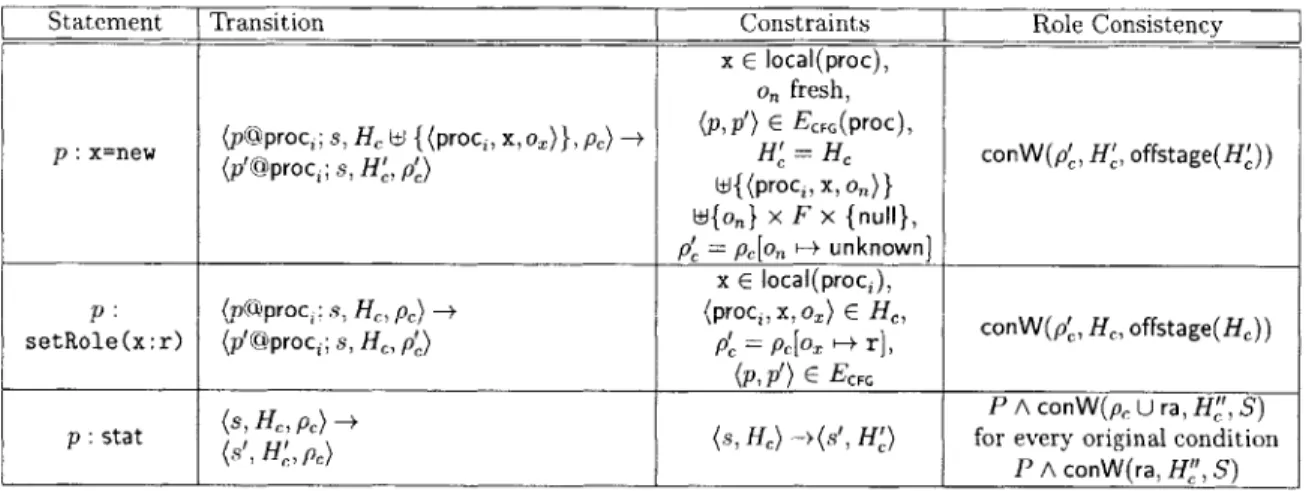
The instrumented semantics extends the concrete heap H, with a role assign-ment pc Figure 3-5 outlines the changes in instrumented semantics with respect to the original semantics. We introduce a new statement setRole(x:r), which
mod-ifies a role assignment pc, giving pc[or -+ r], where ox is the object referenced by
x. All statements other than setRole preserve the current role assignment. For every consistency condition conW(ra, He, Sc) in the original semantics, the
instru-mented semantics uses the corresponding condition conW(pc U ra, Hc, Sc) and fails
if pc is not an extension of ra. Here we consider con(He, S) to be a shorthand for conW(0, He, S). For example, the new role consistency condition for the Copy statement x=y is conW(pc, Hc, offstage(Hc)). The New statement assigns an identifier
unknown to the newly created object o,. By definition, a node with unknown does
not satisfy the locallyConsistent predicate. This means that setRole must be used to
set a a valid role of o, before o, moves offstage.
By introducing an instrumented semantics we are not suggesting an implemen-tation that explicitly stores roles of objects at run-time. We instead use the instru-mented semantics as the basis of our role analysis and ensure that all role checks can be statically removed. Because the instrumented semantics is more restrictive than
the original semantics, our role analysis is a conservative approximation of both the