HAL Id: insu-01354155
https://hal-insu.archives-ouvertes.fr/insu-01354155
Submitted on 17 Aug 2016
HAL is a multi-disciplinary open access
archive for the deposit and dissemination of
sci-entific research documents, whether they are
pub-lished or not. The documents may come from
teaching and research institutions in France or
abroad, or from public or private research centers.
L’archive ouverte pluridisciplinaire HAL, est
destinée au dépôt et à la diffusion de documents
scientifiques de niveau recherche, publiés ou non,
émanant des établissements d’enseignement et de
recherche français ou étrangers, des laboratoires
publics ou privés.
A broken plate beneath the North Baikal rift zone
revealed by gravity modelling
E.B. Burov, Houdry F., M Diament, Jacques Déverchère
To cite this version:
E.B. Burov, Houdry F., M Diament, Jacques Déverchère. A broken plate beneath the North Baikal
rift zone revealed by gravity modelling. Geophysical Research Letters, American Geophysical Union,
1994, 21 (2), pp.129-132. �10.1029/93GL03078�. �insu-01354155�
GEOPHYSICAL RESEARCH..LETrERS,
VOL. 21, NO. 2, PAGES 129-132, JANUARY 15, 1994
A broken plate beneath the North Baikal rift zone revealed
by gravity modelling
E. B. Burov
•*, 'F. Houdry
2, M. Diament
•, J. D6verch•re
2
Abstract. We modelled a 1200 km long gravimetric profile in
the North Baikal rift to assess the mechanical behaviour of the
lithosphere, using a numerical model that accounts for realistic
brittle-elasto-ductile rheology. We use published seismicity and re-
fraction data, a new 5'x7.5' free-air/Bouguer gravity and topogra-
phy data set, and a detailed map of faults obtained from high reso-
lution SPOT imagery. Analysis of the gravity field over the North
Baikal rift zone indicates significant asymmetry of the mechanical
processes governing the deformation of the diverging sides of the
rift. These anomalies cmmot be explained by a conventional con-
tinuous plate undergoing extension beneath the rift zone, whereas a
strong mechanical discontinuity (wedge shaped detachment zone
beneath the rift axis) is able to reproduce observations. Such a
discontinuous model provides a good fit to the gravity and crustal
thickness data and explains the deep seismicity reported there.
Introduction
Among the present-day continental rift systems, the Baikal rift
zone (BRZ) is believed to represent an archetypal rift in the initial
stages of continental plate divergence. This conventional rifting
model mainly implies thinning of the crust and negligible li-
thospheric strength, at least in the vicinity of the rift axis, on the
basis of high heat flow and intense normal faulting throughout the
upper crust. However, recent studies based on depth distribution of
earthquakes, flank uplift patterns, and gravity anomalies over the
East African rifts [Shudofsky et al., 1987; Ebinger et al., 1989],
the Rio Grande rift [Olsen et al., 1987], or BRZ [Diament and
Kogan, 1990; D6verch6re et al., 1991; Ruppel et al., 1993] provide
evidence for a high mechanical strength within the lithosphere
subject to extension. Analytical and numerical models confirm that
plate flexure must be considered in this context to explain uplifted
rift flanks that rise over 1 km above the surrounding topography
[e.g., Weissel and Karner, 1989; Ch6ry et al., 1992]. In the eastern
BRZ, hypocenter relocations show widespread and unusual seismic
deformation throughout the upper 30 km of the crust [D6verch6re
et al., 1993], in a region where interpretation of seismic refraction
and reflection data indicate a thicker crust (40-44 km) than in the
southern rift (35-39 km) or in the surrounding stable zones (around
40 km) [Puzyrev et al., 1978; Zorin et al., 1989; Logatchev and
Zorin, 1992]. In addition to the absence of crustal thinning, it was
also suggested [e.g., Ruppel, 1992], that significant effective
elastic thickness (Te) of the lithosphere (-50 km, [Ruppel et al,
1993]), low heat flow, deep seismicity (hypocenters as deep as 60
lox•, [D6verch6re et al., 1991; 1993]), and, finally, an absence of
volcanic activity (Figure 1) suggest that the North Baikal rift
(NBR) is rather atypical. In this paper, we analyse the short
wavelength gravity field in order to investigate the crustal thickness
variations and mechanical lithospheric properties beneath the NBR.
This is done through the study of density contrasts associated with
the Moho and modelling of the mechanical behaviour of the
1 Gravim6trie
et G(odynamique,
Institut
de Physique
du Globe
de
Parison leave from Institute of Physics of the Earth
also at Department of Earth Sciences/GETECH, University of
Lea•ds
2 Laboratoire
de Ge5odynamique
Sous-Marine,
Universite
Paris
VI
Copyright 1994 by the American Geophysical Union. Paper number 93GL03078
0094- 8534/94/93 GL-03078503.00
lithosphere along representative profiles (Figures 1, 2). We focus
on the north-eastern rift, •vhere the surface expression of extension
is clear, earthquake distribution related to major faults is
constrained with high accuracy (+_2 km, [D6verch6re et al., 1993]),
surface geology is known [Houdry et al., 1993], as are the depth
and geometry of the sedimentary basins [Logatchev and Zorin,
1992]. The sedimentary basins are clearly distributed in an en-
•chelon pattern over a broad area (about 300 km) where the
Proterozoic and Paleozoic granitoids are more homogeneous, than
across the Central and Southern BRZ located on the suture zone between the Siberian platform and the folded mountain ranges of
Caledonian Sayan-Baikal belt (Figure 1). This area is presently
dominated by N160 ø extension [Doser, 1991; D6verch6re et al.,
1993] that could have been preceded by an about N115 ø extension
[Houdry et al., 1993]. The latter would have favoured a strike-slip
component along the major border faults.
Gravity field analysis and Mechanical Modelling
We used the topography and gravity data set provided by the
International Scientific Envirolmaental Centre of Russian Academy
of Sciences (ISEC). It consists of 5'x7.5' free air (FAA) and com-
plete Bouguer gravity anomaly (BA) grids, including terrain cor-
rections (within 200 km of gravity stations), and corresponding ele-
vations (Figure 2). The resolution of the original point data is re-
ported to be around l'x 1', the accuracy of FAA is about 2-4 mgal
[M. Kogan, pers. comm.]. The digital topography was checked
with the ONC topography (Operational Navigational Charts, De-
fence Mapping Agency) and showed a good agreement in the study area (Figure 3). To separate the lithospheric and deep sub-li- thospheric sources of the observed gravity anomaly, we computed a sum of 10 first harmonics of the gravity field (GRIM-3L1 global
field model [Reigber et al., 1985]). This long wavelength compo-
nent appears to provide only a slight negligible EW trend of 0.5-1
mgal per 100 kna (Figure 3). To constrain the sediment thickness in
the basins, the faults geometry and the crustal thickness, we used
topographic cross-sections combined with geophysical data from
Puzyrev et al. [1978], Zorin et al. [1989], Krylov et al. [1990],
Logatchev and Zorin [1992] and D6verch6re et al. [1993]. The
original complete BA, provided by ISEC, adopts crustal density of
2300 kg/m 3. Using the original FAA, we extracted the terrain
corrections from the old complete BA and recomputed BA for more
realistic value of 2670 kg/m 3 (Figure 2). To account for surficial density variations, we also corrected BA over the sedimentary basins for the effect of sedimentary fill, assuming density of sedi- ments p=2400 kg/m 3. This correction does not exceed 10-15 mGal. We did not account for the dense batholith inclusions reported on
the north side of the rift [Yu. Zorin, pers. comm.], due to the ab-
sence of data on their exact location, depth and geometry.
The linear shape of the gravity anomaly in the northeast direc-
tion (direction of the rift axis, Figures 1, 2) advocates for 2D
analysis. We compiled data along seven 1200 km profiles in the di-
rection of the present day extension (roughly perpendicular to the
major structures of the axial Upper Angara Basin, Figures 1, 2). A
800 km segment of the most representative profile A'-A is shown in
Figure 3. Analysis of the Bouguer gravity profiles reveals sig-
nificant deviations from the local (Airy) isostatic equilibrium model
(Figure 3). The major signature of the deviations is the positive
anomaly of about 40-50 mGal observed 100-150 km to the north-
west of the rift axis (Upper Angara basin) and the asynunetric
negative anomaly observed 100-150 km to the south of the rift axis
(Tsipa-Baunt Basin). The topography far to the north of the Upper
Angara Basin is too low and flat to trace out any significant differ-
ence between local and regional compensation.
130 Burov et al.: Broken Plate Beneath the North Baikal Rift Zone
95øE 100øE 105øE
I Cenozoic sediments (Baikal rift zone) ,[• Mesozoic (Triassic) volcanic rocks • Cenozoic volcanic roks (Baikal rift zone) • Paleozoic sediments (Siberian Platlbrm - I• Mesozoic sediments •_• Paleozoic granitoids ( Sayan-Baikal Caledonian Belt)
UP, - Upper Angara Basin; I'T%-'l Arcbean, Pmterozoic rocks ( S-B Caleck•nian Belt)
[JM - Upper Muya Basin; TB - Tsipa-Baunt Basin; SP - Siberian Platform
Fig. 1. Geological context of the Baikal rift zone (simplified from
the Geological World Atlas, UNESCO, 1976). The line (A-A') is a
800 km part of the representative gravimetric profile used for this
study (Figures 2, 3 and 4). White arrows are the directions of ex-
tension obtained from stress tensor analysis (for the northern part
of the rift, D6verch6re et al. [ 1991; 1993]; for the middle part of the
rift, Doser [1991]). Thin black arrows are the direction of fault
movement from geological observations, including field scarp
measurements and SPOT imagery analysis [Houdry et al., 1993].
To explain BA over the rift, we first tried several traditional
continuous plate models of regional (flexural) compensation of the
topography. We began from the simple flexural models based on
elastic plate approximation and end with more realistic plasto-
100'
60*
Baikal. Free-Air gravity anomaly
Bouguer bg 105' 110 ø 58 N 55 N 55* 55 ø 50* 50 ø
100
ø
• 105
ø
110
ø
115
ø
i i i ... i ' i i i i i i i i i -120-100 -80 -60 -40 -20 0 20 40 60 80 100 120 140 FAA. Ag [mgal] ßFig. 2. The BRZ: 5'x7.5' Free Air (FAA) and complete Bouguer gravity anomaly data with location of 7 data profiles running
across the NBR. The contour interval is 20 mgal. The grey shade
interval is 10 mgal. The shade scale for BA is to be shifted by -90 mgal as compared to that for FAA.
elasto-viscous (brittle-elasto-ductile) rheology models, implying
experimental rock mechanics data [Burov and Diament, 1992]. The
latter models use the Byeflee law of brittle failure for the upper-
most crust and mantle, and power law creep within the ductile do-
mains
[Kirby,
,1987]
(• =A*exp(-H*/R•(Ol-O3)
n, where
• is the
strain rate; A is a material constant, A*=5.6xlO 6 and 4.8x10⁶
MPa-nsec
4 for quartz
(upper
crust)
and olivine
(mantle),
respec-
tively;
H* is the activation
enthalpy,
H*=0.19x
106 J mol
4 for
quartz
and
0.533x
106
J mo1-1
for olivine;
R=8.3144
J(mol
K) q is
the gas constant; T [K] is the temperature; n=3 for quartz and 3.5
for olivine [Kirby, 1987]; o•, o 3 are the principal stresses). The
condition
of the brittle
failure
is: o3=(Ol-O3)/3.9
if o3c120 MPa,
and o3=(Ol-O3)/2.1-100 if o3• 120 MPa [Byedee, 1978].
As compared to the other continental rift zones, the average Te
for the BRZ is relatively high (•50 km, [Ruppel et al., 1993]), but it is much lower than the maximum mechanical thickness of 80-100
km that could be expected for a lithosphere of this age (400 to 700
Ma, [Logatchev and Zorin, 1992]). This upper strength limit im-
plies a strong lower crust dominated by rocks with high tempera-
ture of creep activation (&) (e.g. diabase, [Burov et al., 1993]). On
the contrary, the observed low Te (•50 km) suggests that the li-
thospheric strength is reduced by decoupling of the strong upper
1co
50
o-5o
!:•-1oo -15o -200 ,,,,,,, ... i ... ! ... i ...SOUTH • • ^ 11bE NORTH
'
' I _ AgAiry , __ A g T e =50 km A A' _ Ag Te=,OOkm 20 0 -20 -40-60
-80 -100 -120 -1403 •{
UM
•ONC
Topography
•
2 -]
TB j•,,•_ UA
•
IF .... 7.5'x5'
Topography
grid
E I ,
!•:..:..•
•ii '•:•i-•-i•i•....,,.
....
SP
... i ... i ... i ...•
TB...•
UM UA...
•
...
IF Surface Topography•
...
• •• •,•;• • •a-t•.•••• • •'•x• .• :• ,• •.• 7'•7 .• • :.• .• •. •:•: • ,' :. 7:: :: ;-.-:; .; ;; .;.;. :.:.; :•:.... ß •.. - . ,.
0 200 400 600 800Distance [km]
Fig. 3. The profile A-A'. Top: observed FAA, BA and theoretical
BA for continuous brittle-elasto-ductile plate models. Observed
gravity anomalies: circles are the FAA; triangles are the BA;
dashed line is the first 10 harmonics of the gravity field. Curve
"Te=50 km" is the theoretical BA for a plate with a weak decoupled
lower crust and no horizontal extension (summary strength, in tern•s of Te, is -50 km). Curve "Te= 100 km" is for the same model,
but with a strong coupled lower crust. Curve 1 is a theoretical BA
for a plate subjected to extension and flexure. Middle: topography
and the interpretative fault geometries. Bottom: rheological struc-
ture of the extended plate. White areas are competent quasi-elastic
zones. Grey areas are domains subjected to non-elastic deformation
(brittle or ductile failure). Black areas are zones of additional non-
elastic failure due to flexure. The uppermost mantle remains quasi-
elastic and is free of plastic deformation, the crust and the lower
Burov et al.: Broken Plate Beneath the North Baikal Rift Zone 131
crust from the uppermost mantle by a weak (low 0,) lower crust
[Burov et al., 1993]. Therefore we chose low Oa rheology (e.g.
quartz) for the whole crust. This choice is partly validated by the
presence of an intracrustal low velocity zone in the BRZ [Puzyrev,
1981], which might be associated with the weak lower crust.
A 2-D finite difference model accounting for the plasto-elasto-
viscous behaviour of the continental lithosphere was used to study
geologically realistic scenarios of plate deformation. The evolution
of the system is governed by mass, momentum and energy conser-
vation equations [e.g., Bassi, 1991; Ch6ry et al.; 1992]:
{pdetG=p0'
divo+pg
= 0; pCpJ•+div(kVT)=Hr+Hd}
where P0, P are the initial and currein densities, G is the gradientof deformation, g is the gravity acceleration, c• is the stress tensor,
Cp is the specific heat (p Cp=3X 10⁶, 4x 10⁶ J (mSK) -1 for the crust
and the mantle, respectively), k is the thermal conductivity tensor
(k0'=2.5, 2, 3.5 W (mK) 4 for the upper crust, lower crust and the mantle respectively), H r and H a are the radiogenic and dissipative
heat production per unit volume [Burov et al., 1993]. To achieve
rapid convergence of the non-linear finite difference algorithm, we
use a semi-analytical non-elastic plate approximation [Burov and
Diament, 1992] for the predictor/corrector scheme controlling the
effective bending moment A/I x, the longitudinal (Tx) and the vertical shearing (Qx) force components per unit width of the plate:
Mx
= - I C•
0xx
( y - yi
)dy
' Tx
= - I C•
0xxdy
; Qx
= - I C•
0xydy
(Yi is the depth to the ith neutral plane). The starting temperature
distribution and yield-stress profiles were obtained from the solu-
tion of the heat transfer problem for the continental lithosphere
[Burov et al., 1993], assuming thermal age of 400 Ma and • -•1+3
x10 -1• sec 4 [Ruppel, 1992; Houdry et al., 1993]. Initialisation of
necking requires an initial localised strength defect. Such defect
was inferred beneath the axial Upper Angara basin (major de-
pressed zone). We use information on the geometry and location of
normal faults, deduced from high resolution SPOT imagery, field
measurements [Houdry et al., 1993] and seismicity data
[D6verch•re et al., 1993] to consider fault-induced stresses.
Results and Discussion
The general result of these analyses is to show that continuous
plate models of lithospheric extension fail to reproduce the ob-
served gravity anomalies (Figure 3). Models of lithospheric flexure
without extension produce BA that do not differ enough from the
Airy anomaly (Figure 3). Models of extension with flexure [e.g.,
Ch6ry et al., 1992], that results in a crustal/mantle necking beneath
the rift axis and consequent flexural uplift of the rift shoulders,
yield a quasi-syrmnetric BA over the NBR (curve 1 in Figure 3),
whereas the observed BA is anti-synm•etric. Moreover, extension
of a 400 Ma continuous plate gives a relatively broad (80-100 km
in width) elevation of the Moho. This is larger than the width of the
extensional province (<45 km), whereas the data suggest that the
crust is not elevated beneath the NBR [Puzyrev et al_., 1978; Zorin
et al., 1989; Logatchev and Zorin, 1992], except a possible narrow
uplift beneath the Angara Basin [Krylov et al., 1990].
Geological and morphological observations [Houdry et al, 1993]
reveal a significant amount of past ESE/WNW strike-slip move-
ment oblique to the direction of the present-day extension, obtained
from stress tensor analysis [D6verch•re et al., 1991] (Figure 1).
The free strike-slip movements along the major border faults imply
a mechmfical discontinuity that could have allowed the relative
displacements of the rift sides, oblique to the direction of the ex-
tension. The existence of such free displacements means that at
least the crustal domains of the diverging rift sides should be me-
chanically cut (or "torn off') from each other. We tested this point
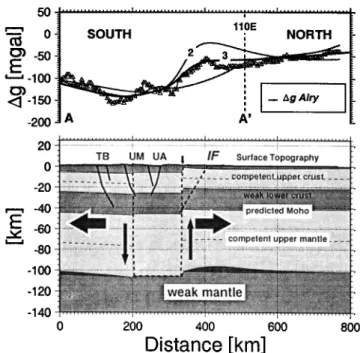
by introducing a detached zone beneath the rift axis. This zone
(wedge-shaped prism or block) is bounded from both sides by near-
vertical zero strength free-slip bands (border faults, Figure 4). The.
5O '=--' -100 <• -150 -200 20 0 -20 ,--, -40
[;:::
-60
-80 -100 -120 -140SOUTH
117E NORTH
2 ,•,•
...-,
•A
_ •2•LLL..•L2•L•LLL•..:..•..;..[•.•.L2X2.•LL•...L•..LL2...•.•.•2.Z.2.•..•...L•.L•.•.•.22•..?..•..2•2..L•2....2•2"LLL2. _ TB UM UA I IF Surface Topography "•'•..--•1 •.•;4•.• •'...•.•..•.•`.•::7•.-•..•`•;;.`.:;::•`•:.•:;:.:•:•:;:`•.•:::.:•;:::;•;•:•:•:•::::•: • ... ; ... :•:•:•;:•5.•:.•;:5:;:;•?, .... •::•::•::•;:•:: i -:57.;:::::.•5•-; •::,:; :::::::::::::::::::::::::::::::::::::::::::::::::::::::::::::::::::::::::::::::::::: •: ::; ==================================================== ... ,'; ...' ::::::::::::::::::::::::::::::::::::::::::::::::::::::::::::::::::::::::::::::::::::::::::::::: i ::::::::::::::::::::::::: •::•::•?:::•?:•::•::::•::;?i:•l :;•?&?•$:-:•:•;::4 :: compelertl u•er manfie
[;•.•::•::•:.::;:?:;::;:•;;•;•;;;•::•;•:•'A::.;•:. • -½.•:•:::•5:•:::•:•:• •Sg::•::•;•::•::::•:::•:::::.*•;•i •:.•}::•::•:• ... , ... •:• •:•:::::•}:•½•;•:•;•:•:•;•:;-•:;;½•;;:•.;:•-:•.:•::•:•:;?::•-; •..: ..'•5½:'::; ::;:;:;:•:::•';:•:•:;:•:•:•.•.•-;':• ============================================================•:.::::::•:•::::.;:•.;:;:;•:•::•:•:•:•:•:;:•;:•:•:•;;•:•;•;5:;•;;;:::•:;::.•:;:?•:•.;:•:•:::•:::{:•5:•:;:•:;:•:::;:•:::::::• . '• --• • , • ... .
•
,':•"•
:•" '•'"W•'•"•A
mantle
. ß •,. :{ ... 0 200 400 600 800Distance [km]
Fig. 4. Discontinuous model. A detaclunent zone, bounded by two
discontinuities (dashes), is imposed beneath the rift axis. Curves 2
and 3 show the theoretical BA for different boundary forces set on
the
edges
of
•e two
plates:
1 - south
F=lx
1012
N/m,
north
F=-
2x10¹²N/m; - south F=lx10 •2 N/m, north F=-4x10 •2 N/m. "IF"
is the inferred Precambrian fault on the north side of the rift. The
detached area resulted in unloading of the rift shoulders and stress
redistributions that have lead to the asynm•etric flexure. The bot-
tom of the mantle lithosphere and the upper crust are submitted to
non-elastic deviatoric strain. See Figure 2 for general notations.
southern boundary can be associated xvith the actually observed
deep normal faults, the northern boundary could be related to a pre-
existing Precambrian fault, similar to those along the boundary be-
tween the Siberian platform and the Sayan-Baikal orogenic belt [V.
Sankov, pers. conm•.]. The rift sides interact with each other
through vertical and horizontal boundary stresses acting on the in-
tennediate detaclunent block (black arrows in Figure 4). In our
numerical experiments, we varied the width (from 0 to 250 km),
position (+100 km from the rift axis), geometry (wedge angles) and
boundary conditions at the sides of this detacluent block
(boundary forces in a range of 10 ]] - 1013 N per unit length). We
found that to fit the observed gravity and Moho geometry, the de-
tachment block should be approximately 150 km wide, with near
vertical wedges (angle 80-60ø). Varying the position of the south
and north boundaries of the detached area, we found "the best fit-
ting" location and amplitude of two steps in the Moho surface, as-
sociated with these boundaries (Figure 4, curve 3). The northern,
most important step in the depth of the Moho, corresponding to a
depth change from 47+2 km to 42+1 km, coincides with the in-
ferred Precambrian fault (IF, in Figure 4), thus justifying our initial
assumption on its role. This result is continned by teleseismic data
[Krylov et al., 1990], that point to a possibility of a 1ocalised uplift
of the Moho from about 50 km to 42 km beneath the Angara basin,
and with the field observation of-1 km surface uplit• that could
happen along this fault [V. Sankov, pers. comm.]. Our model pre-
dicts a comparable basement uplift on the north side of the rift al-
though we cannot claim that it coincides exactly with this fault.
The resulting Moho geometry is asymmetric, with a positive
step at the north and a negative step at the south. This yields an
asynm•etric gravity anomaly that fits the observations. The upward
bending of the north rift side leads to an increase in the com-
pressional deviatoric stress in the uppermost crust and mantle. This
increases the brittle strength limits at the northern side, raises the
Moho and crystalline basement in the vicinity of the rift, and then
lowers them to the end of the profile. Conversely, the downward
132 Burov et al.: Broken Plate Beneath the North Baikal Rift Zone
deviatoric stresses in the uppermost crust and mantle, and therefore
decreases the limits of the brittle failure. This could explain the
asymmetry in the seismicity and fault distributions on opposite
sides of the NBR (Figure 3 and 4). The geometry of the detached
area roughly coincides with the geometry of a system of normal
faults that bound the basin and penetrate the lower crust at depths
up to 30 km [D6verch•re et al., 1993]. This area could be caused
by tearing off of the rift neck during extension, e.g. by the past
ESE/WNW strike-slip movement, oblique to the direction of diver-
gence (the strike-slip component is now minor, probably afler re-
orientation of the major stress axes from Nl15 ø to N160 ø
[D6verch•re et al., 1993]). This could result in the drop of the de-
viatoric stresses at the edges of the diverging rift sides and conse-
quently in the elastic unloading of its shoulders, which has led to
the practical restoration of their initial strength: the effective Te be-
came quite high, of about 45-55 km, compared to 20-30 km that
could be expected in the neck of a classical rifl. Due to the asym-
metric load redistribution that followed the interruption in horizon-
tal stress transition, one of the shoulders (south) went 1-2 km down
and the other one (north) •vent 4-5 km up. The "tom-off" neck is
not a single possible mechanism that could explain the detachment
of the north and south rift sides. The other possibility could be a
large scale extensional "cracking" of the lithosphere due to hetero-
geneous stress/strain field created by the complex northwards
movement of the Indian continent [Tapponnier and Molnar, 1979].
Conclusions
The analysis of the short wavelength gravity field in the light of
seismological and geological data suggests that the NBR presents a
quite untypical "broken" or "cracked" rift. We believe that the pre-
sent behaviour of the diverging plates in the NBR is not associated
with conventional rifling by stretching of the continuous litho-
sphere, but requires a mechanical discontinuity (block-like detach-
ment zone) beneath the rift axis. Due to this detachment zone (its
existence is confirmed by the past strike-slip faulting, supposedly
resulting from the Asia-India collision [Tapponnier and Molnar,
1979]), the mechanical interaction between the sides of the rift is
minor in the direction of divergence, resulting in that the li-
thospheric deformation is well explained by the flexural up- lift/descent of the both detached sides of the rift.
Acknowledgements. We thank ISEC for access to their gravity data set, M. G. Kogan and Yu. Zorin for helpful comments on the manuscript. We are especially indebted to C. Ebinger for her gen- erous help in correcting the manuscript and constructive comments. We thank C. Ruppel for useful comments and providing parts of
her thesis. E. B. Burov benefited from a post-doctoral grant of the
Minist•re de la Recherche and from partial support of GETECH.
This work was partly supported by INSU-DBT (92), and Tec-
toscope (92). Contribution # 1280 (IPGP), # 637 (GEMCO).
References
Bassi, G., Factors controlling the style of continental rifling: in-
sights from numerical modelling, Earth Planet. Sci. Lett., 105,
430-452, 1991
Byeflee, J.D., Friction of rocks, Pure Appl. Geophys., 116, 615-
626, 1978.
Burov, E.B., and M. Diament, Flexure of the continental
lithosphere with multilayered rheology, Geophys. J. Int., 109,
449-468, 1992.
Burov, E.B., Lobkovsky, L.I., Cloetingh, S., and A.M. Nikishin, Con-
tinental lithosphere folding in Central Asia (part 2), constraints
from gravity and topography, Tectonophysics, 226, 73-87, 1993. Ch6ry, J., Lucozeau, F., Daignieres, M., and J.P. Villotte, Large
uplift of rift flanks: A genetic link with lithospheric rigidity?,
Earth Planet. Sci. Lett., 112, 195-211, 1992.
D6verch•re, J., Houdry, F., Diament, M., Solonenko, N.V. and
A.V. Solonenko, Evidence for a seismogenic upper mantle and
lower crust in the Baikal rift, Geophys. Res. Letters, 18, 6,
1099-1102, 1991.
D6verch6re, J., Houdry, F., Solonenko, N.V., Solonenko, A.V., and
V.A. Sankov, Seismicity, active faults and stress field of the
North Muya Region, Baikal Rifl: New insights on the rheology
of extended continental lithosphere, J. Geophys. Res., 1993.
Diament, M., and M.G. Kogan, Long wavelength gravity
anomalies over the Baikal rift and geodynamic implications,
Geophys. Res. Lett., 17, 11, 1977-1980, 1990.
Doser, D., Faulting within the eastern Baikal rift as characterised
by earthquake studies, Tectonophysics, 196, 108-139, 1991.
Ebinger, C.J., Bechtel, T.D., Forsyth, D.W. and C.O. Bowin,
Effective elastic plate thickness beneath the East African and
Afar Plateaux and dynamic compensation of the uplifls, J.
Geophys. Res., 94, 2883-2901, 1989.
Kirby, S.H., and A.K. Kronenberg, Rheology of the Lithosphere:
Selected Topics, Rev. Geophys., 25, 1219-1244, 1987.
Krylov, S.V., Mishenkin, B.P., and A.V. Bryskin, Deep structure of
the Baikal rift zone from multiwave seismic investigations, in:
Logatchev, N.A. and Yu.A. Zorin (Eds.), Geodynamics of
intracontinental mountainous terrains (in Russian), Nauka,
Novosibirsk, 162-169, 1990.
Houdry, F., Gaudemer, Y., Sankov, V., and J. D6verch•re,
Geometry and rate of faulting during the Holocene in the
North Baikal Rift Zone, Abstr. suppl. NøI to Terra Nova, 5,
EUG VII Strasbourg, C09-30, 259, 1993.
Logatchev, N.A., and Y.A. Zorin, Baikal rift zone: Structure
and geodynamics, Tectonophysics, 208, 273-286, 1992.
Olsen, K.H., Baldridge, W.S., and J.F. Callender, Rio Grande
Rifl: An overview, Tectonophysics, 143, 119-139, 1987.
Puzyrev, N.N., Mandelbaum, M.M., Krylov, S.V., Mishenkin,
B.P., Petrik, G.V., and G.V. Krupskaya, Deep structure of
the Baikal and other rift zones from seismic data,
Tectonophysics, 45, 15-22, 1978.
Puzyrev, N. (Ed.), Baikal interiors according to the seismic data (in Russian), Izd. Akad. N. Sib. Otd., Novosibirsk, 1981. Reigber C., Balmino G., Miller H., Bosch W., and B. Moynot,
GRIM gravity model improvement using LAGEOS (GRIM3-
L 1), •1. Geophys. Res., 90, 7285-7299, 1985.
Ruppel,
C. D, Thermal
structure,
compensation
mechanisms,
and
tectonics of actively deforming continents: Baikal rift zone and large scale overthrust and extensional terrains, Ph.D. thesis,
Mas. Inst. of Technology, 292 p., 1992.
Ruppel, C. D, Kogan, M. G., and M. K. McNutt, Implications of new gravity data for Baikal rift zone structure, Geophys.
Res. Lett., 20, 1635-1638, 1993.
Shudofsky, G.N., Cloetingh, S., Stein, S., and R. Wortel, Unusually deep earthquakes in East Africa: Constraints on the
thermo-mechanical structure of a continental rift system,
Geophys. Res. Lett., 14, 7, 741-744, 1987.
Tapponnier, P., and P. Molnar, Active faulting and Cenozoic
tectonics of the Tien Shan, Mongolia, and Baykal regions,
•1. Geophys. Res., 84, 3425-3459, 1979.
Weissel, J.K., and G.D. Kamer, Flexural uplift of rift flanks
due to mechanical unloading of the lithosphere during
extension, o[. Geophys. Res., 94, 13919-13950, 1989.
Zorin, Yu.A., Kozhevnikov, V.M., Novoselova, M.R., and E.K.
Turutanov, Thickness of the lithosphere beneath the Baikal rift
zone and adjacent regions, Tectonophysics, 168, 327-337, 1989.
E. B. Burov and M. Diament, Lab. Gravim6trie et G6ody-
namique, IPGP, 4 Place Jussieu, 75252 Paris Cedex 05, France F. Houdry and J. D6verch•re, Lab. de G6odynamique Sous-
Marine - BP 48, 06230 Villefranche-sur-mer, France.
(Received: August 10, 1993;
revised: October 18, 1993;