XIV. DETECTION AND ESTIMATION THEORY
Academic Research Staff Prof. A. B. Baggeroer Prof. H. L. Van Trees
Graduate Students
S. J. Leverette J. W. Moffett L. C. Pusey L. S. Metzger J. M. F. Moura K. B. Theriault
S. A. Parl
RESEARCH OBJECTIVES AND SUMMARY OF RESEARCH
1. Tracking of Narrow-band Space/Time Random Processes with Adaptive Arrays
Joint Services Electronics Program (Contract DAAB07-71-C-0300) J. M. F. Moura, L. S. Metzger, A. B. Baggeroer
The location of narrow-band sources has traditionally been tracked by using "bearings only" information supplemented by Doppler measurements. The actual spatial/temporal structure of the signal is closely coupled with the relative motion dynamics of the source and receiver. An integrated approach to the tracking of the source location using parameter and continuous estimation theory has been devel-oped. We are studying problems of global acquisition and observability, as well as potential methods for calculating the posterior probability density of the array signals.
References
1. J. M. F. Moura, H. L. Van Trees, and A. B. Baggeroer, "Space/Time Tracking by a Passive Observer," Proceedings of the Nonlinear Estimation Theory Con-ference, San Diego, California, 1973.
2. Detection and Estimation Theory Methods
Joint Services Electronics Program (Contract DAAB07 -71 -C-0300) S. A. Parl, L. C. Pusey, A. B. Baggeroer
Investigations of estimating processes with distributed dynamics and boundary conditions have been made, and the results are being applied to internal oceano-graphic wave processes. We are studying spectral analysis and frequency wave-number function estimation. Generalizations of the adaptive "maximum-likelihood" and "maximum-entropy" procedures are being examined by using the concepts of parameter and optimum linear filtering theory and the resulting error perfor-mance.
(XIV.
DETECTION AND ESTIMATION THEORY)
3.
Seismic Data Processing for the IDOE East Atlantic Continental
Margin Program
National Science Foundation (Grant GX-36331)
K. B. Theriault, S. J. Leverette, A. B. Baggeroer
This effort is a joint program with Woods Hole Oceanographic Institution for the
seismic data processing associated with the NSF International Decade of Ocean
Explor-ation
-
East Atlantic Continental Margin Program.
Previous investigations have
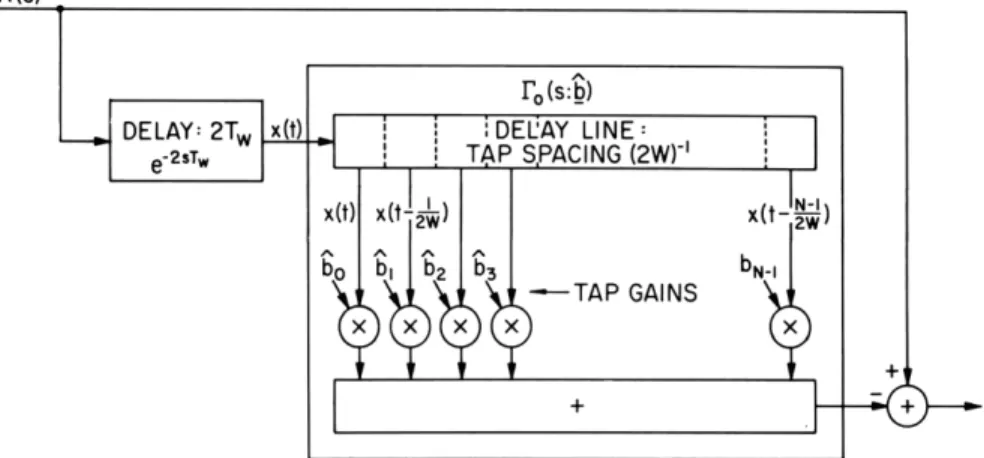
Fig. XIV-1.
Inverse filter using tap delay-line structure.
(b)
Fig. XIV-2.
Comparison of seismic
Orange River.
(a) Before processing.
(b) After processing.
records for a line west of the
QPR No. 112
(XIV. DETECTION AND ESTIMATION THEORY)