ISSN-1047-9511
European Paediatric Cardiac Code: the first revision
Report of the Coding Committee of the Association for
European Paediatric Cardiology
Rodney C. G. Franklin,1 Robert H. Anderson,1 Otto Daniels,2 Martin J. Elliott,1 Marc H. M. L. Gewillig,3 Renzo Ghisla, Otto N. Krogmann,5 Herbert E. Ulmer and Franco P. Stocker7
London, UK; 2Nejmegen, The Netherlands; ^Leuven, Belgium; Zurich, Switzerland; ^Duisburg, Germany; Heidelberg, Germany; 1 Chairman, Bern, Switzerland
I
N 1 9 9 9 AND EARLY 2 0 0 0 , THE ASSOCIATION FOREuropean Paediatric Cardiology published the European Paediatric Cardiac Code as independent but linked Short and Long Lists, containing 650 and 3876 primary terms respectively.1'2 The historical background and rationale for development of this cod-ing system has been previously detailed, but essen-tially it followed a series of meeting of the coding committee of the Association between 1997-1999, during which a pre-existing Long List was adopted and then used to create the condensed Short List.1 The system was published as the recommended stan-dard coding system for use across Europe, covering the diagnosis and therapy of children with congenital and acquired cardiac disease. The scope of the lists was to encompass the needs of all those involved with such patients, from the fetal cardiologist through to the spe-cialist in adult congenital heart disease; and from the general paediatric cardiologist and cardiac surgeon, to those specialising in transcatheter interventions, pae-diatric electrophysiology, and paepae-diatric echocardio-graphers. In addition, the code was crossmapped to the 9th and 10th revisions of the International Clas-sification of Diseases ("ICD-9" and "ICD-10") pro-vided by the World Health Organisation in order to facilitate returns to central government, a requirement in most countries. In so doing, it was hoped to address the concerns of many centres that such information submitted by professional coding staff was often inaccurate due to the complex nature of congenital cardiac disease, together with the limited scope and vague terminology of the International listings.
Correspondence to: Dr Rodney CG Franklin, Paediatric Cardiologist, Harefield Site, Royal Brompton and Harefield NHS Trust, Harefield, Middlesex UB9 6JH, UK. Tel/fax: 01895 828659; E-mail: [email protected]
The Long List was designed as a fully comprehen-sive detailed hierarchical system, for use by those requiring enhanced detail for research and audit, as well as for eventual incorporation as part of the elec-tronic patient record. In contrast, the Short List was created specifically to be part of a database for audit-ing the workload of the paediatric cardiac specialist, whether working in an individual centre or as part of multicentric national, or international co-operative studies. It was intended for day-to-day use by the cli-nician, for whom a more detailed diagnostic and ther-apeutic breakdown was not necessary, or deemed to be too time-consuming. The Short List was designed to remain comprehensive by inclusion of "collective terms", so that the user could cover all eventualities without the need for the longer list. The two lists would not be interdependent, although easily useable together, with appropriate software, as a two level system.
The requirement to undertake inter-institutional audit is, if anything, even more pressing now than at the time of first issuing the European Code, as demon-strated by the publication of the inquiry into the outcome of paediatric cardiac surgery at the centre in Bristol, in the United Kingdom.3' Subsequent analy-sis of data submitted to, and commissioned by, this inquiry permitted the drawing of possible conclusions, such as lower mortality correlating with a higher workload of surgical cases, yet also produced criti-cism of the methods of gathering such data.5' The use of different crude coding schemes, such as the 9th and 10th revisions of the International Classification of Diseases, which fail adequately to deal with the issues of case-mix, as well as poor, if any, validation of the collected data, indicates that any conclusions drawn from such studies must be tentative at best. There is now an obligation in many countries, driven
Cardiology in the Young: Supplement 2 (2002) September 2002 both by government and peer-group pressure, to
pro-vide national and international comparisons of surgical results between centres caring for children with heart disease. Significantly, there is also widespread agree-ment that such comparisons of outcomes must include meaningful stratification of risk when analysing such data, and that the data itself must be accurate mor-phologically and be validated.6'7 This need is exem-plified in paediatric cardiology by the inherent broad spectrum of congenital cardiac lesions, and the varying health of the individuals when presenting for thera-peutic interventions. These factors may then be linked to others, such as whether the lesion has been ante-natally diagnosed.8 Although there is now increasing recognition by governments of the importance of such processes of audit, the underfunding of these initia-tives, both technologically and in terms of human resources, remains a major source of concern and a hindrance to progress.
Since its publication, the European Paediatric Cardiac Code has been accepted increasingly through-out Europe. It is presently used by between 50 and 60 centres for paediatric cardiology within Europe. In Germany, the Short List is used within the government-led programme of National Quality Control, involving both paediatric cardiologists and cardiac surgeons. In Switzerland, the Swiss Society of Paediatric Cardiology is using the Short List in a national audit project. Other multicentric national studies are planned in the near future in the Netherlands and Belgium. In the United Kingdom, it is now obligatory for each paediatric cardiac centre to submit diagnostic and procedural data on all pati-ents with congenital cardiac lesions undergoing inter-ventions. The data is sent to a central body, the United Kingdom Paediatric Central Cardiac Audit Database, which then independently analyses the data to produce outcomes specific to each centre. As from April 2003, it will be necessary for the centres to submit their returns as coded using the Short List of the European Paediatric Cardiac Code.
The European Paediatric Cardiac Code has now been published on the website of the Association for European Paediatric Cardiology (www.aepc.org/code-com.htm) for free down load, conditional upon agree-ment not to alter the system, and to respect the copyright of the Association. To date, 340 individuals or groups have accessed the system in this way, not only from Europe, but also from other continents, con-firming the wide interest in the code. At present, there are also versions translated to the German and Dutch languages which are available on the website.
The coding committee has always recognised the need for regular revisions of the code so as to encom-pass changes in clinical practice, and to address defi-ciencies identified by users and fed back to the
committee. Other users have submitted suggestions for improvement. In addition, there was also the need formally to crossmap the Long List to the Short List, so that those using both Lists could easily transfer data from one to the other, thus enabling submission of data to studies using the Short List, or for central returns. The articles contained in the supplement to this fas-cicle of the Journal addresses these issues. In addition, the supplement provides a bidirectional crossmap between the Short Lists of the European Paediatric Cardiac Code and the Congenital Heart Surgery Nomenclature and Database Project. The surgical list was published shortly after the European code,9 and it is pertinent to give a brief review of its history.
The International Congenital Heart Surgery Nomenclature and Database Project
A few months after the European Paediatric Cardiac Code was published in this Journal,2 the Interna-tional Congenital Heart Surgery Nomenclature and Database Project published its report.9 It was endorsed by the Congenital Heart Surgery Committees of the Society of Thoracic Surgeons and the European Asso-ciation for Cardiothoracic Surgery, as well as the European Congenital Heart Surgeons Foundation. As with the European code, the surgical system has a com-prehensive Long List, and a condensed, or "minimal", data set. Although there is a similar underlying aim of the two systems, namely to establish a standardised nomenclature for congenital cardiac disease, the over-riding drive for the more surgical publication was to provide a system which would be the basis for collec-tion of surgical data, so as to enable multicentric and international comparisons of surgical outcomes with case-mix and stratification of risk. To this end, the minimal data set was produced, with 25 mandatory and 13 optional fields of entry. This uses a Short List of diagnostic and surgical procedural terms, derived from their comprehensive data set, and divided into four subcategories: Non-cardiac diagnoses and general pre-operative risk factors; Diagnoses; Procedures; and Complications. There are no numerical codes attached to the tetms. This minimal dataset has recently been revised, with proposals for a major international co-operative harvest of data.10 It is available for free download from the web (www.ctsnet.org/doc/5357; www.pediatric.ecsur.org).
Crossmap between the European Paediatric Cardiac Code and the
International Congenital Heart Surgery Nomenclature and Database Project
As a result of these near simultaneous publications, representatives of those involved with the two systems
from the Association for European Paediatric Car-diology, the Society of Thoracic Surgeons, and the European Association for Cardiothoracic Surgery agreed in October 2000 that the three societies should work in partnership and produce a reconciliatory bidi-rectional map between the two systems.11 The feasi-bility for the interaction was established initially by creating a crossmap between the two Short Lists. The process was subsequently approved by the 250 par-ticipants at the First International Summit on Nomen-clature for Congenital Heart Disease on 27 May, 2001, held at a designated session of the Third World Congress of Paediatric Cardiology and Cardiac Surgery in Toronto, Canada. The crossmap of the Short Lists was approved, along with the aim in the longer term of crossmapping the Long Lists. To this end, it was agreed that the numerical six digit codes of the European Paediatric Cardiac Code would form the backbone of this process of mapping. They would also be used as a structure on which to hang other coding systems that are in use globally, whatever the language. Prior to the meeting in Toronto, and over the fol-lowing year, a core group of individuals were invol-ved in systematically scrutinising the mapping of the Short Lists so as to highlight imperfections and areas for debate. The resultant bidirectional crossmap is featured in this Supplement. It should be noted that only a full crossmap was possible of the European Paediatric Cardiac Code Short List to the Short List of the International Congenital Heart Surgery Nomen-clature and Database Project. The reasons why the reverse map was not tenable are detailed in the report from the core group involved in this crossmapping project, which appears in the Supplement to this issue of Cardiology in the Young}2
The European Paediatric Cardiac Code — the first revision
Apart from a few minor typographical changes, and numerous minor changes to individual terms to enhance consistency and correctness throughout the system, the following major revisions have been incorporated:
• The addition of 166 new codes to the Short List, mostly as a result of incorporating terms from the International Congenital Heart Surgery Nomencla-ture and Database Project minimal dataset, which were not exactly represented previously in the European Code. Many of these were higher order generic terms and additional procedures. There were also many additions which took into account advances in procedural techniques, such as Arterial and atrial switch procedures (double switch), changes
in diagnostic nomenclature, such as in the sections
devoted to pulmonary vascular disease and arrhyth-mias, and recognition of the changing needs of individual groups, for example, in the sections concerned with fetal diagnoses and arrhythmias. • The addition of 152 codes from the Long List to
the Short List. This "promotion" was the result of requests from many users whose needs have been better recognised since the first publication. This was also required in order to produce a full and exact crossmap between the European Code and each term in the Short List of the Congenital Heart Surgery Project.
• The arrhythmia sections have been completely rewritten to establish a structure much more mech-anistic in approach, as requested and now approved by representatives of the appropriate Working Group of the Association for European Paediatric Cardiology. This included the loss of one code from the system which was considered obsolete (Lown Ganong Levine syndrome, 11.07.13). • The high level generic and "collective" terms
previ-ously having the expression "unspecified" appended after the term have had this addition deleted. The coding committee judged that the generic term on its own was self explanatory without the need for this or other clarifying nomenclature, such as "not otherwise specified", being affixed. The "collective terms" will now also be identified in both lists by additional symbols in an additional column (cl, c2 — see below).
A more detailed breakdown of the revisions and changes in the Short List is given below, whilst these details for the Long List and how it functions are documented in a separate article in the accompanying Supplement. The entire European Paediatric Cardiac Code is fully endorsed again by the Council of the Association for European Paediatric Cardiology, which continues to own the copyright to the system, by the Working Groups for Fetal Echocardiography and Dysrhythmia, as well as the Working Group for adult congenital heart disease of the European Society of Cardiology.
The European Paediatric Cardiac Code Short List
The revised Short List now has 956 terms with numer-ical codes, an increase of 315 since the last publica-tion. It remains derived directly from the Long List, with the same structure, including the major division between diagnostic and procedural codes. The struc-ture has now been altered to give two extra columns. The first column now documents those items in the List which are high level generic "collective" terms ("cl"), and those which are lower level collective
Cardiology in the Young: Supplement 2 (2002)
September 2002
terms ("c2"). Those without such a designation are pri-mary terms in their own right without subcategories in the Long List. The next columns are unchanged, with the term itself in the second column, the six digit numerical code in the third column, and the fourth through seventh columns committed to the maps to the 9th and 10th revisions of the International Classification of Diseases ("ICD-9" and "ICD-10"), respectively. The new eighth column documents the crossmap, where possible, to the minimal data set of the International Congenital Heart Surgery Nomen-clature and Database Project.
In the reverse listing, the less comprehensive Short List of the Congenital Heart Surgery Nomenclature maps to the European Code. The format of Appendixes Ilia, M b , IV, V, and VI is identical to that of the sup-plement of the Annals of Thoracic Surgery,9 repre-senting Non-cardiac diagnoses; General pre-operative risk factors; Diagnoses; Procedures; and Complica-tions, respectively. The first column consists of this term, and is followed by the equivalent term within the European Paediatric Cardiac Code, the six digit numerical code, and then the ninth and tenth versions of the International Classification, in the second through seventh columns, respectively. Details of this list, and the crossmapping process, are in the accom-panying article within the Supplement of this issue
of Cardiology in the Young}2
Otherwise, the structure of the European Paediatric Cardiac Code Short List is little changed. The concept remains that the Short List is a synopsis of the Long List, consisting only of those terms considered to be particularly useful for routine clinical practice, along with "collective" terms to ensure it remains represen-tational of the Long List. Thus, the remaining terms of the Long List within a particular section are covered by this "collective term". For example, there are 38 possible terms for congenital anomalies of the tricus-pid valve, with a further 14 qualifying terms for addi-tional detail. These were reduced to a single collective term, tricuspid valvar abnormality, and six specific items: tricuspidatresia, tricuspidregurgitation-congenital,
straddling tricuspid valve, tricuspid valvar dysplasia (mucoid thickening), tricuspid stenosis and Ebstein's mal-formation of tricuspid valve. If the individual diagnosis
in question corresponds to a detailed term, then this must be used, whilst the collective term is reserved for all the other diagnoses. As before, the collective terms, or primary terms, are left marginalized in col-umn two, with indentation of the lower hierarchical terms below the related collective term.
There are now eight subgroups to the diagnostic section of the European code Short List of 531 terms: • Diagnostic congenital and generic cardiac codes, arranged in a sequential segmental format (188 items).
• Diagnostic hereditary, fetal, neonatal and non-cardiac codes, including congenital abnormalities associated with cardiac diseases (62 items). • Diagnostic codes for acquired and post-procedural
abnormalities or disorders (173 items).
• Diagnostic codes for disturbances of rhythm and conduction (46 items).
• Diagnostic codes for lung and thoracic disease (18 items).
• Diagnostic codes for symptoms and signs (10 items).
• Diagnostic codes for Preoperative Risk Factors (17 items).
• Diagnostic methods (15 items).
The additional penultimate three sections are addi-tions to the Short List to enhance its use as a database for therapeutic procedures, and to aid the day-to-day service of the paediatric cardiologist. In addition are added two Qualifier terms, diagnosis uncertain and
status:post-procedure, that can be appended to any term.
These were requested as enhancements to database processing and validation.
The therapeutic section with 425 terms has six subsections:
• Cardiac surgical procedures (210 items).
• Arrhythmia, transplant and miscellaneous cardiac procedures (38 items).
• Post-operative and cardiac support procedures (18 items).
• Thorax and lung procedures (26 items).
• Transcatheter procedures (51 items and 1 duplicate from diagnostic methods).
• Procedure related complications (82 items). It is important to emphasise again that the Short List, particularly now with its greater length, clearly works best as a computer based system, embedded in a database for the collection of information on the diagnosis, intervention and outcome of individual patients. The Short List itself can then be tailored to the needs of the individual clinician, department or institution, only to include relevant areas of interest. As before, it is hoped that such software could then link into a word processing package to produce let-ters or inpatient summaries, as well as sending off the correct crossmapped codes to the appropriate depart-ment for central returns. It should be possible to remove any sight of the numerical codes themselves to aid user friendliness, although a series of defaults should be incorporated to ensure that the chosen items are pathologically valid. For instance, the four terms possible for Double outlet RV are not compatible with the term Discordant VA connections. If a paper based system must be used, then it is advised that particular areas of interest from the Short List should be highlighted, and transferred onto a form of one or
two sheets to co-exist with a chosen minimal dataset of patient demographics, dates, details of interven-tions, and outcomes. The dataset as a whole would then be entered onto a computer with the use of diagnostic and procedural key words, immediately accessing the correct code and crossmap required. An example of the multi-level use of the European Paediatric Cardiac coding system is given in the Appendix.
Crossmapping to the 9th and 10th revisions of the International Classification of Disease
Despite the inadequacies of the International Classi-fication, many central and governmental authorities still require data on the work of physicians and sur-geons to be returned using this coding system. In Europe and North America there remain many coun-tries using the 9th revision of the Classification, despite its age, being produced in 1977, and despite its deficiencies and the recommendation of the World Health Organisation to move onto the 10th revision. The crossmap to both revisions, therefore, has been retained. In the United Kingdom, the 9th revision is a four digit code. The fifth digit available in some countries has not been added in anticipation that the 10th revision will eventually fully supersede the 9th revision. The detail of how the crossmap between the International Classifications and the European Pae-diatric Cardiac Code was created has been previously documented.1 Apart from minor adjustments to the mapping, there are only two areas where an additional explanation is required. The first is with respect to generic high level terms which refer to lesions which may be either acquired or congenital, such as Mitral
stenosis. In the current revision, several of these terms
have been added in response to the mapping with the Congenital Heart Surgery Nomenclature and Database Project. In the 10th revision of the International Clas-sification, items deemed congenital are in Chapter XVII, "Congenital malformations, deformations and chromosomal abnormalities", and are given the prefix Q, whilst acquired lesions are in the Chapter IX, "Diseases of the circulatory system", with the prefix I. This would seem straight forward, but there are argu-able exceptions, such as Mitral valvar prolapse being designated as acquired (134.1), and Eisenmenger's Syndrome being designated as a congenital cardiac septal malformation (Q21.8), rather than the more widely accepted designation as an acquired subtype of established pulmonary vascular disease. The latter remains under discussion for change with the World Health Organisation after it was put forward through us to the central coding authority of the United Kingdom. In the current case, it has been elected to place these higher level generic terms under the congenital banner, in keeping with the underlying
theme of the European Code, namely congenital heart disease. Thus, the generic term Mitral stenosis has been coded as Q23.2.
The other area of debate was with respect to ante-natally diagnosed cardiac abnormalities, where the International Classification has no appropriate codes. This is an important area, as antenatally diagnosed conditions may lead to termination of pregnancy. Technically, one cannot code any details of a con-genital abnormality until after the birth of the child. In the 10th revision of the Classification, Chapter XV covers "Pregnancy, childbirth and the puerperium", with items given the prefix O, while Chapter XVI deals with "Certain conditions originating in the perinatal period", these items given the prefix P. In the previous version of the European Code, there was an assumption that Chapter XVI would also cover fetal abnormalities so that most antenatally diagnosed fetal abnormalities, such as Fetal unexplained right heart dominance, were given the code P96.8 — Other specified conditions originating in the perinatalperiod'with Z36.3 — A ntenatal screening for malformations using ultrasound and
other physical methods or adding a Q code detailing the
congenital anomaly found. After discussion with the central coding authority of the United Kingdom, it is now clear that this was incorrect. Any antenatally diag-nosed congenital abnormality must use Chapter XV, specifically O28.3 - Abnormal ultrasonic finding on
ante-natally screening of mother as the sole code, despite the
reservations above. Unfortunately, the addition of a Q code for a congenital cardiac lesion would automat-ically be linked to the mother. The map has, therefore, been adjusted accordingly.
The future
After the publication of the complete European Pae-diatric Cardiac Code in 2000, it was expected that the system would need monitoring and updating reg-ularly to incorporate advances in paediatric cardiology and therapeutic procedures, as well as consideration of requests from individuals for improvements to the system and correction of errors that inevitably would become apparent. The current publication is the next stage in this process, incorporating these adjustments and changes, as well as providing a map of the Long to Short Lists. The European Code has proved popular across Europe, and is increasingly being used as the standard for multicentric national and international co-operative audit projects, comparing outcomes of both mortality and morbidity, inclusive of case-mix and stratification of risk. The Association for European Paediatric Cardiology continues to hope that other European national bodies concerned with paediatric cardiology will examine the European Paediatric Cardiac Coding System with a view to recommending its use by individual units, or cross linking their own
Cardiology in the Young: Supplement 2 (2002)
September 2002
systems to it. It is also hoped that translations of the terms into further languages will continue, to aid in the day-to-day use of the system throughout Europe and elsewhere.
It is a measure of the importance of the European code that its underlying numerical structure has been adopted by the global community of paediatric car-diologists and cardiac surgeons as the basis for devel-oping a unified coding system for our speciality. The broader goal of achieving a transglobal international coding and classification system, using mutually exclu-sive and unambivalent terms, has therefore begun with the eventual aim of establishing a system for effective clinical governance and best practice in our speciality. The use of such a system to audit and monitor the outcome of surgical and medical care in paediatric car-diological practice is increasingly likely to become mandatory in many countries, as the differing out-comes between units are highlighted by "league tables" published by governments and the media. Furthermore, the consequent increased awareness of patients and their families of the variability of out-come between units, and the use of web based infor-mation, with a concomitant rise in their expectations, adds further urgency to establishing a valid and truly representative system of audit.
Current technologies for communication have already enabled the establishment of an international paediatric cardiac surgical database using the coding system of the Congenital Heart Surgery Nomenclature and Database Project.10 The final global coding sys-tem, which is now being developed, should also allow such interactions across the whole speciality, exam-ining mortality and detailed morbidity, such that the outcome of individual centres can be compared to the relevant international gold standard. Appropriate practical advice could then be given where needed, perhaps by televisual links, to improve the outlook of patients at individual institutions throughout the world. This would continue to place paediatric cardi-ology at the forefront of medical practice in terms of establishing and maintaining valid international standards of best care and outcome for patients of all ages with cardiac disease.
Website
The Short and Long Lists are available for free down-load from the web page of the Association for European Paediatric Cardiology: www.aepc.org
References
1. Franklin RCG, Anderson RH, Daniels O, et al. The European Paediatric Cardiac Code. Cardiol Young 1999; 9: 633-657.
2. Association for European Paediatric Cardiology. The European Paediatric Cardiac Code. Cardiol Young 2000; 10 (Suppl. 1): 1-146. 3. The Bristol Royal Infirmary Inquiry. The inquiry into the man-agement of care of children receiving complex heart surgery at the Bristol Royal Infirmary, www.bristol-inquiry.org.uk.
4. Smith R. All changed, changed utterly. Brit Med J 1998; 316: 1917-1918.
5. Spiegelhalter DJ. Mortality and volume of cases in paediatric cardiac surgery: retrospective study based on routinely collected data. Brit Med J 2002; 324: 261-264.
6. Aylin P, Alves B, Best N, et al. Comparison of UK paediatric car-diac surgical performance by routinely collected data 1984—96: was Bristol an outlier? Lancet 2001; 358: 181-187.
7. Mavroudis C, Jacobs J P Congenital heart disease outcome anaysis: Methodology and rationale. J Thor Cardiovasc Surg 2002; 123: 6-7. 8. Bonnet D, Coltri A, Butera G, et al. Detection of transposition of the great arteries in fetuses reduces neonatal morbidity and mortality. Circulation 1999; 99: 916-918.
9. Congenital Heart Surgery Nomenclature and Database Project. Ann Thorac Surg 2000; 69(4) (Suppl. 1): 1-372.
10. Maruszewski B, Lacour-Gayet F, Elliott MJ, et al. Congenital Heart Surgery Nomenclature and Database Project: update and proposed data harvest. Eur J Cardiothor Surg 2002; 21: 47^59.
11. Beland M, Jacobs JP, Tchervenkov CI, Franklin RCG. The International Nomenclature Project for Paediatric and Congenital Heart Disease. Report from the Executive of the International Working Group for Mapping and Coding of Nomenclatures for Paediatric and Congenital Heart Disease. Cardiol Young 2002; 1 2 : 4 2 5 ^ 3 0 .
12. Franklin RCG, Jacobs JP, Tchervenkov CI, Beland M. Bidirectional Crossmap of the Short Lists of the European Paediatric Cardiac Code and the International Congenital Heart Surgery Nomenclature and Database Project. Report from the Executive of The International Working Group for Mapping and Coding of Nomenclatures for Paediatric and Congenital Heart Disease. Cardiol Young 2002; 12 (Suppl. 2): 18-22.
Appendix: An example of the application of
the European paediatric cardiac code
Systems for the description of individual cases of con-genital heart disease, their corresponding procedures and later follow-up, increasingly have to take into account the varying specific demands of the user. The broad spectrum of such a comprehensive coding system has to extend from its use in scientific and clinical cardiological databases, to the prescriptions of state-controlled quality assurance programs, and to its use for reimbursement calculations by health insur-ance companies. Inevitably, this will entail the appli-cation of several different links or crossmaps to other systems. Equally, having a well-defined underlying robust numerical coding structure allows the gener-ation of reproducible lists which are comparable between different paediatric cardiac centres, both nationally and internationally.
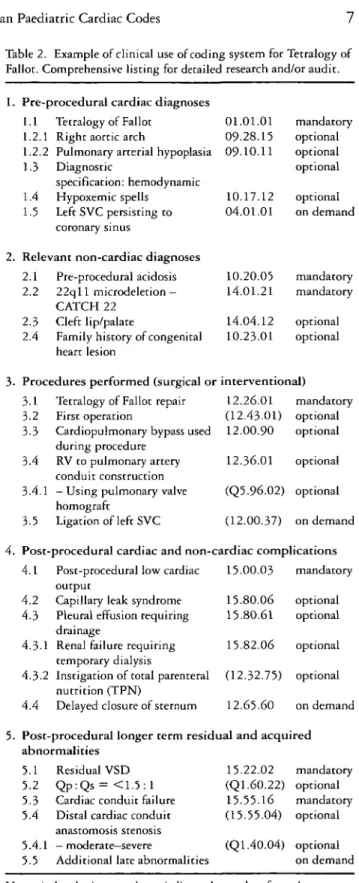
As an example of the multifaceted potential of the system, a fictitious case of tetralogy of Fallot has been used. In this case, the hierarchical system naturally falls in to five main divisions (Table 1), which correspond
Table 1. Example of possible clinical structure for use of the European Paediatric Cardiac Code.
1. Pre-procedural cardiac diagnoses 1.1 Primary cardiac diagnosis
1.2 Diagnostic specification: morphological 1.3 Diagnostic specification: hemodynamic 1.4 Diagnostic specification: functional 1.5 Additional cardiac diagnoses 2. Relevant non-cardiac diagnoses
2.1 Pre-operative risk factors
2.2 Syndromal or chromosomal factors 2.3 Non-cardiac associations or diagnoses 2.4 Patients past or family history related to
heart disease mandatory optional optional optional on demand mandatory mandatory optional optional 3. Procedures performed (surgical or interventional)
3.1 Primary procedural description
3.2 Procedural specification : procedural status 3.3 Procedural specification : procedural
category
3.4 Procedural specification : procedural details 3.5 Additional procedures mandatory optional optional optional on demand 4. Post-procedural cardiac and non-cardiac complications
4.1 Primary post-procedural cardiac complication
4.2 Specifics and sequelae of cardiac complication
4.3 Primary non-cardiac complication 4.4 Specifics and sequelae of non-cardiac
complication 4.4 Additional complications mandatory optional optional optional on demand
Table 2. Example of clinical use of coding system for Tetralogy of Fallot. Comprehensive listing for detailed research and/or audit. 1. Pre-procedural cardiac diagnoses
5. Post-procedural longer term residual and acquired abnormalities
5.1 Primary residual abnormality mandatory 5.2 Details of residual abnormality optional 5 3 Primary late acquired abnormality mandatory 5.4 Details of late acquired abnormality optional 5.5 Additional late abnormalities on demand
to the usual clinical course of the patient: • Pre-procedural cardiac diagnoses. • Relevant non-cardiac diagnoses.
• Procedures performed, be they surgical or transcatheter.
• Post-procedural cardiac and extracardiac complications.
• Post-procedural longer term residual and acquired abnormalities during follow-up.
Each division can then be arbitrarily subdivided into further sections hierarchically arranged depend-ing upon the degree of detail needed, as in the exam-ple of tricuspid valve abnormalities given in the
1.1 1.2.1 1.2.2 1.3 1.4 1.5 Tetralogy of Fallot Right aortic arch
Pulmonary arterial hypoplasia Diagnostic
specification: hemodynamic Hypoxemic spells
Left SVC persisting to coronary sinus
2. Relevant non-cardiac diagnoses 2.1 2.2 2.3 2.4 Pre-procedural acidosis 22qll microdeletion — CATCH 22 Cleft lip/palate
Family history of congenital heart lesion 01.01.01 09.28.15 09-10.11 10.17.12 04.01.01 10.20.05 14.01.21 14.04.12 10.23.01 mandatory optional optional optional optional on demand mandatory mandatory optional optional 3- Procedures performed (surgical or interventional)
3 1 Tetralogy of Fallot repair 12.26.01 mandatory 3.2 First operation (12.4301) optional 3.3 Cardiopulmonary bypass used 12.00.90 optional
during procedure
3.4 RV to pulmonary artery 12.36.01 optional conduit construction
3.4.1 — Using pulmonary valve (Q5.96.02) optional homograft
3.5 Ligation of left SVC (12.00.37) on demand 4. Post-procedural cardiac and non-cardiac complications
4.1 Post-procedural low cardiac 15.00.03 mandatory output
4.2 Capillary leak syndrome 15.80.06 optional 4.3 Pleural effusion requiring 15.80.61 optional
drainage
4.3.1 Renal failure requiring 15.82.06 optional temporary dialysis
4.32 Instigation of total parenteral (12.32.75) optional nutrition (TPN)
4.4 Delayed closure of sternum 12.65.60 on demand 5. Post-procedural longer term residual and acquired
abnormalities 5.1 5.2 5.3 5.4 5.4.1 5.5 Residual VSD Qp:Qs = < 1 . 5 : 1 Cardiac conduit failure Distal cardiac conduit anastomosis stenosis — moderate—severe
Additional late abnormalities
15.22.02 (Ql.60.22) 15.55.16 (15.55.04) (Ql.40.04) mandatory optional mandatory optional optional on demand Numerical codes in parentheses indicate those taken from the European Paediatric Cardiac Code Long List.
body of the text above. Still further additional detail can be coded if the Long List is appended to the sys-tem so that the user can "dip" into it as required, for example, to add haemodynamic or anatomical quali-fier terms. The highest item in the section would, therefore, often be a "collective" or generic term used
8 Cardiology in the Young: Supplement 2 (2002)
September 2002
Table 3. Example of clinical use of coding system for Tetralogy of Fallot. Shortened listing for central returns and/or audit.
List of mandatory primary diagnostic and therapeutic items 1. Pre-procedural cardiac diagnosis
• Tetralogy of Fallot 01.01.01 mandatory 2. Relevant non-cardiac diagnosis
• 22qll microdeletion - CATCH 22 14.01.21 mandatory • Pre-procedural acidosis 10.20.05 mandatory 3- Procedures performed, surgical or interventional
• Tetralogy of Fallot repair 12.26.01 mandatory 4. Post-procedural complications
• Post-procedural low cardiac output 15.00.03 mandatory
5. Post-procedural residual and long term acquired abnormalities
• Residual VSD 15.22.02 mandatory • Cardiac conduit failure 15.55.16 mandatory The list exclusively includes Short List codes, as illustrated by the use only of mandatory higher level items.
for the individual patient in that division, but which would also correspond to the primary diagnostic or surgical code for audit purposes. These high level items would therefore be exclusively derived from
the Short List, with additional detail from both Short and Long lists, as desired. Additional subdivi-sions can, of course, be created, depending upon the needs of the individual study or unit. Additional linkages to other systems such as the International Classification system or the International Congenital Heart Surgery Nomenclature and Database Project "minimal data set" Short List is then a simple soft-ware matter. The latter system can at present only be cross linked at the level of the European Paediatric Cardiac Code Short List.
As an example of this system in operation, Table 2 illustrates a fictitious patient with tetralogy of Fallot, giving a reasonably comprehensive listing of the cli-nical history of the patient. The layout is as shown in Table 1, with some areas of expansion to add additional detail, and some areas left without data where not relevant to the individual. This much detail could then be fed into a database for detailed research analysis along with the patient demographics, dates and delin-eated outcomes.
Table 3 then illustrates how the data can be com-pressed to show only strictly mandatory items, as required for central returns or national audit using a "minimal data set". Any combination of data can evidently be drawn from the comprehensive listing to enable more detailed studies in the future.