HAL Id: hal-02184250
https://hal.archives-ouvertes.fr/hal-02184250
Submitted on 15 Jul 2019
HAL is a multi-disciplinary open access
archive for the deposit and dissemination of
sci-entific research documents, whether they are
pub-lished or not. The documents may come from
teaching and research institutions in France or
abroad, or from public or private research centers.
L’archive ouverte pluridisciplinaire HAL, est
destinée au dépôt et à la diffusion de documents
scientifiques de niveau recherche, publiés ou non,
émanant des établissements d’enseignement et de
recherche français ou étrangers, des laboratoires
publics ou privés.
Distributed under a Creative Commons Attribution| 4.0 International License
Ensing, Jaakko Erkinaro, et al.
To cite this version:
Ida Ahlbeck-Bergendahl, Julien April, Hlynur Bardarson, Geir H. Bolstad, Ian Bradbury, et al..
Working group on North Atlantic salmon (WGNAS). [Research Report] Inconnu. 2019, 368 p.
�hal-02184250�
ICES SCIENTIFIC REPORTS
RAPPORTS
SCIENTIFIQUES DU CIEM
ICES INTERNATIONAL COUNCIL FOR THE EXPLORATION OF THE SEA CIEM CONSEIL INTERNATIONAL POUR L’EXPLORATION DE LA MER
WORKING GROUP ON NORTH ATLANTIC
SALMON (WGNAS)
DK-1553 Copenhagen V Denmark Telephone (+45) 33 38 67 00 Telefax (+45) 33 93 42 15 www.ices.dk [email protected]
The material in this report may be reused for non-commercial purposes using the recommended cita-tion. ICES may only grant usage rights of information, data, images, graphs, etc. of which it has owner-ship. For other third-party material cited in this report, you must contact the original copyright holder for permission. For citation of datasets or use of data to be included in other databases, please refer to the latest ICES data policy on ICES website. All extracts must be acknowledged. For other reproduction requests please contact the General Secretary.
This document is the product of an expert group under the auspices of the International Council for the Exploration of the Sea and does not necessarily represent the view of the Council.
ICES Scientific Reports
Volume 1 | Issue 16
WORKING GROUP ON NORTH ATLANTIC SALMON (WGNAS)
Recommended format for purpose of citation:
ICES. 2019. Working Group on North Atlantic Salmon (WGNAS).
ICES Scientific Reports. 1:16. 368 pp. http://doi.org/10.17895/ices.pub.4978
Editors
Martha Robertson
Authors
Ida Ahlbeck-Bergendahl • Julien April • Hlynur Bardarson • Geir H. Bolstad • Ian Bradbury • Mathieu Buoro • Gérald Chaput • Guillaume Dauphin • Dennis Ensing • Jaakko Erkinaro • Peder Fiske • Marko Freese • Jonathan Gillson • Stephen Gregory • Nora Hanson • Nick Kelly • Hugo Maxwell • David Meer-burg • Michael Millane • Rasmus Nygaard • Maxime Olmos • James Ounsley • Sergey Prusov • Etienne Rivot • Martha Robertson • Ian Russell • Tim Sheehan • Kjell Rong Utne • Alan Walker • Vidar Wenne-vik
Contents
i Executive summary ... v
ii Expert group information ... vii
1 Introduction ... 8
1.1 Main tasks ... 8
1.2 Participants ... 10
1.3 Management framework for salmon in the North Atlantic ... 11
1.4 Management objectives ... 12
1.5 Reference points and application of precaution ... 12
2 Atlantic salmon in the North Atlantic area ... 14
2.1 Catches of North Atlantic salmon ... 14
2.1.1 Nominal catches of salmon ... 14
2.1.2 Catch and release ... 15
2.1.3 Unreported catches ... 16
2.2 Farming and sea ranching of Atlantic salmon ... 16
2.2.1 Production of farmed Atlantic salmon ... 16
2.2.2 Harvest of ranched Atlantic salmon ... 17
2.3 NASCO has asked ICES to report on significant, new or emerging threats to, or opportunities for, salmon conservation and management ... 17
2.3.1 Diseases and parasites ... 17
2.3.1.1 Update on Red Vent Syndrome (Anisakiasis) ... 17
2.3.1.2 Update on sea lice investigations in Norway ... 18
2.3.1.3 Update on Gyrodactylus salaris ... 19
Norway ... 19
Russian Federation ... 19
2.3.1.4 Other updates on disease issues ... 19
Sweden ... 19
Russian Federation ... 19
2.3.1.5 Presence and Abundance of Infectious Agents on Atlantic salmon in the Labrador Sea ... 20
2.3.1.6 Atlantic salmon viral pathogen testing (VHSV, PRV-1, PRV-3, PMCV) at Greenland in 2017 ... 20
2.3.2 Unusually dry conditions in 2018 ... 21
2.3.3 Update on the Atlantic salmon stock situation in Germany ... 22
2.3.4 Atlantic salmon return rate increases with smolt length ... 24
2.3.5 Tracking Studies in the Northwest Atlantic ... 26
2.3.5.1 Update of select acoustic tagging studies in Canada ... 26
2.3.5.2 Update on Pop-off Satellite Tagging Atlantic Salmon at Greenland ... 27
2.3.6 New opportunities for sampling salmon at sea ... 28
2.3.6.1 The International Ecosystem Summer Survey of the Nordic Seas (IESSNS) and other surveys ... 28
2.3.6.2 Project “SeaSalar” ... 29
2.3.6.3 New approaches to estimating bycatch in pelagic fisheries ... 29
2.3.7 Embedding Atlantic salmon stock assessment within an integrated Bayesian life cycle modelling framework ... 30
2.3.7.1 Progress in stock assessment models ... 30
2.3.7.2 Investigating the drivers of Atlantic salmon population declines across the Atlantic basin ... 30
2.4 Reports from ICES expert group and other investigations relevant to North Atlantic salmon ... 31
ii | ICES SCIENTIFIC REPORTS 1: 16 | ICES
2.4.2 SAlmonids Management ARound the CHannel (SAMARCH) ... 32
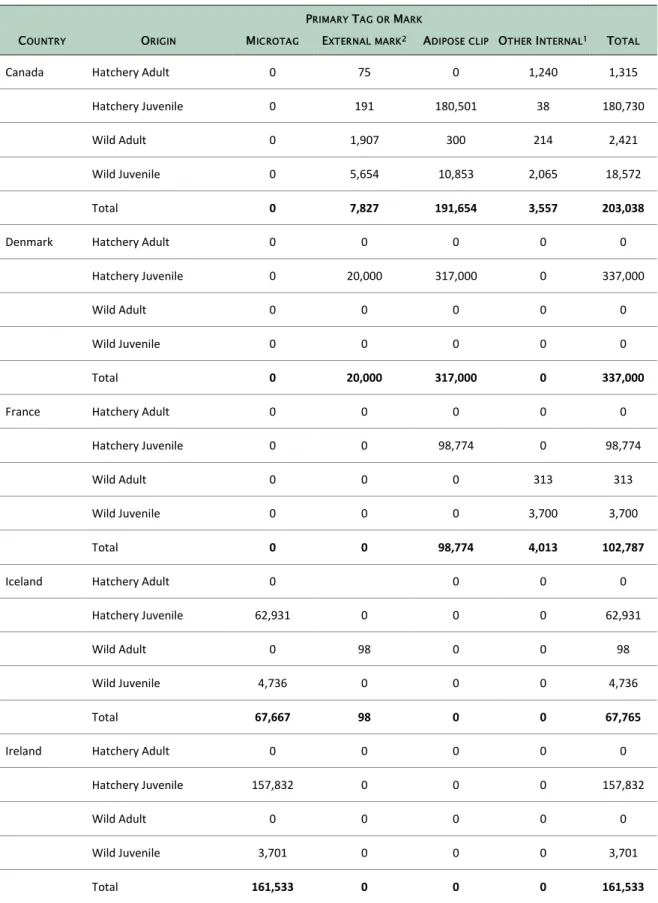
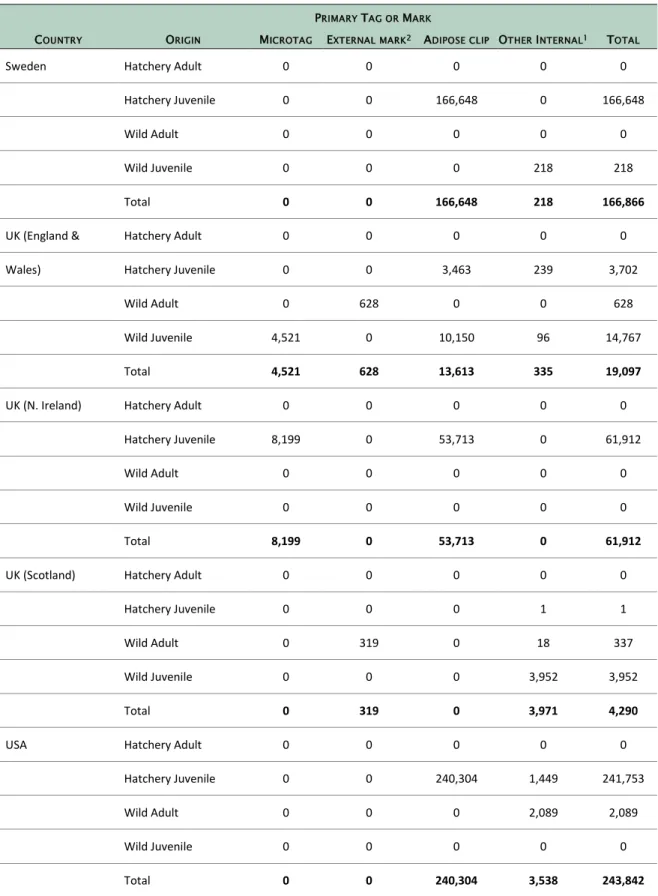
2.5 NASCO has asked ICES to provide a compilation of tag releases by country in 2018 ... 33
3 Northeast Atlantic Commission area ... 65
3.1 NASCO has requested ICES to describe the key events of the 2018 fisheries ... 65
3.1.1 Fishing at Faroes ... 65
3.1.2 Key events in NEAC homewater fisheries ... 65
3.1.3 Gear and effort ... 65
3.1.4 Catches ... 66
3.1.5 Catch per unit of effort (CPUE) ... 67
3.1.6 Age composition of catches ... 67
3.1.7 Farmed and ranched salmon in catches ... 68
3.1.8 National origin of catches ... 68
3.1.8.1 Catches of Russian salmon in northern Norway ... 68
3.1.9 Exploitation indices of NEAC stocks ... 69
3.2 Management objectives and reference points ... 70
3.2.1 NEAC conservation limits ... 70
3.2.2 Progress with setting river-specific conservation limits ... 70
3.2.2.1 UK (Scotland) ... 70
3.3 Status of stocks ... 71
3.3.1 The NEAC PFA run-reconstruction model ... 71
3.3.2 Changes to the national input data for the NEAC PFA run-reconstruction model ... 71
3.3.3 Changes to the NEAC PFA run-reconstruction model ... 72
3.3.4 Description of national stocks and NEAC stock complexes as derived from the NEAC run-reconstruction model ... 72
Individual country stocks ... 73
3.3.5 Compliance with river-specific conservation limits ... 74
3.3.6 Marine survival (return rates) for NEAC stocks... 75
4 North American Commission ... 146
4.1 NASCO has requested ICES to describe the key events of the 2018 fisheries ... 146
4.1.1 Key events of the 2018 fisheries ... 146
4.1.2 Gear and effort ... 146
Canada ... 146
Indigenous food, social, and ceremonial (FSC) fisheries ... 147
Labrador resident subsistence fisheries ... 147
Recreational fisheries ... 147
USA ... 148
France (Islands of Saint Pierre and Miquelon) ... 148
4.1.3 Catches in 2018 ... 148
Canada ... 148
Indigenous FSC fisheries ... 149
Labrdor resident subsistence fisheries ... 149
Recreational fisheries ... 149
Commercial fisheries ... 149
Unreported catches ... 149
USA ... 150
France (Islands of Saint Pierre and Miquelon) ... 150
4.1.4 Harvest of North American salmon, expressed as 2SW salmon equivalents ... 150
4.1.5 Origin and composition of catches ... 151
Labrador subsistence fisheries sampling program ... 151
Saint Pierre and Miquelon fisheries sampling programme ... 152
Recommendations for future activities ... 153
Canada ... 153
USA ... 153
Exploitation trends for North American salmon fisheries ... 153
4.2 Management objectives and reference points ... 153
4.3 Status of stocks ... 155
4.3.1 Smolt abundance ... 155
Canada ... 155
USA ... 155
4.3.2 Estimates of total adult abundance ... 155
Small salmon returns ... 156
Large salmon returns ... 156
2SW salmon returns ... 157
4.3.3 Estimates of spawning escapements ... 157
Small salmon spawners ... 157
Large salmon spawners ... 158
2SW salmon spawners... 158
4.3.4 Egg depositions in 2018 ... 158
4.3.5 Marine survival (return rates) ... 159
4.3.6 Pre-fisheries abundance (PFA) ... 160
4.3.6.1 North American run–reconstruction model ... 160
4.3.6.2 Non-maturing 1SW salmon ... 160
4.3.6.3 Maturing 1SW salmon ... 160
4.3.6.4 Total 1SW recruits (maturing and non-maturing)... 161
4.3.7 Summary on status of stocks ... 161
5 Atlantic salmon in the West Greenland Commission ... 253
5.1 NASCO has requested ICES to describe the key events of the 2018 fishery ... 253
5.1.1 Catch and effort in 2018 ... 254
5.1.2 Phone surveys ... 256
5.1.3 Exploitation ... 256
5.2 International sampling programme ... 256
5.2.1 Biological characteristics of the catches ... 258
5.2.2 Continent of origin of catches at West Greenland ... 258
5.2.3 Region of origin of catches at West Greenland ... 259
5.3 NASCO has requested ICES to describe the status of the stocks ... 259
5.3.1 North American stock complex ... 260
5.3.2 MSW Southern European stock complex ... 260
Annex 1: List of Working Papers submitted to WGNAS 2019 ... 308
Annex 2: References cited ... 310
Annex 3: List of participants... 315
Annex 4: Reported catch of salmon in numbers and weight (tonnes round fresh weight) by sea age class. Catches reported for 2017 may be provisional. Methods used for estimating age composition given in footnote ... 317
Annex 5: WGNAS responses to the generic ToRs for Regional and Species Working Groups .... 346
Annex 6: WGNAS Stock Annex for Atlantic salmon ... 349
Annex 7: Glossary of acronyms used in this report ... 350
Annex 8: NASCO has requested ICES to identify relevant data deficiencies, monitoring needs and research requirements ... 356
List of recommendations ... 356
Annex 9: WGNAS 2019 Response to Review Group 2018 ... 357
WGNAS General comments ... 357
WGNAS Specific comments ... 358
Annex 10: Addressing questions on the EU Data Collection Framework and the ICES Data call ... 364
iv | ICES SCIENTIFIC REPORTS 1: 16 | ICES
10.1 ... 364
10.2 Data Call for NASCO requested information used by the Working Group ... 370
Process for collating catch data ... 370
10.3 DRAFT Data call: Data submission for ICES selected stocks under WGNAS 2020 ... 371
1. Scope of the Data call ... 371
2. Rationale ... 371 3. Legal framework ... 371 4. Deadlines ... 372 5. Data to report ... 372 6. Data submission ... 372 7. Contact information ... 372
i Executive summary
WGNAS met to consider questions posed to ICES by the North Atlantic Salmon Conservation Organisation (NASCO) and also generic questions for regional and species Working Groups posed by ICES.
The terms of reference were addressed by reviewing working documents prepared prior to the meeting as well as development of analyses, documents and text during the meeting.
The report is presented in five sections, structured to the terms of reference. Sections include: 1. Introduction;
2. Catches, farming and significant developments, threats and opportunities; 3. The status of stocks in the Northeast Atlantic Commission area;
4. The status of stocks in the North American Commission area; 5. The status of stocks in the West Greenland Commission area.
In summary of the findings of the Working group on North Atlantic Salmon:
• In the North Atlantic, exploitation rates on Atlantic salmon continue to be among the lowest in the time-series.
• Nominal catch in 2018 was 1090 t. This was 73 t below the updated catch for 2017 (1163 t) and 119 t and 283 t less than the previous five and ten year means, respectively.
• The provisional estimate of farmed Atlantic salmon production in the North Atlantic area for 2018 was 1575 kt; production of farmed Atlantic salmon in this area has been over one million tonnes since 2009 and in 2018 provisional worldwide production of 2335 kt is 2000 times the catch of wild Atlantic salmon.
• The Working Group reported on a range of new findings regarding salmon assessment and management: including an update of salmon populations in Germany, smolt marine survival studies in the UK, tracking programmes in the Northwest Atlantic, satellite tag-ging at Greenland, salmon sampling program in the Nordic Sea, long-term collaborative project focusing on salmon at sea in Norway, methods for estimating bycatch in pelagic fisheries, a single Bayesian life cycle model for the North Atlantic, and modelling the drivers of Atlantic salmon population declines across the Atlantic basin.
• A number of threats were discussed including disease and parasite events in wild salmon in England and Wales (RVS), Norway (salmon fluke and UDN), and Sweden (UDN and RVS); sea lice monitoring in Norway, infectious agents on salmon in the Labrador Sea, and pathogen testing at Greenland.
• The Working Group noted unusually dry river conditions throughout the North Atlantic area in 2018.
• Specific for the NEAC area, exploitation rates on NEAC stocks continue to decline and catches in 2018 were 960 t. This was 60 t below the updated catch for 2017 (1020 t) and 7% and 20% below the previous five-year and ten-year means respectively. Northern NEAC stock complexes, prior to the commencement of distant-water fisheries, were con-sidered to be at full reproductive capacity. The southern NEAC stock complexes how-ever, were considered to be suffering reduced reproductive capacity.
• Specific for the NAC area, the 2018 provisional harvest in Canada was 90 t, which was the lowest in the time-series since 1960. The majority of harvest fisheries on NAC stocks were directed toward small salmon. In recreational fisheries, large salmon could only be retained on 14 rivers in Québec.
VI | ICES SCIENTIFIC REPORTS 1:16 | ICES
• In 2018, 2SW returns to rivers were suffering reduced reproductive capacity in five of the six assessment regions of NAC, ranging from 3% in the USA to 127% in the Gulf. • The continued low abundance of salmon stocks across North America, despite significant
fishery reductions, strengthens the conclusions that factors acting on survival in the first and second years at sea, at both local and broad ocean scales are constraining abundance of Atlantic salmon.
• In Greenland, a total catch of 39.9 t was reported for 2018 compared to 28.0 t in 2017. North American origin salmon comprised 83.1% of the sampled catch.
Members representing EU Member States replied to the questions by RCG-DSG on data needs for assessment by WGNAS by providing a list of data currently used in the assessment, data of potential use, and data of potential use in future. Regarding data quality the Group takes uncer-tainty into account in the assessment, but recognises potential challenges associated with the timeliness and completeness of data reporting. The Group reported that no formal process for the selection of monitored rivers currently exists, and recommends that selection of such rivers remains within the competence of individual MS. The data types and sampling frequency of data collection on such rivers were also reported on.
ii Expert group information
Expert group name Working Group on North Atlantic Salmon (WGNAS)
Expert group cycle Annual
Year cycle started 2019
Reporting year in cycle 1/1
Chair Martha Robertson, Canada
8 | ICES SCIENTIFIC REPORTS 1:16 | ICES
1 Introduction
1.1
Main tasks
At its 2018 Statutory Meeting, ICES resolved (C. Res. 2018/2/ACOM21) that the Working Group
on North Atlantic Salmon [WGNAS] (chaired by Martha Robertson, Canada) will meet in
Ber-gen, Norway, 26 March–4 April 2019 to address: (a) relevant points in the Generic ToRs for Re-gional and Species Working Groups for each salmon stock complex; (b) questions regarding data requirements under the EU Data Collection Framework (EU-DCF) and Data Collection-Multi-Annual Programme (EU-DCMAP); and (c) questions posed to ICES by the North Atlantic Salmon Conservation Organisation (NASCO).
The terms of reference were met. The questions posed in the Generic ToRs for Regional and Spe-cies Working Groups for each salmon stock complex overlap substantially with the questions posed by NASCO. As such, responses to the former were restricted to a limited subset of the questions; brief responses are provided in Annex 5. Questions regarding data requirements un-der the EU-DCF and EU-DCMAP are addressed in Annex 10.
The sections of the report which provide the answers to the questions posed by NASCO, are identified below:
Question Section
Posed by NASCO
1 With respect to Atlantic salmon in the North Atlantic area: Section 2 1.1 provide an overview of salmon catches and landings by country, including unreported
catches and catch and release, and production of farmed and ranched Atlantic salmon in 20181.
2.1, 2.2 and Annex 4 1.2 report on significant new or emerging threats to, or opportunities for, salmon
conserva-tion and management2; 2.3
1.3 provide a compilation of tag releases by country in 2018; and 2.5 1.4 identify relevant data deficiencies, monitoring needs and research requirements. Annex 8 2 With respect to Atlantic salmon in the Northeast Atlantic Commission area: Section 3
2.1 describe the key events of the 2018 fisheries3; 3.1
2.2 review and report on the development of age-specific stock conservation limits, including updating the time-series of the number of river stocks with established CLs by jurisdiction; 3.2 2.3 describe the status of the stocks, including updating the time-series of trends in the
num-ber of river stocks meeting CLs by jurisdiction; 3.3
3 With respect to Atlantic salmon in the North American Commission area: Section 4 3.1 describe the key events of the 2018 fisheries (including the fishery at St Pierre and
3.2 update age-specific stock conservation limits based on new information as available, in-cluding updating the time-series of the number of river stocks with established CLs by ju-risdiction;
4.2
3.3 describe the status of the stocks, including updating the time-series of trends in the
num-ber of river stocks meeting CLs by jurisdiction; 4.3
4 With respect to Atlantic salmon in the West Greenland Commission area: Section 5
4.1 describe the key events of the 2018 fisheries3; 5.1
4.2 describe the status of the stocks4; 5.3
Notes:
1 With regard to question 1.1, for the estimates of unreported catch the information provided should, where
possi-ble, indicate the location of the unreported catch in the following categories: in-river; estuarine; and coastal. Num-bers of salmon caught and released in recreational fisheries should be provided.
2 With regard to question 1.2, ICES is requested to include reports on any significant advances in understanding of
the biology of Atlantic salmon that is pertinent to NASCO, including information on any new research into the migration and distribution of salmon at sea and the potential implications of climate change for salmon manage-ment.
3 In the responses to questions 2.1, 3.1 and 4.1, ICES is asked to provide details of catch, gear, effort, composition
and origin of the catch and rates of exploitation. For homewater fisheries, the information provided should indicate the location of the catch in the following categories: in-river; estuarine; and coastal. Information on any other sources of fishing mortality for salmon is also requested (For 4.1, if any new phone surveys are conducted, ICES should review the results and advise on the appropriateness for incorporating resulting estimates of unreported catch into the assessment process).
4 In response to question 4.2, ICES is requested to provide a brief summary of the status of North American and
Northeast Atlantic salmon stocks. The detailed information on the status of these stocks should be provided in response to questions 2.3 and 3.3.
In response to the Terms of Reference, the Working Group considered 35 Working Documents submitted by participants (Annex 1). Information provided by correspondence by Working Group members unable to attend the meeting is included in the list of working documents. Ref-erences cited in the Report are provided in Annex 2, a full address list for the meeting partici-pants is provided in Annex 3 and a complete list of acronyms used within this document is pro-vided in Annex 7.
10 | ICES SCIENTIFIC REPORTS 1:16 | ICES
1.2
Participants
Member Country Ahlbeck-Beregndahl, I. Sweden April, J. Canada Bardarson, H. Iceland Bolstad, G. NorwayBradbury, I. Canada (Video link)
Buoro, M. France
Chaput, G. Canada
Dauphin, G. Canada
Ensing, D. UK (Northern Ireland)
Erkinaro, J. Finland
Fiske, P. Norway
Freese, M. Germany
Gillson, J. UK (England & Wales)
Gregory, S. UK (England & Wales)
Hanson, N. UK (Scotland)
Kelly, N. Canada
Maxwell, H. Ireland
Meerburg, D. Canada
Millane, M. Ireland
Nygaard, R. Greenland (Video link)
Olmos, M. France
Ounsley, J. UK (Scotland)
Prusov, S. Russian Federation
Rivot, E. France
Robertson, M. Canada
Russell, I. UK (England & Wales)
Sheehan, T. United States
Member Country
Walker, A. UK (England & Wales)
Wennevik, V. Norway
1.3
Management framework for salmon in the North
At-lantic
The advice generated by ICES in response to the Terms of Reference posed by the North Atlantic Salmon Conservation Organisation (NASCO), is pursuant to NASCO’s role in international management of salmon. NASCO was set up in 1984 by international convention (the Convention for the Conservation of Salmon in the North Atlantic Ocean), with a responsibility for the conservation, restoration, enhancement, and rational management of wild salmon in the North Atlantic. While sovereign states retain their role in the regulation of salmon fisheries for salmon originating in their own rivers, distant water salmon fisheries, such as those at Greenland and Faroes, which take salmon originating in rivers of another Party are regulated by NASCO under the terms of the Convention. NASCO now has six Parties that are signatories to the Convention, including the EU which represents its Member States.
12 | ICES SCIENTIFIC REPORTS 1:16 | ICES
1.4
Management objectives
NASCO has identified the primary management objective of that organisation as:
“To contribute through consultation and cooperation to the conservation, restoration, enhancement and rational management of salmon stocks taking into account the best scientific advice available”.
NASCO further stated that “the Agreement on the Adoption of a Precautionary Approach states that an objective for the management of salmon fisheries is to provide the diversity and abundance of salmon stocks” and NASCO’s Standing Committee on the Precautionary Approach interpreted this as being “to maintain both the productive capacity and diversity of salmon stocks” (NASCO, 1998).
NASCO’s Action Plan for Application of the Precautionary Approach (NASCO, 1999) provides interpretation of how this is to be achieved, as follows:
• “Management measures should be aimed at maintaining all stocks above their con-servation limits by the use of management targets”.
• “Socio-economic factors could be taken into account in applying the Precautionary Approach to fisheries management issues”.
• “The precautionary approach is an integrated approach that requires, inter alia, that stock rebuilding programmes (including, as appropriate, habitat improvements, stock enhancement, and fishery management actions) be developed for stocks that are be-low conservation limits”.
1.5
Reference points and application of precaution
Conservation limits (CLs) for North Atlantic salmon stock complexes have been defined as the level of stock (number of spawners) that will achieve long-term average maximum sustainable yield (MSY). In many regions of North America, the CLs are calculated as the number of spawn-ers required to fully seed the wetted area of the river. The definition of conservation in Canada varies by region and in some areas, historically, the values used were equivalent to maximizing / optimizing freshwater production. These are used in Canada as limit reference points and they do not correspond to MSY values. Reference points for Atlantic salmon are currently being re-viewed for conformity with the Precautionary Approach policy in Canada. Revised reference points are expected to be developed. In some regions of Europe, pseudo stock–recruitment ob-servations are used to calculate a hockey-stick relationship, with the inflection point defining the CLs. In the remaining regions, the CLs are calculated as the number of spawners that will achieve long-term average MSY, as derived from the adult-to-adult stock and recruitment relationship (Ricker, 1975; ICES, 1993). NASCO has adopted the region specific CLs (NASCO, 1998). These CLs are limit reference points (Slim); having populations fall below these limits should be avoided
with high probability.
Atlantic salmon has characteristics of short-lived fish stocks; mature abundance is sensitive to annual recruitment because there are only a few age groups in the adult spawning stock. Incoming recruitment is often the main component of the fishable stock. For such fish stocks, the ICES MSY approach is aimed at achieving a target escapement (MSY Bescapement, the amount of
biomass left to spawn). No catch should be allowed unless this escapement can be achieved. The escapement level should be set so there is a low risk of future recruitment being impaired, similar to the basis for estimating Bpa in the precautionary approach. In short-lived stocks, where most
of the annual surplus production is from recruitment (not growth), MSY Bescapement and Bpa might
It should be noted that this is equivalent to the ICES precautionary target reference points (Spa).
Therefore, stocks are regarded by ICES as being at full reproductive capacity only if they are above the precautionary target reference point. This approach parallels the use of precautionary reference points used for the provision of catch advice for other fish stocks in the ICES area. Management targets have not yet been defined for all North Atlantic salmon stocks. When these have been defined, they will play an important role in ICES advice.
For the assessment of the status of stocks and advice on management of national components and geographical groupings of the stock complexes in the NEAC area, where there are no specific management objectives:
• ICES requires that the lower bound of the confidence interval of the current estimate of spawners is above the CL for the stock to be considered at full reproductive capac-ity.
• When the lower bound of the confidence limit is below the CL, but the midpoint is above, then ICES considers the stock to be at risk of suffering reduced reproductive capacity.
• Finally, when the midpoint is below the CL, ICES considers the stock to be suffering reduced reproductive capacity.
For catch advice on fish exploited at West Greenland (non-maturing 1SW fish from North America and non-maturing 1SW fish from Southern NEAC), ICES has adopted, a risk level of 75% of simultaneous attainment of management objectives (ICES, 2003) as part of an management plan agreed by NASCO. ICES applies the same level of risk aversion for catch advice for homewater fisheries on the North American stock complex.
NASCO has not formally agreed a management plan for the fishery at Faroes. However, the Working Group has developed a risk-based framework for providing catch advice for fish ex-ploited in this fishery (mainly MSW fish from NEAC countries). Catch advice is currently pro-vided at both the stock complex and country level (for NEAC stocks only) and catch options tables provide both individual probabilities and the probability of simultaneous attainment of meeting proposed management objectives for both. ICES has recommended (ICES, 2013) that management decisions should be based principally on a 95% probability of attainment of CLs in each stock complex/ country individually. The simultaneous attainment probability may also be used as a guide, but managers should be aware that this will generally be quite low when large numbers of management units are used.
Full details of the assessment approaches used by the Working Group are provided in the Stock Annex, and this includes a general introduction in Section 1. Readers new to this report would be advised to read the Stock Annex in the first instance (See Annex 6).
14 | ICES SCIENTIFIC REPORTS 1:16 | ICES
2 Atlantic salmon in the North Atlantic area
2.1
Catches of North Atlantic salmon
2.1.1
Nominal catches of salmon
The nominal catch of a fishery is defined as the round, fresh weight of fish that are caught and retained. Total nominal catches of salmon reported by country in all fisheries for 1960–2018 are given in Table 2.1.1.1. Catch statistics in the North Atlantic also include fish-farm escapees and, in some Northeast Atlantic countries, ranched fish (see Section 2.2.2). Catch and release has be-come increasingly commonplace in some countries, but these fish do not appear in the nominal catches (see Section 2.1.2).
Icelandic catches have traditionally been split into two categories, wild and ranched, reflecting the fact that Iceland has been the main North Atlantic country where large-scale ranching has been undertaken with the specific intention of harvesting all returns at the release site and with no prospect of wild spawning success. The release of smolts for commercial ranching purposes ceased in Iceland in 1998, but ranching for rod fisheries in two Icelandic rivers continued into 2018 (Table 2.1.1.1). Catches in Sweden have also now been split between wild and ranched cat-egories over the entire time-series. The latter fish represent adult salmon which have originated from hatchery-reared smolts and which have been released under programmes to mitigate for hydropower development schemes. These fish are also exploited very heavily in homewaters and have no possibility of spawning naturally in the wild. While ranching does occur in some other countries, this is on a much smaller scale. Some of these operations are experimental and at others harvesting does not occur solely at the release site. The ranched component in these countries has therefore been included in the nominal catch.
Figure 2.1.1.1 shows the total reported nominal catch of salmon grouped by the following areas: ‘Northern Europe’ (Norway, Russia, Finland, Iceland, Sweden and Denmark); ‘Southern Europe’ (Ireland, UK (Scotland), UK (England & Wales), UK (Northern Ireland), France and Spain); ‘North America’ (Canada, USA and St Pierre et Miquelon (France)); and ‘Greenland and Faroes’. The provisional total nominal catch for 2018 was 1090 t, 73 t below the updated catch for 2017 (1163 t) and 119 and 283 t below the mean for the last five and ten years, respectively. Catches were below the previous five and ten-year means in the majority of countries and were the lowest in the entire time-series (1960 to 2018). The catch in UK (Scotland) was at a historical low level (19 t), representing a drop by three and fivefold compared with the previous five and ten years means (65 and 107 t), respectively. The reduction in catch in the last three years reflects both the impact of conservation regulations and the increased uptake of catch and release in recent years. Nominal catches (weight only) in homewater fisheries were split, where available, by sea age or size category (Table 2.1.1.2). The data for 2018 are provisional and, as in Table 2.1.1.1, include both wild and reared salmon and fish-farm escapees in some countries. A more detailed break-down, providing both numbers and weight for different sea age groups for most countries, is provided in Annex 4. Countries use different methods to partition their catches by sea age class (outlined in the footnotes to Annex 4). The composition of catches in different areas is discussed in more detail in Sections 3, 4, and 5.
ICES recognises that mixed-stock fisheries present particular threats to stock status. These fish-eries predominantly operate in coastal areas and NASCO specifically requests that the nominal catches in homewater fisheries be partitioned according to whether the catch is taken in coastal,
estuarine or riverine areas. Figure 2.1.1.2 presents these data on a country-by-country basis. It should be noted, however, that the way in which the nominal catch is partitioned among cate-gories varies between countries, particularly for estuarine and coastal fisheries. For example, in some countries these catches are split according to particular gear types and in other countries the split is based on whether fisheries operate inside or outside headlands. While it is generally easier to allocate the freshwater (riverine) component of the catch, it should also be noted that catch and release (C&R) is now in widespread use in many countries (Section 2.1.2) and these fish are excluded from the nominal catch. Noting these caveats, these data are considered to provide the best available indication of catch in these different fishery areas. Figure 2.1.1.2 shows that there is considerable variability of the distribution of the catch among individual countries. There are no coastal fisheries in Iceland, Spain, Denmark, or Finland. Coastal fisheries ceased in Ireland in 2007 and no fishing has occurred in coastal waters of UK (Northern Ireland) since 2012 or in UK (Scotland) since 2015. In most countries in recent years the majority of the catch has been taken in rivers and estuaries. However, in Norway and Russia roughly half of the total catch has been taken in coastal waters in recent years and in UK (England & Wales) around 70-80% of the total catch has been taken in coastal waters in the last three years.
Coastal, estuarine and riverine catch data for the period 2007 to 2018 aggregated by region are presented in Figure 2.1.1.3. In northern Europe, catches in coastal fisheries have been in decline over the period and have reduced from 458 t in 2007 to 359 t in 2018. Freshwater catches have been fluctuating between 763 t (2008) and 461 t (2018) over the same period. At the beginning of the time-series about half the catch was taken in coastal waters and half in rivers, whereas since 2008 the coastal catch represents around 30%–40% of the total. In southern Europe, catches in coastal and estuarine fisheries have declined over the period. While coastal and estuarine fisher-ies have historically made up the largest component of the catch, coastal fisherfisher-ies dropped sharply in 2007 (from 306 t in 2006 to 71 t in 2007) and have remained at lower levels. Estuarine fisheries have also generally declined from 72 t in 2007 to 36 t in 2018. The reduction in later years in coastal and estuarine fisheries reflects widespread measures to reduce exploitation in a num-ber of countries. At the beginning of the time-series about half the catch was taken in coastal waters and one third in rivers. From 2007 to 2009 the coastal catch comprised about 20% of the total catch; this increased to around one third of the catch from 2010 to 2016, while the coastal catch in 2017 and 2018 was around one fourth of the total catch.
In North America, the total catch has been fluctuating between 94 and 182 t over the period 2007 to 2018. Two thirds of the total catch in this area has been taken in riverine fisheries; the catch in coastal fisheries has been relatively small in any year with the biggest catch taken in 2013 and 2017 (13 t in both years).
In Greenland, the total catch, which is all coastal, increased steadily from 25 t in 2007 to 56 t in 2015 but decreased to 40 t in 2018.
2.1.2
Catch and release
The practice of catch and release in rod fisheries has become increasingly common. This has oc-curred in part as a consequence of salmon management measures aimed at conserving stocks while maintaining opportunities for recreational fisheries, but also reflects increasing voluntary release of fish by anglers. In some areas of Canada and USA, mandatory catch and release of large (MSW) salmon has been in place since 1984, and since the beginning of the 1990s it has also been widely used in many European countries.
The nominal catches presented in Section 2.1.1 do not include salmon that have been caught and released. Table 2.1.2.1 presents catch-and-release information from 1991 to 2018 for countries that have records. Catch and release may also be practised in other countries while not being formally
16 | ICES SCIENTIFIC REPORTS 1:16 | ICES
recorded or where figures are only recently available. There are large differences in the percent-age of the total rod catch that is released: in 2018 this ranged from 19% in Sweden, to 93% in UK (Scotland) reflecting varying management practices and angler attitudes among these countries. There are no restrictions on the numbers of fish that may be caught on a catch-and-release basis in most countries. For all countries, the percentage of fish released has tended to increase over time. There is also evidence from some countries that larger MSW fish are released in larger proportions than smaller fish. Overall, over 166 000 salmon were reported to have been released around the North Atlantic in 2018, 6% below the average for the last five years (177 000). Summary information on how catch and release levels are incorporated into national assess-ments was provided to ICES in 2010 (ICES, 2010).
2.1.3
Unreported catches
Unreported catches by year (1987 to 2018) and Commission Area are presented in Table 2.1.3.1 and are presented relative to the total nominal catch in Figure 2.1.3.1. A description of the meth-ods used to derive the unreported catches was provided in ICES (2000) and updated for the NEAC Region in ICES (2002). Detailed reports from different countries were also submitted to NASCO in 2007 in support of a special session on this issue. There have been no estimates of unreported catch for Russia since 2008, for Canada in 2007 and 2008, and for France since 2016. There are also no estimates of unreported catch for Spain and St Pierre & Miquelon (France), where total catches are typically small.
In general, the methods used by each country to derive estimates of unreported catch have re-mained relatively unchanged and thus comparisons over time may be appropriate (see Stock Annex). However, the estimation procedures vary markedly between countries. For example, some countries include only illegally caught fish in the unreported catch, while other countries include estimates of unreported catch by legal gear as well as illegal catches in their estimates. Over recent years, efforts have been made to reduce the level of unreported catch in a number of countries (e.g. through improved reporting procedures and the introduction of carcass tagging and logbook schemes).
The total unreported catch in NASCO areas in 2018 was estimated to be 314 t. The unreported catch in NEAC in 2018 was estimated at 279 t, and that for West Greenland and NAC at 10 t and 24 t, respectively. The 2018 unreported catch by country is provided in Table 2.1.3.2. It is not possible to partition the unreported catches into coastal, estuarine and riverine areas.
Summary information on how unreported catches are incorporated into national and interna-tional assessments was provided to ICES in 2010 (ICES, 2010).
2.2
Farming and sea ranching of Atlantic salmon
2.2.1
Production of farmed Atlantic salmon
The provisional estimate of farmed Atlantic salmon production in the North Atlantic area for 2018 is 1575 kt, which is similar to production for 2017 (1577 kt) and the previous five-year mean (1558 kt). The production of farmed Atlantic salmon in this area has been over one million tonnes since 2009 (Table 2.2.1.1 and Figure 2.2.1.1). Norway and UK (Scotland) continue to produce the majority of the farmed salmon in the North Atlantic (81% and 10% respectively). Farmed salmon production in 2018 was above the previous five-year mean in all countries with the exception of Canada (production in 2018 estimated from 2017 data), Faroes and UK (Scotland) (production in 2018 represents a projected estimate). Data for UK (N. Ireland) since 2001 and data for east coast
USA since 2012 are not reported to ICES, as the data are not publicly available. This is also the case for some regions within countries in some years.
Worldwide production of farmed Atlantic salmon has been over one million tonnes since 2001 and has been over two million tonnes since 2012. It is difficult to source reliable production fig-ures for all countries outside the North Atlantic area and it has been necessary to use 2017 data from the FAO Fisheries and Aquaculture Department database for some countries in deriving a worldwide estimate for 2018. The total worldwide production in 2018 is provisionally estimated at around 2335 kt (Table 2.2.1.1 and Figure 2.2.1.1), which is similar to 2017 (2335 kt) and higher than the previous five-year mean (2272 kt). Production of farmed Atlantic salmon outside the North Atlantic is estimated to have accounted for one third of the worldwide total in 2018 and is still dominated by Chile (82%). Atlantic salmon are being produced in land-based and closed containment facilities around the world and the figures provided in Table 2.2.1.1 may not include all countries where such production is occurring.
The worldwide production of farmed Atlantic salmon in 2018 was over 2000 times the reported nominal catch of Atlantic salmon in the North Atlantic.
2.2.2
Harvest of ranched Atlantic salmon
Ranching has been defined as the production of salmon through smolt releases with the intent of harvesting the total population that returns to freshwater (harvesting can include fish collected for broodstock) (ICES, 1994). The release of smolts for commercial ranching purposes ceased in Iceland in 1998, but ranching with the specific intention of harvesting by rod fisheries has been practised in two Icelandic rivers since 1990 and these data are now included in the ranched catch (Table 2.1.1.1). A similar approach has been adopted, over the available time-series, for one river in Sweden (River Lagan). These hatchery origin smolts are released under programmes to miti-gate for hydropower development schemes with no possibility of spawning naturally in the wild. These have therefore also been designated as ranched fish and are included in Figure 2.2.2.1. In Ireland ranching is currently only carried out in two salmon rivers under limited ex-perimental conditions. A catch of 1011 fish was reported on the Gudenå River in Denmark, where the majority of fish are believed to be of ranched origin.
The total harvest of ranched Atlantic salmon in countries bordering the North Atlantic in 2018 was 40 t (Iceland, Ireland and Sweden; Table 2.2.2.1; Figure 2.2.2.1) with the majority of catch taken in Iceland (33 t). The total harvest was 8% above the mean of the last five years (37 t). No estimate of ranched salmon production was made in UK (N. Ireland) where the proportion of ranched fish was not assessed between 2008 and 2018 due to a lack of microtag returns.
2.3
NASCO has asked ICES to report on significant, new or
emerging threats to, or opportunities for, salmon
con-servation and management
2.3.1
Diseases and parasites
2.3.1.1 Update on Red Vent Syndrome (Anisakiasis)
Over recent years, there have been reports from a number of jurisdictions in NEAC and NAC of salmon returning to rivers with swollen and/or bleeding vents (ICES, 2018). The condition, known as red vent syndrome (RVS or Anisakiasis), has been noted since 2004, and has been linked to the presence of a nematode worm, Anisakis simplex (Beck et al. 2008), which occurs commonly
18 | ICES SCIENTIFIC REPORTS 1:16 | ICES
in other marine fish and marine mammals. A number of regions within NEAC observed a nota-ble increase in the incidence of salmon with RVS in 2007 (ICES, 2008). Levels in NEAC were typically lower from 2008 (ICES, 2009; ICES, 2010; ICES, 2011).
Trapping records for rivers in the UK (England & Wales) and France suggested that levels of RVS increased again in 2013, with the observed levels being the highest in the time-series for some of the monitored stocks (ICES, 2014). Monitoring for the presence of RVS has continued on three rivers in UK (England & Wales) (Tyne, Dee and Lune). For all sites, the incidence of RVS was higher in 2018 than the previous year, with levels on the Dee and Lune the highest in their time-series.
There is no clear indication that RVS affects either the survival of the fish in freshwater or their spawning success. Recent results have also demonstrated that affected vents show signs of pro-gressive healing in freshwater (ICES, 2014).
2.3.1.2 Update on sea lice investigations in Norway
The surveillance programme for sea lice infections on wild salmon post-smolts and sea trout at specific localities along the Norwegian coast continued in 2018 (Nilsen et al., 2018a). Activities in the field included trawling for salmon post-smolts in fjords and coastal areas, the capture of sea trout/arctic char in nearshore traps and nets, and the use of sentinel cages with smolts placed at various locations. The field examinations were conducted in two periods; an early period cover-ing the migration period of salmon post-smolts, and a period one week later, focused on sea trout infection. As in previous years, the field activities in the surveillance programme were based on predictions from a hydrodynamic model describing the spread and geographic distribution of salmon louse larvae. Field sampling was directed at areas where the model predicted high den-sities of infective sea louse copepodites in the smolt migration period.
In general, the surveillance programme demonstrated varying infection pressure along the coast during the post-smolt migration period in 2018. There were low levels of sea lice and low infec-tion pressure in southeastern Norway, higher levels in some areas in western Norway with ex-pected negative impacts on wild salmon post-smolts. In mid-Norway, levels of sea lice infection were generally found to be low to moderate. In the three northernmost counties, the results in-dicated a limited negative effect of sea lice on migrating salmon, although in some areas the effect was moderate.
The sea lice situation on the fish farms did not change significantly compared to 2017, though the level of mature female lice in spring was at the lowest level observed since 2013. Production of lice larvae decreased in some production areas (seven out of 13) and increased in others (six out of 13). The use of chemicals to treat sea louse infections on farmed salmon continues to de-crease (a 38% reduction in prescriptions issued compared to 2017), given that fish farmers are switching to alternative methods for the removal of sea lice, such as various thermal and me-chanical methods. Resistance to the commonly used chemicals continues to be a serious problem throughout Norway (Hjeltnes et al., 2019).
In last year’s report, a new management regime for salmonid aquaculture was described and was implemented in 2017 (ICES, 2018). Under this management regime, the level of aquaculture production in 13 defined production areas along the coast will be regulated and adjusted accord-ing to the estimated added mortality inferred on wild salmon populations in the production ar-eas arising from sea louse infections. The results from the monitoring program for sea lice in 2018 were evaluated by an expert group and the different production areas were placed in three cat-egories (Nilsen et al. 2018b). The expert group concluded that, based on results from monitoring in 2018, in 8 of the production areas added mortality from sea lice was below 10%, in four areas the added mortality was considered to be between 10% and 30%, while in one area the mortality
was considered to be above 30%. The classification of the production zones in 2018 will not result in a reduction in production in zones classified as “red” (>30% added mortality) in 2019. A deci-sion on any reductions in production in “red” zones will be made in late 2019, based on the combined results from monitoring in 2018 and 2019.
2.3.1.3 Update on Gyrodactylus salaris
Norway
No new rivers were declared free of the parasite in 2018. In total, G. salaris has been recorded in 50 Norwegian salmon rivers since 1975. Of these rivers, 32 have been declared free of the parasite, 11 have been treated against the parasite and are currently awaiting parasite-free declaration if the parasite is not found in the coming years, and seven rivers are still infected (Hytterød et al., 2019). The rivers that are still infected are located in two regions (four rivers in the Driva region, Møre og Romsdal county and three rivers in the Drammen region, Buskerud and Vestfold coun-ties).
Russian Federation
In 2017, the introduction of the parasite Gyrodactylus salaris was confirmed in the salmon rivers Pak and Shovna in the basin of the Lower Tuloma Reservoir. The introduction of the parasite was believed to have originated from transfers of rainbow trout to the cage-aquaculture farms in the reservoir. No new information is available for 2018.
2.3.1.4 Other updates on disease issues
Sweden
Disease outbreaks continued to impact the health of returning salmon in Swedish rivers in 2018. The Swedish National Veterinary Institute (SVA) received increased numbers of reports of fish with severe fungal infections. In November, reports of large numbers of weak and dead fish came in from several rivers, all with fungal infections. The causative agent is believed to have been Saprolegnia sp. and is likely a secondary infection following injury or exposure to other stressors, although primary infection has not been ruled out. The extremely warm and dry sum-mer in 2018 probably put extra stress on returning salmon. Some cases of red vent syndrome were also identified in 2018, and about 20% of broodstock fish had ulcerative dermal necrosis (UDN) like symptoms and occasional fungal infections. It is unknown if the types or causes of infections on the west coast are the same as those seen on the Baltic Sea coast and the SVA is continuing sampling to find out more.
Russian Federation
ICES (2016) noted that during summer 2015 there was a mass mortality of adult salmon observed in the Kola River, Murmansk region, which was diagnosed as being due to UDN. Salmon parr in the river did not show any sign of disease. In 2016–2017, mortality of spawning fish caused by the same disease was observed again in the Kola River and in the Tuloma River (ICES, 2018), the outlet of which is located 10 km from the Kola River mouth. Both rivers drain into the inner part of the Kola Bay.
In 2018, adult salmon in the Kola and the Tuloma rivers continued to show signs of disease, however there was no large-scale mortality of fish as in previous years. In 2018, parr densities (1+ and older) in both rivers were higher than in 2016 and 2017 but lower than 10-year means. The Murmansk Regional Commissions on Regulation for Harvesting Anadromous Fish did not restrict or close salmon recreational fisheries in the Kola River or in the tributaries of the Tuloma river system for the 2018 season.
20 | ICES SCIENTIFIC REPORTS 1:16 | ICES
2.3.1.5 Presence and Abundance of Infectious Agents on Atlantic salmon in the
Labrador Sea
Infectious agents are key components of animal ecology and drivers of host population dynam-ics. The limited knowledge of the diversity and transmission of bacteria, viruses, and other mi-croparasites hosted by wild animals restricts management capacity and the ability to meet con-servation goals. In 2016 and 2017, tissue samples from individual fish were collected by a sampler participating in the International Sampling Program at West Greenland in support of a disease survey program. In 2016, 43 kidney samples were collected and in 2017, 30 gill, spleen, liver, heart, kidney, and pyloric caeca samples were collected. The objectives of this research is to as-sess the presence and abundance of viral genome sequences and to determine whether there are similarities between North American and European origin fish captured in the Labrador Sea. Tissue processing and data analysis is being conducted by Fisheries and Oceans Canada (DFO) Pacific Biological Station, Nanaimo, BC in collaboration with the Atlantic Salmon Federation. European and North American stocks were represented in the 2016 (European = 33, North Amer-ican = ten) and 2017 (European = four, North AmerAmer-ican = 26) samples based on genetic analysis. Tissue samples were genotyped using genome-wide single nucleotide polymorphisms. The samples were processed using the Fluidigm Biomark HT-qPCR platform and assay panel to quantify the presence and relative loads of 47 agents. Agent profiles did not differ significantly between years within continental stock groupings (p>0.05 for both stock groups).
Nine agents were detected overall, including one species of bacteria, three viruses, and five mi-croparasites, commonly occurring within hosts. There was greater richness among the North American origin stock group (nine agents; mean 1.6 agents per individual) than European origin fish (five agents; mean 0.9 agents per individual).
The primary differences between the agent profiles of North American and European origin groups in the marine environment was alternate contributions and greater richness of agents in North American fish. Individual agent loads were relatively similar between continent origin groups in the marine environment. These data will be compiled with results collected from adult returns from a number of Eastern Canadian rivers, analysed further and submitted for publica-tion in the near future.
2.3.1.6 Atlantic salmon viral pathogen testing (VHSV, PRV-1, PRV-3, PMCV) at
Greenland in 2017
Understanding the ecology and epidemiology of viral pathogens has practical and crucial con-sequences in assessing health of fish stocks and may shed light on the interactions between wild and farmed fish. In 2017, heart and spleen tissue from 30 individual fish were collected by a sampler participating in the International Sampling Program at West Greenland. The samples were in support of a disease survey program conducted by researchers at Technical University of Denmark (Copenhagen, Denmark). The objective of the program was to investigate the pres-ence of four viral pathogens in Atlantic salmon across the Northeast Atlantic. The four patho-gens were as follows:
• Viral Haemorragic Septicaemia virus (VHSV; OIE, 2017); • Piscine orthoreovirus genotype 1 (PRV-1; Wessel et al., 2017) ; • Piscine orthoreovirus subtype 3 (PRV-3; Olsen et al., 2015) ; • Piscine myocarditis virus (PMCV; Garseth et al., 2018).
The four pathogens are considered ubiquitous and are known to cause disease outbreaks in farmed fish. There are no aquaculture facilities in Greenland and therefore these samples were collected to provide an estimate of pathogen prevalence from areas where the possibility of virus exchange between farmed and wild fish by contact through farms or escapees is considered to be minimal.
Post RNA extraction, samples were tested for the presence of VHSV, PRV-1, PRV-3, and PMCV. All samples tested negative, providing preliminary information on the status of these viruses of salmon at Greenland. Samples from rivers and coastal areas were also collected from Atlantic salmon and sea trout from Denmark, Sweden, Ireland, Faroe Islands, France and Belgium and were combined with sample results from Greenland. Results from the survey describing the PRV-1 results have recently been accepted for publication in the Journal of Fish Diseases (Ven-dramin et al., accepted).
2.3.2
Unusually dry conditions in 2018
Changes in climate are global, and the increased natural mortality of salmon at sea in recent years is likely linked to climate change (Chaput, 2012; ICES, 2017b). The higher temperatures predicted as a result of climate change are also predicted to affect all components of the global freshwater system and the most likely scenarios are for higher temperatures, wetter winters, drier summers and more extreme events of flooding and drought (IPCC, 2007; 2014; ICES, 2017b). The Working Group has previously reported on the very poor recruitment of juvenile salmon in many rivers in UK (England and Wales) in 2016, with a combination of unusually warm winter temperatures and extreme flows adversely affecting spawning success and potential implications for numbers of returning adults in future years (ICES, 2017a).
In 2018, a number of jurisdictions around the North Atlantic reported exceptionally dry and warm conditions over the summer period, resulting in particularly low flows and above average temperatures. River flow is a key factor affecting river entry and upstream migration of returning salmon, with consequent effects on angler effort and catches, and will likely have contributed to the relatively low catches reported in many jurisdictions. In addition, high temperatures can af-fect the survival of salmon subject to catch and release and may result in management interven-tions that reduce effort.
Unusually hot and dry conditions were experienced on both sides of the North Atlantic, and the following summary provides some examples from the different jurisdictions:
• The Newfoundland region of Canada experienced an increase in the frequency of river closures due to high temperatures and/or low water levels in the past two years. During the 2018 angling season, 83% of scheduled salmon rivers in Newfoundland were closed for part of the season due to extreme environmental conditions with 30.9% of potential angling days lost, the highest since 1987 (36.9%).
• In the Gulf region of Canada, there were a number of warm-water temperature and low flow events in 2018 that affected fisheries access to Atlantic salmon in several rivers. In the Miramichi and Margaree Rivers, different sections of the river were closed for 47 and 18 days, respectively.
• In UK (England and Wales), many rivers experienced flows that were less than 50% of the long-term average in the period May to August, representing a significant part of the rod fishing season. Above average water temperatures were also recorded in many river catchments leading to some restrictions on fishing. For example, on one river, a temper-ature threshold applied (19°C measured at a lower river fish counter site at 09:00), whereby anglers voluntarily ceased fishing. This threshold was exceeded on 44 days dur-ing the fishdur-ing season, and anglers were only able to fish on four days durdur-ing the period
22 | ICES SCIENTIFIC REPORTS 1:16 | ICES
26 June to 10 August. Similar voluntary fishing restrictions applied on some other catch-ments.
• In UK (Scotland), rivers experienced a prolonged period of extremely low flows through-out 2018. Such low flows are known to present difficult conditions for anglers catching fish, and salmon have been shown to delay their entry into rivers until flows increase, which can be towards the end of the fishing season. Both the size of the catch in 2018 (historical low) and the allocation of catch among fishing methods may have been influ-enced by these environmental conditions.
• In 2018, UK (Northern Ireland) experienced a prolonged warm and dry period during the summer months. This resulted in very low flows, especially in the smaller coastal streams, into the autumn months, restricting the accessibility of these rivers to returning adults. For example, water levels on the River Bush were so low that fish were unable to enter the river at the river outflow on Runkerry Strand and were forced to remain in Runkerry Bay until conditions improved. Predation on these fish by marine cetaceans was observed on several occasions, and it is thought that this contributed to the small number of ascending adults reported from the River Bush adult trap.
• Ireland experienced an extended period of above average temperatures and exception-ally low rainfall in summer 2018. During this period, Inland Fisheries Ireland (IFI) re-quested that anglers suspend catch and release fishing to prevent undue stress in the recovery of released fish. In addition, long periods of very low water levels are likely to have hindered the migration of returning adult salmon into certain river systems. In the Erriff, a temporary modification to the fish pass had to be constructed to facilitate the successful transit of salmon from the estuary into the river. Furthermore, uncharacteris-tically large late runs of fish were observed in two drought-impacted rivers (the River Boyne in the east of Ireland and to a lesser extent the River Owenmore in the northwest of Ireland).
• In Norway, the second half of June and the whole of July were unusually hot and dry in large areas of the country. This led to low catches and late migration into rivers, espe-cially in smaller rivers. In-river exploitation was therefore reduced in many of the smaller rivers in the country. The delayed migration into rivers probably led to higher nominal catches in the marine environment than in rivers for the first time since 2004.
• Water temperature was recorded daily in the River Säveån on the Swedish west coast from July 5th to November 14th, 2018. The water temperature was on average 3°C higher
during this period compared to the average of 1999–2018, with water temperatures above 20°C for 36 days in a row. The high water temperature was accompanied by extremely
low flows in all salmon rivers on the west coast. For example, the index River Högvadsån had flows of 0.28–0.76 m3/s during June–August 2018, compared to average flows of 4.6–
6.0 m3/s during 1999–2018.
• France experienced a very wet winter with above average precipitation rates in 2018. Flood events occurred in many rivers, which could have affected the reproductive suc-cess of adults and juvenile mortality rates. In contrast to winter, the spring and summer periods were very dry, with August being the 4th hottest on record. Low flows affected the upstream migration of returning adults and the efficiency of the fish counters. Water temperature was particularly high during the upstream migration period on the Rhine river (above 20°C in May).
2.3.3
Update on the Atlantic salmon stock situation in Germany
While German salmon populations were once plentiful and significant contributors to European salmon stocks (especially in the large rivers Rhine and Elbe), the species disappeared throughout the entire country. Extirpation of the species began after the onset of the industrial revolution
over a century ago, affecting stocks nationwide that continued to decline until around the 1950s, when all remaining populations were lost (Monnerjahn, 2011; Wolter, 2015).
Factors impacting the stocks are thought to be river degradation, habitat destruction, pollution and overexploitation (Monnerjahn, 2011; Wolter, 2015; Andreska and Hanel, 2015). Today, At-lantic salmon is a priority species in Annex II and V of the Habitat Directive, is listed as “vulner-able” in the IUCN Red List for Europe and as “extremely rare” in the German Red List. It took until the late 1970s when initiatives started the first reintroduction programs (at that time mostly uncoordinated) in specific parts of main German rivers and their tributaries. Monnerjahn (2011) published an overview of the status and efforts taken in those four river systems (River Ems, Rhine, Weser and Elbe) that are listed in WGERAAS (ICES, 2015a; Figure 2.3.3.1).
The overarching management objective for Atlantic salmon in Germany is the re-establishment of self-sustaining stocks in the above-mentioned catchment areas. In order to achieve this goal, key management objectives are the improvement of river connectivity, the quantitative and qual-itative improvement of spawning and nursery habitats and a coordinated, scientifically based salmon broodstock management. Since the beginning of the reintroduction efforts in German rivers, stocking material from several countries (Denmark, France, Ireland, Spain, Sweden, UK (Scotland)) have been used to restore local salmon populations (Monnerjahn, 2011; Schneider, 2011). At present, stocked fish are almost exclusively introduced from Denmark, southwest Swe-den and France and are supplemented with offspring from artificial reproduction of returnees (where possible) as well as selected strains with habitat-specific traits or similarities in order to ideally match the specific demands of the recipient stocking habitat.
Reintroduction programs in German river systems are currently driven by stakeholders in both the public and private sector, and include international commissions, river management coop-eratives, pan-regional and local angling associations. In Germany, inland fisheries are regulated and legislated regionally, putting salmon management including protection and catch control into the responsibility of each of its respective 16 federal states. As a result, legislation such as that regulating harvest, closed seasons or minimum landing sizes may differ among states, even within the same river system. Recreational harvest of salmon in two federal states (Lower Saxony and Saxony) is legal under restricted conditions, whereas targeted commercial fisheries for salmon do not exist in Germany. However, illegal fisheries and/or accidental bycatch of salmon by stow or fykenet fisheries as well as by recreational fishers may exist and potentially hinder the success of recovery programmes.
Although many recovery projects have been running for over 20 years, German salmon popula-tions are still heavily dependent on artificial sustaining measures. There are a number of reasons for this, but the main drivers are probably–aside from the high level of degradation of German watercourses–high predation rates (cormorant, piscivorous fish), poaching and especially barri-ers on the lower River Rhine. Identifying potential habitats and risks to their reproductive ca-pacity is a main emphasis of Atlantic salmon restoration efforts in Germany. The implementation of the EU Water Framework Directive remains the most important tool for restoring degraded and lost habitat as well as for improving river connectivity and habitat accessibility. Today, more salmon habitats are being restored than destroyed. However, only a fraction of the vast salmon habitats that once existed in German rivers are still available.
Today, Atlantic salmon is an integral part of the fauna in the Rivers Rhine and Elbe and their tributaries, again. Nevertheless, many challenges need to be overcome to achieve the goal of self-sustaining salmon stocks in these two river systems. Unfortunately, in the Weser and Ems rivers, the conditions for the salmon reintroduction are still unfavourable. In the main stem of the mid-dle course of the river Weser the free passage for migratory fish is strongly affected and the lower reaches of the river Ems River are heavily modified due to an economically important shipyard. An improvement of this situation cannot be expected in the short or medium term.