
HAL Id: tel-00394205
https://tel.archives-ouvertes.fr/tel-00394205
Submitted on 10 Jun 2009
HAL is a multi-disciplinary open access
archive for the deposit and dissemination of
sci-entific research documents, whether they are
pub-lished or not. The documents may come from
teaching and research institutions in France or
abroad, or from public or private research centers.
L’archive ouverte pluridisciplinaire HAL, est
destinée au dépôt et à la diffusion de documents
scientifiques de niveau recherche, publiés ou non,
émanant des établissements d’enseignement et de
recherche français ou étrangers, des laboratoires
publics ou privés.
Mathieu Lewin
To cite this version:
Mathieu Lewin. Large quantum systems: a mathematical and numerical perspective. Mathematics
[math]. Université de Cergy Pontoise, 2009. �tel-00394205�
Universit´
e de Cergy-Pontoise
Syst`
emes quantiques `
a grand nombre de particules :
une perspective math´
ematique et num´
erique
Th`
ese d’habilitation `
a diriger des recherches
pr´
esent´
ee par
Mathieu LEWIN
JURY
Rapporteurs : Volker BACH
Professeur, Johannes Gutenberg-University Mainz (Allemagne) Fabrice BETHUEL
Professeur, Universit´e Pierre et Marie Curie Claude LE BRIS
Professeur, ´Ecole Nationale des Ponts et Chauss´ees Examinateurs : Maria J. ESTEBAN
Directrice de recherche CNRS, Universit´e Paris-Dauphine Vladimir GEORGESCU
Directeur de recherche CNRS, Universit´e de Cergy-Pontoise Bernard HELFFER
Professeur, Universit´e Paris-Sud Jan Philip SOLOVEJ
Professeur, University of Copenhagen (Danemark) Coordinateur : Eric S ´´ ER ´E
Professeur, Universit´e Paris-Dauphine
Syst`emes quantiques `a grand nombre de particules : une perspective math´ematique et num´erique.
R´esum´e : Ce m´emoire est consacr´e `a l’´etude math´ematique de divers mod`eles variationnels permettant la description de syst`emes quantiques, en particulier infinis. Les outils math´ematiques utilis´es sont ceux de l’analyse non lin´eaire, du calcul des variations, des ´equations aux d´eriv´ees partielles, de la th´eorie spectrale et du calcul scientifique.
Une premi`ere partie contient quelques r´esultats pour des syst`emes finis. Nous ´etudions des approximations de l’´equation de Schr¨odinger pour N ´electrons dans une mol´ecule ou un atome, puis le mod`ele de Hartree-Fock-Bogoliubov pour un syst`eme de fermions interagissant avec une force de type gravitationnelle.
Dans une seconde partie nous proposons une nouvelle m´ethode pour d´emontrer l’existence de la limite thermodynamique pour des syst`emes quantiques interagissant avec la force de Coulomb. Ensuite, nous construisons deux mod`eles de type Hartree-Fock pour des syst`emes infinis. Le premier est un mod`ele relativiste, d´eduit de l’´electrodynamique quantique, et qui permet de d´ecrire le comportement d’´electrons, coupl´es avec celui du vide de Dirac qui peut se polariser. Le second mod`ele d´ecrit l’´etat d’un cristal non relativiste en pr´esence d’un d´efaut charg´e ; il est compl´et´e par une nouvelle approche num´erique.
La derni`ere partie du m´emoire est consacr´ee au probl`eme de pollution spectrale, un ph´enom`ene observ´e lorsque l’on cherche `a calculer des valeurs propres au milieu du spectre essentiel, par exemple pour des op´erateurs de Dirac ou de Schr¨odinger p´eriodique.
Mots cl´es : physique math´ematique, calcul des variations, ´equations aux d´eriv´ees partielles, th´eorie spectrale, analyse num´erique, m´ecanique quantique, th´eorie quantique des champs, chi-mie quantique, ´equation de Schr¨odinger, mod`ele Hartree-Fock, mod`ele Hartree-Fock-Bogoliubov, limite thermodynamique, polarisation du vide, renormalisation de charge, d´efaut dans un cristal, fonctions de Wannier, pollution spectrale.
Large Quantum Systems: a Mathematical and Numerical Perspective.
Abstract: This thesis is devoted to the mathematical study of variational models for large quantum systems. The mathematical methods are that of nonlinear analysis, calculus of variations, partial differential equations, spectral theory, and numerical analysis.
The first part contains some results on finite systems. We study several approximations of the N -body Schr¨odinger for electrons in an atom or a molecule, and then the so-called Hartree-Fock-Bogoliubov model for a system of fermions interacting via the gravitational force.
In a second part, we propose a new method allowing to prove the existence of the thermody-namic limit of Coulomb quantum systems.
Then, we construct two Hartree-Fock-type models for infinite systems. The first is a relativistic theory deduced from Quantum Electrodynamics, allowing to describe the behavior of electrons, coupled to that of Dirac’s vacuum which can become polarized. The second model describes a nonrelativistic quantum crystal in the presence of a charged defect. A new numerical method is also proposed.
The last part of the thesis is devoted to spectral pollution, a phenomenon which is observed when trying to approximate eigenvalues in a gap of the essential spectrum of a self-adjoint operator, for instance for periodic Schr¨odinger or Dirac operators.
Keywords: mathematical physics, calculus of variation, partial differential equations, spectral the-ory, numerical analysis, quantum mechanics, quantum field thethe-ory, quantum chemistry, Schr¨odinger equation, Hartree-Fock model, Hartree-Fock-Bogoliubov model, thermodynamic limit, vacuum po-larization, charge renormalization, quantum crystal with a defect, Wannier functions, spectral pollution.
CNRS & Universit´e de Cergy-Pontoise, Laboratoire de Math´ematiques UMR CNRS 8088 2, avenue Adolphe Chauvin, 95 302 CERGY-PONTOISE Cedex, FRANCE
Contents
Introduction (FR) 9
Introduction (ENG) 19
1 Nonrelativistic atoms and molecules 29
1.1 N -body Coulomb quantum systems . . . 29
1.1.1 The N -body Coulomb Hamiltonian . . . 29
1.1.2 Hartree-Fock theory . . . 31
1.2 Multiconfiguration methods . . . 33
1.2.1 The multiconfiguration approach . . . 33
1.2.2 Existence and properties of minimizers . . . 35
1.2.3 Nonlinear excited states . . . 36
1.2.4 A new algorithm for the computation of the first excited state . . . 38
1.3 A new reduced density matrix approach . . . 41
1.4 A mountain pass for reacting molecules . . . 43
1.4.1 Adiabatic reactions . . . 43
1.4.2 Loss of compactness . . . 45
1.4.3 Existence of the mountain pass . . . 46
References . . . 48
2 The Hartree-Fock-Bogoliubov theory of neutron stars and white dwarfs 53 2.1 The Chandrasekhar limit . . . 53
2.2 The Hartree-Fock-Bogoliubov approximation . . . 55
2.3 Existence and properties of ground states . . . 56
2.3.1 Existence of HFB minimizers . . . 56
2.3.2 Properties of minimizers . . . 58
2.4 The Dynamical Collapse . . . 60
2.5 Appendix: Hartree-Fock-Bogoliubov Theory . . . 61
References . . . 64
3 The thermodynamic limit of Coulomb quantum systems 67 3.1 Introduction . . . 67
3.2 The crystal case . . . 70
3.3 Other models . . . 72
3.3.1 Quantum particles in a periodic magnetic field. . . 73
3.3.2 Classical nuclei with optimized position. . . 73
3.4 A general method . . . 73
3.4.1 Screening via the Graf-Schenker inequality . . . 73
3.4.2 An abstract result . . . 75
3.4.3 Idea of the proof of (A1)–(A5) for the crystal . . . 76
3.4.4 General domains and strong subadditivity of entropy . . . 77 5
4 No-Photon Quantum Electrodynamics in the Hartree-Fock Approximation 83
4.1 The Hartree-Fock approximation of QED . . . 83
4.1.1 The Dirac operator . . . 83
4.1.2 The Hamiltonian of QED . . . 85
4.1.3 Derivation of the Hartree-Fock energy . . . 87
4.2 Definition of the free vacuum . . . 89
4.3 The Bogoliubov-Dirac-Fock model . . . 92
4.4 Global minimization ofEν: the polarized vacuum . . . . 95
4.5 Minimization ofEν in charge sectors . . . . 96
4.6 The reduced model and charge renormalization . . . 98
4.6.1 Renormalization: generalities . . . 98
4.6.2 Minimizers in the reduced BDF model and charge renormalization . . . 100
4.6.3 Renormalization of the self-consistent equation . . . 103
4.7 The time-dependent equation . . . 106
4.8 The positive temperature case . . . 107
References . . . 110
5 Nonrelativistic crystal in the Hartree-Fock approximation 115 5.1 Perfect crystal . . . 115
5.1.1 The periodic Coulomb interaction . . . 115
5.1.2 The (reduced) periodic Hartree-Fock functional . . . 116
5.1.3 Thermodynamic limit of the supercell model in the reduced case . . . 119
5.2 Crystal with a defect . . . 121
5.2.1 The reduced-Hartree-Fock energy with a defect . . . 121
5.2.2 Existence of minimizers . . . 122
5.2.3 Thermodynamic limit of the supercell model . . . 124
5.2.4 Properties of minimizers: the dielectric permittivity of a crystal . . . 125
5.3 Variational approximation and numerical results in 1D . . . 128
References . . . 131
6 Spectral pollution and how to avoid it 133 6.1 A theorem of Levitin and Shargorodsky . . . 134
6.2 Spectral pollution associated with a splitting of the ambient Hilbert space . . . 135
6.2.1 A general result . . . 135
6.2.2 A simple criterion of no pollution . . . 136
6.2.3 Applications . . . 137
6.3 Balanced basis . . . 140
6.3.1 Abstract setting . . . 140
6.3.2 Kinetic and Atomic Balance in Dirac calculations . . . 141
References . . . 143
A Density matrices of Bogoliubov states having finite charge 145 A.1 Generalization of the trace functional . . . 146
A.1.1 Definition of Π-trace . . . 146
A.1.2 A decomposition for P− Π . . . 147
A.1.3 The structure ofK . . . 148
A.2 Bogoliubov states in the Fock space with vacuum Π . . . 148
A.2.1 The Shale-Stinespring condition . . . 149
A.2.2 Density matrices . . . 150
7
A.2.4 Quasi-free states . . . 150 A.2.5 Normal ordering . . . 151 References . . . 153
Introduction
Dans ce m´emoire, nous pr´esentons divers travaux consacr´es `a l’´etude math´ematique de cer-tains syst`emes quantiques. Les mod`eles abord´es permettent la description de la mati`ere `a l’´echelle microscopique, et, surtout, leur comportement lors du passage `a l’´echelle macroscopique.
La plupart des syst`emes ´etudi´es sont compos´es de fermions interagissant `a travers un champ ´electromagn´etique classique (ce dernier n’est pas quantifi´e et il n’y a donc pas de photon). Certains syst`emes sont non relativistes (chapitres 1, 3 et 5) alors que pour d’autres les effets relativistes sont pris en compte (chapitres 2 et 4). Nous ´etudions aussi des syst`emes de fermions interagissant seulement avec la force gravitationnelle. Les mod`eles ´etudi´es sont issus de la physique atomique et de l’´etat solide, de la chimie mol´eculaire et de la th´eorie quantique des champs. Dans plusieurs cas, ils comprennent un nombre infini de particules.
Les m´ethodes math´ematiques utilis´ees sont celles de l’analyse non lin´eaire, du calcul variation-nel, des ´equations aux d´eriv´ees partielles, de la th´eorie spectrale et du calcul scientifique.
Une grande partie du m´emoire est consacr´ee `a l’´etude de mod`eles stationnaires par des m´ethodes variationnelles. Souvent il s’agit de d´emontrer l’existence d’un minimum (ou de points critiques) pour une fonctionnelle non lin´eaire mod´elisant l’´energie (libre) totale du syst`eme, et d’´etablir les propri´et´es des minimiseurs, pertinentes d’un point de vue physique. Les probl`emes sont toujours localement compacts, mais ils sont pos´es dans tout l’espace physique R3, avec une possible perte
de compact´e `a l’infini. Dans beaucoup de cas, une originalit´e notable est que la variable de la fonctionnelle d’´energie est un op´erateur auto-adjoint, pouvant ˆetre de rang infini (contrairement au cadre classique du calcul variationnel o`u la variable est souvent une fonction `a valeurs complexes ou vectorielles). Ceci est toujours le cas lorsque l’on d´esire mod´eliser des syst`emes quantiques com-portant une infinit´e de particules. Les propri´et´es des minimiseurs peuvent alors ˆetre tr`es d´elicates et mener `a la description de ph´enom`enes physiques subtils (renormalisation de charge au chapitre 4, caract`ere di´electrique d’un cristal au chapitre 5).
Un probl`eme r´ecurrent dans notre travail est celui de l’´etude de certains syst`emes dans la limite o`u le nombre de particules tend vers l’infini. On parle de limite thermodynamique. On s’int´eresse alors `a la convergence de l’´energie (par unit´e de volume ou par particule) et `a l’identification pr´ecise de sa limite, ainsi qu’`a la convergence des ´etats eux-mˆemes. Cette technique est souvent utilis´ee pour construire des mod`eles pertinents pour les syst`emes infinis.
Nous ´etudions aussi certaines ´equations d´ependant du temps. Ce sont toujours des syst`emes Hamiltoniens (´equation de Schr¨odinger) pour lesquels nous d´emontrons l’existence de solutions, la stabilit´e orbitale des solutions stationnaires et, ´eventuellement, l’explosion en temps fini (si elle a lieu).
Finalement, une derni`ere composante essentielle de notre travail est la simulation num´erique des mod`eles ´etudi´es, et la construction de m´ethodes algorithmiques robustes. Pour simuler de tels syst`emes, l’effort de calcul `a r´ealiser est souvent d´eraisonnablement grand. Il est donc tr`es important d’apporter la rigueur n´ecessaire `a l’efficacit´e des calculs.
Le m´emoire est organis´e comme suit. Chaque chapitre contient un expos´e assez d´etaill´e d’un ensemble de r´esultats, sur un th`eme pr´ecis. Les chapitres sont quasiment ind´ependants et peuvent ˆetre lus s´epar´ement. Le lecteur trouvera ci-apr`es une liste des articles de recherche dont le contenu est d´evelopp´e dans chaque chapitre, avec un tr`es bref r´esum´e.
Chapitre 1. Atomes et mol´
ecules non relativistes
Le premier chapitre est consacr´e `a l’´etude de l’´equation de Schr¨odinger et de ses approximations non lin´eaires, pour la description des atomes et des mol´ecules. Un syst`eme de N ´electrons dans une mol´ecule est d´ecrit par un op´erateur de Schr¨odinger ayant la forme
H =−∆ + W (x)
et d´efini sur L2((R3)N, C) (en fait sur le sous-espace constitu´e des fonctions antisym´etriques).
La fonction W comprend l’interaction Coulombienne entre les ´electrons et les noyaux atomiques (g´en´eralement mod´elis´es comme des particules ponctuelles classiques) et l’interaction entre les ´electrons eux-mˆemes. Elle d´epend donc des positions spatiales des noyaux atomiques. Le Laplacien mod´elise lui la somme des ´energies cin´etiques des N ´electrons. On s’int´eresse aux ´etats li´es de la mol´ecule correspondant aux solutions stationnaires de l’´equation de Schr¨odinger, c’est-`a-dire aux fonctions propres de H :
HΨ = EΨ. (1)
Si de nombreuses propri´et´es math´ematiques du spectre l’op´erateur H sont connues, ceci est souvent d’un bien faible int´erˆet pratique : la dimension de l’espace L2((R3)N, C) sur lequel H est d´efini
rend la r´esolution num´erique directe de l’´equation (1) tout simplement inaccessible d`es que N & 6 ou 7. Pour cette raison, les physiciens et les chimistes utilisent des mod`eles approch´es, qui sont tr`es souvent non lin´eaires.
Le premier mod`ele que nous avons ´etudi´e dans [1, 2, 3, 4] est appel´e multi-configurations. Il consiste `a restreindre la forme quadratique Ψ 7→ hΨ, HΨi au sous-ensemble de la sph`ere de L2((R3)N, C), constitu´e des fonctions sous la forme
Ψ = X
1≤i1,···iN≤K
ci1,...,iNϕi1⊗ · · · ⊗ ϕiN.
Dans cette formule, les{ϕi}Ki=1forment un syst`eme orthonorm´e de L2(R3, C) et les{ci1,...,iN} sont des nombres complexes (antisym´etriques par rapport aux ´echanges des ik). Lorsque K = N , on
trouve le c´el`ebre mod`ele Hartree-Fock (dont les principales propri´et´es sont rappel´ees au chapitre 1 et dont l’´equation d´ependante du temps a ´et´e ´etudi´ee dans [8]), alors que lorsque K → ∞ on obtient le mod`ele initial de Schr¨odinger pos´e sur tout l’espace L2((R3)N, C). Dans [1, 2] nous
avons ´etudi´e l’existence d’un minimum et de points critiques pour la fonctionnelle obtenue, avec N ≤ K < ∞. Celle-ci est non-quadratique en les ϕi et les ´equations d’Euler-Lagrange associ´ees
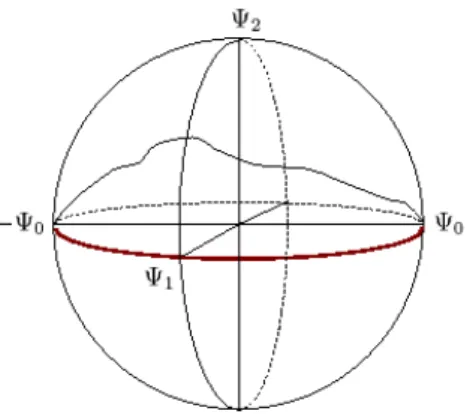
forment un syst`eme de K ´equations aux d´eriv´ees partielles elliptiques non lin´eaires coupl´ees. Nous avons ´egalement reli´e les points critiques construits avec les valeurs propres et les fonctions propres de l’op´erateur H. Dans [3], nous proposons une nouvelle m´ethode num´erique pour le premier ´etat excit´e des ´electrons (la seconde valeur propre de H), bas´ee sur la formulation variationnelle de [2]. On doit essentiellement calculer un point critique de type col ; des tests sont pr´esent´es pour des mol´ecules comprenant deux ´electrons.
Dans [5], nous avons ´etudi´e un autre mod`ele permettant le calcul approch´e de la premi`ere fonction propre de H, bas´e sur les matrices de densit´e d’ordre deux. Essentiellement, le probl`eme de minimisation de Ψ7→ hΨ, HΨi sur L2((R3)N, C) est remplac´e par un probl`eme de minimisation
sur un sous-ensemble convexe du plus petit espace L2((R3)4, C). Comme l’ensemble convexe en
question est tr`es difficile `a caract´eriser, il est approch´e par un convexe plus simple. Plusieurs r´esultats num´eriques sont pr´esent´es.
Enfin, la derni`ere partie du chapitre contient un r´esum´e des travaux de [6, 7], dans lesquels est ´etudi´e un mod`ele tr`es simple pour la description des r´eactions chimiques (celui utilis´e par les chimistes pour d´ecrire des r´eactions adiabatiques). Il consiste `a faire varier les positions des noyaux en supposant que les ´electrons restent toujours dans leur ´etat fondamental (la premi`ere fonction propre de H). Une r´eaction est alors mod´elis´ee par un probl`eme variationnel de type “lemme du col” pour la premi`ere valeur propre λ0de H (qui d´epend des positions des noyaux). Si ce probl`eme
Publications du chapitre 1 11
est pos´e en dimension finie, montrer l’existence du point col est bien sˆur un probl`eme complexe, car il demande de connaˆıtre les propri´et´es pr´ecises de λ0(·) ‘`a l’infini’, qui sont elles-mˆemes reli´ees
`a celles de l’op´erateur H. Publications du chapitre 1
[1] ∗M. Lewin, The multiconfiguration methods in quantum chemistry : Palais-Smale condition
and existence of minimizers, C. R. Math. Acad. Sci. Paris, 334 (2002), pp. 299–304.
[2] ∗M. Lewin, Solutions of the multiconfiguration equations in quantum chemistry, Arch. Ration.
Mech. Anal., 171 (2004), pp. 83–114.
[3] ∗E. Canc`´ es, H. Galicher, and M. Lewin, Computing electronic structures : a new
mul-ticonfiguration approach for excited states, J. Comput. Phys., 212 (2006), pp. 73–98.
[4] M. Lewin, On the computation of excited states with MCSCF methods, J. Math. Chem., 44 (2008), pp. 967–980. Conference “Mathematical Methods for Ab Initio Quantum Chemistry”, Nice, Nov. 2005.
[5] E. Canc`´ es, M. Lewin, and G. Stoltz, The electronic ground-state energy problem : a new
reduced density matrix approach., J. Chem. Phys., 125 (2006), p. 64101.
[6] ∗M. Lewin, A mountain pass for reacting molecules, Ann. Henri Poincar´e, 5 (2004), pp. 477–
521.
[7] M. Lewin, Solution of a mountain pass problem for the isomerization of a molecule with one
free atom, Ann. Henri Poincar´e, 7 (2006), pp. 365–379.
[8] J. Dolbeault, P. Felmer, and M. Lewin, Stability of the Hartree-Fock model with
tem-perature, Math. Models Methods Appl. Sci., 19 (2009), pp. 347–367.
Chapitre 2. Le mod`
ele Hartree-Fock-Bogoliubov pour les ´
etoiles `
a neutrons et
les naines blanches
Le chapitre 1 est consacr´e `a l’´etude des ´electrons au sein d’une mol´ecule, c’est `a dire de particules quantiques se repoussant (ils sont de mˆeme charge) et soumises `a un champ ext´erieur attractif (celui cr´e´e par les noyaux). Dans le chapitre 2, nous ´etudions un mod`ele non lin´eaire c´el`ebre pour des particules qui s’attirent et ne sont soumises `a aucun champ ext´erieur. La combinaison entre le caract`ere attractif de l’interaction et des effets non lin´eaires permet alors l’existence d’´etats li´es, mˆeme si le syst`eme est bien sˆur globalement invariant par translation.
Le mod`ele Hartree-Fock-Bogoliubov (HFB) ´etudi´e dans ce chapitre permet de d´ecrire certaines des propri´et´es physiques importantes des syst`emes quantiques attractifs. Il s’agit d’une fonction-nelle non lin´eaire dont les variables sont deux op´erateurs γ et α, agissant sur L2(R3, C2), et reli´es
par la contrainte : 0≤ µ γ α α∗ 1− γ ¶ ≤ 1.
Les op´erateurs γ et α sont respectivement appel´es matrice densit´e d’ordre 1 et matrice
d’apparie-ment. L’op´erateur α d´ecrit le comportement des paires de Cooper, responsables de la
supraconduc-tivit´e ou de la superfluidit´e de certains syst`emes.
Dans [9], nous avons ´etudi´e le mod`ele HFB pour un syst`eme pseudo-relativiste soumis unique-ment aux forces gravitationnelles, comme on peut en trouver dans les ´etoiles `a neutrons ou les naines blanches. L’´energie cin´etique est maintenant mod´elis´ee par l’op´erateur pseudo-diff´erentiel
T =pm2− ∆ − m
*Les publications dont une version (´eventuellement pr´eliminaire) ´etait d´ej`a contenue dans ma th`ese sont indiqu´ees avec une ´etoile.
et le potentiel d’attraction est purement gravitationnel. Nous avons d´emontr´e l’existence d’un minimum pour la fonctionnelle HFB d`es que cette derni`ere est born´ee inf´erieurement (cela d´epend du nombre total de particules) et donn´e certaines propri´et´es des minima. Plusieurs difficult´es rendent ce probl`eme complexe. Tout d’abord l’´energie est invariante par translation et elle n’est pas semi-continue inf´erieure pour la topologie faible. Nous avons donc utilis´e des techniques de type “concentration-compacit´e” de P.-L. Lions. Cependant, le fait que l’´energie cin´etique est non locale et la difficult´e suppl´ementaire que les variables sont des op´erateurs (´eventuellement de rang infini) ont constitu´e des obstacles importants. Enfin, la pr´esence de l’op´erateur α constitue une complication notable : le terme d’appariement dans l’´energie est “critique” au sens o`u il ne peut ˆetre contrˆol´e que par l’´energie cin´etique.
Dans une seconde partie, nous ´enon¸cons un r´esultat de [10] : nous consid´erons l’´equation d´ependant du temps associ´ee au mod`ele HFB et nous montrons que si la masse initiale du syst`eme est trop grande, le syst`eme gravitationnel s’effondre en temps fini, c’est-`a-dire la solution tempo-relle explose en norme. Ceci correspond au comportement que l’on observe pour certaines ´etoiles trop massives.
Publications du chapitre 2
[9] E. Lenzmann and M. Lewin, Minimizers for the Hartree-Fock-Bogoliubov theory of neutron
stars and white dwarfs. arXiv:0809.2560, 2008.
[10] C. Hainzl, E. Lenzmann, M. Lewin, and B. Schlein. In preparation, 2009.
Chapitre 3. La limite thermodynamique des syst`
emes quantiques Coulombiens
Dans les deux chapitres pr´ec´edents, nous avons ´etudi´e divers syst`emes finis. Le chapitre 3 est le premier de ce m´emoire qui est consacr´e `a l’´etude de syst`emes quantiques infinis.
Un probl`eme naturel est de passer `a la limite macroscopique, c’est-`a-dire de faire tendre le nombre de particules vers l’infini dans un mod`ele fini. Cette question est difficile, en particulier lorsque les particules interagissent avec le potentiel de Coulomb, qui est `a longue port´ee (il n’est pas int´egrable). C’est principalement grˆace `a un ph´enom`ene d’´ecrantage (la mati`ere s’organise spontan´ement de fa¸con `a ˆetre neutre localement) que la mati`ere usuelle peut exister `a l’´echelle ma-croscopique. Quantifier et utiliser cet ´ecrantage pour d´emontrer la stabilit´e de syst`emes quantiques infinis est complexe.
Si on note E(N ) l’´energie fondamentale d’un syst`eme comprenant N particules (`a d´efinir, bien sˆur – voir les d´etails au chapitre 3), on doit montrer que E(N ) ∼N→∞ eN pour une certaine¯
constate ¯e. En effet imaginons un instant que E(N ) ∼N→∞ ¯eNa pour un certain a6= 1. Si on
essaie alors de r´eunir deux syst`emes macroscopiques identiques (deux verres d’eau par exemple), l’´energie `a fournir au syst`eme sera de l’ordre de E(2N )− 2E(N) ∼ (2a
− 2)¯eNa. Comme N est
tr`es grand (typiquement N ∼ 1023), selon le signe de ¯e et la position de a par rapport `a 1, il
faudra soit fournir une ´energie colossale pour r´eunir les deux syst`emes (le syst`eme serait alors tr`es instable), soit au contraire une ´energie gigantesque serait lib´er´ee et la r´eunion de nos deux verres d’eau formerait une sorte de bombe. Comme aucune de ces deux possibilit´es n’est physiquement raisonnable, on doit donc avoir E(N )∼ ¯eN.
La d´emonstration de la convergence de l’´energie par particule E(N )/N quand N tend vers l’infini ainsi que l’identification de la limite constituent un probl`eme crucial pour une meilleure compr´ehension des syst`emes quantiques infinis. Celui-ci a ´et´e abondamment ´etudi´e depuis la fin des ann´ees 60. Dans deux articles [11, 12] r´esum´es dans [13], nous proposons une nouvelle m´ethode pour prouver l’existence de la limite de l’´energie par particule, bas´ee sur une in´egalit´e ´electrostatique due `a Graf et Schenker et qui sert `a quantifier le ph´enom`ene d’´ecrantage. Cette m´ethode permet de retrouver des r´esultats pr´ec´edents de Lieb et Lebowitz, ou de Fefferman de fa¸con unifi´ee, et ´egalement de traiter de nouveaux syst`emes, comme cela est expliqu´e en d´etails au chapitre 3.
Publications du chapitre 3 13
Il est en pratique tr`es difficile d’identifier pr´ecis´ement la limite ¯e de l’´energie par unit´e de volume ou de montrer la convergence des ´etats, sauf pour certains syst`emes plus simples. Dans les chapitres 4 et 5, nous ´etudions deux syst`emes avec un mod`ele de type Hartree-Fock, pour lesquels ce programme peut ˆetre men´e `a bien.
Publications du chapitre 3
[11] C. Hainzl, M. Lewin, and J. P. Solovej, The thermodynamic limit of quantum Coulomb
systems. Part I. General theory, Advances in Math., 221 (2009), pp. 454–487.
[12] C. Hainzl, M. Lewin, and J. P. Solovej, The thermodynamic limit of quantum Coulomb
systems. Part II. Applications, Advances in Math., 221 (2009), pp. 488–546.
[13] C. Hainzl, M. Lewin, and J. P. Solovej, The thermodynamic limit of quantum Coulomb
systems : A new approach, in Mathematical results in Quantum Mechanics : Proceedings of
the QMath10 Conference, I. Beltita, G. Nenciu, and R. Purice, eds., World Scientific, 2008.
Chapitre 4. L’approximation de Hartree-Fock en ´
Electrodynamique Quantique
sans photon
Le chapitre 4 est probablement le plus long de ce m´emoire. Il est consacr´e `a la construction et l’´etude d´etaill´ee d’un nouveau mod`ele permettant la description de syst`emes relativistes, d´eduit de l’´electrodynamique quantique (une th´eorie qui a, en grande partie, encore r´esist´e `a toute formali-sation math´ematique non perturbative rigoureuse).
Pour les atomes lourds, il est n´ecessaire de prendre en compte les effets relativistes, au moins pour les ´electrons “de coeur” (les plus proches des noyaux). En principe, il suffirait de remplacer l’op´erateur−∆ par l’op´erateur de Dirac D0 (un op´erateur diff´erentiel d’ordre un). Or,
contraire-ment `a l’op´erateur−∆, le spectre de l’op´erateur de Dirac n’est pas born´e inf´erieurement : σ(D0) = (
−∞, −mc2]
∪ [mc2,
∞).
Ceci change radicalement le comportement physique et les propri´et´es math´ematiques du syst`eme. Par exemple, en th´eorie des champs relativiste, le vide n’est plus inerte mais il peut se polariser en pr´esence d’un champ ext´erieur, cette polarisation est elle mˆeme vue par les particules et m`ene `a l’´etude d’un syst`eme coupl´e. Si le champ ext´erieur est tr`es fort, le vide peut mˆeme r´eagir in-tens´ement au point de cr´eer spontan´ement, `a partir de l’´energie fournie, une paire ´electron-positron. Au chapitre 4, nous ´etudions l’approximation de Hartree-Fock de l’´electrodynamique quantique en n´egligeant les photons. Le mod`ele que nous avons obtenu d´ecrit le comportement du vide et ses interactions avec les particules “r´eelles”. Le syst`eme physique est toujours compos´e d’une infinit´e de particules quantiques : la plupart d’entre elles forment la mer de Dirac mod´elisant le vide alors que seulement un nombre fini d’entre elles sont des particules physiques r´eelles, comme des ´electrons ou des positrons.
La premi`ere ´etape est de d´eterminer l’´etat du vide libre, c’est-`a-dire en l’absence de tout champ ext´erieur (mais en tenant compte des interactions entre les particules de la mer de Dirac). Pour cela nous avons eu recours dans [18] `a une limite thermodynamique comme expliqu´e plus haut dans notre r´esum´e du chapitre 3 : on commence par poser le mod`ele sur une boˆıte de taille L, avec des conditions au bord p´eriodiques, puis on identifie la limite de l’´energie par unit´e de volume E0(L)L−3. On trouve alors que l’´etat du syst`eme converge vers un ´etat Hartree-Fock comprenant
une infinit´e de particules. Sa matrice densit´e est un projecteur orthogonal P0
− de rang infini,
invariant par translation. Mˆeme si le vide libre comprend une infinit´e d’´electrons virtuels, sa charge est toujours suppos´ee non observable. Dans les cas les plus simples, le syst`eme est simplement repr´esent´e par le projecteur spectral n´egatif χ(−∞,0](D0). Ici l’op´erateur P−0, tenant compte des
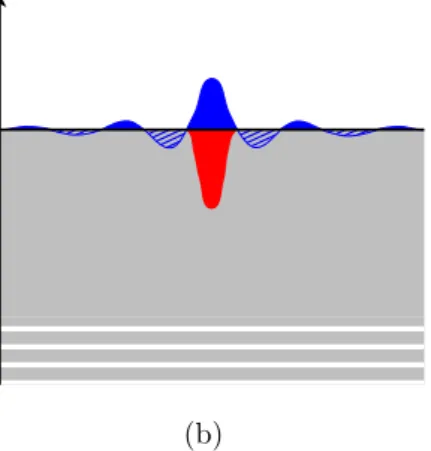
Ensuite, en pr´esence d’un champ ext´erieur V (par exemple cr´e´e par une distribution de charge positive), l’id´ee est de d´ecrire les modifications du syst`eme par rapport au syst`eme de r´ef´erence, le vide libre construit pr´ec´edemment (voir la figure 1). Nous avons montr´e dans [18] que lorsque L→ ∞, l’´energie fondamentale du syst`eme en pr´esence du champ V se comporte comme suit :
EV(L)− E0(L)→ c.
La constante c peut ˆetre identifi´ee comme l’infimum d’une fonctionnelle non lin´eaire Q7→ EV(Q)
ressemblant `a la fonctionnelle Hartree-Fock et dont la variable Q est un op´erateur (a priori de rang infini) satisfaisant la contrainte −P0
− ≤ Q ≤ 1 − P−0. L’op´erateur Q d´ecrit les modifications
du syst`eme en pr´esence de V et on doit avoir Q = 0 en l’absence de tout champ (V = 0). De mˆeme, la diff´erence entre l’´etat fondamental dans la boˆıte de taille L et l’´etat non perturb´e converge `a la limite vers un minimum Q de la fonctionnelleEV.
L’existence de minima pour EV et leur propri´et´es ont ´et´e ´etudi´ees dans [14, 15, 16, 21]. Tout
minimiseur est solution d’une ´equation d’Euler-Lagrange non lin´eaire sous la forme
Q = χ(−∞,µ)(D0+ V + XQ)− P−0 (2)
o`u XQest un op´erateur d´ependant de Q. L’´equation (2) peut s’interpr´eter comme un syst`eme infini
d’´equations aux d´eriv´ees partielles non lin´eaires coupl´ees. Les principales difficult´es pour d´emontrer l’existence de minima sont : (i) le mod`ele est pos´e dans tout l’espace et une perte de compacit´e `a l’infini est possible ; (ii) la variable Q est un op´erateur de rang infini soumis `a la contrainte −P0
− ≤ Q ≤ 1 − P−0; (iii) on s’attend `a ce que les minima soient singuliers. En fait, nous avons
montr´e dans [21] que les minima (d’une fonctionnelle simplifi´ee) ne sont jamais `a trace, ce qui est reli´e au concept de renormalisation de charge. Ceci est expliqu´e en d´etails au chapitre 4.
L’´equation d´ependante du temps et le mod`ele `a temp´erature positive sont respectivement ´etudi´es dans [17] et dans [20]. Le chapitre 4 est une version am´elior´ee de [19] et de la derni`ere partie de [22].
(a) (b)
Fig.1 – (a) Dans l’approximation de Hartree-Fock de l’´electrodynamique quantique sans photon, le
vide est un milieu de charge “infinie mais constante”. (b) Lorsqu’un potentiel ext´erieur est appliqu´e au vide (par exemple si on introduit un noyau charg´e, de densit´e de charge repr´esent´ee en rouge), ce dernier se polarise. Dans le mod`ele du chapitre 4, seulement la modification du vide (en bleue) par rapport au vide libre, d´ecrite par l’op´erateur Q, est mod´elis´ee.
Publications du chapitre 4
[14] ∗C. Hainzl, M. Lewin, and ´E. S´er´e, Existence of a stable polarized vacuum in the
Publications du chapitre 4 15
[15] ∗C. Hainzl, M. Lewin, and ´E. S´er´e, Self-consistent solution for the polarized vacuum in
a no-photon QED model, J. Phys. A, 38 (2005), pp. 4483–4499.
[16] C. Hainzl, M. Lewin, and ´E. S´er´e, Existence of atoms and molecules in the
mean-field approximation of no-photon quantum electrodynamics, Arch. Rational Mech. Anal., 192
(2009), pp. 453–499.
[17] C. Hainzl, M. Lewin, and C. Sparber, Existence of global-in-time solutions to a
gene-ralized Dirac-Fock type evolution equation, Lett. Math. Phys., 72 (2005), pp. 99–113.
[18] C. Hainzl, M. Lewin, and J. P. Solovej, The mean-field approximation in quantum
electrodynamics : the no-photon case, Comm. Pure Appl. Math., 60 (2007), pp. 546–596.
[19] C. Hainzl, M. Lewin, ´E. S´er´e, and J. P. Solovej, A minimization method for relativistic
electrons in a mean-field approximation of quantum electrodynamics, Phys. Rev. A, 76 (2007),
p. 052104.
[20] C. Hainzl, M. Lewin, and R. Seiringer, A nonlinear model for relativistic electrons at
positive temperature, Rev. Math. Phys., 20 (2008), pp. 1283 –1307.
[21] P. Gravejat, M. Lewin, and ´E. S´er´e, Ground state and charge renormalization in a
nonlinear model of relativistic atoms, Commun. Math. Phys., 286 (2009), pp. 179–215.
[22] M. J. Esteban, M. Lewin, and ´E. S´er´e, Variational methods in relativistic quantum
mechanics, Bull. Amer. Math. Soc. (N.S.), 45 (2008), pp. 535–593.
Chapitre 5. L’approximation de Hartree-Fock pour un cristal non relativiste
Nous pr´esentons au chapitre 5 un mod`ele inspir´e de celui pr´esent´e au chapitre 4, mais cette fois pour la description des cristaux (non relativistes) avec et sans d´efauts.
Tout comme le vide de Dirac, un cristal quantique est compos´e d’une infinit´e d’´electrons formant la mer de Fermi. Celle-ci peut aussi se polariser en pr´esence d’un d´efaut dans le cristal.
Comme pr´ec´edemment, la premi`ere ´etape est de d´ecrire le cristal parfait p´eriodique. En utilisant une nouvelle fois un proc´ed´e de limite thermodynamique, on peut construire un mod`ele de type Hartree-Fock (r´eduit) permettant de d´ecrire le syst`eme p´eriodique. L’´etude des propri´et´es des minima p´eriodiques a ´et´e r´ealis´ee dans [25, 24], g´en´eralisant des r´esultats de Catto, Le Bris et Lions.
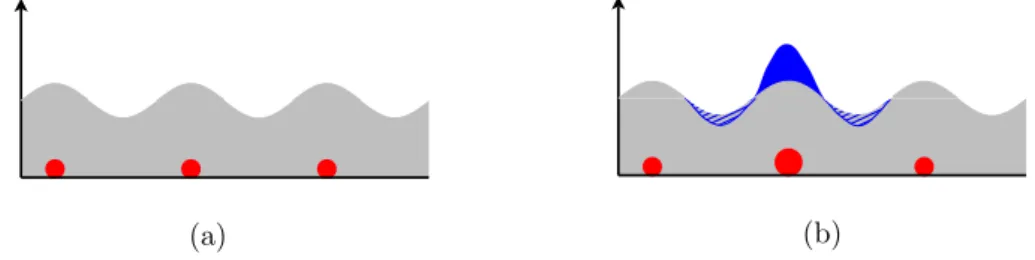
Ensuite, la seconde ´etape est l’´etude du cristal perturb´e, par exemple en pr´esence d’un d´efaut charg´e. Dans [23] nous avons construit et ´etudi´e un mod`ele dans lequel l’´etat du syst`eme est d´ecrit par rapport `a l’´etat “non perturb´e” (p´eriodique), voir la figure 2.
Plusieurs des difficult´es rencontr´ees au chapitre 4 pour la description des syst`emes relativistes se retrouvent dans l’´etude des cristaux non relativistes, avec toutefois des diff´erences notables. En particulier, le Hamiltonien de Schr¨odinger p´eriodique est cette fois born´e inf´erieurement (contraire-ment `a l’op´erateur de Dirac qui a un spectre sym´etrique par rapport `a z´ero). Cependant la mer de Fermi poss`ede moins de sym´etries que la mer de Dirac (qui est invariante par translations) et ceci a des cons´equences importantes sur les propri´et´es des minima, comme prouv´e dans [26] et d´etaill´e au chapitre 5.
La derni`ere partie du chapitre est consacr´ee `a la pr´esentation d’une nouvelle m´ethode num´erique [25] bas´ee sur le mod`ele variationnel introduit dans [23]. Cette m´ethode est fondamentalement diff´erente de celle commun´ement utilis´ee par les chimistes et les physiciens, qui consiste essentiel-lement `a p´eriodiser arbitrairement le syst`eme en choisissant une grande boˆıte bien plus grande que la taille du d´efaut. Notre m´ethode, bas´ee plutˆot sur une description du mod`ele en utilisant deux ´echelles (celle d´ecrivant le r´eseau p´eriodique et celle d´ecrivant les ´electrons localis´es autour du d´efaut), semble plus robuste et plus efficace, d’apr`es les premiers tests qui ont ´et´e effecut´es.
(a) (b)
Fig.2 – (a) Les ´electrons du cristal parfait forment la “mer de Fermi” p´eriodique. (b) En pr´esence
d’un d´efaut (un noyau du cristal plus charg´e que les autres par exemple), la mer de Fermi se pola-rise. Dans le mod`ele de [23] et comme pour le mod`ele relativiste du chapitre 4, seule la modification par rapport au cristal parfait est mod´elis´ee.
Publications du chapitre 5
[23] ´E. Canc`es, A. Deleurence, and M. Lewin, A new approach to the modelling of local
defects in crystals : the reduced Hartree-Fock case, Commun. Math. Phys., 281 (2008), pp. 129–
177.
[24] M. Ghimenti and M. Lewin, Properties of periodic Hartree-Fock minimizers, Calc. Var. Partial Differential Equations, 35 (2009), pp. 39–56.
[25] ´E. Canc`es, A. Deleurence, and M. Lewin, Non-perturbative embedding of local defects
in crystalline materials, J. Phys. : Condens. Matter, 20 (2008), p. 294213.
[26] ´E. Canc`es and M. Lewin, The dielectric permittivity of crystals in the reduced Hartree-Fock
approximation. arXiv :0903.1944, 2009.
Chapitre 6. Pollution spectrale et comment l’´
eviter
Dans le dernier chapitre, nous ´etudions un ph´enom`ene bien connu, sous une perspective nou-velle. Lorsque l’on cherche `a calculer le spectre d’un op´erateur auto-adjoint A, on a souvent recours `a une approximation de type Galerkin : on se fixe un espace de dimension finie et on diagonalise la matrice de la forme quadratique associ´ee `a A dans cet espace. On esp`ere ensuite que, lorsque la taille de la base augmente, le spectre converge vers celui de A. Malheureusement, on peut voir assez facilement (un exemple tr`es simple est donn´e dans l’introduction du chapitre 6) qu’une telle m´ethode peut fournir, `a la limite, des valeurs propres sp´ecieuses, ne faisant pas partie du spectre de A. Ceci ne peut se produire que dans des trous spectraux, au milieu du spectre essentiel. On parle alors de pollution spectrale. Un tel ph´enom`ene est tr`es fr´equemment observ´e lors de calculs sur des op´erateurs de Schr¨odinger p´eriodiques ou des op´erateurs de type Dirac, comme ceux rencontr´es aux chapitres 4 et 5. Dans ces deux cas, on doit toujours calculer des valeurs propres dans un trou spectral, au milieu du spectre essentiel.
En pratique, on peut soit chercher des crit`eres permettant de savoir si une valeur propre calcul´ee est r´eelle ou sp´ecieuse, soit au contraire chercher des contraintes sur les espaces vectoriels utilis´es pour r´ealiser le calcul, afin d’´eviter compl`etement le probl`eme de pollution (au moins dans un intervalle donn´e du spectre). En m´ecanique quantique relativiste, c’est la seconde solution qui est le plus souvent choisie : les physiciens et chimistes ont introduit divers m´ethodes dans le but d’´eviter le probl`eme de pollution spectrale.
Dans [27], nous ´etudions le ph´enom`ene de pollution spectrale en ajoutant certaines contraintes sur les bases de Galerkin. Nous avons ainsi pu justifier que la m´ethode num´erique propos´ee dans [25] (pour le calcul des valeurs propres des op´erateurs de Schr¨odinger p´eriodiques avec des bases de Wannier) est exempte de toute pollution. Nous avons ´egalement ´etudi´e quelques unes des m´ethodes utilis´ees en physique et chimie pour les calculs relativistes et d´etermin´e dans quels cas elles sont efficaces et dans quelle situation elles sont th´eoriquement d’aucun secours.
Publications du chapitre 6 17
Publications du chapitre 6
[27] M. Lewin and ´E. S´er´e, Spectral pollution and how to avoid it (with applications to Dirac
and periodic Schr¨odinger operators). arXiV:0812.2153, 2008.
Appendice A. Matrice de densit´
e pour les ´
etats de Bogoliubov de charge finie
La derni`ere partie du m´emoire est un appendice dans lequel nous pr´esentons certains r´esultats abstraits issus de [14, 16] et qui sont constamment utilis´es dans les chapitres 2, 4 et 5. Elle fait le lien entre certaines propri´et´es des matrices densit´es et le formalisme usuel pour les ´etats de Bogoliubov (ou quasi-libres) en terme d’op´erateurs de cr´eation et d’annihilation dans un espace de Fock.
Remerciements
J’adresse de vifs remerciements `a tous les membres du jury pour leur pr´esence et leur int´erˆet, en particulier `a ceux qui ont accept´e d’assumer la charge de rapporteur.
Je tiens aussi `a remercier profond´ement tous mes collaborateurs et amis, avec qui j’ai tant plaisir `a travailler et interagir, notamment ´Eric S´er´e et Jan Philip Solovej avec qui j’apprends toujours autant.
Merci ´egalement `a mes coll`egues et amis de l’universit´e de Cergy-Pontoise, de l’universit´e Paris-Dauphine et de l’´Ecole Nationale des Ponts et Chauss´ees, pour les nombreuses discussions scienti-fiques ou amicales que nous avons pu avoir.
Introduction
In this thesis, we study, from a mathematical point of view, several quantum systems which are used to describe matter at the microscopic scale, and its behavior when passing to the macroscopic scale.
We will mainly consider fermionic systems interacting through classical electromagnetic forces (as the electromagnetic field is not quantized, there will not be any photon). In some cases we will treat them non-relativistically (Chapter 1, 3 and 5) and in some other cases, we will (maybe partially) take relativistic effects into account (Chapter 2 and 4). We will also study one system only submitted to the gravitational force. All the models that we consider arise from Atomic or Stellar Physics, from Quantum Field Theory, or from Quantum Chemistry. In most cases, our systems will consist of infinitely many quantum particles.
The mathematical methods will be that of nonlinear analysis, calculus of variations, partial differential equations, spectral theory, and numerical analysis.
A large part or our work is focused on the study of stationary states by means of variational methods. The goal will often be to prove the existence of a minimum (or of critical points) for a certain nonlinear energy functional, and to derive some of the properties of minimizers which are the most interesting from a physical point of view. All the problems tackled in this thesis are locally compact (the kinetic energy must stay bounded) but a lack of compactness is always possible at infinity (when the model is posed on the whole space R3). In many cases, the main variable of
our energy will be a self-adjoint operator, possibly of infinite rank. This will always be the case when infinitely many particles have to be described. Some properties of the minimizers can then be rather delicate and lead to subtle physical phenomena (for instance charge renormalization in Chapter 4 and dielectric properties of a crystal in Chapter 5).
We will also be often interested in the study of the limit of certain systems when the number of particles goes to infinity (thermodynamic limit). In this case we will want to prove the convergence of the energy per particle (or the energy per unit volume) and, possibly, the convergence of states. We will always use this technique to derive suitable models for infinite systems.
Time-dependent equations will also be considered. For the Schr¨odinger equation corresponding to our energy, we will prove the existence of solutions, the (orbital) stability of stationary states and, possibly, the blow-up in finite-time when it occurs.
Lastly, a large part of our work is devoted to the numerical analysis of our models, and the design of robust algorithms. For the physical systems we are interested in, the computational cost is almost always unreasonably large. It is then very important to use some rigorous insight in order to gain in efficiency.
The thesis is organized as follows. Each chapter contains a rather detailed review of a set of results, on a precise subject. The chapters are almost independent and can be read separately. For each chapter, we will now give a very short summary together with a list of the corresponding publications.
Chapter 1. Nonrelativistic Atoms and Molecules
In the first chapter we study the Schr¨odinger equation and some of its nonlinear approximations, for the description of atoms and molecules. In a molecule (or an atom), a system of N electrons is described by an N -body Schr¨odinger operator which has the following form
H =−∆ + W (x).
It is defined on L2((R3)N, C) (indeed on the subspace consisting of antisymmetric wavefunctions).
The function W contains both the electrostatic interaction between the electrons and the nuclei, and the self-repulsion between the electrons. The nuclei are usually described as fixed (classical) pointwise particles, hence W depends on their location in R3. The Laplacian models the sum of
the kinetic energy of the electrons. We are interested in the eigenvalues and eigenfunctions of H, solving the time-independent Schr¨odinger equation
HΨ = EΨ. (3)
Many mathematical properties of H are known, but this is of little practical interest: the dimension of the space L2((R3)N, C) on which H is defined is so large that it is simply impossible to directly
solve numerically Equation (3) when N & 6− 7. For this reason, Physicists and Chemists use many approximate models; they are almost all nonlinear.
The first model that we studied in [1, 2, 3, 4] is called multiconfiguration. It consists in restricting the quadratic form associated with H, Ψ7→ hΨ, HΨi, to a smaller set of wavefunctions in the sphere of L2((R3)N, C), taking the form
Ψ = X
1≤i1,···iN≤K
ci1,...,iNϕi1⊗ · · · ⊗ ϕiN.
In this formula, {ϕi}Ki=1 is an unknown orthonormal system of L2(R3, C) and the{ci1,...,iN} are complex numbers (antisymmetric with respect to exchanges of the indices ik). When K = N ,
one recovers the celebrated Hartree-Fock model. Its main properties are recalled in Chapter 1; the associated time-dependent equation was studied in [8]. When K = ∞, one gets the usual Schr¨odinger model settled on the whole space L2((R3)N, C). In [1, 2] we have studied the existence
of a minimum and we have constructed specific critical points (for N ≤ K < ∞) which we have then related to the eigenvalues of H in the limit K→ ∞. The energy for K < ∞ is non-quadratic in terms of the ϕi’s, and the Euler-Lagrange equations form a system of K coupled nonlinear elliptic
PDEs. Finally, in [3] we have proposed a new numerical method for calculating an approximation of the first excited state of H, based on the variational formalism of [2]. Essentially, one has to solve a mountain pass problem. Numerical tests for two-electrons systems are provided.
In [5], we have studied another model allowing to compute an approximation of the first eigen-value of H, based on the formalism of two-body density matrices. Loosely speaking, the mini-mization of the quadratic form Ψ7→ hΨ, HΨi on the space L2((R3)N, C) is replaced by a convex
minimization problem of an N -dependent linear functional, on a very complicated convex subset of the smaller space L2((R3)4, C). The latter convex set being very difficult to characterize, it is
approximated by a simpler convex set. Several numerical results are provided.
Finally, the last part of Chapter 1 contains a summary of [6, 7], where we have studied a very simple model for chemical reactions (the one which is used by chemists to describe adiabatic reactions). The idea is to vary the position of the nuclei, assuming that the electrons always stay in their ground state (the first eigenfunction of H). A reaction then yields to a mountain pass problem on the first eigenvalue λ0 of H. Even if the problem is posed in finite dimension (the
locations of the nuclei are in R3), showing the existence of a mountain pass requires to have some
information on the ‘behavior at infinity’ of λ0, which is of course related to that of H.
*The papers which were already part of my PhD Thesis (possibly in a preliminary version) are indicated with a star.
References for Chapter 1 21
References for Chapter 1
[1] ∗M. Lewin, The multiconfiguration methods in quantum chemistry: Palais-Smale condition
and existence of minimizers, C. R. Math. Acad. Sci. Paris, 334 (2002), pp. 299–304.
[2] ∗M. Lewin, Solutions of the multiconfiguration equations in quantum chemistry, Arch. Ration.
Mech. Anal., 171 (2004), pp. 83–114.
[3] ∗E. Canc`´ es, H. Galicher, and M. Lewin, Computing electronic structures: a new
multi-configuration approach for excited states, J. Comput. Phys., 212 (2006), pp. 73–98.
[4] M. Lewin, On the computation of excited states with MCSCF methods, J. Math. Chem., 44 (2008), pp. 967–980. Conference “Mathematical Methods for Ab Initio Quantum Chemistry”, Nice, Nov. 2005.
[5] E. Canc`´ es, M. Lewin, and G. Stoltz, The electronic ground-state energy problem: a new
reduced density matrix approach., J. Chem. Phys., 125 (2006), p. 64101.
[6] ∗M. Lewin, A mountain pass for reacting molecules, Ann. Henri Poincar´e, 5 (2004), pp. 477–
521.
[7] M. Lewin, Solution of a mountain pass problem for the isomerization of a molecule with one
free atom, Ann. Henri Poincar´e, 7 (2006), pp. 365–379.
[8] J. Dolbeault, P. Felmer, and M. Lewin, Stability of the Hartree-Fock model with
tem-perature, Math. Models Methods Appl. Sci., 19 (2009), pp. 347–367.
Chapter 2. The Hartree-Fock-Bogoliubov Theory of Neutron Stars and White
Dwarfs
In Chapter 1 we have studied electrons in a molecule, that is to say fermions with a repulsive force, submitted to an external attractive field created by the nuclei. In Chapter 2, we study a celebrated nonlinear model for systems composed of attractive particles. The attractive feature of the interaction together with some nonlinear effects can then allow the formation of bound states, even in the absence of any external field and although the model is globally invariant by translation.
The Hartree-Fock-Bogoliubov (HFB) model which is studied in this chapter allows to describe some important physical properties of attractive systems. It provides us with a nonlinear functional whose variables are two operators γ and α acting on L2(R3, C2), related by the constraint:
0≤ µ γ α α∗ 1− γ ¶ ≤ 1.
These operators are respectively called the one-body density matrix and the pairing density matrix. The operator α describes the physical effect of Cooper pairing which is believed to be responsible for the superconductivity or superfluidity of certain physical systems.
In [9], we have studied the HFB model for a system of pseudo-relativistic fermions only sub-mitted to gravitational forces, as may be found for instance in neutron stars or white dwarfs. The kinetic energy is now described by the following pseudo-relativistic nonlocal operator
T =pm2− ∆ − m.
We have proved the existence of minimizers for the HFB functional, as soon as it is bounded from below (this depends on the total particle number), and we have derived some important properties
of minimizers. We had to face some complications: first the energy is not weakly lower semi-continuous which has led us to use the concentration-compactness method of P.-L. Lions. The nonlocality of the kinetic energy operator together with the fact that our variable is a pair of two operators (possibly of infinite rank), linked by a constraint, were important obstacles. Lastly, the operator α cannot be treated by obvious means: the pairing term in the energy is “critical” in the sense that it can only be controlled by the kinetic energy.
In a second part, we state a result of [10] dealing with the associated HFB time-dependent equation and which shows the blow-up in finite-time when the initial datum has a large enough mass (the time-dependent solution then blows up in norm). This corresponds to the observed collapse of certain stars which are too massive.
References for Chapter 2
[9] E. Lenzmann and M. Lewin, Minimizers for the Hartree-Fock-Bogoliubov theory of neutron
stars and white dwarfs. arXiv:0809.2560, 2008.
[10] C. Hainzl, E. Lenzmann, M. Lewin, and B. Schlein. In preparation, 2009.
Chapter 3. The Thermodynamic Limit of Coulomb Quantum Systems
In Chapter 1 and 2, we have studied finite systems. Chapter 3 is the first dealing with infinite quantum systems. A natural problem is to study the thermodynamic limit, i.e. the behavior of some (given) system when the number of particles grows. This is a rather involved question, in particular when the particles interact through the Coulomb electrostatic potential which is long
range (it is not integrable at infinity). It is essentially because of screening (matter arranges
itself in a way that it is always locally neutral) that usual matter can exist at the macroscopic scale. Quantifying and using this screening in order to show the stability of infinite systems is a challenging problem.
Let us denote by E(N ) the ground state energy of a certain quantum system (to be defined, see examples in Chapter 3) with N particles. What we have to prove is that E(N )∼N→∞¯eN for
some constant ¯e. Indeed, let us assume for a while that E(N )∼N→∞¯eNa for some a6= 1. Then
|E(2N) − 2E(N)| becomes very large as N ≫ 1 (typically N ∼ 1023). Depending on a and the
sign of the constant ¯e, a very large amount of energy will be either released when two identical systems are put together (like two glasses of water for instance), or necessary to assemble them. As this behavior is not observed in real life, one must have E(N )∼N→∞¯eN .
The proof of the convergence of the energy per particle E(N )/N as N → ∞ as well as the identification of the limit is a crucial problem for a better understanding of infinite quantum systems, which has been largely studied since the sixties. In two papers [11, 12] summarized in [13], we have proposed a new method for proving the existence of the thermodynamic limit for systems interacting through Coulomb forces, based on an inequality due to Graf and Schenker, serving as a tool to quantify screening. This method allowed us to recover in a unified way some celebrated results of Lieb and Lebowitz, and of Fefferman, and also to study some other systems which were not known before. Everything is explained in details in Chapter 3.
In practice it is very hard to identify exactly the limit ¯e of the energy per particle (or per unit volume), or to prove the convergence of states, except for very simple systems. In Chapter 4 and 5 we study two quantum systems for which this program can be solved completely.
References for Chapter 3
[11] C. Hainzl, M. Lewin, and J. P. Solovej, The thermodynamic limit of quantum Coulomb
References for Chapter 3 23
[12] C. Hainzl, M. Lewin, and J. P. Solovej, The thermodynamic limit of quantum Coulomb
systems. Part II. Applications, Advances in Math., 221 (2009), pp. 488–546.
[13] C. Hainzl, M. Lewin, and J. P. Solovej, The thermodynamic limit of quantum Coulomb
systems: A new approach, in Mathematical results in Quantum Mechanics: Proceedings of
the QMath10 Conference, I. Beltita, G. Nenciu, and R. Purice, eds., World Scientific, 2008.
Chapter 4. No-Photon Quantum Electrodynamics in the Hartree-Fock
Approx-imation
In Chapter 4 (probably the longest of this thesis), we derive and study a model allowing to describe relativistic electrons. Our model is deduced from Quantum Electrodynamics (QED), a theory which, despite its incredible predictive power, is not yet really understood from a mathematical point of view.
For heavy atoms, it is necessary to take relativistic effects into account, at least for the core electrons in an atom (those close to the nucleus). In principle, it suffices to replace the nonrela-tivistic kinetic energy operator−∆ by the Dirac operator D0(a differential operator of order one).
Contrarily to the Laplacian, the spectrum of D0 is not bounded from below,
σ(D0) = (−∞, −mc2]∪ [mc2,∞),
a property which has many physical consequences. For instance, in QED the vacuum is never inert but it can react to an external field and become polarized. This polarization is itself seen by the particles, leading to the study of a coupled system. If the field is large enough, the vacuum can even react so strongly that an electron-positron pair can be spontaneously created.
In Chapter 4, we study the Hartree-Fock approximation of QED, neglecting photons. Our model is able to describe the behavior of the vacuum coupled to that of the real particles. The system always contains infinitely many particles: most of them belong to the vacuum (the so-called
Dirac sea), and only finitely many are ‘real’ particles like electrons or positrons.
The first step is to construct the free vacuum, i.e. the Dirac sea in the absence of any external field, taking into account all interactions between particles. For this, we used in [18] a thermo-dynamic limit procedure, as was explained in the previous paragraph devoted to Chapter 3. One starts by defining the model in a box of size L, with periodic boundary conditions, and one studies its limit as L→ ∞. It was found that the free vacuum is a Hartree-Fock state containing infinitely many particles whose one-body density matrix is an orthogonal projector P0
−, of infinite rank,
invariant by translations. Even if the vacuum contains infinitely charged particles, its charge is itself supposed to be physically unobservable. In the simplest case, the vacuum is described by the negative spectral orthogonal projector χ(−∞,0)(D0). In our case, it is a more complicated projector
solution of a nonlinear equation, due to fact that we do not neglect the interactions between the particles.
In the presence of an external field V (for instance induced by the positive distribution of charge of a nucleus), the main idea is then to describe the change of the vacuum measured respectively to the reference system, the free vacuum (see Figure 1). We proved in [18] that when L→ ∞, the ground state energy EV(L) of the system in the box with the external field V behaves as follows
EV(L)
− E0(L)
→ c.
The constant c can be identified as the minimum of some nonlinear functional Q7→ EV(Q) having
the same form as the Hartree-Fock energy. However Q is now a (possibly infinite-rank) operator defined on the whole space and satisfying the constraint−P0
− ≤ Q ≤ 1 − P−0. The model is such
that when V = 0, one has Q = 0. Similarly, the difference between the ground states with and without V converges as L→ ∞ to a minimizer Q of the functional EV.
The existence of a minimum for EV and the properties of minimizers were studied in [14, 15,
16, 21]. Any minimizer is solution to a nonlinear Euler-Lagrange equation taking the form Q = χ(−∞,µ)(D0+ V + XQ)− P−0
where XQ is an operator depending on Q. This equation can be viewed as an infinite system of
coupled nonlinear PDEs.
The main difficulties in proving the existence of minimizers are as follows: (i) the model is posed on the whole space and a lack of compactness at infinity is possible; (ii) the variable Q is an operator of infinite rank submitted to the constraint −P0
−≤ Q ≤ 1 − P−0; (iii) minimizers are
believed to be rather singular. Indeed we have shown for a simplified model in [21] that minimizers are never trace-class. This is itself related to charge renormalization, as we will explain in details in Chapter 4.
The time-dependent equation and the model at positive temperature were respectively studied in [17] and [20]. Chapter 4 is an enhanced version of [19] and of the last part of [22].
(a) (b)
Figure 1: (a) In the Hartree-Fock approximation of no-photon QED, the free vacuum is a
translation-invariant medium with infinite charge. (b) In the presence of an external potential
V , for instance induced by a positive charge distribution as displayed in red, the vacuum becomes
polarized. In our model of Chapter 4, only the modification with respect to the free vacuum (in blue), modelled by the operator Q, is described.
References for Chapter 4
[14] ∗C. Hainzl, M. Lewin, and ´E. S´er´e, Existence of a stable polarized vacuum in the
Bogoliubov-Dirac-Fock approximation, Commun. Math. Phys., 257 (2005), pp. 515–562.
[15] ∗C. Hainzl, M. Lewin, and ´E. S´er´e, Self-consistent solution for the polarized vacuum in
a no-photon QED model, J. Phys. A, 38 (2005), pp. 4483–4499.
[16] C. Hainzl, M. Lewin, and ´E. S´er´e, Existence of atoms and molecules in the
mean-field approximation of no-photon quantum electrodynamics, Arch. Rational Mech. Anal., 192
(2009), pp. 453–499.
[17] C. Hainzl, M. Lewin, and C. Sparber, Existence of global-in-time solutions to a
gener-alized Dirac-Fock type evolution equation, Lett. Math. Phys., 72 (2005), pp. 99–113.
[18] C. Hainzl, M. Lewin, and J. P. Solovej, The mean-field approximation in quantum
References for Chapter 4 25
[19] C. Hainzl, M. Lewin, ´E. S´er´e, and J. P. Solovej, A minimization method for
rela-tivistic electrons in a mean-field approximation of quantum electrodynamics, Phys. Rev. A,
76 (2007), p. 052104.
[20] C. Hainzl, M. Lewin, and R. Seiringer, A nonlinear model for relativistic electrons at
positive temperature, Rev. Math. Phys., 20 (2008), pp. 1283 –1307.
[21] P. Gravejat, M. Lewin, and ´E. S´er´e, Ground state and charge renormalization in a
nonlinear model of relativistic atoms, Commun. Math. Phys., 286 (2009), pp. 179–215.
[22] M. J. Esteban, M. Lewin, and ´E. S´er´e, Variational methods in relativistic quantum
mechanics, Bull. Amer. Math. Soc. (N.S.), 45 (2008), pp. 535–593.
Chapter 5. Nonrelativistic Crystal in the Hartree-Fock Approximation
In Chapter 5, we present a model for nonrelativistic crystals with defects, which was inspired of the relativistic model of Chapter 4. Like for Dirac’s vacuum, a (nonrelativistic) quantum crystal is composed of infinitely many electrons forming the Fermi sea. The latter can also become polarized in the presence of a defect in the crystal.
As before, the first step is to describe the perfect (periodic) crystal. Using again a thermo-dynamic limit procedure, it is possible to derive a (reduced) Hartree-Fock model for the infinite periodic system. The study of the minimizers was tackled in [25, 24], complementing results of Catto, Le Bris and Lions.
The second step is the study of the perturbed crystal, for instance in the presence of a (local-ized) charged defect. In [23] we have constructed a model in which the state is described by its modification with respect to the unperturbed, periodic, Fermi sea (see Figure 2), similarly to the QED case.
Several of the difficulties encountered in Chapter 4 for the description of relativistic systems arise similarly in the study of crystals. There are some important differences. In particular, the periodic Schr¨odinger Hamiltonian is bounded below, contrarily to the Dirac operator. However the crystalline periodic Fermi sea has much less symmetries than the free Dirac sea which is invariant by translations. This has important consequences on the properties of minimizers, as was proved in [26] and will be explained in Chapter 5.
In the last part of Chapter 5, we detail a new numerical method of [25] based on the variational model of [23]. It is very different from the one which is used by Chemists and Physicists which essentially consists in arbitrarily periodizing the system in a box much larger than the size of the defect. Our method, on the contrary, is based on a two-scale description of the crystal (the periodic sea and the localized modifications due to the defect). Our first tests seem to indicate that it is more efficient and robust.
(a) (b)
Figure 2: (a) The electrons of the perfect crystal form the periodic Fermi sea. (b) In the presence
of a defect (for instance induced by a nuclei with a higher charge), the Fermi sea becomes polarized. In our model of Chapter 5 and like in Chapter 4, only the modification with respect to the reference state (the periodic Fermi sea) is described.
References for Chapter 5
[23] ´E. Canc`es, A. Deleurence, and M. Lewin, A new approach to the modelling of local
defects in crystals: the reduced Hartree-Fock case, Commun. Math. Phys., 281 (2008), pp. 129–
177.
[24] M. Ghimenti and M. Lewin, Properties of periodic Hartree-Fock minimizers, Calc. Var. Partial Differential Equations, 35 (2009), pp. 39–56.
[25] ´E. Canc`es, A. Deleurence, and M. Lewin, Non-perturbative embedding of local defects
in crystalline materials, J. Phys.: Condens. Matter, 20 (2008), p. 294213.
[26] ´E. Canc`es and M. Lewin, The dielectric permittivity of crystals in the reduced Hartree-Fock
approximation. arXiv:0903.1944, 2009.
Chapter 6. Spectral Pollution and How To Avoid It
The last chapter is devoted to the study of an important, well-known effect, in a rather new perspective. When trying to compute the spectrum of a self-adjoint operator A, one usually uses a Galerkin-type approximation: a finite-dimensional space is fixed and the matrix of the quadratic form of A in this space is diagonalized. It is hoped that the so-obtained spectrum will converge to the spectrum of A when the size of the basis is enlarged. Unfortunately, it can be seen on very simple examples (see, e.g., the introduction of Chapter 6) that such a method can provide spurious
eigenvalues which have nothing to do with the true spectrum of A. This phenomenon, which can
only happen in gaps of the essential spectrum, is called spectral pollution. It is very often observed when trying to calculate the spectrum of periodic Schr¨odinger operators or of Dirac operators, like those we will meet in Chapters 4 and 5 (in both cases, we are indeed interested in computing eigenvalues in gaps of the essential spectrum).
In practice, one can either try to find a criterion allowing to decide if a computed eigenvalue is real or spurious, or one can look for constraints on the basis which will avoid the phenomenon of pollution, at least in a fixed interval of the spectrum. In relativistic calculations, it is the second option which has been chosen by Chemists and Physicists. They have introduced several methods in order to avoid spectral pollution (like the so-called kinetic balance).
In [27], we have studied from a rather abstract point of view the phenomenon of spectral pollution, when some very natural constraints are added on the Galerkin basis. This allowed us in particular to show that the method of [25], reviewed in Chapter 5 (using Wannier functions for approximating the spectrum of periodic Schr¨odinger operators) does not produce any spuri-ous eigenvalue. We also have studied the methods used in Quantum Chemistry and Physics for relativistic calculations. We have rigorously decided when they are efficient or when they are theoretically of no help.
References for Chapter 6
[27] M. Lewin and ´E. S´er´e, Spectral pollution and how to avoid it (with applications to Dirac
and periodic Schr¨odinger operators). arXiV:0812.2153, 2008.
Appendix A. Density Matrices of Bogoliubov States Having Finite Charge
The last part of the thesis is an appendix in which we present some abstract results of [14, 16],which we constantly use in Chapters 2, 4 and 5. It clarifies the links between some properties of density matrices and the formalism of Bogoliubov (quasi-free) states in Fock space.
References for Chapter 6 27
Acknowledgments
I am grateful to the members of the jury for their presence and their interest, in particular to those who accepted to write a report on the present manuscript.
I also would like to thank all my collaborators and friends with whom working and interacting was so pleasant. In particular, I deeply thank ´Eric S´er´e and Jan Philip Solovej from whom I always learn a lot.
My thanks also go to my colleagues and friends from the University of Cergy-Pontoise, the Uni-versity of Paris-Dauphine and the ´Ecole Nationale des Ponts et Chauss´ees, for numerous scientific or friendly discussions.


![Figure 1.3: Energy along the successive deformed paths generated by the algorithm of [10] for the computation of the first singlet excited state of H 2 , with R = 1 ˚ A.](https://thumb-eu.123doks.com/thumbv2/123doknet/15043297.692267/41.892.223.612.218.503/figure-energy-successive-deformed-generated-algorithm-computation-singlet.webp)
![Figure 1.4: Distance of K N (R, Z ) − µ to the dual cone ( C N app ) ∗ as a function of µ for N 2 in a STO-6G basis set [13]](https://thumb-eu.123doks.com/thumbv2/123doknet/15043297.692267/44.892.302.636.176.442/figure-distance-dual-cone-app-function-sto-basis.webp)
![Figure 1.6: The system composed of two molecules studied in [45, 48].](https://thumb-eu.123doks.com/thumbv2/123doknet/15043297.692267/45.892.256.600.394.529/figure-composed-molecules-studied.webp)