https://doi.org/10.4224/8914119
READ THESE TERMS AND CONDITIONS CAREFULLY BEFORE USING THIS WEBSITE. https://nrc-publications.canada.ca/eng/copyright
Vous avez des questions? Nous pouvons vous aider. Pour communiquer directement avec un auteur, consultez la
première page de la revue dans laquelle son article a été publié afin de trouver ses coordonnées. Si vous n’arrivez pas à les repérer, communiquez avec nous à [email protected].
Questions? Contact the NRC Publications Archive team at
[email protected]. If you wish to email the authors directly, please see the first page of the publication for their contact information.
NRC Publications Archive
Archives des publications du CNRC
For the publisher’s version, please access the DOI link below./ Pour consulter la version de l’éditeur, utilisez le lien DOI ci-dessous.
Access and use of this website and the material on it are subject to the Terms and Conditions set forth at
Recent Research in Secure Software
Yee, George
https://publications-cnrc.canada.ca/fra/droits
L’accès à ce site Web et l’utilisation de son contenu sont assujettis aux conditions présentées dans le site LISEZ CES CONDITIONS ATTENTIVEMENT AVANT D’UTILISER CE SITE WEB.
NRC Publications Record / Notice d'Archives des publications de CNRC:
https://nrc-publications.canada.ca/eng/view/object/?id=f0d7bfe2-02c5-47c6-9d3c-2eb437edf8d4
https://publications-cnrc.canada.ca/fra/voir/objet/?id=f0d7bfe2-02c5-47c6-9d3c-2eb437edf8d4
National Research Council Canada Institute for Information Technology Conseil national de recherches Canada Institut de technologie de l'information
Recent Research in Secure Software *
Yee, G.
March 2006
* published as NRC/ERB-1134. 8 pages. March 2006. NRC 48478.
Copyright 2006 by
National Research Council of Canada
Permission is granted to quote short excerpts and to reproduce figures and tables from this report, provided that the source of such material is fully acknowledged.
National Research Council Canada Institute for Information Technology Conseil national de recherches Canada Institut de technologie de l'information
Re c e nt Re se a rc h in Se c ure
Soft w a re
Yee, G.
March 2006
Copyright 2006 byNational Research Council of Canada
Permission is granted to quote short excerpts and to reproduce figures and tables from this report, provided that the source of such material is fully acknowledged.
ERB-1134
Recent Research in Secure Software
1George Yee
Institute for Information Technology
National Research Council Canada
[email protected]
Abstract
The rapid propagation of software systems into nearly
every aspect of modern life together with the ever growing
number of threats against these systems have given rise to
one of the greatest challenges in information technology
today. This is the challenge of obtaining software systems
that are secure from threats. These threats range from
exploitations of buffer overflows and unprotected critical
memory locations to reverse engineering in order to find
vulnerabilities. Researchers have risen to this challenge
by proposing solutions that touch all aspects of software
development and operation. Yet, an overall view of this
research, showing how seemingly diverse research efforts
fit together, does not appear to exist. Such an organized
view may help the secure software research community
understand where recent research has occurred and
direct new research to interesting and promising areas. In
addition, newcomers to this field will quickly see what
secure software is all about. This paper provides this view
and suggests a way to identify new research topics in
secure software.
1. Introduction
Today, software touches almost every aspect of our
lives. Almost everything that we do depends on software
that runs computers and computer networks. Software
runs computers and networks that control and manage
manufacturing processes, water supplies, electric power
generation and distribution, air traffic control systems,
stock market trading systems, and many other engines of
the modern economy. The Internet has become
indispensable for governments, companies, universities,
and financial institutions. Yet, despite the important roles
that software plays in modern life, it is full of
vulnerabilities that put our collective and individual well
being at risk. A recent report (September 2005) suggests
that computer crimes are skyrocketing [1]. In studies on
trends in Internet threats, prepared for CSI (Computer
Security Institute), IBM, and McAfee, the following
points were made [1]: i) there is increasing risks to
individuals due to the growth of identity theft schemes
and the growing level of financial damage due to theft of
sensitive company data, ii) computer virus attacks
continue to be the leading source of financial loss, but
unauthorized access is a close second, responsible for
almost one quarter of financial losses, iii) threats now
originate from professional criminals exploiting the
Internet, with about 300 malicious threats per month two
years ago to 2000 such threats a month in 2005, iv) types
of cyber crimes include extortion, damage to reputation,
fraud, phishing, service disruption, information theft, and
money laundering, v) there were more than 237 million
security attacks in the first half of 2005, mostly targeted at
the US government, followed by manufacturing, financial
services, and health care, and vi) the incidence of security
threats contained in email rose from one in every 52
messages in December 2004 to one in every 35 in January
2005 to one in every 28 in June 2005. In the face of such
threats, building software systems that are resistant to
these threats is one of the greatest challenges of modern
times.
The above statistics are alarming but the computer
security problem has existed for more than twenty years
as evidenced by the following quote from a 1981 paper:
“Efforts to build “secure” computer systems have now
been underway for more than a decade” [2]. It’s just that
recently the security problems have grown many times
worst. Researchers have risen to the above challenge by
proposing different varied solutions with the purpose of
making software more secure. Solutions range from
integrating security requirements with software functional
requirements, to specific dangers to watch for during
design, to code obfuscation to resist reverse engineering,
to protecting critical memory locations at run time and
many others. However, no overview of recent research in
secure software appears to exist. Such an overview would
provide at least the following benefits: i) help students,
established researchers, and new comers to the secure
software field know what approaches have been taken
(especially useful for new comers from related fields such
as security), ii) help students and researchers see the “big
picture” of where the different approaches fit, and iii)
identify new opportunities for research based on where
the research coverage has been sparse or how the varied
approaches interrelate. The objective of this work is to
provide this overview.
Before proceeding further, it is useful to define the
meaning of “secure software”. The field of secure
software is made up of two subfields: software security
and application security. McGraw [3] defines these terms
nicely: “Software security is about building secure
software. Issues critical to this subfield include software
risk management, programming languages and platforms,
software audits, designs for security, security flaws, and
security tests. Software security is mostly concerned with
designing software to be secure, making sure that software
is secure, and educating software developers, architects,
and users.” “Application security is about protecting
software and the systems that the software runs after
development is complete. Issues critical to this subfield
include sandboxing code, protecting against malicious
code, locking down executables, monitoring programs
(especially their input) as they run, enforcing software use
policy with technology, and dealing with extensible
systems.” This work reviews research in both software
security and application security.
In the literature, there are two works that “summarize”
work in software security. Apart from the fact that they
are not as recent as this work, they also differ from this
work in the following ways. Wang & Wang [26] present a
taxonomy of security considerations as they relate to
software quality. They show how different types of
security risks affect software quality. In addition they
indicate the effectiveness of various security technologies
in dealing with security threats and risks. Wang & Wang
[26] differs from this work in that they do not look at
recent research approaches to securing software nor are
the security technologies they discuss oriented towards
building secure software. Devanbu & Stubblebine [22]
discuss a roadmap for incorporating security into software
engineering. They examine the interplay between software
engineering and security engineering roughly along the
lines of the waterfall model and discuss a number of
security challenges along the way. Devanbu &
Stubblebine [22] differs from this work in that their focus
is to highlight challenges in integrating security into
software engineering rather than examine recent research
approaches for securing software. However, their work is
closer to this work than Wang & Wang [26] in that they
provide references to research that appear promising at
dealing with the challenges.
The rest of this paper is organized as follows. Section
2 surveys recent research in secure software. Section 3
discusses the coverage of research in secure software and
proposes how to find new areas for research. Section 4
gives conclusions.
2.
Recent Research in Secure Software
The research papers examined here were retrieved
from two databases, the ACM Digital Library and IEEE
Xplore using the search expression “secure software” on
September 9, 2005. The number of papers retrieved form
these databases were 200 and 43 respectively. The actual
papers used (numbering 64) were selected from all those
retrieved using the following criteria:
• Must be about research, so education type papers
were excluded,
• Must be about software security or application
security,
• Must be of wide applicability, hence niche papers
(e.g. features of a specific language) were
excluded,
• Must have been published within the last 10 years
(1996-2005) (most papers are within the last 5
years).
As a result, this work has the following limitations: i) the
research coverage is incomplete, and ii) paper selection
for this work is imprecise. Nevertheless, the results of this
work should be a good approximation to the actual
situation.
2.1. Classification Method
The retrieved papers were classified according to their
subjects. Software security and application security papers
were classified separately in two tables. Software security
papers were classified according to “requirements”,
“processes and methods”, “coding methods”,
“vulnerabilities identification”, “usability”, “testing”,
“tools”, and “other”. These categories refer to software or
software development. Application security papers were
classified under: “threat identification”, “protection from
tampering”, “protection from copying”, “other
protection”, “integrity verification”, and “challenges”.
Application security categories refer to the software in
execution. For all category headings, the number next to
each heading is the number of papers under that heading.
2.2. Recent Research in Secure Software
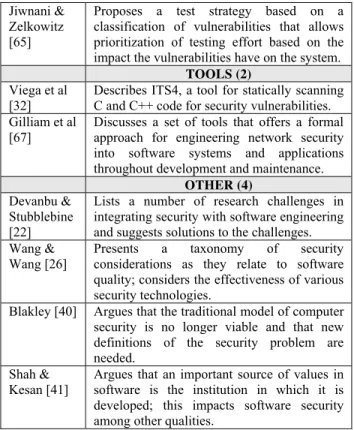
Table 1 shows the papers retrieved for software
security. The paper reference appears in the left column
with a summary of each subject in the right column.
Table 1. Research in software security
REQUIREMENTS (9)
Del Grosso et al [23]
Proposes generating tests for buffer overflows using static analysis, program slicing, and data dependency analysis.
[30] crosscutting concerns can determine and incorporate security requirements with functional requirements.
Koch & Parisi-Presicce [37]
Investigates how access control security requirements may be integrated into the analysis phase of software development using a model-driven approach.
Kienzle & Wulf [42]
Presents a new approach to assess the degree to which software meets its security requirements.
Vetterling et al [44]
Shows how to integrate security aspects into the software development process using the Common Criteria.
Doan et al [51]
Incorporates mandatory access control (MAC) into UML elements to allow UML to express security requirements.
Pauli & Xu [58]
Presents an approach to architectural design and analysis of secure software systems based on system requirements in the form of use cases and misuse cases.
Alghathbar & Wijesekera [60]
On a high-level approach for analyzing information flow requirements and ensuring enforcement of flow control policies; improves security by detecting unsafe flows early in the life cycle.
Hauf et al [61]
Presents an approach to add role based security to CORBA; security settings are expressed using a XML-based description language.
PROCESSES AND METHODS (15)
Davis et al [4]
Discusses and makes recommendations on processes for producing secure software. Yu et al [5] Proposes a formal approach for designing
secure software architectures. Beznosov &
Kruchten [13]
Examines mismatches between security assurance techniques and agile development methods and proposes resolutions.
Kocher et al [14]
Introduces the challenges involved in designing secure embedded systems; surveys solutions to challenges.
Ravi et al [17]
Introduces the challenges involved in designing secure embedded systems, discusses recent advances in solutions, and identifies opportunities for future research. (more detailed version of Kocher et al (2004)).
Zdancewic et al [19]
On secure program partitioning, a language-based approach for protecting confidential data during computation in distributed systems with mutually untrusted hosts.
Jürjens [21] Proposes an approach for developing secure software using an extension of UML called UMLsec.
Devanbu & Stubblebine [22]
Lists a number of research challenges in integrating security with software engineering and suggests solutions to the challenges. Flechais et
al [31]
Presents AEGIS, a secure software engineering method that integrates asset identification, risk and threat analysis, and context of use.
Deubler et al [34]
Proposes an approach for facilitating the development of security-critical service based-software using a tool called AutoFocus, based on the formal method Focus.
Sharma & Trevedi [43]
Proposes an architecture based unified hierarchical model for predicting software reliability, performance, security, and cache behaviour.
Viega et al [57]
Considers and explores trust assumptions during every stage of software development. Yu et al [59] Proposes a formal aspect-oriented approach
to designing secure software architectures. Moriconi et
al [62]
Describes an approach to secure software design in which the software architecture is described formally and desired security properties proven for it.
Harrison & Hook [63]
For constructing secure software, advocates controlling information flow and maintaining integrity using monadic encapsulation of effects.
CODING METHODS (2)
Peine [12] Outline of a tutorial on rules of thumb for coding secure software; the rules are listed. Chinchani et
al [66]
Observes that software vulnerabilities may arise due to the syntax and grammar of a programming language. VULNERABILITIES IDENTIFICATION (5) Tevis & Hamilton [8]
On software vulnerabilities, code vulnerability auditing tools, and functional programming as possibly better at ensuring security.
Kemmerer [11]
Identifies known threats and analyzes protection techniques for countering the threats, also mentions principles for designing secure software.
Hangal & Lam [18]
Describes DIDUCE, a tool for detecting complex program errors and identifying their root causes, using program instrumentation. Viega et al
[32]
Describes ITS4, a tool for statically scanning C and C++ code for security vulnerabilities. Salter et al
[38]
Presents a method for enumerating the vulnerabilities of a system and determining what countermeasures can best close those vulnerabilities.
USABILITY (2)
Zurko & Simon [45]
Discusses the need for user-friendly security and develops three categories for work in this area.
Smetters & Grinter [52]
Proposes the need to design usable and useful systems as opposed to just improving usability.
TESTING (3)
Thompson et al [15]
Proposes the necessity of testing for security failures in hostile environments together with a black box approach for such testing. Ray [24] Presents “Security Check”, a model level
technique that exercises small units of a system and then model checks them. This avoids the complexity of the whole system.
Jiwnani & Zelkowitz [65]
Proposes a test strategy based on a classification of vulnerabilities that allows prioritization of testing effort based on the impact the vulnerabilities have on the system.
TOOLS (2)
Viega et al [32]
Describes ITS4, a tool for statically scanning C and C++ code for security vulnerabilities. Gilliam et al
[67]
Discusses a set of tools that offers a formal approach for engineering network security into software systems and applications throughout development and maintenance.
OTHER (4)
Devanbu & Stubblebine [22]
Lists a number of research challenges in integrating security with software engineering and suggests solutions to the challenges. Wang &
Wang [26]
Presents a taxonomy of security considerations as they relate to software quality; considers the effectiveness of various security technologies.
Blakley [40] Argues that the traditional model of computer security is no longer viable and that new definitions of the security problem are needed.
Shah & Kesan [41]
Argues that an important source of values in software is the institution in which it is developed; this impacts software security among other qualities.
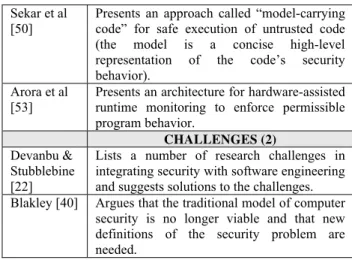
Table 2 shows the papers retrieved for application
security. The format of Table 2 is the same as Table 1.
Table 2. Research in application security
THREAT IDENTIFICATION (2)
Kemmerer [11]
Identifies known threats and analyzes protection techniques for countering the threats.
Salter et al [38]
Presents a method for enumerating the vulnerabilities of a system and determining what countermeasures can best close those vulnerabilities.
PROTECTION FROM TAMPERING (8)
Colberg & Thomborson [7]
Considers the use of tamper-proofing, and obfuscation to protect software from a malicious host.
Zambreno et al [9]
Protection against software tampering using hardware/software co-design techniques via a FPGA.
Zhang et al [10]
Proposes a secret sharing based compiler solution to protect critical program data and achieve intrusion tolerance.
Huang et al [16]
Describes protecting web applications using a combination of static analysis and runtime guards – describes a tool for achieving the protection.
Zambreno et al [20]
Protection against software tampering using hardware/software co-design techniques via a FPGA (more detailed version of Zambreno et al [9]).
Zhuang et al [29]
Presents a hardware assisted obfuscation technique that can dynamically obfuscate control flow information.
Monden et al [49]
Proposes a framework for obfuscating the program interpretation instead of the program itself.
Platte & Naroska [55]
Presents a combined hardware/software architecture to provide a secure and tamper resistant computing environment.
PROTECTION FROM COPYING (3)
Colberg & Thomborson [7]
Considers the use of watermarking to protect software from a malicious host.
Zhang & Gupta [36]
Describes an approach for preventing the creation of unauthorized copies of software by splitting modules into open and hidden components.
Curran et al [54]
Investigates a new software watermarking scheme for securing Java from software pirating.
OTHER PROTECTION (8)
Stytz [6] Advocates a defense-in-depth strategy to protect applications from threats.
Castro & Liskov [25]
Describes the BFT algorithm for building highly available systems that tolerate Byzantine faults.
Kihlstrom et al [27]
Describes the SecureRing message delivery protocol that can be used for secure, reliable communication in distributed systems. Zhang et al
[28]
Proposes a new mechanism for protecting user privacy on trusted processors.
Covington et al [33]
Proposes the use of environment roles to capture security relevant context for access control.
Devenbu et al [35]
Proposes the use of trusted hardware in combination with a key management infrastructure for trusted hosting of applications.
Cowan & Pu [56]
Presents a categorization scheme for security bug tolerance techniques and populates it with techniques from the authors and the literature.
Kojima et al [64]
Describes a mechanism that prevents abuse of trusted Java applets.
INTEGRITY VERIFICATION (6)
Spinellis [39]
Addresses software integrity verification; proposes the use of reflection, whereby the software examines its own operation in conjunction with cryptographic hashes. Kirovski et
al [46]
Presents SPEF, a combination of architectural and compilation techniques that ensures software integrity at runtime (prevent execution of unauthorized code).
Sadeghi & Stüble [47]
Points out the deficiencies of platform integrity verification and qualities binding as proposed in the existing specification of the Trusted Computing Group and proposes a new approach.
Fong [48] Describes link-time bytecode verification as a pluggable service for the JVM.
Sekar et al [50]
Presents an approach called “model-carrying code” for safe execution of untrusted code (the model is a concise high-level representation of the code’s security behavior).
Arora et al [53]
Presents an architecture for hardware-assisted runtime monitoring to enforce permissible program behavior.
CHALLENGES (2)
Devanbu & Stubblebine [22]
Lists a number of research challenges in integrating security with software engineering and suggests solutions to the challenges. Blakley [40] Argues that the traditional model of computer
security is no longer viable and that new definitions of the security problem are needed.
3. Discussion of Recent Research
The above results show that for software security, the
categories with number of papers from high to low are in
the order: processes and methods (15), requirements (9),
vulnerabilities identification (5), other (4), testing (3),
coding methods (2), usability (2), and tools (2). In other
words, researches have worked mostly on processes and
methods for building secure software, followed by
expressing security as requirements, followed by
techniques for identifying vulnerabilities. Areas such as
testing, coding methods, usability, and tools appear
relatively under-represented. Figure 1 shows this
graphically.
For application security, the categories with number of
papers from high to low are in the order: protection from
tampering (8), other protection (8), integrity verification
(6), protection from copying (3), threat identification (2),
and challenges (2). In other words, researchers have
worked mostly on protection from tampering and other
protection, followed by integrity verification, with
protection from copying and threat identification
relatively under-represented. Figure 2 shows this
graphically.
New researchers to the secure software field can make
use of these results to select a research topic within either
software security or application security. Assuming that
the priorities of selection from most important to least
important are: personal interest, utility from research, and
relatively unexplored topic, the new researcher can peruse
the summaries in Table 1 or Table 2 looking for areas of
interest and then think of how this interest can be
transformed to one of high research utility located in a
relatively unexplored area and possibly in a related but
new category (since the categories mentioned are not
exhaustive) not mentioned here (which would be very
unexplored).
9 6 3 0 PFC TI C PFT OP IVFigure 2. Distribution of research in
application security
15
10
4.
Conclusions
This paper has provided an overview of recent research
in the field of secure software, specifically in the subfields
of software security and application security. Readers of
this paper can benefit by: i) seeing a quick picture of what
research has been carried out in the last ten years, ii)
getting an introduction to what secure software is all
about, iii) using the results to zero in on a potential secure
software research topic for investigation.
Although the above benefits are put forward, it must be
noted that they are tempered by the limitations of this
work as mentioned in Section 2. Further, there is the
assumption that papers found in the stated ACM and IEEE
databases are representative of research in secure software
throughout the world. Finally, the categories used to
classify the papers were based on the papers’ subjects.
5
0
O T CM U T P&M R VI
Figure 1. Distribution of research in software
security (first “T” is “Testing”)
Therefore, there could be other categories not mentioned
above, with no matching papers. Thus it is important
when zeroing in on a research topic, not only to think of
the above categories, but to also try to think of other areas
outside the above categories.
5. References
[1] J. Millar, “Computer Crime Skyrocketing”, The London Free Press, available as of Sept. 11, 2005 at: http://www.canoe.ca/NewsStand/LondonFreePress/Busin ess/2005/09/08/1206625-sun.html
[2] C.E. Landwehr, “Formal Models of Computer Security”, ACM Computing Surveys, Vol. 13, No. 3, September 1981.
[3] G. McGraw, “Building secure software: better than protecting bad software”, IEEE Software, Volume 19, Issue 6, Nov.-Dec. 2002.
[4] N. Davis, W. Humphrey, S.T. Redwine Jr., G. Zibulski, G. McGraw, “Processes for producing secure software”, IEEE Security & Privacy Magazine, Vol. 2 , Issue 3 , May-June 2004.
[5] H. Yu, X. He, Y. Deng, L. Mo, “A formal approach to designing secure software architectures”, Proceedings, Eighth IEEE International Symposium on High Assurance Systems Engineering, 25-26 March 2004. [6] M.R. Stytz, “Considering defense in depth for software
applications”,
IEEE Security & Privacy Magazine, Vol. 2 , Issue 1, Jan.-Feb. 2004.
[7] C.S. Collberg, C. Thomborson, “Watermarking, Tamper-Proofing, and Obfuscation – Tools for Software Protection”, IEEE Transactions on Software Engineering, Vol. 28, No. 6, June 2002.
[8] J. J. Tevis, J.A. Hamilton, “Methods for the prevention, detection and removal of software security vulnerabilities”, Proceedings of the 42nd Annual Southeast Regional Conference, April 2004.
[ 9]
J. Zambreno, A. Choudhary, R. Simha, B. Narahari, “Flexible Software Protection Using Hardware/Software Codesign Techniques”, Proceedings of the Conference on Design, Automation and Test in Europe - Volume 1, February 2004.[10] T. Zhang, X. Zhuang, S. Pande, “Building Intrusion-Tolerant Secure Software”, Proceedings of the International Symposium on Code Generation and Optimization (CGO '05), March 2005.
[11] R. A. Kemmerer, “Cybersecurity”, Proceedings of the 25th International Conference on Software Engineering, May 2003.
[12] H. Peine, “Rules of Thumb for Secure Software Engineering”, Proceedings of the 27th International Conference on Software Engineering, May 2005.
[13] K. Beznosov, P. Kruchten, “Towards agile security assurance”, Proceedings of the 2004 Workshop on New Security Paradigms, September 2004.
[14] P. Kocher, R. Lee, G. McGraw, A. Raghunathan, and S. Ravi, “Security as a new dimension in embedded system design”, Proceedings of the 41st Annual Conference on Design Automation, June 2004.
[15] H. H. Thompson, J. A. Whittaker, F. E. Mottay, “Software security vulnerability testing in hostile environments”, Proceedings of the 2002 ACM Symposium on Applied Computing, March 2002.
[16] Y. Huang, F. Yu, C. Hang, C. Tsai, D. Lee, S. Kuo, “Securing web application code by static analysis and runtime protection”, Proceedings of the 13th International Conference on World Wide Web, May 2004.
[17] S. Ravi, A. Raghunathan, P. Kocher, S. Hattangady, “Security in embedded systems: Design challenges”, ACM Transactions on Embedded Computing Systems (TECS), Volume 3, Issue 3, August 2004.
[18] S. Hangal, M. S. Lam, “Dynamic program analysis: Tracking down software bugs using automatic anomaly detection”, Proceedings of the 24th International Conference on Software Engineering, May 2002.
[19] S. Zdancewic, L. Zheng, N. Nystrom, A. C. Myers, “Secure program partitioning”, ACM Transactions on Computer Systems (TOCS), Volume 20, Issue 3, August 2002.
[20] J. Zambreno, A. Choudhary, R. Simha, B. Narahari, N. Memon, “SAFE-OPS: An approach to embedded software security”, ACM Transactions on Embedded Computing Systems (TECS), Volume 4, Issue 1, February 2005.
[21] J. Jürjens, “Using UMLsec and goal trees for secure systems development”, Proceedings of the 2002 ACM Symposium on Applied Computing, March 2002. [22] P. T. Devanbu, S. Stubblebine, “Software engineering for
security: a roadmap”, Proceedings of the Conference on The Future of Software Engineering, May 2000.
[23] C. Del Grosso, G. Antoniol, M. Di Penta, P. Galinier, E. Merlo, “Improving network applications security: a new heuristic to generate stress testing data”, Proceedings of the 2005 Conference on Genetic and Evolutionary Computation (GECCO '05), June 2005.
[24] A. Ray, “Security check: a formal yet practical framework for secure software architecture”, Proceedings of the 2003 Workshop on New Security Paradigms, August 2003.
[25] M. Castro, B. Liskov, “Practical byzantine fault tolerance and proactive recovery”, ACM Transactions on Computer Systems (TOCS), Volume 20, Issue 4, November 2002. [26] H.Wang, C. Wang, “Taxonomy of security considerations
and software quality”, Communications of the ACM, Volume 46, Issue 6, June 2003.
[27] K. P. Kihlstrom, L. E. Moser, P. M. Melliar-Smith, “The SecureRing group communication system”, ACM Transactions on Information and System Security (TISSEC), Volume 4, November 2001.
[28] Y. Zhang, J. Yang, Y. Lin, L. Gao, “Architectural support for protecting user privacy on trusted processors”, ACM SIGARCH Computer Architecture News, Volume 33, Issue 1, March 2005.
[29] X. Zhuang, T. Zhang, H. S. Lee, S. Pande, “Hardware assisted control flow obfuscation for embedded processors”, Proceedings of the 2004 International Conference on Compilers, Architecture, and Synthesis for Embedded Systems, September 2004.
[30] C. B. Haley, R. C. Laney, B. Nuseibeh, “Deriving security requirements from crosscutting threat descriptions”, Proceedings of the 3rd International Conference on Aspect-oriented Software Development, March 2004.
[31] Flechais, M. A. Sasse, S. M. V. Hailes, “Bringing security home: a process for developing secure and usable systems”, Proceedings of the 2003 Workshop on New Security Paradigms, August 2003.
[32] J. Viega, J. T. Bloch, T. Kohno, G. McGraw, “Token-based scanning of source code for security problems”, ACM Transactions on Information and System Security (TISSEC), Volume 5, Issue 3, August 2002.
[33] M. J. Covington, W. Long, S. Srinivasan, A. K. Dev, M. Ahamad, G. D. Abowd, “Securing context-aware applications using environment roles”, Proceedings of the Sixth ACM Symposium on Access Control Models and Technologies”, May 2001.
[34] Deubler, J. Grünbauer, J. Jürjens, G. Wimmel, “Sound development of secure service-based systems”, Proceedings of the 2nd international conference on Service oriented computing”, November 2004.
[35] P. T. Devanbu, P. W-L Fong, S. G. Stubblebine, “Techniques for trusted software engineering”, Proceedings of the 20th International Conference on Software Engineering, April 1998.
[36] X. Zhang, R. Gupta, “Hiding program slices for software security”, Proceedings of the International Symposium on Code Generation and Optimization: Feedback-directed and Runtime Optimization (CGO '03), March 2003. [37] M. Koch, F. Parisi-Presicce, “Formal access control
analysis in the software development process”, Proceedings of the 2003 ACM workshop on Formal methods in security engineering, October 2003.
[38] C. Salter, O. S. Saydjari, B. Schneier, J. Wallner, “Toward a secure system engineering methodolgy”, Proceedings of the 1998 Workshop on New Security Paradigms, January 1998.
[39] D. Spinellis, “Reflection as a mechanism for software integrity verification”, ACM Transactions on Information
and System Security (TISSEC), Volume 3, Issue 1, February 2000.
[40] B. Blakley, “The Emperor's old armor”, Proceedings of the 1996 Workshop on New Security Paradigms, September 1996.
[41] R. C. Shah, J. P. Kesan, “Nurturing software”, Communications of the ACM, Volume 48, Issue 9, September 2005.
[42] D. M. Kienzle, W. A. Wulf, “A practical approach to security assessment”, Proceedings of the 1997 Workshop on New Security Paradigms, January 1998.
[43] V. S. Sharma, K. S. Trivedi, “Architecture based analysis of performance, reliability and security of software systems”, Proceedings of the 5th International Workshop on Software and Performance (WOSP '05), July 2005. [44] M. Vetterling, G. Wimmel, A. Wisspeintner,
“Requirements analysis: Secure systems development based on the common criteria: the PalME project”, ACM SIGSOFT Software Engineering Notes, Volume 27, Issue 6, November 2002.
[45] M. E. Zurko, R. T. Simon, “User-centered security”, Proceedings of the 1996 Workshop on New Security Paradigms, September 1996.
[46] D. Kirovski, M. Drinić, M. Potkonjak, “Enabling trusted software integrity”, Proceedings of the 10th International Conference on Architectural Support for Programming Languages and Operating Systems, Volume 37 , 30 , 36, Issue 10 , 5 , 5, October 2002.
[47] A. Sadeghi, C. Stüble, “Property-based attestation for computing platforms: caring about properties, not mechanisms”, Proceedings of the 2004 Workshop on New Security Paradigms, September 2004.
[48] P. W. L. Fong, “Pluggable verification modules: an extensible protection mechanism for the JVM”, Proceedings of the 19th annual ACM SIGPLAN Conference on Object-oriented programming, systems, languages, and applications, Volume 39 Issue 10, October 2004.
[49] A. Monden, A. Monsifrot, C. Thomborson, “A framework for obfuscated interpretation”, Proceedings of the Second Workshop on Australasian Information Security, Data Mining and Web Intelligence, and Software Internationalisation - Volume 32 CRPIT '04, January 2004.
[50] R. Sekar, V.N. Venkatakrishnan, S. Basu, S. Bhatkar, D. C. DuVarney, “Model-carrying code: a practical approach for safe execution of untrusted applications”, Proceedings of the Nineteenth ACM Symposium on Operating systems Principles, October 2003.
[51] T. Doan, S. Demurjian, T. C. Ting, A. Ketterl, “MAC and UML for secure software design”, Proceedings of the 2004 ACM Workshop on Formal Methods in Security Engineering, October 2004.
[52] D. K. Smetters, R. E. Grinter, “Moving from the design of usable security technologies to the design of useful secure applications”, Proceedings of the 2002 Workshop on New Security Paradigms, September 2002.
[53] D. Arora, S. Ravi, A. Raghunathan, N. K. Jha, “Secure Embedded Processing through Hardware-Assisted Run-Time Monitoring”, Proceedings of the Conference on Design, Automation and Test in Europe - Volume 1, March 2005.
[54] D. Curran, N. J. Hurley, M. Ó Cinnéide, “Securing Java through software watermarking”, Proceedings of the 2nd International Conference on Principles and Practice of Programming in Java PPPJ '03, June 2003.
[55] J. Platte, E. Naroska, “A combined hardware and software architecture for secure computing”, Proceedings of the 2nd Conference on Computing Frontiers, May 2005.
[56] C. Cowan, C. Pu, “Death, taxes, and imperfect software: surviving the inevitable”, Proceedings of the 1998 Workshop on New Security Paradigms, January 1998. [57] J. Viega, T. Kohno, B. Potter, “Trust (and mistrust) in
secure applications”, Communications of the ACM, Volume 44, Issue 2, February 2001.
[58] J.J. Pauli, D. Xu,, “Misuse case-based design and analysis of secure software architecture”, Proceedings, International Conference on Information Technology: Coding and Computing (ITCC 2005), Volume 2, April 2005.
[59] H. Yu, D. Liu, X. He, L. Yang, S. Gao, “Secure Software Architectures Design by Aspect Orientation”, Proceedings,
10th IEEE International Conference on Engineering of Complex Computer Systems (ICECCS 2005), June 2005. [60] K. Alghathbar, D. Wijesekera, “Analyzing information
flow control policies in requirements engineering”, Proceedings, Fifth IEEE International Workshop on Policies for Distributed Systems and Networks (POLICY 2004), June 2004.
[61] M. Hauf, J. Schwarz, A. Polze, “Role-based security for configurable distributed control systems”, Proceedings, Sixth International Workshop on Object-Oriented Real-Time Dependable Systems, January 2001.
[62] M. Moriconi, X. Qian, R.A. Riemenschneider, L. Gong, “Secure software architectures”, Proceedings, IEEE Symposium on Security and Privacy, May 1997.
[63] W.L. Harrison, J. Hook, “Achieving Information Flow Security through Precise Control of Effects”, Proceedings, 18th IEEE Workshop on Computer Security Foundations (CSFW-18 2005), June 2005.
[64] H. Kojima, I. Morikawa, Y. Nakayama, Y. Yamaoka, “Cozilet: transparent encapsulation to prevent abuse of trusted applets”, Proceedings, 20th Annual Computer Security Applications Conference, Dec. 2004.
[65] K. Jiwnani, M. Zelkowitz, “Maintaining software with a security perspective”, Proceedings, International Conference on Software Maintenance, Oct. 2002.
[66] R. Chinchani, A. Iyer, B. Jayaraman, S. Upadhyaya, “Insecure programming: how culpable is a language's syntax?”, Proceedings, IEEE Systems, Man and Cybernetics Society Information Assurance Workshop, June 2003.
[67] D.P. Gilliam, J.C. Kelly, J.D. Powell, M. Bishop, “Development of a software security assessment instrument to reduce software security risk”, Proceedings, Tenth IEEE International Workshops on Enabling Technologies: Infrastructure for Collaborative Enterprises (WET ICE 2001), June 2001.
1