HAL Id: hal-02372823
https://hal.archives-ouvertes.fr/hal-02372823
Submitted on 20 Nov 2019Cephalotaxus Alkaloids
Joelle Pérard-Viret, Laith Quteishat, Rana Alsalim, Jacques Royer, Françoise
Dumas
To cite this version:
Joelle Pérard-Viret, Laith Quteishat, Rana Alsalim, Jacques Royer, Françoise Dumas. Cephalotaxus Alkaloids. Academic Press Elsevier. The Alkaloids, 78, pp.205-352, 2017, The Alkaloids, �10.1016/bs.alkal.2017.07.001�. �hal-02372823�
CEPHALOTAXUS ALKALOIDS
Joëlle Pérard-Vireta, Laith Quteishatb, Rana Alsalimb, Jacques Royera and Françoise Dumasb*
a COMETE UMR CNRS 8638, Faculty of Pharmaceutical and Biological Sciences,
5
Université Paris Descartes, Sorbonne Paris Cité, 75006 Paris, France
b BioCIS laboratory, UMR CNRS 8076, School of Pharmacy, Université Paris Sud, Université Paris Saclay, 5, rue Jean-Baptiste Clément, Châtenay-Malabry 92290, France
CONTENT
10
1. Introduction
2. Natural Occurrence, Isolation and Structural Assignment
2.1 Cephalotaxine and Related Alkaloids2.2 Natural Cephalotaxus Esters 2.3 Other Alkaloids
15
2.4 Production and Purification Studies
3. Synthesis of the Alkaloid Core
3.1 Overview
3.2 Racemic Syntheses
3.2.1 C4–C13 Ring Closure a
20
3.2.1.1 Tietze’s Formal Synthesis (1997)
3.2.1.2 Suga and Yoshida’s Formal Synthesis (2003) 3.2.1.3 Stoltz’s Formal Synthesis (2007)
3.2.1.4 Huang’s Formal Synthesis (2013)
3.2.1.5 Huang and Wang’s Formal Synthesis (2015)
25
3.2.1.6 Nagasaka’s Formal Synthesis (2002) 3.2.1.7 Li’s Formal Synthesis (2007)
3.2. 1.8 Yang and Liu’s Formal Synthesis (2009) 3.2.1.9 Zhang and Liu’s Formal Synthesis (2013) 3.2.1.10 Bubnov’s Formal Synthesis (2008)
30
3.2.2 N9–C5 Ring Closure c
3.2.2.1 Li’s Formal Synthesis (2003–2005) 3.2.2.2 Tu and Zhang’s Formal Synthesis (2009) 3.2.2.3 Li’s Formal Synthesis (2011)
3.2.2.4 Jiang’s Formal Synthesis (2013)
35
3.2.3 Other Strategies for Ring B Formation
3.2.3.1 C4–C5 Ring Closure b: Hong’s Formal Synthesis (2015)
3.2.3.2 N9–C10 Ring Closure e: Chandrasekhar’s Total Synthesis (2016) 3.3 Syntheses of Enantioenriched CET
3.3.1 Asymmetric Catalysis
40
3.3.1.1 Tietze’s Formal Synthesis (1999) 3.3.1.2 Tu’s Formal Synthesis (2012) 3.3.1.3 Renaud’s Formal Synthesis (2012) 3.3.1.4 Trost’s Formal Synthesis (2012)
3.3.2 Use of Chiral Auxiliaries
45
3.3.2.1 Royer’s Total Synthesis (2004)
3.3.2.2 Dumas and d’Angelo’s Formal Synthesis (2005)
3.3.3 Incorporation of Chiral Sources
3.3.3.1 Ikeda’s Formal Synthesis (1999) 3.3.3.2 El Bialy’s Formal Synthesis (2002)
3.3.3.3 Hayes’ Formal Synthesis (2008)
3.3.3.4 Djaballah and Gin’s Total Synthesis (2008) 3.3.3.5 Ishibashi’s Total Synthesis (2008)
3.3.4 Chemical Resolution
3.3.4.1 Nagasaka’s Formal Synthesis (1997)
5
3.3.4.2 El Bialy’s Formal Synthesis (2002) 3.3.4.3 Stoltz’s Formal Synthesis (2007)
3.3.5 Enzymatic Resolution
3.3.5.1 Mariano’s Formal Synthesis (2006) 3.3.5.2 Renaud’s Formal Synthesis (2012)
10
4. Synthesis and Coupling of the Side Chains of Cephalotaxus Esters
4.1. Synthesis of Cephalotaxine Esters4.1.1 Robin’s Synthesis of Semisynthetic HHT (1999)
4.1.2. Margerit’s Synthesis of [14C]-Labelled (–)-HHT (2015) 4.1.3. Gin’s Synthesis of DeoxyHT (2006)
15
4.1.4. Djaballah and Gin’s Synthesis of AnhydroHT, HHT and HomodeoxyHT (2008)
4.2 Synthesis of Side Chains of Cephalotaxus Esters
4.2.1 Dumas and d’Angelo’s Synthesis (2001) 4.2.2 Tietze’s Synthesis (2005) 20 4.2.3 Russel’s Synthesis (2006) 4.2.4 Royer’s Synthesis (2009) 4.2.5 Yang’s Synthesis (2013) 4.2.6 Hung’s Synthesis (2014) 4.2.7 Mac’s Synthesis (2016) 25
5. Synthetic Analogs and their Biological Properties
5.1. Cephalotaxine Analogs5.1.1 Tietze’s CET Analogs (2000)
5.1.2. Bubnov’s CET Analogs (2005-2010) 5.1.3. Royer’s CET Analogs (2004-2010)
30
5.1.4. Chandrasekhar’s CET Analogs (2016)
5.2 Cephalotaxus Esters with Side Chain Analogs
5.2.1. Robin’s Analogs (2002-2004) 5.2.2 Djaballah & Gin’s Analogs (2008) 5.2.3 Lai’s Analogs (2013)
35
6. Pharmacological and Clinical Studies
6.1 Cellular Pharmacology6.1.1 Molecular Mechanism of Action of HHT
6.1.2 Potential Use for the Treatment of Other Tumors 6.1.3 Combination with Other Agents
40
6.1.4 Resistance Mechanism of HHT 6.1.5 Mechanism of Allergic Reaction
6.2.6 Side Effects
6.3 Natural Extracts from Cephalotaxus sp. and Natural Chinese Medicine
References
Abstract
5
Cephalotaxus alkaloids represent a family of plant secondary metabolites known for 60 years.
Significant activity against leukemia in mice was demonstrated for extracts of Cephalotaxus. Cephalotaxine (CET) (1), the major alkaloid of this series was isolated from Cephalotaxus species by Paudler in 1963. The subsequent discovery of promising antitumor activity among new Cephalotaxus derivatives reported by Chinese, Japanese and American teams triggered 10
extensive structure elucidation and biological studies in this family. The structural feature of this cephalotaxane family relies mainly on its tetracyclic alkaloid backbone, which comprises an azaspiranic 1-azaspiro[4.4]nonane unit (rings C and D) and a benzazepine ring system (rings A and B) which is linked by its C3 alcohol function to a chiral oxygenated side chain by a carboxylic function alpha to a tetrasubstituted carbon center. The botanical distribution of these 15
alkaloids is limited to the Cephalotaxus genus (Cephalotaxaceae). The scope of biological activities of the Cephalotaxus alkaloids is mainly centered on the antileukemic activity of homoharringtonine (HHT) (2), which in particular demonstrated marked benefits in the treatment of orphan myeloid leukemia and was marketed as soon as 2009 by EMA (European Medicine Agency) and was approved by US Food and Drug Administration (FDA) in 2012. Its exact 20
mechanism of action was partly elucidated and it was early recognized that HHT (2) inhibited protein synthesis at the level of the ribosome machinery. Interestingly, after a latency period of 2 decades, the topic of Cephalotaxus alkaloids reemerged as a prolific source of new natural structures. To date, more than 70 compounds have been identified and characterized. Synthetic studies also regained attention during the two past decades, and numerous methodologies were 25
developed to access the first semisynthetic HHT (ssHHT) (2) of high purity suitable for clinical studies, and then high grade enantiomerically pure CET (1), HHT (2) and analogs.
Key words:
Alkaloid, Cephalotaxus, Cephalotaxine, Harringtonine, Homoharringtonine, Cancer, Leukemia,
30
Protein synthesis inhibitor, Antiviral, Antiparasitic agent.
Abbreviations
acac Acetylacetonate
AChE Acetyl choline esterase
ACN 1,1’-Azobis(cyclohexanecarbonitrile) 35
AIBN 2,2’-Azobisisobutyronitrile AML Acute myeloid leukemia APL Acute promyelocytic leukemia Ara-C Cytosine arabinoside
ATRA All-trans-retinoic acid 5
AY Average yield
BCR-ABL Breakpoint cluster region and ABL (Abelson) BID Bis in die (twice daily)
Boc tert-Butyloxycarbonyl
brsm Based on recovered starting material 10
CBz Carbobenzoxy
CCDC Cambridge Crystallographic Data Center CDI Carbonyldiimidazole
CET Cephalotaxine
CGAF Cephalotaxus griffithi alkaloid fraction 15
CHR Complete hematologic response CMC Cell membrane chromatography CML Chronic myeloid leukemia CP Chronic phase
Cp Cyclopentadiene 20
CSA Camphorsulfonic acid
CSD Cambridge Structural Database CSE Conventional solvent extraction dba Dibenzylideneacetone
DBU 1,8-Diazabicyclo[5.4.0]undec-7-ene 25
DCC N,N’-Dicyclohexylcarbodiimide de Diastereoisomeric excess
DEPC Diethyl pyrocarbonate DIAD Diisopropyl azodicarboxylate
DMPU 1,3-Dimethyl-1,3-propylurea (1,3-Dimethyl-3,4,5,6-tetrahydro-2(1H)-pyrimidinone) DMSO Dimethyl sulfoxide
DNR daunorubicin DOX Doxorubicin
dppe Bis(diphenylphosphino)ethane 5
DTBMP 2,6-Di-tert-butyl-4-methylpyridine
EDC N-(3-Dimethylaminopropyl)-N′-ethylcarbodiimide hydrochloride ee Enantiomeric excess
EMA European Medicines Agency EMP Embden-Meyerhof pathway 10
FDA Food and Drug Administration
G-CSF granulocyte colony-stimulating factor GHI G-CSF HHT and Imatinib
GMP Good manufacturing practice
HAA HHT, aclacinomycin, and Ara-c 15
HAD HHT, Ara-c and DNR
Hfc 3-(Heptafluoropropyl-hydroxymethylene)-D-camphorate HHT Homoharringtonine, Omacetaxine H1R Histamine 1 receptor HMDS Hexamethyldisilazane 20 HMPA Hexamethylphosphoramide HOBt Hydroxybenzotriazole
HPLC High performance liquid chromatography HSP Heat shock protein
HT Harringtonine 25
IBX 2-Iodoxybenzoic acid IM Imatinib
Im Imidazole
IFN-α Interferon alpha
INN International nonproprietary name 30
IUCN International Union for Conservation of Nature KHMDS Potassium hexamethyldisilazide
LDA Lithium diisopropylamide
LiHMDS Lithium hexamethyldisilazide LCL long-circulating liposomes
LOQ Limit of quantitation
mCPBA meta-Chloroperoxybenzoic acid
Mcl-1 Myeloid cell leukemia-1 MCyR Major cytogenetic response
MERS-CoV Middle East respiratory syndrome coronavirus 5 MDS myelodysplastic syndrome MJ Methyl jasmonate MM Multiple myeloma MS Mass spectrometry Ms Methanesulfonyl 10 MTX mitoxantrone
MWE Microwave extraction NBS N-Bromosuccinimide NCI National Cancer Institute NCS N-Chlorosuccinimide 15
n.d Not determined NIS N-Iodosuccinimide NMM N-Methylmorpholine
NMO N-Methylmorpholine N-oxide NMR Nuclear magnetic resonance 20
NOESY Nuclear Overhauser effect spectroscopy NS Number of steps
NsCl 4-Nitrobenzenesulfonyl chloride OM Omacetaxine
OY Overall yield 25
PARP Poly(ADP-Ribose) polymerase PCC Pyridinium chlorochromate PDC Pyridinium dichromate PEG polyethyleneglycol
p-TsOH p-Toluenesulfonic acid
pyr Pyridine
QCC Quaternary carbon center RCM Ring closing metathesis re Regioisomeric excess 5
Red-Al Sodium bis(2-methoxyethoxy)aluminum hydride RI resistance index
rt Room temperature
SAR Structure activity relationship SC Subcutaneous
10
SNP Single nucleotide polymorphism ssHTT Semisynthetic HHT
TBAF Tetrabutylammonium fluoride TBAI Tetrabutylammonium iodide
TBAT Tetrabutylammonium difluorotriphenylsilicate 15
INN International nonproprietary name TBDMSCl tert-Butyldimethylsilyl chloride TBDPSCl tert-Butyldiphenylsilyl chloride TCM Traditional Chinese medicine TEA Triethylamine
20
TEMPO (2,2,6,6-Tetramethylpiperidin-1-yl)oxy Tf Triflate
TFA Trifluoroacetic acid
TFAA Trifluoroacetic acid anhydride TfOH Triflic acid
25 THF Tetrahydrofuran TMEDA Tetramethylethylenediamine TMG 1,1,3,3-Tetramethylguanidine TMS Trimethylsilyl Ts p-Toluenesulfonyl 30
I. Introduction
This contribution is an updated and expanded version of the two previous chapters published in this series in 19841 and 1998.2 Other reviews focused on the structure and synthesis of these compounds,3,4,5,6 and several reviews are available that cover the structure–activity 5
relationships, biological and clinical properties of these alkaloids.7,8,9,10,11,12,13,14,15,16,17,18,19 The literature is reviewed from the last update in this series which was covering the field till mid-1997, to early 2016. Because they usually exist under the form of unique enantiomer, we numbered the natural products by an arabical digit irrespective to their optical rotation sign, e.g. cephalotaxine (CET) (1), their antipode by ent-digit e.g. ent-cephalotaxine ent-(1), and the 10
corresponding racemic compound usually obtained by chemical synthesis digit, e.g. rac-cephalotaxine rac-(1). In the asymmetric synthesis section, we have precised the sign of the optical rotation, e.g. CET (–)-(1), ent-CET (+)-(1) and rac- CET (±)-(1).
For more than fifty years, chemists have studied the extraction, structure determination, biogenesis and synthesis of CET (1) (Figure 2), the major alkaloid of this series, and related 15
alkaloids, because of the reported biological activity of its natural esters 2–5, in view of their therapeutically use in the treatment of leukemia. Homoharringtonine (HHT) (2) and harringtonine (HT) (3), or mixtures of both, have been used in traditional Chinese medicine (TCM) since the 1970s to treat a variety of malignancies. HHT (2) being the easiest to purify and the most abundant in the plant was selected by the National Cancer Institute (NCI) for clinical 20
development. HHT (2), also known as omacetaxine®, a simple ester of CET (1), probably holds
the record for the longest time to reach the market20 after having experienced increasing interest since its first use in TCM, and efforts by pharmaceutical companies for its development as an antileukemic agent. Despite its clinical efficacy, natural HHT (2) was not recorded until now, simply because normal extract formulations have raised several unresolved problems, such as the 25
reproduction of a constant product from defined extraction procedure, the purity profile, the main source of the raw material in China and biodiversity conservation issues. The Cephalotaxus shrubs with extremely slow growth are mostly protected and endangered species. Moreover,
tyrosine kinase inhibitor (TKI) at that time delayed the interest for HHT (2). However, de novo or acquired resistance to TKIs22 renewed the interest for this alternative first-in-class simple
natural ester of CET (1). HHT (2) is currently approved in Europe and in the USA, due to its reported activity in patients with chronic myelogenous leukemia (CML) resistant to currently available TKIs. As a result, on 2nd September 2004, orphan designation (EU/3/04/224) was 5
granted by the EU for omacetaxine mepesuccinate® (INN, trade name Synribo) /homoharringtonine (HHT) (2) for the treatment of chronic myeloid leukemia to Stragen France SAS, France, for the treatment of chronic myeloid leukemia. Exploitation rights were transferred to ChemGenex Europe SAS, France, in January 2009 and subsequently to Teva Pharma GmbH, Germany, in December 2012. Due to their different mechanisms of action, 10
combinations with TKIs represent attractive treatment options. Recently, on 26th October 2012, HHT (2), Synribo® (formerly Ceflatonin, Omapro), received an accelerated approval by the U.S.
Food and Drug Administration (FDA) for adult patients with chronic-phase or accelerated-phase CML with resistance or intolerance to two or more TKIs. The U.S. FDA has granted full approval to HHT (2) (drug substance international nonproprietary name (INN) omacetaxine 15
mepesuccinate, Synribo®) for injection, based on the final analysis of two phase II trials evaluating the efficacy and tolerability data of omacetaxine in 2014. This renewed interest for isolation, characterisation, biological evaluation and total synthesis of cephalotaxus alkaloids and analogs to suppress the dependance on natural source supply.
2. Natural Occurrence, Isolation and Structural Assignment
20
As early as 1954, Wall brought to light the presence of alkaloids in plants of the genus
Cephalotaxus,23 the only genus of the Cephalotaxaceae family composed of eleven species of evergreen small and only slowly growing conifers which are mostly indigenous to China (Figure 1). The first alkaloid characterized from C. harringtonia var.drupacea (C. drupacea) and C. fortunei was named cephalotaxine by Paudler in 196324 and its original benzazepine nucleus 25
Figure 1. Scientific classification of Cephalotaxus genus and picture (from A. Barra, Wikimedia
Commons) of the fruits and leaves of C. harringtonia var drupacea.
Although its biological activity and partial structure are known since 1959,26 the elucidation of 5
the structure and antitumor activity of natural harringtonine (HT) (3) (Figure 2) isolated from
Cephalotaxus harringtonia var. drupacea against L1210 and P388 leukemia in mice (1 mg/kg)
in 196925 stimulated the continuous search for active compounds and particularly for alkaloids from the Cephalotaxus genus. Apart from the cephalotaxine series focused in this chapter, the other alkaloid part in Cephalotaxus species belongs to the class of homoerythrinane alkaloids, 10
isolated as minor compounds with the exception of C. wilsoniana. Biogenesis of CET (1) postulated by Parry in 1977 showed a common origin for these alkaloids.1,2,27
Cephalotaxanes (6) is the generic name for the particular alkaloids of the
Cephalotaxaceae family which have a general formula derived from the cephalotaxane skeleton
with either 1 or 2 units covalently linked forming dimers having two identical or different units (Figure 3). Cephalotaxanes (6) include neutral compounds or salts having this basic skeleton in 5
common, and may contain various oxygenated substituents (aliphatic ethers or aromatic units, free or esterified alcohols, substituted or free enols, phenol and others). Cephalotaxanes include cephalotaxines characterized by a free alcohol function on ring D (R = H), and harringtonines where the 3-OH group is esterified (R ≠ H). Isolation of cephalotaxanes and homoerythrinane alkaloids [skeleton (7)] from the same plant suggested that they might be formed through similar 10
biogenetic routes.1,2 Hainanensine (8) is a structurally unique Cephalotaxus alkaloid devoid of optical activity and lacking the spiranic tetrasubstituted carbon center. It was isolated from C.
hainanensis and C. fortunei (Figure 3) and displays a type of single rearranged cephalotaxine
skeleton.28 15
Figure 3. Cephalotaxanes (6), the skeleton 7 of minor homoerythrinane alkaloids and the
structurally unique Cephalotaxus alkaloid hainanensine (8).
Until 1997, thirty six compounds related to the cephalotaxine series (Tables 1 and 2), were 20
CET (1) and HHT (2) were also isolated conventionally from fruits, leaves and branches of Cephalotaxus sinensis.29 Among the alkaloids derived from CET (1), compounds possess
different D rings such as cephalotaxinone (10), demethylcephalotaxine (11), isocephalotaxinone (13) and ring C such as cephalotaxinamide (18). Oxygenated compounds with modifications on their B ring as 11-hydroxycephalotaxine (14) and 4-hydroxycephalotaxine (15), or compounds 5
having an oxygen bridge between the rings B and D like drupacine (16) were also described (Figure 4).30,31,32 11-Hydroxycephalotaxine (14) was converted to drupacine (16) in acidic medium.31 Among the minor alkaloids isolated from the bark of Cephalotaxus hainanensis Li (in addition to eleven known alkaloids), cephalotaxine analogs were identified as cephalotaxinone (10), cephalotaxinamide (18) and demethylneodrupacine (17) which possesses an ether bridge 10
between C11 and C3, while drupracine (16) exhibits an ether bridge between C11 and C2. The structure of desmethylcephalotaxinone (12), isolated from Cephalotaxus harringtonia (Forbes) K. Koch var. harringtonia cv. Fastigiata, was determined by semisynthesis from CET (1) via oxidation to cephalotaxinone (10) and cleavage of the enol ether thus confirming desmethylCET (12) as a natural metabolite and biosynthesic intermediate.33
15
Repeated chromatography of an alkaloidal fraction of the ethanolic extract of
Cephalotaxus fortunei Hook f.34 afforded as minor component 4-hydroxycephalotaxine (+)-(15) recently also identified in C. koreana Nakai.35 Epicephalotaxine (9) is another minor metabolite of C. fortunei Hook f. accompanied by CET (1) (50-54% of the total alkaloids), cephalotaxinone (10), (+)-acetylCET (+)-(26), demethylCET (11), HT (3) and HHT (2).36
20
Molecules coupled with side chains bearing an ester function as in nordeoxyharringtonine (nordeoxyHT) (21), homodeoxyharringtonine (homodeoxyHT or deoxyHHT) (22) and bishomodeoxyharringtonine (bishomodeoxyHT) (23) are found among harringtonines (Figure 5).37
Including esters 2–5, these compounds are esters of CET (1) having its polycyclic core 25
coupled to different side chains deriving from (R)-citramalic acid. Although occurence of enantiomeric pairs in the same family of plants is unusual,38 acetylcephalotaxine (acetylCET) (26) was reported under both enantiomeric forms. (–)-AcetylCET (–)-(26) was obtained by semisynthesis through acetylation of natural CET (–)-(1)24and was isolated from C. fortunei30
The opposite enantiomer (+)-acetylCET (+)-(26) was isolated in C. fortunei41 and C.
hainanensis.42 Although an error cannot be excluded in literature data, these findings need to be
confirmed since this natural product (+)-26 is the only one portraiting an opposite absolute 5
configuration (AC) of alkaloid core.
Anhydroharringtonine (20) bearing an additional heterocycle in the side chain is the only natural ester of this type.43 It induced 98% growth inhibition of P388 leukemia cell lines at 1 µg/mL, a level comparable to that of deoxyHT (5). There are also molecules coupled with side chains carrying a free acid group (Figure 5): 5'-des-O-methylHT (30) (harringtonic acid), (2’R,3'S)-3’-10
hydroxy-5'-des-O-methylHT (28) (cephalozemic acid C), 5'-des-O-methylHHT (31) (homoharringtonic acid, also identified as a metabolite of HHT (2) in rats and rabbits) and 5'-des-O-methylisoHT (27) (isoharringtonic acid).1,2 Others possess an ester function and an
aromatic ring, as in homoneoHT (24) and (2’R,3'S)-hydroxyneoHT (25).44 Some of these esters
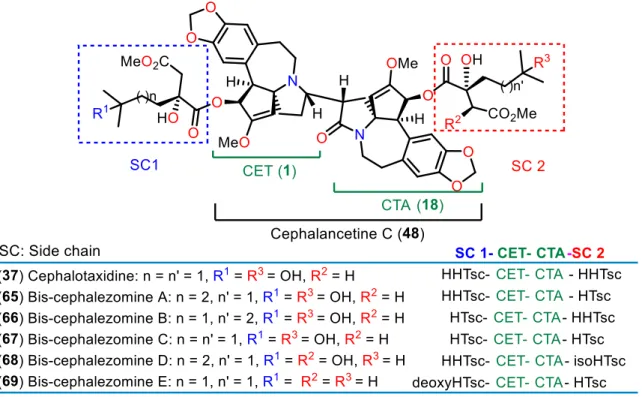
deliver biological activities comparable to those of the first four isolated esters 2–5 but they are available in much lower quantities in the plant. The first dimeric Cephalotaxus alkaloid, cephalotaxidine (37), was isolated from C. harringtonia var. drupacea (C. drupacea) in 1996.45
It is a dimer of HHT (2) and homoharringtonamide (32) with an IC50 of 1.8 µg/mL against P-388
5
murine leukemic cell lines. Drupangtonine (33),46 was the most active (IC50 7 nM against P-388
murine leukemic cell lines) of the four esters of oxygenated cephalotaxine analogs, 11α-hydroxy-homodeoxyHT (34), 11β-hydroxyhomodeoxyHT (35) and 11β-hydroxydeoxyHT (36) (IC50 0.38, 0.33 and 0.17µg/mL respectively against P-388 murine leukemic cell lines) identified
from C. harringtonia var. drupacea (Figure 6).47 10
Figure 6 Natural esters of oxygenated cephalotaxines
Since the last reviews in this series,1,2 more than thirty Cephalotaxus alkaloids have been isolated from various Cephalotaxus sp. These new alkaloids include the following compounds.
5
2.1 Cephalotaxine and Related Alkaloids
N-oxides of cephalotaxine, CET α N-oxide (38), CET β N-oxide (39) and
11β-hydroxycephalotaxine β N-oxide (40), together with isocephalotaxine (41) were identified and characterized in the ethyl acetate extract of C. fortunei fruits by Jossang et al. in 2001 (Figure 7).48 Although it was described as a synthetic compound earlier,49 the relative configuration of 10
isocephalotaxine (41) isolated during this work remains unknown due to the lack of NOESY correlations. These alkaloids exhibited low cytotoxicity against nasopharynx KB cells with IC50
values of 30, 14, 31 and 15 µg/mL, respectively. ACs of cephalezomines G (42) and H (43) described by Kobayashi and Morita50 from the leaves of C. harringtonia var. harringtonia were determined by circular dichroism (CD) as 2S,3R for cephalezomine G (42) and 2R,3R for 15
cephalezomine H (43). However, the structure of cephalezomine H (43), initially assigned as a
trans diol was revised to a syn-β,β-diol after total synthesis (Figure 7).51 Some uncertainty
remained, however, due to the divergent optical rotations of the synthetic and the natural compounds.
Figure 7. New N-oxides and ring D analogs of cephalotaxine
A new stereoisomer (44) of desmethylcephalotaxinone (12) has been isolated from the leaves and heartwood of Formosan Cephalotaxus wilsoniana (Figure 8).52 Although the UV, 1H NMR,
5
and []23D of compound 44 were similar to those of natural desmethylcephalotaxinone (12), C1
to C7 and C10 signals in the 13C NMR spectrum differ from the one of the synthetic sample of
12.100 Evidence that compound 44 was a stereoisomer of desmethylcephalotaxinone (12) was also based on H1 and H6 cross-peak in the NOESY correlation chart of 44. While this correlation seems doubtful, since only one stereogenic carbon center is present in structures 12 10
and 44, these findings imply that the second stereogenic center is the nitrogen atom that lost its fast inversion properties, as observed in the X-ray studies showing the rigid structure of CET (1).53 Compound 44 showed no cytotoxic activity against the Hep G2, MCF-7, Hep 3B, and HT-29 human cancer cell lines.
A phytochemical investigation of the branches and leaves of C. lanceolata, a Cephalotaxus 15
species native to Yunnan Province, China, resulted in the isolation of three new Cephalotaxus alkaloids, cephalancetines A (45) and B (46), and unsymmetrical dimer cephalancetine D (47) together with known cephalancetine C (48) isolated for the first time from this plant, along with nine other known alkaloids (Figure 8).54 The structure of cephalancetine C (48) was unambiguously confirmed by single-crystal X-ray diffraction as consisting of cephalotaxine (1) 20
linked at C8 to C7 (C26) of cephalotaxinamide (18) thus establishing its AC as (3S,4S,5R,8S,22S,23S,24R,26S). Cephalancetine D (47) is a dimer consisting of drupacine (16) linked at C8 to C7 (C26) of cephalotaxinamide (18). Cephalancetine C (48) was identical to the saponification product of bis-cephalezomines (see Figure 12) with LiOH.55
Figure 8 Desmethylcephalotaxinone stereoisomer and cephalancetines A–D
All these isolated alkaloids were tested for their cytotoxicities against four human tumor cell 5
lines, A549, HCT116, SK-BR-3, and HepG2 that evidenced that HT (3) and HHT (2) can strongly inhibit the proliferation of these human tumor cell lines as well, however with limited potency against SK-BR-3 cells (Table 3).54
at C3 of the cephalotaxine skeleton seem to play the most prominent role in the cytotoxic activity of these alkaloids.
Four new cephalotaxus alkaloids, cephalotines A–D (49)–(52) were isolated from the leaves and twigs of Cephalotaxus lanceolata and C. fortunei var. alpina (Yunnan province, P.R. China) along with 24 known alkaloids (Figure 9). None of these compounds showed significant 5
activity against HeLa, SGC-7901 gastric cancer and A-549 lung cancer cell lines (IC50 >20
µM).56
Figure 9 Cephalotines A-D
10
2.2 Natural Cephalotaxus esters
In 2000, Kobayashi et al. isolated from the leaves of Cephalotaxus harringtonia var. nana new cytotoxic alkaloids, cephalezomines A (53) and B (54) which are esters of drupacine (16), as well as cephalezomines C–F (55)–(58) which are esters of CET (1) (Figure 10).57 These new 15
compounds were found together with seven known alkaloid esters, HT (3), isoHT (4), deoxyHT (5), homodeoxyHT (22), CET (1), and related cephalotaxine alkaloids, demethylCET (11),30 11-hydroxyCET (14) and drupacine (16). Their structure and stereochemistry were elucidated by spectroscopic data, circular dichroism and X-ray diffraction analysis.
Among the new Cephalotaxus alkaloids possessing a cephalotaxine type backbone with various 20
side chains at C3, cephalezomine D (56) is the first one with (2'R,3'R) AC. In this study57 the team of Kobayashi also described the cytotoxicity of these alkaloids against L1210 and KB cell lines (Table 4). Two years later, Kobayashi and Morita reported the isolation of five new alkaloids, cephalezomines G, H and J–L from the leaves of C. harringtonia var. nana (Sapporo, Japan). Among them, cephalezomines K (59) and L (60) are esters of CET (1) epimers at C4” 25
In 2010, Morita et al. characterized from the leaves of C. harringtonia forma fastigiata a new alkaloid, cephastigiamide A (61),59 []20D –55 (c 0.1, MeOH), along with CET (1),
cephalotaxinamide (18), bis-cephalezomine A (65), homodeoxyHT (22), and two HHT N-oxides, 5
HHT N-oxide (62) and HHT β N-oxide (63), previously prepared by Takano60,61 for SAR studies (Figure 11). HHT (2) and HT (3) showed pronounced antiplasmodial activity against
Plasmodium falciparum 3D7 but to a lesser extent against Leishmania major (Table 5), while
deoxyHT (5) and homodeoxyHT (22) were active in the two tests.
HHT N-oxide (62) and HHT β N-oxide (63) reported for the first time as natural products, did 10
not display any antileishmanial or cytotoxic activity against A549 cell line, despite the presence an esterified 3-OH function in their structures (Table 5). Structure-activity relationship directed toward antiplasmodial activity of isolated Cephalotaxus alkaloids was also discussed. Cephalezomine J (64) from the leaves of Cephalotaxus harringtonia var. nana (Figure 11) is the unique cephalotaxine conjugate with a sugar type side chain (D-glucose).50 Although the data
15
collected in this study are cytotoxicity values (Table 5), a selectivity index was calculated to rate this effect on human versus parasitic cell lines. In all the cases, the cytotoxicity was greater against parasites, rather on tumor cells (SI > 1).
showed potent cytotoxic activity whereas dimers were far less active against L1210 murine lymphoma cells, with IC50 values in the range of 1.9 to 3.7 µg/mL.
Figure 12. Dimeric Cephalotaxus esters
5
2.3 Other alkaloids
The new alkaloid cephalocyclidin A (72) with an unprecedented polycyclic fused rearranged skeleton derived from CET (1) and six contiguous asymmetric centers was isolated from fruits of
Cephalotaxus harringtonia var. nana.62 ACs at C2 and C3 were assigned by the exciton chirality
10
method as 2R and 3S, respectively, indicating 1R,2R,3S,4S,5R,11S configuration, compatible with the absolute stereochemistry of the hydrochloride of CET (1) deduced through the Flack parameter of 0.01(5), in the X-ray analysis. It could be derived biogenetically by formation of the C1–C11 link of 71 by an intramolecular aldol reaction of the putative intermediate 11-oxodemethylcephalotaxine (70) followed by reduction (Scheme 1). The in vitro cytotoxicity 15
(IC50) of cephalocyclidin A (72) against the L1210 mouse lymphoma and human epidermoid
Scheme 1. Proposed biosynthetic pathway to cephalocyclidine A
2.4 Production and purification studies
The proportion of the four major natural esters 2–5 with antitumor activity is between 0.7% in
5
the needles of C. fortunei and 36% in the roots of C. harringtonia var. harringtonia of the total amount of alkaloids. This plant is the best natural source for these four compounds of pharmacological interest. At present, the plants of the genus Cephalotaxus are endangered species and face the threat of extinction. Only the renewable parts of the plant are used for the extraction of alkaloids. For example, the use of modern methods of extraction provides up to 2 10
kg of pure CET (1) from a ton of dry leaves, that is 0.2% of dry matter. Robin et al. studied a method of preparation of HHT (2) by semi-synthesis from natural CET (1) by attachment of the side chain (see section 3). Purification provided a drug whose purity was 99.8% against 98.5% for NCI products and 95-97% for products of Chinese origin (Table 7).63 For example, 550 g of HHT (2) were injected into a preparative HPLC system (diameter 45 cm, height 1 m containing 15
48 kg of ODS stationary phase). The elution was performed using a gradient of buffered solution of pH 3 methanol-water as mobile phase (flow rate 540 L/h, 1200 psi). The collected fractions (20 to 50 L) were separated by UV detection and analyzed by HPLC. After eliminating fractions with about 0.5% of the total content of HHT (2), fractions suitable for specification (purity> 99.8%) were combined. HPLC analysis of the organic phase after HHT recovery (basified to pH 20
8.5 and extracted with dichloromethane) showed a level of impurities less than 0.5%. HHT (2) (210 g) was then recrystallized by dissolution in 240 mL of methanol at 30 °C, filtration at 0.25 microns for sterilization, then deionized water (2.4 L) was added and methanol was distilled off. The aqueous solution of HHT (2) DS (quality "drug substance") or "drug substance" quality (DS)
Numerous methods were described for the extraction and purification of cephalotaxine, its natural esters and related analogs. Extraction of CET (1) and HHT (2) with 90% ethanol under refluxing conditions allowed for the isolation from fruits, leaves, or branches of Cephalotaxus
sinensis after acid base treatment and chromatographic purification on alumina.64
High speed countercurrent chromatography (HSCC), a form of liquid-liquid partition 5
chromatography in which the stationary liquid phase is retained in the apparatus without the use of a solid support, was performed with a pH gradient elution to shorten the duration of the separation and improve resolution, allowing a very efficient separation of crude alkaloid extract (800 mg) from C. fortunei to yield drupacine (16) (9.3 mg), wilsonine (15.9 mg), CET (1) (130.4 mg), epi-wilsonine (64.8 mg), fortuneine (12.8 mg) and acetylCET (26) (35.6 mg) with 10
respective purities of 81.2%, 85.7%, 95.3%, 97.5%, 89.1% and 96.2%.65 The recovery of each alkaloid was greater than 90%. The extraction step plays an important role in the overall purification process of HHT (2). Traditional methods of isolation and purification of the chemical constituents of plant tissues have some disadvantages. These approaches require very long extraction times and usually a large amount of solvent with sometimes low efficiency. 15
Furthermore, many natural products are thermally unstable and may degrade during a hot extraction. To overcome these drawbacks, a new method of extracting HHT (2) from C. koreana assisted by microwave (MWE) was developed by the team of Kim.66 The MWE process of HHT (2) recovery (biomass/MeOH 1/6 m/v, 250 rpm) gave a performance of the first biomass extraction 25% higher than the conventional solvent extraction (CSE) method for which at least 20
4 extractions were required. It was possible to recover more than 99% of HHT (2) extracting once the biomass by MWE at 40 °C for 15 min or 50 °C for 5 min. Because the content of tars and waxy compounds were also increased, an adsorbent was added to the biomass (1/1.5 m/m) during the MWE extraction. The use of the microwave extraction process for the extraction of HHT (2) when compared to a CSE has many advantages such as shorter extraction time, reduced 25
amount of solvent, and higher yield resulting in a less costly production system for a superior product. A method for ultrasonic-microwave extraction of Cephalotaxus fortunei produced CET (1) in a simple, highly efficient and low cost process, suitable for its industrial production in high purity after two recrystallizations from anhydrous ethanol.67
Using a pre-purification method with adsorption prior chromatography, HHT (2) with over 52% 30
purity can be obtained simply from Cephalotaxus koreana biomass in good yield, minimizing the use of solvents, scale and complexity of operations for the final HPLC purification of HHT (2) (Table 6).68 This process allows increasing the purity of the raw HHT (2) from 10% to over 52% with 3 simple steps and inexpensive pretreatment of the MeOH extract.
A recent study by Robin related a method for isolation and purification of CET (1) from the crude alkaloids extract from 10 kg dry leaves (not from the bark) of C. fortunei var alpina (Sichuan, China).69 CET (1) purification was performed for the first time by reverse phase HPLC. The crude base (24.5 g) containing 71% of CET (1) was dissolved in a mobile phase 5
consisting of ortho-phosphoric acid and deionized water containing 1.55% triethylamine (pH 3). The acid additive necessitated the alkalization of the obtained aqueous phase and its extraction with dichloromethane. Thus, CET (1) (18 g) was fully recovered from the crude alkaloid extract as a white solid with an HPLC purity greater than 95%. The limited supply of promising secondary metabolites from their natural sources is a major hurdle to their pharmaceutical 10
development; however, strategies to overcome this problem were developed. For instance, to increase the yield of natural anti-cancer drug alkaloids from natural sources, methods of extraction are developed. Methods to recover CET (1) from C. harringtonia, var. Fastigiata with vegetable oil in the presence of an aqueous carbonate aqueous phase yielded 5% CET (1) with a purity of 26%.70 The extraction performed with a mixture of scCO
2 (supercritical CO2) with
15
MeOH-10% Et2NH yielded 0.0029% CET (1) of undescribed purity.71 HHT (2) was also
obtained from C. koreana.72 He et al. have developed a HPLC analysis method for HHT (2) determination,73 allowing to reveal three congeners present as impurities in the HHT (2) samples. Two impurities are new: α-isoHHT (73) is an isomer of HHT (2) in which the hydroxyl group is alpha to the isopropyl group and ethyl-HHT (74), the ethyl ester of HHT (2), is an isolation 20
artifact of HHT (2) with ethyl acetate, the third being HT (3) (Table 7). α-IsoHHT (73) was found concentrated in the crystallization mother liquors of HHT (2) (10.7% against 1–3% in crude extracts). The HPLC analysis according to He’s protocol therefore allows the determination of HHT (2) in crude samples with a linear response from 4 to 12 µg and a limit of
A tandem HPLC-electron-spray mass spectrometry (MS-MS) method was developed for the analysis of alkaloids contained in the leaves of C. harringtonia. Nine alkaloids bearing an ester group were detected with a good sensitivity.74 Content in HT (3) was higher than in HHT (2) in the needles of Cephalotaxus griffithii alkaloid fraction (CGAF) (122.14 and 16.79 mg/g of 5
CGAF, respectively) by HPLC analysis.75
Another major concern is the enantiomeric purity of cephalotaxine, which could be translated into diastereoisomeric purity in its natural ester HHT (2). A process for purification of HHT (2) was early developed in view of the clinical studies,63 although recently, a new process for the purification of CET (1) allowed the resolution of racemic or partially racemised samples through 10
formation of various CET salts protonated at N9 with organic anions either chiral such as (2R)- and (2S)-malate, (2R,3R)- and (2S,3S)-tartrate, or non chiral such as benzoate, hydrogenfumarate, hydrogensuccinate, hydrogenitaconate, hydrogenmaleate, hydrogenmalonate, hydrogentartronate, hydrogenmesotartrate, hydrogenglutarate or dihydrogencitrate.69 This study also pointed out that the cristalline structure of HHT (2) deposited at the Cambridge 15
Crystallographic Data Centre (CCDC) exhibits the reverse AC to the commonly accepted one. Eventually, selection of a Cephalotaxus cultivar grown in Europe allowed high recovering of CET (1) (up to 113–139 g of highly pure cristalline CET (1) from 25 kg of dry leaves).69
Similarly, ammonium salts of HT (3) and HHT (2) were characterized and, as expected, protonation occurred at N9,76 a finding in accordance with biological studies of N-oxides by 20
Takano61 and mechanistic studies by Seitz (see section 6).
Apart from the extraction of the natural source, plant cell cultures represent alternative, efficient and sustainable chemical factories for the production of biologically important secondary
metabolites, especially when the natural source become endangered. The production is limited by the low yields associated with harvest and the high costs are associated with complex chemical synthesis. Cephalotaxus evergreen trees are somewhat difficult to propagate and they are relatively rare. Some of them have been listed in the red list of IUCN (International Union for Conservation of Nature) as national plant of second-grade protection in China and are “near 5
threatened” (C. latifolia), “vulnerable” (C. oliveri, C. mannii) or rare and “endangered” (C.
lanceolate or C. fortunei Hook. var. lanceolata (K.M.Feng) Silba, C. hainanensis) species.77 A variety of strategies are being developed to overcome the limitation of low product yields. In the quest of CET raw material, the study of Cephalotaxus crops,78 and development of analysis methods of the composition of the different plants were stimulated. A HPLC protocol was used 10
to determine the content in CET (1), HT (3) and HHT (2) of crop roots and calluses of C.
harringtonia. As expected, CET (1) is the major alkaloid (10 mg/kg dry matter) while HT (3)
and HHT (2) are more present in the roots (6.6 and 7.5 mg/kg, respectively).79
In plant cell and tissue culture, cell growth and product formation are not necessarily correlated, tending to give low product yields and slow metabolic rates. Zhang et al. proposed the technique 15
of periodic oscillation in temperature between 10 and 25 °C every 12 h for 45 days to overcome this key problem.80 The total production of HT (3), HHT (2) and isoHT (4) (1.22 mg/L) in solid cultures (SoC) of Cephalotaxus fortunei was enhanced by 1.8 and 1.3–fold compared to the controls at constant temperatures of 10 or 25 °C. When subjected to such an oscillation every 24 h for 30 days, suspension cultures (SuC) gave a total alkaloid production of 0.18 mg/L, a 2.0 and 20
1.05–fold improvement compared to the SuC controls at 10 or 25 °C, respectively. HT (3) represents the main alkaloid (72-92% for SoC in 45 days, and 50-67% for SuC for 30 days) while HHT (2) is only 4–21% in SoC and 23-40% in SuC, the remaining being isoHT (4). In 2014, Li showed that the combination of 10 mg/L sodium fluoride (NaF) as glycometabolic regulatorand 100 µmol/L methyl jasmonate (MJ) as the elicitor both promoted the biosynthesis 25
of CET (1) in C. mannii suspension cells.81 NaF was more effective to increase cell membrane permeability and product secretion compared to MJ. HT (3) yield in cells was 4.8 greater under NaF + MJ conditions than in the control, 1.7–fold greater under NaF and 1.6–fold under MJ conditions, respectively (Table 8). No HHT (2) was found in NaF + MJ treated cells. The
Another study of the effects and action mechanisms of NaF on the growth and CET (1) production of Cephalotaxus mannii suspension cells indicated that NaF acted as an inhibitor of the Embden-Meyerhof pathway (EMP), not as an elicitor to promote CET (1) production.82 5
3. Synthesis of the Alkaloid Core
The Cephalotaxus alkaloids have drawn the attention of many chemists due to their unique structure and potent antileukemic activities of certain ester derivatives they contain. Excellent review articles on this subject have been published in this series by Huang and Xue (1984),1
Miah et al. (1998)2 and more recently, among others, by Nay et al. (2012).6 Since 1997, thirty
10
nine syntheses of CET (1) have been reported, half of which being asymmetric.
3.1 Overview
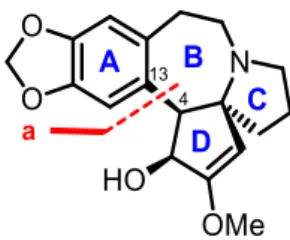
CET (1) can be described as the superposition of two structural units relevant for synthetic strategy choices, namely the pyrrolobenzazepine core ABC 75 and the synthetically challenging azaspiro unit CD 76 (Scheme 2). The three stereogenic centers (C3, C4and C5) are contiguous 15
on the D ring. Weinreb showed that the stereochemistry of the B/D ring fusion (C4/C5) is thermodynamically favoured. In addition, carbonyl reduction of cephalotaxinone (10) delivers CET (1) with the natural configuration at C3.83
20
Scheme 2 Main strategies to access CET (1)
Thirty-two (twenty-one since 1997 described in this review) syntheses of CET (1) concerned its racemic form (Table 9). The number of asymmetric syntheses has grown considerably from only three before 1997 to eighteen until 2015, inflecting the development of asymmetric synthesis, 25
and the efforts to provide a fully synthetic access to the drug (Table 10). The present section describes the recent synthetic strategies organized according to the main carbon-carbon bond
disconnections of the central azepine ring B (Figure 13). Asymmetric syntheses are also classified based on the type of asymmetric center control. The key steps are highlighted for each strategy. Most of these syntheses are formal; nevertheless, the overall yield (OY) of each synthesis up to CET (1) was evaluated. Eight racemic and five asymmetric syntheses of CET (1) are total syntheses, with only one racemic and three asymmetric routes described since mid 5
1997, with experimental overall yield (OY) and ee. The OY and the number of steps (NS) are given from commercially available reagents for comparison purpose. In addition, for convergent syntheses, total number of steps (TNS) which represents the total efforts to be accomplished up to the target molecule, and the corresponding average yield (AY) are given. Synopses of the syntheses of CET (1) reported so far are presented in Table 9 (racemic) and Table 10 10
(asymmetric). Besides formal syntheses targeting Weinreb’s enamine grouped together in Table 9, racemic syntheses are classified according to the type of disconnection of ring B (a–e, Figure 13), then in a chronological order. The asymmetric syntheses are presented in chronological order in Table 10.
15
It is apparent from Table 9 that the syntheses of rac-CET (±)-(1) proceed predominantly (twenty of thirty-three) by the C4–C13 disconnection a. Most of them are linear, nine only being convergent. The most effective total syntheses were described by Kuehne et al.94 in only 11 steps and 11.2% OY (average 82% yield per step) or twelve steps and 17.1% OY, by Ishibashi and Ikeda et al.138 in 19 steps and 15.6% OY (average > 90% yield per step) and by Chandrasekhar et 20
al.120 (6.4% OY in 16 steps, 4.7% AY in 18 TNS). The recent formal synthesis by Hong et al. in
twelve steps and 26.2% OY is the most efficent route.115 The favorite choices as ring A
precursors are piperonal (82) and homopiperonylic acid (89) with C11 and the methylenedioxy group already at the right position.
Table 10 shows that proline (140) is a widely used chiral source (5 over 21 syntheses), either in its natural L form, or in its unnatural D one. Herein, fifteen syntheses are convergent and six are linear. The most efficient total syntheses of CET (–)-(1) (OY > 5%) were reported by Weinreb et 5
al.103 (5.3% OY in 15 steps, 98.5% ee) and by Royer et al.132 (7.5 OY in 16 steps, 98% ee; 5.8% AY in 18 TNS). Formal syntheses by Ikeda et al.137 (5.1% OY and AY in 19 steps, 88% ee), by Dumas and d’Angelo135 (5.4% OY in 20 steps, >95% ee; 4.1% AY in 22 TNS), by El Bialy et
al.140 (12.2% OY in 14 steps, 89% ee; 4.3% AY in 20 TNS) and by Trost et al.129 (13.6% OY in 19 steps, 91% ee; 8.2% AY in 21 TNS) were also efficient.
3.2 Racemic syntheses
3.2.1 C4–C13 ring closure a
The ring closure C4–C13 a (Figure 14) to form the azepine cycle was frequently adopted after Semmelhack’s early extensive developments in the second synthesis of rac-CET ()-(1).83
5
Figure 14 C4–C13 bond disconnection a for elaboration of CET (1) B ring
3.2.1.1 Tietze’s formal synthesis (1997)
10
In 1997, Tietze et al.84 reported an efficient synthesis of Mori’s intermediate ()-8885 in which rings B and C were constructed by two consecutive intramolecular palladium-catalyzed reactions (Scheme 3). The precursor of the D ring and C6–C7–C8 fragment was prepared from 1,3-cyclopentanedione (77) via its enol ether 78. Addition of the Grignard reagent ()-81 and elimination of ethanol followed by tosylation, reduction and acetylation gave the allylic acetate 15
()-81. Alkylation of the bromoamine 84 prepared in four steps from piperonal 82 with the intermediate iodide derivative generated in situ from tosylate ()-81 provided the secondary amine ()-85 bearing the AD ring units which contain all carbon atoms and functionalities required for synthesis completion.
Scheme 3. Formal synthesis of rac-CET (±)-(1)by Tietze (1997)
A palladium-catalyzed Tsuji–Trost allylation furnished the spiro compound ()-86 containing the A and CD ring units. The B ring was formed by a highly stereoselective intramolecular Heck 5
reaction using Herrmann–Beller catalyst 87. The selective formation of Mori’s tetracyclic intermediate ()-88 can be explained by an oxidative addition of the palladium complex to the double bond syn to the nitrogen atom followed by a syn elimination of PdH. Mori’s procedure85
would allow to complete the synthesis of rac-CET ()-(1) in twelve steps (longuest linear sequence) and 5.2% OY from 1,3-cyclopentanedione (77) [2.5% AY in fifteen total number of 10
Suga and Yoshida developed an approach to the azaspiro-compound 101 via ring-closing metathesis of a functionalized pyrrolidine 100 generated by electrochemical oxidation of α,α-bis(trimethylsilyl)pyrrolidine 95 (Scheme 4).86,87
5
Scheme 4. Formal synthesis of rac-CET (±)-(1) by Suga and Yoshida (2002)
First, homopiperonylic acid (89) was used to prepare the A unit 91 bearing a nosylate and an aromatic iodide suitable for ring B annulation, relying on Semmelhack’s procedure.83,88 The two
silyl groups were introduced by Beak’s methodology89 (deprotonation with sec-BuLi and 10
quenching with TMSCl) furnishing compound 94 which was protected into N-methoxycarbonyl compound 95. Its anodic oxidation at low temperature yielded N-acyliminium ion 96, reacting in situ with homoallylmagnesium bromide (97) furnishing pyrolidine 98. This latter compound was next submitted to a second anodic oxidation followed by direct trapping with the organozinc
reagent 99 to provide the diolefin 100. Diene 100 was converted to azaspiro CD unit 101 via ring closing metathesis promoted by Grubbs I catalyst. After deprotection using TMSI, the spiranic amine intermediate reacted with nosylate 91 obtained from homopiperonylic acid (89) following Semmelhack’s procedure.88
The so-formed aryl iodide ()-102 was submitted to an intramolecular Heck-type ring closing 5
reaction according to Tietze84 to give Mori’s intermediate ()-88. Applying Mori’s procedure to complete the synthesis from intermediate ()-88 would provide an access to rac-CET ()-(1) as a linear sequence of 14 steps and 2.2% OY from pyrrolidine 92.
3.2.1.4 Stoltz’s formal synthesis (2007)
10
Stoltz et al. proposed a concise formal route to rac-CET ()-(1) in which the key spirocyclic amine (±)-110 was built through palladium(II)-catalyzed aerobic oxidation (Scheme 5).90 This oxidative cyclization and condensation with ring A-containing aldehyde 104 by reductive amination were the basis to elaborate both enantiomers of CET (1) and (–)-drupacine (16) (see section 3.3.4.3, Scheme 40).
Regioselective bromination of homopiperonylic acid (89) yielded bromocarboxylic acid 103 converted to Weinreb’s amide,2,83 then reduced by DIBAL to furnish aldehyde 104. Different
routes were proposed to prepare the ACD ring–containing aryl bromide 86. The best one starts from β-ketoester 105 tranformed by reduction to allylic alcohol 10691 which was treated with
triethyl orthoacetate under Johnson orthoester-Claisen conditions to give ethyl ester 107. 5
Afterwards, ester 107 was converted in three steps into sulfonamide 108 by successive reduction by LiAlH4, tosylation and nucleophilic displacement by tosylamine. The oxidative
palladium(II)-catalyzed heterocyclization of 108 provided efficiently the spirocyclic tosylamide 109 (scale up to 1.1 g) whose reductive cleavage of the tosyl group with LiAlH4 furnished the desired
spirocyclic amine 110. This compound and the aldehyde 104 were coupled by reductive 10
amination. The resulting tertiary amine ()-86 was converted to the target intermediate ()-88 using stereoselective Heck conditions described by Tietze.84 Including the four steps of Mori’s procedure, this formal synthesis of rac-CET ()-(1) would consist in seventeen steps in 1.6% OY from 89.
15
3.2.1.4 Huang’s formal synthesis (2013)
An efficient synthesis of 1-azaspiro[4.4]nonenes in four steps from γ-butyrolactams (e.g. 113 →
102, Scheme 6) was developed by Huang et al. in 201392 and applied to the synthesis of rac-CET
(1), involving Tietze’s Heck ring closure84 of aromatic iodide ()-10286 (Scheme 6). 20
The γ-butyrolactam 113 was prepared from 2-arylethanol 90 in 65% OY by Mitsunobu’s substitution of the primary alcohol, followed by partial reduction of the crude succinimide 112 with NaBH4 and reductive dehydroxylation of the resulting hemiaminal. Huang’s methodology,
namely activation of compound 113 by triflic anhydride (2,6-di-tert-butyl-4-methylpyridine 5
(DTBMP) was the best base for this reaction) followed by successive addition of buten-1-yl Grignard (97) and vinyl Grignard reagents provided the desired pyrrolidine 114. The hydrochloride salt of the dienyl pyrrolidine 114 was next transformed into the known spiro-pyrrolidine ()-102 under ring-closing metathesis (RCM) conditions (Grubbs’s generation II catalyst). The formal synthesis by Huang et al. was achieved with the synthesis of Mori’s 10
intermediate ()-88 using the palladium-catalyzed Heck-type cyclization of aryl iodide ()-102 developed by Tietze84 and employed by Suga and Yoshida.86 Once again, four steps (Mori’s protocol)85 have to be performed to obtain rac-CET ()-(1), in order to give a 14 steps pathway in 5.4% estimated OY from homopiperonylic acid (89).
15
3.2.1.5 Huang and Wang’s formal synthesis (2015)
In 2015, Huang and Wang proposed a rapid construction of 1-azaspiro[4.4]nonenone (±)-121 via a nitroso-ene cyclization (Scheme 7).93
Scheme 7. Formal synthesis of rac-CET (±)-(1)by Huang and Wang (2015)
Reaction of 1,2-epoxycyclopentane 116 with in situ generated dimethylsulfonium methylide gave allylic alcohol 106 which was directly used for the subsequent Johnson–Claisen 5
rearrangement. The resulting ester 107 was subjected to amidation reaction conditions with hydroxylamine to afford hydroxamic acid 117. The nitroso-ene cyclization was accomplished upon oxidation with tetrapropylammonium periodate via a highly reactive acylnitroso intermediate 118 delivering, N-hydroxy-1-azaspiro[4.4]non-2-one 119 which was trapped as an acetate 120 yielding in moderate yield spiro-lactam (±)-12190 upon SmI2 reduction. Alkylation of
10
the sodium salt of (±)-121 with iodoaryl tosylate 115 gave quantitatively (±)-122. The subsequent Heck reaction promoted by Herrmann–Beller catalyst 87 proceeded smoothly to deliver the ABCD Kuehne’s intermediate94 (±)-123, and the corresponding regioisomeric product (±)-124 in 82% combined yield, based on recovered starting material (brsm) as an inseparable 54:46 mixture. rac-CET ()-(1) could be obtained in twelve steps from cyclopentene 15
oxide (116) and 6.2% OY provided that separation of the regiosiomers is effective and four supplementary steps applied to transform the ABCD intermediate (±)-123 (TNS 15 steps, AY 2.5%, 4.3% brsm). Although Huang and Wang described a rapid access to the CD spirocyclic amide (±)-121, Heck ring closure of ring B led to a mixture of two regioisomers and decreasing dramatically the yield.
5
3.2.1.6 Nagasaka’s formal synthesis (2002)
In 2002, Nagasaka et al. reported a formal synthesis of CET (1),95 through a new access to Hanaoka’s precursor96 ()-139 (Scheme 8), building successively rings C and B. Ring B was
installed by ring expansion of pyrroloisoquinoline 132 which resulted from the cyclization of N-10
acyliminium ion intermediate 131. Alkyne 127 which contains C5, C6, C7 and C8 carbon atoms of ring C and C2, C3 and C4 carbon atoms of the CET skeleton was prepared in four steps (63% OY) from 4-pentyn-1-ol 125. Coupling of 127 with homopiperonylamine 83 (which could be obtained from piperonal 80 in 2 steps and 64% OY), gave amide 128 whose treatment with LiHMDS and catalytic amounts of silver triflate gave the AC enamide 129 by intramolecular N-15
heterocyclization. Oxidation of 129 with dimethyldioxirane delivered the unstable methoxylactam 130 immediately treated with BF3OEt2 producing pyrroloisoquinoline 132 via
the N-acyliminium ion 131. Ring-expansion reaction of the six-membered ring elaborated the seven-membered ring B (132 133). Aldehyde 134 was isolated after debenzylation of 133 followed by Dess–Martin oxidation. The missing C1 carbon atom in aldehyde 134 was 20
introduced by aldol reaction with the lithium enolate of benzyl acetate. Subsequent oxidation of the resulting aldol gave β-keto-ester 135. Formation of ring D was accomplished via Mannich cyclisation of N-acyliminium ion 136 and elimination of hydroiodic acid to produce the enone
138. The final compound of this formal synthesis, spiroketone (±)-139 reported by Hanaoka96
was isolated after decarbobenzyloxylation followed by catalytic reduction. Application of 25
Hanaoka’s procedure (3 steps, 34% OY) to complete the synthesis from compound ()-139 would provide an access to rac-CET ()-(1) in twenty steps and 3.1% OY from 4-pentyn-1-ol
Scheme 8. Formal synthesis of rac-CET (±)-(1)by Nagasaka (2002)
3.2.1.7 Li’s formal synthesis (2007)
In 2007, Li developed a formal synthesis of rac-CET ()-(1) based on a facile Friedel-Crafts 5
cyclization of the amido-spiro-cyclopentenone precursor 148 mediated by triflic acid (Scheme 9).97
Scheme 9. Formal synthesis of rac-CET (±)-(1)by Li (2007)
Reaction of acid chlorides 144 and 145 prepared from homopiperonylic acid 86 and homoveratric acid 143, with proline-derived spirocyclic amino enone (±)-142 led to the amido 5
spirocyclopentenones (±)-146 and (±)-148, respectively. Friedel–Craft cyclization of the methylenedioxy precursor (±)-146 did not led to compound (±)-147 under various acidic conditions due to an electron-deficient aryl system. On the contrary, an efficient Friedel–Craft cyclization of the dimethoxy derivative (±)-148 was observed on treatment with triflic acid yielding Hanaoka’s intermediate98 (±)-149 isolated in 93% yield. In summary, Li described here
10
a concise formal synthesis of rac-CET ()-(1) in thirteen steps from L- proline (S)-140 and 4% evaluated OY.
3.2.1.8 Yang and Liu’s formal synthesis (2009)
Yang and Liu reported two strategies to access to intermediate ()-148 involving a [2,3]-Stevens 15
rearrangement-acid and an acid lactonization sequence as key transformations.99 We describe here the best route which led to Li’s intermediate97 ()-148 via the spirolactone 154 (Scheme 10).
Scheme 10. Formal synthesis of rac-CET (±)-(1)by Yang and Liu (2009)
Spirolactone 154 was obtained from methyl prolinate ()-150 by N-allylation with allyl bromide, leading to allylamine 151 which underwent a [2,3]-Stevens rearrangement of the resulting 5
quaternary ammonium salt by reaction with benzyl bromide providing N-benzyl pyrrolidine 152. After lactonization of 152 under acidic conditions followed by debenzylation through catalytic hydrogenation, spirolactone 154 was acylated with 3,4-dimethoxyphenacetyl chloride (145) to produce the amide spirolactone 155 containing the AC ring units, which was selectively reduced with LiBH4 to diol 156 in 63.9% OY. Swern oxidation of diol 156 furnished the amido
keto-10
aldehyde 157 which was treated with potassium carbonate to give the amido spirocyclopentenone ()-148 with the ACD ring units. This formal synthesis is especially suitable for the production of ()-148 at a scale up to 10-50 g. Li97 and Hanaoka’s98procedures (6
steps, 15% OY) would allow to complete the synthesis of rac-CET ()-(1) in fifteen steps and 7.1% OY from rac-proline ()-(140).
15
3.2.1.9 Zhang and Liu’s formal synthesis (2013)
In 2013, Zhang et al. proposed two pathways for the formal synthesis of rac-CET ()-(1) targeting Li’s enone (±)-174100 and Hanaoka’s enone (±)-18096 based on conventional
alkylations and aldol condensations from known benzazepines101 165 and 166 obtained in 4 steps
from aryl amine 83 (bearing a methylenedioxy substituent) or 158 (bearing two methoxy substituents), respectively (Scheme 11).102
condensation efficiently constructed the CET (1) core in (±)-173. The dimethoxy groups were transformed into the required methylenedioxy group by the usual protocol85 to afford ABCD
enone (±)-174 reported by Li in 2003.100 Application of Li and Weinreb’s103 procedures would
end up a synthesis of rac-CET ()-(1) in seventeen steps from homoveratryl amine (158) and 2.2% calculated OY.
5
These authors also studied the use of methylenedioxybenzazepine 166 as starting material (Scheme 12).
Scheme 12. Formal synthesis of rac-CET (±)-(1)by Zhang and Liu, the “methylenedioxy” route 10
(2013)
Ring C was elaborated by acylation/alkylation of benzazepine 166 with 3-chloropropanoyl chloride (175) to furnish the ABC ketone 176. Treatment with sodium hydride and 2-methoxyallyl bromide (170) produced the enol ether 177 (74%) as a major O-alkylated product 15
along with the desired C-alkylation derivative 178 (22%). Claisen rearrangement allowed conversion of 177 to 178, which was exposed to acid hydrolysis to give dione 179. Intramolecular aldol condensation provided the known amido enone ()-18096 in 95% yield.
Formally, rac-CET ()-(1) could be obtained following Hanaoka’ synthesis96 in a total of sixteen
steps from homopiperonylic acid (89) and 2.5% estimated OY. 20
3.2.1.10 Bubnov’s formal synthesis (2008)
Bubnov et al. developed a convenient and practical methodology for the preparation of various spiro-β-amino alcohols. This procedure was applied to a formal synthesis of rac-CET ()-(1) involving allylboration and RCM to prepare the CD ring containing azaspirobicyclic compound
183 (Scheme 13).104
5
Scheme 13. Formal synthesis of rac-CET (±)-(1)by Bubnov (2008)
2-Pyrrolidone (181) was converted to 2,2-diallylated pyrrolidine 182 by addition of 10
triallylborane. After amine protection, RCM was accomplished with Grubbs I catalyst providing azaspirocyclic carbamate 183 in high yield (three steps, 87% OY). Treatment of 183 with NBS produced tricyclic bromoamide 184. After t-butoxide mediated dehydrobromination affording the spiro olefin 185, an allylic isomerization in the presence of MgBr2 gave 186 as the sole
isomer. Hydrolysis of 186 and acylation with acid chloride 145 were performed in a one-pot 15