HAL Id: inria-00524740
https://hal.inria.fr/inria-00524740
Submitted on 8 Oct 2010
HAL is a multi-disciplinary open access
archive for the deposit and dissemination of
sci-entific research documents, whether they are
pub-lished or not. The documents may come from
teaching and research institutions in France or
abroad, or from public or private research centers.
L’archive ouverte pluridisciplinaire HAL, est
destinée au dépôt et à la diffusion de documents
scientifiques de niveau recherche, publiés ou non,
émanant des établissements d’enseignement et de
recherche français ou étrangers, des laboratoires
publics ou privés.
Right Frontier Constraint for discourses in non
canonical order
Laurence Danlos, Pierre Hankach
To cite this version:
Laurence Danlos, Pierre Hankach. Right Frontier Constraint for discourses in non canonical order.
Proceedings of the Third International Workshop on Constraints in Discourse (CID’2008), 2008,
Post-dam, Germany. �inria-00524740�
Right frontier constraint for discourses
in non-canonical order
Laurence DANLOS Pierre HANKACH Universit´e Paris 7, ALPAGE, IUF France-T´el´ecom
[email protected] [email protected]
1
Introduction
One of the the main characteristics of a coherent (written) discourse is that its constituents are related to each other in a constrained way. The Right Frontier Constraint (henceforth RFC), which is postulated in Seg-mented Discourse Representation Theory (SDRT) [Asher and Lascarides2003] after works in other theories including [Grosz and Sidner1986] and [Polanyi1985], stipulates that while a (written) discourse unfolds a newly introduced constituent cannot be related to any of the other constituents in the preceding discourse. Rather, the constituents of the preceding discourse available for the attachment of a new constituent are those on the “right frontier”. Moreover, RFC is also used as an anaphora resolution constraint.
However, SDRT exclusively concentrates on discourses in “canonical order”, namely, using RST ter-minology [Mann and Thompson1988], discourses in which the Satellite of any nucleus-satellite relation followsthe Nucleus. This paper aims at examining how RFC should be redefined when taking into ac-count discourses in non-canonical order. We concentrate here only on discourses which include a Satellite precedingits Nucleus (to the exclusion of discourses which include a Satellite embedded in its Nucleus).
Section 2 presents how the right frontier is defined and used inSDRTfor discourses in canonical order. Section 3 presents how the right frontier should be redefined and used in SDRT for discourses in non-canonical order.
2
Right Frontier Constraint in
SDRT
2.1
Definition and attachment constraint
The right frontier is defined thanks to the hierarchical structure of discourse representations. The hierarchi-cal structure built inSDRT(at the “information packaging” level) is obtained by differentiating discourse relations of two types: subordinating (nucleus-satellite relation in RST) and coordinating (multi-nuclear inRST). A subordinating relation represents a dominance relationship between the two arguments of the relation. It is geometrically represented by a vertical arrow. InRSTterminology, the dominant argument cor-responds to the Nucleus, the dominated argument to the Satellite. Elaboration, Evidence, Explanation, Background and P urpose are subordinating relations. A coordinating relations indicates that the two arguments are on equal footing and contribute to the same dominant topic. It is geometrically represented by an horizontal arrow. InRSTterminology, both arguments are Nuclei. N arration and Continuation are coordinating relations1.
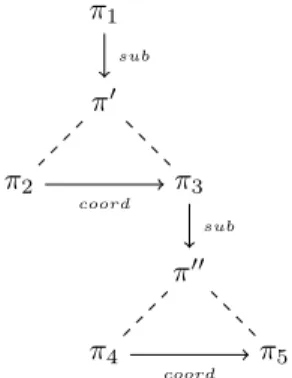
An abstract illustration ofSDRThierarchical discourse structures is depicted in the graph of Figure 1. This graph includes two kinds of nodes:
• πiatomic nodes that are labels of logical forms for atomic clauses,
• π primed nodes (π′, π′′) that are scope nodes which immediatly outscope atomic nodes, e.g i −
outscope(π′, π2). Outscoping relations are represented with dashed lines.
In [Asher and Lascarides2003], the right frontier is defined as being identical to the right frontier of the graph. Namely, it includes the last atomic node and any node that dominates it via a series of outscoping and/or subordinating relations. In Figure 1, the right frontier includes π5, the last atomic node, and the
nodes π′′, π3, π′and π1. π2and π4are not on the right frontier.
1P arallel and Contrast are also coordinating relations, however, they are “structural relations” which are not concerned with
π4 π5 π′′ π3 π2 π′ π1 sub coord sub coord
Figure 1: Illustration ofSDRThierarchical discourse structures
RFC stipulates that only nodes on the right frontier are available for the attachment of a new constituent. This correctly predicts that discourse (1) is infelicitous. The structure of the sub-discourse (1a-e) made up of the first five sentences is the one in Figure 1. The last sentence (f) is supposed to be attached to the second one (b) via Explanation (Mary did the shopping because the fridge was empty), but this is impossible because π2, the label of the logical form for (b), is not on the right frontier, therefore it is not available for
the attachment of a new constituent. (1) a. Mary had a busy day.
b. First, she did the shopping. c. Next, she did some housework. d. She cleaned the kitchen
e. and she vacuumed the dining room. f. #The fridge was empty.
2.2
Anaphora resolution constraint
The right frontier is also used inSDRTfor anaphora resolution. In [Asher and Lascarides2003], it is claimed that an antecedent for any anaphoric expression must be DRS-accessible on the right frontier. This claim seems valid for pronominal anaphors2. For example, it correctly predicts that discourse (2) is infelicitous.
The structure of the sub-discourse made up of the first five sentences (a-e) is the one in Figure 1. The antecedent of the pronoun he in (f) can only be John, an entity which is introduced in (b), but this anaphoric link is impossible because π2is not on the right frontier. On the other hand, (2) becomes acceptable if he
is replaced by John. Therefore, the unacceptability of (2) is only due to the use of the pronoun he, whose antecedent is not on the right frontier.
(2) a. Mary had a busy day.
b. First, she had lunch with John. c. Next, she did some housework. d. She cleaned the kitchen
e. and she vacuumed the dining room. f. #He was in a bad mood.
g. So the lunch was not fun.
However, this constraint does not hold for definite anaphors. Discourse (3) is felicitous3, although the
antecedent of the definite anaphor the duck magret in (f) is in π2which is not on the right frontier.
(3) a. John had a great meal. b. He ate a duck magret.
c. Next, he devoured lots of cheese. d. He tasted some camembert
e. and he also savored some roquefort. f. The duck magret was especially delicious.
2It is also valid for 0 anaphors, see [Asher2008].
In [Asher2008], a solution which heavily relies on “topic nodes” is proposed to handle definite anaphors in discourses such as (3). We will not examine this solution, however we want to discuss the following ques-tion: discourse (3) is obviously a counter-example to RFC as an anaphora resolution constraint when not taking into account constructed topic nodes, but is it a counter-example to RFC as an attachment constraint? The answer to this question depends on the attachment of π6labeling the logical form for (f). As explained
in [Danlos2008], there are two positions. The first one, defended in [Wolf and Gibson2005], is that π6
should be attached to π2via Elaboration since π6 elaborates an entity introduced in π2. Using the
sub-types of Elaboration introduced in [Knott1996], this relation between π6and π2is Elaboration−Object.
The second position, defended by [Egg and Redeker2008] and [Asher2008], is that π6should be attached
to π1 via Elaboration (Elaboration − Event in Knott’s terms). The former amounts to systematically
representing anaphoric links in discourse structures. We think that the latter approach is the right one for two reasons. First, anaphoric links cannot systematically be represented in discourse structure. This is ob-vious for a plural pronoun with disjunct antecedents. In (4), the antecedents of they are the crab salad and the duck magret, however a discourse structure in which π3is linked both to π1and π2is not tenable.
(4) a. John ate a crab salad.
b. He also devoured a duck magret. c. They were delicious.
Second, [Asher2008] rightly insists on the rhetorical role of the last sentence of (3). The use of espe-ciallyin (f) explicitly means that the other elements of the meal were not as delicious. In other words, (f) does not comment only on the duck magret but on the meal as a whole. As a consequence, π6should be
at-tached to π1via Elaboration − Event and not to π2via Elaboration − Objet. Moreover, there is no need
to have a contrastive marker such as especially to get a contrastive effect between an element of a set and the other elements of the set. As an illustration, consider discourse (5a-d) taken from [Wolf and Gibson2005]. The fact that only the price of the basil is described in (d) as being high, implicitly means that the price of the tomatoes was not as high. In other words, (5a-d) and (5a-e) roughly convey the same information.
(5) a. Susan wanted to buy some tomatoes b. and she also tried to find some basil
c. because her recipe asked for these ingredients.
d. The basil would be quite expensive at this time of the year. e. However, the tomatoes would be less expensive.
In discourse (5a-e), (d) and (e) form a complex constituent, whose topic is the price of the ingredi-ents, which is attached to the complex constituent (a-b), whose topic is the buying of the ingrediingredi-ents, via Elaboration(−Event). This means that the anaphoric links between the definite anaphors in (d) and (e) and their respective antecedents in (a) and (b) are not represented in the discourse structure4. Now, since
(5a-d) and (5a-e) roughly convey the same information, their discourses must have compatible discourse structures, the one for (5a-d) being obtained from the one for (5a-e) by suppressing the node π5 for (e)
and any element involving this node. Therefore, in discourse (5a-d), (d) should be attached to the complex constituent formed by (a) and (b) via Elaboration(−Event)5
.
We can add that discourse (6), which differs from (3) in the last sentence (f), is not a felicitous written text. This is due to the fact that the last sentence, which comments on the color of the duck magret, cannot easily induce a contrastive effect with the (color of the) cheese. Therefore, the reader may wonder why the writer adds this information after finishing the description of the meal. She is forced to infer that the duck magret was in some way or other more memorable than the cheeses.
(6) a. John had a great meal. b. He ate a duck magret.
c. Next, he devoured lots of cheese. d. He tasted some camembert
e. and he also savored some roquefort. f. ??The duck magret was a beautiful red.
4If these anaphoric links were represented, then discourse structures for examples such as (5a-e) would exhibit crossing
dependen-cies, as explained in [Egg and Redeker2008] and [Danlos2008].
5By the same reasoning, we also claim that in (5abd), where there is no interposition of a sentence between (d) including the
definite the basil and (b) including its antecedent, (d) should be attached to the complex constituent formed by (a) and (b) via Elaboration(−Event).
Summarizing, the attachment of the last sentence of discourses (3), (5) and (6), which include a definite anaphor whose antecedent is not on the right frontier, doesn’t violate RFC as an attachment constraint. On the other hand, these definite anaphors do violate RFC as an anaphora resolution constraint (when not taking into account constructed topic nodes): this constraint seems to hold only for pronominal anaphors (and 0 anaphors).
3
Right frontier constraint for discourses in non-canonical order
3.1
Discourses in non-canonical order
In SDRT, the following simplification is made: it is assumed that the dominant argument (Nucleus) of a subordinating relation always precedes the dominated one (Satellite)6. As a consequence, a discourse such as (7) with a preposed subordinate clause introducing the Satellite before the Nucleus is not dealt with in SDRT.
(7) a. As John is sick,
b. he didn’t go to work today.
π2
π1
Explanationl
Following [Danlos2008], discourses in which the Satellite of a subordinating relation precedes the Nu-cleus are said to be “in non-canonical order”. Given a subordinating relation R, if its Satellite is on the right of its Nucleus (canonical order), it is noted Rr and is typed as a “right subordinating” relation,
otherwise (non-canonical order), it is noted Rl and typed as ‘left subordinating”. For example, in (7),
Explanationl(π2, π1) holds and the graph of the discourse structure contains a vertical arrow going from
the Nucleus π2down to the Satellite π1.
Now we are ready to tackle the following questions: how should the right frontier be defined for dis-courses in non-canonical order? Can we postulate a right frontier constraint for attachment of a new con-stituent and/or for pronoun resolution which holds for discourses in canonical and non-canonical order? Since definite anaphora are not concerned with RFC for discourses in canonical order (Section 2.2), they are not studied for discourses in non-canonical order.
Before we continue, let us make a methodological remark. The issue of attachment of new information in discourse update should not be confused with the issue of anaphora resolution. This doesn’t mean that discourse update and anaphora resolution must be considered as independent tasks which are performed sequentially. However, even if these two tasks are dependent and performed simultaneously, the issues they raise must be discussed separately. Therefore, Section 3.2 is dedicated only to the former issue. It presents only examples with no anaphora resolution problem: either these examples don’t include anaphora or they do so but only in the case where the antecedent of a pronominal anaphor appears in the clause immediately preceding the clause in which the pronoun appears (a case which is known to be unproblematic). Section 3.3 tackles the issue of pronominal anaphora resolution.
We draw a parallel between the discourse notions of Nucleus and Satellite and the syntactic notions of head and modifier. A Nucleus plays the role of a head, a Satellite the role of a modifier. In syntax, the following rules hold.
Syntactic rule 1 Two modifiers can share the same head.
Syntactic rule 2 Two heads cannot share the same modifier.
Syntactic rule 3 A given element can play two roles, head and modifier.
We postulate that these syntactic rules can be extrapolated to discourse through the notions of Nucleus and Satellite.
3.2
Attachment of new information
First, we examine discourses which start with a left subordinating relation Rl(π2, π1), in other words
dis-courses starting with a left Satellite π1(to simplify, the first clause7) followed by a Nucleus π2(to simplify, 6This simplification is not made inRST: the Satellite of a subordinating relation follows or precedes the Nucleus.
7The left Satellite can be a complex constituent built around a coordinating relation. For example, in (8), we have
the second clause8). Next, we examine left subordinating relations that appear in the middle of a discourse
(Section 3.2.2).
3.2.1 Left subordinating relations at the beginning of a discourse
For discourses starting with a left subordinating relation Rl(π2, π1), the Nucleus π2is clearly available for
attachment of new information, i.e. attachment of a third clause represented in π3. As shown below, π2can
be linked to π3via a right and left subordinating relation or via a coordinating relation.
• Discourse (10) exemplifies the case where π2 is linked to π3 via a right subordinating relation,
P urposer. (10) illustrates Syntactic rule 1 for discourse: two satellites, π1and π3, share the same
nucleus π2.
(10) a. As it was hot,
b. John went walking in the garden.
c. to get some fresh air. π3
π2
π1
P urposer Explanationl
• Discourse (11) exemplifies the case where π2is linked to π3via a left subordinating relation, Backgroundl;
(11) illustrates Syntactic rule 3 for discourse: a given element, π2, is both the Nucleus of π1and the
Satellite of π3.
(11) a. As the wind had chased the clouds away, b. it was pretty sunny.
c. John went walking in the garden.
π3
π2
π1
Backgroundl
Explanationl
• Discourse (12) exemplifies the case where π2is linked to π3via a coordinating relation, N arration.
(12) a. As the fridge was empty b. John did the shopping. c. Next, he went to the movies.
π3
π2
π1
N arrationr Explanationl
So the question at stake for discourses starting with a left Satellite π1is the following: is it possible to attach
new information π3to this left Satellite? To answer this question, we must examine three types of relations
(coordinating, left and right subordinating) possibly linking π1and π3.
It seems impossible to link π1 and π3 via a coordinating relation: (13) with N arration(π1, π3) is
infelicitous, and we speculate that any discourse with this structure is infelicitous. (13) a. While John was shopping,
b. he was in a good mood.
c. #Next, he went to the movies. π3
π2
π1
N arration Backgroundl
We want to stress the following point. In (13), we can replace the anaphoric link between John in (a) and he in (b) by a cataphoric link between he in (a) and John in (b), see While he was shopping, John was in a good mood. Next, he went to the movies.This anaphora/cataphora switch doesn’t drastically change the (un)acceptability of (13). Similarly, for the following discourses, we claim that such an anaphora/cataphora switch doesn’t drastically change their acceptability. Cataphora are discussed in Section 3.4.
(8) a. It was sunny
b. and spring was coming.
c. Mary took a long walk in the garden.
π3 π2 π′ π1 Backgroundl Continuation
8The Nucleus can also be a complex constituent built around a coordinating relation. For example, in (9), we have
Backgroundl(Continuation(π2, π3), π1).
(9) a. It was pretty hot. b. John went into the garden.
c. and Mary went into the cave. π2 π3
π′
π1
Backgroundl
It is also impossible to link π1and π3via a left subordinating relation, which would mean that π1is the
left Satellite both for the Nuclei π2 and π3. This case can be excluded by a general rule stating that two
Nuclei cannot share the same Satellite, which extrapolates Syntactic rule 2 for discourse.
We are left with linking π1 and π3 via a right subordinating relation9. This case is illustrated with
(15abc) which is intended to display Explanationr(π1, π3) and which sounds a little unnatural, or with
(15abd) which displays Elaborationr(π1, π3) and which sounds better without being perfect.
(15) a. As John was sick,
b. he didn’t go to the meeting on Tuesday.
c. ??He had gone jogging in the rain the day before. d. ?He had a bad flu.
π2 π1 π3(c) Explanationl Explanationr π2 π1 π3(d) Explanationl Elaborationr
The unpleasant acceptability of discourses such as (15abc) or (15abd) can be explained intuitively. Namely, since the most salient argument of a left subordinating relation – the Nucleus – follows the argu-ment that depends on it – the Satellite – , the Nucleus is likely to eclipse the Satellite, making impossible to attach new information to it. Nevertheless, this intuition fails when considering (16), which a priori displays Elaborationr(π1, π3) and which sounds perfect.
(16) a. As John was drunk, b. he fell down on the stairs.
c. He had 2 grammes of alcohol in his blood. π2 π1 π3 Explanationl Elaborationr π3 π′ π2 π1 Explanationl Evidencer
In (16), there is a coreference relation between John’s states described in π1 and π310. If (16) were
in canonical order, namely (16bac) switching John and he in (a) and (b), the analysis with Elaborationr
reflecting the coreference relation would be undebatable and unproblematic when (16) is uttered in a non-null left context. However, we will show in the next section that analyzing (16) with Elaborationr(π1, π3)
leads to a crossing dependency when (16) is uttered in a non-null left context. Therefore, with the aim of avoiding crossing dependencies in discourse structures, one can argue that the coreference relation between John’s states described in π1and π3should have no counter-part in the discourse structure, which would
then not include Elaborationr(π1, π3). This position is in the spirit of what was under discussion in
Section 2.2, namely some anaphoric (coreference) links must not be represented in discourse structures. If π3is not attached to π1via Elaborationr, then how and where should π3be attached?
A first solution consists in considering that π3provides background information to John’s falling or to
the causal relation between John’s being drunk and his falling. In other words, Backgroundr(π2, π3) or
Backgroundr(π′, π3) with a complex constituent π′defined by i − outscope(π′, Explanationl(π2, π1))
should hold instead of Elaborationr(π1, π3). However, one must note the incoherence of discourse (17)
which differs from (16) in the first sentence11. In (17), the first and third sentences describe both a state
of John, but without a coreference relation (a background information that doesn’t describe a state of John may be possible, see As John was drunk, he fell down on the stairs. It was pretty hot., however, this is not at the heart of the matter).
(17) a. As John had a high temperature, b. he fell down on the stairs.
c. # He had 2 grammes of alcohol in his blood.
9We put aside any example displaying Correctionr(π
1, π3) since Correctionris, according to [Asher and Lascarides2003], a
special subordinating relation whose first argument is not compulsorily on the right frontier. Discourse (14) is perfect, but we don’t use it to prove that the left satellite π1is an available site of attachment.
(14) a. As John claimed he was sick, b. he didn’t go to the meeting yesterday. c. In fact, he was in a lazy mood.
π2
π1
π3
Explanationl
Correctionr
10This coreference relation implies that the discourse relation Elaboration between π
1 and π3 is of a sub-type called
P articularization in [Danlos2001].
11(17) becomes coherent if also is added to (c), see He also had 2 grammes of alcohol in his blood. Then π
3is another explanation
The contrast between (16) and (17) shows that supposedly background information describing a state of John is possible only when there is a a coreference relation between John’s states described in π1and π3.
This constraint on attachment of background information to π2or to Explanationl(π2, π1) looks ad hoc
since the discourse relation Background imposes only an (overlap) temporal constraint on its arguments. Therefore, we think that the solution which consists in attaching π3 via a relation Backgroundr is not
tenable.
A second solution (advocated by B. Sagot, p.c.) consists in considering that π3provides some evidence
for the causal relation between John’s being drunk and his falling. This analysis amounts in saying that the quantity of alcohol in John’s blood makes that the probability of John falling when going downstairs or upstairs was high: his falling was highly predictable. With this solution, the obligatory coreference between John’s states described in π1and π3is explained in the following informal terms (inspired from the
semantic constraint imposed by Evidence on its arguments that is given in [Asher and Lascarides2003]): if γ provides some evidence for a causal relation α ⇒ β, which is an instance of a causal law A ⇒ B, then γ must be an instance of A such that the probability of γ ⇒ β is strictly greater than the probability of α ⇒ β12. Without starting a discussion on the precise definition of A, we can assume that stating α and γ
are both instances of A is equivalent to stating they are in a coreference relation.
In conclusion, the analysis of (16) as Explanationl(π2, π1) ∧ Evidencer(π′, π3) – in which π′ is
defined by i − outscope(π′, Explanationl(π2, π1)) – which indirectly explains the obligatory coreference
relation between John’s states described in π1and π3, is a tenable solution. It competes with the a priori
analysis Explanationl(π2, π1) ∧ Elaborationr(π1, π3), which directly reflects the coreference relation
between John’s states described in π1and π3.
We don’t want to come out in favor of one of these two solutions right now. However, we are going to show that adopting one or the other solution for analyzing (16) has a drastic consequence when this discourse is uttered in a non-null left context: the second solution leads to a crossing dependency.
3.2.2 Left subordinating relations in the middle of a discourse
We concentrate on left subordinating relations that appear just after the first clause π1, so left subordinating
relations noted Rl(π3, π2). For such cases, π1can be linked to the left Satellite π2neither via a coordinating
relation nor via a right subordinating relation13. Therefore, since π
1must be linked to at least another
dis-course constituent, we assume that it is linked to π3, via a coordinating or right subordinating relation, see
(19a-c) with N arration(π1, π3) or (20a-c) with Explanationr(π1, π3). For such discourses, the question
at stake is the following14: is it possible to attach new information labeled π
4 to the left Satellite π215?
If the answer is positive, it means that discourse structures can exhibit crossing dependencies, the relation Ra(π1, π3) crossing Rb(π2, π4) when Rais subordinating.
(19) a. John entered the living room. b. As he was tired,
c. he sat down on the sofa.
d. ??He had been running around all day
π3
π2
π1
N arration
Explanationl
(20) a. John broke his leg yesterday. b. As he was drunk,
c. he fell down on the stairs.
d. He had 2 grammes of alcohol in his blood. π2
π1
π3
Explanationl Explanationr
12Along the same lines, if γ is some counter-evidence for a causal relation α ⇒ β, which is an instance of a causal law A ⇒ B,
then γ must be an instance of A such that the probability of γ ⇒ β is strictly lower than the probability of α ⇒ β. The difference between evidence and counter-evidence for a causal relation stands in that counter-evidence should be lexically marked, see (18) where (c) is introduced by the contrastive connective yet.
(18) a. As John was drunk, b. he fell down on the stairs.
c. Yet, he had (only) 0.5 gramme of alcohol in his blood.
13The latter case is excluded by an extrapolation of Syntactic rule 2 to discourse. 14Such discourses, especially the ones whose left satellite π
2is not introduced by a connective, see (21) in note 17, also raise
a question for the information package level: how can the relations Ral(π2, π3) and Rb(π1, π3) be computed in a (left-to-right)
incremental way? However, this question is left aside in this paper.
15Only attachment to π
2via a right subordinating relation is considered, coordinating and left subordinating relations being excluded
Discourse (19a-d) which is intended to display Explanationr(π2, π4) sounds unnatural as (15abc)
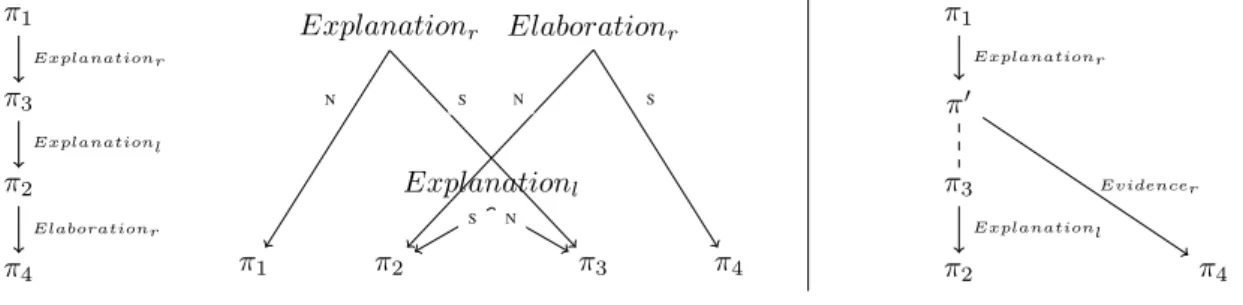
does. On the other hand, (20a-d) sounds natural as (16) does. Our discussion on the discourse structure of (16) has shown that two solutions can be contemplated. By the same reasoning, we can conclude that two discourse structures can be contemplated for (20). They are depicted in Figure 2 asSDRTgraphs and as a dependency graph (DAG) [Danlos2004, Danlos2008] for the discourse structure which exhibits a crossing dependency, Explanationr(π1, π3) crossing Elaborationr(π2, π4)16.
π2 π1 π3 π4 Explanationl Explanationr Elaborationr π1 π2 π3 π4 Explanationl Explanationr Elaborationr S N S N S N π4 π1 π′ π3 π2 Explanationl Evidencer Explanationr
Figure 2: SDRTgraphs and dependencyDAGfor (20)
3.2.3 Conclusion
Both the acceptabilities and the analyses of the discourses presented in the preceding sections are debat-able17. Further investigation on real corpus examples is clearly needed. However, it seems that we can draw the following conclusion. A left Satellite which occurs at the beginning or in the middle of a discourse can be an available attachment node but only in a restricted way, i.e. only as the first argument of a right subordinating relation (excluding any left subordinating and coordinating relation), and not for any right subordinating relation. When it occurs in the middle of a discourse, the attachment of new information to it could lead to a crossing dependency, although it is often claimed that discourse structures don’t ex-hibit crossing dependencies [Mann and Thompson1988, Asher and Lascarides2003, Egg and Redeker2008, Webber et al.2003].
With this conclusion, we are able to define the right frontier for discourses in canonical and non-canonical order. The right frontier is identical to the right frontier ofSDRT graphs. Namely it includes the last atomic node, any node that dominates it and any node that it dominates18. RFC as an attachment
constraint is stated as follows: the available nodes for attachment of new information are those on the right frontier, although attachment to a left Satellite – a node that is dominated by the last atomic node – is constrained in a way which needs further investigation.
3.3
Pronominal anaphora resolution
First, we can note that (22abc) and (22abd) are unacceptable. (22) differs from (15) in the subject of the second sentence (b) which is Mary instead of he referring to John. The fact that the acceptability of (22abc) or (22abd) is worst than the one of (15abc) or (15abd) can be explained by the fact that the pronoun he in the third sentence (c) or (d) has its antecedent in the left Satellite π1, which is intuitively eclipsed by the
Nucleus π2.
(22) a. As John was sick,
b. Mary didn’t go to the meeting on Tuesday. c. # He had gone jogging in the rain the day before. d. # He had a bad flu.
16In the discourse structure with a crossing dependency, we have not considered that π
3and π2linked via Explanationlform a
complex constituent π′. This is not a crucial point because there is a crossing dependency with or without π′, as the reader can check. 17The reader can also examine the discourse structure of (21), in which (b) is introduced by no connective but is linked to (c) by
and.
(21) a. John broke his leg yesterday. b. He was drunk
c. and he fell down on the stairs.
d. He had 2 grammes of alcohol in his blood.
However, (23abc) and (23abd) are totally acceptable. In these discourses, π3 is attached to π2 via
the right subordinating relation P urposerin (23abc) and via the coordinating relation Result in (23abd).
The third sentence (c) or (d) contains a pronoun whose antecedent is Mary introduced in the first sentence (a). Therefore, these discourses show that the left Satellite π1 must be considered as a member of the
right frontier. It has to be stressed that the acceptability of (23abc) is an argument against Veins Theory [Cristea et al.1998], see the quote “The vein definition formalizes the intuition that in a sequence of units A B C, where A and C are satellites of B, B can refer to entities in A (its left satellite), but the subsequent right satellite, C, cannot refer to A due to the interposition of nuclear unit B.”
(23) a. While Mary was taking a nap, b. John cooked a duck `a l’orange(.) c. to please her.
d. She was pleased.
π2 π1 π3(c) Backgroundl P urposer π2 π1 π3(d) Backgroundl Result
In conclusion, we can keep the definition of the right frontier for discourses in canonical and non-canonical order which was given in Section 3.2.3. RFC as a pronominal anaphora resolution constraint is valid both for discourses in canonical and non-canonical order.
3.4
Cataphora resolution
It is well known that a preposed subordinate clause can include a cataphoric pronoun, see (24) in which he in (a) refers to John in (b).
(24) a. As he was sick,
b. John didn’t go to the meeting today.
Cataphora are not dealt with in SDRT since only discourses in canonical order are dealt with. They obviously violate RFC as a pronominal anaphora constraint. Therefore, this constraint must be redefined with the addition of the case where a pronoun appears in the first clause of a discourse (generally within a preposed subordinate clause): this pronoun finds its referent in the subsequent clause.
4
Conclusion and future research
When taking into account discourses in non-canonical order with Satellites preceding Nuclei, the right fron-tier can be redefined so that it contains the last atomic node, any node that dominates it and any node it dominates. With this new definition, RFC holds as an attachment and pronominal anaphora resolution con-straint both for discourses in canonical and non-canonical order. However, attachment of new information to a left Satellite on the right frontier is constrained: a new constituent can be attached only via a right subordinating relation (to the exclusion of left subordinating and coordinating relations), and this kind of attachment is not always allowed.
This study has been based on artificial constructed examples. Obviously, it needs to be validated by real corpora examples. For that, we intend to find left Satellites in the Penn Discourse Treebank [The PDTB-Group2008] for English and in the annotated corpora Annodis for French.
Further research will concern other types of discourse in non-canonical order, for example discourses including Satellites embedded in Nuclei.
Acknowledgments
We want to thank Nicholas Asher, Benoˆıt Sagot and Alexandros Tantos for their very fruitful comments, and also Andr´e Bittar for editing our English.
References
[Asher and Lascarides2003] Nicholas Asher and Alex Lascarides. 2003. Logics of Conversation. Cam-bridge University Press, CamCam-bridge.
[Asher2008] Nicholas Asher. 2008. Troubles on the right frontier. In A. Benz and P. K¨uhnlein, editors, Constraints in Discourse. Benjamins.
[Cristea et al.1998] Dan Cristea, Nancy Ide, and Laurent Romary. 1998. Veins theory: A model of global discourse cohesion and coherence. In Christian Boitet and Pete Whitelock, editors, Proceedings of the Thirty-Sixth Annual Meeting of the Association for Computational Linguistics and Seventeenth Inter-national Conference on Computational Linguistics, pages 281–285, San Francisco, California. Morgan Kaufmann Publishers.
[Danlos2001] Laurence Danlos. 2001. Event coreference between two sentences. In H. Bunt, editor, Computing Meaning (volume 2), pages 271–288. Kluwer Academic Publishers, Amsterdam.
[Danlos2004] Laurence Danlos. 2004. Discourse dependency structures as constrained DAGs. In Pro-ceedings of SIGDIAL’04, pages 127–135, Boston.
[Danlos2008] Laurence Danlos. 2008. Strong generative capacity of RST, SDRT and discourse depen-dency DAGs. In A. Benz and P. K¨uhnlein, editors, Constraints in Discourse. Benjamins.
[Egg and Redeker2008] Markus Egg and Gisela Redeker. 2008. Underspecified discourse representation. In A. Benz and P. K¨uhnlein, editors, Constraints in Discourse. Benjamins.
[Grosz and Sidner1986] Barbara Grosz and Candace Sidner. 1986. Attention, intention, and the structure of discourse. Computational Linguistics, 12(3):175–204.
[Knott1996] Alistair Knott. 1996. A Data-driven Methodology for Motivating a Set of Coherence Rela-tions. Artificial intelligence thesis, University of Edinburgh.
[Mann and Thompson1988] William C. Mann and Sandra A. Thompson. 1988. Rhetorical structure theory: Toward a functional theory of text organization. Text, 8(3):243–281.
[Polanyi1985] Livia Polanyi. 1985. A theory of discourse structure and discourse coherence. In P.D. Kroeber, W.H. Eilfort, and K.L. Peterson, editors, Papers from the General Session at the 21st Regional Meeting of the Chicago Linguistics Society.
[The PDTB-Group2008] The PDTB-Group. 2008. The Penn Discourse Treebank 2.0. Annotation Manual. Technical Report IRCS-08-01, Institute for Research in Cognitive Science, University of Pennsylvania. [Webber et al.2003] B. Webber, A. Joshi, M. Stone, and A. Knott. 2003. Anaphora and discourse structure.
Computational Linguistics, 29(4):545–587.
[Wolf and Gibson2005] Florian Wolf and Edward Gibson. 2005. Representing discourse coherence: a corpus-based study. Computational Linguistics, 31(3):249–287.