Airborne Internet
-
Market & Opportunity
byAnand Bhadouria
B.S. Information Technology (2004)University Of Massachusetts Lowell
Submitted to the System Design and Management Program in Partial Fulfillment of the Requirements for the Degree of Master of Science in Engineering and Management
at the
Massachusetts Institute of Technology
January 007
2007 Massachusetts Institute of Technology All rights reserved
Signature of Author
Anand Bhadouria
System Design and Management Program
January 2007
Certified by
N
M
7()(,,Mary
Tripsas
Thesis Supervisor
d Business SchogP\
Certified byDirector
AACUSTIITTE System Design & Management Program
OF TECHNOL0GY
BARKER
ABSTRACT
The purpose of this thesis to evaluate the opportunity for service provider entry and of the airborne internet, to analyze the disruptive impact technology used by AirCell and AeroSat has had on the development of an airborne internet, and to identify various stake holders and their value propitiation.
The airborne internet has the potential to change the way we fly and spend time when sitting in the plane. In the last fifty years, there has not been much technological advancement in the air traffic control system. Airplane operation still depends on current ground control and radar systems that are very expensive and very difficult to scale. These technologies are also heavily dependant on humans. There have been many technological advancements out side of the aviation industry. Establishing an airborne internet is a tremendous opportunity for everyone. With the help of an airborne internet, each plane can transmit its identity, location, and also direct video footage that will help Homeland security fight against terrorism.
The airborne internet has the ability to connect airplanes not just via a computer on the ground (or via satellite) but directly with each other, relaying information from other planes in an Internet-like fashion. The airborne internet is strongly supported by the Pentagon, FAA and
NASA.
The U.S. Air Force and FAA are working on defining the architecture of an airborne network and hope to begin actively developing and testing the network itself between 2008 and 2012. According to the FAA, in 2005 there were 10 million flights carrying a total of 660 million
passengers in the United States. For the FAA there are a number of merits to working with an airborne internet service provider to continue tests and validate the technical and economic feasibility of an airborne internet. First, there appears to be a substantial market -- in the range of $1 b -- for services that require internet connectivity on the air for the commercial airline, air cargo, business jet, and general aviation sector. Second, current alternatives such as satellite solutions and existing air-to-ground solutions fail to meet all the needs of the mass market.
Satellite solutions provided by companies such as Inmarsat, Iridium, and Globalstar are priced at a premium and carry an expensive cost structure from the maintenance and investment in orbiting satellites.
Airborne Internet service can be offered through three different technologies first, a satellite solution offered by Boeing; second, air-to-ground systems provided by companies such as AirCell; and third, a network of airplane ground -to - air system like AeroSat, all of which are compatible with the planned FAA architecture. Boeing's model is prohibitively expensive; a
business model for an airborne internet solution based on a South West Airlines type low cost approach may make an airborne internet more feasible The model would rely on low service fees to promote greater consumer usage, high capacity utilization of ground stations to promote
margins, low aircraft equipment costs to help cash flows, and risk/reward sharing with airlines to promote aircraft operator adoption. Assuming that a service provider relied on revenue from
non-FAA related services, it could still generate ample margins to support other general FAA applications behind the scenes. The FAA can demonstrate overall support for an airborne
internet vision, help attract key players to the ecosystem needed to implement the system, promote usage, and drive required airline ROI. The FAA could also drive the implementation of industry standards required to eventually ensure globally consistent services.
However, even with these clear benefits, there are a few key risks that need to be considered and further evaluated. First, this analysis evaluated the economic feasibility of an airborne internet. It does not take into consideration testing or validating the potential network performance from AeroSat's innovative mesh approach in an actual pilot test. Second, more extensive demonstrations will be required to further validate performance and the related cost for the supporting infrastructure. Some key economics like the number of antennae required on aircraft as the network grows should be explored in greater detail after initial simulations. Finally, uncertainty over potential developments of spectrum-free solutions, evolutes of ultra-wideband with potentially disruptive cost structures, could slow the market from adopting a spectrum-based solution. Although this is unlikely given the FAA's current stance on the use of UWB, the issue is worth further research and conversations with the FAA.
Accordingly, continued testing, development, and analysis to test feasibility and clarify the key unknowns is recommended. There are a few areas that deserve special attention. First, the target customer composition required to drive the business model should be finalized. The reliability and performance of the mesh-approach is partly dependent on the density of air-traffic in relation to the location of installed ground stations. Second, spectrum requirement issues, including the cost of acquisition and regulatory compliance, need clarification as they strongly impact the business model. Third, the potential magnitude and variability of assumed revenue sources, as well as the timing of cash collections across key customer segments, should be explored. Both of these impact the assumed free-cash-flows generated by the potential business model. Finally the potential terms of airline risk/reward sharing contracts required to equip aircraft with different quantities and types of antennae, need further exploration. Air carriers seem to be moving away from models where they absorb all of the equipment/certification costs - the economic feasiblity of a potential service provider depend on the service provider's ability to offer airlines this service at a reasonably good rate.
ACKNOWLEDGEMENTS
This thesis is the culmination of the author's successful completion of the System Design
and Management (SDM) Program at Massachusetts Institute of Technology (MIT). I would like to thank the faculty, staff, and my class mates who have supported the SDM program and helped me learn about system management. Though courses such as System Architecture, System Engineering, Engineering Risk Benefit Analysis, Operations
Management I learned quite a bit about system management. I learned the business side
by taking courses at Harvard Business School such as Competing with Business Model and
Business Marketing. At MIT Sloan, Disruptive Technologies and Technology Strategy classes also contributed to my understanding of this topic.
A special thanks to my HBS thesis advisor Professor Mary Tripsas and MIT SDM Director
Pat Hale for guiding me through the process and providing me help. I would also like to thank Professor Edward Crawley for giving me a Teaching Assistance position. I learned a lot about system architecture while assisting him on his course.
I would like to thank AeroSat for giving me the opportunity to work as an intern on the very
interesting airborne internet topic. I found this topic very fascinating and decided to take it on as a thesis.
Lastly, and most importantly, I would like to thank Mamta my wife for her patience, support and encouragement during the last two years. You are the love of my life, a remarkable wife, and mother. To my children Aishwarya and Aryan, thank you for your patience your Dad is almost done.
TABLE OF CONTENTS L ist o f F ig u re s ... . .. 7 L ist o r T a b le s ... . . 8 T able of A bbreviations... . . 9 In tro d u c tio n ... . . 12 Overview T e ch no lo g y ... . . 14 M a rke t ... . . 18
Airborne Internet Testing ... 24
B oeing T echnology... . 25
A ir C e ll T echno logy ... . 26
AeroSat Technology ... 27
Disruptive Technology ... 27
Analysis S takeho lder A na lysis... . 29
Interests of FAA and FCC... 30
Interests of Airline Industry...31
Interests of Potential Service Provider...33
Interests of Potential Investors... 34
T h e In te rs e ctio n ... 3 4 T he A lte rnative ... . . 35 A e roS a t's S o lutio n ... . 39 F in a n c ia ls ... . . 4 0 E c o syste m ... . .. 4 8 S ta n d a rd s ... . 5 0 Evaluation
K e y R is ks ... . 5 1
Key Factors For Success... 52
General Conclusions ... 55
Appendices Appendix1: Meeting FAA Interests...56
Appendix 2: Aircraft Quantity Used To Drive Segment Size Estimates ... 59
Appendix 3: Frequency Definitions...60
Appendix 4: Competitor SW OT analysis...61
LIST OF FIGURES
F ig u re 1 ... . . 1 4 F ig u re 2 ... . 1 5 F ig u re 3 ... . 1 6 F ig u re 4 ... . 1 8 F ig u re 5 ... . . 1 9Figure 6: Diagram of Potential Market Size by Segment ... 22
F ig u re 7 :...2 3 Figure 8: Frost & Sullivan Chart On Potential Growth Of Internet Connectivity Segment...23
F ig u re 9 ... . .. 2 5 F ig u re 1 0 ... . . 2 6 F ig u re 1 1 ... . . 2 6 F ig u re 1 2 ... . . 2 7 F ig u re 1 3 ... . . 2 8 F ig u re 1 4 ... . . 2 8 F ig u re 1 5 ... . . 2 9 F ig u re 1 6 ... . . 3 0 F ig u re 1 7 ... . . 3 2 F ig u re 1 8 ... . . 3 2 F ig u re 1 9 ... . . 3 3 Figure 20: Example of a feasible financial model for airborne internet ... 41
Figure 21: Major factors affecting airborne internet provider business model ... 42
Figure 22: Elasticity estimate from Forrester research ... 43
Figure 23: Revenue and risk sharing relationship for a potential commercial airline ... 45
LIST OF TABLES
Table 1: Comprehensive list of applications by potential segment ... 20
Table 2: List of potential FAA related applications and required network features... 31
Table 3: Summary of competitive offerings... 36
Table 4: Customer requirements by segment... 39
Table 5: Example of infrastructure cost assumptions...46
2-D
3-D
4-D
ACAS
ACC
ADS
ADS-B
ADS-C
AEEC
AGDL
A-EXEC
AIC
AIRSEP
AMAN
AMC
AMN
AM(S)S
AMS(R)S
ANSP
AO
AOA
AOC
AP
APP
APT
ARP
ARMAND
AS
ASAS
ASPA
ATC
ATCO
ATFM
ATG
ATM
ATN
ATS
ATSA
ATSU
BGP
bps
Bps
CAGR
C&P
CDM
CDTI
TABLE OF ABBREVIATIONS
Two Dimensional (latitude and longitude)
Three Dimensional (latitude, longitude and altitude)
Four Dimensional (latitude, longitude, altitude, and time)
Aircraft Collision Avoidance System
Area Control Centre
Automatic Dependent Surveillance
Automatic Dependent Surveillance - Broadcast
Automatic Dependent Surveillance - Contract
Airlines Electronic Engineering Committee
Air/Ground Data Link
Automatic Execution Service
Aeronautical Information Circular
Air-to-Air Self-Separation Service
Arrival Manager
ATC Microphone Check
Airspace Management and Navigation
Aeronautical Mobile (Route) Service
Aeronautical Mobile Satellite (Route) Service
Air Navigation Service Provider
Airline Operations
Autonomous Operations Area
Aeronautical Operational Control
Action Plan
Approach Control
Airport
Address Resolution Protocol
Arrival Manager Information Delivery Service
Airborne Surveillance
Airborne Separation Assistance System
Airborne Spacing
Air Traffic Control
Air Traffic Control Officer
Air Traffic Flow Management
Air to ground
Air Traffic Management
Aeronautical Telecommunication Network
Air Traffic Services
Airborne Traffic Situational Awareness
ATS Unit
Border Gateway Protocol
bits per second
Bytes per second
Compound Annual Growth Rate
Crossing and Passing
Collaborative Decision-making
Cockpit Display of Traffic Information
CFMU
Central Flow Management Unit
CNS
Communication, Navigation and Surveillance
D-ALERT
Data Link Alert
D-ATIS
Data Link ATIS
D-ATSU
Downstream ATSU
DHCP
Dynamic Host Configuration Protocol
DYNAV
Dynamic Route Availability
E2E
End to End
EASA
European Aviation Safety Agency
EMER
Emergency
ENR
En route
ETA
Estimated Time of Arrival
ETD
Estimated Time of Departure
FAA
Federal Aviation Administration
FCC
Federal Communications Commission
FCI
Future Communications Infrastructure
FCS
Future Communications Study
FDPS
Flight Data Processing System
FIS
Flight Information Service
FLIPCY
Flight Plan Consistency
FTP
File Transfer Protocol
GA
General Aviation
GAT
General Air Traffic
GBAS
Ground-Based Augmentation System
GIS
Geographical Information System
GNSS
Global Navigation Satellite System
GPS
Global Positioning System
GRECO
Graphical Enabler for Graphical Co-ordination
GS
Ground Surveillance
GTA
Ground to Air
HF
High Frequency
IATA
International Air Transport Association
ILS
Instrument Landing System
IP
Internet Protocol
ISP
Internet Service Provider
kbps
Kilobits per second
kHz
Kilohertz
KIAS
Knots Indicated Air Speed
kph
Kilometers per hour
LAN
Local Area Network
MAC
Media Access Control
MHz
Mega-Hertz
m/s2
Metres per second squared
ms
Milliseconds
n/a
Not available
NOC
Network Control Center
NGATS
Next Generation Air Transportation System
NIC
Network Interface Card
NPV
Net present value
0SI
Open System Interconnection
OSPF
Open Shortest Path First
PC
Personal Computer
PSR
Primary Surveillance Radar
P2P
Peer-to-Peer
QoS
Quality of Service
RARP
Reverse Address Resolution Protocol
RCP
Required Communication Performance
RF
Radio Frequency
ROI
Return-on-Investment
rsvd
Reserved
RTA
Required Time of Arrival
RTD
Required Time of Departure
RTF
Radio Telephony
SRS
Standard Routing Scheme
SSR
Secondary Surveillance Radar
STAR
Standard Terminal Arrival Route
SWIM
System Wide Information Management
TBD
To be determined
TCP
Transmission Control Protocol
VHF
Very High Frequency
WAN
Wide Are Network
WLAN
Wireless Local Area Network
Introduction
The airborne internet has the potential of providing a number of benefits to the aviation
industry as well as establishing a platform for new types of consumer airborne services.
However, previous efforts to provide internet or data connection services on planes have not
been particularly successful. After investing approximately $1 billion dollars in the effort, Boeing
has been unable to create a sustainable model using leased satellite capacity'. To provide
another grim example, after being in the business for a number of years, Verizon decided to
shut down its data and voice service (Airfone)
2.
Do these failed past attempts tell us that there is not a way to commercially establish the
envisioned service? Recent market activity seems to point to the contrary. AirCell and JetBlue
have recently bid on Spectrum and have announced plans to provide an air-to-ground
alternative for domestic internet service
3. Their recent field trials have validated that their
potential approach does work technically and that it would interest the consumer. Their solution
not only provides broadband connection for users, but through in-cabin adaptors, can also
provide data access to potential customers using handheld devices. However, given their
heavy reliance on ground coverage of base stations, their specific approach might not contain
all of the right components to be a long term solution since it can not provide access to remote
locations nor flights that have routes over large bodies of water.
AeroSat has developed a novel approach to creating an air-to-ground airborne mesh
network. Coupled with air-to-ground technology, their airborne mesh network solution allows for
greater coverage per potential base station installed, thereby leveraging the existing backbone
infrastructure of players such as Level 3 Communication. In addition, through peer-to-peer
1
Andy Paztor and J. Lynn Lunsford, "Boeing Weighs Sale or Closure of Connexion Internet Venture", The
Wall Street Journal Online, June 22, 2006, http://online.wsi.com/article/SB1 15094804596687272,
accessed July 2006
2
Pilcher, Jim, "Verizon drops its airphone business", Daily Herald, July 12, 2006
3
Yu,
Roger, "Providing in-Flight Wi-Fi still a struggle; AirCell, JetBlue step up as others take a step back",
USA Today, June 29, 2006relaying, their solution allows for air-to-ground connection for planes not directly linked to ground stations, such as those that are flying over the Pacific. Additionally, AirCell's differs from other players by creating an AirCell coverage area using AirCell Antenna and ground cells mobile switching center. This thesis will examine and evaluate the potential opportunity for an airborne internet service provider, analyze the disruptive technology used by AirCell and AeroSat, and identify the parties interested in the airborne internet. This thesis then evaluates the interests of participating parties and their value propitiation.
Technology
The airborne internet architecture using the same principles as a traditional network. To
understand how the airborne internet works, one must first understand how a traditional LAN
works.
In basic computer local area networks, each computer utilizes a network device, such as
a network interface card (NIC), as its physical interface onto the network wire, or Local Area
Network (LAN). This is part of first layer (physical layer) out of seven OSI layer.
The network wire (or cable) connects directly to the NIC in the back of the PC. At the
next level higher, (data layer) network protocols are applied and bound to the NIC. The most
commonly used is TCP/IP. IPX is another popular protocol, started by Novell. The Internet
Protocol (IP) is a network-layer protocol that contains addressing information and some control
information that enables packets to be routed. With the help of IP addresses the packet is
routed to the destination address. The packet is also forwarded to the next hop using Mac
addresses.
The IP component provides routing from the one network to
other network and finally to the global Internet. TCP is responsible for verifying the correct delivery of data from the client to the destination server. Fiqure 1
A
,a V'
W
~l
M
-Tow_ HHall Mal. ~'h NI ~hAIr~ nt I~W.jI I I '4~AIVV~JI I~I CaOrd he
aMs pnVVuci
ret
Interface Card has a unique MAC address that is applied during the manufacturing process, the
V Prbu C eWaf
Virual P-tw NeWu* v Tow HA
first two hexadecimal digits indicate the manufacturer's name. TCP/IP assigns a unique number
to every workstation (actually its NIC) in the world. There are two way to assign IP address, one
is static and the second is dynamic and uses a DHCP server. Then network addressing
depends on the network configuration. The IP address and the MAC are married together. We
can get MAC address information through the IP using ARP protocol. This is similar to the way
we can get IP address info using RARP protocol. This "IP number" is four bytes long and is
expressed by converting each byte into a decimal number (0 to 255) and separating the bytes
with a period. For example, the www.yahoo.com web site server is 66.94.234.13
The entire network (enterprise and ISP) has been built using commercially available
TCP/IP router boxes. These boxes are located at different places including Internet Service
Providers. Each router maintains its routing tables, that table has information about all different
routes. The table translates the name into a destination IP address. This system is very similar
to US post office delivery mechanism. The way the router operates is very similar to the way the
US Post Office uses zip codes to
Fiqure 2
route, sort, and deliver the mail to
the destination address. Routers
uses the
IP
address to find the
PSecurity Camera
destination address. The router
Portae TiVo o
must also determine where to
VoWIFI Phone sendit next,
or which "route" toLogistics & Fleet
use to ensure it arrives at its
GSNInIg ..- Portabw mpZPayfr
destination. Every time a packet
Remote Control Camera
arrives at an IP router, the router
uses the routing table to make an individual decision about where to send the packet next.
The principle behind the airborne intemet is to create a high-speed network backbone in
the sky with a very reliable and robust network. Aircraft are mobile devices and because of that,
routing information to them is very different than compared to traditional LANs and WANs.
Connectivity is difficult to maintain because airplanes are not stationary. In order to maintain
connectivity, mobile routing is required. The airborne internet model is built on the same
concept as computer networks.
Fiqure 3
Inmarat 3M (Future) Navigation II * IA A d 1SAT S Airp ort
VDL Mode SA
Line ,Seices
ATS ModL Mode sight-LAA SATS SATSAircrft Gateway NOA-SATS -' kki Airc!#Zt NA S Sev s - ATM Systeu -HUB Airports - TIS-B ATC Co ntraHe
Airplanes using the airborne network must have IP network connectivity with another airplane or ground based IP network. This function can be accomplished by using a combination of Very High Frequency (VHF) radio and an alternate, backup communication method to make a
redundancy network. A satellite communication system could be used by aircraft that fly in remote areas that are beyond the VHF coverage of the existing NAS infrastructure. The satellite communication system is currently being used for long flights (trans-oceanic flights) that are
beyond the range of the VHF radio system. To use the airborne internet, the correct position of the aircraft is required. Current GPS technology can deliver this information reliably and accurately Traditionally in-flight internet service uses Satellite (Boeing) technology.
The airborne internet architecture will take advantage of open source, open standards and protocols like TCP /IP, OSPF, BGP etc. Using these technologies, the IT and
telecommunications industry can develop a client-server network system architecture that increases the bandwidth for mobile and wireless applications including WLAN. In the airborne internet architecture, each aircraft is connected to the next aircraft to form a network similar to the peer-to-peer network we have in an IT/Telecommunication network. Peer-to-peer networks
(P2P) do not require a central server. A peer-to-peer (or P2P) computer network is a network that relies primarily on the computing power and bandwidth of the participants in the network
rather than concentrating it in a relatively low number of servers. The peer-to-peer network does not work as a client/server model but in this network each node works as a client and server with equal rights. This type of network is very different than the client-server model . In the client-server model, information flows from server to client. The server has all the information
and resources, the client accesses this data from the server when needed. A File Transfer Protocol (FTP) server is a very good example of the client -server model. Bit Torrest is an excellent expmple of the peer-to-peer model.
In the airborne internet, every aircraft workstation acts as a router that also runs the
Automatic Dependent Surveillance - Broadcast (ADS-B), and flight information services like
broadcasting weather and
Fiqure 4
e-mail applications. The
airborne internet router is
_
_ _ _ _
Demn_
_ _ ___tion
A
__chitect_ __e
connected to the VDL
User Interface Devices
Mode SATS radio and
802.11 big WI-Fl EquippedLaptops, PDAs & Sony PSP CDMA, GSM & VOIP Handsets
ground LAN .The
Controller Pilot Data Link
Communication (CPDLC)
Antenna System
ground controller and the
peer-to-peer workstations
are connected to the
ground LAN. Once connected to the LAN one can access to services like web enabled status
that remotely monitors the status of the routers and the radios.
Market
The market opportunities created by an airborne internet are significant enough in size to
warrant entry by a provider and support by the FAA, despite the past history of failure and
existing competition. The overall opportunity is driven by three potential revenue markets
created from an airbome internet network: consumer services, carrier services, FAA services.
The consumer services market obtains revenue from fees paid by individuals looking for data
access on planes. The potential revenue segments are: laptop users looking to do work on a
plane, mobile users looking to connect while traveling, and fees generated from advanced
in-cabin entertainment services.
There is also a strong potential of advertising revenue generated in this segment.
However for the purpose of quantifying a conservative estimate, these sources of revenue were
ignored in this study. The carrier operational services market obtains revenue from fees that
Fiqure 5
carriers are willing to pay for
\hiarket Driver-s for-(onnectivih-connectivity because of the
What Else Passengers Want
operational benefits. Some
Phone calls via m-obile phone 61%
examples of potential benefits
Phone calls via vice over hteret protocol 68%Live television 4.,
include: improved weather
Personal movie selections 32%
Fight destinationrinlkmation 32%
information, electronic flight-bag
Other travel related reservation services 27%
Air travel related reservation services 26%
applications, receiving gate
Taped television 21%Videogames 12% dispatch assignments, flight
crew scheduling, and
Sw"e: C"""xi" B bo"i
decreasing
pilot idle time.
Finally, potential revenues from fees for FAA related services paid for by airlines (not paid for by
the FAA but by aircraft operator) were considered. These include any fees related to integration
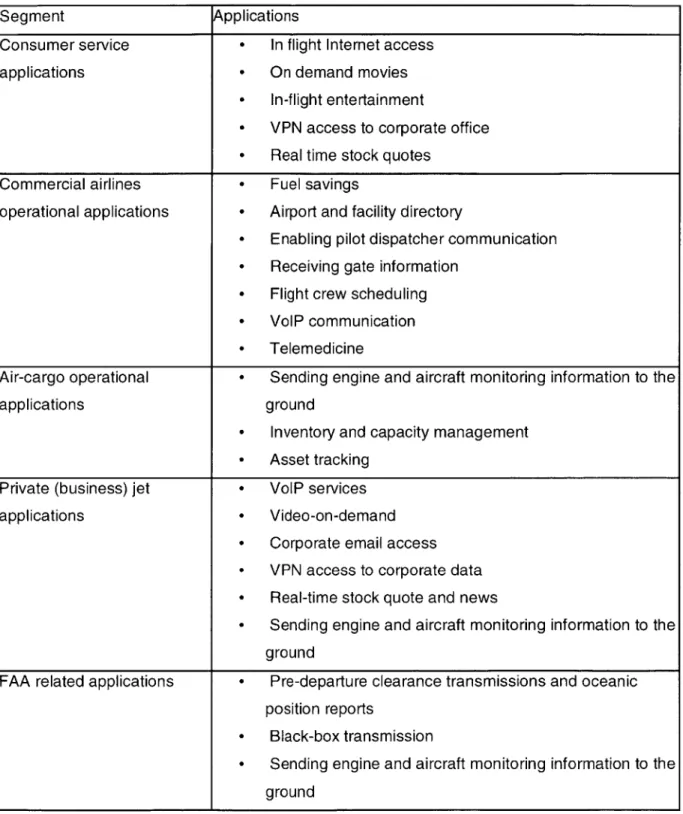
to SWIM or any specialized homeland security functions. Table 1 summarizes the potential
application by consumer, operating, and FAA services segments.
Table 1: Comprehensive list of applications by potential segment
Segment Applications
Consumer service - In flight Internet access
applications - On demand movies
- In-flight entertainment
- VPN access to corporate office
- Real time stock quotes
Commercial airlines - Fuel savings
operational applications - Airport and facility directory
- Enabling pilot dispatcher communication
- Receiving gate information
- Flight crew scheduling
- VoIP communication
- Telemedicine
Air-cargo operational - Sending engine and aircraft monitoring information to the
applications ground
- Inventory and capacity management
- Asset tracking
Private (business) jet - VolP services
applications - Video-on-demand
- Corporate email access
- VPN access to corporate data
- Real-time stock quote and news
- Sending engine and aircraft monitoring information to the
ground
FAA related applications - Pre-departure clearance transmissions and oceanic position reports
- Black-box transmission
- Sending engine and aircraft monitoring information to the
Analysis determined that the potential domestic opportunity for an airborne internet market is in the range of $1 billion. Figure 5 illustrates the composition of market size by segment. We segmented the airline market into four groups: national commercial airlines, regional commercial airlines, air cargo carriers, and private planes. National commercial airlines are comprised of aircraft that fly long-haul national routes. Examples of national commercial airlines are carriers such as United, American Airlines, etc. Regional commercial airlines include aircraft that have more clustered operations. Examples of regional carriers include MaxJet, AmericaWest, etc. Air cargo aircraft includes planes of providers including FedEx and
UPS.
Finally the private plane market includes both business jet and smaller general aviation aircraft. Note that in this diagram the $1 billion market size is represented by the sum of the
product the quantity of aircraft in each segment and total willingness to pay for connectivity
(using number of flights). Our segment approximates were me using domestic aircraft fleet figures listed in the FAA Aviation Report 20054. This is a conservative estimate of the number of aircraft as the report did not include international operators flying over U.S. territory.
Appendix 2 highlights aircraft figures used to make market size estimates.
4 Federal Aviation Administration, "FAA Aerospace Forecasts: Fiscal Years 2006-2017", U.S. Department of Transportation Office of Policy and Plans, accessed July 2006
Figure 6: Diagram of Potential Market Size by Segment
Potential airborne internet enabled market sizes by type of service (2005)
100% 90% 80% 70% 60% 50% 40% 30% 20% 10% 0%
Hegiona commercial Air cargo
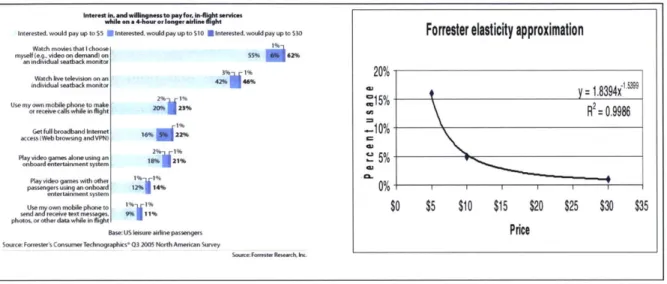
For consumer willingness to pay a 16% usage per flight given $5 usage was assumed
5. The
$50 fee per flight figure for both commercial segments and air cargo is based upon current
market comparables and customer contacts.
In the private jet market, the $10 willingness
to pay for consumer intemet services and
operating service was based on a per flight
basis benchmarking to current prices for
satellite services
6. The $5 figure for fees
generated for FAA services for all three
segments is based on potential cost of using
current alternatives for predicted usage.
These estimates are comparable with Frost
& Sullivan's estimate of $3 billion worldwide
by 201
07.Figure 8 highlights Frost's yearly
projections.
Figure 7
Nlarket IDriNers for ConnectiNity
Connectivity to be Primary Driver in IFE/C
In F119M Ententaiment & Connewcty Dernand Analysis
I(WorkdI S .2 .N 6.0
Ii0
4III
-2002 2003 2004 2005 2006 2007 2008 2009 2010 Year
SMkt Demand-Legacy IFE & C
- Mk Demand-satellie TV
Mkt Denmwd-Prtable IFE & C . Mkt Demand-Connctiviry
Some Fros,&Suln
Figure 8: Frost & Sullivan Chart On Potential Growth Of Internet Connectivity Segment IFE & C Connectitvty Market: Potantial and Demand (World), 2005-20 10
&a I
3DN
zoos 2006 2007 20I moo 2010
g MarIea Pabamim MerktLslu,.nd
s urmc Fis & SuJIVaZ
s Henry H. Harteveldt, "Business Traveler Behavior And Attitudes", The Forrester Report (June 2006), Forrester Research Inc, accessed July 2006
6 Blumenstein, Jack, "Broadband to the Seat: Decoding it All", Powerpoint Presentation, April 2005,
AirCell
7 'World MSS Voice and Data Services Markets", Frost and Sullivan: F841-66 (2006), Frost & Sullivan,
Airborne Internet testing
From the FAA test, Airborne Internet has demonstrated following capabilities:
(Following text taken directly from FAA website http://www.airbomeintemet.com/A14.htm)
"
Demonstrate aircraft-to-aircraft communications. A broadcast capability can be achieved
using Automatic Dependent Surveillance - Broadcast (ADS-B) and Trajectory Change
Point (TCP). ADS-B is a system by which each aircraft's surveillance transponder is
used to broadcast to the other aircraft in the vicinity its position data. ADS-B has also
been used to provide the same information to the ground air traffic control system. By
using ADS-B, a pilot is provided with the information needed to understand his own
"situational awareness" by viewing his own aircraft in the context of those surrounding
him. Ships and boats have had similar "situational awareness" by using shipboard radar
in which they can view other vessels (and objects) around them.
-
Ground broadcast Surveillance information service. Traffic Information Services
-Broadcast (TIS-B) can be used for this purpose. TIS-B is a system by which air traffic
control information available to the air traffic controller is also provided to the aircraft.
-
Maneuver and Control can be demonstrated using Controller Pilot Data Link
Communications (CPDLC). This is a system in which ground controllers can issue
commands to aircraft using text messaging instead of VHF voice radio. In return, the
aircraft can acknowledge on the same text messaging link. The system is being
implemented in the NAS today. The purpose of CPDLC is to reduce the usage of the
already over subscribed aviation VHF voice radio frequencies. In its simplest form, think
of it is an elaborate "Instant Messaging" system.
"
Applicability of external Internet for Flight Information Services - Broadcast (FIS-B) kind
of services, such as weather broadcast to aircraft from the ground. E-mail is another
important service that can be provided. FIS-B can be used to provide near real time
weather information to SATS pilots. One of the uses for VDL Mode SATS is a
continuous broadcast by a ground station of local weather conditions or enroute
weather.
"
Prove the technology of VHF Digital Link Mode SATS, which uses Self-organizing Time
Division Multiple Access (STDMA) as its media access mechanism. VDL Mode SATS
permits data communication without the necessity of having a ground station to support
the protocol.
"
Peer-to-peer activity between two or more air nodes, and between air and ground nodes.
Peer-to-peer communication enables real time collaboration between equal entities by
sharing resources and information.
Boeing
Technology-Ficure 9
Boeing's airborne internet service
"Connexion by Boeing" provides passengers
a broadband internet connection through
satellite technology. With Boeing's service
,
users have an option to connect to the
I Iinternet
through wire (Ethernet cable) or
through wireless LAN on the aircraft.
Transmission speeds was depend on various conditions, but maximum capacity was 20 MBPS
download to the aircraft and 1 MBPS upload. Passengers are able to connect to the service
from laptop or handheld computers over 802.11 b Wi-Fi access points installed in the aircraft.
Those access points provide raw data rates of 11 MBPS. The estimated hardware installation
costs per aircraft for "Connexion" are in the range of US $ 300,000-500,000.
Boeing's business model targets corporate customers directly, as well the corporate jet
market. Boeing Co. set the pricing for its airline passenger high-speed Internet service at
$29.95 for unlimited use on long-duration I flights of /6 hours or more and $19.95 for flights
Fiqure 10
lasting between 3 - 6 hours.
Boeing was also offers a metered
pricing option starting at $9.95 for
30 minutes and 20 cents a minute
thereafter.
In the fall of 2006 Boeing,
discontinued its Airborne Internet
service because this service was
not profitable. Boeing's service
failed because infrastructure was too costly and there was no partnership with another
stakeholder. Boeing assumed all the risk for this service. They should have shared the cost and
risk with airlines carriers.
Fiqure 11
AirCell Technology
-The AirCell airborne internet is approach is
very different then the traditional approach
offered by Boeing. AirCell's model is
dramatically less complex, less expensive,
and more flexible than Boeing's solution. AirCell is going to create coverage area through out
North America with the help of AirCell antenna and ground cells.
AeroSat Network Technology
Fiqure 12
According to AeroSat, it's technology is 1000
-times faster then traditional 64 K satellite
network. AeroSat's network cost is much less
than Boeing's service. AeroSat's airborne
network, forms a network of planes at flight
level by passing the signal from one aircraft to
other aircraft and then down to a ground
station (see figure 11).
AeroSat is offering 45MMBPS speed to
aircraft in flight without using satellites or ground networks. This technology enables the
transmission of data at a very low cost to airline operations, air traffic management,
maintenance, safety and security, and in-flight entertainment. Nine ground stations will be
required around the Atlantic perimeter that will support the network. Similar only seven aircraft
will be required to create a link that extends signals all the way across the Atlantic. Cruise ships
or other ships at sea can also be part of this network by connecting with an aircraft that is within
line of sight and then connecting to the rest of the network through the ground station.
Disruptive Technology
It seems that AeroSat and AirCell are disruptive technology. Both companies offer
similar services with a low price, high speed, and better technology. According to Christensen
description (see figure 13), all disruptive technology should be lower performance but in this
case, lower performance is not an issue. AirCell and AroSat's performance is much better then
the current technology.
Fiqure 13
By combining the GPS provided
position information of any moving
aircraft (or other vehicle) with reliable
MOd
mobile network connectivity, the
aircraft's position could be constantly
reported to the ground network for *
Low WOWt use
processing. Further, this data could be
intelligently parsed to provide position
TimeHow low-end disruption occurs over tme. 6
and tracking information back to the aircraft to alert the flight crew of other aircraft movement in
its proximity. Air-to-air position reporting is possible (such as Automatic Dependent
Surveillance-Broadcast, or ADS-B) if the proper radio method is used. It is possible that enough
aircraft could utilize the airborne internet Fiqure 14 WWW MAIL,DNS,FTPetc
architecture to create a virtual network in the P + B s
sky. At any given moment, there are between
4500 and 6000 aircraft in flight over the
Inlernet 7Firewal Authorsaion,
United States. Air transport aircraft could not
Billinonly use airborne internet for their own
purposes, but they could also provide a
network router function that could sell excess
PS LANbandwidth to other bandwidth-demanding
ClientsI
Cadlorg
reduces equipage and saves system costs, but it could also create a revenue stream for air carriers that does not currently exist.
Stakeholder analysis
To achieve a sustainable model, a successful approach to establishing an airborne network will meet the needs of all the key constituents including: regulatory agencies such as the Federal Aviation Administration (FAA) and the Federal Communications Commission (FCC); the airline industry comprised of commercial airlines, cargo providers, business jets, and
general aviation; the potential service provider; and any potential private investors. As Figure
15 illustrates, the most feasible model to bring this service to the market lies at the intersection
of the interests of four primary parties (Section A).
Fiqure 15: Party Map
Feasible model
FAA & FCC
Pot I ential
S rvice Inve tors rovider
Airl' s: p enge , r
Interests of the FAA and FCC
Fiqure 16
The FAA and FCC's
Otlook for Airline & Pasenger
overall interests are to enable
new public services and to use
Estimated Time
Une
public resources in a way that
+
FCC Spectrum Auction
-May
2006
benefits the general population.
+Airline
Trials
-2007
The FAA wants to work toward
+Begin
Fleet Fitments
-2007
the improvement of aviation
and to demonstrate international leadership. The FCC needs to make sure that any allocated airborne spectrum is used effectively.
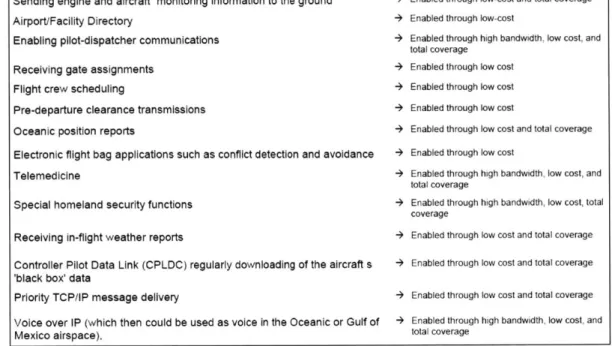
Specifically, the FAA seeks to develop an airborne intemet network to advance the systems and methods of air-traffic control. In order to do this, the FAA is promoting the SWIM program (next generation system). SWIM's fundamental goal is providing continuous
connectivity. The general goal is to reduce the complexity of managing aviation and to promote the growth of the aviation industry. In addition, the FAA is interested in promoting products and services that are likely to make the consumer flying experience safer and more pleasant helping the economic viability of all players involved, such as national and regional airlines. Table 2 highlights the potential FAA related applications and the network requirements to deliver these applications.
Table 2: List of potential FAA related applications and required network features Sending engine and aircraft monitoring information to the ground
Airport/Facility Directory
Enabling pilot-dispatcher communications Receiving gate assignments
Flight crew scheduling
Pre-departure clearance transmissions Oceanic position reports
Electronic flight bag applications such as conflict detection and avoidance Telemedicine
Special homeland security functions Receiving in-flight weather reports
Controller Pilot Data Link (CPLDC) regularly downloading of the aircraft s 'black box' data
Priority TCP/IP message delivery
Voice over IP (which then could be used as voice in the Oceanic or Gulf of Mexico airspace),
4 Enabled through low-cost and total coverage
4 Enabled through low-cost
+ Enabled through high bandwidth, low cost, and
total coverage 4 Enabled through low cost 4 Enabled through low cost 4 Enabled through low cost
4 Enabled through low cost and total coverage 4 Enabled through low cost
4 Enabled through high bandwidth, low cost, and total coverage
4 Enabled through high bandwidth, low cost, total coverage
4 Enabled through low cost and total coverage
4 Enabled through low cost and total coverage
4 Enabled through low cost and total coverage 4 Enabled through high bandwidth, low cost, and
total coverage
The FAA's immediate focus is adopting technologies that are help alleviate the current "pains" of aviation, including safety and monitoring. Given that a potential airborne internet technology meets these requirements, the FAA is likely to support a plan for rapid adoption. In addition, it is likely that the FAA will not want major responsibility of operating and maintaining the airborne internet infrastructure in the long-run, and that it will prefer to support private providers that can be a long-term partners in the airborne internet's R&D efforts. For further details on the FAA's interest, please see Appendix 1.
Interests of airline industry
The airline industry is comprised of commercial airlines, air cargo providers, business jets, and smaller general aviation aircraft. The primary interest of commercial airlines is to increase contributions to their business. On the revenue side, they are likely to be interested in services that bring additional sources of income and/or increase customer loyalty. On the cost side, they are interested in any technology that can lower their operating costs. In addition, they
are likely to be attracted to the idea of a service that helps them differentiate themselves from
the competition.
Fiqure 17
For the commercial
Market Da vers fory
airline segment, it is important
Passenger Demand
to note that the historical
1 Statistic Source38% ofFrequent Fliers want Internet F""( ')
context has made it critical for
access44% of Business Passengers are
40% of business 'Extrenelylor "Very" Interested
any potential service to have a
Broadband34ofAutflig>Itm/ya wee want s4.ofAdultsfing>1time yearAM-are iterested" in Broadband
clear return-on-investment
Broadband is #1 in importance withi (-004IFE (Video: #3 & #4)
(ROI) for airlines. Particularly
81% of Connexion customers will B-4 S-vy(2005)B
I
choose an airlme based on Broadbandafter the Boeing experience, choice of airline 62% of Heavy Fliers will choose 1AG (0)
airline based on Broadband
airlines are likely to be hesitant
to install equipment without a clear ROL. In fact, for the early adopters, subsidizing equipment
purchases is likely to be a requirement. Otherwise, airlines expect a clear "sharing of risk and
sharing of reward." In tum, to
Fiaure 18
assure alignment of these
parties, all of the other parties
involved have to realize that
focusing on meeting aircraft
operator ROI is critical for the
project's success.
In terms of the
remaining segments, air cargo
providers are interested in
services that are likely to bring
them operational
Gartner Study
+ Survey of >2,000 U.S. & U.K. Business travelers
+ 25% of travelers are taking advantage of Wi-Fi when travelinj
+ What would they do
in-flight?
9
Email 50%
- Internet 68%
+ "Interet access is potentially much cheaper for airlines to introduce than
other items such as more personal space, bigger baggage allowances or
better entertainment."
improvements. Applications
Fiqure 19
that can leverage connectivity
alet
Drivers fir Connectivity
to increase how they utilize
What
Passengers Are Doing Today
their capacity or generally
bring efficiencies to their
Sentandree v.-mad.%Accessed the internet for general Info 74%
business are likely to be
Accessed company Itranet 62%Accessed Internet for financial servces 2% Online shopping 7%
attractive.
The businessjets
Chatfinstant Messaging 7%Listened to music online 4%
segment is unique in that it is
Watched a video online 4%Other 8%
likely to have a higher
willingness to pay for
SetUcM CtainM I nebyfl
connectivity because of their interest in using more advanced applications (such as video
conferencing and VoIP). Finally, the general aviation segment comprised of smaller planes and
maintained by independent owners, is likely to be interested in connectivity services, however
with less emphasis in luxury applications and greater sensitivity to price.
Interests of service provider
The interest of a potential airborne internet network provider is to create a sustainable
business. This includes achieving a model that allows the provider to raise the required
financing, gain support from regulatory agencies to assure compliance to market requirements
and integrate into public aviation services, and economics in business to meet the needs of their
customers (parties in the airline industry). The ability to raise required financing depends on
having demonstrated technology and an accurate sense of the key risks in the effort as well as
a clear idea of how to achieve success. To have the support of regulatory agencies, the
technology of the service provider must have the ability to comply with market regulations as
well as effectively integrate with any public aviation service. Finally, to meet the needs of its
customers on a long-term basis, there must be a business model that generates enough free-cash-flows to provide a return to investors, while also funding for maintenance and future infrastructure requirements.
Interests of potential investors
Finally, potential investors want to invest in an opportunity that will yield returns
commensurate with the risks of the project. There are three key factors that affect the potential return for investor: capital invested, growth, and exit value. First, capital invested needs to be controlled and minimized. For an airborne internet effort, it is important for private capital to be
invested at the appropriate time so that it goes into market deployment of the solution when the technology has been validated. Second, potential growth of the service needs to be rapid. This
helps increase the chances of sustainability of the venture by giving the airborne internet a strong foothold in the market. Finally, exit valuation and options must be attractive. It is critical that a private investor have ways to receive back their initial investment plus the premium for taking the risk to invest in future efforts.
The intersection
With an understanding of the diverging interests of all the parties involved, it is clear that executing a plan that meets all parties demands will be challenging. The approach that is likely to be most successful and avoid the failures of the past is one where the above parties can
easily be attracted to the effort. The effort has to meet the public vision, the needs of the FAA and FCC, the aircraft operator's ROI requirements, the potential service provider's required economics, and investor's IRR goals. The FAA business case that follows focuses on a service provider plan that lies at this intersection.
The Alternatives
A second critical reason for the FAA's involvement is that current alternatives are
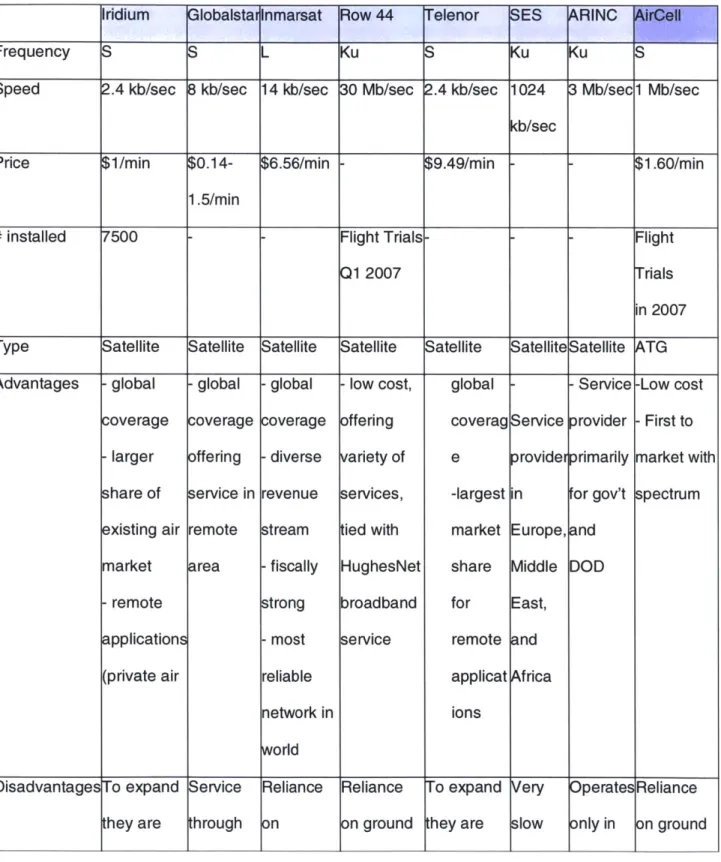
ineffective: they are expensive, have poor coverage, and are slow. Table 3 summarizes the current market offerings for airborne connectivity (please note that values were omitted from the table if they were not found). The offerings can be grouped into two segments: satellite service providers and air-to-ground providers. Satellite service providers include companies such as Iridium, Globalstar, Inmarsat, Row 44, Telenor, SES, and ARINC. The air-to-ground provider is AirCell. These player's offerings differ in performance, because of both the technology and the
spectrum they use (see Appendix 3 for spectrum definitions). Appendix 4 contains more
Frequency
Table 3: Summary of competitive offerings
Iridium
lobalsta rnmarsat Row 44
elenor
SES
hRINC
S
S
L
Ku
Ku
Ku
Speed 2.4 kb/sec 8 kb/sec 14 kb/sec 30 Mb/sec 2.4 kb/sec 1024 3 Mb/sec1 Mb/sec
kb/sec
Price $1/min $0.14- $6.56/min - $9.49/min $1.60/min
1.5/min
f installed 7500 Flight Trials - Flight
1 2007 Trials
in 2007
Type Satellite Satellite Satellite Satellite Satellite Satellite Satellite ATG
Advantages -global -global - global -low cost, global - -Service -Low cost
coverage coverage coverage offering coverag Service provider -First to
- larger offering -diverse variety of e provider primarily market with
share of service in revenue services, -largest in for gov't spectrum existing air remote stream tied with market Europe, and
market area -fiscally HughesNet share Middle DOD
- remote strong broadband for East,
applications - most service remote and
(private air reliable applicat Africa
network in ions
world
Disadvantages To expand Service Reliance Reliance To expand Very Operates Reliance
dependent hand held satellite, stations, likely speeds North stations,
on service require smaller dependent America spectrum
satellites, handheld player, on satellite, limitations,
reliant on equipment,redundancyair is likely redundancy
handheld more private jet, issues
device expensive very slow
Primary Ground, air,Ground, Ground, Ground, Ground, air,Ground Ground, Air
segments sea air, sea air, sea air, sea sea Air
The satellite service providers are the incumbents in the industry. These players generally have a strong foothold in the land and sea markets. Their primary customers include individuals who need the ability to gain internet connection in remote areas or in extreme contexts such as maritime transport. Although the providers have the ability to provide access anywhere in the world given their extensive number of orbiting satellites, the costs of
maintaining and deploying this infrastructure is also their weakness. As can be observed in the table above, these carriers have prices significantly higher than standard telecommunication rates. Additionally, most of the solutions (except for ARINC) are slow, making applications enabled from broadband services nearly impossible. Although many of these companies are investing in technologies to upgrade to higher service rates, we think that these services will never be able to provide economics of air-to-ground solutions given the high capital expenditure requirements from buying, launching, and maintaining satellites. In fact, the satellite providers seem to have lost interest in the airborne segment and are paying closer attention to land, sea, and military opportunities8.
The current AirCell air-to-ground solution also has its limitations. Although it provides much higher transmission speeds, its coverage cannot be compared to that of satellite services as it is limited by the availability of a ground station directly in the line-of-sight of a flying aircraft. 8 Home, Marvin. Interview by Anand Bhadouria Thursday, August 10, 2006
Additionally, this technology may have some redundancy issues given a localized outage (ex: electricity outage in region). A local outage could potentially disable multiple ground-stations that were in place for redundancy purposes.
Overall, the low adoption of alternatives could also indicate that these alternatives do not completely meet all core customer requirements. The current $70M market for airborne
connectivity could significantly understate market opportunity for a new service9. The reason for
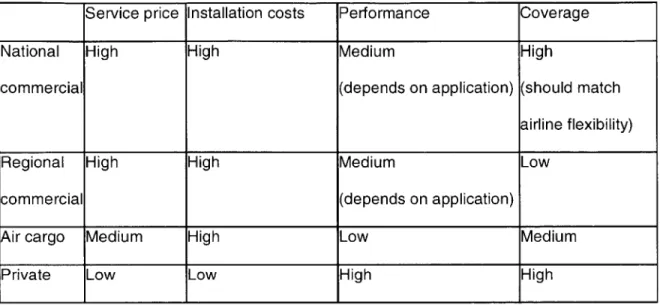
this lack of adoption could be that customers across different segments are sensitive to four attributes when considering adopting an airborne connectivity solution: service price, installation costs, performance, and coverage. Service price influences the potential consumer's usage and the respective ROI per flight. As the Boeing effort demonstrates, the economics of a premium priced internet service do not make sense for commercial airlines. Installation costs
increase the out-of-pocket expenses for airlines and raise the revenue requirements for airlines to achieve their ROI. These costs are especially important for commercial and general aviation
segments"0. Performance of the service limits the types of applications that can be provided
(ex: video conferencing is not possible without high-bandwidth and low cost usage). Finally, coverage effects a potential provider's ability to switch a given aircraft's flying route. Table 4
summarizes the assumptions for potential differences in key requirements across various
customer segments.
Table 4: Customer requirements by segment
Service price Installation costs Performance Coverage
National High High Medium High
commercial (depends on application) (should match
airline flexibility)
Regional High High Medium Low
commercial (depends on application)
Air cargo Medium High Low Medium
Private Low Low High High
AeroSat's Solution
An FAA-tested solution could potentially better meet key next generation FAA systems and broader market requirements. Pending further validation and testing, AeroSat's solution could provide the needed performance. AeroSat's solution deserves attention since it
potentially meets customer needs with the right mix of low costs, high speed, broad coverage, scalability, and redundancy. AeroSat's superior cost position originates from the economics of its mesh architecture. Compared to traditional air-to-ground solutions, ground-stations enabled with AeroSat can achieve better utilization. The reasons for this are that through the peer-to-peer network capabilities, the effective coverage of a ground station will be extended. With a clear understanding of the competitive cost advantages, AeroSat might also be able to develop lighter and cheaper antennae. A second advantage is the greater bandwidth AeroSat can provide versus alternatives. Through the use of the Ku band, connection speeds up to 45 Mbps
may be achieved. Finally, compared with traditional air-to-ground solutions, AeroSat can
provide greater coverage. By extending network coverage and allowing it to potentially adapt to
potentially provides better redundancy, since the communications link to one plane can potentially originate from ground stations that are very far apart.
However, there are a few requirements for this performance to be truly superior on a cost adjusted basis. First, it is assumed that the aircraft antennae can truly be designed to cost, and if not less costly, will be comparable to those of current alternatives. Second, it is assumed that network performance through this architecture is acceptable, providing the appropriate bandwidth, reliability, and latency. Finally, it is assumed that building redundancy into system will not require overly complex systems. At this point in time, these are assumptions that must be true for the performance benefits of AeroSat to be realized. Only through further testing and piloting of the approach will the final metrics be truly determined.
Financials
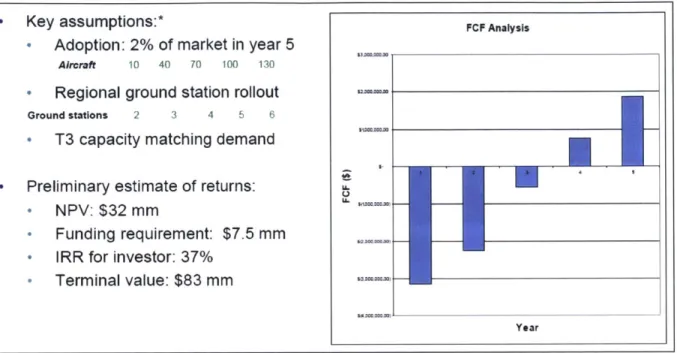
A third reason for FAA involvement is that a feasible financial model exists to attract
investment. Figure 19 demonstrates a sample business model with attractive financials. This scenario is feasible in that it allows airlines to achieve their desired ROI and allows an investor a favorable IRR. Note that some of the primary assumptions in the model include: $50k airline subsidy, 43% revenue shared to airlines, consumer elasticity of $5 equals 16% usage, average passenger load of 100, average aircraft flights per year of 800, operating fee revenue of $50 per flight, antennae cost $125k, and a ground station cost of $200k. Additionally, terminal growth rates have a strong effect on the sensitivity, with the following relationships observed: 1 % yields a 1% IRR, 5% growth yields an 8% IRR, a 10% growth yields a 24% IRR, and a 14% growth yields a 69% IRR.