HAL Id: insu-00861271
https://hal-insu.archives-ouvertes.fr/insu-00861271
Preprint submitted on 12 Sep 2013HAL is a multi-disciplinary open access
archive for the deposit and dissemination of sci-entific research documents, whether they are pub-lished or not. The documents may come from teaching and research institutions in France or abroad, or from public or private research centers.
L’archive ouverte pluridisciplinaire HAL, est destinée au dépôt et à la diffusion de documents scientifiques de niveau recherche, publiés ou non, émanant des établissements d’enseignement et de recherche français ou étrangers, des laboratoires publics ou privés.
Modification of water transfer properties on historical
limestones induced by bio-calcification treatment
Olivier Rozenbaum, Jean-Louis Rouet
To cite this version:
Olivier Rozenbaum, Jean-Louis Rouet. Modification of water transfer properties on historical lime-stones induced by bio-calcification treatment. 2013. �insu-00861271�
Modification of water transfer properties on historical limestones induced
by bio-calcification treatment.
O. Rozenbaum, J.-L. Rouet June 28, 2013
Univ d’Orl´eans, ISTO, UMR 7327, 45071, Orl´eans, France and CNRS/INSU, ISTO, UMR 7327, 45071 Orl´eans, France and BRGM, ISTO, UMR 7327, BP 36009, 45060 Orl´eans, France
Email : [email protected], [email protected]
Corresponding author : [email protected]
Abstract
The effects of a bio-treatment on limestone (here tuffeau) is measured over a large number of drying-imbibition cycles. A model based on a space-dependent permeability coefficient is proposed. It leads to a non-linear diffusion model which accounts for the deviation from the standard Washburn model.
Keyword: Limestone, bio-mineralization, water transfer, imbibition, non-linear diffusion
1
Research aims
Water transfers have been recognized as the main vectors of pollutants, which are responsible for pore network modifications on building stone. Among the techniques used to limit or stop the penetration of water inside the stone, the calcification properties of bacteria have been investigated and used to treat buildings. In this article we study the effect of such a treatment by using a protocol recommended by the Calcite Bioconcept firm (owner of the patent). We carried out imbibition and drying cycles on treated and untreated limestone samples to exhibit the behavior of the treatment. The aim was to monitor the treatment efficiency with these imbibition measurements. The imbibition curves will be compared to the usual Washburn law.
2
Introduction
Weathering of building stones or stone artworks is mainly due to the fluxes of water within the stone which are the main vector of pollutants. Different surface treatments are available to avoid or limit these fluxes [1, 2]. The most widely used are water repellents that form a film at the interface between the pore phase and the solid phase. They give rather good results as water flux from the outside toward the inside of the stones is totally stopped. However, in some cases depending on the stone, the water repellents penetrate the pores, completely filling up the porosity [3]. This is a real problem because gaseous water inside the
pores can no longer escape and remains within the porous lattice, inducing alterations [2, 4]. This leads to aesthetic problems and in extreme cases poses the problem of the solidity of the monument.
It is therefore necessary to prevent the intrusion of water into the stone but it is also crucial to maintain a gaseous exchange between the stone and its environment [2]. In addition, physicochemical compatibility with the treated surface is also required. For such a goal other treatments have been proposed such as inorganic treatments [5]. Another alternative is to use the carbonatogenesis property of some bacteria [6, 7]. This bio-treatment limits (but does not completely stop) the penetration of water from the exterior, while allowing gaseous fluxes in both directions. In a previous article we characterized and analyzed the phase mineralogy produced by such bio-treatment [8]. This treatment was used for the first time on the church of Thouard, a village in the Loire Valley in France. It was observed regularly, and after 10 years the treatment was severely degraded and needed to be re-applied [9].
In order to better understand the protection and durability afforded by the bio coating, the same process as that used by restorers to treat monuments has been followed in this work. In situ, the hydraulic properties of building stones and/or the effects of treatments are often evaluated by the Karsten pipe method[3]. However, since the objective of this work is not only to submit the stone to wetting/drying cycles in order to test and degrade (if possible) the coating, but also to quantify hydraulic modifications of the porous media, the wetting phase was done with the classical imbibition method [10]. It should be mentioned that imbibition is very aggressive for the treatment, giving a lower limit of coating resistance.
The paper is organized as follows. Section 3 describes the biotreatment and the stones on which it was applied. It gives the protocol and the method used to characterise the water properties. Section 4 discusses the experimental results and proposes a model to recover them. Finally, Section 5 presents the conclusions that can be drawn from this work.
3
Material and methods
3.1 Materials and bio-treatment
The material support for the bio treatment used in this article is a tuffeau stone [11] that was collected in a quarry located near the village of Saint-Cyr-en-Bourg (France). In the past, this stone was used to build most houses, churches, cathedrals and chateaux along the Loire valley. This stone is rather soft and is therefore an easily workable building material. Nowadays, this stone is mainly used to restore these monuments. Tuffeau stone is a yellowish-white porous sedimentary limestone, mainly composed of calcite (0.503 g g−1
), silica (0.452 g g−1
) in the form of opal cristobalite-tridymite and quartz, and some secondary minerals such as clays and micas. The total porosity of the tuffeau stone studied in this article was 0.481. It is a multi-scale porous medium since the equivalent pore size distribution ranged from 0.01 to 50 µm [11].
Imbibition measurements were performed on cylindrical samples (diameter: 30 mm) that were small enough for the gravity effect to be neglected (height: 60 mm) [12]. The cylinders were all cut parallel to the sediment bedding in order to avoid undesirable anisotropic effects. Before treatment, the samples were oven-dried during 96 hours at 50◦
C in order to remove all residual water. They were then placed in a desiccator with phosphorous anhydrite in order to reach room temperature while maintaining a dry environment. The capillary coefficients were calculated using three samples (three for the treated and three for the untreated samples) in order to average the local inhomogeneities of the pore lattice.
The bio-treatment used in this work involves a bacterium (Bacillus cereus) that is particularly well-suited for limestones [6, 7]. This technique is under patent (Calcite Bioconcept firm) and has often been used on limestones [8] since it generates a calcite coating i.e. a material of the same nature as the stone substrate, thus
ensuring optimal compatibility. It should be mentioned that this biomineralization treatment was optimized in order to be completed within one week, which is one of the restorers? requirements.
For obvious reasons of conservation, transport and implementation on a restoration building site, the bacteria were lyophilized by the manufacturer. Fifteen hours before use on the site, the freeze-dried bacteria were re-hydrated with a nutritive solution developed by the Calcite Bioconcept firm (peptones, yeast, salts, antifungus). After this lapse of time, the culture medium was sprayed onto a statue or part of a monument (about 1 L/m2). The bacteria were fed with a nutritive solution 24, 32, 48 and 72 hours after spraying. The bacterial colony increased exponentially during these three days. In order to be certain that the treatment was complete, the imbibition measurements presented in this work were done 40 days after the treatment. The reader is referred to [8] and references therein for more details concerning the development of the process.
3.2 Imbibition
Imbibition experiments are used to describe the transfer properties of a material via the imbibition coeffi-cients [12, 13, 14]. The lower surface of the material is placed in contact with water and due to capillary forces, the water fills the pores, pushing the air inside the pores out of the sample. The water mass uptake and the height of the capillary front can be measured as a function of time. Neglecting the gravity effect on water and assuming cylindrical pores, the Washburn law predicts an evolution function of the square root of time t for both the mass uptake ∆m per surface area unit S and the capillary height h:
∆m
S = A
√
t (1)
h = B√t (2)
where the imbibition coefficients A and B are defined as follows:
A = πr2 r rγ cos α 2η (3) B = r rγ cos α 2η (4)
with r the radius of the capillary, η the water viscosity, γ the superficial tension and α the angle between the solid and fluid. Hence, mass uptake and height of the capillary front are usually represented versus the square root of time. Thus, according to Eqs. (1) and (2), it was expected that for homogeneous stones (A and B constant) a linear increase in ∆m/S and h with respect to √t [12, 13, 14] would be recorded. In the following only the mass uptake will be presented as the capillary height gives rather redundant information.
4
Measurements and Modeling
The effect of the treatment was assessed by comparing the imbibition curves for treated and untreated samples. A large number of imbibition-drying cycles were performed to determine the long term behavior of the treatment. After imbibition the samples were put in an oven at 50◦
C until total drying. Once the mass was constant, the sample was ready for a new imbibition-drying cycle. During the drying period, the sample was wrapped in an aluminium sheet, except for the surface which was in contact with water during imbibition. To sum up, water entered or exited the sample via the same surface.
4.1 Imbibition-drying cycles on non treated samples
Fig. 1 shows the time evolution of the mass uptake of water during the imbibition cycles (for cycles 1 to 12). In spite of the cylindrical capillary hypothesis, the imbibition curves recorded for all the untreated stone samples showed a quasi linear increase (∆/m = A√t) within a first zone (between 0 and ts; ts, hereafter called the saturation time, which covers approximately the [35; 45] min range). This behavior, similar to that found in [13], indicates a homogeneous porous lattice [12, 14]. Within the following zone ( √t > 6.5 min1/2), the mass uptake continued very slowly and corresponds to the infilling of the trapped porosity thanks to air diffusion through water. In the first zone (i.e. in the range [0, ts]), the slopes of the curves decreased progressively as the cycle number increased. Hence the coefficient of water absorption A decreased slightly with the number of imbibition/drying cycles. In other words, the mass uptake was longer and water saturation was reached later as the number of cycles increased. Therefore, a slight modification in the water properties was observed, indicating a slight modification in the porous lattice [15].
Figure 1: Imbibition curves for an untreated sample. The enclosed figure is an enlargement of the range √
t ∈ [0, 8] for cycles 1, 6 and 12. The same symbols are used in both figures.
4.2 Imbibition-drying cycles on treated samples
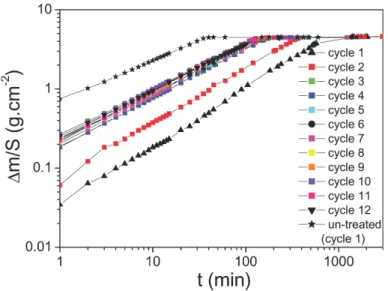
The imbibition curves (Fig. 2) for the treated samples were radically different from the untreated imbibition curves (mainly the first two cycles). Above all, the time ts necessary to reach the saturation zone for the first cycle was considerably increased: ts = 680 min (in comparison, it took approximately 40 minutes for the untreated cycles). But the saturation time ts decreased for the other cycles: ts= 400 min for the second cycle and ts= 220 min for the third cycle. After this third cycle, the time ts decreased slightly, reaching 140 minutes for the last cycle. Hence, ts still remained higher (whatever the cycle number) than the ts times for the untreated samples (40 minutes). Furthermore, while the imbibition curves increased linearly in the first zone for the untreated samples (∆m/S = At1/2), the imbibition curves for the treated samples presented a rather different behavior for (at least) the first two cycles. This behavior has also been observed for other treatments [5, 16]. In view of these differences, it seems necessary to develop another model. We therefore propose a power law behavior in the following section (∼ tα).
Figure 2: Imbibition curves for a treated sample. The imbibition curve obtained for the first cycle of an untreated sample has been plotted (stars) for comparison.
computed and is plotted on figure 3. As expected, the values of A are smaller for the treated sample but increase with the cycle number. Nevertheless A is still lower than the coefficient obtained for untreated samples even for cycle 12. The coefficient A computed for untreated samples decreases slightly with the cycle number. So for both cases, the lattices change with the cycle number. Coefficient A was determined only if the imbibition curves nearly follow a square root time evolution. This is not the case for the first two cycles of the treated samples. So the assumptions made by the Washburn equation are no longer valid. Because the treatment modifies the surface of the samples, a non homogenous lattice will be assumed.
4.3 Modeling
As shown on Fig. 2 for the treated samples, while the mass uptake for the last cycles seems to be proportional to the square root of time, this is clearly not the case for the first two cycles. This suggests that the porous lattice is no longer homogeneous. The log-log representation (Fig. 4) of the data of Fig. 2 shows a power law behavior. The first part (before saturation) is roughly linear and the slope gives the power index that depends on the cycle number. We therefore looked for a model which gives such an evolution. Following the work of Laurent [17, 18], the conservative equation of the water uptake c(t, z) at time t and location z reads
Figure 4: Log-log plot of the imbibition curves for a treated sample and the first cycle of a non treated sample (stars).
∂c ∂t +
∂J
∂z = 0 (5)
where no border effects were considered, so a one-dimensional model was used. The z coordinate stands for the distance from the water surface. The flux J is given by a Darcy law:
J = −D∂c∂z (6) This yields ∂c ∂t = + ∂ ∂zD ∂c ∂z (7)
which is a diffusion equation of coefficient D. As the samples are initially dried, c(0, z) = 0 and as the bottom of the sample is in contact with free water, the boundary condition is c(t, 0) = 1. D usually depends on the moisture c, but then the Boltzmann transformation gives solutions which are a function of the square root of time t. Taking into account the modification induced by the bio-treatment, the dependence on z is assumed. As power-law solutions are sought after, the following equation is considered:
D = D0
With this choice, equation (7) is a classical model of an anomalous diffusion process [19]. The sample is assumed to be high enough so a semi-infinite system is considered. The solution of equation (7) depends only on the variable y defined by O’Shaughnessy et al. [20]:
y = z
t1/(2+λ) (9)
If λ = 0, the usual variable used in the Boltzmann transformation is recovered. The solution of equation (7), taking into account the initial condition and boundary condition reads c(z, t) = f (y). Integrating from z=0 to infinity, the mass uptake ∆m(t) of water by the sample during time t is obtained
∆m(t) ∼ Z ∞ 0 c(z, t)dz ∼ t 1/(2+λ) Z ∞ 0 f (y)dy (10)
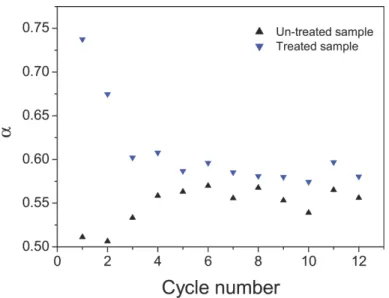
and consequently ∆m(t) ∼ tα with α = 1/(2 + λ). If λ = 0, the usual square root of time dependence is recovered. A linear regression was performed on the curves in Fig. 4 before the saturation time ts. It gives the index α whose evolution as a function of the cycles is given on Fig. 5. The index obtained for untreated samples was also determined and is plotted for comparison.
For the untreated samples, the power index is around .5 which is the value expected for a homogeneous porous lattice. However, the power index increases slightly with the cycle number. This suggests that the lattice has been modified by the imbibition-drying cycles. This was shown previously by Beck [15] who argued that dissolution and recrystallization processes took place within the stone. The index of treated samples is around .7 for the first cycle. It decreases to reach a value that still remains higher than the index obtained for the non treated samples. Hence the bio-treatment considerably modified the porous lattice (at least on the surface [8]) and thus strongly modified the water transfer properties of the stone. But as the imbibition test is aggressive (compared to natural rain for example) the effect of the treatment is reduced after a few cycles. As previously mentioned, even for the last cycles, water transfer into the lattice of the bio-treated sample is still lower than that of the untreated samples. This shows the combination of two effects: (i) the durability of a porous lattice modification induced by the bio-treatment, and (ii) the lattice modification induced by the imbibition-drying cycles. With α > .5, the index λ = (1 − 2α)/α is negative, so the diffusion coefficient increases with z. This tendency is in accordance with the observation that the bio-treatment, applied on the surface samples, slows down water intrusion.
5
Conclusion
The water transfer behavior of a bio-treatment process applied on a building limestone was studied. Treated and untreated samples were submitted to a large number of imbibition-drying cycles. It has been shown that the treatment slows down liquid water penetration into the stone (imbibition phase) while gaseous vapor can move easily from the inside to the outside of the stone (drying phase). These destructive tests also showed that the bio-coating has a limited lifetime. This has been checked in-situ on Thouard church (France) since 1993 where the bio-treatment needed to be renewed every ten years.
Moreover the first imbibition tests on treated samples did not follow the classical law function (i.e. mass uptake proportional to the square root of time). A power law model has been proposed here which takes into account the local modification of the porous lattice. It gives power law solutions which fitted the imbibition curves of all the samples studied here. Furthermore power index evolutions were observed for the treated and untreated samples showing stone evolutions (dissolution and re-crystallisation) for the untreated samples and evolution of both the stone and the coating for the treated samples.
Figure 5: Power index α as a function of the imbibition-drying cycle for bio-treated and untreated samples.
information on the treatment depth is available. Furthermore, the first two cycles of the treated sample reveal more than one scaling range (see the two distinct zones in fig. 2). Hence, a single index is insufficient to monitor the time evolution of the mass uptake m. This may be related to a time evolution of the bio-coating itself during imbibition which is manifested as a time dependence of the coefficient D. Nevertheless the index α gives highly sensitive information on the change in porous media. We believe that this index could be profitably used in other studies.
Acknowledgments
We thank J.-F. Loubi`ere from Calcite Bio Concept for his support and for supplying the biological material as well as for interesting discussions. We also thank Severine Anne for her participation to this project. This study was partially financed by the “R´egion Centre”, France (PASTIS project).
References
[1] L. Lazzarini, M. Laurenzi Tabasso, Il restauro della pietra, Cedam, Padova, 1986.
[2] G.G. Amoroso, V. Fassina, Stone Decay and Conservation : Atmospheric Pollution, Cleaning, Protec-tion, Materials Science Monographs 11, Elsevier, Amsterdam, 1983.
[3] R. Perrier, Les Roches Ornementales, Pro Roc, Ternay, 2004.
[4] M. Camaiti, G. Borselli, U. Matteoli, La conservazione del patrimonio monumentale: prodotti consoli-danti impiegati nelle operazioni di restauro, Edizilia, vol. 2, 1988.
[5] L. Dei, B. Salvadori, Nanotechnology in cultural heritage conservation: nanometric slaked lime saves architectonic and artistic surfaces from decay, Journal Cultural Heritage 7 (2006) 110–115.
[6] G. Le M´etayer-Levrel, S. Castanier, G. Orial, J.-F. Loubi`ere, J.-P. Perthuisot, Carbonatogenesis con-cepts to bacterial regeneration of limestones (microbial lifting). in: IAS-ASF-IGCP 380 International Workshop on Microbial mediation in carbonate diagenesis, Publication ASF, Paris, 26, 1997, pp 41–42.
[7] G. Le M´etayer-Levrel, S. Castanier, G. Orial, J.-F. Loubi`ere, J.-P. Perthuisot, Applications of bacterial carbonatogenesis to the protection and regeneration of limestone in building and historic patrimony, Sediment Geol 126, 1 (1999), 25–34.
[8] S. Anne, O. Rozenbaum, P. Andreazza, J.L. Rouet, Evidence of a bacterial carbonate coating on plaster samples subjected to the Calcite Bioconcept biomineralization technique, Constr Build Mater 24 (2010) 1036–1042.
[9] J.F. Loubiere, private communication.
[10] O. Rozenbaum, L. Barbanson, F. Muller, A. Bruand, Significance of a combined approach for replace-ment stones in the heritage buildings conservation frame, C. R. Geosciences 340 (2008) 345-355.
[11] O. Rozenbaum, 3-D characterization of weathered building limestones by high resolution synchrotron X-ray microtomography, Science of The Total Environment 409 10 (2011) 1959–1966.
[12] J.-D. Mertz, Structures de porosit´e et propri´et´es de transport dans les gr`es, Ph.D. Thesis, Universit´e de Strasbourg, France, 1991.
[13] K. Beck, M. Al-Mukhtar, O. Rozenbaum, M. Rautureau, Characterisation, water transfer properties and deterioration in tuffeau: building material in the Loire valley-France, Build Environ 38 (2003) 1151–1162.
[14] C. Hammecker, J.D. Mertz, C. Fischer, D. Jeannette, A geometrical model for numerical simulation of capillary imbibition in sedimentary rocks, Transport Porous Med 12 2 (1993) 125–141.
[15] K. Beck, ´Etude des propri´et´es hydriques et des m´ecanismes d’alt´eration de pierres calcaires `a forte porosit´e, Ph.D. Thesis, Universit´e d’Orl´eans, France, 2006.
[16] V.L. Barabanov, A.A. Lyubushin, Heat and mass transfer in dispersed and porous media, Journal of Engineering and Thermophysics, 86 (2013) 1–11.
[17] J.P. Laurent, in B. Schrefler, P. Delage, Pierre (Eds.), Trait´e MIM : M´ecanique et ing´enierie des mat´eriaux : G´eomat´eriaux, Herm`es Science, Paris, 2001
[18] Jacob Bear, Dynamics of fluids in Porous Media, Dover, New York, 1972.
[19] P. Brault, C. Josserand, J.-M. Bauchire, A. Caillard, C. Charles, R.W. Boswell, Anomalous Diffusion Mediated by Atom Deposition into a Porous Substrate, Phys Rev Lett 102 (2009) 1–4.