HAL Id: hal-01185296
https://hal.archives-ouvertes.fr/hal-01185296
Submitted on 19 Aug 2015
HAL is a multi-disciplinary open access archive for the deposit and dissemination of sci-entific research documents, whether they are pub-lished or not. The documents may come from teaching and research institutions in France or abroad, or from public or private research centers.
L’archive ouverte pluridisciplinaire HAL, est destinée au dépôt et à la diffusion de documents scientifiques de niveau recherche, publiés ou non, émanant des établissements d’enseignement et de recherche français ou étrangers, des laboratoires publics ou privés.
Distributed under a Creative Commons Attribution - NonCommercial| 4.0 International License
Biological regulation: controlling the system from within
Leonardo Bich, Matteo Mossio, Kepa Ruiz-Mirazo, Alvaro Moreno
To cite this version:
Leonardo Bich, Matteo Mossio, Kepa Ruiz-Mirazo, Alvaro Moreno. Biological regula-tion: controlling the system from within. Biology and Philosophy, Springer Verlag, 2015, http://link.springer.com/article/10.1007/s10539-015-9497-8. �10.1007/s10539-015-9497-8�. �hal-01185296�
1
Biological regulation: controlling the system from within
Published in Biology & Philosophy The final publication is available at Springer via:
http://link.springer.com/article/10.1007/s10539-015-9497-8
Leonardo Bich1,2*, Matteo Mossio3, Kepa Ruiz-Mirazo1,4, Alvaro Moreno1
1IAS-Research Centre for Life, Mind and Society
Department of Logic and Philosophy of Science University of the Basque Country (UPV/EHU) Avenida de Tolosa 70, 20018 Donostia-San Sebastián, Spain
2Instituto de Filosofía y Ciencias de la Complejidad (IFICC)
Los Alerces 3024, Ñuñoa, Santiago, Chile
3Institut d‟Histoire et Philosophie des Sciences et des Techniques(IHPST)
CNRS/Université Paris I/ENS 13, rue du Four, 75006 Paris, France
4Biophysics Unit (CSIC, UPV/EHU)
Barrio Sarriena s/n, 48940, Leioa, Spain
*Corresponding author: [email protected]
Abstract
Biological regulation is what allows an organism to handle the effects of a perturbation, modulating its own constitutive dynamics in response to particular changes in internal and external conditions. With the central focus of analysis on the case of minimal living systems, we argue that regulation consists in a specific form of second-order control, exerted over the core (constitutive) regime of production and maintenance of the components that actually put together the organism. The main argument is that regulation requires a distinctive architecture of functional relationships, and specifically the action of a dedicated subsystem whose activity is dynamically decoupled from that of the constitutive regime. We distinguish between two major ways in which control mechanisms contribute to the maintenance of a biological organisation in response to internal and external perturbations: dynamic stability and regulation. Based on this distinction an explicit definition and a set of organisational requirements for regulation are provided, and thoroughly illustrated through the examples of bacterial chemotaxis and the lac-operon. The analysis enables us to mark out the differences between regulation and closely related concepts such as feedback, robustness and homeostasis.
Keywords
2
1. Introduction
Biological systems exhibit a wide range of mechanisms and strategies to ensure theirsurvival under variable conditions. In some cases, they compensate for internal or external perturbationsbymaintainingthe conditions under which their constitutive processes remain viable (through physical buffering, relative damping of the changes in concentration, temperature, pH...); in other cases, to achieve a similar outcome, they switchbetween differentavailable metabolic regimes (e.g.,distinct biosynthetic routes linked todiauxic shifts1). Allthese mechanisms,usuallyassociated with the concepts of„homeostasis‟and „adaptation‟ respectively, tend to bebroadly interpreted as regulatory, insofar asthey contribute tomaintain the system‟s viability against perturbations by functionally modulating its own dynamic behaviour.
Over the years,the idea of regulationhas been widely applied to deal withmany biological problems, and to explain the remarkable stability, robustness and long-term sustainability of living beings. In recent times this notion has gained more and more scientific attention, especially in relation tothe development of „systems biology‟ (Kitano 2001). Yet, despite this increasing interest, there is no agreement on what regulation actually is. Itremains vague, as if it was a concept without precise meaning and with an ambiguous relationship toother concepts akin to it(such as control, homeostasis, feedback or adaptation)ishardly stated in clear terms.2
It is our contention that the current use of the concept of regulation in the literature mixes up fundamentally different biological capacities while,we argue, itshould designate a particularclass of control capacities, which play a specific biological role. In a nutshell, the main goal of this paper consists in characterisingregulation as a specific form of control at work in biological systems, exerted by dedicated subsystems that donotcarry out basic metabolic (constitutive) functions: i.e., subsystems that are not involvedin the core dynamic network responsible for the production and maintenance of the components that actually make up a living cell.Rather, these additionalregulatory subsystemsendow the cellular organism with the capacity to handle the effects of different perturbationsby modulating its own internal dynamics and, typically, by inducing a shift to a new regime, selectedamong a diverse set of available ones.
Thus, one of the central objectives of the paper is establishing a conceptual distinction between two qualitatively different ways to contribute to biological robustness: i.e.,through network properties usually associated with dynamic stabilityand homeostasis,on the one hand, and through the contribution of mechanisms specialised in the coordination of compensatory responses, on the other. We characterise dynamic stability (sec. 4) as a collectivenetwork response to perturbations, usually based on the tight coupling between various, highly distributed parts of the system -- like the coupling between enzymes and metabolites in a metabolic pathway.However, our thesis is that the robust and adaptive behaviour of living systems requires more complex mechanisms than those ensuring basic network stability; mechanisms that specifically rely on the asymmetry or hierarchical distinction between controlled and controlling subsystems. We propose to use the term„regulation‟(sec. 5) in this more precise and restricted sense, which applies to cases like bacterial chemotaxis or the lac-operon. Therefore, we characterise the regulatory response as functionally activated by a dedicated subsystem, which works as an operationally distinct --or better, as we will explain in sec. 5, as adynamically decoupled-- modulefromthe regulated one, andwhich involves a characteristic set of organisational requirements, fundamental target of this contribution.
1 In bacterial metabolism, these are shifts between different growth phases, which rely on distinct sources of sugar. 2
See for example Fell (1997:2), according to whom regulation is defined in a way that almost coincides with homeostasis: regulation «is occurring when a system maintains some variable constant over time, in spite of fluctuations in external conditions (…) regulation is therefore linked to homeostasis».
3
The distinction between regulatory and other more elementarydistributed control capacities, we argue, points to a qualitative difference in compensatory mechanisms that is seldomaddressed explicitly in the literature. However, the distinction isimportant because regulatory mechanisms, we submit, play a crucial role in the explanation of the robustness of biological organisms, and possibly also to account for their evolutionary emergence and development.
Distributed networks, in fact, exhibit intrinsic limitations and a bottleneck of complexity in their capacity to generate global functional patterns of response to perturbations (Christensen, 2007). Achieving a compensatory effectin that context depends on propagating changes through many local interactions. As a consequence,reliability and specificity in the response becomes an issue. The time required for the response can be long;and it is typically longer the bigger the system and the higherlevel of complexity found init. Additional problems derive from the difficulty in generating multiple differentiated global states and in reaching the appropriate one for a given perturbation. As a consequence, the higher the complexity of an organisation, the higher its intrinsic fragility -- unless additional mechanisms devoted to the selective modulation of the basic dynamics are implemented.
Indeed, life on Earth demonstrates that it is possible to overcome these difficulties. Endowed with complex and hierarchically organised control mechanisms,cells behave and adaptsuccessfully to changing environments since millions of years ago.Furthermore, they have diversified into an incredible range of species and in higher levels of organization (e.g., multicellular organisms). At some point in their early development, protocells surely managed to transit fromrelatively simple self-maintaining (bio-)chemical networks,initially just characterised by global and distributed control capacities (dynamic stability), to more sophisticated(regulatory) architectures that enhanced their robustnessand allowed them to overcome bottlenecksin structural and organisational complexity. The key trick is to generate mechanisms/subsystems that specialisein rapidly finding the appropriate collective pattern of response to changes. Otherwise, adapting to new environmental perturbations would require each time a modification of the organisation of the core (constitutive) network of the system, which would more likely drive the system to disruption than to complex responses: the modification of the regulatory subsystems devoted to a selective control of internal changes (e.g., switches) providesinstead more reliable solutions (Kirschner et al, 2005). An adequate understanding of how organisms manage to maintain themselves, and of how their complexity has appeared through evolution requires therefore a theoretical grasp of the nature and role of regulation.
The structure of the paper is as follows: in section 2 we review various commonly embraced conceptions of regulation, we introduce the (organisational) approach adopted in this paper and illustrate itthrough the analysis of bacterial chemotaxis. In section 3 themost basic and genericnotion of controlis explained, together withthe role that different forms of control play in the constitution of abiological organisation (thermodynamic control, kinetic control, spatial control, etc.). In section 4 we analyse how the combination of different types of coupled control mechanisms involved in the constitutive organisation of a biological system can ensure itsdynamic stability, understood as a collective, distributedresponse.Section 5analysesa new and special type of second-order control(regulatory control) and makes explicit the organisational requirements for its realisation in biological systems.Then we discussanotherconcrete example of regulatory mechanism, the lac-operon system, verifyingthat it satisfies the set of organisational requirements provided in section5. We conclude with a recapitulation and somegeneral remarks on the relationship between regulation and closely related notions, highlightingthe role of regulation as a fundamental condition for functional innovation and for the open-ended increase in the complexity of biological systems.
4
2. Common views on regulation: problems and examples to justify our approach
Historically, regulation has been considered as a common feature of all living beings, and has played a key role in shaping the scientific understanding of what life is and how it originated. Regulation is at the core of Claude Bernard‟s idea of constancy of the internal milieu of living systems (Bernard 1865; 1878). According to Bernard, all the activities and processes at work within organisms are somehow subject to mechanisms of regulation, insofar as biological systems exhibitthe capacity to continuously adapt to changes in their physiological processes: «all vital mechanisms, however varied, have but one objective, that of maintaining the unity of life functions in the internal medium» (Bernard 1878: vol.I,121). Under the influence of Bernard‟s work, the idea of biological regulation also lies behind Cannon‟s notion of homeostasis (i.e., the property according to which one or more properties/variables are maintained constant or stable --Cannon 1929) and the cybernetic approach to the study of living systems (Wiener 1948; Ashby 1956). Later on,regulation occupies a central place in molecular biology as well, especially in Jacob and Monod‟s work (Jacob and Monod 1961; Monod et al 1963; Jacob 1970; Monod 1970), focused on cellular control mechanisms and their role in “organic adaptability” (Morange, 1994: 163). The convergence of these ideas with network theories and self-organisation theories constitutes one of the conceptual pillars of contemporary systems biology (Kitano 2001).
Furthermore, the importance of regulation is being currently discussed in variousscientific domains suchassynthetic biology, origins of life (Bich and Damiano 2012) and systems chemistry (de la Escosura et al. 2015), and it has been suggested as a possible candidate among the defining properties of life (Korzeniewski 2001; Tsokolov2010).On these lines, the chemical engineer and theoretical biologist Tibor Ganti (2003a), whose chemoton model has been particularly influential in these research areas, includes inherent stability and the capability for regulation in his list of „absolute criteria for life‟ (see also Griesemer and Szathmáry 2009). In a similar way, David Deamer (2009) considers regulation an „essential property of life‟, andprimitive forms of regulatory mechanisms as a necessary condition for the emergence of a full-fledged metabolism.
However, the lack of a precise account oftheregulatory mechanismsunderlyingbiological robustnesshas led, already at the unicellular level, to a ubiquitous application of thisconcept,often with qualitativedifferent meanings: in some cases as a distributed network property, in some others as a more organisationally complex mechanism.Indeed, a rapid survey of the relevant literature shows that alleged regulatory phenomenainclude a wide range of phenomena: generic system robustness (Kitano 2004; 826); the homeostasis of a particular variable, active substance, or metabolite (Cornish-Bowden 1995; Fell 1997); genetic mechanisms controlling diauxic shifts and metabolic adaptation to different carbon sources (Jacob and Monod 1961); the allosteric inhibition of an enzyme by a product metabolite (Monod et al. 1965; Koshland et al., 1966); the action of feedback loops in general (Wolkenhauer and Mesarovic 2005; Tsokolov 2010) or feedbacks in the context ofgenetic networks that control (enhance/damp) the effects of noise (Rao et al. 2002; Chalancon et al. 2012); supply and demand control over concentrations of metabolites and metabolic fluxes (Hofmeyr and Cornish-Bowden 2000); molecular switches (Angeli et al 2004); threshold activation of processes (Ganti 2003a);transmission and amplification of intracellular signals, including thecontrol of biorhythms (Heinrich and Schuster 1996);orthe modulation of the activity of many enzymes through cascades of covalent modifications(„multisite modulation‟ -- Fell 1997).
The list above, which is far from exhaustive, illustrates a generic capacity to counteract or compensate for perturbationsthat,without further specification,can apply to remarkably different compensatory behaviours in non-living and living systems. Even elementary properties exhibited by simple chemical systems aroundthermodynamic equilibrium,such as those based on Le Chatelier‟s
5
Principle3,can be classified together withmuch more complex molecular machineries, specific of biological systems: e.g., those allowing forthe genetic control over protein synthesis. Under this generic notion of compensation for perturbations, therefore,very relevant distinctions (from a purely biological point of view) go unnoticed.In particular, there is not a distinction in the literature between specific,hierarchically organized,control architecturesand much simpler, collective ordistributedcontrol mechanisms at work in biological systems. Yet, as highlighted in the introduction, this distinction (which will amount to our distinction between regulation and dynamic stability) has important implications for the study of the adaptive capacities of living systems and of the origin of their organisational complexity. In our view, the problem lies in the tendency tofocus on the effects –i.e. the systems having adjusted itself in such a way to counter the perturbation -- rather than on the nature of compensatory responses–i.e. how the response is achieved. In other words, science has explored many conditions under which living systems have demonstratedtheir amazing adaptive skills, but has not made a comparable effort to discern how those adaptive skills are actually implemented in each of the cases. As a result, the catalogue of compensatory behaviours in biology is huge,butthe analysis and categorisation of the underlying compensatory mechanisms is still rather poor.As Hofmeyr and Cornish-Bowden state in the context of metabolic control analysis: «metabolic regulation was usually recognised as the result of observing the performance of the metabolic system, without knowing exactly what the molecular mechanism responsible for this behaviour was» (Hofmeyr and Cornish-Bowden 1991: 233). It is not surprising, then, that some biologically crucial distinctions are missing.
However, substantial advances can be made, we argue, if we foster achange of perspective: namely,if we tryshifting from a mere phenomenology of compensatory behaviours(focused ongeneric responsive capacities), towards a more precise, organisationalaccount of the distinctive featuresof the mechanisms responsible for those different behaviours. Framing the question of biological regulation in organisational terms does notimply only focusing on local mechanisms. It means also that the analysis of such compensatory mechanisms must be conducted within a wider, systemic framework: it shouldcoveron how certain mechanisms establish more extended and complex architecturesof functional relationships that contribute to themaintenance of the systemwhere they areharboured. Accordingly, we will study the role played by compensatory mechanisms in the more comprehensive context of the biological organisation and the environmental conditions in which they operate.
The question of biologicalregulation, as posited here in organisational terms,couldstill be addressed at many different levels of description(from proto-cells to multicellular systems, or even at the ecological sphere). In this paper we focus on a very basic --though complex enough-- level: the regulation of metabolism in unicellular (prokaryotic) organisms. The reason is methodological.By choosing minimal forms of biological regulation,like bacterial regulation, we consider it should be easierto understand their fundamental featuresand the role they playalready at the level of organisation of a cell. This should help us describethe relationship between regulatory mechanisms and the biosynthetic processes underlying the metabolic core of any living system.
In bacteria, two well-known compensatory, adaptive phenomena,chemotaxis and the control of protein synthesis, stand out as examples of regulation in the specific sense proposed in this paper, which will be based on theoperational distinction (dynamical decoupling) between regulatory and regulated (constitutive) subsystems (see section 5). We will analyse the former casenow, to start illustrating the main idea, and leave the case of the lac-operon to exemplify the more detailed criteria for regulation proposed at a later stage.
3 This principle states that, if any change is imposed on a chemical system at equilibrium, then the system tends to
6 2.1 First example: the case of bacterial chemotaxis
Bacterial chemotaxis consists in the “active movement of a cell or an organism toward or away from a chemical source, the chemical defined as chemoattractant or chemorepellent, respectively” (Eisenbach 2007: 574). It isthe result of the action of a mechanism thatmodulates the movement of the organism in the environment, on the basis of the composition and the gradient of concentration of metabolites in a given medium, so as to maintain the conditions an active metabolism. Chemotaxis is particularly instructive for our purposes because it is a case in which the decoupling between the regulatory and the regulated/constitutivesubsystem(the receptor and signal transduction pathway, on the onehand, and themetabolism and the flagella,on the other) is quite well established, at least in most of the cases studied (see Fig. 1, below, and (Bich and Moreno, 2015) for further discussion).
Fig 1. The subsystems involved in bacterial chemotaxis (Egbert et al, 2010)
Indeed, the classical model of chemotaxis (see Eisenbach, 2004, and Wadhams and Armitage, 2004)describes the functioning of the whole mechanism of control of movement as operationally independent from metabolism, even if metabolism must provide the energy for movement and ensure the synthesis and maintenance of the components of the subsystems involved. But in order to determine whether this type of bacterial movement, based on the control of flagellar rotational modes (clockwise or counter-clockwise, corresponding to tumbling vs. running behaviour), is regulatory--in our sense of the term--we must carefully identify: the candidate subsystem responsible for the controlling action (the receptor complex and the signal transduction pathway), the form of activation of this subsystem, the controlled or regulated subsystem (the flagella complex), and the relationship they all hold with metabolism.
It is generally accepted that chemotactic behaviour involves, at least, three molecular complexes: (a) a receptor subsystem, which is activated by environmental effectors (chemoattractants or chemorepellants); (b) a flagella complex, and (c) a group of molecules, which act as a bridge between the two. Usually the latter are activated through non-covalent post-translational modifications, like cascades of phosphorylations.In particular, a protein, CheY, is a central player of the regulatory process. Depending on the different states of activation of this molecule, it can link to both complexes, receptors and flagella. In a non-phosphorylated state it binds to the receptor. When the receptor is activated through a change in the effector, CheY is phosphorylated, decreasing its affinity to the receptor and, at the same time, increasing its affinity to the switch protein FliM in the flagella complex. By detaching from the former and binding to the latter, CheY triggers an alteration of the flagellar rotation from counter-clockwise to clockwise and, therefore, a change in the swimming movement of the bacterial cell, from running to tumbling. In this manner, the signal transduction pathway (receptor complex plus signal proteins) is able to modulate the movement of the cell. Starting from this relatively elementary mechanism, a variety of more complex behaviours can be implemented (Eisenbach, 2004), but the common feature is that the system gains the ability to change its swimming direction in relation with features of the environment.
7
In the context of our discussion, what is important to realize is that, even if there are different control steps from the receptor on, there is only one regulatory action: that of the whole receptor-signal mechanism on the flagella motors. The crucial point, which will become more apparentas we advance in the paper, is that the whole mechanism does not work as a distributed network. The activity of the regulatory subsystem (receptor plus bridge/signal proteins), in fact, is operationally decoupled from that of the motor subsystem it modulates, and from metabolism.It is not a variation brought forth by metabolism (through changes in the concentration of CheY, or of the other molecules in the receptor or in the signal transmission pathway,that modulates the direction of the rotation of the flagella). The change in directiondepends, instead, on the internal structure of these components and on the change in the affinity to other moleculesinduced bythe phosphorylation signal cascades. The activity of the regulatory subsystem, even if it is materially and energetically supported by metabolism, thus, becomes operationally independent from it. The regulatory subsystem is activated by a specific set of perturbations (specified by the organisation of the receptors), and can reversibly switch between different states of the flagella subsystem in direct relation to changes in the environment. The overall regulated behaviour of the systemenables it to cope with the perturbation, inducing adequate changes in the swimming direction. And, in doing so,regulation contributes to the maintenance of the system, keeping its (constitutive) metabolic activity within viable conditions.
After this prelude, or first approximation to the problem, we will proceed stepwisenow in the development of our theoretical proposal.With that aim, some preliminary definitions and clarifications need to be made first: (1) what we mean by control; (2) what is the role of control in realising a basic self-maintaining organisation (what we call a “constitutive regime”); (3) how the latter responds to perturbations as a network; (4) what organisational requirements need to be satisfied in order for more complex architectures of controlto be developed, specifically involving a distinction between regulator and regulatedsubsystems. In the following section we start by analysing the general notion of control,referred to a diverse set ofmechanismsthat allow modifying or harnessing a (thermodynamic/biochemical) process. We specifically discuss how a combination of these basic mechanisms (in particular, kinetic and spatial control mechanisms)is asine qua non conditionfor a far from equilibrium chemical organization like a self-maintaining metabolism: i.e., forwhat we will call the constitutive regime of a minimal biological system.
3. Control in biological systems
Broadly speaking, control can be defined as the capability to modify the dynamics of a system toward a certain state. Mostly derived from control theory in artefacts, this notion implies that this state usually coincides with what is “desired” by an observer or designer. Robert Rosen, for example, defines control as «the bringing of a system from whatever state it happens to be in to the state we desire it to be» or «to force the desired end-state to act like an asymptotically stable critical point» (Rosen 1970: 79). Hofmeyr and Cornish-Bowden (1991), in turn, define control in metabolic terms as the way the values of the state variables of a system are determined and influenced by the system parameters: for instance, a change in a variable in response to a change in the activity of an enzyme.
In the biological contextcontrolcan be understood and generalised in an observer-independent way, in terms of an asymmetric interaction among the parts of a system. Critically, in order to maintain themselves in far from equilibrium conditions, biological systems need to exertsome control over their underlying thermodynamic processes which, otherwise, would simply proceed towards equilibrium, following the 2nd law. Speaking more precisely, control is exerted by some molecules or supra-molecular structures,generated and maintained by the system itself,which act as constraints
8
on thermodynamic (matter/energy) flows.4 The most typical case is an enzyme that harnesses (catalyses) a chemical reaction, without being affected by it. In biological systems, constraints are involved in two main kinds of control mechanisms: kinetic control (e.g., catalysis), specifying the rates of diverse synthetic pathways, and spatial control (e.g. selectively permeable boundaries and diffusion barriers), avoiding the dilution of certain key compounds and keeping their concentration above critical threshold values (without hindering the accessibility of nutrients, or the easy release of waste products).
Several authors, like Eschenmoser (2007) or Pross (2009), have proposed that kinetic control is crucial for biology, insofar as it represents a fundamental step towards life, understood essentially as a “kinetic state of matter”. In particular, the appearance of kinetic control constitutes the transition from systems driven by thermodynamic laws towards equilibrium (where the products of chemical reactions are highly stable equilibrium compounds), to systems where the chemistry is governed by much more improbable molecular species. In this view, enzyme catalysis is of fundamental importance. And not only in terms of the catalytic effects exerted by these macromolecules, but also because their large size allows for additional sites where different effector molecules can bind and affect theenzymes‟ activity within a network.
Kinetic control, however, would be useless for the integration of a metabolism without spatial control, realised through the continuous generation and maintenance of a global boundary, the cytoplasmic membrane. Thanks tothe selective permeability of these supramolecular constraints, the thermodynamic flow of matter and energy through the system can be controlled to maintain the system in far from equilibrium conditions and achieve self-production (or „basic autonomy‟: Ruiz-Mirazo and Moreno 2004). Control on diffusion processes through compartmentalisation defines also the spatial scale of the system and, thereby, keeps the concentration of all its componentsabove critical threshold values, precluding theirimmediate dilution. In addition, it constitutes the scaffolding where other more sophisticated control mechanisms (e.g., channels, pumps, energy transduction modules) are anchored.
It is important to point out that control, be it kinetic or spatial, can be describedas a form of local action,performed by constraints(macro-molecules, or supra-molecular structures) on a given process. Yet,in order to understand the role of these basic forms of control in a minimal living system, as mentioned above,one must shift the analysis from local interactions to an organisational dimension. Thus, the interweaving of kinetic and spatial control mechanisms becomes biologically relevant when these are organised in such a way as to realise a relatively stable, self-producing and self-maintaining regimeof hetero-catalysis (Kauffman 2000) coupled with spatial compartmentalisation, in far from equilibrium conditions (Ruiz-Mirazo and Moreno 2004). An integrated,collective network of controls over the thermodynamic flow provides self-maintaining (biochemical) organisationswith the possibility to achieve the continuous exploitation of an external matter-energy source for their own means. More concisely, they use their constraints to harness the flows of matter and energy so asto maintain their organisation, which in turn is responsible for the existence of these very constraints. 5
4 Constraints are here generally conceived as material structures that harness underlying thermodynamic processes. In
more explicit and accurate terms, we can use the definition (adapted from Mossio et al. 2013) that, given a particular process P, a material structure C acts as a constraint if:
(1)at a time scale characteristic of P, C is locally unaffected by P;
(2) at this time scale C exerts a causal role on P, i.e. there is some observable difference between free P, and Punder the influence of C.
5As Stuart Kauffman (2000) has pointed out, «constraints beget work, which in turn begets constraints». Kauffman
elaborates on Atkins‟ definition of work as a constrained release of energy (Atkins 1984) and argues that a mutual relationship between work and constraints must be established in a system in order to achieve self-maintenance, in the form of a “work- constraint (W-C) cycle” (Kauffman 2000). A self-maintaining system, by coupling endergonic and exergonic processes, is capable of using work to regenerate at least some of the constraints (such as enzymes and the membrane) that make that work possible.
9
From this standpoint, therefore, one of the central features of biological systems is thatthe constraints which exert both kinetic and spatial control are organised in such a way that they are mutually dependent for their production and maintenance, and collectively contribute to maintain the conditions at which the whole network can persist (Moreno and Mossio, 2015): namely, biological constraints realise a circular organisation.6 The network of internally produced and mutually dependent constraints realises the system as a far from equilibrium unity: the circular organisation underlying their continuous operational integrationputs together the constitutive regime of the biological system, which is the regime responsible for producing and maintaining all the processes and components of the system. Within this theoretical framework, the constraints realising the constitutive regime coincide with the basic biological functions7, necessary for the self-maintenance of any organism.
In the next section, we address the question of how the constitutive organisation of any biological system, by itself, has some inherent capacities to respond to perturbations. Specifically, we focus on dynamical stability, i.e. the kind of collective compensatory responses to environmental perturbations that self-maintaining systems realising a cyclic organisation can perform.
4. Dynamic stability and feedbacks
Biological systems can implement a variety of qualitatively different mechanisms of compensation for perturbations to achieve robustness.Let us proceed gradually in their analysis. First,the simplest cases, in whicha basic self-maintaining metabolic network, as sketched in the previous section, responds to perturbations just relying on the control exerted by those constraints responsible for its constitutive regime: that is, basic or “first-order” controls. One way to think of a primitive form of constitutive stability has been proposed by Deamer (2009), in a discussion concerning the origin of Life (see Fig.2, below):
“Small nutrient molecules must get across the membrane boundary, and so the rate at which this happens will clearly control the overall process of growth. I propose that the first control system in the origin of life involved an interaction of internal macromolecules with the membrane boundary. The interaction represents the signal of the feedback loop, and the effector is the mechanism that governs the permeability of the bilayer to small molecules. As internal macromolecules were synthesized during growth, the internal concentration of small monomeric molecules would be used up and growth would slow. However, if the macromolecules disturbed the bilayer in such a way that permeability was increased, this would allow more small molecules to enter and support further growth, representing a positive feedback loop. The opposing negative feedback would occur if the disturbed bilayer could add amphiphilic molecules more rapidly, thereby reducing the rate of inward transport by stabilizing the membrane. This primitive regulatory mechanism is hypothetical, of course; however, it could be a starting point for research on how control systems were established in the first forms of life” (Deamer, 2009: S4).
6 Over the past decades this idea, usually known as “organisational closure” has been invoked by a number of authors in
biology and systems science (Piaget 1967; Rosen 1958; 1972; 1991; Maturana and Varela 1973; 1980; Ganti 1975; 2003a; 2003b; Kauffman 2000; Ruiz-Mirazo and Moreno 2004; Letelier et al. 2006; Mossio and Moreno, 2010). Even though their conceptions may differ with regard to important aspects, the common idea is that a circular organisation produces the same components and processes which realise it, and it is maintained invariant despite the continuous change at the structural level of molecular parts and subsystems (and the continuous interaction with the environment). For a detailed analysis of this question and a theoretical definition of closure in terms of constraints, see Montévil and Mossio (2015).
7 We rely here on the account that defines function from an organisational perspective, in terms of their contribution to
10
Fig 2. Schematic representation of Deamer's idea of a basic feedback loop operating in vesicles during an early stage of
origins of life. Those vesicles that manage to synthesize oligopeptides, whose assembly at the membrane interface can increase the permeability to nutrients (X, Y and Z in the graph), would reinforce their metabolism (thickened internal
cycle of reactions). Deamer speaks of a «primitive regulatory mechanism» but in our terminology this would correspond to a basic mechanism of dynamic stability.
In a situation of primitive stability like this, the system reacts to variations in environmental conditions by means of changes transmitted through the actual network of couplings and inter-dependences between constitutive constraints (i.e., spatial and kinetic control mechanisms). In doing so, it exhibits what Waddington calls «absorptive buffering» (Waddington 1968: 14). The systemsimply “absorbs” the effects of the perturbation, as a network,by compensating it through internal reciprocal adjustments between tightly coupled constraints, together with the metabolites and reaction processes involved, while the whole dynamics is maintained in the initial attractor -- or shifts to a new available one.
In the literature, this kind of response is usually referred to as dynamic stability (Rosen 1970): the capability to counterbalance the displacement of the system from a certain initial state,provoked bya perturbation, and end up in the same final state. Dynamic stabilitycan be considered as a widespread property in the natural world, instantiated by any system whose dynamic behaviour is characterised by the presence of at least one stable attractor (stationary state or fixed point), and it is related to the nature of the network of transformations and couplings established in the system. What is important to highlight here is thatdynamic stability, when realised collectively,is a distributed property of a whole network of reactions -- it cannot be attributed to any single transformation, or to a partial subset of transformations. In biologically relevant cases the amount of components and reaction processes involved is much wider and intricate than in the case of simpler physico-chemical systems, but dynamical stability is still realised as acollective property (Weiss 1968: 186). This type of stability has been discussed and studied in several cases ofconstitutive self-maintaining biochemical networksthat realise a circular organisation (see, e.g.:Piedrafita et al. 2010; Contreras et al. 2011; Cornish-Bowden et al. 2013). When biological systems are found in dynamically stable regimes, they exhibit a basic form of robustness as an inherent capacity to respond to perturbations by means of highly distributedendogenous patterns of compensation in such a way as to remain within their viability region.
This kind of response just relieson the interplay between the components, reactions and control subsystems that already participate in the constitutive regime, without resorting to additional, dedicated mechanisms. The common feature is that, in metabolism, network responses are
11
essentially governed by changes in concentrations (both of the metabolites, i.e., the reacting species, and of the molecular structures that carry out kinetic/spatial control tasks on those metabolites). Those responses take place in a context of strictstoichiometric couplings8between the subsystems involved: specifically, through a mutual indirect compensation between the activity of the constitutive constraints, which act upon the controlled substrates and transformation/diffusion processes.9In this context, a variation affecting a given process or subsystem can propagate throughout the system, producing the change of one or several other processes and control subsystems which, in turn, compensate for the initial one. As a result, the system can be regarded as stable in that basic sense.
In order to understand how a minimal constitutive biological regime can compensate for perturbations, and therefore robustness to be achieved as a systemic property, it is not enough to consider local interactions only, but it is necessary to take a look at the whole system organisation. For this purpose, it is important to refer to models (even though highly simplified) of the constitutive regime of a minimal living organism. It is the case of Tibor Ganti‟s chemoton. The chemotonconsists ina hypothetical system organisedas a biochemical “clockwork” (Ganti 2003b) in which three autocatalytic reaction loops (metabolic cycle, template subsystem and compartment) are directly coupled to each other, like chemical cogwheels (Fig. 3 below). Although characterised by a degree of organisational complexity which is still very far from that encountered in the simplest forms of current life, this model already exhibits a considerable degree of intrinsic dynamic stability.
Fig 3.Scheme of Gánti‟s chemoton with the three coupled cycles: a metabolic cycle, a template replication cycle and a
compartment (Moreno and Mossio, 2015: 26, fig. 1.4.With kind permission from Springer Science and Business Media) .
8
Stoichiometry concerns the quantitative relationship between substances in chemical processes. It is founded on the law of conservation of mass where the total mass of the reactants equals the total mass of the products.«Chemical processes are stoichiometrically coupled if a component produced by one of the reactions is the starting component of another reaction. The balance equation of the overall process is obtained by the summation of the stoichiometric equations of elementary processes, and is called overall equation» (Ganti 2003b: 20).
9
The rate of activity of an individual constraint (like an enzyme,or a membrane) is, in general, indirectly controlled by the other constraints in the network because they have diverse cross effects on the very synthesis of each constraint, as well ason the processes that supply the substrates or consume the products of the activity of other constraints (Hofmeyr and Cornish-Bowden 1991; 2000; Heinrich and Schuster 1996; Fell 1997).
12
According to Ganti, the chemoton is inherently stable and therefore is «adaptable to environmental changes and capable of compensating for them» (Ganti 2003a: 112). This claim finds further support in simulation results that have addressed computationally the global effects of nutrient availability changes (see, e.g., Csendes 1984 or, more recently, van Sejbroeck et al. 2009). The effects of perturbations are transmitted and compensated forthrough the reciprocal effects of the three stoichiometrically-coupledconstitutive subsystems on the relative ratesat which their supplies are produced and their products consumed, in such a way that the flux and rates of the reactions inside the system are collectively determined.
The chemoton therefore constitutes an illustrative example of howmutual and distributed control mechanisms can certainly lead to intrinsic stability, just through direct dependences between variables (Sommerhoff 1950) and compensatory interactions among the diverse constraints operating in the system. In such aflat and thoroughly distributednetwork organisation,interdependent constraining actions take place essentially at the same dynamical scale, and there is no operational reason to attribute the compensatory response to any individual control mechanism.10 No specificmolecular machinery is at work beyondor on top of the constitutive network.
4.1 A clarification note on feedbacks
Admittedly, in a biological system the stability of the constitutive regime against perturbations can also be enhancedthrough the contribution of additional interactions or mechanisms which are still part of the basic, self-maintaining metabolic network. Feedback --negative feedback, more precisely-- constitutes the paradigmatic case of these mechanisms, and we address it separatelyhere, since it is often considered as the essence of regulation (Wolkenhauer and Mesarovic 2005; Tsolokov 2010). Feedbacks in general can have various effects on a dynamical system. They may increase the robustness of a pre-existing attractor, making a change of steady state more difficult, or stabilise more rapidly a new steady state after a perturbation (see for example Rosen 1970; 1976; Savageau 1976; Fell 1997; Hofmeyr and Cornish-Bowden 2000).They may also lead to oscillations (Savageau 1976) or induce instabilities, by amplifying (through non-linear positive loops) microscopic fluctuations around bifurcation points, like it typically occurs in developmental processes (Rosen 1976).11
Negative feedbacks are especially relevant for the stability of a system because they realise “inhibition loops”: circular causal relationships between the output of the system and one or more of its inputs, in such a way that the functioning of the system becomes dependent on the effects of its own actions12. In the terminology adopted in this paper, a negative feedback is realised when a control subsystem(e.g. an enzyme) acts as a variable constraint on a process by affecting its
10Ganti (2003a), together with di Paolo (2005), consider that the template subsystem of the chemoton might be playing
an incipient regulatory role in the system, in so far as oligonucleotide replication processes are template-length-dependent and modelled to operate only above a certain „activation threshold‟ -- a feature specific to that particular subsystem, which could de-synchronise it, partially at least, from the rest. However, in our view, this slight asymmetry can only introduce a relative delay in the coordination of the various autocatalytic cycles: the actual chemoton response to perturbations is always the result of the coupled activities of all three subsystems, so no distinction between regulator and regulated subsystems can be made in this scenario.
11
Combinations of different feedbacks, in particular, can generate interesting complex effects,such as basic metabolic switches, bistability, excitability, etc. See, for example, Heinrich and Schuster (1996) or Rao et al. (2002).
12 In cybernetic terms (Wiener 1948) the loop is established by connecting the effector (output) with a sensor (input), in
a way that their relation is controlled by a corrector capable of acting on the effector on the basis of a perturbatory deviation detected by the sensor, so as to activate a compensatory action. In turn, the compensatory action modifies the environment that caused the perturbation. In so doing, the system creates a loop between the state of the effector and the sensor through the environment. The effect is to damp environmental perturbations and to keep a variable within a specific range of values.
13
boundary conditions; in turn, a loop is generated because the output of the controlled process constitutes an input for the activity of the control constraint. As a consequence, the two components of the loop (the inhibited process and the inhibitor constraint; the controlled and the controller) are coupled so that a particular state encompassing the two becomes asymptotically stable and the system exhibits homeostasisaround that state. 13
In any case, negative feedbacks(or combinations of negative and positive feedbacks), despite enriching the dynamic behaviour of a (bio-)chemical system and increasing its potential dynamic robustness, must be considered as part of the constitutive regime, because theyare still «dependent on a direct coupling» between subsystems (Waddington 1968: 14), whose interactions are stoichiometrically fixed.In biological feedback loops, in fact, unlike in artificial systems, the components and subsystems involved are produced from within, by the constitutive metabolic regime itself. The couplings that characterise negative feedbacks in this context by involving concentrations and rates of production, encompass not only specific variables but also the conditions of existence of the components involved.
Fig. 4: Feedback inhibition of an enzyme E by a product metabolite N
Let us consider, as an illustrative example, the paradigmatic case of allosteric feedback inhibition (Fig. 4 above).14Given a metabolic pathway in which each step is catalysed by a different enzyme (E, E’, E’’...En), an allosteric inhibition feedback loop is realised when an enzyme E that participates as a variable constraint in the metabolic pathway (kinetically controlling a reaction A=>>B) is allosterically inhibited by one of the products of this pathway: metabolite N. The loop established by this negative feedback mechanism is characterised bythe presence of only one control, exertedby a component, the enzyme E, which can have two different states, active or inhibited, when free or bound to N,respectively.This type of control, though variable, is
13 It is important to point out that feedback loop and the circular organisation (“organisational closure”) introduced in
section 3 are two distinct notions, even though they both appeal to circular causal relations. The fundamental difference in this respect is that feedback realises a circularity of processes, and it depends, in its basic instances, on the action of only one constraint (whose existence does not require that circularity). Organisational closure, instead, consists in a circular generative relation among constraints, and implies the mutual dependence of several constraints that control the underlying processes, which produce and maintain one another.
14Allosterism (Monod et al. 1963; 1965; Koshland et al. 1966) concerns the change in the structure and functioning of a
protein due to the interaction with an effector molecule in a site different from the active one (primary functional activity). The nature and variety of allosteric mechanisms has been widely discussed in the literature (see Morange 2012; and Cornish-Bowden 2014 for a review of the debate) and, still,new theoretical models have beenrecently formulated (Del Sol, et al. 2009; Motlagh et al. 2014). The important aspect of allosteric proteins is that, having two distinct sites, they can respond to effectors and change their activity accordingly.
14
constitutive: it is a kinetic control exerted upon basic biochemical processes.15 All the relations between the components and processes involved are stoichiometrically determined,as the workings of the mechanism are totally dependent on the law of mass action: the activity of the controller, the interactions at the allosteric site, the concentration of the inhibitor and the rate of the inhibited path that produces the latter are all strictly coupled and, therefore, directly dependent on one another.It follows that the stability response to variations in supplies is achieved collectively through the network. Inasmuch as no component escapes constitutive couplings, this system is not functionally decomposable into a constitutive subsystem and a regulatory one.
These features make allosteric feedback inhibition a borderline case, because it is a rather sophisticated dynamic stability mechanism.16 Its systemic effect is the increased stability of the pathway specifically with respect to increases in supply, as it typically shifts the control of the pathway from the supply to the demand (the components controlling the processes that consume the allosteric inhibitor N).17Negative feedback therefore represents one specific way of organising components, tightly coupled together, with the typical outcome of enhancing the dynamic stability of the system where they belong.
5. Biological regulation
So far, our analysis of dynamic stability has shownhow the constitutive regime of biological systems can respond to perturbations as a collectivenetwork. In particular, we have argued that such a response typically implies a distributed set of compensatory effects, dependent on the direct couplings between constitutive constraints (first-order kinetic and spatial controls, as defined in section 3 and 4). In this section we address a more elaborate and qualitatively different type of control at work in biological systems, which we shall call regulation -- in a restricted and precise sense. Regulation requires that the self-maintaining organisation generatesadditionaldedicated subsystemswhose function is tohandle perturbations. The action of a regulatory subsystem mediates the effects of a perturbation by modulating (and possibly switching) the constitutive regime itself and/or its interaction with the environment, so as to produce a viable compensatory response compatible with changes in internal and external conditions.
This capability involves a different architecture of relationships, as well as an increase in the overall organisational complexity of the system, compared to the distributed network that realises the constitutive regime. The main difficulty in understanding regulation, in fact, is that regulatory control cannot be regarded as a straightforward extension of the collective control that enables the dynamical stability of the constitutive regime. It does not just depend on a different way to wire constraints and processes (like in the case of the allosteric feedback mechanism explained above), or on the introduction of additional functional nodes in the basic self-maintaining network. In these cases the result would still be a constitutive network: just more intricate, in the first case, or larger, in the second.
15 The inhibitor N does not act as an additional, second-order controller on the constitutive enzyme E, but realises a
chemical interaction: the change is just that a new complex E+N acts as the (damped/inhibited) constraint now.
16 It is important to point out that ruling out allosteric feedback inhibitionas a regulatory mechanism does not mean that
allosteric interactions are never involved in regulation. It just means that they do not contribute as regulation when they are part of basic negative feedback mechanisms. See the example of the lac-operon for a case in which allosteric interactions are recruited into regulatory mechanisms.
17 See: Hofmeyr and Cornish-Bowden (1991, 2000), and Fell(1997).In addition, the deactivating effects of allosteric
inhibitors affect only the activity of E(and just to a certain degree): they do not necessarily switch the constitutive regime to a new one, unless many enzymes are controlled at the same time. In fact, the power of this mechanism is usually very limited, because the control over the pathway is often shared by all the enzymes which participate in it (see Kacser and Burns 1963).
15
Then, operationally speaking, what makes a subsystem regulatory rather than constitutive?As Bechtel has previously emphasised, regulatory control requires a subsystem «that is sufficiently independent of the dynamics of the controlled processes, and which can be varied without disrupting these processes, but it is still able to be linked to parts of the mechanism controlled system [the regulated subsystem] so as to be able to modulate their operations» (Bechtel 2007: p 290). A regulatory subsystem (R) needs to act freely fromthe constitutive regime (C) while at the same time being related to it: more precisely, it must (a) be produced by C and (b) be able to act on C. This is the case, for instance, of the signal transduction pathway (R) acting on the constitutive regime (C) of a bacterium (metabolism and flagellum) in the example of bacterial chemotaxis described in section 2.The issue is not trivial because, due to the relatively low internal structural differentiation and the high degree of integration that characterises unicellular living systems such as prokaryote cells,even simple forms of functional modularity aredifficult to identify.
Given the lack of obvious, structural motifs in minimal living systems, the analysis of the relations between a regulatory and a regulated subsystem must be carried out from a dynamic-operational perspective. Indeed, we consider that this can be more suitably and precisely understood by appealing to the idea of dynamical decoupling18between C and R, which means that C and R work at distinct intrinsic rates (Pattee 1977), so that their respective activities are not directly dependent on each other.19Dynamical decouplingmeans that the operations of the regulatory subsystem R are neither specified nor determined by the metabolism of the constitutive processes of C: in more technical terms, the activity of R is „stoichiometrically free‟ from that of C (Griesemer and Szathmáry 2009).20This happens when the triggering (activation) and operations of the regulatory subsystem (R) do not depend on the concentration (or variation in the concentration) of its main components. It means, more generally, that they are not dependent, stoichiometrically, on the production of R by C, even though C is responsible for the presence and the amount of R in the system. The action of R is triggered by specific changes in internal and/or external conditions,and the way it operates depends on its own internal configuration, not on the variation of its concentration levels: for example, in the case of chemotaxis, the key is the structure of CheY and its variable affinity to different molecular complexes (like the receptor and the flagellum), not a change in its concentration. Therefore, the regulatory subsystem can work as operationally distinct from C,
18The need to introduce the idea of dynamical decoupling follows from the fact that regulation implies a strong
asymmetry and a basic hierarchical relationship between different modules or subsystems of a system. In artificial systems regulation is implicitly understood as a change in the parameters of the systemoperated by human designers, whose construction protocols and technologically biased goals introduce completely different temporal/spatial scales of behaviour. In natural systems, however, one cannot identify a process of regulation unless the system generates within
itself a clear-cut dynamic differentiation, which of course must satisfy the global functional and stoichiometric
requirements involved.
19
The idea at the basis of this property, which can be traced back to Jacob and Monod‟s models of regulation (Jacob and Monod 1961; Monod et al. 1963; Monod et al. 1965, See also Fox Keller 2002), is that the regulatory mechanism is somehow detached from the constitutive one. Consequently, the effect of the perturbation on the constitutive system is indirect, due to the specific properties of the regulatory subsystem, that has no constitutive activity of its own (see, for example, Monod 1970).
20An example of this property is given in (Grisemer and Szathmáry, 2009: 505): «The composition property should
reflect the concentrations of monomers produced and circulating in the internal milieu of the chemoton. That is, composition is a stoichiometric function of the metabolism that produces the monomers and the polymerization reactions that incorporate them. The order property of monomers, or sequence, however, is a stoichiometrically free property: It does not depend on the stoichiometry of the chemoton, except insofar as possible sequences are constrained to given compositions (and assuming there are no steric constraints among adjacent monomers).»These authors propose a way in which a form of decoupling(although they do not use the term) could have appeared during the transition from self-maintaining systems (driven by non sequentially dependent molecules, like the specific chemoton of fig. 4), to more complex chemoton-like systems (including a template composed of different monomers, which would have enabled sequence-based interactions not directly determined by the chemical stoichiometry of the components). A development of this idea has been proposed through a theoretical model by Zachar et al. (2011).
16
and can in principle act as a dedicated regulatory controller of C.21 This type of relationship cannot be realised, for example, in the case of the basic chemoton analysed in section 4 and represented in fig. 3, because the various subsystems in it are connected through rigid stoichiometric couplings and, thus, their activities are directly dependent on one another.22
Although the decoupling of subsystem R with respect to C provides R with the possibility to act freely fromC, it should be regarded as a necessary but not sufficient condition for regulation. In order to make an actual regulatory contribution, R should not only operate relatively independently from C, but its activity should also be functionally integrated in the system. More precisely, R should have functional effectson the system, through the control over the activity of C in relation to those perturbations to which R is specifically sensitive, bringing forth a viable compensatory response. It is by operating in this way that regulation constitutes an additional anddistinct, autonomous form of control with regard to the control capacities of the constitutive organisation, generating compensatory responses that are qualitatively different from those based on dynamic stability. So, first, the qualitative difference between stability and regulationrelies on the dynamical decoupling between R and C. This decoupling, in fact, introduces new degrees of freedom in the system: one or more new variables in the regulatory subsystem are not directly dependent on the constitutive regime and, therefore, can be sensitive to something different than the production of R by C(like variations in internal/external conditions). But, then, for an action to be regulatory it mustbe significant for the whole system: the decoupled subsystem must play a functional role. In other words, the effect of a regulatory action on C, triggered by the perturbation, must ultimately contribute to the maintenance of the system.
Thus, a whole set of material components and organisational conditionsare required for the realisation and activity of second-order control architectures, complex mechanisms modulating the behaviour of first order functional constraints. We recapitulate and collect them here as a set of requirements for regulation, offered as a checklist for the assessment of specific biological cases (see the example of the lac-operon below):
(1) Regulatory mechanisms/subsystems R are endogenously synthesised: i.e., they are produced by the constitutive regime C of the living system;23
(2) To be regulatory, Rmust be dynamically decoupled from C,whichit regulates. This means that R, even if it is a product of C, operates at a different dynamical scale and under different stoichiometric requirements than C;
(3) The activation of R is triggered by specific changes/perturbations P in either internal or external conditions, rather than by a change in the concentration of the components in R;24
21 The fact that R, strictly speaking, is not part of the constitutive regime, and that C and R are dynamically decoupled,
by no means implies that they are independent. Although R possesses a high degree of freedom with respect to C, the two subsystems are functionally correlated(Sommerhoff 1950): the regulatory subsystemR is produced and maintained by the activity of the constitutive organisation C, whose dynamics is, in turn, modulated by R. Correlation in this context simply means that C and R areindirectly related through the system that they integrate.
22 This is not the only possible chemoton. As stated in Ganti (2003b), and Griesemer and Szathmáry(2009), different
chemotons may include not only stoichiometrically rigid “AND” couplings, but also partially decoupled “OR” relationships between subsystems. As pointed out by an anonymous reviewer, in principle asystem with a decoupled regulatory subsystem could nevertheless be a chemoton in so far as it still has the three constitutive cycles in strict stoichiometric coupling.
23This does not exclude the possibility that at some intermediate stages of the evolution of regulation some components
of R might have been readily available in the environment, so, strictly speaking, they would not have needed to be internally synthesized (but just uptaken).Yet, they would have had to be integrated in a mechanism that, globally speaking, was generated and articulated from within.
24 The causal action of the perturbation on the regulatory mechanism/subsystem is dependent on a) the specific features
of the perturbation, and b) the specific organisation of the regulatory subsystem.For a dedicated subsystem whose function is to respond to perturbations through a shift in the constitutive regime, the sensitivity to the perturbation and
17
(4) The functional role of R is to shift (either reversibly or irreversibly)25between distinct constitutive/metabolic regimes C, C‟, C‟‟… available to the system, depending on those variations in its internal or external conditions that trigger the activation of R;
(5) The new metabolic/constitutive regimes C‟ brought forth by R are capable of coping with the new conditions, extending the range of perturbations or stimuli to which the system may respond in a rapid and efficient way, as well as enriching the sphere of available functional dynamic behaviours.
A few remarks are in place here. First, conditions 1 and 5 imply that the regulatory subsystem, together with the various metabolic/constitutive regimes that it reliably interconnects, realises a more complex self-maintaining organisation. In particular, the regulatory action, by allowing the system to cope with perturbations, contributes to its self-maintenance. Therefore it is functional-- although not in the same way as constitutive controls are. Regulatory constraints aredistinct from constitutive constraints because they do not directly participate in the network of mutually dependent constraints that kinetically and spatially controls the processes of production and maintenance of components. Rather, they control thetransitions between available constitutive regimes in such a way as to ensure the viability of the system under specific perturbations (whereas constitutive controls do not do this). In so doing regulatory controlsperform second-order functions because they modulate the behaviour of constraints that are associated with the basic, first-order functions of the constitutive regime.
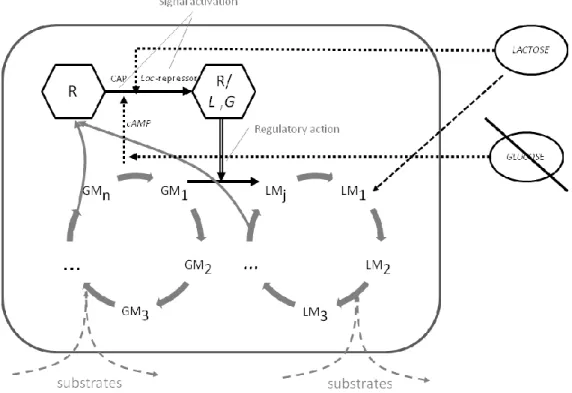
In some cases, such as bacterial chemotaxis, regulation operates upon those first-order functions, like movement, which are more specifically involved in the interaction with the environment. In these cases regulation realises adaptive agency, inasmuch as the system subject to regulation is capable to adapt its interactive functions to environmental conditions (Moreno and Mossio 2015). In order to show more preciselywhat the main regulatory steps are, we presenta general abstract model in the form of a graph (Fig. 5). After a brief description of it,we will show how it applies to a classical biological case: the regulation of metabolism through protein synthesis.
the capability to work or not on the basis of different inputs is crucial. And the input can be neither the concentration of the regulator, nor that of the metabolites directly. Otherwise,the subsystem would work at the same level of the constitutive regime (stoichiometrically determined), and regulation would collapse into dynamic stability.
25 One of the most evident differences between metabolic and developmental regulation is that in the latter the
regulatory change of regime tends to be irreversible, whereas in the former it is not. Metabolic regulation is usually reversible because the initial regime might be necessary again, for example in diauxic shifts between metabolic regimes based on different sugars.When the shift is reversible, it is obvious that the functional plasticity and robustness of the system increases, because it can specifically select, back and forth, between --at least-- two viable constitutive regimes, depending on the changes in the conditions. When they are irreversible (e.g., think of cell differentiation processes in multicellular development, see for example Arnellos et al., 2014) this does not necessarily follow. In so far as previous constitutive regimes are once and for all obliterated from the system (i.e., not available any more), the space for regulatory action seems to shrink. However, relatively often, these irreversible transitions operate as bifurcation points that lead to a richer dynamic scenario, where further regulatory relationships can be established.