HAL Id: hal-00906085
https://hal.archives-ouvertes.fr/hal-00906085
Submitted on 21 Nov 2013
HAL is a multi-disciplinary open access
archive for the deposit and dissemination of
sci-entific research documents, whether they are
pub-lished or not. The documents may come from
teaching and research institutions in France or
abroad, or from public or private research centers.
L’archive ouverte pluridisciplinaire HAL, est
destinée au dépôt et à la diffusion de documents
scientifiques de niveau recherche, publiés ou non,
émanant des établissements d’enseignement et de
recherche français ou étrangers, des laboratoires
publics ou privés.
Wavelength selective light-induced magnetic effects in
the binuclear spin crossover compound
[Fe(bt)(NCS)2]2(bpym)
Nawell Ould-Moussa, Elzbieta Trzop, S. Mouri, Samir Zein, Gábor Molnár,
Ana B. Gaspar, Eric Collet, Marylise Buron-Le Cointe, José Antonio Real,
Sergei Borshch, et al.
To cite this version:
Nawell Ould-Moussa, Elzbieta Trzop, S. Mouri, Samir Zein, Gábor Molnár, et al.. Wavelength
selec-tive light-induced magnetic effects in the binuclear spin crossover compound [Fe(bt)(NCS)2]2(bpym).
Physical Review B: Condensed Matter and Materials Physics (1998-2015), American Physical Society,
2007, 75 (5), pp.054101. �10.1103/PhysRevB.75.054101�. �hal-00906085�
Wavelength selective light-induced magnetic effects in the binuclear spin crossover compound
ˆ†Fe„bt…„NCS…
2‡
2„bpym…‰
N. Ould Moussa,1,3E. Trzop,2S. Mouri,3 S. Zein,4G. Molnár,1 A. B. Gaspar,5E. Collet,2,*M. Buron-Le Cointe,2
J. A. Real,5,†S. Borshch,4K. Tanaka,3 H. Cailleau,2and A. Bousseksou1,‡
1Laboratoire de Chimie de Coordination, CNRS UPR8241, 205 route de Narbonne, 31077 Toulouse, France
2Groupe Matière Condensée et Matériaux, CNRS UMR6626, Campus Beaulieu, Université de Rennes 1, 35042 Rennes Cedex, France 3Department of Physics, Graduate School of Science, Kyoto University, Kyoto 606-8502, Japan
4Ecole Normale Supérieure de Lyon, 46, allée d’Italie, 69364 Cedex, Lyon, France
5Institut de Ciència Molecular, Universitat de València, Edificio de Institutos de Paterna, P.B. Box 22085, València 46071, Spain 共Received 23 May 2006; published 1 February 2007兲
Using Fourier transform infrared spectroscopy, x-ray diffraction, and magnetic susceptibility measurements under light irradiation, the selective light-induced excited spin state trapping 共LIESST兲 and the reversible-LIESST effect have been evidenced and studied in depth in the binuclear spin crossover compound 兵关Fe共bt兲 ⫻共NCS兲2兴2bpym其. In this system, each magnetic site can switch from low spin 共LS兲 to high spin 共HS兲, so that three states exist, namely, the LS-LS, HS-LS, and HS-HS. All these techniques shine a new light on the high phototunability of this system. In addition to the direct photoswitching from the LS-LS to the HS-LS or to the HS-HS state, here we show that photoinduced switching between the excited photoinduced states can be triggered in a reversible way: from HS-LS to HS-HS 共irradiation around 800 nm兲, or reverse from HS-HS to HS-LS 共irradiation around 1300 nm兲. The nature of the intermediate HS-LS state during the thermal and light-induced spin state changes is also discussed by comparing the spectroscopic measurements and the structural analysis. The loss of inversion symmetry in the HS-LS molecular state, where the two magnetic Fe sites are no more equivalent, is not accompanied by any long-range ordering of the noncentrosymmetric molecules in the crystal. Therefore the continuous double-step spin conversion corresponds to a double crossover.
DOI:10.1103/PhysRevB.75.054101 PACS number共s兲: 75.30.Wx, 64.60.My, 78.30.⫺j
INTRODUCTION
The possibility of combining two properties like magnetic coupling and spin crossover 共SCO兲 in a polynuclear mol-ecule was realized by O. Kahn almost two decades ago.1 It was foreseen that the magnetic signal of the material could be modulated as a result of the interplay between the two phenomena. The first stage in this direction was the synthesis of 2,2
⬘
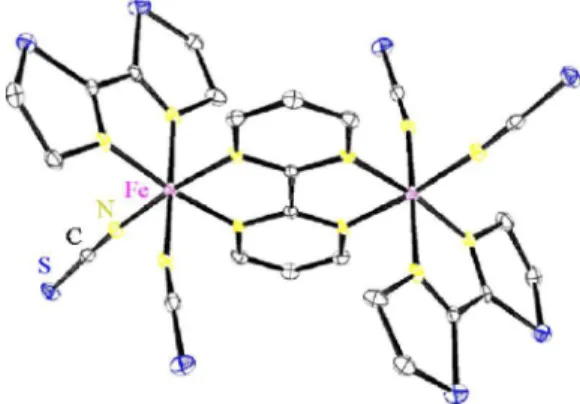
-bipyrimidine 共bpym兲 bridged iron共II兲 binuclear SCO compounds. A revision of this family of compounds has been recently reported.2The most singular compound of this fam-ily is 兵关Fe共bt兲共NCS兲2兴2bpym其, represented in Fig.1, where bt is the peripheral organic ligand 2 , 2⬘
-bithiazoline, which rep-resents the first example of thermally induced two-step spin conversion in a binuclear species.3A singular feature stemming from the binuclear nature of this compound is the generation of a negative short-range interaction, which can be called as an antiferromagnetic-like interaction.4,5 In contrast to molecular magnetism, such an interaction has essentially a steric and/or elastic origin. The very simple idea was that a volume change of one iron center of the dimetallic molecule due to the spin crossover phenom-enon leads to an increase of the energy gap between the high spin 共HS兲 and the low spin 共LS兲 levels of the second iron metal. This effect arises from an intramolecular pressure gen-erated by the first metallic center, leading to a shift of the crossover temperature of the second center toward higher temperatures, generating thus, a two-step spin crossover. In the same paper3 a macroscopic theoretical approach using negative interaction of pairs 共intramolecular兲 has been
pro-posed, then later a microscopic Ising-like model has been introduced based on a ferro-like cooperative interaction for the long-range interactions and an antiferro-like interaction for the short-range interaction.4Both interactions have been treated in the mean-field approximation. This model repro-duced well the main two-step spin crossover behaviors. Later, the antiferro-like interaction was treated with an exact approach in Ref.5.
It has been demonstrated in this work that for a certain balance between negative and positive interactions, a two-step spin crossover may be observed even for homogeneous ferro-like interaction in the material.5Such a situation led to a double symmetry breaking 共reentrant effect兲 around two Néel temperatures, leading to an antiferro-like phase
sepa-FIG. 1. 共Color online兲 Structure of the binuclear molecule 兵关Fe共bt兲共NCS兲2兴2bpym其 located on inversion symmetry site.
rated by two Néel temperatures. Boukheddaden et al. have also evidenced that negative short-range interactions may in-duce a sigmoïdal behavior in the relaxation curves after a photoswitching effect at liquid helium temperatures.6
The crystal structure of the complex
兵关Fe共bt兲共NCS兲2兴2bpym其, represented in Fig. 1, has been
solved very recently at 293 K, 240 K, 175 K, and 30 K.7At all these temperatures the crystal remains in the P1 space
group. The structure consists of centrosymmetric binuclear units where each iron共II兲 atom is surrounded by two NCS−
anions in the cis position, two nitrogen atoms of the bridging bpym ligand, with the remaining positions occupied by the peripheral bt ligand. The iron atom is in a severely distorted octahedral 关FeN6兴 environment. The average Fe-N bond
length of 2.15共9兲 Å indicates that this compound is in the high-spin state 共关HS-HS兴兲 at 293 K. Crystal structure deter-minations at 240 K, 175 K, and at 30 K gave a comparable cell to that seen at 293 K but reduced in volume. At 30 K, the average Fe-N distance is 1.958共4兲 Å, showing that the structure is clearly low spin 共关LS-LS兴兲. At 175 K, the Fe-N average bond length of 2.052共11兲 Å suggests the occurrence of an intermediate phase compatible with an intermediate state halfway between the high and low spin states. The fact that this state consists of 关HS-LS兴 pairs can be inferred from Mössbauer spectroscopic studies of Ksenofontov et al. under applied external magnetic field.8,9
Density functional theory 共DFT兲 calculations on the bi-nuclear complex 兵关Fe共bt兲共NCS兲2兴2bpym其 have also been
per-formed with the goal to characterize energies, geometric, and electronic structure in three possible electronic states 关LS-LS兴, 关HS-关LS-LS兴, and 关HS-HS兴.10 The self-consisted procedure converged to three states with spin densities corresponding to expected values of local spins: 0-0, 0-2, and 2-2. If the first and the last states have been obtained, supposing a center of the symmetry in the complex, the mixed state is clearly char-acterized by loss of the central symmetry. However, in all states the bridging ligand keeps its quasiplanar structure. The iron-nitrogen distances vary from 2.00 to 2.29 Å for the high-spin center, whereas for the low-spin center the disper-sion is much smaller: 1.94– 1.99 Å. The mean iron-nitrogen distance 共2.06 Å兲 is slightly lower than halfway between the 关LS-LS兴 and 关HS-HS兴 states 共1.97 and 2.17 Å, respectively兲. The energy of the mixed state lies also slightly lower than halfway between the 关LS-LS兴 and 关HS-HS兴 states, thus sat-isfying a necessary condition3for the two-step character of the spin transition. In the language of phenomenological models, this stabilization of the mixed state can be seen as a manifestation of the “antiferro”-like elastic interaction be-tween individual centers. Quantum-chemical calculations with the broken symmetry method also allowed determina-tion of the value of the electronic antiferromagnetic ex-change interaction, which is active only in the high-temperature 关HS-HS兴 state.
Following the first photomagnetic studies by Létard et al.,11–13 who observed a LS-LS→ HS-HS photoconversion under red light irradiation, the photomagnetic properties of the 兵关Fe共bt兲共NCS兲2兴2bpym其 compound have been
reex-amined.14Using Raman spectroscopy, it was possible to give spectroscopic evidence for the LS-LS→ HS-HS
photo-switching process with excitation in the red region. More-over, we have shown that infrared light 共1342 nm兲 selec-tively photoconverts the fundamental LS-LS state to the HS-LS state, revealing a direct experimental evidence of the symmetry breaking in this compound, as predicted in 1993,5 and in agreement with Mössbauer spectroscopy experi-ments.2
In the present work, we investigate in-depth the light-induced excited spin state trapping 共LIESST兲 phenomenon in the compound 兵关Fe共bt兲共NCS兲2兴2bpym其 by using different and
complementary techniques 关Fourier transform infrared 共FTIR兲, x-ray diffraction, and magnetic susceptibility mea-surements兴 and DFT calculations. The results presented here make it possible to address two questions of primary impor-tance: is there any long-range ordering in the crystal accom-panying the loss of inversion symmetry of the HS-LS mo-lecular state? Is it possible to trigger photoinduced effects between excited states and what is their nature?
I. EXPERIMENTS
Photomagnetic measurements were performed on a thin layer of polycrystalline compound 共synthesis according to Ref. 3兲 using a magnetic property measurement system 共Quantum Design兲 operated at 1 T between 2 K and 400 K and equipped with a sample rod allowing irradiation of the sample via fiber optics. For the irradiation setup two lasers were used: a Nd: YVO4laser 共1342 nm, 10 mW/ cm2兲 and a
laser diode 共785 nm, 20 mW/ cm2兲. Infrared absorption
spec-tra of 兵关Fe共bt兲共NCS兲2兴2bpym其 were acquired in KBr pellets
by means of a Shimadzu Prestige-21 FTIR spectrometer. The sample was pelletized without grinding. Spectra were recorded between room temperature and 15 K in the 4000− 400 cm−1 frequency range. The experimental setup allowed us to irradiate the sample with red 共785 nm兲 or near-infrared 共1342 nm兲 light at 15 K and record IR spectra of the irradiated zone. The light of the HeNe laser 共calibrating the interferometer in the FTIR instrument兲 was obstructed by a needle. UV visible 共UV-VIS兲 absorption spectra of 兵关Fe共bt兲共NCS2兲2兴2共bpym兲其 were obtained in KBr pellets
us-ing a Shimadzu UV-3150 spectrometer. Spectra were re-corded between room temperature and 15 K in the 300– 1500 nm wavelength range. Thermal and photoinduced switching were investigated by x-ray diffraction on single crystals, obtained by cutting of twined ones as received from the synthesis. X-ray data were collected on a four-circle Ox-ford Diffraction Xcalibur 3 diffractometer 共Mo K␣radiation兲 with a two-dimensional 共2D兲 sapphire 3 charge coupled de-vice 共CCD兲 detector, on samples with typical sizes around 100⫻ 100⫻ 100m3 in different experimental conditions. The single crystals were mounted either in an Oxford Dif-fraction Helijet helium-flow cryostat, allowing temperatures reaching 20 K, or in an Oxford Cryosystems nitrogen-flow cryostat, allowing a better control of the temperature down to 78 K. The unit cell parameters and the data reduction were obtained withCRYSALISsoftware from Oxford Diffraction.15 The structures were solved with SIR-9716 and refined with SHELXL97.17 Typical results of the structure refinement of the stable and photoinduced states gave final R factor 0.03
MOUSSA et al. PHYSICAL REVIEW B 75, 054101 共2007兲
⬍R ⬍ 0.055. The detailed structural analysis will be pub-lished elsewhere.18
II. DENSITY FUNCTIONAL CALCULATIONS
The vibrational frequencies of the complex
兵关Fe共bt兲共NCS2兲2兴2共bpym兲其 in three spin states have been
cal-culated starting from equilibrium geometries obtained in pre-vious DFT calculations.10 As it is meaningless to compute frequencies with a method other than that used for the sta-tionary points determination, the computation details are ex-actly the same. The frequency calculations have been per-formed using GAUSSIAN 98 共A7 version兲 package.19 The LANL2DZ basis set, including the double- basis with the Los Alamos effective core potential for Fe, S, and Se, and the Dunning-Huzinaga all-electron double-basis set with polar-ization functions for the H, C, and N atoms, have been used.20,21The B3LYP*exchange correlation functional,
spe-cially adapted for spin transition systems, has been chosen.22 Special attention has to be paid to the assignment of calcu-lated vibrational frequencies and their comparison in differ-ent spin states. As the shape of force fields changes with the spin state, not only frequencies of normal vibrations vary but also their composition. The comparison of different normal vibrations based on their visual representation, as it has been done in several publications, can be inexact if we do not deal with characteristic vibrations. In order to avoid this difficulty, we proposed a method based on the calculation of projec-tions of normal vibration vectors in one spin state on vectors in another state and then on the selection of counterparts corresponding to the most important projection coefficients.
III. RESULTS AND DISCUSSION A. Magnetic and spectroscopic studies
Figures2共a兲and2共b兲show the variation of themT
prod-uct 共wheremstands for the molar magnetic susceptibility兲
upon light irradiation at 10 K and subsequent heating as a function of the time and temperature, respectively. The sample was first cooled to 10 K in the dark to obtain the LS-LS state 共mT= 0.3 cm3mol−1K兲. It was then irradiated
by red light 共t = 0 min兲, leading to an increase of the mT
product to ca. 1.4 cm3mol−1K. After saturation of the
mag-netization 共t = 610 min兲, we heated the sample to 45 K. Upon heating, the magnetization increased strongly and at 45 K the mT product reached a value of 4.4 cm3mol−1K. As it was
shown earlier, this behavior can be associated with the for-mation of HS-HS pairs 共LIESST effect兲, in which the mag-netic moment is quenched at low temperatures due to the antiferromagnetic coupling between the two HS iron ions.11 In a next step, the sample 共still in the HS-HS state!兲 was cooled back to 10 K 共t = 660 min兲 and was irradiated by IR light 共t = 920 min兲. This irradiation led only to a slight in-crease of themTproduct from 1.4 to 1.9 cm3mol−1K.
Sub-sequent heating to 45 K 共t = 1410 min兲 led to a mT value
of 3.2 cm3mol−1K, which is significantly lower than the
value of 4.4 cm3mol−1K obtained after red light irradiation. We can explain tentatively this change in the magnetic behavior by a reverse LIESST effect, i.e., the infrared light
transforms 共at least partially兲 the HS-HS molecules into HS-LS pairs. As a final step, we cooled back the sample to 10 K 共t = 1455 min兲 and irradiated it again by red light 共t = 1600 min兲, leading to a slight decrease of the magnetiza-tion. When heating to 45 K 共t = 2030 min兲, we observed again the strong increase of the mT product to
4.4 cm3mol−1K.
These photomagnetic experiments suggest that irradiating the HS-HS state by infrared light leads to the formation of the HS-LS state and subsequent red light irradiation of the HS-LS state leads again to the pure HS-HS form. To clarify these hypotheses we decided to employ FTIR spectroscopy. 共Raman spectroscopy cannot be readily used for such double-excitation experiments because of the difficulties to probe the same volume by red and infrared lights in the strongly absorbing powder sample. On the other hand, in infrared spectroscopy the dilution of the sample in KBr pel-lets allows good control of the irradiation volume.兲 Figure3
displays IR absorption of the sample in the region of CN stretching modes at different temperatures and under light irradiation.
At 280 K one can observe two CN stretching modes at around 2080 and 2090 cm−1. These modes were assigned to
the HS state.13In the plateau region 共180 K兲, two new modes appear at around 2110 and 2125 cm−1, which can be associ-ated with the LS state.13 These modes increase further in
FIG. 2. 共Color online兲 Evolution of the mT product in
兵关Fe共bt兲共NCS兲2兴2bpym其 upon successive red, infrared, and red light irradiations as a function of time 共a兲 and temperature 共b兲. The irra-diation of the sample was carried out at 10 K in each case. When the magnetization has reached a constant value, the sample was heated up to 45 K and cooled back to 10 K.
intensity when cooling to 100 K and in the same time the intensity of the HS modes at 2080 and 2090 cm−1decreases.
There remains a small amount of residual HS fraction even at 15 K, but this has also been observed in Mössbauer experi-ments previously.3When the sample is shined with 1342 nm light at 15 K the intensity of HS modes increases for the detriment of LS modes and the spectrum of the photoinduced state corresponds to the spectrum in the plateau region 共180 K兲. In the next step, the sample was irradiated at 15 K by red light, leading to a pure HS spectrum 共HS-HS state兲. Then, irradiation of this HS-HS state by IR light led again to the HS-LS spectrum. These experiments corroborate per-fectly the photomagnetic measurements and give therefore a spectroscopic evidence for the following photoinduced ef-fects:
In other words, the nature of the photoinduced state only depends on the irradiation wavelength and not on the initial state 共stable or photogenerated兲. An open question is the ori-gin of this effect. The most obvious explanation would be to suppose that it is simply related to the absorbance of the sample at 1342 nm in the three states. Therefore we have
recorded UV-VIS spectra of the sample in the three states 共LS-LS, HS-LS, HS-HS兲. These spectra confirmed that at 1342 nm the sample has the highest absorption in the LS-LS state, but no significant difference was observed between the plateau region 共HS-LS兲 and room temperature 共HS-HS兲 共see supplementary material23兲. Time-resolved experiments will therefore be necessary to better understand the dynamics in the relaxation process that follows light excitations at differ-ent wavelengths.
B. Structural analysis of the photo-switching
In the family of spin transition materials, it is well known that important structural changes occur at the level of the coordination sphere surrounding Fe atoms, associated with the change of electronic state. A typical signature is the shift of the Fe-N distances from around 2.2 Å in the HS state to 2.0 Å in the LS state and thus important changes in the vol-ume of the crystal take place.24
Figure 4 shows the temperature dependence of the vol-ume, where two anomalies at around 200 K and 160 K sign the presence of the intermediate HS-LS state. At 23 K, the crystal in the LS-LS state switches by the irradiation at 808 nm 共0.26 mW/ cm2兲 to the HS-HS state, characterized
by a volume of ca. 844 Å3, whereas the irradiation at
1310 nm 共0.13 mW/ cm2兲 switches the crystal to the HS-LS state, characterized by a volume of ca. 828 Å3. The complete transformations take place within a few minutes, as shown in Fig.5共a兲. In agreement with the magnetic and FTIR data, it is possible to switch in a reversible way between the two photoinduced states 共HS-HS and HS-LS兲 by choosing the appropriate laser excitation wavelength. Indeed, the HS-HS state is generated from both the LS-LS and HS-LS states by irradiation at 808 nm, and the HS-LS state is generated from the LS-LS and HS-HS states by irradiation at 1310 nm.
These results show that one can easily increase and de-crease the volume of the crystal by laser excitation. It is noticed that the change of the volume occurs gradually with a gradual shift of the Bragg peaks in the reciprocal space 共see the movie in supplementary material23兲, contrary to what is observed in the case of orthorhombic 关Fe共PM-BiA兲2共NCS兲2兴
共Ref.25兲 or 关Fe共2-picolylamine兲3兴Cl2.EtOH,26where a phase
FIG. 3. 共Color online兲 共a兲 Infrared absorption spectra of 兵关Fe共bt兲共NCS兲2兴2bpym其 at different temperatures and 共b兲 upon suc-cessive infrared, red, and infrared light irradiations at 15 K. 共*The signal around 2050 cm−1is an artifact of the spectrometer.兲
FIG. 4. 共Color online兲 Temperature dependence of the unit cell volume 共where no hysteresis is observed兲 and effect of 1310 nm and 808 nm laser irradiations at 23 K.
MOUSSA et al. PHYSICAL REVIEW B 75, 054101 共2007兲
separation process takes place, indicating that the coopera-tive interactions between the photoinduced molecules are not so strong and the concentration of photodoped molecules is homogeneously increased within the crystal. In addition to the change of the volume, the change of the intensity of some Bragg peaks is a strong signature: the structural reor-ganization affects the intensity of the Bragg reflections. Fig-ure5共b兲shows the time dependence of the intensity of some Bragg peaks at 23 K, between the LS-LS, HS-LS, and HS-HS states.
Both Figs.5共a兲and5共b兲demonstrate the reversible struc-tural rearrangement between the different states. Further-more, the structures obtained for the photoinduced HS-LS and HS-HS states18are comparable with the adequate ones at thermal equilibrium,7 showing that the photoswitching is complete.
Indeed, more detailed information was obtained at the molecular level by solving the structure of the different states 共23 K for the photoinduced HS-HS and HS-LS states, 293 K and 250 K for the HS-HS state, 189 K, 185 K and 180 K and 175 K for the HS-LS state, at 130 and 23 K for the LS-LS state兲.
As already performed for the different states at thermal equilibrium,7the different structures and especially the ones of the photoinduced HS-HS and HS-LS states were refined in the P1 space group, where the binuclear molecules are
lo-cated on an inversion symmetry site 共Fig.1兲. The main sig-nature is associated with the important changes of the 具Fe-N典 bond length from 1.954共3兲 Å in the LS-LS state to
2.081共5兲 Å in the photoinduced HS-LS state and 2.152共3兲 Å in the photoinduced HS-HS state. These values are very similar to the ones observed during the thermal transition on the plateau in the HS-LS state 共that is in the range of 2.05– 2.09 Å between 175 K and 189 K兲 and in the HS-HS state 2.150共6兲 – 2.160共6兲 Å between 250 K and 300 K. Therefore, there is a clear structural signature associated with the generation of the HS-HS or HS-LS states, and here again it is reversible. This result is very interesting in that it dem-onstrates the possibility to generate photoinduced transfor-mation between excited states 共photoinduced HS-HS and HS-LS states兲 and it opens fascinating possibilities both from the experimental, theoretical, and applied point of view.
C. Symmetry of the HS-LS state
As it is indicated below and demonstrated in Ref.14, the formation of photoinduced HS-LS state involves spontane-ous symmetry breaking. To be exact, for binuclear spin-crossover compounds, it is a double symmetry breaking at two Néel temperatures, when the HS population of one me-tallic center becomes different than the HS population of the second center in the network. In other words, if we defined n= nHSA− nHSB, where A and B design the two metallic
cen-ters of the molecule, n has the definition of an order param-eter in the general Landau theory and the symmetry breaking is obtained in the temperature interval between TN+ and TN−for which n becomes ⫽0.5From the structural point of view, it is essential to be more explicit on the structural symmetry changes at TN+ and TN−, i.e., space group and molecular site symmetry changes, and eventually to indicate which type of structural symmetry breaking may be observed.
The symmetry breaking in the HS-LS state is an impor-tant issue that has to be discussed. Raman and Mössbauer spectroscopy8,9,14 have evidenced that the intermediate HS-LS state observed under irradiation at 1342 nm or in the temperature range of 160– 200 K is not a mixture of HS-HS and LS-LS states but that a third molecular state appears. This HS-LS state is associated with the loss of the inversion symmetry on the molecule.8,9,14In order to describe the crys-talline nature of this HS-LS state, one has to describe how the HS-LS molecules rearrange in the crystal and whether or not the symmetry breaking at the molecular level appears on the three-dimensional 共3D兲 crystalline structure. A compari-son of these experimental results with x-ray diffraction data makes it possible to discuss it in terms of structural broken symmetry. The structural analysis of the HS-HS and LS-LS spin states of the binuclear compounds describe them as Pl.
The molecules are located on inversion symmetry sites, so that the two Fe sites of the molecules are equivalent by sym-metry, as schematically shown in Fig. 6共a兲. In the HS-LS state, different possibilities exist regarding the 3D crystalline order, since when binuclear molecules in the HS-LS state form, the inversion symmetry is lost on the molecule. From the space group point of view, it means that another symme-try operator may have to be lost. The Landau theory of phase transition and ordering phenomena was applied to the spin transition, discussing the possibility of ordering between HS and LS sites.27,28 Therefore the crystalline structure of the
FIG. 5. 共Color online兲 Time dependence of the volume of the unit cell 共a兲 and intensity of some Bragg peaks 共b兲 under laser irradiation at 1310 nm and 808 nm at 23 K.
binuclear complex may be discussed as a set of mononuclear sites related by inversion symmetry, where the population of HS state may differ from site-to-site.
One possibility is the loss of translation symmetry 关Fig.
6共b兲兴, where the loss of inversion symmetry couples with a cell doubling along one direction, for example. The inversion symmetry between the molecules is kept so that the space group remains Pl. In such a case, superstructure reflections
should be observed since the structural rearrangement at the molecular level between HS and LS sites is important, as observed in 关Fe共2-picolylamine兲3兴Cl2.EtOH,26–28 or in some other compounds29,30 as well. We looked carefully for such signatures in the diffraction data, but no change of translation symmetry was observed.
Another possibility is that the translation symmetry is kept and that the inversion symmetry on the molecules and between the molecules is lost 关Fig.6共c兲兴. In such a case, the space group changes from Pl to P1. The atomic motions
between the HS and LS states are so large that when the structure of the intermediate state is solved, significant dif-ferences between Fe-N bond lengths of the HS and LS sites should be observed. We solved the structure in the P1 space
group and such differences could not be observed. It also has to be noticed that in such a case, the HS-LS state will be associated with two symmetry-breaking order parameters 共one describing the loss of inversion symmetry on the mol-ecules and the other one between the molmol-ecules兲. As it is well known from the Landau theory of phase transition, when two such symmetry-breaking order parameters couple in the development of the free energy in a biquadratic term, only first-order phase transition will be possible between the HS-HS and HS-LS states and between the HS-LS and LS-LS spin states. In this compound, a gradual change occurs be-tween the HS-HS and HS-LS states and also bebe-tween the HS-LS and LS-LS states. Therefore, by considering the Lan-dau theory, it is another indication that the HS-LS state can-not be P1, since two first-order transitions should take place.
The case where an ordering of binuclear molecules in the HS-HS state and binuclear molecules in the LS-LS state takes place 关Fig.6共d兲兴 will also be associated with a change of the translation symmetry not observed here, as mentioned before. In addition, Mössbauer spectroscopy and Raman
spectroscopy indicated that the symmetry is broken at the molecular level. Therefore, from the x-ray diffraction experi-ments, it comes out that the space group remains Pland that
no change of symmetry occurs on the average 3D structure. In comparison with the Raman scattering experiments, the results reveal that this intermediate state is made of HS-LS binuclear molecules, which are fluctuating in space and eventually in time. As Raman scattering is a fast and local probe, it can watch the symmetry breaking on the molecule. However, as no correlation exists from site-to-site, x-ray dif-fraction will only see an average state where molecules will have a probability of 12 to be in the HS-LS molecular state and the same probability to be in the HS-LS one 关Fig.6共e兲兴. The disordered structure Plof the HS-LS crystalline state is
then isostructural to both the HS-HS and LS-LS ones. The value of the 具Fe-N典 bond length in the HS-LS state on the plateau or in the photoinduced state varies between 2.05 Å 共175 K兲 and 2.09 Å 共189 K兲. It is close to the aver-age value of 2.05 Å between the HS-HS 共⬇2.15 Å兲 and LS-LS states 共⬇1.95共1兲 Å兲 关Figs. 6共e兲 and 6共c兲兴 that we should observe, if we assume that for the molecules in the HS-LS state the average value of the 具Fe-N典 bond length on the LS site is the same as for the completely LS-LS, and vice versa for the HS site. As pointed out before, a slight devia-tion from the average can be explained by the antiferro-like coupling between the two sites that will result in a local pressure.
D. Density functional results
It should be noted that these calculations are done for an isolated molecule. To be exact, it should be extended 共more difficult兲 to the crystal. The calculated vibrational frequen-cies are given in the supplementary material.23 In the cen-trally symmetrical 关LS-LS兴 and 关HS-HS兴 states all normal vibrations can be divided in even and odd combinations. The frequency splitting between even and odd counterparts mea-sures the elastic interaction strength between two vibrations localized in two parts of the molecule and connected by the inversion symmetry. The analysis of the shape of normal vibrations allows assigning the vibrations in the range 1420– 1550 cm−1 to ring deformations and interring stretch-ing of the bridgstretch-ing bpym ligand, in agreement with our pre-vious assignments.14 The four frequencies around 2050– 2100 cm−1 correspond to CN stretching vibrations, in
agreement with our Raman and FTIR results. The even and odd vibrations are formed by “symmetric” and “antisymmet-ric” combination of local vibrations of two NCS ligands around each iron center. It can be seen that the splitting be-tween even and odd components is rather small in the 关LS-LS兴 and 关HS-HS兴 states. In principle, two peaks could be expected for both states. Although the calculated frequen-cies 共2046 and 2063 cm−1 for the 关HS-HS兴 and 2093 and
2107 cm−1for the 关LS-LS兴 state兲 are slightly lower than the
experimental ones 共2080 and 2090 cm−1 for the 关HS-HS兴,
2110 and 2125 cm−1 for the 关LS-LS兴 states兲, the splitting between local “symmetric” and “antisymmetric” vibrations 共⬃10– 15 cm−1兲 is nicely reproduced by the calculations. In
the mixed 关HS-LS兴 state the normal vibrations lose the
sig-FIG. 6. Schematic crystalline structures where the molecules are located on inversion symmetry site. Crosses schematically indicate the lost inversion symmetry operators.
MOUSSA et al. PHYSICAL REVIEW B 75, 054101 共2007兲
nature of even or odd representation and correspond to com-binations of stretching vibrations around each iron center. The obtained four frequencies cover the whole range charac-teristic for both 关LS-LS兴 and 关HS-HS兴 states. This dispersion of vibrations of the same type also displays the loss of the dimer symmetry in the intermediate state.
CONCLUSIONS
In our previous paper14we have demonstrated a selective photoswitching phenomena from the fundamental LS-LS state to the metastable HS-LS 共1342 nm兲 and HS-HS 共647 nm兲 states at low temperatures. In the present paper we provide clear experimental evidences from different tech-niques that a reversible photoconversion occurs between the two metastable states: HS-LS→ HS-HS 共red light irradia-tion兲 and the reverse HS-HS→ HS-LS 共infrared light兲. It ap-pears, therefore, that the mechanism of selective photoexci-tation is related to the reverse-LIESST phenomenon under infrared excitation. These results demonstrate the high pho-totunability of this system, associated with the selective and reversible photoswitching between the metastable states. Fi-nally, it comes out that the photoinduced state only depends on the irradiation wavelength and not on the initial state.
From the x-ray analysis, it comes out that the HS-LS state is a mixture of molecules in the indistinguishable HS-LS and
LS-HS states. The gradual change of the volume during laser excitation or as a function of temperature characterizes a double-crossover phenomenon in a three-state model 共LS-LS, HS-共LS-LS, and HS-HS兲, in agreement with the magnetic properties, since no long-range structural symmetry breaking appears in the HS-LS state, neither at thermal equilibrium nor under laser irradiation. Therefore, in the model devel-oped by Bousseksou et al.,5 the order parameter 共pure mag-netic parameter兲 defining the difference of population on one site of HS and LS molecules, showing a symmetry breaking, concerns only the magnetic states and the local molecular structure 共as inferred from the DFT calculations and vibra-tional spectra兲. It corresponds, from a structural point of view, with regard to the Landau theory of phase transitions,28 to the isostructural scenario.
ACKNOWLEDGMENTS
The authors are grateful to the JSPS, Japanese Office, for the grant to N. Ould Moussa supporting a part of her Ph.D. period in Japan at Kyoto University. Grants from the Euro-pean FLASH network 共MRTN-CT-2003-503641兲, NOE
MAGMANet 共515767-2兲, ANR “Fast-switch”
共NT05-3គ45333兲, Région Bretagne, the Spanish Ministerio de Edu-cación y Ciencia 共MEC兲 共CTQ 2004-03456/BQU兲, and the Spanish MEC for a research contract 共Programa Ramón y Cajal兲 are also acknowledged.
*Corresponding author. Electronic address: [email protected]
†Corresponding author. Electronic address: [email protected] ‡Corresponding author. Electronic address:
1J. A. Real, J. Zarembowitch, O. Kahn, and X. Solans, Inorg. Chem. 26, 2939 共1987兲.
2J. A. Real, A. B. Gaspar, M. C. Muñoz, P. Gütlich, V. Ksenofon-tov, and H. Spiering, Top. Curr. Chem. 233, 49 共2004兲. 3J. A. Real, H. Bolvin, A. Bousseksou, A. Dworkin, O. Kahn, F.
Varret, and J. Zarembowitch, J. Am. Chem. Soc. 114, 4650 共1992兲.
4A. Bousseksou, J. Nasser, J. Linares, K. Boukheddaden, and F. Varret, J. Phys. I 2, 1381 共1992兲.
5A. Bousseksou, F. Varret, and J. Nasser, J. Phys. I 3, 1463 共1993兲. 6K. Boukheddaden, I. Shteto, B. Hoo, and F. Varret, Phys. Rev. B
62, 14796 共2000兲.
7A. B. Gaspar, V. Ksenofontov, S. Reiman, P. Gütlich, A. L. Thompson, A. Goeta, M. Carmen Munoz, and J. A. Real, Chem.-Eur. J. 12, 9289 共2006兲; DOI: 10.1002/chem.200600559. 8V. Ksenofontov, H. Spiering, S. Reiman, Y. Garcia, A. B. Gaspar, N. Moliner, J. A. Real, and P. Gütlich, Chem. Phys. Lett. 348, 381 共2001兲.
9V. Ksenofontov, A. B. Gaspar, V. Niel, S. Reiman, J. A. Real, and P. Gütlich, Chem.-Eur. J. 10, 1291 共2004兲.
10S. Zein and S. A. Borshch, J. Am. Chem. Soc. 127, 16197 共2005兲. 11J.-F. Létard, J. A. Real, N. Moliner, A. B. Gaspar, L. Capes, O.
Cador, and O. Kahn, J. Am. Chem. Soc. 121, 10630 共1999兲.
12G. Chastanet, A. B. Gaspar, J. A. Real, and J.-F. Létard, Chem. Commun. 共Cambridge兲 2001, 819 共2001兲.
13G. Chastanet, C. Carbonera, C. Mingotaud, and J.-F. Létard, J. Mater. Chem. 14, 3516 共2004兲.
14N. O. Moussa, G. Molnár, S. Bonhommeau, A. Zwick, S. Mouri, K. Tanaka, J. A. Real, and A. Bousseksou, Phys. Rev. Lett. 94, 107205 共2005兲.
15CRYSALIS RED, Oxford Diffraction, Ltd., vers. 1.171.26pre2 beta 共2004兲.
16A. Altomare, M. C. Burla, M. Camalli, G. Cascarano, C. Giaco-vazzo, A. Guagliardi, A. G. G. Moliterni, G. Polidori, and R. Spagna., J. Appl. Crystallogr. 32, 115 共1999兲.
17G. M. Sheldrick,
SHELX97, Program for the Refinement of Crystal Structures, University of Göttingen, Germany 共1997兲.
18E. Trzop, M. Buron-Le Cointe, H. Cailleau, L. Toupet, G. Molnar, A. Bousseksou, A. B. Gaspar, J. A. Real, and E. Collet, J. Appl. Crystallogr. 40, 158 共2007兲.
19M. J. Frisch et al.,GAUSSIAN98, rev. A.7 共Gaussian, Inc., Pitts-burgh, PA, 1998兲.
20T. H. Dunning, Jr. and P. J. Hay, in Modern Theoretical Chemis-try, edited by H. F. Schaefer III 共Plenum, New York, 1976兲, Vol. 3, pp. 1–28.
21P. J. Hay and W. R. Wadt, J. Chem. Phys. 82, 270 共1985兲. 22M. Reiher, Inorg. Chem. 41, 6928 共2002兲.
23See EPAPS document No. E-PRBMDO-75-067701 for UV-VIS spectra, calculated vibrational frequencies, and a movie of the shift of the Bragg peak 共23 K, 1310 nm and 808 nm irradiation兲. For more information on EPAPS, see http://www.aip.org/ pubservs/epaps.html
24P. Gütlich, Struct. Bonding 共Berlin兲 44, 83 共1981兲.
25K. Ichiyanagi, J. Hebert, L. Toupet, H. Cailleau, P. Guionneau, J.-F. Létard, and E. Collet, Phys. Rev. B 73, 060408共R兲 共2006兲. 26N. Huby, L. Guérin, E. Collet, L. Toupet, J. C. Ameline, H. Cail-leau, T. Roisnel, T. Tayagaki, and K. Tanaka, Phys. Rev. B 69 020101共R兲 共2004兲.
27D. Chernyshov, M. Hostettler, K. Törnroos, and H. S. Bürgi, An-gew. Chem., Int. Ed. 42, 3825 共2003兲.
28D. Chernyshov, H. B. Bürgi, M. Hostettler, and K. W. Törnroos, Phys. Rev. B 70, 094116 共2004兲.
29K. Nakamo, S. Kawata, K. Yoneda, A. Fuyuhiro, T. Yagi, S. Nasu, S. Morimoto, and S. Kaizaki, Chem. Commun. 共Cambridge兲
2004, 2892 共2004兲.
30M. H. Klingele, B. Moubaraki, J. D. Cashion, K. S. Murray, and S. Brooker, Chem. Commun. 共Cambridge兲 2005, 987 共2005兲.
MOUSSA et al. PHYSICAL REVIEW B 75, 054101 共2007兲