Institute of Literatures and Languages Branch: English Language Department of Foreign Languages
A Dissertation Submitted in Partial Fulfillment for the Requirements of the Master Degree in Language sciences and Didactics of Language
Presented by Supervisor
Mr. Khaled MERZKANE Dr. Leila BELLOUR Mr. Nadjib ZABATBoard of Examiners
Chairman: Mr. Khalid ZIAD Abdelhafid Boussouf University Center of Mila Supervisor: Dr. Leila BELLOUR M.C. Abdelhafid Boussouf University Center of Mila Examiner: Mrs. Amina AGGOUN Abdelhafid Boussouf University Center of Mila
Academic year: 2016 – 2017
The Effect of Teacher Gender on Oral Skill
Proficiency
A Case Study of Secondary School Students
People’s Democratic Republic of Algeria
Ministry
of Higher Education and Scientific Research
I
Khaled Merzkane’s Dedication
For my beloved mother “AICHA” whose love always strengthens my will. For my dear dead father “AHMED”, GOD bless his soul. I may not remember your face, but you are always
living in my heart. I love you “Dad.”
For the ones who gave me love and support; for my lovely second family Mazouzi, especially my uncle Wahid and his precious wife Linda, who like a second mother. For their sons Ishaq,
Mehdi, and Mohamed. For all of you, my everlasting love and gratitude.
For all my brothers: Adel, Yassine, Redouene, Bouzid, Fares, Saliha, Fatiha, Razika, Samia and Warda
For the new family member “Aveline”.
For all my dearest nieces, nephews, and their mothers. For all the rest of my family without exceptions.
For my dear friends Howari, boukezzata, tawfik hariti, Lyes hamiroune, Lamine lounis, Nadjib Zemmouri, Momane Zemmouri, Aissam Flifla, Sofiane Seddari, Kadirou Zemmouri,
and Foufou Boudchiche.
II
Nadjib Zabat’s Dedication
III
Acknowledgements
Thanks to Allah the almighty for his blessings and mercy that are given to us. Peace upon our prophet Mohamed who has brought us from darkness to faith.
Special thanks to our supervisor Dr. LEILA BELLOUR for her devotion, time, and the efforts she made to guide us. Thanks for being such a nice teacher, supervisor, and sister.
We would like the honorable members of the jury Mr. Khalid ZIAD and Mrs. Amina AGGOUN for reading and commenting on our dissertation. We are also grateful to them for being such good teachers.
IV
ABSTRACT
The impact of gender in the EFL classroom is an area that continues to evolve as teachers and scholars strive to provide the most adequate learning conditions. The major aim of this dissertation was to examine the effect of teacher gender on students’ oral performance in the Algerian high school settings. The speaking skill is crucially important in EFL learning. However, due to many internal and external factors, students often face difficulties when trying to speak English in order to communicate or to perform an oral activity. This study was guided by the hypothesis that the teacher’s gender affects students’ oral proficiency level. To achieve our aim and test our hypothesis, two research instruments were used: classroom observation and two questionnaires. The first questionnaire was administered to secondary school teachers, while the second was targeted to secondary school students. The overwhelming conclusion, reached from the results of this study, is that the teacher’s gender does not have a significant impact on students’ oral proficiency. Thus, our hypothesis was not confirmed, and our research topic begs for further investigations.
V
ﺺﺨﻠﻣ
ﺮﯿﺛﺄﺗ نإ ﻰﻌ ﺴﯾ ﺚ ﯿﺣ ,ﺮﻤﺘ ﺴﻣ رﻮ ﻄﺗ ﻲ ﻓ لاﺰ ﯾ ﻻ لﺎ ﺠﻣ ﻮ ھ ﺔ ﯿﺒﻨﺟأ ﺔ ﻐﻠﻛ ﺔ ﯾﺰﯿﻠﺠﻧﻻا سﺎﯿﻘﻣ ﻲﻓ ﻲﻋﺎﻤﺘﺟﻻا عﻮﻨﻟا عﻮ ﻨﻟا ﺮﯿﺛﺄﺗ ﺔﺳارد ﻮھ ﺔﻟﺎﺳﺮﻟا هﺬھ ﻦﻣ ﻲﺴﯿﺋﺮﻟا فﺪﮭﻟا نإ . ﺔﻣءﻼﻣ ﺮﺜﻛﻷا ﻢﻠﻌﺘﻟا فوﺮظ ﺮﯿﻓﻮﺘﻟ ﻦﯾﺪھﺎﺟ ءﺎﻤﻠﻌﻟاو نﻮﻤّﻠﻌﻤﻟا ﺎﺜﻟا ﻲﻓ ﺬﯿﻣﻼﺘﻠﻟ ﻲﮭﻔﺸﻟا ءادﻷا ﻰﻠﻋ ّﻢّﻠﻌﻤﻠﻟ ﻲﻋﺎﻤﺘﺟﻻا ﻢ ﻠﻌﺗ ﻲ ﻓ ﺔ ّﯿﻤھﻷا ﻎﻟﺎ ﺑ ﺮ ﻣأ ثﺪ ﺤﺘﻟا ةرﺎ ﮭﻣ ﺮﺒﺘﻌﺗ ذإ .ﺔﯾﺮﺋاﺰﺠﻟا تﺎﯾﻮﻧ ﺬ ﯿﻣﻼﺘﻟا ﮫ ﺟاﻮﯾ ﺎ ﻣ ﺎ ﺒﻟﺎﻐﻓ ﺔ ﯿﺟرﺎﺨﻟاو ﺔ ﯿﻠﺧاﺪﻟا ﻞ ﯿﻗاﺮﻌﻟا و ﻞ ﻣاﻮﻌﻟا ﻦ ﻣ ﺪ ﯾﺪﻌﻠﻟ اﺮ ﻈﻧ و ﻦ ﻜﻟ .ﺔ ﯿﺒﻨﺟأ ﺔ ﻐﻠﻛ ﺔ ﯾﺰﯿﻠﺠﻧﻹا ﺔ ﻐﻠﻟا ﻲﮭﻔ ﺷ طﺎ ﺸﻧ ءادﻷ وأ ﻞ ﺻاﻮﺘﻟا ﻞ ﺟأ ﻦ ﻣ ﺔ ﯾﺰﯿﻠﺠﻧﻹا ﺔ ﻐﻠﻟﺎﺑ ثﺪ ﺤﺘﻟا ﺔ ﻟوﺎﺤﻣ ﺪ ﻨﻋ تﺎﺑﻮﻌ ﺻ ﺔ ﺳارﺪﻟا هﺬ ھ تﺪ ﺷﺮﺘﺳا ﺪ ﻗو . ﺔ ّﺤ ﺻ رﺎ ﺒﺘﺧاو ﺎﻨﻓﺪ ھ ﻖ ﯿﻘﺤﺘﻟو .ﺬ ﯿﻣﻼﺘﻟا ىﺪ ﻟ ﺔﯿﮭﻔ ﺸﻟا ةءﺎﻔﻜﻟا ىﻮﺘﺴﻣ ﻰﻠﻋ ﺮﺛﺆﯾ ﻢﻠﻌﻤﻟا ﻲﻋﺎﻤﺘﺟﻻا عﻮﻨﻟا نأ ﺎھدﺎﻔﻣ ﺔﯿﺿﺮﻔﺑ ﻦ ﻣ ﺔ ﻨﯿﻌﻟ لوﻷا نﺎﯿﺒﺘ ﺳﻻا مّﺪ ُﻗ ﺪ ﻘﻟ .ﻦﯿﻧﺎﯿﺒﺘ ﺳاو ﺔّﯿﻔ ﺻﻮﻟا ﺔ ﻈﺣﻼﻤﻟا ﺎﻤھ و ﺚﺤﺒﻟا تاودأ ﻦﻣ ﻦﯿﻨﺛا ماﺪﺨﺘﺳا ﻢﺗ ﺪﻘﻓ ،ﺎﻨﺘﯿﺿﺮﻓ ﺞﺋﺎ ﺘﻧ ﻰ ﻟا ﺔ ﺳارﺪﻟا هﺬ ھ ﺖﻠ ّﺻﻮﺗو .ﺔﯾﻮﻧﺎﺜﻟا سراﺪﻤﻟا ﺬﯿﻣﻼﺗ ﻦﻣ ﺔﻨّﯿﻌﻟ ﻲﻧﺎﺜﻟا نﺎﯿﺒﺘﺳﻻا مّﺪُﻗ ﻦﯿﺣ ﻲﻓ ،ﺔﯾﻮﻧﺎﺜﻟا سراﺪﻤﻟا ﻲﻤّﻠﻌﻣ ﻰ ﻘﺒﯾ و ،ﺎﻨﺘﯿ ﺿﺮﻓ ﺪ ﯿﻛﺄﺗ ﻢﺘ ﯾ ﻢ ﻟ ﻲﻟﺎ ﺘﻟﺎﺑو ﺬ ﯿﻣﻼﺘﻠﻟ ﺔﯿﮭﻔ ّﺸﻟا ةءﺎ ﻔﻜﻟا ﻰ ﻠﻋ ﻢﮭﻣ ﺮﯿﺛﺄﺗ ﮫﻟ ﺲﯿﻟ ﻢّﻠﻌﻤﻟا ﻲﻋﺎﻤﺘﺟﻻا عﻮﻨﻟا نأ ﺎھدﺎﻔﻣ ﻮﺘﻔﻣ ﺎﻨﺜﺤﺑ عﻮﺿﻮﻣ .ﻲﻤﻠﻌﻟا ءﺎﺼﻘﺘﺳﻻاو ﺚﺤﺒﻟا ﻦﻣ ﺪﯾﺰﻤﻟ ﺎﺣVI
List of abbreviations
CD: Classrooms discussions
EFL: English as a foreign language
ESL: English as a second language
MI: Multiple intelligences
MT: Mother tongue
OG: Observation grid
Q: Question (in the analysis of the questionnaires)
ST: Students’ gender
TG: Teachers’ gender
VII
List of Figures
Figure 1: The Teaching Pyramid……… 16
VIII
List of tables
Table 01: Students’ level………..…………..………...…… 66
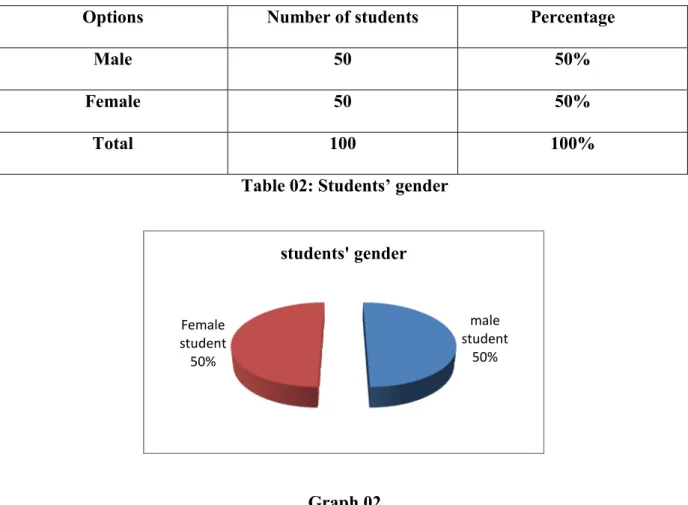
Table 02: Students’ gender………..………...…………...… 67
Table 03: Period of studying English…….…………...……….……...… 68
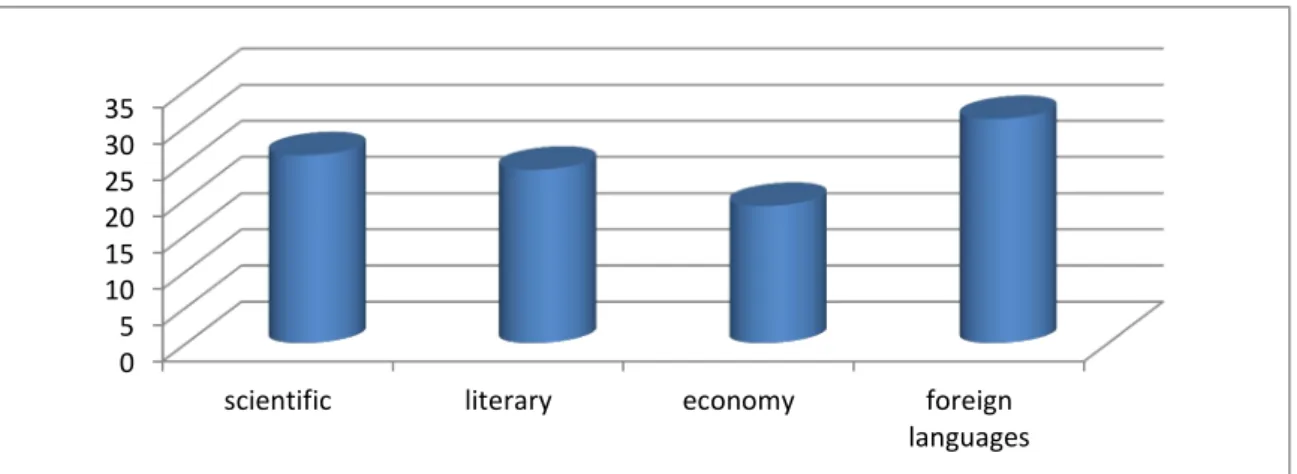
Table 04: Learners’ stream……….………..…………...…. 69
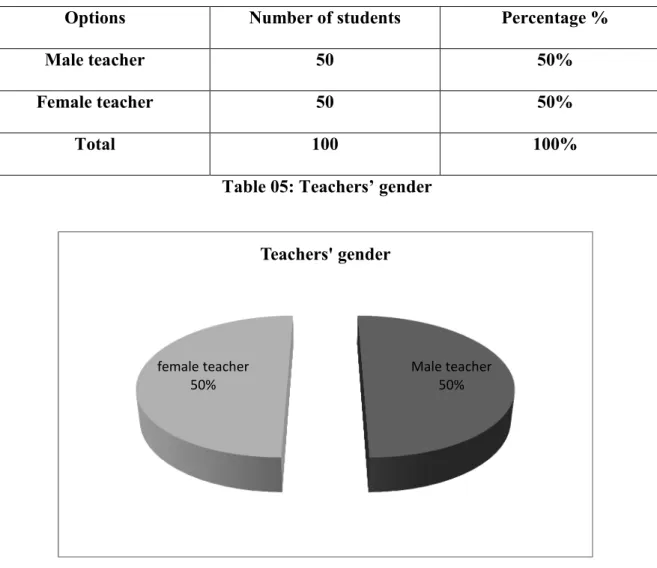
Table 05: Teachers’ gender………...…..… 70
Table 06: Number of sessions per week………..………..…………... 71
Table 07: The importance of English………...………... 72
Table 08: Learners’ interest in English ……….………..………. 73
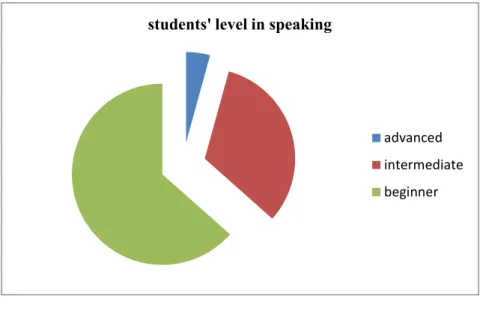
Table 09: Students’ level in speaking English………..… 74
Table 10, 11: Learners’ motivation to speak English……….………..… 75
Table 12: Frequency of using English……...……….………. 76
Table 13: Students’ reasons for not using English………...………...…. 78
Table 14: Speaking activities………...…. 80
Tables 15, 16: Teachers’ openness and approachability ……….……...….. 81
Tables 17, 18: Students’ integration in the classroom………...………..……. 82
Tables 19, 20: Teachers’ evaluation of students’ outcome………….………...…… 84
Tables 21, 22: Teachers attitudes towards learners’ mistakes………..…….... 85
Tables 23, 24: Learners’ reaction to teachers’ feedback……….. 87
Tables 25, 26: Learners’ talking time……….……….………...89
Tables 27, 28: Frequency of learners’ involvement……….……… 90
Tables 29, 30: Teachers’ calls on their students
……...………...………
92Tables 31, 32: Teachers’ interaction with their students………...…..………..…... 93
Tables 33, 34: Teachers’ treatment of their students’ misbehavior………..…….... 95
IX
Table 37: Teachers’ degree…………...…….……..………100
Table 38: teachers’ gender…………...…….………...………... 101
Table 39: Percentage of male and female teachers………...……….……….………… 102
Table 40: Teachers’ experience in teaching ……….…………..…103
Table 41: Streams taught by the teachers………...……….……104
Table 42: Levels taught by the teachers………...….………...106
Table 43: Teachers’ choice of their profession………...……….………...107
Table 44: Teachers’ main objectives in teaching…………..…….………..………109
Table 45/A: Teachers’ use of Arabic language in the classroom…….………...………110
Table 45/B: Frequency of using Arabic….……….…...………..112
Table 46: Teachers’ evaluation of students’ level in speaking …………...………..113
Table 47: Types of activities teachers use in class…………..…….……...……...115
Table 48/A: Teachers’ evaluation of students’ oral production………..……...……...116
Table 48/B: Methods of evaluating learners’ oral proficiency………...….…117
Table 49: Methods of fostering learners’ oral proficiency………..………...…..118
Table 50/A: Male and female students’ oral performance………..119
Table 50/B: Reasons behind boys’ underachievement …….……….……...…..119
Table 51: Teachers’ interaction with male and female students………….……….……122
Table 52: Teachers’ responses to males’ and females’ answers………..……....123
Table 53: Students’ interest in the discussed topics ………..………....…….124
Table 54: Effectiveness of the teaching strategies……….………..….…...125
Table 55: Challenges faced when teaching the opposite gender……….……....126
Table 56: Learners’ attitudes toward teachers of the opposite gender…………..….….127
Table 57: Teachers view of gender effects on the oral skill ………...…….128
X
List of Graphs
Graph 01: Students’ level……….……….……...…………...………66
Graph 02: Students’ gender………..……….….…….. 67
Graph 03: Period of studying English ……….………...……….…..………….. 68
Graph 04: Learners’ stream……….……….……….……... 69
Graph 05: Teachers’ gender……….………...………...……….. 70
Graph 06: Number of sessions per week……….………...……..…..…….. 71
Graph 07: The importance of English………….………...……….…….72
Graph 08: Learners’ interest in English………...…..…....73
Graph 09: Students’ level in speaking English……….………....………75
Graphs 10, 11: Learners’ motivation to speak English……….…76
Graph 12: Frequency of using English……….………..…...…77
Graph 13: Students’ reasons for not using English……….….……….78
Graph 14: Speaking activities……….………...………...………80
Graphs 15, 16: Teachers’ openness and approachability……….………...…….81
Graphs 17, 18: Students’ integration in the classroom ……….………...……82
Graphs 19, 20: Teachers’ evaluation of students’ outcome………….………...84
Graphs 21, 22: Teachers’ attitudes towards learners’ mistakes……….………....……...86
Graphs 23, 24: Learners’ reaction to teachers’ feedback……...……..…...………….87
Graphs 25, 26: Learners’ talking time……….…….………...…………..89
Graphs 27, 28: Frequency of learners’ involvement……….………91
Graphs 29, 30: Teachers’ calls on their students……….……….….92
Graphs 31, 32: Teachers’ interaction with their students……….………….94
Graphs 33, 34: Teachers’ treatment of their students’ misbehavior…………...……95
XI
Table of Contents
Dedications………..………...…...…… I Acknowledgements………..……….III Abstract………..……….……...……..…...IV ... ﺺﺨﻠﻣ... …..V List of Abbreviations………..………....……..…………VI List of Figures……….…….……....……VII List of Tables………..……VIII List of Graphs………...………..XI Table of Content………...……….XIIGeneral Introduction
……….………...11. Statement of the Problem……….………..……….…...1
2. Aims of the Study……….……..……….……3
3. Significance of the Study……….……...3
4. Research Questions ……….…...……...………....….…4
5. Research Hypothesis ……….…..…………..………….4
6. Tools of Research …..………..………...4
7. Structure of the Dissertation……… ………...5
Chapter One: An Overview of the Concepts of Teaching
Introduction……….………..………..…6XII
1. Gender Definitions……….…...………..………6
1.1. Dictionary Definition……….………….……….6
1.2. Sociological Definition………...…..………..6
1.3. Psychological view of Gender……….………...…..……….7
2. Gender Differences……….………..……….…………...8
2.1. Gender vs. Sex difference ………...…….……...…...8
2.2. Gender Psychological Differences………...9
2.2.1. Processing.……….………….….………....10
2.2.2. Chemistry ……….……….….…...……….…... 11
2.3. Gender societal roles……….…………...…….……….12
II. Teaching……….……15
1. Definition of teaching……….………...………...15
2. Characteristics of a teacher……...………...………... 17
3. Characteristics of a successful teacher……….……...………...………... 18
4. The teacher roles….……….……… 21
Conclusion………...24
Chapter Two: Learner’s Oral Proficiency
Introduction ………...……… 251. Definition of the Speaking ...………..……….……….. 25
2. The Importance of Speaking………...26
3. Components Underlying Speaking Effectively ………...…...…….27
3.1 Grammatical competence………….………...………... 27
3.2 Sociolinguistic competence……….. 28
XIII
3.4 Strategic Competence……….….………… 30
4. Characteristics of Successful speaking tasks…………..………..…...……… 31
5. Problems Hindering the Proficiency Achievement………...…….. 32
5.1 Performance Conditions………...………..… 33 5.2 Affective Factors………..……….…..……….… 33 5.2.1 Motivation………... 33 5.2.2 Self-esteem ….……….…. 35 5.2.3 Anxiety ……….……….... 36 5.3 Listening Ability………...….………..…….… 37 5.4 Teachers’ Feedback………...………..……….... 37 5.5 Speaking Problems……….…..…... 38
6. Activities to Promote Speaking………..……….………..………… 38
6.1 Discussions………...…….………… 39
6.2 Role Plays……….………...……….………… 40
6.3 Simulations………... 40
6.4 Brain Storming………...………..…….…....………40
7. Classroom Interaction 7.1 The Interaction Hypothesis..……….……….. 41
7.2 Definition of Classroom Interaction…...……….………... 42
7.3 Types of Classroom Interaction………...……….. 43
7.3.1 Teacher-Learner Interaction………... 43
7.3.2 Learner-Learner Interaction…..………....….... 44
7.4 The Role of Classroom Interaction..………... 45
7.5 Introvert vs. Extrovert Learners..………..……….…45
XIV
Chapter Three: The Effects of Teachers’ Gender on Students’ oral
proficiency
……….……….48Introduction ………...……..……….48
1. Gender differences in the classroom ………...……… 48
1.1 Physical Activity and Motor Skills………...………49
1.2 Cognitive Abilities and Achievement Motivation…………..……….49
1.3 Interpersonal behavior and relationships………..………….50
1.4 Sense of the self and self-esteem………..……..….. 51
2. The Status of Male Teachers and Teachers as role Models………....………51
3. Gender Equity in Schools………..…...53
4. Teachers’ Gender Differences………...54
5. The Problem of Boys’ Underachievement………..………... 56
5.1 The Changing Masculinities ………....57
5.2 New Curriculum Design and New Academic Orientations……….….… 58
6. Teachers’ Gender and Learners’ Oral Proficiency Proficiency……….…....60
Conclusion……….…..63
Chapter Four: The Field Work
I. Learners’ Questionnaire………...……….………….. 651. Aim of the Questionnaire………...….……….…………. 65
2. Description of the Questionnaire………...……….…….……….... 65
3. Analysis of the questionnaire ……….……... 65
Conclusion……….……... 98
II. Teachers’ Questionnaire ……..……….…... 99
1. Aim of the questionnaire……….……….……. 99
XV
3. Analysis of the questionnaire………...……….……… 99
4. Conclusion……….………... 131
III. Observation Grid…………...……….……….... 133
1. Aims of the Observation………..……….………133
2. Description of the study………..……..………133
3. Analysis of the observation ………..……..……… 134
Conclusion………..……… 138
Limitations of the study………..………….. .139
Suggestions and recommendations………..…….…...140
General Conclusion……….……..…….
.142References……….…………...
.145Appendices………...
1511
General Introduction
1. Statement of the Problem
Awareness of gender issues is of a great importance in today’s academia. The issue of gender in language teaching and learning has perplexed and troubled many scholars who aspire to enlighten many spots in this area. The effect of a teacher’s gender on his learners’ perceptions and academic achievement is a question that has received much consideration in recent academic researches. The role of lecturers is not merely spoon-feeding their learners in terms of the four skills. Their role exceeds that far beyond to providing equal interaction chances for students regardless of their social backgrounds, race, ethnicity, and for sure gender. Acting in such a biased freeway, teachers are vitally building their learners’ language competency, learning opportunities, and the language progression process itself (Xiao-yan, 2006). According to Tannen (1992), men feel more at ease in a lecturing role while women find it much more comfortable being in a listening one. In such a sense, males demonstrate expertise and status, while the listening role of females reveals readiness for cooperation, sharing expertise, and confrontation rejection with others. Such contradictory qualities demonstrated by female and male teachers may pave the way to inharmonious teaching styles that may have an impact on learners’ oral proficiency development.
Longitudinal studies on oral proficiency by researchers, the like of Dee (2006) and Tannen (1992), supported the belief that someone’s mastery of speaking and his/her tongue fluency is a solid standard of evaluating his/her language excellence. Reaching an accredited oral mastery is not the mere outcome of acquiring rudiments, grammar, or vocabulary processing. It is, in fact, the result of interacting with expert speakers who help one acquire the structure as well as the use of the language under practice (Goh & Burns, 2012). While assisted by adults who employ authentic conversational techniques during reciprocal action,
2
the learner will develop his own linguistic awareness of language form hand in hand with its function (Halliday, 1975).
Learners’ oral practices, though being of a great benefit, are futile apart from the teacher’s scaffolding role. The latter may, in turn, differ according to the teacher’s gender. Ewing (2009) believed that the teacher-learner relationship, in the classroom, is greatly affected by the issue of gender, since girls are consistently rated higher in closeness and boys higher in conflict. In the same vein, McDonald (2007) found that the instructor’s gender is a driving factor when it comes to in class interruptions, questions, and interaction duration of the student. Female and male teachers interact differently with students sharing the same gender than they do with the opposite gender, and this discrepancy influences students’ oral skill improvement. Instructors’ gender could either obstruct and even harm knowledge acquisition or enhance and nurture it (Yepez, 1994).From this perspective, learners’ communicative skills can be altered vastly by the teacher’s gender .
Sylvester (2004) did spotlight the great need for a thoroughly conducted study in order to examine “how the gendered subjectivities of men and women are not polar opposite, but complex, multiple, Interconnected, locally defined, and intrinsically connected to unequal power structures” (p.396). Our current Algerian classes are a blend of female and male learners and so are the ones entrusted to be their teachers. For sure, equality amongst male and female teachers is a matter of fact in terms of skills and capacities, but they are not necessarily identical. From what has already been stated, the effect of teacher gender on learners’ oral proficiency is really worth investigating. There is need to answer the overwhelming question of which gender is the most adequate one for a teaching profession. This is important, especially that the teaching profession, in Algeria, becomes feminized.
3
Though scholars have started to make substantial inroads into understanding the impact of gender in the EFL classroom, little or non-existent research works have been done on this subject in Algeria. Though there are a lot of research works lavished on the oral skill, the effect of teacher gender on students’ oral proficiency in not touched upon to the best of our knowledge.
2. Aims of the Study
This study aims to investigate the effect of the teacher’s gender on learners’ oral proficiency. It seeks to uncover the role that a teacher’s gender might play in fostering or hindering his learners’ speaking skill development.
3. Significance of the Study
The research work we conduct aims at a fresh understanding of the effect of teachers’ gender on students’ oral skill proficiency development. This study aspires to help teachers have a deeper understanding of the gender variable as it will pave ways to serve learners’ success by enhancing their speaking skill. The fact that female teachers and students outnumber their male counterparts and the reality of boys’ underachievement urged us to examine whether gender counts or not in the oral skill advancement. Classes of opposite gender teachers, equal student numbers, parallel learners’ level, and identical schooling conditions uncover yearly as they do daily the inharmonious ratio in covering the pre-stated speaking skill objectives. Some of the latter succeed vigorously while some fail astoundingly. This study would help broadening areas in understanding the true role the teacher gender may act when dealing with oral proficiency in a real EFL class.
4 4. Research Questions
As discussed earlier, the Algerian educational system is a blend of male and female teachers and students. The following questions can be raised concerning what can affect the smoothness of teaching –learning processes and the oral skill in particular:
1-Does the teacher’s gender have any effects on students’ oral skill proficiency?
2-Does any frequency differences of teachers’ interaction in classes, according to their gender, do exist in our secondary schools?
3-To what extent the Algerian secondary school atmosphere can be considered as a healthy one when it comes to gender equity?
4-Are students who are assigned to male teachers better than the ones assigned to female teachers. Alternatively, is it quite the vice versa?
5. Research Hypothesis
To reach the aim of our study and to answer our research questions, we hypothesize that the teacher’s gender affects students’ oral proficiency.
6. Tools of Research
In order to test the already stated hypothesis ,two tools of investigation have been used .A questionnaire has been administered to a sample of 100 secondary school learners hand in hand with a questionnaires to a sample of twenty high school teachers (ten males and ten females) from different parts of the Algerian territory. We have opted for the questionnaire because it is one of the most practical methods that enables us to gather a large amount of data from a large number of people (100 students, 20 teachers). Also, the data gathered from the questionnaires can easily and quickly be quantified.
5
In addition to the questionnaire, an observation grid was used as a tool to observe objectively teachers as they interact with their learners in a real EFL classroom setting. The observation is a very direct method for collecting data, and it is one of the best ones for human and behavior studies. Another reason why we opted for the observation is to confirm or deny the findings from both learners’ and teachers’ questionnaires.
In fact, our research method is qualitative and not quantitative. We could have used the experimental method because it is considered as the best one for testing cause and effect relationship; however, it cannot test abstract variables (Fraenkel, Wallen & Hyun, 2012). It was also impossible for us to use the quantitative method, because it could have been effort exhausting and time consuming.
7-Structure of the Dissertation
Our research work is divided into a theoretical and a practical part. The theoretical part is made up of three chapters which review the literature related to our investigated variables. The first chapter provides an overview of the concepts of teaching and gender. This chapter covers gender definitions, the distinctive features between gender and sex, the main tenets of teaching, and teacher’s role. The second chapter of this dissertation sheds light on the speaking proficiency via reviewing its definition, importance, tasks to promote it, its hindrances, and the in-class interaction for a better speaking skill development. The last chapter of the theoretical part is a crucible which tries to discuss gender in relation to learning. It also attempts to figure out the relation between the teacher’s gender and students’ oral proficiency. Chapter four is an in-depth practical exploration of the above mentioned variables (teacher’s gender and students’ oral proficiency level) through the administration and analysis of learners' and teachers' questionnaires hand in hand with an observation of a sample of male and female teachers in real Algerian EFL classrooms.
6
Chapter One: an Overview of the Concepts of Teaching and Gender
Introduction
The Algerian school is a crucible of intricate variables and a complex environment that consists mainly of learners and teachers who interact actively for a desirable proficiency to be attained. The first chapter aims at identifying and clarifying some key aspects related to our research work’s key concepts, which are gender and the teacher. This is very important because it helps us see if one’s gender has an effect on his/her method of teaching and his/her students’ level of achievement.
I Gender
1. Gender Definitions
There is no one unique definition to the term gender since every researcher defines it in consonance with his or her interest field. So, as to comprehensibly define it, various definitions are in need to be tackled.
1.1. Dictionary Definition
The Oxford online dictionary defines the term gender as the state of being male or female, which is typically used with reference to social and cultural differences rather than biological ones. On the other hand, Merriam-Webster dictionary defines it as the sum of behavioral, cultural, or psychological traits typically associated with one sex.
1.2. Sociological Definition
Baker (2013, p.140) regarded biological sex as being far different from gender. Gender, according to him, is that set of social roles that makes someone male, female, or even of another role in their own society. Gender identities, in such a glance, are too fluid and may
7
depend on one’s age, social situation, and may be influenced to some extent by biological determinants such as genitalia. From such a perspective, the person’s physical characteristics may not matter in the role he or she may assume. For instance, a physically female person may embrace a male’s traditional role in some societies and vice versa. To put it another way, not all women are necessarily feminine and men are masculine. Sometimes, there is a toppling and destabilization of the traditional gender roles. The sobering reality is that Algerian men become effeminate while women become more assertive.
Zimmerman (1987, p.125) argued that gender is mainly a part of one’s own physical appearance; the fact is that gender definitions should be built on the basis of shared cultural values and thus attributed objectively rather than subjectively according to the role played by the individual. Hitherto, it will depend on how everybody treats the targeted person and how this person assume his role, how he does address his identity to determine his gender. Gender, in few words, is ultimately up to socialization (Zimmerman, 1987, p.125). In other words, the sociological view of gender is based on the premise that social standards of masculinity and femininity are imposed on all biological men and women.
1.3. Psychological view of Gender
From a psychological perspective, gender is seen as somehow identical to the sociological view. Psychologists agree on the isthmi separating gender from sex. They refer to the former as masculinity and femininity that are determined by one’s culture (Andrew, 2010). Therefore, male and female definitions are subject to difference across countries, societies, and even subcultures. Together, all of these socially defined expectations make up the gender roles for masculinity and femininity. An example of gender can be spotted in New Guinean tribe where masculinity is measured according to the number of elk that a tribesman
8
has hunted, whereas in America some might define masculinity according to how much fortune one makes or how much weight one can lift.
Unger (2001, p.73) defines gender to be the set of characteristics and traits socio-culturally considered appropriate to males and females. According to cognitive development, one’s gender is to be achieved by the child and fixed irreversibly via modeling the same gender act. In other words, gender identity is constructed via vicarious learning, like Unger, Butler (1997, p.144) argues that gender is produced as a ritualized repetition of conventions, and that this ritual is socially compelled. While sex pertains to what is biologically inherited, gender pertains to what is learned culturally and socially too. From this gender functions under the norm of universality of categorization
2. Gender Differences
2.1. Gender vs. sex Differences
Gender and sex are two different terms with too different meanings that are used vastly by language users interchangeably, the thing that may lead to semiotic misunderstanding between language users. The word gender is believed to be a much softer and politer way to address one’s own characteristics in terms of the role played or believed to be played by a member socially and/or culturally. Gender role is mainly a picturesque of feminine and masculine performance according to one’s social norms, expectations, and stereotypes. However, sex is believed to be a much naked term which is used to refer to the biological differences among males and females. By differences, here, we mean the concrete physical appearance, that is biological qualities.
Diamond (2002, p.457) stated that sex is an indication of physical or physiological disparity between males and females, including both primary sex characteristics (the reproductive system) and secondary characteristics such as height and muscularity. Gender is
9
a term that refers to social or cultural distinctions associated with being male or female. Gender identity is the extent to which one identifies himself/herself as being either masculine or feminine.
A person’s sex does not always come in a harmonious way with his or her developed gender. Therefore, the terms sex and gender are not interchangeable. A baby boy who is born with male genitalia and physical appearance will be identified as male. It is a matter of fact that sex signifier is of a shared signified between different human societies. For example, all male persons, in general, regardless of culture, will eventually experience muscle enlargement and develop facial hair. Characteristics of gender, on the other hand, may vary greatly unspeakably between societies (Diamond, 2002, p.461). For example, in American culture, it is considered as feminine (or a trait of the female gender) to wear a dress or skirt. However, in many Middle Eastern, Asian, and even African cultures, dresses or skirts (often referred to as sarongs, robes, or gowns) can be seen as a masculine factor. The kilt worn by a Scottish male does not make him appear feminine in his culture; in fact, it is all the masculinity that one can act out by the Scottish.
2.2. Gender Psychological Differences
It is well known that there are many differences between males and females. These differences go beyond what a naked eye can spot. They also go beyond what an ear can see, taking its nature beneath and in every aspect that makes us the ones we are, as humans. Research has revealed major divergences between male and female brains.
Psychologically speaking, cross-gender brain differences are of two main branches. One of which is related to the brain side and how it functions in the two genders, while the second dress itself in a behavioral nature. That is how behavior vary from one gender to another (Jantz, 2014, para.1).
10
The differences between male and female brains show up all over the world, but some exceptions to every so-called gender rule was discovered by scientists (Jantz, 2014,para.2). One might find some boys who are very sensitive, immensely talkative about feelings, and just generally do not seem to fit boys’ way of doing things. As it is with different genders, there is no such ways as better and worse in doing things. The following will display some simply generalized differences in brain functioning, and it counts a lot to remember that all and every difference has some advantages as well as disadvantages to be played (Jantz, 2014, para.2).
2.2.1 Processing
Savic (2010, P. 5) explained that our brains contain what is called “Gray matter”, which refers to the spots used to analyze and process various data. Such spots had been proven to be used differently by males and females, and they exist in various proportions as well.
According to Savic (2010, p. 5), gray matter areas of the brain are localized. They are responsible for information- and action-processing centers in specific splotches in a specific area of the brain. The brain’s gray matter can be seen in some tunnels vision when they do something. Such tunnels, when deeply engaged in a task, may marginalize their sensitivity to other surrounding like people around.
According to Frith (2014, p. 22), brain analysis shows that women have more white matter and men more gray matter related to intellectual skill. This reveals that no single neuroanatomical structure determines general intelligence and that different types of brain designs are capable of producing equivalent intellectual performance, yet cannot be said to be identical. Girls tend to make transition between tasks more quickly than boys do. Allen
11
(2009, p. 221) pointed out that the gray-white matter difference may explain why, in adulthood, females are great multi-taskers, while men excel in highly task-focused projects.
Sprenger (2010, p.194) demonstrated that females’ brains integrate information from different areas in the brain, the thing that allows them to master many language abilities such as listening, talking, and communication. Female gray matter analyses show that they are even allowed to reach levels males are too far to even get close to. It encourages them to utilize relationships so as to reach their goals. Gray matter also allows them to make good use of memory centers on both hemispheres. While in work, they can process the work at hand in concordance with the people, and the context elements that surrounds the objective targeted. They are in few words gifted empathizers and multitaskers.
From another perspective, Cohan (2003, p. 5) claimed that males systemize, generally, to a larger degree than females. They tend to cooperate better in large groups. On average, males score better than females at certain spatial tasks. Specifically, males have an advantage in some sort of tests that require the mental rotation or manipulation of an object. Males also tend to outperform females in mathematical reasoning, while females do far better than males in verbal intelligence, yet odd cases might exist. Concerning decision making, females exhibit a tendency to be guided by avoidance of negativity while decision making in males is mainly guided by assessing the long term outcome of a situation (Halpern et al., 2007)
2.2.2 Chemistry
In terms of neurochemicales, males and females process exactly the same things, yet in different proportions and through gender-specific body connections (Jantz, 2013, para.6). Some dominant neurochemicals are ‘serotonin’, which, among other things, helps us sit still; testosterone, our sex and aggression chemical; ‘estrogen’ is female growth and reproductive
12
chemical; and oxytocin is a bonding-relationship chemical. These all together are the fuel that make us what we are, and they construct our responses the way they are whether female or male ones.
In part, owing to differences in processing these chemicals, males, on average, tend to be less inclined to sit still for as long as females. They tend to be more physically impulsive and aggressive. Additionally, males process less oxytocin chemical than females. Overall, it is such chemical processing that rise the need to deal with boys in a way different than educators and parents deal with girls especially in terms of stress situations (Jantz, 2013, para.7).
2.3. Gender Societal Roles
As defined by Greenwood Dictionary of Education, gender roles are the set of roles, behaviors, and expectations assigned to males and females by societies and cultures (Collins & O’Brien, 2011, p.198). For example, traditional gender roles in the United States delineated men as providing for the family economically by working outside of the home and women as attending to domestic tasks, including child bearing. In contemporary society, there is greater acceptance of females performing traditionally male roles than males performing female roles. Many present-day religious and cultural groups are based on traditional gender role expectations.
Gender roles are determined by the specific social roles occupied by women and men in a society. In contrary to sex definition, some gender roles may differ greatly from one society to another. Women work almost exclusively in the home, taking care of all domestic chores. Anything that involves leaving the house is taken care of by men, including shopping. According to Collins and O’Brien (2011), only 7 percent of women work outside the home.
13
Most of these jobs are traditionally female professions such as secretarial work, teaching, or nursing. However, this 7 percent does not include women who work in agriculture. It is common for women as well as men to work in the fields. Women are allowed to run for public office, but such attempts are still extremely rare.
As in Arabic culture in general, women in Algeria are to a large extent still considered weaker than men, and in need of a male protection. Men are entrusted with the most important decisions related to family. Women live in a very confined circle of house and family, they and are deprived of that male freedom of visiting that place or another or staying out without permission and a trusted family companion. Their only contact aside from male family members is with other women. Men, on the other hand, have a much broader sphere, which includes the mosque, the streets, marketplaces, and coffee shops.
The Berbers have their own concepts and practices regarding gender, which vary widely among the different groups. The role of Kabyle women is most similar to the Arabic tradition; they are unable to inherit property or to remarry without the consent of the husband who divorced them though some changes can be noticed in recent times. The M'zabites advocate social equality and literacy for men and women within their villages but do not allow the women to leave these confines.
From the division of labor in society, most social behavior is embedded in the performance of specific roles. In all cultures, women and men tend to specialize in different behaviors. People have different beliefs to what males and females have to or had better to do. These beliefs, all together, yield in shared stereotypes within a society in terms of the social role of the two genders. In essence, gender roles are reflected in a society’s stereotypes about men and women (Wendy & Eagly, 2009, p.630). Thus, women may be viewed as kind and compassionate and men as bold and fearless. These gender stereotypes may have their
14
expansion to the various skills, associating some skills with women while considering others men’s field of expertise. For instance, women are referred to as having the ability to cook , clean and take care of children and men to take care of crops.
Roles are schemas, or abstract knowledge structures, pertaining to a group of people. When role schemas are shared among members of a society, they constitute structures at the societal level, as well as the individual level. Roles are, thus, symbolic aspects of the social structure, which consists of persisting and bounded patterns of behavior and social interaction (Levine & Hogg, 2001). Gender roles, like roles based on group memberships such as age, social class, and race, apply to many aspects of daily life. Deaux and LaFrance (1998) compared gender to air, as a never-present part of people’s experience. By contrast, roles that are more specifically based on factors such as family relationships (e.g., father or daughter) and occupations (e.g., teacher or police officer) are relevant mainly to behavior in a particular social context. For example, occupational roles are pertinent mostly at work.
Gender roles are not of a neutral nature; they may change from one society to another. A role that is defined as feminine, in a European country can be seen as nonnegotiable masculine in an Asian one. These intersections of gender roles with other roles lead complexity concerning the behavior of some female and male members. Gender roles specify how a woman or man usually acts and what they should perform. Roles are descriptive, prescriptive, and possibly injunctive (Levin & Hogg, 2009, p. 41). Gender roles may stand as an obligation in some cultures, and if a gender is seen as responsible for that role but opposes the society’s expectation in terms of doing or not doing it, that opposition may lead to some sort of social punishment whether in material form or in the form of moral sanction.
Levin and Hogg (2009) stated that gender roles are of powerful influence on individuals who consider them as he/she strives to reach important goals, enhance their
self-15
esteem, and gain approval and acceptance from others. Even without conscious awareness of gender roles, individuals have strict mental associations about men and women samples that guide their thoughts and behaviors and help maintain traditional arrangements. However, not every sample is a trustworthy one. Because masculine and feminine associations are elicited automatically by cues related to gender, these associations influence virtually all social interaction (Levin & Hogg, 2009).
Violating others' expectations about male or female expected behavior could bring negative feedbacks, whereas meeting their pre-conceived expectations can bring rewards of social acceptance and cooperation. In an Algerian context, a female is expected to be a house worker, someone who takes care of cleaning and cooking and not the one who acts as a taxi driver or a builder. The latter can yield some aggressive behaviors toward such females and the least could be verbal harassment. In addition, living according to one’s own gender identity can yield rewards of self-esteem and satisfaction. Although the change of gender role can defuse traditional norms and societal expectations about how men and women should behave and thus allow more behavioral flexibility, other consequences include ambiguity, confusion, and debates concerning what must be the role and deed of some gender in his/her society (Eckes &Trautner ,2012,p.64). In fact, the change in gender roles can even lead to psychological problems.
II Teaching
1. Definition of Teaching
Teaching is a multifaceted activity, which often requires instructors to tackle multiple tasks and goals simultaneously and flexibly. Teaching is a word that is simple to be uttered but hard to be manifested. Gage (1969, para. 2) maintained that teaching is a form of
16
interpersonal influence which aims at changing the behavior potential of another person. Additionally, Brubacher (1979) defined teaching as an arrangement and manipulation of a situation in which an individual will seek to overcome and from which he will learn in the course of doing so. Hence, teaching is the process of attending to people’s needs, experiences and feelings, and making specific interventions to help them learn particular things.
The act of teaching primarily involves class room talk which takes place between the teacher and his/her pupils, and it occurs during a certain definable activity, taking into its perspectives not only and blindly the learner’s own interest but the various needs of the pillars building up this learner’s environment too.
For teaching to take place, all we need is a student, a teacher and some log to sit on. The log here stands for the tools an instructor as well as the learner is in need to attain the objective(s) targeted (Parini, 2011, para.1). One sees that the teaching triangle below has for its vertices the tools, the teacher and the student. All three are essential for teaching to happen successfully. However, what ties together all these three vertices is the subject of discussion. Thus, it is more of a pyramid with the subject of discussion forming the fourth vertex (Parini, 2011, para. 2).
17 2. Characteristics of a Teacher
If we refer to a dictionary definition of the term teacher, for instance Meriam-webster online dictionary, it would be stated that he is the one that teaches; especially one whose occupation is to instruct. Yet, for sure, the actual role a teacher assumes exceeds that unspeakably.
The issue of defining a teacher and what makes a person a real teacher has been extravagantly discussed before the days and decades Socrates tackled the matter. For Socrates, teaching is a form of cooperative argumentative dialogue between individuals, based mainly on asking and answering questions to stimulate critical thinking and to draw out ideas and the underlying presumptions. A teacher, for Socrates, is not seen as the source of knowledge or the most knowledgeable group member. For him, a true teacher is a guider and nurturer of the child’s mind (Garlikov, 2011). The teacher is no longer the purveyor of encyclopedic knowledge, as he was perceived in the tradition method of teaching which used to put the teacher at the center and the student at the periphery. Now, with the increasing calls for a learner-centered approach, the teacher becomes a partner in the teaching-learning process. He/she helps stir discussions in the classroom to make learners more involved, but he/she is not expected to have an authoritative role that makes learners feel marginalized. For Nyerere (1966, p. 5), the teacher is
the only person who is capable of imparting knowledge and shaping the youths to the wider scope of knowledge. Teachers are capable of living and molding the youths such that their power is paramount as they determine the fate of the society. Both teachers and parents live with the children for a long time and hence they are capable of imparting knowledge, skills and values that cannot be easily challenged by the society.
18
Nyeree (1966) posited that the role of teacher exceeds knowledge providing to value implementing and skill nurturing. Teachers can shape the personality of their students. In fact, they are able to exert a radical change in the society because they may influence students’ attitudes and their behaviors. Thus, great teachers can help develop and civilize their societies. Gardner (1986), though not referring to teaching and teachers exclusively, preached another theory that paved the way to a teaching experience turn-about. In his Multiple Intelligences theory, he claimed the differences our learners are subject to and the great need of the small family as well as the vast society to respect and to welcome them. A teacher, according to learning styles’ advocates, is an orchestra man who should know the value and the role of every and each member in his class. He needs to know the uniqueness of every mind and the unseen color of it since a wee unawareness of a learners’ unique design style is a merciless death sentence to that learner (Armstrong, 2009). For a teacher to be successful in helping his learners develop in their learning, an understanding of their learning styles is quite important. Teachers must teach the way their learners learn better. They must color their lessons in the way their students understand most. Teaching practices that are egocentric are doomed to failure.
3. Characteristics of a Successful Teacher
According to Miller (1987), knowledge accumulation is the pillar that may deliver a good teacher; it is the one that can make the teaching learning experience a pleasant one. For Miller the main element in building that skillful teacher is his own perspective about himself/herself. A great teacher should keep on being an eager learner. He should believe that the task of learning cannot be sealed or ended. A teacher may benefit a lot from his own students and the peer school staff learning from each other’s mistakes and accomplishments.
Miller summarized the teacher characteristics in ten qualities. The more a teacher can be of them, the more his teaching would inspire and the greater his teaching can positively
19
affect learners (1987, pp. 36-38). The first of the characteristics needed to be present in a teacher’s character is enthusiasm for his teaching. Enthusiasm here refers to the love manifested to the students and the work a teacher does. Acting in an undesirable profession will motivate in no way to provide one’s students with the needed learning passion. Doing a job that is not one’s first desire is likely to end in making students hate the subject matter and even the teacher. Second, a teacher must be creative; he must not be a robotic creature that follows blindly a textbook or a teaching approach. Teaching must be more than simply opening a book, doing exercises, and following an outline written by someone else. In the tedium of repetition, the student can go through the motions of doing the exercises without his mind, his curiosity and motivation being present.
A successful teacher must also have a sense of humor in the class. That humor is of educational colors that can alleviate nervousness, reduce affective filter and create an atmosphere of trust and belonging to a class family. As Krashen (1988) said, when the affective filters of the students are low, acquisition would be facilitated and successful. Krashen (1998) claimed that learners with high motivation, confidence, a good self-image, and a low level of anxiety are better equipped for success in second language acquisition. Low motivation, low self-esteem, and debilitating anxiety can combine to 'raise' the affective filter and form a 'mental block' that prevents comprehensible input from being used for acquisition. In other words, when the filter is 'up', it impedes language acquisition. On the other hand, positive affect is necessary, but not sufficient on its own for acquisition to take place (Krashen, 1998).
Moreover, a teacher must be a challenger, someone who raises the students’ confidence concerning the topic under discussion. A teacher switching codes with his learners shows that he trusts their level, and he believes that they can do better. Challenging a learner’s level is a way to move smoothly with them from the achieved to the wanted to be
20
achieved objective. Speaking in the target language to the learner prepares and challenges him to speak in that language. Another important characteristic is that a teacher needs to be encouraging and patient. A successful teacher demonstrates an incredible level of patience with all the students, and he never shows the smallest traces of displeasure to cross their faces. On the other hand, encouragement must always be present so as to break ice and offer a learner the push he needs to practice and overcome his own learning challenges.
A great teacher must also show his interest in his learners as being of a great importance and not just list numbers that he must deal with. He should always bear in mind that inside the learner there is a human being. Discussing topics of interest to learners tighten the relation and the trust scope among the learner and his/her educator. Hobbies, family, travel and the like could matter more and weigh better for a successful lesson that rigidly rough grammar points. Students are more likely to be interested in subjects that are relevant to their real life. A teacher’s competence in his subject matter is an essential element too. The great teacher must be of knowledge that allows him to master the class and to be seen as the unmistaken leader. That does not mean closing rooms of discussion, but it means the intangible and wise answers when needed, and clarifications when asked for by learners as Einstein stated it once “If you can't explain it simply, you don't understand it well enough”(as cited in Lau, 2011, p. 13).
Allocating a few minutes to cover learners’ inquiries, asking and answering their questions can be of a great influence and importance to them. Teachers may also check what learners did on their own in order to guide, witness their advance, encourage their autonomous learning, and most of all appreciate their efforts. Teachers should encourage students not only to study what is required, but also to pursue on their own areas of interest and their own pace as well. When acting on that basis, a successful teacher must leave no feeling of discrimination among learners. He/ she must act on an equal basis with all the
21
members of the class regardless of their gender, marital status, race, or educational background. Any sign of marginalization or group prejudice would be discouraging to the student, and that is not conducive to progress. Teachers must look carefully at their classes to be certain that they are including everyone equally.
Finally, it is advised that teachers leave their negative emotional baggage outside the classroom. The classroom is a stage and teachers should not hold any stereotype; they must, in many cases, be actors. He/she must choose the best strategy and adopt the fittest way according to the situations encountered in class to make sure that he/she is not blocking any learning or acquisition that might take place.
4. The Teacher’s Roles
A good teacher’s characteristics are molded by his awareness of the roles he must respect and perform as perfectly as possible. Teachers’ roles have been subject to change in a parallel way with the change of the various pedagogical assumptions, scientific discoveries, technological advance, economic status, social and cultural needs. (Sindhi & Shah, 2013, para. 1, 2).
Over the past decade, teachers have adapted colorfully to the demands of the new-age learner commendably. The new world transformations have left teachers with few options. It will not be enough for a teacher to be that old character of knowledge provider, class authority, and a group leader. The role of the teacher, and the approach to teaching, has evolved. Even Darwin would have raised an eyebrow at the speed of this evolution (Khambatta, 2012).
Harmer (2001) described teachers, generally, as being actors, orchestral conductors, and gardeners. The teaching profession requires them to be able to cover the various personalities and characters, whether the learner is introverts, extroverts, kinesthetic, visuals
22
and even spacial. The teacher must be of readiness to address him/her the way he learns best (2001, p. 1). Harmer summarized the roles that teachers must cope with for a successful teaching in eight influential elements, as will be clarified in what follows:
First, a teacher must be a controller of his entrusted classes. Transmission of knowledge from the teacher to the pupils is not the most ranked role. A controller here is in terms of facilitating the knowledge to be transmitted and giving an equal chance for every student to practice and satisfy his learning needs whether it is in inquiring or recasting his understanding.
Secondly, a teacher must be an organizer of the in-class activities and learning phases. Teachers must organize the lesson’s targeted, objectives, how to do the activity, and when to request students to work in pairs or groups. These tasks are important to get full advantage of in order to avoid chaos. The teacher must help students get involved and ready. He must speak an accurate language and present instructions in a logical order. Being organized could include within its scoop students’ in-class interaction, feedback, engagement, initiation, and practice time and form.
Third, an important role of the teacher is that of being an assessor. By assessing learners, the teacher can compare their needs to their accomplished learning objectives. Thus, this enables him to know what must be remedied. Pupils should know what teachers are looking for and what success looks like.
Moreover, a teacher must be a prompter. It is in the sense of giving the right push so as the learner’s zeal will not dim away. If pupils lose the thread of what is going on or they are lost for words, teachers may nudge them forward in a discreet and supportive way. Educators want to help, but not to take over. Taking the initiative away from the pupil is of a great influence since if it is not done wisely, it will negatively affect the learner in hand.
23
Though participation is greatly expected from the part of the learner; it is still a major role of the teacher as well. The traditional picture of a teacher sitting on a desk, letting learners get on with some activity, and later giving feedback and/or correcting mistakes is no more valid in today’s teaching. Sometimes the teacher should join in –not as a teacher but as a participant and a peer in order to pave and guide learning. He must enliven things from the inside instead of organize from the outside. Yet, teachers should cautiously participate; otherwise, they will dominate and turn the session into a teacher talking time only.
Furthermore, teachers should be authentic resources. They should be helpful and available but, at the same time, resist the urge to spoon-feed the pupils because they become over-reliant on them. Teachers need to offer guidance to where their students can go and look for the information. Teachers are also expected to help their students to become more independent in their learning generally. Being a resource does not mean in any way the one who never says “I do not know”; it is okay to say, “I don’t know, but I’ll tell you tomorrow.”
Sometimes it is not enough for a teacher to be a teacher only. He should dress in a tutor role. Teachers should better work with individuals or small groups, combining the roles of prompter and resource by participating in their learners’ activities and by asking and working side to side with them. A contact that is more personal gives the learners a real chance to feel supported and helped, but it must be conducted rationally keeping the balance between the personal and the professional. A tutor would show up the times learners of specific needs ask for help implicitly or implicitly such as slow learners or those who exhibit shortage in some language skills.
Finally, yet importantly, a good teacher is supposed to be an observer. Teachers should always observe what the pupils do – especially in oral communicative activities – to be able to give them useful feedback. That role of an observer will allow teachers to plan for future in-class activities and remedial tasks so as to scaffold learners’ learning. When taking
24
notes on pupils’ performance, teachers should highlight not only what learners get wrong, but also what they do right. Observing, for success, gives teachers a different feeling of how well they are doing. Teachers need to be able to work and observe simultaneously, listening, watching, and absorbing. Observation is not only for the sake of learner scores and development. It is a teaching strategy to have a self-correction of lesson phases and tasks that did not work as expected. Thus, teachers can make necessary changes and improvements in the future.
Conclusion
Basically, the aim of teaching is to make learning simple and attainable. To teach, it is not enough to know very well the subject that is taught. Probably, one of the most important requirements is to know the students and the way that helps them learn better. A teacher’s role is greater than transferring data from one mind to another. In fact, it surpasses behavior changing to building society and creating a glorious future. Another key concept that was discussed in this chapter is gender. It was important to explain this concept and its main aspects to clarify and pave the path to our main purpose which is the investigation of whether teachers’ gender has any effects on the students’ oral proficiency. So, it was important to discuss teaching and the qualities of a good teacher to see, later, if male and female teachers differ in these qualities.
25
Chapter Two: Learners’ Oral Proficiency
Introduction
Learning how to speak is very essential in foreign language learning. It is considered as a tool of communication with which one’s thoughts and ideas are transferred and turned into language. The following chapter encompasses the definition of speaking, its nature, components of speaking proficiency, and some factors that affect EFL learners’ oral communication. It also covers the speaking tasks and the types of activities that promote the speaking skill. In addition to that, the chapter tackles some problems that might hinder oral proficiency.
1. Definition of Speaking
The concept of speaking seems to be very common and well known by almost every one, yet no clear definition was given or agreed upon to be the exact one. In order to clarify it, here are some definitions of speaking given by researchers in the field: Hedge (2000, p, 261) gave a definition to speaking as follows “a skill by which they [people] are judged while first impressions are being formed.” That is to say, speaking is an important skill which is attention-demanding in both first and second language learning. In Bygate’s view, “Speaking skill is the ability in using oral language to explore ideas, intentions, thoughts and feelings to other people as a way to make the message clearly delivered and well understood by the hearer,”(1987, p. 2).
Speaking can also be defined as an interactive process of constructing meaning that involves producing, receiving and processing information (Brown, 1994; Burns & Joyce, 1997). We speak for many purposes, in order to be understood by others, to share ideas and feelings, to express an opinion, and to respond to what has already been said by others. In
26
other words, we speak in order to be sociable. Brown (2001) claimed that speaking a language means that we can carry out a conversation successfully.
However, students' speech in the classroom is very different and more complex than speaking in the casual contexts. Students rely on the classroom to improve their language mastery and speaking proficiency. Indeed, speaking proficiency is a very hard task which requires time and huge efforts to be made .The students may master the rules of grammar, vocabulary of the target language, but this does not guarantee that they will be able to speak effectively in that language because speaking is a high complex skill for EFL learners.
2. The Importance of Speaking
Speaking is of a great importance to EFL learners. It is an essential skill for communication. Actually, speaking is usually a priority for most English learners (Florez, 1999). In-order to become a good language speaker, one needs to be proficient in each of the four language skills viz., listening, speaking, reading and writing, but the ability to speak skillfully, provides the speaker with several distinct advantages. The capacity to express one’s thoughts, opinions and feelings, in the form of words put together in a meaningful way, provides the speaker with the following advantages. The joy of sharing one’s ideas with others is immense. When we speak to others we come to have a better understanding of our own selves. Undoubtedly, the clarity in speech reflects clear thinking. Ur (1996) claimed that speaking is the most important skill among the four skills because people who use a certain language are called speakers of that language. In other words, being able to use the language in real life situation is considered to be more important than knowing about it and its rules. Scrivener (1994) stated that the ultimate aim of learning a language is putting it into practice. Without the ability of using and practicing the language, there is no point in learning it. Therefore, teachers must emphasize and focus on the students' oral proficiency in order to allow them to speak and express their ideas and thoughts by eliminating and minimizing all