Radiochimica Acta 29, 7 9 - 8 2 (1981)
© by Akademische Verlagsgesellschaft, Wiesbaden 1981
Chemical Effects of I. T . 9 5 m T c -9 5 9T c in some Pertechnetates in Aqueous Solution
By E. lANOVlCI, P. LERCH, G. ZAHNER, Institut d'Electrochimie et de Radiochimie, EPF-Lausanne (Switzerland) and A . G. MADDOCK, Chemical Laboratories — Cambridge (England)
(Received October 23, 1980; revised February 1 6 , 1 9 8 1 )
Isomeric transition /Technetium / Pertechnetate/Chemical effects
Abstract
Although the distribution of 9 s gT c amongst the different products
following isomeric transition in solid samples of pertechnetates is independent of the pH of the solution in which the dissolution for analysis takes place, the same is not true if the decay takes place in solution. The ®5gTc appears in neutral and cationic forms as well as TCO4 and another anionic species. Introduction of scaven-gers into the solution suggests that this pH effect may arise f r o m reactions of the primary ,5®Tc products with radiolytic products
formed in the solution by Auger electrons released during the isomeric transition.
1. Introduction
The high retention following isomeric transition in solid pertechnetates labelled with 9 5 mT c [1 ] suggests an inves-tigation of the effects in aqueous solution, where the crys-tal cage effect is absent. Although few data are available on similar systems, there are indications of other factors complicating the interpretation of results. For instance, H I L L M A N has found that the distribution of the ground state between the tetra- and hexavalent chemical species, following decay of the tellurium isomers, is dependent on the pH of the solution in which decay takes place [2]. The yield of hexavalent ground state species increased with the pH of the solution. Isomeric transition in selenates has also been reported to give a pH-dependent distribution of ground state species [3]. An unusual feature of the selen-ate results was that solutions of the lithium salt behaved differently f r o m the solutions of the sodium, potassium or caesium salts.
The only other system in which radioactive decay leads to a pH-dependent distribution of the products seems to be the β ' decay of Ce and Yb in complexes and this has been attributed to a pH-dependent decomposition of the excited complex [4].
It should be noted that retention following (η, γ ) in per-rhenate solutions is close to 100% [5].
2. Experimental
2 . 1 . P r e p a r a t i o n of 9 S mT c 04 s o l u t i o n
The 9 S mT c was obtained b y the reaction 9 6M o ( p , 2n) 9 5 mT c on natural molybdenum powder, using 20 MeV protons f r o m the SIN cyclotron at Villigen, Switzerland. The target was stored for about 2 months before
proces-sing, during which time the primary 9 5 gT c (20 h ) and 9 6T c (4 d) decay.
The target was dissolved in peroxide to give a solution of pertechnetate, as described previously [6]. The 9 5 mT c was separated by extraction with methyl-ethyl-ketone after adjusting the pH of the solution to 8 with a small quantity of lithium, potassium or ammonium hydroxide solution, depending on the salt to be investigated. The extract was dried in vacuo.
2 . 2 . P r e p a r a t i o n of t h e l a b e l l e d p e r t e c h n e t a t e L i " T c 04 and K " T c 04 were prepared by dissolving hydrated " T c 02 in 3% hydrogen peroxide and refluxing to destroy the excess of peroxide. The pertechnetic acid was then neutralized with lithium or potassium hydroxide solutions, the end point being deduced f r o m potentio -metric measurements of the pH. For the ammonium salt, a few drops of hydrogen peroxide were added to the ori-ginal ammoniacal solution of pertechnetate, supplied by the Radiochemical Centre, Amersham, and the mixture evaporated until the excess peroxide was destroyed. Solu-tions of L i " T c 04, K " T c 04 and N H4" T C 04 were then mixed with solutions of the corresponding salt of 9 5 mT c 04 and aliquots of the mixtures evaporated to dryness under reduced pressure. The 9 5 mTc-labelled pertechnetates were then dissolved in solutions, adjusted to the required pH, saturated with nitrogen and stored at 3 °C t o reach the transient equilibrium of the 9 5 mT c /9 5 gT c isomeric pair.
2 . 3 . T c ( I V ) c a r r i e r s o l u t i o n s
One carrier solution was prepared by the dissolution of freshly prepared hydrated T c 02 in sulphuric acid [1 ] fol-lowed by adjustment of the pH to the desired value by the appropriate alkali hydroxide (Carrier A).
At pH > 2 some technetium reprecipita ted and after centrifugation the residual solution contained only traces of technetium. For the higher pH values, another carrier solution was used. It was prepared by the hydrolysis of ( N H4)2T c C l6 in an acetate buffer solution (Carrier B) [7]. Above pH 5, some technetium precipitated f r o m these latter solutions. It was separated by centrifugation and the supernatant solution, which was used as carrier, con-tained less than 10"4 M Te (IV).
These carrier solutions were investigated by electrophoresis using a previously described procedure [7]. The sulphuric
80 E. IANOVICI, P. LERCH, G. ZAHNER and A. G. MADDOCK
acid solution (Carrier A) at pH 0.1 contained only an un-charged species. At pH 1.7, a small amount of a cationic species appeared. The other carrier solutions also con-tained a cationic and neutral species, the proportion of the former decreasing at higher pH values.
2 . 4 . S o l u t i o n s used in i n v e s t i g a t i o n
Labelled pertechnetate solutions of appropriate pH were prepared as above. With the exception of the experiments conducted at pH > 8, a small quantity of carrier solution was added. After the experiments yielding the data of Figure 1, for which both carrier solutions were tried, solu-tion A was used for experiments at pH < 1.7 and solusolu-tion Β u p to pH 8. The final concentration of technetium was about 8 ·ΙΟ"3 M and the volume 200 μΐ.
pH
Fig. 1. Yield of 9 S gT c O ; VS. pH in L i T c 04 solution
ft carrier A; o carrier Β
2 . 5 . S e p a r a t i o n p r o c e d u r e
After establishment of transient equilibrium in the solu-tions stored at 3°C, the different technetium species were separated by low voltage electrophoresis. In a few experi-ments, the less selective solvent extraction separation was tried. The paper strips for electrophoresis were Schleicher-Schull No 2043 Β and the supporting electrolyte was 1 M Hi SO4. A voltage of 400 V was applied for 1 1 /2 hours. From the original 200 μΐ solution, more than half was used for electrophoretic runs and the rest was diluted to
5 ml with 3 M H2 S 04 and the T c 04 extracted by isoamyl alcohol.
2 . 6 . M e a s u r e m e n t of 9 5 6T c
Fig. 2. Influence of pH on the chemical distribution of 9 S8Tc in
LiTcOa solution in the presence of Tc(IV) carrier, carrier A at pH < 1.7, carrier Β at 1.7 > pH < 8. o retention, · cation,
0 uncharged species, ft anion
The activity of 9 5 gT c in the different fractions was deter-mined using a high resolution Ge/Li detector and pulse analysis selection of the 766 keV emission [6],
3. Results
Figure 1 shows that carriers A and Β give only slightly dif-ferent results, the difference being greatest at pH ~ 5 . The proportion of 9 5 gT c 04 is lower for the solution contain-ing the carrier prepared by the hydrolysis of (NH4)2TcCl6 in acetate solution.
Previous work (Ref. [7] and unpublished) has shown that in the absence of carriers, trace amounts of Tc(IV) species are liable to aerial oxidation, so that, as far as possible, an attempt was made to avoid such conditions. At both low and high pH, in the absence of carrier, more than 90% of
the 9 5 gT c is found as T c 04. Between pH 3 and 5 some-what more separable 9 S gTc is found, but all the results obtained under these conditions show poor reproducibility. The influence of pH on the distribution of 9 S gTc in I i T c 04 solution is presented in Figure 2. The yield of 9 5 gT c 04 decreases from 90% at pH 0.1 to about 40% at pH ~ 3,
% 100. _ Tc 9 S t , , v/'/I Tc a 9 59 T c
Uncharged species
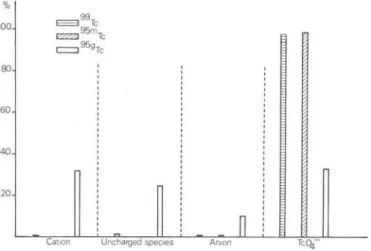
Tea-Fig. 3. Distribution of T c in different chemical species in the L i T c 04 solution at pH 3
but then increases, finally exceeding the value found in the more acid solution. The activity of 9 5 gT c is found as cationic, uncharged and anionic forms. The cation is pre-ponderent in the unretained fraction at low pH. The pro-portions of 9 S gTc and 9 S mT c in the different electrophoret-ically separated fractions are shown in Figure 3, for a solu-tion of L i9 5 mT c / " T c 04 at pH 3. Data for solutions at
Chemical Effects of I. T. 9 5 mT c -9 5 gT c in some Peitechnetates in Aqueous Solution 81
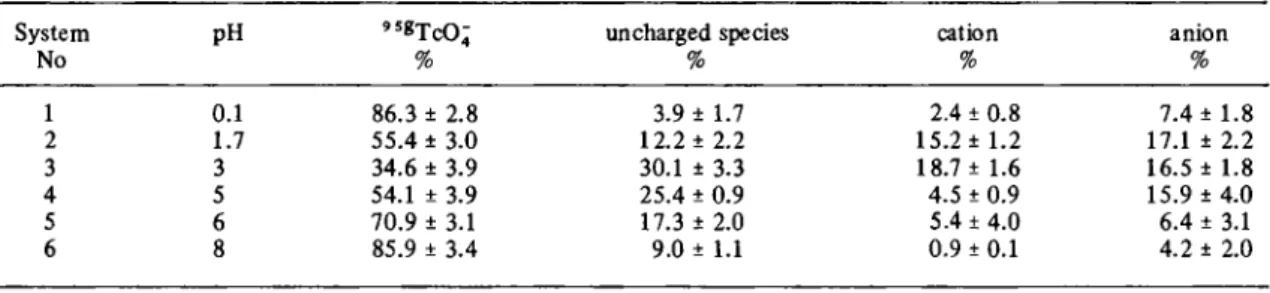
Table 1. Influence of pH on the chemical distribution of 9 S gTc in NH4Tc04 solution*
System pH ®sgTc04 uncharged species cation anion
No % % % % 1 0.1 86.3 ± 2.8 3.9 ± 1.7 2.4 ± 0.8 7.4 ± 1.8 2 1.7 55.4 ± 3.0 12.2 ± 2.2 15.2 ± 1.2 17.1 ± 2.2 3 3 34.6 ± 3.9 30.1 ± 3.3 18.7 ± 1.6 16.5 ± 1.8 4 5 54.1 ± 3.9 25.4 ± 0.9 4.5 ± 0.9 15.9 ± 4.0 5 6 70.9 ± 3.1 17.3 ± 2.0 5.4 ± 4.0 6.4 ± 3.1 6 8 85.9 ± 3.4 9.0 ± 1.1 0.9 ± 0.1 4.2 ± 2.0 5 parallel experiments
p H 0.1 and p H 6 agree and show that no significant pro-portion of 9 5 mT c or " T c appears in fractions other than
T c 04. These results show that no macroscopic
self-radio-lysis o f the solutions takes place.
The effect o f p H on the stabilisation o f 9 5 gT c in N H4T c 04
solution is given in Table 1. Not unexpectedly the results are substantially the same as for the solutions o f the lithi-um salt (Figs. 2 and 4).
Comparison o f results obtained b y the electrophoresis and extraction procedures shows extraction leads to higher val-ues for the 9 S gT c 04 fraction; but adding the yields of the
uncharged species and the 9 5 gT c O i obtained b y
electro-phoresis gives the retention measured b y extraction.
Final-Fig. 4. Yield of 9 5 gTcO; vs. pH in LiTc04 o and in NH4Tc04 λ.
Carrier as for Fig. 2
ly, the results obtained by extraction are similar to those obtained by electrophoresis o f the solution in the absence of T c ( I V ) carrier.
The effect o f p H on the yield o f 9 5 gT c 04 in K T c 04
solu-tion is shown in Figure 5. Although the f o r m o f the p H dependence is the same as for the lithium and ammonium salts, the minimum R0 is much higher 60% rather than
~ 4 0 %). In view o f the dilute solutions used this is a sur-prising result but it has been confirmed in several inde-pendent experiments, even to the extent o f using 9 S mT c
from 3 different irradiations.
Finally, a f e w experiments have been made in which the solution contained different radical scavengers. A solution o f K T c 04 in CCI3COOH and N a N 03 at different
concen-trations ( 4 M ) and p H (pH = 2.5 for CC13 C O O H and p H =
5 for N a N 03) gave a 9 5 gT c 04 retention higher than 90%.
Saturation o f the solution with N2 O also gave rather higher
retentions in the p H range 1 - 4 . A solution o f K T c 04
con-taining 8 0 % o f alcohol gave a practically constant reten-tion, lower at p H 0.5 and higher at p H 3 than the corre-sponding aqueous solution. The cationic f o r m practically disappears in these solutions.
N o pH-dependence is found for solid samples o f potassium pertechnetate. The percentages o f the cationic, uncharged and anionic species remain constant at 14%, 10% and 6 % respectively. A small increase in retention f o r solid ammo-nium pertechnetate may occur at higher p H (Fig. 6).
40
pH
Fig. 5. Yield of 95gTcOJ vs. pH in KTc04 solution, o solution
with N2, <' solution with N20 , o solution containing alcohol.
Carrier as for Fig. 2
6 pH
Fig. 6. Yield of 9 5 gTc04 vs. pH in NH4Tc04 ; « aqueous solution,
8 2 E. IANOVICI, P. LERCH, G. ZAHNER and A. G. MADDOCK
4. Discussion
The products of the isomeric transition in aqueous solution appear to be the same as those found after decay in the solid pertechnetates, followed by dissolution for electro-phoretic analysis. The sensitivity of the products to oxi-dation suggests that they are Tc(IV) derivatives; the un-charged species may be TcO(OH)2, or a related species such as TCO(OH)(CH3COO) [7], The cationic species may be TcO(OH)+ [8,9]. In addition to the TcO¿, a small amount of another anionic species was generally found. Although it is hoped that the use of the Tc(IV) carrier solutions has suppressed extraneous oxidation of prod-ucts, the retention as TcO^ should probably be regarded as a maximum value. However, as the comparison of the two carriers in Figure 1 shows, the pH effect on the dis-tribution of products may not be much affected by the oxidation. The difference between the two Tc(IV) carrier solutions, the acetate containing solution surviving at much higher pH, must be attributed to an acetate com-pie xing of the Tc(IV), stabilizing this oxidation state, so that T c 02 Χ η H2 O precipitation only occurs at a higher pH. Thus the retention was a somewhat lower when this carrier was used, because oxidation of the Tc(IV) becomes a little more difficult. A similar effect was reported in hydrolysed TcClg " solution [7].
In view of the absence of a pH effect on the 9 S gT c dis-tribution following the dissolution of the solid potassium salt, after growth of the ground state in the crystals, the pH-dependent distribution found after growth in solution, can only arise from two possible causes:
(i) The primary 9 S 6Tc species participate in a pH-depend-ent hot reaction with water.
(ii) The 9 5 gT c species are involved in pH-dependent ther-mal reaction with the not very distant radiolysis prod-ucts arising from the Auger electrons.
The excitation of the 9 S mT c is 38.9 keV, so that the ini-tial conversion electrons will carry about 18 ke V for con-version in the Κ shell (~95%), 36.2 keV for concon-version in the L shell ( ~ 5 % ) and 38.4 keV for conversion in M shell (trace) [10]. But the conversion will be followed by an Auger cascade arising from the vacancy so produced. Now the average binding energies of the electrons in the K, L and M shells for technetium are about 21, 2.8 and < 0 . 5 keV and the fluorescence yield for the filling of the Κ vacancy is 77%. It will be much lower for subsequent steps. Hence of the total number of electrons emitted in each event (on average perhaps about 5) one, and in about 23% of the events a second electron, has an energy ex-ceeding 10 keV. The remaining three or four electrons will carry 2 keV or less, so that in general there will be a
localised radiolysis of the aqueous medium in the close vicinity of the nascent 9 5 gTc.
It should be possible to test this latter possibility (ii) by the introduction of scavengers. Our preliminary results looking for OH-scavenging by alcohol and electron scav-enging by N20 , trichloroacetate, or nitrate, where the first of these led to a reduced retention as TcO^ at low pH, while the others gave rather higher retentions over the middle range of pH values, seems to suggest that oxi-dation by the radiolytic hydroxyl might be involved. It is seen that under all conditions at least 40 % of the TcC>4 ions either survive the isomeric transition, or are reformed so quickly that we cannot interfere with the process. Although the Κ fluorescence yield is rather high, the majority of Tc atoms undergoing the transition will suffer considerable charging. If this generally leads to a Coulombic explosion, there must be an equally efficient reaction reconverting a large part of the 9 5 gT c to the TCO4 state.
Attention should be drawn to the difference between these results and the well known pH dependence of the (η, γ ) retention in the permanganate system. In the latter case a pH effect is found both in solution and dissolution of the irradiated crystals [11,12]; it has been shown to be due to a pH dependence of the chemical behaviour of Mn2 + in the solution [13, 14].
References
1. IANOVICI, E., LERCH, P., PROSO, Ζ., MADDOCK, A. G.: Radiochimica Acta in press.
2. HILLMAN, M., WEISS, A. J.: Radiochimica Acta 15, 79 (1971).
3. DUPLATRE, G.: Thèse CNRS Α. O. 1 1 6 3 9 ( 1 9 7 5 ) .
4. GLENWORTH, P., WRIGHT, C. L.: J. Inorg. NucL Chem. 3 1 , 1 2 6 3 ( 1 9 6 9 ) .
5. SCHWEITZER, G. K., WILHELM, D. L.: J. Inorg. Nucl. Chem. 3, 1 ( 1 9 5 6 ) .
6. IANOVICI, E., LERCH, P., PROSO, Ζ., DECOMBAZ, M., MADDOCK, A. G.: Radiochim. Acta 26, 141 ( 1 9 7 9 ) . 7. IANOVICI, E., LERCH, P., PROSO, Ζ., MADDOCK, A. G.:
J. Radioanal. Chem. 4 6 , 11 ( 1 9 7 8 ) .
8. GORSKI, B., KOCH, H.: J. Inorg. Nucl. Chem. 3 1 , 3 5 6 5 ( 1 9 6 9 ) .
9. OWUNWANNE, Α., MARINSKY, J., BLAU MONTE: J. Nucl. Med. 18, 1 0 9 9 ( 1 9 7 7 ) .
10. AGEEV, V. Α., G A V R I L Y U K , V. I., K U R Y A S H K I N , V. T., LATYSHEV, G. D., LYUTYI, I. N., MAKOVETSKII, YU. V., FEOKTISTOV, Α. I.: Bull. Acad. Sci. U. S. S. R. Phys. Ser. (Eng. Trans.) 3 3 , 1 1 8 3 ( 1 9 6 9 ) .
11. LIBBY, W. F.: J. Amer. Chem. Soc. 6 2 , 1 9 3 0 ( 1 9 4 0 ) . 12. APERS, D. J., HARBOTTLE, G.: Radiochimica Acta 1,
188 ( 1 9 6 3 ) .
13. COGNEAU, Μ. Α., APERS, D. J., CAPRON, P. C.: Radio-chimica Acta 8, 143 ( 1 9 6 7 ) .
14. COGNEAU, Μ. Α., APERS, D. J., CAPRON, P. C.: Radio-chimica Acta 10, 1 7 0 ( 1 9 6 8 ) .