THE JOURNAL OF INFECTIOUS DISEASES • VOL. 147, NO.3. MARCH 1983 © 1983 by The University of Chicago. All rights reserved. 0022-1899/83/4703-0024$00.81
Successful Single-Dose Amoxicillin Prophylaxis Against Experimental
Streptococcal Endocarditis: Evidence for Two Mechanisms of Protection
M. P. Glauser, J. P. Bernard, P. Moreillon, and P. Francioli
From the Division des Maladies Infectieuses, Departement de Medecine, Centre Hospitalier Universitaire Vaudois, Lausanne, Switzerland
Amoxicillin prophylaxis against experimental endocarditis due to one nontolerant and two tolerant strains of streptococci was studied in rats. Single-dose amoxicillin pro-tected against the two tolerant strains in animals challenged with the 90% infective dose (ID9o),but protection diminished with increasing inoculum sizes. Protection against the nontolerant strain was successful with inocula that were 100- and I,OOO-fold larger than the1D90.Close correlation existed between the speed of bacterial killing in vitro, the time
of exposure to bactericidal levels in vivo, and the range of inocula against which pro-phylaxis was effective. Amoxicillin seemed to protect by at least two mechanisms.(1) When in vitro tests indicated adequate bacterial killing, protection was independent of the inoculum size and was probably conferred by bacterial killing. (2) When in vitro tests indicated bacterial inhibition but not. killing, protection was inoculum-dependent and was probably mediated by inhibition of bacterial adherence.
Preexisting endothelial cardiac lesions may be col-onized during bacteremia, resulting in bacterial endocarditis. It has been recommended that pa-tients with known cardiac lesions receive prophy-lactic antibiotics before undergoing procedures that might cause bacteremia [1, 2]. Because clini-cal trials of antibiotic prophylaxis in humans can-not be conducted for both ethical and statistical reasons [3], the question of which antibiotic and what dosage to use has been studied mainly in ani-mals. The rabbit model developed by Garrison and Freedman [4] was used to test several prophy-lactic antibiotic regimens. These experiments sug-gested that bactericidal antibiotics would have to be given to obtain adequate prophylaxis and that a synergistic combination of antibiotics would be more effective than a single agent [5]. In rabbits, parenteral penicillin and vancomycin have been shown to be effective in preventing bacterial endo-carditis. However, some strains of viridans strep-tococci are relatively resistant to the bactericidal
Received for publication April 12, 1982, and in revised form September 7, 1982.
We thank Drs. J. A. McCutchan and P. Casey for critical review, S. Bovey for typing the manuscript, and Dr. O. Zak and K. Vosbeck for demonstration of the in vitro bacterial adhesion assay.
Please address requests for reprints to Dr. M. P. Glauser, Division des Maladies Infectieuses, Centre Hospitalier Univer-sitaire Vaudois, 1011 Lausanne, Switzerland.
568
activity of penicillin [6]. Indeed, when we mea-sured the sensitivity to amoxicillin, (a well-ab-sorbed penicillin advocated for prophylaxis in hu-mans [7]) and to vancomycin (the most powerful prophylactic agent in rabbits) of streptococci iso-lated from patients with endocarditis, we found that eight of 21 strains were tolerant to amoxicillin (MBC:MIC ratio, >32 [8]) and that five of 20 were tolerant to vancomycin.' Therefore, prophylaxis against endocarditis by means of bacterial killing would have failed against these strains. However, in recent experiments using a rat model, we showed that vancomycin prevented endocarditis in the ab-sence of bacterial killing [9]. Because amoxicillin is easier to administer than vancomycin, we inves-tigated amoxicillin prophylaxis against experimen-tal endocarditis caused by strains of streptococci that are variously sensitive to the bactericidal ac-tivity of amoxicillin.
Materials and Methods
Microorganisms.
Three bacterial strains wereused to produce endocarditis. (1)
Streptococcus
intermedius,
also calledStreptococcus sanguis [9],
1M. P. Glauser, P. Meylon, P. Francioli, and P. Moreillon,
"Tolerance to Amoxicillin and Vancomycin among Strains of Non-Group 0 a-Hemolytic Streptococci Isolated from Pa-tients with Endocarditis," manuscript in preparation.
was originally isolated from a patient with endo-carditis. This strain has been used in experiments on endocarditis in both rabbits [10] and rats [9, 11]. (2)
S. sanguis
biotype II was provided by Dr. D. T. Durack (Duke University Medical Center, Durham, N.C.) who had used it in his investiga-tions of prophylaxis against endocarditis in rab-bits [5, 12]. (3)Streptococcus mitior
was isolated from a patient in Lausanne with endocarditis. It was chosen because, of 23 strains of a-hemolytic streptococci isolated from patients with endocardi-tis, it was the most sensitive to the bactericidal ac-tion of amoxicillin.'Determination of MICs, MBCs, and rates of
bactericidal activity.
The MICs of amoxicillinand vancomycin were determined with a standard broth dilution technique [13] with an inoculum of 105-106 organisms from either an overnight or a
log-phase culture. The MBCs were determined by subculturing on penicillinase-containing blood agar plates 0.1 ml of an undiluted sample, as well as 0.1 ml each of 10-fold and lOO-fold dilutions, from each dilution of antibiotic showing no tur-bidity after 24 hr and 48 hr of incubation. After incubation for 48 hr, the number of colonies on each plate was counted, and the MBC was deter-mined as the lowest dilution of .antibiotic that showed 99.9070 killing. Using 10-fold and loo-fold dilutions of the antibiotic-containing broth avoids carry-over of antibiotic, a phenomenon that can give falsely low MBCs.
The rates of bactericidal activity of 25 I-tg of amoxicillin/ml against the three strains of strepto-cocci were determined in trypticase soy broth (Dif-co Laboratories, Detroit) using 106 organisms
from an overnight culture as the inoculum. A con-centration of 25 I-tg of amoxicillin/ml was chosen because it is similar to serum levels achieved in rats 30 min after iv injection of 40 mg of the drug/kg of body weight and in humans 2 hr after an oral dose of 3 g [7]. At various times after the inocu-lation of bacteria into the antibiotic-contain-ing broth, 10-fold (10-1), 1,000-fold (10-3
) , and
100,000-fold (10-5) dilutions of a O.I-ml sample were subcultured on penicillinase-containing blood agar plates and incubated overnight before colony counts were determined.
Serum levels of antibiotics and serum
bacte-2See footnote 1.ricidal activity.
Serum levels of antibiotics weredetermined by the standard agar diffusion tech-nique, using
Bacillus subtilis
as the test organism and normal rat serum as the diluent [14]. The sam-ples were taken 30 min and 1, 2, and 4 hr after administration of various iv doses of amoxicillin to groups of five rats. The serum bactericidal ac-tivity against each strain 30 min and 1, 2, and 4 hr after iv administration of amoxicillin to nine rats was determined by standard methods [8], using 105 organisms from an overnight culture as the in-oculum. The serum bactericidal activity was de-fined as the highest serum dilution providing 99.9070 killing «100 surviving bacteria) after 18 hr of incubation.Production of endocarditis and evaluation of
infection.
Sterile vegetations were produced infemale Wistar rats (weight, 180-200 g) by a slight modification of a previously described method [11]. In brief, a polyethylene catheter (model no. PP 10; Portex, Hythe, Kent, England) was in-serted through the aortic valve into the left ventri-cle via the right carotid artery and secured with a silk ligature. Twenty-four hours after catheriza-tion, rats were injected in the tail vein with 0.5 ml of 0.85070 NaCI containing inocula of various sizes (expressed in cfu) from overnight cultures of the test microorganisms. Rats were killed 72 hr there-after, and 1 ml of blood was drawn from the in-ferior vena cava and plated on blood agar. Aortic vegetations were excised, weighed, homogenized in 1 ml of 0.85070 NaCI, serially diluted, and plated. Colony counts were determined after 48 hr of incubation at 37 C. This method permitted the detection of 102 cfu/gof vegetation.
Prophylaxis of endocarditis with amoxicillin.
Thirty minutes before bacterial challenge with var-ious inocula of the three test microorganisms, groups of rats were injected iv with either 40 mg of amoxicillin/kg of body weight or 0.85070 NaCI alone.
Influence of amoxicillin on in vitro adhesion of
S. intermedius and
S.sanguis to platelet-fibrin
matrices.
Experiments were performed using anin vitro assay system that simulates nonbacterial thrombotic endocarditis as described by Scheld et al. [15]. In brief, cultures of S.
intermedius
orS.
sanguis,
grown overnight in brain-heartinfu-sion broth supplemented with 5070 sucrose, were suspended in either 25 I-tg of amoxicillin/ml
570
diluted in phosphate-buffered saline (PBS) or in PBS alone at a concentration of 103cfu/ml. These suspensions were immediately poured into Petri dishes containing platelet-fibrin matrices, incu-bated for 2 min at 37 C in a shaking incubator, and washed two times with amoxicillin or PBS for 5 min and a third time with PBS supplemented with 2,000units of penicillinase {Difco)/ml for 5 min. The time of exposure to amoxicillin was chosen to simulate the mean duration of bacte-remia after iv challenge [9], during which period prevention of adhesion has to occur if it is to pre-vent endocarditis. Penicillinase-containing blood agar was then poured over the matrices, and the adherent colonies were counted after 24hr of in-cubation. The adherence ratio for each sample was defined as the number of cfu adherent to the matrix divided by the initial number of cfu in the inoculum.
Statistical evaluation. TheX2test with Yates's
correction and Student's unpairedt-testwere used for statistical comparisons.
Results
The MICs and MBCs and the MBC:MIC ratio of amoxicillin for the three test organisms are shown in table 1. Although the MBCs of S. intermedius
and S. sanguiswere lower when subcultured after
48 hr, both bacteria remained tolerant.
Serum levels of amoxicillin in rats. After iv
administration of various doses of amoxicillin into rats, it was found that 40 mg/kg iv resulted in a mean ± so peak serum level of 23.7 ± 3IJg/ml at 30 min. This level was similar to those achieved in humans following an oral dose of 3 g of amox-icillin [7].The values 1, 2,and4hr after iv injec-tion in the rat were 8.8 ± 1.0 IJg/ml, 3.5 ± 0.4 IJg/ml, and 0.6 ± 0.3 ug/rnl, respectively.
Serum bactericidal activity. In order to
measure the maximum bactericidal activity to which streptococci were exposed, serum bacterici-dal activities were measured at the time of bacteri-al injection, that is, 30 min after iv injection of 40 mg of amoxicillin/kg. No serum bactericidal ac-tivity could be detected against S. intermedius.
The serum bactericidal activity against S. sanguis
was 1:2, and that against S. mitior was
>
1:256 (table 1). After 1 hr, no serum bactericidal activity was detected against either S. intermedius orS. sanguis,while that againstS. mitiorwas 1:128.
Glauser et al.
Serum bactericidal activity of 1:8 against the latter strain persisted 4 hr after amoxicillin was adminis-tered iv.
Rate of in vitro killing of the three test strains.
Figure 1shows the rate of in vitro killing of the three strains by 25 IJg of amoxicillin/ml, a concen-tration similar to the serum level achieved in rats 30 min after iv administration of 40 mg/kg and in humans 2 hr after an oral dose of 3 g. One million
S. mitiororganisms/ml were killed in 2 hr. In
con-trast, no significant killing of S. intermedius and
S. sanguis occurred during the first 6 hr of
ex-posure. The rates of killing for the three strains were similar regardless of whether an overnight or a log-phase culture was used.
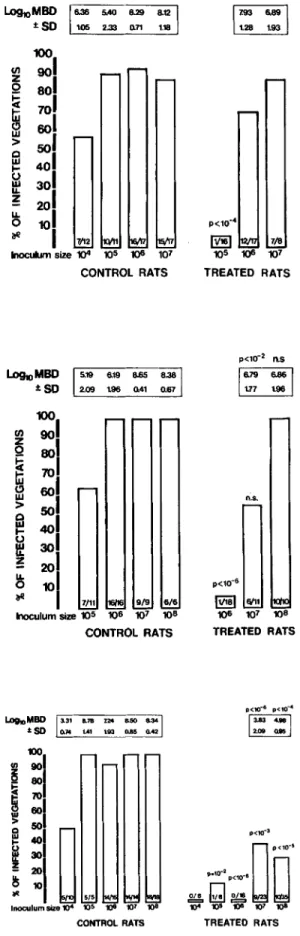
Natural history of experimental endocarditis and prophylaxis with amoxicillin. S. intermedius
endocarditis. As shown in figure2, top, the
inci-dence of infection in control rats increased directly with inoculum size. The90070 infective dose (1090) was found to be 105 cfu. In rats that received
amoxicillin prophylaxis and were challenged with this inoculum, protection was almost complete. However, in rats receiving larger inocula, the pro-tective effect of amoxicillin was overcome.
In the animals with endocarditis despite prophy-laxis with amoxicillin, the mean bacterial densities in the vegetations were similar to those found in control animals, suggesting that amoxicillin did not diminish the severity of endocarditis due to
S. intermedius when it failed to prevent the
endo-cardial infection.
S. sanguis endocarditis. As shown in figure 2,
middle, S.sanguiswas less effective in causing en-docarditis in rats than S. intermedius (1090' 106
cfu). Only in rats challenged with 11090was amox-icillin fully effective in preventing endocarditis; ef-ficacy decreased with increasing inoculum size. In those amoxicillin-treated rats in which endocardi-tis was produced by giving an inoculum 10 times higher than the 109o, infection as judged by the mean bacterial densities in the vegetations was less severe than in control animals that received no antibiotic. Thus, unlike the case with S.
inter-medius, amoxicillin influenced not only the
inci-dence but also the course of endocarditis caused
by S. sanguis.
S.mitior endocarditis. In the case of S. mitior,
the109 0was 105cfu (figure 2, bottom). In contrast
to both S. intermedius and S. sanguis, S. mitior
.2 00 "o:t 00 "o:t V '0 N
-§
N 008
o
00in amoxicillin-treated rats, even with inocula 100 or 1,000 times the 109 0 • Furthermore, in rats that developed endocarditis despite prophylaxis, infec-tion as judged by the mean bacterial densities in the vegetations was much less severe than that found in animals that had developed S. sanguis
endocarditis despite prophylaxis (figure 2, middle).
Effect of amoxicillin on the in vitro adhesion of
S. intermedius and S. sanguis to platelet-fibrin
matrices. When incubated in vitro with 25 tJg of
amoxicillin/ml for a period of time simulating the mean duration of bacteremia in vivo [9], the ad-herence ratio (mean ± so of 12 determinations) was reduced from 0.0174 ± 0.0055 for control de-terminations (PBS alone) to 0.0038 ± 0.0009 for determinations with amoxicillin-incubated S.
in-termedius, a reduction of 78010 (P
<
10-5) . For
S. sanguis, the mean adherence ratio fell from
0.0165 ± 0.002 in control determinations to 0.009 ± 0.001 for those with amoxicillin-incubated bac-teria, a reduction of 44010 (P
<
10-5) (data not
shown).
Discussion
Previous studies in rabbits have stressed the need for a bactericidal antibiotic or combination of an-tibiotics to achieve adequate prophylaxis against endocarditis due to S. sanguis. It has been ob-served, however, that vancomycin, the most potent antibiotic in rabbits, may afford protection in the absence of bacterial killing both in rabbits and rats [9, 16]. The present study clarifies the conditions in which killing or alternative mechanisms may be operative in preventing endocarditis.
It is improbable that successful prophylaxis against endocarditis due to S. intermedius or
S.sanguiswith a short course of amoxicillin could
have acted through bacterial killing.Ittook 24 hr or more for sustained concentrations of amoxicil-lin that simulate peak serum levels to kill both strains in vitro. In vivo, these peak concentrations were transient due to the rapid elimination of amoxicillin from the rat serum, thus leaving little time for killing of the infectious inoculum (table 1). In addition, only insignificant serum bacterici-dal activity was detected at the time of bacterial challenge following administration of amoxicillin. Thus, these results extend studies of vancomycin prophylaxis to additional streptococcal strains and
572
E
.~...
(1)...
()~
1°1
9
1
8
1
~~.~.•
• S. intermedius ControlsS. sanguisI
~I :~~~=:----.
S milim51·'
._._._._._.-
<,
s.
i,. , . - . ... ·,/e4
"
" ,
<,y:'~a,iJ.a
I
\
.
...
Q \'.
~ ...3
1
\
\
':oS'~~".9.'
<,
2
\
~~~....
I
\
\' , ' ,
. , 'Y..<1
1
"
\"
.,
...
....
\ S. mitior ., ... • - - - : .. _._._---,I'.:.JI'•.__. • .•-•.- . Glauser et al.Oh
2h
6h
24h
HOURS OF INCUBATION
48h
Figure 1. Rate of in vitro killing of
Streptococcus intermedius, Streptococcus sanguis,
andStreptococcus mitior
by 25 JIg of amoxicillin/ml (a concentration similar to serum levels in rats 30 min after a single dose [40 mg/kg of body weight] given iv).to amoxicillin, which is more practical to adminis-ter than vancomycin. In these studies amoxicillin prevented endocarditis in the absence of killing, probably by inhibiting the adherence of S.
sanguis
to the sterile vegetation [9, 16]. Several reports suggest that nonbactericidal concentrations of f3-lactam antibiotics, which, like vancomycin, act on cell-wall synthesis, inhibit the adherence of bacteria in vitro to platelet-fibrin clots [16-19]. In the present experiments, amoxicillin at concen-trations simulating peak serum levels rapidly and efficiently inhibited the in vitro adherence of both
S.
intermedius
and S.sanguis
on platelet-fibrinmatrices. Therefore, we postulate that a single dose of amoxicillin may have acted through the same mechanism as vancomycin in preventing en-docarditis following challenge with bacteria that are only minimally sensitive to its bactericidal action.
In contrast to its effects on S.
intermedius
andS.
sanguis,
we found that the prophylactic activityof amoxicillin against S.
mitior
was demonstrable with inoculum sizes that were 1,000 times theID9o.This difference in ability of bacteria to produce endocarditis after exposure to prophylaxis with amoxicillin may be related to the different kinetics
of killing among the strains. Only S.
mitior
was exposed to a high serum bactericidal activity (>1:256) after iv administration of amoxicillin. Furthermore, S.mitior
was the only streptococcal species of the three tested that was exposed in vivo to concentrations of amoxicillin greater than its MBC for a longer period than was required to kill it in vitro (table 1).We interpret these findings as indicating that amoxicillin could have acted by two mechanisms when preventing endocarditis.(1)With S.
mitior,
an organism that was rapidly killed, amoxicillin may have protected primarily by kill-ing. The protection afforded by killing was inoculum-independent, that is, not limited to theID9o, but extending to inoculum sizes that were
1,000-fold greater. (2) With those strains that were only slowly killed by amoxicillin in vitro, protec-tion may have been due to the prevenprotec-tion of bacte-rial adherence to vegetations rather than to actual bacteridical activity [9, 15-19]. Protection af-forded by this mechanism was inoculum-depen-dent, that is, limited to the ID90 and decreasing
with increasing inoculum sizes (table 1).
When inoculum sizes of S.
mitior
10, 100, or 1,000 times larger than theID90were used to infectLosho MOO 5.19 6.19 B.65 8.38 ±SO 2.09 1.96 0.41 0.67 n.s, p<10- 2 n.s 16.79 6.861 1.77 1.96 108 TREATED RATS ~ 7/8 105 1()6 107 TREATED RATS CONTROL RATS
\: : :: ::1
1001
~ 901
~
801
~
701
~ 601
faSOl
to- 401
~
_ 301
!~
:1
*
1
7/11 9/9 6/6 Inoculumsize 105 106 107 108 CONTROL RATS LoshoMOO ±SDfew rats three days after amoxicillin prophylaxis was less severe than in control rats. A similar phe-nomenon, although less pronounced, was ob-served following challenge with 10 times the ID90
of S.
sanguis.
Thus, bacteria that were not killed by amoxicillin appeared damaged sufficiently to adversely affect multiplication once endocardial infection was established, thus demonstrating a postantibiotic effect in vivo [20]. Further experi-ments have shown that this phenomenon is trans-ient, since the few rats challenged with S.mitior
that developed endocarditis despite prophylaxis had 109 cfu of S. mitior/g of vegetation when
killed seven days after infection, a degree of infec-tion similar to that found in control rats (data not shown).
The results of this study agree with those of our recent work showing that a short course of clinda-mycin prophylaxis successfully prevented endo-carditis due to S.
sanguis,
S.intermedius,
and S.mitior
in rats when given in doses that produce serum levels equal to those achievable by oral administration in humans [21]. Since clindamycin is bacteriostatic, these experiments provide further evidence that killing is not essential for effective prophylaxis. The results of both studies appear to contradict those of previous observations in rab-bits by Durack and Petersdorf [5] and Pelletier etat.
[12], in which single injections of several anti-biotics failed to prevent infection. However, the latter experiments were performed with an in-oculum of 108 cfu of S.sanguis,
an inoculumwhich was probably many times higher than the
ID90 for rabbits. If so, our observations on the
dependence of prophylaxis efficacy on inoculum size provides an explanation for this apparent Figure 2. Incidence of endocarditis in control and amoxicillin-treated rats three days after bacterial challenge with (top) Streptococcus intermedius,
(mid-dle) Streptococcus sanguis,and (bottom) Streptococcus
mitior. The mean (± SD) bacterial density (MBD)
recovered from vegetations (expressed as cfu/g of vegetation) is indicated for each group. The no. of rats with infected vegetations/total no. of rats per group is indicated at the base of each column. To compare the incidence of endocarditis in control vs. treated rats, P values were calculated byXlanalysis with Yates's correc-tion. To compare MBDs in control vs. treated rats challenged with the same inoculum size,Pvalues were calculated by Student's unpaired t-test (n.s.
=
not significant). I..oImMBD 3.31 8.78 124 a.so 8.34 ~SO 0.74 1.41 \93 Il.85 0.42 CONTROL RATS~Q·;DD·
1()4 1()5 1()11 107 1()8 TREATED RATS574
contradiction. Rabbits challenged with many times the IDgowould not be protected because the
strain of S.
sanguis
used in these studies (provided to us by Dr. Durack) was not rapidly killed by the antibiotics tested for prophylaxis.In considering the relevance of these results to prophylaxis against endocarditis in humans, we were interested to know which of the two prophy-lactic mechanisms we have observed was likely to be clinically operative. We found that one-third of streptococcal strains causing endocarditis were tolerant to amoxicillin and two-thirds were toler-ant to vancomycin." This result suggests that, to prevent bacterial endocarditis due to these tolerant strains, these antibiotics would have to act by mechanisms other than killing. The present experi-ments in rats indicate that these alternative mech-anisms protect against challenging inocula only as high as the ID go• However, there are two reasons
which suggest that the administration of 3 g of amoxicillin could prevent endocarditis in humans. (1)The magnitude of the bacteremia necessary to reach the IDg oin rats is probably far greater than
that present in humans after dental manipulation [22]. (2) In the present experiments, the plastic catheter was left in place before prophylaxis was tested; however, few patients at risk of developing endocarditis harbor an endovascular foreign body, and we have previously shown that removal of the catheter increases the effectiveness of pro-phylaxis with vancomycin 1,000-fold [11]. The results in our experimental model therefore sug-gest that, even in the absence of bacterial killing, endocarditis may be prevented by other mecha-nisms - possibly inhibition of adherence - and that these mechanisms may give the prophylactic regimen a margin of safety even after single-dose prophylaxis.
References
1. Hook, E. W., Kaye, D. Prophylaxis of bacterial endocar-ditis. J. Chronic Dis. 15:635-646, 1962.
2. American Heart Association Committee on Rheumatic Fever and Bacterial Endocarditis. Prevention of bacte-rial endocarditis. Circulation 56:139A-143A, 1977. 3. Durack, D. T. Prophylaxis of infective endocarditis.
InG.L. Mandell, R. G. Douglas, Jr., and J. E. Bennett [ed.]. Principles and practice of infectious diseases. Wiley, New York, 1979, p. 701-710.
3See footnote 1.
Glauser et al.
4. Garrison, P. K., Freedman,L. R. Experimental endocar-ditis.I. Staphylococcal endocarditis in rabbits resulting from placement of a polyethylene catheter in the right side of the heart. Yale J. BioI. Med. 42:394-410, 1970. 5. Durack, D. T., Petersdorf, R. G. Chemotherapy of exper-imental streptococcal endocarditis. I. Comparison of commonly recommended prophylactic regimens. J. Clin. Invest. 52:592-598, 1973.
6. Holloway, Y., Dankert, J., Hess, J. Penicillin tolerance and bacterial endocarditis [letter]. Lancet 1:589, 1980. 7. Shanson, D. C., Ashford, R. F., Singh, J. High-dose oral amoxycillin for preventing endocarditis. Br. Med. J. 1:445-446, 1980.
8. Anhalt, J. P., Sabath,L. D., Barry, A. L. Special tests: bactericidal activity, activity of antimicrobics in com-bination, and detection of fJ-Iactamase production. In E. H. Lennette, A. Balows, W. J. Hausler, Jr., and J. P. Truant [ed.], Manual of clinical microbiology. 3rd ed. American Society for Microbiology, Washington, D.C., 1980, p. 478-484.
9. Bernard, J.-P., Francioli, P., Glauser, M. P. Vanco-mycin prophylaxis of experimental Streptococcus
sanguis: inhibition of bacterial adherence rather than bacterial killing. J. Clin. Invest. 68:1113-1116,1981. 10. Arnold, S. B., Valone, J. A. Askenase, P. W.,
Kash-garian, M., Freedman,L.R. Diffuse glomerulonephritis in rabbits with Streptococcus viridans endocarditis. Lab. Invest. 32:681-689, 1975.
11. Heraief, E., Glauser, M.-P., Freedman, L. R. Vanco-mycin prophylaxis of streptococcal endocarditis in rats.
In J. D. Nelson and C. Grassi [ed.]. Current chemo-therapy and infectious disease. Vol. 2. American Society for Microbiology, Washington, D.C., 1980, p. 911-913. 12. Pelletier, L. L., Jr., Durack, D. T., Petersdorf, R. G. Chemotherapy of experimental streptococcal endocar-ditis. IV. Further observations on prophylaxis. J. Clin. Invest. 56:319-330, 1975.
13. Washington, J. A., II, Sutter,V.L.Dilution susceptibility test: agar and macro-broth dilution procedures. In E. H: Lennette, A. Balows, W. J. Hausler, Jr., and J. P. Truant [ed.]. Manual of clinical microbiology. 3rd ed. American Society for Microbiology, Washington, D.C., 1980, p. 453-458.
14. Sabath, L. D., Anhalt, J. P. Assay of antimicrobics. In E.H. Lennette, A. Balows, W. J. Hausler, Jr., and J. P. Truant [ed.]. Manual of clinical microbiology. 3rd ed. American Society for Microbiology, Washington, D.C., 1980, p. 485-490.
15. ScheId, W. M., Valone, J. A., Sande, M. A. Bacterial adherence in the pathogenesis of endocarditis: interac-tion of bacterial dextran, platelets, and fibrin. J. Clin. Invest. 61:1394-1404, 1978.
16. ScheId, W. M., Zak, 0., Vosbeck, K., Sande, M. A. Bacterial adhesion in the pathogenesis of infective endocarditis: effect of subinhibitory antibiotic concen-trations on streptococcal adhesion in vitro and the development of endocarditis in rabbits. J. Clin. Invest. 68:1381-1384, 1981.
interactions mediating the attachment of bacteria to mucosal surfaces. J. Infect. Dis. 143:325-345, 1981. 18. Tylewska, S., Hjerten, S., Wadstrom, T. Effect of
sub-inhibitory concentrations of antibiotics on the adhesion ofStreptococcus pyogenesto pharyngeal epithelial cells. Antimicrob. Agents Chemother. 20:563-566, 1981. 19. Neuhaus, E., Lowy, F., Chang, D., Horne, D., Tomasz,
A., Steigbigel, N. Penicillin tolerant S. viridans:effect of penicillin on host-bacterial interaction [abstract no. 356J.In Proceedings and abstracts of the 20th
Inter-science Conference on Antimicrobial Agents and Chemotherapy. American Society for Microbiology, Washington, D.C., 1980.
20. Bundtzen, R. W., Gerber, A. U., Cohen, D. L., Craig, W. A. Post antibiotic suppression of bacterial growth. Rev. Infect. Dis. 3:28-37, 1981.
21. Glauser, M. P., Francioli, P. Successful prophylaxis against experimental streptococcal endocarditis with bacteriostatic antibiotics. J. Infect. Dis. 146:806-810, 1982.
22. Levison, M. E. Pathogenesis of infective endocarditis. In
D. Kaye [ed.], Infective endocarditis. University Park Press, Baltimore, 1976,p, 29-41.
![Figure 1. Rate of in vitro killing of Streptococcus intermedius, Streptococcus sanguis, and Streptococcus mitior by 25 JIg of amoxicillin/ml (a concentration similar to serum levels in rats 30 min after a single dose [40 mg/kg of body weight] given iv).](https://thumb-eu.123doks.com/thumbv2/123doknet/14928365.664406/5.891.167.740.109.486/figure-killing-streptococcus-intermedius-streptococcus-streptococcus-amoxicillin-concentration.webp)