Canadian Journal on Aging/ La Revue canadienne du vieillissement 22 (2) : 155 - 165
155
Sedentary Persons? A Cohort Study in
Switzerland
*
Christian J. Lalive d’Epinay and Jean-François Bickel
University of Geneva, Switzerland
RÉSUMÉ
Selon le paradigme du « vieillissement réussi », le sentiment de bien-être est aussi important que la sant é «objectiv e.» L’exercice physique est considéré comme un facteur important de la santé ; cependant, son lien avec le bien-être au sein de la population vieillissante n’a été que peu exploré. Sur la base de deux enquêtes sur échantillons aléatoires de la population âgée menées l’une en 1979 et l’autre en 1994, qui comprenaient des questions biographiques, deux cohortes de personnes de 65 à 74 ans ont été sélectionnées (cohorte 1, née en 1905–1914, N = 949 ; cohorte 2, née en 1920–1929, N = 602) et réparties en quatre groupes selon leur trajectoire sportive (sportifs constants LE ; nouveaux sportifs NE ; anciens sportifs Q ; sédentaires S). Le lien entre ces trajectoires et deux indicateurs de bien-être (santé auto-évaluée et échelle de dépression auto-évaluée) a été examiné au moyen d’analyses de régression. Dans les deux cohortes, LE présente un niveau de bien-être supérieur à Q et S. Cette étude attire également l’attention sur les anciens sportifs (Q), qui ont le plus faible niveau de bien-être ; l’abandon de l’exercice physique et ses causes étant jusqu’à ce jour négligés par la recherche.
ABSTRACT
From a “successful aging” perspective, the subjective feeling of well-being is as important as “objective” health. Phys-ical exercise is seen as being an effective way of staying healthy, but its link with well-being in a normal aging popula-tion remains largely unexplored. Based on two randomized surveys of the aging populapopula-tion, conducted in 1979 and 1994, respectively, with questionnaires including retrospective questions on activities and health, two cohorts of
young-old (aged 64–74) were selected (cohort 1, born 1905–1914, N = 949; cohort 2, born 1920–1929, N = 602) and split into four
groups, corresponding to their exercising trajectories (long-term exercisers LE, new exercisers NE, quitters Q, seden-tary S). The link between the four trajectories and two indicators of well-being (self-rated health, self-assessed depres-sion scale) was examined by means of regresdepres-sion analyses. In both cohorts, the LE group had a higher level of well-being than the Q and the S. The study also throws light on the case of the quitters (Q), who showed the lowest level of well-being. Scant research has hitherto been done on the causes and repercussions of abandoning exercise.
* This research was funded by the Swiss National Science Foundation (grant no. 1214–52377). We wish to thank Barry McPherson (Wilfrid Laurier University) and the two CJA reviewers, for their helpful comments and suggestions; Nathalie Vollenwyder (Geneva), for the preliminary analyses she made; and Ian Hamilton (Geneva), for his editorial work.
Manuscript received: / manuscrit reçu : 13/03/02 Manuscript accepted: / manuscrit accepté : 18/02/03
Mots clés : aging, activités sportives, bien-être, étude de cohorte, Suisse
Key words: vieillissement, physical exercise, well-being, cohort study, Switzerland
Requests for offprints should be sent to: / Les demandes de tirés-a-part doivent être adressé e s à: Christian J. Lalive d’Epinay
Centre for Interdisciplinary Gerontology (CIG) University of Geneva
59, route de Mon Idée CH-1226 Geneva (Thônex) Switzerland
156 Canadian Journal on Aging 22 (2) Christian J. Lalive d’Epinay and Jean-François Bickel
Physical Activity, Health, and Well-Being
The relationship among exercising, fitness, and health has long been a topic of scientific interest, as the volu-minous publications on the subject attest. Recent over-views are to be found in Bouchard, Shephard, and Stephens (1994), Shephard (1997), and American Col-lege of Sports Medicine [ACSM] (1998, 2001). Robust research results have been obtained. Sedentary life has been shown to be significantly related to higher mor-tality, at all ages, and to a wide range of diseases: hypertension, coronary heart disease, stroke, cancer, osteoporosis, and metabolic disorders (see Bokovoy & Blair, 1994; Heikkinen, 1998; Keysor & Jette, 2001). Exercise has a beneficial effect on maintaining and/or enhancing cardiovascular health, endurance, muscu-lar strength, flexibility, and coordination (see Spir-duso, 1994).
However, the more the focus of attention moves away from physical health and physiological measures toward mental health, cognitive functioning, and sub-jective well-being, the more meagre the research find-ings become and the less conclusive the current results. For example, that exercising, mental health, cognitive functioning, and depression are linked is well established in terms of correlation, but the causal direction and the way it works remain at issue. Cross-sectional studies are unable to establish the causal link, and the findings of training studies on exercising and cognition are said to be “equivocal at best” (ACSM, 1998, p. 999). Physically inactive elders show a higher level of depressive symptoms than those who are active, but there is no proof that exercising by itself reduces depression (O’Connor, Aenchbacher, & Dish-man, 1993; Keysor & Jette, 2001) or that it enhances the feeling of well-being. A higher level of well-being may be a pre-condition for exercising, suggest Spir-duso and Leilani Cronin (2001).
The “successful aging” paradigm (Baltes & Baltes, 1990; Rowe & Kahn, 1997, 1998) encompasses the sub-jective as well as the obsub-jective dimensions of health. Successful aging requires not only that aging individ-uals remain healthy and function better but also that they feel better than “normal aging” persons. This paradigm has been criticized for its underlying elitism and voluntarism (Höpflinger, 1995; Scheidt, Humph-erys, & Yorgason, 1999). However, it is widely accepted that the subjective feeling of well-being is an important aspect of self-fulfilment, during old age and throughout the process of human development (Spirduso & Leilani Cronin, 2001).
A survey among the population at large to determine whether elders whose lifestyle includes exercising feel better would thus seem to be a worthwhile task, but little research has been done on that aspect (Sheppard,
1997, pp. 314–316). The few available studies carried out on samples of the old-age population show a con-vincing correlation between exercising and indicators of well-being, but being cross-sectional, they cannot establish the causal direction of the link (Lalive d’Epi-nay, Bickel, Maystre, & Vollenwyder, 2000, pp. 284– 297; Parkatti, Deeg, Bosscher, & Launer, 1998; Poh-jolainen, 1997; Ragheb & Griffith, 1982; Ruuskanen & Ruoppila, 1995).
Objectives of the Study
In this article we investigate the relationship, among the young-old population, between regular participa-tion in physical exercise and sport as a component of lifestyle and well-being. More specifically, we test the hypothesis of a causal incidence of participation in sport and physical exercise on the feeling of well-being. In short, we deal here with the following three questions:
1. Do those elders whose lifestyle involves physical exercis-ing feel better than their more sedentary contemporar-ies?
2. If so, is this a consequence of their involvement in sport and physical exercise?
3. Are our results stable over time or do we observe a cohort effect?
Methods
Design
The first research question can be examined on the basis of cross-sectional data with bivariate analysis, and research has already yielded a convincingly posi-tive answer. The second, concerning the causal link and its direction, remains unknown. A lifestyle is a stable pattern of individual behaviour that reflects personal choices within a framework of biological, environmental, sociological, and cultural influences (Wankel & Sefton, 1994, p. 530). Thus behavioural sta-bility (here, involvement in physical exercise) must be shown over a long timespan, which calls for long-term panel data. Not surprisingly, none of the few available longitudinal databases, to our knowledge, offers the information needed for such an analysis. One alternative is offered by the use of reminiscence in cross-sectional questionnaires, with the aim of gather-ing biographical information that can be used to recon-struct specific trajectories (family, professional, health, leisure pattern, etc.) (Blossfeld & Götz, 1995; for a dis-cussion, see below). This is the path we have chosen in this article. Revisiting the data obtained from two sur-veys of the old-age population carried out in Switzer-land in 1979 and 1994, we selected the young-old (aged 65 to 74), for whom the questionnaires included retro-spective measures of activity and of self-rated health.
We then split them into four groups according to their exercising trajectory from mid-life to young-old age (long-term exercisers, new exercisers, quitters, and sedentary elders). The resulting design is quasi-experi-mental: We compare the score of the four groups on two measures of well-being (self-rated health and a scale of depressive symptoms).
Samples
The data we revisited are taken from two cross-sec-tional surveys of the old-age population, the first hav-ing been carried out in 1979 and the second, 15 years later, in 1994. The main goal of the 1979 project was to obtain, for the first time in Switzerland, a comprehen-sive description of the aging population in various domains of life: health, income and housing, house-hold, family, social networks, activities, and attitudes and beliefs (Lalive d’Epinay et al., 1983). The 1994 sur-vey reproduced the general pattern of the first, the aim being to provide for a comparison with the 1979 study and to make a systematic study of the changes that had occurred in the elderly population during a space of 15 years (Lalive d’Epinay et al., 2000). Both studies were carried under the leadership of the first author of this paper, had a similar design, and fol-lowed the same methodological and practical rules. Both were based on random samples of the popula-tion aged 65 and over (1979, n = 1,608), then 60 and over (1994, n = 1,898), drawn from the cantonal regis-ters of population. The samples were stratified by gender and 5-year age groups, and by the two regions covered by the study, namely, the Canton of Geneva and the central part of the alpine Canton of Valais. The choice of these two regions was made in 1979, the aim being to compare the situation in an urban–metropoli-tan area with that in a semi-rural one (according to the classification of the Federal Office of Statistics, which is based on the degree and structure of urbanization and on economic activity). The fieldwork for the two studies entailed face-to-face interviews (lasting from 1½ to 2½ hours), conducted by a team of specially trained investigators from the University of Geneva. The refusal rate in 1979 was 24 per cent, and in 1994, 34 per cent. Note that representativity is not an issue here, due to the quasi-experimental design, but rand-omized samples ensure their heterogeneity. The two regions of the study are located in the western, French-speaking part of Switzerland, so French was the language of the questionnaire and the interviews. One feature of the questionnaire was that, in addition to the usual biographical questions (date and place of birth, family, education, career, etc.), it included a set of questions about free-time activities and health, referring not only to the current period but also to the time when the subject was “close to fifty years old”. Specific trajectories from mid-life to young-old age
could thus be reconstructed. The goal was to study continuities and changes following retirement, so these questions were addressed only to persons in the 65-to-74 age group.
This feature of the questionnaire was of special inter-est for the purpose of this article. The authors were thus able to select the members of two cohorts, aged 65 to 74 when interviewed – the members of the first cohort (C1) having been born before World War I, between 1905 and 1914, and having been interviewed in 1979 (NC1= 949); and those of the second (C2)
hav-ing been born between the two wars, from 1920 to 1929, and having been interviewed in 1994 (NC2= 602).
Measures
To examine the link between participation in sports and physical exercise, on the one hand, and well-being, on the other, we used
1. as independent variable, the individual trajectory of par-ticipation between mid-life and young-old age; 2. as dependent variables, two measures of well-being at
the time of the interview – self-rated health and the Wang self-assessing depression scale; and
3. as control variables, gender, region, SES, and self-rated health at mid-life.
Independent Variable: Trajectories of Participation in Physical Exercise and Sports
In French, faire du sport or pratiquer un sport (“partici-pate in sports or other athletic activities”) clearly excludes such activities as strolling, gardening, or any kind of physically demanding hobby but may include physical or fitness exercise, such as gymnastics, fast walking, jogging, or cycling. Thus, to avoid any mis-understanding, two questions were asked in the fol-lowing sequence:
Faîtes-vous
1. des exercices physiques (gymnastique de toute
sorte, aérobic, etc.; promenade non comprise)
2. un sport (exercices physiques et promenade
non compris)
[Currently, do you
1. engage in physical exercise – gymnastics of all
kinds, aerobics, etc. (not strolling)?
2. participate in sports or other athletic activities
(not physical exercise or strolling)?]
[Answers:
no / yes
,
at least once a year
/
yes, at
least once a month
/
yes, at least once a week
/
yes, almost every day
]
These questions were asked retrospectively during a second round:
Quand vous approchiez la cinquantaine, disons
entre 45 et 50 ans, faisiez-vous
158
Canadian Journal on Aging 22 (2)
Christian J. Lalive d’Epinay and Jean-François Bickel
1. des exercices physiques (gymnastique de toute
sorte, aérobic, etc.; promenade non comprise)
2. un sport (exercices physiques et promenade
non compris)
[When you were close to 50 years old – say,
between 45 and 50 – did you
1. engage in physical exercise …?
2. participate in sports …?]
[
The set answers
were as before, with an
addi-tional control:
more than no w
/
the same as no w
/
less than now
].
An exerciser was defined as “a person who either engages in physical exercise or plays a sport once a week or more”. Those who exercised less often or not at all were termed sedentary persons. According to the sociology of leisure, engaging in such an activity on at least a weekly basis means that it is part of the agenda, that time in the week has been set aside for it, and that going to exercise has become part of the weekly rou-tine. In other words, exercising is a component of the lifestyle (Lamprecht & Stamm, 1994; Paillat, Delbès, Gaymu, & Sammartino, 1993, Pronovost, 1993).
Exercising once a week per se is seen as an insufficient minimum to expect health benefits (U.S. Department of Health and Human Services, 1996). But the goal of our study is to determine not whether exercisers are (objectively) in better health than their more seden-tary contemporaries but whether they feel better. The former would require adopting the norms defined by the ACSM, whereas the latter deals with exercising as a regular practice.
Four groups were defined according to each person’s trajectory of involvement in physical exercise and sports, and the members of the two cohorts were each assigned to one:
1. long-term exercisers (LE): exercisers at mid-life who con-tinue when young-old
2. new exercisers (NE): persons sedentary at mid-life who have become exercisers when young-old
3. quitters (Q): exercisers at mid-life who no longer exercise when young-old
4. sedentary elders (S): persons sedentary both at mid-life and when young-old
Dependent Variables
Well-being refers to “the way people feel about their
lives”. Two indicators are available here: self-rated health (SRH) and the Wang self-assessed depression scale (SADS).
Self-rated health (SRH) is one of the possible indicators
of well-being and quality of life (Spirduso & Leilani Cronin, 2001, p. S599). Current self-rated health (CSRH) was assessed by the question, “Altogether,
how do you rate your health?” on a 5-point scale, from very good to very bad.
The second indicator assessed a negative component of psychological health, namely, depressive symptoms (a similar approach was adopted by Ruuskanen & Ruoppila [1995]). The Swiss 1979 questionnaire used the SADS, which is a simplified version (with 10 items) of Zung’s 20-item self-rating depression scale (Zung, 1965) that Wang and associates validated by comparing results with the Zung scale (Wang, Treub, & Alverno, 1975). For comparative purposes, the SADS was again used for the 1994 questionnaire, although meanwhile the CES-D had gained accept-ance. Answers were dichotomized, with “always /
often” coded 1 and “never / seldom” coded 0. Control Variables
Gender and region are dummy variables. Socio-economic status is a three-level construct, based on last
occupa-tion, educaoccupa-tion, and current income. Past self-rated
health (PSRH) is introduced as a control variable in the
multivariate analyses, in an attempt to neutralize health as a cause of higher or lower participation in sports and exercise at mid-life.
Cohort is also used as a control variable: In the same
way that the comparison between regions revealed the spatial consistency of the results, the cohort com-parison tested their consistency over time (see Poh-jolainen, 1997, who also used a two-cohort design). SRH was also assessed retrospectively for the mid-life period, with the same 5-point scale (“When you where close to 50 years old – say, between 45 and 50 – would you say that your health was …?”).
Reminiscence
Recourse to reminiscence provides measures of partici-pation in sports and physical exercise and of self-rated health at mid-life. Compared to panels, cross-sectional surveys using reminiscence offer huge savings in terms of financing and time. The critical issue is the reliability of the data gathered. The basic rules derived from a knowledge of the memory’s functioning must be respected (Blossfeld & Götz 1995; Campbell, 1992): 1. The mnemonic functioning of the population under
study must be normal.
2. Questions on past opinions and beliefs must be avoided because they could result from “autobiographical reconstruction” (Plumer, 1983).
3. Reminiscence about facts or events may be subject to con-fusion with regard to their place in time or space (“time/space telescoping”, Menard, 1991, p. 42). Within these constraints the use of reminiscence is widely accepted (e.g., Baltes & Mayer, 1999; Bruckner & Mayer, 1998). In connection with this study, (1) the
recollective (biographical) memory of persons aged 65 is not significantly different from that of younger age groups (Rubin, 1996); (2) questions should deal with facts, not beliefs; and (3) these facts should be indexed not by place (space), but only by a very specific and memorable time of life – for example, the age of 50 years. Furthermore, the comparative framework of current and past situations makes answering easier.
Analytical Strategy
For the presentation of the basic data, bivariate analy-ses were used and cohort differences tested with the Pearson χ2 test (percentage comparisons) or a t-test
(means comparisons). The latter was also used for the co-variations between exercising and well-being in young-old age (question 1). In order to estimate the causal impact of the exercising-related trajectories on well-being (question 2), ordinary least-square multiple regressions were carried out separately for each cohort.
Results
Cohort Characteristics and Trajectories Regarding
Exer-cising
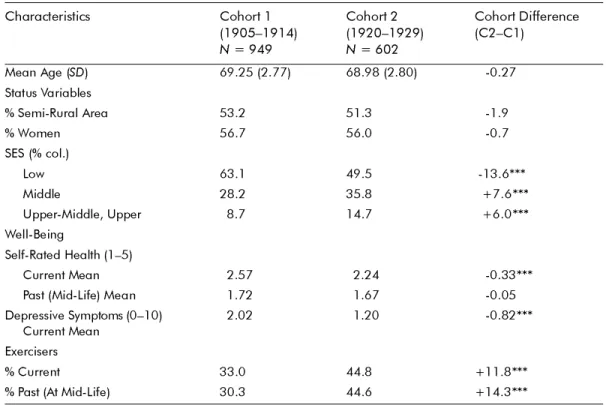
Table 1 presents the basic descriptive information. The mean ages of the members of each cohort are very close, which makes the cohorts fairly comparable. Due to the stratification of the overall samples, both genders and regions are almost equally represented. Socio-economic status shows a shrinkage of the
low-est-status position, reflecting the structural transfor-mation of Swiss society in past decades: development of post-compulsory education, decline of the working classes, and the increase in the number of white-collar workers. Compared to cohort 1, the young-old mem-bers of cohort 2 rated their health higher and showed significantly fewer depressive symptoms.
The proportion of exercisers jumped from 33 per cent among cohort 1 to 45 per cent among cohort 2, with no decline in (aggregate) participation from mid-life onward to young-old age, either in C1 or in C2. Figure 1 displays the four trajectories related to the physical exercising of the members of the two cohorts. The cohort comparison shows a decline in the propor-tion of sedentary persons (S) and an increase in that of long-term exercisers (LE) from the earlier to the more recent cohort. The longitudinal comparison indicates that the apparent aggregate stability of participation between mid-life and young-old age shown in Table 1 hides huge discontinuities. About 1 person in 4 in C1 quit (12%) or began (15%) exercising between mid-life and young-old age; in C2 the proportion was more than 1 in 3, with 18 per cent quitters (Q) and 18 per cent newcomers (NE) As a matter of fact, in each cohort roughly 40 per cent of those who were exercis-ing in mid-life quit doexercis-ing so, while among those who were exercising when young-old, roughly the same proportion were new exercisers.
Table 1: Cohort characteristics: Age, status variables, well-being, exercisers from both cohorts
*p < 0.05; **p < 0.01; ***p < 0.001 Both samples are weighted.
Characteristics Cohort 1 (1905–1914) N = 949 Cohort 2 (1920–1929) N = 602 Cohort Difference (C2–C1) Mean Age (SD
)
69.25 (2.77)
68.98 (2.80)
-0.27
Status Variables
% Semi-Rural Area
53.2
51.3
-1.9
% Women
56.7
56.0
-0.7
SES (% col.)
Low
63.1
49.5
-13.6***
Middle
28.2
35.8
+7.6***
Upper-Middle, Upper
8.7
14.7
+6.0***
Well-Being
Self-Rated Health (1–5)
Current Mean
2.57
2.24
-0.33***
Past (Mid-Life) Mean
1.72
1.67
-0.05
Depressive Symptoms (0–10)
Current Mean
2.02
1.20
-0.82***
Exercisers
% Current
33.0
44.8
+11.8***
160 Canadian Journal on Aging 22 (2) Christian J. Lalive d’Epinay and Jean-François Bickel Co-Variation between Exercising and Well-Being during Young-Old Age
Before making any attempt to establish the direction of the link between exercising and well-being, we must check whether our results confirm its existence (question 1). As Table 2 shows, they do: at young-old age, among both cohorts, non-exercisers rated their health lower and had a higher score for depressive symptoms than exercisers. The question now is whether inferences about causality can be drawn from these cross-sectional co-variations.
Trajectories of Scores on the Exercising, Self-Rated Health, and Self-Assessing Depression Scales
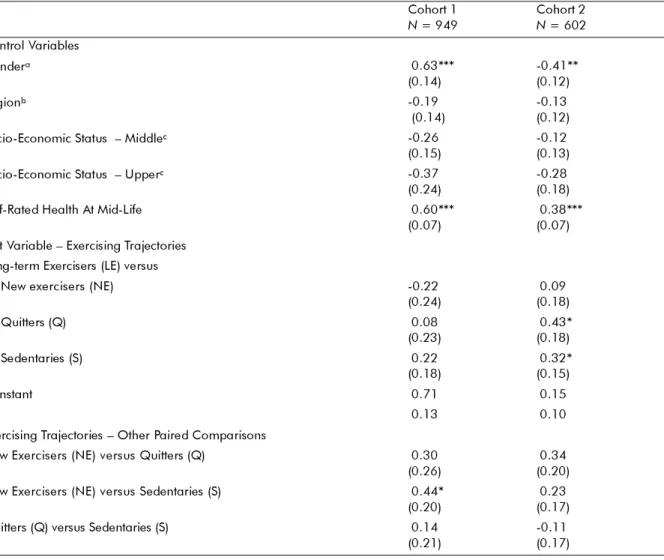
In response to question 2, we checked the link between the four exercising trajectory categories and the two indicators of well-being. Tables 3 and 4 dis-play the results of ordinary least-square regression analyses with, CSRH and SADS as dependent varia-bles, respectively. The model includes three socio-demographic variables and past self-rated health as control variables. Long-term exercisers (LE) serve as reference category for the exercising trajectories and the results of the other possible paired comparisons are added at the bottom of the tables.
Table 2: Mean score on self-rated health and self-assessed depression scale by young-old exercisers and
non-exercisers, for each cohort
*p < 0.05; **p < 0.01; ***p < 0.001 (two-tailed test) Both samples are weighted.
Trajectories of Scores on the Exercising, Self-Rated Health, and Self-Assessing Depression Scales
In response to question 2, we checked the link between the four exercising trajectory categories and the two indicators of well-being. Tables 3 and 4 dis-play the results of ordinary least-square regression analyses with, CSRH and SADS as dependent varia-bles, respectively. The model includes three socio-demographic variables and past self-rated health as control variables. Long-term exercisers (LE) serve as reference category for the exercising trajectories and the results of the other possible paired comparisons are added at the bottom of the tables.
Self-Rated Health
Table 3 refers to CSRH. Among the status variables, the only impact is that of SES, with the lower-status
members rating their health worse than did the other two categories in cohort 1 and than the upper status in cohort 2. In both cohorts self-rated health at mid-life (PSRH) is a strong predictor of self-rated health in young-old age.
Among the members of C1 the two exercising groups (LE and NE) rated their health significantly better than did the quitters (Q) and the sedentary persons (S), with no difference between the former two or the between latter two. C2 displays another pattern, with the Q group having the lowest CSRH score and no significant difference among the other three groups, S included.
Self-Rated Health
Self-Assessing Depression Scale
Cohort 1***
N
= 949
Cohort 2**
N= 602
Cohort 1**
N= 949
Cohort 2**
N= 602
Exercisers
2.31
(0.06)
(0.05)
2.13
(0.12)
1.72
(0.09)
0.97
Non-Exercisers
2.69
(0.04)
(0.05)
2.32
(0.09)
2.17
(0.09)
1.39
Long term Exercisers
New Exercisers Quitters Sedentaries Cohort 2 Cohort 1 18 15 12 55 27 18 18 37 0 10 20 30 40 50 60 %
Figure 1
Table 3: Self-rated health in young-old age regressed on exercising trajectories (controlledby gender, region,
socio-economic status and self-rated health at mid-life)
* p < 0.05; **p < 0.01; ***p < 0.001 (two-tailed tests)
a 1 = women, 0 = men; b 1 = urban, 0 = semi-rural;
c compared to low socio-economic status.
Ordinary least-square multiple regression. Unstandardized regression coefficients with standard errors in parentheses.
Self-Assessing Depression Scale
Table 4 reports on the SADS. This time gender (with women reporting symptoms at a higher rate) and not SES adds its effect on depressive symptoms to that of PSRH. In cohort 1 the only significant difference in SADS lies between the NE and S groups. In the more recent cohort (C2) the LE group has a lower score for depressive symptoms than Q and S.
Discussion and Conclusions
A comparison of cohorts points to an improvement in well-being in the more recent one, according to both indicators (Table 1). Previous time-lag studies have shown a cohort improvement in health (mainly func-tional; see Manton, Corder, & Stallard, 1997; Mor-miche, 1997) but have not focused on well-being. Our
data also confirm the trend toward wider participa-tion in sports and physical training, which is congru-ent with the results of studies carried out in various countries, based on longitudinal data (Pohjolainen, 1997; Hirvensalo, Lampinen, & Rantanen, 1998; Ver-brugge, Grubber-Baldini, & Fozard, 1996) or on series of cross-sectional surveys (Elkeles, 1997; Garrigues, 1989; Paillat et al., 1993; Pronovost, 1993). In a recent paper based on the same data, we analysed the cohort changes in participation in sports and physical train-ing and in the socio-demographic composition of the exercisers, showing that the increase in the proportion of exercisers was related to a change in the pattern of participation, from one in which sports and physical exercise were a mostly male, urban, and upper- (mid-dle-) class activity, to a more generalized, democratic pattern (Lalive d’Epinay, Maystre, & Bickel, 2001).
Cohort 1
N= 949
Cohort 2
N= 602
Control Variables
Gender
a-0.01
(0.07)
-0.04
(0.06)
Region
b-0.08
(0.07)
-0.05
(0.06)
Socio-Economic Statu s– Middle
c-0.27***
(0.07)
-0.09
(0.07)
Socio-Economic Statu s– Upper
c-0.26*
(0.12)
-0.27**
(0.10)
Self-Rated Health at Mid-Life
0.35***
(0.04)
(0.04)
0.38***
Test Variable – Exercising Trajectories
Long-Term Exercisers (LE) versus
New exercisers (NE)
-0.01
(0.12)
(0.10)
0.12
Quitters (Q)
0.35**
(0.11)
(0.10)
0.35***
Sedentaries (S)
0.28**
(0.09)
(0.08)
0.08
Constant
1.90
1.61
R20.16
0.20
Exercising Trajectories – Other Paired Comparisons
New Exercisers (NE) versus Quitters (Q)
0.34**
(0.13)
(0.11)
0.23*
New Exercisers (NE) versus Sedentaries (S)
0.27**
(0.10)
-0.04
(0.09)
Quitters (Q) versus Sedentaries (S)
-0.07
162 Canadian Journal on Aging 22 (2) Christian J. Lalive d’Epinay and Jean-François Bickel
Table 4: Self-assessed depression scale (SADS) in young-old age regressed on exercising trajectories (controlled by
gender, region, socio-economic status, and self-rated health at mid-life)
* p < 0.05; **p < 0.01; ***p 0.001 (two-tailed tests)
a 1 = women, 0 = men; b 1 = urban, 0 = semi-rural;
c compared to low socio-economic status.
Ordinary least-square multiple regression. Unstandardized regression coefficients with standard errors in parentheses. Let us now consider the first two objectives of this
study. With regard to question 1, our results confirm the existence of a synchronic link, among young-old persons, between participating in a sport and/or exer-cising and well-being (Table 2).
With regard to question 2, once exercising trajectories are taken into account, our results (Tables 3 and 4) prompt three observations:
1. Long-term exercisers (LE) show a higher level of well-being than both the S and the Q groups, according to CSRH among cohort 1, and according to SADS among cohort 2. The lower level of well-being among S (com-pared to LE) is attested on one of the two indicators in each cohort. These results support the hypothesis of a positive causal relationship between a long-term exer-cising lifestyle and well-being.
2. New exercisers (NE) rate their health better than S and Q in the earlier cohort, and than Q in the later cohort (where differences between NE and S are not signifi-cant). When compared with long-term exercisers, NE always rank very close; no significant difference was found between these two groups on any of the two measures. The data suggest that new exercisers derive some benefit from taking up exercise (although the direction of the causal link remains unclear in the later cohort). Spirduso (1994) has argued that, with an ade-quate level of exercise, “late exercisers” (those becom-ing active after their mid-forties) could improve their general health status and almost close the gap with the group of people having a long-term “exercise life-style”. Her argument was based on evidence drawn from training studies, with measures at the beginning and at the end of the training period. Our study deals with the young-old at large and we focus on subjective
Cohort 1 N = 949 Cohort 2N = 602 Control Variables Gendera
0.63***
(0.14)
-0.41**
(0.12)
Region
b-0.19
(0.14)
-0.13
(0.12)
Socio-Economic Status – Middle
c-0.26
(0.15)
-0.12
(0.13)
Socio-Economic Status – Upper
c-0.37
(0.24)
-0.28
(0.18)
Self-Rated Health At Mid-Life
0.60***
(0.07)
(0.07)
0.38***
Test Variable – Exercising Trajectories
Long-term Exercisers (LE) versus
New exercisers (NE)
-0.22
(0.24)
(0.18)
0.09
Quitters (Q)
0.08
(0.23)
(0.18)
0.43*
Sedentaries (S)
0.22
(0.18)
(0.15)
0.32*
Constant
0.71
0.15
R20.13
0.10
Exercising Trajectories – Other Paired Comparisons
New Exercisers (NE) versus Quitters (Q)
0.30
(0.26)
(0.20)
0.34
New Exercisers (NE) versus Sedentaries (S)
0.44*
(0.20)
(0.17)
0.23
Quitters (Q) versus Sedentaries (S)
0.14
well-being. However, it is interesting to transfer the hypothesis from health to well-being and to note that, while our results do not validate it, they do not contra-dict it either.
3. The Q group shows the lowest level of well-being, a result that raises serious practical and theoretical ques-tions. The quitters form a large part (about 40%) of the mid-life exercisers in each of the two cohorts. They are an important and worrisome group for research as well as for social medicine and practical gerontology. Why they quit we do not know. The cause might lie in an injury brought about by exercising, in an unrelated health problem or in some non-health-related circum-stance. In the absence of information on the path lead-ing from past health and health problems to quittlead-ing and current health, the causal link between quitting exercise on the one hand, and health and well-being on the other, remains a mystery. Specialists have drawn attention to the barriers, both physical and psychologi-cal, that deter people from exercising as they grow older (McPherson & Yamaguchi, 1997, Lehr & Jüchtern, 1997). The risks involved in sports and train-ing are also the subject of numerous studies (Pate & Macera, 1994; Thomson & Fahrenbach, 1994). But we are not aware of any studies dealing with quitters. The main reason for this omission seems to lie in the diffi-culty of tracking quitters, but the magnitude of this group, and the evidence that there is a connection here with the quitters’ low level of well-being, should spur more research on the subject.
Turning now to the third question we raised at the outset, namely that of a possible cohort effect, we find that the link between exercising and well-being fol-lows the same basic pattern among the two cohorts: In both cases, long-term exercisers felt better than seden-taries and quitters, with the latter scoring lowest in well-being. But a striking result is the difference in the sensitivity of the cohorts to the two available indica-tors of well-being. Cohort 1 relates exercising mostly to SRH, with 4 significant paired differences out of a total of 6 and only 1 for SADS, while cohort 2 shows 3 significant differences on SRH and 2 on SADS. One explanation could be that a substantial change in the socio-occupational structure took place from the first to the second cohort. About half of the members of C1 were manual workers (farmers or blue-collar), com-pared with only 19 per cent of C2. Manual workers might consider physical health first, while white-col-lar workers and professionals might be more sensitive to psychological well-being and depressive symptoms (Thorslund & Lundberg, 1994; Mossey & Shapiro, 1982).
Our study is a secondary analysis and thus depends on the available indicators. Three remarks apply. First, future research would benefit from being based on a more complete conceptualization of subjective well-being (McAuley & Rudolph, 1995, Spirduso & Leilani
Cronin, 2001). Second, measures of physical activity are given for only two periods of the life course: close to the age of 50 and when interviewed in young-old age. We postulated continuity among the LE and S groups, but in the case of the new exercisers and the quitters, the change (starting or stopping the activity) may have hap-pened either recently or decades ago. Lastly, the use of PSRH to control health at baseline (mid-life) is a rudi-mentary solution, but more reliable data could be obtained by means of a long-term, longitudinal panel or through access to past medical information.
References
American College of Sports Medicine. (1998). Exercise and physical activity for older adults. Medicine and Science in
Sports and Exercise, 30, 992–1008.
Dose-response issues concerning physical activity and health [Special issue]. (2001). Medicine and Science in
Sports and Exercise, 33(June suppl.).
Baltes, P., & Baltes, M.M. (Eds.). (1990). Successful aging:
Per-spective from the behavioral sciences. Cambridge:
Cam-bridge University Press.
Baltes, P., & Mayer K.-U. (Eds). (1999). The Berliner aging
study: Aging from 70 to 100. Cambridge: Cambridge
Uni-versity Press.
Blossfeld, H.-P., & Götz, R. (1995). Techniques of event history
modeling. Mahwah, NJ: Lawrence Erlsbaum.
Bokovoy, J.L., & Blair, S.N. (1994). Aging and exercise: A health perspective. Journal of Aging and Physical Activity,
2, 243–260.
Bouchard, C., Shephard, R.J., & Stephens, T. (Eds.). (1994).
Physical Activity, Fitness, and Health: International pro-ceedings and consensus statement. Champaign, IL:
Human Kinetics.
Brückner, E., & Mayer, K.-U. (1998). Collecting life history data. Experiences from the German life history study. In J.Z. Giele & G.H. Elder Jr. (Eds), Methods of life course
research: Quantitative and qualitative approaches (pp. 152–
181), Thousand Oaks, CA: Sage.
Campbell, R.T. (1992). Longitudinal research. In E.F. Bor-gatta & M.L. BorBor-gatta (Eds.), Encyclopedia of sociology (Vol. 3; pp. 1147–1158). New York: Macmillan.
Elkeles, T. (1997). Trends in sports activities in elder German people 1984 to 1991. In G. Huber (Ed.), Proceedings of the
Fourth International Congress on Healthy Aging, Activity and Sports (pp. 487–492). Gamburg, Germany: Health
Promotion Publications.
Garrigues, C. (1989). Une France un peu plus sportive qu’il y a vingt ans … grâce aux femmes. Economie et
statis-tique, 224, 45–49.
Heikkinen, R.L. (1998). The role of physical activity in healthy
aging. Geneva: World Health Organization, Ageing and
Health Programme.
Hirvensalo, M., Lampinen, P., & Rantanen, T. (1998). Physi-cal exercise in old age: An eight-year follow-up study on involvement, motives, and obstacles among persons age 65–84. Journal of Aging and Physical Activity, 6, 157– 168.
164
Canadian Journal on Aging 22 (2)
Christian J. Lalive d’Epinay and Jean-François Bickel
Höpflinger, F. (1995). From ageism to gerontologism?Emerging images of aging in gerontology. In C. Hum-mel & C. Lalive d’Epinay (Eds.), Images of aging in
West-ern societies (pp. 91–98). Geneva: University of Geneva,
Centre for Interdisciplinary Gerontology.
Keysor, J.J., & Jette, A.M. (2001). Have we oversold the bene-fits of late-life exercise? The Journals of Gerontology. Series
A, Biological Sciences and Medical Sciences, 56A, M412–
M423.
Lalive d’Epinay, C., Christe, E., Coenen-Huther, J., Hag-mann, H.M., Jeanneret, O., Junod, et al. (1983).
Vie-illesses. Situations, itinéraires et modes de vie des personnes âgées aujourd’hui. St Saphorin, Switzerland: Georgi.
Lalive d’Epinay, C., Bickel, J.-F., Maystre, C., & Vollenwyder, N. (2000). Vieillesses au fil du temps: 1979–1994: santé,
sit-uations de vie, formes de participation et visions du monde des personnes âgées en Suisse. Lausanne, Switzerland:
Réalités sociales.
Lalive d’Epinay, C., Maystre, C., & Bickel, J.-F. (2001). Aging and cohort changes in sports and physical training from the Golden Decades onward: A cohort study in Swit-zerland. Loisirs et société / Society and Leisure, 24, 453– 481.
Lamprecht, M., & Stamm, H. (1994). Die soziale Ordnung der
Freizeit. Zurich, Switzerland: Seismo.
Lehr, U., & Jüchtern, J. (1997). Psychophysical activity in the elderly: motivations and barriers. In G. Huber (Ed.),
Proceedings of the Fourth International Congress on Healthy Aging, Activity and Sports (pp. 25–35). Gamburg,
Ger-many: Health Promotion Publications.
Manton, K.G., Corder, L.S., & Stallard, E. (1997). Chronic disability trends in elderly United States populations: 1982–1994. Proceedings of the National Academy of
Sci-ences: Medical Sciences, 94, 2593–2598.
McAuley, E., & Rudolph, D. (1995). Physical activity, aging and psychological well-being. Journal of Aging and
Phys-ical Activity, 3, 67–96.
McPherson, B.D., & Yamaguchi, Y. (1995). Aging and active lifestyles: A cross-cultural analysis of factors influenc-ing the participation of middle-aged and elderly cohorts. In S. Harris, E. Heikkinen, & W.S. Harris (Eds.).
Physical activity, aging and sports (Vol. 4, pp. 293–308).
Albany, NY: Center for the Study of Aging.
Menard, S. (1991). Longitudinal research. Newbury Park, CA: Sage.
Mormiche, P. (1997). Vie et santé progressent de concert. In J. Du Pasquier (Ed.) L’espérance de vie sans incapacités. Paris: Presses Universitaires de France.
Mossey, J.M., & Shapiro, E. (1982). Self-rated health. A pre-dictor of mortality among the elderly. American Journal
of Public Health, 72, 800–808.
O’Connor, P.J., Aenchbacher, L.E., & Dishman, R.K. (1993). Physical activity and depression in the elderly. Journal of
Aging and Physical Activity, 1, 34–58.
Paillat, P., Delbès, C., Gaymu, J., and Sammartino, E. (1993).
Les pratiques culturelles des personnes âgées. Paris:
Fonda-tion naFonda-tionale de gérontologie.
Parkatti, T., Deeg, D.J.H., Bosscher, R.J., & Launer, L.L.J. (1998). Physical activity and self-rated health among 55- to 89-year-old Dutch people. Journal of Aging and Health,
10, 311–326.
Pate, R.R., & Macera, C.A. (1994). Risks of exercising: mus-culoskeletal injuries. In C. Bouchard, R.J. Shephard, & T. Stephens (Eds.), Physical Activity, Fitness, and Health:
International proceedings and consensus statement (pp.
1008–1018). Champaign, IL: Human Kinetics. Plumer, K. (1983). Documents of life. London: Allen and
Unwin.
Pohjolainen, P. (1997). Physical activity and self-rated health in two cohorts in the elderly. In G. Huber (Ed.),
Proceed-ings of the Fourth International Congress on Healthy Aging, Activity and Sports (pp. 505–509). Gamburg, Germany:
Health Promotion Publications.
Pronovost, G. (1993). Loisir et société: traité de sociologie
empirique. Sainte-Foy, QC: Presses de l’Université du
Québec.
Ragheb, M.G., & Griffith, C.A. (1982). The contribution of leisure participation and leisure satisfaction to life satis-faction of older persons. Journal of Leisure Research, 14, 295–306.
Rowe, J.W., & Kahn, R.L. (1997). Successful aging. The
Geron-tologist, 37, 433–440.
Rowe, J.W., & Kahn, R.L. (1998). Successful aging. New York: Pantheon.
Rubin, D.C. (Ed.). (1996). Remembering our past: Studies in
autobiographical memory. Cambridge: Cambridge
Uni-versity Press.
Ruuskanen, J.M., & Ruoppila, I. (1995). Physical activity and psychological well-being among people aged 65 to 84 years. Age and Ageing, 24, 292–296.
Scheidt, R.J., Humpherys, D.R., & Yorgason J.B. (1999). Suc-cessful aging: What’s not to like? The Journal of Applied
Gerontology, 18, 277–282.
Shephard, R.J. (1997). Aging, physical activity and health. Champaign, IL: Human Kinetics.
Spirduso, W.W. (1994). Physical activity and aging: Retro-spections and visions for the future. Journal of Aging and
Physical Activity, 2, 233–242.
Spirduso, W.W. & Leilani Cronin, D. (2001). Exercise dose-response effects on quality of life and independent liv-ing in older adults. Medicine and Science in Sports and
Exercise, 33, S598–S608.
Thomson, P.D., & Fahrenbach, M.C. (1994). Risks of exercis-ing: Cardiovascular, including sudden cardiac death. In C. Bouchard, R.J. Shephard, & T. Stephens (Eds.),
Physi-cal Activity, Fitness, and Health: International proceedings and consensus statement (pp. 1019–1028). Champaign, IL:
Human Kinetics.
Thorslund, M., & Lundberg, O. (1994). Health and inequali-ties among the oldest old. Journal of Aging and Health,
6(1), 51–69.
U.S. Department of Health and Human Services. (1996).
Physical activity and health: A report of the Surgeon Gen-eral. Atlanta: International Medical Publishing.
Verbrugge, L.M., Grubber-Baldini, A.L., & Fozard, J.L. (1996). Age differences and age changes in activities: Baltimore longitudinal study of aging. Journal of
Geron-tology: Social Sciences, 51B, S30–S41.
Wang, R., Treub, S., & Alverno, L. (1975). A brief self-assess-ing depression scale, Journal of Clinical Pharmacology, 15, 163–167.
Wankel, L.M., & Sefton, J.M. (1994). Physical activity and other lifestyle behaviors. In C. Bouchard, R.J. Shephard,
& T. Stephens (Eds.), Physical Activity, Fitness, and
Health: International proceedings and consensus statement
(pp. 530–550). Champaign, IL: Human Kinetics. Zung, W.W.K. (1965). A self-rating depression scale. Archives