INTRODUCTION
Several studies have found a high prevalence of keel bone deformities in laying hens (Gregory and Wilkins, 1996; Fleming et al., 2004; Wilkins et al., 2004; Clark et al., 2008; Sandilands et al., 2009). In 39 flocks from Swiss commercial laying farms, 55% of the birds had keel bone deformities and 25% of the hens showed mod-erate or severe deformities (Käppeli et al., accepted a). Other investigators reported similar results and con-cluded that almost all moderate and severe keel bone deformities were associated with callus formation and most likely resulted from traumatic bone fractures
(Fleming et al., 2004; Scholz et al., 2008). This implies a considerable welfare problem because birds’ sense of pain is similar to that of mammals (Gentle, 1992). Assumedly, one-quarter of all Swiss laying hens suffer from keel fractures that are likely to be painful. Besides osteoporosis, which is a widespread problem in laying hens (Rennie et al., 1997; Knowles and Wilkins, 1998; Bishop et al., 2000; Whitehead, 2004; Fleming et al., 2006), alternative housing systems and perches are of-ten identified as responsible for keel bone fractures. In alternative systems, the hens may break the anatomi-cally exposed keel in collisions with perches or other ob-stacles (Gregory et al., 1990; Abrahamsson et al., 1996; Tauson and Abrahamsson, 1996; Knowles and Wilkins, 1998; Fleming et al., 2004; Scholz et al., 2008). In Swit-zerland, cages for laying hens were banned in 1992 and only alternative systems with perches conform to the law. According to European Communities (1999),
Effects of housing, perches, genetics, and 25-hydroxycholecalciferol
on keel bone deformities in laying hens
S. Käppeli,* S. G. Gebhardt-Henrich,*
1E. Fröhlich,* A. Pfulg,* H. Schäublin,† and M. H. Stoffel‡
*Federal Veterinary Office, Centre for Proper Housing of Poultry and Rabbits, CH-3052 Zollikofen, Switzerland;†Aviforum, Ch-3052 Zollikofen, Switzerland; and ‡Division of Veterinary Anatomy, University of Bern, CH-3001 Bern, Switzerland
ABSTRACT Several studies have shown a high
prev-alence of keel bone deformities in commercial lay-ing hens. The aim of this project was to assess the effects of perch material, a vitamin D feed additive (25-hydroxyvitamin D3; HyD, DSM Nutritional Prod-ucts, Basel, Switzerland), and genetics on keel bone pathology. The study consisted of 2 experiments. In the first experiment, 4,000 Lohmann Selected Leghorn hens were raised in aviary systems until 18 wk of age. Two factors were investigated: perch material (plas-tic or rubber-coated metal) and feed (with and with-out HyD). Afterward, the hens were moved to a layer house with 8 pens with 2 aviary systems. Daily feed consumption, egg production, mortality, and feather condition were evaluated. Every 6 wk, the keel bones of 10 randomly selected birds per pen were palpated and scored. In the second experiment, 2,000 Lohmann Brown (LB) hens and 2,000 Lohmann Brown parent stock (LBPS) hens were raised in a manner identical to the first experiment. During the laying period, the
hens were kept in 24 identical floor pens but equipped with different perch material (plastic or rubber-coated metal). The same variables were investigated as in the first experiment. No keel bone deformities were found during the rearing period in either experiment. During the laying period, deformities gradually appeared and reached a prevalence of 35% in the first experiment and 43.8% in the second experiment at the age of 65 and 62 wk, respectively. In the first experiment, neither HyD nor the aviary system had any significant effect on the prevalence of keel bone deformities. In the second ex-periment, LBPS had significantly fewer moderate and severe deformities than LB, and rubber-coated metal perches were associated with a higher prevalence of keel bone deformities compared with plastic perches. The LBPS laid more but smaller eggs than the LB. Again, HyD did not affect the prevalence of keel bone deformi-ties. However, the significant effect of breed affiliation strongly indicates a sizeable genetic component that may provide a basis for targeted selection.
Key words: laying hen , keel bone , 25-hydroxycholecalciferol , parent stock , welfare
2011 Poultry Science 90 :1637–1644 doi: 10.3382/ps.2011-01379 1637
Received January 21, 2011. Accepted April 29, 2011.
1 Corresponding author: [email protected]
ventional cages will need to be replaced by furnished cages or alternative systems equipped with perches in all European Union countries after 2012. In a review paper, Sandilands et al. (2009) requested that the de-sign of all housing systems be tested for risk of injury.
Nutrition influences osteoporosis, especially through calcium and vitamin D metabolism (Rennie et al., 1997; Whitehead, 2004; Fleming et al., 2006). Two studies in broilers reported beneficial effects of dietary supplementation with the vitamin D metabolite 25-hy-droxycholecalciferol on tibial dyschondroplasia (Soares et al., 1995; Zhang et al., 1997). It is unknown so far whether this vitamin D metabolite might improve keel bone condition in laying hens. In a previous study, we demonstrated that the partial replacement of vi-tamin D by this metabolite increases the serum level of 25(OH)D3 in laying hens and pullets (Käppeli et al., accepted b). Genetics seems to be one of the most important factors in osteoporosis (Bishop et al., 2000; Fleming et al., 2004, 2006). Bishop et al. (2000) and Fleming (2006) showed that bone strength can be im-proved through genetic selection without compromising laying performance. In this study, the following factors were investigated with respect to their potential effect on the prevalence of keel bone deformities: aviary de-sign, perch type, vitamin D additives, and breed affilia-tion to a white hybrid, a brown hybrid, and the brown hybrid’s female parent stock.
MATERIALS AND METHODS
The study comprised 2 experiments that were carried out between July 2008 and March 2010.
First Experiment
A total of 4,000 chicks (Lohmann Selected Leghorn, Lohmann Tierzucht, Cuxhaven, Germany) were raised from d 1 until 18 wk of age in 8 separate pens with 2 aviary systems. Four pens were outfitted with the aviary system Landmeco Harmony (Globogal, Lenz-burg, Switzerland) and the other 4 pens were outfitted with the aviary system Inauen Natura (Big Dutchman, Appenzell, Switzerland). All pens were equipped with perches, automatic chain feeder, nipple drinkers, room heater, humidifier, and manure belt. In both systems, 2 factors were examined: type of perch and feed. Perch-es were either a T-shaped plastic perch (4.5 cm upper width, 7 cm high; Rihs Agro AG, Seon, Switzerland) or a rubber-coated metal pipe (Sanatherm, R. Inauen AG, Appenzell, Switzerland). The rubber-coated metal pipe was circular and had a diameter of 3.7 cm. The red rub-ber was too thin to be measured and did not alter the hardness of the metal. A chick starter diet (2,820 kcal of ME, 20% CP, 9.2–12.1 g/kg of calcium) was fed until wk 9 and a grower diet (2,772 kcal of ME, 15.5% CP, 11.2–12 g/kg of calcium) was fed from wk 9 through wk 18. The feed of the control group contained 2,800
(starter) and 2,000 (rearing) IU of synthetic vitamin D, and the feed of the treatment group contained 1,400 (starter) and 1,000 (rearing) IU of synthetic vitamin D3 with 1,400 (starter) and 1,000 (rearing) IU of add-ed 25-hydroxycholecalciferol (HyD, DSM Nutritional Products, Basel, Switzerland; see Table 1 in Käppeli et al., accepted b).
For the laying period after 18 wk of age, the hens were moved to a house with 8 pens with access to covered outdoor areas, and all birds underwent an identical vac-cination and lighting program. Hens from the HyD diet remained on their diet and hens from the control diet remained on the control diet. Hens from both rearing aviaries were distributed to both laying aviaries. Four pens with 355 hens used the aviary system Rihs Boleg 2 (Rihs Agro AG) with the same T-shaped plastic perches as used during rearing. The other 4 pens held 360 hens each and were equipped with the aviary system Globo-gal Voletage (GloboGlobo-gal) with wooden perches. Wooden perches were 3.5 cm wide and 3 cm high and had a con-vex surface (part of a Volito grid; Volito, Veenendaal, the Netherlands). Group laying nests were placed along the wall in both aviary systems. To change nest sites for a simultaneous experiment, additional nests of the same colors and dimensions were placed into the avi-ary racks and, in this case, nests along the wall were blocked. At 36, 44, and 52 wk of age, the nest sites in 4 of the 8 compartments were changed. Time and number of changes (1–2) between nest sites depended on individual sequence of each pen (T. Lentfer, Federal Veterinary Office, Zollikofen, Switzerland; unpublished data). A 2-phase standard diet was fed [laying phase 1 (wk 20 to 44) diet: 2,772 kcal of ME, 17.6% CP, 30 g/ kg of calcium; laying phase 2 (wk 45) diet: 2,725 kcal of ME, 16.7% CP, 38 g/kg of calcium). The control group received 3,000 IU of synthetic vitamin D3 in the feed and the treatment group received 1,500 IU of synthetic vitamin D3 and 1,500 IU of HyD in the feed (see Table 1 in Käppeli et al., accepted b).
Daily feed consumption, egg production, and mor-tality were monitored. Feather condition of hens was scored in the middle and at the end of the experiment according to the method of Tauson et al. (2005).
Every 6 wk from 6 wk of age until the end of the ex-periment at 65 wk, the keel bone of a random sample of live hens was determined by palpation. From wk 6 until wk 50, 10 live hens/pen were examined, and from wk 55 onward, 15 hens/pen were examined. The same ex-aminer (S. K.) performed all examinations by catching a hen and palpating the keel bone by running 2 fingers down the edge of the keel bone feeling for alterations such as s-derivations, bumps, or depressions. The fol-lowing scoring system was used: 4 = normal keel bone, 3 = slight deformation, 2 = moderate deformation, 1 = severe deformation. The scoring method was the same as that used by Scholz et al. (2008) and assessments by S. K. were matched and calibrated with Scholz et al. (2008).
Second Experiment
In the second experiment, 2,000 Lohmann Brown chicks (LB) and 2,000 chicks of Lohmann Brown par-ent stock (LBPS) were raised under the same condi-tions as described for the first experiment, including the same 8 rearing pens with the same housing and feeding conditions and treatment factors. White female parent stock hens are mated with dark male parent stock roosters to obtain the LB laying hybrid. The LB and LBPS chicks were of the same age and were reared simultaneously but in separate pens. Each line was sub-jected to each treatment combination. There were 2 pens/treatment combination, 1 pen for each line.
For the laying period, the feeding, vaccination, and lighting programs were identical to those in the first experiment but the housing system was different. Hens were kept in a house with 24 pens containing 156 birds each. All pens were identical floor pens (16 m2) with elevated perches, automatic chain feeders, nipple drink-ers, and litter area. Twelve pens had plastic perches and the other 12 were equipped with rubber-coated metal pipes. These perches were identical to the perches used during the rearing period. The hens from each rearing pen were distributed to 3 pens in the layer house. Birds raised on the HyD diet remained on this diet during the laying period. Birds raised on plastic perches remained on plastic perches during the laying period, and those raised on metal perches remained on metal perches. The hens were fed commercial prelayer feed (2,772 kcal of ME, 18% CP) and layer feed phase 1 (2,772 kcal of ME, 18% CP) and phase 2 (2,749 kcal of ME, 16.5% CP), which were supplemented with 2,500 IU of syn-thetic vitamin D3 for the control group and 1,250 IU of synthetic vitamin D3 and 1,250 IU of HyD for the treatment group.
Daily feed consumption, egg production, and mor-tality were monitored. Feather condition of hens was scored in the middle and at the end of the trial ac-cording to the method of Tauson et al. (2005). On one occasion during the wk 64 of age, 3 eggs/pen were col-lected and the egg shells were cleaned and weighed with a Mettler AT261 DeltaRange balance (Mettler-Toledo, Greifensee, Switzerland) to the nearest 10−4 g.
Every 6 wk from 6 through 65 wk of age, the keel bone status of a random sample of 10 hens of each pen was determined by the palpation method as described for the first experiment. Repeatability of the palpations was assessed at 48 wk of age using 30 LBPS hens from 3 pens. These birds were identified by leg bands. Hens were palpated again about 2 h later as well as 6 and 12 wk after the initial palpation.
Statistical Design and Analysis
Statistical analysis for the rearing period relied on a randomized block factorial design with 4 treatments in 2 blocks. The treatments consisted of the completely crossed factors perch type and diet. The 2 blocks
con-sisted of the aviary system Harmony and aviary system Natura. The second experiment followed the same de-sign, but with the additional factor of the 2 breeds, LB and LBPS. In both cases, the experimental unit was the pen. During the laying period of the first experi-ment, the aviary system Rihs Boleg 2 and the aviary system Globogal Voletage and the diet with and with-out HyD were used in a 2 × 2 factorial arrangement in 8 pens. These 4 treatments were replicated resulting in each treatment in 2 pens, pens being the experimental units. Data from the second experiment were analyzed by a completely crossed 3-factor arrangement of 2 hy-brids, 2 diets, and 2 types of perches yielding 8 treat-ments in 24 pens. Thus, each treatment was replicated 3 times and the pen was the experimental unit. Data of all ages were analyzed as repeated measures using pen as the repeated subject variable. The generalized linear model using type 3 significances of generalized estimable equations (PROC GENMOD, SAS 9.1, SAS Institute, 2003) was used. Nonsignificant interactions (P > 0.2) were pooled. The agreement between the re-peatedly measured scores of the same hens was given as the weighted kappa coefficient in PROC FREQ of SAS 9.1. The weighted kappa coefficient differs from the nonweighted by weighting the scores according to the frequencies in the second scoring event.
RESULTS
First Experiment
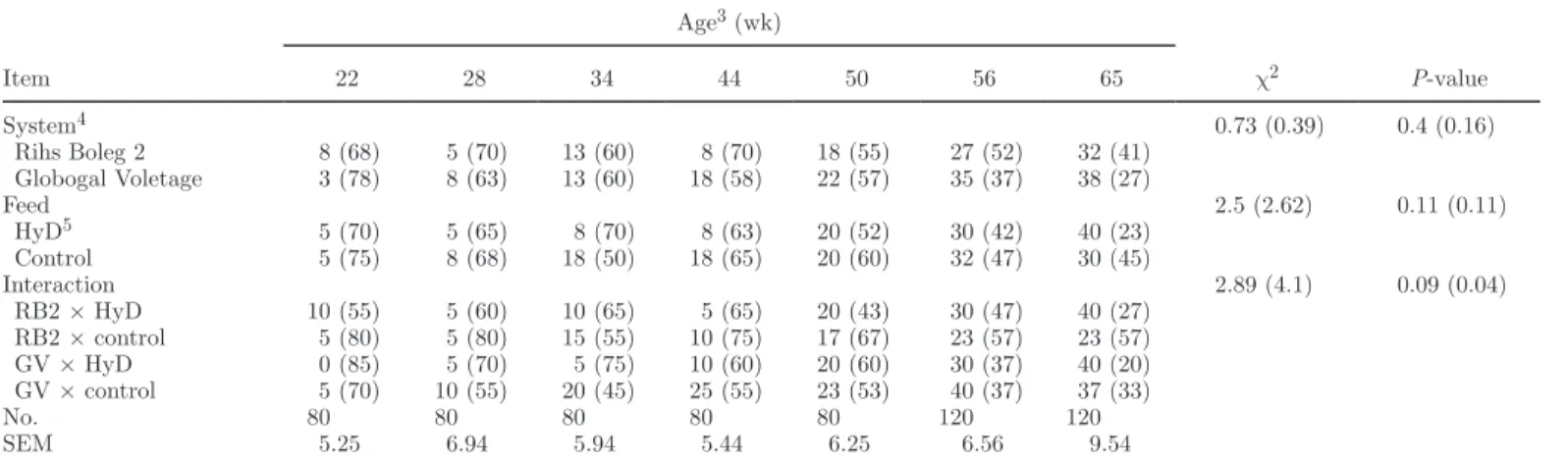
During rearing in the first 18 wk, practically no de-formities of the keel bone were found (Figure 1). There-fore, no analyses of those data were made. Early in the laying period, keel bone deformities started to occur. By 22 wk, 27.5% of all hens had deformities of the keel bone (grade 1 to 3), 5% of which were moderate and severe (grade 1 and 2). The number of hens with defor-mities increased over the course of the laying period. At the end of the laying period of 65 wk, 65.8% of the hens had a deformed keel bone; 35% of the deformities were moderate or severe (Figure 1). Age had a significant influence on deformities (Table 1).
No significant difference was found between the 2 avi-ary systems with respect to keel bone status (Table 1). No effect of dietary HyD supplementation was found on the proportion of deformities (Table 1). A significant interaction was found between diet and system for the total proportion of deformities (Table 1). No significant interaction was found for moderate and severe deformi-ties (Table 1).
Irrespective of system and diet, we found consider-able variation between the 8 pens. At wk 65, the pen with the lowest proportion of moderate and severe de-formities had 13.3% affected birds, whereas in the 2 pens with the highest proportion of moderately and severely deformed keel bones the prevalence reached 53.3%.
Two incidents interfered with our data collection dur-ing the first experiment. Durdur-ing wk 2 of reardur-ing, some birds in 4 pens switched pens unnoticed. Two weeks later, the birds were counted and we noticed that up to 40 of the birds had changed pens. Because we did not find any keel bone deformities at that point and blood samples at 11 wk of age revealed significant differences of vitamin D between the diet treatment groups (Käp-peli et al., accepted b), the experiment was continued with the present distribution of hens in pens and all hens were marked with specifically colored bands for each pen. During the laying period, some of the pens with Rihs Boleg 2 aviaries had a high rate of mortality
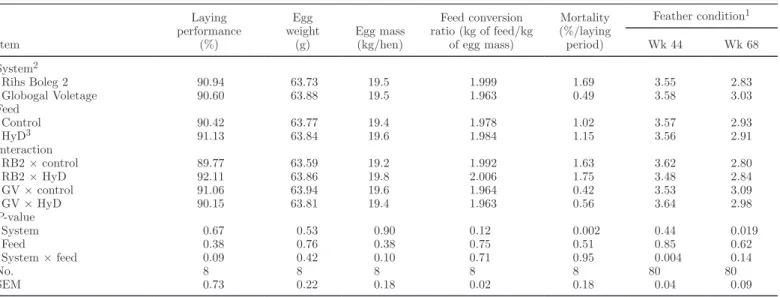
and feather score was worse in this aviary than in the Voletage aviary (Table 2). During the first experiment no significant effects in laying performance, egg weight, and feed conversion ratio between treatments were ob-served (Table 2).
Second Experiment
As in the first experiment, few deformities were found during rearing. With the onset of laying, the prevalence of deformities increased with age (Figure 2). A marked increase of deformities occurred between wk 23 and 43 and wk 37 and 43. The total proportion of deformities
Figure 1. Overview of keel bone deformities in the first experiment.
Table 1. Hens (%) from experiment 1 with grade 1 and 2 keels1,2
Item Age3 (wk) χ2 P-value 22 28 34 44 50 56 65 System4 0.73 (0.39) 0.4 (0.16) Rihs Boleg 2 8 (68) 5 (70) 13 (60) 8 (70) 18 (55) 27 (52) 32 (41) Globogal Voletage 3 (78) 8 (63) 13 (60) 18 (58) 22 (57) 35 (37) 38 (27) Feed 2.5 (2.62) 0.11 (0.11) HyD5 5 (70) 5 (65) 8 (70) 8 (63) 20 (52) 30 (42) 40 (23) Control 5 (75) 8 (68) 18 (50) 18 (65) 20 (60) 32 (47) 30 (45) Interaction 2.89 (4.1) 0.09 (0.04) RB2 × HyD 10 (55) 5 (60) 10 (65) 5 (65) 20 (43) 30 (47) 40 (27) RB2 × control 5 (80) 5 (80) 15 (55) 10 (75) 17 (67) 23 (57) 23 (57) GV × HyD 0 (85) 5 (70) 5 (75) 10 (60) 20 (60) 30 (37) 40 (20) GV × control 5 (70) 10 (55) 20 (45) 25 (55) 23 (53) 40 (37) 37 (33) No. 80 80 80 80 80 120 120 SEM 5.25 6.94 5.94 5.44 6.25 6.56 9.54
1Grade 1 = severely deformed keel; grade 2 = moderately deformed keel; grade 3 = slightly deformed keel; grade 4 = normal keel. Grades 1 and 2
are predominantly fractures.
2The percentage of hens with normal keels (grade 4) is given in parentheses. 3χ2 = 7.04 (7.11); P-value = 0.008 (0.008).
4Rihs Boleg 2 (RB2; Rihs Agro AG, Seon, Switzerland) had plastic perches and Globogal Voletage (GV; Globogal, Lenzburg, Switzerland) had
wooden perches.
increased from 46.7 to 64.6%, and the moderate and severely deformed keel bones increased from 24.2 to 39.2%. From that time on the proportion of deformities remained consistently high and increased again at the last palpation. At 62 wk of age, values were 72.9% for total deformities and 43.8% for moderate and severe deformities (Figure 2). Age was again a highly signifi-cant factor (Table 3).
The LB hens and LBPS hens differed greatly in the prevalence of keel bone deformities. Parent stock hens had both fewer total and fewer moderate and severe
deformities (P = 0.008, Table 3) than LB hens. At the last palpation at 62 wk, the average proportion of mod-erate and severe deformities in LB hens was 53% and in LBPS hens was 35%. Hens in pens with rubber-coated metal perches almost consistently had fewer normal (P = 0.002) and more moderate and severe keel bone de-formities than hens in pens with plastic perches (P = 0.007). Similar to the first experiment, we could not find any significant difference between the groups with or without HyD added to the diet. Interactions were found between age with perch and hybrid in the total Table 2. Effect of system and feeding treatment on laying performance, egg weight, feed conversion ratio, and mortality during wk 21 to 68 and feather condition during wk 44 and 68 in the first experiment
Item Laying performance (%) Egg weight
(g) Egg mass (kg/hen)
Feed conversion ratio (kg of feed/kg of egg mass) Mortality (%/laying period) Feather condition1 Wk 44 Wk 68 System2 Rihs Boleg 2 90.94 63.73 19.5 1.999 1.69 3.55 2.83 Globogal Voletage 90.60 63.88 19.5 1.963 0.49 3.58 3.03 Feed Control 90.42 63.77 19.4 1.978 1.02 3.57 2.93 HyD3 91.13 63.84 19.6 1.984 1.15 3.56 2.91 Interaction RB2 × control 89.77 63.59 19.2 1.992 1.63 3.62 2.80 RB2 × HyD 92.11 63.86 19.8 2.006 1.75 3.48 2.84 GV × control 91.06 63.94 19.6 1.964 0.42 3.53 3.09 GV × HyD 90.15 63.81 19.4 1.963 0.56 3.64 2.98 P-value System 0.67 0.53 0.90 0.12 0.002 0.44 0.019 Feed 0.38 0.76 0.38 0.75 0.51 0.85 0.62 System × feed 0.09 0.42 0.10 0.71 0.95 0.004 0.14 No. 8 8 8 8 8 80 80 SEM 0.73 0.22 0.18 0.02 0.18 0.04 0.09
1Scale of 4 (good feather cover) to 1 (severe damage).
2Rihs Boleg 2 (RB2; Rihs Agro AG, Seon, Switzerland) had plastic perches and Globogal Voletage (GV; Globogal, Lenzburg, Switzerland) had
wooden perches.
3HyD = 25(OH)D3 (DSM Nutritional Products, Basel, Switzerland).
number of deformities and between perch with feed and hybrid in the number of moderate and severe deformi-ties (Table 3). This means that the effects of perch and hybrid were not additive. Thus, the increase in the total number of deformities with age depended on the perch and the hybrid, and the influence of the perch depended on the feed and the hybrid. The influence of the perch on the number of moderate and severe defor-mities depended on the hybrid.
The repeatability of the palpation method with mea-surements 2 h apart yielded a kappa value of 0.95 and was sufficiently high. It declined when the values 6 wk later were used but remained high at 0.75 even after 12 wk (Käppeli et al., accepted a).
The LBPS hens achieved a significantly higher lay-ing rate but had significantly lower egg weights than LB hens (Table 4). However, the mass of the egg shells did not differ (LB: 19.5 ± 0.37 g, LBPS: 19.3 ± 0.3 g, n = 24, P = 0.67). Toward the end of the experi-ment, LBPS hens of a few pens started feather pecking, which resulted in a significantly higher mortality rate for LBPS hens compared with LB hens. At the end of the experiment, feather condition was significantly bet-ter in LBPS hens than in LB hens (Table 4).
A replacement of vitamin D3 with HyD led to a sig-nificantly lower feed conversion compared with the con-trol feed. Hens fed HyD showed a better feather cover than birds fed control feed [significant in the middle
of the experiment (not shown) and a tendency at the end of the trial]. There tended to be an interaction (P = 0.06) between feed and perch for mortality. Further-more, there were 3-way interactions between hybrid, feed, and perch for average laying rate (P = 0.03), egg weight (P = 0.01), feed conversion ratio (P = 0.02), and feather condition (P = 0.000).
DISCUSSION
The prevalence of keel bone deformities was high in both experiments. At 35 and 43.8% in the first and sec-ond experiments, respectively, the flocks in our experi-ment were in an upper range compared with commer-cial layer farms in Switzerland (Käppeli et al., accepted a). This is alarming if we consider that moderate and severe deformities resulting from fractures (Fleming et al., 2004; Scholz et al., 2008) are most likely associ-ated with pain. Despite the many benefits of noncage systems, including superior opportunities to display natural behavior and enhanced bone strength, these systems are associated with more fractures, especially of the keel bone (Gregory et al., 1990; Appleby et al., 1993; Tauson and Abrahamsson, 1996; Newman and Leeson, 1998; Sandilands et al., 2009). In the epidemio-logical study of Swiss laying hens, flocks held in aviaries from different companies differed in the prevalence of keel bone deformities (Käppeli et al., accepted a). In Table 3. Hens (%) from experiment 2 with grade 1 and 2 keels1,2
Item Age3 (wk) χ2 P-value 18 23 31 37 43 49 56 62 Hybrid4 11.26 (6.84) 0.0008 (0.009) LB 0 (95) 6 (70) 29 (35) 37 (43) 50 (24) 50 (28) 50 (17) 53 (16) LBPS 1 (96) 1 (93) 10 (70) 12 (65) 28 (47) 30 (53) 36 (46) 35 (38) Perch5 7.36 (9.78) 0.007 (0.002) Plastic 0 (97) 4 (86) 14 (57) 18 (53) 35 (38) 33 (43) 48 (27) 40 (26) Metal 1 (94) 3 (78) 25 (48) 31 (53) 43 (33) 47 (38) 38 (38) 48 (28) Feed 0.41 (0.85) 0.52 (0.36) Control 0 (97) 3 (80) 17 (53) 22 (59) 38 (38) 39 (41) 46 (29) 43 (31) HyD6 1 (94) 4 (83) 23 (52) 27 (48) 42 (33) 41 (40) 39 (33) 45 (23) Interaction Plastic × LB 0 (97) 8 (75) 22 (38) 32 (43) 48 (25) 45 (30) 60 (10) 50 (12) Plastic × LBPS 0 (97) 0 (97) 7 (75) 3 (63) 22 (52) 22 (55) 35 (43) 30 (40) Metal × LB 0 (93) 3 (65) 37 (32) 42 (42) 52 (23) 55 (25) 38 (23) 55 (20) Metal × LBPS 2 (95) 2 (90) 13 (65) 20 (65) 35 (42) 38 (52) 37 (48) 40 (37) Plastic × control 0 (95) 5 (83) 17 (53) 18 (53) 35 (40) 38 (42) 57 (23) 42 (28) Plastic × HyD 0 (98) 3 (83) 12 (60) 17 (53) 35 (37) 33 (43) 38 (30) 38 (23) Metal × control 0 (98) 0 (77) 17 (53) 25 (65) 38 (35) 45 (40) 35 (35) 43 (33) Metal × HyD 2 (90) 5 (78) 33 (43) 37 (42) 48 (30) 48 (37) 40 (37) 52 (23) Age × perch 3.18 (5.54) 0.07 (0.02) Age × hybrid 1.9 (5.11) 0.17 (0.02) Perch × feed 4.94 (2.56) 0.03 (0.11) Perch × hybrid 3.88 (2.86) 0.049 (0.09) No. 240 240 240 240 240 240 240 240 SEM 1.25 3.6 5.2 7.0 6.9 6.6 6.5 6.2
1Grade 1 = severely deformed keel; grade 2 = moderately deformed keel; grade 3 = slightly deformed keel; grade 4 = normal keel. Grades 1 and 2
are predominantly fractures.
2The percentage of hens with normal keels (grade 4) is given in parentheses. 3χ2 = 21.45 (23.41); P-value = 0.001 (0.001).
4LB = Lohmann Brown; LBPS = Lohmann Brown parent stock. 5Metal perches were covered with a thin red rubber sheet.
the first experiment, however, we did not find any sta-tistical differences between the 2 aviary types, possibly because of the small number of pens (8) or because the 2 aviary systems were too similar to reveal differences in the prevalence of keel bone deformities. The aviary systems used for rearing were very similar as well. At 18 wk of age, all young hens were moved to a new sys-tem and it is unlikely that the syssys-tem during rearing influenced their predisposition to keel bone deformities during laying. The change in the nest positions, which had been carried out for another experiment with these hens, might also have influenced the results by alter-ing the movements of the birds and therefore the risk of accidents. Further research must be conducted to make recommendations for the design of aviary sys-tems. Perches are an important factor for the appear-ance of keel bone deformities (Abrahamsson et al., 1996; Tauson and Abrahamsson, 1996). In the second experiment, we found significantly more deformities in the pens equipped with metal perches than in those equipped with plastic perches. Given that these defor-mities supposedly are of traumatic origin (Knowles and Wilkins, 1998), it is possible that the harder material causes more injuries in the case of a collision compared with plastic. For the design of aviaries, perch type and the array of perches within the system could be impor-tant factors in preventing injuries in laying hens.
In either experiment, we could not find any benefi-cial effect on keel bone status when adding HyD to the diet despite the higher serum level of 25(OH)D3 in the treatment group fed HyD (Käppeli et al., accepted
b). In studies with broilers, Zhang et al. (1997) found beneficial effects on tibial dyschondroplasia by add-ing 25(OH)D3 in the diet. In turkeys, however, studies on morphological characteristics of different bones as well as strength indicators of tibias did not clearly sup-port the conclusion that the administration of 25(OH) D3 improved the mineralization of leg bones (Faruga, 2009). Most likely, the amount of vitamin D in com-mercial layer feed is already sufficient and the admin-istration of more or different metabolites cannot fur-ther improve bone mineralization in laying hens. In our birds, the higher serum level of 25(OH)D3 did not af-fect the concentration of blood calcium (Käppeli et al., accepted b). This observation is supported by the study of Rennie et al. (1997) who reported that a deficiency of nutrients, especially calcium or vitamin D, leads to osteoporosis, but that the role of nutrition in preven-tion of osteoporosis in laying hens is not clear. None of the treatments, such as different calcium sources, vitamin C, or fluoride, could prevent the occurrence of osteoporosis.
In the second experiment, we found more deformi-ties in the brown LB hybrid than in the white parent stock birds. Because they were kept under the same husbandry conditions, the genetic influence must ac-count for the differences. The parent stock laid more but smaller eggs. The mass of the egg shells and, there-fore, their calcium content did not differ between LB and LBPS. Thus, the parent stock needed at least as much calcium as LB hens. Other studies show the effect of genetics on bone strength in laying hens. Fleming Table 4. Effect of hybrid, feeding treatment, and perch type on laying performance, egg weight, feed conversion ratio (FCR), and mortality during wk 21 to 64 and feather condition during wk 44 and 64 in the second experiment
Item
Average laying
rate (%) weight (g)Egg Egg mass (kg/hen)
FCR (kg of feed/kg of egg mass) Mortality (%/laying period) Feather condition1 Wk 44 Wk 64 Hybrid2 0.012 0.000 0.001 0.089 0.005 0.000 0.000 LB 86.0 64.2 17.0 2.143 0.50 3.56 2.92 LBPS 87.8 60.9 16.5 2.122 1.11 3.89 3.16 Feed 0.052 0.26 0.029 0.026 0.85 0.018 0.066 Control 86.2 62.4 16.6 2.147 0.79 3.70 2.98 HyD3 87.6 62.6 16.9 2.118 0.83 3.75 3.10 Perch 0.72 0.72 0.85 0.58 0.96 0.025 0.39 Plastic 87.0 62.5 16.7 2.129 0.80 3.75 3.01 Metal 86.8 62.6 16.7 2.136 0.81 3.70 3.07 Interaction LB × control × plastic 84.6 63.8 16.6 2.155 0.51 3.52 2.98 LB × control × metal 86.6 64.3 17.1 2.150 0.41 3.54 2.79 LB × HyD × plastic 87.1 64.5 17.3 2.115 0.37 3.68 2.87 LB × HyD × metal 85.8 64.0 16.9 2.153 0.72 3.51 3.03 LBPS × control × plastic 88.0 60.9 16.5 2.124 1.44 3.91 2.92 LBPS × control × metal 85.8 60.7 16.0 2.159 0.80 3.83 3.25 LBPS × HyD × plastic 88.4 60.7 16.5 2.123 0.89 3.90 3.27 LBPS × HyD × metal 88.9 61.2 16.8 2.081 1.32 3.93 3.21 P-value Feed × perch 0.81 0.83 0.73 0.48 0.06 0.34 0.98 Hybrid × perch 0.35 0.74 0.45 0.40 0.55 0.27 0.26
Hybrid × feed × perch 0.030 0.013 0.005 0.022 0.43 0.000 0.49
No. 24 24 24 24 24 240 240
SEM 0.44 0.22 0.18 0.02 0.03 0.03 0.08
1Scale of 4 (good feather cover) to 1 (severe damage).
2LB = Lohmann Brown; LBPS = Lohmann Brown parent stock. 3HyD = 25(OH)D3 (DSM Nutritional Products, Basel, Switzerland).
(2006) found that genetic selection is very effective for improving bone strength in laying hens. Bishop et al. (2000) showed that it is possible to select laying hens with stronger bones without compromising laying per-formance. These facts should encourage the addition of bone strength as a selection criterion for laying hens to prevent fractures. Other factors such as behavioral dif-ferences between LB and LBPS could also be important and need to be investigated further.
The palpation method has been used before (Wilkins et al., 2004; Scholz et al., 2008) and was found to be an accurate method to determine the keel bone status of live hens. In both studies, authors matched mac-roscopic findings with histological analysis and found fracture callus formation in practically all moderately and severely deformed keel bones. Accuracy and re-peatability of the palpations were further validated in a double blind test resulting in a kappa coefficient of 0.95 (Käppeli et al., accepted a).
This study showed that the prevalence of keel bone deformities in alternative systems is high and is an important welfare problem in modern laying hen hus-bandry. Perch material might be an important factor for the appearance of keel bone problems. We found more moderate and severe deformities with metal perches compared with plastic perches. For future design of aviaries, efforts should be made to prevent accidents and keel bone deformities. More research is needed to provide specific guidelines. A very important factor seems to be genetic influence. We recommend that bone strength be considered for genetic selection of modern laying hybrids in order to improve the preva-lence of broken keel bones in laying hens.
ACKNOWLEDGMENTS
The research study was partially funded by the Fed-eral Veterinary Office (FVO) of Switzerland. S. K. had a doctoral grant from the FVO. We gratefully acknowl-edge additional financial and logistic support from DSM (Basel, Switzerland), Lohmann Tierzucht (Cuxhaven, Germany), and Animalco (Staufen, Switzerland). We thank the staff of the Aviforum (Zollikofen, Switzer-land) for taking care of the birds.
REFERENCES
Abrahamsson, P., R. Tauson, and M. C. Appleby. 1996. Behaviour, health and integument of four hybrids of laying hens in modified and conventional cages. Br. Poult. Sci. 37:521–540.
Appleby, M. C., S. F. Smith, and B. O. Hughes. 1993. Nesting, dust bathing and perching by laying hens in cages: Effects of design on behaviour and welfare. Br. Poult. Sci. 34:835–847.
Bishop, S. C., R. H. Fleming, H. A. McCormack, D. K. Flock, and C. C. Whitehead. 2000. Inheritance of bone characteristics affect-ing osteoporosis in layaffect-ing hens. Br. Poult. Sci. 41:33–40. Clark, W. D., W. R. Cox, and F. G. Silversides. 2008. Bone fracture
incidence in end-of-lay high-producing, noncommercial laying hens identified using radiographs. Poult. Sci. 87:1964–1970.
European Communities. 1999. Council Directive 1999/74/EC of 19 July 1999 laying down minimum standards for the protection of laying hens. Off. J. L203:53–57.
Faruga, A. 2009. Comparison of the effect of cholecalciferol and 25-hydroxycholecalciferol on the characteristic features of femoral and tibia bones in male fattening turkeys. Arch. Gefl. 73:237– 241.
Fleming, R. H. 2006. Towards the genetic improvement of bone qual-ity in laying hens. Accessed Jun. 2011. http://www.lohmann-in-formation.com/content/l_i_41_2006-12_artikel8.pdf.
Fleming, R. H., H. A. McCormack, L. McTeir, and C. C. Whitehead. 2004. Incidence, pathology and prevention of keel bone deformi-ties in the laying hen. Br. Poult. Sci. 45:320–330.
Fleming, R. H., H. A. McCormack, L. McTeir, and C. C. Whitehead. 2006. Relationships between genetic, environmental and nutri-tional factors influencing osteoporosis in laying hens. Br. Poult. Sci. 47:742–755.
Gentle, M. J. 1992. Pain in birds. Anim. Welf. 1:235–247.
Gregory, N. G., and L. J. Wilkins. 1996. Effect of age on bone strength and the prevalence of broken bones in perchery laying hens. N. Z. Vet. J. 44:31–32.
Gregory, N. G., L. J. Wilkins, S. D. Eleperuma, A. J. Ballantyne, and N. D. Overfield. 1990. Broken bones in domestic fowls: Effect of husbandry system and stunning method in end-of-lay hens. Br. Poult. Sci. 31:59–69.
Käppeli, S., E. Fröhlich, S. G. Gebhardt-Henrich, A. Pfulg, H. Schäublin, R. Zweifel, H. Wiedmer, and M. H. Stoffel. Accepted b. Effects of dietary supplementation with synthetic vitamin D3 and 25-hydroxycholecalciferol on blood calcium and phosphate levels and performance in laying hens. Arch. Gefl.
Käppeli, S., S. G. Gebhardt-Henrich, E. Fröhlich, A. Pfulg, and M. H. Stoffel. Accepted a. Prevalence of keel bone deformities in Swiss laying hens. Br. Poult. Sci.
Knowles, T. G., and L. Wilkins. 1998. The problem of broken bones during the handling of laying hens—A review. Poult. Sci. 77:1798–1802.
Newman, S., and S. Leeson. 1998. Effect of housing birds in cages or an aviary system on bone characteristics. Poult. Sci. 77:1492– 1496.
Rennie, J. S., R. H. Fleming, H. A. McCormack, C. C. McCorquo-dale, and C. C. Whitehead. 1997. Studies on effects of nutritional factors on bone structure and osteoporosis in laying hens. Br. Poult. Sci. 38:417–424.
Sandilands, V., C. Moinard, and N. H. C. Sparks. 2009. Providing laying hens with perches: Fulfilling behavioural needs but causing injury? Br. Poult. Sci. 50:395–406.
SAS Institute. 2003. SAS Software. Release 9.1. SAS Inst. Inc., Cary, NC.
Scholz, B., S. Rönchen, H. Hamann, M. Hewicker-Trautwein, and O. Distl. 2008. Keel bone condition in laying hens: A histological evaluation of macroscopically assessed keel bones. Berl. Munch. Tierarztl. Wochenschr. 121:89–94.
Soares, J. H., J. M. Kerr, and R. W. Gray. 1995. 25-Hydroxychole-calciferol in poultry nutrition. Poult. Sci. 74:1919–1934. Tauson, R., and P. Abrahamsson. 1996. Foot and keel bone disorders
in laying hens. Effects of artificial perch material and hybrid. Acta Agric. Scand. Sect. A Anim. Sci. 46:239–246.
Tauson, R., J. Kjaer, G. A. Maria, R. Cepero and K. Holm. 2005. Applied scoring of integument and health in laying hens. Laywel EU-project 502315. Accessed Jun. 2011. http://www.animalia. no/upload/Filer%20til%20nedlasting/Fj%C3%B8rfe/Dyrevelf-erd/Scoringsystem.pdf.
Whitehead, C. C. 2004. Overview of bone biology in the egg-laying hen. Poult. Sci. 83:193–199.
Wilkins, L. J., S. N. Brown, P. H. Zimmerman, C. Leeb, and C. J. Nicol. 2004. Investigation of palpation as a method for determin-ing the prevalence of keel and furculum damage in laydetermin-ing hens. Vet. Rec. 155:547–549.
Zhang, X., G. Liu, G. R. McDaniel, and D. A. Roland. 1997. Re-sponses of broiler lines selected for tibial dyschondroplasia in-cidence to supplementary 25-hydroxycholecalciferol. J. Appl. Poult. Res. 6:410–416.