Genetic and developmental analysis of the sex-determining
gene ' double sex' (dsx) of Drosophila melanogaster
ROLF NOTHIGER AND MARGRIT LEUTHOLD,
AND NILS ANDERSEN, PIA GERSCHWILER, ARMIN GRUTER, WALTHER KELLER, CHRISTIAN LEIST, MAJA ROOST, HELEN SCHMID
Zoological Institute, University of Zurich, Winterthurerstrasse 190, CH-8057 Zurich/Switzerland (Received 4 March 1987 and in revised form 8 April 1987)
Summary
Sex determination in Drosophila depends on the ratio of X chromosomes to sets of autosomes (X: A). This chromosomal signal is used to regulate a few control genes whose state of activity selects either the male or the female sexual pathway. We have studied the structure and function of dsx (double sex) which appears to be the last regulatory gene on whose function the sexual pathway eventually depends. We have mutagenized the locus, varied the doses of dominant dsx-mutations and wildtype alleles, and combined different Ax-alleles with recessive dsx-mutations in other sex-determining genes, such as ix, tra-2 and tra.
The locus dsx harbours two genetic functions, dsxm to implement the male program, dsx' to implement the female program. We found that dsxm and dsx' can mutate independently although most mutations abolish both functions. We conclude that dsxm and dsx' each have their specific domain, but also share a large region of DNA that is essential for both functions. We present evidence that the dominant mutations correspond to a constitutive expression of the male-determining function dsxm, with the simultaneous abolishment of the female-determining function dsx!. This effect can be counteracted by two doses of expressed dsx' so that a female phenotype
results. The products of one dose of expressed dsxm and one dose of expressed dsx' in the same cell appear to neutralize each other which leads to a null phenotype. The mutant combinations suggest that the product of dsx' requires the products of ix+, tra-2+ and tra+ to become functional.
Introduction
In Drosophila, the ratio of X chromosomes to sets of autosomes (X:A) is the only discriminator between male (XYAA) and female (XXAA) development (Bridges, 1921). All processes related to sex, i.e. dosage compensation and sex determination in the soma and in the germ line, depend on the X: A ratio. This quantitative signal, however, does not directly control the sex differentiation genes, but uses a small number of regulatory genes whose state of activity then selects either the male or the female pathway. Seven genes are known so far that govern sexual differentiation of somatic cells, namely da, sis-a, Sxl,
ix, tra-2, tra and dsx. Of these, dsx (double sex),
described by Hildreth (1965), occupies a special position: Mutant combinations suggest that it lies at the end of a regulatory pathway and that the functional state of dsx actually determines the sexual phenotype of somatic cells (Baker & Ridge, 1980). Mutations at
dsx can be recessive or dominant, and they can affect
both chromosomal sexes, or only XY, or only XX. The mutations cause an intersexual phenotype at the
cellular level as if the male and the female programs were simultaneously expressed in the same cell. The rfsx-locus is also special since it seems to harbour two functions, one required for male development and one for female development (for review see Baker &Belote, 1983;N6thiger&Steinmann-Zwicky, 1985; for sis-a see Cline, 1986).
In an attempt to learn more about structure, function and regulation of dsx, we undertook a genetic and developmental analysis of this locus and studied the phenotypic effects of various mutant alleles and genetic combinations.
2. Materials and Methods
Unless noted otherwise, all crosses were done at 25 °C. The flies were reared on standard food (corn meal, sugar, yeast, agar). For genetic symbols see Lindsley & Grell (1968). The mutation dsx° was described by
D u n c a n & Kaufman (1975), dsxM™ by Nothiger et al. (1980); dsxT is another dominant allele of dsx, found in W. Gehring's laboratory in Basel.
2.1. Screening of mutants at the dsx-locus
Males with the genotype X/Y.B*; mwh jv pp were fed with E M S (Lewis & Bacher, 1968), and massmated to Base; Sb/TM3, Ser females. Progeny was raised at room temperature. Male parents were discarded after five days to prevent clustering of new mutations. Single F j males of the genotype Base/Y. 8s; mwhjv pp/ TM3, Ser and single females of the genotype + / Base: mwh jv p"/ TM3, Ser were crossed with two th st tra cp Df(dsx) bx sr es/TM3, Sb Ser flies. (The Df{dsx) was recovered as a ' revertant' of dsx° and identified as a deficiency described as Dj{3R), dsxu+Rb in D u n c a n & Kaufman, 1975.)
The single crosses were set up at 29 °C in an attempt to isolate also temperature-sensitivie mutants. In the F2, new <foc-mutants as well as lethal factors were
uncovered by the chromosome carrying the deficiency Df{dsx), and could be kept over the TM3 chromosome as a balanced stock. Flies expressing a new dsx mutation were mounted in Faure's solution and studied under a compound microscope.
2.2. Complementation analysis
Crosses were performed between new *fcc-alleles inter se and also with previously existing mutants. The resulting flies were checked for fertility and afterwards mounted for microscopical inspection of their sexually dimorphic structures. Recessive lethals which are
located within Df[dsx) were tested for complementa-tion ; they were also combined with a viable <fcc-allele to see whether any of the lethals displayed a dsx phenotype.
2.3. Induction of reversions of two dominant dsx mutations, dsx° and dsxT
(a) dsx° Sbe/TM6 males were treated with EMS (Lewis & Bacher, 1968) and crossed with y w females. The progeny was screened for normal and fertile Sb females.
(b) Males with the genotype X/Y.BS; dsxT/TM3, Sb Ser e were irradiated with 4000 r (Philips MG160, 2 mm A l filter, 25 cm distance, 150 kV, 14 mA, 8 min) and crossed with e females. Sb+ Ser+ e+ daughters showing a normal female phenotype indicated a dsxT revertant. Revertants were testcrossed and analysed over different dsx-a\\eles and over DJ{dsx).
2.4. Dosage effects
The effect of dsx11 in the presence of two doses of dsx* was studied in (1) triploid females (3X;3A), (2) triploid intersexes (2X;3A) and (3) normal diploids (2X;2A). For this purpose, animals with the genotypes (1) XX/X;dsxD/ + / + , (2) XX;dsxD/ + / + , and (3) JCXIY.dsx+; dsxD/+ were constructed and their sexually dimorphic structures were compared with those of X/X; dsxD/+ flies. The Y.dsx+ is a translocation of the region 84D10, 11; 85A1-3 to the Y chromosome; besides dsx+, it also carries p+ and Rgipbx), and is described as T(Y;3) P92 in Duncan & Kaufman (1975).
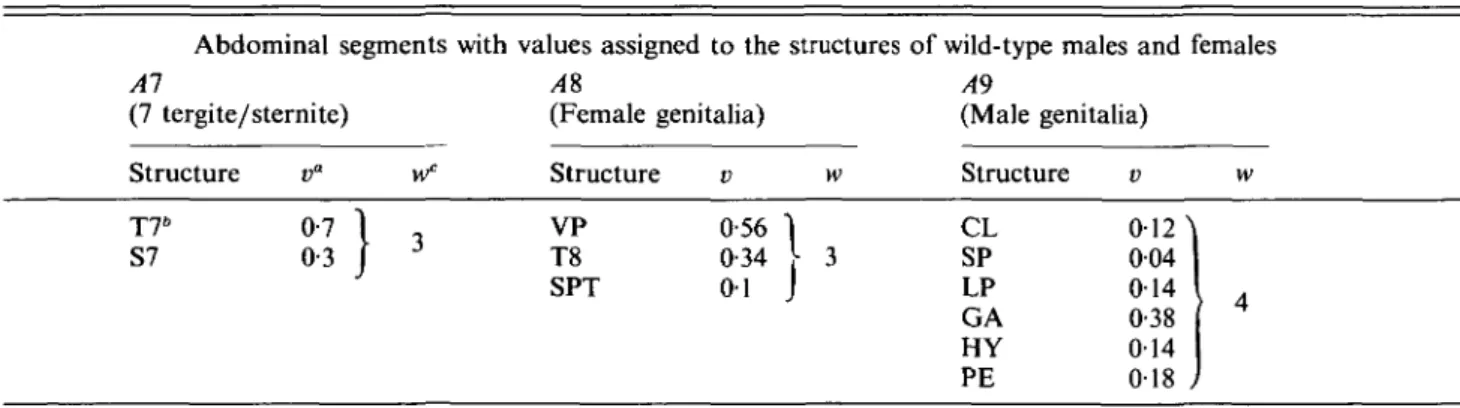
Table 1. Scheme for quantifying the sexual phenotype of flies in abdominal segments A1-A9 Abdominal segments with values assigned to the structures of wild-type males and females Al AS A9
(7 tergite/sternite) (Female genitalia) (Male genitalia)
Structure v" wc Structure Structure
CL SP LP GA HY PE v w 012 \ 004 014 0-38 014 018 J A T76 S7 0-7 0-3 VP T8 SPT 0-56 I 0-34 [
01 J
" A value (v) was ascribed to each structure so that the sum of these values added up to 1-0 for the imaginal derivatives of one abdominal segment in a normal wild-type female or male. In the intersexes, the structures were most of the times smaller and incomplete and sometimes absent, yielding a sum considerably below 1-0 (see Fig. 1).
6
Abbreviations: T7, S7, tergite 7, sternite 7; VP, vaginal plate; T8, tergite 8; SPT, spermatheca; CL, clasper; SP, sperm pump; LP, lateral plate; GA, genital arch; HY, hypandrium; PE, penis with parameres.
c
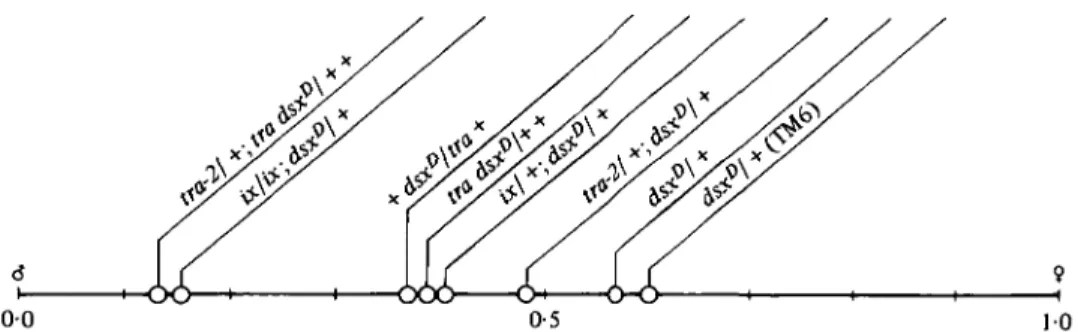
For the calculation of the ' sex index' (see Fig. 2), the values of the three segments were given a weight (w) roughly proportional to the size of the imaginal structures in normal flies. Thus, for each genotype the lengths of the shaded columns in Fig. 1 were multiplied by 3 for A7 and A8, and by 4 for A9; the three values obtained were then added and divided by 10 (3 + 3 + 4). In this way, a value between 0-0 (completely male) and 1-0 (completely female) was obtained (for explanation see Fig. 1). This value places an intersex on a line between a male and a female (see Fig. 2).
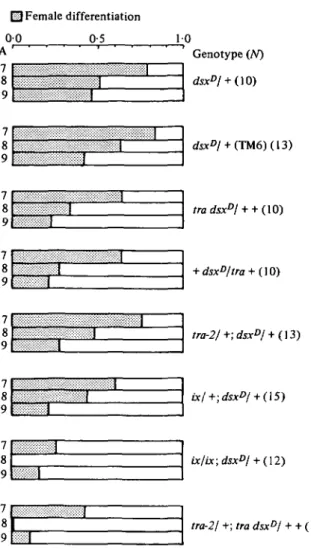
[U Female differentiation 0 0 05 H) A ' 7 8 9 Genotype (AO dsxDl + (TM6)(13) tra dsxDl + + (10) + dsxD/tra + (10) tra-2/+;dsxD/ + (13) 9L_L tai-2/ +; + + (13)
Fig. 1. Characterization of the sexual phenotype produced by combinations of dsxD with recessive mutations in other sex-determining genes. The dotted area represents the degree of femaleness, calculated as described in section 2.6 of Materials and Methods and in Table 1. Abdominal segments 7, 8 and 9 (A7, A8, A9) display strong sexual differences: A7 produces tergite and sternite 7 only in females, A8 the female genitalia, and A9 the male genitalia, respectively. A reduction in size and number of female structures in A7 and A8 represents a male tendency, a reduction in the inventory of male structures in A9 signals a female tendency. Thus, for A7 and A8 the shaded area gives a measure for the number and size of female structures differentiated by a given genotype; for A9, however, the shaded area, i.e. degree of femaleness, derives from incompleteness of male structures. A short shaded column in A7 and A8 means that we observed relatively few and small female structures, in A9 it means that there were many and large male structures present. The combined values for A7, A8, A9 were used to calculate a 'sex index' (Table 1 and Fig. 2). A, Abdominal segments 7-9; N, number of analysed flies. For complete genotypes see Materials and Methods.
2.5. Ovary transplantation
After we had found that XX/Y. dsx*; dsxD/+ were
sterile females with well developed ovaries, we tested whether such ovaries could give rise to functional eggs if transplanted into normal females (series A and B),
and whether XX/Y .dsx*; dsxD/+ would become
fertile if provided with normal ovaries (series C and
D). Ovaries were transplanted between larvae of the late 3rd instar as described by Ursprung (1967). 2.5.1. Series A and B
Host larvae were obtained by crossing Base; TM3,
Ser/Sb females to Fs{\)K1237/Y males. Fs{\)K1237
is a fully penetrant, dominant mutation that sterilizes females by blocking oogenesis before stage 4 (see King, 1970 for description of stages); the mutation acts only in the germ line (Busson et al. 1983). Since
K1237 host ovaries remain small, donor ovaries can
develop without competition (Monod & Poulson, 1936). (The Fs(l) K1237 mutation was kindly provided by M. Gans, Gif-sur-Yvette.)
Donors were produced by crossing C(l) RM, y v/
Y.dsx+; red I'red females to y/Y.dsx+; dsx° Sb e/red
males. Half of the female larvae had the genotype
C(])RM, yv/Y.dsx+; dsx™ Sb e/red; the other half
carried three doses of dsx+ and is also listed in Table 2. After transplantation, surviving female hosts were test-crossed to either y/ Y; dsxMas/TM3, Sb Ser males
(series A), or to X/Y.dsx+; dsxMas/TM2, Ubx males
(series B). The genotype of the donor ovary, abbre-viated as dsx° and dsx+ in the right-most column in Table 2, was inferred from the genetic markers seen in the offspring. The C(\)RM, yv chromosome is abbreviated as XX in Table 2.
2.5.2. Series C and D
Donor ovaries from y wf*a mal larvae were injected
into C(\)RM, yv/Y.dsx+; dsxD Sb e/red hosts (series
C) or into Basc/T(\;Y;3) HI; dsxDSbe/+ hosts
(series D). The T{1;Y;3)H\ is an X chromosome that carries a duplication for dsx+ p+Rg(pbx) besides
the markers y waf. It was constructed in our
labora-tory by A. Hilfiker (1983), and is abbreviated as
X.dsx+ in Table 2.
All surviving host females were mated with wildtype males, tested for fertility, and dissected after a few days. The donor ovaries carry the mutation mal that eliminates aldehyde oxidase (AO) activity and that can be used as a histochemical marker (Janning, 1976). Thus, donor and host ovaries could be distinguished and we could determine whether a donor ovary had attached to the host's gonoducts. 2.6. Interaction of dsx-alleles with mutations at other
sex-determining loci
(a) To study the epistatic relation between dsx
alleles and transformer {tra), the following double-mutants were constructed, both in X/X and X/Y animals: (1) tra dsxm/tra dsxm, (2) tra dsx''/'tra dsx'',
(3) tra dsxmt/tra dsxmf and (4) tra dsxD/tra +. The
recombinant chromosome tra dsx" was obtained by irradiating X/ Y; dsxD Sb e/th st tra cp rip" males
with 2500 r and screening their male offspring for an
Fig. 2. Graphical representation of sexual phenotypes as characterized by a "sex index' between 00 (normal male) and 1-0 (normal female). For calculation of the 'sex index' see Table 1.
induced recombinational event between st and ri or pv. Individual recombinant males were tested for the presence of tra and dsxD in cis on the Sb e chromosome. (The symbol dsxmf designates alleles that have lost both functions, m and/.)
(b) The interaction of dsxD with ix, tra-2 and tra was studied in the following six genotypes:
(1) X/X; ix/SM5; dsxD Sbe/ + , (2) X/X; ix/ix; dsxD Sbe/ + , (3) X/X; tra-2/ + ; dsxD Sbe/ + , (4) X/X; tra/ + dsxD Sb e, (5) X/X; tra-2/ + ; tra dsxD Sb e/ + (6) X/X; +/SM5; tra dsxD Sbe/ + .
Two genotypes, X/X; +/SM5; dsxD Sbe/+ and X/X; dsxD Sb e/TM6, served as references.
The sexually dimorphic structures of these flies were microscopically analysed. For this purpose, the flies were macerated in hot 10% NaOH, washed in H2O,
and mounted under coverslips in Faure's solution. For abdominal segment 7 and the genitalia, the sexual, phenotype was quantified by estimating the size of a structure relative to the corresponding size in normal males or females (for details of the procedure see Table 1 and Janning et al. 1983). Thus, each intersexual fly is characterized by three values between 0 and 1 (Fig. 1): one value for segment 7, one for the female genitalia (segment 8), and one for the male genitalia (segment 9). The values are quantitative and do not indicate whether the structures were morphologically normal or abnormal.
The values for the structures of these three segments were used to calculate a ' sex index' which characterizes the intersex by assigning a place to each of the genotypes on a line between normal male and normal female (see Table 1, Fig. 2).
3. Results 3.1. Mutagenesis
From a total of 7218 single crosses, 4854 had progeny. Among these, eight new dsx alleles and 40 recessive lethals were recovered within the deficiency of dsxD+Ri (referred to as Df[dsx) in this paper). The dsx alleles fall into three categories:
(i) dsxmf, recessive, affecting both chromosomal sexes, 6 alleles. These mutations transform both
chromosomal sexes, although with different expres-sivity, into intersexes of the type described by Hildreth (1965) and Baker & Ridge (1980) for the original dsx-allele. Our new alleles were tested in trans with Hildreth's (1965) original dsx allele and with DJ{dsx). The allele dsx31 gives the same strong intersexual phenotype as the original dsx allele which presumably corresponds to a loss of function (Baker & Ridge, 1980). Four mutants (dsx53, dsxi0\ dsxl0R, dsxiM) have a much stronger effect on XX than on XY animals. The latter look almost normal, but display slightly rounded analia, an incomplete penis ap-paratus, and are sterile. In AT-animals, all four mutants give a clear intersexual phenotype in com-bination with Hildreth's (1965) dsx-a\\de. All chromosomes carrying a new dsx mutation were homozygous lethal in both sexes; since they are viable over Df{3R) dsxD+Ri, they must have suffered lethal hits outside the deficiency. A sixth mutant was lost before a stock could be established.
No complementation was found among the five alleles, except for X/Y; dsx5Si/dsxM1 that were fertile males. In combination with the strong *fct31-allele, the four weaker alleles showed a weak phenotype in XY and a strong phenotype in XX-f[ie&. We conclude that these alleles are leaky and can still make some dsx+ -product that is at least partially active in chromosomal males.
(ii) dsx1, recessive, affecting only XX animals, one allele. Animals with genotype X/X; dsx1'/'dsx1 have a strong t/sx-phenotype whereas X/Y; dsxf/dsxf are normal, fertile males. Transheterozygotes of the male-specific mutation dsxm and our dsxf yield fertile males and females indicating full complementation of the two mutations. The allele dsxm was discovered and kindly provided by A. Garen and briefly described as dsx136 by Baker & Ridge (1980).
(iii) dsxDw, dominant, affecting only XX animals, one allele. Animals with genotype X/X;dsxDm/ + are always sterile and show a very weak dsx phenotype (reduced number of vaginal teeth, cleft in dorsal anal plate). X/X; dsxDw/dsx show a strong <fct-phenotype with more male than female characteristics. XY-animals remain unaffected.
Lethal mutations within the dsx-deficiency. Forty lethals were detected within the interval of Df(dsx). None of them gave an intersexual phenotype in
combination with a dsx-alMe; conversely, none of the eight new dsx alleles was lethal over the deficiency. The complementation pattern is complex and yielded 29 different complementation groups (Leist, 1983). The lethals were not analysed further.
3.2. Dominant mutations at the dsx-locus
(a) Description. So far, three different spontaneous dominant mutations at the dsx-locus were recovered:
dsxD (Fung & Gowen, 1957; Duncan & Kaufman, 1975), dsxMas (Mischaikow, 1959; Nothiger et al. 1980), dsxT (kindly provided W. Gehring, Basel). They produce very similar phenotypes, and the following description thus applies to all three of them.
The terminalia of X/X; dsxD/ + flies carry abnormal
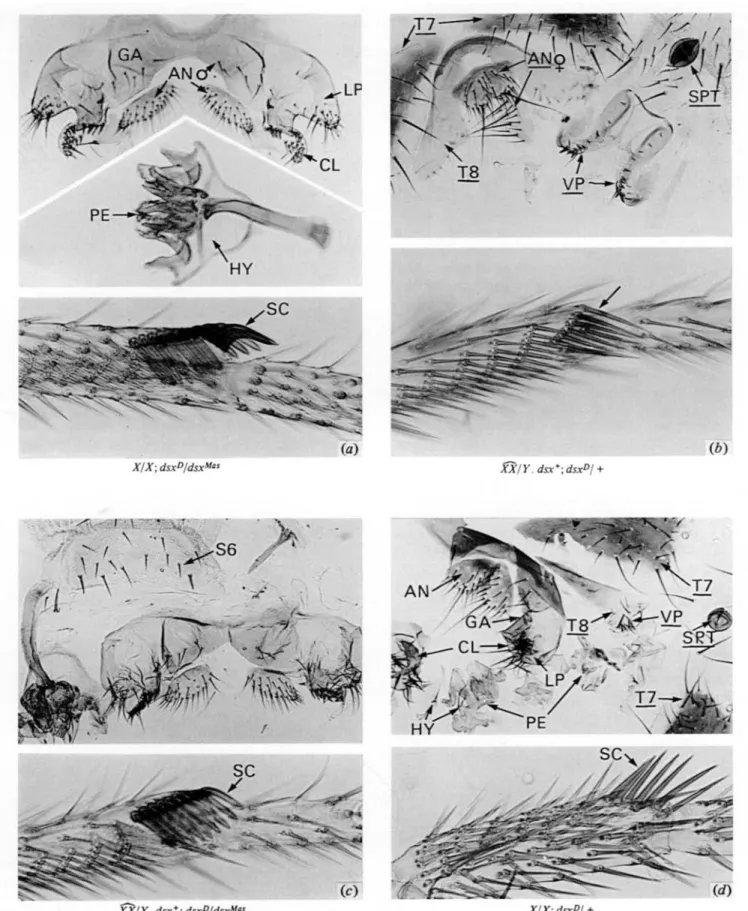
male and female elements, with the female genital set anterior to the male set (Fig. 3d). The male genital structures are well developed, but the penis apparatus is reduced, the hypandrium mostly absent, and many bristles are abnormal. The female vaginal plate is always present, but reduced in size and with abnormal bristles. Between the vaginal plates, a mass of yellow, chitinized tissue is often enclosed, identified as a secondary rudimentary penis apparatus. The anal plates are arranged in a left-right position as in males, but the shape corresponds to a sexually intermediate form. The bristle pattern is a mosaic of male, female and intermediate bristles. The basitarsus of the foreleg carries a sex comb whose position and shape of bristles, however, are intermediate between male and female. Interestingly, the phenotype of X/X; dsx"/ + is indistinguishable from that caused by homozygosity for null alleles, such as dsx. For a more detailed description of X/X; dsxD/ + flies see Epper (1981) and
Roost (1978). X/Y; dsxD/+ flies are completely
normal and fertile males.
X/X; dsx"/dsx flies as well as X/X; dsxD / Df{dsx)
flies are sterile pseudomales with perfect external and internal male genitalia and analia (Duncan & Kauf-man, 1975; Nothiger et al. 1980; Baker & Ridge, 1980). The inner genitalia are also male; the gonads are rudimentary testes and resemble those found in
X/X; tra/tra pseudomales (Seidel, 1963).
Flies with the genotype X/X; dsxD/dsxf are pseudo-males and indistinguishable from X/X; dsxD/dsx.
(b) Description of'reversions'. Among 2655 X/X; Sb progeny of EMS-treated X/Y; dsxDSbe/TM6
males, two 'reversions', designated dsxD+HH1 and
dsxD+R"\ were found. X/X; dsxD+RHl/ + show a slight
tfex-phenotype (reduced number of vaginal teeth, spliced dorsal anal plate), but are weakly fertile females; X/X; dsxD+RH2/ + is a normal female. X/Y; dsxD+RH1/+ and X/Y; dsxD+RH2/ + are normal
males.
Among 2500 X/X; non-TM3 flies deriving from irradiated X/Y; dsxT/TM3 males, one 'reversion'
was found. It showed the same phenotype as dsxD+nH1.
All three 'revertants' were tested in trans with
dsxm, dsx', dsxmf, Dfljsx), and dsxD. These
com-binations revealed that the ' revertants' were recessive cfcc-alleles of the type dsxmf, as were the ' revertants'
of dsxD and dsxMtt* described by Duncan & Kaufman
(1975) and by Belote et al. (1985). Over dsxm> or Dj{dsx) they showed an intersexual phenotype in both
chromosomal sexes; over dsx" Sb+ they transformed
XX animals into pseudomales; with dsxm or dsxf, they
gave an intersexual or normal phenotype, depending on the chromosomal sex.
3.3. Effects of variable doses of dsxD and dsx+
(a) Sexual phenotype of triploids and diploids
(1) Triploidflies with the genotype XX/X; dsxD/ + /
+ looked like females, but were sterile, a fact already noticed by Gowen & Fung (1957). The sixth tergite was darkly pigmented; the basal row of bristles on the forelegs showed a slight dsx-sex comb; the outer genitalia and analia were as in normal females, except that the vaginal plates and the seventh tergite carried a reduced number of bristles; the internal genitalia were also female, but not always complete. The parovaria, the uterus and the receptaculum seminis were absent in about 1/5 of the flies studied. Ovaries were present, but they remained rudimentary in most cases; some 40 % of the animals also contained traces of testicular tissue.
(2) Triploid intersexes with XX/Y; dsxD/ + / +
displayed the general features of triploid intersexes, i.e. a mosaic pattern of male and female elements (Stern, 1966; Lauge, 1969), rather than the intersexual phenotype of dsx mutants. When compared to their siblings 2X; 3 A dsx+ that arose in the same cross, the
2X; 3A dsxD flies looked very similar. Both had typically male sex combs that contained a reduced number of bristles. The segmentation pattern was variable, with seventh and eighth tergites sometimes being present, sometimes absent. The pigmentation of the fifth and sixth tergites was a mosaic for the male and female pattern. The differences between the two genotypes were insignificant. The 2X; 3A dsxD con-tained fewer external male genitalia than the 2X; 3A
dsx+ controls, which, in view of the masculinizing action of dsx", is paradoxical. The effect cannot be ascribed to dsxD, but must be the result of differences
in the genetic background which is known to influence the sexual phenotype of triploid intersexes.
(3) Diploid flies with the genotype XX/Y.dsx+; dsxD/+ looked like normal females, but were sterile
(Fig. 3 b). In contrast to the triploid flies with one dose of dsxD (see above), their ovaries were well developed containing all oogenic stages up to mature eggs, and all the other internal structures appeared also normal. They mated, and few of them even laid eggs, that, however, were never fertilized. Microscopical inspec-tion of the receptaculum seminis showed that sperm were present at 0, 0-5, 2 or 24 h after copulation, but
they were invariably immotile. In wild type control females, on the other hand, motile sperm were found at all times tested up to 24 h after copulation. It thus seems that the sperm became immobilized immediately after entry into the gonoducts of xl?/ Y. dsx+; dsxD Sb e/red females.
(b) Ovary transplantation
The results, summarized in Table 2, show that
XX/Y .dsx+; dsxD Sb el red ovaries, when attached to
the gonoducts of a normal female, can in fact produce eggs that can be fertilized and give rise to adult flies. The experiment indicates that the gonadal soma of
XX/ Y. dsx+; dsxD Sb e/red is capable of supporting
the development of normal eggs. The sterility focus of
XXIY. dsx+; dsx" Sb e/red females must therefore
reside outside of the germ line and the gonadal soma. The fact that normal sperm is instantly inactivated in the seminal receptacle of these females suggests a focus in the gonoducts which are the derivatives of the genital disc. The situation is reminiscent of meta-females (3X;2A) which are invariably sterile and in which Schiipbach et al. (1978) could map the focus for sterility to the derivatives of the genital disc. The actual physiological cause for the sterility is not known, but it appears that dsxD, in spite of two doses
of dsx+, still succeeds in partially repressing the female
differentiation genes, and that the genital ducts may be particularly sensitive to this effect. The data from series C and D are consistent with this conclusion. None of the 31 dsxD/ + / + host flies with an implanted y wfmal ovary became fertile, although at least three
hosts had an attached, unstained donor ovary. The low number of attached ovaries can be explained by Table 2. Transplantation of ovaries
the fact that the hosts in series C and D had, in contrast to those in series A and B, their own developing ovaries as competitors for attachment to the oviducts (Monod & Poulson, 1936).
(c) Flies with two dominant dsx-alleles, produced by ovary transplantation
The transplantation series A and B differ in the genotype of the tester males (Table 2) which in series B carry a Y chromosome with a duplication of dsx+. In series A, part of the progeny will have the genetic constitution XX/ Y; dsxD/dsxMa*. Twelve such flies were produced by the three females with attached dsxD ovaries. They were phenotypically male and sterile with rudimentary testes, resembling X/X; tra/tra pseudomales in every respect (Fig. 3 a). This observation confirms earlier results obtained with transplanted pole cells of X/X; dsxD/+ em-bryos (Nothiger et al. 1980).
In series B, the 12 females with attached dsxD ovaries produced an interesting genotype with two dominant dsx-a\\des and one dose of dsx+ (XX/Y. dsx+; dsxMas/dsxD). We obtained 46 animals of this genotype all of which were typical pseudomales (Fig. 3 c). A microscopical inspection disclosed that the 6th sternite was evenly covered with bristles, which is a female characteristic; the 6th sternite of normal males is devoid of bristles. The analia of XX/ Y. dsx+; dsx*""'/ dsxD are slightly rounded compared with those of XX/Y; dsxMas/dsxD. The genitalia are male, but morphologically not quite normal (compare Fig. 3 c with 3 a). These characteristics suggest that the additional dose of dsx* has a very weak feminizing effect. Series A B C D Host" Fs(l)Kl 237/Base; TM3, Ser/ + Fs(\) K1237/Base; TM3, Ser/ + XX/Y. dsx*; dsxD/dsx* X.dsx*/X; dsx°/dsx* Donor* XX/Y.dsx*; dsx°/dsx* or XX/Y. dsx*; dsx*/dsx* XX/Y. dsx*; dsx°/dsx* XX/Y. dsx*; dsx*/dsx* y w Partial yWp*°mal No. of surviving
Tester male8 hosts
X/Y;dsxMa'/TM3 53 X/ Y. dsx*; dsx""/ TM2 111 + /+ 8 + / + 23 No. of fertile females 10 27 0 0 No. of attached donor ovaries 3 dsx0 1 dsx* \5dsx* 1 2
° For complete genotypes of hosts and donors see Materials and Methods. The genotype of the donor ovary in series A and Bjs abbreviated in the right-hand column as dsxD corresponding to XX/Y.dsx*; dsxD/dsx*, and as dsx* corresponding to XX/Y.dsx*; dsx*/dsx*.
/IZ
(b) X/X;dsxD/dsxM" XX/Y.dsx+;dsxD l (c) dsx*\dsxDjdsxM" X/X;dsxD/Fig. 3. Photographs of terminalia and forelegs of XX flies with variable doses of wild-type (dsx+) and dominant mutant (dsxD, dsxMa') alleles of dsx. (a) X/X; dsxD/dsxK"* is a normal pseudomale. (b) XX/Y.dsx+; dsxD/+ is practically female. Arrow points to basal row of bristles on the basitarsusjjf the foreleg; in males, this row is rotated by 90 ° and the bristles are thick with rounded tips (see SC in (a), (c) XX/Y.dsx+; dsxD/dsxMa' is essentially pseudomale, but the male genitalia are slightly less well developed than in (a), the analia are more round, and sternite 6 (S6) carries bristles, (d) X/X; dsxDl + is typically intersexual: note intermediate shape and position of sex comb bristles (arrow SC), presence of abnormal and incomplete male and female genital structures, position, shape and bristle pattern of anal plates. Female structures (underlined): AN%, anal plates; SPT, spermatheca; T7, tergite 7; T8, tergite 8; VP, vaginal plates. Male structures: ANtf, anal plates; CL, claspers; GA, genital arch; HY, hypandrium; LP, lateral plates; PE, penis; SC, sex comb.
GRH 50 Downloaded from https:/www.cambridge.org/core. University of Basel Library, on 30 May 2017 at 21:32:21, subject to the Cambridge Core terms of use, available at
3.4. Interaction of dsx-mutations with mutations at
other sex-determining loci
(a) Homozygosity for tra. Irrespective of their sex chromosome constitution (X/X or X/Y), the geno-types tra dsxm/tra dsxm or tra dsxmf/tra dsxmf were intersexual showing the typical ^x-phenotype. All flies with genotypes tra dsxf/tra dsxf or tra dsxD/tra
had a male phenotype. In terms of gene interaction,
dsxm and dsxmf are epistatic over tra, but tra is epistatic over dsxf and dsxD. This is easily understood
when we recall that activity of tra needs a functional
dsxf to make a female, and an inactive tra needs a functional dsxm to make a male.
(b) Combinations involving dsxD/ +. The genotypes
to be described in this section only affect X/X individuals; X/Y-flies are normal and fertile males. Each of the recessive mutations {ix, tra-2, tra), when heterozygous over its respective wildtype allele,
inter-acts with dsxD to produce a phenotype that is
considerably more masculinized than X/X; dsxD/ +
(Figs. 1, 2). Based on this interaction, dsxD was originally classified as an allele of tra (see traD in Lindsley & Grell, 1968), an error that was later corrected by Duncan & Kaufman (1975).
Homozygosity for ix, when combined with dsxD/ +,
produces a phenotype that is almost male (Figs. 1, 2). The inventory of male genitalia is complete and the structures are of almost normal size, the female genitalia are absent, the anal plates are male. Some residual female tendencies, however, are seen in traces of tergite 8 and in an intersexual position and shape of the sex comb bristles on the foreleg.
The same 'male' phenotype results when dsxD/ +
flies are also heterozygous for tra-2 and tra (Figs. 1, 2). The general observation is that a reduction of wildtype alleles of ix, tra-2 and tra enhances the masculinizing effect of dsxD/ + . This result will be
used to speculate about the interaction of ix, tra-2 and
tra with dsx (see Discussion). 4. Discussion
4.1. The dsx locus
The observations presented in this paper allow us to draw a picture of the structure and function of dsx. The locus apparently harbours two genetic functions,
dsxm and dsx1, that can mutate independently. The
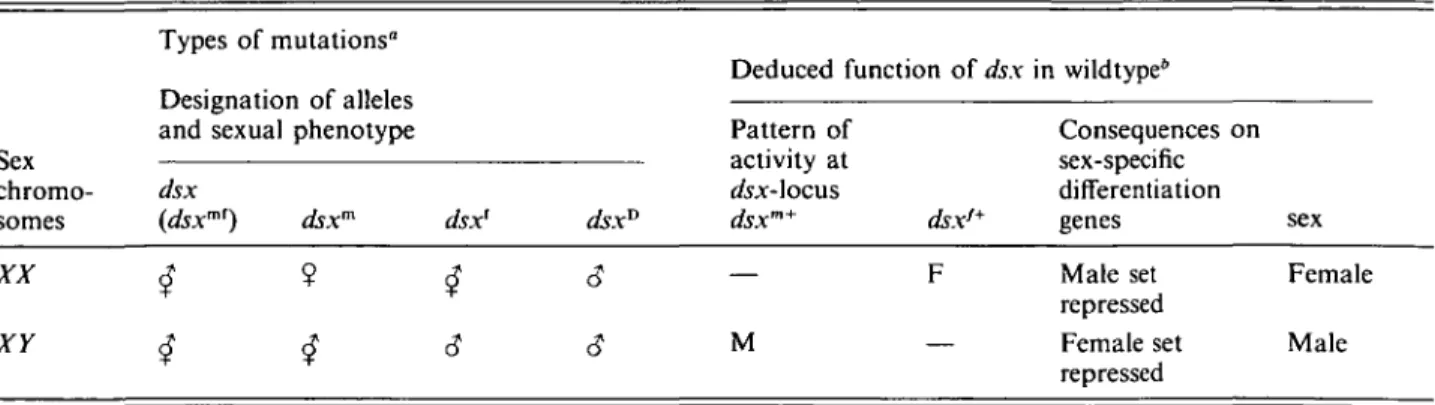
different types of mutations are represented in Table 3. Recessive mutations in dsxm and dsx' fully comple-ment each other in trans position. It is striking, however, that most of the newly induced mutations were of the dsxm'-type abolishing both functions. We
found 6 dsxm!, 1 dsx1, and 1 slightly dominant dsxUw
-allele that is also female-specific. The same observation was made by Garen & Lepesant (pers. comm.) who isolated 17 dsxm', 3dsxm and 1 dsx' allele. This probably means that dsxm and dsx' share a large region or many dispersed sites that are essential for both functions,
but also comprise separate domains that are only required for female development (dsx') or only for male development {dsxm). It will be informative to see
how the different mutations map relative to each other. In a pilot experiment, we were able to recover
two wild-type (dsx+) recombinants among 13626
offspring of females that were heterozygous for dsxm and the dsxm' allele of Hildreth (1965). This result and
the arrangement of the flanking markers place dsxm 0-03 cM to the left of dsxm' (Gruter, 1983).
The function of the locus can be deduced from the mutant phenotypes, as summarized in Table 3. Recessive mutations that behave like null alleles show that dsxm is required for male development, and
dsx' for female development. In the absence of either
product, flies develop as intersexes with a phenotype that suggests that both sets of sex differentiation genes are simultaneously expressed in a cell. Shape and position of the bristles of the sex comb, e.g. are intermediate between the male and female type, similar to that shown in Fig. 3 d. This suggests that the sex differentiation genes are constitutively active, and that the wild-type function of dsxm is to repress the female set, that of dsx' to repress the male set so that, in a normal fly, only one set of sex differentiation genes is expressed. The same conclusion was reached by Baker and his collaborators (review see Baker & Belote, 1983; Belote et al. 1985).
The dominant dsx mutations are particularly informative. So far, three spontaneous dominant alleles (dsxu, dsxU!iS, dsxr) and one weaker allele (dsxDw, induced by EMS) have been found. In
combination with a wildtype dsx+ allele, the dominant mutations transform XX-zygotes into intersexes of the same type as do the recessive alleles; over DJ{dsx),
dsxml or dsx', the strong spontaneous alleles transform XX-zygotes into pseudomales, but have no effect on XY-animals. They thus behave as constitutive muta-tions for dsxm while at the same time lacking dsx' function. The complementary dominant mutation, i.e. one that has a dominant feminizing effect on XY zygotes, has not been found. This fact has implications for our interpretation of the structure and regulation of the <ftjt-locus (see later).
Since X/X; dsxD/DJ{dsx) is a pseudomale, the
intersexual phenotype of X/X; dsxD/+ must be
ascribed to the wild-type allele. In X/X animals, this wildtype allele is apparently expressed in the female mode, yielding the female-specific product of dsx'. It is intriguing that X/X; dsxD/ + , in which dsxm and
dsx' are simultaneously expressed, produces the same
intersexual phenotype as X/X; dsx/dsx in which no functional products are formed. If we introduce M and F to designate the functional products of dsxm and dsx', respectively, we can say that M and F neutralize each other which leads to abolishment of both functions so that neither the male nor the female differentiation genes are repressed.
Table 3. The dsx-locus. Sex chromo-somes XX XY Types of mutations" Designation of alleles and sexual phenotype dsx (dsx"") dsxm
$
?
£ $
dsx' $ dsxD 6 Deduced function of dsx Pattern of activity at dsxAocus dsxm* M dsx'* F in wildtype* Consequences on sex-specific differentiation genes Male set repressed Female set repressed sex Female Male" Genetic analyses reveal two functions (complementation units) in dsx; the male-directing dsxm and the female-directing dsx' function (see text).
6
In normal wild-type flies, dsx is regulated in such a way that either dsxm or dsx' is expressed. The respective products, M or F, are used the repress either the female set or the male set of sex differentiation genes. Absence of the required product results in intersexuality (<J) due to expression of male and female differentiation genes. The allele dsxD expresses M constitutively.
?, female; $, male; A, intersexual.
• - \
alleles and with dsx' leads to male development; of the mutant alleles, only the male-specific dsxm results in intefsexual development of X/X; dsxD/dsxm. This
indicates that an intact functional product of dsx' is required to neutralize dsxv. This neutralization could
occur at the protein level. We arrive at this conclusion because the functional product of dsx appears to be a dimer or multimer, as suggested by the observation that dsx584 and dsx301, 2 alleles of the dsxmf type, complement in XY animals to give normal fertile males. It is therefore conceivable that the normal products of dsxm and dsx' which are both made in
X/X; dsxD/ + can also aggregate, but such a heteromer
would be non-functional.
Considering that XX/Y.dsx*; dsxD/ + produces a
phenotype that is essentially female, and XXjY.dsx*;
dsxD/dsxMas a phenotype that is essentially male, it appears as if F was titrated against M. If M and F were to form random aggregates, we would expect to find a minority of pure M-homomers in the former genotype, and a few pure F-homomers in the latter. These homomers could lead to some intersexuality. We have in fact observed that X~X/Y.dsx*; dsxD/ +
are sterile 'females', and XX/Y.dsx*; dsxD/dsxMa!
' males' display some weak female characteristics (see Results).
We are aware that our titration model is rather naive, but we were struck by its simplicity and accuracy in accounting for the observed phenotypes. It can also accommodate the phenotype of triploid intersexes carrying a dsxD-a\\e\e (X/X; 3A). These flies
display a mosaic of male and female structures, as do regular triploid intersexes, and show no signs of the presence of a dominant masculinizing mutation, such as more and larger male structures of a tfcc-phenotype. The mosaic character of regular triploid intersexes is thought to result from the ambiguous value of the X:A signal that is read by some cells as male, by
others as female (Baker & Belote, 1983; Steinmann-Zwicky & Nothiger, 1985 a, b). In X/X; 3A with one dose of dsxD, the constitutive expression of dsxm in those cells that embark on the male pathway is, of course, without consequences; in the cells that respond by implementing the female program, the one dsxD is counteracted by the two dsx+ alleles now expressing F, a situation that will lead to a female phenotype.
4.2. Regulation of dsx
How is dsx regulated so that in a normal male the locus expresses the male-determining M-function of
dsxm+, and in a normal female the F-function of dsx'+t-The epistatic relations displayed by double
mutants have been used to infer a genetic hierarchy with the gene Sxl at the top and dsx at the end of the cascade; the role of tra-2, tra and ix is to medi-ate between Sxl and dsx (for reviews see Nothiger & Steinmann-Zwicky, 1985; Belote et al. 1985).
We want to discuss two questions: (1) do all these genes act in a cascade by forming a single chain? and 2) is dsx regulated at the transcriptional or post-transcriptional level?
If the genes were arranged in a single chain, e.g.
Sxl tra-2 tra ix and if the purpose of the cascade was
to achieve expression of either dsxm or dsx', then recessive (lack of function) mutations in either Sx\,
tra-2, tra or ix should result in XX animals becoming
transformed into pseudomales, whereas dominant (constitutive) mutations in any one of these four genes should transform XY animals into pseudofemales. The predictions are fulfilled for recessive mutations in
X Sxl, tra-2, and tra, but not for the two alleles at the
ix-locus; and dominant mutations with the expected >-phenotype are only known for Sxl, but not for tra,
tra-2 or ix. Therefore, we think that tra- 2, tra and ix do
8-2 Downloaded from https:/www.cambridge.org/core. University of Basel Library, on 30 May 2017 at 21:32:21, subject to the Cambridge Core terms of use, available at
not form a cascade, but are separately regulated and function in parallel; their concerted action achieves that dsx makes a functional F-product.
The genetic data which show two functions, dsxm and dsx!, are compatible with the existence of two cistrons. Formally, we can imagine that expression of dsxm is the basic state, and that M represses F and other female-specific genes. When dsxm is repressed (by tra+ and other upstream genes), dsx' can become active leading to F. Such a model, however, in which dsx' is OFF as a consequence of dsxm being ON, and is ON whenever dsxm is OFF, is unlikely on several arguments:
- the constitutive mutations dsxD, dsxMas and dsxT only act in cis and do not prevent the correct expression of dsx' by a wild-type allele in trans, as revealed by the intersexual phenotype of X/X; dsxD/+;
- mutations that abolish the >w-function (3 alleles, Garen & Lepesant, pers. comm.) do not lead to constitutive expression of dsx' although the f-function is intact. In fact, no dominant constitutive mutations exist for dsx' whereas four are known for dsxm;
- most mutations induced by EMS - which thus are mainly point mutations - abolish m and / simultaneously; the m and f functions appear small relative to the common function.
We want to propose that the dsxAocus is not regulated at the transcriptional level, but produces the same primary transcript(s) in XX and XY animals. This transcript has male-determining function. The female-determining transcripts could be made by splicing whereby tra-2+ and tra+ cooperate to remove or abolish the M-function. The ensuing product is non-functional, and acquires its functionality as F only after the product of ix+ has further modified the transcript(s) or has combined with the dsx protein.
The following arguments lend support to this hypothesis:
- in the absence of positive regulatory signals, i.e. when none of the genes Sxl, tra-2, tra, ix are active, dsx expresses the male function. Thus, the M-function represents the basic state of dsx-ex-pression;
- when tra or tra-2 is inactivated by mutations, XX animals develop as pseudomales. Thus, both genes, tra-2+ and tra+ cooperate in XX animals to abolish the M-function, say by removing the w-domain. But the resulting product is non-functional; it is only ' demasculinized' and does not yet function as F, as revealed by mutations in ix. When this gene is mutated, but tra-2+ and tra+ are active, XX animals turn into intersexes. Thus, ix+ is required in XX animals to convey F-function to the rfsx-product after tra-2+ and tra+ have modified the basic M-product. (We know that tra-2+ and tra+ are active in X/X; ix/ix because such flies are intersexes whereas X/X; ix/ix; tra/tra or X/X; ix tra-2/ix tra-2 are
pseudomales.) This view predicts that the genotype X/X; ix/ix; dsxD/dsx+, in which lack of ix+ leaves the product of dsx+ non-functional, should produce a pseudomale comparable to X/X; dsxD/dsxmf. This is practically the case although some residual activity of F is noticeable, probably due to ix being a leaky allele (see Figs. 1,2);
- genotype X/X; dsxD/Df[dsx) is a pseudomale showing that the mutant product of dsxD is resistant to the action of tra-2+, tra+ and ix+, three genes that, we conclude, must be active in X/X; dsxD/ + since a functional F-product is formed by the wild-type allele. Reducing the dose of wild-type alleles at tra-2, tra, or ix reduces the amount of F-product in dsxD/ + and shifts the sexual phenotype in the male direction (Fig. 2). Inasmuch as their effects are dose-sensitive, these genes behave like structural genes performing an enzymatic reaction.
We think that the presented evidence, although indirect, is more supportive of a post-transcriptional than of a transcriptional mode of regulation. The preliminary molecular data are compatible with both views (Belote et al. 1985).
The locus of dsx has recently been cloned (Belote et al. 1985). It is rather large comprising some 30 kb. If we extrapolate from the recombinational and mol-ecular data of the rosy locus which has a genetic length of 0005 cM and a molecular size of 4.1 kb (Cote et al. 1986), our recombination distance of 0-03 cM between dsxm and dsxm! corresponds to some 24 kb, an estimate that is in good agreement with the molecular data. The rra-gene, on the other hand, is at least 10 times smaller, with the relevant information being contained within some 2 kb (Butler et al. 1986; McKeown et al. 1987). Northern analysis of the dsx RNA show that sex-specific transcripts do in fact exist as anticipated on the basis of the genetic data. But the pattern of transcripts is more complex than expected, and sex-specific differences were so far only found in pupae and adults, but not in larvae (Belote et al. 1985). This latter result, however, must be due to insufficient sensitivity of the assays, since clonal analyses had shown that proper expression of dsx is required during larval development (Baker & Ridge, 1980). Direct observations also indicate that dsx is differentially expressed in male and female larvae. We conclude this because X/X; dsxD/DJ{dsx) larvae are phenotypically male with testes anlagen and male genital discs (unpubl. obs.). These pseudomales are indistinguishable from X/Y; dsx+/dsx+ normal male larvae, but differ from X/X; dsx+/dsx+ female larvae.
The cloning of the sex-determining genes is currently under way (Belote et al. 1985; Maine et al. 1985a, b; Butler et al. 1986; McKeown et al. 1987). The molecular probes will allow us to test the hypotheses put forward by developmental geneticists, and they will eventually reveal the regulatory network of the genes governing sex determination.
Acknowledgements
We are grateful for the critical comments on the manu-script by Monica Steinmann-Zwicky and Andres Duben-dorfer. We also thank Andres Hilfiker for providing mutant chromosomes, Margrit Eich and Annemarie Kohl for graphic work, and Susan Hohl-Schlegel for typing the manuscript. Our work was supported by the Swiss National Science Foundation, the ' Jubilaumsspende fur die Universitat Zurich', and by the ' Stiftung fur wissenschaft-liche Forschung an der Universitat Zurich'.
References
Baker, B. S. & Ridge, K. (1980). Sex and the single cell: on the action of major loci affecting sex determination in Drosophila melanogaster. Genetics 94, 383-423. Baker, B. S. & Belote, J. M. (1983). Sex determination and
dosage compensation in Drosophila melanogaster. Annual Review of Genetics 17, 345-393.
Belote, J. M., McKeown, M. B., Andrew, D. J., Scott, T. N., Wolfner, M. F. & Baker, B. S. (1985). Control of sexual differentiation in Drosophila melanogaster. Cold Spring Harbor Symposia on Quantitative Biology 50, 605-614.
Bridges, C. B. (1921). Triploid intersexes in Drosophila melanogaster. Science 54, 252-254.
Butler, B., Pirrotta, V., Irminger-Finger, I. & Nothiger, R. (1986). The sex-determining gene tra of Drosophila: molecular cloning and transformation studies. EMBO Journal 5, 3607-3613.
Busson, D., Gans, M., Komitopoulou, K. & Masson, M. (1983). Genetic analysis of three dominant female sterile mutations located on the X-chromosome of Drosophila melanogaster. Genetics 105, 309-325.
Cline, T. W. (1986). A female-specific lethal lesion in an X-linked positive regulator of the Drosophila sex determina-tion gene, Sex-lethal. Genetics 113, 641-663.
Cote, B., Bender, W., Curtis, D. & Chovnick, A. (1986). Molecular mapping of the rosy locus in Drosophila melanogaster. Genetics 112, 769-783.
Duncan, F. W. & Kaufman, T. C. (1975). Cytogenetic analysis of chromosome 3 in Drosophila melanogaster. Mapping of the proximal portion of the right arm. Genetics 80, 733-752.
Epper, F. (1981). Morphological analysis and fate map of the intersexual genital disc of the mutant double-sex dominant in Drosophila melanogaster. Developmental Biology 88, 104-114.
Fung, S. T. C. & Gowen, J. W. (1957). The developmental effect of a sex-limited gene in Drosophila melanogaster. Journal of Experimental Zoology 134, 515-532.
Gowen, J. W. & Fung, S. T. C. (1957). Determination of sex through genes in a major sex locus in Drosophila melanogaster. Heredity 11, 397-402.
Griiter, A. (1983). Genetische Feinstrukturanalyse am doublesex-Locus von Drosophilia melanogaster. Diploma Thesis, University of Zurich, Switzerland.
Hildreth, P. E. (1965). Doublesex, a recessive gene that transforms both males and females of Drosophila melano-gaster. into intersexes. Genetics 51, 659-678.
Hilfiker, A. (1983). Gendosisanalyse X-chromosomaler und autosomaler Geschlechtsbestimmungsfaktoren unter Berucksichtigung der Temperatur bei Drosophila melano-gaster. Diploma Thesis, University of Zurich, Switzerland. Janning, W. (1976). Entwicklungsegenetische
Untersuchun-gen an Gynandern von Drosophila melanogaster. IV. Vergleich der morphogenetischen Anlageplane larvaler und imaginaler Strukturen. Wilhelm Roux's Archives of Developmental Biology 179, 349-372.
Janning, W., Labhart, C. & Nothiger, R. (1983). Cell lineage restrictions in the genital disc of Drosophila revealed by Minute gynandromorphs. Wilhelm Roux's Archives of Developmental Biology 192, 337-346.
King, R. C. (1970). Ovarian Development in Drosophila melanogaster. New York: Academic Press.
Lauge, G. (1969). Influence de la temperature d'elevage sur l'expression des caracteres sexuels externes et internes des intersexues triploides de Drosophila melanogaster. Comptes Rendues de f Acade'mie des Sciences Paris 255, 1798-1800.
Leist, Ch. (1983). Komplementationsanalyse von 40 rezes-siven Letalfaktoren in der double-sex Region (84F 2-3; 84F 16) von Drosophila melanogaster. Diploma Thesis, University of Zurich, Switzerland.
Lewis, E. B. & Bacher, F. (1968). Method of feeding ethyl methanesulfonate (EMS) to Drosophila males. Drosophila Information Service 43, 193.
Lindsley, D. L. & Grell, E. H. (1968). Genetic variations of Drosophila melanogaster. Carnegie Institution of Washing-ton Publication No. 627.
Maine, E. M., Salz, H. K., Schedl, P. & Cline, T. W. (1985a). Sex-lethal, a link between sex determination and sexual differentiation in Drosophila melanogaster. Cold Spring Harbor Symposia on Quantitative Biology 50, 595-604.
Maine, E. M., Salz, H. K., Cline, T. W. & Schedl, P. (19856)- The Sex-lethal gene of Drosophila: DNA alterations associated with sex-specific lethal mutations. Ce//43, 521-529.
McKeown, M., Belote, J. M. & Baker, B. S. (1987). A molecular analysis of transformer, a gene in Drosophila melanogaster that controls female sexual development. Cell 48, 489^99.
Mischaikow, E. (1959). Mas: Masculinizer. Drosophila Information Service 33, 98.
Monod, J. & Poulson, D. F. (1936). Specific reactions of the ovary to interspecific transplantation among members of the melanogaster group of Drosophila. Genetics 22, 257-263.
Nothiger, R., Roost, M. & Schupbach, T. (1980). 'Masculi-nizer' is an allele of'doublesex'. Drosophila Information Service 55, 118.
Nothiger, R. & Steinmann-Zwicky, M. (1985). Sex determina-tion in Drosophila. Trends in Genetics 1, 209-215. Roost, M. (1978). Das Zusammenwirken
geschlechtsbestim-mender Gene bei Drosophilia melanogaster unter beson-derer Berucksichtgung der Mutation doublesex Domi-nant. Diploma Thesis, University of Zurich, Switzerland. Schupbach, T., Wieschaus, E. & Nothiger, R. (1978). A study of the female germ line in mosaics of Drosophila.
Wilhelm Roux's Archives of Developmental Biology 184, 41-56.
Seidel, S. (1963). Experimentelle Untersuchungen iiber die Grundlagen der Sterilitat von transformer (tra) Mannchen bei Drosophila melanogaster. Zeitschrift fur Vererbungs-lehre 94, 215-241.
Steinmann-Zwicky, M. & Nothiger, R. (1985 a). The hierarchical relation between X-chromosomes and auto-somal sex-determining genes. EMBO Journal 4, 163-166.
Steinmann-Zwicky, M. & Nothiger, R. (19856). A small region on the X chromosome of Drosophila regulates a key gene that controls sex determination and dosage compensation. Cell 42, 877-887.
Stern, C. (1966). Pigmentation mosaicism in intersexes of Drosophila. Revue Suisse de Zoologie 73, 339-355. Ursprung, H. (1967). In vivo culture of Drosophila imaginal
discs. In 'Methods of Developmental Biology' (ed. F. H. Wilt and N. K. Wessells), pp. 485-492. New York: T. Y. Crowell.