HAL Id: hal-01188914
https://hal.inria.fr/hal-01188914
Submitted on 31 Aug 2015
HAL is a multi-disciplinary open access
archive for the deposit and dissemination of
sci-entific research documents, whether they are
pub-lished or not. The documents may come from
teaching and research institutions in France or
abroad, or from public or private research centers.
L’archive ouverte pluridisciplinaire HAL, est
destinée au dépôt et à la diffusion de documents
scientifiques de niveau recherche, publiés ou non,
émanant des établissements d’enseignement et de
recherche français ou étrangers, des laboratoires
publics ou privés.
Flavia Bonomo, Guillermo Duran, Martın D. Safe, Annegret K. Wagler
To cite this version:
Flavia Bonomo, Guillermo Duran, Martın D. Safe, Annegret K. Wagler. Balancedness of subclasses
of circular-arc graphs. Discrete Mathematics and Theoretical Computer Science, DMTCS, 2014, Vol.
16 no. 3 (in progress) (3), pp.1–22. �hal-01188914�
Balancedness of subclasses of circular-arc graphs
∗
Flavia Bonomo
1†Guillermo Dur´an
2,3Mart´ın D. Safe
4Annegret K. Wagler
51
CONICET and Depto. de Computaci´on, FCEyN, Universidad de Buenos Aires, Argentina
2
CONICET and Depto. de Matem´atica and Instituto de C´alculo, FCEyN, Universidad de Buenos Aires, Argentina
3
Depto. de Ingenier´ıa Industrial, FCFM, Universidad de Chile, Santiago, Chile
4
Instituto de Ciencias, Universidad Nacional de General Sarmiento, Los Polvorines, Argentina
5
CNRS and LIMOS, UFR Sciences et Technologies, Universit´e Blaise Pascal, Clermont-Ferrand, France
received 13thMar. 2013, revised 25thMay 2014, accepted 25thMay 2014.
A graph is balanced if its clique-vertex incidence matrix contains no square submatrix of odd order with exactly two ones per row and per column. There is a characterization of balanced graphs by forbidden induced subgraphs, but no characterization by mininal forbidden induced subgraphs is known, not even for the case of circular-arc graphs. A circular-arc graph is the intersection graph of a family of arcs on a circle. In this work, we characterize when a given graph G is balanced in terms of minimal forbidden induced subgraphs, by restricting the analysis to the case where G belongs to certain classes of circular-arc graphs, including Helly circular-arc graphs, claw-free circular-arc graphs, and gem-free circular-arc graphs. In the case of gem-free circular-arc graphs, analogous characterizations are derived for two superclasses of balanced graphs: clique-perfect graphs and coordinated graphs.
Keywords: balanced graphs, clique-perfect graphs, circular-arc graphs, coordinated graphs, perfect graphs
1
Introduction
Two fundamental combinatorial optimization problems are set packing and set covering, which can be expressed by
max cTx s.t. Ax ≤ 1, x ∈ {0, 1}n (1) and
min cTx s.t. Ax ≥ 1, x ∈ {0, 1}n, (2) respectively, where A is some {0, 1}-matrix. The matrix A is perfect (resp. ideal) if no integrality require-ments are needed in (1) (resp. (2)) as the polytope P (A) = {x ∈ Rn+: Ax ≤ 1} (resp. the polyhedron
∗Research partially supported by FONDECyT Grant 1140787, Millennium Science Institute “Complex Engineering Systems”
(Chile), ANPCyT PICT 2012-1324, UBACyT Grants 20020100100980 and 20020090300094, UBACyT Grant 20020100100980, and CONICET PIP 112-200901-00178 and 11220120100450CO (Argentina).
†Emails: [email protected], [email protected], [email protected], [email protected]
Q(A) = {x ∈ Rn
+: Ax ≥ 1}) has integral extreme points only. The matrix A is balanced if all its
submatrices are both perfect and ideal or, equivalently, if it contains no submatrix of odd order with ex-actly two ones per row and per column [2, 18]. Well-known examples of balanced matrices are totally unimodular matrices where even no integrality requirements are needed in (1) and (2) for varying right hand side vectors.
A graph G is balanced if its clique-matrix is balanced. Here, a clique Q in a graph G = (V, E) is an inclusion-wise maximal subset of pairwise adjacent vertices and given an enumeration Q1, . . . , Qkof all
cliques of G and an order v1, . . . , vnof all vertices of G, a clique-matrix of G is the k × n {0, 1}-matrix
A = (aij) such that aij = 1 if and only if vj ∈ Qi. The clique-matrix of a graph is unique up to
permutations of rows and/or columns. The name ‘balanced graphs’ appeared explicitly in [3], but these graphs were already considered in [2, see Theorem 5 therein].
The class of balanced graphs is closed under taking induced subgraphs. Examples of balanced graphs are interval graphs (the intersection graphs of intervals of a line) and bipartite graphs (having a partition of their nodes into two stable sets) as their clique-matrices are totally unimodular [17, 22] and, thus, balanced.
Well-known superclasses of balanced graphs are perfect graphs and hereditary clique-Helly graphs. A graph is perfect if its clique-matrix is perfect [15]. Some years ago, the minimal forbidden induced subgraphs of perfect graphs were characterized [14], settling affirmatively a conjecture posed more than 40 years before by Berge [1]. The minimal forbidden induced subgraphs of perfect graphs are the chordless cycles of odd length having at least 5 vertices, called odd holes C2k+1, and their complements, the odd
antiholesC2k+1.
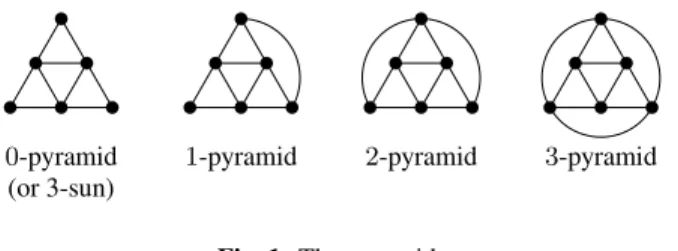
A graph is hereditary clique-Helly if, in any of its induced subgraphs, every nonempty subfamily of pairwise intersecting cliques has a common vertex. It follows from [2] that balanced graphs are hereditary clique-Helly. Prisner [28] characterized hereditary clique-Helly graphs as those graphs containing no induced 0-, 1-, 2-, or 3-pyramid (see Figure 1).
Fig. 1: The pyramids
Hence, no balanced graph contains an odd hole, odd antihole, or any pyramid as induced subgraph. In addition, balanced graphs were characterized by means of forbidden induced subgraphs as follows. For a graph G = (V, E) and W ⊆ V , let N (W ) =T
w∈WN (w) and use N (e) as shorthand for N ({u, v})
for an edge e = uv, whereas N (∅) = V (G). An unbalanced cycle of G is an odd cycle C such that, for each edge e ∈ E(C) (i.e., joining two consecutive vertices of C), there exists a (possibly empty) complete subgraph Weof G such that We ⊆ N (e) \ V (C) and N (We) ∩ N (e) ∩ V (C) = ∅. Notice
that it is possible for the sets Weand We0 for different edges e and e0to overlap. It is not hard to see that
unbalanced cycles are obstructions for balanced graphs. Indeed, if, for each e ∈ E(C), we choose any clique Qeof G containing Weas well as the endpoints of e, then the submatrix M of any clique-matrix of
to the vertices of C has exactly two ones per row and per column. More precisely, for each e ∈ E(C), the ones in the row of M corresponding to the clique Qeare exactly in the columns corresponding to the
endpoints of e, while the ones in the column of M corresponding to each vertex v of C are exactly in the rows corresponding to the cliques Qeand Qe0 where e and e0are the two edges of C incident to v. An
extended odd sunis a graph G with an unbalanced cycle C such that V (G) = V (C) ∪S
e∈E(C)Weand
|We| ≤ |N (e) ∩ V (C)| for each edge e ∈ E(C). The extended odd suns with the smallest number of
vertices are C5and the pyramids. Moreover, every odd hole is an extended odd sun (by letting We= ∅ for
each e). Notice that C3is not an extended odd sun, since otherwise we would be forced to choose We= ∅
for each edge e, but then N (We) ∩ N (e) ∩ V (C) = {v} where v is the only vertex non-incident to e
(because N (We) = N (∅) = V (C) and N (e) = {v}). The characterization of balancedness by forbidden
induced subgraphs is the following.
Theorem 1 ([2, 9]) A graph is balanced if and only if it has no unbalanced cycle, or, equivalently, if and only if it contains no induced extended odd sun.
However, the above characterization is not by minimal forbidden induced subgraphs because some extended odd suns contain some other extended odd suns as induced subgraphs, as Figure 2 shows. Thus, excluding extended odd suns suffices to guarantee balancedness, but it is not necessary to exclude all of them. We address the problem of finding the minimal forbidden induced subgraphs, i.e., those graphs that are not balanced but all their proper induced subgraphs are balanced. (An induced subgraph H of a graph G is proper if H is different from G.)
Fig. 2: On the left, an extended odd sun that is not minimal. Bold lines correspond to the edges of a proper induced extended odd sun, depicted on the right.
This problem is still open. Partial answers are obtained in [10] where minimal forbidden induced subgraph characterizations of balanced graphs restricted to the following graph classes are found: P4-tidy
graphs, paw-free graphs, line graphs, and complements of line graphs. In this paper, we study balanced graphs restricted to some subclasses of circular-arc graphs. An extended abstract containing the main results of this work appeared in [11].
Let F be a family of sets. The intersection graph of F is a graph whose vertices represent the members of F , where two members of F are adjacent if and only if they intersect. A circular-arc (CA) graph is the intersection graph of a family of open arcs on a circle [24]. Since it is always possible to perturb a set of arcs on a circle so that they do not share any endpoints while preserving their intersection graph, the assumption that the arcs are open is not restrictive. Clearly, CA graphs can be seen as an extension of interval graphs. But while interval graphs form a subclass of balanced graphs, this is not the case for CA graphs. Note that CA graphs are neither perfect nor hereditary clique-Helly in general as odd holes, odd antiholes, and pyramids can be easily seen to be CA graphs. Perfectness of CA graphs was addressed in [32], but the study of balancedness of CA graphs is still in order.
This paper is organized as follows. In Section 2, we present minimal forbidden induced subgraph characterizations of balanced graphs within a superclass of the class of Helly circular-arc graphs and the classes of claw-free circular-arc graphs and gem-free circular-arc graphs. In Section 3, we additionally characterize, within gem-free circular-arc graphs, two further superclasses of balanced graphs: clique-perfect and coordinated graphs (see Section 3 for the definitions).
1.1
Basic definitions
We close this section by providing some basic definitions. All graphs in this paper are undirected, without loops and without multiple edges. Let G be a graph. We denote by V (G) its vertex set, by E(G) its edge set, and by G its complement. If W ⊆ V (G), the subgraph induced by W in G is denoted by G[W ] and is proper if W 6= V (G). The subtraction G − W denotes G[V (G) \ W ]. A vertex v is a cutpoint of G if G − {v} has more connected components than G.
A universal vertex of G is adjacent to all the other vertices of G and an isolated vertex of G is adjacent to no vertex of G. The neighborhood of a vertex v in G consists of all vertices that are adjacent to v and is denoted by NG(v), or simply N (v) if G is clear from the context. The common neighborhood of an
edgee = vw is NG(e) = NG(v) ∩ NG(w) and, in general, the common neighborhood of a nonempty set
W ⊆ V (G) is NG(W ) =Tw∈WNG(w), whereas NG(∅) = V (G). Two adjacent vertices u and v of G
are true twins if NG(u) ∪ {u} = NG(v) ∪ {v}.
A complete is a set of mutually adjacent vertices. The complete on n vertices will be denoted by Kn.
A complete on 3 vertices is said a triangle. An inclusion-wise maximal complete is a clique. A stable set of a graph is a set of pairwise nonadjacent vertices. A set A ⊆ V (G) and a vertex v of V (G) are complete to each other if A ⊆ NG(v), and anticomplete if NG(v) ∩ A = ∅. The set A ⊆ V (G) is complete
(resp. anticomplete) to the set B ⊆ V (G) if A and b are complete (resp. anticomplete) for each b ∈ B. A dominating setof G is a set A ⊆ V (G) such that each v ∈ V (G) \ A is adjacent to at least one element of A.
Paths and cycles are assumed to be simple; i.e., with no repeated vertices aside from the starting and ending vertices in the case of cycles. By the edges of a cycle C we mean those edges joining two consecu-tive vertices of C. The set of edges of a cycle C will be denoted by E(C). A chord of a cycle (resp. path) is an edge joining two nonconsecutive vertices. We denote the chordless cycle on n vertices by Cn and
the chordless path on n vertices by Pn. A chord of a cycle is short if its endpoints are at distance two
within the cycle, and is long otherwise. Two chords ab and cd of a cycle C such that their endpoints are four different vertices of C that appear in the order a, c, b, d in C are called crossing. A cycle is odd if it has an odd number of vertices, and is called even otherwise. A hole is a chordless cycle of length at least 4. An odd antihole is the complement of an odd hole.
Let G and H be two graphs with V (G) ∩ V (H) = ∅. The disjoint union of G and H is a graph G ∪ H whose vertex set is V (G) ∪ V (H) and whose edge set is E(G) ∪ E(H). The disjoint union is clearly an associative operation, and for each nonnegative integer t we will denote by tG the disjoint union of t copies of G. A class G of graphs is called hereditary if, for every graph G of G, each induced subgraph of G belongs to G. The class of balanced graphs is hereditary (see [9]). Let G and H be two graphs. We say that G is H-free to mean that G contains no induced H. If H is a collection of graphs we say that G is H-free to mean that G contains no induced H for any H ∈ H. A graph H is a forbidden induced subgraph for graph classC if no graph of C contains an induced H. Moreover, if C is a hereditary class, H is said a minimal forbidden induced subgraph for C or a minimally non-C graph if H does not belong to C but each proper induced subgraph of H belongs to C. Some small graphs to be referred to in this
Fig. 3: Some small graphs
context are depicted in Figure 3.
For each t ≥ 3, the complete t-sun St is a graph whose vertex set can be partitioned into a clique
{q1, q2, . . . , qt} and a stable set {s1, s2, . . . , st} such that N (si) = {qi, qi+1} for each i ∈ {1, 2, . . . , t}
(where qt+1 stands for q1). The graph S3 is simply called 3-sun. The 3-sun is also called tent in the
literature.
2
Balancedness of some subclasses of circular-arc graphs
Recall that a circular-arc (CA) graph is the intersection graph of a family of open arcs on a circle. Such a family of arcs is called a CA model of the graph. CA graphs were first studied by Tucker [30, 31, 32, 33] and can be recognized in linear time [27]. Some minimal forbidden induced subgraphs for the class of CA graphs are K2,3, G2, G3, domino, G5, G6, C6, net ∪ K1, G9, and Cn∪ K1for each n ≥ 4 [29] (cf.
Figure 4).
Fig. 4: Some forbidden induced subgraphs for the class of circular-arc graphs
Since Cn∪ K1is not a CA graph for any n ≥ 4, if G is a CA graph and H is a hole of G, then V (H)
is dominating in G. We state the following slightly more general result for future reference (cf. [7]). Lemma 2 Let G be a CA graph and H be a hole of G. If v ∈ V (G) \ V (H), then either v is adjacent to every vertex ofH or NG(v) ∩ V (H) induces a path in G.
2.1
Balancedness of a superclass of Helly circular-arc graphs
A family A of nonempty sets has the Helly property if every nonempty subfamily of A consisting of pairwise intersecting sets has a nonempty intersection. A Helly arc (HCA) graph [19] is a circular-arc graph admitting a circular-circular-arc model A that satisfies the Helly property. We call A a HCA model of the graph. The class of HCA graphs contains all interval graphs because every set of intervals of a line has the Helly property [21]. Let G be a HCA graph and let A be a HCA model of G. Let us denote by Avthe
arc of A that corresponds to the vertex v ∈ V (G). For a clique Q of G, we call any point p ∈T
v∈QAvan
Fig. 5: Families of minimally non-balanced HCA graphs: (a) Family V2t+1
p : The dotted paths joining v3and vp+1
resp. vp+2and v1represent chordless even paths, not simultaneously empty. All vertices of the dotted path joining v3
to vp+1are adjacent to u2. (b) Family D2t+1: The dotted path joining v3and v2t+1represents a nonempty even path
of length 2t − 2. (c) Family Xp2t+1: The dotted paths joining v4and vpresp. vp+1and v2t+1represent any chordless
even paths, both of them possibly empty, even simultaneously. The vertices of the dotted path joining v4to vpare all
adjacent to u4.
p ∈ Avif and only if v ∈ Q. In [23], a linear-time recognition algorithm for HCA graphs was proposed,
as well as a characterization by forbidden induced subgraphs of those CA graphs that are HCA graphs (see Theorem 5 on page 11).
In this subsection, we give a minimal forbidden induced subgraph characterization of balancedness for a superclass of HCA graphs. In order to do so, we introduce the graph families below, which are schematically represented in Figure 5.
• For each t ≥ 2 and each p even such that 2 ≤ p ≤ 2t, let V2t+1
p be the graph with vertex
set {v1, v2, . . . , v2t+1, u1, u2}, such that v1v2. . . v2t+1v1 is a cycle whose only chord is v1v3,
N (u1) = {v1, v2}, and N (u2) = {v2, v3, . . . , vp+1}.
• For each t ≥ 2, let D2t+1 be the graph with {v
1, v2, . . . , v2t+1, u1, u2, u3} as vertex set such
that v1v2. . . v2t+1v1 is a cycle whose only chords are v2t+1v2 and v1v3, N (u1) = {v2t+1, v1},
N (u2) = {v2, v3}, and N (u3) = {v1, v2}.
• For each t ≥ 2 and each even p with 4 ≤ p ≤ 2t, let X2t+1 be the graph with vertex set
{v1, v2, . . . , v2t+1, u1, u2, u3, u4}, v1v2. . . v2t+1v1is a cycle whose only chords are v2t+1v2and
v1v3, N (u1) = {v2t+1, v1}, N (u2) = {v2, v3, u4}, N (u3) = {v2t+1, v1, v2, u4}, and N (u4) =
{v1, v2, v3, . . . , vp, u2, u3}.
In the three families of graphs above, C = v1v2. . . v2t+1v1is an unbalanced cycle and consequently all
their members are not balanced. In fact, we will see later that all these graphs are minimally non-balanced (see Corollary 4).
Our first result below is the minimal forbidden induced subgraph characterization of balanced graphs restricted to HCA graphs.
Theorem 3 Let G be a HCA graph. Then, G is balanced if and only if G has no odd holes and contains no induced 3-sun, 1-pyramid, 2-pyramid,C7,Vp2t+1,D2t+1, orXp2t+1for anyt ≥ 2 and any valid p.
Proof: The ‘only if’ part is clear because the class of balanced graphs is hereditary. Conversely, suppose that G is not balanced. Then, G contains some induced subgraph H that is minimally non-balanced; i.e., H is not balanced but each proper induced subgraph of H is balanced. Since G is a HCA graph, H also is so. The proof will be complete as soon as we prove that H is an odd hole, 3-sun, 1-pyramid, 2-pyramid, C7, Vp2t+1, D2t+1, or Xp2t+1for some t ≥ 2 and some valid p.
Since H is not balanced, the clique-matrix of H contains some square submatrix of odd order with two ones per row and per column. Clearly, this implies that the clique-matrix of H contains some square submatrix that is the clique-matrix of an odd chordless cycle. Therefore, there are some cliques Q1, Q2, . . . , Q2t+1and vertices v1, v2, . . . , v2t+1of H such that {v1, v2, . . . , v2t+1} ∩ Qi = {vi, vi+1}
for each i ∈ {1, 2, . . . , 2t + 1} (all along the proof, subindices are to be understood modulo 2t + 1) for some t ≥ 1. It is easy to verify that C = v1v2. . . v2t+1v1 is an unbalanced cycle by setting
We:= Qi\ {vi, vi+1} for each edge e = vivi+1of C.
Suppose first that t = 1. Since C is an unbalanced cycle, there is some vertex u1 ∈ NH(v1v2) \
V (C) such that u1is not adjacent to v3. Indeed, since NH(Wv1v2) ∩ NH(v1v2) ∩ V (C) = ∅ and v3 ∈
NH(v1v2) ∩ V (C), there must be at least one vertex of Wv1v2that is not adjacent to v3; clearly, it suffices
to let u1be any such vertex. Similarly, there is some vertex u2∈ NH(v2v3) \ V (C) that is not adjacent
to v1, and some vertex u3 ∈ NH(v3v1) \ V (C) that is not adjacent to v2. Now, {v1, v2, v3, u1, u2, u3}
induces a pyramid in H. This implies that H itself is a pyramid because H is minimally non-balanced. So, if t = 1, then H equals a 3-sun, 1-pyramid or 2-pyramid (because the 3-pyramid is not a HCA graph). From now on, we will assume, without loss of generality, that t ≥ 2. Let A be a HCA model of H in a circle C. Denote by Ai the arc of A corresponding to the vertex vifor each i ∈ {1, 2, . . . , 2t + 1}.
Fix an anchor pjof the clique Qjfor each j ∈ {1, . . . , 2t + 1}. By construction, pj ∈ Aiif and only if
vi ∈ Qj. Therefore, by hypothesis, {p1, p2. . . , p2t+1} ∩ Ai = {pi−1, pi} for each i ∈ {1, . . . , 2t + 1}.
Since A1, A2, . . . , A2t+1are arcs of C, there are only two possible orders for the anchors when traversing
C in clockwise direction, either p1, p2, . . . , p2t+1or p2t+1, . . . , p2, p1. So, we can assume, without loss of
generality, that the anchors p1, p2, . . . , p2t+1appear exactly in that order when traversing C in clockwise
direction. Hence, Ai∩ {p1, p2, . . . , p2t+1} = {pi−1, pi} implies that Ai is contained in the clockwise
open arc of C that starts in pi−2and ends in pi+1for each i ∈ {1, . . . , 2t+1}. We now prove the following
three claims about C.
Claim 1 All chords of C are short.
If t = 2, all possible chords of C are short. So, suppose that t ≥ 3. Since Ai is contained in the
clockwise open arc of C that starts in pi−2and ends in pi+1for each i ∈ {1, . . . , 2t + 1}, it follows that if
the arc Aiintersects Aj for some j ∈ {1, . . . , 2t + 1} then i = j − 2, j − 1, j, j + 1, or j + 2 (modulo
2t + 1). We conclude that each chord of C is short, as claimed.
Claim 2 Any set of three vertices of C that induces a triangle in H consists of three consecutive vertices ofC.
Suppose, for the purpose of contradiction, that there is some set S of three vertices of C that induces a triangle T in H but, nevertheless, S does not consist of three consecutive vertices of C. Notice that if each vertex of S were consecutive in C to some other vertex of S, then S would consist of three consecutive vertices of C. So, necessarily, there must be some vertex s1of S such that s1 is not consecutive in C
to any vertex of S \ {s1}. By symmetry, we can assume that s1 = v1and, since all chords of C are
S = {v1, v3, v4} is contained in some clique of H, that should have some anchor q. Nevertheless, since
A1 is contained in the clockwise open arc of C that starts in p4and ends in p2, A3 is contained in the
clockwise open arc of C that starts in p1and ends in p4, and A4is contained in the clockwise open arc of
C that starts in p2 and ends in p5, there is no suitable position in C for q. This contradiction proves that
indeed any set of three vertices of C that induces a triangle in H consists of three consecutive vertices of C, as claimed.
Claim 3 Every two chords of C are crossing.
Suppose, for the purpose of contradiction, that C has two different chords ei = vi−1vi+1 and ej =
vj−1vj+1that are not crossing (recall that all chords are short by Claim 1). Notice that it is possible that
eiand ejshare one endpoint. We will show that H − {vi, vj} is not balanced. Indeed, consider the cycle
C0 = v1v2. . . vi−1vi+1. . . vj−1vj+1. . . v2t+1v1. For each edge e of C0, define We0 = ∅ if either e = ei
or e = ej, and We0= Weotherwise. Since all the triangles of C are induced by three consecutive vertices
of C by Claim 2, C0and the We0’s satisfy the definition of an unbalanced cycle. Indeed, for each edge
e of C0, either W0
e= Weand N (We0) ∩ N (e) ∩ V (C0) ⊆ N (We) ∩ N (e) ∩ V (C) = ∅, or e = ek for
k ∈ {i, j} and N (We) ∩ N (e) ∩ V (C0) ⊆ N (e) ∩ (V (C) \ {vk}) = ∅ because, by Claim 2, the only
vertex of C with which vertices vk−1and vk+1can form a triangle in H is vk. Therefore, H − {vi, vj} is
not balanced, a contradiction with the minimality of H. This contradiction shows that indeed every two chords of C are crossing, as claimed.
With the help of the three previous claims, we complete the proof of Theorem 3. Notice that if C has no chords, then, by the minimality of H, H = C2t+1, as required. Therefore, we will assume that C
contains at least one chord. Since all chords of C are short and crossing by Claims 1 and 3, either C has exactly one chord that is short or C has exactly two chords that are short and are crossing. We divide the remaining proof into two cases corresponding to the former and the latter cases.
Case 1 C has exactly one chord that is short.
Without loss of generality, let v1v3be the only chord of C. Since C is an unbalanced cycle, there exists
u1 ∈ NH(v1v2) \ V (C) such that u1is not adjacent to v3. Analogously, there exists u2∈ NH(v2v3) \
V (C) such that u2is not adjacent to v1. By minimality, V (H) = V (C) ∪ {u1, u2}. Let p = |NH(u2) ∩
V (C)| and q = |NH(u1) ∩ V (C)|. By construction, 2 ≤ p, q ≤ 2t. By Lemma 2 applied to the hole
induced by V (C)\{v2}, NH(u2)∩V (C) = {v2, v3, v4, . . . , vp+1} and, by symmetry, NH(u1)∩V (C) =
{v2, v1, v2t+1, v2t, . . . , v2t−q+4} (where for q = 2, we mean that NH(u1) ∩ V (C) = {v2, v1}).
Suppose, for the purpose of contradiction, that u1is adjacent to u2. If u2were adjacent to v2t+1, then
either {v2t+1, v1, v2, v3, u1, u2} would induce a proper 2-pyramid in H or {v2t+1, v1, v3, u1, u2} would
induce a K2,3 in H, depending on whether u1 is adjacent to v2t+1 or not, respectively. Since H is a
minimally non-balanced CA graph and K2,3 is not a CA graph, we conclude that u2 is not adjacent to
v2t+1. If u1were adjacent to v2t+1, then {v2t+1, v1, v2, v3, u1, u2} would induce a proper 1-pyramid in
H. This contradiction shows that u1 is not adjacent to v2t+1, and this means that q = 2.
Symmetri-cally, p = 2. But then, either t = 2 and {v1, v3, v4, v5, u1, u2} induces a domino in H, or t ≥ 3 and
{v1, v3, u2, u1, v5} induces a C4∪ K1in H, which are not CA graphs, a contradiction. This contradiction
arose from assuming that u1and u2were adjacent, so we conclude that u1is not adjacent to u2.
If p were odd, then u2vp+1vp+2. . . v2t+1v1v2u2would be an odd hole in H, contradicting the
and H = C7, or q = 2 and H = Vp5 for some p ∈ {2, 4}, as desired. So, without loss of generality,
assume that t ≥ 3. If NH(u1) ∩ NH(u2) 6= {v2}, then, since p and q are even, there would exist some k
such that 5 ≤ k ≤ 2t and vk ∈ NH(u1) ∩ NH(u2); but then, {v1, u1, vk, u2, v3} would induce a C5in
H, in contradiction with the minimality of H. This contradiction shows that NH(u1) ∩ NH(u2) = {v2}.
If p 6= 2 and q 6= 2, then u2vp+1vp+2. . . v2t−q+4u1v2u2would be an odd hole in H, contradicting the
minimality of H. Therefore, we can assume that q = 2, and finally H = V2t+1
p for some p even such that
2 ≤ p ≤ 2t.
Case 2 C has exactly two chords that are short and are crossing.
Since the two chords are crossing, we assume, without loss of generality, that the chords of C are v1v3
and v2t+1v2. Since C is an unbalanced cycle, there is some u1 ∈ NH(v2t+1v1) \ V (C) such that u1is
not adjacent to v2and there is some u2∈ NH(v2v3) \ V (C) such that u2is not adjacent to v1.
Let r = |NH(u2) ∩ V (C)|. By construction, 2 ≤ r ≤ 2t and, by Lemma 2 applied to the hole induced
by V (C) \ {v2}, NH(u2) ∩ V (C) = {v2, v3, v4, . . . , vr+1}. If r = 2t, then {v2t+1, v1, v2, v3, u1, u2}
would induce a proper 1-, 2- or 3-pyramid in H (depending on the existence or not of the edges u1u2
and u1v3), a contradiction with the minimality of H. If r is even and 2 < r < 2t, then the cycle
u2vr+1vr+2. . . v2tv2t+1v2u2would be a proper odd hole in H, a contradiction. If r were odd and r 6= 3,
then the cycle u2vr+1vr+2. . . v2tv2t+1v1v3u2 would be a proper odd hole in H, a contradiction. So,
r = 2 or 3. Symmetrically, if s = |NH(u1) ∩ V (C)|, then s = 2 or 3 and, by Lemma 2 applied to the
hole induced by V (C) \ {v1}, NH(u1) ∩ V (C) = {v2t+1, v1} or {v2t, v2t+1, v1}, respectively.
Suppose, for the purpose of contradiction, that u1and u2 are adjacent. Then, the set {u1, v1, v2, u2}
induces a C4in H, which must be dominating because H is a CA graph. If t = 2, then at least one of
u1 and u2should be adjacent to v4and either {u1, u2, v1, v3, v4} or {u1, u2, v2, v4, v5} would induce a
K2,3or V (C) ∪ {u1, u2} would induce a proper C7in H. (Notice that indeed V (C) ∪ {u1, u2} induces
a proper subgraph of H because, by the definition of an unbalanced cycle, Wv1v2 ⊆ V (H) \ V (C) and
NH(Wv1v2)∩{v3, v4} = ∅, which implies Wv1v2 6= ∅ and, by construction, Wv1v2∩(V (C)∪{u1, u2}) =
∅.) If t ≥ 3, then {u1, u2, v1, v2, v5} would induce C4∪K1in H. So, in all cases we reach a contradiction
with the minimality of H. These contradictions prove that u1and u2are nonadjacent.
We claim that r = s = 2. Indeed, if r = s = 3, then v1v2u2v4v5. . . v2tu1v1would be an odd hole
in H, a contradiction. Alternatively, if r = 3 and s = 2, then C0 = v1v2u2v4v5. . . v2t+1v1would be a
cycle whose only chord is v2t+1v2, NH(u1) ∩ V (C0) = {v2t+1, v1}, NH(v3) ∩ V (C0) = {v1, v2, u2, v4}
and, therefore, V (C) ∪ {u1, u2} would induce a proper V42t+1in H, a contradiction. (Recall that V (C) ∪
{u1, u2} 6= V (H) from the discussion in the paragraph above.) The case r = 2 and s = 3 is symmetric.
We conclude that our claim, r = s = 2, is true; in other words, NH(u1) ∩ V (C) = {v2t+1, v1} and
NH(u2) ∩ V (C) = {v2, v3}.
Suppose that
there is some u3∈ NH(v1v2) \ V (C) such that u3v2t+1, u3v3∈ E(H)./ (*)
Then, by minimality, V (H) = V (C) ∪ {u1, u2, u3}. By Lemma 2 applied to the hole induced by V (C) \
{v2}, NH(u3) ∩ V (C) = {v1, v2}. If u1were adjacent to u3, then either t = 2 and {v2, v3, v4, v5, u1, u3}
would induce a domino in H, or t ≥ 3 and {u1, v2t+1, v2, u3, v5} would induce C4∪ K1in H, which are
not CA graphs, a contradiction. So, u1is nonadjacent to u3and, symmetrically, u2is nonadjacent to u3.
It only remains to consider the case when (*) does not hold. Since C is an unbalanced cycle, this means that there are two adjacent vertices u3 and u4such that u3, u4 ∈ NH(v1v2) \ V (C), u3 is adjacent to
v2t+1but not to v3, and u4is adjacent to v3but not to v2t+1.
We notice that NH(u3) ∩ NH(u4) ∩ V (C) 6= {v1, v2}, since otherwise there would be some k such
that 4 ≤ k ≤ 2t and vk∈ NH(u3) ∩ NH(u4) and {v2t+1, v1, v3, vk, u3, u4} would induce a proper 0-, 1-,
or 2-pyramid in H depending on whether the number of inequalities holding with equality in 4 ≤ k ≤ 2t were 0, 1, or 2, respectively, contradicting the minimality of H.
Let p = |NH(u4) ∩ V (C)| and q = |NH(u3) ∩ V (C)|. By construction, 3 ≤ p, q ≤ 2t. By Lemma 2
applied to the hole induced by V (C) \ {v2}, NH(u4) ∩ V (C) = {v1, v2, v3, . . . , vp} and NH(u3) ∩
V (C) = {v2, v1, v2t+1, . . . , v2t−q+4}. If p were odd and p 6= 3, then v1u4vpvp+1. . . v2t+1v1would be
a proper odd hole in H, a contradiction. So, p = 3 or p is even. Symmetrically, q = 3 or q is even. If p and q had the same parity, then u3u4vpvp+1. . . v2t−q+4u3would be a proper odd hole of H (recall that
NH(u3) ∩ NH(u4) ∩ V (C) = {v1, v2}), a contradiction. By symmetry, we will assume, without loss of
generality, that p is even, p ≥ 4, and q = 3. In particular, u4is adjacent to v4.
Notice that u2is not adjacent to u3, since otherwise u2v3v4. . . v2t+1u3u2would be a proper odd hole
of H. Moreover, u2is adjacent to u4, since otherwise {v2, v3, v4, u3, u4, u2} would induce a proper 3-sun
in H. So, NH(u2) = {v2, v3, u4}. (Recall that we already proved that u1and u2are nonadjacent.)
If u1 were adjacent to u4, then {v2t+1, v1, v2, u1, u2, u4} would induce a proper 1-pyramid in H,
contradicting the minimality of H. So, u1is nonadjacent to u4. Finally, if u1were adjacent to u3, then
C0= u3v2v3. . . v2t+1u3would be a cycle whose only chord is v2t+1v2, NH(u1)∩V (C0) = {v2t+1, u3},
NH(u4)∩V (C0) = {u3, v2, v3, . . . , vp} and, therefore, since u1and u4are nonadjacent, V (C0)∪{u1, u4}
would induce a proper Vp2t+1in H, a contradiction. This contradiction shows that u1is nonadjacent to
u3 and we conclude that NH(u1) = {v2t+1, v1}. We proved that H = Xp2t+1where p is even and
4 ≤ p ≤ 2t, as required. 2
It is easy to see that among the forbidden induced subgraphs that characterize balancedness in The-orem 3 there are no two of them such that one is a proper induced subgraph of the other. Therefore, Theorem 3 is indeed a characterization by minimal forbidden induced subgraphs. In particular, we obtain the following result.
Corollary 4 The graphs Vp2t+1,D2t+1, andXp2t+1are minimally non-balanced for anyt ≥ 2 and any validp.
We will extend Theorem 3 to a superclass of HCA graphs; namely, the class of {net,U4,S4}-free CA
graphs (cf. Figure 3). This extension will also serve as a basis for the characterizations in the following two subsections.
For that, let us firstly present the forbidden induced subgraph characterization of those CA graphs that are HCA graphs given in [23]. Let an obstacle be a graph H containing a clique Q = {v1, v2, . . . , vt}
where t ≥ 3 and such that for each i ∈ {1, . . . , t}, at least one of the following assertions holds (where in both assertions, vt+1means v1):
(Y1) N (wi) ∩ Q = Q \ {vi, vi+1}, for some wi∈ V (H) \ Q.
(Y2) N (ui) ∩ Q = Q \ {vi} and N (zi) ∩ Q = Q \ {vi+1}, for some adjacent vertices ui, zi∈ V (H) \ Q.
Theorem 5 ([23]) Let G be a CA graph. Then, G is a HCA graph if and only if G contains no induced obstacle.
Notice that obstacles are not necessarily minimal; i.e., there are obstacles that contain proper induced obstacles. For instance, 2C5is an obstacle and contains a proper induced 2P4, which is also an obstacle.
In addition, there are minimal obstacles that are not CA graphs; e.g., antenna and C6are minimal obstacles
that are not CA graphs. Our next result determines all the {1-pyramid,2-pyramid}-free minimal obstacles that are CA graphs. Recall that for each t ≥ 3, Stdenotes the complete t-sun.
Theorem 6 Let H be a {1-pyramid,2-pyramid}-free minimal obstacle which is a CA graph. Then, H is the 3-pyramid,U4, orStfor somet ≥ 3.
Proof: Let Q = {v1, . . . , vt}, the wi’s, the ui’s, and the zi’s as in the definition of an obstacle. All along
the proof, subindices should be understood modulo t.
Let us consider first the case where t = 3. Suppose that (Y2) holds for at least two values of i, say
i = 1 and i = 2. Then, {u1, z1, z2} is a complete and {v1, v2, v3, u1, z1, z2} induces a 3-pyramid,
since otherwise {v1, v2, v3, u1, z1, z2} would induce a 1-pyramid or a 2-pyramid. Hence, by minimality,
H = 3-pyramid. Consider now the case where (Y2) holds for exactly one value of i, say i = 1, and,
consequently, (Y1) holds for i = 2 and i = 3. We claim that {u1, z1} is anticomplete to w2. Indeed, if
w2were adjacent to z1, then {v1, v2, v3, w2, z1, u1} would induce a 1-pyramid or a 2-pyramid in H, a
contradiction. In addition, if w2were adjacent to u1, then {v1, v2, u1, z1, w2} would induce a K2,3in G,
which is not a CA graph. We proved that {u1, z1} is anticomplete to w2and, symmetrically, to w3. Also
notice that w2and w3are nonadjacent, since otherwise {v1, v2, w2, w3, u1, z1} would induce a domino,
which is not a CA graph. Then, by minimality, H = U4, as desired. Finally, assume that (Y1) holds for
each i ∈ {1, 2, 3}. Necessarily {w1, w2, w3} is a stable set, since otherwise G would contain an induced
C4∪ K1, G3(see Figure 4), or C6which are not CA graphs. By minimality, H = net = S3, as desired.
From now on, we assume that t ≥ 4. Suppose, by way of contradiction, that (Y2) holds for some i, say
i = 1. On the one hand, if (Y1) held for i = 3, then {v1, v2, v3, u1, z1, w3} would induce a 1-pyramid,
2-pyramid, or a proper 3-pyramid in H, a contradiction. On the other hand, if (Y2) held for i = 3, then
{v1, v2, v3, u1, z1, u3} would induce a 1-pyramid, 2-pyramid or a proper 3-pyramid in H, a contradiction.
These contradictions arose from assuming that (Y2) held for some i. We conclude that, if t ≥ 4, then (Y2)
does not hold for any i ∈ {1, . . . , t} and, by definition of obstacle, (Y1) holds for each i ∈ {1, . . . , t}. By
minimality, the vertices of H are Q ∪ W where W = {w1, w2, . . . , wt}. We claim that W is a stable set
and, consequently, H = St. We divide the proof of the claim into two cases: t = 4 and t ≥ 5.
Assume that t = 4. Suppose, for the purpose of contradiction, that W is not a stable set. Suppose first that wiis adjacent to wi+1 for some i, say w3is adjacent to w4. Necessarily w1 is nonadjacent to
w4, since otherwise {v1, v2, v3, w1, w3, w4} would induce a 1-pyramid or a 2-pyramid in H (depending
on the adjacency between w1 and w3), a contradiction. In addition, w1 is nonadjacent to w3, since
otherwise {w1, v1, w4, v3, w3} would induce a K2,3, which is not a CA graph. Symmetrically, w2 is
nonadjacent to w3 and w4. On the one hand, if w1 and w2 are adjacent, then {w2, v1, w3, w4, v3, w1}
induces a domino in G, which is not a CA graph. On the other hand, if w1 and w2 are nonadjacent,
then {v1, v2, v3, w1, w2, w3, w4} induces a proper U4 in H, a contradiction with the minimality of H.
These contradictions prove that wi is not adjacent to wi+1 for any i. Notice that also wiand wi+2 are
nonadjacent, since otherwise {vi, wi, wi+2, vi+3, wi+3} would induce C4∪ K1in G, which is not a CA
It only remains to consider the case where t ≥ 5. Let S be any unordered pair of vertices from W . Since t ≥ 5, S can be extended to a set S0 = {wi, wj, wj+1} of three vertices where i and j
are not consecutive modulo t and neither are i and j + 1. Notice that S0 is a stable set in H, since otherwise {vi, vj, vj+2, wi, wj, wj+1} would induce a 1-pyramid, a 2-pyramid, or a proper 3-pyramid in
H, a contradiction. Since S0is a stable set, so is S. Since S is any pair of vertices from W , W is a stable set and H = St, as claimed.
Finally, notice that 3-pyramid, U4and Stfor t ≥ 3 are obstacles, are CA graphs, and none of them is a
proper induced subgraph of any of the others. 2 As a corollary of Theorems 5 and 6, we obtain a minimal forbidden induced subgraph characterization of HCA graphs within the class of {1-pyramid,2-pyramid}-free CA graphs.
Corollary 7 Let G be a {1-pyramid,2-pyramid}-free CA graph. Then, G is a HCA graph if and only if it contains no induced 3-pyramid,U4, orStfor anyt ≥ 3.
Since net, U4, and S4are obstacles, the class of {net,U4,S4}-free CA graphs is indeed a superclass of
HCA graphs. We now prove the main result of this subsection, which is an extension of the characteriza-tion of Theorem 3 to the class of {net,U4,S4}-free CA graphs.
Corollary 8 Let G be a {net,U4,S4}-free CA graph. Then, G is balanced if and only if G has no odd
holes and contains no induced pyramid,C7,Vp2t+1,D2t+1, orXp2t+1for anyt ≥ 2 and any valid p.
Proof: If G is a HCA graph, the result reduces to Theorem 3. So, assume that G is not a HCA graph. Then, by Corollary 7 and since G is {net,U4,S4}-free, G contains an induced 1-pyramid, 2-pyramid, or
3-pyramid or an induced Stfor some t ≥ 5 (notice that S3 = net and S4 = S4). Since Stcontains an
induced 3-sun for every t ≥ 5, we conclude that G is not balanced and contains an induced pyramid. 2 Corollary 8 is crucial in the proof of the main results in the next two subsections.
2.2
Balancedness of claw-free circular-arc graphs
In this subsection we will characterize, by minimal forbidden induced subgraphs, those claw-free CA graphs that are balanced. A proper circular-arc graph (PCA) is a CA graph admitting a CA model in which no arc properly contains another. The class of claw-free CA graphs is a superclass of the class of PCA graphs, as follows from the forbidden induced subgraph characterization of PCA graphs in [31].
By Corollary 8, in order to characterize balanced graphs within claw-free CA graphs, it will be enough to study the balancedness of those claw-free CA graphs containing an induced net (because claw-free graphs contain neither induced U4’s nor induced S4’s). The following lemma will be of help in analyzing
the structure of claw-free CA graphs containing an induced net.
Lemma 9 ([7]) Let G be a claw-free CA graph containing a net induced by H = {t1, t2, t3, s1, s2, s3},
where{t1, t2, t3} induces a triangle and si is adjacent toti for eachi ∈ {1, 2, 3}. If v is a vertex of
G − H, then NG(v) ∩ H is either {si, ti}, or {t1, t2, t3, si}, or {si, ti, ti+1, si+1}, for some i ∈ {1, 2, 3}
(where subindices should be understood modulo 3).
A graph G arises from a graph H by vertex replication if G can be obtained from H by replacing each vertex x of H by a nonempty complete graph Mxand adding all possible edges between Mxand Myif
study the structure of chordal claw-free CA graphs containing an induced net. The proof in [7] can be easily adapted to prove the following related result in which chordality is not required. For the sake of completeness, we give the adapted proof.
Theorem 10 ([7]) If G is a claw-free CA graph containing an induced net and containing no induced 3-sun, thenG arises from the net by vertex replication.
Proof: The proof will be by induction on the number of vertices of G. If |V (G)| = 6, then G equals a net, which trivially arises from the net by vertex replication. So, assume that |V (G)| > 6. Then, there is some vertex v of G such that G − {v} contains an induced net. Since G − {v} is also a claw-free graph containing an induced net and containing no induced 3-sun, by induction hypothesis, G − {v} arises from a net by vertex replication; i.e., the vertices of V (G − {v}) can be partitioned into nonempty completes S1, S2, S3, T1, T2, T3such that T1, T2, T3 are mutually complete and Ti is complete to Si
and anticomplete to Si+1 and Si+2, for each i ∈ {1, 2, 3} (where subindices along the proof should
be understood modulo 3). Let s1 ∈ S1, s2 ∈ S2, s3 ∈ S3, t1 ∈ T1, t2 ∈ T2, and t3 ∈ T3. Let
H be the net induced by {s1, s2, s3, t1, t2, t3} in G − {v}. By Lemma 9, NG(v) ∩ H = {si, ti} or
NG(v) ∩ H = {t1, t2, t3, si} for some i ∈ {1, 2, 3}. (Notice that the fact that G contains no induced
3-sun prevents NG(v) ∩ H = {ti, si, ti+1, si+1} from holding.)
Suppose first that NG(v) ∩ H = {ti, si} for some i ∈ {1, 2, 3}. Let j ∈ {1, 2, 3}. If s0j ∈ Sj, then,
applying Lemma 9 to the net induced by {t1, t2, t3, sj0, sj+1, sj+2}, it follows that v is adjacent to s0jif
and only if j = i. Thus, v is complete to Siand anticomplete to Si+1and Si+2. Using the same strategy,
we can prove that v is complete to Tiand anticomplete to Ti+1and Ti+2. Thus, we can obtain a partition
of the vertices of G showing that G is arises from a net by vertex replication (replacing Siby Si∪ {v}).
Finally, consider that NG(v) ∩ H = {t1, t2, t3, si}. Reasoning as in the above paragraph, it follows that
v is complete to T1, T2, T3, and Si, and v is anticomplete to Si+1and Si+2. Thus, we obtain a partition
of the vertices of G showing that G arises from a net by vertex replication (replacing Tiby Ti∪ {v}). 2
Recall that a graph is minimally non-balanced if it is not balanced but each of its proper induced subgraphs is balanced. It is clear that minimally non-balanced graphs have no true twins, since the removal of one of the true twins only eliminates a repeated column in the clique-matrix. Now we state and prove the main result of this subsection.
Theorem 11 Let G be a claw-free CA graph. Then, G is balanced if and only if G has no odd holes and contains no induced pyramids and no inducedC7.
Proof: The ‘only if’ part is clear. In order to prove the ‘if’ part, suppose that G is not balanced. Then, G contains some induced subgraph H that is minimally non-balanced. Since G is a claw-free CA graph, H also is so. The proof will be complete if we prove that H is an odd hole, a pyramid, or C7. Suppose,
for the purpose of contradiction, that H is not net-free. By Theorem 10, H is a net, has true twins, or contains an induced 3-sun. Since the net is balanced and since minimally non-balanced graphs have no true twins, G contains an induced 3-sun. By minimality, H is a 3-sun, a contradiction with the fact that H is not net-free. This contradiction proves that H is net-free. Since U4and S4are not claw-free, H is
{net,U4,S4}-free and Corollary 8 implies that H has an odd hole or contains an induced pyramid or C7
(because each of V2t+1
p , D2t+1, and Xp2t+1contains an induced claw for each t ≥ 2 and each valid p).
As PCA graphs are claw-free, and the odd holes, the pyramids, and C7are all PCA graphs, the minimal
forbidden induced subgraphs for balancedness within PCA graphs are the same as those within claw-free CA graphs.
2.3
Balancedness of gem-free circular-arc graphs
In this subsection we will give minimal forbidden induced subgraph characterizations of balanced gem-free CA graphs.
Lemma 12 Let G be a gem-free CA graph that contains an induced net or an induced U4. Then,G either
has true twins or has a cutpoint.
Proof: Assume that G has no true twins. We will prove that G has a cutpoint.
Consider first the case where G contains an induced U4. That is, there is some chordless cycle C =
u1u2u3u4u1in G, some vertex z that is complete to V (C), and a pair of nonadjacent vertices p1, p2of
G such that NG(pi) ∩ (V (C) ∪ {z}) = {ui} for each i ∈ {1, 2}. Since G is a CA graph, V (C) is a
dominating set of G. Let v be a vertex of G not in V (C) ∪ {p1, p2, z}. We will analyze the possibilities
for the nonempty set NG(v) ∩ V (C).
Suppose, for the purpose of contradiction, that v has two neighbors on C. Then, they are consecutive vertices of C by Lemma 2. So, NG(v) ∩ V (C) = {ui, ui+1} for some i ∈ {1, 2, 3, 4} (from now on,
subindices should be understood modulo 4). If v were not adjacent to z, then {v, ui, z, ui+2, ui+1} would
induce a gem in G. If v were adjacent to z, then {v, ui+1, ui+2, ui+3, z} would induce a gem in G. Since
G is gem-free, we conclude that |NG(v) ∩ V (C)| 6= 2.
Now, for each i ∈ {1, 2, 3, 4}, let Vi be the set of vertices not in V (C) whose only neighbor in C
is ui. In particular, pi ∈ Vi for each i ∈ {1, 2}. Let Z be the set of vertices not in V (C) that are
complete to V (C), so z ∈ Z. Finally, for each i ∈ {1, 2, 3, 4}, let ¯Vibe the set of vertices not in V (C)
whose only non-neighbor in C is ui. Notice that every v ∈ V (G) \ V (C) belongs to one of the sets in
{Vi, ¯Vi}i∈{1,2,3,4}or Z.
Claim 1 Viis anticomplete toVjfor everyi 6= j.
Indeed, if vi∈ Viand vj∈ Vj were adjacent, then V (C) ∪ {vi, vj} would induce either a domino or the
graph G2in Figure 4, which are not CA graphs, a contradiction.
Claim 2 Viis anticomplete toZ for every i ∈ {1, 2, 3, 4}.
Indeed, if vi ∈ Vi and w ∈ Z were adjacent, then {vi, ui, ui+1, ui+2, w} would induce a gem in G, a
contradiction.
Claim 3 Z is a complete.
Indeed, if w, w0in Z were nonadjacent, then, by the previous claim, both of them would be nonadjacent to p2and {u1, w, u3, w0, p2} would induce C4∪ K1in G, which is not a CA graph, a contradiction.
Claim 4 ¯Viis a complete and is complete toZ for every i ∈ {1, 2, 3, 4}.
Indeed, if ¯vi, ¯vi0in ¯Viwere nonadjacent, then {¯vi, ¯v0i, ui, ui−1, ui+1} would induce K2,3in G, which is not
a CA graph, a contradiction. And, if ¯vi ∈ ¯Vi and w ∈ Z were nonadjacent, then {¯vi, ui+2, w, ui, ui+1}
By the previous claims, all the vertices in Z are true twins. So, since G has no true twins, we conclude that Z = {z}.
Claim 5 ¯Viis complete to ¯Vi+1and anticomplete to ¯Vi+2for everyi ∈ {1, 2, 3, 4}.
Let ¯vi ∈ ¯Viand ¯vi+1 ∈ ¯Vi+1. If ¯viand ¯vi+1were nonadjacent, then {ui, ¯vi+1, ui+2, ¯vi, ui+3} would
in-duce a gem in G, a contradiction. If ¯viwere adjacent to some ¯vi+2 ∈ ¯Vi+2, then {ui, ¯vi+2, ¯vi, ui+2, ui+1}
would induce a gem in G, a contradiction.
Claim 6 ¯Viis anticomplete toVjfor everyj 6= i + 2.
Let ¯vi ∈ ¯Vi and vj ∈ Vj and suppose, by way of contradiction, they are adjacent. If j = i, then
{ui, ¯vi, ui+1, ui+3, vj} induces a K2,3 in G, that is not a CA graph, a contradiction. If j = i ± 1, then
{vj, ui+1, ui+2, ui+3, ¯vi} induces a gem in G, also a contradiction. These contradictions prove that ¯vi
and vjare nonadjacent unless j = i + 2.
Claim 7 ¯Viis empty for everyi ∈ {1, 2, 3, 4}.
Suppose, by way of contradiction, that ¯Viis nonempty for some i ∈ {1, 2, 3, 4} and let ¯vi∈ ¯Vi. Since ¯vi
is not a true twin of vi+2, by the previous claims, there must be a vertex vi+2in Vi+2that is nonadjacent
to ¯vi. But then, {¯vi, ui+3, ui, ui+1, vi+2} induces a C4∪ K1in G, that is not a CA graph, a contradiction.
By all the previous claims, u1and u2are cutpoints of G, as required. This completes the proof when
G contains an induced U4.
It only remains to consider the case where G contains no induced U4but a net induced by H = T ∪ S
where T = {t1, t2, t3} is a complete, S = {s1, s2, s3} is a stable set and NG(si) ∩ T = {ti} for each
i ∈ {1, 2, 3}. Let v be a vertex of G not in H. Then, NG(v) ∩ H is nonempty because net ∪ K1is not a
CA graph. If |NG(v) ∩ H| ≥ 5, then G would contain an induced gem, so |NG(v) ∩ H| ≤ 4.
Suppose that |NG(v) ∩ H| = 4. If |NG(v) ∩ S| = 3 then G would contain the graph G3in Figure 4 as
induced subgraph, which is not a CA graph. If |NG(v) ∩ S| = 2, then G would contain an induced gem.
So, if |NG(v) ∩ H| = 4, then |NG(v) ∩ S| = 1.
Suppose, by way of contradiction, that |NG(v) ∩ H| = 3. If |NG(v) ∩ S| = 3, then G would contain
the graph G9in Figure 4 as induced subgraph, which is not a CA graph. If |NG(v) ∩ S| = 2, then G
would contain either C5∪ K1or C4∪ K1as induced subgraph, and neither of them is a CA graph. If
|NG(v)∩S| = 1, then G would contain either a gem or C4∪K1as induced subgraph. If |NG(v)∩S| = 0,
then G would contain the graph G6 in Figure 4 as induced subgraph, which is not a CA graph. We
conclude that |NG(v) ∩ H| 6= 3.
Suppose now that |NG(v) ∩ H| = 2. If |NG(v) ∩ S| = 2, then G would contain C5∪ K1as induced
subgraph, which is not a CA graph. If |NG(v) ∩ S| = 1 and the neighbors of v in H were nonadjacent,
then G would contain C4∪ K1as induced subgraph. So, if |NG(v) ∩ H| = 2, then either NG(v) ∩ H ⊆ T
or NG(v) ∩ H = {ti, si} for some i ∈ {1, 2, 3}.
Finally, if |NG(v)∩H| = 1, then the neighbor of v in H belongs to T ; since otherwise G would contain
the graph G5in Figure 4 as induced subgraph, and it is not a CA graph.
This shows that we can classify the vertices in G − H as follows: Let Sibe the set of vertices in G − H
whose only neighbor in T is ti (i.e., the set of neighbors in H is either {ti} or {ti, si}), Tibe the set of
vertices in G − H whose neighbors in H are {t1, t2, t3, si}, and Zibe the set of vertices in G − H whose
neighbors in H are T − {ti}. Since G is gem-free, at most one of the Zi’s is nonempty. So, without loss
Claim 8 Siis anticomplete toSjfor everyi 6= j.
Indeed, if v ∈ Siwere adjacent to w ∈ Sjand i 6= j, then {v, ti, tj, w, s6−i−j} would induce a C4∪ K1
in G, which is not a CA graph, a contradiction.
Claim 9 For each i ∈ {1, 2, 3}, Siis complete toTiand anticomplete toTjfor everyj 6= i.
If v ∈ Si and w ∈ Ti were nonadjacent, then (H \ {s1}) ∪ {v, w} would induce the graph G6 in
Figure 4, which is not a CA graph, a contradiction. If v ∈ Siwere adjacent to w ∈ Tj and j 6= i, then
{sj, tj, ti, v, w} would induce a gem in G, a contradiction.
Claim 10 For each i ∈ {1, 2, 3}, Tiis a complete andTiis complete toTjfor everyj 6= i.
Indeed, if w, w0 ∈ Tiwere nonadjacent, then {w, si, w0, ti+1, si+2} would induce C4∪ K1in G, which
is not a CA graph, a contradiction. Also, if wi ∈ Ti were nonadjacent to wj ∈ Tj and j 6= i, then
{sj, wj, ti, wi, tj} would induce a gem in G, a contradiction.
Claim 11 For each i ∈ {1, 2, 3}, Siis anticomplete toZ1.
Indeed, if v ∈ Siwere adjacent to z1∈ Z1, then either i = 1 and {v, t1, t2, z1, s3} would induce C4∪ K1
in G, or i 6= 1 and {t1, t5−i, z1, v, ti} would induce gem in G, and in both cases we would reach a
contradiction.
Claim 12 T1is anticomplete toZ1.
Indeed, if w1 ∈ T1 were adjacent to z1 ∈ Z1, then {s1, t1, t2, z1, w1} would induce a gem in G, a
contradiction.
By the previous claims, every vertex in T1is a true twin of t1and, since there are no true twins in G,
T1is empty. Since the claims also prove that S1∪ {s1} is anticomplete to V (G − {t1}) \ (S1∪ {s1}), t1
is a cutpoint of G, as required. 2
The following is an immediate consequence of Theorem 1. Corollary 13 Minimally non-balanced graphs have no cutpoints.
Proof: Let H be a minimally non-balanced graph. By Theorem 1, H is an extended odd sun. Let C and {We}e∈E(C)be as in the definition of extended odd suns. It is clear that neither the vertices of C nor the
vertices of the We’s are cutpoints. Since V (H) = V (C) ∪Se∈E(C)We, H has no cutpoints. 2
Now we are ready to characterize balanced graphs among gem-free CA graphs.
Theorem 14 Let G be a gem-free CA graph. Then, G is balanced if and only if G has no odd holes and contains no induced 3-pyramid.
Proof: The ‘only if’ part is clear. In order to prove the ‘if’ part, suppose that G is not balanced. Then, G contains some induced subgraph H that is minimally non-balanced. Clearly, H is a gem-free CA-graph because G is so. The proof will be complete as soon as we prove that H is an odd hole or a 3-pyramid. Suppose, by way of contradiction, that H is not {net,U4,S4}-free. Since H is gem-free, H contains an
induced net or an induced U4. By Lemma 12, H has true twins or has a cutpoint, a contradiction with
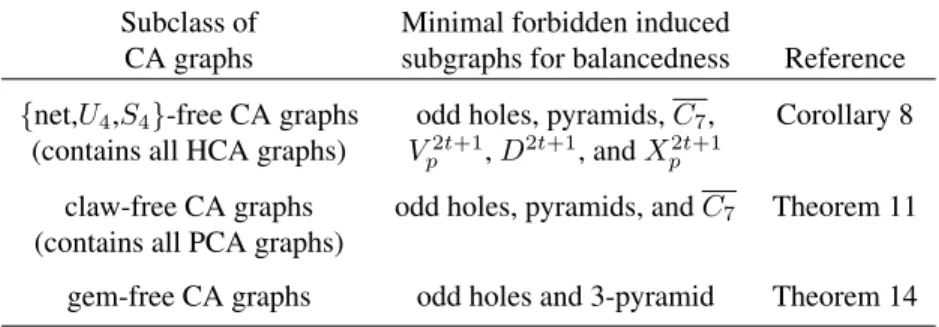
Tab. 1: Minimal forbidden induced subgraphs for balancedness in each studied subclass of CA graphs
Subclass of Minimal forbidden induced
CA graphs subgraphs for balancedness Reference {net,U4,S4}-free CA graphs odd holes, pyramids, C7, Corollary 8
(contains all HCA graphs) Vp2t+1, D2t+1, and Xp2t+1
claw-free CA graphs odd holes, pyramids, and C7 Theorem 11
(contains all PCA graphs)
gem-free CA graphs odd holes and 3-pyramid Theorem 14
H has an odd hole or contains an induced 3-pyramid (because each of 3-sun, 1-pyramid, 2-pyramid, C7,
X2t+1
p , D2t+1, and Xp2t+1, for each t ≥ 2 and each valid p, contains an induced gem). The minimality of
H ensures that H is an odd hole or a 3-pyramid, which concludes the proof. 2 We conclude this section with Table 1 that summarizes the characterizations of balanced graphs by minimal forbidden induced subgraphs within each studied subclass of CA graphs.
3
Considering further superclasses of balanced graphs
Recall that well-known superclasses of balanced graphs are perfect graphs and hereditary clique-Helly graphs. As perfect graphs are exactly the odd hole- and odd antihole-free graphs [14] and hereditary clique-Helly graphs exactly the pyramid-free graphs [28], the list of minimal forbidden induced subgraphs from Theorems 11 and 14 implies the following for claw-free and gem-free CA graphs:
Corollary 15 Let G be a claw-free CA graph. Then, G is balanced if and only if G is perfect and hereditary clique-Helly.
Corollary 16 Let G be a gem-free CA graph. Then, G is balanced if and only if G is perfect and heredi-tary clique-Helly.
This motivates us to also consider the relationship between CA graphs and further superclasses of balanced graphs. Note that perfect graphs are characterized in several different ways, among them in terms of a min-max relation of two graph parameters: The size of a largest clique in a graph is a trivial lower bound for the minimum number of colors required to assign different colors to adjacent vertices; perfect graphs are exactly the graphs where both parameters coincide for all induced subgraphs. Some other graph classes were defined in a similar way and turned out to be superclasses of balanced graphs.
A clique-independent set of a graph G is a set of pairwise disjoint cliques of G. A clique-transversal of G is a subset of vertices meeting all the cliques of G. The maximum cardinality αc(G) of a
clique-independent set is a trivial lower bound for the minimum cardinality τc(G) of a clique-transversal of G.
A graph G is clique-perfect if and only if αc(H) = τc(H) holds for each induced subgraph H of G. The
term ‘clique-perfect’ was coined in [20], but the equality of these parameters has been studied long before in the context of hypergraphs [4]. It is important to mention that clique-perfect graphs do not need to be perfect; e.g., odd antiholes of length 6n + 3 are clique-perfect for each n ≥ 1 and are not perfect (Reed, 2001, cf. [16]).
Coordinated graphs were introduced while looking for characterizations of clique-perfect graphs and are also defined by requiring equality in a min-max inequality between two graph parameters. Let γc(G)
be the minimum number of colors needed to assign different colors to intersecting cliques of G, and let ∆c(G) be the maximum cardinality of a family of cliques having a vertex of G in common. Clearly,
γc(G) ≥ ∆c(G) holds for any graph G, and a graph G is called coordinated if γc(H) = ∆c(H) for each
induced subgraph H of G. Coordinated graphs form a proper subclass of perfect graphs [8]. Furthermore, the works of Berge [2] and Lov´asz [26] on hypergraphs imply that a balanced graph is simultaneously hereditary clique-Helly, clique-perfect, and coordinated.
The characterization by forbidden induced subgraphs of clique-perfect and coordinated graphs is open, but some partial results were obtained in [5, 6, 12, 13]. In particular, in [6], clique-perfect graphs were characterized by minimal forbidden induced subgraphs within the class of Helly CA graphs. We present here the minimal forbidden induced subgraph characterization of clique-perfectness and coordination re-stricted to gem-free CA graphs.
Theorem 17 Let G be a gem-free CA graph. Then, the following statements are equivalent:
(i) G is clique-perfect.
(ii) G is coordinated.
(iii) G is perfect.
(iv) G has no odd holes.
Proof: A graph is minimally non-perfect (resp. minimally non-coordinated) if it is not clique-perfect (resp. not coordinated) but all its proper induced subgraphs are so. Along this proof, we will denote by C1and C2the classes of minimally non-clique-perfect and minimally non-coordinated graphs,
respectively, within the class of gem-free CA graphs. Let C = C1∪ C2.
Clearly, odd holes are in C1∩ C2 and therefore also in C. If we prove that the odd holes are the only
graphs in C, then the equivalence among (i), (ii), and (iv) follows. The equivalence between (iii) and (iv) is an immediate consequence of the Strong Perfect Graph Theorem [14] because every antihole C2t+1,
for t ≥ 3, contains an induced gem.
Suppose, by way of contradiction, that there exists a graph H in C that is not an odd hole. In particular, H is not balanced and, by Theorem 14, H contains an induced 3-pyramid. Let P ⊆ V (H) such that P induces a 3-pyramid in H and let W ⊆ P such that W induces a C4in H. Let w1w2w3w4w1be the hole
induced by the vertices of W in H and let P \ W = {u1, u2}. Let U be the set of vertices of V (H) \ W
that are complete to W and, for each i ∈ {1, 2, 3, 4}, let Vibe the set of vertices of V (H) \ W whose
only non-neighbor in W is wi. Clearly, u1and u2belong to U .
Claim 1 Each vertex of H belongs to exactly one of the sets U , V1,V2,V3,V4, andW .
The sets U , V1, V2, V3, V4, and W are pairwise disjoint by definition. Let v be an arbitrary vertex of
V (H) \ W . If v ∈ P \ W , then v ∈ U by construction. So, without loss of generality, suppose that v ∈ V (H) \ P . Let k = |NH(v) ∩ W |. By Lemma 2 and symmetry, we can assume, without loss of
generality, that NH(v) ∩ W = {wi : 1 ≤ i ≤ k}. If k = 0, then V (H) ∪ {v} would induce C4∪ K1
in H, which is not a CA graph, a contradiction. If k = 1, then either v would be adjacent to ui for
C4∪ K1in H, a contradiction. If k = 2, either {v, w1, w4, w3, u1} or {v, w2, u1, w4, w1} induces a gem
in H depending on whether v is adjacent to u1or not, respectively, another contradiction. We conclude
that either k = 3 or k = 4; i.e., v ∈ Vifor some i ∈ {1, 2, 3, 4} or v ∈ U , as claimed.
Claim 2 For each i ∈ {1, 2, 3, 4}, every vertex of Viis a true twin ofwiinH.
In fact, notice that the following statements hold for each i ∈ {1, 2, 3, 4} (subindices should be understood modulo 4):
• Vi is complete toU : If there were vertices vi ∈ Vi and u ∈ U which were nonadjacent, then
{u, vi, wi, wi+1, wi+3} would induce a K2,3in H, a contradiction.
• Vi is a complete set: If there were two different nonadjacent vertices vi and vi0 in Vi, then the set
{vi, v0i, wi, wi+1, wi+3} would induce a K2,3in H, a contradiction.
• Vi is complete toVi+1: If there were vertices vi in Viand vi+1in Vi+1 which were nonadjacent,
then {vi, wi+2, vi+1, wi, wi+3} would induce a gem in H, a contradiction.
• Vi is anticomplete toVi+2: If there were vertices viin Vi and vi+2 in Vi+2which were adjacent,
then {wi, vi+2, vi, wi+2, wi+1} would induce a gem in H, a contradiction.
By Claim 1, the definition of Vi, and the four above statements, it follows that every vertex of Viis a true
twin of wiin H, as claimed.
Claim 3 The sets V1,V2,V3, andV4are all empty.
Indeed, since αc, τc, γc, and ∆care invariant under the addition of a true twin, no graph in C1∪ C2has
true twins. In particular, H has no true twins and, by Claim 2, Vi is empty for each i ∈ {1, 2, 3, 4}, as
claimed.
Claim 4 H is the disjoint union of three or more complete bipartite graphs. (We regard an isolated vertex as a trivial complete bipartite graph.)
In fact, since H is gem-free and K2,3-free, H[U ] is P4-free and 3K1-free. Moreover, in [7], it is proved
that if a graph is {3K1, P4}-free, then its complement is the disjoint union of complete bipartite graphs.
Therefore, H[U ] is the disjoint union of complete bipartite graphs. By Claims 1 and 3, V (H) = U ∪ W . Since H[W ] = C4 = 2K2 and U is anticomplete to W in H, H is the disjoint union of at least three
complete bipartite graphs, as claimed.
With the help of Claim 4 we now complete the proof of the theorem. Notice that Claim 4 implies that H /∈ C1because no minimally non-clique-perfect graph is the complement of a disconnected graph
(cf. [25, Lemma 1]). So, necessarily, H ∈ C2; i.e., H is minimally non-coordinated. Then, γc(H) 6=
∆c(H) and, in particular, H has no universal vertices; i.e., each connected component of H has at least
two vertices. Let H1, H2, . . . , Htbe the connected components of H and, for each i ∈ {1, 2, . . . , t}, let
{A1
i, A2i} be the partition into two stable sets of the vertices of the complete bipartite graph Hi. Then, the
cliques of H are of the form Aj1
1 ∪ A j2
2 ∪ · · · ∪ A jt
t where j1, . . . , jt∈ {1, 2}. Notice that γc(H) = 2t−1
and clearly ∆c(H) = 2t−1(indeed, each vertex of H belongs to 2t−1cliques of H), which contradicts
the fact that H ∈ C2. This contradiction arose from assuming that there was some graph in C1∪ C2which
4
Further remarks
In this work, we considered the problem of characterizing balanced graphs by minimal forbidden sub-graphs within different subclasses of CA sub-graphs, including a superclass of each of two of the most studied subclasses of CA graphs: the class of HCA graphs and the class of PCA graphs. The complete characteri-zation of balanced graphs by minimal forbidden induced subgraphs within CA graphs in general, remains unknown. The sun S5is the only example of a minimally non-balanced CA graph not belonging to any
of the here studied classes of CA graphs that we know. (The graphs Stwith t odd and t ≥ 7 are not
circular-arc graphs.)
A careful reading of the proof of Theorem 3 reveals that the hypothesis that the graph is HCA (and not merely a CA graph) is only used in the proofs of Claim 1 and 2, and in the latter case only for t = 2. So, along the proof we indeed identified all CA graphs that are minimally non-balanced and whose unbalanced cycles have length at least 7 and have only short chords. Therefore, a possible road towards extending the proof of Theorem 3 to the entire class of CA graphs could be that of finding some property of the chords of the unbalanced cycles within CA graphs in general that could serve as a substitute for Claim 1. A different approach would be to take Theorem 6 as a starting point and to study the balancedness of CA graphs containing net, U4, or S4as induced subgraph. We managed to do so when restricting ourselves to
claw-free and gem-free graphs. A better understanding of the structure of CA graphs would be of help to overcome these restrictions.
We also considered the problem of characterizing clique-perfect and coordinated graphs by forbidden induced subgraphs within CA graphs. In [6], clique-perfect graphs were characterized by minimal forbid-den induced subgraphs within the class of HCA graphs. It is easy to see that the approach used here to extend Theorem 3 to Corollary 8, works also for extending the characterization of clique-perfect graphs within HCA graphs in [6] to a characterization of clique-perfect graphs within the class of {net,U4,S4
}-free ∩ {1-pyramid,2-pyramid,3-pyramid}-}-free CA graphs. Nevertheless, characterizing clique-perfect graphs by forbidden induced subgraphs within all {net,U4,S4}-free CA graphs seems much harder. The
characterization of clique-perfect graphs by forbidden induced subgraphs is open even within PCA graphs. For coordinated graphs, the characterization remains unresolved even within both HCA graphs and PCA graphs.
References
[1] C. Berge. F¨arbung von Graphen, deren s¨amtliche beziehungsweise, deren ungerade Kreise starr sind (Zusammenfassung). Wiss. Z. Martin-Luther-Univ. Halle-Wittenberg, Math.-Naturwiss. Reihe, 10:114–115, 1961.
[2] C. Berge. Balanced matrices. Math. Program., 2(1):19–31, 1972.
[3] C. Berge and V. Chv´atal. Introduction. In Topics on Perfect Graphs, volume 88 of North-Holland Mathematics Studies, pages vii–xiv. Noth-Holland, 1984.
[4] C. Berge and M. Las Vergnas. Sur un th´eor`eme du type K¨onig pour hypergraphes. Ann. N.Y. Acad. Sci., 175:32–40, 1970.
[5] F. Bonomo, M. Chudnovsky, and G. Dur´an. Partial characterizations of clique-perfect graphs I: subclasses of claw-free graphs. Discrete Appl. Math., 156(7):1058–1082, 2008.
[6] F. Bonomo, M. Chudnovsky, and G. Dur´an. Partial characterizations of clique-perfect graphs II: diamond-free and Helly circular-arc graphs. Discrete Math., 309(11):3485–3499, 2009.
[7] F. Bonomo, G. Dur´an, L. N. Grippo, and M. D. Safe. Partial characterizations of circular-arc graphs. J. Graph Theory, 61(4):289–306, 2009.
[8] F. Bonomo, G. Dur´an, and M. Groshaus. Coordinated graphs and clique graphs of clique-Helly perfect graphs. Util. Math., 72:175–191, 2007.
[9] F. Bonomo, G. Dur´an, M. C. Lin, and J. L. Szwarcfiter. On balanced graphs. Math. Program., 105(2–3):233–250, 2006.
[10] F. Bonomo, G. Dur´an, M. D. Safe, and A. K. Wagler. On minimal forbidden subgraph characteriza-tions of balanced graphs. Electron. Notes Discrete Math., 35:41–46, 2009.
[11] F. Bonomo, G. Dur´an, M. D. Safe, and A. K. Wagler. Balancedness of some subclasses of circular-arc graphs. Electron. Notes Discrete Math., 36:1121–1128, 2010.
[12] F. Bonomo, G. Dur´an, F. Soulignac, and G. Sueiro. Partial characterizations of clique-perfect and coordinated graphs: Superclasses of triangle-free graphs. Discrete Appl. Math., 157(17):3511–3518, 2009.
[13] F. Bonomo, G. Dur´an, F. Soulignac, and G. Sueiro. Partial characterizations of coordinated graphs: line graphs and complements of forests. Math. Methods Oper. Res., 69(2):251–270, 2009.
[14] M. Chudnovsky, N. Robertson, P. D. Seymour, and R. Thomas. The strong perfect graph theorem. Ann. Math., 164(1):51–229, 2006.
[15] V. Chv´atal. On certain polytopes associated with graphs. J. Combin. Theory Ser. B, 18(2):138–154, 1975.
[16] G. Dur´an, M. C. Lin, and J. L. Szwarcfiter. On clique-transversal and clique-independent sets. Ann. Oper. Res., 116(1):71–77, 2002.
[17] D. R. Fulkerson and O. A. Gross. Incidence matrices and interval graphs. Pacific J. Math., 15(3):835–855, 1965.
[18] D. R. Fulkerson, A. J. Hoffman, and R. Oppenheim. On balanced matrices. In M. Balinski, editor, Pivoting and Extensions: In honor of A.W. Tucker, volume 1 of Mathematical Programming Study, pages 120–133. North-Holland, Amsterdam, 1974.
[19] F. Gavril. Algorithms on circular-arc graphs. Networks, 4:357–369, 1974.
[20] V. Guruswami and C. Pandu Rangan. Algorithmic aspects of transversal and clique-independent sets. Discrete Appl. Math., 100(3):183–202, 2000.
[21] E. Helly. ¨Uber Mengen konvexer K¨orper mit gemeinschaftlichen Punkten. Jber. Deutsch. Math.-Vereining., 32:175–176, 1923.
[22] A. J. Hoffman and J. B. Kruskal. Integral boundary points of convex polyhedra. In H. W. Kuhn and A. W. Tucker, editors, Linear Inequalities and Related Systems, volume 38 of Annals of Mathematics Studies, pages 247–254. Princeton University Press, 1956.
[23] B. L. Joeris, M. C. Lin, R. M. McConnell, J. P. Spinrad, and J. L. Szwarcfiter. Linear-time recognition of Helly circular-arc models and graphs. Algorithmica, 59(2):215–239, 2011.
[24] V. Klee. What are the intersection graphs of arcs in a circle? Am. Math. Mon., 76:810–813, 1969.
[25] A. Lakshmanan S. and A. Vijayakumar. The hti-property of some classes of graphs. Discrete Math., 309(1):259–263, 2009.
[26] L. Lov´asz. Normal hypergraphs and the perfect graph conjecture. Discrete Math., 2(3):253–267, 1972.
[27] R. M. McConnell. Linear-time recognition of circular-arc graphs. Algorithmica, 37(2):93–147, 2003.
[28] E. Prisner. Hereditary clique-Helly graphs. J. Combin. Math. Combin. Comput., 14:216–220, 1993.
[29] W. T. Trotter and J. I. Moore. Characterization problems for graphs, partially ordered sets, lattices, and families of sets. Discrete Math., 16(4):361–381, 1976.
[30] A. Tucker. Matrix characterizations of circular-arc graphs. Pacific J. Math., 38:535–545, 1971.
[31] A. Tucker. Structure theorems for some circular-arc graphs. Discrete Math., 7:167–195, 1974.
[32] A. Tucker. Coloring a family of circular arcs. SIAM J. Appl. Math., 29(3):493–502, 1975.