HAL Id: hal-00318238
https://hal.archives-ouvertes.fr/hal-00318238
Submitted on 21 Dec 2006
HAL is a multi-disciplinary open access
archive for the deposit and dissemination of
sci-entific research documents, whether they are
pub-lished or not. The documents may come from
teaching and research institutions in France or
abroad, or from public or private research centers.
L’archive ouverte pluridisciplinaire HAL, est
destinée au dépôt et à la diffusion de documents
scientifiques de niveau recherche, publiés ou non,
émanant des établissements d’enseignement et de
recherche français ou étrangers, des laboratoires
publics ou privés.
Solar cycle effect on geomagnetic storms caused by
interplanetary magnetic clouds
C.-C. Wu, R. P. Lepping
To cite this version:
C.-C. Wu, R. P. Lepping. Solar cycle effect on geomagnetic storms caused by interplanetary
mag-netic clouds. Annales Geophysicae, European Geosciences Union, 2006, 24 (12), pp.3383-3389.
�hal-00318238�
Ann. Geophys., 24, 3383–3389, 2006 www.ann-geophys.net/24/3383/2006/ © European Geosciences Union 2006
Annales
Geophysicae
Solar cycle effect on geomagnetic storms caused by interplanetary
magnetic clouds
C.-C. Wu1,2,3and R. P. Lepping3
1CSPAR/The University of Alabama in Huntsville, Huntsville, AL 35899, USA
2also at: Key State of Laboratory for Space Weather, Chinese Academy of Sciences, Beijing 100080, China 3Heliophysics Science Division, NASA/GSFC, Greenbelt, MD 20771, USA
Received: 4 April 2006 – Revised: 9 October 2006 – Accepted: 13 October 2006 – Published: 21 December 2006
Abstract. We investigated geomagnetic activity which was
induced by interplanetary magnetic clouds during the past four solar cycles, 1965–1998. We have found that the in-tensity of such geomagnetic storms is more severe in solar maximum than in solar minimum. In addition, we affirm that the average solar wind speed of magnetic clouds is faster in solar maximum than in solar minimum. In this study, we find that solar activity level plays a major role on the intensity of geomagnetic storms. In particular, some new statistical re-sults are found and listed as follows. (1) The intensity of a geomagnetic storm in a solar active period is stronger than in a solar quiet period. (2) The magnitude of negative Bzmin is larger in a solar active period than in a quiet period. (3) Solar wind speed in an active period is faster than in a quiet period. (4) V Bsmaxin an active period is much larger than in a quiet period. (5) Solar wind parameters, Bzmin, Vmax and V Bsmaxare correlated well with geomagnetic storm in-tensity, Dstmin during a solar active period. (6) Solar wind
parameters, Bzmin, and V Bsmaxare not correlated well (very poorly for Vmax) with geomagnetic storm intensity during a solar quiet period. (7) The speed of the solar wind plays a key role in the correlation of solar wind parameters vs. the intensity of a geomagnetic storm. (8) More severe storms with Dstmin≤−100 nT caused by MCs occurred in the solar
active period than in the solar quiet period.
Keywords. Interplanetary physics (Interplanetary magnetic
fields; Solar wind plasma) – Magnetospheric physics (Storms and substorms)
1 Introduction
Many scientists have tried to understand the fundamental mechanisms that explain the geomagnetic storm since storm Correspondence to: C.-C. Wu
patterns were explored by Chapman (1919). The primary cause of a magnetic storm is long duration, intense south-ward interplanetary magnetic fields which interconnect with the Earth’s magnetic field and allow solar wind energy trans-port into the Earth’s magnetosphere (e.g. Tsurutani et al., 1988; Gonzalez et al., 1994). Magnetic clouds (Mcs) are major sources of long-lasting strong southward interplane-tary magnetic field (IMF) Bz and, therefore, usually cause
magnetic storms (Burlaga et al., 1981; Wilson, 1990). How-ever, the largest (in duration) Mcs do not necessarily have the most intense field strengths (Farrugia et al., 1997). Nor are the most intense (strong |B|) clouds the most geoeffective, especially if the MC of interest is highly inclined with re-spect to the ecliptic plane and possesses a positive axial field. Then there will be little or no negative Bz (Lepping et al.,
2003). A geomagnetic storm might be driven by a MC itself or by the sheath fields upstream of a MC if an upstream exists (e.g., Lepping and Berdichevsky, 2001; Wu and Lepping, 2002a).
Various changes in the IMF are well known to play a key role in regulating geomagnetic activity (e.g., Fairfield and Cahill, 1966). In particular, the variation of the north-south component of the IMF (Bz), when rendered in the
geocen-tric solar-magnetospheric (GSM) coordinate system, plays a crucial role in determining the amount of solar wind en-ergy that is transferred to the magnetosphere (e.g. Arnoldy, 1971). Using Explorer 12 measurements of the magnetic field outside the magnetosphere and comparing with ground magnetograms from arctic observatories, Fairfield and Cahill (1966) showed that an IMF with a southward component tends to be associated with a ground disturbance, whereas a northward IMF is associated with a quiet condition. The early studies of “solar wind-magnetosphere coupling” have concentrated on a single coupling function (e.g. Perreault and Akasofu, 1978; Kan and Lee, 1979; Doyle and Burke, 1983; Gonzalez et al., 1989) which contains either a single or several solar wind parameters (e.g. Gonzalez et al., 1994).
3384 C.-C. Wu and R. P. Lepping: Solar cycle effect on geomagnetic storms
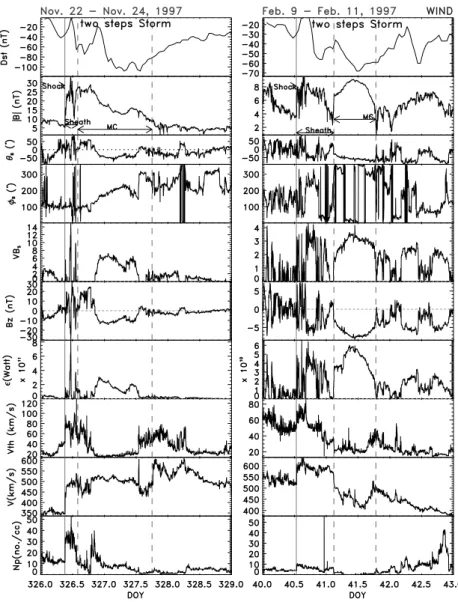
Fig. 1. Solar wind parameters and Dst for two magnetic clouds: 22–24 November 1997 and 9–11 February 1997. The parameters are (from top to bottom): geomagnetic index (Dst), interplanetary magnetic field magnitude (|B|), field latitude (θB), and longitude (φB), induced
electric field (V Bs), north-south component of the IMF (Bz), Akasofu (1981) ǫ, proton thermal speed (Vt h), plasma bulk speed (V ), proton
density (NP).
Burton et al. (1975) presented a formula for predicting the
Dst index from knowledge of the velocity and density of the
solar wind and the north-south component of the interplane-tary magnetic field (in GSM coordinates). The intensity of a magnetic storm which is associated with a geomagnetic cloud is predictable (Wu and Lepping, 2005).
Wu and Lepping (2002a) used the first four years of WIND magnetic field (Lepping et al., 1995) and plasma data (Ogilvie et al., 1995) to investigate the relationships between solar wind parameters and geomagnetic storms. They found that the intensity of geomagnetic storms (Dstmin) is strongly
related to the magnitude of solar wind parameters (Bz, V BS
or ǫ in Akasofu, 1981) within magnetic cloud complexes (in-cluding upstream sheath regions), and the occurrence
tim-ing of a geomagnetic storm is associated with the occurrence timing of Bzmin, (V Bs)maxor ǫmax. Dstmin is minimum Dst,
Bzmin is minimum Bz, (V Bs)max is maximum V Bs, and
ǫmaxis the maximum ǫ (Akasofu, 1981) value observed dur-ing or in front of a MC event (i.e., in the sheath). (The word “event” here usually means the entire “sheath”/cloud com-plex.) Bs is the southward component of the IMF (Bs=|Bz|
for Bz<0 and Bs=0 for Bz≥0). Using the solar wind
pa-rameters of the apparent 135 magnetic clouds observed be-tween 1965 and 1998 from the OMNI data set, Wu and Lep-ping (2002b) found that storm intensity (Dstmin) is strongly
related to the IMF in the z-direction (Bz) and to V Bs, but
not well correlated with solar wind velocity alone. How-ever, the relationship between storm intensity and Bz (or
C.-C. Wu and R. P. Lepping: Solar cycle effect on geomagnetic storms 3385
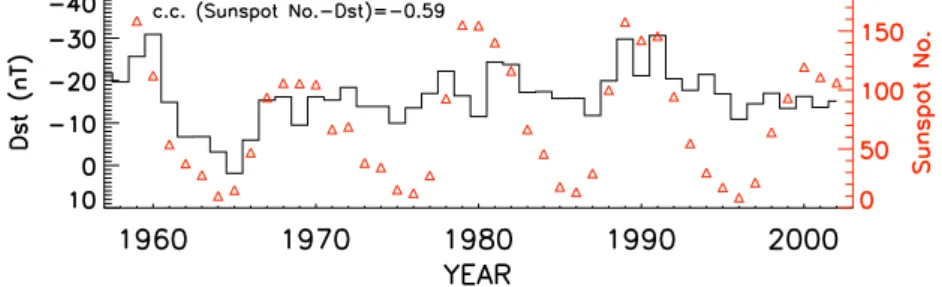
Fig. 2. Yearly averages of sunspot number (△) and geomagnetic activity index, Dst(solid line), during 1957–2002.
V Bs) shows better correlation as the solar wind velocity gets
faster. Eighty-two interplanetary magnetic clouds were iden-tified by the MFI team by using WIND solar wind plasma and magnetic field data from solar minimum through the maximum of solar cycle 23 (1995–2003) (Lepping et al., 2006). The occurrence frequency of MCs appears to be re-lated neither to the occurrence of coronal mass ejections as observed by SOHO LASCO nor to the sunspot number (e.g. Wu et al., 2003, 2006). In contrast, the intensity of geomag-netic storms related to maggeomag-netic clouds is affected by both so-lar activity and the occurrence frequency of CMEs, and more than ∼87% of MCs induced geomagnetic storms (Wu et al., 2003, 2006). Wu et al. (2006) also found that the occurrence of magnetic cloud-like structures (MCLs) or the occurrence rate of the joint set (MCs+MCLs) are correlated with both sunspot number and the occurrence rate of CMEs. This mo-tivated us to study several relationships for solar activity vs. various solar wind parameters in order to understand the so-lar cycle effect on geomagnetic storms which is caused by MCs.
In Sect. 2 we present associated data analysis, storm event selection and the derived storm intensities, Dstmin, and
pre-diction schemes, which include both velocity dependence and independence. The results will be discussed in Sect. 3, and some conclusions are stated in Sect. 4.
2 Data analysis
Four data sets are used in this study. The first data set, OMNI solar wind plasma and magnetic field data, which were ob-tained from NSSDC/NASA-GSFC, were used for most ear-lier events. The second data set, WIND solar wind plasma and magnetic field data, were obtained from the WIND SWE and MFI groups for the events after 1995. Both the third data set (the geomagnetic activity index, Dst) and the forth data
set (sunspot number) were obtained from National Geophys-ical Data Center, Boulder, Colorado, USA.
2.1 Magnetic cloud event selection
The MC events used in the present study have been extracted from three previously published reports (Klein and Burlaga,
1982; Bothmer and Rust, 1997; Lepping and Berdichevsky, 2000). Hourly averages of solar plasma and magnetic field data from OMNI and Dst during these cloud events were
compiled into a data base. Thus, a total of 135 events which cover the period from 1965 to 1998 were obtained for this analysis. (It should be understood that this set of 135 events must be considered a subset of the full set of MCs occur-ring over the period 1965–1998, since there were many data gaps due to spacecraft tracking limitations and from times when the spacecraft were behind the bowl shock.) This data set has been used to study the effect of solar wind speed on magnetic cloud-associated magnetic storm intensity (Wu and Lepping, 2002b).
Figure 1 shows two examples of MCs which occurred dur-ing 22–24 November and 9–11 February 1997. Note that each MC produced a two-step (two main phases) geomag-netic storm. In Fig. 1, we define the following: ǫmaxis the maximum value of the Akasofu [1981] ǫ observed during a cloud event. Note that Dstminis the minimum value of Dst
ob-served during a cloud “event” (where “event” here and below usually means the entire “sheath”/cloud complex.), V Bsmax is the maximum value of V Bs observed during a cloud event, where Bs is the southward component of the IMF (Bs=|Bz|
for Bz<0 and Bs=0 for Bz≥0); Bzminis minimum Bzvalue
observed during or in front of a MC event (i.e., in the sheath region, if there is an upstream shock).
The yearly averages of sunspot number and geomagnetic activity index (Dst) for the years 1965–2002 are shown in
Fig. 2. The solid line represents yearly averaged Dst and the
triangles represent yearly averaged sunspot number. The cor-relation coefficient (c.c.) between yearly sunspot number and
Dstis –0.59. Figure 2 also shows that solar minima occurred
in 1964, 1976, 1986 and 1996 and solar maxima occurred in 1969, 1980, 1991 and 2000.
Figure 3 shows plots of Dstmin vs. |Bzmin|, Vmax and
V Bsmaxwith respect to Dst and resulting correlation
coeffi-cients for the solar active periods (years of 1968, 1969, 1979, 1980, 1981, 1990, 1991, 1992) and quiet periods (years of 1965, 1966, 1975, 1976, 1985, 1986, 1996, 1997). There were 32 MCs observed during the active period and 33 MCs observed during the quiet period. Table 1 summarizes the correlation coefficients of Dstminvs. three different solar wind
3386 C.-C. Wu and R. P. Lepping: Solar cycle effect on geomagnetic storms
Fig. 3. Relationships and correlation coefficients (c.c.) for storm intensity (Dst) vs. various solar wind parameters (see the text). The left
column represents the results for the 32 events the during solar active period; the right column represents the results for the 33 events during solar quiet period.
parameters. It shows clearly that all three solar wind param-eters are well correlated with Dstmin during solar maximum
but have a poor correlation in solar minimum. For example, the c.c. is quite high (–0.93) between |Bzmin|and Dstmin for
the active period.
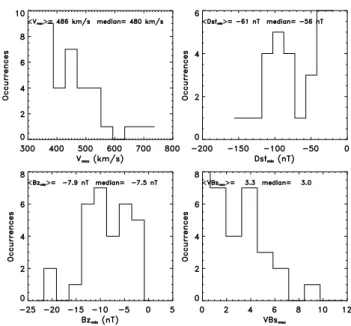
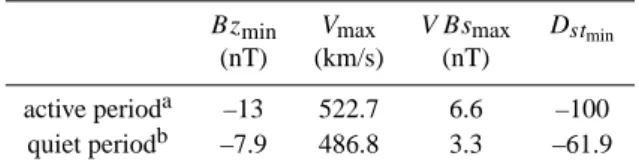
Figures 4 and 5 show the histograms of Vmax, Dstmin,
Bzminand V Bsmaxfor both solar quiet and active periods, re-spectively. Table 2 summarizes the results related to Figs. 4 and 5. Both figures show that: (1) the solar wind speed is faster in solar maximum than in solar minimum; (2) |Bz| at
Bzminis greater in solar maximum than in solar minimum;
(3) the averaged storm intensity, <Dstmin> is more intense
in solar maximum than the averaged <Dstmin> in solar
min-imum; and (4) averaged V Bsmaxin solar maximum is two times larger than what it is in solar minimum.
Table 3 summarizes the occurrence frequency of MCs which caused different strengths of geomagnetic storms dur-ing both solar quiet and active periods. More than twice as many MCs causing severe geomagnetic storms (Dstmin≤–
100 nT) occurred in the solar active period (13 MCs) as in quiet period (6 MCs).
C.-C. Wu and R. P. Lepping: Solar cycle effect on geomagnetic storms 3387
Table 1. Summarized correlation coefficient for Dstminvs. |Bzmin|,
Vmaxand V Bsmax.
|Bzmin| Vmax V Bsmax (nT) (km/s)
Dstmin(active period)a –0.93 –0.71 –0.91
Dstmin(quiet period)
b –0.64 –0.19 –0.66
aEvents occurred during the years 1968, 1969, 1979, 1980, 1981, 1990, 1991 and 1992.
bEvents occurred during the years 1965, 1966, 1975, 1976, 1985, 1986, 1996, and 1997.
3 Discussion
Using 34 MCs that occurred during 1995–1998, Wu and Lepping (2002a) found that the correlation between storm intensity (Dstmin) and the z-component of the interplanetary
magnetic field, IMF (Bz), (or with V Bs) is very high. For solar cycle 23, previous studies have shown that the yearly average geomagnetic activity index (Dst) is not correlated
well with solar activity (Wu et al., 2003), but the intensity of geomagnetic storms induced by MCs (observed during solar cycle 23) is related to solar activity (Wu et al., 2003, 2006). (The correlation coefficient for the yearly averages of sunspot number vs. yearly averages of intensity of magnetic storms due to MCs is 0.83 (Wu et al., 2006).) Using data from 4 solar cycles, the results of this study show that the correlation coefficient is poor (c.c.= –0.59) between the yearly average geomagnetic activity index and sunspot number. This result reconfirms the reports of previous studies.
Cane et al. (2000) studied the relationship between the intensity of geomagnetic storms (with Dstmin<−50 nT) and
southward interplanetary magnetic field strength in ejecta or sheath regions for events associated with front-side halo CMEs during 1996–1999. They found that storm intensity versus the maximum southward magnetic field (Bs) in either the ejecta or the adjacent disturbed solar wind has a correla-tion coefficient of –0.74. Using 34 MCs observed between 1995 and 1998, Wu and Lepping (2002a) found that the
Dstmin is strongly correlated with V Bsmax and |Bzmin|with
c.c.= –0.79 and –0.77, respectively. Both of the earlier stud-ies (Cane et al., 2000; Wu and Lepping, 2002a) show that the intensity of a storm is strongly correlated with the mag-nitude of Bz. However, both studies cover less than 1/4 of
solar activity cycle (where 22 years is a full solar cycle). The correlation coefficient of |Bzmin| and Dstmin is similar
for both of these earlier studies (i.e., –0.74 for Cane et al. and –0.77 for Wu and Lepping). Using 135 MCs which oc-curred during 1965–1998 (33 years, one and a half full solar cycles), Wu and Lepping (2002b) found that the intensity of a geomagnetic storm is primarily related to the solar wind parameters Bz and VBs. The results confirmed the two
ear-Fig. 4. Histograms of Vmax, Dstmin, Bzminand V Bsmaxfor MCs
during the quiet time of the solar cycle for the years 1965, 1966, 1975, 1976, 1985, 1986, 1996, 1997.
Fig. 5. Histograms of Vmax, Dstmin, Bzminand V Bsmaxfor MCs during the active time of the solar cycle for the years of 1968, 1969, 1979, 1980, 1981, 1990, 1991, 1992.
lier studies (Cane et al., 2000; Wu and Lepping, 2002a). The c.c. of |Bzmin|vs. Dstminis –0.86 for that extended study
which means that the long term study apparently gives a bet-ter correspondence than the short bet-term studies for this cor-relation. In addition, Wu and Lepping (2002b) also found that the relationships between storm Dstmin and Vmaxis poor (i.e., c.c. is –0.58), but the correlation for Dstmin vs. Bzmin (or V Bsmax) increased dramatically when solar wind speed
3388 C.-C. Wu and R. P. Lepping: Solar cycle effect on geomagnetic storms
Table 2. Averages of Vmax, Dstmin, Bzminand V Bsmaxfor solar
quiet and active periods.
Bzmin Vmax V Bsmax Dstmin
(nT) (km/s) (nT)
active perioda –13 522.7 6.6 –100 quiet periodb –7.9 486.8 3.3 –61.9 aEvents occurred during the years 1968, 1969, 1979, 1980, 1981, 1990, 1991 and 1992.
bEvents occurred during the years 1965, 1966, 1975, 1976, 1985, 1986, 1996, and 1997.
Table 3. The occurrence frequency of MCs which caused a geo-magnetic storm during solar quiet and active periods.
quiet active
Dst> –30 nT 10 7
–30 nT ≥Dst>–50 nT 5 5
-50 nT ≥Dst>–100 nT 12 7
Dst≤–100 nT 6 13
increased. For example, the correlation of Dstminwith Bzmin
increases from c.c. = –0.86 for all events to c.c. = –0.93 for events with Vmax>600 km/s (Wu and Lepping, 2002b). That implies that solar wind speed also plays a role in the geomag-netic active but not in any simple way.
The result of this study (see Fig. 3) shows clearly that
Vmax is well correlated with Dstmin in the solar active
pe-riod (c.c. = –0.71). In contrast, during the solar quiet pepe-riod, the correlation is very poor between Vmaxand Dstmin(c.c. = –
0.19). As expected, we notice that the solar wind speed within MCs on average is higher during the active period. The average of Vmaxin the solar active period (522 km/s) is
∼10% higher than in the solar quiet period (468 km/s). The correlation of Dstmin vs. different solar wind
param-eters (e.g., Bzmin, Vmax or V Bsmax) became poor when the Sun became quiet (see Table 1). In addition, the intensity of a storm, in terms of average Dstmin during
MC passage was more than ∼60% stronger in the ac-tive period (<Dstmin>= −100 nT) than in the quiet
pe-riod (<Dstmin>= −61.9 nT). The average strength of Bzmin
in the active period (<Bzmin>= –13 nT) is ∼60% greater than in the quiet period (<Bzmin>= –7.9 nT). The average strength of V Bsmax in the active period (<V Bsmax>=6.6) is almost two times greater than that in the quiet period (<V Bsmax>=3.3). The overall results show that southward IMF is important for causing a geomagnetic storm, as ex-pected, but solar wind speed also plays a role.
Our earlier study showed that the most severe storms caused by MCs/MCLs (i.e., for Dstmin≤−100 nT) during
solar cycle 23 occurred in the solar active part of the cycle (Wu et al., 2006). This study shows longer term statistical results (33 years). More than twice as many MCs causing se-vere geomagnetic storms (Dstmin≤–100 nT) occurred in the
solar active period as in the quiet period. The result of this study is consistent with the earlier study by Wu et al. (2006).
4 Conclusions
Solar activity plays a major role in the average intensity of geomagnetic storms. Some new results were found as fol-lows, where MC passage is understood in all statements. (1) The intensity of a geomagnetic storm in a solar active pe-riod is significantly stronger than in a solar quiet pepe-riod. (2) The magnitude of negative Bzmin is larger in a solar active period than in a quiet period. (3) Solar wind speed in an ac-tive period is faster than in a quiet period. (4) V Bsmax in an active period is much larger than in a quiet period. (5) Solar wind parameters, Bzmin, Vmax and V Bsmax are well correlated with geomagnetic storm intensity, Dstmin, during a
solar active period. (6) Solar wind parameters, Bzmin, and
V Bsmaxare not correlated well (very poorly for Vmax) with geomagnetic storm intensity during a solar quiet period. (7) The speed of the solar wind plays a role in the correlation for solar wind parameters vs. the intensity of a geomagnetic storm. (8) More severe storms with Dstmin≤−100 nT caused
by MCs occurred in the solar active period than in the solar quiet period.
Acknowledgements. We wish to thank the team at Kyoto
Univer-sity, Kyoto, Japan for providing the Dst data, and the NSSDC
at Goddard Space Flight for providing OMNI data. The work of CCW was supported by NASA Grant NNG08GG80G. CCW was also supported in part by the International Collaboration Research Team Program of the Chinese Academy of Sciences.
Topical Editor I. A. Daglis thanks a referee for his/her help in evaluating this paper.
References
Akasofu, S.-I.: Energy coupling between the solar wind and the magnetosphere, Space Sci. Rev., 28, 121–190, 1981.
Arnoldy, R. L.: Signature in the Interplanetary medium for Sub-storms, J. Geophys. Res., 76, 5189–5200, 1971.
Bothmer, V. and Rust, D.: The field configuration of magnetic clouds and the solar cycle, in: Coronal Mass Ejections, edited by: Crooker, N., Joselyn, J. A., and Feynman, J., GM 99, Wash-ington, D.C., AGU, 139-146, 1997.
Burlaga, L. F., Sittler, E., Mariani, F., and Schwenn, R.: Magnetic loop behind an interplanetary shock: Voyager, Helios, and IMP 8 observations, J. Geophys. Res., 86, 6673–6684, 1981. Burton, R. K., McPherron, R. L., and Russell, C. T.: An empirical
relationship between interplanetary conditions and Dst, J. Geo-phys. Res., 80, 4204–4214, 1975.
C.-C. Wu and R. P. Lepping: Solar cycle effect on geomagnetic storms 3389
Cane, H. V., Richardson, I.G., and St.Cyr, O.C.: Coronal mass ejec-tions, interplanetary ejecta and geomagnetic storms, Geophys. Res. Lett., 27 (21), 3591–3594, 2000.
Chapman, S.: An outline of a theory of magnetic storms, Proc. Roy. Soc. London, A-95, 61–83, 1919.
Doyle, M. A. and Burke, W.: S3-2 measurements of the polar cap potential, J. Geophys. Res., 88, 9125–9133, 1983.
Fairfield, D. H. and Cahill Jr., L. J.: Transition Region magnetic Field and Polar magnetic Disturbances, J. Geophys. Res., 71, 155–169, 1966.
Farrugia, C. J., Burlaga, L. F., and Lepping, R. P.: Magnetic Clouds and the Quiet-Storm effect at Earth, in: Physics of Magnetic Storms, AGU Monograph 98, edited by: Tsurutani, B. T., Gon-zalez, W. D. and Kamide, Y., 91–106, 1997.
Gonzalez, W. D., Tsurutani, B. T., Gonzalez, A. L. X., Smith, E. J., Tang, F. and Akasofu, S.-I.: Solar wind-magnetosphere coupling during intense magnetic storms (1978-1979), Planet. Space Sci., 94, 8835–8851, 1989.
Gonzalez, W. D., Joselyn, J. A., Kamide, Y., Kroehl, H. W., Ros-toker, G., Tsurutani, B. T., and Vasyliunas, V. M.: What is a geomagnetic storm?, J. Geophys. Res., 99, 5771–5792, 1994. Kan, J. R. and Lee, L. C.: Energy coupling functions and solar wind
magnetosphere dynamo, Geophys. Res. Lett., 6, 577–580, 1979. Klein, L. W. and Burlaga, L. F.: Interplanetary magnetic clouds at
1 AU, J. Geophys. Res., 87, 613–624, 1982.
Lepping, R. P. and Berdichevsky, D.: Interplanetary magnetic clouds: Sources, properties, modeling, and geomagnetic rela-tionship, in Research Signpost, Recent Res. Dev. Geophys., 77– 96, 2000.
Lepping, R. P. and Berdichevsky, D.: Eos, Transactions, American Geophysical Union, vol. 82(20), Spring Meeting Suppl., Abstract SH61A-07, p.S332, 2001.
Lepping, R. P., Berdichevsky, D., and Wu, C.-C.: Sun-Earth elec-trodynamics: The solar wind connection, in Research Signpost, Recent Res. Dev. Astrophys., 1, 139–171, 2003.
Lepping, R. P., Berdichevsky, D. B., Wu, C. C., Szabo, Z., Narock, T., Mariani, F., Lazarus, A. J., and Quivers, A. J.: A summary of WIND magnetic clouds for the years 1995–2003: Model-fitted parameters, associated errors, and classification, Ann. Geophys., 24, 215–245, 2006.
Lepping, R. P., Acu˜na, M. H., Burlage, L. F., et al.: The wind mag-netic field investigation, Space Sci. Rev., 71, 207–229, 1995. Ogilvie, K. W., Chornay, D. J., Fritzenreiter, R. J., et al.: SWE: A
comprehensive plasma instrument for the Wind spacecraft, Space Sci. Rev., 71, 55–77, 1995.
Perreault, W. K. and Akasofu, S.-I.: A study of geomagnetic storms, Geophys. J. R. Astron. Soc., 54, 547–573, 1978.
Tsurutani, B. T., Smith, E. Gonzalez, W. D., Tang, F., and Aka-sofu, S. I.: Origin of interplanetary southward magnetic fields re-sponsible for major magnetic storms near solar maximum (1978– 1979), J. Geophys. Res., 93, 8519–8531, 1988.
Wilson, R. M.: On the behavior of the Dst geomagnetic index in the vicinity of magnetic cloud passages at Earth, J. Geophys. Res., 95, 215–219, 1990.
Wu, C.-C. and Lepping, R. P.: The effects of magnetic clouds on the occurrences of geomagnetic storms: the first four years of WIND, J. Geophys. Res., 107 (A10), 1314, doi:10.1029/2001JA000161, 2002a.
Wu, C.-C. and Lepping, R. P.: The effect of solar wind velocity on magnetic cloud-associated magnetic storm intensity, J. Geophys. Res., 107 (A11), 1346, doi:10.1029/2002JA009396, 2002b. Wu, C.-C. and Lepping, R. P.: Relationships for predicting
mag-netic clouds related geomagmag-netic storm intensity, J. Atmos. Terr. Phys., Vol 67/3, 283–291, doi:10.1016/j.jastp.2004.07.040, 2005.
Wu, C.-C., Lepping, R. P. and Gopalswamy, N.: Variations of magnetic clouds and CMEs with solar activity cycle, in Pro-ceedings of International Solar Cycle Studies Symposium 2003: Solar variability as an input to the Earth’s environment, SP-535, Tatranska Lomnica, Slovak Republic, June 23–28, 429–432, 2003.
Wu, C.-C., Lepping, R. P., and Gopalswamy, N.: Relationships among magnetic clouds, CMEs and geomagnetic storms, Solar Phys., in press, 2006.