HAL Id: hal-02792538
https://hal.sorbonne-universite.fr/hal-02792538
Submitted on 5 Jun 2020
HAL is a multi-disciplinary open access archive for the deposit and dissemination of sci-entific research documents, whether they are pub-lished or not. The documents may come from teaching and research institutions in France or abroad, or from public or private research centers.
L’archive ouverte pluridisciplinaire HAL, est destinée au dépôt et à la diffusion de documents scientifiques de niveau recherche, publiés ou non, émanant des établissements d’enseignement et de recherche français ou étrangers, des laboratoires publics ou privés.
special emphasis on foraminiferans and naked protists
Andrew Gooday, Alexandra Schoenle, John Dolan, Hartmut Arndt
To cite this version:
Andrew Gooday, Alexandra Schoenle, John Dolan, Hartmut Arndt. Protist diversity and func-tion in the dark ocean -challenging the paradigms of deep-sea ecology with special emphasis on foraminiferans and naked protists. European Journal of Protistology, Elsevier, 2020, 50, pp.125721. �10.1016/j.ejop.2020.125721�. �hal-02792538�
European Journal of Protistology, 2020, Volume 50 https://doi.org/10.1016/j.ejop.2020.125721
Protist diversity and function in the dark ocean - challenging the
paradigms of deep-sea ecology with special emphasis on
foraminiferans and naked protists
Andrew J. Gooday
ab, Alexandra Schoenle
c, John R. Dolan
d, Hartmut Arndt
c* a National Oceanography Centre, University of Southampton Waterfront Campus,Southampton, UK
b Life Sciences Department, Natural History Museum, Cromwell Road, London SW7 5BD,
UK
c University of Cologne, Institute of Zoology, General Ecology, 50674 Cologne, Germany dSorbonne Université, CNRS UMR 7093, Laboratoroire d'Océanographie de
Villefranche-sur-Mer, Villefranche-Villefranche-sur-Mer, France *corresponding author.
H. Arndt, Institute of Zoology, University of Cologne, Zuelpicher Straße 47b, 50674 Cologne, Germany. Telephone number: +49 221 470 3100; email: [email protected]
Abstract
The dark ocean and the underlying deep seafloor together represent the largest environment on this planet, comprising about 80% of the oceanic volume and covering more than two-thirds of the Earth’s surface, as well as hosting a major part of the total biosphere. Emerging evidence suggests that these vast pelagic and benthic habitats play a major role in ocean biogeochemistry and represent an ”untapped reservoir“ of high genetic and metabolic
microbial diversity. Due to its huge volume, the water column of the dark ocean is the largest reservoir of organic carbon in the biosphere and likely plays a major role in the global carbon budget. The dark ocean and the seafloor beneath it are also home to a largely enigmatic food web comprising little-known and sometimes spectacular organisms, mainly prokaryotes and protists. This review considers the globally important role of pelagic and benthic protists across all protistan size classes in the deep-sea realm, with a focus on their taxonomy, diversity, and physiological properties, including their role in deep microbial food webs. We argue that, given the important contribution that protists must make to deep-sea biodiversity and ecosystem processes, they should not be overlooked in biological studies of the deep ocean.
1. Early history of deep-sea protistology
Until relatively recently, protists, and particularly the small naked taxa, were mentioned only in passing in major accounts of deep-sea biology (e.g. Menzies et al. 1973). The starting point for deep-sea studies is often given as 1873, the year the Challenger sailed (e.g. Wüst 1964). However, protistologists were at work on deep-sea samples long before then. Below we briefly review some of the early studies of both pelagic and benthic forms, leading up to and including the Challenger Expedition. The goal is to underline the fact that there is a long history of deep-sea protistology, perhaps forgotten in our present 'omics' era. These classical morphological approaches remain important and should be combined with those of modern molecular methods in protozoological research.
Early studies of deep-sea benthic Foraminifera
The Foraminifera d’Orbigny, 1826 were the first deep-sea protists to be discovered. The earliest record of a benthic foraminiferan from the deep sea (>300 m depth) is probably that of the renowned German microscopist Christian Gottfried Ehrenberg, who found
Grammostomum divergens Ehrenberg, 1844 (the genus Grammostomum Ehrenberg, 1839 is a junior synonym of Bolivina D’Orbigny, 1839; see Loeblich and Tappan 1964) in a small volume of sediment collected with a sounding device at 494 m during James Ross’ Antarctic expedition of 1841-1843 (Ehrenberg 1844). Subsequent papers by Ehrenberg (1854, 1858, 1861) included benthic foraminiferal species from deep Mediterranean, Atlantic and Pacific sites. Pourtales (1850) listed Rotalina baileyi Pourtales, 1850 (originally spelt incorrectly as Rotulina baileyi) in a sounding sample from 200 fathoms (366 m) depth off the east coast of North America (note that Rotalina d’Orbigny, 1839 is a junior synonym of Cancris de Montfort, 1808; see Loeblich and Tappan 1987). Later Pourtales (1853) recorded this and two other species that he assigned to Rotalina in soundings from 823-1920 m depth off the Atlantic coast of Florida, with Texularia turbo Pourtales, 1850 and Marginulina bacheii Bailey, 1851 (originally spelt incorrectly as Marginulina bachei) also occurring at 914 m and 1097 m, respectively. However, these samples were dominated by what are now known to be planktonic Foraminifera. The American microscopist Jacob Bailey (1855) analysed even deeper soundings (1975-3658 m) in the North Atlantic, but only mentioned planktonic species (Fig. 1). Another early record is that of George Wallich. He discovered two shells of ‘Truncatulina lobata’ [probably Serpula lobata de Montfort, 1808, a synonym of
alive’, in a sounding obtained during the 1860 HMS Bulldog cruise from 1247 m between Iceland and the Faroe Islands (p. 4 in Wallich 1862; Rice et al. 1976). Bulldog soundings taken off the southern tip of Greenland (198-2286 m) yielded another sessile species, later described by Wallich (1877) as Rupertia stabilis Wallich, 1877 [now Rupertina stabilis (Wallich 1877)].
Parker and Jones (1865) made the first major contribution to our knowledge of deep-sea benthic Foraminifera, based on samples (mainly soundings) from depths down to 574 m in the Arctic and, most importantly, from 42 soundings taken between 79 and 4298 m in the North Atlantic. These samples yielded 46 benthic species from depths below 300 m; 34 >1000 m, 31 >2000 m, 29 >3000 m and 18 >4000 m (Parker and Jones 1865, Table V). Soundings taken in the Mediterranean Sea (585 m), Red Sea (680-1240 m), tropical Atlantic (1975 m), South Atlantic (475-4938 m) and Indian (1646-4023 m) Oceans provided
additional records (Table VII in Parker and Jones 1865).
Samples collected with dredges contributed much to our knowledge of European benthic faunas during Victorian times. In particular, members of the British Association Dredging Committee were active in sampling the seafloor around the British Isles to depths down to 100 fathoms (183 m) for several decades, starting in 1839 (e.g., Rice and Wilson 1980). Further afield, dredges were used to collect animals from as deep as 732 m during the above-mentioned James Ross expedition (Hooker 1845; Anderson and Rice 2006). However, the 1860s saw the first serious efforts to study deep-sea benthic life using dredges, which catch far more benthic organisms than small sounding samples, as well as larger species. For some years, Michael Sars and his son George Ossian had been dredging off the Norwegian coast near the Lofoten Islands, and by 1868 the elder Sars was able to list 68 species of Foraminifera from depths between 589 m and 823 m, including two that he named (but did not describe) as Rhabdammina abyssorum Sars, 1869 and Saccammina sphaerica Brady, 1871 (Sars 1868). During 1869, this work was extended to even greater depths in the Hardanger Fjord (Sars 1872), where large numbers of the same two species, and a tubular species that M. Sars called Bathysiphon filiformis G.O.and M. Sars in G.O. Sars, 1872
(Gooday 1988b), were recovered from 914 m. G.O. Sars (1872) lists a further 13 agglutinated and calcareous species from this site.
These Norwegian studies provided a stimulus for the British Lightening expedition of 1868, led by W.B. Carpenter and C. Wyville Thomson, to the north and west of Scotland (Mills 1983). The campaign benefited considerably from experience gained earlier by the British Association Dredging Committee. Despite often terrible weather, large numbers of
‘gigantic rhizopods’, including R. abyssorum and Astrorhiza (= A. arenaria Carpenter in Norman, 1877), were dredged at 968 m, and some large biloculine miliolids at the deepest station (1189 m) (Carpenter 1876; Carpenter and Thomson 1868). The abundance of life at these bathyal depths encouraged Carpenter and his colleagues to organise the ‘first great oceanographic expedition’ (p. 15 in Mills 1983), a series of three cruises during 1869 aboard HMS Porcupine (Carpenter et al. 1869). Dredge samples were obtained to the west and SW of Ireland (cruises 1 and 2) and in the Faroe-Shetland area to the north of Scotland, revisiting areas sampled by the Lightning expedition (cruise 3; Rice 1986). A particular highlight was the recovery during the second cruise of samples from 4453 m and 3822 m. These proved the existence of life at abyssal depths and finally laid to rest the curiously persistent ‘azoic theory’, proposed by Edward Forbes in the 1840s (Forbes 1844), which, despite subsequent evidence to the contrary, maintained that the deep sea was devoid of life at depths below about 550 m (Anderson and Rice, 2006). Large agglutinated foraminiferans, as well as calcareous miliolids and lageniids, were abundant in some samples and feature prominently in the expedition report (Carpenter et al. 1869). The deepest haul yielded a ‘branching flexible rhizopod’ (later described as Rhizammina Brady, 1879), while bathyal samples obtained on the third cruise contained immense numbers of agglutinated tubes of Botellina Carpenter, Jeffreys & Thompson, 1870, together with Astrorhiza Sandahl, 1858 and Rhabdammina. Carpenter (1869) gave an overview of the foraminiferans recovered during the Lightning and Porcupine cruises, and illustrated many of the species for the first time in his book ‘The Microscope and its Revelations’ (5th edition; Carpenter 1875).
The pioneering Lightning and Porcupine campaigns of 1868 and 1869 led directly to the Challenger Expedition (1872-1876) and the monumental monograph of H.B. Brady (1884), the importance of which for our knowledge of deep-sea Foraminifera cannot be over-estimated. However, other less famous cruises resulted in the discovery of species
representing two very important but neglected deep-sea groups, the Komokiacea and the Xenophyophorea. Haliphysema conferta Norman, 1878 (now Normanina conferta), the first described komokiacean, was collected in the Davis Strait during the 1875 Valorous
Expedition (Norman 1878). Syringammina fragilissima Brady, 1883, the first described xenophyophore, was collected in the Faroe Channel during the 1872 Triton Expedition (Brady 1883).
Early studies of planktonic deep-sea protists
surgeon, the later to be famous Joseph Dalton Hooker, sent samples taken from, at that time, the greatest depths sounded, to Christian Gottfried Ehrenberg. His examination of material from depths of 350–500 m revealed, in addition to the foraminiferans mentioned above, diatoms, both benthic and planktonic forms, as well as nassularian radiolarians, apparently alive at the time of sampling. He described diatoms complete with 'green ovaries', his interpretation of chloroplasts. Ehrenberg (1844) concluded, "The supposition, that in great depths, below 100 fathoms (182 m) there is no fresh nutriment for organized beings of any kind, has become untenable.", a conclusion supported by much later studies, such as those of Billett et al. (1983), Thiel et al. (1990) and Agusti et al. (2015). It also bears mentioning that in this rarely cited work, Ehrenberg listed the “protists” he found in a sample of 'atmospheric dust' deposited on the deck of the Beagle when near Cape Verde Islands off Africa, sent to him by Charles Darwin. Ehrenberg concluded that the dust was not of volcanic or meteor origin, as thought by Darwin, but most likely from a marshland in the Americas based on finding diatoms such as a Surirella and Eunotia spp. This is very likely the first evidence of long-distance atmospheric transport of terrestrial matter and protists.
A few years later, Jacob Bailey (1851) reported a rich assemblage of benthic and planktonic foraminiferans, diatoms, and silicoflagellates ("...a truly wonderful development of minute organic forms") from sounding material taken at depths down to 165 m off the New York and New Jersey (USA) coasts. Subsequently, Ehrenberg (1854) described many new species of tintinnid ciliates, radiolarians and diatoms in an article entitled "Charakteristik der neuen mikroskopischen Organismen des tiefen atlantischen Oceans" ("The systematic characteristics of new microscopic organisms of the deep Atlantic Ocean"). Unfortunately, no details were provided about the habitats sampled. For example, Coscinodiscus profundus is said to be "from the depths of the Atlantic Ocean 12000 feet" (3600 m) and Cornutella profonda was noted only as "12000 feet". As mentioned above, Bailey (1855) reported on the organisms, primarily planktonic Foraminifera, found in deep soundings (1975–3668 m) in the North East Atlantic, and gives what appears to be the first description of 'foraminiferal ooze'. His succinct report begins: "1. None of these soundings contain a particle of gravel, sand, or other recognizable unorganized mineral matter. 2. They all agree in being almost entirely made up of the calcareous shells of minute, or microscopic Foraminiferae (Polythalamia, Ehr.), among which the species of Globigerina greatly predominate in all the specimens, while Orbulina universa, D'Orb., is in immense numbers in some of the soundings, and particularly abundant in that from 1800 fathoms. 3. They all contain a few specimens of non-parasitic or pelagic Diatoms, among which Coscinodiscus lineatus, C. excentricus, and C.
radiatus of Ehrenberg, are much the most abundant." The following year, Bailey (1856) provided the first description of protists from deep-sea soundings in the North Pacific (Fig. 1), and subsequently from the subarctic Atlantic (Bailey 1857). Ehrenberg (1858) compared deep-sea forms from Eastern Mediterranean soundings to those from the North Atlantic (Ehrenberg 1854), noting that the former contained fewer foraminiferal species, but far more radiolarian species, than the latter. Later, Ehrenberg (1861) described protists in six samples from the Central Pacific at depths ranging from 3500 to 4700 m and found that the deepest samples yielded the largest number of species (Ehrenberg 1861). In 1863, the Dutch microscopist Pieter Harting considerably extended the depth limit in a long report dealing primarily with radiolarians and foraminiferans found in material taken at depths from about 1000 to 7300 m depth in the South Pacific between Australia and Malaysia (Harting 1863).
These early protistan studies, ranging geographically from Antarctica to the South Pacific to the subarctic Atlantic and the Mediterranean Sea, have been largely eclipsed by data gathered during the Challenger Expedition. This provided material for the monumental monograph of Haeckel (1887) on the planktonic Radiolaria, as well as that of Brady (1884) on Foraminifera, mentioned above. These two protist monographs are still used as standard references. However, we hope in this short summary of early works to have shown that protistologists were examining material from the deep sea long before the Challenger Expedition.
Fig. 1. Plate from Bailey (1856) illustrating 'new species' found in deep soundings from the North Pacific. 1: Asteromphalus brookei, 2: Cadium marinum, 3: Ceratospyris borealis, 4: Chaetoceras
furcillatum (Chaetoceros furcillatus), 5: Cornutella annulata, 6: Dicladia mitra (Chaetoceros mitra),
7: Difflugia marina, 8: Dictyophimus gracilipes, 9: Eucyrtidium aquilonaris, 10: Eucrytidium
hyperboreum, 11: Eucrytidium tumidulum, 12: Eucrytidium cuspidatum, 13,14: Halicalyptra cornuta,
15: Lithobotrys inflatum, 16,17: Perichlamidium venustum, 18,19: Rhizosolenia hebetata, 20:
Stylodictya stellata, 21: Spongolithus clavata, 22: Spongolithus orthogona. Bold indicates species
Early studies on deep-sea benthic heterotrophic flagellates and ciliates
Until the end of the last century, there were only a few morphology-based studies of deep-sea, non-testate protists. The relatively large shells of foraminiferans make it easier to investigate their diversity in comparison to other protists (e.g. ciliates, flagellates, naked rhizopods), which are small, naked, and often lack distinctive taxonomic characteristics. While being raised through the water column, these naked protists are exposed to changing environmental conditions including rising temperature and decreasing pressure, which may significantly affect their morphology and survival, making their study a challenging task.
While bacteria had been recorded in deep sea sediments as early as the 1880's (Alder and Dücker 2018; Certes 1884), the discovery of substantial densities of naked heterotrophic flagellates started only in the 1960s. Although some authors failed to find any flagellates in sediment samples from the deep-sea floor (e.g. Lighthart 1969), others reported large
numbers of protists, particularly heterotrophic flagellates but also amoebae and testate forms (e.g., Alongi 1987, 1991; Burnett 1977, 1979, 1981; Snider et al. 1984; Thiel 1983), with densities as much as 105 cells/cm³ (Bak and Nieuwland 1997; Danovaro et al. 1998). The cultivation of samples from the deep-sea floor and marine-snow habitats in the pelagial revealed that several species of heterotrophic flagellates (at least cysts) can occur even in very deep parts of the ocean (Atkins et al. 1998, 2000; Hausmann et al. 2006; Patterson et al. 1993). In recent decades, it has become clear that a proportion of the production of organic matter in the surface waters can reach the deep seafloor at depths below 1000 m in the form of ‘phytodetritus’ and ‘marine snow’ (e.g. Alldredge and Silver 1988; Beaulieu 2002; Billett et al. 1983; Gooday 2002; Thiel et al. 1989; Turley et al. 1995), as well as other rapidly sinking particles such as Sargassum, faecal pellets and carcasses (e.g. Baker et al. 2018; Rowe and Staresinik 1979). Caron et al. (1982) discovered that this rapid delivery of fixed carbon from the surface waters to the deep sea via sinking particles provides a link between surface and deep-sea protist communities (Arndt et al. 2003; Patterson et al. 1993). However, whether protists from euphotic surface waters can grow under deep-sea conditions was unknown. Turley et al. (1988) were the first to report a barophilic (better growth at high pressure) bodonid flagellate in sediment contact water from 4500 m depth in the NE Atlantic, indicating an adaptation to deep-sea conditions (450 atm; 2°C). At the same site, populations of this flagellate developed only under pressure in phytodetrital aggregates collected from the sediment surface (Lochte and Turley 1988). In pressure experiments on particulate material collected at 50 m depth, also in the NE Atlantic, another flagellate (Neobodo curvifilus Larsen & Patterson, 1990) was shown to have a wide barotolerance with reproduction being
recorded at pressures up to 300 atm, while a Cercomonas-like species only grew at pressures of 300 atm and above (Turley and Carstens 1991). Furthermore, Atkins et al. (1998) observed that deep-sea isolates of Caecitellus parvulus (Griessmann, 1913) Patterson et al., 1993 and Rhynchomonas nasuta (Stokes, 1888) Klebs, 1892 had a higher growth rate at higher pressures (up to 300 atm) than their shallow-water counterparts.
In more recent years, clone library and high-throughput-sequencing (HTS) studies have revealed an enormous genotypic diversity of deep-sea heterotrophic flagellates collected from the deep sea (e.g., Edgcomb et al. 2009; López-García et al. 2001; Pawlowski et al. 2011; Scheckenbach et al. 2010). Scheckenbach et al. (2005) isolated similar genotypes of heterotrophic flagellates originating from surface and deep-sea waters. However, for most genotypes it is not clear whether they originate from vital deep-sea populations or from cysts of organisms sedimented from surface waters and inactive in the deep sea. Understanding the functioning of deep-sea communities of naked protists requires a combination of ecological studies and molecular surveys. Experiments conducted to date on the pressure tolerance of different strains isolated from various marine habitats at different depths indicate that
barophilic (e.g., Atkins et al. 1998; Morgan-Smith et al. 2013; Turley et al. 1988; Turley and Carstens 1991) as well as barotolerant protists may populate the deep sea (Živaljić et al. 2018, 2020a, b).
Studies conducted some 50 years ago revealed the presence of ciliates down to depths of almost 4000 m (Uhlig 1970, 1971, 1973). These included epizoic folliculinids (Uhlig 1973), subsequently also reported from hard substrates near hydrothermal vents and methane seeps (Pasulka et al. 2017; Small and Gross 1984; Van Dover et al. 1988). Cunningham and Ustach (1992) found that ciliates may outnumber foraminiferans in sediments from the Blake Outer Ridge (NW Atlantic). Abyssal ciliates belonging to the class Karyorelictea Corliss, 1974 and to the subclasses Suctoria Claparède and Lachmann, 1858 and Peritrichia Stein, 1859 have been found as epibionts on arthropods collected from the deep sea (Bartsch and Dovgal 2010; Sedlacek et al. 2013). Recently, comprehensive analyses of ciliate records from depths >1000 m using molecular techniques indicated the potential existence of a very large variety of ciliates (Schoenle et al. 2017). Nevertheless, data about ciliates living on the deep seafloor remain very scarce and mostly based on molecular studies. So far, only a few ciliates have been collected from the deep sea and cultivated successfully in laboratory conditions (Schoenle et al. 2017; Živaljić et al. 2020a, b).
Our knowledge of naked amoebae in the deep sea is even more fragmentary. Probably the first record is that of Davis et al. (1978), who found naked amoebae (Acanthamoeba-like)
at a depth of 3090 m in the central North Atlantic. Another interesting finding was the
description of a new genus of bacterivorous amoeboid protists, Ministeria marisola Patterson et al., 1993, from 1515 m depth, also in the North Atlantic (Patterson et al. 1993). As a sister group to choanoflagellates and metazoans, this filasterean genus occupies a key position in understanding metazoan evolution (e.g. Suga et al. 2013). Later, Moran et al. (2007) described a vannellid amoeba, Platyamoeba oblongata Moran et al., 2007, from a depth of 3800 m in the Ross Sea. In recent years several more species from different groups of lobose amoebae had been described from deep-sea habitats (Kudryavtsev and Pawlowski 2013; Kudryavtsev et al. 2018). Lobose amoebae have been quite frequently recorded from depths greater than 1000 m in the Meditrerranean (Arndt et al. 2003). Small naked amoebae were most probably overlooked in the past and should be considered as typical components of the pelagial and benthos of the deep sea.
2. The deep sea as a habitat for protists
The deep oceanic seafloor was long considered to be a relatively featureless habitat characterized by stable environmental conditions and low species diversity (e.g. Dayton and Hessler 1972). Nowadays, it is known that submarine canyons, deep trenches, mid-ocean ridges and fracture zones, together with smaller features such as seamounts, deep-water coral reefs, and pockmarks, form a highly complex environment at the landscape level (e.g., Devey et al. 2018; Ramirez-Llodra et al. 2010). Rather than being quiescent and depauperate, this vast and remote region is subject to episodic disturbances, including seasonally pulsed food inputs and periods of elevated current activity, and hosts highly diverse communities of benthic animals and protists (Gage 2003; Snelgrove and Smith 2002; Tyler 2003). In
addition, dark inorganic carbon fixation (Herndl and Reinthaler 2013; Molari et al. 2013) and the episodic sedimentation of phytodetritus debris, including macroalgae, have changed our understanding of organic carbon available for deep-sea microbial communities (Baker et al. 2018; Boeuf et al. 2019; Duineveld et al. 2000; Lochte and Turley 1988).
The benthic deep-sea environment is divided into a number of distinctive ecological zones. The bathyal zone covers ~16% of the Earth’s surface and extends from 300 to 3500 m depth down the continental slope and rise (Watling et al. 2013) and also encompasses mid-ocean ridges (Priede et al. 2013). Abyssal plains, ranging from 3500 to 6500 m depth (Watling et al. 2013), form the largest habitat on Earth, occupying more than 50% of the submerged seafloor and characterized by temperatures of 4°C or less (Ramirez-Llodra et al.
2010). The abyss is subdivided into basins by bathyal features, such as mid-oceanic ridges (e.g. Watling et al. 2013), which may be interrupted by fracture zones that provide channels between basins. Beneath the abyss, between 6500 to almost 11000 m depth, lies the hadal zone covering only 0.24% of the Earth’s surface and occupied mainly by oceanic trenches formed by the subduction of ocean crust. These are separated by abyssal areas often thousands of kilometers in extent and therefore often have island-like characteristics (Jamieson 2015; Watling et al. 2013). Large areas of the deep seafloor are covered by sediments of biological origin (Gage and Tyler 1991) with sedimentation rates depending on a number of factors, including the intensity and seasonality of biological processes, distance from sediment sources, water depth, etc. (Barron and Whitman 1981; Müller and Suess 1979; Szmytkiewicz and Zalewska 2014). For instance, under regions of high productivity, the calcareous and siliceous tests of planktonic protists, which are major deep-sea sediment components, form thicker sediment layers.
Deep-sea habitats are extremely heterogeneous at all spatial scales (Levin et al. 2001). Large-scale features, such as seamounts, submarine canyons, and cold-water coral reefs, can lead to increased productivity due to topographically modified currents and enhanced
transportation of particles (Ramirez-Llodra et al. 2010). Small-scale features, such as patches of organic detritus and biogenic structures, are believed to play an important role in
maintaining the high levels of species diversity that are characteristic of deep-sea sediment communities (Snelgrove and Smith 2002). Mesoscale features, including small abyssal hills and ridges, provide a source of heterogeneity that may increase regional diversity (Durden et al. 2018). Deep-sea communities are generally dependent on sinking detritus derived from surface water production (Gage 2003; Johnson et al. 2007) and are highly sensitive to variations in food supply (K.L. Smith et al. 2008). Only 1-5% of the surface primary production reaches the deep seafloor (Gooday and Turley 1990; Graf 1989) resulting in a strong food limitation shaping deep-sea communities, particularly those at abyssal depths (C.R. Smith et al. 2008).
The main exceptions to ‘normal’ deep-sea environments are chemosynthetic ecosystems, notably hydrothermal vents and cold seeps, where bacteria fueled by chemical energy sources act as primary producers (e.g. Orsi 2018) and form a rich food source for protists (Atkins et al. 1998, 2000; Edgcomb et al. 2002; Levin 2005). In addition, oxygen starved areas, Oxygen Minimum Zones (OMZs) (Bertagnolli and Stewart 2018; Levin 2003) and Deep Hypersaline Anoxic Basins (DHABs) can be hot spots of chemoautotrophic bacteria production (e.g. Bernhard et al. 2014; Kormas et al. 2015; Pachiadaki et al. 2014; Taylor et al. 2001), where
bacteria, as well as some protists (Bernhard et al. 2012b; Koho and Ochoa 2012; Piña-Ochoa et al. 2010; Risgaard-Petersen et al. 2006), use other sources, e.g. nitrate, nitrite and sulphate, for oxidization. OMZs occur mainly along western boundaries of continents under upwelling areas. Here, deep nutrient-rich water is transported to the surface, fueling primary production and enhancing the flux of decomposing phytoplankton cells out of the photic zone, thereby increasing the demand for oxygen at depth. OMZs also occur in continental margin basins with restricted circulation due to bathymetry and stratification. The severely hypoxic Santa Barbara Basin off California, and the Cariaco Basin, a bathyal basin in the Caribbean Sea that resembles the Black Sea in being completely devoid of oxygen (i.e., anoxic) below about 250 m depth, have been important locations for intensive studies on protistan communities (e.g. Bernhard et al. 2000; Edgcomb et al. 2009, 2011). DHABs are formed on the seafloor where massive buried salt deposits, exposed to the seawater after tectonic activity, create dense anoxic brines, which are separated by a chemocline/pycnocline from the overlying oxygen-rich deep water. They have been reported from different parts of the world ocean, including the Eastern Mediterranean where there is evidence for abundant active protists within the chemocline (Bernhard et al. 2014). Protists are able to populate these various hypoxic and anoxic deep-sea habitats with the help of symbiosis with bacteria and/or the possession of hydrogenosome-like modified mitochondria. These include the euglenozoan Calkinsia aureus Lackey, 1960 in the Santa Barabara Basin (Yubuki et al. 2009) and ciliates (e.g. Schoenle et al. 2017).
3. Benthic Foraminiferans – classical and key deep-sea protists
Foraminifera are rhizarian protists with single-chambered (monothalamous) ormultichambered (polythalamous) tests composed of organic material, calcium carbonate, or constructed from agglutinated particles (Murray 2006). Calcareous globigerinids are
important members of the plankton, but they are far out-numbered in terms of species by the benthic Foraminifera that we consider here. Many deep-sea foraminiferans are small (<1 mm) and fall within the size range of meiofauna (32–300 µm) and smaller macrofauna (>300 µm), but others are considerably larger. A key defining feature of the group is the highly mobile system of fine, reticulated filopodia characterized by the bi-directional transport of particles driven by a complex microtubule cytoskeleton (Travis and Bowser 1991). This pseudopodial network is involved in many foraminiferal life processes and a major factor in their enormous success. Foraminiferal life cycles are complex and classically involve an alternation of
generations that reproduce sexually (small proloculus) and asexually (large proloculus), albeit with frequent deviations from this pattern in the small proportion of species for which life cycles are known (Goldstein 1999). Reproduction in deep-sea species is poorly understood. It has been suggested that asexual reproduction is probably normal in stable deep-sea
environments (p. 301 in Murray 1991), although distinguishing sexual and asexual modes based on proloculus size has proved problematic in fossil material (Schmidt et al. 2018).
Foraminifera have an outstanding fossil record. They are by far the most abundant benthic organisms preserved in deep-sea sediments and provide important proxies for
reconstructing ancient oceanic environments (e.g., Gooday 2003; Jorissen et al. 2007; Murray 2006). As a result, much of the work on the ecology and distribution of modern faunas has been geologically driven and concerned the fossilizable, ‘hard-shelled’ multichambered taxa (agglutinated as well as calcareous), with little attention being paid to the delicate, often ‘soft-shelled’, monothalamids. Fortunately, the balance has been redressed to some extent since the 1970s, when deep-sea biologists began to include monothalamids, together with other
foraminiferans, in quantitative studies across different size classes (Bernstein et al. 1978; Gooday 1986; Hessler 1974; Snider et al. 1984; Thiel 1983).
The deep sea encompasses different habitats and ecosystems related partly to water depth and distance from land, both of which influence the amount of food reaching the seafloor. As depth increases, the proportion of agglutinated Foraminifera, and particularly monothalamids, tends to increase at the expense of calcareous taxa (Cornelius and Gooday 2004; Phipps et al. 2012). This trend probably reflects a closer dependence of calcareous Foraminifera on inputs of fresh organic matter compared to agglutinated taxa, which seem better adapted to oligotrophic abyssal environments (Gooday 2003), combined with increasingly corrosive bottom-water (Murray 2006). Below the carbonate compensation depth (CCD: >5000 m in the Atlantic, 4000–5000 m in the Pacific), foraminiferal faunas are largely agglutinated (Saidova 1976). Here, we consider mainly, but not exclusively, the monothalamid-dominated faunas of abyssal plains. In the interests of brevity, we mention gromiids, another group of testate rhizarians that resemble organic-walled monothalamids, only in passing. Recent studies have shown these to be sometimes important components of deep-sea benthic communities (Gooday et al. 2000b; Rothe et al. 2011).
Meiofaunal Foraminifera
Foraminifera often represent 50% or more of the deep-sea meiofauna, with proportions ranging as high as 80–90% in some bathyal and abyssal areas (Gooday 2019; Thiel 1975).
Where delicate monothalamids are included, they typically make up a substantial part of the ‘live’ (i.e., stained with Rose Bengal) foraminiferans in fine (>32, 45 or 63 µm) sieve fractions. The proportion ranges from 27% to 58% at bathyal depths (<2000 m) in the Porcupine Seabight and Rockall Trough (NE Atlantic) (Gooday 1986; Gooday and Hughes 2002), but is higher (up to 89%) on abyssal plains (> 4000 m) in the NE Atlantic (Gooday 1996) and eastern equatorial Pacific (Gooday and Goineau 2019; Nozawa et al. 2006). Coarser fractions (>150 µm) of equatorial Pacific samples are also dominated (87–89%) by stained monothalamids (Goineau and Gooday 2017, 2019). Lower proportions (40–53%) of monothalamids were reported from three North Pacific sites (4263–5350 m), where
multichambered textulariids and rotaliids were common in >32-µm fractions (Gooday et al. 2001).
These relatively small Foraminifera encompass many different morphotypes and taxa. Among those with multichambered tests, agglutinated hormosinids (mainly Reophax spp.) and trochamminids are often common, together with calcareous rotaliids, particularly in bathyal samples. The monothalamids include a great variety of undescribed forms (Fig. 2D– F). Small spheres are often abundant, as well as tubes (often fragmented) and fragments of Komokiacea, a group discussed further below. Other forms are difficult to categorize, even morphologically. The so-called ‘Nodellum-like’ and ‘Resigella-like’ species (Fig. 2E), which constitute an enigmatic group with organic-walled, tubular or segmented tests, are typically present and may be dominant at extreme hadal depths (Gooday et al. 2008; Sabbatini et al. 2002). Very fine sieve residues of abyssal sediments (32–63 or 28–63 µm) yield tiny agglutinated spheres, flasks and occasional multichambered tests, some as small as 20–30 microns (Gooday et al. 1995, 2001; Nozawa et al. 2006; Ohkawara et al. 2009). Burnett (1977, 1979, 1981) recorded even smaller testate organisms (nanobiota), interpreted as Foraminifera, in stained preparations of unsieved sediment examined under a compound microscope. These included single- and multi-chambered agglutinated structures, <10 µm to ~20 µm in size from the San Diego Trough (1200 m depth). Single-chambered Foraminifera <20 µm diameter were occasional components of the abyssal central Pacific nanobiota (Snider et al. 1984).
Fig. 2. Deep-sea monothalamid foraminifera from abyssal sites in the Pacific and Atlantic. Photographs are original, unless where indicated otherwise. (A) Large plate-like xenophyophore, width ~17 cm, photographed by the remote operated vehicle Lu’ukai in the equatorial Pacific (Area of Particular Environmental Interest 1; depth 5205 m). Photo courtesy of Craig Smith and Jennifer Durden, DeepCCZ project. (B) Reticulammina sp.; xenophyophore from the NE Atlantic (Porcupine Abyssal Plain; depth 4844 m). This photograph, taken with a hand-held camera, was previously published in Buhl-Mortensen et al. (2010 Biological structures as a source of habitat heterogeneity and biodiversity on the deep ocean margins. Marine Ecology 31, 21-50, Fig. 12-2E) and is reused here with permission from John Wiley and Sons. (C) Surface of polymetallic nodule from eastern
equatorial Pacific with several different types of encrusting foraminifera (depth 4095 m); photographed under a stereo-microscope. (D) Organic-walled monothalamid with two tubular apertural structures from central Atlantic (BIOTRANS area; depth 4539 m); differential interference contrast illumination. (E) Bilocular Resigella sp. from eastern equatorial Pacific (4035 m depth); photo courtesy of Nina Ohkawara, unpublished PhD thesis, 2011; bright-field illumination. (F)
Vanhoeffenella sp. from eastern equatorial Pacific (4035 m depth); photo courtesy of Nina Ohkawara,
unpublished PhD thesis, 2011; bright-field illumination. (G–I) Komokiacea from the eastern equatorial Pacific; photographed under a stereo-microscope. (G) Septuma sp. (depth 4336 m). (H)
Macrofaunal Foraminifera
Foraminifera >300 µm are often very abundant in deep-sea box cores and epibenthic sled samples, but since they are rarely considered as part of the macrofauna, there are no real quantitative data on their relative contribution to this size category. However, in the central North Pacific, the volume of one group, the Komokiacea, ‘greatly exceeds that of all
metazoans combined’ (Tendal and Hessler 1977). These ‘komoki’ (Fig. 2G–I) were ignored for many years because they have morphologies unlike those of other Foraminifera. Around 25 species have now been established (Gooday et al. 2007a,b; Schröder et al. 1989), but many others remain undescribed. New observations have somewhat blurred the limits of the group, as defined by Tendal and Hessler (1977), leading to the distinction between ‘core komoki’ and ‘komoki-like’ forms (Gooday et al. 2007a; Kamenskaya et al. 2012). In the abyssal Pacific (5600–6000 m), the macrofauna also encompasses a rich assortment of tubes and spheres, together with multichambered agglutinated textulariids (Bernstein et al. 1978; Schröder et al. 1989). Assemblages in the abyssal Atlantic (4850 m) comprise a similar array of morphological and taxonomic groups, but with a greater relative abundance of certain types, such as komokiacean ‘mudballs’ and ‘mud-walled spheres’ filled with waste pellets (stercomata), as well as some large calcareous miliolids and lageniids (Gooday et al. 1992a, 1997; Shires 1994).
The foraminiferal megafauna
The tests of deep-sea agglutinated Foraminifera can reach sizes of 10 cm or more, making them large enough to appear in photographic surveys of seafloor megafauna. They include tubular species such as Bathsiphon filiformis Sars, 1872, which form dense populations on bathyal continental margins (Gooday et al. 1992b). However, the most familiar megafaunal Foraminifera are the xenophyophores (Fig. 2A,B). The first species were discovered in the late 19th century and identified as either foraminiferans or sponges, until Schulze (1907) established them as a distinct group of ‘rhizopod’ protists. Xenophyophores were largely forgotten during the middle decades of the 20th Century, until rescued from obscurity by the 1972 monograph of Ole Tendal, who expanded Schulze’s (1907) classification to include two orders and five families (Tendal 1972). These giant protists are widely distributed in the oceans at depths below ~500 m (Tendal 1996) and are sometimes a dominant constituent of the megafauna in bathyal (Bett 2001), abyssal (Amon et al. 2016; Gooday et al. 2011; Kamenskaya et al. 2013; Simon Lledó et al. 2019a), and extreme hadal (Gallo et al. 2015) settings. A few deep-sea gromiids also attain megafaunal size (Gooday et al. 2000b)
The phylogenetic position of xenophyophores was finally settled when the first genetic analyses showed them to be monothalamous Foraminifera (Pawlowski et al. 2003). Since then, an increasing body of genetic data has cemented their place as a monophyletic group within monothalamid Clade C (Gooday et al. 2017a,b,c, 2018; Voltski et al. 2018). Xenophyophores display an enormous variety of test morphologies, including spheres, fan-shaped plates, curved contorted plates, domes, and lumps, as well as reticulated, tubular, and segmented (pseudo-chambered) structures. In one group, the test incorporates a dense system of fine proteinaceous fibres, chemically related to silk (Hedley and Rudall 1974). Most are epifaunal and sessile species are found where hard substrates are available. They have a distinctive internal organization with dark masses of stercomata and pale strands of
cytoplasm enclosed within an organic sheath that extend through much of the test (Gooday et al. 2018a). The cytoplasm is packed with heavy minerals, normally barite (Gooday and Nott 1982; Hopwood et al. 1997; Tendal 1972), although one species found in a submarine canyon accumulates titanium-rich minerals (Rothe et al. 2011).
Little is known about xenophyophore biology. Some fan-shaped species may be suspension feeders, but others probably feed either directly on the sediment or by using their morphologically complex tests to passively trap particles (Levin and Thomas 1988). A time-lapse camera recorded a ten-fold increase in the test volume of three xenophyophores over a 291-day period in the NE Atlantic, a process that involved the collection of sediment and appeared to combine growth with deposit feeding (Gooday et al. 1992a). Xenophyophore cytoplasm takes up only a few percent of the test volume (Gooday et al. 2018a), a proportion that is further diminished by the space occupied by inert intracellular crystals. Their
contribution to seafloor biomass is therefore much less than their large test size would suggest (Tendal 1979). However, where they are abundant, the tests of xenophyophores and other large agglutinated Foraminifera provide an important source of habitat structure for diverse animal (Gooday et al. 1992a; Levin 1991; Levin and Thomas 1988) and foraminiferal assemblages (Hughes and Gooday 2004), and can even serve as nurseries for fish (Levin and Rouse 2020).
Hard substrates
Sessile Foraminifera are frequent colonisers of hard substrates including rocks and biogenic structures, in bathyal (Lutze and Altenbach 1988) and abyssal (Gooday and Haynes 1983) settings. Monothalamids (Fig. 2C) are typically the dominant organisms encrusting
al. 2007). Artificial hard substrates deployed in bathyal settings, including the Santa Catalina Basin (Mullineaux 1988), a Pacific seamount (Bertram and Cowen 1999), and near methane seeps (Burkett et al. 2016) and vents (Van Dover et al. 1988), have been rapidly colonised over periods of several weeks to several years by large numbers of calcareous and
agglutinated foraminiferans. These hard-substrate assemblages are often diverse, and include many species that are not present in adjacent sediments.
Species diversity
Deep-sea foraminiferal assemblages are often highly diverse, with a long tail of rare species (Douglas and Woodruff 1981; Gooday 1986). Well over 100 meiofauna-sized morphospecies are typically present in the 0–1 cm layer of core samples from the abyssal NE Atlantic
(Gooday et al. 1998). Surficial box-core sediments from the same area yielded comparable numbers of macrofaunal (>500 µm) species. In both cases, monothalamids represented well over half (66–82%) of the species. Similarly, high levels of morphospecies richness are reported in the abyssal Pacific (Gooday et al. 2004). For example, seven small sediment samples (3.45 cm3 volume, >32 µm fraction) from the abyssal eastern Pacific yielded 168
morphospecies (>75% monothalamids) among 983 complete specimens, with a further 84 monothalamid species being represented by test fragments (Nozawa et al. 2006). A total of 462 stained species were picked from 11 megacore samples (78 cm2, >150-µm fraction) obtained in a nearby area; the number increased to 546 when dead tests were included, and to 580 when fragments were included (Goineau and Gooday 2019). Five samples in which finer residues (63–150 µm) were analyzed, in addition to the >150 µm fraction (Gooday and Goineau 2019), yielded 462 morphospecies; three-quarters were monothalamids and more than a third (37%) found only in the 63–150-µm fraction.
Rough estimates suggest that the proportion of described (rather than undescribed) foraminiferal species in Atlantic deep-sea samples is much higher (generally >50%) for multichambered taxa than for monothalamids (usually <15%) (Gooday et al. 1998). Around a third of multichambered forms in abyssal Pacific samples can be easily assigned to well-known species, a proportion that will undoubtedly rise with further taxonomic study, whereas the vast majority of monothalamids (around 96%) are undescribed.
Foraminifera in deep-sea hypoxic environments
Foraminifera reach unusually high densities in bathyal OMZs (Levin 2003), where low-diversity assemblages of hypoxia-tolerant species flourish at sometimes vanishingly low
oxygen concentrations (Bernhard et al. 1997, 2006; Caulle et al. 2015; Glock et al. 2012; Gooday et al. 2000a; Larkin and Gooday 2009; Mallon et al 2012; Phleger and Soutar 1973). Calcareous rotaliids and lageniids, often with flattened biserial/triserial, globular, or
lenticular/planispiral morphologies, are typically common (Bernhard and Sen Gupta 1999; Koho and Piña-Ochoa 2012), but agglutinated taxa are an important faunal constituent in some OMZs (Caulle et al. 2015; Taylor and Gooday 2014) and monothalamids may also occur (Bernhard et al. 2006). There is also a record of the rotaliid Virgulinella fragilis Grindell and Collen, 1976 in hypoxic and sulfidic sediments of the Cariaco Basin (Bernhard 2003).
A range of morphological and physiological attributes have been suggested as possible adaptations to severe hypoxia (Bernhard and Sen Gupta 1999; Koho and Piña-Ochoa 2012). These include small, thin-walled, sometimes flattened tests (Phleger and Soutar 1973), increased test pore sizes and densities (Rathburn et al. 2019), the presence of bacterial endosymbionts and sequestered chloroplasts, and increased densities of organelles, notably mitochondria, endoplasmic reticulum, and peroxisomes (Bernhard 2003, Bernhard and Bowser 2008; Bernhard et al. 2000, 2012b). One important mechanism that has attracted considerable recent attention is the ability of many foraminiferal and gromiid species in hypoxic settings, to accumulate, store and respire nitrate rather than oxygen, a process (denitrification) that leads to the release of dinitrogen gas (Risgaard-Petersen et al. 2006; Høgslund et al. 2008, 2017; Piña-Ochoa et al. 2010; Koho and Piña-Ochoa 2012). Within the Peru margin OMZ, nitrate respiration was found to be metabolically preferable compared to oxygen respiration in nine calcareous species (Glock et al. 2019). In some cases, it appears that prokaryotic endosymbionts are responsible for denitrification (Bernhard et al. 2012a). However, the possibility that this process may be performed by foraminifera themselves (Risgaard-Petersen et al. 2006; Bernhard et al. 2012b), receives strong support from the presence of genes coding for enzymes involved in denitrification in two species of Globobulimina, a common genus in OMZs that does not host large numbers of bacteria (Woehle et al. 2018).
Insights from environmental genetic studies
Environmental DNA (eDNA) data supports the conclusion drawn from morphological studies that deep-sea Foraminifera are highly diverse and include a substantial proportion of
undescribed monothalamids (Pawlowski et al. 2014). The majority (>70%) of ribosomal DNA sequences (OTUs = operational taxonomic units) obtained from six sediment samples
collected in the Southern Ocean (1927–5338 m depth) could not be assigned to already-sequenced multichambered or monothalamous taxa, although phylogenetic analysis placed them within the monothalamid radiation, in many cases in clades comprising known
environmental sequences (Pawlowski et al. 2011). DNA barcoding, based on a hypervariable region of the SSU rDNA gene unique to Foraminifera, provides a powerful tool for
recognising species (Pawlowski and Holzmann 2014). Applying this approach to sediment samples collected across a wide depth range (1745–5338 m depth) in different oceans, Lecroq et al. (2011) found that reads and OTUs corresponding to monothalamids were consistently common (overall 42% and 39%, respectively), compared to the multichambered rotaliids (6.5% of OTUs) and textulariids (4.2% of OTUs). The assigned OTUs revealed considerable phylogenetic diversity, including almost all previously defined monothalamid clades. More than 200 monothalamid OTUs could not be properly assigned to a clade, suggesting that monothalamid diversity is even higher. Similarly, 74% of reads and 33% of OTUs
corresponded to monothalamids in an eDNA study by Lejzerowicz et al. (2014) of samples from three sites (3966–4155 m depth) in the Southern Ocean. The samples analysed by Lecroq et al. (2011) and Lejzerowicz et al. (2014) also yielded many reads (34% and 18%, respectively) and OTUs (47.0% and 56%, respectively) that could not be assigned to any foraminiferal clade. Clearly, much remains to be learnt about the nature of deep-sea benthic foraminiferan diversity.
Biogeographic patterns
There is a general perception that deep-sea foraminiferal morphospecies, particularly those living on abyssal plains, have distributions spanning all the major oceans (Douglas and Woodruff 1981; Gooday et al. 2004; Gooday and Jorissen 2012; Holbourn et al. 2013; Murray 2006). In a few cases, genetic support exists for these wide ranges. The best example is Epistominella exigua (Brady, 1884), populations of which are more or less identical (based on SSU rDNA sequences) in the Arctic, North Atlantic and Southern Oceans (Pawlowski et al. 2007). This conclusion was extended to the western Pacific by Lecroq et al. (2009b), who also showed that Arctic populations of a related species, Epistominella arctica Green, 1959, were genetically identical to those from the Antarctic.
Monothalamids are more problematic because they are (a) largely undescribed and therefore not normally recognised and (b) often rare. Among the numerous species
recognised by Goineau and Gooday (2019) in the eastern Pacific, only 34 (6.2%) occur at 9– 11 sites, compared to the 313 (57%) confined to one or two sites. Moreover, the widely
distributed species accounted for 44% of specimens whereas the much larger number of restricted species accounted for only 17% of specimens and almost half (46.6%) were singletons. A similar picture emerges from eDNA data. Only 16 (1%) of the 1642 OTUs identified by Lecroq et al. (2011) occurred at all five sampling sites located in different oceans, whereas 1303 OTUs (~79%) were confined to one site. Yet these sixteen cosmopolitan OTUs represented a disproportionately large percentage (11.4%) of reads compared to the 1303 confined to one site (37.2%).
These kinds of observations suggest that chronic undersampling is a major hindrance to establishing the ranges of deep-sea Foraminifera, and make it almost impossible to prove endemic distributions. Nevertheless, it seems unlikely that all deep-sea foraminiferal species are cosmopolitan, even at abyssal depths. Gooday et al. (2004) and Gooday and Jorissen (2012) point to some possible examples of endemism from continental margins as well as a few from abyssal plains. Stannomid xenophyophores are common in the abyssal Pacific but represented by a single record in the Atlantic (Tendal 1996). Given the different histories and environmental characteristics of the Pacific and Atlantic, it would not be surprising if some foraminiferal species are restricted to one or other of these oceans.
Role of Foraminifera in deep-sea food webs and carbon cycling
Deep-sea foraminiferans generally feed at a low trophic level (Gooday et al. 1992a, 2008; Nomaki et al. 2008). Some species exploit pulsed inputs of fresh phytodetritus derived from surface production, using this labile food source to fuel reproduction and the rapid
development of large populations (Gooday 1988a, 1993; Gooday and Hughes 2002). These predominantly calcareous opportunists, and calcareous foraminiferans in general, may be more important in the initial processing of labile organic matter on the deep seafloor than agglutinated species, particularly monothalamids, a conclusion supported by uptake
experiments using 13C-labelled diatoms (Enge et al. 2011; Moodley et al. 2002; Nomaki et al. 2005). Experiments by Nomaki et al. (2006) at a bathyal site (1450 m depth) off Japan
utilized labelled bacteria (representing a sedimentary food source), as well as diatoms and the alga Dunaliella (representing a phytodetrital food source). These experiments suggested that some species feed exclusively on phytodetritus, others also select phytodetritus when it is available, but in its absence will exploit sedimentary organic matter, while a third group randomly consumes sedimentary organic matter. Nomaki et al. (2009) subsequently explored the degradation of phytodetritus at the molecular level, showing that some algal components, notably polyunsaturated fatty acids, are degraded rapidly by foraminiferans and that these
protists are able to modify certain compounds (phytols and fatty acids) derived from algae and thereby influence the lipids available as food to higher trophic levels. Rapid uptake of labile dissolved organic matter (glucose) has also been demonstrated in bathyal
foraminiferans (Nomaki et al. 2011).
Many monothalamids, and all gromiids, retain large quantities of stercomata containing clay minerals, and are clearly feeding in a way that is different from that of the more opportunistic calcareous taxa (Gooday et al. 2008; Tendal 1972, 1979). They may be deposit or suspension feeders that ingest sediment particles and consume associated bacteria, degraded organic matter, or organic molecules adsorbed on clay particles. The consumption of less nutritious food by stercomata-bearing monothalamids (Enge et al. 2011; Sweetman et al. 2019), and the likely sedentary life-styles of many species (suggested by complex test morphologies, large sizes, and occupancy of cryptic microhabitats), makes it likely that they are metabolically less active than calcareous species.
Foraminifera are consumed by selective and non-selective predators (Lipps 1983). Many are ingested incidentally by deep-sea deposit feeders such as holothurians, although whether they have much nutritional value is debatable (Sokolova 2000). Selective deep-sea predators include certain ascellote isopods (Gudmundsson et al. 2000; Svavarsson et al. 1993), scaphopods (Langer et al. 1995), and sipunculan worms (Heeger 1990), as well as smaller meiofaunal animals such as harpacticoid copepods (Nomaki et al. 2008). Some isopod species have powerful jaws that can crush hard foraminiferal tests, while scaphopods have a muscular stomach that functions as a gizzard (Morton 1959). Gastropods are well-known predators of hard-shelled Foraminifera in coastal settings (Culver and Lipps 2003) and possibly also in deep water (Arnold et al. 1985). Stercomata-bearing monothalamids may also be targeted. Circular holes bored through the test wall of the xenophyophore Aschemonella ramuliformis Brady, 1884 could be made by gastropods (Gooday et al. 2017b). Tendal (1985) showed that the monoplacophoran mollusc Neopilina Lemche, 1957 feeds on Stannophyllum zonarium Haeckel, 1889, creating shallow pits in the test similar to those seen on other Pacific xenophyophores (Gooday et al. 2017a). The remains of xenophyophores and
komokiaceans are found in the guts of some deep-sea animals, including an echiurid worm, eurycopid isopods, and some holothurians and asteroids (Sokolova 2000). Thus, by linking lower and higher levels of deep-sea food webs (Lipps and Valentine 1970; Nomaki et al. 2008), benthic foraminiferans probably play an important role in carbon cycling in the deep ocean. Even the less active monothalamids could make a substantial contribution, given their shear abundance across vast tracts of abyssal seafloor.
4. Non-testate protists on the seafloor: heterotrophic flagellates, ciliates and
amoebae
The possession of relatively large tests makes it easier to investigate foraminiferal diversity based on morphology. In contrast, microscopical studies may miss the majority of deep-sea protistan diversity since fragile taxa, such as tiny flagellates, amoebae and ciliates, are often disrupted during recovery through the water column, and cultivation approaches are often very selective (Arndt et al. 2003; Edgcomb et al. 2014; Schoenle et al. 2016). The
establishment of in-depth culture-independent High-Throughput-Sequencing (HTS) has revolutionized our understanding of the microbial diversity that can be recorded from deep-sea samples, and millions of barcoding sequences (reads) can be obtained and compared with public reference databases. Although this very powerful technique can reveal much about non-foraminiferal protistan diversity, there are also certain limits to its interpretation (Edgcomb et al. 2014; Schoenle et al. 2016), as discussed below. It is clear from a
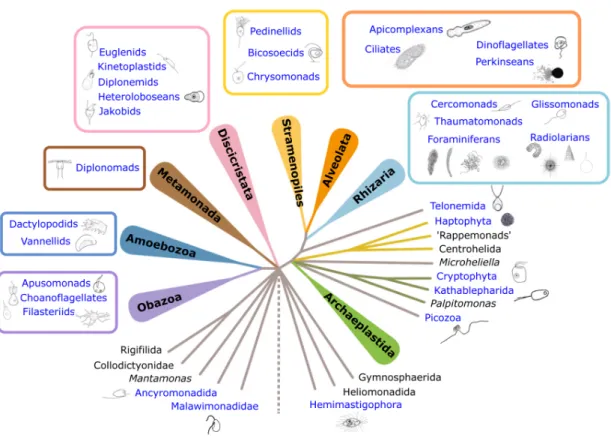
combination of molecular studies and direct observations, that nearly all known phylogenetic groups of non-testate protists are represented in deep- sea sediments below 1000 m depth (Schoenle et al. 2016; Fig. 3).
Heterotrophic flagellates
While molecular studies indicate the presence of nearly all phylogenetic groups of flagellated protists in the deep sea, there are only a few direct observations of living specimens in
samples or cultures isolated from deep-ocean habitats. While benthic and planktonic
foraminiferans are largely distinct, many flagellated protists occur both on the seafloor and in the pelagial. This is due to the fact that most flagellates are in the size range 2-8 µm for which small flocs of detritus (marine snow) form a suitable habitat (Arndt et al. 2000; Caron et al. 1982). Thus, aggregate-dwelling protists like kinetoplastids and stramenopiles, as well as small naked amoebae, occur throughout the water column (Patterson et al. 1993; Arndt et al. 2003). Many of these flagellates have been shown to withstand high pressure and,
therefore, are believed to remain active when they reach the seafloor via sedimentation (Živaljić et al. 2018). An extreme example is the common bicosoecid Cafeteria burkhardae Schoenle and Arndt, 2020, the genotype of which was recorded in samples from several abyssal plains as well as from global analyses of planktonic communities (de Vargas et al. 2015; Schoenle et al. 2020). There are certainly many barophilic flagellates that have been
overlooked when using traditional sampling methods where deep-sea samples are released from pressure when brought to the surface (Edgcomb et al. 2016b). Only few studies of these barophilic flagellates currently exist (Atkins et al 1998; Turley et al. 1988; Turley and
Carstens 1991; Živaljić et al. 2018). A rough estimate of deep-sea flagellate community composition can be derived from live-observations made directly after sampling, altthough some sensitive flagellate species may not survive sample recovery. Investigations at 1225 m depth in the Sporades Basin (Mediterranean; Greece) using direct microscopic analysis immediately after sampling showed that about one third of the flagellate community were euglenids, another third bodonids and the remaining part consisted of forms that are often overlooked in molecular studies (Arndt et al. 2003). Among these “overlooked” flagellate taxa were hemimastigophorans, which are thought to be rare in the environment (Lax et al. 2018) but seem to be common in bathyal sediments (Arndt et al. 2003; Arndt unpubl.). Flagellate taxa recorded from cultures or direct counts of deep-sea sediments (>1000 m depth; e.g. Arndt et al. 2003; Arndt et al. 2020; Arndt et al. unpubl., Patterson et a. 1993) include: apusomonads (Amastigomonas-like), filastereans (Ministeria-like), choanoflagellates (Acanthocorbis-, Diaphanoeca-, Salpingoeca-like), telonemids (Telonema-like), placidids (Placidia-, Placilonga-like), bicosoecids (Bicosoeca-, Caecitellus-, Pseudobodo-, Cafeteria-like), chrysomonads (Paraphysomonas-Cafeteria-like), pedinellids (Pteridomonas-Cafeteria-like), cercozoans (Cercomonas-, Massisteria-like, Allantion-, Protaspis-, Kiitoksia-like), cryptomonads (Goniomonas-like), jakobids (Jakoba-like), percolomonads (Percolomonas-like, Barbelia-like), euglenids (Heteronema-, Petalomonas-, Ploeotia-, Keelungia-Barbelia-like), kinetoplastids (Bodo-, Neobodo-, Bordnamonas-, Rhynchomonas-, Procryptobia-like), ancyromonads (Ancyromonas-, Fabomonas-like), hemimastigophorans (Spironema-, Hemimastix-like), incertae sedis groups (Meteora-like). Since most of these taxa were not analysed in detail, and many hve not been sequenced yet, only the closest genus is given.
Ciliates
Ciliates are an abundant and ubiquitous component of deep-sea microbial food webs. Cunningham and Ustach (1992) reported abundances in fixed samples of up to 700 cells per cm³ in surface sediments at nutrient-rich NW Atlantic stations (3833 m depth).
Metabarcoding studies regularly reveal a high diversity of ciliates in most samples from the deep seafloor (for review see Schoenle et al. 2017). Representatives of nearly all major phylogenetic groups, including Karyorelictea, Heterotrichea, Spirotrichea, Armophorea, Litostomatea, Phyllopharyngea, Nassophorea, Colpodea, Prostomatea, Plagiopylea,
Oligohymenophorea, have been recorded at depths of 1000–3000 m. However, only a few records exist from abyssal depths. Live observations of ciliates isolated from the deep sea are scarce (Schoenle et al. 2017; Živaljić et al. 2020a, b), possibly because they generally occur at relatively low abundances, and may be damaged by hydrostatic stress during conventional sampling. The broad spectrum of genotypes registered so far indicates that ciliates occupy diverse niches ranging from being consumers of prokaryotes, other protists and detritus, to acting as epibionts and parasites and most probably also as osmotrophs. Since most ciliates are relatively large compared to the nano-sized heterotrophic flagellates and amoebae, they have a potentially shorter generation time and their response to local accumulations of organic matter might be correspondingly slower. On the other hand, fast encystment and excystment was observed for a bacterivorous scuticociliate isolated from the deep sea. which could support the idea that ciliates can react quickly to pulsed organic matter inputs
(Schoenle et al. 2017; Živaljić et al. 2020b).
Naked amoeboid protists
Since direct observations are very difficult due to low abundances, slow movement and masking by sediment particles, observations on amoebae are limited to cultivable species obtained from aliquot cultivations. Davis et al. (1978) reported an Acanthamoeba-like species from the North Atlantic (3090 m depth) at densities of 0.66 ind./l. Lobosean abundances (mainly vexilliferid-like and vannellid-like morphotypes) in Mediterrean deep-sea basins close to Greece reached up to 50 ind./cm³ sediment at depths of 1225 m, considerably lower than that of flagellates although the amoebae were always present (Arndt et al. 2003). Recently, several new species have been described from deep-sea sediments, mainly representatives of paramoebid and vexilliferid amoebae (e.g. Kudryavtsev and Pawlowski 2013; Kudryavtsev et al. 2018). According to metabarcoding studies, the diversity of deep-sea amoeboid protists encompasses nearly all groups of amoebozoans, including tubulineans, evosean and discocean taxa (e.g. Rodríguez-Martínez et al. 2020).
Parasitic and symbiontic deep-sea protists
Skovgaard (2014) reviewed the great variety of marine protistan taxa that act as important parasites in the marine pelagial, observations which must also apply to deep-sea ecosystems. In a relatively early study, López-García et al. (2001) reported astonishingly high percentages of parasitic protistan genotypes (especially dinoflagellate taxa) from the deep pelagial realm (250-3000 m depth) in the Southern Ocean. Flegontova et al. (2016) pointed to the great
importance in deep water of diplonemid euglenozoans, which have recently been shown to also contribute significantly to abyssal sediment communities (Schoenle 2018). It appears currently that alveolate, euglenozoan, and radiolarian genotypes are most important in the deep sea, although their specific hosts are still unknown. According to the Red Queen Principle it could be argued that these protozoan parasites potentially contribute to the high diversity of metazoans and protozoans in the deep sea.
Another important phenomenon is that of protists as symbionts. Volkova and Kudryavtsev (2017) detected Perkinsela-related kinetoplastids living as symbionts in deep-sea isolates of Neoparamoeba longipodia Volkova and Kudryavtsev, 2017 from about 5000 m depth. Symbioses between bacteria and protists have also been reported, for example, in the case of euglenozoans, allowing their survival under anaerobic conditions (e.g., Yubuki et al. 2009).
Naked protists in deep-sea hypoxic environments
Several species of heterotrophic flagellates, ciliates and amoebae, representing different phylogenetic lineages, can live as facultative anaerobes, but only a few are known to be obligate anaerobes that perform anaerobic energy metabolism (Bernard et al. 2000; Fenchel 2012). Among them are some ciliates from deep-sea sediments that possess mitochondria-derived hydrogenosomes (Stoeck et al. 2012, Schoenle et al. 2017). As in the case of foraminiferans, nitrate respiration has been recorded (Fenchel 2012), and investigations of genes expression patterns indicate that nitrate and sulphate reduction might be of importance also for anerobic protists in deep-sea hypersaline basins (DHABs; Edgcomb et al. 2016a).
Many protists have established symbioses with bacteria such as methanogens in order to reduce hydrogen tension under anaerobic conditions, while others live in symbiosis with sulfate reducers (Fenchel 2012). The euglenid Calkinsia is associated with ectosymbiotic bacteria at more than 500 m depth in the oxygen-depleted Santa Barbara Basin (e.g. Yubuki et al. 2009). At cold seeps, grazing by protists is believed to act as an effective process structuring bacterial and archaeal communities on the surface of the sediment, as well as influencing prokaryote community structure in deeper sediment layers (Orsi 2018). Protists in cold seeps have isotope signatures of methane-derived carbon, indicating the role of
Insights from environmental genetic studies
Many novel and uncultured protistan lineages from surface waters and the deep sea have been revealed by HTS, among them new superdiverse phylogenetic groups (e.g. del Campo and Massana 2011; Edgcomb et al. 2011; López-García et al. 2001; Triadó-Margarit and Casamayor 2013). Several marine stramenopile (MAST) groups seem to be restricted to planktonic communities (Massana et al. 2004), while the groups (clades) MAST-1, -9 and -12 have also been reported in significant abundances from deep-sea sediments (Takishita et al. 2007). New lineages, including several very diverse groups of marine alveolates (MALV; Groisillier et al. 2006; Guillou et al. 2008; García et al. 2001; Moreira and López-Garcı́a 2002), have been described from the deep sea. Five independent lineages of marine alveolates (MALV group I–V) branching at the base of dinoflagellates have been discovered. One lineage (MALV II) includes sequences from described genera, among them members of the Syndiniales, which are partially or entirely intracellular parasites. It is possible that the whole MALV II group may consist of parasitic forms. On the other hand, MALV I seem to dominate permanent anoxic waters and hydrothermal ecosystems (Edgcomb et al. 2002; Groisillier et al. 2006; López-García et al. 2003). Another superdiverse deep-sea protistan group revealed by metabarcoding techniques are diplonemids belonging to the Discicristata. Although diplonemids were recorded over a decade ago (Lara et al. 2009; López-García et al. 2001), only a few sequences of cultivated and morphologically described species are
currently available (Gawryluk et al. 2016; Tashyreva et al. 2018). Metabarcoding studies, however, have recently shown that diplonemids are among the most abundant and diverse lineages of marine heterotrophs in the sunlit ocean and mesopelagic waters, representing one-fifth of the eukaryotic OTUs (David and Archibald 2016; de Vargas et al. 2015; Flegontova et al. 2016). Recent molecular studies have indicated that this might also be true for abyssal deep-sea sediments (Scheckenbach et al. 2010; Schoenle 2018). The ecological roles of several of these novel and known lineages are unclear, but they could be key players in deep-ocean ecosystems and responsible for critical environmental processes. However, the activity of these different and very abundant genotypes under deep-sea conditions remains obscure.
Substrate type
Flagellates, ciliates and naked amoebae colonise all types of substrate. Generally, higher abundances are recorded from the upper sediment layers decreasing with depth due to a reduction of available food recources (Hohlfeld et al., subm.). Non-testate protists have been found to be enriched on the surface of hard substrates such as animal remains and manganese