HAL Id: hal-00295408
https://hal.archives-ouvertes.fr/hal-00295408
Submitted on 22 Mar 2004
HAL is a multi-disciplinary open access
archive for the deposit and dissemination of
sci-entific research documents, whether they are
pub-lished or not. The documents may come from
teaching and research institutions in France or
abroad, or from public or private research centers.
L’archive ouverte pluridisciplinaire HAL, est
destinée au dépôt et à la diffusion de documents
scientifiques de niveau recherche, publiés ou non,
émanant des établissements d’enseignement et de
recherche français ou étrangers, des laboratoires
publics ou privés.
emissionsto the tropical Atlantic ozone paradox during
the Northern Hemisphere winter season: climatology
G. S. Jenkins, J.-H. Ryu
To cite this version:
G. S. Jenkins, J.-H. Ryu. Linking horizontal and vertical transports of biomass fire emissionsto
the tropical Atlantic ozone paradox during the Northern Hemisphere winter season: climatology.
Atmospheric Chemistry and Physics, European Geosciences Union, 2004, 4 (2), pp.449-469.
�hal-00295408�
SRef-ID: 1680-7324/acp/2004-4-449
Chemistry
and Physics
Linking horizontal and vertical transports of biomass fire emissions
to the tropical Atlantic ozone paradox during the Northern
Hemisphere winter season: climatology
G. S. Jenkins and J.-H. Ryu
Department of Meteorology, Penn State University, 503 Walker Building, University Park, Pennsylvania, USA Received: 29 July 2003 – Published in Atmos. Chem. Phys. Discuss.: 13 October 2003
Revised: 22 December 2003 – Accepted: 22 December 2003 – Published: 22 March 2004
Abstract. During the Northern hemisphere winter season,
biomass burning is widespread in West Africa, yet the to-tal tropospheric column ozone values (<30 DU) over much of the Tropical Atlantic Ocean (15◦N–5◦S) are relatively low. At the same time, the tropospheric column ozone val-ues in the Southern Tropical Atlantic are higher than those in the Northern Hemisphere (ozone paradox). We examine the causes for low tropospheric column ozone values by con-sidering the horizontal and vertical transport of biomass fire emissions in West Africa during November through March, using observed data which characterizes fires, aerosols, hori-zontal winds, precipitation, lightning and outgoing longwave radiation. We have found that easterly winds prevail in the lower troposphere but transition to westerly winds at pressure levels lower than 500 hPa. A persistent anticyclone over West Africa at 700 hPa is responsible for strong easterly winds, which causes a net outflow of ozone/ozone precursors from biomass burning in West Africa across the Atlantic Ocean towards South America. The lowest outgoing longwave ra-diation (OLR) and highest precipitation rates are generally found over the central Atlantic, some distance downstream of fires in West Africa making the vertical transport of ozone and ozone precursors less likely and ozone destruction more likely. However, lightning over land areas in Central Africa and South America can lead to enhanced ozone levels in the upper troposphere especially over the Southern tropical At-lantic during the Northern Hemisphere winter season.
1 Introduction
Biomass burning in the tropics serves as a primary source for atmospheric pollutants on an annual basis. In the early 1990s, it was estimated that the global annual biomass burn-ing represented 1.8 of the 4.7 GT of carbon burned and re-Correspondence to: G. S. Jenkins
leased to the atmosphere, with the savanna fires being the dominant component (1–1.6 GT of carbon burned) (Crutzen and Carmichael, 1993). Moreover, African savanna fires are estimated to account for 30% of the global biomass burn-ing emissions of trace gas and aerosols (Lacaux et al., 1993). The source of savanna fires in Africa are not centrally located in one area but can be found in the Northern and Southern Hemisphere during various times of the year. In addition, sa-vanna fires can be found in both western and eastern parts of Africa (Jenkins et al., 1997). The majority of fires are associated with clearing of forest, agricultural use, control of weeds and brush and nutrient regeneration in grazing and crop-lands (Andreae, 1991).
Biomass burning is a source of carbon monoxide oxida-tion which in the presence of nitrogen oxide (>4 pptv) can lead to ozone production in the tropics. Marufu et al. (2000) estimate that biomass burning emissions contribute 9% to the production of global tropospheric ozone on annual time-scales. Africa represents the largest contribution to the pro-duction of tropospheric ozone accounting for approximately 35% of the total. In addition to being a pollutant in the plan-etary boundary layer (PBL), O3in the troposphere acts as a
greenhouse gas, increasing the longwave forcing directed to-wards the surface. The formation of ozone near the source of the fires in the planetary boundary layer (PBL) can influ-ence the health of individuals near the fires but is quickly destroyed through deposition and photolysis. However, if ozone and its precursors (CO, NO) can be vertically trans-ported above the PBL, then the lifetime of ozone can increase from days to weeks. Satellite estimates of tropospheric col-umn ozone (TCO) values associated with biomass burning show the highest levels over the Tropical Atlantic during the months of August through November (Fishman et al. 1991). Field experiments with measurements over the Tropical At-lantic and adjacent land areas in South America (TRACE-A) and Southern Africa (SAFARI) have been carried out in order to understand the relationship between biomass burning and
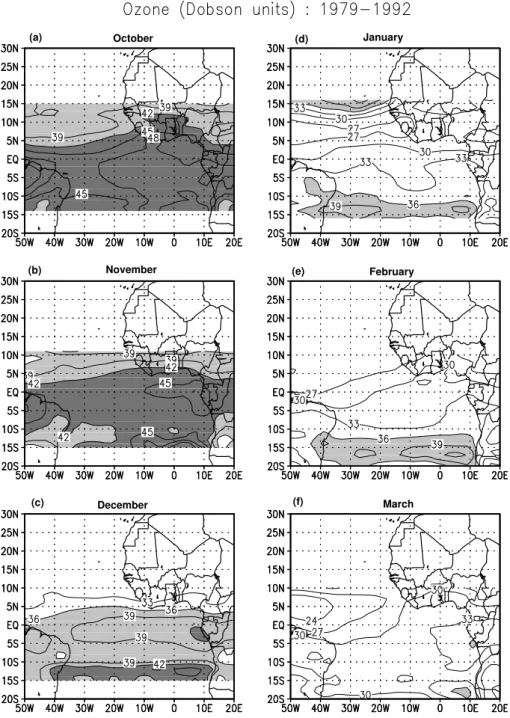
October (a) November December March February January (d) (e) (b) (f) (c)
Fig. 1. The spatial distribution of TOMS tropospheric column ozone values (Dobson unit) during (a) October through (f) March averaged
from 1979 to 1992.
elevated tropospheric ozone (Fishman et al., 1996; Lindesay et al., 1996).
During the Northern Hemisphere winter season, biomass burning is found north of the Equator (∼5–15◦N) (Gr´egoire et al., 1999). However, satellite and ozonesonde estimates of tropospheric column ozone show lower values over the north Tropical Atlantic Ocean relative to the south Tropical Atlantic and is denoted as the “Ozone Paradox” (Weller et al., 1996; Thompson et al., 2000). This suggests there might be several processes at work with respect to reduced
tro-pospheric columnar ozone in the Northern Hemisphere: (1) Ozone is produced near areas of biomass burning but limited to the PBL and destroyed in time (<1 week) by deposition and photolysis. (2) An important O3precursor is not found in
sufficient quantities for the production of O3. The most likely
O3precursor that would limit O3production is NO. In such a
case HO2could lead to the destruction of O3. However,
mea-surements in TROPOZ I and II show that NO is produced in sufficient quantities near areas of biomass burning con-tributing to the production of O3 (Jonquieres et al., 1998).
(3) O3is produced in the PBL and vertically transported into
the free troposphere. It is then transported horizontally to other regions by mean winds in the middle or upper tropo-sphere.
Measurements from aircraft, ship, and ozonesondes show elevated ozone mixing ratios in the lower troposphere (3– 5 km) over the Tropical Atlantic Ocean downstream of biomass burning in West Africa (Jonquieres et al., 1998; Thompson, et al., 2000). Jonquieres et al. (1998) suggests
that O3 is produced over West Africa and is transported at
low altitudes (3–5 km above the surface) by easterly winds towards South America. Both TROPOZ and AEROSOLS99 also found elevated levels of ozone in the middle and upper troposphere over the Southern Tropical Atlantic. Thompson et al. (2000) suggest that these elevated levels of ozone in the middle/upper troposphere were due to either a mid-latitude source or lightning, depending on the latitude. Edwards et al. (2003) have reached a similar conclusion to Thompson et al. (2000) from their satellite study during January 2001. However, these studies covered relatively short periods of time (several weeks). In this study, observational data sets are averaged over numerous seasons in order to produce a climatology.
Meteorological conditions during the winter and spring seasons, which are important to the horizontal and vertical transports of biomass fire emission, are controlled by dry northeasterly Harmattan winds with the Sahara Desert ori-gin from the surface into the lower troposphere. Near the Guinea coastline, a layer of moist southwesterly winds blow from the Gulf of Guinea and there is precipitation over ex-treme southern parts of West Africa. If vertical transport were to occur it should be due to the convection (shallow or deep). Jonquieres et al. (1998) suggest that dry
Harmat-tan winds carry O3 and O3 precursors above the Monsoon
layer as seen through cross sections of equivalent potential temperature between 5◦S and 5◦N.
The objectives of this study are to examine: (1) the hori-zontal transport of biomass fire emissions from West Africa during the Northern Hemisphere winter season. (2) Examine mechanisms for the vertical transport of biomass fire emis-sions. (3) Examine lightning over the continental outflow of South America and Central Africa during Northern Hemi-sphere winter. (4) To relate biomass emission, transport and lightning to the satellite observations of relatively low (high) tropospheric column ozone levels over the Northern (South-ern) Tropical Atlantic during the Northern Hemisphere win-ter (“ozone paradox”). This paper focuses on a climatologi-cal time-sclimatologi-cale (1979–1992) during the Northern Hemisphere winter season (DJF), while a companion paper examines ob-jectives 1 to 4 on daily time-scales during the Aerosols99 ship campaign (Jenkins et al., 2003).
2 Data description
Ozone, wind, precipitation and OLR are averaged for the pe-riod of 1979–1992 in order to establish climatological con-ditions near West Africa. The National Center for Environ-mental Prediction (NCEP) reanalysis (Kalnay et al., 1996) averaged for January 1979–1992 are used at a horizontal resolution of 2.5◦×2.5◦. The rain rates are derived from a merged data set using satellite and rain gauge data and produced at a horizontal resolution of 2.5◦×2.5◦ (Xie and
Arkin, 1997). The ozone climatology (1979–1992)
pro-duced from the total ozone mapping spectrometer (TOMS) is produced at a horizontal resolution of 1◦×2◦(Hudson and Thompson, 1998; Thompson and Hudson, 1999). Additional data associated with the production of ozone (fire counts, aerosols and lightning) are also used here but do not overlap with the meteorological and ozone data. The ozone vertical profiles from Southern Hemisphere Additional Ozonesondes (SHADOZ) stations are also used for 1998–2000 (Thompson et al., 2003). The fire count data (1996–1999) is produced from the Along Tracking Scanning Radiometer (ATSR) in-strument, which has a horizontal resolution of 1 km and a swath width of 512 km. Fires are identified at a fixed thresh-old of 312◦K (Arino and Melinotte, 1995). Fires tend to be
underestimated by the ATSR instrument because of its rel-atively poor temporal resolution with the satellite visiting a site once every three days in equatorial regions (Buon-giorno et al., 1997). The 1996–1999 monthly aerosol
in-dex is produced on a 1◦×1.25◦grid with a minimum of 20
days necessary to produce a monthly average (Herman et al., 1997; Torres et al., 1998). The Lightning Imaging Sensor
(LIS)/Optical Transient Detector (OTD) 2.5◦low-resolution
annual climatology is used for lightning data. This climatol-ogy is a combination of the 5-yr OTD (4/1995–3/2000) and 3-yr LIS (12/1997–11/2000) data and has been averaged for 2 months to reduced the bias due to undersampling (Williams et al., 2000; Christian et al., 2003). Non-gridded monthly Lightning flashes from daily LIS overpasses are also used in this study.
3 Result
3.1 Fire counts and aerosol indices
Figure 1 shows the time-averaged 1979–1992 tropospheric column ozone values for October through March over West Africa and the adjacent Tropical Atlantic Ocean. High tro-pospheric ozone columnar values (>42 DU) can be found during October and November in association with the Tropi-cal Atlantic ozone maximum (Fishman et al., 1991). There-after, smaller ozone values (<30 DU) are found over the
tropical Atlantic and adjacent West Africa. During
Jan-uary and FebrJan-uary, less than 36 DU can be found over much of the tropical Atlantic, especially those areas adjacent
Average Fire Count in West Africa (5-15N, 15W-25E) 0 500 1000 1500 2000 2500 J F M A M J J A S O N D Month Fire Count
(b)
(a)
Aerosol Index (5-15N, 15 W-25E) - Land
0 0.2 0.4 0.6 0.8 1 1.2 1.4 J F M A M J J A S O N D Month
Fig. 2. (a) The monthly fire count in West Africa (5◦N–15◦N, 15◦W–25◦E), (b) the aerosol index over land (5◦N–15◦N, 15◦W–25◦E) averaged from 1996 to 1999.
to West Africa. Higher values of ozone are found
be-tween 10◦S to 15◦S during January and February. A
similar pattern of low tropospheric columnar ozone val-ues is found using the cloud-slicing method of Ziemke et al. (2001) (http://code916.gsfc.nasa.gov/Data services/
cloud-slice/gif/clim79-01seas.gif). January ship
measure-ments of Weller et al. (1996), Thompson et al. (2000), and aircraft measurements in January (Martin et al., 2002) show that the highest ozone mixing ratios are found lower tropo-sphere. The climatological tropospheric column ozone val-ues shown in Fig. 1 during January over West Africa and the adjacent Atlantic Ocean are slightly lower than those
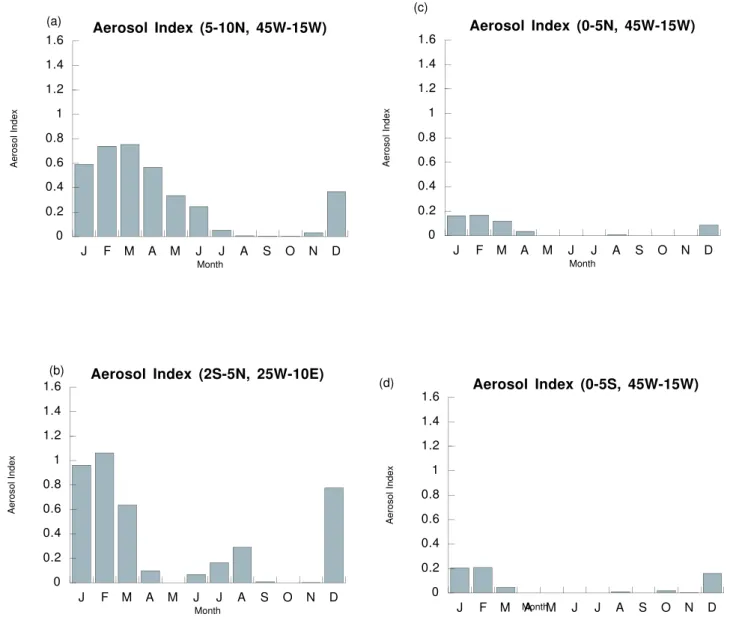
0 0.2 0.4 0.6 0.8 1 1.2 1.4 1.6 J F M A M J J A S O N D Aerosol Index (0-5N, 45W-15W) Aerosol Index Month 0 0.2 0.4 0.6 0.8 1 1.2 1.4 1.6 J F M A M J J A S O N D Aerosol Index (0-5S, 45W-15W) Aerosol Index Month 0 0.2 0.4 0.6 0.8 1 1.2 1.4 1.6 J F M A M J J A S O N D
Aerosol Index (2S-5N, 25W-10E)
Aerosol Index Month 0 0.2 0.4 0.6 0.8 1 1.2 1.4 1.6 J F M A M J J A S O N D Aerosol Index (5-10N, 45W-15W) Aerosol Index Month (d) (c) (a) (b)
Fig. 3. The monthly aerosol index averaged over the area of (a) 5◦–10◦N, 45◦W–15◦W, (b) 2◦S–5◦N, 25◦W–10◦E, (c) 0◦–5◦N, 45◦W– 15◦W, (d) 0◦–5◦S, 45◦W–15◦W.
found during January 1999 (Thompson et al., 2000) and Jan-uary 2001 (Edwards et al., 2003) with the overall pattern be-ing quiet similar. However, Kim et al. (2001) suggest that TOMS can underestimate the tropospheric column ozone if high ozone mixing ratios are found in the lower troposphere. Martin et al. (2002) suggest that TOMS tropospheric column ozone values are underestimated by 3–5 DU during DJF over areas of biomass burning in West Africa because biomass burning is confined to the lower troposphere. There are also other factors such as clouds, dust and aerosols that can in-fluence tropospheric column ozone values (Edwards et al., 2003).
The low tropospheric column ozone values in Fig. 1 oc-cur during the period (January, February) when the num-ber of fires and aerosol indices in West Africa obtain their
highest values (Fig. 2). The fire count in West Africa (5◦–
15◦N, 15◦W–25◦E) is averaged from 1996 to December
1999. Monthly geographic distributions of biomass burning can be obtained from (http://shark1.esrin.esa.it/ionia/FIRE/
AF/ATSR.). The fires occur primarily during Northern
Hemispheric winter increasing after the month of Novem-ber, peaking in January and declining thereafter (Fig. 2a). Figure 2b shows the aerosol index over a large portion of West Africa (5–15◦N, 15◦W–25◦E). The aerosol index also has a maximum during winter and high values persist for several months after the highest frequency of detected fires. High aerosol indices are found during March and April when the fire counts have fallen considerably. This suggests that aerosols can remain suspended over West Africa even when fire counts are lower.
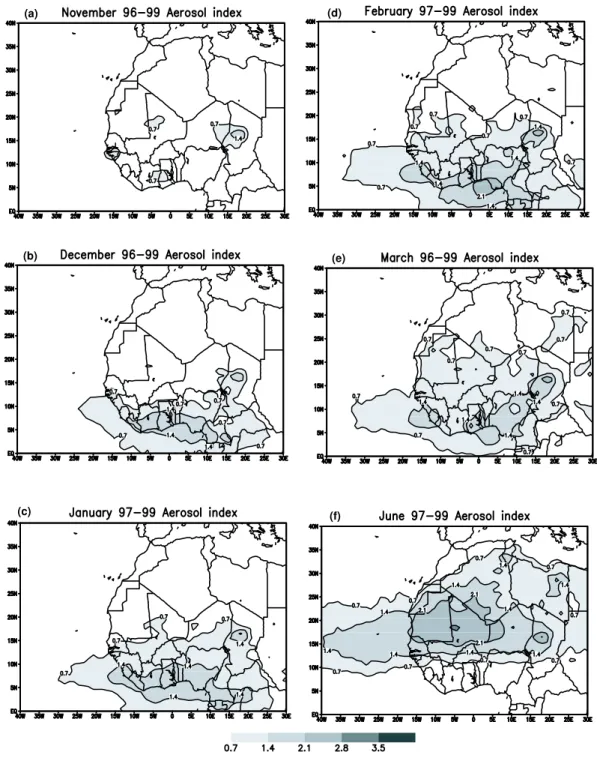
(a) (b) (c) (d) (e) (f)
Fig. 4. The spatial distribution of the aerosol index in West Africa during (a) November through (e) March and (f) June.
In the examination of aerosol indices for ocean areas ad-jacent to West Africa, the highest aerosol indices are found from January through March. There are two notable areas where high aerosol index values are found: to the west of the continent in the latitudes of 5–10◦N (Fig. 3a) and just to the south of land areas over the Gulf of Guinea, between 2◦S and 5◦N (Fig. 3b). The result suggests that two exit regions for constituents from biomass burning – to the west and to the south. Figure 3a shows the aerosol index averaged over the
ocean (5–10◦N, 45◦W–15◦W). The aerosol indices here are approximately 1/2 of the land values due to scavenging by precipitation and gravity (Fig. 2b) and possess a similar tem-poral pattern. Figure 3b shows that the highest ocean aerosol indices occur just south of the West African land mass (2◦S– 5◦N, 25◦E–10◦W). The aerosol indices over this region cor-respond closely to those over land areas (Fig. 2b) implying constituents from biomass burning are transported into this region from land. To areas just north and south of the Equator
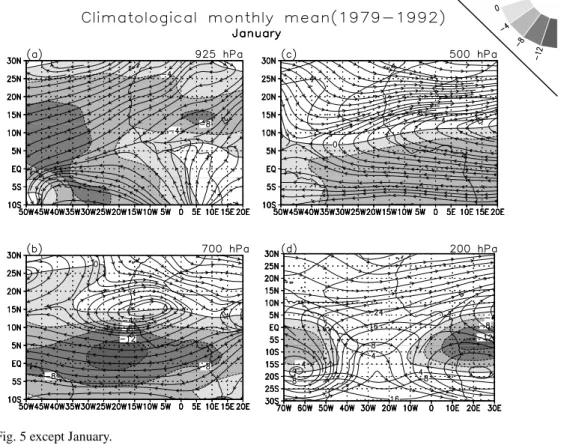
Fig. 5. The climatology of the zonal wind and streamlines in West Africa at (a) 925 hPa, (b) 700 hPa, (c) 500 hPa and (d) 200 hPa for
November averaged from 1979 to 1992.
Fig. 7. Same as Fig. 5 except January.
and located further downstream, the highest aerosol indices occur during December, January and February but the values are considerably reduced relative to land values and ocean areas closer to the West African land mass (Figs. 3c, 3d).
Figures 4a–f show the spatial distribution of aerosols for November through March and June averaged from 1996 to 1999. The aerosols can be seen in several isolated regions in November. It is during December, January and February when the fires occur in West Africa that high index values can be seen in the latitudes of 5–10◦N, extending over ocean areas due south and west of land areas. The highest indices over the ocean are confined to areas just north of the Equa-tor and to the east of 30◦W. The location of the high aerosol
index values corresponds to areas of fires, implying that the detected aerosols are due to biomass burning and not Saha-ran dust. During the month of March, high aerosol indices are found even when the fire count is substantially lower (Fig. 4e). The high aerosol indices could be due to a combi-nation of mineral dust and carbonaceous aerosols from smol-dering fires that have not been detected by satellite. March marks the end of the dry season in extreme southern parts of West Africa as precipitation begins to return. However by June, when the detected fire counts are low, high aerosol in-dices are due to Saharan dust, where high values are found to stretch across the Atlantic Ocean poleward of 10◦N (Fig. 4f).
3.2 Horizontal transport processes
Figures 5–8 show the November through February time-averaged 1979–1992 zonal wind and streamlines at 925 hPa, 700 hPa, 500 hPa and 200 hPa levels over West Africa and
the adjacent Atlantic Ocean. At 925 hPa, winds are
di-rected from the northeast and converge with southerly flow
at approximately 5◦N during November and February but
converge at slightly lower latitudes during December and
January (Figs. 5a, 6a, 7a, 8a). Hence, O3, O3 precursors
and aerosols associated with savanna fires would be trans-ported equatorward towards the convergence zone during these months as noted by Jonquieres et al. (1998). Over the Atlantic Ocean, the easterly winds are dominant during this period. A characteristic feature at 700 hPa is an anticyclone centered near 15◦N in the longitude range of 20◦W–10◦W which persists from November through February (Figs. 5b, 6b, 7b, 8b). Westerly winds can be found to the north of the anticyclone and easterly winds to the south of it. The strongest easterly winds are found over the Eastern Atlantic
between the Equator and 5◦N and longitudes of 15–30◦W.
This is not the West African Easterly Jet (AEJ) as suggested by Jonquieres et al. (1998) that owes its existence primar-ily to the meridional temperature gradient over land areas of West Africa (Cooke, 1999). The AEJ is found during the months of May through October and extends from Lake Chad out to the Eastern Atlantic Ocean. Finally, the AEJ is gen-erally found between 8◦N and 16◦N while the strong
east-erly winds identified by Jonquieres et al. (1998) are found at lower latitudes and located further west during January.
Anti-cyclonic circulation is also found at 500 hPa with the axis of the anticyclone found in the latitudes of 5–15◦N dur-ing the period (Figs. 5c, 6c, 7c, 8c). To the south of the axis, easterly winds are found to extend as far north as 10◦N during November but are confined to lower latitudes during December, January and February. The winds at 500 hPa are weaker than those at 700 hPa during the time period. This cir-culation at 500 hPa is persistent through February and west-erly winds intensify over Northern Africa. A transition to westerly winds occurs at approximately 300 hPa and prevail-ing winds are from the west or southwest directions through-out the tropics at 200 hPa throughthrough-out the period (Figs. 5d, 6d, 7d, 8d). The strongest westerly winds (>24 m/s) over West Africa are found during January and February.
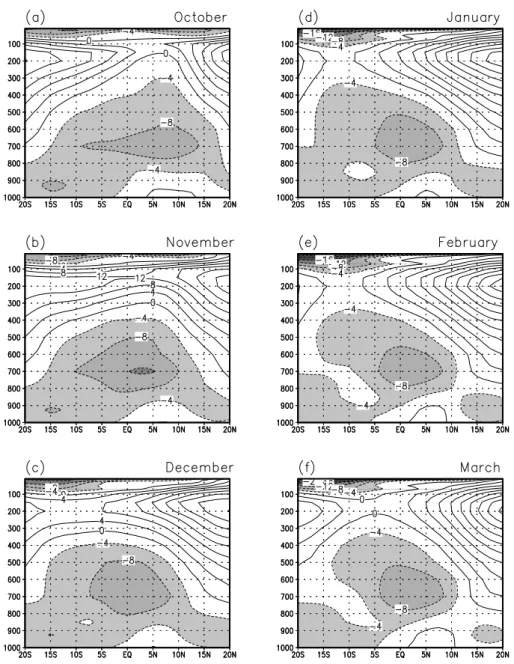
A north-south vertical profile of zonal winds at 10◦W
from October through March (Fig. 9a–f) shows that east-erly winds are found throughout the lower and middle tro-posphere. The core of easterly winds is centered at near 700 hPa from October through March and its latitudinal po-sition is located between 5◦S–15◦N. There is a transition, however, from easterly to westerly winds at approximately 500 hPa at 10◦N. Equatorward of 10◦N, this transition takes place at lower pressure levels (higher altitudes) but poleward of 10◦N this transition occurs at higher pressure levels (lower
altitudes) between 600–700 hPa. This zonal wind profile
implies that convection would not extend to very high alti-tudes and would be confined to the middle troposphere where the convective systems would be embedded in the easterly flow. Organized convective systems would encounter a sig-nificant amount of vertical shear in areas to the north of
10◦N and therefore would not be long-lived systems. But
organized convective systems are a rarity poleward of 10◦N from November through March as the “dry season” has com-menced in West Africa.
3.3 Vertical transport processes
Low OLR fluxes in the tropics are a proxy for deep convec-tion. Figure 10 shows the October through March 1979– 1992 OLR values. The lowest OLR values over land ar-eas in West Africa occur during the months of October and March. Between the months of November and February, the lowest OLR values are displaced westward over the
Trop-ical Atlantic. TypTrop-ical OLR values of 250–270 W-m−2 are
found over land areas in West Africa from November through February (Figs. 10b–e). Consequently, in order to transport biomass constituents to the middle or upper troposphere, hor-izontal transport towards the central Atlantic is necessary. Figure 11 shows the precipitation rates over West Africa and the adjacent Atlantic from October through March. Most areas associated with high precipitation rates tend to corre-spond to those of low OLR values, implying that the pre-cipitation events in the Central Atlantic are associated with
Fig. 9. Vertical Cross section of the climatological zonal wind at 10◦W for (a) October through (f) March. Units are m-s−1.
deep convection. The high precipitation rate over Tropical Atlantic Ocean in October shifts to the southwest from Octo-ber through March.
Low precipitation rates are found over land in south-ern parts of West Africa from October through November followed by even lower precipitation rates from December through February. Higher precipitation rates are found just equatorward of West Africa in the Gulf of Guinea, but the relatively high OLR values that are found do not imply deep convection. Hence, ozone and ozone precursors from fires
that are horizontally transported over the ocean cannot be vertically transported to the middle or upper troposphere by deep convection. Thus, ozone mixing ratios in the lower tro-posphere can be reduced through photolysis, deposition or may be horizontally transported towards the south or west by low level winds.
If ozone is transported equatorward or to the west by low level winds it could reach the free troposphere over the ocean through adiabatic lifting. In Figs. 12a–c, the time-averaged 1979–1992 north-south cross-sections of
November October December March February January (a) (d) (e) (b) (f ) (c)
Fig. 10. The climatology of the Outgoing Longwave Radiation (OLR) in West Africa for (a) October through (f) March averaged from 1979
to 1992.
potential temperature at 10◦W shows that equatorward
mov-ing parcels in West Africa near the surface would rise above the marine boundary layer from December through Febru-ary. Consequently, higher ozone mixing ratios should be found between 950 hPa and 800 hPa in the absence of deep convection over ocean areas due to the equatorward advec-tion of continental air from West Africa. In Figs. 12d–f, the time-averaged 1979–1992 east-west cross-sections of
poten-tial temperature at 8◦N shows that westward moving parcels in West Africa near the surface would rise above the marine boundary layer from December through February. Conse-quently, higher ozone mixing ratios should be found between 950 hPa and 800 hPa in the absence of deep convection over ocean areas due to the westward advection of continental air from West Africa. These results are in agreement with the equivalent potential temperatures found by Jonquieres
October November December January February March (a) (b) (c) (f ) (e) (d)
Fig. 11. The climatology of the precipitation rate for (a) October through (f) March averaged from 1979 to 1992. Units are mm-day−1.
et al. (1998) and the CO and O3mixing ratios found during
flights 10 and 12 during the TROPOZ campaign (CF Plates 1 and 2, Jonquieres et al., 1998). The MOSAIC commercial aircraft measurements also find that that highest ozone mix-ing ratios near 800 hPa durmix-ing January of 1997–2000 (Martin et al., 2002).
Lightning can also increase ozone levels through the
for-mation of the ozone precursor, NOx. Aircraft measurements
during TRACE-A show elevated NOx levels in the vicinity
of deep convection/lightning (Pickering et al., 1996; Jacob
et al., 1996; Smyth et al., 1996). Moreover, the study of
Martin et al. (2000) using global lightning NOx emission
estimates available from Price et al. (1997) have found that lightning explains about 20% of the variance in tropospheric column ozone values using EOF analysis. Figure 13 shows
the combined OTD-LIS flash rate (fl/km−2/dy) for 2-month
averages from November through February. The lightning distribution shows a strong land bias compared to the OLR distribution (Fig. 10). The high lightning flash rate corre-sponds to the low OLR over land, while the flash rate is
(a) (b) (d) (e) (f) (c) latitude longitude longitude longitude latitude latitude
Fig. 12. NCEP 1000-600 hPa vertical cross section of Potential Temperatures at 10◦W for (a) December, (b) January, (c) February and at 8◦N (d) December, (e) January, (c) February. Units are degree K.
(a)
(b) (d)
(c)
Fig. 13. The combined OTD/LIS flash rate for (a) October through (f) March. Units are fl-km−2-day−1.
very small over the tropical Atlantic Ocean even when the OLR values are low. The difference in the spatial distribu-tion of flash rates between tropical oceans and tropical land-masses has been studied by Boccippio et al. (2001), Nesbitt et al. (2000), Toracinta and Zipser (2001). Their studies sug-gest that land/ocean lightning differences are associated with land versus ocean convective intensity, i.e. the updraft veloc-ity and the cloud optical depth. Warm clouds over the ocean have weaker updrafts and less supercooled liquid water than clouds over land. The weak updrafts reduce the loft of large particles, such as supercooled liquid water, into the mixed phase region causing few ice particle collisions and leading to less charge separation, i.e. less cloud electrification.
High lightning flash rates are found over the continents of Central Africa and South America. Near the coastline of West Africa, lightning is observed during October and November, but the flash rate is reduced December through
February. This feature was also shown in Toracinta and
Zipser (2001). The lightning frequently occurred over a wide range of the South America continent during October and
November and decreases from December through March. The frequent occurrence of the lightning over the two con-tinents during November through February is likely linked to the elevation of tropospheric column ozone over the Tropi-cal Atlantic Ocean when considering the upper troposphere streamline distribution. During December, an anticyclone
whose center is found between 15–20◦S and near 25◦E
de-velops and persists through March producing easterly winds and outflow from Central Africa at 200 hPa. At the same time, westerly winds are associated with continental outflow from South America at 200 hPa and cyclonic flow over the extreme Western Atlantic. This is essentially a Walker type circulation with rising motions over land and sinking mo-tions over the Tropical Atlantic (not shown). Since both of these regions (Central Africa and South America) are asso-ciated with high flash rates, ozone produced by lightning in the upper troposphere would get transported horizontally into the Central Atlantic Ocean producing relatively high ozone values in the latitude band between 10◦S and 15◦S during January and February (Figs. 1d, 1e).
4 Conclusions
During Northern Hemisphere autumn, high tropospheric col-umn ozone values (>42 DU) can be found over the Southern Tropical Atlantic Ocean from September through Novem-ber. During Northern Hemisphere winter (DJF), the high-est tropospheric column ozone values are still found over the Southern Tropical Atlantic Ocean and not the Northern Tropical Atlantic Ocean, which is located just downstream of biomass burning in West Africa (Ozone Paradox).
Our analysis suggests that there are four possible processes that can enhance tropospheric ozone levels during N. H. win-ter over the Tropical Atlantic Ocean.
– Air is transported westward or equatorward from areas
of biomass burning near the surface in West Africa is lifted above the marine boundary layer through adia-batic motions even in the absence of moist processes. In this case, the highest concentrations of pollutants should be found between 950 and 800 hPa over the East-ern and Central Atlantic Ocean. Elevated ozone mixing ratios were found in TROPOZ I, II, RV Polarstern and Aerosol99 campaign (Jonquieres et al., 1998; Weller et al., 1996; Thompson et al., 2000).
– Ozone and/or its precursors from biomass burning in
West Africa are transported equatorward or westward over the Tropical Atlantic Ocean after it has been ver-tically transported to the lower/middle troposphere by convection. This process would take place primarily in the Gulf of Guinea where lower OLR and higher pre-cipitation rates are found during the Northern Hemi-sphere winter season. Even if this process were to occur OLR and precipitation rates do not suggest deep convec-tion and hence ozone or ozone precursors would be de-trained in the lower or middle troposphere (>500 hPa) and transported westward over the Tropical Atlantic. At lower pressures (<500 hPa), ozone or ozone precursors would be transported eastward by westerly winds.
– Stratosphere/troposphere exchanges of ozone could also
enhance tropospheric columnar levels (Weller et al., 1996). In the tropics, such exchanges would most likely occur with deep convection that penetrates the lower stratosphere (Jenkins et al., 1997). These deep con-vective systems would be associated with strong verti-cal updrafts and lightning. The only regions that could be associated with stratosphere/troposphere exchanges would be over Central Africa and parts of South Amer-ica based on low OLR values and lightning distributions during January.
– The fourth mechanism for enhancing tropospheric
ozone especially in the latitude band between 10◦S and
15◦S during January and February is associated with
Ozone Mixing Ratio at Ascension Island (7.98oS, 14.42o W)
0 10 20 30 40 50 60 70 80 90 sur-850mb 850-700 700-500 500-300 300-150 Layer (hPa) ppbv January October
Ozone Mixing Ratios at Natal, Brazil (5.42oS, 35.38oW)
0 10 20 30 40 50 60 70 80 sur-850 850-700 700-500 500-300 300-150 Layer (hPa) January October
Ozone Mixing Ratio at Paramaribo, Surinam (5.81oN, 55.21oW)
0 10 20 30 40 50 60 70 80 sur-850 850-700 700-500 500-300 300-150 Layer (hPa) January October (a) (b) (c) ppbv ppbv
Fig. 14. 1999–2001 ozone mixing ratio during January and October
averaged over various tropospheric layers. (a) Ascension Island, (b) Natal, Brazil, (c) Paramaribo, Surinam. Units are in ppbv.
lightning leading to the production of NOx/O3, and
con-sequently, ozone over Central Africa and South Amer-ica followed by the horizontal transport of ozone by upper level winds towards the Tropical South Atlantic. Thompson et al. (2000) surmise that ozone production
of 4–8 DU per day during the Aerosols99 campaign in the upper troposphere was due to NOxfrom lightning in
Central Africa.
Jonquieres et al. (1998) suggest that elevated O3levels in
the upper troposphere during January were associated with South America. However, they did not provide the mecha-nism for the production of O3. We have found that the most
likely source of O3is lightning. Thompson et al. (2000)
iden-tified lightning from Central Africa as a likely source of el-evated ozone in Zone 3 (0–23◦S). However, our results sug-gest that upper tropospheric O3 levels in Zone 3 (0–23◦S)
and the southern latitudes of Zone 2 (14◦N–0◦) can also be
enhanced by lightning from South America. In fact, light-ning is probably an important factor in the SON Tropical At-lantic ozone maximum. We examine this possibility further through ozonesonde, lightning data and upper troposphere streamline analysis associated with South America/Central Africa and the Tropical Atlantic.
Figures 14a, b, and c show that the 1999–2001 average ozone mixing ratios at Ascension Island (7.98◦S, 14.42◦W),
Natal, Brazil (5.42◦S, 35.38◦W) and Paramaribo, Surinam
(5.81◦N, 55.21◦W) are higher in the upper troposphere in both January and October. During January, ozone mixing ratios are approximately 45–65 ppbv during January in the 500–300 hPa layer and 50–65 ppbv in the 300–150 hPa layer. During October, ozone values in the upper troposphere are enhanced by an additional 5–25 ppbv at the three locations. We believe that the high ozone mixing ratios found at all three sites in the upper troposphere are linked to deep con-vection/lightning from South America and Central Africa based on our analysis below. Moreover, higher ozone mix-ing ratios are found at all layers throughout the troposphere during October (Ozone Maximum) relative to January. The 1999–2001 average ozone mixing ratios from the surface to 150 hPa during January at Ascension Island, Natal and Para-maribo are 45 ppbv, 40 ppbv and 37.1 ppbv, respectively. The 1999–2001 average ozone mixing ratios from the surface to 150 hPa during October at Ascension Island, Natal and Para-maribo are 65 ppbv, 56 ppbv and 46 ppbv, respectively.
Figure 15a shows the monthly total number of lightning flashes from the LIS instrument from 1998 through 2001 for
a 3◦×3◦ area surrounding Natal and Paramaribo. In both
cases, only a small number of lightning flashes have been identified near these locations and consequently the NOx/O3
production by lightning must be transported into this region from other areas of South America. The highest frequency of lightning flashes in Natal occurs during the Southern Hemi-sphere summer and autumn season and during the Northern Hemisphere summer and autumn seasons at Paramaribo.
Figure 15b shows the 1998–2001 monthly lightning flashes from LIS overpasses for central and northwestern sectors of South America (10◦N–10◦S, 76◦W–56◦W), and over the continental outflow regions of eastern South
Amer-ica (0◦–20◦S, 56◦W–36◦W) and Central Africa (4◦N–
16◦S, 9◦E–29◦E). Based on the 1998–2001 period an
average of 9206 flashes were detected in Central Africa and 7728 flashes in South America (6164 flashes in cen-tral/northwestern and 1564 flashes in eastern parts of South America) during the month of January. Hence, lightning in South America and Central Africa can serve as a source of ozone during January. In contrast, during the same period an average of 26 771 lightning flashes were detected during the month of October for the combined three regions. An average of 10 637 flashes occurred in Central Africa while 16 134 flashes occurred in South America. The large num-ber of lightning flashes in Central Africa and South America overlaps with the timing of the ozone maximum (SON) over the South Tropical Atlantic Ocean. It provides support to the model study by Moxim and Levy (2000), which suggests that the September ozone maximum is due to lightning and not necessarily biomass burning. Model simulations by Martin et al. (2002) show that ozone is enhanced through lightning during DJF and SON by 10–14 DU. Lightning was also sug-gested as the dominant cause for high NO and ozone values in the upper troposphere during October in TRACE-A exper-iment (Thompson et al., 1996).
Figures 16 and 17 show the wind patterns in the middle and upper troposphere for January and October 1999–2001. At 500 and 400 hPa during January and October the prevail-ing winds are easterly and would transport ozone produced by lightning from Central Africa toward the South Tropi-cal Atlantic influencing the 3-ozonesonde stations (Figs. 16, 17a, b). At 300 hPa during January and October the easterly winds can be found over the Tropical Atlantic, but the east-erly winds are displaced into the northern hemisphere during October (Figs. 16c, 17c). The 3-ozonezonde stations are un-der the influence of 300 hPa easterly winds January but in October only Paramaribo is under the influence of easterly winds. Westerly winds are found above Natal and Ascension Island during October, but an oceanic anticyclone, which cir-culates air from Central Africa into their vicinities, also influ-ences these stations. During January at 200 hPa, Natal and Paramaribo are under the influence of westerly winds from South America while Ascension Island is under the influence from Central Africa (Fig. 16d). During October all three sta-tions are under the influence of westerly winds, which come from South America (Fig. 17d). It is possible that Ascension Island could be influenced by anticyclone flow from Central Africa at 200 hPa in October (Fig. 17d).
A summary of Figs. 14–17 implies that elevated ozone mixing ratios at the 3 ozonesonde stations and over the Trop-ical Atlantic in the 500–300 hPa layers during January and October are associated with NOx/O3produced via lightning
processes over Central Africa. Ozone is then transported by easterly winds towards the Tropical South Atlantic and South America. On the other hand, elevated ozone mixing ratios in the 300–150 hPa layers during January and October are asso-ciated with NOx/O3production via lightning primarily from
1998-2001 Total Lightning Flashes 0 5 0 0 0 1 0 0 0 0 1 5 0 0 0 2 0 0 0 0 2 5 0 0 0 3 0 0 0 0 3 5 0 0 0 4 0 0 0 0 4 5 0 0 0 5 0 0 0 0 J F M A M J J A S O N D Month # of Flashes South America (10oN-10oS, 76oW-56oW) South America East (0-20oS, 56oW-36oW) Central Africa (4oN-16oS, 9oE-39oE)
1998-2001 Total Lightning Flashes near Ozonesonde Launch Stations
0 5 0 1 0 0 1 5 0 2 0 0 2 5 0 3 0 0 3 5 0 J F M A M J J A S O N D Month # of Flashes Natal Paramaribo (b) (a)
Fig. 15. 1998–2001 total lightning flashes detected by the LIS instrument (a) for Natal, Brazil and Paramaribo, Surinam. (b) For
Fig. 16. The climatology of the zonal wind and streamlines at (a) 500 hPa, (b) 400 hPa, (c) 300 hPa and (d) 200 hPa for DJF averaged from
1979 to 1992.
west affecting the Tropical Atlantic and the ozonesonde sta-tions in Paramaribo, Natal and Ascension Island.
Another suggested potential source of upper tropospheric ozone during DJF could be associated with the Northern Hemisphere extra-tropics. The model study of Martin et al. (2002) suggest that upper level westerly winds in the N. H. subtropics could be diverted to the southern Tropical Atlantic enhancing ozone by 10–15 DU. The simulated upper level winds by Martin et al. (2002) differ significantly from the NCEP long-term winds which show strong westerly winds at 300 hPa that are not diverted towards the Tropical South Atlantic Ocean (See Fig. 16c).
In summary we have examined the causes of the Tropical Atlantic “ozone paradox” and determined that tropospheric ozone values are relatively low during DJF because: (1) The
lack of deep convection near regions of biomass burning is suppressing ozone mixing ratios in the troposphere by con-fining it to the lower troposphere. (2) Ozone and ozone pre-cursors are horizontally transported in the lower troposphere from the eastern Tropical Atlantic towards South America, in agreement with Jonquieres et al. (1998), by strong low-level easterly winds between 925 hPa and 700 hPa. On the other hand, lightning over South America and Central Africa, as determined by LIS, enhances Southern Hemisphere ozone values in the middle/upper troposphere during DJF. The 1998–2001 LIS results are agreement with the modeling study of Martin et al. (2002) and the satellite results for Jan-uary 2001 by Edwards et al. (2003).
Fig. 17. The climatology of the zonal wind and streamlines at (a) 500 hPa, (b) 400 hPa, (c) 300 hPa and (d) 200 hPa for SON averaged from
1979 to 1992.
The results presented here are also consistent with the re-sults of Jenkins et al. (2003) for the Aerosols99 campaign time period. We have shown Jenkins et al. (2003), however, that on daily-time scales eastward propagating anti-cyclones in the middle/upper troposphere can influence the horizontal transport (trajectories) and convection in the Gulf of Guinea may lead the vertical transport of ozone/ozone precursors associated with biomass burning in West Africa. We have also shown that for this time period that lightning in Gulf of Guinea, Central Africa and South America influenced the measured ozone in the middle/upper troposphere. Because of westerly wind at high altitudes, lightning over South Amer-ica can influence ozone mixing ratios at pressure levels less than 300 hPa, while lightning over Central Africa influences ozone mixing ratios in the middle troposphere (500/300 hPa).
Future field experiments should be undertaken over the
Tropical Atlantic (20◦N–20◦S), adjacent South American
and West African land masses to determine the various sources (biomass burning, lightning), sinks (photolysis, de-position), horizontal and vertical transports (convection). One important issue to resolve is the differences between TOMS satellite derived tropospheric column ozone values and those of ozonesondes. The proposed African Monsoon Multidisciplinary Experiment (AMMA), which has a winter monsoon component (http://medias.obs-mip.fr/amma) could help to resolve some of these issues. However, long-term monitoring sites of ozone in West Africa will provide a more complete understanding of the ozone paradox with the other monitoring sites in the Southern Hemisphere tropics (Logan, 1999).
Acknowledgements. This research was supported through NSF
Grant ATM-0105206 and NASA Grant NAG5-7443. Lightning data have been provided by the NASA Lightning Imaging Sensor (LIS) science team and the LIS data center located at the Global Hydrology and Climate Center (GHCC), Huntsville, Alabama. NCEP data have been provided by the climate diagnostics center in Boulder Colorado. We thank T. Stoy for the useful comments on this manuscript.
Edited by: P. Monks
References
Arino, O. and Melinotte, J.-M.: The Fire Atlas, Earth Observation Quarterly, 50, December, 1995.
Andreae, M.: Biomass burning: Its history, use and distribution and its impact on environmental quality and global climate, Global Biomass Burning: Atmospheric, Climatic and Biospheric Impli-cations, edited by Levine, J. S., pp. 3–21, MIT Press, Cambridge, Mass., 1991.
Boccippio, D. J., Goodman, S. J., and Heckman, S.: Regional differences in tropical lightning distribution, J. Appl. Met., 39, 2231–2248, 2000.
Buongiorno, A., Arino, O., Zehner, C., Colagrande, P., and Goryl, P.: ERS-2 Monitors The South East Asia Exceptional Fire Event, Earth Observation Quarterly, 56, 1997.
Christian, H. J., Blakeslee, R. J., Boccippio, D. J., et al.: Global frequency and distribution of lightning as observed from space by the Optical Transient Detector, J. Geophys. Res., 108, doi:10.1029/2002JD002347, 2003.
Cooke, H. K.: Generation of the African easterly jet and its role in determining West African Precipitation, J. Climate, 12, 1165– 1184, 1999.
Crutzen, P. J. and Carmichael, R.: Modeling the influence of fires on atmospheric chemistry, Fire in the Environment: The ecological and Climatic Influence of Vegetation Fires, edited by Crutzen, P. J. and Goldhammer, J. G., John Wiley, NY, 1993.
Edwards, D. P., Lamarque, J.-F., Attie, J.-L., et al.: Tropospheric Ozone over the Tropical Atlantic: A satellite perspective, J. Geo-phys. Res., 108, doi:10.1029/2002JD002927, 2003.
Fishman, J., Fakhruzzaman, K., Cros, B., and Nganga, D.: Identifi-cation of Widespread Pollution in the Southern Hemisphere De-duced from Satellite Analyses, Science, 252, 1693–1696, 1991. Fishman, J., Hoell Jr., J. M., Bendura, R. D., McNeal, R. J., and
Kirchhoff, V. W. J. H.: NASA GTE TRACE A Experiment (September–October 1992): Overview, J. Geophys. Res., 101, 23 865–23 879, 1996.
Gr´egoire, J.-M., Pinnock, S., Dwyer, E., and Janodet, E.: Satellite monitoring of vegetation fires for EXPRESSO: Outline of activ-ity and relative importance of the study area in the global picture of biomass burning, J. Geophys. Res., 104, 30 691–30 699, 1999. Herman, J. R., Bhartia, P. K., Torres, O., Hsu, C., Seftor, C., and Celarier, E.: Global Distribution of UV-Absorbing Aerosols From Nimbus-7/TOMS Data, J. Geophys. Res., 102, 16 911– 16 922, 1997.
Hudson, R. D. and Thompson, A. M.: Tropical tropospheric ozone from total ozone mapping spectrometer by a modified-residual method, J. Geophys. Res., 103, 22 129–22 145, 1998.
Jacob, D. J., Heikes, B. G., Fan, S.-M., et al.: Origin of ozone and NOx in the tropical troposphere: A photochemical analysis of aircraft observations over the South Atlantic basin, J. Geophys. Res., 101, 24 069–24 082, 1996.
Jenkins, G. S., Mohr, K., Morris, V. R., and Arino, O.: The Role of Convective Processes over the Zaire and Congo Basins to the Southern Hemisphere Ozone Maximum, J. Geophys. Res., 102, 18 963–18 980, 1997.
Jenkins, G. S., Ryu, J.-H., Thompson, A., and Witte, J.: Link-ing horizontal and vertical transports of biomass fire emis-sions to the Tropical Atlantic Ozone Paradox during the Northern Hemisphere winter season: 1999, J. Geophys. Res., doi:10.1029/JD2002003297, 2003.
Jonquieres, I., Marenco, A., Maahes, A., and Rohrer, F.: Study of Ozone Formation and TransAtlantic Transport from Biomass Burning Emissions over West Africa during the Airborne Tropo-spheric Ozone Campaigns TROPOZ I and TROPOZ II, J. Geo-phys. Res., 103, 19 059–19 073, 1998.
Kalnay, E., Kanamitsu, M., Kistler, R., et al.: The NCEP/NCAR 40-Year Reanalysis Project, Bulletin of the American Meteoro-logical Society, 77, 3, 437–472, 1996.
Kim, J. H., Newchurch, M. J., and Han, K.: Distribution of Trop-ical Ozone Determined by the Scale-Angle Method Applied to TOMS Measurements, JAS, 58, 2699–2708, 2001.
Lacaux, J. P., Cachier, H., and Delmas, R. A.: Biomass Burning in Africa: An overview of its impact on atmospheric chemistry in Fire in the Environment: The ecological and Climatic Influence of Vegetation Fires, edited by Crutzen, P. J. and Goldhammer, J. G., John Wiley, NY, 1993.
Lindesay, J. A., Andreae, M. O., Goldammer, J. G., et al.: Inter-national Geosphere-Biosphere Programme/InterInter-national Global Atmospheric Chemistry SAFARI-92 field experiment: Back-ground and overview, J. Geophys. Res., 101, 23 521–23 530, 1996.
Logan, J. A.: An analysis of ozonesonde data for the troposphere: Recommendations for testing 3-D models and development of a gridded climatology for tropospheric ozone, J. Geophys. Res., 104, 16 115–16 149, 1999.
Martin, R. V., Jacob, D. J., Logan, J. A., et al.: Detection of a light-ning influence on tropical tropospheric ozone, Geophys. Res. Lett., 27, 1639–1642, 2000.
Martin, R. V., Jacob, D. J., Logan J. A., et al.: Interpretation of TOMS observations of tropical tropospheric ozone with a global model and in situ observations, J. Geophys. Res., 107, doi:10.1029/2001JD001480, 2002.
Marufu, L., Dentener, F., Lelieveld, J., Andrea, M. O., and Helas, G.: Photochemistry of the African troposphere: Influence of biomass-burning emissions, J. Geophys. Res., 105, 14 513– 14 530, 2000.
Moxim, W. J. and Levy II, H.: A model analysis of the tropical South Atlantic Ocean tropospheric ozone maximum: The inter-action of transport and chemistry, J. Geophys. Res., 105, 17 393– 17 415, 2000.
Nesbitt, S. W., Zipser, E. J., and Cecil, D. J.: A census of precipi-tation features in the tropics using TRMM: Radar, ice scattering and lightning observations, J. Clim, 13, 4087–4106, 2000. Pickering, K. E., Thompson, A. M., Wang, Y., et al.:
Convec-tive transport of biomass burning emissions over Brazil during TRACE-A, J. Geophys. Res., 101, 23 993–24 012, 1996.
Price, C., Penner, J., and Prather, M.: NOX from lightning 1. Global distribution based on lightning physics, J. Geophys. Res., 102, 5929–5941, 1997.
Smyth, S. B., Sandholm, S. T., Bradshaw, J. D., et al.: Factors in-fluencing the upper free tropospheric distribution of reactive ni-trogen over the South Atlantic during the TRACE A experiment, J. Geophys. Res., 101, 24 165–24 186, 1996.
Thompson, A. M., Pickering, K. E., McNamara D. P., et al.: Where did tropospheric ozone over southern Africa and the tropical At-lantic come from in October 1992? Insights from TOMS, GTE TRACE A, and SAFARI 1992, J. Geophys. Res., 101, 24 251– 24 278, 1996.
Thompson, A. M. and Hudson, R. D.: Tropical tropospospheric (TTO) maps from Nimbus 7 and Earth-Probe TOMS by the Modified-Residual method: Evaluation with sondes, ENSO sig-nals and trends from Atlantic regional time series, J. Geophys. Res., 104, 26 961–26 975, 1999.
Thompson A. M., Doddridge, B. G., Witte, J. C., et al.: A Trop-ical Atlantic Paradox: Shipboard and Satellite Views of a Tro-pospheric Ozone Maximum and Wave-one in January–February 1999, Geophys. Res. Lett., 27, 3317–3320, 2000.
Thompson, A. M., Witte, J. C., McPeters, R. D. et al.: South-ern Hemisphere Additional Ozonesondes (SHADOZ) 1998– 2000 tropical ozone climatology 1. Comparison with Total Ozone Mapping Spectrometer (TOMS) and ground-based mea-surements, J. Geophys. Res., 108, DOI:10.1029/2001JD000967, 2003.
Toracinta, E. R. and Zipser, E. J.: Lightning and SSM/I ice-scattering mesoscale convective systems in the global tropics, J. Appl. Met., 40, 983–1002, 2001.
Torres, O., Bhartia, P. K., Herman, J. R., Ahmad, Z., and Gleason, J.: Derivation of aerosol properties from satellite measurements of backscattered ultraviolet radiation: Theoretical basis, J. Geo-phys. Res., 103, 17 099–17 110, 1998.
Weller, R., Lilischkis, R., Schrems, O., Neuber, R., and Wessel, S.: Vertical ozone distribution in the marine atmosphere over the central Atlantic Ocean (56◦S–50◦N), J. Geophys. Res., 101, 1387–1399, 1996.
Williams, E. R., Rothkin, K., Stevenson, D., and Boccippio, D. J.: Global lightning variations caused by changes in thunderstorm flash rate and by changes in the number of thunderstorms, J. Appl. Met. 39, 2223–2230, 2000.
Xie, P. and Arkin, P. A.: Global Precipitation: 17-Year Monthly Analysis Based on Gauge Observations, Satellites Estimates and Numerical Model Outputs, BAMS, 78, 2539–2558, 1997. Ziemke, J. R., Chandra, S., and Bhartia, P. K.: “Cloud Slicing”: A
new technique to derive upper tropospheric ozone from satellite measurements, J. Geophys. Res., 106, 9853–9867, 2001.