HAL Id: hal-02349539
https://hal.umontpellier.fr/hal-02349539
Submitted on 6 Nov 2020
HAL is a multi-disciplinary open access
archive for the deposit and dissemination of sci-entific research documents, whether they are pub-lished or not. The documents may come from teaching and research institutions in France or abroad, or from public or private research centers.
L’archive ouverte pluridisciplinaire HAL, est destinée au dépôt et à la diffusion de documents scientifiques de niveau recherche, publiés ou non, émanant des établissements d’enseignement et de recherche français ou étrangers, des laboratoires publics ou privés.
pressure subduction-zone metamorphism (Lago di
Cignana Unit, Italian Western Alps)
Mattia Gilio, Marco Scambelluri, Samuele Agostini, Marguerite Godard,
Daniel Peters, Thomas Pettke
To cite this version:
Mattia Gilio, Marco Scambelluri, Samuele Agostini, Marguerite Godard, Daniel Peters, et al.. Stabil-ity of antigorite serpentinite and geochemical exchange with oceanic crustal rocks during ultrahigh-pressure subduction-zone metamorphism (Lago di Cignana Unit, Italian Western Alps). Journal of Petrology, Oxford University Press (OUP), 2019, 60 (6), pp.1229-1262. �10.1093/petrology/egz030�. �hal-02349539�
For Peer Review
Draft Manuscript for Review
Stability of antigorite serpentinite and geochemical exchange with oceanic crustal rocks during ultrahigh– pressure subduction–zone metamorphism (Lago di Cignana
Unit, Italian Western Alps)
Journal: Journal of Petrology
Manuscript ID Draft
Manuscript Type: Original Manuscript
Date Submitted by the Author: n/a
Complete List of Authors: Gilio, Mattia; Universita degli Studi di Genova Dipartimento di Scienze della Terra dell'Ambiente e della Vita; Universita degli Studi di Pavia
Dipartimento di Scienze della Terra e dell Ambiente
Scambelluri, Marco; University of Genova, Dipartimento di Scienze della Terra dell'Ambiente e della Vita Genova
Agostini, Samuele; Istituto di Geoscienze e Georisorse, Consiglio Nazionale delle Ricerche (CNR), Via Moruzzi, 1, 56124 Pisa, Italy
Godard, Marguerite; CNRS, Géosciences Montpellier, Université de Montpellier
Peters, Daniel; University of Bern, Institute of Geological Sciences; Institut de Recherche en Astrophysique et Planetologie
Pettke, Thomas; University of Bern, Institute of Geological Sciences
Keyword: subduction, serpentinite, oceanic crust, ultrahigh-pressure metamorphism, fluid-rock exchange, element transfer, Lago di Cignana, Ti-chondrodite
For Peer Review
Stability of antigorite serpentinite and geochemical exchange with oceanic crustal rocks
1
during ultrahigh–pressure subduction–zone metamorphism (Lago di Cignana Unit,
2
Italian Western Alps).
3
Mattia Gilio1,2*, Marco Scambelluri1,3, Samuele Agostini3, Marguerite Godard4, Daniel
4
Peters5,6, Thomas Pettke5 5
1
Dipartimento di Scienze della Terra e dell’Ambiente e della Vita, Università degli Studi di 6
Genova, corso Europa 26, 16132 Genova, Italy 7
2
Dipartimento di Scienze della Terra e dell’Ambiente, Università degli Studi di Pavia, via 8
Ferrata 1, 27100 Pavia, Italy 9
3
Instituto di Geoscienze e Georisorse, Consiglio Nazionale delle Ricerche, via Moruzzi 1, 10
56124 Pisa, Italy 11
4
Géosciences Montpellier, Université Montpellier 2, cc60, Place Bataillon, 34095 12
Montpellier, France 13
5Institute of Geological Sciences, University of Bern, Baltzerstrasse 3, 3012 Bern,
14
Switzerland 15
6
Institut de Recherche en Astrophysique et Planétologie, Observatoire Midi-Pyrénées, 14 16
Avenue Belin, 31400 Toulouse, France 17
Keywords
18
Subduction; serpentinite; oceanic crust; ultrahigh-pressure metamorphism; fluid-rock 19
exchange; element transfer; Lago di Cignana; Ti-chondrodite 20 Abstract 21 3 4 5 6 7 8 9 10 11 12 13 14 15 16 17 18 19 20 21 22 23 24 25 26 27 28 29 30 31 32 33 34 35 36 37 38 39 40 41 42 43 44 45 46 47 48 49 50 51 52 53 54 55 56
For Peer Review
The Lago di Cignana Unit is a coesite– and diamond–bearing ophiolite recording 22
Alpine ultrahigh–pressure (UHP) metamorphism at 600 °C–3.2 GPa (~110 km depth). This 23
Unit is tectonically sandwiched between two ophiolitic slices: the eclogitic Zermatt–Saas 24
Zone (540 °C–3.2 GPa) and the blueschist Combin Zone (400 °C–0.9 GPa) along a tectonic 25
structure joining high–pressure (HP) units recording a ~1.2 GPa (40 km) pressure difference. 26
So far, the Zermatt–Saas Zone has been attributed to HP conditions and the mechanism 27
driving exhumation and accretion of the UHP Lago di Cignana Unit in its present structural 28
position is not fully understood. Here we show that the top of the Zermatt–Saas Zone consists 29
of a thin sliver of UHP serpentinites (the Cignana serpentinite), lying on top of a 30
homogeneous unit (the Zermatt serpentinite). The Zermatt and the Cignana serpentinites 31
underwent different pressure–temperature paths during the Alpine subduction history. The 32
serpentinite enveloping the UHP Lago di Cignana Unit shows a first crystallization of olivine 33
+ Ti–clinohumite in rocks and veins at about 2.0 GPa and 450–500 °C. A second generation 34
of veins include Ti–chondrodite formed at higher PT conditions of about 3.0 GPa and 600– 35
650 °C, comparable to the UHP event recorded by the nearby eclogite and metasediments of 36
the Lago di Cignana Unit. Type 1 and type 2 veins are both overgrown by later stage Ti– 37
clinohumite. 38
The mineral association antigorite + olivine + Ti–clinohumite/chondrodite is thus 39
stable in serpentinites at U HP conditions in the coesite and diamond facies. Furthermore, the 40
trace element and isotopic compositions of the Cignana serpentine suggest geochemical 41
exchange with the nearby crustal rocks of the Lago di Cignana Unit. This geochemical 42
imprint is different from the one recorded by the Zermatt serpentinite, which only records 43
oceanic hydration and underwent subduction in a close system environment. This implies that 44
the UHP serpentinite enveloping Cignana was tectonically juxtaposed with the Cignana 45
crustal rocks during the prograde subduction history, exchanging fluid–mobile trace elements 46 3 4 5 6 7 8 9 10 11 12 13 14 15 16 17 18 19 20 21 22 23 24 25 26 27 28 29 30 31 32 33 34 35 36 37 38 39 40 41 42 43 44 45 46 47 48 49 50 51 52 53 54 55 56
For Peer Review
and modifying its pristine oceanic isotopic signature. The crustal UHP Cignana rocks and the 47
associated UHP serpentinite were exhumed together along the major discontinuity separating 48
the Zermatt and the Combin Zones, which may represent a fossil plate interface active during 49
the exhumation stages. 50
INTRODUCTION
51
Serpentinites are considered as key rocks affecting the geochemical cycles of fluid 52
mobile elements and tectonics in subduction zones (Spandler and Pirard, 2013; Deschamps 53
et al., 2013; Kendrick et al., 2017). Due to their ability to transfer water (Ulmer and
54
Trommsdorff, 1995) and fluid mobile elements to great depths, they have been referred to as
55
'sponges' (Deschamps et al., 2011), whose behaviour during hydration and dehydration 56
processes controls the geochemical and physical properties of subducting slabs and overlying 57
mantle (Reynard, 2013; Rüpke et al., 2004). Increasing importance is now given to interface 58
domains between subducting and overlying plates, where serpentinite is part of tectonic 59
mélanges atop the slab (Bebout, 2007; Scambelluri et al., 2014), forms thick tectonic slices 60
detached from slabs and accreted to the plate interface (Angiboust et al., 2014; Guillot et al., 61
2015; Cannaò et al., 2016), or derives from hydration of supra–subduction mantle (Guillot
62
et al., 2001; Bostock et al., 2002; Savov et al., 2005; Ryan et al., 2014). From a geophysical
63
point of view, architecture and lithologies of the subduction plate interface are uncertain due 64
to limited resolution in geophysical screening of deep subduction environments. Several 65
models for the plate interface environment tried to integrate field/structural and 66
petrological/geochemical studies with geophysical investigations of present day subduction 67
zones (Ranero & Sallares, 2004; Bebout, 2007; Brovarone et al., 2013; Agard et al., 2009; 68
Angiboust et al., 2009; 2014; Bostock, 2013). These models suggest the plate interface is a
69
sharp contact between oceanic crust and mantle wedge, which preserves distinct lithological 70
domains, or coincides with a mechanical and metasomatic melange zone. One of these 71 3 4 5 6 7 8 9 10 11 12 13 14 15 16 17 18 19 20 21 22 23 24 25 26 27 28 29 30 31 32 33 34 35 36 37 38 39 40 41 42 43 44 45 46 47 48 49 50 51 52 53 54 55 56
For Peer Review
models for deep (80 km) environments describes this plate interface as consisting of 72
decoupled slices of coherent oceanic crust and metasediments associated with thick portions 73
of serpentinized slab mantle (Angiboust et al., 2009, 2014). This implies complex 74
geometries with strain partitioning and deformation accumulated in 100–500 m thick 75
serpentinite shear zones enveloping less deformed bodies of oceanic crust and metasediments 76
(Guillot et al., 2001; Angiboust et al., 2011; 2012b; 2014). Understanding such geometries 77
and the processes involved during subduction and exhumation is vital to characterize the 78
timing of coupling–decoupling of different oceanic slices and their accretion at the plate 79
interface. 80
The interest in serpentinites increased in the mid–1990s, based on the 81
discovery of widespread ocean floor serpentinization (Cannat et al., 1995) and the stability 82
of antigorite to eclogite–facies conditions (Ulmer & Trommsdorff, 1995; Scambelluri et 83
al., 1995; Schmidt & Poli, 1998). This led to investigations on the role of subducted
84
serpentinized mantle in water and fluid–mobile element recycling to arc magmas 85
(Scambelluri et al., 2004, 2014; Scambelluri & Tonarini, 2012; Deschamps et al., 2011, 86
2013; John et al., 2011; Kendrick et al., 2011; Debret et al., 2013a, 2013b; Cannaò et al.,
87
2015, 2016; Rüpke et al., 2004; Iwamori, 1998) and its involvement in exhumation
88
tectonics (Hermann et al., 2000; Schwartz et al., 2001). Serpentinites are reliable tracers of 89
geochemical interactions and metasomatism in subduction zones (Hattori et al., 2005; 90
Deschamps et al., 2011, 2013; Scambelluri & Tonarini, 2012; Scambelluri et al., 2015;
91
Cannaò et al., 2015, 2016; Lafay et al., 2013). Serpentinites acquire their peculiar
92
geochemical (e.g. B, U/Cs, As, Sb; Kodolányi et al., 2012; Peters et al., 2017) and isotopic 93
(e.g. marine 87Sr/86Sr, δ11B) characteristics during the main oceanic serpentinization event, 94
and these may variably evolve during their subduction. The study of subducted serpentinites 95
and associated oceanic crust and metasediments can be a powerful tool to reconstruct 96 3 4 5 6 7 8 9 10 11 12 13 14 15 16 17 18 19 20 21 22 23 24 25 26 27 28 29 30 31 32 33 34 35 36 37 38 39 40 41 42 43 44 45 46 47 48 49 50 51 52 53 54 55 56
For Peer Review
geometry and architecture of fossil subduction systems (Scambelluri & Tonarini, 2012; 97
Cannaò et al., 2015, 2016; Scambelluri et al., 2014, 2015).
98
Serpentinized mantle can host up to 13 wt.% of water to HP and UHP depth 99
(Ulmer & Trommsdorff, 1995). Dehydration reactions like antigorite + brucite → olivine + 100
H2O, and antigorite → olivine + orthopyroxene + chlorite + H2O release substantial amounts
101
of water in subduction zones, triggering element exchange between serpentinites and adjacent 102
rocks. Although these reactions can provide reliable temperature constraints (Sanchez– 103
Vizcaino et al., 2005; Scambelluri et al., 2004, 2014), the steep slopes of dehydration
104
reactions in a pressure versus temperature plot prevent accurate pressure estimates (Ulmer & 105
Trommsdorff, 1995). To the contrary, the transition from Ti–Clinohumite to Ti–Chondrodite
106
(2.6–3.0 GPa for 500–650 °C), helps to constrain the pressure attained during high–pressure 107
(HP) metamorphism of serpentinite (Shen et al., 2015). 108
Serpentinite and de-serpentinization fluid compositions help to unravel 109
element exchange and fluid–pathways in HP subduction settings. The HP ophiolites of 110
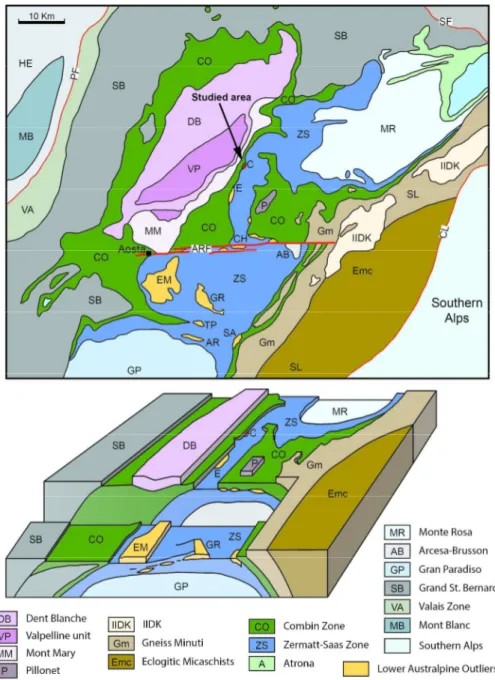
Zermatt–Saas Zone (Figure 1) and the associated ultrahigh–pressure (UHP) oceanic crust of 111
the Lago di Cignana Unit (Figures 1 and 2), are suitable locations to investigate fluid 112
exchange under UHP subduction conditions. The Zermatt–Saas Zone (ZSZ) is a slice of 113
eclogite–facies oceanic crust (Ernst & Dal Piaz, 1978; Bucher et al., 2005; Angiboust et 114
al., 2009) in contact with the continental Monte Rosa Nappe at the bottom and the
115
blueschist–facies metaophiolites of the Combin Unit at the top. The top of the ZSZ hosts 116
several tectonic slices of different ages, pressure–temperature evolution and provenance 117
(Teodulo, Etirol–Levaz, Allalin Gabbro; Bucher & Grapes, 2009; Skora et al., 2015). One 118
of these slices, the Lago di Cignana Unit (LCU), was subducted to more than 90 km depth 119
(3.2 GPa – 550 °C) during the Eocene and retains the highest recorded pressures amongst HP 120
ophiolites in the Alpine–Himalayan orogenic system (Figure 1; Reinecke, 1998; Groppo et 121 3 4 5 6 7 8 9 10 11 12 13 14 15 16 17 18 19 20 21 22 23 24 25 26 27 28 29 30 31 32 33 34 35 36 37 38 39 40 41 42 43 44 45 46 47 48 49 50 51 52 53 54 55 56
For Peer Review
al., 2009; Frezzotti et al., 2011). As such, it represents a good proxy for studying the fluid
122
pathways and the tectonic coupling of different rock units within the plate interface during 123
UHP metamorphism. 124
There is strong debate about whether the Zermatt–Saas Zone was a coherent tectonic 125
unit during its subduction–exhumation cycle. Several structural and petrologic studies 126
suggest that this is the case, also based on original stratigraphic contacts preserved 127
(Angiboust et al., 2009; Beltrando et al., 2010; Tartarotti et al., 2017). Other work 128
indicates that the Zermatt–Saas Zone is a stack of different slices which followed distinct 129
subduction–exhumation paths (Li et al., 2004; Bucher and Grapes, 2009; Groppo et al., 130
2009; Rebay et al., 2012; Zanoni et al., 2016; Skora et al., 2015). Skora et al. (2015)
131
evaluated and discussed Lu–Hf ages from various slices in the Zermatt–Saas Zone and 132
suggested an early subduction of the units at its structural top (50 Ma; Lago di Cignana, 133
Pfulwe, and Chamois), followed by a largely coeval peak metamorphism at around 43–39 134
Ma. 135
Classic petrologic work has reconstructed the evolution of the Zermatt Saas Zone 136
from basaltic eclogites, often ignoring (for a lack of viable geobarometers) the tectonic 137
history and PT evolution of the surrounding serpentinites. Using simple thermodynamic 138
modelling on Zermatt serpentinites directly underlying the Lago di Cignana Unit, Rebay et 139
al. (2012) reports peak estimates up to 2.7 GPa. Following these results, Zanoni et al. (2016)
140
suggested that such PT estimates may point to a domain of UHP conditions. Nonetheless, PT 141
estimates on basaltic eclogites suggest the Zermatt–Saas zone was equilibrated at an overall 142
lower P (Angiboust et al., 2009). Furthermore, it has remained unclear whether an antigorite 143
+ olivine + Ti–clinohumite system will survive UHP conditions (P ≥ 3.0 GPa), because this 144
assemblage was never found in natural sample but only observed in experimental work 145
(Ulmer and Trommsdorff, 1995). 146 3 4 5 6 7 8 9 10 11 12 13 14 15 16 17 18 19 20 21 22 23 24 25 26 27 28 29 30 31 32 33 34 35 36 37 38 39 40 41 42 43 44 45 46 47 48 49 50 51 52 53 54 55 56
For Peer Review
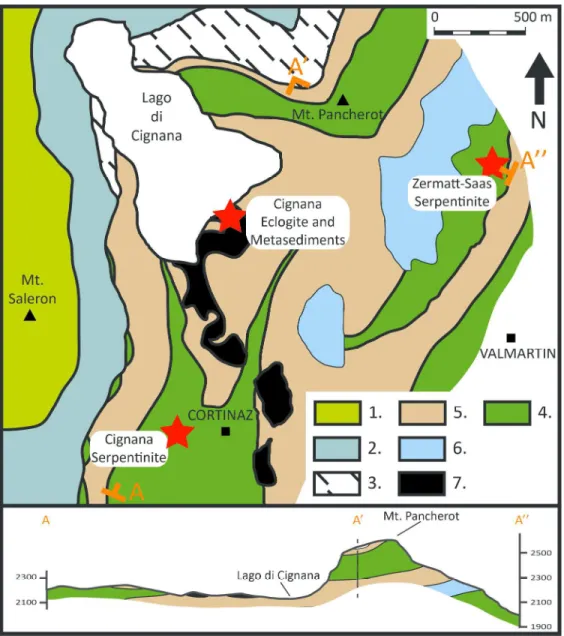
In this work, we sampled serpentinites at increasing distance from the UHP Lago di 147
Cignana Unit (Figure 2) to test whether the transition from the UHP Cignana Unit to the 148
surrounding serpentinite is accompanied by a change in PT conditions recorded by 149
serpentinites and/or by a change in their trace element (TE) and isotopic (Sr and Pb) 150
composition. Our goal is to compare the geochemical and isotopic imprint of the ZSZ and the 151
Cignana serpentinites, verify whether element exchange occurred between the crustal UHP 152
Cignana rocks and the surroundings serpentinites and if so, at which conditions it took place. 153
This will shed light on the nature and behaviour of the plate interface during the Alpine 154
subduction cycle. 155
GEOLOGIC AND PETROLOGIC BACKGROUND
156
The Piemonte Ophiolite Nappe is the remnant of the Mesozoic Piemontese ocean, 157
subducted and incorporated into the Alpine orogen. In the Valtournenche area (Aosta Valley, 158
Italy), the Piemonte Ophiolite Nappe consists of a pile of tectonic slivers commonly divided 159
into Combin Zone on top, and Zermatt–Saas Zone at the bottom (Bearth, 1967). The high– 160
pressure ophiolite units from Valtournenche and Aosta Valley are overlain by the continental 161
Dent Blanche klippe (blueschist–facies) and Sesia-Lanzo (eclogite–facies) units. The Combin 162
Unit represents the sedimentary transition between the Piemonte ocean and the European 163
continental margin (Figure 1). It consists of metamorphic conglomerates, quartzites, 164
dolostones, and sedimentary breccias, containing slices of serpentinized mantle peridotite 165
equilibrated in epidote–blueschist facies during the Eocene (300–450 °C and ∼∼∼0.9 GPa; ∼∼ ∼∼∼44
166
Ma; Reddy et al., 1999). 167
The Zermatt–Saas Zone represents a subducted remnant of the Mesozoic 168
Tethys. It consists of: (1) serpentinized mantle peridotite (Li et al., 2004; Rebay et al., 169
2012), (2) portions of oceanic crust (Fe–Ti and Mg–Al gabbros and metabasalts) strongly re–
170
equilibrated in eclogite, blueschists and greenschists facies (Bucher et al., 2005) and 171 3 4 5 6 7 8 9 10 11 12 13 14 15 16 17 18 19 20 21 22 23 24 25 26 27 28 29 30 31 32 33 34 35 36 37 38 39 40 41 42 43 44 45 46 47 48 49 50 51 52 53 54 55 56
For Peer Review
subordinate oceanic metasediments (Mn–rich quartzites, calc–schists and marbles; Bearth & 172
Schwander, 1981). Previous work on Zermatt serpentinite, performed by Rebay et al. (2012)
173
and Zanoni et al. (2012) showed that this area underwent a complex tectonic and 174
metamorphic history, from oceanic hydration to Alpine subduction. The authors distinguished 175
three main deformation events, related to deformation–induced recrystallization of antigorite 176
and metamorphic olivine during the prograde (D1), peak (D2), and retrograde (D3) 177
metamorphic event. D1 develops an antigorite foliation (S1). Olivine + Ti–clinohumite + 178
magnetite veins cut the S1 foliation and are, in turn, deformed and stretched along an olivine– 179
bearing foliation (S2). Late crenulation (D3) and open folding deforms the pervasive HP S2 180
foliation and develops a weak, antigorite + chlorite foliation (S3). Zircon crystals associated 181
with the HP S2 foliation in serpentinite gave an age of about 65.5 Ma (Rebay et al., 2017). 182
The central section of the ZSZ shows concordant metamorphic peak 183
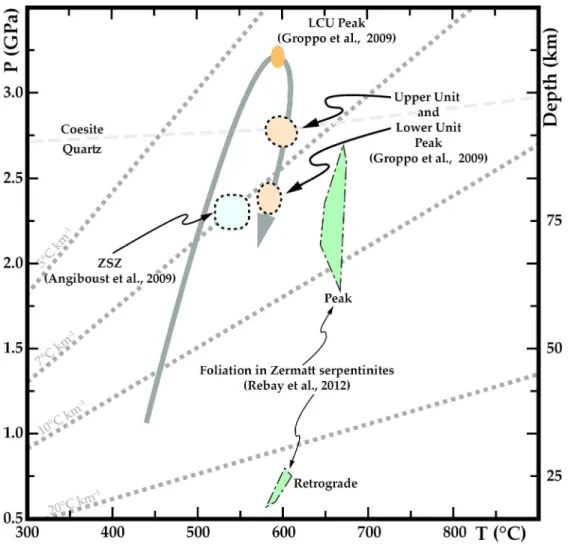
conditions (540 ± 20 °C and 2.3 ± 0.1 GPa; Figure 3; Angiboust et al., 2009) and ages (41– 184
38 Ma, Skora et al., 2015). To the contrary, the top–section of the ZSZ, in contact with the 185
Combin Unit, shows greater complexity. Here, oceanic and continental slices of different 186
provenance, PT histories, and metamorphic ages occur within olivine– and Ti–clinohumite– 187
bearing serpentinites (Etirol–Levaz, Beltrando et al., 2010; Pfulwe, Skora et al., 2015; 188
Allalin Gabbro, Bucher & Grapes, 2009; Teodulo Glacier Unit, Weber & Bucher, 2015; 189
Lago di Cignana Unit, Groppo et al., 2009; Frezzotti et al., 2011; Reinecke, 1998). One of 190
these slices of metasediments and eclogites, the Lago di Cignana Unit (LCU), crops out to the 191
South of the Cignana artificial lake, SW of the dam. The Lago di Cignana Unit is a small 192
slice of MORB–type oceanic crust covered by oceanic sediments tectonically sandwiched 193
between the lower ZSZ and the overlying Combin and Dent Blanche Units. The peculiar 194
feature of the Cignana crustal section is that it equilibrated under ultrahigh–pressure (UHP) 195
conditions during the alpine event (600 °C – 3.2 GPa; Figure 3; Groppo et al., 2009; 196 3 4 5 6 7 8 9 10 11 12 13 14 15 16 17 18 19 20 21 22 23 24 25 26 27 28 29 30 31 32 33 34 35 36 37 38 39 40 41 42 43 44 45 46 47 48 49 50 51 52 53 54 55 56
For Peer Review
Reinecke, 1998), witnessed by the presence of coesite inclusions in mafic rocks and
197
metasediments and of microdiamonds in meta–sedimentary rocks (Reinecke, 1991, 1998; 198
Frezzotti et al., 2011). Pressure estimates of up to 3.6 GPa derive from microdiamond
199
occurrence (Frezzotti et al., 2011). U–Pb zircon ages of Cignana eclogite yield an average of 200
44.1 ± 0.7 Ma, interpreted to date the peak subduction event (Rubatto et al., 1998). Rb–Sr 201
cooling ages on white mica in Cignana metasediments indicate rapid exhumation at ∼38 Ma 202
(Amato et al., 1999). Several authors (Forster et al., 2004; Groppo et al., 2009; Reinecke, 203
1998) consider these serpentinites to be part of the underlying, lower pressure, Zermatt–Saas
204
Zone. 205
ANALYTICAL METHODS
206
Bulk rock major element concentrations were measured either by XRF at the 207
Activation Laboratories in Toronto, Canada, or by the laser–ablation ICP–MS pressed 208
powder pellet (LA–ICP–MS PPP) technique at the University of Bern, Switzerland (Peters & 209
Pettke, 2017). Trace element measurements were done either by liquid–mode ICP–MS at the
210
University of Montpellier, France, or by LA–ICP–PPP at the University of Bern, Switzerland. 211
Data are reported in Table 2. 212
Liquid mode ICP–MS followed the procedures described in Ionov et al. (1992) and in 213
Godard et al. (2000). 100 mg powdered sample aliquots were dissolved in a HF/HClO4 214
mixture in screw–top Teflon beakers and then diluted for measurement by a factor of 1000, 215
2000, and 4000 for ultramafic, mafic, and silicic rocks, respectively, using an Agilent 7700X 216
quadrupole ICP–MS. External calibration solutions employed were multi–element standard 217
solutions (Merck) except for Nb and Ta, and In and Bi were used as internal standards. To 218
avoid memory effects due to the introduction of concentrations Nb–Ta solutions in the 219
instrument, Nb and Ta concentrations were determined by using, respectively, Zr and Hf as 220
internal standards. This surrogate calibration technique is adapted from the method described 221 3 4 5 6 7 8 9 10 11 12 13 14 15 16 17 18 19 20 21 22 23 24 25 26 27 28 29 30 31 32 33 34 35 36 37 38 39 40 41 42 43 44 45 46 47 48 49 50 51 52 53 54 55 56
For Peer Review
by Jochum et al. (1990) for the determination of Nb by spark–source mass spectrometry. 222
Scandium, V, Mn, Co, Ni, Cu, Zn, and As were measured in helium cell gas mode, in order to 223
reduce polyatomic interferences. Reproducibility and accuracy of analyses were monitored 224
by measuring, as unknows, the standards BHVO-1, BE-N and OU6 (used for trace–element 225
rich rocks, like gneiss, micaschist and black-wall), UB-N, BIR-1 and MRG1 (for intermediate 226
mafic rocks), and JP-1 and DTS-1 (for depleted chlorite harzburgite). 227
Bulk rock measurements performed by LA–ICP–MS PPP follow the procedures 228
documented in detail by Peters & Pettke (2017). The sample processing procedure 229
comprised the following steps: (1) dry milling of crushed rock powder and (2) subsequent 230
wet milling of ∼2.2 g of rock powder in 5.6 g of high purity water, all in agate milling 231
equipment using a Retsch PM 100 planetary ball mill, to obtaining an average powder grain 232
size a few µm. (3) The sample suspension is then dried down on a hot plate under a fume 233
hood at 70 °C. (4) The production of the pressed powder pellets involves homogenisation of 234
the dried powder and mixing by hand of 120 mg rock powder with 30 mg of microcrystalline 235
cellulose as binder using a small agate mortar and pestle, and then pressing robust pellets in a 236
manual hydraulic press at 500 MPa using an in–house built steel apparatus. The resulting 237
pellets were measured at 6 spots each with a laser beam size of 120 µm, an energy density of 238
5 J/cm2 at a repetition rate of 10 Hz, and calibrated by bracketing standardisation employing
239
the United State Geological Survey (USGS) basalt glass GSD–1G. LA–ICP–MS 240
measurements were done using a Geolas Pro 193 nm ArF excimer laser coupled with an Elan 241
DRC–e ICP–MS at the University of Bern, Switzerland. Instrument optimisation procedures 242
followed those detailed in Pettke et al. (2012). Data reduction employed SILLS (Guillong et 243
al., 2008), and 100 wt.% minus LOI (wt.%) was used as the internal standard for
244
quantification. Due to lack of data on Fe3+/Fe2+, total iron was calculated as FeO. Analytical
245
accuracy was monitored by measurement of BCR–2G standard as PPP, and data correspond 246 3 4 5 6 7 8 9 10 11 12 13 14 15 16 17 18 19 20 21 22 23 24 25 26 27 28 29 30 31 32 33 34 35 36 37 38 39 40 41 42 43 44 45 46 47 48 49 50 51 52 53 54 55 56
For Peer Review
to the long–term averages reported in Peters & Pettke (2017) except for Be and Cd, for 247
which measurements near the respective limits of detection can produce strong overestimates 248
(Peters and Pettke, 2017). 249
Isotope ratio measurements were performed using a Finnigan MAT 262 multiple 250
collector thermal ionisation mass spectrometer (TIMS) at IGG–CNR of Pisa (Italy). For Pb, 251
the instrument was operated in static mode. Lead fractions were purified with conventional 252
ion chromatography using Dowex AG1–X8 anion resin, using standard HBr and HCl elution 253
procedures. Lead was loaded on single Re (99.999% pure) filaments with TEOS solution and 254
measured at a pyrometer–controlled temperature of 1310 °C. Replicate analyses of Pb 255
standard SRM981 yielded isotope ratios are accurate to within 0.025% (2SD) per mass unit, 256
after applying a mass bias correction of 0.15±0.01% per mass unit relative to the NIST SRM 257
981 reference composition of Todt et al. (1996). Lead blanks were of the order of 0.2 − 0.4 258
ng during the period of chemistry processing; hence, no blank correction was made. 259
Strontium isotope ratio measurements were performed in dynamic mode. Strontium fractions 260
were purified using the Sr–spec ion exchange resin. Instrumental mass bias correction was 261
done by internal normalisation to 86Sr/88Sr = 0.1194. Replicate measurements of NIST SRM
262
987 (SrCO3) standard gave an average value of 0.710207 ± 13 (2SD, n = 47). Our data were
263
adjusted to 87Sr/86Sr = 0.710250. Throughout the full chemical process, the Sr blanks were
264
approximately 0.3 ng, which are negligible for the analysed samples (0.3–0.5 g of sample, 265
depending on Sr content). Lead and Sr isotope ratios are reported with age correction (40 Ma; 266
Rubatto et al., 1998) using U, Th, Pb, Rb, and Sr concentrations obtained from liquid mode
267
ICP–MS measurements, respectively. 268
In–situ major element (SiO2, TiO2, Al2O3, Cr2O3, FeO, MgO, MnO, CaO, NiO, Na2O,
269
and K2O) compositions of minerals (Table 2–6) were measured using a JEOL JXA 8200
270
Superprobe equipped with five wavelengths–dispersive (WDS) spectrometers, an energy 271 3 4 5 6 7 8 9 10 11 12 13 14 15 16 17 18 19 20 21 22 23 24 25 26 27 28 29 30 31 32 33 34 35 36 37 38 39 40 41 42 43 44 45 46 47 48 49 50 51 52 53 54 55 56
For Peer Review
dispersive (EDS) spectrometer, and a cathodoluminescence detector (accelerating potential 272
15 kV, beam current 15nA), operating at the Dipartimento di Scienze della Terra, University 273
of Milano. The measurements of all elements were performed with a 30–second counting 274
time. Results with total oxide percentage lower than 98% and higher than 102% were 275
immediately discarded from the data set. A second measurement quality check was done 276
based on atoms per formula unit, discarding measurements that showed more than 0.5% 277
deviation from the stoichiometric composition. 278
RESULTS
279
Petrography and microstructures
280
Samples were collected along a profile from the internal part of the Zermatt–Saas 281
Zone into the LCU UHP unit, localised in Figure 2 and reported in Table 1. Tectonic units 282
sampled include (1) the serpentinites from the Zermatt Saas Zone, in the area described in 283
Rebay et al. (2012), (2) the Lago di Cignana Unit (basaltic eclogites and metasediments),
284
and (3) the serpentinites directly in contact with the UHP Lago di Cignana Unit referred to 285
here as Cignana serpentinites; serpentinites and Ti–chondrodite/clinohumite veins). 286
Zermatt–Saas Zone Serpentinite
287
Zermatt–Saas Zone serpentinites crop out in a structurally lower area with respect to 288
the LCU (Figure 2). Three samples of Zermatt serpentinite (ZSG1405, ZSG1406, ZSG1410) 289
from the area described in Rebay et al. (2012) were investigated in detail. The Zermatt 290
serpentinite displays a well–developed antigorite (Atg) + olivine (Ol) + diopside (Di) ± 291
magnetite (Mag) foliation (S2) parallel to boudinaged rodingite dykes and wrapping around 292
less deformed serpentinite domains. This foliation and the less deformed serpentinite include 293
pre–kinematic clasts of mantle clinopyroxene (Cpx), bastites after mantle pyroxene, and 294
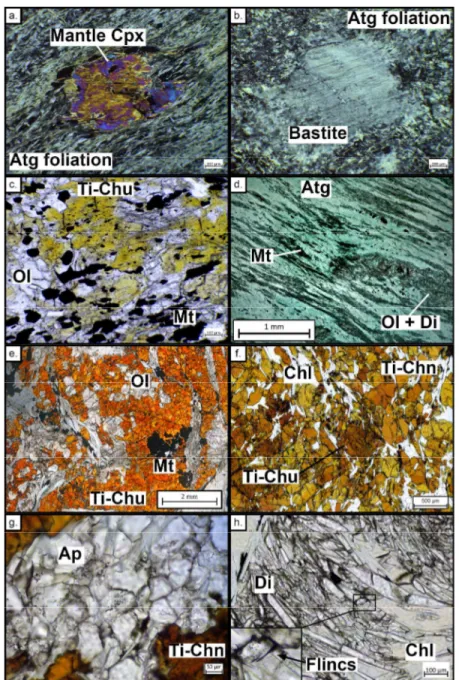
mesh structures (serpentine + magnetite) after mantle olivine (Figure 4a–b). Metamorphic 295 3 4 5 6 7 8 9 10 11 12 13 14 15 16 17 18 19 20 21 22 23 24 25 26 27 28 29 30 31 32 33 34 35 36 37 38 39 40 41 42 43 44 45 46 47 48 49 50 51 52 53 54 55 56
For Peer Review
diopside aggregates are stretched along the main foliation or grow around mantle 296
clinopyroxene porphyroclasts. Sample ZSG1406 contains fragments of olivine + Ti– 297
clinohumite (Ti–Chu) veins, locally showing tiny Ti–chondrodite (Ti–Chn) relict grains 298
(Figure 4c). 299
Lago di Cignana eclogite and metasediments
300
The five metasediment samples comprise metaquartzite (LCG1414 and LCG1415), 301
meta–calcschist (LCG1416A and LCG1416B), and marble (LCG1501), in addition to one 302
basaltic eclogite (LCG1401; Table 1). 303
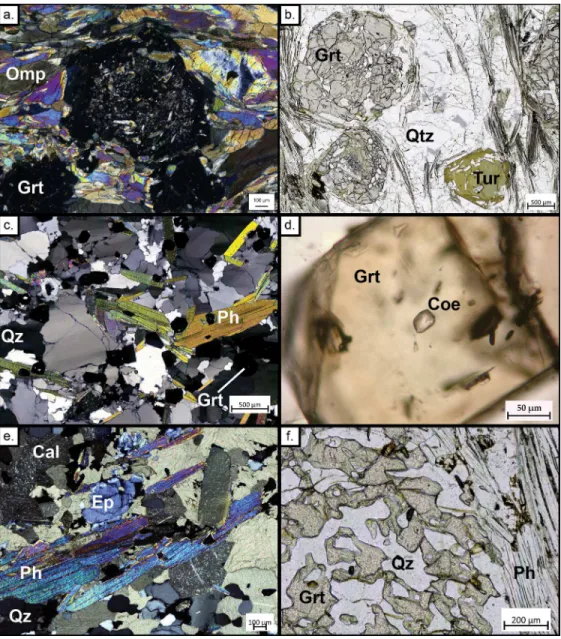
The basaltic eclogite (Figure 5a) consists of garnet (Grt), omphacite (Omp), phengite 304
(Ph), and rutile (Rt). Garnet shows inclusion–rich cores, mostly coesite (Coe), quartz (Qz) 305
phengite, zircon (Zrn), rutile, and apatite (Ap), and inclusion–poor rims. Omphacite occurs as 306
large (mm–sized) crystals, generally zoned from core to rim. Eclogite shows various degrees 307
of re–equilibration along weak foliations defined by blue– and/or green–schist facies 308
minerals, mostly glaucophane (Gln) after omphacite, chlorite (Chl) and barroisite (Brs) after 309
garnet. Amongst collected eclogites, sample LCG1401 (Figure 5a) show the weakest 310
retrograde overprint (<5%). 311
The Cignana metasediments consist of (1) impure, locally Mn–rich, quartzite 312
(LCG1415, Figure 5b–c–d), (2) garnet calcschists (LCG1416A and LCG1416B, Figure 5e– 313
f), and (3) garnet–bearing impure marbles (LCG1501). Quartzite has poikiloblastic garnet
314
and tourmaline (Tur) with inclusions of coesite (optically identified, now mostly quartz), 315
phengite/piemontite, apatite, and rutile. Mn–quartzite contains garnet, phengite, piemontite 316
(Pmt), pseudomorphs after lawsonite (Lws), and epidote (Ep) with an allanite (Aln) core 317
(Figure 5c–d). Mn–garnet occurs within layers and close–packed nodules of 50–300 µm– 318
sized crystals and often contains coesite inclusions (Figure 5d). Quartzite locally hosts large 319 3 4 5 6 7 8 9 10 11 12 13 14 15 16 17 18 19 20 21 22 23 24 25 26 27 28 29 30 31 32 33 34 35 36 37 38 39 40 41 42 43 44 45 46 47 48 49 50 51 52 53 54 55 56
For Peer Review
(1–2 mm) garnet poikiloblasts and zoned tourmaline (LCG1415). Oriented phengite (3T 320
polytype; Groppo et al., 2009) defines the foliation in quartzites. Exhumation–related quartz 321
sub–grain growth along with undulous extinction suggests that all quartz recrystallized from 322
original UHP coesite during exhumation. Quartzites are partially retrogressed to epidote– 323
greenschist facies: albite (Ab) replaces phengite, albite and muscovite (Ms) replace 324
lawsonite, and chlorite and barroisite replace garnet. Calcschist (LCG1416A and LCG1416B) 325
and impure marble (LCG1501) contain calcite (Cal), quartz, poikiloblastic garnet, epidote, 326
phengite, and rare paragonite (Figure 5e–f). Typical inclusions in garnet are calcite, apatite, 327
rutile, coesite, and white mica. The UHP eclogitic assemblage is rarely preserved in 328
calcschists. Garnet is partially chloritized at rims and late iron hydroxides replace HP mica 329
and epidote. 330
Cignana Serpentinites
331
A serpentinite body, 1km long and 100m thick, crops out 200m to the West of the 332
Southern section of the Lago di Cignana Unit (Figure 2). The Cignana serpentinite shows an 333
antigorite + olivine–bearing HP foliation deforming rodingite dykes comparable to the S2 334
foliation described for the underlying Zermatt serpentinites (Rebay et al., 2012). In Cignana, 335
widespread Ti–rich metamorphic veins cross–cut the olivine–bearing foliation and are, in 336
turn, crenulated by later deformation events. We investigated four serpentinite samples 337
(ZSG1403, ZSG1502S, ZSG1507S and ZSG1510), and three veins (ZSG1402, ZSG1502V, 338
ZSG1507). 339
The serpentinite foliation is defined by elongated domains of HP metamorphic 340
olivine, metamorphic diopside, and magnetite embedded in antigorite (Figure 4d). Chlorite 341
aggregates with magnetite cores are stretched along the main foliation. Two types of veins 342
cut the Cignana serpentinite: one dominated by Ti–clinohumite (type 1) and another contains 343
Ti–chondrodite (type 2). Type 1 veins host 3–5 mm Ti–clinohumite crystals, olivine, chlorite, 344 3 4 5 6 7 8 9 10 11 12 13 14 15 16 17 18 19 20 21 22 23 24 25 26 27 28 29 30 31 32 33 34 35 36 37 38 39 40 41 42 43 44 45 46 47 48 49 50 51 52 53 54 55 56
For Peer Review
magnetite, and rare diopside (Figure 4e). Type 2 veins are 1–3 cm thick and up to 20 cm 345
long, characterised by the occurrence of primary Ti–chondrodite. Type 2 veins consist of Ti– 346
chondrodite, chlorite, olivine, apatite, and diopside (Figure 4f–g) and display a 347
compositional banding consisting in 5–10mm thick chlorite–rich rims and Ti–chondrodite– 348
rich cores. Ti–chondrodite occurs as 0.5–1 mm–sized, isolated crystals, filled with inclusions 349
of ilmenite (Ilm), zircon and REE–bearing phases (Figure 4f). The Ti–chondrodite vein 350
crystals display corroded rims which recrystallize into 50–500 µm–sized, inclusion–free, Ti– 351
clinohumite neoblasts (Figure 4f). Olivine generally occurs as relics, partially replaced by 352
Ti–clinohumite. In type 2 veins, chlorite occurs as idiomorphic, inclusion–free crystals 353
(Figure 4f), and apatite occurs as mm–sized aggregates of solid and fluid inclusions–rich 354
crystals (Figure 4g). Vein diopside occurs as sub–mm fibres bordering the Ti–clinohumite– 355
rich bands (Figure 4h). Elongated fluid inclusions (Flincs) occur parallel to the diopside 356
elongation axis. Such diopside fibres extensively recrystallized into finer–grained, inclusion– 357
free diopside crystals (Figure 4h). The type 2 Ti–chondrodite–bearing veins contain no relics 358
of potential igneous minerals, like aphyric clinopyroxene or ilmenite, which might hint to a 359
Fe–Ti gabbroic protolith for these bodies (i.e. Scambelluri & Rampone, 1999). 360
Type 1 and type 2 veins are deformed by an olivine–bearing antigorite foliation and 361
are crenulated during a later–stage deformation event. Crenulations display an olivine–free, 362
antigorite axial plane foliation. In both type 1 and type 2 veins, the original mineralogy 363
recrystallized into finer–grained (<1 mm), inclusion–free, Ti–clinohumite (2), chlorite (2), 364
and diopside (2). 365
Bulk–rock compositions
366
The major and trace element and isotopic bulk compositions of metasediments, meta– 367
oceanic crust and serpentinites from the Lago di Cignana Unit and from the Zermatt–Saas 368
Zone are reported in Tables 2 and 3 and illustrated in Figures 6, 7, 8, 9 and 10. 369 3 4 5 6 7 8 9 10 11 12 13 14 15 16 17 18 19 20 21 22 23 24 25 26 27 28 29 30 31 32 33 34 35 36 37 38 39 40 41 42 43 44 45 46 47 48 49 50 51 52 53 54 55 56
For Peer Review
Major elements370
The Zermatt–Saas Zone serpentinite displays a rather homogeneous harzburgitic 371
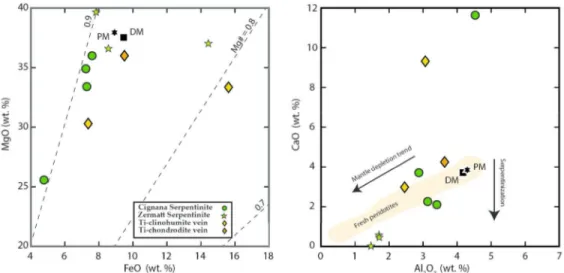
composition (except for higher FeO content of sample ZSG1406), but with much lower Al2O3
372
(∼1.5–1.7 wt.%) and CaO (∼0.5%) content than Cignana serpentinites (Figure 6a–b). 373
The Cignana basaltic eclogite (LCG1501) is a typical oceanic Fe–Ti gabbro, has 374
Al2O3 ∼ 15.8%, TiO2 ∼ 2.5% and low L.O.I content (0.4%), compatible with an altered
375
oceanic Fe–Ti gabbro protolith, as suggested by Groppo et al. (2009). The Cignana 376
metasediments include several lithological subtypes with varying silica and CO2 contents.
377
The most abundant varieties include Qz–micaschists with Mn–rich layers and calcschists. 378
Qz–micaschists have a SiO2 content >70% and Al2O3 of 7–12%; their compositional
379
variability includes high MnO (∼ 3.7%; sample LCG1414) and high B (360 µg/g; sample 380
LCG1415) concentrations. Centimetre to m–sized layers of calcschist (CaO ∼ 20–30%, 381
L.O.I. ∼ 20–30%; LCG1416A and LCG1416B) and silicate–bearings marbles (CaO ∼ 30%, 382
L.O.I. ∼ 35%; LCG1501) reflect local variability in carbonate content. 383
The Cignana serpentinite displays a harzburgitic to lherzolitic composition with Al2O3
384
∼ 2.5–4.5% and CaO from ∼ 2–4% up to 11.6% (this latter value reflects the exceptionally 385
high diopside modal composition of sample ZSG1507S of about 40 vol.%; Figure 6a–b). Ti– 386
clinohumite veins enclosed in Cignana serpentinites display variable major element 387
compositions, especially for their FeO (∼7–15%) and CaO (∼3–9%) content. This difference 388
reflects their relative abundance in magnetite, diopside, olivine, and Ti–clinohumite. The Ti– 389
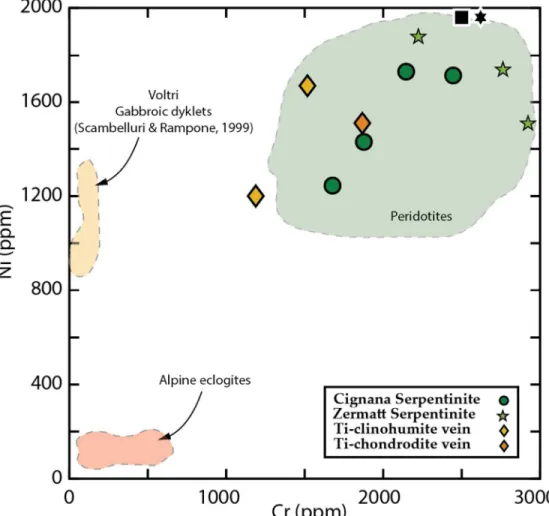
chondrodite vein has a major element (FeO, MgO, CaO, and Al2O3; Figure 6a–b) and Cr–Ni
390
(Figure 7) composition comparable to mantle peridotites, Cignana serpentinite, and the Ti– 391 clinohumite veins. 392 Trace elements 393 3 4 5 6 7 8 9 10 11 12 13 14 15 16 17 18 19 20 21 22 23 24 25 26 27 28 29 30 31 32 33 34 35 36 37 38 39 40 41 42 43 44 45 46 47 48 49 50 51 52 53 54 55 56
For Peer Review
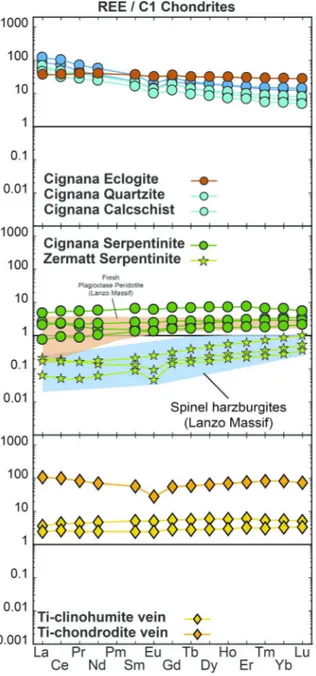
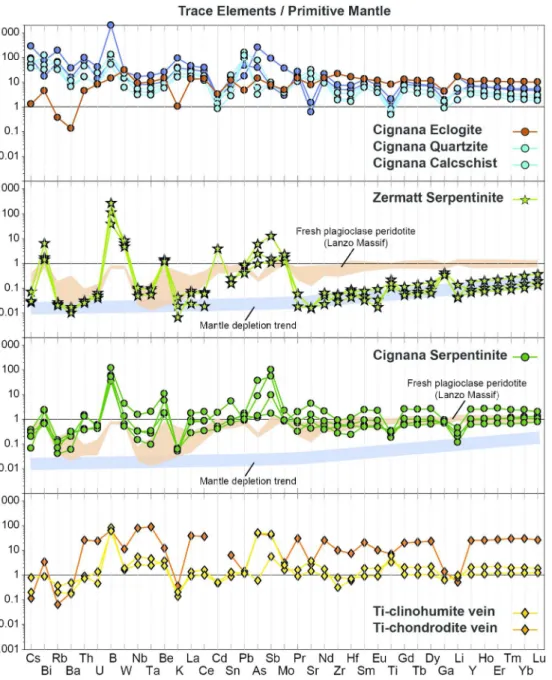
Zermatt Serpentinite. The Zermatt serpentinite displays rather depleted TE and REE
394
patterns (Figures 8 and 9; C1 chondrite and PM from McDonough & Sun, 1995). Rare 395
earth elements (REE) decrease from heavy to light and show a variably small negative Eu 396
anomaly (Figure 8). All samples display comparable PM–normalized TE patterns, with 397
notable enrichments in B, Bi, W, Mo, As, and Sb with respect to the mantle depletion trend 398
(Figure 9). 399
LCU crustal rocks. The Cignana eclogite has a flat REE and TE pattern (Figures 8
400
and 9). Except for a slight depletion in Cs, Rb, Ba, and K, all other TE are equally enriched,
401
between 10 and 30 times the primitive mantle. The Cignana metasediments have 402
homogeneous REE patterns, showing steady decrease from light to heavy REE (Figure 8). 403
All samples display a weak negative Eu anomaly, absent in the eclogite sample. The TE 404
patterns show positive peaks in Cs, Rb, Pb, As, and Sb and negative peaks in Cd and Ti 405
(Figure 9). Quartzites and calcschists show similar trends, except for Pb and Sr, up to one 406
order of magnitude higher in calcschists, and for As and Sb, generally higher in quartzites. 407
The remarkably high B content (365 µg/g) of sample LCG1415 reflects the presence of 408
tourmaline. 409
Cignana Serpentinite. The Cignana serpentinite shows rather flat REE patterns, with
410
values ranging between 1 and 10 C1 chondrite composition (Figure 8). The TE patterns 411
scatter, showing positive anomalies for several fluid mobile elements (Figure 9). Noticeably, 412
As and Sb values are very variable, ranging from PM values (ZSG1510; 0.07 and 0.01 µg/g) 413
up to values two orders of magnitude higher (sample ZSG1502S, 1.82 and 0.3 µg/g). 414
Moreover, the Cignana serpentinite displays (strong) enrichments in B, Bi, W, As, Sb, Sr and 415
Th. The TE patterns of Ti–clinohumite veins hosted by the Cignana serpentinites closely 416
resemble that of the host Cignana serpentinite, except for increased Nb, Ta, and Ti contents. 417
The type 2 Ti–chondrodite vein (ZSG1402) is, instead, extremely enriched in all REE and 418 3 4 5 6 7 8 9 10 11 12 13 14 15 16 17 18 19 20 21 22 23 24 25 26 27 28 29 30 31 32 33 34 35 36 37 38 39 40 41 42 43 44 45 46 47 48 49 50 51 52 53 54 55 56
For Peer Review
most TE (especially Nb, Ta, Th, U), by up to 2 orders of magnitude relative to the host 419
serpentinites. Type 2 vein displays a light–REE pattern comparable with metasediments and a 420
slightly enriched heavy–REE pattern, most comparable with eclogite. Elements such as Cs, 421
Rb, Ba, B, Cd, Pb, As, Sb, Sr, Ga, and Li display values comparable with those of Cignana 422
serpentinites. 423
Isotopic Compositions
424
Selected samples from the Lago di Cignana Unit and from the Cignana and Zermatt 425
serpentinites were analysed for their Pb and Sr isotopic compositions. All results, corrected 426
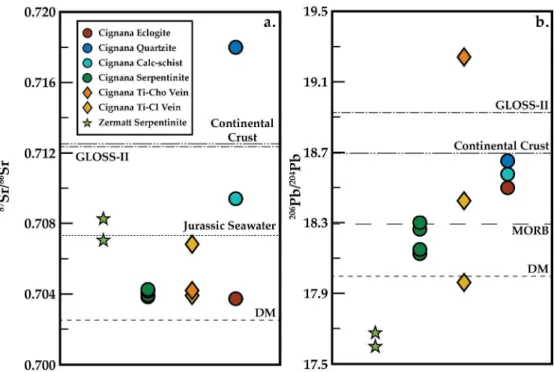
for an age of 40 Ma, are shown in Table 3 and displayed in Figure 10. The Zermatt 427
serpentinite shows non–radiogenic Pb isotopic values (lower than DM values) for all three 428
isotopic systems (206Pb/204Pb, 207Pb/204Pb, and 208Pb/204Pb are 16.887–17.731, 14.841–15.548,
429
and 35.776–37.555, respectively) and 87Sr/86Sr = 0.707051, typical for Jurassic seawater
430
serpentinization (Jones & Jenkyns, 2001; Vils et al., 2009; Cannaò et al., 2016). The 431
Cignana eclogite shows typical isotopic composition for MORB (Kelemen et al., 2014), with 432
206
Pb/204Pb, 207Pb/204Pb, and 208Pb/204Pb being 18.547, 15.518, and 37.986, respectively and 433
87
Sr/86Sr = 0.703764. The Cignana metasediments (quartzite and calcschist) show similar
434
values as GLOSS–II (Plank, 2014); 206Pb/204Pb, 207Pb/204Pb, and 208Pb/204Pb are between
435
18.636–18.706, 15.642–15.652, and 38.719–38.881, respectively and 87Sr/86Sr is between
436
0.709368 and 0.711573. The Cignana serpentinite has Pb and Sr isotope values between DM 437
and MORB values (206Pb/204Pb, 207Pb/204Pb, and 208Pb/204Pb are 18.172–18.341, 15.402–
438
15.596, and 37.692–38.129, respectively. 87Sr/86Sr are 0.703883–0.704160, lower values than
439
Jurassic seawater (Jones & Jenkyns, 2001) and like MORB (Kelemen et al., 2014) and the 440
Cignana eclogite. Ti–bearing veins in serpentinites retain similar 87Sr/86Sr, and close to
441
MORB values (0.704221 in Ti–chondrodite vein and 0.704059 in Ti–clinohumite vein). The 442
Ti–clinohumite vein has Pb isotopic compositions comparable with the host serpentinite. To 443 3 4 5 6 7 8 9 10 11 12 13 14 15 16 17 18 19 20 21 22 23 24 25 26 27 28 29 30 31 32 33 34 35 36 37 38 39 40 41 42 43 44 45 46 47 48 49 50 51 52 53 54 55 56
For Peer Review
the contrary, the Ti–chondrodite vein is quite enriched in radiogenic lead, having values over 444
the range reported for reservoirs around the Lago di Cignana Unit (eclogite and 445 metasediments). 446 Mineral compositions 447 Major elements 448
We performed electron probe measurements on rock–forming minerals of the Cignana 449
eclogite and metasediments, on the Cignana serpentinites and their Ti–clinohumite and Ti– 450
chondrodite veins, and on the Zermatt serpentinites. Representative mineral data are reported 451
in Tables 4-9; the full dataset is shown in the repository data. Cignana eclogite consists of 452
garnet, omphacite and rutile. Garnet is of almandine–grossular composition and has Fe-rich 453
cores (Alm ∼ 56–57% and Prp ∼ 7%) and Mg contents increase towards the rims (Alm ∼ 454
50–51% and Prp ∼ 8–9%). Jadeite content in omphacite increases from ∼ 50% in the core to 455
∼ 70% in the rim. Epidote occurs as small inclusions within garnet cores and has ∼ 50% 456
clinozoisite component. In the Cignana quartzite, garnet is almandine–grossular and has Ca– 457
rich cores (Alm ∼ 50–53%, Grs ∼ 27–28%, Sps ∼ 10–11% and Prp ∼ 4%) and Fe(II) content 458
increases towards the rims (Alm ∼ 69–70%, Grs ∼ 10–11%, Sps ∼ 1–2% and Prp ∼ 16– 459
17%). Tourmalines are dravites, with schorl contents increasing from cores (∼ 18–19%) to 460
rims (∼ 30–31%). Mn–rich layers in quartzites consists of quartz, Mn–rich (sps > 70%) 461
garnet, phengite, and epidote (allanite cores and clinozoisite ∼ 30% towards the rims). In the 462
Zermatt serpentinites antigorite (Figure 11a) has low Al contents (∼0.05–0.09 a.p.f.u.) and 463
high Mg# (∼0.97–0.98); Olivine (Figure 11b) has low NiO2 contents (∼0.05–0.1%) and
464
Mg# (∼0.96–0.98) comparable with associated antigorite, and Ti–chondrodite and Ti– 465
clinohumite have different compositions with respect to Cignana serpentinites, presenting 466
lower Ti contents and higher Fe(II) + Mg (Figure 12a–b). The Cignana serpentinites and the 467 3 4 5 6 7 8 9 10 11 12 13 14 15 16 17 18 19 20 21 22 23 24 25 26 27 28 29 30 31 32 33 34 35 36 37 38 39 40 41 42 43 44 45 46 47 48 49 50 51 52 53 54 55 56
For Peer Review
Ti–clinohumite/chondrodite veins have similar mineralogy (despite changes in modal 468
amounts of the single phases) and consist of antigorite, chlorite, olivine, diopside, magnetite, 469
and Ti–clinohumite. Antigorite (Figure 11a) has Mg#∼0.86–0.88 and variable Al contents 470
(0.9–0.15 a.p.f.u.). Olivine (Figure 11b) shows similar compositions both in the serpentinites 471
and in the Ti–clinohumite veins, having Mg#∼0.84–0.88 and variable NiO2 contents (∼0.15–
472
0.5%). Similarly, Ti–clinohumite (Figure 12a) has similar compositions both in Ti– 473
clinohumite and in Ti–chondrodite veins (Ti∼0.3–0.5 a.p.f.u.). 474
Trace elements
475
The full LA–ICP–MS mineral trace element dataset for the Cignana eclogite and 476
metasediments and the Cignana and Zermatt serpentinites and Ti–clinohumite veins is 477
reported in the repository data. Representative analyses are shown in Tables 10-13 and 478
plotted in Figure 13. Antigorite (Figure 13) displays rather similar TE and REE patterns, 479
both in Cignana and Zermatt serpentinites. REE are depleted (0.01 to 0.1 C1 chondrite) and 480
show a slight increase from light to heavy REE. Cignana serpentines are slightly more 481
enriched in light REEs. Cignana serpentines show enrichment in Th, Be, Ta, La and Ce. 482
Conversely, Zermatt serpentines have higher B, As, and Sb. In the Cignana serpentinite, 483
olivine is depleted in light–REE and enriched in heavy REEs, B, Sb, and Li (Figure 13). 484
While the major element composition of diopside from the Zermatt and Cignana serpentinite 485
is similar, its REE and TE compositions differ (Figure 13). The Cignana diopside is enriched 486
in REE (∼5–10 times the C1 chondrite), while in the Zermatt serpentinite, diopside is 487
depleted in REE, showing a slight negative Eu anomaly. Besides REE’s, the Cignana 488
diopside is enriched in Rb, U, Th, Be, Ce, Pb, and Sr. Conversely, Zermatt diopside contains 489
considerable amounts of W, B, As, and Sb. Ti–clinohumite (Figure 13) has generally similar 490
patterns in all Cignana lithologies. Ti–clinohumite is enriched in Nb, Ta, B, W, As, Sb, and 491 3 4 5 6 7 8 9 10 11 12 13 14 15 16 17 18 19 20 21 22 23 24 25 26 27 28 29 30 31 32 33 34 35 36 37 38 39 40 41 42 43 44 45 46 47 48 49 50 51 52 53 54 55 56
For Peer Review
REE. To the contrary, Ti–clinohumite in Zermatt serpentinite has more depleted trends, with 492
lower levels of REE, Nb, and Ta. 493
DISCUSSION
494
PT evolution of the Cignana serpentinite
495
The Lago di Cignana Unit consists of oceanic crustal rocks such as eclogites and 496
metasediments which underwent a complex Alpine subduction history to UHP metamorphic 497
conditions. Prograde zoning in garnet, omphacite and white mica, observed in both 498
metasedimentary rocks and metagabbros, records subduction to UHP depth along a cold 499
geothermal gradient (∼7 °C/km; Amato et al., 1999; Groppo et al., 2009; Reinecke, 1998; 500
Rubatto et al., 1998; Skora et al., 2015). Re–hydration and destabilization of HP phases in
501
eclogite and metasediments indicates exhumation to greenschist–facies conditions following 502
the UHP peak (26 km/m.y.; Amato et al., 1999). HP serpentinites sandwich the UHP Lago di 503
Cignana Unit and display an antigorite + olivine foliation deforming olivine + Ti– 504
clinohumite + magnetite ± diopside metamorphic veins. Rebay et al. (2012) recently studied 505
the serpentinites and associated eclogites lying below the Lago di Cignana Unit (the Zermatt 506
serpentinite). These serpentinites reached pressure conditions of 2.4–2.6 GPa during the 507
Alpine HP event (Rebay et al., 2012; Angiboust et al., 2009), like several other ophiolite 508
domains in the Western Alps (e.g. Erro–Tobbio, Scambelluri et al., 1995; Lanzo Ultramafic 509
Massif, Pelletier and Müntener, 2006; Debret et al., 2013a, 2013b). The serpentinites lying 510
above the Lago di Cignana Unit (the “Cignana serpentinites”) were, instead, never 511
investigated in detail and are commonly attributed to the Zermatt–Saas Zone. Our 512
observations of the Zermatt and Cignana serpentinites add further detail and information to 513 this scenario. 514 3 4 5 6 7 8 9 10 11 12 13 14 15 16 17 18 19 20 21 22 23 24 25 26 27 28 29 30 31 32 33 34 35 36 37 38 39 40 41 42 43 44 45 46 47 48 49 50 51 52 53 54 55 56
For Peer Review
The HP Zermatt serpentinites are characterized by the formation of HP olivine via the 515
dehydration of brucite, according to the reaction (1) antigorite + brucite = olivine ± chlorite + 516
H2O, which liberates a fluid phase drained in olivine + Ti–clinohumite + magnetite veins
517
(Figure 14). This type of vein forms in serpentinites during prograde metamorphism in the 518
presence of free water, after simultaneous breakdown of brucite (reaction 1 in Figure 14) and 519
former Ti–bearing clinopyroxene, according to the generalized reaction: mantle‐ 520
clinopyroxene + olivine + antigorite = diopside + chlorite + Ti‐clinohumite + H2O (López
521
Sánchez–Vizcaíno et al., 2009). Genesis of such veins has been related to these dehydration
522
reactions in the Zermatt–Saas Zone (Rebay et al., 2012; Zanoni et al., 2012), as well as in 523
other HP serpentinites such as Erro–Tobbio (Scambelluri et al., 1995), the Lanzo Massif 524
(Debret et al., 2013a), and Cerro de Almirez (López Sánchez–Vizcaíno et al., 2009). 525
The Cignana serpentinites display a well–developed antigorite + olivine foliation, 526
locally deforming two distinct types of veins containing titanate phases: type 1 and type 2 527
veins. Type 1 veins contain Ti–clinohumite as the main Ti–bearing phase (large crystals, 528
locally overgrown by finer–grained Ti–clinohumite), plus olivine, chlorite, magnetite, and 529
rare diopside (Figure 4e). Figure 14 shows a series of reaction lines (adapted from Shen et 530
al., 2015) in the system TiO2–MgO–SiO2–H2O (plus the reactions graphite–diamond and 531
quartz–coesite for comparison with the LCU crustal lithologies), based on which the P-T 532
formation conditions of type 1 veins can be constrained (in analogy to the veins reported for 533
Almirez; López Sánchez–Vizcaíno et al., 2009). The P-T field is roughly divided into two 534
domains by reaction (5): an orange shaded area delimiting the stability field of Ti– 535
clinohumite, and a reddish area at higher pressure were Ti–chondrodite is stable. The black 536
arrow is the PT path proposed by Groppo et al. (2009) for eclogites in the Lago di Cignana 537
Unit. The origin of type 1 veins can be related to the formation of metamorphic diopside and 538
to brucite dehydration, according to reaction (1) and (2) respectively. Brucite dehydrates at a 539 3 4 5 6 7 8 9 10 11 12 13 14 15 16 17 18 19 20 21 22 23 24 25 26 27 28 29 30 31 32 33 34 35 36 37 38 39 40 41 42 43 44 45 46 47 48 49 50 51 52 53 54 55 56
For Peer Review
temperature of around 500 °C, which corresponds to about 2.0–2.5 GPa (∼ 75km depth) 540
considering the P–T estimates of eclogites from the ZSZ (Angiboust et al., 2009) and a 541
typical Alpine subduction geothermal gradient (6.5–7.5 °C/km; Scambelluri et al., 1995; 542
López Sánchez–Vizcaíno et al., 2009; Groppo et al., 2009). The TE composition of these
543
veins (Figure 9) closely compares to that of the host rock, suggesting dehydration in a closed 544
system, with little to no influx of externally derived components and fluids. As such, the 545
Cignana and Zermatt serpentinites released moderate amounts of aqueous fluid during 546
subduction, which slightly remobilized many elements and locally recrystallized as Ti– 547
clinohumite–bearing veins. 548
The second occurrence of Ti–bearing minerals concerns the type 2 veins, hosting 549
coarse Ti–chondrodite, chlorite, olivine, diopside, and apatite (Sample ZSG1402). The 550
presence of Ti–chondrodite as main vein–forming mineral readily indicates that type 2 veins 551
formed at higher pressures than type 1, in the stability field of Ti–chondrodite (orange shaded 552
area in Figure 14). Importantly, the P-T conditions necessary for the formation of TI– 553
chondrodite–bearing veins are not recorded in the Zermatt–Saas Zone. To the contrary, they 554
are compatible with the P-T path recorded in the Lago di Cignana Unit eclogites and 555
metasediments (Figure 14; Groppo et al., 2009). Such estimates for the formation of type 2 556
veins lie at higher temperature than the dehydration reaction (1), which generated type 1 557
veins, and at lower temperature than the expected antigorite dehydration of reaction (2). As 558
such, it is unlikely that the fluid responsible for the type 2 veining had an internal origin as 559
for the type 1 veins. Instead, this fluid was probably externally derived (i.e. non– 560
serpentinitic). Hypotheses on the possible origins of such fluid are discussed below. 561
Deformation and recrystallisation of type 1 and 3 veins occurred during a lower 562
pressure deformation event (D3). Large crystals are replaced by smaller metamorphic phases: 563
Ti–clinohumite(2) replaces Ti–chondrodite and Ti–Clinohumite (Figure 4e–f–g–h); when 564 3 4 5 6 7 8 9 10 11 12 13 14 15 16 17 18 19 20 21 22 23 24 25 26 27 28 29 30 31 32 33 34 35 36 37 38 39 40 41 42 43 44 45 46 47 48 49 50 51 52 53 54 55 56
For Peer Review
present, first generation olivine, chlorite, apatite, and diopside recrystallize. Regarding the 565
origin of such Ti–chondrodite veins, we propose here that type 2 veins crystallized from a 566
fluid derived from the nearby crustal Cignana rocks for the following petrologic and 567
geochemical reasons. Compared to type 1 Ti–clinohumite veins, the type 2 Ti–chondrodite 568
veins are strikingly enriched in REE, Th, U, Nb, Ta, As, Sb, and Y (Figure 9). This 569
enrichment can be interpreted to be due either to (1) metasomatism of initial gabbroic 570
dykelets (Scambelluri & Rampone, 1999) or to (2) channelized infiltration of metamorphic 571
fluids enriched in crustal components into the Cignana serpentinite at UHP conditions. In the 572
Voltri Massif, Scambelluri & Rampone (1999) described Ti–chondrodite + Ti–clinohumite 573
+ diopside + chlorite bearing veinlets associated with the occurrence of igneous 574
clinopyroxene and ilmenite relics, which provided evidence for an origin from metasomatized 575
Fe–Ti gabbroic dykelets. Differently from Voltri, magmatic clinopyroxene and ilmenite relics 576
are absent in the Ti–chondrodite + olivine veinlets from Cignana. Nevertheless, favouring 577
hypothesis (2) does not enable to rule out hypothesis (1). However, a magmatic origin of such 578
veins should be recorded by the immobile elements in the bulk composition (e.g. Cr and Ni), 579
which are very different in concentration in a former gabbroic dyke with respect to a 580
peridotite. Figure 7 shows that Cr–Ni bulk compositions of the Cignana Ti–chondrodite 581
veins are comparable with serpentinites, peridotites and type 1 veins is and strongly different 582
from reference eclogites and gabbroic dykes. This bears implications on the fluid origin of 583
type 2 Ti–chondrodite veins. 584
The petrogenetic sequence presented in Figure 15 summarizes and compares the 585
metamorphic evolutions of the Zermatt serpentinites with the Cignana serpentinite and the 586
Lago di Cignana Unit. The mineralogical and textural evolution of the Cignana serpentinites 587
thus reveals prograde, peak, and retrograde events. The three metamorphic stages recorded in 588
type 1 and 2 veins and in their LP recrystallization products are comparable to the 589 3 4 5 6 7 8 9 10 11 12 13 14 15 16 17 18 19 20 21 22 23 24 25 26 27 28 29 30 31 32 33 34 35 36 37 38 39 40 41 42 43 44 45 46 47 48 49 50 51 52 53 54 55 56
For Peer Review
metamorphic evolution defined for the coesite–bearing eclogites and metasediments (Groppo 590
et al., 2009). The type 1 veins can correspond to the prograde metamorphic zoning observed
591
in eclogitic garnet (Reinecke, 1998; Groppo et al., 2009), while type 2 Ti–chondrodite– 592
bearing veins in serpentinites likely formed under peak metamorphic conditions in the coesite 593
stability field. Consequently, peak conditions are consistent for both the Lago di Cignana 594
Unit and the Cignana serpentinites. Retrograde re–equilibration of eclogite and 595
metasediments (formation of chlorite after garnet and barroisite and glaucophane after 596
omphacite) indicates near–isothermal decompression (Groppo et al., 2009). In serpentinites, 597
this retrograde event causes the recrystallization of type 1 Ti–clinohumite and type 2 Ti– 598
chondrodite veins. As such, the microstructural and mineralogical record of the Ti–bearing 599
veins provides constraints to the evolution of the Lago di Cignana Unit and of the 600
surrounding serpentinites throughout their prograde, peak and retrograde evolution. A main 601
implication of this finding is the stability of the mineral association antigorite + olivine in 602
natural samples at UHP metamorphic condition, as predicted from experimental work by 603
Ulmer & Trommsdorff (1995).
604
Zermatt–Saas serpentinites (ZSG1405, ZSG1406 and ZSG1410) are closely 605
comparable to Cignana serpentinites in petrology, microstructure, and field occurrence. As 606
such, it is difficult to clearly distinguish the Cignana serpentinites from the Zermatt–Saas 607
serpentinites; hence, the definition of a boundary for the UHP event in serpentinites is not 608
possible. Furthermore, the occurrence of Ti–chondrodite is not limited to the area 609
surrounding the LCU. Ti–Chondrodite is found in sample ZSG1406 and it is reported in other 610
sections of the Zermatt–Saas Zone (Rebay et al. (2012); Tartarotti, Hermann, personal 611
communications). This might imply (1) deeper subduction of the Zermatt area than so far 612
known and only local preservation of the UHP mineralogy, or (2) that the Zermatt–Saas 613
consists of slices of oceanic crust and metasediments which were equilibrated at different 614 3 4 5 6 7 8 9 10 11 12 13 14 15 16 17 18 19 20 21 22 23 24 25 26 27 28 29 30 31 32 33 34 35 36 37 38 39 40 41 42 43 44 45 46 47 48 49 50 51 52 53 54 55 56
For Peer Review
depths, and were then incorporated into the plate interface during exhumation. In this latter 615
case, the model of tectonic coherence of the Zermatt–Saas unit should be reconsidered, an 616
arduous task given the extensive greenschist–facies retrogression of metabasic rocks and/or 617
lack of viable pressure indicators. Trace element and isotopic analyses in serpentinites 618
(discussed below) proved to be a useful tool to discriminate between different serpentinite 619
slices. 620
Geochemical evolution
621
Recent work (Hattori & Guillot, 2003; Deschamps et al., 2011, 2012, Lafay et al., 622
2013; Scambelluri et al., 2014, 2015; Cannaò et al., 2015, 2016; Debret et al., 2013b) has
623
investigated the role of serpentinites in acquiring and releasing FME during tectonic 624
processes. Interaction with subduction fluids (Cannaò et al., 2015, 2016), as well as 625
lizardite–antigorite and antigorite dehydration reactions (Kodolányi and Pettke, 2011; 626
Debret et al., 2013a, 2013b), change the TE budget of a serpentinite and might affect its Sr–
627
Pb isotopic signature (Cannaò et al., 2015, 2016). FME geochemistry, coupled with detailed 628
field and microstructural investigations, helps unravelling (1) the timing and tectonic setting 629
of fluid–rock interaction and (2) the evolution of the serpentinites during their subduction– 630
exhumation cycle. 631
Using this geochemical petrology approach, we discuss (1) the tectonic setting of 632
initial serpentinization and the evolution and FME exchange of the Zermatt and Cignana 633
serpentinites and (2) the origin of fluids interacting with serpentinites. This will allow us to 634
propose a possible evolution of the Zermatt–Saas Zone near the Lago di Cignana Unit. 635
Inherited features of Zermatt and Cignana serpentinites
636
The Western Alpine ophiolites are fragments of different sections of the Ligurian– 637
Piemontese slow–spreading ocean opened during the Jurassic (Dal Piaz et al., 2003; 638 3 4 5 6 7 8 9 10 11 12 13 14 15 16 17 18 19 20 21 22 23 24 25 26 27 28 29 30 31 32 33 34 35 36 37 38 39 40 41 42 43 44 45 46 47 48 49 50 51 52 53 54 55 56