HAL Id: hal-03137575
https://hal.archives-ouvertes.fr/hal-03137575
Submitted on 10 Feb 2021
HAL is a multi-disciplinary open access
archive for the deposit and dissemination of
sci-entific research documents, whether they are
pub-lished or not. The documents may come from
teaching and research institutions in France or
abroad, or from public or private research centers.
L’archive ouverte pluridisciplinaire HAL, est
destinée au dépôt et à la diffusion de documents
scientifiques de niveau recherche, publiés ou non,
émanant des établissements d’enseignement et de
recherche français ou étrangers, des laboratoires
publics ou privés.
the Mediterranean Sea: a review of unresolved issues
and directions for future research
P. Malanotte-Rizzoli, V. Artale, G. Borzelli-Eusebi, S. Brenner, A. Crise, M.
Gacic, N. Kress, S. Marullo, M. Ribera d’Alcalà, S. Sofianos, et al.
To cite this version:
P. Malanotte-Rizzoli, V. Artale, G. Borzelli-Eusebi, S. Brenner, A. Crise, et al.. Physical forcing
and physical/biochemical variability of the Mediterranean Sea: a review of unresolved issues and
directions for future research. Ocean Science, European Geosciences Union, 2014, 10 (3), pp.281-322.
�10.5194/os-10-281-2014�. �hal-03137575�
www.ocean-sci.net/10/281/2014/ doi:10.5194/os-10-281-2014
© Author(s) 2014. CC Attribution 3.0 License.
Ocean Science
Physical forcing and physical/biochemical variability of the
Mediterranean Sea: a review of unresolved issues and directions for
future research
P. Malanotte-Rizzoli1, V. Artale2, G. L. Borzelli-Eusebi3, S. Brenner4, A. Crise3, M. Gacic3, N. Kress6, S. Marullo2, M. Ribera d’Alcalà8,*, S. Sofianos11, T. Tanhua12, A. Theocharis13, M. Alvarez14, Y. Ashkenazy15, A. Bergamasco10, V. Cardin3, S. Carniel10, G. Civitarese3, F. D’Ortenzio16, J. Font5, E. Garcia-Ladona5, J. M. Garcia-Lafuente17, A. Gogou13, M. Gregoire18, D. Hainbucher19, H. Kontoyannis13, V. Kovacevic3, E. Kraskapoulou13, G. Kroskos13, A. Incarbona20, M. G. Mazzocchi8, M. Orlic21, E. Ozsoy7, A. Pascual22, P.-M. Poulain3, W. Roether9, A. Rubino23, K. Schroeder10, J. Siokou-Frangou13, E. Souvermezoglou13, M. Sprovieri24, J. Tintoré22, and G. Triantafyllou13
1Massachusetts Institute of Technology, Cambridge, MA, USA
2ENEA, Agenzia nazionale per le nuove tecnologie, l’energia e lo sviluppo economico sostenibile,
Centri ricerca Frascati e Roma, Rome, Italy
3Istituto Nazionale di Oceanografia e di Geofisica Sperimentale – OGS, Trieste, Italy
4Department of Geography and Environment, Bar llan University, Ramat Gan 52900, Israel
5Institut de Ciencies del Mar – CSIC, Barcelona, Spain
6National Institute of Oceanography, Israel Oceanographic & Limnological Research, Haifa, Israel
7Middle East Technical University, Institute of Marine Sciences, Erdemli, Turkey
8Stazione Zoologica Anton Dohrn, Naples, Italy
9University of Bremen, Bremen, Germany
10CNR ISMAR, Istituto di Scienze Marine, Venice, Italy
11University of Athens, Division of Environmental Physics, Ocean Physics and Modeling Group, Athens, Greece
12GEOMAR Helmholz Center for Ocean Research, Kiel, Germany
13Institute of Oceanography, Hellenic Centre for Marine Research, Sounio Ave., P.O. Box 712, Athens, Greece
14Instituto Espanol de Oceanografia, Calle del Corazon de Maria 8, Madrid 28020, Spain
15Department of Solar Energy & Environmental Physics, The Jacob Blaustein Institutes for Desert Research,
Ben-Gurion University of the Negev, Israel
16Laboratoire d’Oceanographie de Villefranche (LOV), CNRS and Université Pierre et Marie Curie, Paris 06, UMR7093,
Villefraneche-sur-mer, France
17Physical Oceanography Group University of Malaga, Malaga, Spain
18Universite de Liege – Laboratoire d’Oceanologie – Centre MARE, Liege, Belgium
19University of Hamburg – Institute of Oceanography, Hamburg, Germany
20Universita di Palermo, Dipartimenti di Geologia & Geodesia, Palermo, Italy
21University of Zagreb, Faculty of Science Andrija Mohoroviviv Geophysical Institute, Zagreb, Croatia
22Instituto Mediterraneo de Estudio Avanzados, IMEDEA (CSIC-UIB), Balearic Islands, Spain
23Universita Ca’ Forscari di Venezia, Venice, Italy
24CNR IAMC, Unita Operativa di Capo Granitola, Trapani, Italy
Correspondence to: P. Malanotte-Rizzoli ([email protected])
Received: 7 June 2013 – Published in Ocean Sci. Discuss.: 24 July 2013
Abstract. This paper is the outcome of a workshop held in
Rome in November 2011 on the occasion of the 25th an-niversary of the POEM (Physical Oceanography of the East-ern Mediterranean) program. In the workshop discussions, a number of unresolved issues were identified for the physical and biogeochemical properties of the Mediterranean Sea as a whole, i.e., comprising the Western and Eastern sub-basins. Over the successive two years, the related ideas were dis-cussed among the group of scientists who participated in the workshop and who have contributed to the writing of this pa-per.
Three major topics were identified, each of them being the object of a section divided into a number of different sub-sections, each addressing a specific physical, chemical or bi-ological issue:
1. Assessment of basin-wide physical/biochemical prop-erties, of their variability and interactions.
2. Relative importance of external forcing functions (wind stress, heat/moisture fluxes, forcing through straits) vs. internal variability.
3. Shelf/deep sea interactions and exchanges of physi-cal/biogeochemical properties and how they affect the sub-basin circulation and property distribution.
Furthermore, a number of unresolved
scien-tific/methodological issues were also identified and are reported in each sub-section after a short discussion of the present knowledge. They represent the collegial consensus of the scientists contributing to the paper. Naturally, the unresolved issues presented here constitute the choice of the authors and therefore they may not be exhaustive and/or complete. The overall goal is to stimulate a broader interdisciplinary discussion among the scientists of the Mediterranean oceanographic community, leading to en-hanced collaborative efforts and exciting future discoveries.
1 Introduction
The motivation for this paper stems from a workshop held in Rome in November 2011, on the occasion of the 25th an-niversary of the POEM (Physical Oceanography of the East-ern Mediterranean) program. The objectives of the workshop were however rather more ambitious than simply having a memorial. First, the workshop was meant to provide a syn-opsis of the state-of-the-art of research and present knowl-edge of the Mediterranean Sea’s physical, chemical, and bi-ological properties. Second, it wanted to offer the opportu-nity to scientists working in different regions of the sea, both the Western and Eastern basins, to meet and share ideas, and hence foster pan-Mediterranean collaborations.
The importance of the Mediterranean Sea for the world ocean has long been recognized. First, the Mediterranean Sea has a profound impact on the Atlantic Ocean circula-tion and, consequently, on the global thermohaline conveyor belt. Maps of the Mediterranean salty water tongue exiting from the Gibraltar Strait at intermediate depths and spread-ing throughout the Atlantic interior have been well known since the 1950s. Through direct pathways to the Atlantic’s polar regions or through indirect mixing processes, the salty Mediterranean water preconditions the deep convection cells of the polar Atlantic. There the North Atlantic Deep Wa-ter is formed that successively spreads throughout the world ocean, constituting the core of the global thermohaline circu-lation.
Even more importantly, the Mediterranean Sea is a labora-tory basin for the investigation of processes of global impor-tance, being much more amenable to observational surveys because of its location at mid-latitude and its dimensions. Both the western and eastern basins in fact possess closed thermohaline circulations analogous to the global conveyor belt. A unique upper layer open thermohaline cell connects the eastern basin to the western basin and, successively, to the North Atlantic through the Gibraltar Strait. In it, the At-lantic water entering into Gibraltar in the surface layer, after travelling to the easternmost Levantine Basin, is transformed into one of the saltiest water masses through air–sea heat and moisture fluxes. This is the salty water that, crossing the en-tire basin in the opposite direction below the surface Atlantic water, finally exits from the Gibraltar Strait at mid-depths.
Both the western and eastern basins are endowed with deep/intermediate convection cells analogous to the polar At-lantic deep convection cells or to the intermediate mode wa-ter ones. Deep and inwa-termediate wawa-ter masses are therefore formed in different sites of the entire basin. Because of their easily accessible locations, these convection cells are much more amenable to direct observational surveys and mooring arrays.
A ubiquitous, energetic mesoscale and sub-mesoscale eddy field is superimposed onto and interacts with the sub-basin scale, wind-driven gyres that characterize the upper thermocline circulation. Three different scales of motion are therefore superimposed, producing a richness of interaction processes which typify similar interactions in unexplored ocean regions.
Both wide and narrow shelves are at present separated by steep continental slopes from the deep interiors. Cross-shelf fluxes of physical as well as biogeochemical parameters are crucial in determining the properties of the shallow vs. deep local ecosystems and their trophic chain. Most importantly, the Mediterranean Sea is a basin of contrasting ecosystems, from the strongly oligotrophic deep interiors to the fully eu-trophic northern Adriatic characterized by recurrent, anoma-lous algal blooms and related anoxia events.
This review focuses on the identification of major unsolved scientific issues and provides directions for future re-search to address these issues both theoretically and observa-tionally. However, the unresolved issues discussed here stitute the selection of the group of authors who have con-tributed to the review. It cannot therefore be either exhaus-tive or complete. Furthermore, a different group of scientists might have provided a different set of unresolved issues for physical/biogeochemical properties. The major purpose in presenting the present choices is to induce the Mediterranean oceanographic community to a broader, more inclusive and fully interdisciplinary discussion to move forward in the the-oretical and observational investigation of the Mediterranean Sea.
2 Assessment of basin-wide physical/biochemical properties and their variability and interactions 2.1 Scales of variability of the Mediterranean
circulation
2.1.1 State of knowledge
It is of paramount importance to know which are the dom-inant scales of variability of the circulation characterizing a specific oceanic basin. External wind forcing determines the large barotropic circulation pattern while stratification deter-mines the internal baroclinic deformation radius, the scale of the ubiquitous, energetic mesoscale eddy field. Further-more, oceanic motions cover the entire space and time spec-trum, from the global thermohaline conveyor belt to micro-turbulence. Therefore, to capture the variability of a specific oceanic region, knowledge of the dominant scales of motion and their variability and interactions is crucial, both theoret-ically and for the design of sampling strategies.
The Mediterranean circulation is characterized by three predominant interacting spatial scales, which represent the wide variety of forcings that characterize the basin: basin, sub-basin and mesoscale. The basin-scale circulation is broadly described in terms of a surface flow from the At-lantic Ocean entering through the Strait of Gibraltar and proceeding to the eastern basin, and a return flow of inter-mediate water, originating in the Levantine Basin, proceed-ing towards Gibraltar and finally exitproceed-ing into the Atlantic. This basin-scale open cell is mainly driven by thermohaline forcing: an east–west density gradient, associated with en-hanced heat and moisture fluxes in the Levantine Sea, drives the eastward flow of surface Atlantic water. In the Levan-tine Basin the ocean releases buoyancy into the atmosphere through heat loss and an evaporation/precipitation deficit. The buoyancy loss reduces the stability of the water column, with loss of potential energy in the Levantine. This energy deficit is compensated for by a buoyancy gain associated with the inflow of the fresh surface Atlantic water. For this open
cell, the forcings of the Mediterranean basin-scale circula-tion are the inflows through the Gibraltar and Sicily straits. Sannino et al. (2009) discuss the importance of including variations of the Atlantic water inflow through the Gibraltar Strait to describe decadal variations in the western Mediter-ranean circulation pattern. Similarly, Malanotte-Rizzoli and Bergamasco (1991), investigating the relative contribution of wind forcing, thermohaline surface fluxes and boundary con-ditions to the EMed circulation, showed that flow changes in the Sicily Strait can induce variability in the circulation pat-tern on the basin scale. Pierini and Rubino (2001) modeled the remotely forced dynamics in the areas surrounding the Strait of Sicily and, imposing steady fluxes along the open boundaries, obtained in the absence of meteorological forc-ing, quasi-stationary circulations representing the local man-ifestation of the large-scale Mediterranean conveyor belt. It is interesting to note that Demirov and Pinardi (2002), dis-cussing changes in the Ionian circulation in relation to the variability in the thermohaline properties of the water mass formed in the Levantine, provided evidence that variations in the latter one could be associated with changes in the Io-nian circulation. Gaˇci´c et al. (2010, 2011) showed that these changes may be responsible for modifications of the eastern Mediterranean thermohaline cell, thus impacting the overall structure of the eastern Mediterranean circulation. This find-ing constitutes an example in which changes in the sub-basin scale alter the basin-scale circulation pattern.
Air–sea heat and moisture fluxes also drive the eastern and western convection cells through the formation of dense wa-ter in the southern Adriatic and the Gulf of Lion, respectively. In these cases, the related downslope flow modifies the verti-cal structure of the water column and determines changes in the horizontal scales of the circulation (Winters et al., 1995; CIESM, 2009; Winters and Young, 2009). Wintertime Dense Shelf Water Cascades (DSWC) can transport large amounts of water and sediment through submarine canyons, reshaping the canyons and affecting the deep water environment in the process. An excellent example was presented by Canals et al. (2006) from observations in the Cap de Creus Canyon in the Gulf of Lions in the Mediterranean Sea (one of his figures shows measurements made during a gravity/turbidity current event, which shows current speeds as high as 80 cm and high sediment concentrations). Similar events can be expected to occur in the Bari Canyon when North Adriatic Deep Wa-ter (NADW) formed in the northern parts reaches the Bari Canyon System (BCS) in a few months. The BCS intercepts sediments derived from the Po and southern Apennine rivers and funnels this material into the deep South Adriatic Basin. A useful approach to describing scales of oceanic circula-tion relates to the vertical particircula-tioning of oceanic energy into barotropic and baroclinic components (Wunsch and Stam-mer, 1995; StamStam-mer, 1997; Wunsch, 1997). This allows us to identify the dominant components of the motion and es-timate its characteristic scales in terms of the Rossby defor-mation radius (Lermusiaux and Robinson, 2001). However,
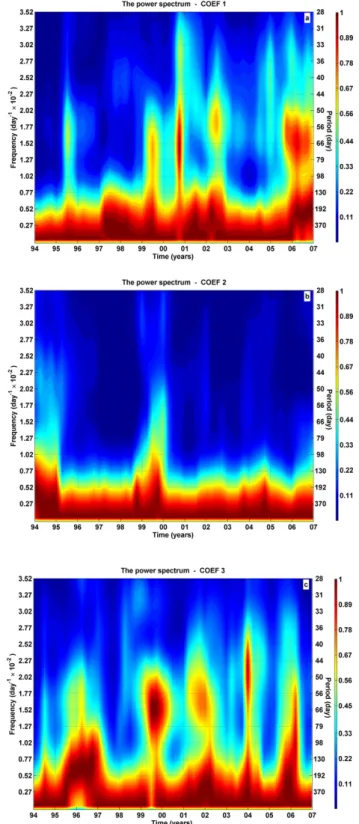
the quantification of the relative importance of the barotropic and baroclinic mode(s) in determining the horizontal circula-tion is difficult, due to the fact that, for a faithful descripcircula-tion of a given region of the ocean, nearly continuous sampling over wide areas is necessary. Another possible approach is based on satellite remote sensing, which allows data to be gained over wide areas of the ocean nearly continuously. An example is given in Fig. 1.
This approach implies direct evaluation of the scales of variability of a specific passive scalar, assumed to be a tracer of the surface circulation (Barron and Kara, 2006; Borzelli and Ligi, 1999a, b; Borzelli, 2008), or evaluation of the scales of variability of the sea level anomaly (SLA, Ioannone et al., 2011) obtained by orbiting satellite altimeters. In practice, this technique relies upon the estimation of the autocorlation function of the parameter represented by satellite re-motely sensed data and the evaluation of characteristic scales of the autocorrelation function, which are assumed to repre-sent the scales of the sea surface structure. Figure 2 shows examples of SLA autocorrelation functions computed in the Ionian Sea in the different seasons. Figure 3 gives the time variability of the scales of the same autocorrelation function. This approach, however, leads to great uncertainties since, first, through direct evaluation of scales, it is difficult to de-termine which is the dominant vertical component determin-ing the horizontal circulation and, second, interactdetermin-ing com-ponents due to nonlinearities and active over short scales are filtered out.
2.1.2 Unresolved issues
1. Stratification, stratification changes and variability in the horizontal circulation scales
The horizontal circulation of the sea can be repre-sented as the superposition of barotropic and baro-clinic modes (normal modes). This representation is convenient, since it allows us to express the character-istic scales of the horizontal motion in terms of Rossby radii of deformation. In the Mediterranean, the over-turning circulation concurs in determining consider-able variability over time in the stratification regime and producing changes both in the structure of individ-ual modes and in the way in which these modes com-pete with each other to determine the horizontal mo-tion. This requires an analysis of how, in the Mediter-ranean, stratification changes modify horizontal scales of motion.
2. Energy exchanges and excitation of normal dynamical modes (i.e., barotropic and baroclinic modes)
In the available literature (see, e.g., Malanotte-Rizzoli and Bergamasco, 1989) it has been pointed out that, in the Mediterranean, the wind excites primarily the barotropic mode, which is a long, fast and tran-sient component of the circulation. Over the longer
Fig. 1. Normalized time-dependent frequency spectra of empirical orthogonal function coefficients of the SLA. (a–c) Spectra of co-efficients 1–3, respectively. Left and right vertical scales indicate frequencies and periods, respectively (adapted from loannone et al., 2011).
Fig. 2. Contours of the SSH autocorrelation function over the Ionian Sea in the period 1993–2007 averaged over the different seasons. (a) Winter; (b) spring; (c) summer; (d) fall (adapted from Ioannone et al., 2011).
timescales (annual and inter-annual) the circulation is essentially determined by baroclinic components. This implies that, in order to maintain the long-term circula-tion, energy transferred from the wind to the barotropic component has to be transferred from the barotropic component to baroclinic ones. In order to clarify this mechanism an analysis of the way different modes in-teract with each other is necessary.
3. Mediterranean overturning circulation and deep mix-ing rates
Throughout the world ocean, stratification is main-tained by mixing in the deep layers that, counteract-ing upwellcounteract-ing processes, provide the counterflow of dense water necessary for restoring the stability of the water column. In the Mediterranean, although scales of the horizontal circulation have been intensively in-vestigated during POEM and PRIMO, the relationship between the intensity of the Mediterranean overturn-ing circulation and deep mixoverturn-ing rates is not yet un-derstood. Indeed, mixing is generally believed to oc-cur through tidal dissipation over shelf breaks and/or breaking of internal gravity waves. In the Mediter-ranean, energy associated with these processes is too low compared to the energy required for maintaining the overturning circulation.
Fig. 3. Temporal variability and frequency spectra of the correlation length scale of the SSH over the Ionian in the period 1993–2007. The correlation length is computed as the average of 17 e-folding distances obtained by fitting the SSH autocorrelation with a Gaus-sian along 17 different radial directions. (a) Average over 17 radial directions between 0 and 90°; (b) standard deviation of the mean of Fig. 5a; (c) power spectrum of Fig. 5a (adapted from Ioannone et al., 2011).
2.2 Differences and similarities between circulation, forcing and water mass conversion in the WMed and EMed and interactions between the basins 2.2.1 Present knowledge
The Western and Eastern Mediterranean (WMed, EMed) are connected by the Strait of Sicily (sill depth 500 m). Forcing is dominated by exchange with the Atlantic Ocean through the Strait of Gibraltar in the west (sill depth about 300 m) and, to a lesser degree, also with the Black Sea through the Strait of Dardanelles in the northeast. There are also a number of straits and channels that connect both the WMed and EMed with the marginal seas. They play a crucial role in determin-ing the water mass exchanges and related properties (Astraldi et al., 1999). The other factor is atmospheric forcing, primar-ily in the form of net evaporation. Local climate variability exists due to both the different impacts of large-scale tele-connection patterns (NAO, EA/WR, etc.) in the WMed and EMed (Krichak and Alpert, 2005; Josey et al., 2010) and the
Fig. 4. Western Mediterranean circulation in the upper layer. In the northern part of the WMed, the westward rim current is permanently well defined, even if affected by seasonal variability. This AW flow is a recirculating branch that detaches AW from southern latitudes in the southwestern area of Sicily (Millot and Taupier-Letage, 2005). In the southern part of the WMed the Algerian Current is unstable and generates (anticyclonic) meanders and eddies of ∼ 50–100 km (up to 200) in diameter. These eddies can detach from the Algerian current and propagate into the interior of the Algerian and Tyrrhe-nian basins. The pattern of Fig. 4 has recently been extended to the entire Mediterranean by Millot and Taupier-Letage (2005), who have inferred it from SST imagery. In the EMed, however, and es-pecially in the Levantine Basin (or Levantine Sub-Basin, LSB, as in Menna et al., 2012), the AW is topped by the more saline Levantine surface waters during most of the year and the use of SST imagery to infer circulation patterns is rather controversial.
regional characteristics (Xoplaki et al., 2003, 2004). The in-duced eastward salinity increase in the upper waters results in two kinds of thermohaline cells.
The open conveyor belt consists of an upper layer east-ward flow of low-salinity Atlantic Water (AW) and a subsur-face westward spreading of the warm and saline Levantine Intermediate Water (LIW) in 200–400 m (i.e., at depths shal-lower than the Sicily and Gibraltar Strait sills; Schroeder et al., 2012) formed in the Levantine Basin, enriched sporad-ically by Cretan Intermediate Water (CIW) formed in the Cretan Sea. This Eastern Mediterranean Intermediate Wa-ter (EIW) enWa-ters the WMed, where part of it participates in the DWF processes. A further ingredient in the EIW is the Western (formerly Winter) Intermediate Water (WIW), cooler and fresher than the LIW, formed in the WMed (Send et al., 1999). The main volume of the EIW along with the WIW exit at depth at Gibraltar. The parts of the Intermedi-ate WIntermedi-aters that cannot outflow directly through the Channel of Sicily and the Strait of Gibraltar continue recirculating in both Mediterranean basins (Millot, 2013).
Secondly, there exist internal or quasi-closed thermohaline cells in both Mediterranean basins, driven by deep water for-mation processes in the northern regions of the seas. These deep waters are partly involved in the Sicily and Gibraltar overflows. The WMDW is formed in the open region of the
Fig. 5a. Schematic of the upper thermohaline circulation and water mass pathways in the central Mediterranean. Dashed lines mark wa-ter mass pathways. Solid lines denote permanent dynamic features, i.e., currents and sub-basin gyres, for which names are given in the table.
NW Mediterranean, while the EMDW originates in marginal seas, regularly mostly in the Adriatic but also in the Aegean and, sporadically, in the NW Levantine (Kontoyiannis et al., 1999).
A marked difference exists in the bathymetry between the two basins. A highly structured bathymetry characterizes the EMed compared to the WMed, which has a virtually flat bot-tom east and south of the Balearic Islands. This contributes to the differences in the circulation, especially the depth, of the two basins. In the WMed the eastward flow of AW is concen-trated in the southern part of the basin, along the continental slope, i.e., the Algerian Current (Fig. 4, adapted from Millot, 1985, 1999).
Figure 5 shows the circulation pattern for the EMed, specifically Fig. 5a for the Ionian Sea (adapted from Malanotte-Rizzoli et al., 1997) and Fig. 5b for the LSB (adapted from Menna et al., 2012). The anticyclonic pat-tern of AW depicted in Fig. 5a synthesizes the hydrographic data set collected during POEM-Phase I, especially during 1987. It corresponds to the anticyclonic circulation mode of the recently discovered Bimodal Oscillation System (BIOS) (Gaˇci´c et al., 2010, 2011). During the anticyclonic mode there is increased spreading of the AW northeastward, thus freshening the northern Ionian Sea (see Sect. 3.1).
For the LSB, there has been an ongoing controversy re-garding the pathway of surface waters propagating eastward from the Ionian Sea. Two pictures have been proposed and contrasted. The first one was proposed by Millot and Taupier-Letage (2005), Alhammoud et al. (2005), and Hamad et al. (2005, 2006), and is similar to the WMed pattern of Fig. 4, based again on SST imagery. The assumed instabilities of
Fig. 5b. Mean absolute geostrophic velocities in the period 1992– 2010 (dark grey). Black lines emphasize the main currents and sub-basin eddies for which names are given in the table.
the Libyo–Egyptian current are responsible for the gener-ation of anticyclonic eddies propagating the AW into the LSB interior. This picture is in sharp contrast to the picture originally proposed by the POEM group (1992), in which the surface/sub-surface waters carry the AW into the Lev-antine as an open sea central eastward current. This con-tinues as the Mid Mediterranean Jet (MMJ) splitting into several branches (Robinson et al., 1991, 2001; Robinson and Golnaraghi, 1994; Malanotte-Rizzoli et al., 1997, 1999; Malanotte-Rizzoli and the LIWEX group, 2003). Further-more, observational work comprising several oceanographic surveys carried out in the CYCLOPS experiment (Zodiatis et al., 2005) and the recent works by Schroeder et al. (2012) and especially Menna et al. (2012) demonstrate unambigu-ously the existence of the MMJ. Figure 5b, reproduced from Menna et al. (2012, their Fig. 5b) is based on the analysis of 18 years of drifter data and satellite-derived sea level anoma-lies. It clearly shows the major currents and eddies of the LSB, thus confirming and refining the old POEM pattern. The reader is referred to Menna et al. (2012) for a detailed description of the AW flow, the major eddies characterizing the region, and the mechanism of periodic generation of the Shikmona eddy (see also Brenner, 1993).
The classical view that the thermohaline circulation of the Mediterranean was quasi-stable has more recently been over-ruled. During the late 1980s to the early 1990s the Aegean
Fig. 6. West–east σθ cross-sections in the Cretan Sea showing the
evolution of the 29.2 kg m−3surface during the decade 1987–1997.
deep water formation took over from the Adriatic (Fig. 6, adapted from Theocharis et al., 1999a, b).
Huge amounts of very dense waters characterized by en-hanced salinity and temperature were released for a few years, forming the Eastern Mediterranean Transient (EMT; Roether et al., 1996, 2007; Theocharis et al., 1999, 2002a), significantly influencing the thermohaline structure and strat-ification of the entire EMed Basin (Fig. 7, adapted from Roether et al., 1996).
A specialty is that the Aegean dense-water outflow feeds into the Hellenic Trench region before being transferred into the EMed at large. However, deep water formation in the Aegean has been reported for the 1970s (Lascaratos et al., 1999; Theocharis et al., 2002b; Beuvier et al., 2010), but it is not known if the Aegean dense water observed in the deep layers of the EMed was enough to produce a substantial change in the deep thermohaline cell as in the 1990s.
Fig. 7. Salinity isolines on sections across the Ionian Basin (see inset maps) for Meteor cruises M5/6 (1987) (A) and M31/1 (1995) (B) – stations are at the top.
Recently it was also suggested that the EMT could be a recurrent phenomenon (Borzelli et al., 2009; Pisacane et al., 2006). EMT-induced changes have been communicated through the Sicily Strait to the WMed (Fig. 8, adapted from Schroeder et al., 2006), with the role of the Tyrrhenian be-coming enhanced for some years (Gasparini et al., 1995; Roether and Lupton, 2011).
More specifically, in the Tyrrhenian Sea, the WMDW and the overflow from the Eastern Mediterranean mix, lifting the former component to allow it to take part in the Sicily Strait outflow (Millot and Taupier-Letage, 2005), and, at the same time, forming a deep salinity source for the WMDW. Indeed, a significant warming and salinification of the whole wa-ter column has been observed also in the Weswa-tern Mediwa-ter- Mediter-ranean, comparable to the EMT, both in terms of intensity and observed effects (Schroeder et al., 2008). This event of high production of anomalously warm and salty new deep water during the winters of 2004/2005 and 2005/2006 (Fig. 9, adapted from Schroeder et al., 2008) is now known as the Western Mediterranean Transition (WMT) (Schroeder et al., 2008; Herrmann et al., 2010).
Currently, thus, the subsurface distributions of temperature and salinity, as well as of most other properties in the en-tire Mediterranean, are far from a steady state. Moreover, the changes observed in the circulation during the last decades, such as the reversals in the Ionian circulation (Gaˇci´c et al., 2011; Borzelli et al., 2009) and the transport of the EMT ef-fects westwards (Gasparini et al., 2005) dictate a more thor-ough study on water mass spreading pathways and their vari-ability and on water mass conversion, as well as temporal and spatial variability in the marginal seas of the EMed (Adri-atic/Aegean). Only if these items have been resolved will it be possible to come up with quantitative answers on the geo-chemistry and ecology of the Mediterranean Sea.
In the last two decades there has existed an increased effort for the development of observational systems in the Mediter-ranean in the framework of programs or initiatives such as Med-GOOS, MFSTEP (Mediterranean forecasting system), ECOOP (European Coastal/Shelf seas operational observing and forecasting), MYOCEAN/GMES (Global Monitoring
and Environmental Security) and EUROARGO. These ob-servational systems are designed to transmit real-time data to operational centers with the ultimate goal of producing ac-curate model predictions. Recent developments in numerical modeling that assimilate available in situ observations are a promising step towards more reliable ocean predictions and long-term reanalysis simulations in the Mediterranean within the scope of operational oceanography (Adani et al., 2011; Dobricic et al., 2007, 2010; Pinardi and Coppini, 2010; Nils-son et al., 2011).
There is furthermore a need for clarification of the role of the characteristic atmospheric circulation patterns (west vs. east), also in the context of large climatic variations and trends that are associated with variability of the circulation and with deep water formation events (Josey et al., 2010; Kontoyiannis et al., 2012).
2.2.2 Unresolved issues
1. Long-term variability
A principal concern is to improve the understanding of the long-term variability and evolution of the Mediter-ranean circulation. A special item that must urgently be amended is scarce data in the southern part of the EMed in consequence of the political situation in the past.
2. Influence of lateral forcing
One need is to monitor the path and characteristics of the AW after it enters the Mediterranean at Gibral-tar and after passing the Sicily Channel, to find the causes of its path variability and its contribution in water mass transformations. Furthermore, one needs to monitor the characteristics of the overflows at the Gibraltar and Sicily straits and to relate their variability to that observed in both Mediterranean basins. Finally, the interaction between subsurface Eastern and West-ern Mediterranean waters must be clarified further.
Fig. 8. (a) Temporal evolution of salinity in the Corsica Channel; (b) temporal evolution of potential temperature and salinity at the DY-FAMED site showing the propagation of the EMT towards the WMed.
3. Sub-basin and mesoscale variability
Additionally, we need to improve our understanding of the eddies, their nature (permanent/transient) and life-times and their role in water mass transport and distri-bution that have different influences in each sub-basin. 4. EMT and its influence in the WMed
A further subject is the changes relevant to the EMT since the 1990s and the corresponding changes in the WMed, and the related variability over decadal or longer timescales in the entire Mediterranean, also in relation to the ongoing climatic changes (IPCC report). This analysis is straightforward for water properties based on historical hydrographic data after the early 50s, but the question of the past circulation patterns is more difficult, so that one has to employ model simu-lations.
5. Joint observational strategies and modeling studies Apart from the existing European observational sys-tems mentioned above, field observations from ships are of great value because they provide unique infor-mation with respect to the circulation and the ther-mohaline processes. One strategy in this direction would be to reapply past multi-ship multi-national hydrographc surveys, but these surveys will have to (1) be on a decadal timescale jointly for both Mediter-ranean basins, (2) extend to the near-Africa areas and (3) employ presently available technology on direct current measurements (ADCPs, LADCPs) so as to produce near-synoptic realizations of the 3-D surface-to-bottom mass and flow fields. These ob-servations will provide indisputable pictures of the Mediterranean circulation that can not be achieved by
Fig. 9. Vertical θ , S and O2distributions below 1500 m depth along transects in the WMed showing the evolution of the WMT.
the operational observing systems. The other direc-tion would be to continue monitoring certain param-eters at key locations, such as straits and water forma-tion areas. It is of importance to continue the effort towards an ocean–atmosphere interaction direction, which combines models with data, with schemes as-similating all different parameters of direct field mea-surements, from temperature and salinity to flow ve-locities throughout the water column.
2.3 Forcings and variability in the stock of nutrients of the Mediterranean Basin
2.3.1 Present knowledge
In this section we use the term biogeochemical in a restrictive sense, focusing only on the distributions of nutrients and the key processes affecting them. Based on nutrient concentra-tions, the western and the eastern Mediterranean are classi-fied as oligotrophic or extremely oligotrophic. However, the trophic regimes of the basin cannot be characterized only by the low nutrient concentrations of Mediterranean waters. Atmospheric deposition, riverine inputs, exceptional cross-shelf transports and exchanges with the Black Sea suggest a less extreme lack of nutrient availability in the photic zone,
with a quick utilization and channeling through the food web (e.g., Thingstad et al., 2005).
Estimates of atmospheric fluxes are generally based on a few stations located around the perimetry of the basin (e.g., Guerzoni et al., 1999; Markaki et al., 2008) or, in the case of Saharan dust deposition, inferred from remote-sensing ob-servations (e.g., Volpe et al., 2009). Despite the obvious un-certainties, most of the estimates support the view that atmo-spheric contributions provide an amount of nutrients to the photic zone comparable to other sources. Krom et al. (2004) presented a detailed nutrient budget for the eastern Mediter-ranean and showed that atmospheric input of dissolved in-organic nitrogen (DIN) and dissolved inin-organic phosphorus (DIP) may account for 61 % and 28 % of the total budget of nitrogen (N) and phosphorus (P), respectively. This con-tribution is the most difficult to track in surface concentra-tions due to the low values of instantaneous fluxes and rapid uptake. A parallel uncertainty exists for cross-shelf fluxes due to extreme and hard-to-monitor events . The importance of external sources as compared to internal stocks and the rapid turnover of the basin is also at the origin of the non-Redfieldian N : P ratio in the stocks. N : P ratio in the atmo-spheric deposition, in dissolved or soluble inorganic forms (Ridame et al., 2003), is considered the natural candidate
for explaining the anomalous high N : P ratio typical of the Mediterranean. Indeed, it displays an eastwardly increasing trend, from about 20 : 1–24 : 1 in the western basin to 28 : 1 in the eastern one (Markaki et al., 2008).
In the Mediterranean, river loads, even relatively impor-tant ones, have limited shelves (with the noticeable exception of the Po and West Adriatic rivers) and release their nutri-ent contnutri-ent directly into the open ocean. They also display a N : P ratio higher than Redfield, especially after the reduction in phosphorus utilization on land. Despite this evidence the relative weight of the different processes is still elusive.
The internal stock is homogenized by general circulation processes, such as the recurrent meandering of the north-ern current over the Provencal–Catalan shelf, that facilitate the export of nutrients from the coastal region offshore. Ir-regular bathymetric features near the coastal region, such as canyons, further enhance the export of water properties and suspended material offshore, contributing to an efficient transfer of coastal signals to the open ocean (e.g., Gomez Gesteira et al., 2003; de Madron et al., 2011).
All the external inputs contribute to mitigate, or to com-pensate for, the imbalance in the phosphate and nitrate budget estimated at Gibraltar (surface waters with low nutrient con-centration, about 3–4 11 M N, enter the Alboran Sea in the upper layer of −200 m, while roughly twice as much exits in the lower layer). On the other hand, the large differences in water fluxes at the Gibraltar Strait (0.81 Sv in, 0.76 out, CANIGO group) and the exchanges at the Sicily Channel (around 1.2 Sv) suggest that in the western Mediterranean a relevant recirculation (with an associated supply of nutrients) must take place between the intermediate and upper layers, even if wind-driven upwellings are relatively small and not permanent. This is testified to by the relatively steady con-centration of the nutrients in the deep layers of the Mediter-ranean.
2.3.2 Unresolved issues
1. Understanding the functioning of the Gibraltar valve The Mediterranean is connected to the Atlantic through a shallow sill at Gibraltar, which is expected to decrease the turnover of tracers passing through the Gibraltar Strait. Despite its small section the strait is still responsible for the largest flux of water and elements into the basin. In the last decade observa-tions have become more systematic and data are, there-fore, increasing (e.g., Huertas et al., 2012). However, what is crucial is the net flux, which, as mentioned above, is significantly negative. Budget estimates have existed since the pioneering age of Mediterranean oceanography (e.g., McGill, 1961), but they gener-ally assume a steady state. A dynamical reconstruc-tion of the exchange with the Atlantic is still lack-ing. An analysis of pluriannual or long-term variations in fluxes, which may depend on the reorganization of
Mediterranean and Central Atlantic circulation, im-pacting on Mediterranean stocks, is not available. A robust estimate of the role of entrainment and mixing among different water masses because of the peculiar functioning of the Strait has only recently been made (e.g., Huertas et al., 2012; Bruno et al., 2013), but should be better refined. Models have also provided important insight, e.g., Sannino et al. (2009), but, to date, no single term of the nutrient budget of the basin is really solid, which is striking considering the size and the closeness of the basin. A better understanding of the functioning of the Gibraltar valve at different timescales (from decadal to centennial) is a necessary step for analyzing the Mediterranean internal variabil-ity and changes in nutrient stocks.
2. Turnover rates and exchanges between Mediterranean sub-basins
The turnover rates of Mediterranean nutrient stocks in different basins depend not only on advective pro-cesses and exchanges through the straits, but also on water mass transformation rates and biogeochemical processes. Constraining the physical drivers with clas-sical approaches based on passive tracers and mod-eling would allow one to determine the coupling be-tween surface biology and internal remineralization, which would also help in building scenarios of future trends in the basin. Furthermore, biogeochemical pro-cesses in filaments, fronts and eddies may be very im-portant in coupling the surface and deep layers. 3. Timescales of internal variability
To assess the scales of internal variability a care-ful analysis of possible longer term oscillations/trends is required. Existing databases, even in presently re-viewed forms, display high internal noise and disper-sion of data. Despite this an updated assessment of pluri-decadal trends in nutrient concentrations for the eastern and western Mediterranean must be carried out starting from the existing database.
4. Data on stable isotopes
Stable isotopes have been recently used to differentiate the different atmospheric inputs in the eastern basin. Less is known for the western basin and, overall, the
data available are still too few.15N has also been used
to infer trophic levels of copepods or top predators (e.g., Koppelman et al., 2009), still without covering the whole basin. Future surveys should consider those parameters, especially to approach the problem of the external vs. internal contribution of elements to the basin production.
5. Silicon dynamics
De Madron et al. (2011) noted that decrease in terres-trial inputs may decrease the Si content of the basin. Ribera d’Alcala et al. (2003) pointed out that balanc-ing the silicon budget in the Mediterranean is diffi-cult with the existing data. The silicon distribution in the Mediterranean shows a different gradient with re-spect to nitrogen and phosphorus, indicating that a bet-ter representation of the silicon sources is necessary to quantify its variability in the open sea. In addition, there are sediment trap data that show a large propor-tion of biogenic silica, in contrast to the low primary production (at least in the eastern basin).
6. Mutual feedbacks between biogeochemical function-ing and community structure
These feedbacks display differences between the sub-basins of the Mediterranean that need to be addressed better (e.g., Moutin et al., 2012). Furthermore, the functioning of the biological pump should be
investi-gated, combining estimates of pCO2, satellite PP,
Chi-a dChi-atChi-a Chi-and POC fluxes meChi-asured by sediment trChi-aps Chi-at various depths along with the role of community struc-ture (D’Ortenzio and Ribera d’Alcala, 2009).
7. Biogeochemical processes in intermediate and deep layers
These processes should be analyzed in relation to the higher respiration rates and the very low values of dis-solved organic carbon (DOC, Santinelli et al., 2010).
2.4 Modeling and assessing ecosystems in the Mediterranean Sea
2.4.1 Present knowledge
The objective of this section is to identify some research pri-orities in physical–biological interactions limited to basin-wide seasonal-to-decadal scales, in order to be consistent with the overarching objectives of this article. The interested reader can refer for the climatic scale to a comprehensive review of functioning and responses of Mediterranean ma-rine biogeochemical cycles and ecosystems to key natural and anthropogenic drivers, recently published by the Mer-Mex Group (2012). To elicit the nonlinear impact of dynam-ical variability on the ecosystem on the above-mentioned scales, basic questions, opportunities offered by innovative observational networks, and scientific challanges in numeri-cal models are discussed to underpin the emerging research themes in a crosscutting perspective. A holistic approach has been followed in this section, prioritizing those themes that have been neglected up to now both for conceptual and prac-tical reasons. The key questions have been set, retaining the “Mediterranean flavor”, i.e., the specificity that makes this
basin unique and vulnerable. The peculiarity of the Mediter-ranean Sea however has indeed been recognized but still not understood in its full complexity.
The whole Mediterranean Sea was characterized as a sin-gle bio-province by Longhurst (1998) by using an inter-mittent, variable-quality data set produced by CZCS. This conclusion has been questioned more recently by other pa-pers based on different approaches: in situ data (Bianchi and Morri, 2000), remotely sensed surface chlorophyll (D’Ortenzio and Ribera d’Alcala, 2009), and decadal sim-ulation of hydrodynamical–biogeochemical models (Lazzari et al., 2012). In this last paper an analysis of the dynam-ics of the physical–biogeochemical seasonal cycle has been produced, showing contrasting behaviors according with the different forcing. In Fig. 10 the opposite responses of the ecosystems to the seasonal cycles are represented using a sub-basin-integrated Longhurst diagrams (see the caption for details): in the NWMed (left plate) deep convection plays a major role in delaying the spring bloom by a month, while, to the other extreme, the model predicts a deepening of mixed layer depth (MLD), relatively high daily irradiance even in winter and a concomitant gentle increase in primary produc-tion and autotrophic biomass. Thus, two dominant regimes have been identified: “bloom” and “no bloom”. In fact, de-spite being smaller, the WMed displays a larger number of trophic regimes than the eastern basin, which is known to be oligotrophic with the exception of the shallower part of the Adriatic Sea (D’Ortenzio and Ribera d’Alcala, 2009).
This is largely due to the interplay between physical and biological processes (inverse estuarine thermohaline circula-tion, biological pump, limited river loads, ubiquitous atmo-spheric inputs, etc.), the different forcings and their modu-lation by the morphology of boundaries, which may in turn produce a different internal dynamics (Crispi et al., 1998). In-teresting responses to the interplay between primary and sec-ondary producers have been identified in the case of episodic nutrient inputs. Paradigmatic is the impact of atmospheric input, which has long been recognized as a major source of nutrients in the Mediterranean surface waters. The response of the planktonic community to this episodic input in the case of nutrient-depleted surface water has proved elusive: during the CYCLOPS experiments, as a response to an artificial ad-ditional phospate addition, the total chlorophyll declined in the surface waters and there was an increase in bacterial pro-duction and, lately, copepod egg abundance. Thus the nutri-ent supply to the higher trophic levels may have taken place by phosphorus uptake in heterotrophic bacteria and by “tun-nelling” to copepod through the heterotrophic nanoflagellate predation (Thingstad et al., 2005). This pathway may par-tially explain the relatively high carry capacity of the eastern basin compared with its primary productivity.
The link between differences in multiannual through multi-decadal variability in the internal dynamics of the two basins and the biotic dynamics is still an unexplored trait of the Mediterranean Sea. This issue deserves even more
Fig. 10. Seasonal cycles of two contrasting ecosystem dynamics. The seasonal cycles of Chi-a concentration (green), MLD (black), net primary production (red solid), phosphocline (green dotted) and grazers (red dotted) are been modeled for the deep NWMed convection area (left) and for the Levantine Basin (right). The first reproduces very well the post-convection bloom (as seen in the Chi-a satellite images), while the latter follows a semi-tropical dynamics. Note that the vertical scales have been adjusted to accommodate the different intensities in the responses (after Lazzari et al., 2012, modified).
attention considering the recent finding of multiannual os-cillations in the eastern Mediterranean (Gaˇci´c et al., 2011; Roether et al., 1996). On the other end of the drivers of changes, uncontrolled anthropic activities such as overfish-ing are impactoverfish-ing top predators of high commercial values. The expected impact on the food web is not confined to the upper trophic levels, but also influences the whole food chain (Parsons and Lalli, 2002). The biomass continuously sup-plied by primary producers was once channelled towards the top predators; now it is supposed increasingly to feed jel-lyfish growth (more generally the macro-zooplankton). “If jellyfish prevail, they are a further blow to fish populations, as they prey upon the prey of fish larvae (crustacean plank-ton) and on the larvae themselves, acting as both competitors and predators of fish” (Boero et al., 2008). The understand-ing of this potential regime shift should also be connected with the above dynamic variability and the introduction of non-indigenous species.
This fact, in turn, highlights that processes occurring in the basin should be approached through their appropriate space and timescales, spanning from the synoptical to the decadal (and longer) variability. The need to investigate the impacts of the internal and forced variability on longer timescales in the Mediterranean community structures and composition re-quires better, qualified, problem-oriented models and model systems (Arhonditsis and Brett, 2004).
The considerable efforts made up to now in trying to model the vertical dynamics and circulation processes and their im-pact on biogeochemical cycles on basin scale started approx-imately 20 years ago. A number of 3-D models were devel-oped on the basin scale using a simplified food web (NPD) (Crise et al., 1998; Crispi et al., 1998) to study/simulate the east–west gradient in nutrient limitation and DCM depth, as well as the impact of the general circulation on the ecosys-tem dynamics. Many subregional studies have been carried
out with intermediate complexity biogeochemical-coupled models in both the WMed and EMed, in particular in the NWMed (see Herrmann et al., 2013 and the references re-ported therein), the Adriatic Sea (Polimene et al., 2006; Cossarini et al., 2012) and the Alboran and Levantine basins. Despite its local validity, the regional approach to modeling is generally not useful for sub-basin intercomparison because of the forcing mismatches and the lack of spatio–temporal synopticity. In addition, even if the open boundary condi-tions derive from a coarser model, the solution is boundary condition dependent (in particular if the flushing timescale
Lbasin/UOBCis less than the internal adjustment time to local
forcing). In this case sub-regional simulations largely mimic the coarse model solutions on scales longer than the seasonal one.
More complex 1-D (water column) configurations based on the ERSEM and BFM (Fig. 11) model were used to study the ecosystem functioning in more detail, although mostly on the regional scale, addressing the dynamics of the microbial loop, the bacterial dynamic and primary production (Allen et al., 1998; Anderson and Turley, 2003; Polimene et al., 2007; Lazzari et al., 2012). A significant effort has focused on the data assimilation of biophysical parameters into an ecosys-tem model of the eastern Mediterranean (Triantafyllou et al., 2005, 2007).
Only recently have food web models and ecological net-work analysis applications been developed for Mediter-ranean marine ecosystems. Because of the intrinsic formu-lation of this class of models, the studies have focused on data-rich areas of the basin (Coll and Libralato, 2011). Very few studies (if any) are available for the southern side of the Mediterranean Sea. Few comparisons of trophic networks from different Mediterranean sub-basins have been published (Coll et al., 2008; Barausse and Palmieri, 2013), even if they can be proved essential in understanding the differences in
Fig. 11. State-of-the-art biogeochemical model schematics. The biogeochemical flux model is used extensively in Mediterranean biogeo-chemical studies. It describes the trophic interactions of the marine ecosystems by describing the cycles of the organic and inorganic carbon as well as the macro-nutrients. Major features are the plastic intracellular N : P : Si : C : Chl a ratios and the explicit description of the micro-bial loop.
the functioning of Mediterranean ecosystems. Such ecosys-tem models, if properly validated, can also provide a man-agement tool for exploitation of renewable resources (Coll and Libralalto, 2012) and constitute a component of end-to-end implementation of the marine ecosystems (Libralato and Solidoro, 2009). Experiments in producing decadal-scale re-analyses provided by state-of-the-art biogeochemical models coupled with data-assimilation schemes are carried out in the framework of some ongoing EC FP7 projects (MyOCEAN2, OpEc) in order to be able to describe the dominant modes of variability of the Mediterranean ecosystem(s).
In recent years, substantial improvements in the science-to-policy interface in the marine sector have been achieved, driven by practical requirements such as the ecosystem ap-proach to the management of natural resources. This cross-cutting approach also includes a socio-economical adap-tive component to be connected in a seamless way to the ecosystem models. This approach is the backbone of on-going projects aimed at connecting marine science findings with socio-economical models and management tools (e.g., the EC FP7 PERSEUS project).
2.4.2 Unresolved issues
The necessarily brief summary of the state of the art in ecosystem studies in relation to the physical forcing can gen-erate many open questions. In the following, a selection of key questions focuses on basic understanding and modeling of the Mediterranean marine ecosystem to scales from syn-optic to decadal.
1. Non-indigenous species (NIS)
The Mediterranean ecosystem structure(s) is(are) clearly influenced by the overall physical/chemical processes and exchanges active in the basin that fa-vored the immigration of many species of Atlantic origin that dominate the Mediterranean communities and the invasion of alien species from either Gibraltar, Suez, and anthropogenic transport (Galil et al., 2007; Galil, 2000). The short time needed by several new non-indigenous species to colonize vast areas of the Mediterranean Sea hints at the presence of favorable conditions that may contribute to NIS success related to resources, natural enemies and the physical environ-ment (Shea and Chesson, 2002). The foreseen tem-perature and salinity positive trends summed to the
anthropogenic pressures create conditions to observe and understand the evolution of NIS in a changing ocean. The relative importance of resources, enemies and environment in an evolutionary perspective has to be investigated, and their impacts on the interactions between them (resource and escape opportunity, inter-action between natural enemies and competition in the native range of the invader and the invaded commu-nity, community maturity and invasion resilience). The Mediterranean can be an ideal natural laboratory for improved understanding of coexistence mechanisms in an evolving marine realm.
2. Mesopelagic community structure
It has long been recognized that the dissolved oxygen vertical structure in the Mediterranean shows only a slightly pronounced oxygen minimum layer (if any) compared with other bio-provinces (i.e., the equatorial Pacific) (McGill, 1961). This highlights a relatively small export likely due to the peculiar community structure and composition. In addition, possible venti-lation spots can occur in anticyclonic structures. This, in turn, further reduces the concentration of macronu-trients in the ocean interiors, which suggests that the community efficiently recycles most of the nutrients in the surface layer. Conversely, dissolved organic carbon exhibits a well-shaped minimum with values compa-rable with those typical of the oceans (Santinelli et al., 2006). The mesopelagic trophic regime and respiration dynamics therefore deserve specific studies in light of these peculiar conditions.
3. Habitat mapping
The Regional Activity Centre for Specially Protected Areas showed that 39 % of habitats and associated species considered in the list are scarcely covered by scientific knowledge and that the quantitative in-formation about the geographical distribution of se-lected habitats and associated species is largely un-balanced toward the shallow western Mediterranean Sea (UNEP-MAP-RAC/SPA, 2006). There is a need to improve the classification protocols and the inven-tories of marine habitats (Fraschetti et al., 2011) in a novel perspective of continuously evolving ocean con-ditions. The classification would also include dynam-ical processes and rather new concepts such as eco-logical coherence and connectivity to allow better esti-mates of biodiversity distribution, and to reverse habi-tat loss rates through the systematic implemenhabi-tation of proper measures and instruments.
4. Mesoscale impact on primary producers
The mesoscale has a typical length shorter than the major oceans (about 15–20 km according to Pinardi and Masetti, 2000), but the coherent structures found
in the satellite images are roughly three to four times the Rossby internal deformation radius, since two-dimensional geostrophic turbulence is evolving toward larger scales. Large, long-lasting anticyclonic eddies are regularly generated in the Algerian Current, most probably because of the baroclinic instability of this current flowing along the African coast. A number of large, recurrent, continuously evolving structures connected by jets and separated by fronts (Robinson and Golnaraghi, 1994) have been observed in the sur-face waters of both sub-basins. In recent years the mesoscale activity in the Mediterranean has been a matter of scientific discussion, and is not the sub-ject of this section. What is worth noting here is that the response in the surface chlorophyll images is not clearly connected to the vorticity polarity, so the simple equivalence cyclone (anticyclone) = more(less) nutrient supply in the surface layer = more(less) pri-mary production seems not to hold in general. More intriguingly, during the stratified season no Chl a fea-tures are evident in the EMed. Since mesoscale, as tracked by the SSt and SSHA satellite-borne sensors, is ubiquitous, this unexpected result may be related to the well-known E–W nutricline slant. Alternatively (or in combination), a different penetration of the mixed layer, possibly modified by baroclinic processes, can be confined in the proximity of the surface, being un-able to puncture the (deep) nutricline. This in turn can be responsible for the different responses in the standing crops and primary production of the two sub-basins. The origin of the differences in this response has still to be investigated thoroughly.
5. Impact of decadal variability on the western Mediter-ranean food web
While recent analyses hint at a relevant role of interan-nual variability in the EMed (10–20 % of the seasonal cycle), existing data show that the seasonal cycle is the dominant component of variation. However, recent 50-year Mediterranean climatology provides evidence of consistent temperature changes in the WMed and the North Atlantic, explained by similarities in the atmo-spheric heat flux anomalies strongly correlated with NAO (Rixen et al., 2005). Conversely, the copepod community composition and abundance (even with a clear seasonal cycle) exhibits in the Ionian Sea a duced variability on the interannual scale showing a re-markable resilience to the interannual variability. More generally, an assessment of the long-term atmospheric variability impact on the food web has still to be made. 6. Multiple stressor impacts on Mediterranean marine
ecosystem functioning
Global increases in atmospheric CO2 and
and circulation, altering light, pH and nutrient regimes. Resulting changes in phytoplankton community struc-ture are expected to have a cascading effect on pri-mary and export production, food web dynamics and the structure of the marine food web as well as the biogeochemical cycling of carbon and bio-limiting el-ements in the sea. A review of the current literature indicates that cell size and elemental stoichiometry of-ten respond predictably to abiotic conditions and fol-low biophysical rules that link environmental condi-tions to growth rates, and growth rates to food web interactions, and consequently to the biogeochemical cycling of elements. This suggests that cell size and elemental stoichiometry must be monitored to allow modeling and tracking changes in phytoplankton com-munity structure in response to climate change. In turn, these changes are expected to have further im-pacts on phytoplankton community structure through as yet poorly understood secondary processes associ-ated with trophic dynamics (Finkel et al., 2010). 7. Modeling and assessing the budgets of the relevant
ocean variables for Mediterranean sub-basins
The Mediterranean physiography as well as its circu-lation dynamics are composed of a limited number basins connected by straits. In their interior, sub-basins have internal (in some ways independent) dy-namics, whereas the impact of the other sub-basins is ruled by the exchanges at the connecting straits. In this context, the Mediterranean nutrient dynamics as depicted with full-blown 3-D coupled BGC hydro-dynamical models can be represented as averaged 1-D or 0-1-D variable vectors, each representing a sub-basin interconnected by laterally averaged fluxes. This simplified analysis should allow the testing of sce-narios (i.e., modifications of boxes’ internal function-ing, changing fluxes at the connecting boundaries, steady state vs. interannual/decadal variability, con-nections/feedbacks/linkages with climate alteration), directly focusing on the impact of the internal vs. ex-ternal forcing on the nutrients, and spatio–temporal repartition between sub-basins.
8. Observational needs and perspectives
The issues unresolved above often require closely interconnected state-of-the-art observational capacity and cutting edge technologies. Here some basic re-quirements are spelled out, in terms of observations, data management and modeling. Autonomous ob-servational techniques profiting from the advance-ment of observational techniques should be adopted extensively because they provide new relevant in-formation on distributions and internal dynamics of the mesopelagic and bathypelagic ecosystems at high space and time resolution. The integration with
advanced technologies (metagenomics, automated im-age analysis and recognition, innovative acoustic mea-surements) on autonomous vehicles such as AUV is still a challenge, but will lead in the near future to a totally different approach to observing ocean in-teriors. There is a need for a network of sustained truly multidisciplinary deep sea observatories able to complement the “diffuse” and often problem-/project-dependent observing initiatives and experiments. The data integration and harmonization of observing state-gies lead to the further development of a sustained ocean observing system prioritizing the Mediterranean at European level and taking advantage of what has been developed and consolidated within Euro-GOOS and, in particular, MONEuro-GOOS. There is a need for a sustained pan-Mediterranean cyber-infrastructure based on existing components (MyOCEAN, Sea-DataNet, national initiatives) to link, qualify, preserve and disseminate the observations to facilitate the data and metadata interoperability in the framework of the GEO and GEOSS programs. An open and free data policy should be adopted by all the major actors in Mediterranean marine research acknowledging the EC INSPIRE directive, in order to enable easy access to data and their reuse.
3 Relative importance of external forcing functions (wind stress, heat/moisture fluxes, forcing through straits) vs. internal variability
3.1 The role of salinity decadal oscillations in triggering the thermohaline circulation and the
Mediterranean conveyor belt 3.1.1 Present knowledge
The Mediterranean Sea open circulation cell is driven by the salinity differences between the inflowing low-salinity At-lantic Water (AW) and the highly saline Eastern Mediter-ranean waters, mainly the Levantine Intermediate Water (LIW). The salinity differences established between the two water masses are maintained due to the prevalence of evap-oration over precipitation. Deep closed circulation cells are driven by the air–sea heat losses at specific locations, re-sulting in vertical convection and dense-water formation. This average circulation pattern is subject to interannual and decadal variability due to both external (meteorological) and internal forcings. Temporal variability of the closed circu-lation cells is primarily determined by the intensity of the dense-water formation, which in turn depends on the air–sea heat fluxes and the preconditioning. Deep circulation was thought for a long time to be invariable, and based on that the residence time of the Eastern Mediterranean was esti-mated at about 100 years. Recent long-term simulations gave
evidence that the alteration of the two sources of dense waters (Adriatic and Aegean Seas) in the EMed could be a recur-rent phenomenon, connected to salinity out-of-phase decadal oscillations between the two basins (Borzelli et al., 2009), given the necessary intense local atmospheric forcing. The salt content in each formation site, along with the intensity of the atmospheric forcing, determines the depth of the con-vection and thus the density of the newly produced water. In the early 70s a high-salinity event was documented in the Levantine and Aegean, but with lower formation rates and thus without a significant signature of Aegean dense water in the adjacent sub-basins (Beuvier et al., 2010). Theocharis et al. (2002) noted that the 70s episode was evident in all three basins, Levantine, Ionian and Aegean, with a maximum sig-nal in the Levantine. The total volume of the produced waters was lower than that produced during the EMT, thus its effect vanished quickly.
In the mid-1990s, experimental evidence on the Eastern Mediterranean Transient (EMT) was presented and it was shown that the abyssal circulation is not in a steady state but can be subject to episodic sudden changes (Roether et al., 1996). The EMT involves the passage of the Eastern Mediterranean dense-water formation site from the Adriatic to the Aegean. This then resulted in important changes in the abyssal circulation of the entire basin. Changes were evi-denced over the upper part of the water column as well. Gen-erally, the most prominent variations in the upper layer cir-culation have taken place in the northwestern Ionian, where they manifested as the circulation reversal in 1997 reinforced by the EMT. In addition, evidence of two other events in 1987 and 2006 (Gaˇci´c et al., 2011) was presented. These re-versals of the upper-layer circulation pattern in the Ionian denominated Bimodal Oscillation System (BiOS) (Gaˇci´c et al., 2010) determine the salt redistribution between the Adri-atic and the Levantine/Cretan seas (Fig. 12, adapted from Gaˇci´c et al., 2010). This is due to a preferential pathway of the relatively fresh AW; in the cyclonic circulation pattern in the Ionian the AW pathway is towards the Levantine/Cretan seas, while during the Ionian anticyclonic circulation mode the northern Ionian and the southern Adriatic are subject to freshening due to the increased spreading of the AW north-eastward.
Therefore, the salt content and buoyancy in the upper layers of the Adriatic and the Levantine/Aegean are out of phase, suggesting that one or the other sub-basin is more prone to the convective mixing. This suggests that the EMT, i.e., the Cretan Sea undertaking the role of the main dense-water source for the Eastern Mediterranean, is potentially a recurrent phenomenon if the winter air–sea heat losses are strong enough. Important decadal variability in the thermo-haline properties and the deep circulation were evidenced in the Western Mediterranean as well. Again, salinity forcing seems to play an important role, since on decadal scale there is important building-up of the highly saline water spreading over the entire bottom layer and increasing continuously in
Fig. 12. Schematic presentation of the BiOS decadal inversions of the Ionian circulation and pathways of the principal water masses.
Fig. 13. Time–depth diagram of the salinity variations in the Sicily Channel. Two episodes of the salinity maximum at the depth of the LIW are evident in the early 1990s and in the second half of the 2000s associated with BiOS and impacting the WMDW and Western Mediterranean Transition pre-conditioning (modified from Gaˇci´c et al., 2013).
thickness from 2004 up to the present day. The phenomenon is called the Western Mediterranean Transition and can pre-sumably be connected to the inflow of the LIW of varying salinity from the Eastern Mediterranean (Schroeder et al., 2009). In fact, it has been shown recently (Gaˇci´c et al., 2013) that this salinity increase can be explained by up to 60 % by the advective input of the highly saline LIW and thus related to BiOS and circulation reversals in the Ionian sub-basin (Fig. 13). The replenishment of the deep sub-basin is by newly formed Western Mediterranean Deep Water that, de-pending on its density, can either uplift old resident waters or lay above them, leaving in any case a cold signature in the temperature series (Garcia-Lafuente et al., 2009). This mechanism then determines interannual variability of ther-mohaline properties of the outflowing Mediterranean waters, possibly changing their impact on the global conveyor belt.