• Aucun résultat trouvé

Light induced inverse-square law interactions between nanoparticles: “mock gravity” at the nanoscale

N/A
N/A
Protected

Academic year: 2021

Partager "Light induced inverse-square law interactions between nanoparticles: “mock gravity” at the nanoscale"

Copied!
1
0
0

Texte intégral

(1)

Light induced inverse-square law interactions between nanoparticles:

“Mock Gravity” at the nanoscale

(Supplemental Material)

J. Luis-Hita,

1, 2

M.I. Marqués,

3, 4

R. Delgado-Buscalioni,

3, 5

N. de Sousa,

1

L.S. Froufe-Pérez,

6

F. Scheffold,

6

and J.J. Sáenz

1, 7, ∗

1Donostia International Physics Center (DIPC), 20018 Donostia-San Sebastian, Spain 2Departamento de Física de la Materia Condensada, Universidad Autónoma de Madrid (UAM), 28049 Madrid, Spain 3Condensed Matter Physics Center (IFIMAC) and Instituto “Nicolás Cabrera”, UAM, 28049 Madrid, Spain 4Departamento de Física de Materiales, UAM, 28049 Madrid, Spain 5Departamento de Física Teórica de la Materia Condensada, UAM, 28049 Madrid, Spain 6Department of Physics, University of Fribourg, CH-1700 Fribourg, Switzerland 7IKERBASQUE, Basque Foundation for Science, 48013 Bilbao, Spain [email protected] Light induced forces are generally not pairwise additive due to multiple recurrent scattering effects. Here we present numerical results of the interaction forces between three resonant nanoparticles. When the particles’ extinction cross section is dominated by absorption, i.e. at a Fröhlich resonance, our results indicate that assuming pairwise interactions is a good approximation even for relatively high particle densities.
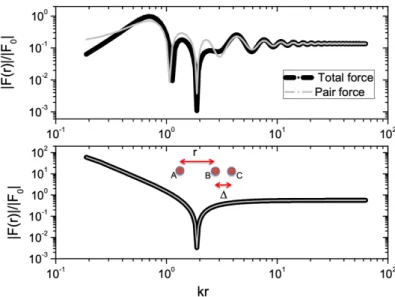
To estimate the relevance of many-body interactions, we have considered the three-particle problem

sketched in the inset of Fig. S1. The total force on particle “B” is calculated by solving self-consistently

the three couple dipole equations (including all multiple scattering effects) in a stationary random

field and compared with the pairwise sum of the two body forces. While in absence of absorption

three-body forces can be relevant, they are negligible for strongly absorbing nanoparticles as it can

be seen in Fig. 4 for a relative B-to-C distance ∆ = 0.2λ

F

(larger ∆ values give the same conclusion).

We then expect pairwise interactions to be a good approximation even for relatively high particle

densities, ρ.

FIG. S1. Three-body forces. Log-log plot of the absolute value of the optical force on a particle “B”, fixed at the origin, due to the presence of two particles: Particle “A” is at a distance −r from the origin and “C” is at +∆ (∆ = 0.2λ is fixed). Grey lines correspond to the sum of two body forces FBC + FBA and thick black lines to the self-consistent three-body forces acting on “B”. (a) Forces for non-absorbing particles at resonance as in Fig. 1 in the main text. (b) Forces for absorbing particles as in Fig. 2 in the main text (Γ0 = 10−3ωF ).

Figure

FIG. S1. Three-body forces. Log-log plot of the absolute value of the optical force on a particle

Références

Documents relatifs