Department of Languages and Literatures
Section of Multilingualism
and Foreign Language Teaching
Cross-linguistic influence in bilingual
motion event encoding: The role of
language dominance and language
mode
Ladina Brugger
from Jenins, GR
Dissertation zur Erlangung der Doktorw ¨urde
an der Philosophischen Fakult¨at der Universit¨at Freiburg in der Schweiz
submitted on September 11, 2017 Accepted by the Faculty of Humanities on November 9, 2017 at the proposal of
Prof. Dr. Raphael Berthele, University of Fribourg (first advisor) Prof. Dr. Bernhard W¨alchli, University of Stockholm (second advisor)
Patterns of cross-linguistic influence can be traced in bilingual speakers’ speech. If a speaker is bilingual in two typologically different languages, his or her lexicalization patterns can show convergence of two distinct systems for different linguistic aspects. Drawing on previous studies, the extent of cross-linguistic influence can depend on factors such as dominance configurations between the languages and the state of language activation (i.e. the language mode).
Cross-linguistic differences between French and (Swiss-)German have been documented extensively in the domain of motion. These differences go beyond the lexical and grammatical levels and concern semantic-structural aspects of language. A striking semantic-structural difference between the languages can be found in Manner and Path of motion, i.e. the way a figure moves and the path he or she covers. In French, a Verb-framed language, the Path of a motion event tends to be expressed in the verb, the Manner of motion is typically expressed in adverbial elements. In (Swiss-)German, a Satellite-framed language, the description of motion events usually show the mapping of the Manner component on the verb and the mapping of the Path component on verb-external elements. Patterns of semantic convergence manifest in, for instance, an increasing number of manner verbs in French constructions or an increasing use of path verbs in German.
This thesis sets out to combine a set of interrelated questions on the role of dominance constellation between a person’s languages, the role of language mode and how these factors can have an effect on cross-linguistic influence in motion event descriptions. In this way, the study aims to connect fundamental questions of bilingual production with questions on semantic convergence and variation within motion event description.
To this end, oral descriptions of motion events from 154 bilingual speakers have been elicited by means of video clips showing self-propelled motion events. The speakers show varying degrees of language dominance, which is assessed via an online questionnaire. They were asked to describe 60 animated video clips, 30 critical items (translational motion events) and 30 filler items (caused motion events) in four conditions: a monolingual mode in German, a monolingual mode in French,
a bilingual mode once with critical items in French and filler items in German and a bilingual mode with critical items in German and filler items in French.
The results indicate that — in line with previous studies — dominance configurations show an effect on certain variables, but do not influence both languages to the same degree. The manipulation of language mode, however, does not lead to the patterns expected in the present study. The outcomes further demonstrate that besides cross-linguistic influence, certain patterns may be attributed to general patterns of bilingual encoding. Finally, it will be argued that a mix of factors contribute to variations in bilingual motion event encoding — factors, which are problematic to unravel and should be modeled simultaneously.
This thesis is the product of several contributions from people whose comments, suggestions, and critiques supported and enriched my work over the past three years. The project primarily received financial support from the Swiss National Science Foundation (project number 156121; title: Motion at the linguistic border. On the
influence of language dominance and language mode on the expression of motion in bilinguals [French-German]). A grant awarded by the University of Fribourg covered salaries of
the collaborators in data collection, and the Institute of Multilingualism in Fribourg generously compensated the speakers for their participation.
First, my thanks go to my supervisor Raphael Berthele, who allowed me to work on this project and investigate his original ideas and who incessantly provided support, encouragement and constructive suggestions.
Special thanks are in order for Jan Vanhove, who inspired this thesis not only through his statistics tutorials and blog posts but also through his helpful suggestions and support. I thank him for the patience and time he has dedicated to my questions. I am also very much obliged to my fellow PhD students and colleagues with whom I worked or encountered during this time at the Department and/or the Institute of Multilingualism in Fribourg. Special thank is also due to Elsa Liste Lamas for her help in the coding procedure.
Thanks to all 154 speakers who participated in the study and allowed me to analyze the linguistic variations in their motion event descriptions. I am also grateful to Flavio Manetsch, Simon Gauthier and Laure Chaignat for helping me collect the data.
Finally, my warmest thanks go to Rebecca, Roman, Audrey, Laura, Lucia, Seraina and Janine, for their comments and suggestions on a draft of a chapter in this document, and to my family and my better half, Gilles, for their encouragement and moral support.
List of Figures xi
List of Tables xiii
Introduction 1
1 Motion event encoding 5
1.1 The study of space, language and cognition . . . 5
1.2 Defining motion events and types of movement . . . 10
1.3 Semantic components of motion events . . . 11
1.3.1 Event integration . . . 11
1.3.2 Overlapping and divergent semantic distinctions . . . 13
1.4 Motion typology . . . 14
1.4.1 Development of a motion typology . . . 15
1.4.2 Satellite-framed languages . . . 18
1.4.3 Verb-framed languages . . . 20
1.5 Critique and redefined typologies . . . 22
1.5.1 Dichotomy, trichotomy or a continuum? . . . 22
1.5.2 Variation: Intratypological, diatopic and individual . . . 26
1.5.3 Revised notions and constructional variation . . . 29
1.6 The Boundary-Crossing Constraint . . . 31
1.7 Languages in the present study . . . 34
1.7.1 French . . . 34 1.7.2 (Swiss)-German . . . 37 2 Bilingual lexicalization 41 2.1 Defining bilingual . . . 41 2.2 Cross-linguistic influence . . . 42 2.2.1 Transfer . . . 43 2.2.2 Convergence . . . 43
CONTENTS
2.2.4 Strategies of avoidance . . . 45
2.2.5 Directionality . . . 45
2.2.6 Affected domains and factors interacting with CLI . . . 46
2.2.7 Intentionality and normativity . . . 46
2.3 Bilingual dominance . . . 47
2.3.1 Dominance vs. proficiency . . . 47
2.3.2 Components of dominance . . . 48
2.3.3 Gradual vs. categorical understanding of dominance . . . 50
2.3.4 Assessing dominance . . . 51
2.4 Language mode . . . 52
2.4.1 Defining language mode . . . 53
2.4.2 Language mode research . . . 54
2.4.3 Manipulation of language mode . . . 55
2.4.3.1 Language activation . . . 56
2.4.3.2 Conflicting variables in controlling language mode . . 57
2.5 The interplay of language dominance and language mode . . . 58
3 Cross-linguistic influence in motion event descriptions 61 3.1 Why study CLI in the motion event domain? . . . 61
3.2 Literature review on the acquisition and use of typologically different languages . . . 63
3.2.1 Language pairs . . . 63
3.2.2 Methods . . . 65
3.2.2.1 Stimuli and data elicitation . . . 65
3.2.2.2 Participants’ profile and influencing factors . . . 66
3.2.3 Occurrence and directionality of CLI . . . 67
3.2.3.1 Satellite-framed patterns in a V-language . . . 68
3.2.3.2 Verb-framed patterns in an S-language . . . 71
3.3 Implications, methodological concerns and research gaps . . . 74
3.4 Preceding studies to the project . . . 76
3.4.1 Preceding study I: Language dominance effects . . . 77
3.4.2 Preceding study II: Language mode effects . . . 78
4 Methodology 81 4.1 Hypotheses . . . 81
4.2 Materials . . . 84
4.2.1 The Bilingual Language Profile . . . 84
4.2.2 Language Tests . . . 86
4.2.3.1 Critical items . . . 88
4.2.3.2 Filler items . . . 88
4.2.3.3 Randomized block design . . . 89
4.2.4 Texts to control for language mode . . . 89
4.3 Procedure and data collection design . . . 90
4.3.1 Piloting . . . 91
4.3.2 Groups, sessions and scheduling . . . 92
4.3.3 Instructions and language mode manipulation . . . 93
4.4 Transcriptions and coding decisions . . . 94
4.4.1 Transcriptions . . . 94
4.4.2 Coding lines . . . 94
4.4.3 Inter-rater-reliability check and corrections . . . 96
4.5 Participants . . . 97
4.6 Methods of data analyses . . . 98
4.6.1 Qualitative and descriptive data analyses . . . 98
4.6.2 Statistical modeling . . . 99
4.6.2.1 Generalized mixed-effect models . . . 99
4.6.2.2 Fitting and analyzing generalized mixed effect models 100 5 French and German motion event descriptions 103 5.1 Data summary . . . 103
5.2 Inter-rater reliability . . . 104
5.3 General cross-linguistic differences . . . 105
5.3.1 The description of Path . . . 107
5.3.2 The description of Manner . . . 109
5.3.3 Simple and complex constructions . . . 111
5.3.4 Correlation of semantic components . . . 114
5.4 Participant-related variation . . . 115
5.5 Item-related variation . . . 118
5.5.1 Manner saliency . . . 120
5.5.2 Path type and boundary-crossing items . . . 121
5.6 Alternative constructions and cross-linguistic influence . . . 124
5.6.1 Missing description of boundary-crossing . . . 124
5.6.1.1 Omission of Path . . . 124
5.6.1.2 Boundary-reaching constructions . . . 125
5.6.1.3 Implicit boundary-crossing . . . 126
5.6.2 Strategies in describing boundary-crossing situations . . . 126
5.6.2.1 Multiple-clause constructions with finite manner verbs 126 5.6.2.2 Path-g´erondif construction . . . 127
CONTENTS
5.6.2.3 Infinitif-de-but . . . 128
5.6.3 CLI at the morpho-lexical level . . . 128
5.7 Discussion . . . 130
6 The effect of language dominance 133 6.1 General dominance effects . . . 133
6.2 Dominance effects in motion verbs . . . 137
6.2.1 Manner, path and deictic verbs . . . 137
6.2.2 Different coding of a verb — different outcome? . . . 139
6.2.3 Verb diversity and dominance . . . 142
6.3 Dominance effects in verb-external motion expressions . . . 143
6.3.1 Manner elaboration . . . 144
6.3.2 Path granularity and pleonastic constructions . . . 145
6.4 Construction-based dominance dependency . . . 147
6.5 Dominance effects in boundary-crossing-constructions . . . 148
6.6 Additional dominance calculations . . . 151
6.6.1 Correlation of measures . . . 151
6.6.2 Additional scoring . . . 152
6.6.3 Further language skills as co-variate? . . . 154
6.7 Discussion . . . 156
7 The effect of language mode manipulation 161 7.1 Language mode differences . . . 161
7.2 Mode effects on dependent variables . . . 163
7.3 Task-related mode effects . . . 165
7.3.1 Difference of item orders . . . 165
7.3.2 Difference between sessions . . . 167
7.4 Code-switching practice . . . 169
7.5 Model-robustness check . . . 170
7.5.1 Stimuli sub-group . . . 170
7.5.2 Participant sub-group . . . 171
7.6 Discussion . . . 172
8 Interaction between language dominance and language mode 177 8.1 Mode differences as a function of language dominance . . . 177
8.2 Dominance and language mode interaction . . . 182
8.3 Modeled interactions . . . 186
9 General discussion and conclusions 191
9.1 Summary . . . 191
9.2 General discussion . . . 193
9.2.1 Pattern variation and CLI . . . 193
9.2.2 CLI and general effects of bilingualism . . . 194
9.2.3 Language activation and extent of CLI . . . 196
9.3 Limitations of the study . . . 198
9.4 Future research directions . . . 199
References 203 A Item maps 231 A.1 Critical stimuli . . . 231
A.2 Fillers . . . 232
B Participants and scheduling 235 B.1 Participants’ BLP score distribution . . . 235
B.2 Further language competences . . . 236
B.3 Scheduling . . . 236
C Coding Manual 239 C.1 Response segmentation and basic coding line . . . 239
C.2 Macro constructions . . . 244 C.3 Micro constructions . . . 245 C.4 Verb table . . . 247 C.5 Manner table . . . 249 C.6 Path table . . . 249 D GLMM output 251 D.1 mv9 . . . 251 D.2 pv9 . . . 253 D.3 me9 . . . 254 D.4 pai9 . . . 255 D.5 pa7 . . . 257 D.6 bcc9 . . . 258 D.7 mvm . . . 259 D.8 mvd . . . 261
1.1 The conceptual structure of a macro-event . . . 12
1.2 Syntactic mapping of macro-event in a satellite-framed language . . . . 19
1.3 Syntactic mapping of a macro-event in a verb-framed language . . . . 22
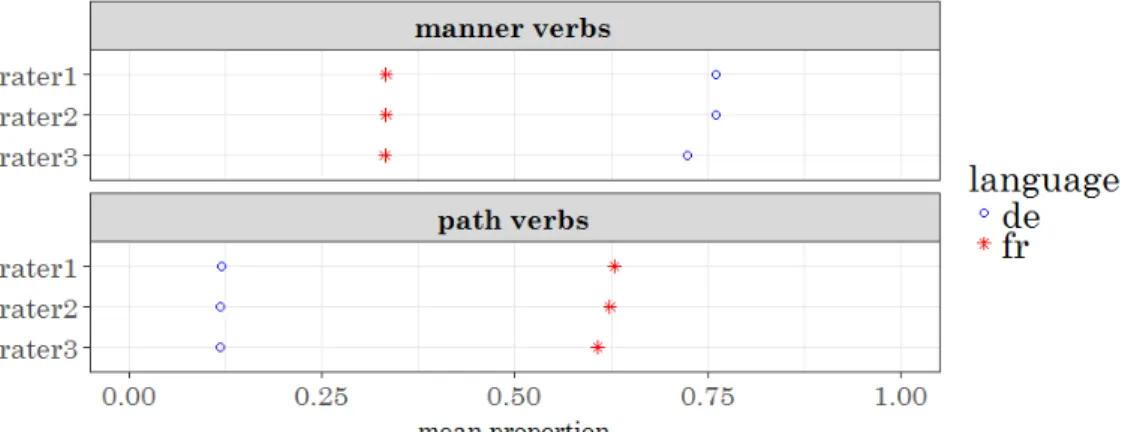
5.1 Proportions of manner verbs and path verbs across three different codings . . . 105
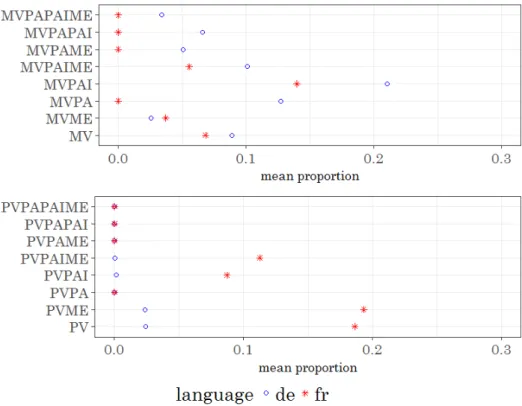
5.2 Proportions of dependent variables across language . . . 105
5.3 Proportions of constructions . . . 113
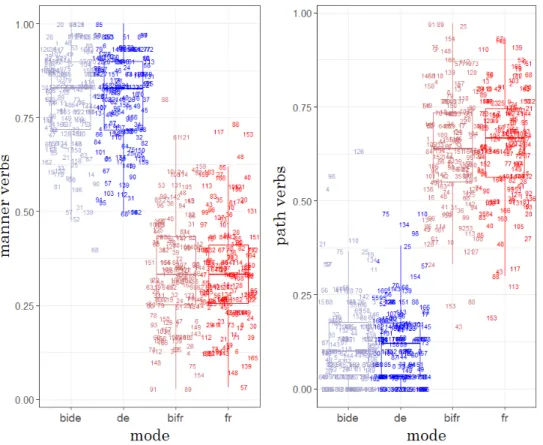
5.4 Boxplots for manner and path verbs across modes . . . 116
5.5 Proportions of dependent variables across mode for each participant . 117 5.6 Proportions of dependent variables across language . . . 119
5.7 Proportions of dependent variables across Path categories . . . 123
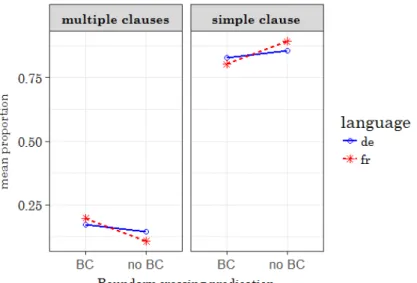
5.8 Proportions of multiple- and simple-clause constructions for items predicating a BC or not . . . 123
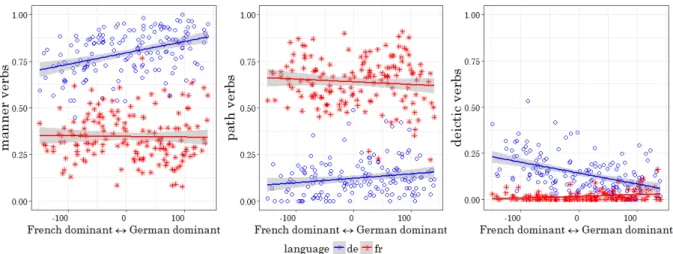
6.1 Effects of dominance for manner, path and deictic verbs . . . 138
6.2 Manner verbs excluding ‘gehen’ . . . 140
6.3 Manner verbs including ‘gehen’ . . . 141
6.4 Dominance effects for manner, path and deictic verbs . . . 143
6.5 Manner adverbials across the dominance scale for French and German 144 6.6 TTR in German and French manner adverbials across the dominance scale . . . 145
6.7 Path adverbials and path adverbals across the dominance scale . . . . 146
6.8 Path adverbials and path adverbals combined across the dominance scale . . . 146
6.9 Proportions of constructions across the dominance scale . . . 147
6.10 BCC-violations across the dominance scale . . . 149
6.11 BCC-violations across the dominance scale excluding the verb ‘sauter’ 150 6.12 BCC-violations across dominance scores for French and German . . . . 150
6.13 Proportions of manner verbs across different BLP-dominance components . . . 153
LIST OF FIGURES
6.14 Proportions of dependent variables across English skills . . . 154
6.15 Proportions of dependent variables across English skill levels for each participant . . . 155
7.1 Proportions of dependent variables across mode condition . . . 163
7.2 Proportions of manner verbs across all order ranks for all stimuli . . . 166
7.3 Proportions of manner verbs across order ranks . . . 167
7.4 Proportions across sessions . . . 168
7.5 Manner verbs and adverbials across code-switching practice . . . 169
7.6 Path verbs for 10 stimuli . . . 171
7.7 Path verbs of 10 participants . . . 172
8.1 Mode differences across the dominance scale for manner verbs . . . 179
8.2 Mode differences across the dominance scale for path verbs . . . 180
8.3 Mode differences across the dominance scale for path adverbials . . . . 181
8.4 Mode differences across the dominance scale for manner adverbials . . 181
8.5 Mode differences across dominance scale for BCC-violations . . . 182
8.6 Proportion of manner verbs across the dominance scale and the modes 183 8.7 Proportion of path verbs across the dominance scale and the modes . . 184
8.8 Proportion of BCC-violations across the dominance scale and the modes185 8.9 Proportion of path adverbials across dominance scale and modes . . . 185
8.10 Proportion of manner adverbials across the dominance scale and the modes . . . 186
B.1 BLP-score distribution across participants (identification number) . . . 235
D.1 Probability of using a manner verb . . . 252
D.2 Probability of using a path verb . . . 254
D.3 Probability of using a manner adverbial . . . 255
D.4 Probability of using a path adverbial . . . 256
D.5 Probability of using a path adverbal in German . . . 258
D.6 Probability of BCC-violation . . . 259
D.7 Probability of using a manner verb excluding ‘gehen’ . . . 260
1.1 Terminological correspondences for the main semantic dimensions of
a motion event . . . 14
4.1 Stimuli order 3: example of randomized block design . . . 89
4.2 Demographic characteristics of the participants . . . 98
5.1 Number of main variables per language . . . 104
5.2 Language as a fixed factor . . . 106
5.3 Constructions . . . 112
5.4 Correlation coefficients of dependent variables (German) . . . 114
5.5 Correlation coefficients of dependent variables (French) . . . 115
5.6 Random effect adjustment for participants . . . 118
5.7 Random effect adjustments for the stimuli . . . 120
6.1 Dominance as a fixed factor . . . 134
6.2 Interaction between dominance and language . . . 136
6.3 Gradients of dominance for dependent variables . . . 136
6.4 Correlation coefficients of BLP components . . . 151
6.5 Correlation coefficients of BLP and language tests . . . 152
7.1 Mode as a fixed factor . . . 164
7.2 Interaction between mode and language . . . 165
8.1 Interaction between dominance and language mode . . . 187
8.2 Three-way interaction of language, dominance and mode . . . 188
B.1 Language competences across 6 levels . . . 236
B.2 Schedule for the main data collection . . . 237
C.1 Basic coding line . . . 241
C.2 Macro construction . . . 245
C.3 Micro constructions . . . 246
LIST OF TABLES C.5 Path table . . . 250 D.1 Model mv9 . . . 252 D.2 Model pv9 . . . 253 D.3 Model me9 . . . 254 D.4 Model pai9 . . . 256 D.5 Model pa7 . . . 257 D.6 Model bcc9 . . . 258 D.7 Model mvm . . . 260 D.8 Model mvd . . . 261
AIC Akaike information criterion
AoA Age of acquisition
BC Boundary-crossing
BCC Boundary-Crossing Constraint BDS Bilingual Dominance Scale BIA Bilingual Interactive Activation bide Bilingual German mode
bifr Bilingual French mode
BIMOLA Bilingual Model of Lexical Access
BLP Bilingual Language Profile CLI Cross-linguistic influence
de Monolingual German mode
ES Effect size
GLMM Generalized linear mixed models FLA First Language Acquisition
fr Monolingual French mode
IC Inhibitory Control
LT LexTALE
LoR Length of Residence
LIST OF TABLES
REFL Reflexive verb construction SLA Second Language Acquisition
SE Standard error
SES Socio-economic status
S-Language Satellite-framed language
TFS Thinking-for-Speaking TLA Third Language Acquisition
TTR Type-Token Ratio
Juggling between typologically different language systems presents linguistic and cognitive challenges on different levels. When it comes to language production, a cascade of interrelated factors can determine lexicalization patterns of speakers who are bilingual in two typologically different languages. These patterns can follow the typical patterns of one language or show constructional variants and traces of the other language — not only at the phonological, lexical or structural level but also in semantic aspects. The extent to which the typical or atypical language pattern is used can depend on a mix of factors. Among these factors are language-related factors, such as the topic, the context of production and the degree of language activation, and speaker-related factors, such as preferences for certain constructions, or idiosyncrasies, modulated by language dominance configurations. Related to these determining factors are degrees of cross-linguistic influence, general developmental patterns and phenomena of bilingualism.
Scope
This thesis is embedded in a bilingual framework following interrelated lines of inquiry. On the one hand, questions about how language dominance configurations of two languages influence the production patterns of individual bilingual speakers of both languages are addressed. Language dominance is thus considered an important factor contributing to variation. On the other hand, the study investigates these production patterns in light of theoretical propositions on language activation — the language mode at the moment of production (Grosjean, 1998a, 2008).
The study of how speakers verbally express the concept of motion in space has revealed interesting insights not only regarding lexical and structural, but also in terms of semantic differences between languages. The domain of motion therefore constitutes an important field of inquiry for the challenges of handling two typologically different language systems that has been the focus of a great number of empirical studies (see Matsumoto & Slobin, 2012 for an extensive list of contrastive motion event studies).
INTRODUCTION
Motion forms part of the overarching concept of space. The domain of space is a vast field that has gained interdisciplinary interest. This interest is due to the fact that space and spatial relationships constitute an ontological universal and are thus the subject of inquiry of different approaches and research traditions in the fields of philosophy, biology, psychology and linguistics. The linguistic expression of motion in particular has been investigated from interrelated approaches such as cognitive linguistics, linguistic typology, spatial linguistics and psycholinguistics in the broadest sense (Hickmann & Robert, 2006, p. 1). While the bulk of studies of motion event encoding are concerned with the relationship between language and cognition, the present work focuses exclusively on the verbal expression of motion events. Hence, the scope of this study is delineated by production patterns and does not intend to investigate conceptualization processes or make claims about mental construal.
Motion events can refer to different types of movement. The type of motion event that the present examination investigates is dynamic, voluntary and translational (see section 1.2 for definitions) and has gained particular theoretical and empirical attention. The cross-linguistic differences previous studies have identified pertain primarily to the semantic components of Manner and Path of movement, i.e. the manner a figure moves and the way a figure covers. While these differences are gradual and not categorical, previous research has identified such systematic cross-linguistic differences in the domain of motion between French and (Swiss-)German — the language pair this study focuses on.
The present work thus tries to investigate the two fundamental factors of language dominance and the degree of language activation in bilingual productions of voluntary motion events.
Aim and contribution
The overarching goal of this thesis is to shed light on how bilingual language dominance configurations and language mode can account for variations in motion event descriptions.
Many questions in the face of linguistic variation, particularly the ways in which individual bilingual speakers vary, remain controversial and unanswered. While the present study does not pursue all these questions, it aims to cover some of the research gaps and limitations in previous studies — both on theoretical and methodological grounds. Variation has been shown to not only pertain to typologically-motivated differences between languages and language varieties, but also between and within subjects and between and within different motion events
(i.e. stimuli). In connecting questions about variation in motion event encoding with fundamental questions of bilingual production, the project aims to broaden the scope of inquiry in these domains. The overarching concerns in the analyses and approaches to explain linguistic variation are bilingual speaker-related differences. Bilingual speakers have shown varying degrees of cross-linguistic influence in their production patterns. However, approaches to assess language dominance and to control for this factor in the motion domain have remained scarce. Moreover, while theoretical propositions of language mode hypotheses have been developed and often cited, an experimental manipulation of language activation to examine these propositions has not yet been conducted with regard to semantic aspects of language. Along with tackling the effects and interplay of these factors, this work aims to contribute to the understanding of bilingual production patterns and phenomena of semantic convergence by adopting methods that account for speaker- and stimuli-related differences.
Research questions
Based on the theoretical framework and previous empirical studies, this thesis sets out to investigate four interrelated and interdependent sets of research questions.
The first set of questions that are investigated focus on whether the general cross-linguistic differences identified in previous studies appear in the present project. More specifically, are there differences in the encoding of semantic elements, such as Manner and Path of motion, between French and German descriptions? How are those language-specific factors reflected in both languages of a bilingual speaker? What kinds of semantic convergence patterns are visible in these motion event constructions?
Second, how do the bilingual speakers’ dominance configurations influence the linguistic description of motion events? Which structures and motion components are affected and to what degree? Do dominance effects depend on language, i.e. are there differences between (Swiss-)German and French in terms of dominance effects? The third set of research questions investigates the effect of language mode on bilingual motion event production. Does an experimental manipulation of language activation lead to differences in lexicalization patterns? More specifically, how and to what degree do deliberate manipulations of the language mode — i.e. the activation of both languages (bilingual mode) vs. a partial deactivation of one language (monolingual mode) — differently affect motion event encoding? Is the language mode effect more present in French? In (Swiss-)German? Or, are both languages affected to the same degree?
INTRODUCTION
The last set relates the second and third sets. Is there an interaction between the speakers’ dominance configurations and language mode manipulation? Does the effect of language mode depend on the speakers’ language dominance configurations? Does this vary between French and German?
Organization
This dissertation is divided in three main sections. Chapters 1–3 provide the theoretical backdrop for the empirical investigation outlined in chapters 4–8 and chapter 9 discusses the study’s results and general implications. The theoretical chapters begin with an introduction to the field of motion event research (chapter 1). The second chapter addresses the terminological complexity in studying bilingual lexicalization patterns (chapter 2). The final theoretical chapter (chapter 3) combines the two backgrounds and provides a brief literature review on relevant empirical investigations in the field. Based on this literature review, the methodology for the present investigation is outlined in chapter 4. Chapter 5–8 are organized following the research questions outlined in the previous section. In this way, chapter 5 provides a primary data inspection and investigates the global differences between French and (Swiss-)German constructions. The subsequent chapter addresses the second research question on the effect of language dominance configurations (chapter 6). The next chapter (chapter 7) addresses the third question on language mode, and chapter 8 shows the result for the fourth research question on interaction effects — connected to the preceding questions. Finally, chapter 9 closes with a general discussion, implications and limitations of the thesis as well as avenues for further inquiries.
Motion event encoding
The encoding of motion events has been a central focus of cognitive linguistics. Cross-linguistic analyses of lexicalization patterns laid the groundwork for an impressive body of research in cognitive and spatial semantics. The study of cognitive semantics raises questions about the relation between cognition and language in general and goes hand in hand with the discussion on linguistic relativity. Associated with the domain of motion events, Slobin’s Thinking-for-Speaking (TFS)-hypothesis and more fundamental views on the relation between language and non-verbal cognition, have been sources of divergent theoretical debates and series of empirical studies deploying different methodologies. Since the present study exclusively deals with the ‘speaking’ part, the discussion on linguistic relativity will be rather ‘straitjacketed’. Moreover, the scope of this chapter exclusively deals with dynamic, self-propelled and translational motion events (see section 1.2). The definition of and distinction between different semantic components of a motion event (section 1.3) lead to the development of the motion typology outlined in section 1.4 that is primarily associated with Leonard Talmy’s seminal work Toward
a Cognitive Semantics, but that is alluded to, explored and developed from different
perspectives and traditions. Following a vast body of empirical investigations of these typological distinctions, a series of critiques and redefinitions emerged (section 1.5). The languages of the present study (section 1.7) largely follow typological patterns and constraints (section 1.6), but show considerable variation and language variety-related idiosyncrasies (section 1.7).
1.1
The study of space, language and cognition
Conceptualizing and communicating space and spatial relations is crucial for the survival of various species and is one of the most basic human behaviors. Without the ability to mentally represent and talk about spatiality, we would be unable to
1.1. THE STUDY OF SPACE, LANGUAGE AND COGNITION
locate objects or move in space (Hickmann & Robert, 2006, p. 4). Consequently, all languages must somehow show linguistic devices to express spatial relations. Linguistic systems provide speakers with means to distinguish between static and dynamic situations and mark different types and aspects of motion. Although considered a sine qua non and thus a universal characteristic, the linguistic patterns to express spatiality show considerable variation across the world languages. For these reasons, there is particular interest in exploring the relationship between language and cognition, which is the focus of cognitive linguistics. In the domain of space, cognitive linguistics embodies an array of related disciplines and sub-disciplines, such as spatial linguistics, spatial cognition or linguistic relativity, which address questions on what spatial language reveals about spatial cognition and what spatial cognition reveals about language. As a part of cognitive linguistics, cognitive semantic refers to meaning as a cognitive phenomenon. Talmy (2000a, p. 4) defines “cognitive semantics” as follows:
“[. . . ] the word “semantic” simply refers to the specifically linguistic form of the more generic notion “conceptual”. Thus, general conception –– that is, thought –– includes linguistic meaning within its greater compass. [. . . ] Thus, research on cognitive semantics is research on conceptual content and its organization in language and, hence, on the nature of conceptual content in general.”
In this view, the expression of meaning is intrinsically linked to human cognition and is not regarded as an autonomous cognitive faculty (Cadierno, 2008, p. 241). From this constructivist point of view, linguistic meaning is a central part of grammar. Examining the linguistic representation of conceptual structure, Talmy proposes a typology primarily based on motion event constructions (1972, 1985) and later extends this to event constructions in general and particularly to constructions with resulting states (1991, 2000a, 2000b).
In contrast to previous typologies, the focus is not on formal linguistic aspects like morphology or syntax, but rather on semantic aspects of event encoding. Central to his typological distinction is the notion of lexicalization patterns or conflation patterns which refer to the ways experience is expressed in languages through the semantic content of linguistic forms. The relationships between meaning and form can also be termed conceptualization patterns (e.g. Bylund & Jarvis, 2011; Flecken, 2011). The proposition that typological categories can be built according to systematic differences between lexicalization patterns is rooted in the fact that languages differ in the amount and type of information they convey in the foreground and in the background. In Talmy’s terminology, the process of foregrounding information (i.e.
explicitly mentioning the information) or backgrounding information (i.e. omitting the information) is referred to as windowing for attention (2000a, p. 257). The degree to which a semantic component is foregrounded or backgrounded in terms of attention is called salience and is defined by its type of linguistic representation (Talmy, 2000b, p. 128).
Hence, in the course of information selection, filters and channels are employed at different levels. In other words, a speaker filters the experience of the world into verbalized events governed not only by her or his individual choice and perspective but also by the language(s) she or he speaks. The question on whether this ‘filter’ of language may have an impact on thought or cognition in general has a long and hotly debated history. In the paradigm of linguistic relativity, proponents argue for a causal link between language and thought. While the proposition that language determines thought (strong version of the Sapir-Whorf-hypothesis — although never suggested by Whorf) has become scientifically obsolete, interest in the proposition that language influences thought (weaker version of the Sapir-Whorf-hypothesis) has diminshed due to controversies and limited empirical evidence. Due to a growing interest in questions on language, cognition and space, however, there has been a resurgence of interest in linguistic relativity (Hohenstein, 2005, p. 404). The opposing views that still hold in current discussions on the relation between language and thought are summarized by Bylund and Athanasopoulos (2015, p. 2):
“On the one side, there is the universalist camp, which holds that human cognitive processes are guided by universal perceptual biases, and on the other side, the relativist camp, according to which human cognition is indeed influenced by language.”
In the domain of space, the universal camp advocates that linguistic and non-linguistic spatial representations are relatively independent from one another, the relativist camp assumes that they are intimately related (Hickmann & Robert, 2006, p. 10). Contemporary experimental research on the relationship between language and thought are characterized by two lines of inquiry differing in their definitions of ‘thought’ and the methodologies they deploy (Bylund & Athanasopoulos, 2015, p. 2). One line of inquiry relates language to non-verbal behavior and is associated with Whorf’s (1956) legacy. The studies advocating this view basically elicit non-verbal data by means of sorting, categorizing or recognizing memory tasks not intended to imply overt speech production or comprehension. While the effects of language on non-verbal cognition have been documented in the domain of motion (e.g. Gennari, Sloman, Malt, & Fitch, 2002; Kersten et al., 2010; Filipovi´c, 2011; Athanasopoulos & Bylund, 2013; Montero-Melis, Jaeger, & Bylund, 2016), they remain rather weak,
1.1. THE STUDY OF SPACE, LANGUAGE AND COGNITION
and methodological differences between the studies render it difficult to compare their results (Montero-Melis et al., 2016). Proponents of this Neo-Whorfian view cautiously formulate the links between language and cognition in that language may influence “certain cognitive processes” under “certain circumstances” depending on factors such as the characteristics of the perceptual domain, the linguistic category under investigation and the experimental task (Bylund & Athanasopoulos, 2015, p. 2). The other line of inquiry is associated with the work of Dan Slobin. Related to the aforementioned ‘windowing for attention’, in the process of speaking, speakers of a given language direct the attention to the elements of the experience that are linguistically coded. According to Slobin (1996, p. 75), the ‘thinking’ tied to language is carried out “on-line” and “in the process of speaking”. Based on his research on narrative productions, Slobin (1987, p. 435) formulated the TFS-hypothesis in the following terms:
“The activity of thinking takes on a particular quality when it is employed in the activity of speaking. In the evanescent of time frame of constructing utterances in discourse, one fits one’s thoughts into available linguistic forms. A particular utterance is never a direct reflection of “objective” or perceived reality or of an inevitable and universal mental representation of a situation. This is evident within any given language, because the same situation can be described in different ways; and it is evident across languages, because each language provides a limited set of options for the grammatical encoding of characteristics of objects and events. “Thinking for speaking” involves picking those characteristics that (a) fit some conceptualization of the event, and (b) are readily encodable in the language.”
Even though Slobin uses the term “speaking” in his formulation, he notes that the framework embraces all forms of linguistic production and reception as well as a range of mental processes (cf. Slobin, 2003, p. 160). In other words, “speaking” can be replaced by “writing”, “listening” or “understanding”. In the motion event domain, a series of studies within the TFS-framework investigate not only verbal, but also co-verbal behavior which refers to “behaviour concurrent with speech, such as visual attention allocation and gesture” (Bylund & Athanasopoulos, 2015, p. 2) (see e.g. Slobin & Hoiting, 1994, on sign language; Gullberg, Hendriks, & Hickmann, 2008, on gestures; Papafragou, Hulbert, & Trueswell, 2008; Carroll, Weimar, Flecken, Lambert, & von Stutterheim, 2012, on allocating visual attention to entities when verbally describing them). However, Slobin’s TFS-hypothesis does not claim that language influences thought or non-verbal behavior. Slobin rather replaces the two abstract
terms “thought” and “language” with ‘thinking’ and ‘speaking’ respectively (1996, p. 71). These terms denote activities, and a more dynamic and less fundamental stance is thus adopted on linguistic relativity.1
When it comes to First Language Acquisition (FLA), Slobin formulates the idea that “the child learns particular ways of thinking for speaking” (1996, p. 76). This idea has been investigated in a series of cross-linguistic studies using the picture storybook Frog, where are you? (Mayer, 1969) (e.g. Slobin, 2004). As for Second Language Acquisition (SLA), Slobin (1996, p. 89) hypothesizes the presence of particular difficulties when a typologically different language is acquired:
“In brief, each native language has trained its speakers to pay different kinds of attention to events and experiences when talking about them. This training is carried out in childhood and is exceptionally resistant to restructuring in second-language acquisition.”
Following this proposition, there is a potential influence of the L1 on the L2 when they are typologically different. In recent years, several scholars have approached the question of what happens, linguistically and cognitively, when a second language is acquired. Based on cross-linguistic studies showing the different lexicalization patterns across languages, Cadierno and Lund (2004, p. 145) hypothesize that during SLA, a speaker must learn “another way of thinking for speaking”, especially when the L2 diverges typologically from the L1. Patterns of cross-linguistic influence in terms of the ‘speaking’ part in motion event descriptions have been attested in several SLA-studies. As for the ‘thinking’ part, there have been fewer studies investigating the influence of a typologically different language on mental construal in SLA (see chapter 3). In a bilingualism framework (see section 2.1 for definitions), bilingual convergence in mental construal has been documented in a number of empirical studies (e.g. Cook, Bassetti, Kasai, Sasaki, & Takahashi, 2006; Bassetti, 2007; Jarvis & Pavlenko, 2008; Cook & Bassetti, 2011; Athanasopoulos, 2011; Pavlenko, 2011; Aveledo & Athanasopoulos, 2015).
The study of spatial language and cognition constitutes a source of fundamental debates concerning the existence of universals as well as challenging questions concerning the relation between language and thought. Given that the focus here is not on mental construal and the study exclusively discusses the dimension of ‘speaking’ and not ‘thinking’, this thesis does not intend to make any claims concerning the linguistic relativity debate, and further discussions on linguistic relativity are outside the scope of this work.
1 For more and recent contributions on linguistic relativity, see e.g. Wolff & Holmes, 2011; Gleitman
1.2. DEFINING MOTION EVENTS AND TYPES OF MOVEMENT
1.2
Defining motion events and types of movement
In the domain of space, the lexicalization patterns of aspects of the spatial universe that can be investigated are vast. Hendriks, Hickmann, and Lindner (2010, p. 183) argue for two types of sub-spaces: static space and dynamic space. Both dimensions are central to spatial representations, and all languages provide means to express static and dynamic information. Whereas the static space refers to the localization of entities in relation to other entities, the dynamic space refers to motion and involves different types of motion. The most cited definition of motion event by Talmy, formerly termed “translatory situation” (Talmy, 1972, p. 10), incorporates both sub-spaces: “a situation containing movement or the maintenance of a stationary location” (e.g. Talmy, 2000b, p. 25). Given that the present study exclusively focuses on dynamic motion, static events are excluded from this definition, and thus only include a “situation that involves displacement of an object in relation to a reference point” (Bylund & Athanasopoulos, 2015, p. 3) is considered a motion event. Among the types of dynamic motion events, there must be made a distinction between translational and self-contained motion. In Talmy’s terms, translational motion refers to motion in which “the location of the Figure changes in the time period under consideration” (Talmy, 2000b, p. 25). In contrast to self-contained motion such as rotation, oscillation or dilation, there is a change of location, a translocation, a trajectory that is covered. Translational motion may further be divided into voluntary motion and caused motion. While caused motion involves an external force, voluntary motion refers to self-propelled motion. This type of motion can be agentive or non-agentive. Grammatically, when motion is expressed through a verb, caused motion is usually encoded in the transitive form involving a direct object; whereas, self-propelled motion usually implies an intransitive verb with no direct object. In more recent studies on motion events, there has been a growing interest in fictive motion (e.g. Tomczak & Ewert, 2015). Figurative or fictive motion refers to “motion with no physical occurrence” (Talmy, 2000a, p. 99) as for instance in the case of sensory paths encoded by perception verbs such as ‘I looked toward the valley’ (cf. Cadierno & Ruiz, 2006, p. 197). In this study, however, the focus is on real motion or what Talmy calls “factive motion”. Factive motion implies an overlap with reality and is “used with reference to a concrete, overt (explicit) movement of some entity through a three-dimensional space” (Tomczak & Ewert, 2015, p. 51). In summary, the notion of a motion event refers to dynamic, translational, voluntary and factive motion in this thesis.
1.3
Semantic components of motion events
In a motion event, different semantic information can be mapped on different lexical and syntactic elements. Observations on these semantic distributions have been made from different angles, resulting in a terminological complexity. Although the present thesis adopts the mainstream terminology in motion event research, primarily based on the work of Leonard Talmy, similar ideas have been expressed and developed before and after Talmy. Hence, subsection 1.3.1 presents the main components of event integration, primarily based on Talmy’s terminology, and subsequently explores these semantic components in light of different frameworks and ideas upon which these terms are based.
1.3.1
Event integration
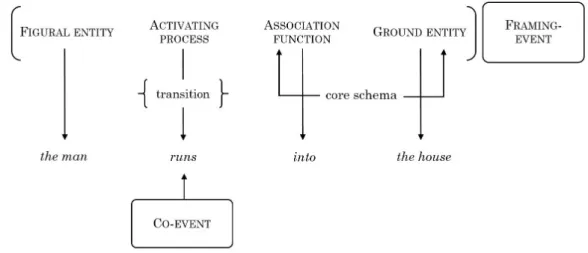
Talmy (2000b, pp. 213-221) argues that in the underlying conceptual organization of language, events are encoded in internal structures with varying degrees of complexity. Semantically and syntactically complex properties of an event can be conveyed in a macro-event. A macro-event can be expressed by a single clause, but its content and structure resembles that of a complex event. A single clause’s expression of a complex event is called event integration and is greatly constrained in terms of the categories that can be integrated. The macro-event incorporates the main-event, or framing-event, and the subordinate-event(s) or co-event(s). The framing-event determines the overarching conceptual framework of the macro-event. In contrast, the co-event constitutes an event of circumstance in relation to the macro-event and supports the framing-event. In other words, a co-event can “fill in, elaborate, add to, or motivate the framing event” (Talmy, 2000b, p. 220). The framing-event comprise four components: The Figural and Ground entity, the activating process and the association function. The activating process depicts the process whereby the Figure makes a transition in relation to the Ground in the case of a dynamic event, and it refers to the motion component of a motion event. The association function contributes to the core schema of the event and refers to the path component of a motion event (Talmy, 2000b, p. 118). The co-event can conflate with the activating process (Fortis, 2010, p. 4) as in the case of a manner verb in a motion event. The example in Figure 1.1 depicts the conceptual structure of a macro-event.2
2 Figure 1.1 is adapted from Berthele (2004a, p. 95) which is based on Talmy (1991, p. 485) and Talmy
1.3. SEMANTIC COMPONENTS OF MOTION EVENTS
Figure 1.1: The conceptual structure of a macro-event
As indicated above, among the domains to which the notion of macro-event applies is the domain of space. In the domain of space, a framing-event refers to a basic motion event (Fortis, 2010, p. 4). According to Talmy (2000b, p. 25), a motion event typically comprises five parameters: the Figure (the Figurative entity), the Ground (the Ground entity), the Motion (the Association Process), the Path (the Association Function) and any associated Co-Events. The encoding of these semantic elements is distributed over open-class lexical items, closed-class grammatical items and syntactic structures of phrase elements (i.e. surface elements) (Talmy, 2000a, p. 178).
The Figure is an object that can potentially be moved or that moves and covers a particular trajectory in a dynamic motion event. In other words, the Figure moves (or is moved) in relation to the Ground. The Ground is a stationary reference event, that is relative to a reference frame (usually along the temporal axis). The Figure’s temporal location is characterized with respect to this reference frame (Talmy, 2000a, p. 320). However, Figure and Ground are closely interrelated (Talmy, 2000a, p. 289). In other terms, the Figure requires anchoring, and the Ground anchors it (Talmy, 2000a, p. 331).3
The component of Motion refers to “the presence per se of motion or locatedness in the event” (Talmy, 2000b, p. 25). That is, dynamic motion events refer to translational motion in which the location of the Figure changes over time. Hence, it does not refer to kinesis in general, as it does not encompass other types of motion such as self-contained motion (Talmy, 2000b, p. 26). Finally, the fourth semantic component and the core entity of a motion event is the Path. As mentioned above, this component is seen as the core schema of the motion event in the Talmyan approach (Talmy, 2000b, p. 225). Whereas the Co-Event can be omitted, the core schema is
3 For more details on the characterization and relation between Figure and Ground see Talmy, 2000a,
seen as critical to a motion sentence (Talmy, 2009, p. 390).
Although a Co-Event can bear a range of support relations to the motion event4,
Manner and cause are the most frequent and most widely investigated (Talmy, 2000b, p. 26). Cause of motion is not relevant to the present study, as none of the critical items intend to trigger the expression of cause. Manner of motion is considered highly relevant. Together with the component of Path, Manner is regarded crucial for typological distinction (section 1.4). Following studies elaborating on this Co-Event, the category of Manner can be subdivided, according to its semantic complexity, into more general Manners such as walk, run or fly or more specific distinctions such as limp, sprint or swoop (Slobin, 2004, p. 6). This partition, elsewhere referred to as “manner tiers”, indicates Manner elaboration and contributes to a typological distinction (Slobin, 1997, 2004, 2006; Jessen, 2014a) (cf. subsection 1.5.1).
1.3.2
Overlapping and divergent semantic distinctions
Distinctions between the semantic units of a motion event have been noticed in different approaches –– both dependent on and independent from each other. Labeling the distinction between the semantic components of what Talmy calls Manner and Path can at least be traced back to Malblanc (1966, p. 66) who builds upon the ideas and observations of German (e.g. Strohmeyer, 1910) and Romance philologists (e.g. Bally, 1932). In Stylistique compar´ee, Malblanc employs the expression la direction du mouvement to refer primarily to French verbs expressing Path and la nature du mouvement to refer to German verbs expressing Manner (1966, p. 66). Lucien Tesni`ere (1969) builds on this distinction and re-labels and further develops these semantic elements. In ´El´ements de syntaxe structurale, he distinguishes
between mouvement ‘movement’ and d´eplacement ‘displacement’ (1969, pp. 307-310).
Mouvement is regarded as an intrinsic component that depends on the Figure’s
corporal structure and possibilities and can be expressed in an undefined number of specific verbs such as trotter ‘to trot’, galoper ‘to gallop’ or sauter ‘to jump’. D´eplacement, on the other hand, is extrinsic, is not centered on the Figure and exclusively delineates space.
The terms Figure and Ground are adopted from Gestalt psychology. In Gestalt psychology, Figure refers to the main object that is perceived whereas Ground refers to the background that garners less attention. Although the semantic interpretation
4 In a foreword to a recent book edited by Iraide Ibarretxe-Antu ˜nano, Motion and space across languages and applications (2017), Talmy notes several aspects that have been underexplored. Among these
parameters are the different relations that a co-event can have to a motion event: precursion, enablement, onset causation, extended causation, manner, concomitance, concurrent result and subsequence.
1.4. MOTION TYPOLOGY
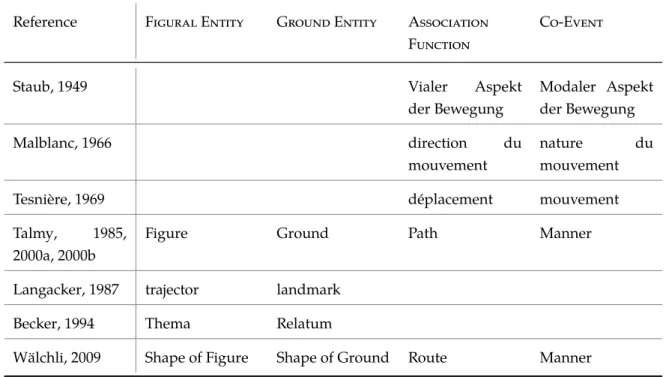
of these entities is different when adopted in motion event terminology (Talmy, 1985, p. 6; 2000a, p. 25) and is far more complex in the field of Gestalt psychology, the basic idea of the Ground as a reference object and the Figure as an object that needs anchoring remains the same (Thiering, 2011, p. 248). This asymmetric relationship between Figure and Ground is employed similarly in Langacker’s (1987) distinction between trajector and landmark. Langacker defines trajector as “the figure within a relational profile” (1987, p. 494) and the landmark as “a salient substructure other than the trajectory of a relational predication or the profile of a nominal predication” (1987, p. 490). Yet other terms to refer to the Figure and Ground distinction include Thema and Relatum, respectively (e.g. Becker, 1994), and other terms to refer to Path and Manner of motion are Vialer und Modaler Aspekt der Bewegung (Staub, 1949) or Route and Manner (W¨alchli, 2009). Table 1.15summarizes the terminological complexity of
the main semantic units of a motion event.
Table 1.1: Terminological correspondences for the main semantic dimensions of a motion event
Reference Figural Entity Ground Entity Association Function
Co-Event Staub, 1949 Vialer Aspekt
der Bewegung Modaler Aspekt der Bewegung Malblanc, 1966 direction du mouvement nature du mouvement Tesni`ere, 1969 d´eplacement mouvement Talmy, 1985,
2000a, 2000b
Figure Ground Path Manner Langacker, 1987 trajector landmark
Becker, 1994 Thema Relatum
W¨alchli, 2009 Shape of Figure Shape of Ground Route Manner
1.4
Motion typology
Although Talmy’s framing approach (see below) is the most widely acknowledged typological distinction in the domain of motion and has been called ‘the Talmyan typology’ (e.g. Ferrari & Bator´eo, 2016), there have been important precursors to
Leonard Talmy with similar ideas and observations. In the European context6, these pre-Talmyan observations have primarily been ascribed to contrastive linguistics rather than linguistic typology (W¨alchli & S ¨olling, 2013, p. 5; Stolova, 2015, p. 21). However, these stylistic observations laid the groundwork for motion typology. The present chapter demonstrates the development from observations in contrastive stylistics to the establishment of a widely-anchored typology.
1.4.1
Development of a motion typology
In the European context, several authors in comparative stylistics and structuralistics have noticed that there is a prominent difference in expression between Germanic and Romance languages in the domain of motion. In the early 20th century, several German and Romance philologists remark that German has a range of specific verbs, whereas French is more restricted in the domain of motion (e.g. Strohmeyer, 1910; Bally, 1932). To illustrate this difference of motion verb specification, Strohmeyer’s (1910, pp. 217-218) observation deserves to be quoted here7:
Ganz besonders zeigt sich die Abneigung des Franzosen gegen das Spezialisieren der Begriffe bei den Ausdr ¨ucken der Bewegung. Aller heisst bekanntlich alles: “gehen”, “fahren”, “reiten”, “fliegen”, “segeln”, “steigen”, “sinken” usw. [...] Dasselbe hat sich nun auch mehr oder minder auf die anderen Verben der Bewegung ¨ubertragen, besonders auf
entrer [. . . ], sortir, arriver, venir, revenir, retourner, descendre, traverser, suivre, pr´ec´eder usw. Ob die Rede ist von einem Zuge, der einf¨ahrt und ausf¨ahrt,
von einem Boote, das hineingleitet und herausgleitet, von einer Biene, die in den Stock hineinfliegt und wieder herausfliegt, von einem Bergmann, der in den Schacht hineinsteigt und wieder heraussteigt, von einem federnden Maschinenteil, der in sein Lager hineinspringt und wieder herausspringt, dem Franzosen gen ¨ugt ¨uberall ein einfaches entrer und sortir.8
Building on these ideas of German’s verbal richness in the expression of motion and French’s verbal simplicity, Malblanc (1966, p. 66) notes that for the French verb
6 Beyond the European context, similar observations have been made in contrasting Japanese to
Romance languages (Miyajima, 1984, cited in Matsumoto, 2003, p. 407).
7 The emphases are adopted from the original. All the German and French quotes in this chapter are
translated freely by the author of this thesis.
8 Translation: The French reluctance toward specifying notions is particularly prominent in motion
expressions. To go(French) can, as is known, mean everything: “going”, “driving”, “riding”,
“flying”, “sailing”, “ascending”, “sinking” etc. [...] The same is true for the other motion verbs, in particular enter, [...] exit, arrive, come, come back, return, descend, cross, follow, precede etc. If there is talk of a train, which runs in and leaves, of a boat which floats in and floats out, of a bee, which,
flies in and flies out of a hive, of a miner, who descends and ascends the mine, of a springy machine
1.4. MOTION TYPOLOGY
entrer ‘to enter’, the German translation would use several different verbs such as laufen ‘to walk’, treten ‘to step’ and fliegen ‘to fly’. He explains this difference in verbal
specification in the following words (Malblanc, 1966, p. 66):
Le franc¸ais n’a qu’un seul verbe, parce qu’il a, dans ce verbe, retenu seulement la direction du mouvement qui est la mˆeme dans les trois cas. L’allemand a trois verbes compos´es, parce que, en mˆeme temps que la direction du mouvement, il indique la nature de celui-ci, nature qui, diff´erente dans les trois cas, est exprim´ee par le verbe proprement dit. La particule, exprimant le sens du mouvement, se retrouve la mˆeme ou presque, puisque ce sens reste le mˆeme.9
Tesni`ere (1969, pp. 307-310) elaborates on this perception of verbal confinement by referring to geometrical confinement of space. The notions describing d´eplacement are limited in number, as they are only meant to describe the axes of three dimensions: up and down, left and right, and back and forth. Tesni`ere provides some examples of verbs expressing d´eplacement in French (entrer ‘to enter’ and sortir ‘to exit’ or monter ‘to ascend’ and descendre ‘to descend’) and some examples of prepositions in German (auf ‘up’ and ab ‘down’ or hin ‘hither’ and her ‘tither’) and remarks that due to the geometrical axes, these verbs and prepositions usually come in opposing pairs. The observation that Path (or der viale Aspekt der Bewegung) is expressed outside the verb in German, can also be found in the contrastive work of Staub (1949, p. 21) (as cited in Jokinen, 2005, p. 54):
Im allgemeinen scheint der implizite Richtungsgehalt des einfachen deutschen Verbum schwach und vor allem in der Umgangssprache selten. Der Bedeutungskern des Verbum liegt in der Bewegung, im modalen Aspekt der Bewegung. Die Richtung dieser Bewegung, ihr Verlauf im Raume, ihr vialer Aspekt, wird ausserhalb des Verbum festgelegt, im Adverb, im adverbialen Pr¨afix, in der adverbialen Erg¨anzung. 10
Tesni`ere (1969, p. 309) notices that even though the dimension of Path (or
le d´eplacement) can be expressed outside the verb slot in French such as in the
9 Translation: French has only one verb, because it has, in this verb, only kept the direction of motion,
which is the same in the three cases. German has three compound verbs, because, at the same time as the direction of motion, it indicates the nature of it. The nature, which is different in the three cases is expressed by the actual verb. The particle, which expresses the direction of motion, is there or nearly, as its meaning remains the same.
10Translation: In general, the implicit meaning of direction of the simple verb seems weak and —
particularly in vernacular language — rare. The core meaning of the verb lies in the motion, in the modal aspect of the motion. The direction of this motion, its progress in space, its vial aspect, is specified verb-externally, in an adverb, in an adverbial prefix, in an adverbial complement.
preposition `a travers in example 1, it would not convey the resultative meaning as in the German translation ¨uber in example 2, which allows a straightforward way to express change of location.
(1) Antoine ‘Antoine nage swims `a travers across le the fleuve. river.’ (2) Anton ‘Anton schwimm swims ¨uber across den the Fluss. river.’
Therefore, the Path must be expressed in the verb in French to convey a resultative meaning. As for the dimension of Manner (or mouvement), Tesni`ere (1969, p. 309) notices that in French, this constituent is either expressed in a substantive (example 3) or in a g´erondif (example 4), because the verb slot is reserved for the expression of Path: (3) Antoine ‘Antoine traverse crosses le the fleuve river `a at la the nage. swim.’ (4) Antoine ‘Antoine traverse crosses le the fleuve river en by nageant. swimming.’
These contrastive stylistic observations on the syntactic distribution of the semantic dimensions of a motion event correspond precisely to the phenomenon on which Leonard Talmy bases his semantic motion typology. According to Talmy, there are two approaches to classifying languages: focusing on a grammatical locus such as the verb root and observing which semantic element it most often expresses, and taking a semantic component as a starting point and observing by which syntactic elements it is most frequently encoded. The former approach is termed actuating
typology (Talmy, 2000b, chapter 1) and fixes on the main verb root by analyzing
the semantic component it expresses. In his dissertation (1972), Talmy compares the polysynthetic language Atsugewi with English and Spanish and carves out a three-way classification according to this actuating approach. Whereas the English motion verb typically expresses a Co-Event, the Atsugewi verb conflates Motion and Figure, and the Spanish verb conflates Path and Motion (Talmy, 2000b, p. 57). In his later publications, Talmy focuses on the latter approach which is called framing
typology (Talmy, 2000b, chapter 3) and which is adopted by most researcher working
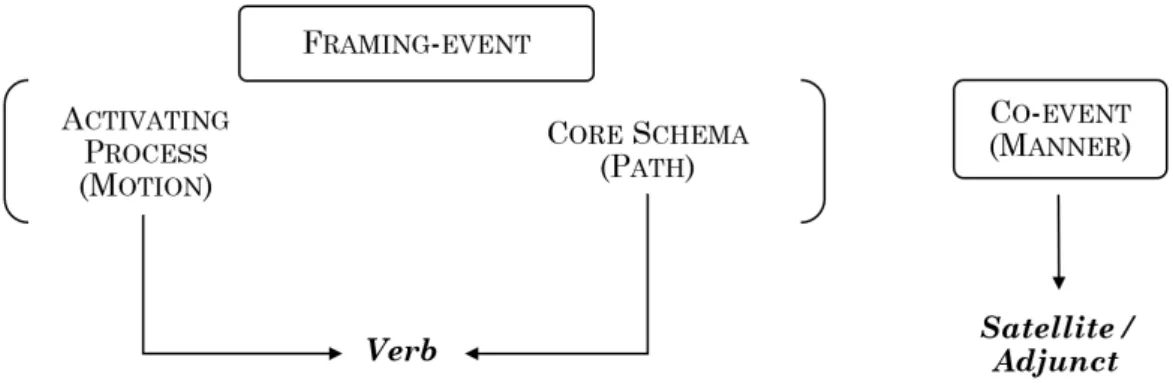
on motion event descriptions. The semantic component taken as the starting point is the Path or core schema of the motion event. Following the language specific conflation of Path and Motion, he establishes a two-way classification. One way to encode the Path component is in the main verb root (viz. verb-framed language). The other way to lexicalize Path is to express this entity in grammatical constituents such
1.4. MOTION TYPOLOGY
as prepositions, particles, adverbs, which all fall under the umbrella term satellite11 (viz. satellite-framed language). Among Indo-European languages, the verb-framed type is generally represented by Romance languages, while the satellite-framed type is represented by Germanic and Slavic languages.
It must be mentioned that Talmy speaks of tendencies, i.e. patterns that are “most colloquial in style, frequent in occurrence, and pervasive across different types of constructions” (Talmy, 2017, p. 4, or also Talmy, 1985, p. 62; 2000b, p. 27). Hence, the typological classification should not be regarded as rigorous dichotomy, but a set of preferences for certain lexicalization patterns. In this way, languages can only be classified by quantitative empirical research (Berthele, 2006, p. 25).
1.4.2
Satellite-framed languages
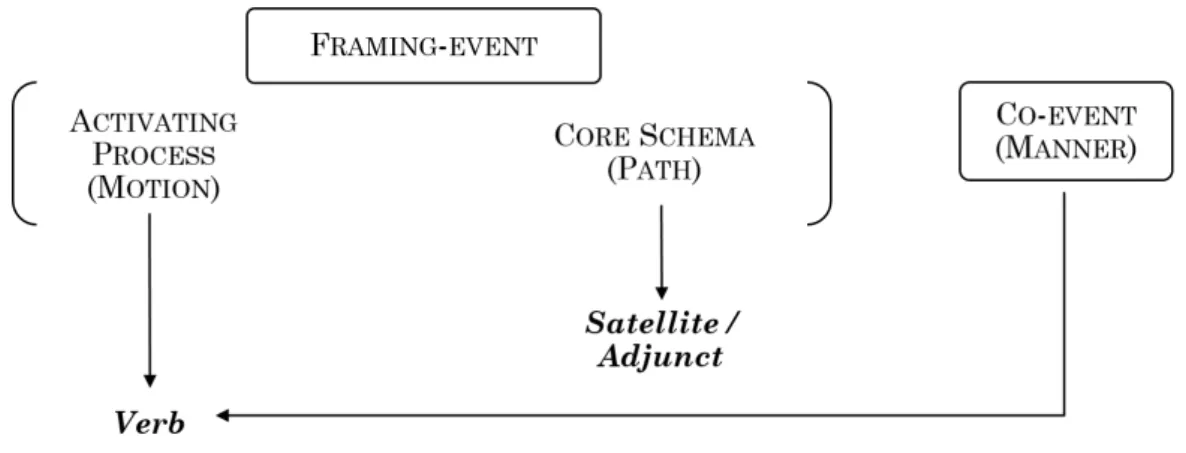
The status of satellite-framed language (S-language) is ascribed to Germanic and Slavic languages (Slobin, 2004). As outlined in the previous section, the location of Path is framed in satellites in this language type. Satellites are defined by Talmy (1991, p. 486) as “the grammatical category of any constituent other than a nominal complement that is in a sister relation to the verb root”. A satellite, either a bound affix or a free form, can encompass different grammatical forms, such as German separable or inseparable verb prefixes, English verb particles or Russian verb prefixes. Forms that function as satellites often overlap with forms in a grammatical category. For instance, English satellites often overlap with prepositions, and satellites in Mandarin often overlap with verb roots (Talmy, 2000b, p. 102). These various grammatical forms have semantic and syntactic commonalities, which is the function of the core schema of a typological category of languages (viz. satellite-framed languages) (Talmy, 1991, p. 486)12. In the satellite-framing pattern, the Co-Event
is then characteristically mapped onto the verb, which is thus termed co-event verb (Talmy, 2000b, p. 222). The syntactic mapping of the macro-event is illustrated in Figure 1.213.
11See subsection 1.5.3 for problems with this term.
12Cf. subsection 1.5.3 for critiques of and revision to this definition. 13The figure is adapted from Talmy (2000b, p. 223).
Figure 1.2: Syntactic mapping of macro-event in a satellite-framed language Drawing on (Swiss-)German data from the present project, examples 5 through 7 correspond to this characteristic satellite-framed mapping of Manner on the main verb and the Path component verb-externally14:
(5) es ‘an oranges orange m¨anndli manikin h ¨upft hops in into es a huus house’ (31-K2-de-IV) (6) er ‘he dreht turns schich himself-REFL us out em a h ¨u ¨us house us out-of’ (127-K1-de-IV) (7) der ‘the mann man h ¨upft hops gl ¨ucklich happily in in ein a haus house hinein into’ (20-K2-de-III)
In example 5, the Path component is mapped on the preposition in, while the Manner of movement is expressed in the verb h ¨upfen. Example 6 illustrates a syntactic distribution of the Path component on two grammatical elements: the path preposition us (‘aus’) and the path particle us (‘heraus’). This case of distributed
spatial semantics is discussed in subsection 1.5.1 and subsection 1.5.3. In example 7,
the speaker specifies the Manner of motion, which is already expressed in the verb
h ¨upfen with an additional Manner element expressed in the adverb gl ¨ucklich.
However, as mentioned above, the focus in the framing-typology is on “tendencies” or “characteristic patterns of conflation” (Talmy, 1985, p. 62; Talmy, 2000b, p. 27). Hence, alternative conflation patterns can occur where Path is not expressed in satellites, but rather in the main verb root. This pattern would correspond to typical verb-framing lexicalization. Such a verb-framing lexicalization in S-languages is shown in example 8:
14Throughout this thesis, all examples taken from the data are followed by a code indicating the
ID-number of the participant, the item, the language mode and the number of the session (see Appendix C for further explanation of these codes). The items are described in section A.1.
1.4. MOTION TYPOLOGY (8) er ‘he verloht leaves s the huus house mit with dreihende revolving bewegige movements’ (80-K1-de-IV)
The finite verb verloht expresses the Path whereas the prepositional phrase mit
dreihende bewegige expresses the Manner of motion. Constructional variations and
expressions with neither Path nor Manner mapping in the finite verb are discussed in subsection 1.5.3. S-languages can differ in their tendencies to express Path or Manner in the verb. In German, for instance, the Path is less often expressed in the verb than it is in English, because English shows a great number of Latinate path verbs15(Carroll
& von Stutterheim, 1993; Hendriks, 2005; Carroll et al., 2012). Such intratypological differences are discussed in subsection 1.5.2.
Due to the tendency to express the Manner component in the main verb slot, it is more likely to describe the optional Co-Event in S-languages than in verb-framed languages (Slobin, 2004, 2006). Therefore, S-languages show not only different rhetorical styles (Slobin, 1996, 1997) but also greater specificity and lexical diversity (Berman & Slobin, 1994; Slobin, 2004; Cappelle, 2012; Slobin, Ibarretxe-Antu ˜nano, Kopecka, & Majid, 2014). This observation has also led Slobin (2004, p. 26) to propose a typology based on Manner salience rather than a binary division based on the mapping of the Path (cf. subsection 1.5.1).
1.4.3
Verb-framed languages
Verb-framed languages (V-languages) are represented by Romance languages, but also a range of other, non-Indo-European languages have been investigated empirically and identified as V-languages such as Japanese (Wienold & Schwarze, 2002; Bauer, 2010) or Korean (Choi & Bowerman, 1991). In contrast to S-languages, the Path element is characteristically encoded in the main verb root in V-languages. Drawing again from data in the present project, examples 9 and 10 show the typical pattern for the V-language French:
(9) il ‘he sort exits d’une from-a maison house’ (3-K1-bifr-III) (10) le ‘the robot robot sort exits de from la the maison house en by dansant dancing’ (21-K1-bifr-IV)
In example 9, the Path element is mapped on the main verb sortir and the event description lacks a lexicalization of the Co-Event. As discussed in the previous section, compared to S-languages, V-languages are said to show a lower tendency to express the optional Co-Event component. However, V-languages display a variety
15Talmy (1985, p. 72) has already noted such differences due to diachronic reasons. However, he
remarks that these verb forms are borrowings from Romance languages and are not original English verb forms.