Computational Characterization of
Radiation-induced Defect Dynamics and Material Response
by Miaomiao Jin
B.S., Nuclear Engineering
University of Science and Technology of China, 2013 SUBMITTED TO THE
DEPARTMENT OF NUCLEAR SCIENCE AND ENGINEERING
IN PARTIAL FULFILLMENT OF THE REQUIREMENTS FOR THE DEGREE OF DOCTOR OF PHILOSOPHY IN NUCLEAR SCIENCE AND ENGINEERING
AT THE
MASSACHUSETTS INSTITUTE OF TECHNOLOGY JUNE 2019
©2019 Massachusetts Institute of Technology All rights reserved.
Signature of Author:
Miaomiao Jin Department of Nuclear Science and Engineering May 20, 2019 Certified by:
Michael Short, Ph.D. Class ’42 Career Development Assistant Professor of Nuclear Science and Engineering
Thesis Supervisor Certified by:
Ju Li, Ph.D. Battelle Energy Alliance Professor of Nuclear Science and Engineering Professor of Materials Science and Engineering Thesis Reader Accepted by:
Ju Li, Ph.D. Battelle Energy Alliance Professor of Nuclear Science and Engineering Professor of Materials Science and Engineering Chair, Department Committee on Graduate Theses
Computational characterization of radiation-induced defect
dynamics and material response
by
Miaomiao Jin
Submitted to the Department of Nuclear Science and Engineering on May 20, 2019, in partial fulfillment of the
requirements for the degree of
Doctor of Philosophy in Nuclear Science and Engineering
Abstract
Material degradation due to radiation damage poses serious concern on the reliability and durability of any reactor design. To understand material performance under the extreme environments combining high temperature and intense irradiation, the response of radiation damage must be meticulously analyzed, both experimentally and computationally. These efforts will not only bridge the knowledge gap in the fundamental understanding of physical processes, but also allow for prediction of material behavior under a variety of conditions and development of novel materials with superior radiation tolerance.
This thesis investigates multiple aspects of radiation damage in materials using various computational methods over a wide range of time and length scale, including atomistic description of defect dynamics, multiscale simulations of radiation processes, and artificial intelligence prediction of material responses based on experimental stud-ies. Firstly, to resolve the fundamental mechanisms of radiation-induced behavior, the traditional molecular dynamics simulations on single-atom damage cascade is extended by developing an algorithm to appropriately introduce numerous consecu-tive cascades; hence, an experimental dose level on the order of dpa (displacement per atom) can be achieved to enable realistic understanding of observed material re-sponses. It has been utilized to examine the radiation behaviors in solid-solution alloys and nanocrystalline metals such as defect dynamics and grain boundary migration. Secondly, to break the intrinsic limitation of scale in atomistic simulations, a multi-scale microstructural evolution framework that links binary-collision approximation, molecular dynamics and cluster dynamics is built to describe mesoscale experimental observations. It is used to successfully explain the non-power-law defect distribution in irradiated tungsten. This tool can be generalized to study the spatial dependent defect evolution in materials under ion irradiation. Finally, to bypass the physics-based complexity of describing materials evolution in real applications, a holistic view enabled by machine learning techniques is utlized, and applied to predict the onset of void swelling in metals with a manually collection of data from experimental studies. The model has generated satisfying results for prediction of unseen data based on
material properties and experimental parameters. Thesis Supervisor: Michael P. Short
Acknowledgments
I would like to express my earnest thanks to a number of people throughout the thesis process.
I hold deep and sincere thanks to my advisor, Prof. Michael Short, for his very generous guidance, strong support and tremendous patience during the research. Not only have I been genuinely influenced by the enthusiam, perseverance, and optimism, I have also learnt the philosophy of a better research life in the future. This thesis would not have been greatly improved without his comments, but surely any errors that remain are my own.
I want to acknolwledge all the individuals in the MIT MNM group for their in-dispensible roles in both my research and life, especially Dr. Penghui Cao, a keen mentor whom I will never thank more than enough. My gratitude extends to Prof. Ju Li and Prof. Sidney Yip, whom I always look up to and who inspire me to embark on a fulfilling research journey.
I would also like to thank my friends including Weiyue Zhou, Yang Yang, Yifeng Che, and my fellow classmates, with whom I have had so many wonderful experiences, and whose friendship I will value for life.
Finally, my family, especially Jilang Miao, have embraced me with endless support through my emotional ups and downs. I owe them more than I would be able to experess.
Contents
1 Introduction 25
1.1 Thesis layout . . . 27
2 Background 29 2.1 Radiation damage . . . 29
2.2 Brief review of previous work . . . 34
2.2.1 Experiments and theories . . . 35
2.2.2 Simulations . . . 36
2.3 Radiation resistant materials . . . 40
2.3.1 Compositional and structural tailoring . . . 41
2.3.2 Dispersion . . . 42
2.3.3 Nanostructuring . . . 42
2.3.4 High entropy alloys . . . 43
2.4 Summary . . . 45
3 Atomistic characterization of radiation-induced defect dynamics 47 3.1 Radiation resistance in high entropy alloys . . . 47
3.1.1 Introduction . . . 48
3.1.2 Methods . . . 49
3.1.3 Results . . . 52
3.1.4 Discussion . . . 63
3.2 Radiation resistance in nanocrystalline metals . . . 68
3.2.2 Computational models and methods . . . 70
3.2.3 Results . . . 72
3.2.4 Discussion . . . 81
3.3 Radiation-induced grain growth in nanocrytalline metals . . . 85
3.3.1 Introduction . . . 85
3.3.2 Methods . . . 87
3.3.3 Results . . . 88
3.3.4 Discussions . . . 96
3.4 Radiation effects in solute-stabilized nanocrystalline metals . . . 98
3.4.1 Introduction . . . 98
3.4.2 Methods and models . . . 99
3.4.3 Results . . . 100
3.4.4 Discussion . . . 108
3.5 Summary . . . 112
4 Multiscale modeling of radiation-induced defect evolution 115 4.1 Defect evolution in tungsten: deviation from power law . . . 116
4.1.1 Introduction . . . 116
4.1.2 Methods . . . 117
4.1.3 Results . . . 122
4.1.4 Discussion . . . 133
4.1.5 Conclusion . . . 136
4.2 Spatial dependent defect evolution in Fe . . . 137
4.2.1 Introduction . . . 137
4.2.2 Methods . . . 138
4.2.3 Results . . . 141
4.2.4 Discussion . . . 144
4.3 Summary . . . 147
5 Data-driven prediction in nuclear materials 149 5.1 Predict the onset of void swelling . . . 149
5.1.1 Introduction . . . 149 5.1.2 Methods . . . 153 5.1.3 Results . . . 158 5.1.4 Discussion . . . 163 5.2 Summary . . . 166 6 Summary 167 6.1 Thesis overview . . . 167 6.2 Thesis contributions . . . 169 6.3 Outlook . . . 170
List of Figures
1-1 Generations of reactor design. . . 26
2-1 Radiation effects: (a) Radiation-induced segregation of Cr, Ni, Si, and P at the grain boundary of a 300 series stainless steel irradiated in a light water reactor core to several dpa at 300 ∘C; (b) Effect of
irra-diation dose on measured tensile yield strength for several 300 series stainless steels irradiated and tested at a temperature of about 300∘C;
(c) Swelling of Fe-15Cr-xNi ternary alloys in EBR-II at temperatures between 400 and 510 ∘C for nickel levels between 12.1 and 24.4 wt%;
(d) Irradiation-assisted stress corrosion cracking: cracks in cold-worked 316 stainless steel baffle bolt. The location of the cracks received a neu-tron dose of about 7 dpa at ∼ 310∘C. . . . 30
2-2 Difference in damage morphology, displacement efficiency, and average recoil energy for 1 MeV particles of different types incident on nickel. 32
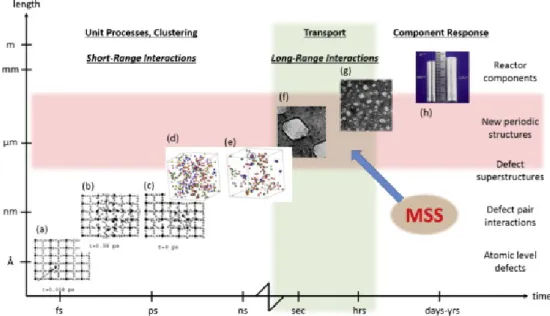
2-3 Spatial-temporal scales of processes involved in void swelling. In (a)-(e), radiation knocks host atoms out of their lattice points, causing local melting, followed by annealing where most atoms return to lattice sites. With longer time for vacancies to migrate and accumulate, (f)-(g) show the observed material response in the form of void swelling . MSS denotes mesoscale science which bridges micro- and macro-response. . . 33
2-4 TEM imaging: (a) Vacancy clusters and dislocation loops in Ni (neu-tron irradiated at 305 K to 0.15 dpa); (b) Histogram of the vacancy cluster count corresponding to (a). . . 37 2-5 Typical methods for scale-dependent processes ranging from atomistic
study on defects to continuum modeling of macro-scale experimentally measurable effects. . . 38 2-6 Comparison of swelling response in various austenitic and ferritic alloys
as a function of dose. It can be seen that ferritic structure outperforms austenitic. . . 41 2-7 Oxide size distribution for samples irradiated with Ni ion at 700oC to
0, 5, 50, and 150 dpa. . . 43 2-8 Nanostructured materials in various forms to improve radiation
toler-ance, including nanograins, nanolayers, nanotwins, nanopores, nanopar-ticles, and nanowires. . . 44 2-9 Cross-sectional TEM images on void distribution: Ni, NiCo, NiFe, and
NiCoFeCr irradiated with 1.5 MeV Ni+ ions to 3 × 1015cm−2 at 773K,
scale bars in rightest zoomed images are 50 nm. . . 44
3-1 Comparisons of randomly generated system energy with MC+MD an-nealed system. The anan-nealed systems show smaller energies for all alloy compositions, showing that better-equilibrated configurations are ob-tained after MC+MD relaxation. The energy is computed based on system of containing 10,800 atoms. . . 53 3-2 (a) Radial distribution function 𝑔(𝑟) for Fe-Fe and Ni-Ni before (i.e.
randomly generated configuration) and after MC+MD swap annealing of Ni40Fe60. (b) Mixing energy ∆𝐸 versus Fe concentration. The blue
squares in the inset show the energy of the annealed system 𝐸𝑓, while
3-3 (a) Damage production map for elemental Ni and Ni1−𝑥Fe𝑥 alloys with
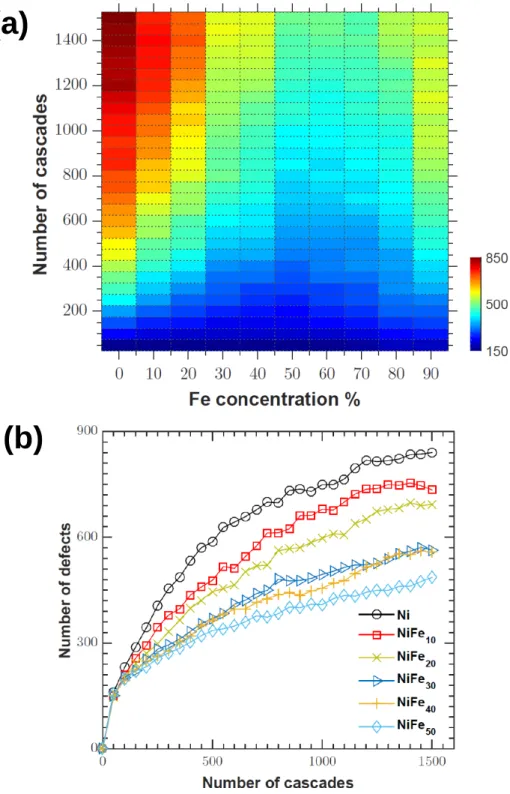
various Fe concentrations, subjected to radiation damage from up to 1500 consecutive cascades (∼ 0.5 DPA). For each composition, the map is color coded by the average number of defects (Frenkel pairs) produced from twelve independent simulations. (b) Number of defects as a function of number of cascades for Ni and various Ni-Fe alloys as indicated. . . 56
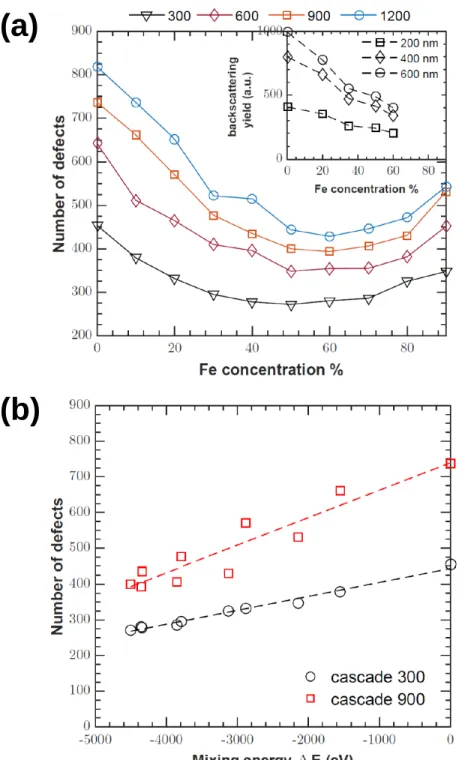
3-4 (a) Fe concentration-dependent defect production at different stages of radiation damage (300, 600, 900 and 1200 cascades). The error bars indicate one standard deviation. The inset shows experimentally measured radiation damage at different depths, as a function of Fe con-centration from 0 to 60%. (b) Correlation between radiation damage and mixing energy ∆𝐸 for Ni and nine Ni1−𝑥Fe𝑥 alloys. . . 57
3-5 Evolution of defect size as a function of damage cascades for (a) Ni and (b) Ni40Fe60. . . 58
3-6 Defect distributions at different damage stages in Ni and Ni40Fe60.
(a)(d) Point defects produced after 50 cascades. Red indicates inter-stitials, while blue shows vacancies. (b)(c) and (e)(f) Ordered defect structures formed at 500 cascades and grown in size at 1,500 cascades in Ni and Ni40Fe60, respectively. Only large defect cluster are shown.
The atoms shown have non-FCC structures. The red atoms are hexag-onally close packed (HCP) stacking faults, while the solid lines indicate dislocations. . . 58
3-7 (a-b) Schematic illustrations of defect migration pathways in the po-tential energy landscape (PEL) for Ni (a) and (b) Ni-Fe alloy, respec-tively. The energy difference between a local minimum and nearby saddle point constitutes the energy barrier for defect migration. (c-d) Two examples of NEB computed point defect migration minimum en-ergy pathways (MEPs). The insets illustrate the corresponding initial and final atomic configurations. (c) The calculated MEP for a vacancy exchanging position with one of the neighbors indicated. In this work, all possible 12 pathways for each atom are considered. (d) MEP for in-terstitial [100] dumbbell rotation MEP. The migration barrier is energy difference between initial state and activation state (saddle point). . . 61
3-8 (a) Average vacancy migration energy barrier versus Fe concentration in Ni1−𝑥Fe𝑥 alloys. The error bars represent one standard deviation
𝑐std. (b) Average interstitial migration energy barrier versus Fe
con-centration. (c) Standard deviation of the migration energy barrier 𝑐std
for all defect types versus Fe concentration. . . 62
3-9 Distributions of Ni- and Fe-vacancy migration energy barriers in Ni1−𝑥Fe𝑥.
(a)-(i) correspond to x = 10%-90%, respectively. The vertical dashed line denotes the migration energy barrier for pure Ni. The energy barriers are calculated for ∼10,368 paths. . . 64
3-10 Distributions of Ni- and Fe-interstitial migration energy barriers in Ni1−𝑥Fe𝑥. (a)-(i) correspond to x = 10%-90%, respectively. The
3-11 (a) Illustration of the simulation model used in this study. Brown atoms have a FCC structure, while GB atoms are shown in red. Pe-riodic boundary conditions are applied in all three directions, with periodicity along the x-direction plotted to show GBs separated by a spacing 𝜆. (b-c) GB structures and atomic volume. The GBs structures of Σ5(210) (b) and Σ5(310) (c) are viewed along the [001] axis. The kite-shaped units are marked to illustrate the GB structures, where atoms are colored by the volume of their Voronoi cells. The misorien-tation angle is defined by the [100] direction of the two crystals. . . . 71
3-12 Radiation-induced defect clusters and GB evolution in Σ5(210) Cu at different doses. The grain spacing 𝜆 is 11.4 nm. Atoms are color coded according to their structures (red → HCP, blue → BCC, grey → other structure, FCC atoms not shown). For the sake of clarity, only the ten largest defects are shown in the figures. (a) shows the point defects and interstitial-loaded GB produced at a low radiation dose of 0.001 dpa (two collision cascades at 5 keV). (b) displays the irradiated GBs and radiation-induced SFTs at 0.079 dpa. (c-d) indicate that SFTs do not appear to grow in size and number at higher doses, as they are observed to be interacting with GBs. The SFTs are annihilated via the GB-SFT interaction. Abbreviations are as follows: FCC, face centered cubic; HCP, hexagonal close packed; BCC, body centered cubic; GB, grain boundary; SFTs, stacking fault tetrahedra. . . 73
3-13 (a)-(d) Distributions of vacancy and interstitial at various doses in Σ5(210) system with spacing 11.4 nm. Grey atoms represent GBs, while blue and red are vacancy and interstitials, respectively. The GBs absorb most radiation-induced interstitials, becoming interstitial-loaded and leaving vacancy-rich bulk regions. The interstitials and vacancies are identified by Wigner-Seitz cell method. . . 74
3-14 (a) Total number of defective (non-FCC) atoms as a function of dose in Σ5(210) and Σ5(210) systems. The dashed-lines are shown to guide the reader. (b) Number of large SFTs (clusters containing more than 15 vacancies) versus dose. . . 76
3-15 (a) Statistical distribution of vacancy-type defect sizes in irradiated Σ5(210) Cu with grain spacing of 11.4 nm at damage dose from 0.01 dpa to 0.27 dpa. Mono- and di-vacancies, defective SFTs, and per-fect SFTs are grouped and shown according to their sizes (number of vacancies). (b) SFT annihilation process via interaction with a GB. A radiation-induced SFT (upper panel) migrates to a GB, which be-comes locally distorted upon contact (middle panel). A cross-sectional view is also provided where neighboring atoms of the GB are colored by atomic strain. Finally, the SFT is absorbed, returning the distorted GB to a straight profile (bottom panel). (c) shows the process of SFT annihilation by interstitial recombination. An immobile SFT shrinks in size due to absorbing interstitials resulting from GB emission and nearby cascades. . . 77
3-16 Processes of immobile SFT annihilation. The size of the SFT decreases by absorbing interstitials. . . 80
3-17 (a) Statistic distributions of defect size for different Σ5(210) spacing 𝜆. Three independent simulations are performed for each grain spacing 𝜆, and all defects produced at damage dose from 0.01 dpa to 0.27 dpa are extracted. (b) The density of defect cluster (with size > 1) as a function of 𝜆 for both Σ5(210) and Σ5(310) systems. . . 80
3-18 (a) and (b) spatial distributions of defect clusters in irradiated Σ5(210) systems at 0.27 dpa with 𝜆 values of 22.9 nm and 11.4 nm, respectively. (c) Two GBs simultaneously interact with a large SFT at a small 𝜆 of 5.7 nm. Small defects are the primary forms of damage (d). . . 82
3-19 (a) shows the simulation cell with periodicity in each direction. Two values of spacing 𝜆 are studied. (b) plots the Σ5(210) GB atomic arrangement. Atoms are colored by per-atom volume identified by Voronoi method after performing minimization to show the extra vol-ume inside the GB. . . 87
3-20 (a) shows the simulation cell with periodicity in each direction. GB spacing of 11.3 nm is used. PKAs are randomly selected atoms with 5 keV kinetic energy. (b) plots the GB position during the irradiation process. (c) shows the potential energy change corresponding to (b). . 89
3-21 (a) Evolution of the distribution of non-FCC atoms along the horizon-tal axis at various damage level indicated by the number of cascades on the left ( T=300 K and 𝜆=5.7 nm); (b) The change in GB distance (𝜆 − ∆) for 𝜆=5.7/11.3 nm at T=800 K with increasing dose level. (c) Multiple simulations on GB evolution prior to annihilation at 800 K and 𝜆=5.7 nm, where the red dots indicate the start of rapid GB elimination. The shaded band illustrates a critical interval where GBs are very prone to annihilation. Note the temperature is raised to ac-celerate the process. The position of GB is calculated the taking the average of constituent atoms. . . 91
3-22 Temporal evolution of variance of GB position (⟨¯ℎ2⟩) in irradiated and
un-irradiated systems, respectively. The GB mobility (𝑀) is calculated based on the linear fitting using ⟨¯ℎ2⟩ = 𝐷𝑡, where 𝐷 is the diffusion
3-23 GB evolution under continuous irradiation within system 𝜆 = 11.3 𝑛𝑚, 𝑇 = 800 𝐾: (a) GBs and SFTs; (b) SFT interacts simultaneously with both GBs; (c) direct GB contact; (d) GB annihilation process; (e) GBs disappear into stacking faults; (f) defects in the system identified by Voronoi cell method. Number at corner denotes the configuration at the end of such many cascades. Atoms are colored by structure-type after minimization. Shaded turquoise indicates the location of initial GBs. Only large atom clusters are shown in (a-e) for ease of visualization. 94
3-24 Grain growth mechanism from GB evolution: (a) Stage I: GB exhibits random walk due to the random disturbance from damage cascades; (b) Stage II: biased GB migration dominates as the distance decreases enough to allow for synergistic absorption of defects generated during thermal spikes; (c) Stage III: rapid curvature-driven GB migration after direct contact. . . 95
3-25 (a) A bi-crystal simulation cell containing two AIFs, where Cu Σ5(210) GBs are doped with Zr atoms (Cu-25 at.%Zr). 𝜆 and 𝑑 denote the GB distance and AIF width, respectively. Atoms are colored by the structure type; (b) Atom counts across the AIF region between the two red-dashed lines, binned by a width of 0.1 Å. . . 101
3-26 Schematic model of Zr atom mixing behavior: evolution of Zr con-centration profile. Starting with initial condition (black step curve), before Zr atoms from neighboring AIFs coincide (red curve), Eq. 3.6 can provide a good estimation of Zr distribution. As the solution ap-proaches the blue curve, more terms ought to be included to account for contribution from neighboring AIF. . . 103
3-27 (a) Model fitted 4𝐷𝑡 of Zr concentration profile with respect to the damage level for systems with 𝜆 = 5.7 nm and initial 𝑑 = 3.62, 10.85 Å at 300 and 800 K. Therein, the fitting to 𝑑 = 10.85 Å are plotted along with the histogram after 10, 250 and 500 cascades, where 𝑇 = 800 K shows much quicker Zr mixing rate. (b) Model fitted 4𝐷𝑡 of Zr concentration profile with respect to the damage level for systems with 𝜆 = 11.3 nm. 𝛽 denotes the slope of linear regression. . . 104
3-28 (a) Model fitted 4𝐷𝑡 of Zr concentration profile with respect to the damage level for systems with 𝜆 = 11.3 𝑛𝑚 and initial 𝑑 = 10.85 Å at 100-800 K. (b) Linearly fitted slope (𝛽) versus 𝑇 ; upper-left: 𝛽 versus the mean squared displacement of Zr atoms after single damage cascade in a well-mixed Cu-Zr system at different temperatures; bottom-right: cascade induced displacement field at 100 and 800 K. . . 105
3-29 (a)-(b) non-FCC atoms shows the initial GB and atom configuration after around 200 PKA in pure Cu at 800 K, respectively. (c)-(d) non-FCC atoms shows the initial Zr-doped GB and atom configuration after 600 cascades at ambient temperature 800 K, 𝑑 = 3.62 Å and 𝜆 = 5.7nm. (e) Defective structure size distribution after 100 and 600 cascades for the Zr-doped system as in (d). (f) Zr atoms distribution in (d) where the left shows the atom positions and the right gives the histogram by binning atoms horizontally. (Non-FCC atoms are determined via common neighbor analysis) . . . 106
3-30 (a)-(b) Residual defects in pure Cu and Cu-4.65 at.%Zr solution after 500 cascades, respectively. Blue dots denote vacancies and red dots are SIAs, both of which are equal to the number of Frenkel pairs (FPs) shown in the figure. The concentration of Zr is approximated using the number of Zr atoms in 𝑑 = 3.65 Å of Cu-4.65 at.%Zr and 𝜆 = 5.7 nm system. . . 107
3-31 Residual defect density in the bulk region of in Cu containing GB (red) and Zr-doped GB (black), respectively. Solid curve denotes the total number of defects including both vacancies and interstitials, and dashed curve plots the number density of vacancies. System setting: 𝜆 = 5.7 nm and 𝑇 = 300 K. . . 108 3-32 GB location in pure Cu (green) and doped Cu-25 at.%Zr GB with
𝑑 = 3.65 Å, 𝜆 = 5.7 nm system (red) versus increasing damage level. The ambient temperature for both systems is 800 K. Note that in pure Cu, the two GBs have direct contact and start to merge at around 200 cascades. . . 109
4-1 Multiscale simulation methodology used to study radiation defect size evolution. Key results extracted in each stage are marked in bold. . . 120 4-2 PKA spectra calculated from SRIM, for tungsten self-ion irradiation
at 150 keV (black) and 400 keV (yellow) . . . 123 4-3 Number of defects created at various PKA energies in MD simulations 123 4-4 Defect cluster size distribution at 30 K during the primary stage of
tungsten self-irradiation. For each case, a power law fitting is provided along with the corresponding 𝑅2 value. . . 124
4-5 Defect size distribution with different mobility constraints on the largest mobile SIA cluster (𝑁𝑖𝑚𝑎𝑥), after one second of 150 keV tungsten
self-ion irradiatself-ion . . . 126 4-6 Final defect size distribution in self-ion irradiated tungsten, with three
different dose rates applied to the same dose (with 𝑁𝑖𝑚𝑎𝑥 = 6) . . . . 127
4-7 Defect size distribution in self-ion irradiated tungsten to 0.014 dpa, with incoming ion energies of 150 keV and 400 keV applied at the same dose rate (𝑁𝑖𝑚𝑎𝑥 = 6) . . . 127
4-8 Effect of total dose on the defect cluster size distribution in self-ion irradiated tungsten, at a dose rate of 0.0125 dpa/s and a maximum mobile SIA cluster size of 𝑁𝑖𝑚𝑎𝑥 = 6) . . . 129
4-9 Effect of defect production term in CD model . . . 130
4-10 Defect cluster concentration as generated by MD simulations, rate the-ory calculations (this work), and experimental measurements. . . 132
4-11 (a) Depth dependent of void swelling curve and distribution of de-posited Fe ions in pure Fe with 3.5 MeV self-ions to various peak dam-age level; (b) Distinctions between distributions of vacancy clusters from MD damage cascade simulations in bulk and thin foil (Fe and W, with PKA energy at 50 and 150 keV). . . 138
4-12 (a) shows the vacancy production and injected ion deposition rates based on the output from SRIM simulations with 10,000 ions and ex-perimental conditions. For each bin across the depth (100 bins in total), PKA spectrum and consequent defect size distribution from the pri-mary damage stage can be acquired by incorporating MD simulations of cascades. (b-c) Example of the PKA spectrum and the defect size distribution in the peak damage bin (around 0.9 𝜇m). . . 139
4-13 Calculated defect size distribution in the peak damage region at various doses with dose rate at 7 × 10⁻⁴dpa/s. “-" denotes vacancy type and
“+" for interstitial type clusters. The appearance of double peaks in vacancy cluster distribution indicates the nuclear barrier of void growth.142
4-14 Calculated defect size distribution in the peak damage region at various doses with dose rate at 7 × 10⁻³dpa/s. “-" denotes vacancy type and
“+" for interstitial type clusters. The appearance of double peaks in vacancy cluster distribution indicates the nuclear barrier of void growth.143
4-15 Comparison of the void swelling curves from calculation and experi-ment. 𝑑𝑐 denotes the cutoff minimum size used in aggregating defect
size distribution into swelling percentage in order to mimic TEM res-olution in the experiment. . . 144
5-1 Application of machine learning (left half) to nuclear materials (right half) for i) prediction of radiation effects (e.g. incubation dose for void swelling in metals), and ii) discovery of new materials with superior radiation performance. Insights can be gained from the identification of meaningful features, such as chemical composition and microstructure, and patterns in the increasing amount of experimental data. (AUC: area under the curve; MSE: mean squared error; R2: R-squared). . . 152 5-2 (a) Plot of correlation matrix 𝜌(·, ·) for each pair of variables denoted
in the figure. Note that no significant linear dependence exists between variables, especially between the target variable (incubation dose) and all features. (b) Categorization of data by irradiation type: combining the original ion species “Fe++" and “Ni++" into “Heavy", and “C++"
and “Proton" into “Light" ion irradiation to make the dataset more bal-anced. (c) Distribution of the target variable (void swelling incubation dose) in the dataset. . . 159 5-3 (a)-(e) Predicted versus experimental values of incubation dose using
different machine learning models. The points are colored by the irradi-ation type. The GB method performed the best, with good predictions and high correlation. . . 160 5-4 Box-plots of the MSE for training (a) and test (b) sets using different
machine learning models. Insets plot the error distribution from the GB method. The difference in vertical scale between training (a) and testing stages (b) indicates overfitting. Note that the error is calculated with the normalized dataset. . . 161 5-5 (a) Top ten important features in predicting void swelling using the
GB method on a single dataset split; (b)-(i) Distribution of rank for the top ranked features from (a) using 50 different dataset splits. . . . 162 6-1 Distribution of vacancy formation energy (a) and migration energy (b)
List of Tables
2.1 Approximate timescales in the primary stage of radiation damage. . . 31 4.1 Parameters used in cluster dynamics (PART I). . . 121 4.2 Binding energies used in cluster dynamics (PART II). . . 121 4.3 Parameters used in cluster dynamics for Fe (PART I). . . 141 4.4 Binding energies used in cluster dynamics for Fe (PART II). . . 141 5.1 Representative subset of the dataset used in this study, showing two of
the 305 records. Chemical composition is a placeholder for 21 elements: Fe, Cr, Mn, Si, Co, Mo, Ni, C, Ti, N, B, P, S, Nb, Cu, Ta, Al, V, Mg, W, Zr. . . 154 5.2 Summary of numerical variables in the dataset. . . 154 5.3 Optimized parameters for different methods in scikit-learn 0.19.1. . . 158
Chapter 1
Introduction
Material problems in nuclear systems must be successfully resolved for nuclear en-ergy to make further improvement on safety and economics. The current and pro-posed concepts on future fission and fusion reactors (Figure 1-1) present an excep-tionally harsh operating environment for structural materials due to a combination of high temperature, high stress, chemically aggressively coolant and intense irradia-tion [1]. Structural materials are expected to maintain mechanical, dimensional and microstructural integrity during the long service time under these extreme conditions. Therefore, many alloys that are currently used in nuclear energy systems will not sat-isfy the requirements, calling for the development of mechanically reliable and highly radiation-tolerant materials.
Multiple promising material designs have been proposed to improve radiation resistance and also bear superior mechanical properties, including nanoscale oxide dispersed steels [3], high entropy alloys [4], nano-layered materials [5], and interfacial engineering [6]. A good description of radiation response of materials is the prereq-uisite to both qualify the novel options and optimize existing designs.
Although tens of years of radiation study have provided numerous experimental results on different materials, ranging from simple metals to complicated alloys, these results can be hard to explain and generalize and sometimes contradictory. Even with the availability of more advanced techniques facilitating clearer observations on multi-angles of material behavior, information regarding the fundamental processes
Figure 1-1: Generations of reactor design [2].
and the underlying mechanisms is still hardly obtainable. For a variable-rich system including radiation environment and complexity of materials such as various con-stituent elements, internal structures and manufacturing specifications, it is hard to identify active factors for any unexplained behavior, given limited time-consuming experiments.
However, computational study of the physical processes backed by a appropriate theoretical framework and the exponential growth of computation capability can ef-fectively provide an avenue to describe and predict material behavior. Simulation techniques like Monte Carlo, molecular dynamics, and continuum equations are espe-cially useful to characterize physical processes and reveal new interpretations, such as high temporal and spatial resolution of microstructural evolution which experiments are hard to deliver. Therefore, this thesis work is characterizing radiation-induced material response with the appropriate computation tools, focusing on various as-pects such as long-term microstructure evolution, defects structures, and defect-grain boundary interaction, phenomenological prediction of radiation effects. Radiation damage is inherently multiscale process, and the capability to describe it on a wide range of length and time scales is key to understanding material behavior; hence, these
studies are organized into three themes, from atomistic mechanisms with molecular dynamics, to integrated response in a multiscale computation framework, to physics-agnostic data prediction using machine learning:
∙ Atomistic understanding: mechanisms of damage resistance in single-phase con-centrated solid solution alloys (Ni-Fe) and nanocrystalline metals (Cu); mech-anistic understanding of radiation-enhanced grain growth; assessment of grain stabilization via amorphous intergranular film.
∙ Multiscale description: multiscale study of radiation-induced defect evolution with spatial dependence in pure tungsten and iron.
∙ Data-driven prediction: predicting the onset of void welling in metals via ma-chine learning.
The goal is not only to provide mechanistic understanding, but also facilitate the prediction of material behavior, which will ultimately contribute to efficient screening and qualification of candidate materials for nuclear energy to make further improve-ment on safety and economics.
1.1 Thesis layout
Chapter 1 serves as an introduction of the whole structure, where motivations and highlights of current work are emphasized.
Chapter 2 starts with an overview of radiation damage and effects, analyzed via both experiments and simulations. On the experimental side, previous experiments in studying material degradation under neutron irradiation and the strong argument in using ion irradiation as surrogate to expedite experiment time span are concisely reviewed. Computationally, the inherent multiscale property necessitates multiple simulation techniques over different ranges of time and spatial regimes. In the end, some trending radiation-tolerant material designs are introduced.
Building on top of current computation techniques, the following chapters fo-cus on resolving various issues arising from the material-dependent characteristics.
Firstly, material behavior is examined with atomistic simulations. Chapter 3.1 and 3.2 focus on the understanding of radiation resistance shown in high entropy alloys and nanocrystalline materials, respectively. Following the study of nanocrystal, the inevitable problem is irradiation-enhanced grain growth. Chapter 3.3 elaborates the grain boundary migration and grain growth due to irradiation in nanocrystalline Cu. Then Chapter 3.4 characterize the technique and the effect of grain stabilization via grain boundary complexion in Zr doped nanocrystalline Cu. Secondly, scaling up to multiscale framework is necessary considering the limitation of both time and length scales in atomistic simulations. To tackle this problem, the cluster dynamics model has been built using a finite element solver in conjunction with atomistic methods to describe the long-term defect evolution. As an application, Chapter 4.1 demonstrates this methodology and tries to understand the deviation from power law of defect size distribution in irradiated pure tungsten at cryogenic temperature. Finally, as the complexity of real materials systems can become intractable with physics-based models, a shortcut via modern machine learning methods may be possible to circum-vent the conundrum. Chapter 5 as proof-of-concept is a demonstration of promising results using this technique to predict the onset of void swelling based on manually collected experimental data.
Chapter 6 provides an overview of the studies encompassed in this thesis, the major contributions, and current trending problems. Although different materials are considered, the findings and methodology can be generalized in understanding radiation damage in other materials. The atomistic details of microstructural evolu-tion, along with coarse-grained continuum modeling compose a relatively complete big picture, making possible both macro-scale blueprint and high-resolution touches. However, more work still needs to done considering the emergence of new radiation-resistant designs and the incentive to understand radiation effect in other applications such as semi-conductors.
Chapter 2
Background
This chapter briefly reviews radiation damage process, the effects on materials, and the study techniques including experimental tools and simulation methods. It ends with an overview of current understanding of radiation resistance in new materials.
2.1 Radiation damage
Structural materials in reactors are subject to harsh environments involving a com-bination of high temperature, high stress, chemically aggressive coolant, and intense radiation fluxes. In contrast to other energy industries, this additional radiation field accelerates microstructure evolution and material degradation, such as embrittlement and dimension instability. The problem becomes more pronounced with increas-ing irradiation dose, hence limits the economy and safety of long-serviced reactors. Therefore, to accommodate the imminent need of reactor lifetime extension and im-plementation of advanced reactor systems, the performance of materials in extreme environment must be improved. Significant progress has been made to better under-stand radiation effects. Figure 2-1 demonstrates some examples: (a) segregation, (b) increase in yield strength, (c) swelling and (d) irradiation-assisted stress corrosion cracking. To describe these long term behaviors, it is necessary to characterize the microstructural evolution with experiments and modeling. Such evolution is a re-sult of collective dynamics of defects and internal structures (interfaces, dislocations,
and precipitates). Correspondingly, the capability to effectively remove defects and control structural integrity is crucial to improve radiation resistance.
a
b
c
d
Figure 2-1: Radiation effects [1]: (a) Radiation-induced segregation of Cr, Ni, Si, and P at the grain boundary of a 300 series stainless steel irradiated in a light water reactor core to several dpa at 300 ∘C; (b) Effect of irradiation dose on measured
tensile yield strength for several 300 series stainless steels irradiated and tested at a temperature of about 300 ∘C; (c) Swelling of Fe-15Cr-xNi ternary alloys in EBR-II
at temperatures between 400 and 510∘Cfor nickel levels between 12.1 and 24.4 wt%;
(d) Irradiation-assisted stress corrosion cracking: cracks in cold-worked 316 stainless steel baffle bolt. The location of the cracks received a neutron dose of about 7 dpa at ∼ 310 ∘C.
Zooming in on the radiation damage process, it starts from the collisions between energetic incident particles and lattice atoms. Part of the energy is transferred as
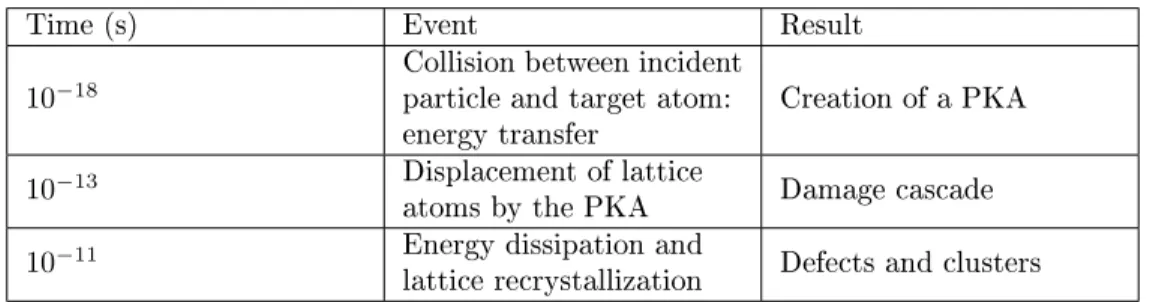
the kinetic energy of the target atoms which are referred as primary knock-on atom (PKA). The PKA can then be displaced out of its lattice position and continue colliding with other atoms. A damage cascade may be generated given higher enough incident energy. Finally, as the PKA energy has dropped to an amount smaller than the displacement threshold, it rests in the lattice. An approximate timescale for the process which constitutes the initial 10−11𝑠is shown in Table 2.1 [1]. During the time
span, particles loses energy in several ways during transport, by collision, electron excitation, ionization, or Bremsstrahlung. The energy loss can be described in two main forms: nuclear (𝑆𝑛) and electronic (𝑆𝑒) stopping power. In the high energy
regime, 𝑆𝑒 dominates and atoms are less likely to be displaced from their lattice
sites. In the low energy regime, 𝑆𝑛 > 𝑆𝑒, where deposition of energy which leads to
displacement of target atoms becomes dominant.
Table 2.1: Approximate timescales in the primary stage of radiation damage.
Time (s) Event Result
10−18
Collision between incident particle and target atom:
energy transfer Creation of a PKA
10−13 Displacement of lattice
atoms by the PKA Damage cascade
10−11 Energy dissipation and
lattice recrystallization Defects and clusters
Corresponding to Table 2.1, the primary stage can be roughly divided into three steps: ballistic stage, thermal spikes, and quenching. During the first phase, atoms undergo high-energy binary collision and many atoms are displaced from their original lattice sites. However, these temporary defects are not stable. During the following thermal spike, the kinetic energy of PKAs is shared with surrounding atoms, which induce local melting. As energy is dissipated, the molten zone quenches back down to thermal equilibrium within a few pico-seconds. At the end of this stage, defects are left behind, in the form of defect clusters or isolated point defects including vacancies and interstitials. The number of residual defects is, however, much lower than that from the ballistic stage. Displacement efficiency, defined as the ratio of between the residual defects from quenching the cascade and the estimated “ballistically" produced
defect, is introduced to quantify the damage, although argument still remains on whether this concept is a good measure considering the microstructural evolution induced by produced defects with different characteristics. It should be noted that damage cascades are closely related to the type and energy of incident particles. Well-separated subcascades may be formed with high energy incident particles. Meanwhile, the morphology of residual defects vary significantly with the particle types. Light ions such as electrons, protons and helium tend to produce isolated Frenkel pairs while heavy ions and neutrons create large defect clusters. Figure 2-2 [1] illustrates the differences by considering 1 MeV incident particles to target nickel. The reason is that the energy transfer cross-sections of heavy ion or neutron are usually much larger than those of light ions, so that the former can more efficiently transfer kinetic energy to target atoms, which then generate a cascade of displaced atoms rather than isolated defects.
Figure 2-2: Difference in damage morphology, displacement efficiency, and average recoil energy for 1 MeV particles of different types incident on nickel [1].
Radiation damage is inherently multi-scale process as depicted by Figure 2-3 [7]. Beyond initial cascade stage (∼ 10−11𝑠) as described in Table 2.1, the annealing of
residual damage involves defect migration and interaction, through thermally acti-vated diffusion of mobile defects species. The long timescale evolution of defects over
Figure 2-3: Spatial-temporal scales of processes involved in void swelling. In (a)-(e), radiation knocks host atoms out of their lattice points, causing local melting, followed by annealing where most atoms return to lattice sites. With longer time for vacancies to migrate and accumulate, (f)-(g) show the observed material response in the form of void swelling [7]. MSS denotes mesoscale science which bridges micro- and macro-response.
periods of seconds to decades induces microstructural evolution [8], causing mate-rial property changes such as void swelling, hardening, and embrittlement [9]. Thus long timescale studies are important to quantify real damage to irradiated materi-als. Currently, radiation damage continues to be quantified using displacements per atom (dpa) [1], which only describes the initial, ballistic stage of radiation damage. One dpa means that on average all atoms have been displaced from their lattice points once. It was initially introduced to reconcile differences in observed radiation damage from reactors or irradiations with different energy spectra [10], and made great strides in discovering similarities between formerly disparate experiments. The Norgett-Robinson-Torrens (NRT) model [11] which modifies the basic Kinchin-Pease model is commonly used to estimate the number of displacements,
𝜈(𝑇 ) = 𝜅𝐸𝐷
2𝐸𝑑 (2.1)
lost in electron excitation from the total energy of the PKA, 𝜅 is a factor around 0.8 accounting for the two-body potential approximation, and 𝐸𝑑 is the threshold
displacement energy. While the NRT model provides a quick estimation of the number of displacements, it does not describe the process within the cascade, the configuration of defects, or the fraction of defects that survives the ballistic stage. Since the actual surviving defects from damage cascades and the spatial correlation will affect the evolution of microstructure, dpa itself is an inadequate measure in comparing the level of radiation damage. Woo and Singh later conceptualized a production bias model to treat the scenario of damage cascade where intracascade recombination, clustering, and thermal dissociation of clusters become non-negligible [12]. It was found that the bias has a controlling effect on the void swelling rate. It signifies the need of proper theories to characterize radiation-induced microstructure evolution.
2.2 Brief review of previous work
Radiation effects such as void swelling that alters physical and mechanical proper-ties of nuclear components have been a drive force in understanding the mechanisms. Since the mid-last century, a number of sophisticated radiation experiments have been done: materials ranging from highly purified metal to industrial alloys, bombardment with a variety of particles, very low temperature environment, in-situ observations, and recolonization of recovery stages with careful annealing. As aforementioned, ra-diation damage is multiscale in nature, the evolving of defects especially during the short time scale in the collisional phase can not be resolved experimentally, which calls for simulation techniques that cover time scale from feto-second to years in order to efficiently examine microstructural evolution. Thanks to the increasing capability of computation power, the development of radiation simulation techniques is much expedited. Section 2.2.1 and 2.2.2 give brief reviews of experiment effort and simula-tion achievement, and provide references for detailed studies on specific phenomena such as voids near grain boundaries, decoration of edge dislocations by SIA loops, self-organized void lattice, etc., for interested readers.
2.2.1 Experiments and theories
A comprehensive coverage of the physical effects of radiation damage is given by Was [1], such as dimensional evolution and mechanical degradation. In this book, the author specifically talks about the following phenomena with ample directly related experimental studies as manifest of long-time microstructural evolution: element seg-regation, void swelling, growth, hardening, embrittlement, and irradiation-assisted stress corrosion cracking. Overall, the damage accumulation that gives rise to di-mension changes and segregation has been treated in terms of chemical rate theory. The assumption behind the theory include homogeneous production of point defects, which can be justified under conditions such as electron irradiation. However, conven-tional rate theory becomes inadequate where damage morphologies vary significantly and material parameters change dramatically in space.
Although it may appear that the rest of research is patchwork attempts to previous framework, in fact, inconsistencies and confounding interpretations always arise, such as the relation between spatial correlation of cascades and swelling rate, the effect of impurities in affecting defect migration barrier, and the role of injected intersti-tials using charged particles. With more advanced and high resolution characteriza-tion techniques, new phenomena and explanacharacteriza-tions are revealed and in the meantime, some old understandings are open to scrutiny because of factors like dpa calculation, instability of neutron source, and migration dimensionality of mobile defects.
Unfortunately, lengthy experiments are often infeasible to conduct in realistic conditions, owing to the worldwide scarcity of simulated neutron sources and low dose rates. Therefore, heavy/light ion irradiations and simulations are often used to emulate the effect of neutrons in order to speed the irradiation process with a much lower cost. Since the resultant PKA spectrum vary significantly from that of neutron irradiation, and neutron spectra in different reactors and even at different locations within the reactor are not the same and much less controllable than ion irradiation, the emulation is still a recognized technique to test material response. However, the residual radiation damage in the form of various microstructural defects,
ultimately of interest in experiments and material property evolution predictions, is significantly affected by the types of incoming particles [13], the temperature [14], and the dose rate [15]. Meanwhile, some unique effects of ion irradiation are revealed such as surface sputtering, mixing, and chemical change in the target. Generally, ion can penetrate much less in depth and introduce strong spatial variation along the trace in contrast with neutron irradiation. A cross-sectional sample may become a confounding factor for experimental observations. Hence, it still remains controversial in drawing equivalence with a proper measure of radiation effects between charged particle and neutron irradiation.
Up to now, a number of characterization techniques have been used. On the microstructural level, TEM (transmission electron microscopy), SEM (scanning elec-tron microscopy), scattering imaging techniques (eg. neuelec-tron, x-ray) are commonly used. At the atomic scale, APT (atom probe tomography) offering extensive capa-bilities for both 3D imaging and chemical composition measurements is becoming favorable. Specifically, microstructure characterization has benefit significantly from sophisticated TEM imaging. The resolution can be down to ∼ 𝑛𝑚 on the thin foils of samples. With settings such as bright field, dark field and microdiffraction, one can identify and then quantify the defects like dislocation loops and cavities (see Fig-ure 2-4 for demonstration). A depth dependent image may suggest the void swelling after transformation of the raw cavity counts [16]. These quantities are valuable in assessing simulation results and perform parametrization of the models.
2.2.2 Simulations
Commonly employed simulation approaches to describe radiation damage process are adapted to the dominant physical processes over different scales. Figure 2-5 sketches the commonly applied methods in different regimes. They include the binary collision approximation (BCA) of the initial stage of radiation damage, molecular dynamics (MD) simulations of damage cascades, kinetic Monte Carlo (KMC) and rate theory (RT) for long term evolution, etc. It is these microstructures at extremely long times, ranging from seconds to years, which are of interest to experimentalists and reactor
(a) (b)
Figure 2-4: TEM imaging [17]: (a) Vacancy clusters and dislocation loops in Ni (neutron irradiated at 305 K to 0.15 dpa); (b) Histogram of the vacancy cluster count corresponding to (a).
designers. A full picture of the multiscale evolution of radiation damage, culminating in the accurate prediction and understanding of long timescale phenomena, should consider material-specific properties, irradiation conditions and then utilize proper approaches to reach experimental scales without sacrificing important information. The following paragraphs give brief introduction of the common techniques.
The initial production of defects can be obtained from BCA Monte Carlo simula-tions. The NRT and Kinchin-Pease model can be used to save computational cost by calculating defect production in terms of dpa with simplified equations [11]. A well-used software package is called SRIM, standing for the Stopping and Range of Ions in Matter [18]. This Monte Carlo simulation code can compute a number of results relevant to ion implantation. A 1D profile of damage level in dpa along the depth can be conveniently acquired by setting basic parameters such as displacement energy and composition. Recently, Stoller et al. [19] pointed out that the inconsistencies between SRIM calculation and more detailed atomistic simulations of damage cas-cades, and proposed several recommendations such as using "Quick" Kinchin-Pease option. While the dpa cannot determine the defect populations produced by radia-tion damage, the resulting PKA spectrum is useful in follow-on simularadia-tions of damage cascades, which allows for the precise description of the production of defect clusters. MD has been extensively used in this regard to generate a comprehensive database
Figure 2-5: Typical methods for scale-dependent processes ranging from atomistic study on defects to continuum modeling of macro-scale experimentally measurable effects.
of surviving defects in simulation model resulting from various PKA energies [20]. It was found that interstitial and vacancy cluster production on MD (nanosecond) timescales varies significantly with temperature, cascade energy and interatomic po-tential. By examining the detailed damaging process across multiple time steps, one may extract interesting mechanisms related to defect migration and interaction. For example, Bai et al. [21] found that grain boundaries have a "loading-unloading" ef-fect, i.e. interstitials are loaded into the boundary upon irradiation and then get emitted into the bulk to annihilate vacancies. It should be noted that the time and length scales of MD simulations are usually on the order of nanoseconds and tens of nanometers respectively, though some more advanced techniques have been developed to extend to much longer time scale. Considering the limitation of these accelerated MD in simulating cascades, an accurate simulation of further annealing of residual damage from multiple cascades calls for larger scale methods.
events of object creation and destruction based on the rate constants, 𝑑𝑃𝑖 𝑑𝑡 = ∑︁ 𝑗 −𝑘𝑖→𝑗𝑃𝑖+ 𝑘𝑗→𝑖𝑃𝑗 (2.2)
where 𝑃𝑖 and 𝑃𝑗 denote different states, and 𝑘𝑖→𝑗 and 𝑘𝑗→𝑖 are transition
coeffi-cients. An event is selected randomly according to its occurrence probabilities. It can explicitly handle the temporal and spatial fluctuations in defects production. The probabilistic nature of cascade initiation, nucleation and growth are intrinsically considered. In addition, the anisotropic mobility of defects can be very easily imple-mented. There are several variants of KMC, including: (1)AKMC, accounting for atomic jump details with potential; (2) LKMC, latticed based KMC; (3) OKMC, or object-KMC. Among these, OKMC is a very practical method to evolve the system in a relatively easy way. It can be applied to model the microstructural evolution of materials from the atomic to the mesoscopic scales [22–24]. It relies on pre-existing knowledge of all important interaction mechanisms of modeled entities, defect stabil-ity, and migration properties [25]. OKMC simulations sometimes suffer from serious inefficiency due to the enormous catalog of events and dominant low-barrier events. In addition, the number of simulated entities should be large enough to guarantee statistical quality of the results.
Rate theory approach based on chemical reaction kinetics can simulate meso- and macroscale time and length evolution of microstructures due to radiation damage. Ig-noring the stochastic nature of the system, rate theory based on diffusion and reaction (master equation, ME) is a mesoscopic description of kinetics with rate coefficients from transition state theory. At microscopic level, the time evolution of a system can be characterized by molecular dynamics and Monte Carlo simulations. The tracking of particle positions can become computationally prohibitive, and thus the application of MEs gains popularity in recent years. It implicitly assumes 1) the system evolves deterministically, i.e. the volume is large enough such that the atomistic fluctuation can be safely ignored; 2) the system the well-mixed via diffusion or constant stir-ring [26]. A specific realization of MEs in the study of evolution of radiation-induced
defects in materials is referred to as cluster dynamics (CD). Although classical rate theory assumes the concentration of species is homogeneous (mean-field rate theory, MFRT), the spatially dependent factors such as the production of defects, inhomo-geneous microstructure, and surface effects, necessitates an appropriate treatment of spatial dependence in MEs. Typical examples are heavy ion implantations and thin film experiments, where the production bias needs to be considered [12]. Then neutron and electron irradiation may be simplified as a degenerate scenario with a homogeneous model. Similar to OKMC, it also requires the parameterization of inter-action coefficients. CD modeling of radiation damage has made many recent advances with. Multiple species have been modeled simultaneously, such as triple beam (H, He, and Fe) irradiation of ferritic alloys [27]. CD modeling of anisotropic materials, such as zirconium, has matched experimental predictions of growth [28]. Stoller et al. have proposed the conditions under which KMC and rate theory calculations overlap well [29]. More recently Jourdan et al. compared the effectiveness of different CD models and cluster size grouping methods [30]. Major advances have also been made in directly linking CD with experiments, such as direct observation of defect pro-duction and migration under in situ ion irradiation [31], and parameterizing cluster dynamics simulations directly with experimental TEM observations [32].
2.3 Radiation resistant materials
Although dose is commonly used to quantify radiation damage level, the effective-ness is compromised because certain materials can effectively recover from the initial ballistic collisional damage which means the real residual damage in materials due to radiation is not necessarily correlate with the dose level. In fact, the key to radiation resistance is the recovery of damage, so that serious radiation effects in reactor sys-tems such as void swelling, segregation and precipitation can be postponed or avoided. Considerable efforts have been devoted to this subject, and they follow the general rule of enhancing defect annihilation, such as increasing defect sink density and tun-ing defect diffusion mode to boost recombination. There are four main categories as
summarized below.
2.3.1 Compositional and structural tailoring
Traditional austenitic stainless steels of type 316 and 304 experience series void swelling in reactors. It is then found that cold work and certain solute additions, par-ticularly Ti, Si and P can extend the incubation period. The reason can be the forma-tion of fine precipitates such as TiC carbides, FeTiP phosphides and 𝛾′−(Ni
3(Si, Ti)),
which act as efficient traps for helium atoms and defer void growth rate [33,34]. Along with microstructure tailoring, Ferritic-martensitic (FM) steels based on 9-12%Cr com-position exhibit exceptional low swelling response, but the reduced high temperature strength restricts the use to certain low stressed components. As another example, Figure 2-6 compares several alloys in terms of the swelling response. It can be seen that ferritic alloys generally outperform austenitic alloys. Such difference may be explained by the solute-mediated defect annihilation and the dislocation stress field (Cottrell atmosphere) for defect absorption in the BCC structure, hence defects are reduced to limit void nucleation rate.
Figure 2-6: Comparison of swelling response in various austenitic and ferritic alloys as a function of dose [34]. It can be seen that ferritic structure outperforms austenitic.
2.3.2 Dispersion
Dispersoids in steel matrix can effectively tune materials performance. For example, oxide dispersion strengthened (ODS) steels have been seen as a promising struc-tural material in future nuclear systems due to their superior radiation resistance, high-temperature creep strength, and chemical stability [35, 36]. Embedding oxide dispersion in the matrix of FM steels can address the deficiencies of high-temperature strength [37]. Small Y2O3 nanoclusters are uniformly dispersed in the steel matrix
with a high number of density (∼ 1023𝑚−3 [37]). The co-addition of elements such
as Ti and Zr were extensively investigated to control oxide particle size and stability. It turns out that a small amount of addition of Ti can effectively reduce the oxide particle size and improve the creep rupture strength [38]. Stability is still maintained in intense neutron irradiation environment, and at temperatures as high as 1400oC,
around 0.9 𝑇𝑚, where 𝑇𝑚 denote melting temperature. Hirata et al. [39] attributes
such unusual stability of the oxide nanoclusters to defective NaCl structure with a high lattice coherency with the BCC steel matrix. It means that the interface energy between oxide and matrix is very low and can effectively prevent particle coarsen-ing. In the presence of radiation, there have not been consistent observations on the particle size evolution as a function of dose [37]. Size reduction and density increase generally shows up only at higher temperature and dose (see Figure 2-7 for an ex-ample). Overall, the fine dispersion with long-term stability create extensive sites to absorb defects, thus such designs are inherently radiation tolerant.
2.3.3 Nanostructuring
Nanostructured materials provide extensive interface areas of defect sinks accounting for the high radiation tolerance. Nanostructure can be in the forms of nanocrystalline, nanotwinned, nanolayer, nanoporous, and nanowires. Figure 2-8 depicts the applica-tions. Zhang et al. comprehensively [40] summarized recent studies on these emerging materials. Although the key idea is to create defect sinks by increasing boundary ar-eas, the underlying mechanisms are drastically different. For example, it is proposed
Figure 2-7: Oxide size distribution for samples irradiated with Ni ion at 700oCto 0,
5, 50, and 150 dpa [37].
that nanotwinned metals accommodate additional defects by the incoherent segments on the coherent twin boundaries. In nanoporous materials, the abundant free sur-faces are considered as effective sinks, where defects clusters including dislocation loops and SFTs can be absorbed [41]. Misra et al. [5] showed that the interfaces of Cu-Nb nanolayered composites can effectively trap point defects and rapidly remove them due to the greatly reduced formation energy of interfacial defects, which traces back to the unique structural characteristics of the interfaces.
2.3.4 High entropy alloys
High-entropy alloys (HEAs), with multiple elements in near-equiatomic composition, have recently received extensive attention because of the excellent properties in con-trast with traditional alloys containing one primary element, such as high strength, structural stability, thermal stability, and corrosion resistance. Such alloys exhibit simple BCC or FCC crystal structure. The compositional complexities and local lattice distortion of the random well-mixed solution effectively reduce damage accu-mulation. Figure 2-9 shows the void distribution for several Ni-containing equiatomic materials after Ni ion irradiation at 773 K. It can be seen that much smaller voids in NiFe and NiCoFeCr, which implies higher swelling resistance than Ni and NiCo. Zhang et al. observed that suppressed damage accumulation by increasing the
con-Figure 2-8: Nanostructured materials in various forms to improve radiation toler-ance, including nanograins, nanolayers, nanotwins, nanopores, nanoparticles, and nanowires [40].
stituent elements [42]. Chemical alternation turns out to be an effective way to achieve higher radiation resistance [42–45]. This also calls for an effective design rule to optimize candidates for experimental testing.
Figure 2-9: Cross-sectional TEM images on void distribution: Ni, NiCo, NiFe, and NiCoFeCr irradiated with 1.5 MeV Ni+ ions to 3 × 1015cm−2 at 773K, scale bars in
2.4 Summary
Radiation effects are heavily dependent on both material internal properties (e.g. crystal structure, microstructure, and composition) and external conditions (e.g. such as radiation type, temperature, dose rate, and stress state). The complexity in real systems where multiple physical processes may dominate, introduces knowledge gaps in building theoretical descriptions and computational models. In this sense, under-standing the fundamental mechanisms in controlling defect dynamics and ultimately predicting material behavior under prolonged irradiation is of utmost importance to assess material performance with high fidelity. In the next Chapter, efforts are paid to examine the radiation behavior of selected material systems including high entropy alloys and nanocrystalline materials using atomistic simulations; they build the foun-dation of more extensive investigation and optimization of the aforementioned new material designs.
Chapter 3
Atomistic characterization of
radiation-induced defect dynamics
Atomistic simulations on simulating damage cascades on the order of tens of pico-seconds render a complete picture of the primary damage stage of radiation damage, and deliver an atom-resolved resolution. By tracking atom trajectories, detailed evolu-tion process and interacevolu-tion mechanisms can be uncovered. Convenevolu-tional simulaevolu-tions commonly assign an atom with a high energy which constitutes the single-cascade sim-ulation, however, it limits the scope of study and may generate misleading results, as continuous irradiation is expected in realistic scenarios. To break such limitation, an algorithm is developed to consecutively introduce damage cascades into the system to simulate continuous irradiation. The subsequent analysis generates experiment-consistent observations and uncovers mechanistic understanding towards radiation resistance. The following sections detail these findings in high entropy alloys and nanocrystalline materials.
3.1 Radiation resistance in high entropy alloys
Declaration
: This section mainly cites from my published work in [4], with per-mission from the publisher.3.1.1 Introduction
The main technical impediment to the development of advanced nuclear power sys-tems lies in the creation of radiation-resistant structural materials. Various ap-proaches are under active research, ranging from oxide dispersion strengthened (ODS) steels [47], to nanograined alloys [48], to severely plastically deformed (SPD) mate-rials [49]. Recently, a new class of matemate-rials, called single-phase concentrated solid solution alloys (SP-CSAs) [50], including high entropy alloys (HEAs) [51], has re-ceived great attention due to their extraordinary, potential radiation resistance [44]. SP-CSAs are typically composed of two or more principle elements in a simple, single-phase solid solution, with near-equiatomic concentrations. The random arrangement of atoms results in a complex local atomic environment [42], with implications ranging from high strength [52] while retaining ductility [53], to high fracture toughness [54], to excellent corrosion resistance [55]. Moreover, recent experiments and simulations indicate that these single-phase alloys have significantly better radiation resistance than their corresponding elementary metals [44,45].
Varying alloy elemental concentrations and types changes the local atomic envi-ronment, which can significantly influence the migration energy barriers and pathways of radiation defects. This has been demonstrated by tuning the composition of alloys to increase their radiation damage tolerance. Wang et al. found that radiation-induced defect sizes resulting from ion irradiation of Ni-Cu alloys decrease when increasing the Cu concentration from 10% to 50% [56]. Jin et al. and Zhang et al. observed enhanced radiation tolerance in Ni-Fe alloys by increasing the Fe con-centration up to 60% [57, 58], and suggested chemical disorder be a key factor for controlling radiation performance [57]. Molecular dynamics (MD) simulations of ra-diation damage accumulation have been studied intensively from elementary metals to many SP-CSAs [43–45], revealing that more alloying (both in species and con-centrations) demonstrates higher radiation resistance. However, these investigations focus on the reduction of damage in a few selected alloys in comparison to elemen-tal Ni. A comprehensive understanding of the effects of alloy composition, defect
dynamics, damage accumulation, and defect recombination are necessary to gain a more fundamental basis for designing radiation tolerant alloys.
In this work, radiation-induced defect evolution and damage accumulation in ele-mental Ni and Ni1−𝑥Fe𝑥 alloys with 𝑥 ranging from 10-90% have been studied. The
face-centered cubic (FCC) structure is considered so as to study the pure effect of the single variable of Fe concentration 𝑥 on radiation resistance, without introducing any additional complexity of crystal structure. However, it should be noted that when 𝑥 is larger than ∼ 70%, the FCC system is in a thermodynamically metastable state. A hybrid Monte Carlo and Molecular Dynamics (MC+MD) approach (see Methods) is employed to prepare well-mixed systems. MD is then utilized to impose consecutive radiation collision cascades to achieve radiation doses of about 0.5 DPA (displace-ments per atom) (See Methods). By analyzing defect production and evolution, it has been found that defect accumulation clearly shows a dependence on alloy compo-sition, and the rate of damage accumulation is controlled by the speed of large defect cluster growth. The largest reduction in damage is observed near the minimum of mixing energy. To obtain a more fundamental understanding of the results, defect mi-gration energy barriers and pathways of point defects in these alloys using the nudged elastic band (NEB) method [59] are examined. The variance of these barriers, which reflects the complexity of the local potential energy landscape (PEL), indicates in-creasingly heterogeneous point defect migration in the more highly radiation-tolerant compositions. These results provide atomistic details of damage evolution and reduc-tion, suggesting a quantitative basis for developing radiation-tolerant materials.
3.1.2 Methods
3.1.2.1 Hybrid MC+MD simulations and atom swapping
Ni1−𝑥Fe𝑥 alloys are modeled using the embedded atom method (EAM) potential
de-veloped by Bonny et al. [60]. This potential is an improved version of the Bonny 2011 potential [61], which was developed to model the production and evolution of collision cascade-induced defects. It has been extensively applied to successfully
![Figure 2-1: Radiation effects [1]: (a) Radiation-induced segregation of Cr, Ni, Si, and P at the grain boundary of a 300 series stainless steel irradiated in a light water reactor core to several dpa at 300 ∘ C ; (b) Effect of irradiation dose on measured](https://thumb-eu.123doks.com/thumbv2/123doknet/14433876.515645/30.918.158.759.201.785/radiation-radiation-segregation-boundary-stainless-irradiated-irradiation-measured.webp)
![Figure 2-2: Difference in damage morphology, displacement efficiency, and average recoil energy for 1 MeV particles of different types incident on nickel [1].](https://thumb-eu.123doks.com/thumbv2/123doknet/14433876.515645/32.918.279.639.547.879/figure-difference-morphology-displacement-efficiency-particles-different-incident.webp)

![Figure 2-7: Oxide size distribution for samples irradiated with Ni ion at 700 o C to 0, 5, 50, and 150 dpa [37].](https://thumb-eu.123doks.com/thumbv2/123doknet/14433876.515645/43.918.167.750.107.343/figure-oxide-size-distribution-samples-irradiated-ni-ion.webp)
![Figure 2-8: Nanostructured materials in various forms to improve radiation toler- toler-ance, including nanograins, nanolayers, nanotwins, nanopores, nanoparticles, and nanowires [40].](https://thumb-eu.123doks.com/thumbv2/123doknet/14433876.515645/44.918.239.679.104.511/nanostructured-materials-radiation-including-nanograins-nanolayers-nanotwins-nanoparticles.webp)