CODING FOR A DISCRETE INFORMATION SOURCE WITH A DISTORTION MEASURE
by
THOMAS JOHN GOBLICK, JR.
Bucknell University (1956)
Massachusetts Institute of Technology (1958) Massachusetts Institute of Technology (1960)
SUBMITTED IN PARTIAL FULFILLMENT OF THE REQUIREMENTS FOR THE DEGREE OF
DOCTOR OF PHILOSOPHY at the
MASSACHUSETTS INSTITUTE OF TECHNOLOGY October 1962
Signature of Author ...
Department of Electrical Engineering, October 1962
Certified by.. . . .. . . . .. .. . . .. . . . .. . .. . Thesis Supervisor
Accepted by . ... ... ...
Chairman, Departmental Committee on Graduate Students B. S. ,
S. M., E. E.,
CODING FOR A DISCRETE INFORMATION SOURCE WITH A DISTORTION MEASURE
by
THOMAS JOHN GOBLICK, JR.
Submitted to the Department of Electrical Engineering in October 1962 in partial ful-fillment of the requirements for the degree of Doctor of Philosophy.
ABSTRACT
The encoding of a discrete, independent letter information source with a distortion measure is studied. An encoding device maps blocks of source letters into a subset of blocks of output letters, reducing the number of different blocks that must be transmitted to a receiving point. The distortion measure, defined between letters of the source and output alphabets, is used to compare the actual source output with the encoded version which is then transmitted to the receiver. This problem was previously studied by Shannon who showed that the constraint that the average distortion per letter between the source output and its facsimile at the receiving point not exceed d* implies a minimum necessary information capacity (dependent on d*) between source and receiver.
In this work, the average distortion per letter for block codes of fixed rate and length n is upper and lower bounded, and for optimum block codes these bounds are
shown to converge to the same limit, with the convergence being as a negative power of n as n - 0. The asymptotic agreement of these bounds for optimum codes leads to an alternate description of Shannon's rate-distortion function R(d*). Moreover, this analysis of optimum block codes gives an explicit computational method for calculating the rate-distortion function. The final results may be interpreted in terms of the same test channel described by Shannon, though no such test channel is actually used in the bounding arguments.
In studying the instrumentation of codes for sources, as a tractable example the binary symmetric, independent letter source with Hamming distance as the distortion
measure is treated. The existence of group codes which satisfy the upper bound on average distortion for optimum block codes is proved. The average distortion and the average number of computations per encoded digit are upper bounded for sequential encoding schemes for both group codes and tree codes.
The dual nature of channel coding problems and source coding with a distortion measure is pointed out in the study of topics closely related `L the zero error capacity of channels, channels with side information, and a partial ordering of channels.
Thesis Supervisor: Robert G. Gallager
iii
ACKNOWLEDGEMENT
I wish to express special thanks to Professor Robert Gallager for his patient supervision and many very valuable suggestions during the course of this research, and also to Professor Claude Shannon for motivating and encouraging this work. I also wish to thank Professor Irwin Jacobs, Professor Peter Elias, and Dr. Barney Reiffen for helpful suggestions during the course of many discussions.
I am grateful to my fellow graduate students in the Information Processing and Transmission group of the Research Laboratory of Electronics, especially Robert Kennedy, James Massey, and Jacob Ziv, for the benefit of many helpful discussions * which contributed to this research.
I wish to express my thanks to Dr. Paul Green and Dr. Robert Price of Lincoln Laboratory who encouraged me to undertake my graduate study as a Lincoln Laboratory Staff Associate. The difficult job of typing this thesis was cheerfully done by Miss Linda M. Giles, to whom I am grateful. I thank also Lincoln Laboratory for their financial support during the three years of my graduate study.
Finally, it would have been impossible to undertake and complete my graduate study if it had not been for the many sacrifices of my wife Carolyn.
TABLE OF CONTENTS ABSTRACT ii ACKNOWLEDGEMENT 111 TABLE OF CONTENTS iv LIST OF FIGURES vi CHAPTER I INTRODUCTION 1
CHAPTER II BLOCK CODES FOR INDEPENDENT LETTER SOURCES 11
Sec. 2. 1 Introduction 11
2.2 The Average Distortion for Randomly Constructed Block Codes 13 -2.3 Optimization of the Upper Bound on Average Distortion 18 2.4 Lower Bound to Average Distortion for Fixed Composition Block Codes 28 2. 5 A Lower Bound on Average Distortion for Block Codes 40
2.6 Summary 51
CHAPTER III ASYMPTOTIC CONVERGENCE OF THE LOWER BOUND ON AVERAGE
DISTORTION 54
3. 1 A Lower Bound to Average Distortion 54
3.2 Asymptotic Expansion of D 59
CHAPTER IV BINARY SOURCE ENCODING 64
4. 1 Introduction 64
4.2 Binary Group Codes 69
A•fl8Q3
CHAPTER V MISCELLANY
Sec. 5. 1 Maximum Allowable Letter Distortion as a Fidelity Criterion 5. 2 Sources with Side information
5.3 A Partial Ordering of Information Sources
CHAPTER VI CONCLUDING REMARKS AND SUGGESTIONS FOR FURTHER RESEARCH
6. 1 Summary and Conclusions
6. 2 Extension of the Theory to Markov Sources and Markov Distortion Measures
6. 3 Fidelity Criterion on Several Distortion Measures 6.4 General Remarks
APPENDIX A -- PROOF OF THEOREM 2.1
APPENDIX B -- ASYMPTOTIC EXPANSION OF CERTAIN INTEGRALS BIOGRAPHICAL NOTE REFERENCES 96 96 106 111 120 120 123 127 129 132 139 143 145
LIST OF FIGURES
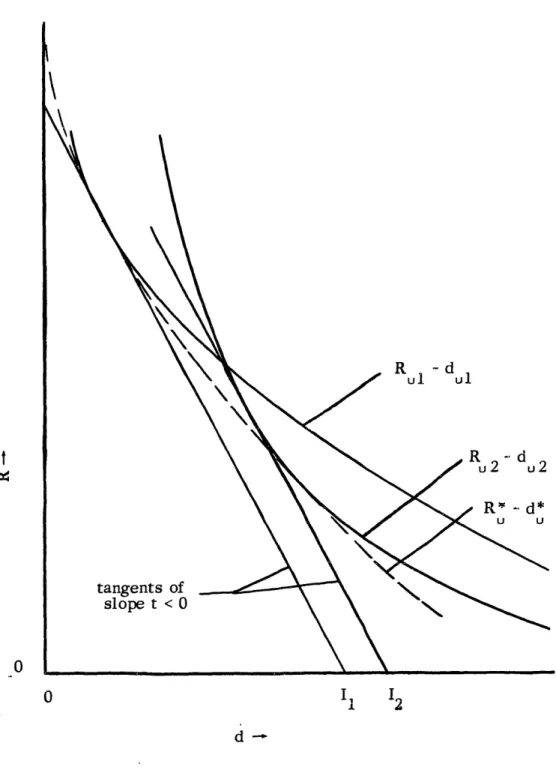
Fig. 1. 1 An example of a simple source encoder and decoder. 3 1. 2 A block diagram of the communication system studied in this work. 6 2. 1 The lower envelope of all R -d curves may be determined by finding
the smallest intercept I of all tuangents of the same slope of the
R -d curves. 20
U u
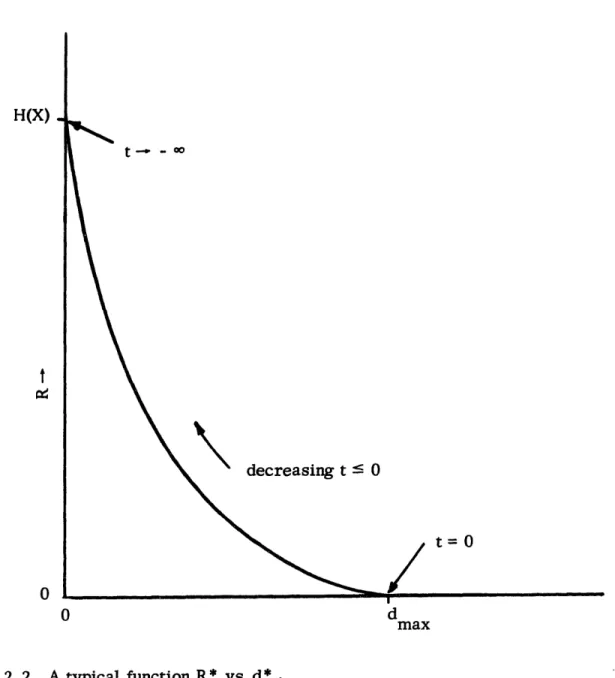
2.2 A typical function R* vs d*. 27
U u
2.3 The function F.(z) for a code word v. of composition n (y), showing
1 1 C
some of the u E wi, Zo, z', and D . 32
2.4 The test channel. 43
2. 5 The rate-distortion function for an asymmetric binary source showing
the optimum f(x) and P (y). 48
2. 6 A rate-distortion function with a discontinuity in slope and a straight
line segment. 50
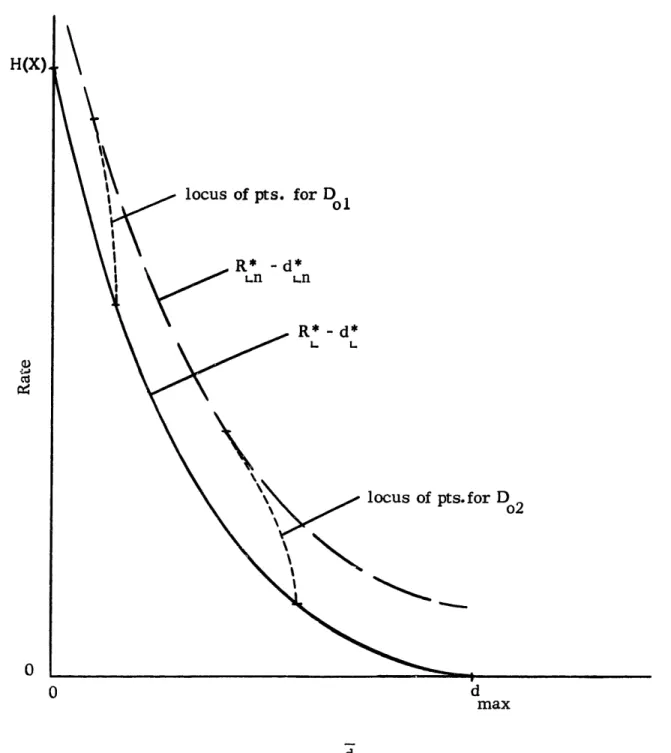
3. 1 Convergence of points on R* - d* to R*- d*. 63
Ln Ln L L
4. 1 The rate-distortion function R(d) for the binary symmetric source with Hamming distance as the distortion measure, and a
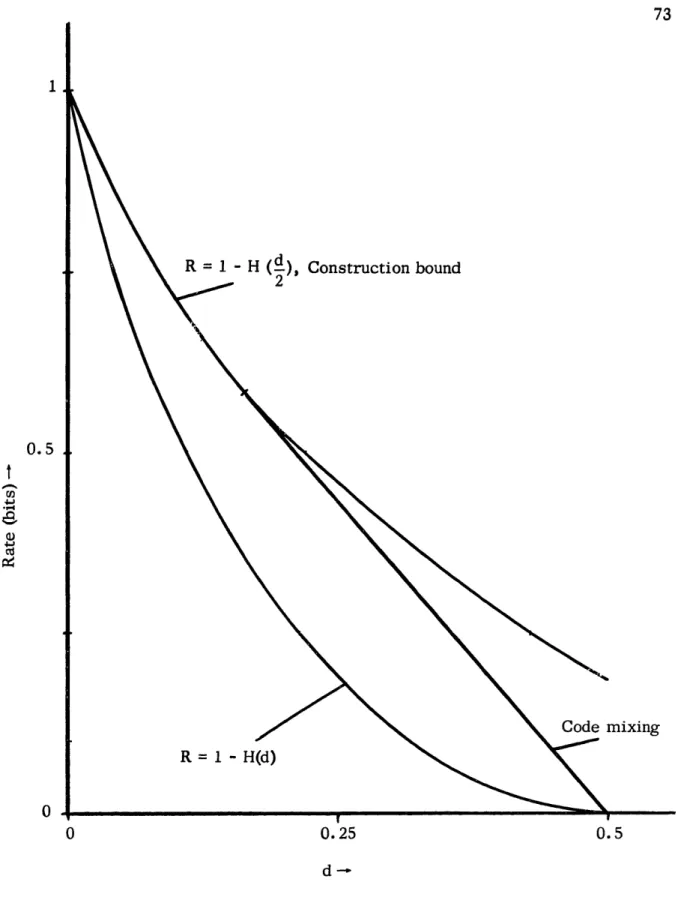
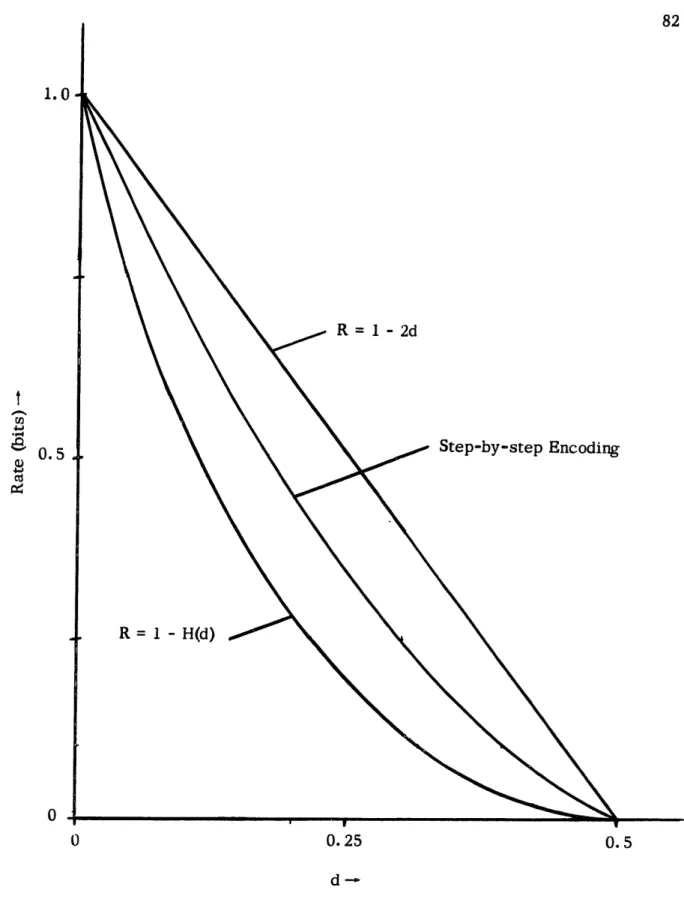
construc-tion bound on average distorconstruc-tion for binary group codes. 73 4.2 Comparison of R(d) and the upper bound on average distortion for
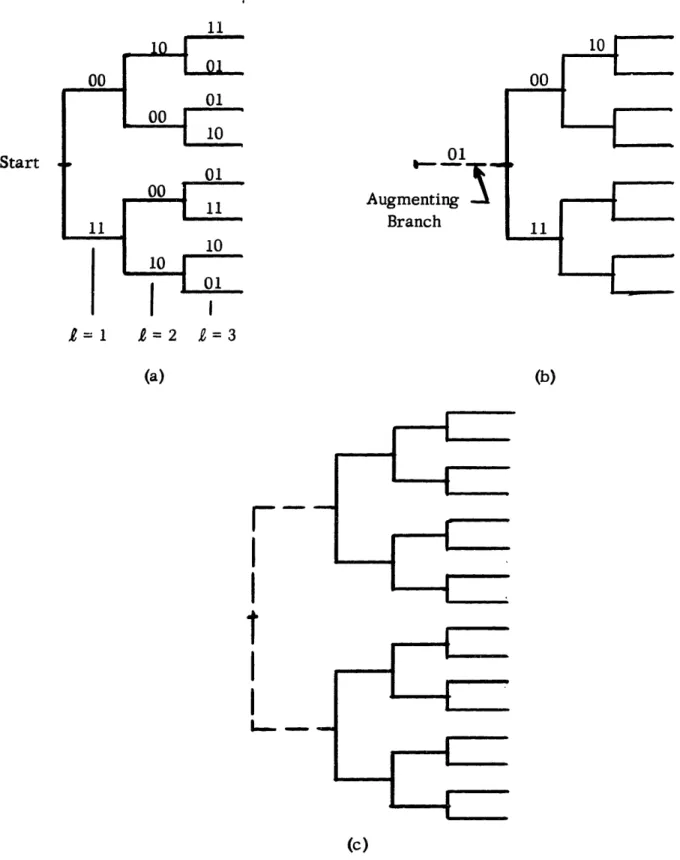
step-by-step encoding with codes of length 20. 82 4.3 (a) Binary tree code of length 3
(b) Augmented binary tree of length 4
(c) Tree code of length 4 formed from two independent augmented
trees of length 4. 84
4.4
The function pI(w) for a tree code,
.= 25, 100. Also included for
w comparison is the function p,(w) for a block code, 2 = 100.
Fig. 4.5 Accept thresholds 2Wd* and reject threshols B that give good results. The broken line is the locus of P (w) - 10 192.
5. 1 Line diagram showing equivalent source and output letters. 98 5.2 (a) Line diagram of a 3-letter source.
(b) Acceptable encoder of length 2 with 3 code words. 98
5.3 A typical R(D) function. 107
(a)
5.4 A source with iWde information available to both encoder and
decoder, and only at the decoder. 109
6. 1 Block diagram showing a sink with a fixed input device. 125 6. 2 A typical rate-distortion surface R(dl, d2). 128
CHAPTER I INTRODUCTION
In many communication systems it is required that messages be transmitted to a receiver with extremely high reliability. For this reason there has been a great effort to put into practice Shannon's theorems on coding information for error-free communication through noisy channels.
There are also many communication systems in which not exact but merely approximate transmission of messages is required. For example, it is certainly not necessary to transmit television pictures to viewers without any errors. Let us con-sider a communication system to transmit television pictures across the country. It is impossible to transmit pictures over a distance of several thousand miles in the same form of an amplitude modulated carrier for local transmission to viewers because the cumulative effect of the noise along the entire transmission system would produce objectionable picture quality. Therefore, for cross-country transmission, a picture is divided into a large number of discrete picture cells or elements, and the light intensities
of these picture elements are coarsely quantized into discrete levels. This discrete representation of a picture (the encoded picture) is then transmitted without error from one relay station to the next across the country. In order to reduce the transmission capacity requirements to transmit the encoded version of a picture without error, the number of quantum levels for encoding the picture element intensities may be reduced.
I
However, it is clear that there is a trade-off between the required transmission capacity and the distortion introduced into the picture by the quantization. If the quantization is
made too coarse, the resulting distortion will render the encoded version of the picture objectionable even when the actual transmission of the encoded picture is done without error. We may conclude that such a system requires a certain minimum amount of information to be transmitted in order to maintain acceptable picture quality.
This work is concerned with a much simpler, abstract problem than the television example. We shall confine ourselves to the consideration of a discrete information
source which chooses letters x from a finite alphabet X independently with probability P(x). The output of the source, a sequence of letters, is to be transmitted over a
channel and reproduced, perhaps only approximately, at a receiving point. We are given a distortion measure d(xy) - 0, which defines the distortion (or cost) when source letter x is reproduced at the receiver as letter y of the output alphabet Y. The Y alphabet may be identical to the X alphabet, or it may be an enlarged alphabet which includes special symbols for unknown or partly known letters.
Consider another example in which we have a source which chooses integers from 0 to 10 inclusive, independently and with equal probability. Suppose we are given the distortion measure d(xy) = x-y I, where the output alphabet is identical to the source alphabet. If we are required to reproduce each letter with no more than one unit of distortion, we find that we need to use only four output letters to represent the source output well enough to satisfy this requirement on distortion. We therefore need a transmission channel capable of sending any one of four integers without error to the decoder. (See Figure 1.1) 'The decoder is a device which merely looks up the output
Encoder Decoder vow 2 3 Source 4 -l Alphabet 5 6 7 IIT. 8 9 IV
10
Noiseless channel II 4 Decoder Output IlI _ 7 IV 9Figure 1. 1 An example of a simple source encoder and decoder.
S
letter that a received integer corresponds to, and this output letter is the facsimile of the source output. If we were required to reproduce each source letter with zero distortion, we would require a channel capable of sending any one of eleven integers to the decoder without error. It is clear from this example that a specification of the tolerable distortion implies a certain minimum required transmission capacity for this type of source encoding. A different type of specification on the tolerable distortion, such as average distortion per letter of one unit or less, would lead to a different minimum required transmission capacity between source and receiver.We wish to consider a more general type of source encoder which maps blocks of n source letters into a set of M blocks of n output letters called code words. When the source produces a block of n letters, the encoder maps this block into one of the M code words, say the jth one. The output of the encoder is then the integer j, and this
is transmitted without error over a channel to the decoder. The decoder output is the jth code word, which is a sequence of output letters. The combination of the source and encoder resembles a new source which selects one of M integers to be transmitted to the decoder. A channel which is capable of sending any one of M integers to the decoder without error is needed, and in view of this we define the transmission rate per source letter for an encoder as
1
R = - log M.
n
We wish to find encoders which minimize M for a given block length n while satisfying a given specification on the tolerable level of distortion.
Throughout this work we will assume that the transmission channel introduces no errors in sending the encoder output to the decoder. Error free transmission from encoder to decoder may actually involve a noisy channel with its own coding and
decoding equipment to give the required reliability. We make the assumption of an error free transmission channel in order to keep the source encoding problem separate from the problem of combating channel noise.
There are obviously many ways in which the tolerable level of distortion could be specified. In the example of Fig. 1. 1, we required that each source letter be reproduced at the receiver with no more than D units of distortion. Another widely applicable fidelity criterion is the average distortion per letter. Furthermore, this fidelity criterion is mathematically more tractable than that used in the example of Fig. 1. 1, and a much more interesting theoretical development can be achieved. The majority of this research, therefore, deals with the fidelity criterion of average distor--tlon per letter.
When a block of source letters u = x x2 . .. xn is encoded, transmitted, and
reproduced at the receiver as the block of output letters v = yl y2 " yn, the average distortion per letter is
n
d(uv) = n d(xi y ).
i=]
The noiseless channel assumption allows the transmission channel to be represented as a fixed transformation, and since an encoder and decoder are fixed transformations, the combination of an encoder, transmission channel, and decoder may be represented simply as a transformation T(u) defined on all possible blocks of n source letters. The T(u) are actually blocks of n output letters, and we may write the average distortion for our communication system as
d=
5
P(u) d(u,T(u)) ,where P(u) is the probability that the source produces the block of letters u. To
minimize the average distortion of the system for a particular set of M code words, the encoder should map each block of source letters into the code word which gives the smallest average distortion per letter with the source block. The operation of the source encoder is very similar to the operation of a noisy channel decoder, which must map a channel output sequence into the code word which gives the lowest probability of error. The source decoder is also seen to be analogous to the channel encoder. From our experience with channel coding and decoding, we expect that the source encoder will be a far more complex device than the source decoder. A block diagram of the communication system that we study in this work is shown in Figure 1.2.
I
I
0 C* r-0 C-o c:0 "-I O ,.a c1 L.:: - - .The concept of a fidelity criterion is basic to the information theory. The information rate of an amplitude continuous source is undefined unless a tolerable level of distortion according to some distortion measure is specified, since exact transmission of the output of a continuous source to a receiver would require an infinite information capacity. This is somewhat analogous to the problem of finding the channel capacity
of an additive gaussian-channel which is undefined until one puts constraints on the signals that the transmitter may use.
The fundamental work on the encoding of a discrete information sourch with a distortion measure was done by Shannon. (15) He showed that the constraint that the average distortion per letter be no more than a certain amount, say d*, led to a unique definition of the equivalent information rate R(d*) of the source. The rate-distortion
p
function, R(d*), was defined by Shannon as follows. Given the set of source probabilities P(x), and a distortion measure d(xy), we can take an arbitrary assignment of transition probabilities q(ylx), (q(ylx) O0, q (ylx) = 1 ), and calculate the quantitiesd (q(ylx)) = P(x) q (ylx) d(xy)
xY
R(q(ylx) ) = P(x) q (ylx) log q(yIx)
X, Y ZP(x') q(yfx')
X
The rate-distortion function R(d*) is defined as the minimum value of R(q (ylx)) under the variation of the q(ylx) subject to their probability constraints and subject to the constraint that d(q(ylx)) 5 d*. The use of a test channel q(ylx) with the source to define R(d*) is similar to the use of a test source with a channel to define channel capacity.
8 The test channel is adjusted to minimize the average mutual information of the source-test channel combination while the average distortion is kept equal to or less than d*, when transmitting the source output directly throagh the test channel.
The significance of the function R(d*) is explained by the following powerful results. Shannon showed that there are no encoding schemes with rate less than R(d*) which give average distortion per letter d* or less, but there are encoding schemes which give average distortion per letter d* with rates arbitrarily close to but greater than R(d*). These results justify the interpretation of R(d*) as the equivalent information rate of the source.
This research is largely an elaboration of Shannon's fundamental work. Of special interest were the problems involved in putting the theory of source coding into practice.
The first results derived are upper and lower bounds on average distortion for block codes of fixed rate and block length n. The asymptotic form of the upper bound on average distortion as n-, o leads to the parametric functions R (t) and d (t), t 5 0,
u Lu
which have the following significance. For a given t 5 0, there exist block codes with rates R (t) + E, E > 0, which give average distortion d*(t) or less. Convergence of the upper bound on average distortion to its limiting value is as a negative power of n, as
n-o.
The asymptotic form of the lower bound on average distortion as n- *o leads to the parametric functions R (t) and d (t), t S 0, which are interpreted as follows. For a
L L
given t 5 0, there exist no block codes with rate less than R (t) for which the average distortion is less than d (t). Convergence of the lower bound to its limiting form is found from an asymptotic series and the limiting value of the bound is also approached as a negative power of n, as n- -o.
p
The asymptotic form of the upper and lower bounds may be optimized to yield asymptotic bounds on the average distortion for optimum block codes. We show that this optimization yields R,(t) = R (t) = R*(t) and d (t)= d (t) = d*(t), for all t - 0. WeU L U L
have therefore shown that, for a given t 5 0, there are no block codes with rate less than R*(t) for which the average distortion is less than d*(t), and there are block codes with rate R*(t) + E, E > 0, for which the average distortion is d*(t) or less. The
parametric functions R*(t) and d*(t), t 5 0, thus have exactly the same significance as Shannon's rate-distortion function R(d*). We find that R*(t) and d*(t), t 5 0, may be calculated explicitly by solving two sets of linear equations. Although we did not use a test channel in bounding the average distortion for block codes, the expression for R*(t) is interpreted as the average mutual information of a channel Q(ylx), where Q(yjx)
p
depends on P(x), d(xy), and t. The expression for d*(t) is also interpreted as the average distortion when the source output is transmitted directly through this test channel Q(ylx). Thus we have also found an explicit description of Shannon's test channel. These results are presented in Chapters 2 and 3.In Chapter 4, the general problem of analyzing block codes with algebraic structure for sources is discussed briefly. The remainder of the chapter treats the binary symmetric, independent letter source with Hamming distance as the distortion measure. We show the existence of group codes which satisfy the upper bound on average distortion for optimum block codes. We also study the use of group codes and tree codes together with sequential encoding schemes as a means of reducing encoder complexity. The sequential encoding of group codes is simple to instrument, but yields a weak upper bound on average distortion. The sequential encoding of binary tree codes
appears to yield the optimum average distortion, but the complexity required to do so is very great.
Chapter 5 presents three separate topics, the first of which deals with the fidelity criterion mentioned above on maximum allowable distortion per letter. The analysis of source coding problems with this fidelity criterion is quite similar to the treatment of the zero error capacity of channels by Shannon( 13 ) . The second topic treats sources with side information available at the decoder, and this problem is seen to be similar to the problem of a channel with side information available at the
(14) transmitter
Finally, a partial ordering of sources is defined but only for a fidelity criterion of geometric mean fidelity. Given the measure of fidelity p(xy) between letters of the source and output alphabets, the geometric mean fidelity (g. m. f.) that is produced when the source sequence u = xl x2 ... xn is reproduced as the output sequence v = yly
2 ... Yn
is defined as
g. m.f. (uv) = p(xYi ) n. i=1
The partial ordering of sources has roughly the same significance as does Shannon's partial ordering of channels( 1 6), with the important exception that the geometric mean distortion seems to be much less practical as a fidelity criterion. A simple partial ordering for arithmetic average distortion as fidelity criterion could not be found. All of the topics in Chapter 5 serve to emphasize the dual nature of the problems of channel coding and source coding with a distortion measure.
We present some general remarks on this research in Chapter 6 and also several interesting directions in which to extend the theory.
11
CHAPTER II
BLOCK CODES FOR INDEPENDENT LETTER SOURCES 2. 1 Introduction
The main concern of this chapter will be the theoretical performance of block codes for reducing the equivalent information rate of an independent letter source at the expense of introducing distortion.
We restate the source encoding problem in order to introduce some notation. The information source selects letters independently from a finite alphabet X according to the probability distribution P(x), x e X. There is another finite alphabet Y, called the output alphabet, which is used to encode or represent the source output. We call a block or sequence of n source letters a source word and a block of n output letters an output word. An encoder is defined as a mapping of the space U of all possible source words into a subset V* of the space V of all possible output words. The subset V*, called a block code of length n or just a block code, consists of M output words called code words. When the sourceproduces a particular sequence u E U, the encoder output is the code word which is the image of u in the mapping.
The encoder may be specified by a block code and a partitioning of the space U into M disjoint subsets w, w , . . ,wM . Each subset w. consists of all those source
1 2M 1
words u that are mapped into the code word v. E V*. Every u sequence is in some
1
The distortion measure d(xy) - 0 defines the amount of distortion introduced when some letter x is mapped by the encoder into the output letter y. When the sequence U= 1 . n , 1 i E X2 is mapped by the encoder into the sequence v = 17 17. .
". 7n 7i ~ Y, the distortion is defined by
n
d(uv)= n Z d(i7i). (2.1)
= 1
For any block code and a partitioning of the source space U, there is a definite average distortion (per letter) which is given by
M
d= C P(u) d(uvi). (2.2)
i= 1 w.
1
P(u) is the probability that the source produces the sequence u, and for an independent letter source, this is given by
n
P(u) = P(i) i EX . i=l 1
The output of the encoder must be transmitted to the information user or sink. The output sequences themselves need not be transmitted if the block code is known in advance. For instance, the binary representation of the integers from 1 to M could be sent over a channel. At the output of the channel the binary numbers could be converted back to code words, giving the sink an approximation to the actual source output. It would take log M binary digits to represent n source letters in this scheme. In view of
1
this, we define the information rate for a block code as R = - log M nats per letter. n
(All logarithms are to the base e unless otherwise specified.)
13
p
Throughout this work we will make the important assumption that there are no errors introduced by the transmission channel. We thereby restrict ourselves to theproblem of mapping a large number of possible source words into a smaller set V* of code words, assuming that the code words are presented directly to the sink. The sink is presented with an approximate representation of the source output but the channel capacity requirements to transmit the data are reduced by encoding.
2.2 The Average Distortion for Randomly Constructed Block Codes
We will study an ensemble of randomly constructed block codes in order to prove the existence of block codes with rate R that guarantee a certain average distortion d.
The random code construction is as follows. We choose at random M code words of length n, each letter of each word being chosen independently according to a probability distribution P (y), y
c
E Y. Each output word v has probabilityn ic ici
i=l
of being chosen as a particular code word of a random block code. According to this system, the same code word may appear more than once in a block code. Each block code of the set of all possible block codes of length n with M code words has a certain probability of being selected. An ensemble of block codes is then completely specified by M, n, and P (y).
c
Given a particular set of code words, we define a partitioning of the space U which minimizes the average distortion. We put u E w. if and only if
1
d(uv.)-5d(uv.), j= 1, . . . , M. (2.3)
14 If for a particular u there are several values of i which satisfy Eq. 2.3, then we put u in the subset denoted by the lowest integer. Each block code now has a definite
probability of being chosen and a definite average distortion when used with the source P(x) and distortion measure d(xy). We now derive an upper bound to the average over the ensemble of codes of all the average distortions of the individual codes, the
weighting being the probability of choosing the individual codes. We can conclude that there exists a block code with at least as low an average distortion as that for the whole ensemble, and hence there exists a code satisfying our upper bound on average
distortion over the ensemble.
Denote the number of letters in the X and Y alphabets by a and b respectively. Theorem 2. 1. Consider the ensemble of block codes consisting of M code words of length n with letters chosen independently according to Pc(y). The average distortion over this ensemble of codes, when used with a source P(x) and a distortion measure d(xy) 2- 0, satisfies
A21/a
a-1/4 exp (-n /2 21) a 2I 22q exp(-n /2 ) d y'(t)+n +y'(0) -- (2 n (2r)"z nli 4
3 log n 93 a + 2.23
-1 4 n-1 4]
e-(M- 1) K(n) exp - n [ty'(t) - y(t) + n + ItIn ]
+e
(2.4)
for any t ` 0.
,
Yx(t) = log yPc(y) etd(x
variables with probability P(x), have mean values y(t) and y'(t), and v and o, respectively.,
l
and Pz3 are third absolutevariances 1
moments of yx(t) and y'x(t), respectively. 'y indicates summation only
over letters y E Y for which P (y) > 0.
C
_a(b-1) ab tI xy-1] y
2 2
K(n) = (2 7rn) e
where Q(y x) = P (y) etd(xy)- y(t) A = max d(xy)
C XY
The proof of this theorem is rather involved and has been relegated to Appendix A. It should be pointed out that an upper bound to d could actually be computed for finite n from Eq. 2.4. However, the main use of this theorem will be to study the upper bound on d for an ensemble of block codes as the block length n gets very large. The only term of Eq. 2.4 that does not clearly vanish in the limit as n - 00 is the very last term in the brackets, which depends upon M. In this term, K(n) is an unimportant function of n whereas the exponential in the first exponent is all important since
ty'(t) --y(t) 2 0. Substitute M = enR and notice that as n - ýo we must have the first exponent
K(n) (enR-1) exp(-n [ty'(t) --y(t)+ 1 +
It
In ])--1/4to drive this whole term to zero. This can be accomplished if we set R >ty'(t) -y(t)- -0 because as n -- o
enR-n(ty'(t) - y(t))
will then be increasing exponentially with n;, overcoming the algebraic functions of n in K(n). The bound on-f then becomes, as n - oo
16 d -y'(t)
The above discussion proves the following theorem.
Theorem 2. 2. There exist block codes with rate R > ty'(t) -y(t), t 5 0, that give average distortion d 5 y'(t).
We will now put the constraints on R and d of theorem 2. 2 in a more useful form. From the definitions of yx(t), y(t), y'x(t), y'(t) in theorem 2.
v(t) = X y'(t) = X P(x)
yx(t)
=Z
P(x) log 1 we can write P (y) etd(xy)d(xy) P(x) Pc(y) etd(xy)
P(x)
yx(t)=
XY
Pc(y) etd (x
y ) Y
It is convenient to define the tilted conditional probability distribution
Q(yrIx)
=Pc(y) etd(xy)
EPc(y) etd(xy)
Y
with which Eq. 2. 5b (together with Eq. A. 6) becomes
du y'(t) =
Q(yI x) P(x) d(xy)
.XY Directl y from Eq. 2.6 we get
Q(ylx) log P)
C
= td(xy) - In P (y)c etd(xy)
= td(xy) - yx(t) . (2. 5a) (2.5b) (2. 6) (2.7) (2. 8)
Combining Eqs. 2 .5a, 2. 5b, 2. 6, and 2. 8 we can define R as u
R u = ty'(t) - y(t) = (yIx) P(x) (td(xy) - yx(t))
XY
=
Z
Q(yAx) P(x)log Q(YlX)XY Pc( y
(2.9)
Fano(4 ) has shown (on pages 46-47) that ZyQ(YI x) log (Q(yl x) / Pc(y) ) 2 0 so that w have Ru - 0.
The expression in Eq. 2.9 for Ru rdsembles the expression for the average mutual information I (X; Y) of a channel Q(yj x) dkiven by the source P(x). However, Eq. 2. 9 is not exactly an average mutual information because the channel output probabilities are L.Q(yj x) P(x) which do not in general match P (y). The expression for du in Eq. 2.7 resembles the average distortion for a source-channel combination.
The interpretation of Q(yJ x) as a channel will be used again later.
Ruand du are related parametrically through the variable t. We may think of d as the independent variable and t as the intermediate variable when we write
R = td - y(t) u u (2.
The derivative of the curve of R vs du is then (see Hildebrand( 8 ) pages 348-351)
U U
dR aR
u u dt
dd = t at dd
u u
but from Eq. 2. 10,
aR
t - du - ,'(t)
8t
which is zero from Eq. 2.7 because of the way t is related to d . The R vs d curve
u u U
has slope t - 0.
i
10)
We can show the convexity of the R vs d curve for fixed P (y) as follows. U U C u 8
(•
u\
dt 1 1 dd t d dd - dd y"(t) U U U U dt From Eq. 2.7y"'(t) = P(x) d(xy)
-
Q(yjx)= P(x)
[y
Q(ylx) d (xy)
-
Q(y
x)d(xy
)2j
X
Y
We may interpret the qhntity inside the square brackets as the variance of a random variable, and y"(t) is an average of variances, therefore y"(0) 2 0. We have shown that for fixed P (y),
c
I
d'Rd u 1 --- -. = (2. 11) ddZ y"(t) ddSince U = y"(t) - 0-, d is a monotone function as t decreases and this fact
dt u
together with Eq. 2. 11 show that R vs d is convex downward.
u u
2.3 Optimization of the Upper Bound on Average Distortion
For each probability distribution P (y) we have an ensemble of block codes and c
an R vs d curve. From Theorem 2. 2 it is clear that we want to find the ensemble
u u
of codes which gives the lowest value of R for a fixed d u U . From another viewpoint, we want to find the lower envelope of all R vs d curves.
u u
From Eq. 2. 10 we see that if there was no parametric relation between t and d
U
such as Eq. 2.7, fixing t would give R as a linear function of d for any particular P (y).
u u c
This straight line in the R - d plane is the tangent to the R vs d curve corresponding to the P (y) at the point at which Eq. 2.7 is satisfied for the fixed t. The slope of this
c
straight line is t (from Eq. 2. 10) and its d-axis intercept is y(t) / t, t < 0. Because of the convexity of the R vs d curves, we can find a point on the lower envelope of all
u u
Ru vs d curves by finding the P (y) which gives the minimum d-axis intercept. (See
U U c
Figure 2.1.)
Let us define the lower envelope of all R vs d curves as the curve R* vs d*
u U U U
We attempt now to find the ensemble P (y) which for fixed t gives the minimum d-axis c
intercept. First, we show that for fixed t < 0, the intercept I(P(y) )= = - (t)
Iti
is a convex downward function of the P (y). Consider two different probability vectors c
P (y) and P (y) and denote
ci c2
(1) (t)log 2 P (y) etd(xy)
c3 c l 2
Y(2)(t)
x
log P (y) etd(xy)c3
YSince log x is a concave downward function of X, we use the concave inequality from Hardy(7 ) (theorem 98, page 80). For any x E X,
i
0
0 I1 I1
01 2
d-Figure 2. 1. The lower envelope of all RU - d curves may be determined by finding
the smallest intercept I of all tangents of same the slope of the R -d
the smallest intercept I of all tangents of the same slope of the R -d curves.
u u
I
y(3)(t)
X
(1)(t)-t
i
-
Ittl
(2)
(1-x)
It[
(t)therefore, for 0 5X 5 1,
I(X Pcl (y ) + (-) P2 y) I(Pl(y) ) + (d- a) I(Pc2(y) )
and the intercept I as a function of the P (y) is a convex downward function.
C
We now seek to minimize I = y(t)/t straints P (y) 0, PP(y) = 1. Firs
c Y
for fixed t by varying the P (y) under the con-c
3t we find a stationary point of I with respect to the P (y) while constraining the sum of the P (y).
c c
a
y(t)
t Yy P (y)c
= 0, t < 0.
Using Eq. 2. 5a this becomes
etd(xyk)
P(x)
P (y) et d ( x y ) Y
+ =0. (2.13)
Multiplying this last equation by t Pc(Yk ) gives
P(x)
X Q(yk/x) = - t Pc(yk) (2.14)
where we have used Eq. 2. 6. We have a stationary point of I if we can find P (y), all c
y E Y, which satisfy Eq. 2. 14. It is convenient to define the probability distribution
Q(y) =
x
Q
(y Ix) P(x).
(2. 15)
If we now choose p = - I/t we see that Eq. 2. 14 becomes Q(y) = P (y), all y Y
c For t < 0,
(2.12)
22 and this value of.I then implies that the P (y) satisfy the constraint on their sum.
C
However, we can not guarantee that the P (y) which satisfy Eqs. 2. 16 will be non-c
negative.
It is convenient to denote
gx(t)== ebx(t ) Pc(y) td(xy) (2. 17)
Y
The Eqs. 2. 16 imply that in order to calculate the optimum P (y), we may first solve
cc
-1 -1
forg,( (t) the following set of equations which are linear in g (t).
P td(xy) -1
Pc(y) etd(xy) gx(t), x E X (2.19)
which are linear in P (y). These operations are easy to perform with the aid of modern c
computers. However, we may notice that P(x), d(xy) and t may be such that one or
1 1
more of the g (t) satisfying the Eqs. 2. 18 are negative or zero. A (t) that is zero implies that the Eqs. 2. 19 are meaningless and we cannot get a solution for P (y). A
. c
negative gx(t) implies a negative Pc(y), but more important, since y(t)= CXP(x) log g (t), we find that the solution for P (y) leads to imaginary values of R and d', again a
C -1
There are such P(x), d(xy), t - 0 such that g (t) < 0 for some x. For example, con-sider the ternary source with letter probabilities all 1/3, set t = -1, and take
log 1. 5 log 6
d = log 2 0 log 2
meaningless situation. We can conclude that there are situations in which one does not have any meaningful solution to Eqs. 2. 16 for a range of t < 0. This can be inter-preted as an Rý vs d* curve with discontingities in its derivative dR */dd* , since the slope of R1 vs d* is given by t (by construction).
Finally, it should be obvious that there may be situations in which all the
-1
gx (t) > 0 and we still get from the Eqs. 2. 19 a negative Pc(y). We have shown that I is a convex downward function of the b arguments P (y) (b letters y E Y). We constrain
c
the Pc($), considered as points in b-dimensional Euclidian space, to vary within a region of the (b-1)-dimensional hyperplane Zy Pc(y) = 1. The boundary of the acceptable region of points P (y) are the hyperplanes P (y) = 0, all y E Y. If the absolute minimum
c c
of I lies outside this region, the solution to Eqs. 2. 16 may have one or more negative probabilities P (y). We can still find a minimum of I along a hyperplane boundary of
c
the acceptable region by setting some P (y) = 0 and minimizing I again by solving the set of Eqs. 2. 16. The fact that such a further constraint on P (y) still leads to a
c minimum of I is guaranteed by the convexity of I.
The special case of t = 0 must be treated separately. We wish to find a minimum of
lim y(t)
t-'O t
Since y(O) = 0 (from Eq. 2. 5a), we may write lim y(t) lim y(t) - y(O)
- - =y'(0)
and so we wish to minimize y'(0) with respect to the P (y).
C
= min
P (y) XY
c
and the solution to Eq, 2. 20 for which
From Eq. 2.5b P(x) Pc(y) d(xy)
c
Zp(y)= 1 is the choice of 1 for yO
cP
(y) =0
otherwise where y is such thatd
max=
P(x) d(xy) =rmin
yP(x) d(xy) )
From Eq. 2.6,
lim Q(ylx) = Pc(y)
A. c
so that Q(y Ix) / P (y)c = 1 and from Eq. 2. 9 we see that this implies R* = 0 for this U
case. (2.22)
It will be helpful to put our results on the optimum upper bound on average distortion in a form which will allow comparison with later results on a lower bound. If we defirn the function f (x) as
o
fto (x) =g(t)
we may re-write Eqs. 2.20 as a linear set in ft (x), i.e.,
P(x) et d (x y ) ft(x) = O 1, yE Y. (2.22)
The optimum P (y) can then be found as the solution to the set of linear equationsc
= f-t (x), xE X. 0 min y'(0)
P (y)
c (2.20) (2.21)YP(y) e
td(xy)
y
(2.23)25 For the optimum ensemble of codes, we may interpret the Q(y
Ix)
as a channel driven by the source P(x), with output probabilities E Q(y I x) P(x) = Q(y) = Pc(y). We can find the dual set of transition probabilities Q(xj y) which speclfyi this channel asQ(xly)-
Q(y1
x) P(x)
P(x) e
t d (xy)ft (x)
P
(y)Y
td(xy)ft
c) P(x) etdy) f 0(x) X = P(x) etd(xy) ft (x), (2. 24) 0where we have used Eq. 2. 22. From Eq. 2. 24 we find the useful relation
Q(xIy) =
Q(yx)
(2.25)P(x) P (y)c
so that we may re-write Eqs. 2.7 and 2. 9 for the optimum P (y) as c
R*(t) = xY P (y) In y)P(y))_ Q(x (2. 26)
a c P(x)
d'(t) = Q(x y) P (y) d(xy) , t5 0. (2.27)
XY
We see that the R*(t) - d*(t) function is defined by Eqs. 2.26 and 2.27 and by the sets of Equations 2. 22 and 2. 23.
Theorem 2.3 For any t - 0 and any E > 0, there exist block codes with rate R = R*(t) + E and average distortion at least as low as d*(t). *
u u
The Q(y[ x) may be interpreted as a channel whose transition probabilities depend on P(x), d(xy), and t. R* is the average mutual information of the channel
U
Q(yl x) when driven by the source P(x), and d* is the average distortion from this
source-U
channel combination.
Shannon (1) showed that any channel with input and output alphabets X and Y, respectively, could be used as a test channel to prove a coding theorem for a source with a distortion measure. His coding theorem states that there exist block codes with rate arbitrarily close to but greater than the average mutual information of the source-test channel combination with average distortion equal to that calculated for the source-channel combination. J. L. Kelly (9) used this approach to prove a coding theorem for amplitude-continuous sources by using a continuous channel. Our work here obtains a coding theorem for sources without using such a test channel, but the resulting expressions involve a fictitious channel Q(ylx). Moreover, we only have a strict channel interpretation after optimization pf the upper bound on average distortion with respect to the code ensemble P (y).
c
As a special example, suppose we have a distortion measure with the property that for every x E X there is one and only one y = yx such that d(xYx) = 0. There is only one way to represent the source output exactly (zero distortion) in this case. Since, from Eq. 2.6
lim Q(yx) = 6.
t --0 -x
we have for this case
lim du*(t) = P(x) 6 d(xy) 0.
t- '0 XY Y' Yx Also
Z
6 log 6 = 0 so SY'Y YxYx lim R *(t) = P(x) log P H(X) t-- 00 Xwhere H(X) is the well-known source entropy. From Eq. 2.21 we see that for t = 0,
d*(0)= d , , and from.Eq. 2,22,
ua max
R*(0) = 0.
U
In general, R*(--)' ='0 if and only if each source letter x C X has some output letter y
u
such that d(xy) = 0. A typical R* (t) - d* (t) function is shown in Figure 2. 2.
U U H(X)
t
12
0 d maxFigure 2.2 A typical function R* vs d*.U U
2,4 Lower pound to Average Distortion for Fixed Composition Block Codes
We have demonstrated the existence of block codes that guarantee a certain average distortion. Now we seek a lower bound to average distortion applicable to all block codes, so that we may compare the performance of our randomly constructed codes to the best possible block codes.
First we define a distance function
D(xy) = d(xy) + log f()q) (2.28)
where d(xy) is the distortion measure and f(x) may be any strictly positive function defined on the source alphabet X. The distance between two sequences u and v is defined as
n n
D(uv) = n D(i ) = (d (i i) + log f(.))
Si=1 i= 1
d(uv) + - f(u) (2.29)
n where we have denoted
n
f(u)-
=
f
()
i=1For any output word v of length n we may count the number of times each letter of the Y alphabet appears. We denote by n(Yk) the number of times-letter yk appears in the v sequence and we call the set of integers n(y), y E Y, the composition of v. The composition of a source word u is denoted n(x). The product composition of a pair of sequences u - v is denoted n(xy) and is the number of timesi the letters xk and y. appear in corresponding positions of the u and v sequences. The product composition of a u-v pair is such that
n(xy) = n,, n(xy) = n(y), n(xy) = n(x).
XY
X
Y
For a u-v pair with product composition n(xy) we can write the probability of the source word t as
P(u)
=P(x)n(xy)
=P(x)
fi
P(x)n(x)
(2.30)
XY
X
X
and the distance between the u-v pair is
D(uv) = n(xy) d(xy). (2.31)
XY
We see that for an independent letter source the probability of a source word depends only on the composition of the word. Also, the distance function and distortion measure between sequences depend only on the product composition of a u-v pair.
The distance function D(xy) can be thought of as another distortion measure so that for any block code consisting of the code words vi, i= 1, ... , M and a given
partitioning of the source space U into encoding subsets wi, i=l, ... , M, we may write the average distance for the block code and encoder as
M
D = P(u) d(uvi). (2.32)
i=l w.
Theorem 2.4 Consider a source P(x), distortion measure d(xy) 2 0, and a positive function f(x). Suppose we have a set of M code words of length n and all have the same composition n (y). Let U represent the subset of
c O
source sequences u for which D(uvo) 5 D for any particular sequence v with composition n (y), and D such that U is not empty. Then if M is
p
such thatM S 1 (2.33)
E P(u) U
o
the average distance for the block code satisfies
P(u) D(uv0)
D : (2.34)
uP(u)
o
Proof The proof of this theorem is analogous to R. G. Gallager's (unpublished) proof of a theorem on the lower bound to the probability of error for a memoryless channel.
I
A block code in which all code words have the same composition will be referred to as a fixed composition block code. We proceed to derive a lower bound to the average distance that any block code of fixed composition n (y) could give for any partitioningc
of the source space. For each code word v.
1
, i=l, ... , M, we define the increasingstaircase function F.(z) as follows. List all source sequences u of length n in order of
1
increasing D(uvi) and number the sequences in the i -th ordering uli, u2 , u3i, ... Now define
F.(z)= 0 , z <0
1
Fi (z) = D(uliVi), O 5 z P(ul
1 Iiii
Fi (z) = D(u2ivi), P(Uli) < z P(Uli) + P(u2i
k-I k
F. = D(ul v)7 P(u <z s Pu, .
31
We may visualize every source word u being represented in Fi(z) by a rectangle with height D(uvi) and width P(u). (See Figure 2.3.)
For a given partitioning wi, i=1, ... , M, we can write the average distance as
M 1= 1 where
Di =
P(u) D(uv)
wi
If we shade all rectangles of Fi(z) corresponding to all u sequences in wi, we can
inter-z
i
pret D.as the area of these shaded rectangles. Each D. is lower bounded by1 1
D. f f F.(z) dz , z= P(u). (2.35)
S
1 1 1o W.
We have underbounded D. by the area under F. (z) on the interval 0 -z 5 z.. This
1 1 1
bound may be interpreted as a sequential process of replacing the area of shaded rectangles for the largest D(uvi ) by smaller areas in unshaded portions of F.(z), pre-serving the width measure of the shaded rectangles, until the entire area under F.(z) is shaded out to some z..
1
Define
Z
Oi(z)
=f
F.i(21)
dz'0
where the .i (z) are convex downward, monotone increasing, continuous functions of z.
The main point of the proof hinges on the fact that P(u) and D(uv) depend only on the product composition of the pair u-v and so for code words u1with identical composition
S
N Figure 2.3D(uv
o) Pr(u) Z -.The function Fi(z) for a code word v. of composition n (y), showing some
1 C
z,, z', and DO.
33 n (y), the 0i(z) are all identical and we may drop the subscript i. Note from Eq. 2.35
that
M
i=l
since every source word is in some subset wi. We may now apply the convex inequality (see Hardy(9 ), theorem 86, page 72) to give us
M M
1 1 1(2.36)
5- M q (zi) M ( " zi) = MO ( M) (2.36)
i= 1 i= 1
A lower bound to D for any block code of fixed composition n (y) is achieved if wec assume that we can make all z. = z = 1/M so that
1 O - 1 D. = (-) . D- 1 o F(z) dz (2.37) Z I Z
f
F(z) dz
2-
f
F(z)dz, z'-zo.
(2.38)
o0o oLet us then define z' by
z' = P(u)-5z = (2.39)
U
where Uo is the subset of source words for which D(uvo) - Do . Any Do for which
Hereafter we will use the standard shorthand notation in the definition of sets, e.g.,
Eq. 2.39 is true can be used to define Uo. Hence, if Do is a constant such that SM 1
EP(u)
U 0then from Eqs. 2.37 and 2.38 and the definition of F(z), P(u) D(uv°)
E P(u) U
0
Q.E.D.
This theorem on average distance leads to a lower bound on average distortion for block codes of fixed composition n (y). From Eqs. 2.29, 2.32, and 2.2 we see that
c
M M
=
P(u) d(uv
P(u) d(uv+)+
-
Y
P(u)log f(u)=d + P(x)log f(x)
(2.40)
i=1 w. 1 i=1 w. 1 X
since
n
log f(u)= log f(.i ) , u = (i),
i=1
and this term is entirely independent of the block code. We may now restate Theorem 2.4 in terms of its implications to the average distortion of fixed composition block codes.
Theorem 2. 5 Suppose we have a source P(x), distortion measure d(xy), and any positive function f(x). Any block code with M code words of length n, all having fixed composition n (y), which satisfies
c
M - (2.41)
E P(u)
Uomust have average distortion that satisfies P(u) D(uvo) Uo - P(x)log f(x) (2.42)
SP(u)
X U 0 where U ={u [ D(uvo)D}, 0vo is any output sequence with composition nc(Y),
Do is such that Uo is not empty. *
It is difficult to get bounds on the expressions in Eq. 2. 42 for finite n which will give the correct asymptotic bound on d as n -- ~. These difficulties and methods of
surmounting them are the main concern of Chapter 3. Our present interest is to obtain the correct limiting forms for the constraints on M and d as n - 0.
Let us define the sets
A={ u [ D- 6 s D(uv) D } , 6 >0,
00 0
Uo-A= { uD(uvo) <D o - 6 }
and denote the right hand side of Eq. 2.34 as D . We re-write Eq. 2.34 as
C
P(u) D(uvo) + Z P(u) D(uv)D-D Uo-A 0 A 0 D-D = o SP(ou) U 0
P(u)
(Do - 6 ) (2. 46)p
2 P(u)
U 0For a given vo, nD(uvo) is a sum of independent, non-identical random variables and we may write the distribution function for the random variable D(uv ) as
0
Sf
(X ) = P'[ D(uv)- x ]
so that Eq. 2.43 becomes
D = (D - 6) L o - (D -6) o0 Pn(Do) - n(Do-6)
S(D)
no (1- qn(Do-6) ) n (Do)We may apply Fano's(4) bounds (pages 265 which are as follows.
(2.44)
and 275) on Pn(x )for a given von 0'
K (n) e--nnE(x) (x) - e -nE(X)
1t , t 0, (2.45)
E(X ) = t/•'(t) - p(t) - 0
(2.45a) (t) =- Pc(y) log Z P(x) etD(xy)
Y X
P (y) = nc(
c n
and t is chosen so that
(t)= (t)
'(t) t = mean value of X . (2.46)
K (n) is only algebraic in n and is similar to Eq. 8. 125 of Appendix A. Ap"(t) can be interpreted as an average of variances, so p"(t) - 0, implying '(t) is a continuous monotone increasing function of t which then guarantees that we can always satisfy
S
D
Eq. 2. 46 for some value of t s 0. u'(t) = D % ' '(t ) =Do- 6, 6 >0 then t2<t I-d
Since E(X) = t/"(t) 5 0, for t - 0, E(X) is a continuous, dt
of ts 0 and 0 - E(D 0 - 6) < E(D).
0 O
monotone decreasing function This difference in exponents in the bounds of Eq. 2.45, when applied to Eq. 2.44, overcomes the function K (n) as n--~ and we have
L
n(oD -6)
-" 0.
S(Do
We conclude that for arbitrary 6 > 0, lim
D =D
L0
n, o
-6
Therefore the limiting form of the bound on average distance is, for n- 0o D_ D.
o
Applying Eq. 2.40, the bound on average distortion is, for n - 0o lim
D
-Z
P(x) log f(x)n---,o X
= Do - P(x) log f(x) . (2.47)
X
We can write the constraint on M of Eq. 2.41 more conservatively, using Eq. 2.45, with t chosen so that p"(t) = Do'
*
M en E(Do)
Z
P(u) UoFrom the definition of R we have the constraint on the code rate 1
R= - log M- E(D) .
n o
We summarize the above discussion with the statement of a theorem.
Theorem 2.6 There exist no block codes of fixed composition nc(y) withc rate R -< t '(t) - p(t), t 5 0, that give average distortion
d < '(t) - P(x) log f(x) . X
We now put the constraints on R and d of Theorem 2.6 in a more useful form. From the definition of p(t) in Eq. 2. 45, we proceed (as in Eqs. 2. 6, 2. 7, and 2. 9) to define
R = tp'(t) - p(t)= Q(x Iy) Pc(y) log
XY
d =p'(t) - P(x) log f(x)
X
Q(xly)
P(x)
(2.50)
Q(x (Iy) P (y) d(xy)+ ( Q(x) - P(x) ) log f(x)
P(x) etd(xy) ft(x) Q(x y) = P(x) etd(xy) ft(x) X (2.48) (2.49) = XY where (2. 51) (2.52)
and
(2.53)
Q(x) = rQ(x (y) Pc(y)Y
R resembles the expression for the average mutual information of a channel Q(x
Iy)
driven by the source P (y), but Q(x) and P(x) do not match in general so there is onlyc a resemblance.
For each function f(x) and composition P (y) we have a curve R vs d with R
c L L L
and dL related para:uetrically through t. We may think of d as the independent variable and t as the intermediate variable when we write, from Eqs. 2. 50 and 2. 51,
(2. 54)
R = t (d +)' P(x) log f(x)) - p(t)
LThe derivative of the R vs d curve for fixed f(x) and P (y) is
L L C
-dR
8R
dt
=t + - ---dd ' at dd L Lbut from Eqs. 2.50 and 2.51 we see that t is chosen so that k./ 8 t = O, hence dRL
dd
L
We can show the convexity of
dd R, 8
I1"(t) can be interpreted as an
dZR d d2 I-(2.55) R vs d as follows. L L d R. dt 1 1 ddL) ddL ddL p"(t) dt average of variances so dd,
and ddL - "(t) 0 is a monotone function of t. We conclude that R vs d is a
dt L L
40 continuous, convex downward function of t with continuous slope for fixed f(x) and P (y).
C
2.5 A Lower Bound on Average Distortion for Block Codes
The arbitrary function f(x) may be thought of as a parameter which may be adjusted to optimize the lower bound on average distortion for block codes of fixed composition P (y). Fano(4 ) used such a function in his derivation of both upper and
c
lower bounds on probability of error for discrete, memoryless channels. To get the strongest lower bound to average distortion for a fixed P (y) we should maximize R
c L
with respect to the f(x) while holding d fixed. Using the expression in Eq. 2.54 for RL we obtaint
(aR,.
8R, aR t + R,f(
)
j
akt
f(xf)
+af(x
k)Again, 8RL/at = 0 by choice of t. Using Bqs. 2. 54 and 2.45a,
ORL
(P()
-
Pc(y)
Q(xly)
)
=0.
Ef( k) f()(P(xk) yUsing Eq. 2. 53, we find that we have a stationary point of R for fixed d if we choose f(x) so that
P(x)= Q(x) , all x EX . (2. 56)
We cannot show explicitly that this stationary point of R is a maximum with respect to the f(x), but the Theorem 2. 6 is true for any positive f(x). Let us then assume for the present that for fixed P (y) and each value of t 5 0 we can find a positive f(x) such that
c.
Eq. 2. 56 is satisfied and let us then use this f(x) in the following work. We use Hildebrand's(8)notation of page 350, Eq. 4b.
We now find a lower bound to average distortion for any fixed composition block code by minimizing R with respect to P (y) for fixed d ,
L C L
Pc(y) a 0Y,
YPc(y)= 1
a c cYk)
We solve
R+ X
Y
under the constraints that
P(y) c
)
=for fixed d . Again using
(
8RLa P(yk)
Hildebrand's ( 8 ) notation,Pc
cji(Y),j#k
-z
X
aR
Ld f(x) d f(x)a
f(x)
a Pc (yk) since aR /at = 0. stationary.Also BR /Bf(x) = 0 for all x because the f(x) are chosen to make R We obtain
08RL + A=0
aPc(
k)and from Eqs. 2.54 and 2.45a, P (y) should be chosen so that c
log E
X
P(x) etd (xy )ft(x) = K
where K is a constant independent of y. We may re-write Eq. 2. 57 as
SP(x) etd ( x y ) f(x) = K'
X
(2.58)
but since X Q(x [y) = 1 for any y, we see that Eq. 2.58 together with Eq. 2.52 implies
(2.59) 8R